

Happy rainy Monday.
Below are the most notable stories that came across my inbox this past week…
Federal bikelash: Washington D.C. bike advocates are sounding the alarm that the Trump Administration plans to remove one of the busiest bikeways in the city. (Washington Area Bicyclist Assocation)
Unfair-iffs and the bike industry: One well-known bike brand (Terry Precision) was one of the plaintiffs in the landmark Supreme Court decision that deemed Trump’s tariffs unconstitutional and several other bike companies are already in line for refunds. (Bicycle Retailer & Industry News)
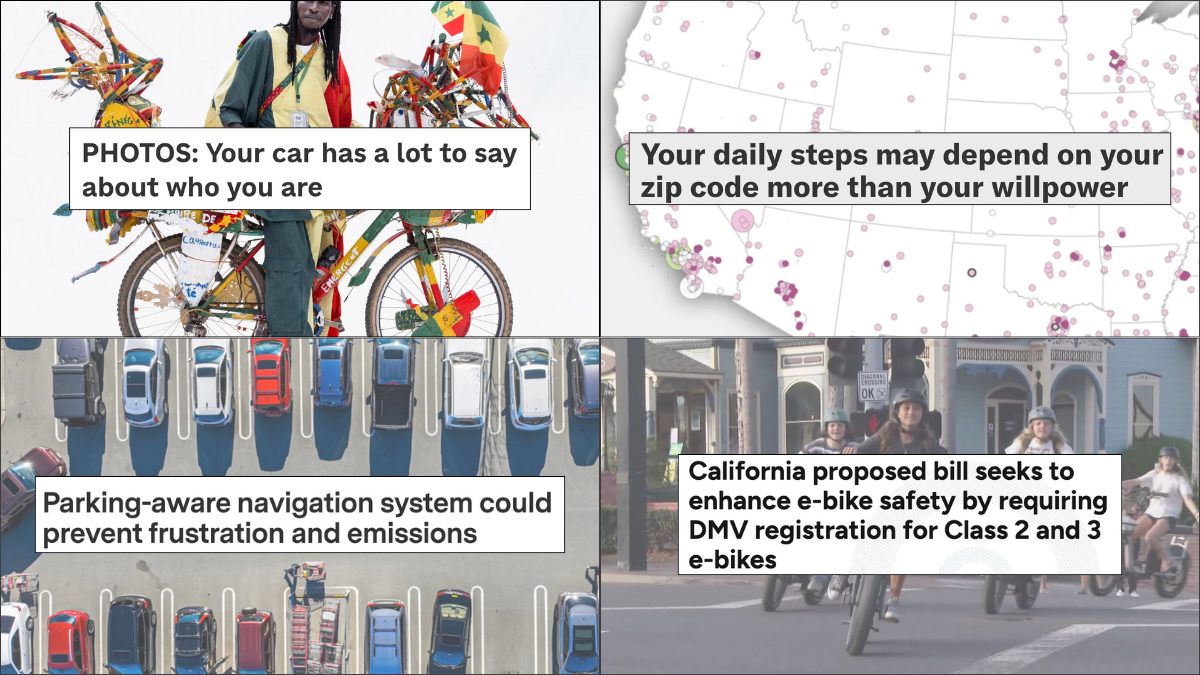
Looking for parking: Scientists and app makers are working hard to to solve the problem of delays due to lack of parking near destinations. If they figure out how to integrate parking availability into navigation apps like Google Maps, they could reduce VMT. (MIT News)
What your vehicle says about you: This very cool photography project includes portraits of people and their cars/bikes/rickshaws with an aim of sharing how the vehicles people use are a reflection of themselves. (NPR)
Truthers: An interesting new initiative set to launch on Bluesky this week bills itself as, “a creative, evidence-based collaboration launched to share the truth and take on disinformation about how to make better cities for people.” (Urban Truth Collective/Bluesky)
More e-bike regulation: The moral panic over e-bikes is spreading as ignorant, paternalistic politicians in California are pushing a law that would require registration and licenses for some types of e-bikes — even though the politician behind the legislation is actually concerned about e-motos. (CBS 8)
Where you live and how you walk: Researchers analyzed the number of daily steps people took after moving between walkable and non-walkable cities to reveal that, “built environments, rather than personal choice alone, might affect not just the amount but the intensity of the exercise their inhabitants get.” (Scientific American)
Video of the Week: Residents of the bustling African city Dakar loves their new express bus service…
Thanks to everyone who sent in links this week. The Monday Roundup is a community effort, so please feel free to send us any great stories you come across.

Thanks for reading.
BikePortland has served this community with independent community journalism since 2005. We rely on subscriptions from readers like you to survive. Your financial support is vital in keeping this valuable resource alive and well.
Please subscribe today to strengthen and expand our work.
One man’s “moral panic” is another’s realization that we face a rapidly growing problem with increasingly powerful motorized vehicles using MUPs and other areas traditionally seen as the realm of human-powered transportation. No, not a problem worse than human driven car mayhem, but a problem nonetheless.
There may not be a good solution, so I suspect we’ll end up with people proposing bad ones that may seem better than doing nothing.
I agree it’s a problem. I also think pointing out the irrational responses and moral panic around “e-bikes” is a problem.
I see no signs of a moral panic. I’m not a supporter of registration, but it’s not a totally batty idea, either. After all, we have a long history of requiring other motor vehicles to be registered.
If the goal is safety, note that registration of heavy motor vehicles weighing a ton, or tons, does not prevent drivers killing tens of thousands of humans every year in the US. Many more are badly injured requiring at least a trip to the ER or maybe a life of continuing disability.
A license plate does not make us safe.
I never claimed it did; I just said it wasn’t batty (or a sign of a “moral panic”). What it does is provide a mechanism to tie an otherwise anonymous rider to a name, which can be useful when things go wrong.
It is a moral panic when the “solutions” are based on emotions and not on data and rational decisions.
By that definition, the bicycling community (or at least those who comment here) is swamped with moral panics.
Why is a proposal to register a new class of motorized vehicles irrational? I can see an argument for ineffective, but irrational?
Having to register class 2 and 3 e-bikes won’t do anything for safety, but it will reduce the number of people biking.
If a registration requirement reduces the number of high speed electric vehicles on MUPs, then that is probably a good thing.
That may actually increase the number of people bicycling even if the number of motorists on those paths declines.
If it increases identification and thus accountability, wouldn’t it also increase safety?
So–ride a class 1 bike or a pedal only bike–problem solved!
As e-vehicles get more powerful, there might be a good case to be made for registration and licensure. If the most powerful and fast vehicles (bike or one-wheelers) had license plates, it might be easier to regulate which vehicles could go where. I was pretty disappointed in the the whole approach- they identified that some motorized bikes are really fast and distinctly different form bikes, but their regulation seems to start and stop with registration/licensure. What about where these things can go? Once you get a license plate, are you free to rip down the sidewalk at 40 mph? Can you go 60 mph on a bike trail? The legislators don’t seem to understand the problem very well
This is just barely reframing the argument that e-bike boosters used to dismiss.
Skeptics knew the end game all along, and shortening their term to “e-moto” does not save any face.
I saw your blurb says, “What your VEHICLE says about you”, but the graphic replaces “vehicle” with “car”. Then, going to the article, I see your “vehicle” is correct, since the book is Homo Mobilis and is about all types of vehicles. “Car” came from NPR’s headline (Your CAR has a lot to say about who you are). The article’s author may have focused their questions on cars, but clearly understood and stated the book was about all types of vehicles. And headlines are not written by authors of articles.
So what I see is the headline writer blindly translated “vehicles” into “cars” resulting in a misleading headline. It’s not a huge deal, but c’mon, NPR. For a news source that portrays itself as environmentally enlightened, it’s a bit embarrassing.
qqq,
Feels nice to know that other people have some of the same internal dialogues that I have.
I noticed that too! And yes it shows that someone at NPR is pretty car-brained.
I have long been suspicious that 40 years ago an NPR exec decided that their most important demographic was someone listening to “All Things Considered” while sitting in traffic during their car-commute to and from work. Since then, this has been an unquestioned dictum that is ingrained in every Public Broadcasting newsroom across the country. Ughhh, the “driveway moment” thing is also the worst.
To compound matters, they broadcast their two flagship news programs during commute hours.
They are truly horrible.
I’ve wandered away from NPR but have to say they are truly horrible in the way that the Oregon state legislature is truly horrible, if car normality is what we’re talking about.
NPR reports the news (they lost me as a lifelong listener and contributor when they abandoned objectivity in the late 20-teens, though they appear to have recovered somewhat since then).
What does that have to do with “car normality”? Cars are “normal” by any definition.
Thank goodness I can listen to Lars for a fair and balanced program!
Ironically, NPR’s local affiliate (as much as I like their reporting) is as car-brained as I imagine Lars is in regard to managing their facilities, especially their parking.
Of all the things to criticize about NPR, I have a hard time even registering “driveway moments”.
I lived and biked in DC for years and that 15th street NW bike lane is really important for getting around some of the busiest areas of the city (even when not going to a federal building or the national mall). It’s also just a nice facility that’s a pleasure to use and works pretty well in an area that has a ton of bike, pedestrian, and vehicle traffic. I hope WABA (a great organization!) can successfully defend it.
On Bike Portland they are idiosyncratically “e-motos” but just about everywhere else they are e-bikes. This attempt to create an arbitrary division around >28.1 mph is the epitome of subcultural wishful thinking
Maybe we can just start calling them Motor Vehicles?
It’s not just bike Portland. Streets blog, a variety of popular mobility focused YouTube channels, and other media outlets that have an understanding of issues around two wheel transportation have noted that some types of unregulated electrified personal transport pose serious risks, and that others are beneficial. Clearly people ripping down shared mobility paths at 40 or 50 mph is an exponentially greater hazard than people riding bikes that comply with class 1,2, or 3 standards.
You might wanna check out Heybike. They just introduced “electric dirt bike” as a category in their offerings this year. Their “e-moto” goes up to 45 mph. All of their “e-bikes” top out at 20 or 28 (except for one that can go up to 35 for some reason).
Many people can pedal a regular bike over 28 mph on flat ground. Few can get up to 45. The “e-motos” that can go 45 and maintain a range similar to “e-bikes” weigh more by the nature of their larger motors and batteries, and in many cases, much more stout frames, wheels, brakes, suspension, and other parts. Many “e-motos” go faster than 45.
And of course, what people refer to as electrical motorcycles generally weigh hundreds of pounds, so are not comparable to e-bikes. You might not care about arbitrary distinctions, but we humans make them all over the place for the sake of efficient communication. For what exactly are you suggesting people wishfully think by trying to find meaningful distinctions in the context of crafting policy?
I’d put the arbitrary division somewhere around 17.1 mph which is a good brisk pace on a flat greenway and actually rather fast for a populated MUP.
Lots of people using their own power can cruise at about that speed or better. I’m not clear about who makes up the subculture or what they are wishing.
To me, an “e-moto” is any bike-like motor vehicle that can carry riders faster than they could reasonably go on their own. 17 mph seems about right.
Clearly we need a more comprehensive e-bike class system:
Class I 0-17 mph: helment, lights, and illegal for anyone younger than 21
Class II 17.01-20 mph: helment, lights, mirror, cycling license, insurance
Class III 20.01-28 mph: helment, lights, mirror, cycling license, insurance, ped-friendly bumpers, license plate
Class IV 28.0000001+: suspension of cycling license and life-time ban from bike riding or identification as a cyclist (also IP ban from bikeportland.org)
“e-bikes are going upwards of 30, 40 even sometimes 60 miles per hour”
What class of e-bike goes upwards of 40 mph?!
The ones that the dumb, needlessly-complex, and unenforced e-bike class system has failed to regulate.
Plenty of models out there that can be easily modified (software only) to go that fast.
I saw a dude riding something looking like a Super 73 on the freeway once.
I saw a couple on a gas-powered “bike” on the SW 4th bike lane last week.
Surron motor bikes go up to 70 mph. They clearly are much more akin to motorcycles than they are to bicycles. They are one extreme. And class 1 ebikes are another extreme. There’s a whole universe if variation in between, and many e bikes that are sold with factory installed speed limiters that stop them from exceeding statutory limitations are designed to be easily hacked to remove the speed limiters.
The issue is that regulators don’t understand that the things they really don’t like are electric motorbikes and not ebikes. They don’t understand the difference, and they aren’t equipped to regulate these classes of vehicles given their state of ignorance.
So, if I hear this right, the legislator is saying that bikes with electric motors that propel them upwards of 40 mph are still e-bikes despite classifications that say otherwise and not some illegal motor vehicle driven at illegal speeds, and what they think will fix the worry is to require licensing like a multi-ton car, truck, or SUV?
California: now trying to slap licenses and fees on e-bikes because apparently pedaling electrically is taxable fun. Oregon, don your blue-state cape — your turn to show the DMV some love isn’t far behind.
…this sounds like a good argument to simply make speeding cameras ubiquitous.
As long as they can be verified to only take pictures of speeding vehicles and not act as surveilance systems of course. Nothing is ever simple anymore.