

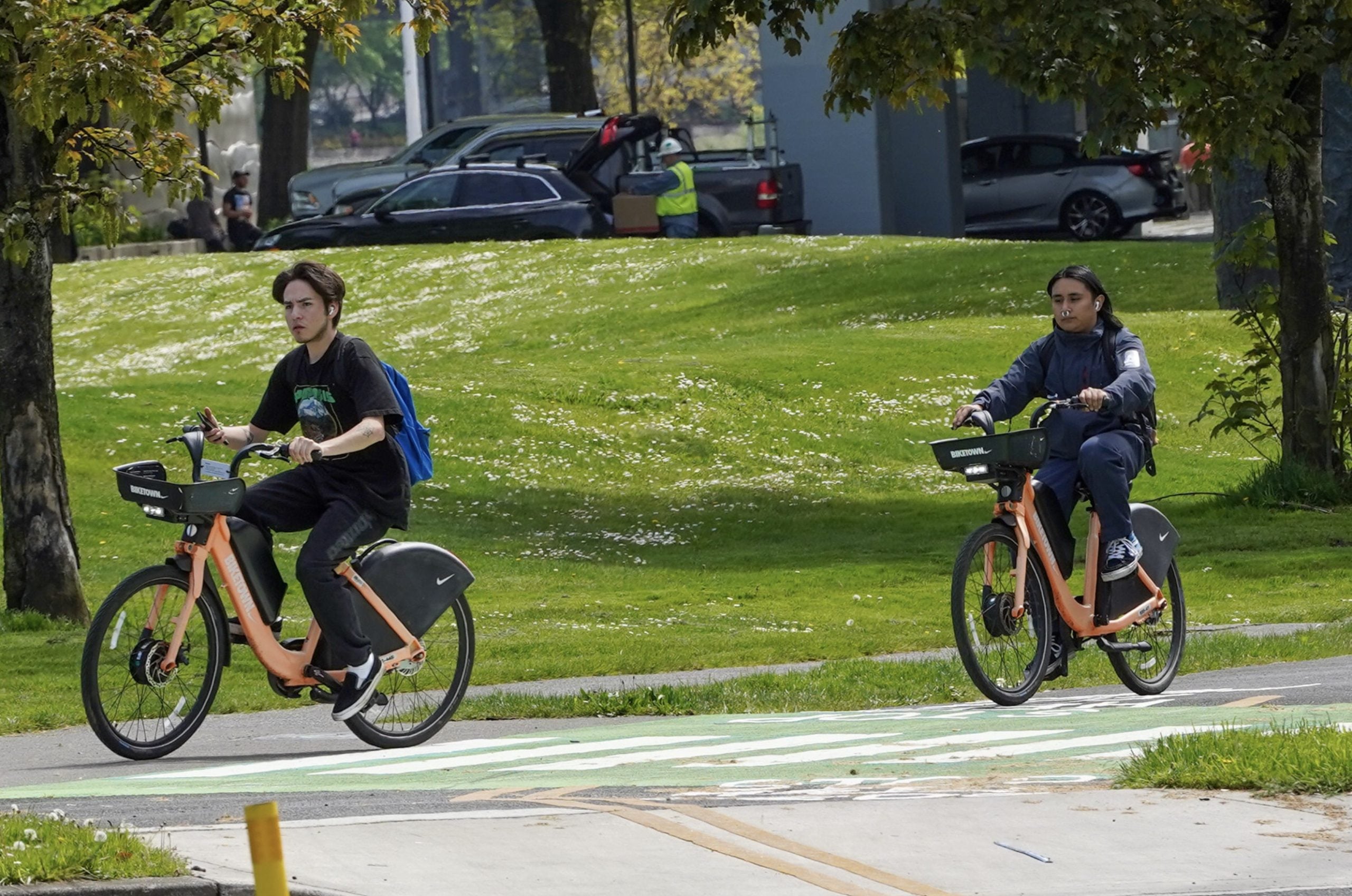
The City of Portland wants to talk about its bike share and e-scooter rental program. 10 years after the Nike-sponsored Biketown system launched to much fanfare, the Portland Bureau of Transportation has grown its fleet of orange bikes into a relatively reliable form of transportation for thousands of people. Today there are roughly 3,000 bikes and scooters available as part of the “Shared Micromobility” program for rent in a service area that touches nearly every square mile of the city.
Now PBOT says they are, “thinking through new ways to shape the future of e-bike share and e-scooter share,” and they want to benefit from your opinion. Today the bureau launched a Shared Micromobility long-term planning survey. If my memory serves, this is the first time they’ve conducted such a survey. I haven’t heard any rumors about big changes afoot, so I can only assume this is being done so PBOT can keep their finger on the pulse of folks who use the system. I also feel like these systems are pretty static at the moment and if everything stays the same ridership will likely stay flat and the fleet of scooters and bikes will become even more outdated and in need of a refresh.
That’s why I believe the one thing on the horizon that could have a major influence on the future of this program is funding. From what I can tell, the current system is starved for cash. The older model “Watson” bikes (the orange ones) are woefully outdated and a majority of them have batteries in dire need of replacement. Ideally the entire fleet would be replaced with the newer, “Cosmo” models (the grey ones), but that would require a big investment. The system also needs a lot more bikes in order to meet its vast potential as a true public transit system.
With PBOT in such a dire budget situation and the political capital necessary for more public funding of Biketown, the only bright spot for Biketown investment is the Portland Clean Energy Community Benefits Fund (PCEF). PCEF has already funded Biketown’s low-income program and in their latest annual revision of the PCEF Climate Investment Plan, the City of Portland has made it even easier for Biketown to win grants through this program. Among the changes to the CIP that’s under consideration by Portland City Council this month, PCEF will add “Biketown infrastructure fleet addition” as an eligible use of funds.
If we expect councilors and the City of Portland to continue to support and invest in bike and scooter share, it’s important they hear what folks think about the system. Which brings me back to the purpose of this post: to encourage you to take the survey.
I took the survey this morning. It was very quick and the questions were straightforward. Take the survey here.


Thanks for reading.
BikePortland has served this community with independent community journalism since 2005. We rely on subscriptions from readers like you to survive. Your financial support is vital in keeping this valuable resource alive and well.
Please subscribe today to strengthen and expand our work.
None of the math works out. The closest bike to me is a six minute walk away in the wrong direction. The closest place to properly lock it back up when I get home (because the charging people don’t put them in proper places) is a 15 minute walk away. Most of my trips are 20 to 40 minutes. The cost for my regular trips would come to ~$2,000 a year.
The only benefit would be not having to do maintenance, $150 a year in expenses and not having to worry about theft. Which isn’t worth a 50 to 100% increase to my commute times and $2,000 a year. I could buy a new ebike every two years with that forgo any maintenance and worry about theft a lot less.
This is one of the factors that convinced me to buy my own ebike. Even with a subscription (ugh) it doesn’t pencil out anywhere close to just getting your own ebike.
It’s not a particularly well designed survey, which is typical of what PBOT throws up when they ask for “public input.” They can then say they have data but the data aren’t good data. Which is a bit like saying “I have a bike” if you own something with flat tires, a rusted chain, no seat, and a frame that is six inches too big or too small for your body type. Yup, that’s a bike/those are data points. Nope, they aren’t actually useful.
I used Biketown for a night out around new years and found a few annoyances the hard way. I tried to get a bike in Sellwood but there were only scooters. Which are limited to 12mph on the springwater, wtf?? I’ve never gone so slow on that stretch in my life. At the corral near the sellwood bridge, I spotted a bike and tried to lock up the scooter which I couldn’t do because I was in a no-lockup area. I was in the corral! Wtf. That explains why there were bikes and scooters locked up to every nearby pole but none in the corral.
Later I got a bike in Lents to ride home to Sellwood and found out that everything south of foster is out of the service area so I had to pedal that whole beast until the assist kicked back in around Reed.
For more standard trips, and if I can find a working bike, I like it. No theft risk and pretty speedy riding, in the service area.
Yeah, the scooters not being allow to crowd the docks makes sense when you look at the system holistically, but annoying since it’s a bikeytown bike and a bikeytown scooter but you can’t do the same thing with them. They really should have rebranded the scoots, or something.
Its too expensive. I miss the non-electric bikes.
Agreed. 35 cents per minute adds up quickly. Including the $1 unlock fee, a 5 minute ride costs as much as a 2.5 hour Trimet pass. I used Biketown maybe a few times a week when it was just the old non-electric clunkers. Now I don’t use it at all.
Non electric bikes, even if a little heavy, would add resilience to the system. I guess they are probably easier to steal since there’s no way to brick them?
A 30-minute ride to run an errand, get to friend’s house in another neighborhood, or to pick up some groceries would cost $11.50?! That’s a fantastic argument for using a car.
Ah, Portland’s Biketown—where the bikes are more “finders-keepers” than “ready to ride.” It’s like a scavenger hunt every time you try to get on one. The racks are emptier than a pub during dry January, and if you do find one, it’s a game of “Is this one going to work?” Will it have a flat tire? Is it completely dead? Who knows!
And don’t even get me started on the cost. If you’ve got a golden ticket to free rides, you’re living the dream. But for the rest of us? It’s like paying for a rental car, only it doesn’t come with air conditioning, and half the time, the engine’s missing.
Honestly, Portland seems to have perfected the art of offering half-baked services and asking the people who are already paying taxes to just, well, put up with it. They’ve got the cash, sure—but apparently, it’s all going to “help” the people who don’t pay for a thing.
So, how about it, PBOT? Maybe fix the bikes, fill the racks, and then we’ll talk about how to make this whole thing better. Until then, I’ll keep walking past the empty bike racks while my tax dollars go toward “visionary” projects like charging stations for scooters I can’t find.
What do you reckon, though? You think they’ll ever make this whole system, you know, work? Or is it just going to be Portland’s version of a very expensive bike share museum?
this statement had applied to Portland for many years now. Very nicely said. Tax flight is real.
Honestly, Portland seems to have perfected the art of offering half-baked services and asking the people who are already paying taxes to just, well, put up with it. They’ve got the cash, sure—but apparently, it’s all going to “help” the people who don’t pay for a thing.
Weird. I don’t use it often because it’s over priced and I have (and love) my own bike. But I use it now and then and the bikes have been perfect every time. They’re great. That is not the problem with the service.
And the app tells you if it’s charged.
At least in my neighborhood, the biketowns seem to be treated as the personal e-bikes for the homeless. That’s where they are all parked at, because homeless can ride them unlimited for free, so they just horde them all for themselves in front of their encampments
Yeah, I agree. It’s mostly become just a homeless bike program. Too expensive and too hard to find a bike for anyone else.
This is what equity looks like.
Do you know how houseless folks are riding them for free? Biketown for All used to be wildly cheap, nearly free; my partner was enrolled for a while and used it, but it was gutted last year to be practically worthless.
I have my own ebike so I didn’t renew my Biketown membership. Now, when I do use, it’s just so expensive. If I am going more than a mile or two, it ends up costing more than the bus. If there are two of us and we are going more than a couple of miles, it’s almost as much as a rideshare ride. There are times when it’s incredibly convenient, but the limited availability and charge for locking out of station and high per minute rates all became a reason I tend to avoid it now.
I found the Lime bikes (and eventuality e bikes) in Seattle ca.2018 to be a reasonable backup plan when I was 100% bike commuting at odd hours without reasonable transit options. I never figured out how to use the Biketown fleet when I moved to Portland because they seem to be both expensive and unreliable.
– docked ONLY, especially for scooters. Lime scooters are a scourge on sidewalks everywhere.
– charge by distance, not time. I should not be penalized for getting unlucky with stoplight timing or opting to ride a little slower on a bike that I’m usually riding without a helmet (sorry mom). That makes the cost much more predictable too.
– regular bikes. The e-bikes are nice if you’re going uphill but I found the regular Citi bikes in NYC to be perfectly fine for getting around and even going up hills.
– keep bikes stocked and well maintained. Offering credits for locking up at docks that are running low would be a great way to keep the system balanced without having to run a bunch of trucks to do so.
-expand the service area, especially to cover more space around MAX stations. Bike + train is a great combo imo.
If Biketown is meant to be a climate and transportation equity tool, it’s failing on basic accountability. A system that’s too expensive for working residents and visitors, under-maintained, and functionally unavailable in many neighborhoods isn’t advancing mode shift—it’s just misallocating scarce public dollars. If PCEF funds are going into Biketown, the priority should be reliability, affordability, and actual trip replacement, not a program where bikes sit idle at homeless camps while racks are empty. Climate justice requires outcomes, not just good intentions.
PS More taxes are NOT the answer to this problem.
Lime/lyft/bird will drop all the scooters and bikes one can use. Let the free market handle it.
Extend the network south of foster and _stop cutting the motor off_ when you ride just outside the line. I was doing a round trip, and I ended up riding the single speed (e minus e) bike 3 miles into woodstock all while it happily charged me the ebike rate.
That said, Biketown has been a real boon for me over the years. I see all the negative comments here and wonder how often they actually use it. As a member, for the year I lived in Brooklyn, I was able to ride a bike downtown for jury duty daily for less than the cost of a day tri-met pass. And then I didn’t have to worry about my bike. Sure, I had to walk a few blocks to get one but that’s the reality of ride sharing. They can’t be everywhere all the time.
Anyway, thanks for the link J, I’ll be sure to take the survey.
When was that? I suspect the price has gone up substantially since then.
We visited Ljubljana, Slovenia, last year. Signing up for the bikeshare program cost us 1 euro per person for an entire week. The app was easy and reliably snappy.
Riding the bike for under 60 minutes was free. You just scan a code, ride the bike, and park it on one of the ample number of racks when done. Ride for over an hour? That’ll be one more euro.
The bike was perfect. Steel frame, generator light, basket, one size. Everyone was riding. Parents, grandparents, business-lookin’ folks, everyone. Bikeshare felt normal, for once.
If Biketown wants increased ridership, make it cheaper, put racks everywhere, and voila.
There should be biketown at the airport
(and a safe & low stress way to get in/out of the airport industrial area by bike)
a real bike network. If people felt safe biking in Portland, the city wouldn’t have to ask why people don’t use their bikes. There are Nike Bikes all around me, but why would I use them if all the bike paths around me are death traps?
Before taking the survey, I went and checked out the Biketown web site.
I looked carefully for ways to use the system without a smartphone.
If you search the “Help” section, you’ll find that a card for those without a smartphone is mentioned, but I cannot find out how to obtain said card, even if accessing a Site Map.
All of the info on the web site is geared to smartphone technology, which a surprising number of people on social services still cannot afford.
To sign up for membership online, even a Reduced Fare membership, you are required to give a mobile phone number that can receive texts and download an app.
So I called Biketown and spoke with a nice person, who informed me that plans are in the works to ultimately discontinue the card (“sometime in the next year or so”) and just go forward with smartphone apps.
“Because everyone has a smartphone now,” he added.
Any system that requires smartphone ownership in order to use it is not truly equitable.
Smartphones should remain a personal choice, rather than a requirement, for access to services.
I’ll skip the survey, thanks.