
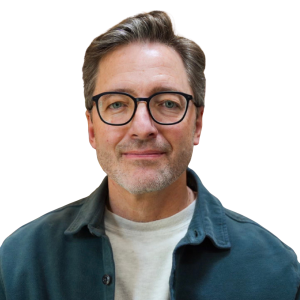
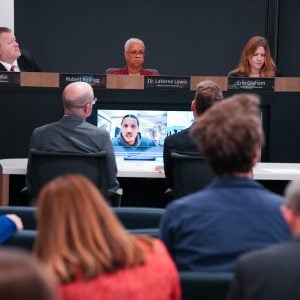
TriMet Board Member Tyler Frisbee speaking at Wednesday’s Trimet board meeting.
UPDATE, 12:30 on Sunday 12/14: Sorry for such a brief post folks. It was end of a long week and I barely finished this video before I had to quit and get to my son’s basketball game. I posted it in the car on the way to his game! Anyways, Judging from comments a lot of you figured out what it was about.
Quick context: Tyler Frisbee (longtime former policy advisory to U.S. Congressman Earl Blumenauer, former Deputy Direcrtor of Government Affairs and Policy Development at Metro, now Director of the Institute of Metropolitan Studies at PSU) weighed in on the 82nd Ave Transit Project at the TriMet Board Meeting on 12/10.
Below are her comments (which I’ve edited for brevity):
“We actually have two very different visions of 82nd that are finally clashing with each other in this moment. We literally had someone get up and say, ’82nd is a highway, stop treating it like it’s a neighborhood.’ And then we had people get up and say, ’82nd is my neighborhood. We’ve been asking for it to be a neighborhood street and serve the neighborhood for 30 years.’ That, to me, is the question, right? This is the moment: is 82nd a highway? Or is it a community? Is it a street that serves the community that it’s in?
And it is correct that it was built as a highway over 100 years ago. It is an incredibly different landscape and neighborhood than it was when it was built. And I would argue that the decision has actually already been made. It is no longer a highway. That [decision] was made with the transfer of 82nd to the City of Portland, and it was made when we started this project, right? You don’t run frequent service down a highway. If that is what we intend that road to be, then we shouldn’t be building sidewalks on it. We shouldn’t be building bus improvements on it. But in response to what we heard from the community, they’ve been organizing for that to be a different kind of street.
I understand people’s attachment to the way a road was built over 100 years ago, but I think there has been really clear discussion that that community looks really different now, particularly in the last 30 to 40 years, it has changed dramatically. And there have been a series of decisions that say we need to change the road to reflect the community and the landscape that it’s in now. And to me, the most ambitious transit project on our busiest bus line in the entire region that will only grow, right? That is a part of our city that is only growing, and more people are moving there, and we are seeing more transit need along that space. That is a very clear answer about where that community is going and what that community needs from us in the future. That does not disregard the fact that change is hard, and that does not disregard the fact that there are folks who have built up entire approaches to their business based on the way that street was.
But we are building a project that’s not meeting the next five years of need. We’re building a project that needs to meet the next 20,30, 40,50, years of need.
Big picture, I think that’s where we are. And you know, Michael [Kiser, TriMet Interim Director of Major Projects], I’ve heard you talk about being a community builder and a city builder — that is what this project needs to do. And some extent, actually, the community is built, right? They went ahead and built without the transportation service, without the transit service, and we’re just trying to catch up. [Bless you, baby. Good job (to her baby with her on the dais!)] This is where things get interesting, right? And it is where you can say, ‘You know, yes, I hear you have a concern around the Left turn lanes here. Here are different ways we can mitigate that. Let’s look at some of these options. Is it going to be perfect? No? Is your clientele going to change? Right?’ Each of those stores has an individual proportion in terms of who gets there by bus, who gets there walking, and who gets there by driving. That is going to change after this project, but our goal is that we are bringing enough new ridership there by the bus, and you know, PBOT is working to make it possible by foot, that they are actually seeing more folks visiting.
And that is my sort of second big picture comment. I have heard a lot from folks asking for we want more data on business impact. And my response has been, ‘You know what? When we look at BAT [Business Access & Transit] implementation across the country, much less internationally, it shows almost uniformly an increase in foot traffic and in support for the businesses that rely and depend on that foot traffic, and frankly, even businesses that are that think of themselves as car dependent, actually often see a much more significant increase in their foot traffic and folks coming off the bus that ends up being more than making up for any potential car loss.
What I have had said to me is, ‘Well, we don’t believe that,’ basically, or ‘It’s different here,’ and it is hard for me to then get to the next stage of a conversation, because it’s like, well, what are we going to turn around for you, that you’re going to believe if your answer is always just that data doesn’t meet my needs, that data is not what I want. When we look at the best data we have across the country, real life, BAT implementation and its impact on businesses, to me, it is very heartening. And what it says it’s a story of resiliency. It’s a story of these projects. They change the way that folks get there, but overall they’re bringing more folks to the door of your business.
So I guess I’m using this as a little bit of a soapbox to kind of push back, because I don’t know how to keep having the conversation of just like, ‘I don’t believe that.’ And I think the question that we have that we want to work with folks on is, ‘How can we help make this work so that it’s not about preserving the way that people get to you right now. It is about what does this look like in the future?’ What do your next 10, 20, 30 years as a business look like around 82nd because let me tell you, that community is changing, and you’re going to have folks getting there differently no matter what. And frankly, sometimes just having the same conversation six different times doesn’t actually change the conversation.
And so I would encourage us to think about how we can have the important conversations and the effective conversations with people that understand their needs and try to help find a good path forward. If they don’t want to participate in that, having that conversation six times is not useful, and so I want to find a way to work with all of our folks, with all the community folks who live along there and make sure everyone’s voice is heard, to find a way to meet needs and address needs when we can and acknowledge that this community has changed and is changing, and we need to meet that.”

Thanks for reading.
BikePortland has served this community with independent community journalism since 2005. We rely on subscriptions from readers like you to survive. Your financial support is vital in keeping this valuable resource alive and well.
Please subscribe today to strengthen and expand our work.
Carbrained people only care about data that conforms to their worldview. If they can’t accept the data that shows they are wrong, they should just be ignored.
How very inclusive of you, Sky — nothing says open-minded like declaring half the city ‘carbrained’ and unworthy of conversation. That’s not acceptance, mate, that’s just gatekeeping with a tote bag. Maybe the data would land better if it wasn’t delivered with a side of smug and a ‘shout-down anyone who disagrees’ policy. Even in Portland, consensus isn’t built by telling people to bugger off. Think about it mate.
Too bad “carbrained” people make up more than 90% of the population. Don’t think that class of people will be ignored anytime soon because they can vote out or recall anyone/anything they don’t agree with.
I’m so glad there are people out there who can advocate forcefully and respectfully for a better future. It was a highway, but it is no longer functioning as a highway and needs to change to reflect the changes to the area that have already occurred and prepare for changes we anticipate in the future. Scary stuff.
She stayed so calm and positive as well. I was impressed.
Nice articulate speech, but…
PBOT is not a very good example of a transportation agency that converts highways into neighborhood streets – in East Portland, Cully, and SW they’ve been deathly slow in making those conversions from Multnomah County highways into neighborhood streets, often taking 25-35 years and numerous lives after annexation to do so – many of their highways are still more or less highways. PBOT’s plans for most of 82nd outside of the BAT section looks just like it did as an ODOT highway.
“PBOT’s plans for most of 82nd outside of the BAT section looks just like it did as an ODOT highway.”
What are you talking about? The more BAT lane option goes from Clapstop to Lombard. Thats 7 miles and almost all of 82nd within Portland city limits. Clapstop is literally the dividing line between Portland and Clackamas.
David lives in NC now so he could be dealing with old information. Maybe we could have a “nostalgia” section of the comments?
That’s cute but the dividing line between Portland and Clackamas hasn’t changed in the 20 years since they lived here. It’s not old information they’re just lazily shitting on the city from NC.
TriMet is talking about 3 miles of BAT, not all 7 miles. And the Portland portion of the stroad will still be 5 lanes even with the BAT lanes, as well as the long portion in Clackamas County outside the city. Here in NC, a state with a lot of highway money (unlike Oregon), we do have lots of BAT lanes and they look and function just like regular highways as far as bicyclists and pedestrians are concerned.
What are you talking about?
https://trimet.org/82nd/lanedesign.htm#morebatlanes
As a community member, I can confidently say it serves the needs of the neighborhoods best by having 4 general purpose lanes.
There’s a high speed transit line literally 14 blocks away. There is not, however, another north-south through route for cars between 60th and 104th.
You sound like someone who doesn’t walk to their destinations. 14 blocks is significant.
Apparently I205 doesn’t count as a north-south route for cars? The MAX literally runs along it.
As someone who lives close to 82nd, I use the line 72 way more than the Green line MAX. Most of the Green line’s stops aren’t close to anything useful to me. Mostly because the freeway takes up a large portion of its walk shed. The line 72 on 82nd actually has places I want to go on it.
It’s a 20 minute walk one way from 82nd to 205 if you happen to be parallel with a station. Best case scenario, someone traveling along 82nd by transit would have a 40 minute detour using the Green Line. Most likely, it would be longer. From a transit rider’s perspective, the 72 and Green Line serve almost entirely different purposes. If you rode the bus, maybe you’d understand that before boldly claiming people can just use the Green Line as a substitute for the 72.
It takes a car ~3 minutes to drive that far, and 205 is faster than 82nd 99% of the time. But worst case scenario, it’s a 6 minute detour for a driver.
I personally think bus lanes are needed on 82nd. You don’t have to agree, but don’t pretend that the detour to 205 makes any sense at all for anyone outside a car
Since this is BikePortland, I feel compelled to say that 82nd does NOT serve my purposes in any way as a cyclist. I have ridden in the right lane but it’s really dangerous – more so than any other street in Portland.
So how exactly do the four general-purpose lanes serve cyclists? And how do they serve transit riders? Have you ever tried crossing a high-speed street like 82nd on foot? I’m guessing not.
The “through route for cars” will still be there. All 4 lanes will still be used by cars, but Bus travel will be prioritized in the outer lanes. If people drove the speed limit, and drove carefully, road design would be less important. If cars were regulated to adhere to safe limits in size, shape, acceleration and speed, road design would be less important. If we were serious about removing dangerous drivers from the roads, road design would be less important. But we don’t do any of that, so road design is the best tool.
Great comment SD! These are all the reasons we have to take expensive, drastic measures to allow everyone to travel safely and efficiently.
Comment of the week.
In case people forgot this is all happening because drivers killed two people in the same week on this road. Pedestrian and bike infrastructure is car infrastructure.
Exactly. And typically, bike and pedestrian-related infrastructure projects are things that should have been included in the original vehicle-related projects. Streets shouldn’t have been built without sidewalks and crosswalks, freeways shouldn’t have been built without overpasses, etc. You could even argue the freeway lids should have been built as part of the original freeway work in NE.
If people say including those things in the original project would have made the projects too expensive to build–well, yes. The answer would have been to increase the budgets, or abandon the projects–not to build the projects without mitigating the impacts. And especially not viewing subsequent, decades-late mitigations as favors/wastes of money, and the people who need them as selfish or entitled.
I love this perspective. I was wondering the other day why new motor-vehicle infra is added all the time and viewed as completely necessary and justified, yet addition of bike lanes, sidewalks, and similar infra is viewed as a luxury add-on. What if everyone had the view that NOT ONE MORE LANE of motor-vehicle infra be built until bike and walking infra catches up?
It’s a 15 minute walk each way to get from 82nd to the highway. The highway has very few entry points so for most destinations it’ll be way more than that. So you want people to walk a minimum of half hour just so cars don’t have to slow down? To each their own.
No one is going to walk from 82nd to the highway to take transit there. No matter what choice TriMet makes, there will still be transit and sidewalks on 82nd, and neither scenario will make a noticeable difference in the quality of either.
In fact, if I’m right about the impact of sharing the bus lane with bikes and other bike-like vehicles, adding BAT lanes will make transit slower.
Why will buses be slower, Watts? Because of bicycles??
Serving the needs of the neighborhoods and functioning as a through route are often two conflicting things, unless the neighborhoods are the ones at the ends of the street, and not along it.
Portland is full of examples of streets that were altered over the years for improved through-route performance, with the result that their function as main streets serving the neighborhoods along them was greatly compromised.
In an urban setting, it seems odd to imply that auto users must have a series of unencumbered transit routes. Those 44 blocks between 60th and 104th suggest to me an urban fabric that prioritizes neighborhoods as places where people live and congregate instead of simply pass through.
I think it’s refreshing that Portland doesn’t have road after road, stroad after stroad dedicated to uninterrupted north-south travel. That’s not to say there aren’t north-south routes which crisscross the city, but streets like 33rd and 42nd are 2-lane roads more aligned with the pace and practicalities of city life.
I also think there’s an inherent contradiction. Why do the neighborhoods adjacent to 82nd have to worry about a through route for cars at 60th? Arguably, the folks who use the 60th Ave through route aren’t using it for the same reason as the folks on 82nd.
And, when I’m travelling north-south by car, I rarely believe that the roads will take me to my destination without deviation.
The point of the BAT is to serve the people who live and work and shop and use transit in the 82nd orbit. When 82nd is referenced as a through route, it suggests the road exists primarily for people in an auto passing through without an affiliation with 82nd other than as a mode of travel. And I don’t think our transit policies for the 82nd Ave community members should be dictated by the preferences of a Mill Plain commuter.
The best thing about this, is that the rest of the Trimet Board can’t pretend that they didn’t know or understand. Tyler Frisbee clearly laid out the case for full BAT and its broader impact and significance that Trimet has been trying to ignore.
She is 100% correct, the decision for 82nd to become a residential street has already been decided. This is a very savvy point to make, because decision makers often pretend that they are informed by data, vision and virtue, but in reality they regress to inevitability and normalization. They make decisions based on self preservation, and maintaining their positions or leadership trajectory under the cover of the status quo.
Many argue that car sewers are the greatest because everyone uses the car sewer, However, this argument is actually one of the best examples of how simple minds will normalize one of the worst rotting vestigial organs of civilization. Even when there is full blown appendicitis, or in this case, car sewer-itis, and the infection has spread to surrounding tissue and the whole system is tilting toward sepsis, the Michael Liu’s of the world, will congratulate themselves for saying “car sewers are normal, we can’t remove the car sewer or else nothing will be normal ever again!”
That’s probably the best sentence I have read all year!
82nd is neither a highway nor a neighborhood street, and it won’t be either of these things after reconfiguration. It will basically be what it is today in every important way.
And if anyone thinks this lane configuration is being built for a 50 (or even 30) year time horizon, they are not seeing how fast the world is changing.
I actually think the BAT decision is very low stakes for bus riders. The potential for a small marginal increase in speed will not draw new riders, and will probably be eaten up by other users of the BAT lane.
I think the main beneficiaries will be people on small electric (and perhaps gasoline powered) vehicles who will use the bus lane, and, probably, getting hurt in increasing numbers.
I understand what you’re getting at here; but I remain entirely skeptical that self-driving cars will be the panacea you like to sell them as. The tech is just really not there and still takes a ton of human intervention, either in the form of actually taking over the vehicles or the meticulous mapping of the places that the cars drive. There’s also the cost issue, and the question of whether they will be individually-owned, or rented out. I just don’t see the cost of self-driving tech coming down much. They call them “datacenters on wheels” for a reason.
I am very bearish on the safety aspect as well. I know that in the constrained trials, there have been moderate decreases to pedestrian and cyclist collisions; though I suspect some of that is just due to the fact that they go the speed limit and follow the law. Though I will concede that is something to be celebrated. On that note, however, if self-driving cars are individually-owned, what’s to stop someone from jailbreaking their car to be hyper-aggressive or disregard laws? In the event that a sensor breaks, either a $6000 module gets replaced, or, more likely, people will probably hack the cars to just ignore the faulty sensor.
I suspect that like many other safety technologies (seatbelts, airbags) self-driving tech will probably bring the lion’s share of the safety benefit to the occupants or vehicles, not those around them. I still think that is a worthwhile pursuit given how many people die and are seriously injured in highway crashes.
Traffic is already pretty bad with cars carrying only about one person on average. I can’t imagine it will be anything but worse when cars are carrying less than one person on average.
Seeing the kind of degeneracy that people engage in while behind the wheel is already startling. Self-driving cars would completely remove people from the communities they travel through and enable a completely new and disturbing level of hedonistic moral rot that makes me question the point of human existence if we’re all just going to be in Wall-E chairs all day and night. The idea that I’ll probably get killed by someone’s jailbroken goon cocoon really makes my skin crawl.
I’m not really in charge of what happens with self-driving cars, so I guess I’ll just wait and see. At the moment, it seems like hype tech (like electric McSUVs) that isn’t really about benefitting humanity but more about reinforcing the status quo. You’re welcome to try to convince me otherwise though.
Bus lanes do help prevent bunching; something that the FX2, which has also no bus lanes, deals with often. Speed is just one aspect of good transit service; reliability is also paramount. Bus lanes also create space for more capacity and frequency in the future.
In this comment, I am making no claims about automated vehicles. I am just saying the world is going to be vastly different in 30 years, and it would be shocking if those changes did not extend to transportation. It’s even possible that in 30 years, TriMet will have electrified its buses, but let’s not get too excited.
If you think back to a world before Google maps, and somebody told you they were going to take continuous photographs of every street in the world, and give them away for free, the only reasonable response would be to think they were nuts.
Or what if, 15 years ago, someone said they were going to put a whole fleet of electric scooters out on the street for anyone to use. Anyone who remembered the yellow bike project would know how that was going to end up.
Or if 10 years ago someone told you someone was going to build a internet system in space that was faster than a direct fiber optic cable on the ground.
Your ability to predict the future may be better than mine, but I would have been wrong on all those counts because I am actually fairly conservative when it comes to predicting what it’s possible. But I also know the pace of change and innovation is increasing.
Maybe you know what the transportation landscape will look like in 30 years, but I sure don’t.
(And say what you will about the safety of automated vehicles, but you have to reckon with the real world data, which we have because there are so many automated vehicles out on the streets right now driving people around.)
I don’t think I understand anything you are trying to say.
I’m saying things are changing at extraordinary speed, and doing transportation planning for 30 to 50 years in the future, as Frisbee says we are doing, is a fool’s errand.
I am also saying that the difference in transit performance between more BAT and less BAT is pretty small, and that it is likely that other users in the BAT lanes, such as scooters and bicycles, will degrade transit performance perhaps even more than cars using the BAT lanes to go straight would.
So my bottom line is that this project is much lower stakes than people here are making it out to be. More BAT lanes will not transform anything.
I disagree. The ones in Hillsdale have been transformative. If you rode the bus thru Hillsdale, as I do, you would know this.
The BAT lanes will also transform 82nd.
If Oregon/portland can’t get this done…who will?
Los Angeles, New York, Chicago, Atlanta, Boston, Philadelphia, Washington DC? I hear that Portland should be better at this by now. Lanes prioritizing public transit, it’s a thing! We all need to do it, too!
I know Atlanta has changed a lot since I moved away 17 years ago. Hell, I’m there right now and I just saw with my own eyes miles of protected bike lanes being installed on a road I used to commute to grad school. At that time, that road would have been best described as “Lombard, but with much faster traffic”.
That said, Atlanta today is still very much the Atlanta I grew up in:
https://www.fox5atlanta.com/news/georgia-400-express-lanes-u-s-dot-gives-state-almost-4b-loan
Wow, Tyler Frisbee rocks !! She is spot on and delivers a kind direct message of where 82nd and it’s community are.
Tyler is using coded words. Let’s dig deeper into 82nd.
If we value 82nd as a freeway we also value ignoring the data. If we value a freeway we accept more death and more heath risks. If we value a freeway we value making the money the old way with used car lots. If we value a freeway on 82nd we must accept that 205 is slow and a failure in commute hours. If we admit 205 is a failure we must expand 82nd and Interstate 5 to compensate for that failure. If we value a freeway on 82nd we must accept that people who take the bus on 82nd must suffer because everyone who drives alone is entitled to block that bus packed full of 40 people.
The pattern I see in this blog of Jonathan’s is that he needs an income and is very unwilling to take big risks in journalism. He does not want to dig deeper into why a driver can get no citation from the cops after jumping a sidewalk and killing a pedestrian or running a red on Cesar Chaves and putting a cyclist on Clinton in the hospital.
I think we need to see people as leaders under one condition: Our leaders must be bold admit that that America in general has a failed transportation system because it is more efficient if you own a car. It is less efficient if you take transit.
Most people in Oregon get around by car, and they don’t see failure when they see policy that preserves 82nd as a freeway. The majority of Portland will see rapid bus lines as a failure. That is because the majority of Portland likes the comfort of their car, and we preserve what we like. .
It is very unpopular to tell your friends and neighbors they are part of the failure that makes them stuck in traffic. Bike advocates will say in their private bike circles that our leaders are failures on transportation, but they will not say this in public, which makes bike advocates part of the problem. This is why I don’t sit well in bike circles any longer.
It is my view that If people can not speak boldly, they are not leaders, they are a cog in the machine that is moving us to global self destruction.
82nd is going to remain a highway.
82nd will not get a BAT lane because the Trimet board is appointed by Governor Kotek. We know that Kotek, like most democrat voters, can’t admit that America is self destructive in policy. Nobody wishes to wake up every day and admit we are making long term self destructive decisions.
We need a law to make the Trimet board an elected body. We need criteria that serving on the board means not owning a car. Democrat voters are not this bold. Democrat lawmakers are not this bold. Until we are ready to make bold decisions we will keep making decisions as a nation addicted to driving alone. Transit will remain as a system subordinate to the car driver who drives alone.
People keep talking about the car dealerships and suggesting they’ll go away if the BAT lanes are installed. Why would the dealerships close down after reconfiguring the roadway? Used car lots don’t see a large number of customers per hour. It’s not a high-volume business.
If the reconfiguration would affect any type of business, I’d expect the fast-food restaurants to be the most impacted.
Looking at 82nd on Google Street view, you see hardly any customers at the used car lots. All of the drive-thrus are jam packed.
The 82nd Ave improvements and the BAT lanes are a nice idea but there are two huge problems. Cost and elimination of over 1/2 of the existing stops. Walking farther to a stop isn’t feasible for many residents (elderly, physically challenged, some families). And the decrease in transit times for the full route would only be reduced by 3-4 mins for the full BAT lane option. As an alternative why not have extra buses at peak commute times that make fewer stops?