

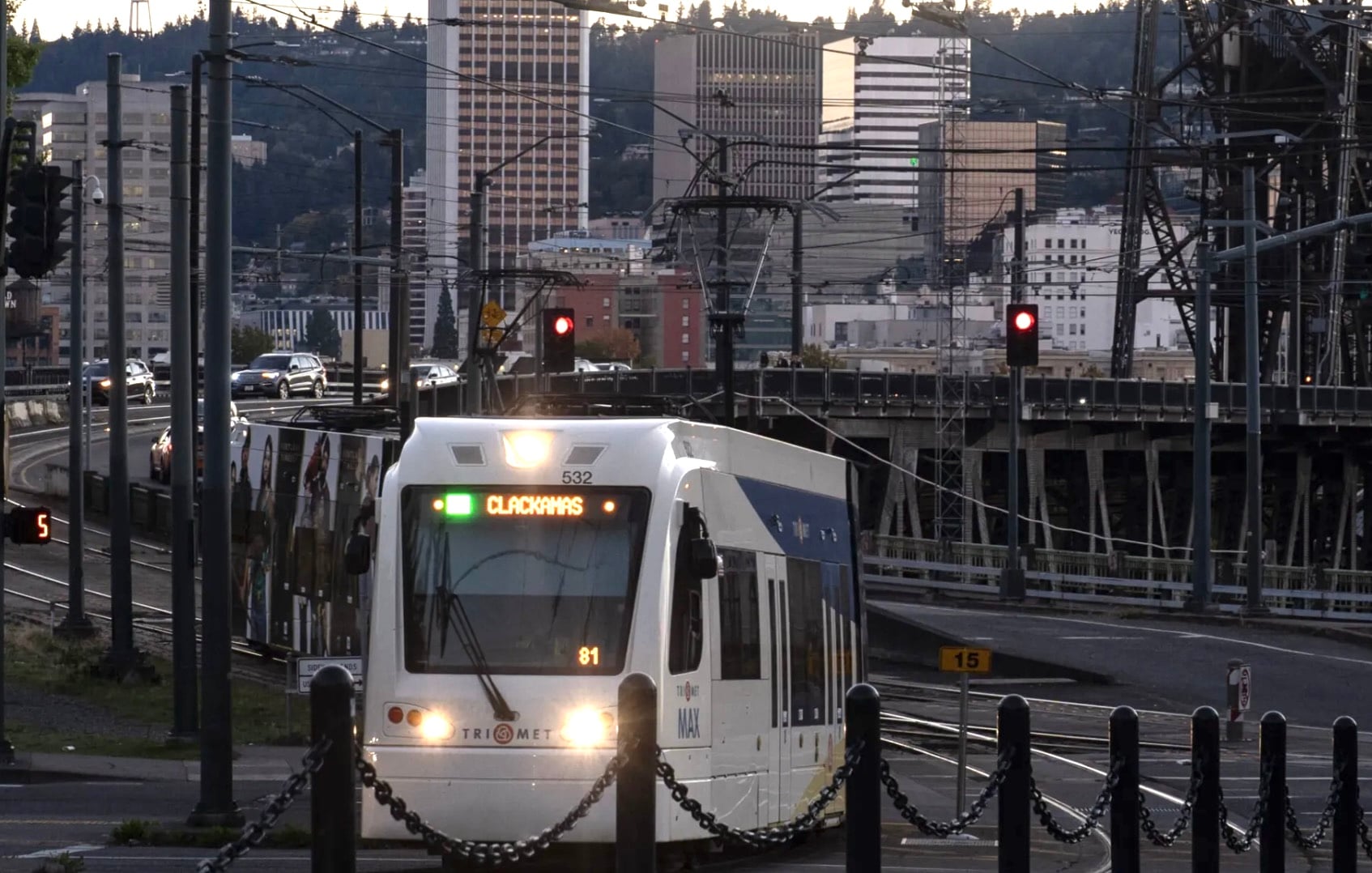
When TriMet announced the first round of service cuts last summer year they told us the worst was yet to come. Now that the second round has been announced, we get an even stronger taste of what they meant.
“With rising costs and less money coming in, we must reduce spending now to avoid more severe cuts down the road, which would affect many more riders,” reads a TriMet statement released today. The agency faces a $300 million budget gap due to rising inflation, low ridership numbers and other factors.
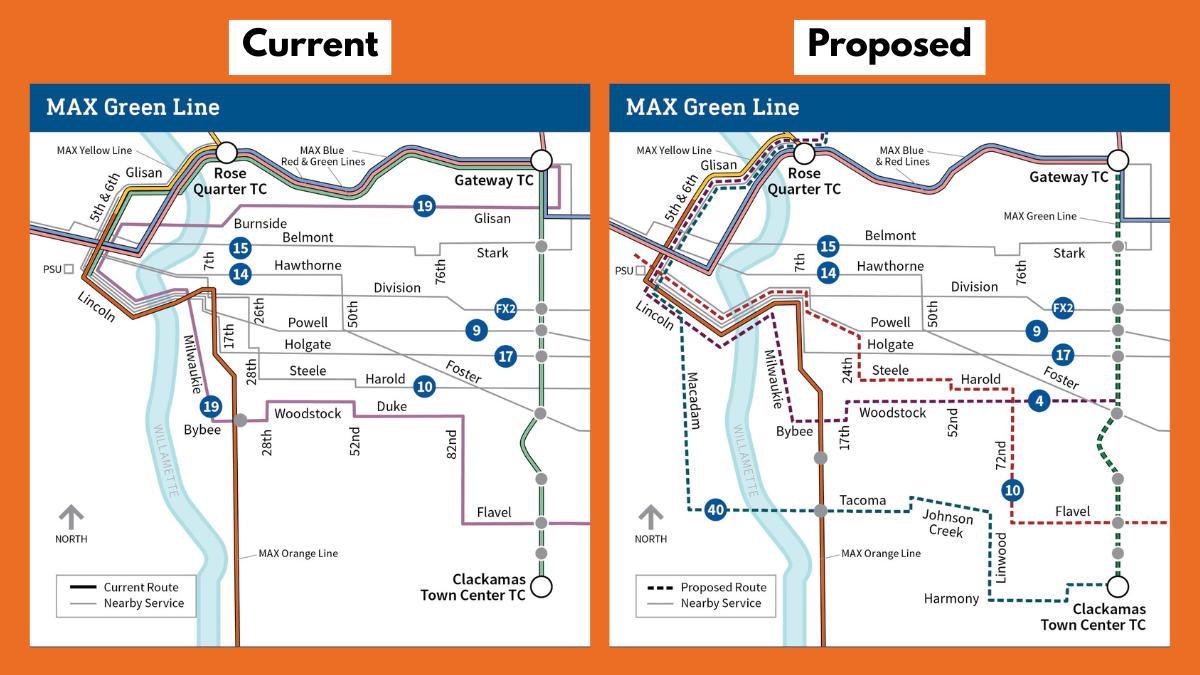
One of the highest profile cuts is the elimination of about half of the MAX Green Line. The line, which opened in 2009, currently runs from the Clackamas Town Center, north to the Gateway Transit Center in Northeast Portland, and then along I-84 into downtown. Starting in August of this year, the line will only service stops between Clackamas Town Center and Gateway. All east-west travel on the line will be cut. Other cuts include changes to 35 bus lines (including the elimination of all bus service in south Gresham; along Stafford and Salamo roads in West Linn; and Tualatin-Sherwood Road in Tualatin).
To prep the public for the cuts TriMet will hold 11 open houses (eight in person and three online) this month across the region.

TriMet says that since before the pandemic they’ve, “faced staggering cost increases in almost everything related to running the transit system, including labor, vehicles, facilities, contractors, equipment and software.” That increase includes a 53% jump in cost per service hour between from 2019 to 2024. In addition to higher costs for materials they need for daily operations and lower revenue, they say their system is aging and needs maintenance and equipment upgrades. A major increase in safety and security-related expenses was also listed as a reason for the cuts.
But what, it gets worse. To reverse the transit doom loop, TriMet says a fare increase in likely to come in 2028.
Meanwhile, the Trump administration is not likely to throw transit a lifeline and even the state legislature is keeping service down. An increase to the statewide payroll tax was agreed to by lawmakers in the 2025 special session (albeit much smaller than many had hoped), but in a bid to ensure quorum, Democrats gave Republicans a sunset on that tax, which means it would end on January 1, 2028. And currently, even that bump in funding is on hold due to a successful petition effort that has frozen new revenue sources until a vote in November.
The proposed cuts will be discussed by TriMet’s Board of Directors at their meeting in March and will be voted on in April. Learn more and find an open house near you at TriMet.org/servicecuts.

Thanks for reading.
BikePortland has served this community with independent community journalism since 2005. We rely on subscriptions from readers like you to survive. Your financial support is vital in keeping this valuable resource alive and well.
Please subscribe today to strengthen and expand our work.
This is so mind boggling. They’ve had cost increases over the years but for some reason they flat out refuse to do anything about fare evasion. Part of the solution is staring at them in the face. The ones that get punished are the ones that have been paying every time and even then it still won’t be substantial because they don’t care about the ones that don’t so why even pay at all anymore? This affects everybody because they don’t want to do their jobs.
Even in the days of yore in 2016 when TriMet had a healthy financial outlook, it only received $125M (27%) of its revenue from fares. Latest numbers I see are ~$30M, but ridership is still significantly down so getting to a similar level of fare compliance wouldn’t necessarily bring in that $95M gap. And that gap is still less than 1/3rd of the deficit they face. Plus, it costs significant money to do fare enforcement which would further undermine the budget. I think at most, TriMet could plug $50M of their budget hole with punitive and aggressive fare enforcement, but that would have other negative impacts on riders and would still leave deep cuts on the table. Which I think would be bad.
I pretty much agree with all of this, but want to add that in addition to negative impacts of strict fare enforcement, there would be positive impacts to reestablishing transit as a lawful public space. I imagine at least some of the riders who have abandoned TriMet for safety issues might be tempted to return if they perceived they would no longer be trapped in a tight space with people willing to publicly flaunt the social contract.
Enforcement might still be a financial loser, but it’s hard to see how TriMet comes back without it.
I generally think the positive social benefits of better fare adherence can be achieved with or without fares, but yeah improving the social dynamics on buses and trains is a must. I moved up to Seattle a few months ago and have definitely noticed that the culture on buses and trains is a little less hectic here – and I don’t think it’s because more people pay their fare. I think it’s because more people ride in general.
Some fare enforcement is necessary as long as fares are a financial necessity for agencies. I’d prefer a lighter touch, and maybe a return to pre COVID norms on buses where operators have a more active role in fare payment.
Counterpoint: last time I road a Seattle bus somebody tried to sell me drugs. Ignore that this happened 15 years ago…..
On a more serious note, it’s definitely a hard balance to strike between enforcing fare payment. Trimet absolutely should not be a makeshift cold weather shelter or a free ride to entitled commuters, but enforcement also costs money in building turnstiles, hiring enforcement officers, etc. It’s easy to come out as a net negative if you try to come down too hard. Also, I’ll say that the argument that Trimet shouldn’t enforce fares because of inequities in our city is really an indictment of the government bodies that are properly tasked with solving many of those inequities. Trimet can absolutely be part of the solution in offering free and reduced fares in certain circumstances, but they can’t do MultCo’s or Portland’s jobs for them.
There are key stations (e.g., RQ, Beaverton, Goose Hollow, Gateway, Pioneer) that have some of the largest number of departure/arrivals that might benefit from a closed system.
I’d much rather see a tunnel with a closed system Downtown/Lloyd, than a sort of perpetual aura of controllers the open systems engenders. Closed system stations would also limit walking traffic in some dense walking areas, as well as cost a bit to fence off, so I’m not sure what the best solution is exactly.
Can’t speak for the other stations, but it would be trivial for TriMet to install a fence around Gateway, put in turnstiles, and only allow paying passengers access to the platform.
TriMet needs to do something, at least when I ride in the early morning, many people get on the Max from Gateway to Rose Quarter, then knowing there are fare checkers at Rose Quarter get off, walk across the bridge, then get back on the train at Old Town/Chinatown.
Before COVID I’d estimate 3/4 of my company’s employees rode TriMet. Post COVID <1/4 as the rest drive and park in our building. When I say I still ride some shake their heads and can’t believe I would risk it. And yes, sometimes, it is a risk due to crazy behaviors that sometimes happen.
Right, I hear you, except if major stops like RQ and Gateway were part of a closed turnstile system it would make that fare avoidance effort a lot less likely, and much less practical. Both of those stations are pretty high ped traffic areas so separating them might be difficult, but would have an effect both on safety and fare avoidance. It would also allow controllers to focus on the remaining open stations.
I’m with 2Wheels here: Yes, fare enforcement costs money, but it’s critical to maintaining public order on buses and trains. Without public order, people simply won’t ride buses or trains AT ALL.
Portland gets this balance wrong repeatedly – we can’t regulate camping b/c it would upset some people; we can’t enforce driving laws b/c some people feel targeted; etc etc. When you abandon public order, everything goes to hell, quickly.
I think it’s foolish to say that paying a fare is the primary way to maintain public order on public transit. Riders themselves and operators can and should play an active role too, and sheer volume of ridership plays a role too. Tallinn has fare free transit for residents and you don’t hear stories of chaos on their trams (not that you hear much about Estonia unless you look for it anyways). If the goal is having pro social behavior on transit (a good goal), then a narrow focus on fare enforcement has the potential to miss other ideas about how to achieve that goal.
No amount of draconian measures will prevent someone without a home from sleeping outside, unless you consider jailing them a good choice. The reason a camping ban isn’t effective is not because people in Portland might be upset about it. It’s because it doesn’t solve any problems, it just pushes homeless people around (and often destabilizes their already fragile existence).
I’m not convinced that public order has been abandoned in Portland, but maybe things have changed dramatically since I moved to Seattle in October.
A question related to whether it is worth pursuing strict fare enforcement is whether it is worth empirically studying the extent to which strict fare enforcement improves public order.
I think such study has a large upside and seems like it should be affordable. Suppose it turns out that strict fare enforcement does meaningfully improve public order. And suppose that related study shows that many more people would ride public transit if such an improvement in public order happened. Then we would have what I presume to be a relatively cheap path to more public transit use.
“Riders themselves and operators can and should play an active role too…”
Can you say what you actually mean by this statement?
Do you mean that riders and drivers should step in when someone is making trouble on transit?
Please clarify, thanks.
In general, yes. In all social spaces, people play an active role in creating safety. I think it’s both ruinously expensive and wrongheaded to rely on the threat of security or violence to do this on buses. Operators should have more discretion to turn passengers away, and passengers should say something to obnoxious or disruptive people (within reason)
Part of the problem is that any crime that occurrs on a bus or MAX platform generates media hysteria, when there were probably 10 similar crimes on parking lots or streets the same day that got no coverage. Our media is heavily biased toward car drivers, and talking about the “safety issues” involved with driving does not generate clicks for media organizations. I have been a TriMet rider for 20 years (not daily, but usually weekly at least), and I have *never* observed anyone on a bus, train, or MAX platform who “flaunted the social contract.” I used to travel on business and regularly rode the last MAX train from the airport to Beaverton at 1am and never felt unsafe. Granted, I am a white male so the overall risk profile is lower, but I have shared buses and trains with women, people of color, LGBTQ+ people, etc. and haven’t seen a lack of safety for any of them either. The handful of instances that could have developed into a problem were handled well by the bus or train operators (and the perpetrators were paying passengers in at least some of those cases).
I certainly have, and I probably ride less frequently than you. I’ll chalk that up to luck of the draw.
But more importantly, if we want to bring folks back to transit, it’s the perception of safety and order that matters more than the reality, and fare evasion plays into that — it’s a visible signal to other riders that the usual social rules do not apply.
Maybe a sensationalist car-brained media is the problem (and sensational incidents like one rider shooting another in the lung with a blowgun certainly don’t help), but even so, it’s part of the landscape transit has to contend with. If TriMet wants to attract more riders who have other options, making transit seem more orderly, and just plain “normal” is critical.
It sounds like you are already riding TriMet, so they don’t need to persuade you. They need to focus on someone in Beaverton heading out to the bar who could take transit but chooses a much faster, more comfortable, cleaner, more dependable, and more expensive, Uber instead. If that rider does end up on Max and sees people misbehaving, acting threatening, or even skipping the fare, she may not take it again.
That’s who TriMet needs to convince.
Correction: TriMet gets about $50M/year in revenues now. So the reasonable additional revenue (considering ridership loss since 2016) is probably more like $25M. Not nothing, but not enough to plug this budget hole.
I said it’s part of the solution, not the only thing. What would be the negative impacts be? I know plenty of people who depended on it but stopped riding because it felt too unsafe and uncomfortable. I take it less for the same reason (along with other problems with service). The majority of the time, that’s due to the ones not paying the fare so it’s not just a money issue. Even if you can somehow ignore this, there’s still a lot of mismanagement and the whole city suffers because of it. This has a knock-on effect on local businesses as well.
I ride the bus all the time and don’t notice many people not paying.
Not sure what bus you ride, but on my bus tonight 3 unpaying passengers got on at Rose Quater and 2 got on at 102nd.
On the MAX I ride in the morning TriMet does fare checks at Rose Quarter, and just on my train alone, 3 people were forced off for lack of payment.
And that’s probably about average for each day.
“…they flat out refuse to do anything about fare evasion.”
That’s flat out false. I literally saw someone get kicked off the train for fare evasion yesterday. Another person picked up a ticket for fare evasion.
In the last two days, all four trains that I’ve been on have had public safety personnel of one variety or another.
I appreciate seeing these public safety personnel and fully support their presence, so my problem with your comment is not that I disagree with your policy preference, it’s that you don’t seem to realize that Trimet agrees with your policy preference, too!
I’ve never seen a fare check on the buses I ride, and the ONLY time I see them for the train is at Rose Quarter, never on the train while moving or at other stations.
So, they are doing the bare minimum and it’s not enough. Ideally there should never be someone who hasn’t paid be on TriMet. Social Service agencies can give out tickets for people to use so those that can’t afford a fare can have a way to get on without charge.
I think fare inspectors focus on MAX and FX-2, which use a proof-of-payment system (no fare gates or human checkers at the stops). Other buses theoretcally restrict entry to the front door of the bus and the operator checks the fare as people board. Sure, there are exceptions, and when there are a lot of people boarding at a stop when the bus is running a little late, I have seen drivers that are more focused on keeping the bus on time than collecting the fare. In my opinion this is the right thing to do to provide good service. Also, I don’t ride every day, but I have never seen any fare evader commit crimes or cause disorder while on a bus or train.
Looks like Trimet’s business model has finally caught up to them. Forever expanding without budgeting for predicted maintenance and apparently only now becoming concerned about security when fewer and fewer paying customers want to ride. It’s a shame because if light rail had been taken seriously as transportation in and of itself this inevitable outcome might have been different. Instead, the main reason for light rail has always seemed to be to raise property values along the lines so developers could make a quick profit.
“In addition to higher costs for materials they need for daily operations and lower revenue, they say their system is aging and needs maintenance and equipment upgrades. A major increase in safety and security-related expenses was also listed as a reason for the cuts.”
Seems like things normal people would have factored into a budget somewhere?
Transit agencies all over the US are in crisis right now. The pandemic destroyed ridership, particularly the “choice” riders who paid the highest fares. Costs for labor and materials have skyrocketed, and tax revenue has not kept pace.
Is your beef with Trimet, or the idea of mass transit in general?
https://www.pbs.org/newshour/show/public-transit-systems-on-the-edge-of-a-cliff-amid-funding-shortfalls
I used Trimet (2 bus lines, Blue and Green lines and a mile dash up a hill to work when the second bus never showed up) and I really like the idea of mass transit. I really don’t like the MAX and the way it’s been run. As I said, their business model never seemed to be for the riders, but to make land adjacent to their new lines an opportunity for developers. Even now they want a new line over to Vancouver, but have all these issues that will only get bigger if they do expand more.
How long are we going to blame the pandemic for how bad Trimet is doing? How long do we want to gloss over the systemic problems it has had and are only getting amplified by the loss of federal grants and new construction bonds?
The MAX hasn’t had a sustainable business model and as a rider I never felt it was taken seriously as a replacement for auto travel. Complaining that they didn’t anticipate costs associated to maintenance and equipment repair? Seriously?
The MAX pre 2020 was relatively sustainable for US rail systems. But crucially, it was largely a result of one extremely good line (the Blue line), a few decent ones (Yellow and Red), and a few middling to bad ones (Green and Orange). The sheer greatness of the Blue line covered up flaws in the other lines.
And I’m assuming they are talking about cost increases to maintain and operate the system. Obviously they budget for replacement of existing infrastructure and rolling stock. But battery bus projects are really expensive. So are tariffs. So are a litany of other things. Oh and payroll tax revenue and fare revenue are both down significantly since 2016. This isn’t bad budgeting, it’s a fiscal and institutional crisis.
TriMet hasn’t budgeted for replacement vehicles. They told the FTA in their 2024 report that they had 40 “surplus” light rail vehicles.
They initially demanded 19 new light rail vehicles for the 1.83 mile extension of the Yellow Line into Vancouver. That’s ridiculous. Today, the IBR reports the number is down to just 3 new light rail vehicles.
Then there’s the cost. TriMet said they paid $4.5 million per vehicle for the 10-mile Better Red extension to Hillsboro. They ordered just 4 new vehicles.
But TriMet is telling the IBR they must pay between $10 million and $15 million per vehicle, for the IBR. That’s a total ripoff.
The TriMet Board has ignored financial realities for far too long. The chickens have now come home to roost.
I’d chalk most of that up to “IBR bad” more than TriMet doesn’t know how to budget. The number of vehicles and agency plans to replace during a major capital project is not evidence that those haven’t been accounted for in a budget.
And maybe there’s some reason why light rail vehicles cost double what they did in 2019 when a Better Red was planned. That’s not to say the IBR isn’t a rip off, it’s more to say that costs like trains have really been thrown out of whack more than other things.
Perhaps that is due to the timeline of the IBR? If Trimet bought cars this year, they would be about $6 million each. By the time the IBR actually gets built (ten years from now?), the vehicles likely will cost $10 million each.
Bingo. most people aren’t savvy enough to understand that.
“””The MAX hasn’t had a sustainable business model and as a rider I never felt it was taken seriously as a replacement for auto travel.”””
I ride by the Holgate/Green line stop morning and night on my commute. Pre-Covid the parking lot would be full or very close to full. I think on a good day now there’s half dozen cars there at best. If that isn’t Pandemic/WFH related, I don’t know what else it would be.
Yes, that sucks for the other transit agencies, but I don’t use them and don’t know their issues.
I just know about the blatant incompetence that leadership (execs and board) of Trimet have shown over the years with a fiscally irresponsible focus on the failed (never meet ridership goals until many many years after opening, if even then) Max trains.
I propose that the Green, Yellow, and Orange lines be closed completely. Then they can route the remaining buses better as they won’t have to “feed” the trains.
The problem with a statement like this is that it assumes that Trimet is a business out to make a profit, when in fact it is a government body that is out to implement a series of vague and often conflicting set of community goals and policies in conjunction with numerous other government bodies such as the City of Portland, Clackamas County, FTA, ODOT, Portland Public Schools, the Rockwood Water District, METRO, and so on and so forth, over 100 various local, state, regional, and federal bodies. Blaming Trimet without blaming the others for their failures is incredibly dishonest and ignorant about how government actually works or is supposed to work.
If Portland and its 3-county (Triple Metropolitan) region was serious about reducing congestion, pollution, and increasing land use density, it would implement a series of policies and projects to increase transit use, bicycling, and work-from-home, and decrease SOV car-dependency. Trimet is just one part of that. For many years, the cities and counties of the Portland region were very supportive of carrying out projects and policies in support, but as others have pointed out in this blog, the City of Portland has suddenly become very car-SOV-friendly lately. The City of Portland could remove onstreet parking along every bus route and put in dedicated bus lanes, but it isn’t doing that. The City of Portland could price parking citywide to get people to seek alternative modes such as transit and bicycling, or not travel at all, but the city isn’t doing that.
Some good points here. I agree that Trimet isn’t a business, but they could benefit from adding some business-like thinking. Where I live in SW Portland, almost no one takes the bus, so Trimet has continued to degrade further and further what little bus service we have, basically punishing those of us who want to do the right thing (for congestion and the planet).
Whenever I have talked with people at Trimet about getting more people to ride the bus, they have basically no idea how to do it. They are stuck in the “chicken or egg” doom-loop, saying that they will improve service when there are more riders, while acknowledging that people won’t ride til service improves.
Public transit needs a complete re-think, yet Trimet seems unable to do that.
The transportation landscape is changing faster than probably any time since the 1950s. The proliferation of small electric vehicles, small vehicle sharing, work from home, Uber/Lyft, and Waymo and others are introducing a range of new challenges and opportunities.
Meanwhile, TriMet continues to operate using a model that was established in the 1800s if not earlier, and vehicle technology that has been around since the early 1900s.
I fully agree that public transit needs a complete re-think.
I agree with you about the technology, but most transit systems started out as private, often owned by power companies. Portland’s transit wasn’t “public-owned” until the 1970s and many jurisdictions waited until the 1980s and 1990s to take over the local transit services. Many yellow school bus operators are still privately owned.
What a lot of jurisdictions do to save money on transit is to contract out the transit services to corporate contractors, most of whom are foreign, who in turn deal with the unions, negotiate contracts, purchase fuel, dispatch buses, and deal with customer service, often saving cities a lot of money (and headaches). The cities still own the buses and transit facilities, approve contracts, and control routes and fares. About half of US cities have Trimet-like agencies that are government with government employees and the other half contract out, but you as a passenger wouldn’t see any difference, all the drivers and personnel still wear the same local uniforms. Of those who contract out, 80% of the US market is controlled by just 5 companies – First Transit (UK), National Coach (UK), Keolis (France/Quebec), Transdev (France), and RAT-P (France, essentially the Paris Metro). All these companies have strong government links in their respective countries, including to government pension funds.
It’s generally uncommon for cities to have transit agencies relative to counties or special districts. And I don’t think there’s much benefit to contracting service provision out to third parties. Or at least I’ve yet to see evidence of it being a better option either financially or administratively. The “headache” of “having to provide a public service” is a silly way to frame things. We should expect publicly administered services to be effective.
Most counties in Washington state have county transit agencies, including King County and C-Tran, Statewide agencies exist in VA, NC, CT, CA, & NJ, probably others too. Lots of regional agencies like BART in CA, PART in NC, MARTA in GA. The DC system includes parts of two states (VA & MD) plus DC, and includes both public employees and contracted services. Even Trimet contracts out some of its lift services for disabled transit.
The “headaches” refer to complaints from taxpayers that transit is a waste of money, no one uses it, etc, that politicians in turn try to manipulate the local contracts to benefit their family/insiders/constituents. By contracting out services, the contractors themselves are legally obliged to report any corruption directly to federal authorities, bypassing local control.
In WA, King County Metro is the only countywide transit authority. All the others are public benefit districts that don’t necessarily span the entire county, and aren’t run by the county government. This generally means that they are more like TriMet (funded directly by a tax to deliver transit service) and are somewhat insulated from county politics.
I don’t think there’s any statewide agencies in CA either. Amtrak California is funded at the state level, but the day to day governance is done by the various joint powers authorities. CA loves a joint powers authority.
And I understand why a public agency may contract out, but it just doesn’t really seem to make a difference from what I’ve seen. Corruption is illegal anywhere, and id hardly trust the feds to enforce that more effectively than a local government.
So tired of this argument. The fact is that, in terms of passenger capacity, private transport simply cannot match public transport. It is and will always remain–due to simple geometry–an inferior way to transport masses of people. Autonomous vehicles won’t solve this; rideshare hasn’t solved this.
The simple truth is that humans and cars have different, conflicting spatial needs. As long as urban agglomeration retains significant positive micro and macroeconomic benefits–which it does, despite what a lot of WFH boosters claim–humans will have to come first if we want to have successful economies. That means serving areas with “old” technology like mass transit (which, surprise surprise, arguably is newer than private transport; we’ve had horses and horse-and-buggies for thousands of years, whereas the bus/train have only been with us since the late industrial revolution).
I fully agree with this; but it is also true that in terms of flexibility, efficiency, and suitability for low volume routes, public transport simply cannot match private transport. They play fundamentally different roles on the transportation network and have very different strengths and weaknesses.
Geometry certainly matters in some scenarios, but for most of the day, and in most places, it’s simply not an issue.
We don’t need a single solution that solves every problem, we need a network of many complimentary solutions, and I hope TriMet can think more expansively about how it can best achieve its mission of helping people move around the city.
Okay, but the problem that cars present is that their spatial needs are fundamentally incommensurate with the needs of people.
If you’re going to have vehicles which are substantially larger than people, you should prioritize those withe substantially larger capacity than individual people, right? A single-occupancy car is moving the same number of people as someone walking or biking (undeniably at far greater comfort and speed than either, and of course they may move more than a single person or a single person’s worth of carrying capacity, they just mostly don’t).
The fact that they need larger spaces than either a pedestrian or cyclist means that they scale really poorly without necessarily providing any additional capacity, and it is precisely the flexibility of cars that is the source of this problem. To give them the opportunity of the space to work as intended, you make every other mode less viable. By contrast, buses/trucks provide far more capacity than either individual people or cars for the space they consume, and the security/emissions-free nature of electrified rail means it can be built far more hospitably, or even–as with underground rail–without doing anything to effect the urban environment at all.
Put simply, cars are not complementary to other transportation modes; they are inimical. There is nothing you can do to make cars more usable that doesn’t make other modes less so. That’s what the fight against car dependency is about.
This is what Portland (and most other young American cities) have yet to contend with. It’s at very low levels of population concentration that geometry does matter. This region has been at that point for a long time.
How is it that cities like Portland are going to “contend”? We have the built environments we have, and our long-term future is unlikely to include the sort of perpetual growth that would let us transform into a New York City in the West, even if there were political support for that idea.
The big decisions driving our fundamental urban form have been made and there is no going back. Generally speaking, and with some notable exceptions, cars work pretty well in a city like Portland (at least compared to the available alternatives). We don’t face a geometry problem.
A city doesn’t need to be the size of NYC or even the density of Manhattan for transit to work. I will note, however, as I and others have elsewhere, that as long as more heated real estate markets like SF, LA, Seattle, or a handful of cities in the eastern US continue to underbuild housing (and I’ll note, too, lower wages in a lot of the rest of the country), places like Portland can benefit. The metro continues to grow; this presents a solution to the problem of “the built environments we have”, because they’re not sufficient to absorb demand without becoming increasingly unaffordable. The problem is that the demand has been met with sprawl in the past; that needs to change.
Right now, Portland largely has no urban form (this is among the reasons MAX ridership has never been world-beating), because cars have worked to disperse and dissolve that form. At the same time, there are several basic geographic factors that cut against that dispersal working forever.
First of all, the Columbia River and the West Hills both are major barriers to longer-term pain-free sprawl of the kind you find in a lot of southern and Great Plains cities. Anyone who uses 26 or I-5 during rush hour can see that. And secondly–more importantly–there is a point at which car commutes are simply not sustainable without major consequences, be they public health, factors to do with climate change, or more reliably, a loss of the economic benefits of urban agglomeration.
Finally, traffic of any kind is a major psychological contributor to the sense that a place is overcrowded. If it’s a subway car in Tokyo at 250% capacity, that’s hard to argue against being a fair perception. We don’t have the technology to move more people than a well-designed heavy rail metro system can. By contrast, we know that you can more cheaply, conveniently, safely, rapidly, and resource-efficiently move people around than a city built around cars does. Cars are a geometry problem; we’ve just destroyed and rebuilt enough around them to disguise that fact.
“this presents a solution to the problem of “the built environments we have”, because they’re not sufficient to absorb demand without becoming increasingly unaffordable.”
Not really… Even if the inner core became more dense, the suburbs will still exist, and people will still need to get around. Let’s say you doubled the number of people living inside of 82nd. How does that fix our inability to provide even basic bus service to people in the West Hills?
I think you’d probably find that if you substantially increased the amount of housing stock available in Portland, there’d be a less demand for bus services in places like the West Hills. It’s geographic sorting; the problem is that Portland doesn’t offer enough truly urban living to meet the demand of people who want it. I know the West Hills is not generally a cheap place for housing, but maybe those people are paying a premium for any access to Portland (and Oregon), even if it’s in more expensive housing of the kind they’re note even crazy about. (It’s still a lot cheaper than equivalent housing in a lot of other cities, mind you.)
I can’t deny I’m speaking at least a little bit for myself; I thought I’d go to a secondary city of Portland–Beaverton–and find plenty of walkable, bikeable, urban neighborhoods to walk in. I did–and do–still walk preferentially for most errands (bus to work), but it’s definitely a sacrifice of my time, because most of the entirety of the metro was built for cars. I’m not complaining–it’s a choice I’ve stuck with for 5 years for a reason–but maybe if more people could affordably live within 82nd, they’d be able to get the level of transit service they want but can’t be efficiently provided (because, e.g., of the geography of the West Hills).
“The suburbs would still exist”. Yes, but truly low-density suburbia of the kind that creates car dependency should start further from a metro center.
Play with the website population around a point; it’s fun! Drop a 5km circle on, e.g., Boston vs. Portland, and you get twice as many people in the former (500k vs. ~260k); make it a 15km circle and it’s 1.1m vs. 1.7m. These are the kinds of population density differences that exacerbate traffic enough to get many more people out of their cars. The MBTA (Boston) gets about 4x the ridership out of a service area with a population barely twice the size. Additionally, creating that kind of user base creates pressure for better services. It’s exactly the opposite dynamic of Portland’s system (even though it has its fair share of issues, too).
This is kind of my point — it’s been built. What’s been built can and probably will change over time, but it will be slow, incremental, and likely change to some small variation on what is already there.
We have to contend with the reality that our urban form is largely set in concrete (literally).
I don’t know if you’ve spent much time in Boston, but once you are out of the downtown, it is far more car-bound even than Portland. The MBTA is pretty good for getting into downtown from some locations, but if you want to go anywhere else, good luck. At least they manage to keep their buses and trains vehicles clean.
….I’m from southern New Hampshire. I’ve spent a lot of time walking around Back Bay, Roxbury, Jamaica Plain; Cambridge, Sommerville, Chelsea. I’ve been to and through every “Gateway City” as we call them (Lowell, Lawrence, Haverhill), and grew up from Nashua to Concord, Bedford to Portsmouth, Rye, and Durham (where I went to college).
I’m not saying those places are transit paradise; none of them are. However, they almost all have older urban cores that were built around railroads and so work well on foot (which can help create demand for transit; my hometown of Manchester, NH has only been bereft of a commuter rail station because the state’s more rural quarters keep knocking it off the table), and contrarily, suburbs that are far more sprawling than what you see in most of Metro Portland. That’s one of the things that I find so odd here; there’s a lot of denser housing on smaller plots, but it’s all built to be difficult to navigate without a car. It’s the worst of both worlds in a lot of places, here. Again, it’s not all bad; there is, I think, a greater conscientiousness that the status quo is unsustainable, but I think that that’s because in some ways, anyway, it’s more acute.
And urban forms are never set in concrete. Especially when you have substantial population growth–as Portland has had and will probably continue to have as long as our national population keeps growing and California’s housing disaster remains unresolved–there’s not just the possibility to change urban forms, there can be a requirement to change it. The city has certainly been skipping the opportunity for more positive qualitative change of form for decades, but temporary slowdown aside, the future remains unset in stone.
We’ve had fast, paradigm-shifting change in the past; the fact that so much of it worked so actively against a lot of people (certainly particular groups were targeted) has made us afraid of doing that again, led us to think that big fast change can only be bad. I lay that almost all at the feet of cars. We built for them, not for us, cut-throatedly; we can–and I think must–build for us, now.
You can walk the extent of downtown Concord in about 15 minutes if you stop to look in the shop windows. Manchester isn’t much bigger. And yet most people get around those cities by car. It is probably possible to live in Cambridge without a car (though everyone I know who lives there has one), especially if your life is oriented around the center of Boston. But move even one town further out and most people are driving for most trips that don’t involve going downtown.
Once you have built a city, it is very expensive and difficult to change. A simple example is why we are not widening 82nd to make a more sane sidewalk — that should be an easy case since most of the adjacent land is parking lots, but doing something even modest like that is too much politically and financially even though it would be such an obvious benefit.
You argue that things can be changed, and I agree with that they can be. They just generally aren’t because there are real world constraints on what we can do.
Even in cases where we are willing to spend the money, the results aren’t always all that great. The Big Dig, for example, did not turn Boston into a pedestrian or transit or bicycling paradise — it mostly just converted one form of highway into another, and the city is still a pretty intense place to drive. And we only seem willing to buy about one of those projects per generation.
Again, not denying that these things are all true. But pretending that there’s no qualitative difference in the built environments of these places is just dishonest, ergo their potential is different, as they sit now, even if the present reality of the difference is one of degree and not of kind.
Equally, their potential to change is always infinite; I don’t think I’ve said (correct me if I’m wrong) that I’d said these changes would be easy to initiate politically, but that doesn’t make them impossible. I think, conversely, that we have a lot to gain by making Portland (and basically every other large-enough city on Earth) less car-dependent, and that the reality of population growth (however much of it we have) and urban economics necessitates it, unless we’re going to kinda miss the whole point of living in cities.
I don’t really care about cars; for me it’s really more about pollution, climate, safety, and noise as opposed to individualized motorized transport itself (that doesn’t happen to be a bike or scooter).
I just can’t take unrealistic proposals seriously, and the political limits are one element that define reality. Those political limits can change of course, but often do so completely unpredictably and uncontrollably, and have mostly been going in a more conservative direction. That will change someday somehow, but only a fool would plan on it.
One thing I like about electrification and automation is they address many of my core concerns, and are realistic if not inevitable. I definitely see a role for mass transit in our future transportation landscape, not as the sole answer, but as one component in a multifaceted system.
Uber/Lyft/Waymo are all cab companies masquerading as technology companies. If Uber type services had the ability to compete with public transit on financial efficiency lines, microtransit would have taken off in earnest a long time ago (relevant Jarret Walker post: https://humantransit.org/2019/08/what-is-microtransit-for.html). The service Uber et al. provide is just cheaper cab service by eliminating or proletariazing the driver. This is not transformative for cities.
And it’s worth saying that cabs are about as old as fixed route transit in cities, maybe even older. In fact that TriMet uses a 19th century technology (fixed route service) with 20th century vehicles (diesel buses) is not relevant unless you just vaguely think old things are bad. Outside of photovoltaic cells, the basic way all electric power is produced is spinning a magnet in a coil of wires. This effect was first described well over 200 years ago, and commercial power service is over 150 years old. None of this matters!
Work from home is a big change, but it’s not as revolutionary as it looked like it might have been 5 years ago. And it’s only an existential threat to US transit agencies because of the specific series of choices made – mostly the narrow focus on work trips. Luckily, most other places in the world have more financially and socially sustainable guides on how to run good transit – even counties with roughly similar histories of urban development like Australia.
You think public transit needs a rethink, but you have no actual ideas to present other than gesturing towards “TriMet is backwards, what if we used Waymo”. That is never going to happen. If it does, I will personally go on a live stream with Jonathan and eat my shorts
“Uber/Lyft/Waymo are all cab companies masquerading as technology companies.”
I agree about Uber and Lyft (though the significant reduction in friction they represent appears to have attractive a lot of new riders), but Waymo represents something fundamentally new, as do all the small electric vehicles that are available now, both for purchase and for on-demand rental.
I believe high capacity transit still has a role to play in Portland, but I think we have been trying to use it in ways that are fundamentally unsuitable (and are increasingly unaffordable, as their service cuts illustrate), and we may increasingly have an opportunity to rethink some of those applications.
And you are right that I am speaking in generalities and I’m not presenting any specific solutions. It is too soon to definitively declare what TriMet and other agencies should do — I certainly don’t know, and I suspect they don’t either. The landscape is changing rapidly, and my request to planners is that they respond creatively to new opportunities as they arise.
But I am confident that assuming the future will look like the past is wrong.
Waymo is a cab company. They provide a cab service! The fact that they don’t have a driver in the driver’s seat and that you can imagine a different business model for self driving cars has nothing to do with the way Waymo operates in the here and now.
I’d compare it to airplanes. When the airplane first came into social prominence, people imagined it to be car-like, where families or individuals would have a personal one. But it turned out to be train-like, where the high capital costs and operational constraints made it more suited to be operated via third party ownership and ticketing.
Waymo may posture itself as part of the self driving personal car world, but given that it is not price competitive with Uber/Lyft, and the very high capital cost of the vehicles themselves (not to mention the cost of all that data storage and processing) makes me extremely skeptical that it will do anything revolutionary at all.
Transit agencies are trying new stuff, but outside specific use cases for app-based on demand service in some types of residential areas, most of the technological improvements have come from better scheduling communications (i.e. GTFS based apps).
Given the broad funding crises most agencies face, and the total lack of currently viable alternatives to mass transit, I find that your posturing only really serves to build consensus for disinvestment at a moment when the system needs investment. Saying that a rapidly changing technological landscape will force transit agencies into some new paradigm some time in the future undermines the need to invest right now to prevent catastrophic cuts. Maybe you don’t mean to imply that, but I think regardless of what the future holds people deserve good bus service.
It is my view that if “taxi rides” (broadly defined) were cheaper, more people would take them, because, from an individual’s standpoint, they are much more efficient than taking transit, and, at some level, offer even more utility than a private car.
If you define a taxi as any small vehicle that can take a passenger point to point, then yes, Waymo is a taxi. But it’s one that has the potential to be much cheaper to operate, and thus holds the potential to shift transportation dynamics.
I am not arguing for a defunding of TriMet, and I think it is too soon for them to make operational changes based on the still speculative future. But when it comes to long-term capital projects, I hope planners recognize the uncertain future and build in flexibility so they can adapt. A good example is the BAT lans on 82nd; those can be easily reconfigured if circumstances change and we want to do something different.
It is my hope that the paradigm will not be one of forced change, but one of seizing new opportunities. For example, it could it be beneficial to replace late night service on low volume routes with a low cost on-demand automated taxi or van pool ride (or, heck, even with a Lyft ride if the economics work).
Waymo is a taxi with a computer driver. That is their business model. The amount that it is cheaper to operate is the difference between the amortized additional capital costs of their fleet plus all the server time and training. I’m not sure what that will translate to in per rider fare terms, but I have seen no evidence that Waymo is financially able to drive the competition into the ground.
Part of this issue is that taxi fleets require significant deadheading, since there is generally a concentrated place people are coming from and a dispersed set of destinations (or vise versa). Rapid transit solves that problem by running on fixed routes, though peak hour service can often be extremely expensive for transit agencies for the same reason. Something like 50% of taxi miles are deadheaded in real world scenarios. That’s not cheap, and it’s actually a place where Uber/Lyft have a market advantage since their drivers can go in and out of service so easily.
Any route where a transit agency is right to consider higher order treatment (bus lanes, rail, etc.) is one that will be most likely to have high demand no matter what the future holds. Portland doesn’t have a ton of those corridors left, but 82nd is absolutely one. I’d say Vancouver to downtown still is as well (though the IBR is such a bad project that it shouldn’t be built as is).
Replacing late night service is usually not worth it. Even if the routes get zero rides, the marginal cost to run that service can be very low depending on how the agency does their shifts. If you have 16 hours of service covered by two 8 hour shifts, cutting the last hour doesn’t do much if the driver still has to be paid. And microtransit as you describe is extremely expensive to run – 10x more expensive than a bus per rider. I haven’t looked at Portland routes that may have the potential for this kind of service shift at low demand times, but I imagine it would be a very fringe case, and that TriMet would be lucky to save money on it.
Are you arguing that TriMet (and transit agencies in general) should not be thinking expansively about how they can provide their core service, and trying to take advantage of new technologies and opportunities as they come online, perhaps partnering with other transportation providers to make it as easy as possible for people to travel without their car?
TriMet is struggling, and asking for more money to provide the same mediocre and very expensive service can’t be their only answer.
No, I’m arguing that they don’t really have a cost effective new technology to leverage. Bike sharing may be one avenue, but I imagine that there would be significant legal issues that could stem from TriMet attempting to replace a coverage route with a bike share as it relates to fair provision of service regardless of disability status.
At a minimum TriMet needs more money than they had in the 2010s. Right now they have less, since fares and payroll taxes are down. The reason for the budget hole could be understood through the narrow reliance on payroll taxes, and issuing bonds or getting cities to contribute other taxes in mind could get them out of the hole and into a more stable future. I’d like to see TriMet focus more on good bus service outside of their extremely narrow Frequent Service brand, but to do this they factually need more money.
“I’m arguing that they don’t really have a cost effective new technology to leverage.”
I agree that this is currently the case (and said so above). It is my opinion that this will change along with much else in transportation, and that if TriMet doesn’t respond, they’ll find themselves in a deeper hole than today.
Yes, and the reason they aren’t doing those things is unbelievably simple, though it requires one to no longer have living in Portland as the most meaningful part of their identity. Almost everything Portland provides is accessible in the suburbs at a cost and quality superior to Portland. Housing, education, food, parks, security, etc. The captive audience Portland and Trimet thought they had and that they could take advantage of in perpetuity was more fragile than they were capable of understanding. That, combined with all the beautiful aspects of the populace being more tuned into what funding is being allocated to, creates a need for austerity or for the people who use the thing to pay more for the thing, or for some things to not be paid for anymore.
You are delusional if you think you can get better food in the suburbs than Portland. And parks? I’m not gonna throw shade on the city parks in the Portland suburbs, but Forest Park by itself is better than the entirety of the parks systems in any suburb. And sure, you can buy more house for less money in the suburbs. But some people prefer smaller or older homes with character and apartments. Good luck finding those in the suburbs.
There’s plenty of old housing stock in the Portland suburbs.
I would argue that Mexican & Asian cuisine and markets are definitely better in Beaverton than Portland.
Portland is catching up lately, but still behind.
Mt. Talbert, the Gladstone River walk, The Trolley trail through Milwaukie to Gladstone, all the parks on the Clackamas river, and the upcoming Willamette Falls Project make a network of parks through the oldest (along with Portland) settlements in the metro area : Milwaukie, Oak Grove, Gladstone and Oregon city deligthful.
Have you ever been to Gladstone? The oaks are huge and the houses craftsman.
You’re wrong–with all due respect. But don’t take my word for it, housing prices in the burbs are going up and Portland down.
The age of transplants looking down on the suburbs is over.
I think all those parks are nice, but I think they are worse than Forest Park. And yes, I’ve been to Gladstone. I think it’s fine, but I’d compare Portland Ave in Gladstone to Halsey/Weidler in Gateway. It’s fine, but not a place I’d visit often. And do I think downtown Oregon City is charming? Of course, who wouldn’t? But outside the immediate are of downtown I’d have no real reason to go. Old suburbs of Portland have like one nice downtown street and not much else of note. That’s fine, not meant to be a knock, I just like the variety and character of Portland more.
Housing prices in Portland are not going down, even if they’re rising less quickly than some of the suburbs. And I think housing prices going down or increasing more slowly would be a thing worth celebrating not a mark against given the generally unaffordable housing market.
You’re great to debate with, hence all the replies. See I find the suburbs i mentioned to have MORE of a sense of character and place as people tend to stick around there.
Portland has transients on so many levels and I think you can see it reflected in the political discord and stalemates. It lacks a solid grounding of community–much of it is forced or interest/hobby based or around restaurants.
Property values going down are not something to celebrate; for the individual mortgage holder its scary and it means the economy is in trouble. The economy is where people find the money to live.
And with an average value of 550k and the US average being 450k, why do people keep saying its unnafordable? At least in a relative sense its not. The rents are now at the median for the US. They’ve come down considerably. But the talking point remains.
On unaffordablity, I think a larger portion of the conversation (in Portland anyways) should be about the wage side of things. Housing prices have seemingly stabilized (which is good), but wages haven’t really caught up especially if we consider how things were pre-2007. My ideal circumstance for housing prices is minimal change – maybe roughly in pace with general inflation. I think housing as an investment is at odds with housing as a fundamental right in a rich society.
And on charm/character, it’s all relative anyways. I’m in Seattle now, a place that’s even more transient and expensive now, so I’m sure I look at Portland differently now than I did a few months ago. But I found Portland to be an easy place to make friends and to find community, and I really can’t overemphasize how great the food is. Some Portland suburbs I find somewhat charming, but I generally find single family home dominated neighborhoods kinda boring. But those are all, admittedly, my personal preferences. The only thing I wouldn’t compromise on is the food scene being better in Portland than the suburbs, but that’s because I genuinely think Portland has the best food of anywhere in the country – not because the suburbs are bad
The best food is not in Portland, or the Burbs, but that which I make myself. Forest park is mostly not in portland, although the zoo part is. There are plenty of great parks all over the metro area, ot just Portland. I’ll take my burbs house that cost 50% less than in Portland, and 1/2 the tx rate as well. If you like Portland, great, but it’s not for everyone.
“….Instead, the main reason for light rail has always seemed to be to raise property values along the lines so developers could make a quick profit.”
I’ve never understood this complaint, and I still fail to. We want development in Portland.
Part of Metro Portland’s entire issue with transportation–never even mind VMT and emissions reductions goals–is that it doesn’t have the kind of strong, dense centers that really drive transit ridership. Conversely, if a place is built sprawling enough, accommodating enough of car traffic, and a very large portion of the people in that place own a car, they will drive. It’s a young, Western U.S. city, with all the car-centric sprawl that suggests. Portland was already built to serve cars better than people or transit. What it needed to do was use the MAX as a catalyst to densify.
You know how you fix that sprawl? Density. You know how you justify density? High population growth. Usually attendant to that is the sort of rising property values that attract developers. (Oh but of course, I forget that all development is evil, except for YOUR particular residence, naturally, which has existed since before homo sapiens crossed the land bridge from Asia lo these 15,000 years ago) The fact that we really haven’t had development at the scale of density that the MAX can support–arguably requires, insofar as tax revenues fund transportation of any sort–is an indictment of Metro’s management of the region’s growth spurt over the past few decades: out, not up.
TriMet and the MAX are far from perfect; ignoring the issues inherent with serving a region like Metro Portland is just, well, ignorant.
I agree with you that density is crucial to optimize services and reduce our footprint. My complaint is that it doesn’t seem as if the MAX was laid out to holistically enable the growth and maximization of non-auto travel. I agree with David above that the city has and continues to squander its opportunities to promote, encourage and even demand more public and human transportation.
Rather, it seems that the MAX lines were selected to aid developers in making a quick profit where the developers wanted the lines to go.
Yes, Orenco Station is kinda sorta a good example of a new community built up by the Blue line, but where else has that been copied and is Orenco really that dense?
I’m all for density and MAX, but preferably where it’s needed for overall growth. Don’t bother asking for citations, I can’t provide any. It’s just a feeling I had when I was using Trimet exclusively, but as you say this is not a new concern.
I’m just not clear on what this would even look like, though. Where ought MAX lines have been built that’d have better enabled growth? The only really dense area that there appears to have ever been is central Portland, and even that has a lot of parking garages, surface parking, highways cutting through and encircling it, etc. Meanwhile, secondary centers in every surrounding city–Gresham, Beaverton, Clackamas, Hillsboro, Vancouver, Tigard, Oregon City, etc.–are so weak as to more or less functionally not exist.
This is where regional governance ought to have been brought in to demand that these secondary cities not just build out but up. Almost all of them has had the majority of their population growth happen after the MAX, benefiting from the agglomeration effects that a relatively-stronger/denser central city (like Portland) offers for economic growth, but clearly doing next-to-nothing to avert the congestion burdens that their development styles impose on it.
That’s the thing that bugs me so much about Portland. The Metro likes to pretend that it’s so progressive, so different from other young American cities, but the part of it that matters–the economic dynamic of sprawling, resource-draining suburbs built around a productive central city, which still is somehow vilified by those same suburbs (not to say that Portland is perfectly flawless and innocent)–is just the same as every other metropolitan region in the country.
The goal of Tri Met was to increase investment and development in Portland itself, and bring people from the suburbs into downtown. As the downtown core has hollowed out and vacancy rates skyrocket, that decision looks more and more foolish.
Hindsight is 20/20.
MAX is fixed, which compounds the issue, of course. However, bus ridership is also way down, even with Trimet adjusting bus routes and schedules after Covid. It could be argued that a fundamental redesign of the bus system is still needed to eliminate the focus on downtown, but I’m not sure that is something they can really do at this point.
This is just…so myopic I hardly know where to start. Trying to think of other thriving metros with hollowed-out downtowns. Detroit? Hmmm, no….Cleveland? Nuh uh. Increasingly, SF? Nope.
All of these suburbs are here because Portland is here. Do you honestly think Hillsboro, Vancouver, Gresham, Beaverton, Oregon City, etc., would be nearly as populous if they didn’t have a Portland to orbit around? It’s never been as strong a center as a lot of older, eastern cities, but it was and is one, just the same. Do you honestly think this nest of suburbia built around the city will thrive without anything in the middle?
More importantly, think of any major global city. How many of them have empty, desolate cores?
This is the kind of anti-urban sentiment–couched in a blasé ignorance–that needs to be corrected, here and everywhere on Earth it occurs.
Brutal situation for TriMet. And that bump they were going to get from the payroll tax is likely dead, too. The Dems have all but said that they are cutting the gas tax and reg fee elements of the bill given the petition and the payroll tax will go along with those cuts. What a bad time for public transit in the region. I’m sure the cuts will ripple through planned improvements, too. Like 82nd Ave.
It’ll be interesting to see what the estimated Clackamas TC to downtown run time will be for that new #40 bus. I bet it will be close to the Green Line’s time. However, it will likely only run every half hour.
I live close to MAX on I-84, and the green line trains are typically empty as they go by. And that’s even after they switched to mostly single-car trains. In addition to those people losing their one-seat ride from the I-205 corridor to downtown, folks along with east-west MAX line between Lloyd and gateway will be missing a one-seat ride to Union Station and PSU.
I imagine so. The 14 is like 8 minutes faster off-peak between downtown and Lents, and the 40 is about the same as the Orange line from downtown to Tacoma. But yeah the lack of frequency will be rough. But this kind of scenario is exactly why TriMet should have made it easy for through running trains between the Green and Red lines on 205 at Gateway during a Better Red. The Green line being rerouted to the airport would provide a potentially more useful service to Clack Co than downtown now, and it would be way way cheaper to run than the current downtown service. It may be technically possible still, though I’m not certain about the signaling details around Gateway. Just a shame all around that wasn’t seriously considered.
With the Gateway track changes, it is theoretically possible to have the green line continue on to PDX, and it would be a welcome addition, especially during the periods when the Red Line drops to 30 minute frequencies. I always take MAX to PDX, but it really sucks to get in late and just miss a train at PDX. I can plan for early departures, but flight landing/de-boarding times are unpredictable.
For Green trains to continue north from Gateway, both the NB and SB trains would have to somehow share the center track. NB trains would have to stop and have the driver switch to the other end of the train, before continuing south and around the loop to head north towards the airport. This movement requires the trains to cross the Blue/Red outbound tracks, which is not ideal. Likewise, SB trains would have to cross the inbound Blue/Red tracks. Given that one of the main goals of Better Red was to eliminate these crossover movements, I very much doubt that Trimet would ever consider this kind of operation. They will have Green trains come in and park at the center platform for a layover, and force a transfer to Red or Blue.
Yeah, it’s definitely possible to do it. I recall the general issue (pre Better Red) being a combination of the Steel Bridge scheduling concerns interacting with the Gateway ones (and single tracked portions of the Red Line both at the Gateway loop and near the airport). It’s possible that without the Green Line on the Steel Bridge this kind of cascading delay risk would be reduced with good scheduling. Worth studying at least, since the benefits seem to be pretty clear, the costs aren’t that high, and the CTC Airport line is part of long range plans.
Seems like an actually justifiable use of PCEF funds. Or an opportunity for TriMet to consider some non-payroll tax methods of funding, they should have the authority to levy a property tax up to 0.5% for issued bonds. Why not come up with a plan to reduce future operating costs via capital spending? Do a 50% FX treatment (stop reduction, signal priority, bus lanes) on every frequent route and they could probably save a decent amount on operating. Though that’s probably a bit too complicated for a short term crisis like this.
In general, it’s really disappointing to see nothing from other local agencies. I’m in Seattle now, which funds more service on King County Metro via a transit levy. I know the city is strapped for cash, but it seems like something worth considering.
Some of these cuts are so bad it’s hard to see a real path forward. It’d be nice to see some real urgency from electeds.
Agreed about PCEF.
But Seattle/Bellevue/Redmond has way more tax potential. Houses are worth twice as much and incomes are almost twice as much.
IMO Portlander’s need to stop complaining and get to work like Clackamas and Washington counties. The world is a tough place and it isn’t “capitalism’s” fault.
There’s no income tax in Washington, and property taxes are limited by the 1% levy limit on year over year growth.
If the world is a tough place, it’s because we’ve made it that way. I’d describe our social and economic system as “capitalist”, so I don’t see how blaming capitalism is wrong. Just kind of saying that isn’t a very useful way to enact real change though, but better tax policy is.
I find you respectful and intelligent, so thanks for that. But being here in India and well, seeing the brutality that openly forms the currency of human interaction among strangers, and reading history, for example when Persian, Nadir Shah, destroyed the mughal empire by slaughtering the entire population of Delhi as he watched from the rooftops, contributing to the power vaccum that allowed the British to then repeatedly starve the population killing untold millions.
I differ that the world is a tough place because anyone made it that way. It always was, it is in the jungle where tigers hunt their prey including humans and it certainly appears that it always will be based on the past.
Can’t thumbs up this enough!!
The veneer of human civilization in thin indeed. I continually keep my fingers crossed that the plenty we have here in the states keeps going through my lifetime as I am not eager to re-enact the conditions of actual scarcity I have experienced overseas in my dotage.
Some political systems do better than others at keeping us fat and happy, but if it comes down to it everyone is edible.
….Well, this mindset certainly helps nothing. If your perspective is factually correct, we at least owe it to each other to lie to ourselves about it, because we know very well that it’s not actually advantageous to anyone to live like it’s dog-eat-dog.
Our species dominates the planet not because we are the most dominant, or predatory, or powerful, obviously. A bear, a mountain lion, a tiger, an elephant–a wooly mammoth–are all far stronger than any of us. We’ve won because we work together. Doesn’t mean even that we need to be happy about it, but pretending that being honest about our essentially-predatory nature is the wisest course of action–and not the easiest recourse to our lesser instincts–is to damn us as less than we are, instead of expecting us all to do better.
So apparently Forward Together is still being planned despite the budget shortfall it seems (sorta, noted by the 4 extension to Lents Town Center that would run along Woodstock Blvd and the 40 going into small portions on Johnson Creek Blvd. But we’re still cooked either way).
I will hate to say and admit, but extending 4 to run along Woodstock Blvd into Lents Town Center may help attract people in the Woodstock neighborhood, but the 30 minute frequency on Woodstock isn’t enough sadly.
In all seriousness, it’s mind boggling that people choose shortening the Green line to go as far as Gateway Transit Center is being the top priority. I don’t even know who wanted that to be the top priority. Just imagine the Yellow/Orange line trains and/or 5th and 6th Ave buses get crammed. The fact that 10-Harold (close to my aunt and uncle’s house on my dad’s side) and 19-Glisan being axed is a bad look.
I can’t even believe that democrats don’t even have the guts to strategize and push back against republicans being typically brainless. Like hello, can’t you just counteract against that diminishing petition? I’ll state again, we’re so cooked.
Forward together is probably now their “if we had the money plan”. Payroll taxes must really be a lot less than what they expected a few years ago.
Replacing the 19 with the 4 is pretty neutral for Woodstock from what I can tell. Not many people ride between the two ends of the line (though I did occasionally when the 70 stopped running). The 4 is a better fit for through riding (since it’s less out of the way travel to go via downtown), but going via downtown is always extremely slow. I wish TriMet would address how slow buses go on 5th/6th.
I actually think the Green line cut is sort of the best choice of bad choices. The MAX is twice as expensive to operate per rider than a frequent bus now, and the Green Line isn’t all that popular. The 14 is 8 minutes faster from Lents to downtown, and I’m sure the 9 and FX2 are similar.
Weird. Usually, the MAX trains would be faster and be cheaper to operate than a bus. Do you have any reasoning why that would be the case to have MAX being expensive to operate?
TriMet’s own stats show MAX is more expensive than buses.
trimet.org/about/dashboard/index.htm
Numbers for November
MAX – $10.83/ride
Bus – $7.93/ride
In that case, I stand corrected. I haven’t paid any attention to that dashboard.
The blue and red lines have enough ridership to bring costs down to less than the bus average. High-capacity transit makes sense, if it is actually used as high capacity transit. The ridership drop after Covid, and lower-performing yellow, orange, and green lines are primarily responsible for the average exceeding that of the bus lines now.
The cost of maintaining the right of way is included, which is a significant cost buses don’t directly pay (they probably do indirectly through fuel taxes, and this is part of bus operating costs but of course other entities also contribute to road maintenance)
We really need to do what Seattle is doing and get a bond measure on the ballot. That our leaders have let TriMet’s funding get to this crisis point is beyond unacceptable.
Citizens are over taxed in Portland. Let’s not add to that oppressive burden.
Suppose driving people out of their homes is ok, as long as TriMet is given more money.
“Citizens are over taxed in Portland”
Citation needed. Portland has a medium to medium high tax burden in the context of major U.S. cities, and most of this is state level taxes.
John, We already have a doom loop in Portland because of high taxes and low services….and your solution is to add another tax? Huh?
If it’s cut it was redundant. People choose to sit in traffic for whatever reasons. Trimet has to charge for services rendered or they will be out of business.
False.
The City needs to make a deal with the State to trade funding with PCEF money of Trimet for Portland getting majority control of Trimet.
Well, they gotta do what they gotta do. I support cuts if that’s what it will take to eliminate the budget gap.
Tens of thousands of choice transit riders are going to switch to driving a climate-destroying air-toxic-spewing cage and most will never switch back.
*This* is a genuine doom loop.
This seems a little over-the-top. Were tens of thousands of people even riding that section of the green line? Of those that were, how many were doing so opportunistically (by that I mean that they got on the first train between downtown and Gateway regardless of which line it was)?
Having three lines go through the same section of track always felt a little redundant.
“latest round of service cutS“
Nothing about any of the stops on the 205 part of the green line feel safe after dark. As a big male not too old yet and a Lents resident, I felt sketched out a number of times. I would never, ever, leave my car at any of those stations.
And the freeway makes going anywhere on the east of the line at least a half mile walk–to what? Your house if you live in the 100s. If you live past that youre absolutely not taking the green line. So where does it really serve?
It would make a lot more sense if there was more development around the interceding stations. Maybe when/if Gateway re-develops into the “Eastside Downtown” that some envision, and after the Hollywood & Lloyd zones fill back up/develop more it will make sense.
At one point I commuted from near the Moda center to near Gateway and it was extremely convenient to have a train come every 5 minutes. Not really enough housing or jobs on either end to make it worth it at the moment though.
I don’t agree with Mr Charles on all his points but for those that want to add some balance to the Trimet conversation this is an important read.
TriMet Retreat Should Focus on Crisis, Not Expansion
https://cascadepolicy.org/wp-content/uploads/2025/11/11-11-2025-TriMet-Should-Focus-on-Crisis-PDF.pdf
Interesting none of the proposals so far are trimming the fat at TriMet.
and I’m sure the list can go on and on
Cascade Policy is frankly not worth reading, and certainly not an article that implies the 82nd Ave transit project is a mistake for TriMet. Capital projects are funded differently than operating budgets, and speeding up the 72 means lowering per mile operating costs.
Is the IBR a bloated, stupid mess? Of course. But very little of that is TriMet’s fault. Should they play a more active role in steering the project away from a ruinously expensive mega project that will cost them an arm and a leg to maintain and drive CTRAN into bankruptcy? Yes. But given that ODOT and WSDOT are the major players funding and planning the project, I’m not confident they really can do much.
And for what it’s worth, the express buses between Vancouver and Portland kinda suck. Sure, without traffic they’re faster than the MAX extension will be but they are almost unusable when traffic gets bad. Does the solution need to be extending the Yellow line across the river? Maybe not. But someone who claims the express buses are doing a good job strikes me as someone who doesn’t rely on them.
Obviously it would be nice if TriMet could tap into the federal and state dollars that are so eagerly being thrown at highway expansion. The price tags of the bridge over the Columbia and expansion of I-5 near Rose Quarter make TriMet look like a screaming deal.
If all of these cuts go through, there will be no direct service to the Providence Medical Center on NE Glisan.
Providence is already infrequently served by transit, with only the #19 bus serving the hospital on Glisan. Trimet is planning to eliminate this bus line completely, with no other transit line picking up service along that route.
The closest transit after this change would be the #20-Burnside bus, requiring .7 miles of walking; or the MAX line which would require .8 miles. For someone who is healthy and able to walk more than half a mile each way, maybe that’s okay. But hospitals are generally visited by those in need of healthcare services, for whom this longer walk will pose a hardship — and that’s before it’s raining out.
If this cut goes through, Portland will become the first large US city to eliminate public transit access to and from a major medical center.
Add to this the fact that Providence manages healthcare for the majority of Portlanders on the Oregon Health Plan (Medicaid), and what you have is a first-class middle finger to the poor and infirm in need of medical services.
This is actually what they want you to think. This is a classic tactic of governmental bodies. They eliminate the things the public wants because they think that when they come with their hand out (new taxes) the gullible public will vote to increase our over-the-top taxes we already pay.
Of course if we had a local government body that would pay attention to the problems TriMet is trying to cause and stand up to them, but let me check my notes, their priority is stopping <1% of Portland’s population from purchasing and consuming goose liver . . . so there goes that thought that we elected a City Council that was concerned about the average everyday citizen of the city.
Please look at Trimet’s proposed changes to the transit routes around Providence and tell me how I’m not wrong:
https://trimet.org/servicecuts/index.htm
Scroll down to find the changes for N/NE Portland under route #19-Glisan.
I wasn’t aware that this was part of an expected series of political theater events in which government agencies take a specific action and then expect the public to respond with a specific reaction.
This is not a thought exercise. This is a reality that will affect literally thousands of people.
Were they even able to elect a council president yet. I know they couldn’t do it yesterday, and it’s too dysfunctionally depressing to look for myself.
You think that TriMet is in the business of extorting the public? Do you have any evidence to cite other than “I feel like my taxes are too high”?
Get a grip
PPB extorted the public with its refusal to enforce road laws to enhance its budget. It’s not out of bounds to think another agency would do the same.
Sure, but you still have to provide tangible evidence if you make that claim. I see no reason to think that TriMet is doing this, both because they aren’t specifically asking for more money, and because their experience of falling revenues and rising costs is mirrored in basically every place across the country.
Yes, but why that specific route? Seems odd that if something is going to be cut or reduced (and there are certainly plenty of reductions planned), that it would be a hospital route. I don’t know if they are deliberately choosing that one as a fear based example of what other cuts might do, but I certainly consider it a possibility. Apologies that I don’t have access to internal emails to show the kind of proof ( for or against) you’re after. If that PPB officer hadn’t run his mouth at the press conference, there would have been little to no proof of their plan to extort the public . Proof of these things is hard to find open source.
Where these cost increases are coming from should be obvious. If its not a business decision to cooperate fully with federal efforts to profile every brown person (in their own words, with blatant disregard to the Constitution), then I hate to think what else could be motivating them. Twice in 2025 I saw Trimet security start falsely accusing brown people of breaking some petty law, to the immediate dispute of witnesses, with masked feds watching nearby. They camp out at transit centers. US citizens are dead or missing, including my friends. Trimet now actively facilitates theft, murder, and worse. If they were somehow required to cooperate, it would have been better for them in every sense to shut down completely and warn customers of the safety situation, like they do for extreme weather.
Between this and the sharp decline in Trimet’s treatment of people with disabilities, even those that are clearly temporary and personally relatable (as if that matters), I am prepared for a long term boycott of Trimet. I am walking or biking at times my doctor would fiercely disagree, Ive wasted enough gas in my life and wont have another stain on my soul. Historically, the targeting of percieved disability goes hand in hand with racial hatred. Im not waiting until its “my turn” for Trimet leaders to be charged for their role in aiding ethnic cleansing, I will not fund this. Not 1 penny to Trimet or anyone else adjacent to atrocities targeting us and our neighbors, their kids… And what do they show for it? They havent bragged about arresting even 1 violent criminal, not 1, only mothers and fruit vendors. What they choose to publicize is telling, theyre making sure everyone believes they only target the innocent to terrorize the public. The purpose is to coerce anti-social change through threat of violence, the textbook definition of terrorism. They want to provoke the maximum response from us, because unrest is the only legal justification in hindsight for what they firmly intended to do before such justification existed, always with the cart ahead of the horse.
If Trimet thinks this is what people (bots?) meant by increased security, they have more to learn than just statistics… Portland is by the numbers one of the safest places to take buses and trains. Im aware of rare but horrifying exceptions, but my thousands of hours riding tell me that increased ridership is the best way to increase safety. Ive seen when things get messy and its only when I happen to be the 3rd passenger. Only a fully public and city-owned solution going forward can win back the trust of the working class and the disabled. The proof of it working other places hasnt skipped a beat in decades, and neither have Portlanders who keep their fingers pointed at bad faith efforts, we refuse to accept anything less than a fair chance in a nation that promises nothing more.
Having a good place to live is the whole point of wealth, its what makes a nation wealthy in the eyes of the world. The people obsessed with competition are too weak and stupid to consider a better life for themselves and their families, they condemn themselves to the purest form of poverty. “We pretended to try this before” isnt fooling anyone, if we try and fail where the rest of the world (weather permitting) has succeeded, that speaks volumes about our government and nothing about reasonable taxpayer demands for return-heavy investment. We even have examples of how it worked well here already, whenever the effort is driven by a desire for true wealth instead of self-pity. The cowardice that defines the entire anti-social political movement has never been more clear, they should expect no mercy from future jurors.
Do you have any suggestions for those who rely on transit to get to medical appointments, the store or other places if they don’t have anyone who can take them there? Boycotts sound noble and all that, but they don’t serve the elderly or the disabled who have no other options.
Like I said, I am disabled myself, permanently in 3 different ways that make walking and biking dangerous and impractical. This boycott comes at tremendous cost to me, a cost I weighed in my comment above. You dont want to know how I had to rearrange my personal life, burn some relationships and find new ones in order to get rides on days I couldnt move. You must know, we find a way. And youre ignoring the half of my reasoning I didnt delve into: trimet’s poor management allowing mistreatment of disabled people and other road users, including valid reports of clear law violation. The thought of using Trimet makes me physically ill, exacerbating disabilities further. As valid as your point is, please understand, I am hanging them out to dry and leaving them there.