

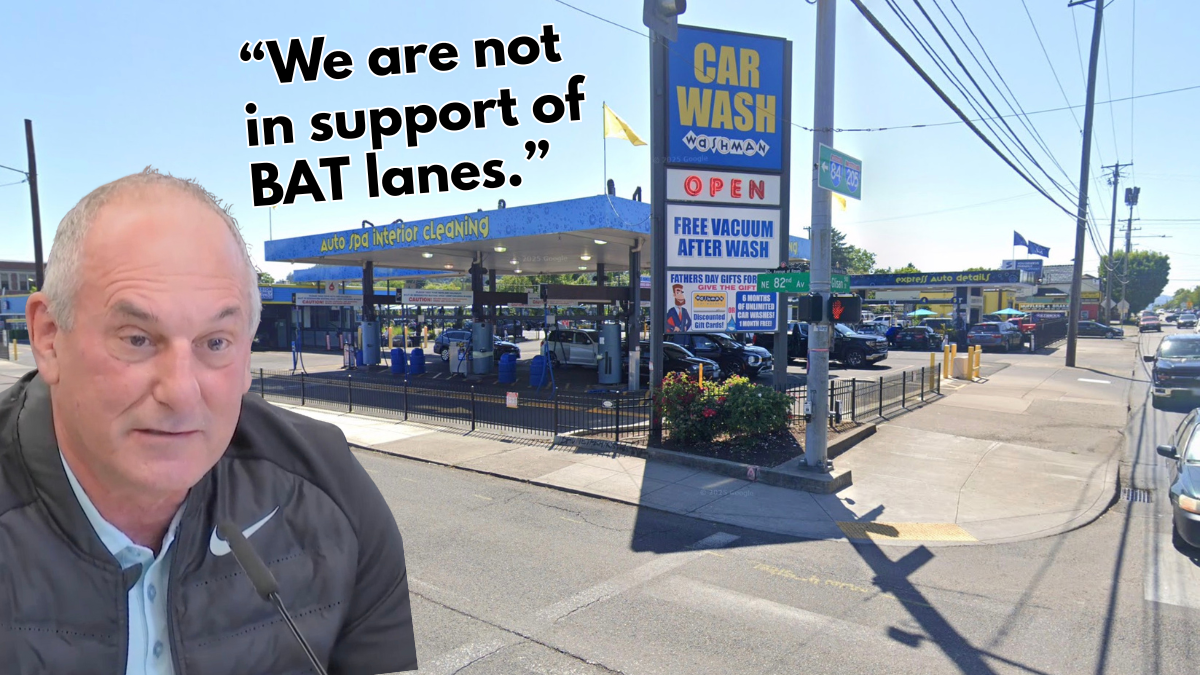
On Friday at the Policy and Budget Committee meeting for 82nd Avenue Transit Project, the CEO of a business that has two outlets in the project area testified in opposition to building better bus lanes. But as I listened to this influential person make their case, it just didn’t ring true. I figured since TriMet is very concerned about business owner opposition, it’s worth taking a closer look at one of their arguments.
Washman Car Wash CEO David Tarlow made it clear in his testimony that Washman does not support Business Access and Transit – or “BAT” – lanes on 82nd Avenue. But the proposal he described in his testimony isn’t even what’s actually being proposed. Below are some false claims and other misunderstandings and/or misrepresentations Tarlow made in his testimony, followed by my thoughts.
“The proposal is that two entire lanes of 82nd — both northbound and southbound — will be closed to motor vehicles and the bus lanes will take their place.”
That is incorrect. The proposal would convert the curbside lane in each direction from a general travel lane to a BAT lane. BAT lanes explicitly allow car users inside of them. TriMet puts “business access” in the name to clarify that.

“… Creating serious additional congestion, taking away 50% of 82nd Avenue’s capacity just to speed up transit times by just a few minutes, but causing the same, or worse, corresponding delays for motor vehicle traffic.”
This is also a misrepresentation of the facts. TriMet’s numbers show that the “More BAT” option (that would build continuous bus lanes on seven miles of 82nd Ave from Clatsop to Lombard) would speed up buses by 11 to 14 minutes. In project documents, TriMet says even without an BAT lanes, buses would be 8-10 minutes faster than current conditions due to new signals, better buses, and so on. The “More BAT” option would add an additional 3-4 minute time saves for bus users. Taken together, that’s a transit trip that would be 8-14 minutes faster — compared to an estimated 3-4 minute delay for car users.
As for capacity, given how much more efficient buses are compared to cars, giving more space to more buses would actually increase the capacity of 82nd Avenue.
“82nd Avenue is a highway corridor that drivers use to get from Southeast Portland to Northeast Portland, and it should not be turned into a local street.”
Since Tarlow clearly only started following this project once he felt threatened by new bus lanes, he must not realize that 82nd Avenue is no longer a highway and that it was already turned into a local street three years ago. If that issue was a concern of his, he should have advocated before the owners of 82nd was officially transferred from the State of Oregon to the City of Portland.
“This proposal would add serious impediments to vehicles trying to get to 82nd Avenue business destinations.”
The proposal would actually remove all through car traffic from two lanes — which to me sounds like removing a serious number of “impediments” (other cars) to drivers trying to get to businesses.
“[The bus lanes]… would lead to frustrated drivers, empty bus only lanes, and more traffic diversion into local streets, resulting in those neighborhood streets becoming less safe for those residents that walk, ride their bikes and kids playing.”
Tarlow is right that the bus lanes would often be empty, giving car drivers even better access to businesses than they have today. And if diversion into neighborhoods became a problem, the answer would be the installation of modal filters and other traffic calming tools to keep drivers from cutting through. Also keep in mind, when drivers cut through neighborhoods it doesn’t have to make streets unsafe. The streets become unsafe when those drivers choose to drive dangerously.
“The congestion caused by taking away 50% of the lane capacity will not only result in increased congestion, as previously mentioned, but will also result in 82nd Avenue becoming a more dangerous corridor to drive on.”
The fewer cars we have on 82nd Avenue, the safer it will be. The more buses we have on 82nd Avenue the safer it will be. Of the 20 people killed while using 82nd Avenue in the past decade, not one of them was hit by a bus operator, while car drivers were involved in all of them.
“I-205, is already at capacity, so those vehicles that normally travel on 82nd will no longer use that route. They will utilize neighborhood streets, take their shopping, etc, to other locations in the city to avoid the congestion, and as mentioned previously, cause businesses to eventually close their doors and move to more viable locations.”
I shouldn’t have to point out the folly of that argument, but it also makes the point that cars are extremely inefficient and a business corridor designed around them lacks the resiliency and capacity necessary to compete for business in 2025.
I realize why someone who’s a CEO of a car wash feels threatened by this project, but if Tarlow is going to take the extraordinary step of becoming an outspoken critic of it, the least he can do is come up with a factual, good-faith argument against it.
For a different view of this story, watch it on YouTube.
Thanks for reading.
BikePortland has served this community with independent community journalism since 2005. We rely on subscriptions from readers like you to survive. Your financial support is vital in keeping this valuable resource alive and well.
Please subscribe today to strengthen and expand our work.
“I-205, is already at capacity” lol.
LA would like to have a conversation with you about what at capacity looks like. Portland has near zero traffic congestion in comparison.
I would love to invite this man on a bike ride going north or south paralleling 82nd. The idea that people will use “local streets” (is 82nd not local?) to get around congestion is laughable. North/South routes don’t continue in a consistent or straight line for more than half a mile for most of 82nd and require crossing many arterials with no or substandard crossings. The few roads where drivers are using side streets to avoid 82nd are already being used and aren’t all that much faster (if at all).
It’s ridiculous we’re even giving him this much consideration over people that actually live along 82nd and or have to commute on it without a car. I’m sure if someone proposed putting an orphaned highway through his neighborhood, in Camas I presume, he would be up in arms about it but it’s fine here where “the poors” live. This isn’t some strip mall off I5 with nothing else around. It’s literally one of the main thoroughfares in the middle of the largest city in the state and is surrounded by people that actually live here.
Is Marine Drive a local street or a highway?
What does that have to do with anything?
In any case, Marine Drive is a regular non-highway roadway under local jurisdiction. That’s not the same as saying “local street” of course, which would be a street primarily for local access.
My point is that “Highway” versus “Local Street” is a completely arbitrary designation. The city owns and maintains several “highways”, some of which are built that way, such as Marine Drive, Capitol Highway, Cornell, Beaverton-Hillsdale, Patton, and so on; many other they “inherited” from Multnomah County (122nd, outer Division, etc), and several from ODOT (inner Sandy, outer Powell, the Portland portion of 82nd). 82nd still has a state designation even after the transfer (route 213), as will outer Powell (US 26) – it’s up to the state to make those designations, not the city. The state and counties also maintain numerous stroads that have gutters, sewers, complete sidewalks, bike lanes, lots of local access, that in most jurisdictions would be considered “local streets” – how is Lombard through North Portland not a local street, exactly, other than ODOT owns and maintains it? And why is 99E on MLK not considered a city highway?
The stupid thing is that it won’t be decreasing his business.
People don’t go to his business becasue they happen to be driving down 82nd, see his sign and say “Oh, man my car is dirty, I’d better turn in and get a wash”.
No, like many businesses people plan to go there and make the trip specifically to get their car washed.
This is certainly how I use 82nd (I travel by car there with one or a few specific destinations in mind). As a car operator, I vehemently support traffic calming measures because they will make driving to destinations on or near 82nd safer, less stressful, and more pleasant. For me a trip to 82nd is already an outing of significance, and a few minutes +/- on 82nd is not going to have a huge impact — if inconvenient travel could dissuade my patronage, it already would have. If I was a daily auto commuter on 82nd, I might feel differently. I really, really don’t understand why businesses so frequently and vocally oppose improvements to their streets. It makes me think they either don’t understand my POV as their customer or don’t value my patronage compared to the more hard core driver.
Especially when Washman basically has a local monopoly on automatic carwashes at this point! It’s hard to find any others left in the Portland area. This guy has nothing to worry about.
You can still go to Kaady on Barbur – and a few other locations, I think. Washman may have something close to a monopoly east of the river.
Still your point is valid: the businessman wants NOTHING to impede his business, ever.
I think you could say this about most businesses on 82nd. I couldn’t begin to guess how few people are zooming along 82nd, see a sign, and say, “Let’s stop here right now “
Using his own arguments, 82nd is a highway devoted to getting from point A to point B as quickly as possible. That’s the exact opposite of the “street traffic” that many businesses in shopping districts like to have.
Trike Guy: in the traffic biz, what you are referring to is “pass by trips”, those unplanned trips generated on a whim while driving…kinda like when one shuffles past an end cap of a supermarket aisle with your shopping cart and you grab that bag of chips between your origin (veggies section) and the destination (milk-like things section).
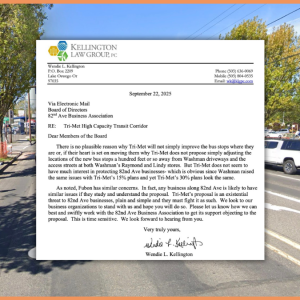
It does beg the question: Do they genuinely not understand the plans or are they lying?Tarlow, one of his managers, and their lawyer all testified last week and repeated the falsity that a “more BAT lanes” project would remove 50% of capacity.
If they really don’t know, then Trimet should have educated them. This isn’t the first time they’ve made this claim. Their letter to the community committee last month made the same claim. Trimet is being negligent in their job if they haven’t educated them.
If, however, Washman folks are lying, Trimet should promptly begin ignoring them.
Knowing how anti-mountain bike people testify at public meetings, these people absolutely know that they’re misrepresenting the proposal
“Do they genuinely not understand the plans or are they lying?”
Reading Jonathan’s article, my conclusion is that Tarlow’s pitch has nothing to do with facts or reasoning or data but is a political stance, something we could slot into the Culture Wars we keep fighting. Just like 47, he has to be against it because the people/groups/perspectives he loathes are for it.
Is this person the CEO of all Washmans in the area or is this a franchise thing?
Its hard to get past the idea that the owner of a business that caters to cars might be reflexively, perhaps vehemently, against anything that does not explicitly favor cars over any other priority.
I’m going to say this again, but it would be incredible to hear from the Tarlows of past transit improvement projects who predicted safer streets would put them out of business. How do they feel now that it’s been a couple of years?
I was just thinking about that the other day when going down Foster. I passed the furniture store and remembered all the signs they had when Foster was changing. They still seem to be around. In fact, there seems to be more on Foster these days.
Well, to be fair, 82nd Ave is rechnically still a highway, albeit one under local jurisdiction. It was a condition of the jurisdictional transfer that PBOT maintain the Oregon Highway 213 highway designation, since it would be weird for Highway 213 in Clackamas County to suddenly end at the city limits. So it is a “non-state” highway, similar to Hwy 99E (MLK Jr Blvd) through inner SE and inner NE Portland up to Lombard St, or Hwy 10 (B-H Hwy) through SW Portland. In other cases, like inner Sandy Blvd (formerly Hwy 30) or Interstate Ave (formerly Hwy 99W), the highway designation and route number were removed completely upon jurisdictional transfer. But 82nd Ave is still Hwy 213, and thus still a “highway” in some sense.
I’m not saying I agree with this guy. I think he’s overstating how much 82nd Ave serves long-distance traffic.
Thanks Marvin.
Also worth noting that the project analysis has found that the average person drives just one mile on 82nd while the average transit trip is 3 miles. So that to me is another reason why Tarlow’s characterization of this as needing to be a highway is very flawed.
Steel Bridge, and Naito Parkway are also considered a highway (99W) and they have separated protected bikeways on them.
N Interstate Ave (99W) is a highway, with only one lane in each direction, and has a continuous sidewalk, bike lanes, bus service, parking and MAX light rail. Change is hard, Life is hard too.
Business owners who care more about money than people need to examine their morality.
82nd Ave is a dangerous, unsafe stroad and is under Portland control now.
Portland needs to show what it’s like when a government is run by mature adults who care more about safety then they do about ADT, when they care more about the environment and our future, than killing us and the planet with fossil fuels.
122nd is even less safe than 82nd, according to PBOT, and it’s been under city control since 1991 when they got it from the county 34 years ago. PBOT has a terrible record related to “show what it’s like when a government is run by mature adults who care more about safety then they do about ADT, when they care more about the environment and our future, than killing us and the planet with fossil fuels.” Ditto on outer Stark, 148th, 162nd, outer Glisan, outer Division, …
I believe BAT lanes stands for “Business Access and Transit” lanes. Business access means private vehicles can use those lanes to turn right into businesses while transit can proceed forward unimpeded. It should be noted that BAT lanes are already a compromise compared to exclusive transit lanes and they do not reduce capacity the same as an exclusive transit lane would.
The streetcar and Line 6 have had a continuous BAT lane on MLK and Grand for years where Washman has two other car washes – Stark and Grand as well as Broadway and MLK Jr. I don’t think the sky fell then, did it?
I do think that business owner concerns about BAT lanes making it hard to access their businesses are wildly overblown, but even if it were the case that their businesses were genuinely harmed, the arguments against car infrastructure are:
-cars are the most dangerously form of transportation
-cars are the most expensive form of transportation
-the city cannot afford to maintain car infrastructure because it is too expensive
-if we require car parking for houses/apartments, people cannot afford to buy them
-public transit has much higher capacity for the same road footprint than cars
-cars cause noise pollution, air pollution, carbon pollution with many harmful and expensive consequences
So uh, sort of a no brainer?
FYI your article defines BAT lanes as “business access and turn” lanes. Just want to point out that the project defines it as “business access and transit.” Small difference but worth noting.
ah thanks gimbo! That was a mistake. Sorry for any confusion. PBOT calls them Bus and Turn so my brain got mixed up.
Notable that one of the Washman car washes sits at a high crash intersection. I wonder how much his business has contributed to those crashes and injuries. People like this are the reason we need a full on “War on Cars.”
“PBOT reviewed 10 years of crash data (2012-2021) on 82nd Avenue, from NE Glisan to Davis streets, to understand patterns in safety issues. This analysis gave particular attention to incidents involving vulnerable roadway users and those that result in fatalities or serious injuries.
A total of 236 collisions occurred within this study area from 2012 to 2021, which is the most recent period with data available.
Seven of these collisions resulted in eight serious injuries and two deaths. Both of the fatal collisions involved a vehicle and a pedestrian, and both occurred at signalized intersections – one at Glisan and the other at Davis. PBOT found that 86 percent of serious injuries and fatal crashes involved travelers who disregarded their signal.
In 2023, a third fatal collision involved a vehicle and pedestrian using a wheelchair at the intersection of 82nd and Glisan.
The blocks just north and just south of the NE Glisan intersection have a notable pattern of left-turn crashes. Within five years, there were nine such crashes, resulting in a severe injury, a moderate injury, six minor injuries, and a pedestrian injury. The pedestrian was injured while crossing NE 82nd Ave north of NE Glisan. The proposed traffic separators and medians on NE 82nd Avenue will reduce or eliminate the risk of these crashes.”
If you look up “Portland Washman car washes” on Google Maps you will find that all 12 of their locations, every single one of them, are on high-crash corridors. His whole business model is directly related to maintaining high-traffic dirty stroads, otherwise he loses business. There are many businesses, both local and national, that thrive specifically because they benefit from dirty stroads, crashes, car dents, skidding, and burning fossil fuels – car repair, tires, auto parts, lawyers – it’s worth many billions of dollars, not to mention the industries related to rebuilding and repaving streets.
Anyone else wonder if he’s nervous this change might impact his business’ reliance on allowing cars to overflow onto the street when the line gets too long?
Nailed it!