

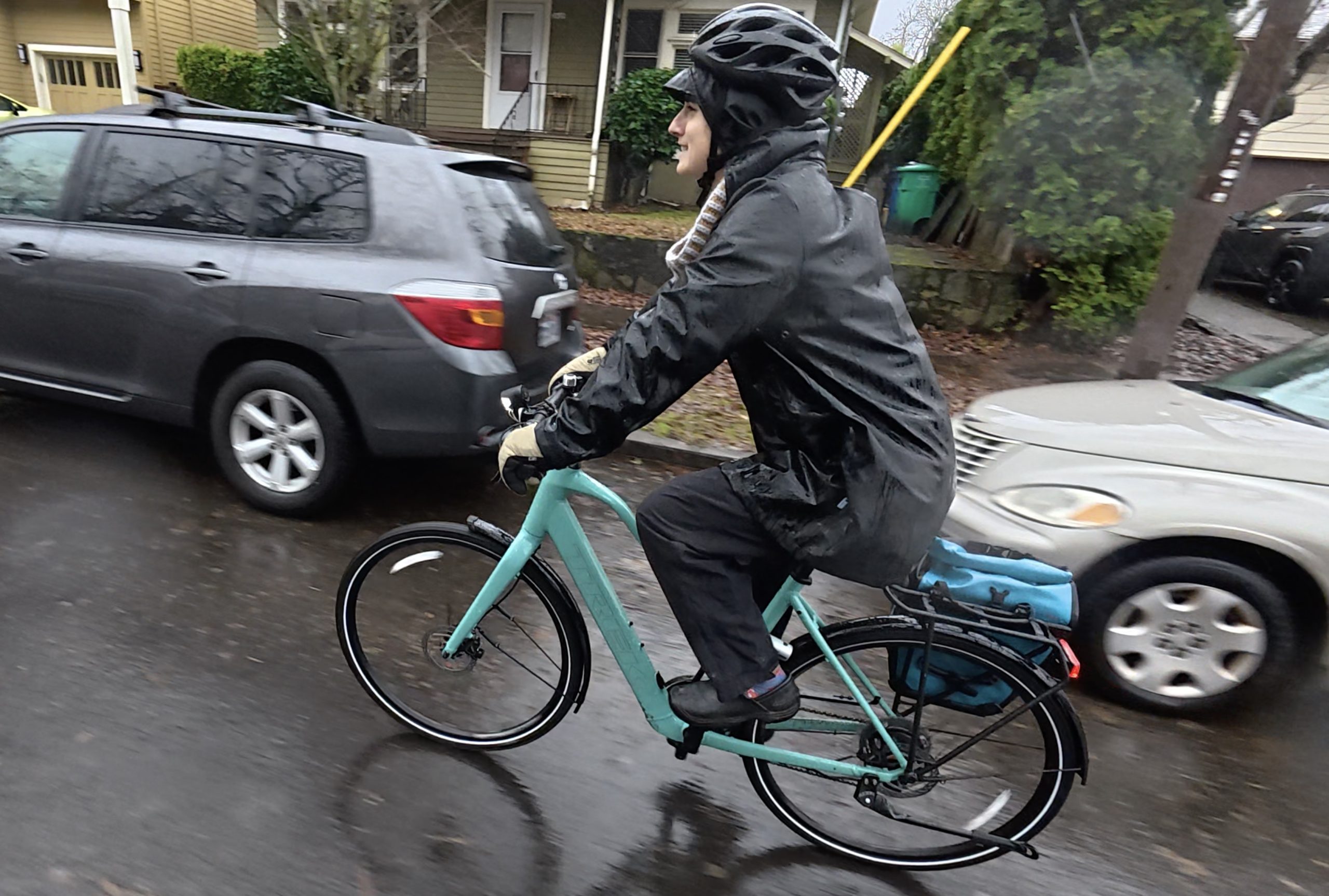
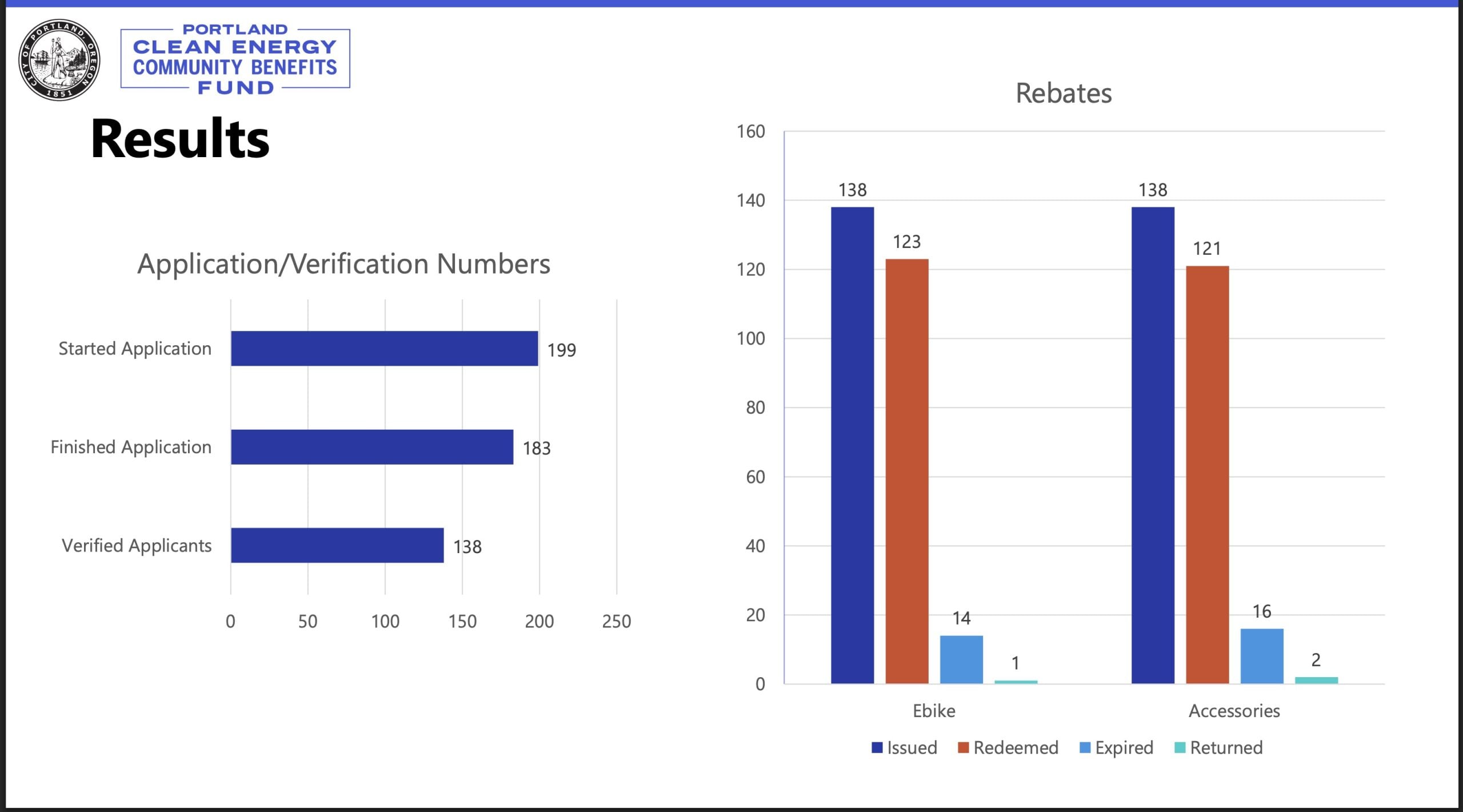
138 Portlanders took advantage of the City of Portland’s first e-bike rebate program. The Portland Bureau of Planning and Sustainability (BPS) launched a pilot of the program back in September and reported last night at a meeting of the Bicycle Advisory Committee that there was “strong demand” for the discounted bikes.
The pilot offered rebates of $1,600 for e-bikes and $300 for accessories to Portland Community College students. A presentation shared last night revealed that 183 of them finished the application and 138 were ultimately verified. The program directs rebate recipients to specific types of bicycles (Class 1 e-bikes with a 20 mph top speed and no throttle only) at authorized e-bike retailers.PCEF Strategic Communications Manager Elizabeth Stover tells BikePortland, “We have 123 more Portlanders on e-bikes and boosted local business by putting $250,037 in the hands of our Portland bike shops.”
Below is some of the data BPS gleaned from 202 pilot program participants:
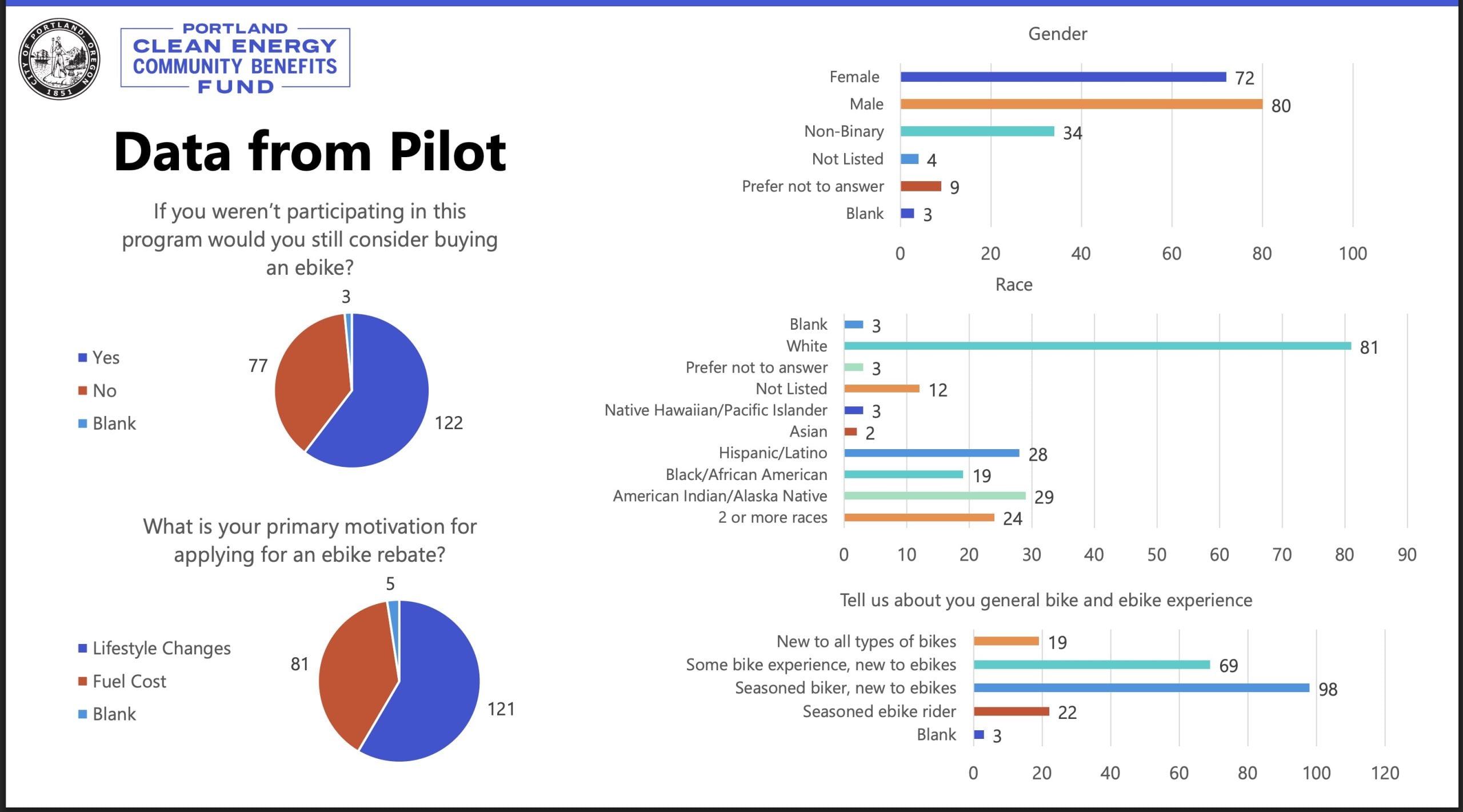
- The gender split between male and female was relatively even, with males receiving 80 rebates and females receiving 72. Non-binary people received 34 rebates.
- When it comes to race, White people received the overwhelming number of rebates with 81. Black Portlanders received 19 rebates, with Hispanic/Latino and American Indian/Alaska Native people received 28 and 29 rebates respectively.
- Just over 9% of the participants were new to bicycling.
- Asked, “If you weren’t participating in this program would you still consider buying an e-bike?,” 60% of respondents said “Yes.”

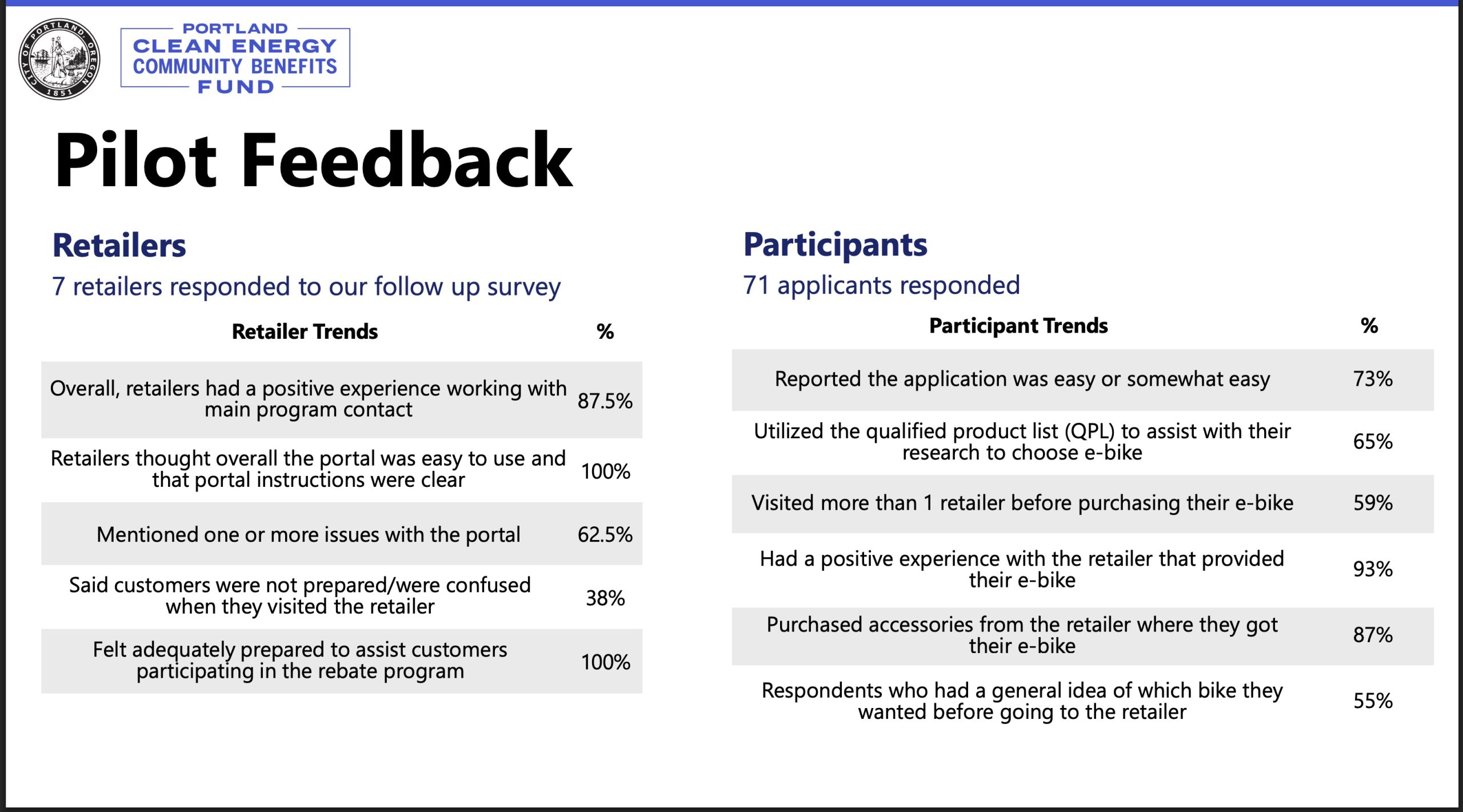
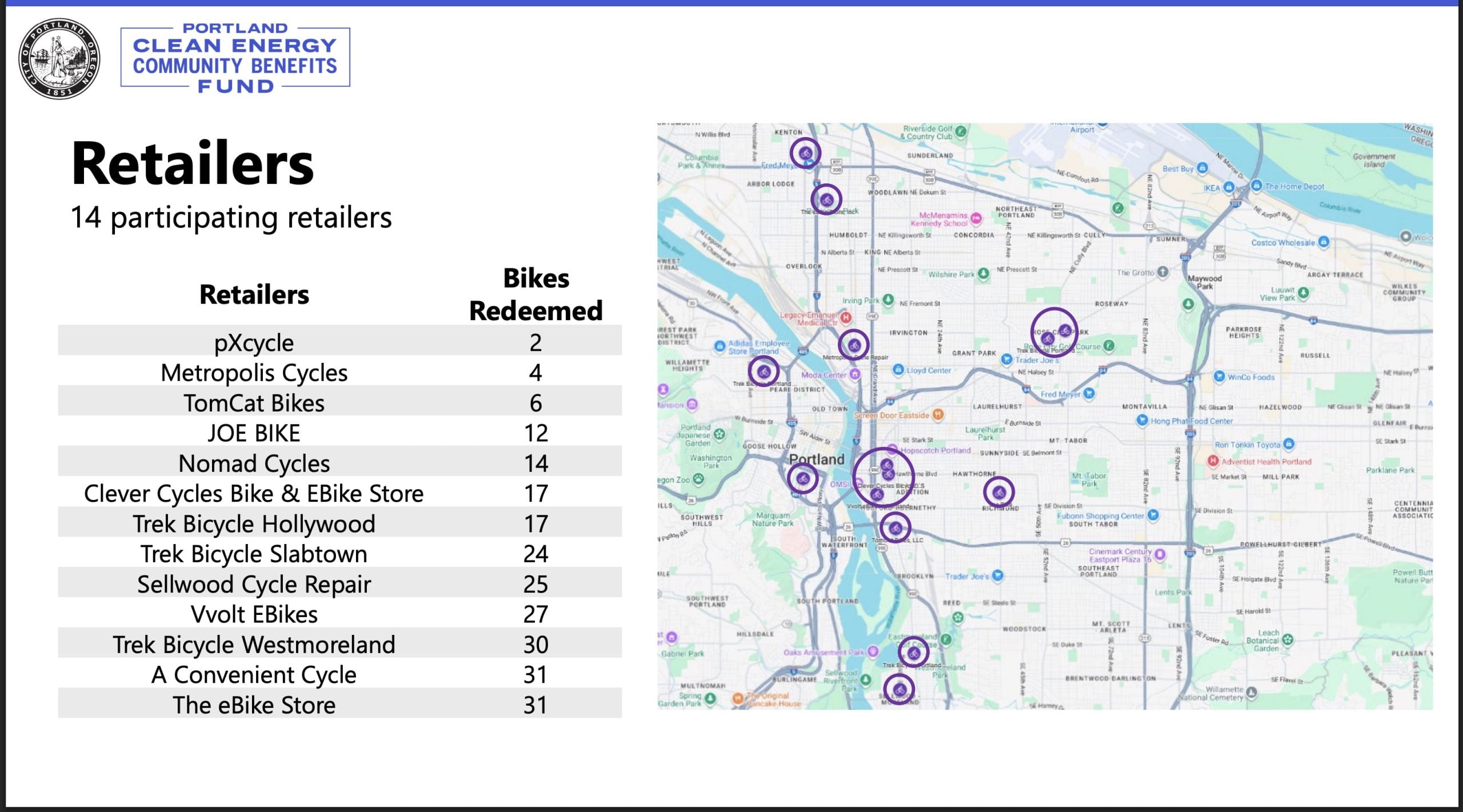
13 local bike shops redeemed at least one rebate. The two shops with the most rebates processed were A Convenient Cycle and The e-Bike Store who both sold 31 bikes through the program. Other top sellers were Trek Bicycle Westmoreland (30), Vvolt (27), Sellwood Cycle Repair (25), and Trek Bicycle Slabtown (24). A big measure of success for the pilot is that 88% of retailers said they had a positive experience working with program staff and 100% of respondents said the online portal was clear and easy to use. There were similar levels of good reviews from program participants.
PCEF Transportation Decarbonization Program Manager Seetha Ream-Rao said beyond the clear success, some of the lessons learned include: more outreach to “key demographics,” more education on choosing e-bikes, and it’s important for participants to test ride bikes before making a decision.
Ream-Rao said the main launch of the program will happen in late March (of this year) with a complementary program for adaptive bikes launching in April. BPS will expand offerings in the full launch, adding Class 2 e-bikes and cargo e-bikes (which will qualify for a $2,350 rebate). Visit PortlandEbikeRebate.com to learn more.
NOTE: I realize that some of the numbers in the BPS report don’t quite add up. I’ll follow up with project staff next week to clarify.
UPDATE, 1/26 at 8:44 am: Given the confusion over data in the report, I asked BPS to clarify. They acknowledged a few typos in the report and have shared the statement below:
I spoke to our team, who let me know the chart in the presentation deck had a typo. Please allow me to share an accurate breakdown of those numbers below:
244 rebates were redeemed overall, including:
- 123 E-bike rebates
- 121 Equipment rebates
There were 138 participants awarded, but 15 did not redeem them within the allotted timeframe.
Each participant was awarded a rebate for an e-bike and equipment. However, not everyone who redeemed the rebate for an e-bike redeemed for equipment.
In our chart, the number of overall rebates was incorrectly labeled as “bikes redeemed.”

Thanks for reading.
BikePortland has served this community with independent community journalism since 2005. We rely on subscriptions from readers like you to survive. Your financial support is vital in keeping this valuable resource alive and well.
Please subscribe today to strengthen and expand our work.
“Free” money from beleaguered Portland taxpayers shows “strong demand”. What a surprise…..
I’m happy to see my tax dollars go toward programs like these. Automobile drivers have been the beneficiaries of socialized subsidies for far too long!
Jeremy,
No one here is anti-bike—but let’s be honest: writing $1,600 checks to people who mostly already planned to buy e-bikes isn’t radical climate policy. It’s consumption-based decarbonization that leaves the car-first system intact. And the irony is that the same folks cheering this on keep pushing anti-business tax hikes and protest politics that shrink the tax base we’d actually need to fund real change. You don’t get protected lanes, frequent transit, or car-optional neighborhoods by chasing employers and revenue out of the city and then redistributing what’s left in feel-good rebates. Structural change requires a functioning economy, not just better press releases.
Where did you find the data that the people who receive e-bike subsidies (in portland or elsewhere) mostly already planned to purchase the same bike with or without the subsidy? I haven’t seen that reported anywhere. I leased an electric car in 2016, something I am not sure I would have done without the federal credit that lowered the cost. Having it for a few years caused us to continue to have an electric car after that even though the one we bought had no tax credit. I have talked to many other folks who had a similar experience, I see no reason why an ebike rebate program wouldn’t create similar long term shifts.
Maybe you need to read the article… 60% of the participants in the program state they would buy an e-bike if they were not given one.
The program is attracting people who already want to bike so I assume it will be successful for that reason.
The bikes are not replacing cars so the program has no effect on climate anyway… It’s ludicrous to think a few hundred e-bikes makes a dent in anything climate related. It is a nice feel good program that just makes the PCEF tax seem entirely performative which does not bode well for taxes longevity. Programs like this just ensure taxpayer blowback.
Back with the Chat GPT responses Tropical Joe. No one is typing out an em dash! And the “doing X isn’t Y. It’s Z” constructions.
Also, what are you talking about? You can in fact have good infrastructure while doing re-distributive tax policy. You can make structural changes to policy at any time. It’s just harder when the economy is weak, because naysayers bring up a bunch of reasons why you can’t do it, and politicians are unaccustomed to standing on principles (most of the time anyways).
Mate, going after punctuation and yelling “ChatGPT” is just a way to dodge the argument. It changes the subject without answering anything.
Yes, in theory you can have redistributive tax policy and good infrastructure. The problem you keep skipping is the Portland doom loop happening right now. Employers leave, the tax base shrinks, services get worse, and City Hall leans into feel good programs because they are easy to announce.
Saying “you can make structural changes anytime” is classic everything is fine while the walls crack. Structural change needs revenue, trust, and a functioning economy, all of which Portland is actively burning through.
If you want to debate policy, let’s do that. But pretending this is about grammar or ChatGPT is just a distraction. Cheers
“Yes, in theory you can have redistributive tax policy and good infrastructure. The problem you keep skipping is…”
The other problem is the fact that most politicians, even the “socialist” ones, want to get reelected to what is a fairly cushy, generously paid job.
“No one is typing out an em dash!”
WordPress changes two dashes to a –.
This program seems like a winner all around. I couldn’t tell from the stats whether ALL of the 138 e-bikes were purchases locally – maybe some were mail-order?
That’s a real winner – pumping so many $$ into our local economy helps everyone.
We can’t know if the program is a winner until we get some data back about how much these bikes are used, how much driving they displace, and how long the bikes stay in use.
I think Fred has their finger on the pulse of the popular opinion. Actual success setting us all up for a better tomorrow with a resilient local environment and a economy based on resilience is nowhere as important as getting the money from the “big corporations” out to the population. The original goals were:
It’s clear from the awards given out and the support given them by people here that the Economic Opportunity and Equity and Community Leadership seem to be the priorities.
As long as the money flows to the right people and new things are bought and handed out, no matter how disposable they are, its a win.
If it’s anything like The Street Trust’s Ride2Own program, the majority of participants will be racking up serious miles. Since our first deployments in 2023, we’ve seen numerous R2O bikes come in for service or checkups that have been steadily logging hundreds of miles per month.
Out of the 27 Erides pilot program vouchers we redeemed at Vvolt, we identified one customer who was primarily seeking a free toy. 97% are in it to get themselves a better transportation option.
It takes a lot of riding to make the vouchers cost effective from an environmental standpoint, and the counterfactual is important too. Displacing conventional bike miles aren’t great, and displacing bus travel could actually be harmful of it makes transit less viable.
Only time and vigorous data collection/analysis will tell.
Do you really think our local “slush fund” will look critically at their expenditures? PCEF has already spend hundreds of millions of tax dollars without doing so and created an arsenal of funded nonprofits that will fight back against accountability for taxpayers.
Any and all city money goes to one of 3 main types of businesses: The city agency itself or other public agencies who are all well-experienced in hiding expenditures and results in “budgets”; Private corporations including local small firms and massive multinationals who are equally good at hiding expenditures and results in annual and quarterly “GAAP” balance sheets; and nonprofit corporations (usually 501c3) who have to file 990, 990EZ, or 990N forms at least once every 3 years or else the IRS removes their nonprofit status (and the city will no longer do business with them.) All these types must file taxes, but with nonprofits you the public can actually look up the forms filed and scrutinize them, for any and all nonprofits.
A 990N form is pretty simple, did your nonprofit make $50,000 or more? Yes or no? (Presumably yes, it made less than $50,000, end of story.) Almost no useful information on the form other than they didn’t have much income and their board is probably pretty small (it may be just one or two people.) You can find out from the state who is actually responsible for the corporation.
If your nonprofit filed a 990EZ (required for any nonprofit making $250,000 income but smaller nonprofits have an option to file the form too), there’s quite a bit more information, including actual income, some of the personnel involved, and income sources.
The 12-page full 990, required for $500,000 income nonprofits (but an option for smaller ones too) has quite a lot of detail, personnel and their incomes, funding sources, and quite a lot of other details. Given how long the form is, why would a smaller nonprofit even consider doing the form you might ask? Because the form has most of the information that a $1,000 to $5,000 financial audit would also have, but at a small fraction of the cost, which a nonprofit needs in order to apply for certain kinds of operational grants with certain corporate foundations and governments.
Compared to the other types of corporations and agencies, nonprofits are relatively speaking much more transparent (or not as opaque).
David, with respect, you live in North Carolina. You are doing this from 2,800 miles away with a spreadsheet and a lot of faith. On the ground in Portland, the nonprofit scene is not some choir of angels filing pristine 990s. It is a feeding frenzy.
Yes, nonprofits file forms. Great. So did the outfit that PCEF nearly handed millions to that turned out to be run by a straight up fraudster. That only stopped because Shane Kavanaugh slammed the brakes, not because the system caught it. The system was happily writing the check.
Here we have nonprofits with no track record, no capacity, and three board members who all live together suddenly becoming “community based climate leaders” the moment a tax stream appears. Money goes in, consultants get paid, swag gets bought, reports get written, and emissions reductions remain purely theoretical.
From afar it looks transparent. From here it looks like a cottage industry where the main deliverable is staying eligible for the next grant cycle. Filing a 990 does not stop grift. It just documents it nicely after the fact.
So yeah, I get the theory. But Portland is not a theory. It is a case study.
“138 Portlanders took advantage…” But 15 of those actually did not take advantage because:
“We have 123 more Portlanders on e-bikes…” Kinda crazy that 15 people got a free $1,900 but said “Nah,”
Also, I added up the Retailer list of bikes and there are 240 bikes redeemed. (so, 102 to 117 more than people actually received bikes)
The Pie charts are curious too. From either the 183 who finished the application, or the 71 that completed the survey they have 202 and 207 responses.
Hard to make sense of these numbers.
Who is doing the math on those charts?
240 Bike redeemed from 14 Retailers
123 ebikes ‘Redeemed’ (next page)
202 “If you weren’t participating….”
207 “What is your primary…”
202 “Gender?”
204 “Race?”
211 “ebike experience?”
Haven’t forgotten about this. I’ve emailed the program staff to ask for clarity around the discrepancies in the numbers.