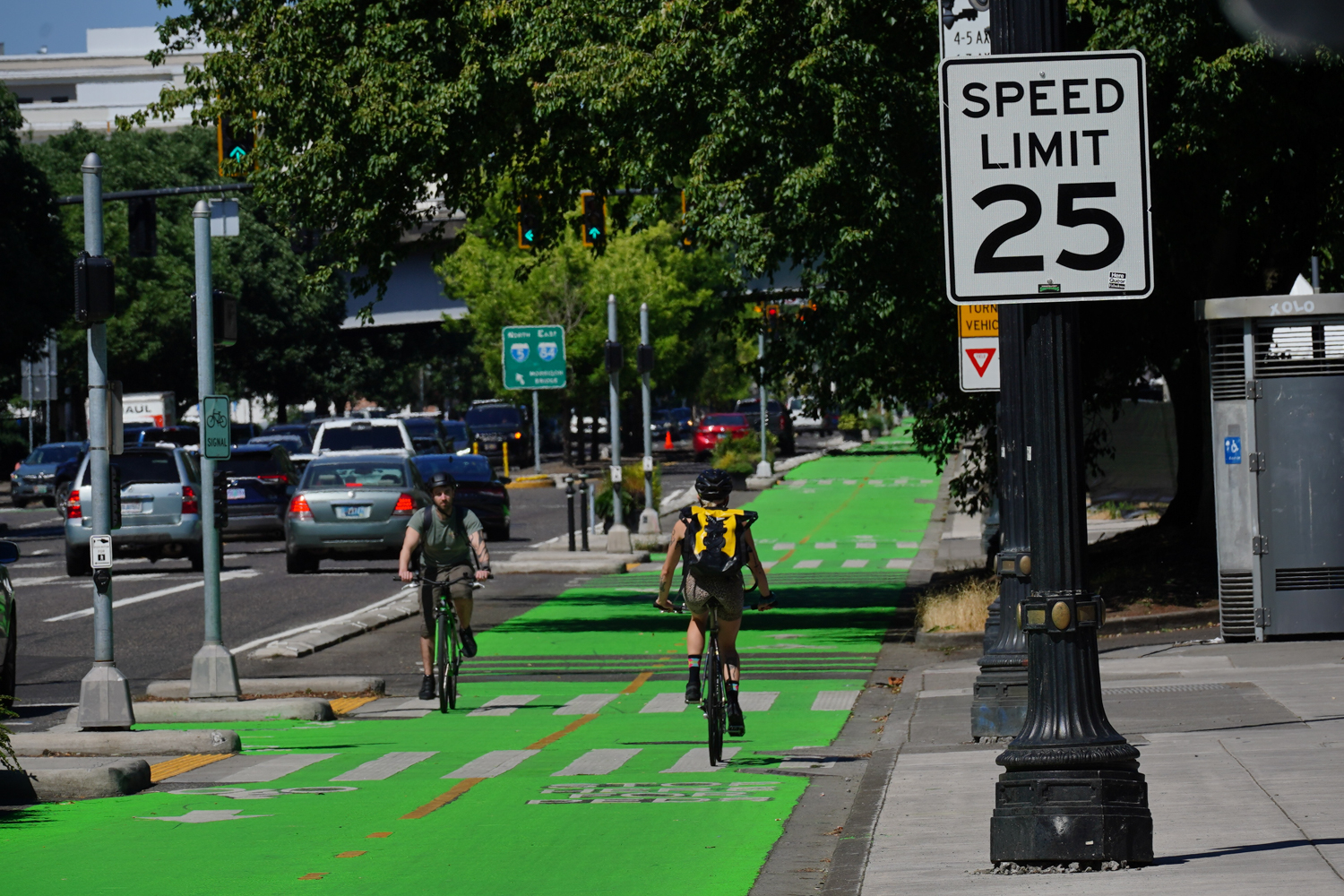
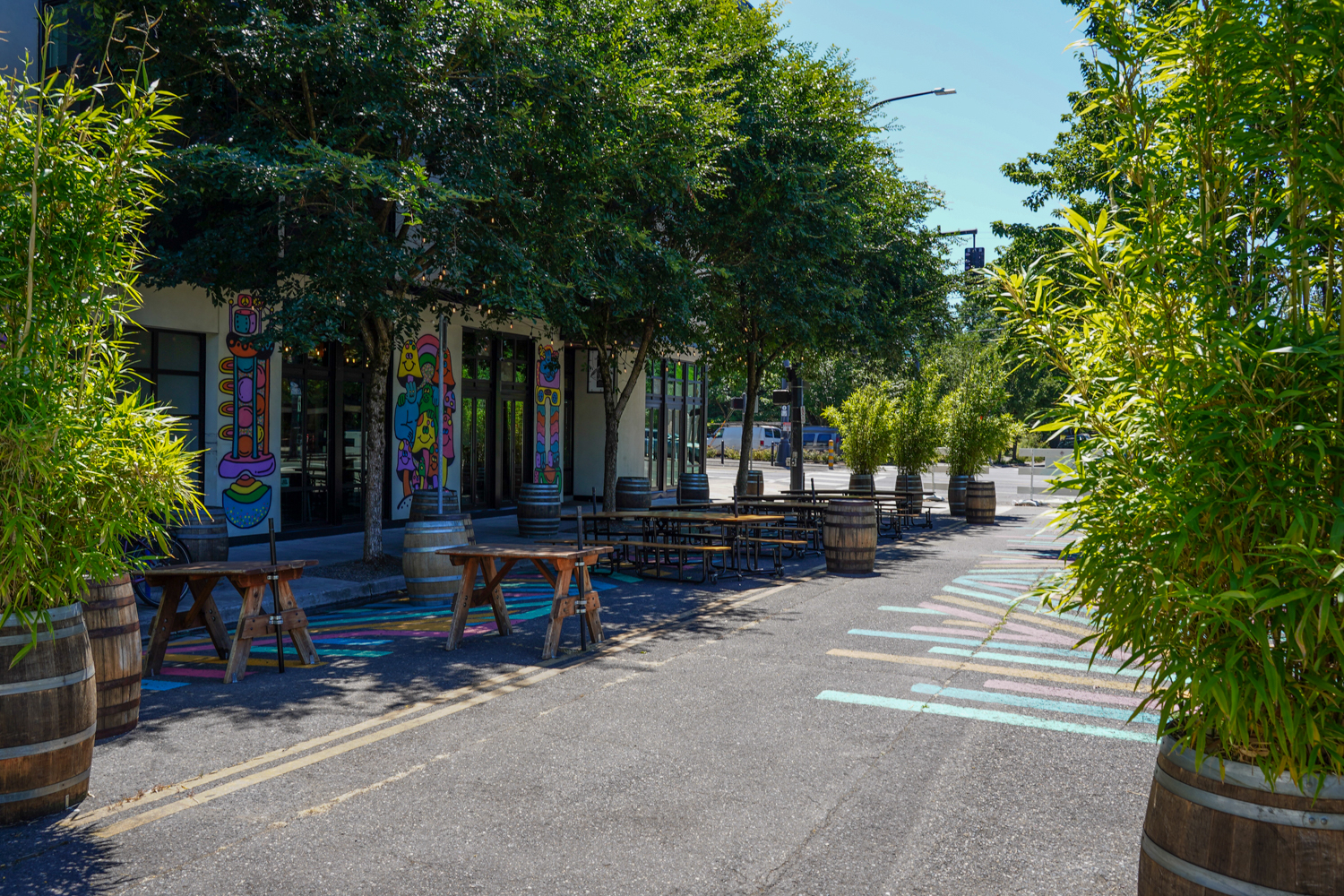
Get out and enjoy this great weather! (Photo: Jonathan Maus/BikePortland)
I hope everyone is having fun on all the great rides going on. Remember it’s Bike Summer Pedalpalooza season so you’ll want to check the official calendar and/or grab the Bike Fun App (iPhones only) for all the ride options!
Check out my picks for the best things to do for bike lovers this weekend…
Saturday, July 27th
Ride Around Clark County – All Day in Vancouver (WA) Vancouver Bicycle Club hosts this annual supported ride with four route options ranging from 18 to 104 miles in length. More info here.
Bike Back the Night – 11:00 am at Colonel Summers Park (SE) This ride raise awareness of how to handle domestic and sexual abuse. I did this ride way back in 2008 and it was really eye-opening. Supports the nonprofit Call to Safety. More info here.
Community Cycling Center 30th Anniversary Bike Carnival – 12:00 to 5:00 pm at Alberta Park (NE) Come one, come all to this family-friendly celebration of three decades of the CCC! Classic games, traditional carnival snacks, workshops, and more! More info here.
Advertisement
Art in the Bike Lane Ride – 2:00 pm at Ladd Circle (SE) Fourth annual edition of this classic ride that pays homage to the whimsical bike lane characters and sharrow art you see all over town. Folks come dressed up as their favorite and the ride leader is an amazing person who knows a ton about the bike lane art program and wants to keep the tradition alive. More info here.
Big Break Block Party – 4:00 to 10:00 pm at SE 7th and Sandy Be a part of the excitement for a future green plaza at the intersection of SE 7th/Washington/Sandy. Hosted by Depave and the Central Eastside Inudstrial Council, this event starts today with a clean-up and builds to Saturday’s massive blowout featuring food, fun, tons of great live bands, and all the cool people who believe excellent public spaces are the key to excellent cities. More info here.
80s Mixtape Ride – 7:15 pm at Portland Opera/Esplanade (SE) Vibe to a crowd-sourced playlist of 80s favorites and stop for karaoke and dancing. Ride merges with other big rides so get ready to party! More info here.
Sunday, July 28th
NPGreenway River Walk – 11:00 am at University of Portland Boathouse (N) Get a close look at the newest section of the North Portland Greenway paved trail on the Willamette River and take a walk with advocates pushing to complete the project that will someday connect the Esplanade to Kelly Point Park. More info here.
Hablamos Español con Abuelita! – 11:30 am at Peninsula Park Keep your Spanish-speaking on point by spending time on a ride where only Spanish will be spoken (I’m sure they’ll help you along if you have trouble) and the playlist will be abuelita-approved. More info here.
Ride for Gaza and Sudan – 12:30 pm at Alder Commons (NE) Join with others who want to end these horrific, violent conflicts and raise support and awareness for innocent victims. Ride ends at a fundraiser. More info here.
Climate Adaptation Ride – 2:00 pm at Salmon Street Springs (SW) From ride organizers: “Let’s spend a bit more time in our saddles talking about adapting to a future where we can thrive, no matter what climate change throws at us, by being more prepared and building community.” More info here.
— Did I miss your event? Please let me know by filling out our contact form, or just email me at maus.jonathan@gmail.com.
A Biketown station on NE 11th in the Lloyd full of the new scooters. (Photos: Jonathan Maus/BikePortland)
The City of Portland has silently launched a new fleet of electric scooters. As far as I can tell, the new scooters hit the streets this week. A spokesperson I contacted via text yesterday after seeing the scooters in the wild for the first time responded with only, “Soft launch. Big news coming. In a couple weeks. 😃 [smiling face emoji].”
The scooters are Biketown-branded and are owned by Lyft, the same company that holds Portland’s bike share contract. Readers have reported Biketown stations full of scooters in northwest and the Lloyd. The tight marketing integration (you can also find the scooters in the same Biketown app where you rent bikes) makes sense and will likely help these new scooters succeed.
PBOT first launched an e-scooter rental program in July 2018. Despite being a mode many people love to hate, e-scooters have done very well here. In 2022 PBOT decided it was time to drop the “pilot” and make scooters a permanent program. Since that time they’ve issued requests for proposals for a company (or companies) to operate the program and expected to have the new contract in place last year.
Advertisement
The grey color differentiates them from the Nike orange bikes, but an orange rear fender ties the colorways together.
We’ve had several different scooter companies enter and exit our market. Bird was here for a while. So was Spin, but both of those companies no longer offer e-scooters in Portland. That leaves just Lime — and now Lyft/Biketown — as the only scooters on our streets. According to the city’s micromobility dashboard, there are currently about 1,340 e-scooters for rent in Portland (compared to about 1,000 e-bikes).
the first ride is limited to 10 mph maximum, then they top out at 15 mph (we should do that for cars!);
riders must be 18 or over;
parking is free at Biketown stations and there’s a $1 fee if parked elsewhere;
the scooters have integrated turn signals;
riding is prohibited inside Portland parks, high school campuses, and TriMet MAX platforms.
Advertisement
Pricing-wise, annual Biketown members can unlock scooters for free and rides are $0.27 per minute. Non-member rates are $1 to unlock and $0.37 per minute. The “Community Pass” offers eligible Portlanders a monthly fee of $5 for free unlocks and rides for $0.07 per minute.
The scooter is Lyft’s “next-gen” model that came out in February 2023. It’s got lots of tech to track routes and detect when riders are on sidewalks. The scooters also have a phone mount, dual brake leavers, and suspension.
PBOT spokesperson Dylan Rivera says Lime and Lyft are slowly ramping up service and, “In the coming weeks the two companies should have more than 3,000 scooters combined in Portland.”
Stay tuned for the official launch and let us know if you’ve ridden one yet and what your experience has been.
Naito Parkway near SW Taylor St on July 23rd, 2024. (Photo: Jonathan Maus/BikePortland)
We watch Naito Parkway very closely here on BikePortland because it’s home to one of the most high-profile bikeways in the entire city: Better Naito. So when I recently heard grumblings in activist circles about its speed limit and the rate at which people break it, I decided to take a closer look.
Turns out the posted speed limit on this important, 1.2 mile stretch of Naito between SW Harrison (near Tom McCall Waterfront Park) and NW Everett (where the protected bike lane ends prior to the Steel Bridge) has gone through quite a few changes in the past eight years. And if all goes according to plans hatched just this week by the Portland Bureau of Transportation, we’ll see yet another change before the end of the year.
Come with me on a bit of a wonky ride into the history of Naito Parkway speeds…
Advertisement
Same location as lead photo in 2009 with a 30 mph speed limit.At beginning of Better Naito in 2017 with 20 mph speed limit.
Think back to 2016 when Naito (also known as Pacific Highway West/99W) had narrow, paint-only bike lanes and five general travel lanes (image on left). It was really inhospitable to cycling! In that era it had a posted speed limit of 30 mph. When the adjacent Waterfront Park had large festivals, crowds would spill into the lanes and create a very unsafe situation. It was that context that the idea for more cycling and walking space was born and named “Better Naito.”
In 2020, after three years as a pilot project, PBOT was finally ready to make the protected bike lanes permanent and launched the Better Naito Forever project. During this period, PBOT was able to reduce the speed limit to 20 mph since Naito was a construction zone (image on right).
In 2021 PBOT began the process to reduce the posted speed limit from 30 to 25 mph by making a formal request with the Oregon Department of Transportation (who oversees all speed limits). ODOT approved that change in 2023 and the signs changed from 20 to 25 mph earlier this year.
That five mph increase raised eyebrows. Why would we allow people to go faster on a multi-modal street in a crowded part of downtown Portland? That’s the question I asked PBOT this week as I began to look closer into this story.
Advertisement
PBOT spokesperson Dylan Rivera explained the history and said, “The bureau has been working on submitting a new speed zone reduction to 20 mph through our authority to set speeds in business districts.”
The “authority to set speeds in business districts” Rivera refers to is something PBOT has only had since a change to Oregon law went into effect in 2022. This change (outlined in Oregon Administrative Rule 734-020-0013) gives cities more power to investigate and determine speeds on roads in their jurisdiction (instead of ODOT having total control). In Oregon, the statutory speed limit for business districts is 20 mph.
Then Rivera added, “As of this morning (July 24th), we’ve submitted a request to rescind the 25 mph speed from Harrison to Everett in favor of a 20 mph speed as a business district. Assuming ODOT approves that request (which they typically do within days), we could change the speed back to 20 mph in the next 2-3 months.”
While Rivera seems confident ODOT will grant the 20 mph request, the ultimate decision is still in state engineers’ hands. (Who exactly has authority over the various aspects of speed limit setting is still a bit murky to me. The ODOT flow chart that explains it helps a little).
Advertisement
(Source: ODOT speed zone investigation #13168, May 2023.)
The current rate of rampant illegal speeding on Naito might figure into that decision. When ODOT did a speed study of Naito in May 2023 (and approved PBOT’s request to go from 30 mph to 25 mph), they found that 94% of all drivers exceeded the 20 mph limit. The 85th percentile speed — the speed at or below which 85 percent of all vehicles are observed to travel under free-flowing conditions — was 32 mph. (A PBOT speed study in December 2022 found similar numbers.)
One of the reasons ODOT agreed to lower the speed limit to 25 mph was because, “The crash rate for the segment exceeds 150% of the average crash rate,” for similar types of roadways. The question remains whether ODOT thinks lowering it even further to 20 mph will encourage folks to slow down and crash into each other less frequently, or whether it will be too low to process average daily traffic volumes.
Given how fast the majority of people drive on this stretch of Naito, making Better Naito Forever 20 mph forever could be considered too much of a stretch for ODOT to make.
ODOT says they are currently reviewing PBOT’s request and they will have a decision next week. Stay tuned. The speed limit signs on Naito might be changing once again!
Zidell Yards was bustling at the 2023 MADE show. (Photo: Echos Communications)
The MADE 2024 bike show will return to Portland next month. Organizers announced Monday that tickets are now available for the event that will take place once again at the Zidell Yards venue in South Waterfront on August 23rd through 25th.
Last year MADE brought around 200 exhibitors to the cavernous, 100,000-square foot former shipbuilding warehouse and in so doing set a new standard for handmade bike shows and cemented Portland’s status as a cycling epicenter. The show’s organizers, bike industry public relations and marketing firm Echos Communications, is fresh off a show in Melbourne, Australia in June.
Th exhibitor list for MADE 2024 includes over 50 framebuilders and Echos already saying it will be, “the world’s largest gathering of builders and the public.” Among the builders coming this year are Portland-area favorites HotSalad Bicycles, Ira Ryan Cycles, Fiddlehead Cycles and Sage Titanium.
“For 2024 we’ve expanded the floorplan and have ample space for new builders and brands to join the community,” said MADE Co-found and Show Director Billy Sinkford. “We have new brand partnerships and activations with BikeFlights, Campagnolo, Chris King, ENVE, Shimano and Yakima, builders coming in from all across the world, and a full schedule of events.”
Advertisement
If you love bicycles and appreciate the craft of building them from raw materials into beautilitarian machines, you should consider attending this show. It’s a unique celebration of the art of framebuilding and a gathering of artisans and admirers where everyone is welcome.
Event details:
Dates: August 23 – 25, 2024
Location: Zidell Yards, Portland, Ore.
200+ builders and supporting brands
Evening activations supported by Chris King, Shimano, and Yakima
Iconic covered venue with indoor and outdoor expo space
Elevator Coffee provided by Shimano
Cold treats provided by ENVE
Sparkling water provided by Campagnolo
Beer garden supported by Block 15 Brewing
Multiple food and beverage options on-site, with many more in walking distance of the venue
Single- and multi-day tickets available
On-site parking available with ticket purchase
On-site bike parking
Public transit: Zidell Yards is a half-block away from a bike-specific bridge and directly on the waterfront bike path. Multiple train and bus options are less than a block away
Francisca Garfia and Leah Benson from the City of Portland on the patio last week. (Photo: Jonathan Maus/BikePortland)
Thanks to everyone who came out to Bike Happy Hour last week. A lot of our regulars were on the Urban Shade Equity ride, but we still had a nice crowd. With perfect weather on tap, I’m looking forward to seeing all your beautiful faces again tomorrow. Keep reading for a quick recap of last week and a note about who’s coming to the patio this week.
Last week we were treated to a fun and informative presentation about ranked-choice voting and the City of Portland government transition. We had several city staffers on hand to answer questions and we held a mock election. Francisca Garfia and Leah Benson from the city’s elections team tallied votes for the most important bike path in Portland. They explained that ranked-choice voting is a process of counting votes in multiple rounds and throwing out the option with the least votes in each round. Since voters make up to six choices, any votes for the losing option get transferred to that voter’s next highest-ranked choice until there are three winners who reach the required vote total.
After 413 total votes cast, the winners where Eastbank Esplanade, Springwater Corridor (Southeast) and Springwater on the Willamette. I highly recommend checking out the results page to watch the rounds play out in real time and learn more about the voting process. Thanks to everyone who voted! And I appreciate the City of Portland folks for coming out. Francisca, Leah, and Charter Transition Project Manager Shoshanah Oppenheim weathered a hot sun and some very spirited questions.
This week we’ve got at least two special guests: Josh Hetrick from the Shift calendar team and Jacob Apenes from Sunrise PDX.
Josh is a lead volunteer for the Shift website and calendar. If you haven’t heard, Shift is the original group who began organizing Portland’s bike fun community in 2002 and has remained a stalwart part of its foundation ever since. Their calendar is the go-to source for fun group rides and other events. At Bike Happy Hour tomorrow (Weds, 7/24) he’ll ask trivia questions about the calendar, give away a few spoke cards, and promote his ride, “Biking & bits – a ride towards the Shift website,” which leaves from the patio at 6:00 pm.
Advertisement
Jacob is on the outreach team for Sunrise PDX, a local chapter of the national climate change advocacy nonprofit. Jacob and his crew requested time to speak on the mic about their latest campaign, “Portland Rise,” which has the goal of electing city council candidates, “who prioritize people over the wealthy few and are focused on building a livable and affordable city for all Portlanders.”
Everyone is welcome to speak when the mic opens at 5:00, these are just the folks who’ve given prior notice. Come on out to meet Josh, Jacob, and tons of other really fun and nice people. We have first-timers every week and they all seem to have a wonderful time. We can’t wait to meet you.
Bike Happy Hour #67 – Weds, 7/24 3:00 to 6:00 pm at Gorges Beer Co (SE Ankeny Rainbow Road Plaza at 27th) 3:00 – Quiet(er) time. Bend my ear and enjoy smaller group conversations before the crowds show up! 4:00 – Free Fries at Four (please help pay for them if you are able) 5:00 – Open mic to speak your mind.
An electric car recharging station on SW Salmon. (Photo: Jonathan Maus/BikePortland)
The State of Oregon has received a $197 million grant from the federal government to reduce greenhouse gas emissions. According to the Oregon Department of Environmental Quality, all the funds devoted to the transportation sector — which is Oregon’s largest source of GHG emissions — will be spent to help people purchase and drive electric cars.
Oregon’s award is part of over $4.3 billion given out through the Biden Administration’s Climate Pollution Reduction Grants Program administered by the Environmental Protection Agency.
As I clicked through the press release from Governor Tina Kotek’s office and the supportive material about the grant, I was surprised to see that all the funds awarded to Oregon will be spent on cars. Regardless of how they are powered, state subsidies for cars will increase vehicle miles traveled (VMT), lock more Oregonians into lopsided financial relationships with banks and major corporations who benefit from people who use the most expensive transportation option available, cause more deaths and injuries on our roads, create more traffic bottlenecks, clog neighborhoods with parked cars, and perpetuate highway building and expansions.
Advertisement
Even the EPA suggested a balanced approach to investment plans.How Oregon will spend the $197 million. (Source: Oregon Priority Climate Action Plan)
The $197 million will be split into three sectors of spending: residential and commercial buildings, materials and waste, and transportation. Of the $66 million going to transportation, $52 million will go toward e-car rebates and $14 million will be spent on charging infrastructure.
Getting fossil fuel powered vehicles off the road and helping people with lower incomes is important, but the lack of balance in Oregon’s funding plans is striking.
Several other states and local governments across the country who received funding from this same grant program spread the money around and will make bicycling and transit investments.
Austin plans to expand transit and invest in, “expansion of the local electric bikeshare system and micromobility choices.” Austin will also use the money to, “construct large-scale bicycle storage at 16 mobility hubs,” and “reduce vehicle-miles-traveled and increase equity by improving transit and mobility infrastructure in low-income and disadvantaged communities.” New Orleans plans to spend their funding on, “transportation access for disadvantaged communities… via 148 new bike share stations, 2,500 new bikeshare e-bikes, and incentives for 3,000 new e-bikes for residents.” Northwest Arkansas will, “construct bicycle and pedestrian trails to improve electric bike access, including vouchers reserved for income-qualified applicants.” The Nez Perce Tribe will, “create a fleet of e-bikes for staff at field facilities,” and Utah plans to, “Deploy up 2,000 electric bikes with a focus on low-income communities.”
Advertisement
It’s not as if Oregon didn’t know people wanted this money to go toward VMT reduction and things that would promote more bicycling and transit. Below is an excerpt from a feedback summary on the transportation sector shared in the Oregon DEQ Priority Climate Action Plan (the EPA-funded planning document required as part of the grant application):
Reduction of vehicle miles traveled was also a theme throughout the transportation feedback. Suggested actions included the promotion of biking, walking, and public transit through increasing safety, infrastructure, and rebates on micro mobility devices such as electric bicycles. Longer term actions included designing communities to encourage driving reductions.
The State of Oregon also asked Native American Tribe members what they wanted this money to be spent on. According to a table on page 16 of the Priority Climate Action Plan, the “priority tribal measures” included:
Transit improvements, clean diesel, and bus electrification.
Increase the number of electric vehicles, gas electric hybrid automobiles, and fuel-efficient vehicles in the tribe’s fleet.
Expand electric vehicle charging infrastructure for government operations and employees.
Increase use and fleet of available eBikes Improve public transit service and infrastructure.
Non-motorized Transportation: Walking and biking trails and safety infrastructure.
Advertisement
This program was recommended, but didn’t make the final funding cut.
And State of Oregon agency staff who worked on the Priority Climate Action Plan suggested funding for a program called, “Oregon Micromobility Accelerator” that would promote things like bicycling, e-bikes, e-scooters and other small mobility devices.” The program would have provided financial support for bike and scooter share systems in Portland and Eugene as well as a statewide e-bike rebate program. Unfortunately those micromobility investments, which are backed up by a 2023 ODOT report that recommended more investment in e-bikes and scooters, did not make the final priority list. And despite having e-car rebates in place for many years, the Oregon Legislature failed to pass a similar program for bikes last year.
While there are many other funding sources and grants for transportation that do (and will) include non-driving investments, the way Oregon has chosen to invest this grant illustrates the continued primacy of car-centric planning at state agencies and continues our imbalanced approach to climate change mitigation and transportation electrification.
Imagine being the person who finally convinced your family or friends to join you on a bike ride. “It’s safe, we’ll be on a bike path the whole way,” you promise. Then this happens. Reader photo from Friday, July 19th on I-205 path between SE Powell and Division.
The City of Portland and other government partners in the metro area are losing control of some of their most beloved and important public spaces because some drivers refuse to obey laws and lax design and enforcement makes it very easy to do so. And so far there doesn’t seem to be a strong plan to stop it from happening.
Last week we shared the disturbing trend of people parking on the grass in Sellwood Park and the scary story of a man who was injured in a hit-and-run while enjoying the calm of Creston Park. That story came just a few days after we shared information about someone who drove on the bike path adjacent to I-5 across the Columbia River and narrowly hit a bicycle rider. And a bit before that was the story of a man who drove several miles on the popular Springwater Corridor path, hit a bicycle rider, and was only stopped by a metal bollard.
Advertisement
Minivan driver on Springwater Corridor near SE 111th on July 11th.
On Friday, a reader shared a photo of a car being driven on the I-205 path between SE Powell and Division (above).(Note the I-205 path is owned and managed by Oregon Department of Transportation). Then over the weekend someone shared video of a person driving a minivan on the Springwater. “Watched the guys remove the bollard at SEE 111th and drive right on towards Foster,” the person shared in a message to BikePortland. “Looks like the lock on that bollard needs replaced.”
After all this, many readers are rightfully disturbed by this erosion of norms and how it makes people question what should always remain safe spaces.
Last Wednesday, I asked the Portland Parks & Recreation public information officer about the incidents in Creston and Sellwood parks: Does Parks have a plan to address dangerous driving in these situations? Do Parks have something to share with the community around safety and expectations going forward?
Here’s the response from Parks:
Advertisement
Thank you for asking about these instances of people driving vehicles into parks. Portland Parks & Recreation Park Rangers are visiting Creston Park every night and have been in coordination with Portland Police Bureau about the Creston Park and Sellwood Riverfront Park instances.
To further assist your readers:
Portland Park Rangers work collaboratively with partners in other City bureaus, they offer services and visitor assistance. Their work includes informing visitors about park rules regarding park hours, City code related to erecting structures, and so on. They will offer social services to anyone in need who wants them.
Advertisement
If you need to report an immediate problem in a park, please contact our Park Ranger Dispatch at 503-823-1637 or email RangerCallCenter@portlandoregon.gov.
If a crime, an injury, or an emergency / dangerous situation is taking place, call 911.
PDX 311 improves access to local government within Multnomah County by providing a single point of contact – in person, online or over the phone to find information, report issues, or request services. Phone: at 3-1-1 within Multnomah County or (503) 823-4000 Email:311@portlandoregon.gov
Rangers are not law enforcement officers, rather they serve as public safety ambassadors and provide a positive public safety presence in Portland parks and park facilities. It is indeed peak season for our staff, and we strive to respond to all concerns we’re alerted to.
This isn’t a very inspiring response to such a serious problem. But it’s a start.
Save this contact info and make sure you report everything you see. Part of making Parks act with more urgency will be data that shows the problem is frequent enough to warrant their attention.
Fenwick Plaza with North Interstate Ave in the background. (Photo: Jonathan Maus/BikePortland)
Last week we shared a story about how the owner of Mayfly Taproom in Kenton was alarmed because the Portland Bureau of Transportation (PBOT) wanted to re-open the plaza in front of his business to car drivers. PBOT has said Fenwick Plaza doesn’t fit their vision for a neighborhood public street space and would have to be removed this fall. But now the city might reconsider that position based on community feedback and the issue has sparked a robust conversation about public plazas and who they serve.
For the past three years, Mayfly owner and proprietor Ryan Born has relied on a carfree block on N Fenwick Ave (at N Interstate) to, literally and figuratively, expand his business. Born credits the colorful tables and space in Fenwick Plaza as the reason he’s survived the rocky post-pandemic years. He feels if PBOT allows drivers to use the street again it will hurt his business, be a loss for the community, and make the street more dangerous.
“It raises questions as to whether this location is where Kenton neighborhood wants us to invest limited placemaking resources.”
– Dylan Rivera, PBOT
Advertisement
Born operates his plaza under the same Healthy Business Program permit he received when the program first launched in fall 2021. That program ended in August 2023 (because the federal funding that paid for it ran out) and morphed into what’s now called the Outdoor Dining Program. Unlike the Covid era Healthy Business Program, the new Outdoor Dining program (which was formally adopted by city council in August 2023) offers permits for sidewalk cafes and street seats — but does not include carfree street plazas.
Turning former streets into public spaces requires more planning than simply using the sidewalk or a few parking spaces, and PBOT hasn’t completed all the necessary budgeting and policy work to make them a permanent part of their portfolio. Amid staff turnover and a recent budget crisis, PBOT’s Public Street Plaza Program remains in pilot mode and has made slow but steady progress since its launch at an enthusiastic press conference in March 2022. The city continues to work on things like plaza design standards, maintenance agreements, activation methods and so on.
Part of the issue with Fenwick Plaza (and a few other plazas whose locations I’m still trying to track down) is that it’s caught in a bureaucratic grey area. These spaces exist around town, but they’re operating without a solid policy foundation and the plan for their future remains unclear.
Advertisement
Another issue at play is who benefits most from these spaces. During the creation of their Outdoor Dining program PBOT heard concerns from some Portlanders about the “over privatization of the right-of-way,” said PBOT spokesperson Dylan Rivera in an email to BikePortland Friday evening. Put another way, PBOT wants to make sure these plazas — which are on streets in the public right-of-way — primarily serve the public, not a single private business.
On Friday I asked PBOT: Is the crux of the issue with Fenwick Plaza that PBOT believes it only serves one business?
“Yes,” Rivera replied. “In the sense that it raises questions as to whether this location is where Kenton neighborhood wants us to invest limited placemaking resources. We would love to be able to create multiple public plazas in every neighborhood but, at this moment, in our program infancy, we are unable to spread ourselves so thin.”
To make a plaza successful, PBOT says they require materials like planters, picnic tables and other types of seating, even public art. And staff and funding are needed to deal with things like graffiti, garbage, and replacing broken traffic control devices and other damaged furnishings. PBOT has also paid for live music performances in some plazas. “It’s a considerable investment,” Rivera says.
Advertisement
Rivera also said selection of plaza locations, “Is not as simple as evaluating whether a location checks all the boxes on a list of criteria.” PBOT wants to make sure a plaza will be maintained and activated. “Plazas require partnership between the city on the one hand, and businesses and community organizations on the other. It should be a process of working with the community to determine where a plaza could provide the most public benefit, and then working with that community partner on how to best design and activate that space.”
“Sort of like how PBOT works with communities to identify the best route for a neighborhood greenway or other transportation investment,” Rivera added.
When it comes to Fenwick Plaza specifically, Rivera said, “Earlier this month we gave [Ryan Born] and his business partners a heads up that with the formalization of the public street plaza we might not be able to justify a public street plaza at this location.” PBOT has proposed making Fenwick one-way northbound for road users and giving Born a permit for outdoor dining in the other lane.
As word has gotten out, PBOT has heard considerable support for Fenwick Plaza from the Kenton community. Based on that, it now appears PBOT might reconsider their previous decision.
Advertisement
PBOT says this location on N McClellan just west of Denver, has much more plaza potential.
A reader forwarded an email to BikePortland from the PBOT staffer in charge of the plaza program. On Friday afternoon, the PBOT staffer wrote: “Maintaining Fenwick as a public street plaza remains an option if the community choses it as the place where the greatest public space value can be attained.”
At the Kenton Neighborhood Association’s August 14th meeting (7:00 pm at Kenton Firehouse), PBOT will propose an alternate location that is closer to the Denver Avenue commercial corridor — specifically N McClellan on the west side of Denver. “This location is shaded, in the heart of pedestrian activity, has a lot of active land uses next to it, hosts the farmers market, and offers an opportunity to create a larger public plaza space,” wrote the PBOT staffer in an email, who also said they’re interested in hearing other location ideas.
These street plazas emerged from the chaos of Covid and have become one of the most popular PBOT endeavors in years. But as we’ve seen with programs like Sunday Parkways, popularity doesn’t always lead to pervasiveness.
Stay tuned for updates. Consider attending the meeting on August 14th and make sure you take PBOT’s current street plaza survey.
UPDATE, 7/23 at 5:50 pm:
Below is a Q & A based on emails between BikePortland and PBOT spokesperson Dylan Rivera:
Can you share an estimate for annual cost to PBOT for maintenance/implementation of a Public Street Plaza?
Current costs for the city can range from $20,000 to $35,000 a year for materials and services — not including city staff time.
Also, related to the budget question: If a business owner in a situation like Ryan and Mayfly was willing to pay for the upkeep and implementation of a full street plaza, would PBOT allow that?
We offered that option during the COVID-19 pandemic but that is no longer an option the bureau offers. If we were to start offering full street plazas to individual businesses, it would likely need to be established in a citywide policy.
It would likely be incredibly difficult to apply and manage fairly in a way to benefits the whole community. Street sizes and business sizes vary so much. It would be very challenging for the city to ensure businesses are activating the plazas and maintaining them in a way that makes them an asset to the community.
Or is it more about the public right-of-way for private gain and not solely a question of who foots the bill?
Yes. The public has expressed a concern about the privatization of the public right of way. This concern led to policy being developed that does not provide for a single business to close an entire street for business purposes. That said, we are exploring an idea for a seasonal plaza option that would provide curb to curb space, to test locations that could be suitable for a future plaza that could be year around — or just offered seasonally. Alternatively, perhaps some plazas would be most successful if they are operated only in the summer.
(As we shared with you on Friday.) One of the concerns that we heard in developing the Outdoor Dining Program was the over privatization of the right of way. To address that concern, when PBOT formalized the Outdoor Dining Program in August 2023, we removed the option to have a private Healthy Business street closure permit for private use of a street. Mayfly is one of a few outstanding Healthy Business permits with curb-to-curb plaza spaces — which are not allowed under the Outdoor Dining Program that Council approved — that we are trying to find solutions for.
Or, is this question something that PBOT simply doesn’t have an answer for yet because the policy isn’t finalized?
Yes, we need to do more work to develop the policy.
Welcome to the week. I’m still processing the huge political news and feeling a massive weight lifted from my mind now that the Democrats have a new, capable candidate.
Today’s Monday Roundup is sponsored by The eBike Store (809 N Rosa Parks Way). Portland’s original, all-electric bike shop with top brands and great service.
And with that, here are the most notable items we came across in the past seven days…
Cool it: Trees are powerful when it comes to keeping a city cool and Portland is on the leading edge of “shade equity” trend that’s at the intersection of social, economic, transportation, and environmental justice. (Portland Mercury)
Physical feat: Imagine pedaling as hard as you can for 100 miles and averaging 31 mph the entire time. That’s what a rider did to break the 100-mile time trial world record. (Cycling Weekly)
‘Round and ’round: I like traffic circles and roundabouts and wish we had more of them here in Portland, so it was fun to see that my former hometown of Long Beach, California has embraced the facility. (Streetsblog LA)
A highways-are-really-bad primer: Here’s a cheat sheet with five key insights from Megan Kimble’s excellent book, “City Limits: Infrastructure, Inequality, and the Future of America’s Highways,” — including the part where she uncovers who the Interstate Highway Program was never meant to fund freeways through cities! (Fast Company)
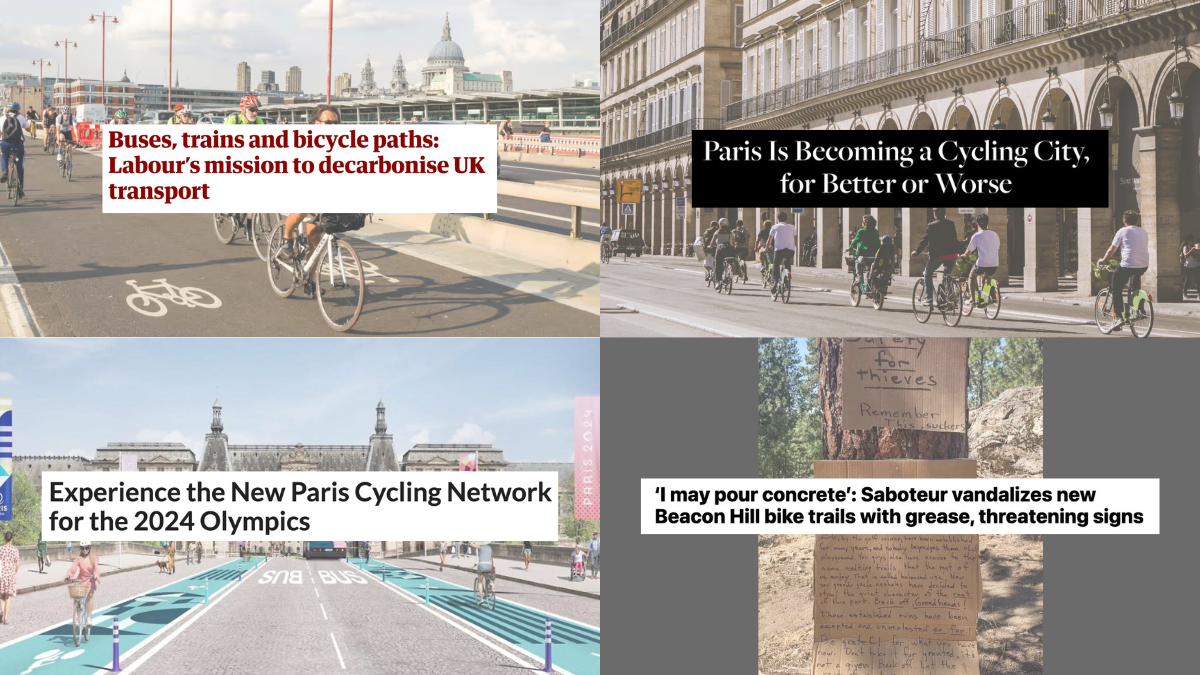
What leadership looks like: We desperately need our local and regional government to stop throwing billions at freeway expansions and start talking about transportation like the Labour party in the UK. (The Guardian)
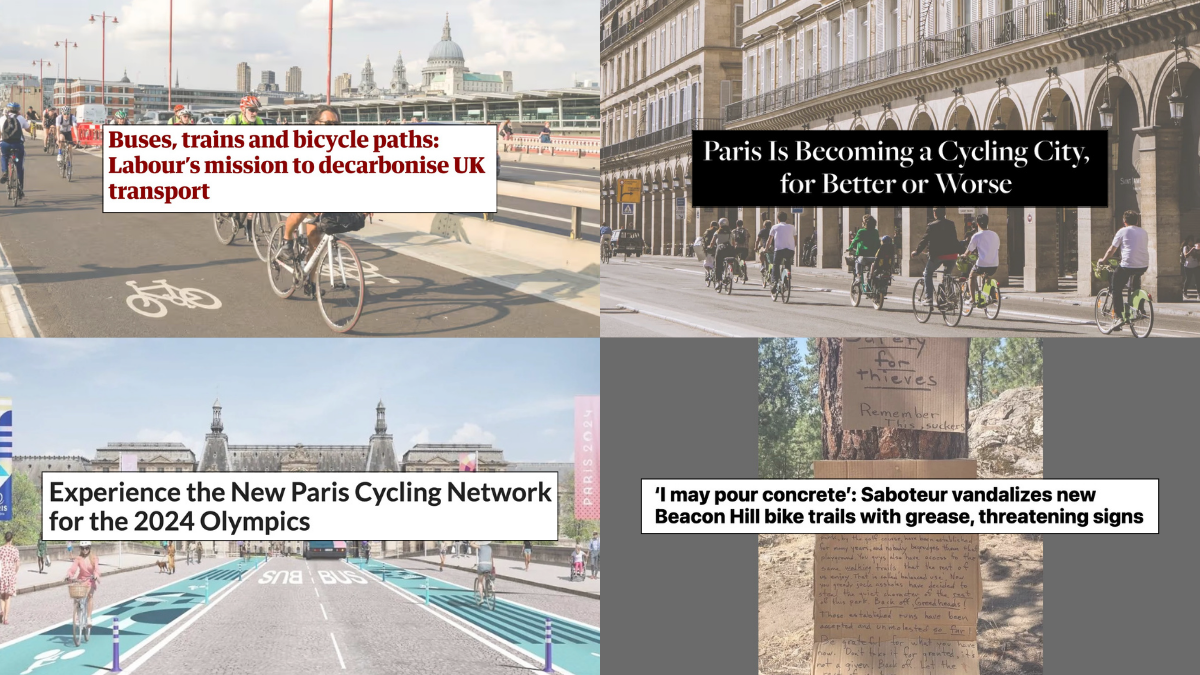
Bike trail haters: Someone is so upset that the City of Spokane and a local bike trail group are working together to improve off-road riding that they’ve resorted to vandalism and sabotage that has injured at least one person already. (Spokesman-Review)
Bikes ‘indispensable’ in Paris: No I’m not yet tired of sharing stories about how cycling has become a huge thing in Paris. Or as this global travel publication says, “up there with the baguette, the béret, and the Marinière shirt.” (Conde Nast Traveler)
Olympian effort: Related to the item above, the City of Paris plans a new bike network just to get folks to Olympic venues, and they plan to keep the new bike lanes in place when the sporting games are complete. (Tripzilla)
Portland needs a MAX tunnel: This week’s must-watch video comes from RMTransit, who deftly breaks down why Portland’s light rail system is too slow and why we need a tunnel to fix the problem. (RMTransit on YouTube)
Maria Sipin joined me in the shed this week (Eva Frazier is out of town). Maria is a transportation planner and community organizer with a long and impressive resume as a volunteer and agency staffer. She’s currently the campaign manager for Portland City Council D4 (W/Sellwood) candidate Mitch Green, and in the past she’s been a planner at Oregon Department of Transportation, has worked at Safe Routes National Partnership, was on the Portland Clean Energy Fund Community Advisory Committee, and recently worked on the campaign to get participatory budgeting on the ballot in Portland.
Advertisement
Maria and her Lectric e-bike.
We talked about all sorts of stuff, from bike valets to a renters’ bill of rights to her electric bike, Bike Loud’s Bike Buddy program, and much more.
NE Broadway near 15th. We can do a whole lot better than this!
If all goes according to plan, by next summer a key segment of Northeast Broadway will finally receive a design update that includes protected bike lanes.
In the past week or so the Portland Bureau of Transportation (PBOT) has uploaded the website for the NE Broadway Main Street Pave & Paint Project. This site makes official what many Portlanders have dreamed about for years: turning inner Broadway from a car-dominated stroad into a more humane street where people can walk and bike — and drive! — with much less stress and crash risk.
The project was triggered by a need to install fresh pavement between NE 11th and 24th. And as PBOT prefers to do, they’ll seize the opportunity to update lane striping when given a blank canvas to work with. And with major bikeways already established on NE 7th and NE 26th, the project scope will go beyond the new paving boundaries to make connections to those existing routes.
Advertisement
(Source: PBOT)
The current cross-section on this section of NE Broadway has five lanes for car users and just one narrow, unprotected bike lane. The final design is far from final, but early concepts have all shown at least a seven-foot wide, curbside bike lane and three-foot buffer zone.
While the conventional wisdom is that there will be less space for drivers in the new design, nothing is certain until the paint dries (and even then we know PBOT can change their mind). And given the high-profile stature of Broadway as a major commercial corridor, we should expect healthy debates about the final cross-section.
On the PBOT website, they place “support a vibrant main street” and “make the streetscape work better for [the small business community]” atop a list of project goals. Other stated goals are to make the street safer, make it better for bicycle riders and walkers, and “develop a high-quality project with broad community support.”
Advertisement
One major thing to keep in mind that sets this project apart is how it ties directly into the I-5 Rose Quarter megaproject. PBOT received a $38 million federal grant back in March to transform NE Broadway into a “civic main street” between NE 7th and the Broadway Bridge. My hunch is whatever cross-section they have in mind for that project will have to match up to this one. Will the more prescriptive federal dollars influence the design of the lower Broadway project? If so, what will that mean for the PBOT-funded “pave and paint”? That is one question on my mind as this gets underway.
I am also eager to see how the newly elected city council handles what could be a very high-profile project.
The “pave and paint” project kicks off this summer with a “listening and learning” phase that will include business and neighborhood outreach, some technical analysis, and a series of walks and bike rides along the corridor. By fall, PBOT should have initial concept drawings to share and open houses will start. We should see a design recommendation by early 2025 and PBOT says they plan to implement the changes in summer 2025.
This rider went out of their way to make sure their large-tired e-bike could hang on a MAX hook. They even folded the handlebars in to prevent them from snagging other riders. (Photos: Jonathan Maus/BikePortland)
Electric bikes have the potential to radically transform American transportation culture in a very positive way. Despite this, and in contrast to how our society and systems treat electric cars, it often feels like e-bikes can’t catch a break.
A few examples: We have vast federal and state purchase incentives programs for e-cars, but none for e-bikes. We limit the speed of e-bikes, while e-cars — even though their potential for harm is much greater — are gleefully sold with “insane mode” acceleration and absurdly high speeds.
And in the past few weeks I’ve been contacted by two readers with stories about how the system is working against them when it comes to choosing to ride an e-bike. One of them was told they cannot park their e-bike at work; the other watched as a TriMet transit officer booted two e-bike riders off a MAX train because the bikes weren’t on designated bike hooks.
I looked into both situations and here’s what I found out.
Advertisement
Last week a reader messaged BikePortland on Instagram:
“This morning on the MAX going out to Hillsboro some TriMet guy got on to check tickets. On his way out he told two guys with e-bikes they weren’t allowed to have them on the train because they couldn’t hang them!? I was shook.
Just felt ridiculous TriMet would deny someone bring their bike on board because their tires were “too big” it’s not even prohibited on their website, which that guy said it was. I’ve never seen anyone kicked off the MAX for having an e-bike! It wasn’t that packed at all.”
This was very disappointing to hear because the combination of e-bikes and light rail is a powerful tool that can expand non-driving possibilities for many folks in our region. I reached out to TriMet to learn more.
Advertisement
When MAX is crowded and your bike isn’t on a hook, don’t be surprised if you’re told to disembark.
According to TriMet Public Information Officer Tyler Graf, e-bikes with sealed battery compartments are allowed on MAX trains. What if someone can’t lift their e-bike onto a hook? Graf said hanging bikes on hooks is the preferred option. “However, we know e-bikes can be heavy, and it may be difficult or dangerous to lift them up and down,” he said. “Riders are allowed to stand with their bikes, but they should not block doors or aisles,” Graf clarified.
In short, your bike should never create an accessibility problem for other riders. TriMet’s rules for riding state, “If you have a bag or bike, make sure it’s not blocking the aisle or doorway.” And Graf added that people should be mindful of these rules because TriMet’s recent enforcement increase includes bicycles on trains as, “an area of extra focus.”
As for the specific case of telling two e-bike riders to disembark, Graf said these “Customer Safety Supervisors” are taking an education-first approach whenever possible. He also shared that the size and type of someone’s bike also comes into play in how enforcement decisions are made: “Bikes with oversized wheels, trailers or internal combustion engines are not allowed at all. Not only is it impossible to hang these types of vehicles from the bike hooks, they pose a danger if the train has to stop suddenly and they’re thrown forward.”
Advertisement
(On a related note, TriMet’s administrative rules state, “Only conventional single seat, two-wheeled bicycles, folding bicycles, and recumbent and electric bicycles the size of a standard bicycle” are allowed on their vehicles. “Bicycles with oversized wheels, tandems, three or more wheels, trailers, or internal combustion engine-powered bicycles are not allowed.”)
A model MAX rider makes sure their bike is on a hook and doesn’t interfere with other riders.
To summarize: Try to store your bike on a hook. If you can’t do that, make sure you and your bike have a small footprint and allow easy access to priority seating areas. I met a man on MAX a few days ago with a 20-inch wheeled, folding, fat tire e-bike (above). He carried his own bungee cord to strap the wheel to the hook and folded the handlebars in to keep them from snagging other riders near the door. He knows that if people are impeded or have to step over a bike for any reason, a rider could be asked to leave the train. See TriMet’s Bikes on MAX website and their administrative rules for “Transport of Bicycles on District Transit System (August 2022)” for more information.
The second example comes from a reader who works at the downtown Marriot hotel. They were told e-bikes were not allowed on the property. “Now I can’t use my electric bike to commute to work and would appreciate any suggestions/solutions to this dilemma,” they wrote to BikePortland.
I first reached out to the Portland Fire Bureau. Senior Fire Inspector/Lieutenant Wendy Stanley told me, “The Fire Marshal’s Office has no stance or prohibition on storing and charging e-bikes inside of buildings. Such a prohibition, if created, would be at the discretion of the property owner/management company.”
Advertisement
Lt. Stanley was right. A few days later I heard from the Marriott employee. They since heard from management that the “no e-bikes” order came from Marriott’s own fire inspector who has banned electric bikes and scooters from the hotel property.
“That’s a lot of properties limiting electric transportation,” our reader shared. “I know Tesla has chargers onsite at many properties so apparently the ban doesn’t apply to electric vehicles.”
Hopefully as e-bikes continue their march toward normalization in American society, the rules that apply to them will change. In a truly just society e-bike rules wouldn’t be on par with e-cars, they would be much more favorable and would do everything possible to encourage their use.