🚨 Please note that BikePortland slows down during this time of year as I have family in town and just need a break! Please don't expect typical volume of news stories and content. I'll be back in regular form after the new year. Thanks. - Jonathan 🙏

Green bike boxes, bike lanes return to 26th Avenue following tragic death

The new bike box installed in the same corner where Sarah Pliner was hit and killed back in October. Vegetation on the left has also been cut back to improve visibility. (Photos: Jonathan Maus/BikePortland)

When the Oregon Department of Transportation strong-armed the City of Portland to remove the bike lanes and bike boxes on Southeast 26th Avenue and Powell Boulevard in 2018, we knew it would make the crossing less safe. But ODOT persisted. In a twisted plan to encourage people to not bike on 26th (lest they get hit and make ODOT look bad) the agency removed infrastructure that was meant to protect them.

Looking back, that plan was both twisted and tragic.

That’s because on October 4th of last year, Sarah Pliner was riding her bike to work and somehow came into contact with a large trailer pulled by the driver of a semi-truck who was making a right turn from 26th onto Powell. The collision killed Pliner and her body came to rest just yards from where ODOT removed the bike box.

Now the Portland Bureau of Transportation has re-installed the bike boxes. One of them is in the exact spot where, just four months ago Oregon Walks leader (now Metro Councilor) Ashton Simpson stood in the southeast corner of the intersection with a sign that read, “Human Bike Box.” He was part of a large protest that helped force the hand of PBOT and ODOT to step up and do the right thing.

It’s nice to see this infrastructure come back. But I won’t celebrate, because it cost us the life of Sarah Pliner.

When I visited the intersection yesterday to take a closer look, I had that sick feeling in my stomach. That mix of anger and frustration I’ve had so many times over the years as we sit back and wait for the city and state to get serious about reining in the inherent danger of streets filled with people driving cars and trucks in a way that endangers us every single day.

It’s the same feeling I had in July 2008 when I rolled up to West Burnside and 14th — the intersection I’ll always know as the place where Tracey Sparling was run over and killed by the driver of a large truck who — just like in Sarah’s case — was making a right turn. At that time, bike boxes were new, but the threat of right-hooks wasn’t.

When I heard about the installation of a bike box where Tracey died, I called her aunt. “It makes me physically ill to consider that such a simple fix would have definitely prevented the right hook that killed my niece,” she told me. When I got home and worked on my story, all I could think of was why Tracey had to die before we took that simple step. It was a bittersweet bike box. I even made a video about it (below).

The re-born bike boxes at 26th and Powell occupy a similar place in my head. When ODOT, PBOT, and The Street Trust agreed to remove them, we knew people would still ride through that intersection. We knew it would more dangerous. But they were removed anyway.

I’m glad they’re back. They seem to work very well. Combined with the head-start on the walk signal (a.k.a. leading pedestrian interval, which I was happy to see a bike rider use, even though Oregon law hasn’t caught up to this behavior yet), the new curbs in the southeast corner where Sarah was killed, the lower speed limits and school zone signage, it feels like drivers have calmed down a bit.

We haven’t done nearly enough to tame traffic on Powell Blvd, but adding back green bike lanes and bike boxes in both directions is a good step forward — or should I say a step sideways since we’ve merely added back what we had before.

Would they have saved Sarah’s life? We will never know. What we will always know, is that that it took her death to get them back.

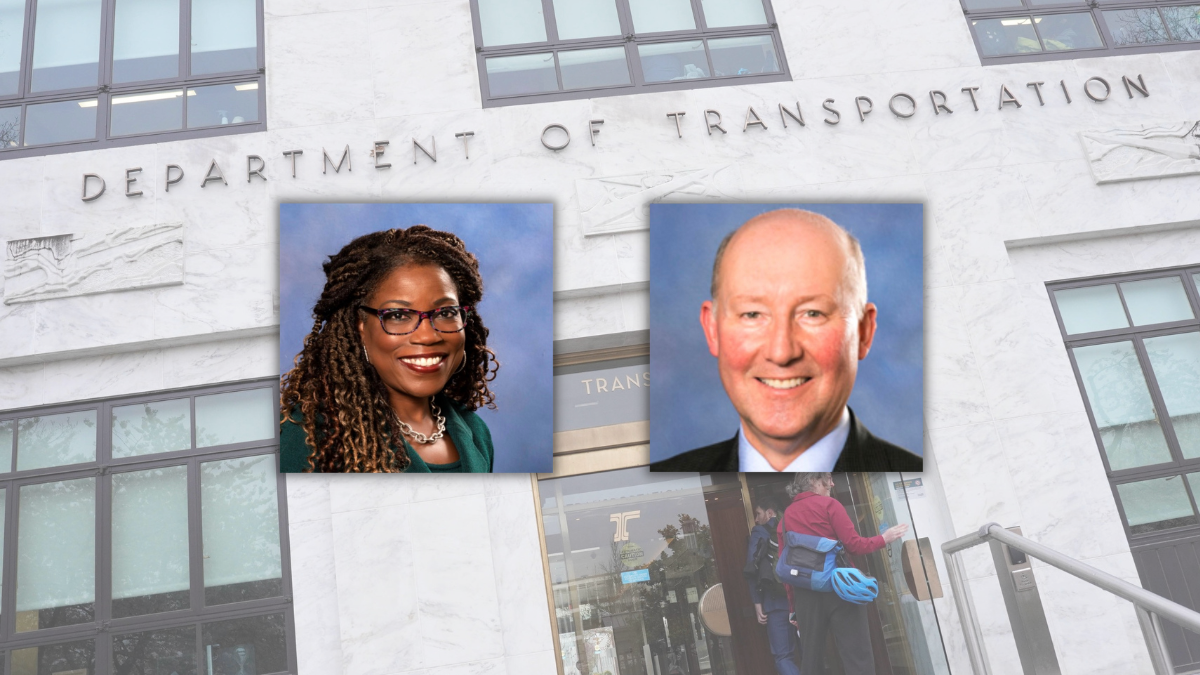
Podcast: PBOT and their search for a new leader

What do we want to see in the next leader of the Portland Bureau of Transportation?

Why is this hire so important for the agency?

What were previous PBOT directors like and why does that matter?

These are some of the questions my co-host Kiel Johnson and I had on the latest episode of our podcast.

Last week, Kiel messaged me and said, “What are your thoughts on the PBOT director position?” I get messages like that all the time from local transportation activists and insiders. Typically we end up having a good conversation on the phone or on the side of an event. But since I’ve had a more audio-oriented mindset with BikePortland, I’ve wanted to share these conversations with you. So I invited Kiel over to the Shed and we recorded it.

This episode is different than we’ve had in the past. It’s more of an informal chat. It’s really just two old friends talking about something they both care about a lot. Hope you enjoy eavesdropping! And if you have thoughts about what you’d like to see in the next PBOT director, let’s hear them. We hope candidates for the job — and maybe even the folks that will make the hire! — will read this post and listen to this episode.

Find this episode on Apple Podcasts or wherever you listen.

Citing safety concerns, ODOT will close 181 Portland area crosswalks this year

Get used to these signs. (Photo: Jonathan Maus/BikePortland)

The Oregon Department of Transportation has just released a list of crosswalks they plan to close in our region this year. There are 181 crossings on the list — 53 of them are in Portland. ODOT plans to close 16 crosswalks on Southeast Powell Blvd between SE 8th and I-205, including closures at: 8th, 11th, Milwaukie, 13th, 20th, 22nd, 36th, 42nd, 45th, 47th, 57th, 61st, 70th, 74th, and 86th.

In an email with the innocuous subject line “ADA Program and Safe Crossings on U.S. 26 (SE Powell Boulevard)” the agency says they plan to erect “Crosswalk Closed” signs like the one above at these locations in the name of safety. ODOT also frames these closures as part of an ongoing project to comply with an ADA lawsuit the agency settled with a disability rights group in 2016. “Bringing curb ramps up to accessibility standards and closing unsafe and inaccessible crosswalks are tools we use to meet these obligations,” reads the email.

Here’s more from ODOT:

In Oregon, every intersection is a crosswalk unless marked otherwise. This means that if a crosswalk is open, it should meet our safety and accessibility standards… We evaluated crosswalks statewide and found that a number of them do not provide equal safety to all users for a variety of reasons. These reasons may include crosswalks ending at or in close proximity to a driveway, a median island or landscaping in the crosswalk path, or traffic signals that do not have pedestrian signals and push buttons. In these cases, the crosswalks are closed… This ensures that people are guided to use an alternate, nearby, safer and open crosswalk.

“Crosswalk Closed” signs have been proliferating in Portland and statewide for several years now. In 2019 we reported on a major uptick in them from the Portland Bureau of Transportation. Despite concerns from readers about how these closures make walking less respected and convenient, PBOT said they only do it as a last resort.

We went further into the story two months later when we heard ODOT was just ramping up their closure effort. At that time, ODOT was closing crosswalks without any standardized process to make the decisions. And there was zero public input. The decisions were in the hands of just two ODOT engineers. In 2019, ODOT State Traffic Roadway Engineer Mike Kimlinger told members of the Oregon Bicycle and Pedestrian Advisory Committee (OBPAC) that they were closing only two per month.

Given that ODOT plans to close 181 crosswalks in Region 1 alone this year, the pace has clearly skyrocketed.

See the full list of closure locations below…

These closures come after a record number of pedestrians were killed on Portland roads last year — with many of those tragedies happening on ODOT-owned highways.

The closures also remove the legal protection for people trying to cross the street. People can still legally cross the street where a “Crosswalk Closed” sign is posted, but they are no longer afforded any right-of-way privileges. If the person was hit, they would be much more likely be held at fault for impeding traffic or failing to yield.

That’s just one reason these closures are cause for concern.

One legal expert we spoke to in 2019, Portland lawyer Ray Thomas, said, “It’s almost like they’re making us trespassers on our own crosswalk.”

I have asked ODOT if the decision-making process around these closures has been formalized since 2019 and if there’s any way the public can offer feedback. I’ll update this story when I hear back.

New interactive tool shows Portland’s place in the national roadway safety crisis

The USDOT’s national heat map of fatal traffic crashes from 2016-2020. (Sources: USDOT)

Last week, the U.S. Department of Transportation announced $800 million in roadway safety grants nationwide, including more than $22 million for Portland-area projects. But it will take more than funding and a plan to achieve the goal of zero roadway fatalities nationwide. First we have to see where we currently stand and admit there’s a problem.

A new set of interactive visualization tools just released by the USDOT show just how dire America’s traffic safety crisis is. These visualizations use a national dataset of all fatal motor vehicle crashes from the National Highway Traffic Safety Administration (NHTSA) to “illustrate the significant impact of motor vehicle deaths in our communities.” These maps provide an illuminating look at traffic violence statistics nationwide, giving insight on the different factors that contribute to fatal crashes and where they’re most and least prominent.

How does Portland compare?

A closer view of the heat map.

Looking at the first visualization, which shows traffic death hotspots across the U.S., Portland might seem like it’s in pretty good shape compared to other places in the country. While central and southern California, Florida and the mid-Atlantic coasts are covered in blobs of bright yellow to indicate a very high rate of fatal crashes, the Portland region is more of a burnt orange. The number of fatalities in Multnomah County from 2016-2020 was 5.3 times higher than the national average — but Los Angeles County experienced 63.4 times the national traffic crash deaths in that time.

However, it’s difficult to compare a county’s fatality rate against the “national average county,” because a lot of counties in the U.S. are in very rural areas. Los Angeles County has more than twelve times the population as Multnomah County, so it follows they’d have a much higher number of crash deaths. This is where another visualization, which looks at per capita crash rates, comes in handy.

Crash rates per capita by county. Blue represents high population and comparatively low crash fatality rates, white represents low population and low fatalities, yellow represents low population and high fatality rates and red represents high population and high fatalities.

Per capita, Kern County north of Los Angeles makes a better comparison against Multnomah County. About 100,000 more people reside in Kern County than Multnomah, but the fatality rate there is 18.57 per 100,000. In Multnomah County, it’s 7.68. The median for all counties nationally is 17.98, which points to a really dire situation particularly for rural areas.

The fact that the Portland area is doing better when compared to some other places is more of an indictment against them than a credit to us. From 2016-2020, 313 people died due in car crashes in Multnomah County, and the crisis has only been trending upwards in recent years. Our region is depicted on the less dire end of the spectrum nationally, which shows just how bad the problem is nationwide.

Inequitable impacts

The USDOT’s visualization of crash rates in historically Disadvantaged Communities.

The tool also depicts an “equity-focused analysis of the unequal distribution of roadway fatalities at the neighborhood level,” visualizing how many crashes take place in historically Disadvantaged Communities (DACs). DACs are defined by the USDOT through their Justice40 initiative, which aims to tackle transportation inequity. In order to fit the title of Historically Disadvantaged Community on the map, a neighborhood has to meet at least four of the following criteria:

  • Transportation access disadvantage identifies communities and places that spend more, and take longer, to get where they need to go.
  • Health disadvantage identifies communities based on variables associated with adverse health outcomes, disability, as well as environmental exposures.
  • Environmental disadvantage identifies communities with disproportionately high levels of certain air pollutants and high potential presence of lead-based paint in housing units.
  • Economic disadvantage identifies areas and populations with high poverty, low wealth, lack of local jobs, low homeownership, low educational attainment, and high inequality.
  • Resilience disadvantage identifies communities vulnerable to hazards caused by climate change.
  • Equity disadvantage identifies communities with a with a high percentile of persons (age 5+) who speak English “less than well.”

As transportation equity advocates know, people who live in DACs are more likely to be victims of traffic violence. When you zoom in on the map and look at where vehicular fatalities happen the most in Portland, they are located in the lowest-income parts of the city, predominantly in east and north Portland.

According to the data, nearly half (43%) of the communities in the top 20% of roadway fatalities nationwide belong meet the DAC criteria. 26% of all fatal crashes in DACs result in pedestrian deaths. (It’s unclear how the national data accounts for people biking or rolling.)

The Portland Bureau of Transportation’s annual fatality reports demonstrate this as well. But looking at the national data is helpful for putting together larger trends over time and place.

Is there any progress?

Vision Zero communities in the Portland area.

According to this data, there are some places in the Portland area that are doing well. Sherwood, Milwaukie and Newberg are all Vision Zero cities on the map, with no fatal crashes from 2016-2020. Wilsonville and West Linn are both in the top 25 small cities for low fatality rates, having reported one fatality each during those five years.

But as Kea Wilson points out in a Streetsblog article about this new tool, the cities that the DOT heralds as Vision Zero-achievers haven’t necessarily gotten there on purpose. Some, like Hoboken, New Jersey, have a dedicated Vision Zero strategy that guides their infrastructure development. Others haven’t put in quite so much work. Without more context, this data shouldn’t necessarily be used to indicate the best cities to emulate for meeting Vision Zero.

“Many are exclusive, minuscule suburbs that simply shunt faster vehicle traffic onto arterial roads outside their borders, effectively endangering residents every time they enter or leave,” Wilson writes.

While there are some glimmers of hope on the map, the overall takeaway from this data is bleak. Nationally and locally, the problem is getting worse by the year. The only good news depicted in this data set is that we have a national transportation department willing to look at the problem honestly enough to create these impactful visualizations.

You can find the full set of visualizations at the NRSS website.

Advocates push PBOT for progress on southwest Portland projects

A new 43-unit apartment building sits adjacent to an unfunded SW In Motion project that would build a sidewalk connection to Portland’s largest employer, Oregon Health Science University. (Photos: Lisa Caballero/BikePortland)
Plan cover

Implementation of the Southwest in Motion (SWIM) plan is flagging according to area transportation advocates. In a letter (PDF) sent yesterday to the Portland Bureau of Transportation (PBOT), former members of the SWIM Stakeholders Advisory Committee (SAC) laid out their concerns about the quality of the plan’s roll-out.

Co-signers include the current and past chair of PBOT’s Bicycle Advisory Committee (BAC).

The letter comes on the heels of PBOT Bicycle Coordinator Roger Geller’s recent update on bike network progress to the BAC. Geller presented a table which showed the southwest region of Portland lagging behind the rest of the city in the percentage of its planned bikeway network that has been built.

Correspondence between the advocates and PBOT began over a year ago, and yesterday’s letter is organized as a synopsis of those communications. It begins by recapping the group’s original concerns:

SW Marquam Hill Rd, just uphill from Gibbs, is slated for a safer shoulder, but the project has no funding.

While it acknowledges that PBOT has “partially addressed” some of these issues, the letter makes the case that the bureau still has “a considerable way to go.”

  • The lack of the 2-year progress report called for in the plan;
  • Deficient and outdated information on the SWIM website;
  • Slow progress made on project delivery relative to other In Motion plans; and
  • Perhaps most important – having virtually no knowledge or involvement in project prioritization, selection, or design until they are announced.

Portland has adopted four “In Motion” plans over the past decade, beginning with East Portland in Motion (EPIM) in 2012, and followed by Central City (CCIM) in 2018, SWIM in December 2019, and Northwest (NWIM) in 2020. Most recently, North Portland in Motion got underway at the end of 2021.

A characteristic of all “In Motion” plans is that they are grounded in public participation. Project lists are the product of dialogue with advisory committees, and have been vetted through open houses, focus groups, meetings with stakeholders—the full Portland engagement process.

But there does not appear to be a uniform process for reporting out or overseeing project status — or budgeting — and this makes it difficult to account for progress, or commitment from the city. The advocates sum up this concern in their letter’s first of four action items:

Complete the progress report described in the SWIM plan including:

  • Status report of projects completed. 
  • Projects for 2022-2023 that are budgeted/under construction, in design, and under consideration. 
  • An annually updated summary of the funds available for SWIM projects for the coming fiscal year including the anticipated funding sources. 
  • Summary of any anticipated issues regarding funding, staffing, etc. and how PBOT will try to resolve them.

Comment: The SWIM website was updated for the completed projects. It also lists projects that are called “active”, but this includes a wide range from, projects that are under construction to ones that appear to only be in the staff discussion stage. The listings offer minimal project descriptions and no information about the schedule, project manager contact information, estimated budget and funding source(s), or upcoming community involvement opportunities and summary of past public comments. It also does not list potential future projects under consideration or a funding outlook. What has been completed so far is a good start, but important information is lacking, and the public continues to remain mainly in the dark.

While recognizing that the areas of town with “In Motion” plans differ greatly, each with varying scope and needs, a cursory review of their websites shows that:

  • Each plan follows a unique implementation approach (Central City in Motion has an ongoing Working Group which meets regularly to review project status and design);
  • The city’s financial commitment to each differs by orders of magnitude (The EPIM 2021 10th Anniversary Status Report states that “PBOT and our agency partners now have allocated nearly $320 million to East Portland in Motion (EPIM) project implementation and related projects.” In contrast, a SWIM update notes that $500K will be available for “QuickBuild” projects which are expected to be constructed by 2024.
  • Some plans offer more detailed timelines and implementation information. (NWIM describes an implementation strategy which includes project evaluations and ”tweaks and changes.”)

I reached out to Bicycle Advisory Committee Chair Ally Holmqvist, a co-signer of the letter, to learn why she and the BAC supported the SWIM requests. She brought up the BAC’s southwest ride last August,

I didn’t want to stand next to, let alone ride through, “the crossroads” and I felt uncomfortable using many of the bike lanes we rode on where the topography can provide challenge enough for riders. I was heartened to see the work done on SW Capitol Highway, but it is clear there is still more work to do and that all of those who devoted their time and effort to SWIM deserve an update on the next steps.

The letter is addressed to PBOT SWIM Project Manager Nick Falbo, and closes with a request for a closer partnership between PBOT and the community:

The plan states “Continued community advocacy for projects will be instrumental to the success of this plan.” This can only happen through a community – PBOT partnership. We invite you to have an open discussion with interested SW residents about how to best establish an on-going partnership that is effective and efficient for the city and SW residents.


Falbo responded briefly yesterday upon receiving the letter via email: “We appreciate the feedback and I will discuss with our capital delivery division in charge of project design and construction processes,” he wrote. “More to come.”

Opinion: Oregon Legislature should step up for local media

Hi from the The Shed.

Today the Oregon Legislature will host a public hearing on House Bill 2605 — the Protect Journalism Act. At first glance, it has nothing to do with bicycles or transportation. But if you consider that it could be a vital source of funding for BikePortland — which I’d argue is the largest and most influential cycling and transportation news outlet in the state — you’ll understand why this is on our front page.

Sponsored by House Rep. Khanh Pham, the bill aims to improve the financial health of businesses like BikePortland throughout the state by creating new funding opportunities to support journalists and the news outlets they work for. The way it was initially introduced it would allow Oregonians to make a financial contribution to a news outlet and receive a tax credit (Similar to Oregon’s existing political tax credit). The bill also seeks to kickstart a new grant program to offer immediate financial aid to fund local news — especially in rural parts of Oregon where news deserts are increasingly common.

I’ve heard that the bill has been amended since being introduced. The new plan is to drop the tax credit and instead seek the legislature’s permission to establish a statewide task force of journalism experts that will meet and come up with an better solution to this problem. That solution will then be pitched in a bill next session. (The grant program part of the bill will remain this session.)

I was so happy to see this bill introduced! It was like someone finally saw me and my struggle to make the business side of BikePortland work.

Below is the testimony I submitted this morning:

Dear Committee members,

Thank you for taking time to consider the Protect Journalism Act (HB 2605). I strongly support this bill for two main reasons: I’m an Oregonian who believes that a well-informed public is essential to a strong democracy, and because I’m the owner of a small news business who knows all too well how hard it is to survive in today’s media business.
I launched BikePortland in 2005 — 18 years ago — because I saw a gap in our community that needed to be filled. There was no central, trusted source of information where all the different groups, people, policymakers and organizations could come together, learn from one another, build a stronger community, and learn about important news that could impact their lives. 

Nearly 20 years in, I’ve won journalism awards, awards from advocacy groups, a special commendation from a member of the United State Congress, and have been the subject of numerous magazine and newspaper stories. I’ve built a platform that reaches hundreds of thousands of people every month. Our work has influenced countless policies, projects, and people.

But I don’t consider BikePortland a success. Why? Because, despite broad support from our community, and many years of hard work, we are still not financially sustainable. If we don’t raise revenue significantly by the middle of this year, we have to face some very hard decisions.

The news business is unforgiving, and it’s not a meritocracy. It doesn’t care about the quality of your work or the impact it has on the community. It only cares about clicks. I believe in focusing on what’s vital, not viral. I have felt the urge to favor clicks over quality — to give people a piece of candy instead of a well-rounded meal — because that’s often where the money is.  But doing that leads to a race to the bottom and it’s not what is best for our community or for Oregon.

As a for-profit corporation, we don’t pursue grant funding and we can’t offer tax deductions for donations. That makes our funding challenge even more difficult, and it makes us even more reliant on the whims of advertisers, and the financial support of individual Oregonians.

The legislature has already created the political tax credit to encourage more people to support and get engaged in electoral politics. We should have funded journalism first! After all, more funding for political parties without the news outlets and journalists to hold them accountable in this age of divisive, win-at-all-costs, misinformation campaigns — puts Oregon’s democracy in peril.

The local news business has never been a downhill ride in the park, and these days it’s like trying to pedal a bicycle through a sandy desert without water.  HB 2605 would be an oasis.

Please support this bill. Let’s rebuild the foundation of local news.

Thank you for the opportunity to testify.

– Jonathan Maus

HB 2605 will be heard in the House Committee on Rules at 1:00 pm today (2/9). If you believe local media outlets like BikePortland are worth fighting for, I strongly encourage you to support this bill. You can still submit written testimony, and you can connect with Rep. Pham’s office if you’d like to learn more or get involved.

And yes, it’s true what I wrote in my testimony. Please become a financial supporter of BikePortland today.

E-bike rebate bill coasts through first legislative hearing

Cheap(er) thrills. (Photo: Jonathan Maus/BikePortland)

Oregon’s first ever electric bike rebate bill received a hearing at the Oregon Legislature today. Supporters of the bill were well-prepared and it was an almost entirely positive affair with no major speed bumps. There was no vote (that will hopefully come later), but it was our first chance to gauge the temperature of lawmakers and see how supporters frame the bill. It was also the first chance for any detractors to emerge from the woodwork.

HB 2571 would give people up to $1,700 cash back on the purchase of an e-bike with a goal of getting more Oregonians to consider bikes as their next EV. Oregon currently has generous purchase incentives for electric cars, but does nothing for their much smaller, safer, cheaper, and more eco-friendly, two-wheeled brethren.

The bill was heard in the House Committee on Climate, Energy, and the Environment. Prior to the meeting, well over 80 people submitted written testimony in support of the bill. Only one of them opposed it — and it was only partial opposition. The person said they support rebates for the purchase of e-bikes, but only certain types. “I do have a problem with my tax dollars going to purchase a mountain bike that somebody uses for their weekend hobby. That only benefits the individual and is not a valid use of taxes,” the person wrote.

Portland nonprofits The Street Trust and BikeLoud PDX have been whipping up support of the bill among their members. A new group, E-bike Oregon, has also emerged. They have a website and are working to get bike shops and organizations statewide to formally endorse the bill.

The bill’s chief sponsors are Democrat House reps Dacia Grayber and Mark Gamba. (Rep. Khanh Pham is a co-sponsor, and she is also a member the committee where the bill was heard today, but stayed quiet throughout.)

Rep. Grayber introduced the bill by reminding committee members of Oregon’s goal of phasing out gas-powered vehicles by 2035. “In our efforts to make that a reality we need to ensure a wide range of electric vehicle alternatives are accessible to Oregonians in both urban and rural communities. E-bikes have emerged as one of — if not the — most popular alternatives.” “And I’m just going to put it on the record,” she continued. “It’s a lot of fun as well.”

Bill co-sponsor Rep. Mark Gamba, a former mayor of Milwaukie who knows a lot about e-bikes as a regular rider himself, extolled their virtues, saying they are “extraordinarily different” than bicycles and make longer and more difficult bike commutes possible while allowing you to arrive at your destination, “a lot less sweaty and smelly than you would otherwise.” Gamba also said e-bikes make transportation cheaper for people with less money and they can relieve freeway congestion in busy metro areas.

Rep. Virgle Osborne, a Republican from Roseburg, asked why the bill offers a rebate instead of a tax credit. Grayber and Gamba answered by saying research shows cash rebates work best to spur sales and reach a wide variety of people — and that many Oregonians don’t have enough money in the bank spend $3,500 on an e-bike. “But if you walk in [to a shop], and it’s going to be half [the price] of what it was going to be otherwise, that’s reachable for folks,” Gamba answered.

After testimony from Portland State University e-bike expert John MacArthur, Rep. Bobby Levy, a Republican who represents the area around the town of Echo in eastern Oregon, said she lives on a gravel road. “How do these [bikes] work on dirt and gravel?” she asked. MacArthur channeled his inner-bike shop salesman and replied, “There’s lots of different types of e-bikes… So it’s about finding the right e-bike for you.”

Megan Ramey, a youth and family cycling advocate from Hood River, testified in her Bike Train Conductor costume. She told stories about people she knows whose lives have been changed for the better because of their e-bikes. “E bikes are a great way to build resiliency and preparedness in communities,” Ramey said.

Nick Wood with Portland-based e-bike company VVolt, told lawmakers he thinks the incentive will have a “viral effect” with many people currently on the fence due to cost concerns deciding to to buy an e-bike and “make the leap into the bike lane.” Wood also said he believes hundreds of small business across Oregon will benefit from the additional sales spurred by the rebate.

National nonprofit industry group People for Bikes Deputy Director of State and Local Policy Ashley Seaward also testified. She said the bill checks all the right boxes, but proposed two amendments that would make it even better. Seaward said her group thinks it’s a bad idea to define “electric cargo bicycle” in statute (which the bill does). “The types of electric bicycles are usually detailed once the [state administrators] begin working on the program. And this allows for more flexibility in the planning process… You wouldn’t define an electric minivan within state statute for an electric vehicle rebate program so you wouldn’t do the same for an electric bicycle incentive program.”

Seaward also thinks the bill would be stronger if it had an amendment to provide additional incentives for people with lower incomes (which came as no surprise to bill sponsor Rep. Grayber, who said at the outset of the hearing she would welcome amendments that help the rebate program, “serve the broadest range of Oregonians.”)

The only substantive critique of the bill from the public came from Jody Wiser, a lobbyist with Tax Fairness Oregon. She said her group feels the rebate is way too high, especially compared to what Oregon offers for e-cars. Here’s her argument:

“My electric car subsidies from the state were about 15%. If you buy a $26,000 electric motorcycle you get $750. [With the e-bike rebate] If you buy a $900 bike and a bunch of equipment, you can walk out of the store with $1,400 worth of equipment costing you $200. That’s just way out of line with how we are subsidizing other electric modes of transportation.”

I’m not sure where you would find a $900 e-bike, but she made her point. Wiser also thinks the bill should have an Oregon residency requirement so that people who live out of the state aren’t able to benefit from our taxes.

Overall impression it felt like a very strong first outing for HB 2571. There were so major objections from lawmakers, bill sponsors received excellent advice on how to make it even better with various amendments, and thanks to solid testimony there was some solid learning that took place. From here, the bill could return to this committee for a second reading to consider amendments.

Stay tuned for further developments on this and other bills. See our 2023 legislative guide to learn about the 23 bills we’re currently tracking.

How US DOT grants will be spent in our region

Metro will use some of the funding to plan for safer streets in Troutdale. (Photos: Jonathan Maus/BikePortland)

Since we covered the big US Department of Transportation grants last week, we’ve learned a bit more detail about what exactly they’ll fund.

You’ll recall Portland received two notable chunks of funding: $20 million to PBOT for 122nd Avenue and $2.4 million to Metro to develop safety plans.

Here’s what we’ve learned since our first story was published:

Metro – $2.4 million

Metro’s grant will be spread regionwide. (Map source: Metro)

Metro applied for the grant on behalf of three jurisdictions: East Multnomah County, the City of Tigard, and Washington County (and one-third of the grant will go directly to them).

Here’s Metro’s description of how the money will be spent:

Metro’s grant will be used to work with regional partners perform data collection, enhanced analysis, and identify a list of quick-build projects across the region, and to support the development of comprehensive Transportation Safety Action Plans for Washington County, Tigard, and Multnomah Counties and the cities of East Multnomah County. The project will build upon the 2018 Regional Transportation Safety Strategy and bring a focus on advancing equity outcomes and pedestrian safety across the region. This grant is well-timed with Beaverton’s upcoming Transportation System Plan update and city staff are coordinating with Metro staff on Beaverton’s participation in this regional effort…

Metro will work with joint applicants and other partners to prioritize pedestrian crossing locations across the region for quick build, high-impact projects…. The county and city safety actions plans will be data-driven and focus on identifying near-term, effective strategies to address locally identified safety issues. Strategies include setting appropriate speed limits, applying proven countermeasures at intersections, addressing driver impairment and distraction, crosswalk visibility enhancements, and accessibility improvements. Inclusive, culturally-appropriate and meaningful engagement of communities and jurisdictional partners will be used throughout the planning process.

For their part, Multnomah County says they’ll use $444,000 of the grant to develop a new Safety Action Plan that covers streets in the cities of Fairview, Gresham, Troutdale and Wood Village. The City of Tigard will use $240,000 to develop a Vision Zero Action Plan.

Metro Deputy Director Margi Bradway told BikePortland the funds will be,

“Focused on reducing traffic fatalities, will help us address pedestrian safety in greater Portland — a major concern in many of our communities, but especially in those with a history of less public investment focused on protecting people walking to work, school, the store or the bus. Metro is excited for the opportunities this will create to move our transportation system closer to Vision Zero.”

Portland Bureau of Transportation – $20 million

122nd Avenue near SE Stark.

In addition to $20 million in updates coming to 122nd Avenue we shared initially, PBOT will add their own funding to make an even greater impact on the street.

In a statement about the grant, PBOT said they plan to add $5 million in funds to the grant from the Fixing Our Streets program that will allow them to pave about one mile of 122nd from SE Foster Road to Holgate Street.

The pot for 122nd will get even sweeter with $6.4 million grant PBOT has already received from Metro (via federal “flexible funds”) that will allow them to install four new “enhanced crossings” on the corridor at NE Beech, NE Sacramento and Brazee, NE Broadway and Hancock, and NE Wasco and Multnomah. PBOT says, each crossing will include high visibility crosswalks, street lighting, upgraded ADA curb ramps, and will be signalized with a Rectangular Rapid Flashing Beacons (RRFB) and medians, Pedestrian Hybrid Beacons, or half signals. Construction on the enhanced crossings is anticipated to begin in 2025.

All of that will combine with yet another $3.3 million project where PBOT will build new signals at NE Davis Street and SE Clinton Street. Construction on that will begin later this year.


While these are far from the mega-grants some local insiders are hoping for, this infusion of cash is a nice shot-in-the arm in the ongoing fight for safer streets.

Job: Kerr Bikes Worker – Albertina Kerr

Buffered Bike Lane with a bike symbol and arrow pointing forward

Job Title

Kerr Bikes Worker

Company / Organization

Albertina Kerr

Job Description

We’re seeking Workers for our Kerr Bikes rental store. Kerr Bikes provides the public with seasonal bike rental services.

Albertina Kerr strengthens Oregon families and communities by helping children and adults with developmental disabilities and mental health challenges – empowering them to live richer lives.

All Kerr employees are required to be fully vaccinated or meet the requirements for a medical or religious exception prior to beginning work.

Qualifications:
– Interact with high volume of customers
– Understand basic bike maintenance and anatomy
– Great written and spoken, internal and external communication skills
– Ability to lift 50lbs, use ladders, dollies and other moving tools
– Ability to stand long hours
– Basic understanding of tablet technology and ability to learn POS system
– Knowledge of Portland downtown and surrounding recreation areas
– Ability to think on their feet and ask questions when unsure of something

How to Apply

Apply online at https://www.albertinakerr.org/careers/

Job: Kerr Bikes Lead Worker – Albertina Kerr

Buffered Bike Lane with a bike symbol and arrow pointing forward

Job Title

Kerr Bikes Lead Worker

Company / Organization

Albertina Kerr

Job Description

We’re seeking a Lead Worker for our Kerr Bikes rental store. Kerr Bikes provides the public with seasonal bike rental services. The Lead Worker may supervise other Kerr Bikes employees, volunteers and participants in services we provide, and will perform maintenance on bicycles as needed.

Albertina Kerr strengthens Oregon families and communities by helping children and adults with developmental disabilities and mental health challenges – empowering them to live richer lives.

All Kerr employees are required to be fully vaccinated or meet the requirements for a medical or religious exception prior to beginning work.

Responsibilities:
– Provide seasonal bicycle rentals of Kerr Bikes
– Supervise other hourly employees, volunteers and/or participants in services we provide as needed.
– Responsible for the store in absence of manager(s)
– Manage cash handling of bike rentals
– Prepare the daily register reports, make bank deposits, hold store keys, open and close store, etc.
– Provide excellent customer service while representing Albertina Kerr and Kerr Bikes.

Qualifications:
– At least 18 years of age.
– Supervisory experience is preferred.
– Retail cash handling experience is strongly preferred.
– Excellent customer service skills.
– Ability to work well with little supervision.
– Ability to lift 60 pounds, continuously squatting, bending and twisting.
– Mechanical aptitude and knowledge of maintenance of bicycles.

A criminal background check and ability to meet agency driving requirements are required.

How to Apply

Apply at https://www.albertinakerr.org/careers/

PBOT comments on I-5 Rose Quarter project reveal tension around obscure, yet pivotal, policy

Central City Multimodal Mixed-use Area boundary. (Source: City of Portland)

This seems to imply that City would be unable to provide ‘safer and greater’ conditions for bicycling without this project. This is untrue.

– Roger Geller, PBOT

The list of people who have criticized the Oregon Department of Transportation’s latest design proposal for their I-5 Rose Quarter project includes some obvious names (like anti-highway advocacy group No More Freeways PDX) and some more unexpected ones (like the entire Trail Blazers organization). Members of the Portland bicycle and pedestrian advisory committees have also spoken out against the design, which they think will create worse conditions for people biking and walking in and around the Rose Quarter.

It’s one thing for activists and other stakeholders to make strong public statements against a megaproject. It’s another thing entirely when concerns come from another government agency — especially one that’s an official project partner. 

Last week we shared what former PBOT Director Chris Warner had to say about the project as part of his official comments on ODOT’s supplemental environmental analysis (SEA, a document required by the federal government as part of the NEPA process). Warner’s statements were backed up by 135 comments from 13 different city staff members, 44 of which came from longtime PBOT Bicycle Coordinator Roger Geller. 

We highly recommend taking a closer look at all the comments (one PBOT engineer calls the new southbound ramp a potential “fatal flaw” and the word “misleading” is used three times) — but for now I want to focus on Geller’s and on one thread in particular.

Geller’s comments reveal an interesting (and growing?) tension between ODOT and PBOT about something called the Central City Multimodal Mixed Use Area (MMA). If you came to our Wonk Night event on this project in 2021, you might recall hearing about this. It’s a little-known and relatively technical, yet highly important piece of this project’s puzzle.

(Source: State of Oregon Land Conservation and Development Department)

An MMA is land use designation cities can receive from the State of Oregon Land Conservation and Development Department (this PDF has a good summary of how it works). Typically, when a city wants to develop urban land with more buildings, housing, and destinations, they are required by Oregon Administrative Rule (Chapter 660, Division 12: Transportation Planning) to expand the road infrastructure to accommodate more driving. This rule (known as the Transportation Planning Rule, or TPR) exists to prevent congestion and perpetuate convenient auto access.

Think of it like this: The rule does to roads what minimum parking mandates do to parking lots.

The only way around the rule is if you receive a MMA designation.

PBOT has been operating under the assumption that they have a MMA for the area impacted by the I-5 Rose Quarter project since ODOT officially agreed to it in 2016. The Central City MMA (including the Lloyd and Lower Albina areas) was then adopted as part of Portland’s Central City 2035 plan in 2018 and was then into the city’s Transportation System Plan in 2020 (PDF).

Here’s where ODOT comes in: There’s a stipulation in the state’s land use planning rule that when a MMA is near a freeway interchange, ODOT approval is needed. There’s been an understanding from the get-go that PBOT and ODOT would work together on this. A cynic could argue that there’s a quid pro quo going on here: PBOT supports the project, ODOT signs off on the MMA designation.

We’ve already covered how PBOT is walking on egg shells around this project. Geller’s comments on the SEA reveal that the latest — and perhaps most substantive — disagreement has to do with the MMA.

In SEA section 3.8.2.1, ODOT states:

the No‐Build Alternative would have an adverse effect on the City of Portland’s long‐term vision for land development

To which Geller replies:

This is presumably based on not achieving the realization of the Central City Multimodal Mixed Use Area (MMA) and the subsequent need to apply long‐established TPR [Transportation Planning Rule] requirements for automobile congestion. However it’s not clear that ODOT’s written concurrence is required for an MMA designation that is more than one‐quarter mile of any interchange ramp… many of the development goals in the Lloyd District could still be implemented so long as they were more than five blocks away from the interchange ramps.

Even developments within a short distance of freeway interchanges may be allowed depending on the outcomes of a congestion analysis. Only in the scenario in which new structures generate significant levels of congestion would they have a potentially negative outcome on the freeways. Congestion pricing and equitable transportation pricing in general have elsewhere proven effective tools to minimize automobile transportation and congestion. Under such a scenario increased development — even within one‐quarter mile of freeway interchanges — would not necessarily have a negative effect on the freeways and could be allowed.

Geller is referring to a part of the MMA where ODOT agreed to only consider development impacts if they caused drivers to back up onto ramps, causing potential safety issues for freeway users.

The 2016 agreement between ODOT and PBOT (which has been adopted into Portland’s TSP) states:

For freeways, [MMA traffic impacts] will be measured by whether traffic on off-ramps backs up onto the deceleration portion of the ramp, or onto a freeway mainline. Traffic impacts on freeway on-ramps and off-ramps where there are no identified safety concerns need not be addressed as part of plan amendments.

ODOT’s interpretation of the MMA in the SEA also elicits comments from PBOT Traffic Design Manager Jamie Jeffrey. In her comments, Jeffrey is concerned that ODOT doesn’t mention the MMA when the topic of ramps comes up:

Statements that interchange intersections would need to meet ODOT mobility standards would not be consistent with the adopted MMA.

In a different comment, Geller pushes back on another threat from ODOT.

In the SEA, ODOT states:

The No-Build Alternative [not building the project] would have two major consequences for future land development… First, the City would be unable to implement the goal of supporting high-density, mixed-use development with safer and greater pedestrian and bicycle connectivity through implementation of policies specific to the Rose Quarter [a reference to the MMA]… Second, ODOT would require the City to apply ODOT vehicle traffic mobility (congestion) standards… These changes would likely have the effect of limiting allowed development…

But Geller is not having it. In his official comment, Geller replies,

This seems to imply that City would be unable to provide ‘safer and greater’ conditions for bicycling without this project. This is untrue.

These disagreements about the MMA will be very interesting to watch from here on out. If the two agencies can’t come to an agreement, there is a 10-step process that includes detailed traffic modeling with the ultimate decision going to the land use board or the legislature for a final decision. That type of analysis could cause even more delays and would only further illustrate how controversial and unwelcome this project is — all of which will make it even harder for ODOT to win the political funding and political support they so badly need.

And since PBOT is an official I-5 Rose Quarter project partner and these comments are part of the federal NEPA process, ODOT must reply to each of them in writing. Stay tuned. And you might want to grab some popcorn.

Meet Ruandy “Roo” Albisurez of Warpaint Mag

(Photo: Ruandy Albisurez)

Ruandy “Roo” Albisurez
Age 44
1st Generation Guatemalan-American
Raised in Inglewood, CA
USAF Veteran
Father of two sons

One of the fun parts of my job is to keep track of who’s-who and who’s doing what in our community. In that past year or so I started coming across a guy named Roo. My curiosity piqued when I heard he was helping out with trail maintenance out at Gateway Green Bike Park and when I learned he was working on a digital magazine about the outdoors.

Turns out Roo’s full name is Ruandy Albisurez. I made a note to connect with him; but it wasn’t until I opened up the BikePortland Shed (our backyard headquarters I’m trying to make into a community clubhouse of sorts), that we were able to meet face-to-face.

Below is a Q & A we did over email (since our time in the Shed was just an informal chat):

What has your relationship with cycling been like throughout your life?

I’ve been riding bikes since I was young. Like so many people who grew up in L.A., I had a black BMX bike purchased from the local Inglewood indoor swap meet. I used my bike to ride on my street with the other kids. As I got older I rode bikes on and off but nothing too serious. In my mid 20’s I purchased a Trek 820 and outfitted it with commuter tires for riding to work. I was a few weeks into my commuting journey when my old Air Force friend Eddie was over at my house visiting. He saw the bike on my back porch and asked when I got into mountain biking. I said I didn’t know that there were any trails around but I had just been commuting. Eddie asked if I had the knobby tires that came with the bike originally. I said yes and he said I’m taking you mountain biking this weekend. After that first ride I was hooked. I have since owned a bunch of bikes. Mostly mountain bikes, but I’ve also had a couple of dirt jumpers, a couple of commuters and at one time I even owned a couple of road bikes. 

My relationship with cycling is very deep and personal. As soon as I fell in love with mountain biking both of my boys did as well. My youngest has been putting tires to dirt since the age of 5 and my oldest from the age of 10. I’ve spent the last 20 years as a single parent and about 12 of those have been spent having a blast with my two boys in the woods all around the country. From southern California to Whistler B.C. to Atlanta, GA. We’ve ridden and the boys have raced all over the country. Mountain biking will hopefully always be a large part of my life. I am now a grandpa and my 2-year-old granddaughter has two bikes and one push-bike in her stable so far. Hopefully this summer we can get her riding down hills on her balance bike, but for the time being she loves riding on her seat on the bike with her dad.

Tell us about Warpaint:

Warpaint is (for the time being) a digital magazine that highlights Black, Indigenous and People Of Color that are athletes in outdoor sports as well as community organizers that are doing their part to introduce BIPOC people to outdoor sports. I encourage people in their bios to share positive and negative experiences they have experienced by stepping into the outdoors. I don’t think that everyone fully understands how daunting that can be at times for people of color. There is a long history of negativity when we’ve stepped into outdoor spaces. Warpaint exists to help point that out and help bring awareness to it by not hiding it. 

We will be fundraising to get a first print issue of the Warpaint magazine done and printed by some time this summer. We are really excited to get that going and have a printed issue with great images and story’s of BIPOC athletes and their journey into the world of outdoor sports.  Personally I cannot wait to get a print issue out. We hope to be able to make it like a coffee book that people can purchase and have in their homes. 

An event at Gateway Green
Roo putting in the sweat equity at a trail maintenance event.

And you organize community events too right?

Yes. Warpaint is also an all-BIPOC media company and a Community Organization. On the community side of things we have been doing a ton of work. Group rides, get togethers, skills clinics, maintenance clinics and trail work party’s have all been parts of what we have been doing with the community. We had a couple of small fundraisers last year and have a few pretty big ones that we will be launching this year as well. Those along with more skills clinics and community events can be expected this year. A few big announcements to come!

I really enjoy helping get people onto bikes. That is a large part of why I put on beginner clinics through Warpaint and NW Trail Alliance, and is a huge part of the group rides I organize as well that are open to all skill levels. I never want anyone to feel left out and it just feels great to see people falling in love with this in the same way that I did.

How can people follow your work?

They can go through Instagram @warpaintmag or on Facebook. You can read rider bios and a lot more at our website www.warpaintmag.co.