

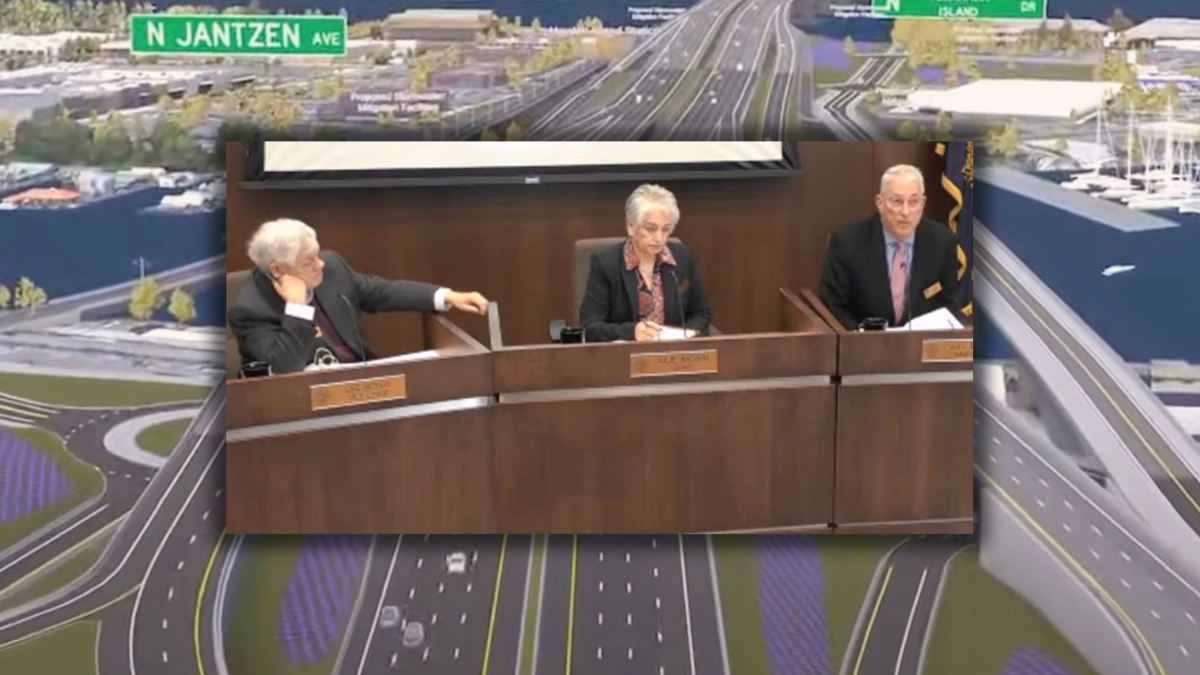
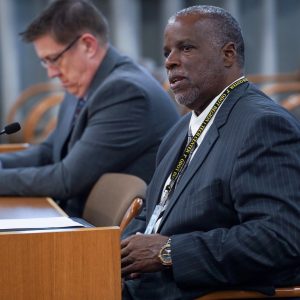
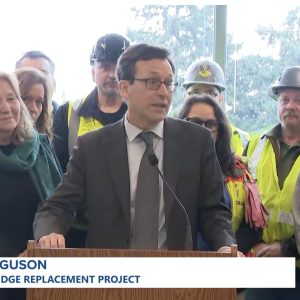
The bombshell report about vast cost overruns for the Interstate Bridge Replacement Program that came out earlier this month continues to reverberate. Project staffers faced sharp questioning from members of the Oregon Transportation Commission on Thursday at their first meeting since the news dropped.
Commissioners received an update on the IBR from Interim Project Administrator Carley Francis and Assistant Program Administrator Ray Mabey. Earlier this month, reporting from the Willamette Week revealed that the cost estimate to widen five miles of I-5 and replace the bridge between Vancouver and Portland could balloon from $6 billion to $12 to $17 billion. To make matters worse, project officials have been accused of intentionally holding back the higher cost estimate for political and strategic reasons. Suffice it to say, none of this sat well with OTC members.
“At $13.6 billion, what do you think that’s going to do to our ability to handle projects around the state if that bridge is draining the tank? I’d really like to know what the plan is,” Commissioner Jeff Baker asked Francis. “Because the narrative now is so negative that you guys could put the bridge in jeopardy simply because you’re not willing to have these conversations until the numbers are perfect.”

And Commissioner Lee Beyer, a strong supporter of the project who was a key member of the legislature during planning of the IBR’s previous iteration, the Columbia River Crossing, said, “It’s a tough one. I just don’t see a $12 to $16 billion dollar project being possible.”
“I’m concerned about the numbers jumping that far, that fast,” Beyer continued. “If those numbers are correct, we can’t build this project. There’s no way you’re going to get the money to do it at this point.”
Even OTC Chair Julie Brown had a pointed statement to get off her chest: “You put us all in a bad situation by having information that you may not have given to elected officials or committee members, and tried to contain it and try to figure out what to do.” Brown then said the officials hid the estimate because they were, “trying to come out with a narrative.”
For their part, Francis and Mabey tried to keep the focus on moving forward with the project. There was no clear apology, but Francis said at one point, “It’s incumbent upon us to get information out, which obviously has been a breach of trust with folks. So I’m recognizing that.”
Francis and Mabey painted a picture that the new cost estimate was so preliminary that it didn’t need to be shared yet. But at least one commissioner did not buy that line.
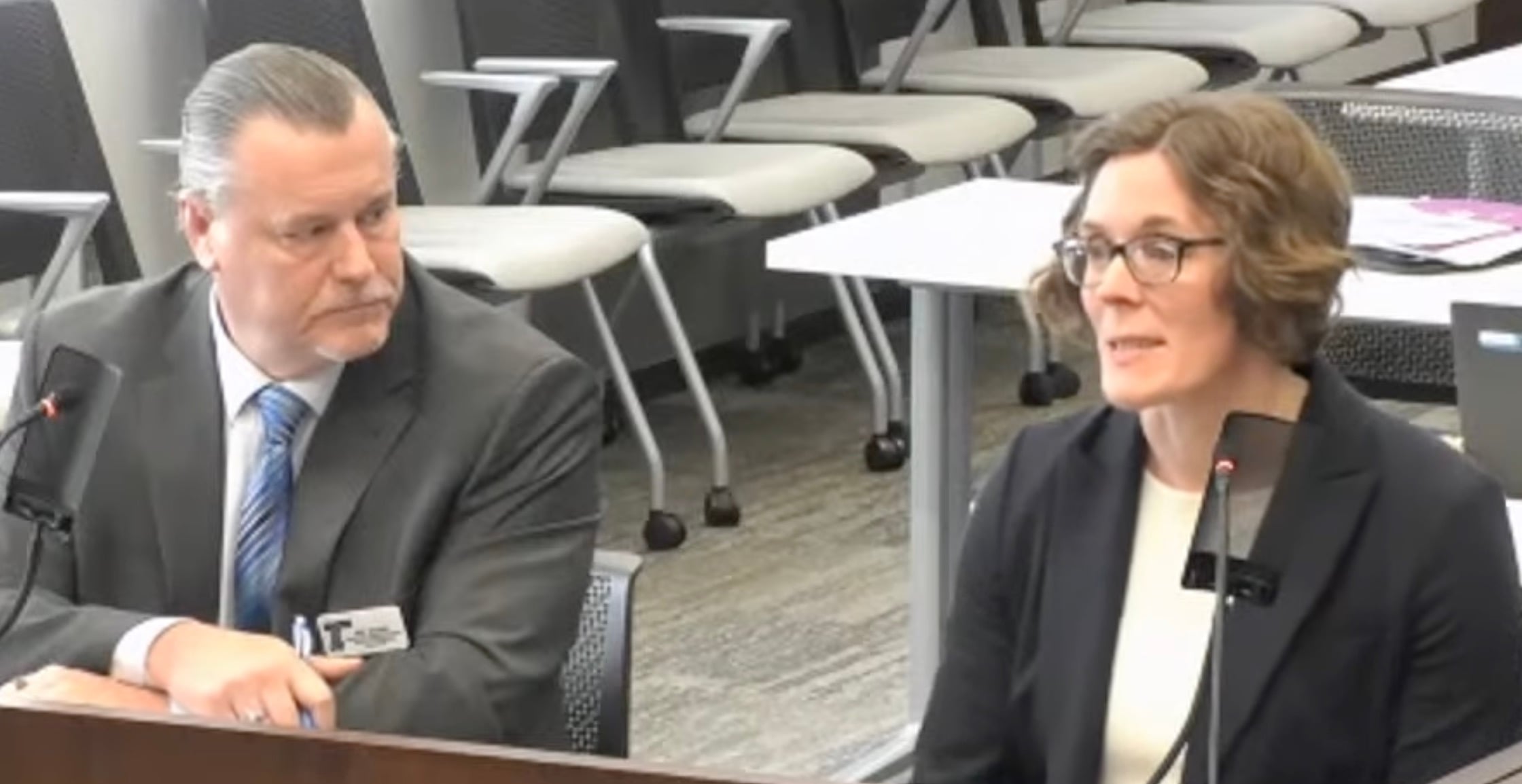

Baker, who had clearly done his homework and has studied the once-hidden cost estimate documents in detail, pointed out that project staff were part of twice-weekly meetings about the numbers. “So this is information that should have been discussed and known.” Baker seemed to resent being in the dark about the numbers during previous conversations with project staff. Referencing a presentation about economic calculations for the project, Baker said staff knew at the time the project cost was going to double, but they presented the information based solely on the old estimate, “without even an asterisk” that it might soon rise precipitously.
In one exchange with Mabey, Baker asked him point-blank: Why was the new cost estimate, which he’d promised would come out in December, moved out to March?
Mabey said they couldn’t provide a new cost estimate until the Coast Guard revealed their decision on bridge type. “It made sense to make sure we’re aligning an estimate with that key knowledge in hand,” he said.
“I’m going to hold your feet to the fire,” Baker replied. “Because there were two documents — one for each bridge type option… So it’s not like we were waiting on that decision to create the information. It was on there.”
Instead of even ponder what a pause or reset for the project would mean, Francis was clearly focused on moving forward. She wants to “start the dialog” about “sequencing” the project — that is, starting with a small piece of it and then moving onto larger pieces as new funding is identified. That tact seemed to irk Commissioner Baker.
“A budget is a promise,” Baker said, during an exchange about construction phasing. “The plan would be that we spend the amount of money that we’ve got allocated right now, and then we come back for more? And we spend until we run out of money, and then we come back and ask for more? And I understand that’s a process that has worked in the state of Washington [where Francis has worked]. And we have been guilty of it here from time-to-time. But, the direction of the legislature and certainly the feeling of this commission, is that that’s not the appropriate way to do it.”
As for the forthcoming, official cost estimate the project team expects to release in March, Francis didn’t say too much about what number we should expect. “The costs are definitely going to go up,” she said.
“I think [the rising cost is] why it’s so incumbent on us about mapping out what are some first steps, and how do they fit, how do they relate to the funds that we have?,” Francis said.
And as Francis talked about moving forward with the project by breaking it up into smaller pieces, Baker didn’t seem comfortable with that idea. “About that comment you made about, ‘How do we get started [on the project]?’ I don’t want you to get started until we get some answers. This is where we get into trouble. And are we starting on $6 billion project? Or are we starting on a 14 billion project?”
No one knows the answer to that question yet; but it’s clear some amount of value-engineering could be on the table. “How much can we downsize that and break it into a number of different projects?” asked Commissioner Beyer.
Beyer, who for some reason only now appears to have noticed the project isn’t just about one bridge, then described the full project scope as a “nice to have.” He asked where cuts could be made.
“I think there are like, six buses that they wanted to buy in there? And there’s some questions about that,” Beyer said. “Do we need that? There’s some questions about the light rail. Do we need both those kinds of things?”
Francis said however the project is phased it must “start at the river,” — which I heard as doing the bridge and its approaches first, and thinking about everything else later.
But it remains to be seen if there will be a later. And if there is, given the loss of trust and severe budget crunches, what amount of funding will lawmakers even be willing to commit to?
Thanks for reading.
BikePortland has served this community with independent community journalism since 2005. We rely on subscriptions from readers like you to survive. Your financial support is vital in keeping this valuable resource alive and well.
Please subscribe today to strengthen and expand our work.
I’m going to “start the dialog” with my bank about “sequencing” a beach house.
Woof. I hope they don’t value engineer light rail out.
This project is such a quagmire (and shows some really poor planning culture at ODOT/WDOT).
I wasn’t here for the CRC blow up, but was this also what happened there? Cost going up because ODOT/WADOT wanted a massive project we couldn’t afford?
David Bragdon wrote an editorial a few years ago recounting the CRC experience from his perspective as Metro President during that time, available here: https://cityobservatory.org/hard-earned-lessons-dont-repeat-the-mistakes-of-the-failed-crc2022/
The piece opens:
Well, they got the Coast Guard on board this time I guess.
This is fantastic, thank you for sharing it. Can we put this guy in charge of ODOT?
Wow.
yes, same as it ever was…
Actually, let’s hope they do. Light rail has shown to be fiscally irresponsible, never meets promises, and is totally inflexible. Heck TriMet can’t even do the most basic of maintenance to keep it running.
A dedicated lane for buses is all that is needed and could be useful for emergency vehicles.
Is light rail also financially irresponsible in European and Asian cities? The cities that so many of my friends love to visit? Tokyo, Berlin, Amsterdam, London? Are those cities financially irresponsible because they provide a big percentage of daily transportation in the form of rail transit?
There are many examples of functional rail transit in cities outside the US that have been financially stable for decades. Light rail is not the problem. The problem is the sunk cost fallacy and the trillions we’ve spent on roads and private motor vehicles, most of which have a functional lifespan of 15-20 years.
Private car ownership drains American cities of transportation dollars that should go to public transit modes while folks who have a vested interest in auto industry profits work to restrict transit any way they can.
TBH I expect that the entire US transportation system will collapse before we get more investment into public transit. That’s why bikes are such an important part of the conversation, they’ll still function when gasoline costs $10/gallon (which is what it costs in those transit rich European and Asian cities).
Anyway good luck with your car dealership or gas station or drive thru or whatever car centric business you’ve invested in.
None of those cities with successful light rail you mention are in the US and obviously none of them are Portland.
It’s wearying hearing people here constantly lamenting that medium sized Portland which is barely 175 years old is somehow comparable to the old, wealthy, large and capital cities you hold up as such desirable places to visit.
The historical situations over there that led to their systems are far different than the historical systems that built the MAX. We are all locked in from decisions we can’t change. They have theirs and we have ours.
Ours isn’t sustainable because in my opinion the whole MAX system was set up to feed downtown and let people who worked downtown bar/activity hop. It was never meant to be a connective system for the city or metro area and definitely wasn’t expected to replace cars.
I desperately want more investment into public transportation, but the Orange line and IBR continuing fiasco reminds me that shoveling money at the problem isnt enough. Engineering and political competence must also be involved with the goal being to lessen the scourge of single occupancy trips and to eventually lessen the number of cars on the road.
As far as your estimate that the entire transportation system will collapse I agree with you. The grid will fail as it trys to keep up with AI and data centers and the increase in everything electric and so no matter the price of gas, it won’t be flowing.
Sure would be nice if there was a giant pot of money to help us prepare for the climate crisis results by hardening electric wires, installing solar panels on all city owned property, installing solar on private homes and any available space while simultaneously planting a lot of trees and preparing manually powered water wells.
One last thing, maybe your friends should care more about the environment and not pollute us all by participating in jet engine flight which is incredibly damaging to the environment and rains jet fuel on us all.
This is just…so not true. Mid-20th century, post-war, European cities were just as flooded with cars. People say, “oh, well, those cities were leveled during the war”, and a.) they certainly weren’t ALL leveled, and b.) WE leveled our cities, too–for highways. A lot of European tram systems were abandoned during that time, and yet, surprise, surprise, they’ve been coming back all across the continent because cars are not mass transit, and building cities that act as though they are (in America as by mandate and ignorance from the mid-20th century onward, to just out of habit, now) doesn’t work at scale without both massive public subsidy and a general acceptance of the public harms of mass car usage.
It’s not just European cities, either. All across East Asia, historically there has always been good rail (Japan) or buses (South Korea), or mass bicycle (China) or mopeds (Taiwan, Vietnam), even prior to the modern subway/regional rail systems we see a lot of in these places now. Of course, there are still a lot of cars in these places, but because not everyone is always driving everywhere, there’s always been a constituency that works against building places that only work for cars. The end result is messy, sure, but the point is that people living in these countries still truly have a choice about how they get around, so they can have much bigger cities without suffocating from total gridlock.
The Asian only places that have been as car-dependent as the U.S. have been politically and socioeconomically dysfunctional places like the Philippines or Indonesia, where there’s just never been the systemic organization to do efficient large-scale planning…as was done in the U.S. historically, albeit around the wrong modal choice. However, as an obviously mixed blessing, those places are also too poor for truly mass car ownership, so car-centric sprawl doesn’t really exist, either. They just suffer from the poor being essentially travel-deprived, and the rich being stuck in the kind of traffic jams that’d make Portlanders blush.
The problem with a lot of younger American cities is that they are and will only ever be traversable by car unless they change course, because they are so decentralized and sprawling that no other mode is practical. This is, unarguably as you say, a problem, but one that we can fix with population growth. That is the opportunity that Portland squandered over the past few decades after the MAX was built: building outwards around highways and stroads, instead of upwards around MAX lines and true cycle lanes. I certainly won’t claim that there’s a silver bullet solution to our development patterns, but they do need to change. As long as Metro Portland’s population continues to grow, that change is feasible. And, for transit to work, it is necessary.
Also, your little coda about the damages of flying is not incorrect, but so obviously a red herring that it’s almost cute. Like yes flying is bad, but it’s not something most people do more than maybe twice a year…and completely off-topic, besides. Driving is a daily activity for most people, and so even with EVs, the much bigger environmental harm to try to reduce.
“This is just…so not true“
Which part wasn’t true? You made a lot of statements and ideas in your post that I didn’t make and then you argued against the points you brought up. This fever dream is one whole straw man example. There’s nothing for me to even rebut except for one thing.
Why in the world did you tell me my concern about flying is a red herring? Flying is bad for the environment and there is little necessity to indulge in it. Driving is bad for the environment, but frequently there is no other choice on getting around. I am tired of caviar climate deniers who never realize that making sacrifices to save the planet actually means making real sacrifices. Do any of us really need to jet around the world? Do any of us need a global shipping industry to make sure we have year round avocados? The answer is no. Getting rid of international commercial flights would be a great start in cutting down C02 emissions and it wouldn’t hurt anybody. The ultimate low hanging fruit.
More or less everything you said was untrue in some manner. If you want me to rebut them directly, point by point, I can do so, but you have a lot of erroneous thinking to correct, especially as someone who sure seems to think that environmental sustainability is important. If it feels like I was setting up straw men, you perhaps should wonder why I imputed a lot of things to what you said. These are not simple issues, nor are they entirely unique to the U.S.
P.S. The problem with flying is that for distances over ~600miles, nothing can compete with it. And a.) we all know that people love being asked to make irreplaceable quality-of-life sacrifices, and b.) travel over long distances is a great way to see the world, appreciate people’s differences, and eventually come to value it all enough to, e.g., care about the global environment. Flying is also still rare enough that it generates a fraction of the emissions that driving does in the U.S., even with all of our short-haul flights that should be on high-speed rail.
“More or less everything you said was untrue in some manner. If you want me to rebut them directly, point by point, I can do so,“
If you have time I’d appreciate it if you would. I’m always curious how other peoples thought process works and your critique of my deliberately vague points will be interesting.
As far as air travel goes, here are some fun open source articles that show how bad it is for us. I’m guessing you already know how bad it is, it seems that it might not be as important for you as your desire to travel.
https://www.bbc.com/news/science-environment-49349566
https://ourworldindata.org/travel-carbon-footprint
https://www.sciencedaily.com/releases/2024/04/240430131900.htm
I don’t know if you remember 9/11, but those two days of no domestic flights were incredible, despite the horrors of what had happened. Nothing overhead, no contrails, no aerosolized fuel in everything.
No flights and the world kept turning. It is possible, it’s been proven that not flying won’t destroy our social or physical infrastructure and might even encourage the rebuilding of all the abandoned train track.
Okay, if you’re game, so am I. Always appreciate the opportunity for us to learn from each other.
From your first post, the response to Kate:
Portland is a medium-sized city by perhaps American standards, but it’s actually quite large for European ones (though unarguably small by most Asian standards, yes). In each European country, there are few cities of Metro Portland’s size. We’d be the 2nd biggest city in France or the UK, and among the top 5 in Spain, Germany, Poland, and Italy. Nonetheless, many cities in all of these countries which are smaller than Portland have both land use which is efficient enough to be served by public transit, and transit which is good enough to meaningfully contribute to their congestion management in a ways that Portland cannot.
Being “barely 175 years old” is also not exactly an excuse. As a reminder, true car-dependent sprawl didn’t happen–simply was not even entertained–until at best 100 years ago (in places like metro NYC, never mind much younger Portland). In all that time, it has been conscientious, directed action to make Portland and other such young places car-dependent. By extension, conscientious, directed action can make it much more transit/ped/bike-friendly.
Neither age, nor wealth, nor size determine a metropolitan region’s modal split. It is at least 75% policy and planning. (This is also reflected in how our highways came to be; these were not voted-upon things, they were commanded by people on high–wealthy, class-insulated people–who thought that cars and auto-dependent sprawl were “the future”, regardless of how many could actually afford to live that way, or the ultimate capacity of a city built like this. I strongly recommend Steven Conn’s Americans Against The City for an overview of this dynamic).
No one could argue that the history of cities like Portland and almost anywhere else are identical; certainly, I am not. But the point is that history–both looking back, and planning for the future–is entirely contingent, truly dependent on only a handful of things like preceding history, geography, and demographics (even the latter of which can be changed by things like immigration).
Criticizing the MAX for feeding downtown is to misunderstand what makes transit work in ways that cars simply can’t. The strongest transit systems in the world–with the largest modal share–feed downtowns, sometimes more than one in sufficiently large cities. If your metro region is such that there’s no one area that people want to go to above all others–if it’s truly polycentric–transit struggles, because it thrives off intensiveness of use; this is an urban geography where cars dominate. Conversely, if there is a part of your metro that everyone wants to get to–or even simply must go through to reach other areas–then cars cannot compete. It’s simple geometry: cars take up too much space per person (even with a loaded car) to get everyone to one area without huge losses to congestion.
Metro Portland’s problem is that too much development leaked out of downtown, and so people continue to want to get through it as much as to it, and there are very limited areas they’re getting through Portland to that could reasonably be traveled in car-free. Not only is Portland–as a metro–sprawling, but so are its suburbs. None of this needed to be so, but as in most of the rest of the U.S. driving is severely under-priced here, so development went out–everywhere: first out of Portland when prices rose, then out of the secondary centers because cheaper undeveloped land was within reach.
The problem with MAX is that it’s not a higher-speed regional rail system, and the areas its connecting are too low-density, as well. Ultimately, it has nothing inherently to do with the layout of the system, and everything to do with the development (or lack thereof) around it. That’s why people complaining about it as a “favor for developers” is so galling to me; development is what makes cities. Complaining about it is completely misguided.
You have these mostly right, I think. The lack of governmental competence is a bigger American problem, but that’s in part because we’ve been told for decades that government can’t be competent, that it is inherently wasteful. However, that’s a political discussion for another time.
When you’re in the boom times, you can get away with it because growth permits waste–as Portland did from the turn of the century until the COVID epidemic took the wind out of American cities’ sails. Now that those good times appear to be behind Portland, at least for a good while, the metro’s (and by extension state government’s) incompetence is being shown for what it is. A big part of this is the obvious mismatch between infrastructure development priorities and fiscal sustainability, as well as stated goals around public health and environmental sustainability. You can waffle about these things when “the future”, bright and distant, still seems ahead. The future is here now, and our lack of taking it seriously is coming home to roost, as it were.
Put plainly, after all this, there is no version of the American status quo that is sustainable (outside of small handful of dense, multicultural, economically vibrant cities like you see east of the Mississippi; even those have their own issues, to be sure). That includes things as *ahem* pedestrian as transportation and land use planning. Continuing on with what we have–in Portland, in San Francisco, LA; in Dallas and Houston, in Phoenix, in Miami–is not truly an option, just an illusion.
Glad to hear from you and thanks for taking the time. Looking through what you’re saying I’m not sure if we are in much disagreement over very much. I think we have a different perspective, but let me respond to your points and we’ll see.
“Portland is a medium-sized city by perhaps American standards, but it’s actually quite large for European ones (though unarguably small by most Asian standards, yes).”
In my head I was thinking population and density when I discussed the size of Portland. I know it’s geographically more spread out (most American cities are larger in comparison to European cities mainly due to the sprawl you (and I ) dislike), but did not specify why I was calling Portland “medium”. For example, Paris has roughly 3 times the population as well as (roughly again) 3 times the density as Portland while being nearly a third the geographical size as Portland.
“Being “barely 175 years old” is also not exactly an excuse. As a reminder, true car-dependent sprawl didn’t happen–simply was not even entertained–until at best 100 years ago (in places like metro NYC, never mind much younger Portland). ”
I mentioned Portland’s age to highlight how old the money and political systems are in European and Asian cities and how entrenched living in cities is in their psyche and how used they are to living together. We’re the new kids on the block that literally wiped out our predecessors a few generations ago and moved into their spaces. Agree that the auto hit everyone at the same time, but we are too young to have an entrenched cultural and legal nobility to control society. I can’t back this up, but American growth always seems so willy nilly compared to the seemingly more controlled, more directed European growth. The BP article on Bogota is one of my favorites and really instead of Vienna or Amsterdam, our City Council should go there to explore transportation solutions.
“Criticizing the MAX for feeding downtown is to misunderstand what makes transit work in ways that cars simply can’t. The strongest transit systems in the world–with the largest modal share–feed downtowns, sometimes more than one in sufficiently large cities.”
This one is personal from my own perspective. When I was solely commuting via Trimet I had to cross downtown and the Metro area to get to work for awhile. The slog through downtown was torturous and so slow. I understand what you are saying about feeding downtown and I see the importance of that. At the same time there has to be a way for everyone else going through downtown to get where they are going with some alacrity. I don’t know the solution for that, but it’s clear the question wasn’t even considered when MAX was first built by those who only wanted people brought into downtown. I agree with you that it didn’t need to be so, but we are trapped by the decisions made that gave too much to auto transportation and not enough to public transportation.
“The future is here now, and our lack of taking it seriously is coming home to roost, as it were.”
Totally agree with this sentiment and your whole paragraph.
“Put plainly, after all this, there is no version of the American status quo that is sustainable (outside of small handful of dense, multicultural, economically vibrant cities like you see east of the Mississippi; even those have their own issues, to be sure).”
I agree. Sprawl is the escape valve that keeps us from being pressured to design and build actual density where competent designers pick where development should happen for the good of us all rather than developers picking where they want to go to make an easy buck that’s not sustainable (looking at you, Orange Line).
I worked in Singapore for a bit and loved it. Dense, parks , civic pride and attachment, buying a car requires buying an expensive license, excellent, clean and intertwined public transportation. Things not likely to happen here anytime soon or at all.
Also, for what it’s worth, flying is better for the environment than driving per mile. It’s just that people go such long distances that it adds a lot of CO2 in a short time.
I suppose, unless you drive cross country in an EV.
With basic route planning its very possible nowadays.
https://www.motortrend.com/features/ev-electric-car-road-trip-cross-country-race
(This 3,000-mile race wasn’t one of outright ground speed; driving more than 10 mph above the speed limit (85-mph max) was against the rules.) I underlined the last sentence at the bottom.
https://insideevs.com/news/733089/lucid-air-grand-touring-la-to-nyc/
Your own AI (I used the generic google version as people have a tendency to believe AI for some reason) may offer a different answer.
For a 1,000-mile trip, flying is generally more carbon-efficient than driving alone, but driving becomes better for the environment if two or more people share a fuel-efficient vehicle. A single person flying coach emits less CO2 than a solo driver, but a family of four driving often produces roughly one-third of the emissions of flying.
Key Factors for 1,000-Mile Trip Emissions:
For the lowest impact, traveling with 2+ passengers in a car—or using a train—is generally superior to flying.
All of that totally depends on your assumptions and computation method.
If the plane is flying anyway, filling (or not) two seats doesn’t make much difference in marginal carbon emissions, especially if not filling the seats just causes the airline to lower the cost of a ticket $20 in order to sell one or two additional tickets, maybe to a heavyset couple with lots of luggage.
If you naively divide the emissions of the plane by the number of passengers, you end up with inane conclusions like driving alone emits less than being a passenger on a nearly empty bus.
If you are comparing the impacts of two options, you really need to consider the marginal effects of each, and the marginal effect of driving is firing up a vehicle (that would otherwise sit passively in your garage emitting nothing) while the plane you didn’t take flies overhead.
> If the plane is flying anyway, filling (or not) two seats doesn’t make much difference in marginal carbon emissions
Nah, that is absolutely not now that works. This is the most defensive, motivated reasoning I’ve seen in a while. When you fly, you’re creating the demand. You are responsible for exactly your share of that flight. The plane is not flying anyway, it is flying because you’re paying for it.
How much demand does my annual or twice-annual flight create? Enough that United or Alaska is going to add another flight to their schedule? Or to remove one if I forgo my trip, with all the systemwide cascading effects that would entail?
It might (or might not) be enough for their algorithm to alter the pricing for my flight. But if I drive instead of fly (with all the emissions that entails), you better believe that plane is going to fly anyway, and the seat I would have occupied is probably going to be full. The biggest impact I’m likely to have is a swing of $20 or so in the airline’s bank account.
Call it motivated reasoning if you want, but it’s how the system works. The planes fly, and airlines adjust their prices to fill their seats. It was possible to fly across country for $100 early on the morning of New Year’s Day (or so I heard), and it’s why most flights these days are completely full.
Passenger demand is not static; it can literally be created (or suppressed) with the push of a button.
I know you don’t like numbers, but if I’m wrong, please give me some very rough estimate of how much CO2 does not get emitted if I don’t book a flight to visit my in-laws in Denver for their anniversary, and drive there instead. Not some accounting number, but actual CO2.
For comparison, if I drive round-trip to Denver, I will emit roughly 600kg, or .6 tonnes of CO2. (2000 km x 2 x 1.5 g/km), maybe a little more if I snack on beef jerky or eat a hamburger along the way.
Your flight, no matter when you do it, creates one passenger flight of demand. You are responsible for whatever fraction of an average flight you are. If you fly, United needs to run more flights, period. They wouldn’t fly empty planes, nor would they lower the price indefinitely.
Spin it around, try all you like to justify it to yourself, you are responsible for the flight. You don’t get to round it to zero just because you feel like it.
Any reasonable person can see this, but it requires someone who thinks they’re much more clever than they are to try and say every passenger on a cross country flight causes zero emissions.
(Side note, it has already been discussed that flying is more efficient than single occupancy vehicles by far, that is beside the point)
They don’t, and I explained why. They constantly twiddle the price knob, and their planes are all full with no extra customers wanting to buy tickets (when they do it right, anyway).
Any reasonable person can see this, and you can too if you watch ticket prices and observe that planes are full but you can also buy a ticket the day before a flight.
What matters is actual emissions, not some accounting mechanism that only makes sense at the policy-level.
You’re being dense and I don’t know why. Or maybe it’s cognitive dissonance, I don’t know.
They fly fewer flights to places with lower demand. They change prices to recover some profit from partial planes, but if you were not flying, you are lowering that demand. Lowered demand means they will fly fewer flights. They fly the number of flights they do because on average they can fill them. When you fly, you are doing your part to help ensure they can fill them. If they consistently had to lower the price, it would be less profitable and they would adjust.
You can’t wriggle out of it. When you fly, you are responsible for whatever share of that flight you represent. These are actual emissions that change based on how many people fly. Which, compares to about driving half the distance in a single occupancy car.
Sorry! I’m trying as hard as I can to keep up!
Are you saying my demand drives routing decisions? Or are you saying that, through collective action and boycotts across many thousands of passengers, we could, perhaps, change airline schedules by lowering demand on flights to New York by 150 or so passengers daily (per airline) even when ticket prices are at the minimum economically viable price?
And if it’s the second one, would my once or twice-annual flight cause them to add the flight back to their schedule?
Either I have the power to alter airline decisions on my own, or I don’t. The plane either flies or it doesn’t — do I have the power to control whether it does? If I do, I will definitely exercize it! If I don’t, what does it matter what I do in the face of what many thousands of others choose?
Using your method of accounting, I would emit more CO2 riding the bus late at night when I’m one of only a small number of passengers than when I make the same trip by car, so, from an emissions standpoint, I should drive.
My puny mind can’t wrap it’s head around that. My simplistic way of thinking leads me to think I would emit less by riding the bus, even though you’re telling me otherwise. You’re also telling me I emit more by riding the bus at night than during rush hour. This is hard!
Marginal emissions (the difference between what’s emitted if I fly or I don’t), I get, but why more than that?
Sorry, I don’t know why this is hard to understand. I think most people get it, but I think there is a strong bias to say “but I’m not the problem”.
The planes fly because people are buying tickets to fly. Fewer tickets means fewer flights. To handle small fluctuations, they adjust prices to help keep the planes full, but they will not keep doing that if fewer people are flying on average.
So yes, your one off flight contributes your share.
You’re making the same fallacious argument that voting doesn’t matter, because your vote doesn’t make much difference. It really is the same, and you’re getting hung up on an unrelated issue.
You don’t need an organized boycott for this to be true. If people lean towards flying less often, less flights would happen. It couldn’t be simpler.
So in my mind, and I think this is probably widely agreed on, you are contributing to GHG emissions when you fly. Not the whole plane worth. Not the negligible difference in fuel use from your weight. Your share of the total emissions that were needed to make an average flight.
This is a relatively small thing, because the solution should be systemic, but it’s important that your incorrect interpretation doesn’t get used by more people to justify their actions. It’s wrong. Your argument justifies arbitrary amounts of flying (how could it not?), which should tell you that you are wrong.
Fly or not fly. There aren’t fractional flights, the decision is a binary. My choice to buy one or two tickets a year won’t tip the balance (especially if I’m flying coach — business class is where the profits are, coach passengers are mostly along for the ride). I am responsible for the CO2 emitted as a result of my decision, and nothing more (or less).
You are using systems accounting math, which doesn’t apply to individual decisions. That’s why you (apparently) think driving emits less than a late night bus ride.
But not to worry, I’m boycotting all airlines this week, and next week too! I’m doing my part!
So I guess the jets are just a natural phenomenon that happens no matter what. They’ll fly even if nobody boards. Even if it’s not profitable to do it.
Don’t bring up the bus red herring. That’s apples and oranges. The bus runs late night because 1, it’s an accessibility issue. And 2, it’s a behavior we want people doing more of.
And for what it’s worth, yes, in fact, the bus runs less often on less popular routes, to the point of having routes removed (sadly!).
You are abusing the idea of a collective action problem (which is real) to wash your hands of any guilt doing a wasteful, unsustainable thing. Because you care about global warming unless it would mean doing anything inconvenient.
That’s not my claim. I’m saying they’ll fly even if I don’t board. I did not fly today. Were any flights canceled? I’m also not flying tomorrow, and I predict they won’t be canceled then, either. That’s a testable hypothesis, and I hope you’ll verify my prediction.
Why your apportionment method applies to planes and not to buses is unclear. You say the situation is completely different, but won’t say why, except that you want to encourage one behavior and not another, so you account for the costs differently. That sounds more like politics than science.
Your argument boils down to “because I say so”, but I think the real reason is because the bus scenario clearly shows why your logic doesn’t work.
I don’t wash my hands of anything; I take responsibility for the emissions I cause. I count real, actual emissions because those are what drive planetary physics.
Nah. This is just head in the sand denialism. Your claim is that when you fly, that doesn’t cause any emissions. What a joke.
No. My claim is that when you ride in a mass transit vehicle (such as a plane) that is already running, you are responsible for the actual emissions your actions cause. That applies equally to buses, trains, planes, and even cars. To anything, really, without any political evaluation.
If you had a valid argument, you wouldn’t need to keep misrepresenting mine.
I would like enough people to boycott air travel so there would not be the money for fuel for the planes to fly empty or not.
As to the plane vs car efficiencies, I agree with you the potential combinations are vast. However, having a full passenger plane vs a full passenger car seems like a good place to start.
Also however, the post was mainly to refute a few of the posters here who think that air travel is just fine compared to auto travel. It’s not. Air travel is bad as is auto travel.
It can even be argued that due to the unfortunate way infrastructure is set up that car use can (not should, but can) be essential for some people. There’s really not the same argument for air travel and no argument for tourism air travel.
Quotes from AI can be dismissed out of hand regardless of which computer friend you asked.
The math in the second bullet doesn’t add up, looks like flying is still more efficient than 2 people in a car, although, according to the possibility I entirely fabricated AI hallucinations, it’s close.
Doesn’t really change anything. The point is people fly too much, but the alternative isn’t to drive instead as that would probably be worse. It would depend how often people fly solo (I expect most of the time, for work related trips) where the plane is better and the time cost of driving makes it a non option anyway.
The problem is too many people making unnecessary long trips, probably mostly business stuff (but that I don’t know). Not that flying is bad in it’s own right.
I come to Bike Portland to read people defending climate-polluting transportation modes.
It’s a fact, whatever you think about climate. Nobody is defending it. But face reality.
You for one are defending it when you say “Not that flying is bad in its own right”. It is bad in its own right. You’re so used to just being a contrarian I don’t think you realize you are supporting a climate destroying industry. Talk about being in thrall to the status quo.
Flying is bad in the same way driving is. It’s not sustainable to do it as much as we do.
But it is a simple fact that a cross country flight causes fewer emissions than a cross country drive, in a single occupancy vehicle. This is just the baseline, it isn’t a defense of flying.
But if you have family on the other side of the country, and for some emergency you need to go see them, there isn’t anything better than flying if time matters. A bus or train would be better if you had time. A bullet train would be better if we lived in a modern society. But just like your example of some people who actually need to drive, sometimes people need to fly and we don’t have alternatives.
We should strive to not have families spread out all over the world who we try to visit multiple times a year. We should maybe not fly thousands of miles for a vacation multiple times per year. We absolutely should not be flying anywhere for regular business needs. This is what is wrong with flight (and driving!). It makes the unsustainable actions cheap and easy and convenient. It’s like putting candy in front of a child. And most adults. They simply cannot resist it. That doesn’t make doing it sometimes wrong.
Perhaps those places hire people based on competency.
Every European city is built around a walkable medieval core. The same is true for many Asian cities. American cities, on the other hand, are, as you point out, much more decentralized.
Changing that will take many decades, and a whole lot of money and political will. Meanwhile, new transportation technologies will exert their own pressure on the urban form.
I predict that in 50 years Portland will look nothing like Central Tokyo, Paris, or Amsterdam. Not because it’s impossible, but just because there is no way we will muster the political and economic energy to do that.
Portland’s walkable core may not be “medieval” (I’m sure I don’t nee don’t need to tell you that, e.g., central Paris’ core isn’t, either), but its blocks are still just ~66m long and wide; there are similarly compact-on-a-map cores in every other city in the metro. What we lack is the political will to accurately ascribe the high price of developments styles that don’t have this compactness, and thereby induce developments that do.
I don’t pretend that the sort of change Metro Portland needs is quick and easy, but that doesn’t mean it’s impossible, and if we want to continue to pretend to be “progressive” and “environmentally sustainable”, ceasing to lie to ourselves about what that actually looks like is necessary.
If there’s no way for everywhere on Earth to live the way sprawling American cities do without dooming the planet–which seems extremely likely–then no place can pretend to care about people and live like we do.
Even if Portland channeled all new residents into a single ultradense building, it would do nothing to solve the difficulties serving our existing development with transit. More people won’t fundamentally change our development pattern.
There are at least two very well situated so-called “cottage cluster” units that have been on the market for over a year near Cleveland High School if you know anyone who wants to move here and live in that kind of housing. It looks awful to me.
Actually yes it would absolutely. More people means bigger tax base.
We’ll never be a dense city if everyone thinks like you and does nothing that would move us in that direction.
Reality is such a drag!
With you 90%? When I first rode the Orange line I was amazed by all the nothing that surrounded it, in spite of the eminent domain pitched battles that were fought for right of way. The biggest development near the rails was the damn parking garage.
NE Portland is changing fast, with infill and sometimes 10-15 units replacing two. A person can see these changes in any neighborhood where housing stock was marginal in any way.
I like trees, and I like solar panels, but they don’t mix.
It’s definitely a balancing act. It just seems that wherever there is concrete or water there could be solar panels and wherever this is dirt there could be trees. I realize that sound simplistic, but that is essentially what’s needed. Portland has to start generating some power on its own and I sure don’t want a power plant nearby. Even hydro power has severe drawbacks. I really would have liked Biden to have doubled down on American solar while he was in power. We might have squandered an opportunity. Of course there’s the PCEF fund, but it’s getting nickel and dimed out instead of coordinating whole of problem solutions. It’s frustrating.
Resuscitate Trojan? Biden went as big as imaginable on solar and wind. The American left did not support his administration and the current guy is setting us back centuries. BPA wind is a local renewable success story, but there are difficulties fully exploiting the resource. I fully agree with your statement that we should be installing PV everywhere that sees the sky, but that will be expensive and beset with problems just like every other energy source. In particular, intermittency, storage, and transmission issues with solar seem similar in magnitude and complexity to those confronting wind.
“Biden went as big as imaginable on solar and wind. The American left did not support his administration and the current guy is setting us back centuries.”
I wanted him to go as big on actual green spending (not just green cronyism) as trump is going on authoritarianism. Green energy was Biden’s sole virtue (besides not being trump) and the results sadly speak for themselves.
I don’t think you can say Biden went as big as was possible since here we are. Two of the bluest states near and at the bottom of green energy projects, but only if we look at actual results. If you listened to leadership and looked at how much money Oregon and Washington have taxed for green projects, you’d think we’d be at the top of the heap.
“I don’t think you can say Biden went as big as was possible since here we are. Two of the bluest states near and at the bottom of green energy projects, but only if we look at actual results.”
Not sure I follow the logic. Are you implying that you think that if Biden had been more ambitious in terms of new wind and solar, Trump would not have won the election? Do you resent the development of alternative energy in red states? I would love to see more renewables built here. I think the most realistic path towards realizing that is to elect democratic candidates to local, state, and federal offices. Durable democratic electoral success depends on the development of a large and cohesive coalition. This coalition seems as distant and improbable as ever, largely because progressive elements of such a coalition feel underserved when dems do set policy. Biden’s large investments in renewables were one (apparently unsuccessful) attempt to shore up the progressive wing. Now they can learn (again) what the alternative is….
-I’m implying that If Biden had energetically addressed green manufacturing and widespread distribution we would have more access to solar and other green capabilities that trump would not have been able to unwind so easily. Green energy was not going to change the election results, but it would have materially helped us all.
-I’m happy for the red states that are succeeding in their green initiatives, I wish we were too.
-I think that looking at results that simply having a D is no guarantee of ecological victory. You have to actually care about the environment and locally we are seeing that the D’s in Salem do not. The R’s don’t care either so it’s kind of a quandary, but there are of course other reasons to vote strictly blue. I just would like a primary season with real options.
-Just investing in something is no guarantee that any of that money will do any good. The plans need to be good and competent people need to actualize them. This is what Salem seems to have forgotten. All that money going to contractors and cronies just make people suspicious that their tax money is being redistributed to politically connected friends. The money needs to provide results for any plans to work.
“If Biden had energetically addressed green manufacturing and widespread distribution we would have more access to solar and other green capabilities that trump would not have been able to unwind so easily.”
I feel like this position needs to acknowledge Biden’s significant efforts in renewables and ‘green’ economic activity. Sure, I would have liked to see more. But BIL, IRA, CHIPS, etc. were quite large and bold with lots of policy features for environment and labor activists. The conventional political analysis is that this substantial stimulus engendered backlash over inflation (along with dissatisfaction with brown-skinned migration into the country). I think this analysis misses a lot, but any claims that Biden should have more “energetically” addressed the grid and green energy need to address this narrative. What it looks like to me is that Biden gave the left what they ask for, and they abandoned him as soon as any of the political liability for such policies started to appear. As you say, funding is not sufficient to obtain good outcomes. But no funding means no government action, and I don’t have any other ideas for how to change patterns of large-scale generation and electricity transmission. Piling on Biden (and then Harris) or the Salem dems only guarantees backsliding.
I don’t see it as “piling on Biden, Harris or the Salem Dems” or the R’s and whatever trump is. I see it as holding them to account over the corruption that is evident in a lot of these programs including the Rose Quarter and IBR, Dubai and Saudi kickbacks, sudden wealth gains from politicians and etc, etc.
I feel you keep trying to make this an “us against them, Dem versus Repub” type of argument when it really should be “all of us against corruption so the money flows to people who know what they’re doing rather than who they know and the money actually goes to solving problems”
As always I enjoy your civility which is admirable in these trying and frustrating times.
I very much enjoy our discussion here, too. And I sympathize with the perception that the government is crooked and useless. But I do really think it is us against them. Republicans are more than welcome to join me, if they like, but I fear we have unbridgeable differences in metaphysical beliefs. To my friends to the left, I would suggest they will have more power within a governing coalition than from the outside. Sitting in that coalition will, of course, require compromise (of dearly held principles). My $.02.
Because they blind birds and cause cancer???
“shoveling money at the problem isnt enough”
Sir, this is Oregon. Our roads are paved with good intentions
Unfortunately, I have to agree with this. Huge mistake building the yellow line the way that they did. I just don’t see more than a few dozen people making the LRT slog through north Portland when all of this new vehicle capacity is in front of them. Having the ability to run a bus to DT or Lloyd directly is a much better sales pitch for public transit.
The CTRAN route 60 gets about 1,000 rides a day (source), and essentially just connects the Yellow Line with Vancouver. That is the absolute floor of ridership for a MAX extension (which would be far more reliable and much faster than the existing service). The express buses CTRAN already runs are okay, but would remain deeply unreliable even with the IBR since congestion in and out of Portland plus on I5 north makes providing good service tricky. I’d fully support an express BRT service on I5, but no one is proposing that.
There are reason to be skeptical of the MAX extension to Vancouver (especially as it relates to the operational cost for CTRAN). Ridership and utility are not among them.
I totally support extending Max into Vancouver, but 1000 rides a day doesn’t sound like a compelling argument.
If 1,000 riders a day are willing to deal with a bad transfer from a bus bogged down in freeway traffic to get between Delta Park and Vancouver, many more are surely willing to use a better service. I’m not sure what official projections are like these days, I mostly meant that a few dozen in the comment I was responding to is laughably low
I can’t speak for the accuracy of the CRC report, particularly since it’s so antiquated and well pre-pandemic, but the estimate was:
Ultimately, it depends a lot on frequency, and whether tri-met can weather the current financial storm.
The Orange Line had big ridership forecasts as well. I’d want to see an updated forecast that reflects the reality of transit as it now stands.
Also, there may be increased resistance to extending Max, just as there is to building new bike paths. For me, Max is a critical component of any new bridge, but I no longer see it as inevitable, especially if we end up going with a smaller project.
The financial storm has not even happened yet.
We are still waiting to see the impact of Trump’s tax cuts on state revenue AND the impact of commercial property values cratering on city revenue.
Portland also has a budgetary poison pill that is starting to hoover up the majority of property tax revenue — the abysmally stupid “pay as you go” FPDR pension.
Just writing this out makes me question whether the things I love about Portland are in any way sustainable.
And for the record, I am no fiscal conservative. What pisses me off about this sad state of affairs is how current and past generations are robbing young people of hope.
Socialism or barbarism.
I bet you have a car.
I’ve long said extend MAX to a Hayden Island surface station ‘terminus’ junction with an extension of the Vancouver BRT bus line which would serve downtown Vancouver better than the stupid parking lot now proposed to cap I-5. A future MAX extension to Vancouver is not ruled out. Cancel WsDot’s plan to rebuild I-5 interchanges other than the main one to Hwy14 East and downtown Vancouver. The bridge “type” that seems most logical is “single-deck” because it meets the Coast Guard minimum river clearance standard of 125′ (eliminating the ‘Lift-span’ option and simplifies exit/on-ramp design.
One thing planners should consider is building the southbound span first (with 3 extra lanes for transit and walkway) while leaving both old spans in place for northbound traffic while the new northbound span is constructed. This also should simplify construction and reduce costs. ODOT & WsDot are corrupt closet republicans, fascist in service to our ruling class business interests.
The OTC has failed Oregonians. They should be replaced by people who recognize that it is their job to hold ODOT accountable. Bringing up buses and light rail while ignoring the massive interstate build out shows how clueless Beyer is about the content of the project.
He’s not clueless, he’s intentionally bringing up transit by ignoring the million extra lanes they want to add for miles on either side of the freeway. I suspect that he wants to cut all the transit and bike/walk portions of the project, which will save maybe a billion if we’re being honest, then push for the (by then, probably) $20 billion project to get built because “we have to get this done”.
Sigh… I know. This degree of willful ignorance has to be a facade for whatever self-serving motivation lies beneath the surface. But, I imagine that it is easier for casual observers to believe that OTC is incompetent or too busy to pay attention to details rather than they are deeply corrupt. However, after a decade of bad faith “oversight” from OTC, corruption is 100 times more likely.
We’ve got to reinforce the behaviors we want. If you watch the video from the OTC hearing, Jeff Baker grills them hard. Phil Chang, while quieter, is seeing the mess that is ODOT and these megaprojects. I strongly suggest sending them an email thanking them and encouraging them to ask these questions. Sincerely. None of us has a chance to ask questions and demand real answers, but those guys are starting to show that maybe, just maybe, someone is finally watching ODOT. I’m sure it’s not easy going against the grain of the freeway industrial complex, so we ought to give them some “attaboys” and “keep it ups”
Vote for Tina Kotek if you want OTC reform!!!
The only way to prevent the republicans from DOMINATING the OTC is to vote for democratic climate champions like Tina Kotek!!!
Exactly. Everyone on the OTC serves at Kotek’s pleasure, so if you like what they are doing, keep voting for Kotek, True Climate Champion, to get more of the same.
Long live the status quo! Long live Tina Kotek!
The other only way is for Kotek to get primaried and we have a solid, competent and energetic person facing off against the R’s.
It’s interesting how none of the progressive climate champions in the House or Senate have stepped up to primary Kotek.
It’s really depressing that politics continues as normal here and the politicians are waiting for their turn to run and not step on any toes. The dire ecological and financial situation would hopefully encourage someone to break ranks and give us an option to positively vote for rather than “a no vote for the R”.
Time to go back to the initial “Common Sense Alternative” from a decade ago (not the CSA II that was recently proposed). (1) Retrofit the existing bridges for seismic safety and continue using them for freeway traffic; (2) move the swing span on the railroad bridge to line up with the lift span on I-5, eliminating 90% of bridge lifts; (3) build local-traffic bridges (2 car lanes, 2 transit lanes, and bike/pedestrian facilities) from Portland to Hayden Island and Hayden Island to Vancouver–and eliminate the Hayden Island interchange on I-5. That proposal has always made the most sense to me: It improves traffic flow by getting local traffic off of crowded I-5 interchanges, supports active transportation, and enables light rail or BRT to connect Portland and Vancouver. Of course that proposal will be impacted by inflation too….might just need to start with the bridge retrofitting.
Time to go back to the NO NEW HIGHWAY bridge alternative and use the remaining bonding to fund transportation decarbonization/sustainability. It is maddening how so many commentators on bike portland want to spend billions on new highway infrastructure when Portland/Oregon is doing fuck all to address the climate crisis.
If only there was some portion of project expense that doesn’t depend on the structure of a bridge and could be spun off to its own project.
“Now explain to this board the value of keeping you two in your present positions because the bad odor of this project reflects poorly on us all.”
The way this project has barrelled forward is so mind boggling. The rest of the 5-mile I-5 corridor doesn’t need to be improved and was always loosely related to the bridge itself. Traffic engineers have optimal design standards, but those don’t make sense in dense urban communities, so why go through the huge cost of implementing them here?
Given the the competing issues of maximum bridge height due to the airport and minimum height due to navigational clearance, I wish the tunnel option was taken more seriously. Europe has tunnels all over the place, which reduce environmental, visual, and noise impacts.
Same JR. The tunnel option was never really given honest assessment. If you read through the tunnel evals, it’s a little disheartening.
The tunnel is great… except there was no way to dump southbound folks coming west on SR14. Car brained camas surbarbinites avoiding Oregon income tax to live on ranchettes couldn’t stand for not having a perfect direct connection
At least that’s my theory. Such a bummer
Right, I understand that was the general theme of resistance to the tunnel idea but it was never really explored honestly. The idea that S-14 might be difficult/expensive to connect is different from the idea that it is not within the realm of basic engineering. Maybe rerouting should even be a consideration? But the screenings were all done with the assumption that SR-14 would use the existing spans because it was just impossible to connect them and the projections said it would be necessary. The projections were/are wrong.
There were other factors I don’t mean to diminish like environmental considerations, archaeological considerations from Fort Vancouver, and the absence of an MUP, but that’s easily solvable with retrofitting/repurposing the existing spans. There were various other specious reasonings in the original CRC like the existing bridges would still be needed for auto capacity from SR-14 so during lifts congestion would increase etc. etc. It was mostly just hand-wavey, circle jerk nonsense. Garbage traffic studies in with prioritization of as many cars as possible limiting and biasing choices, garbage out. No consideration of moving people, and improving the surrounding environment (e.g., noise, property value). It feels like reading a document from 1960.
Couldn’t agree with you more. They wanted to build a big as bridge that caters to cars, so other options damned. When the IBR falls under its own financial weight, I wonder if in the third time around we’ll solve for some of these problems… or if it’ll just be more of the same.
It has 100% worked in Oregon too. This is the part where I get to point out that just LAST MONTH the OTC voted to move forward with phase 1 construction of the I-5 Rose Quarter project via “Option 4” which did absolutely nothing to conjure up the remainder of the $2 billion that ODOT never had even before having $450 million rescinded by the Federal government. So they will clearly be returning for more funds, not that we should hold the OTC to account on that project because the Albina Vision Trust has made that project untouchable. To be fair that was only partially because the state funds for that project were reallocated to the Abernethy Bridge, which has tripled in cost since construction began. A project where they have come back to the OTC to ask for more money after they ran out of funds.
There doesn’t appear to be any memory of the past which means we get to watch it repeat in slow motion. I continue to be disappointed and unsurprised by the lack of competence demonstrated by the OTC. It shouldn’t be a surprise to anyone that transportation is causing all kinds of political problems at the state level when the people appointed to these critical positions are so willing to unquestioningly support projects that expand highway capacity in spite of a lack of evidence that the projects would be able to achieve their goals. This doesn’t even touch on the work that ODOT has done to keep our roads more dangerous than necessary (see: 82nd avenue car priority, Rose Parks overpass, Hwy 43, ignoring the Barbur Road Safety Audit, SE 26th and Powell) while people keep dying on roads without the allure of billion dollar projects that could save lives in the future.
So the only promise I see here is that a whole lot more money and time will be wasted trying to keep this project alive in its current form rather than asking real questions and getting rid of the consultants that have managed to collect hundreds of millions for a project that has managed to upset everyone outside of their firms by screwing things up so completely.
Maybe they can use Oregon’s Safe Routes 2 School funding to shore up the IBR financing, especially in “sequencing” the curb ramps for the bike spirals in phase 28?
They can use all $15m of the SRTS funding to pay 7 consultants to send emails back and forth for a couple years. It’s called job creation and it’s good actually.
When David Bragdon was president of Metro I testified that the Tom Lawson McCall Memorial Columbia River Crossing was by far the finest choice: one lane northbound.
Just build a new bridge with light-rail and forget the rest. Or better yet, make that a tunnel, tear out the freeway between portals, convert to boulevards, and sell the freed up land to help cover the costs…that plus a good toll should do the trick.
This bridge is not going to be built until the Big One takes out the current bridge. And when it does get built, it’ll be a quasi-private entity with bonding and tolling authority, in the context of a post-quake Pacific NW. Plan accordingly.
Maybe it’s time to take an honest look at an immersed tunnel alternative—an option used in major projects around the world, profiled by BikePortland, and long advocated by retired engineer and transportation activist Bob Ortblad—yet consistently ignored by IBR planners. In many cases, immersed tunnels appear to be significantly less expensive than large bridge projects.
BikePortland covered this concept in detail here:
https://bikeportland.org/2023/12/01/i-5-freeway-immersed-tunnel-model-on-display-in-vancouver-today-382208
Examples from around the world include:
Fehmarnbelt Tunnel (Denmark–Germany): 18 km under the Baltic Sea, estimated at $7–9 billion https://www.bbc.com/news/articles/cy70y2x3xj6o
Fraser River Tunnel (Metro Vancouver): estimated at $3 billion (CAD), providing three vehicle lanes and a dedicated transit lane in each direction, a separated multi-use path for biking and walking, and maintaining navigational clearances https://engage.gov.bc.ca/fraserrivertunnel/about-the-project/
Hong Kong–Zhuhai–Macau Bridge, which includes a 6.7 km immersed tunnel https://www.hzmb.gov.hk/en/
Basra Tunnel (Iraq): 2.5 km immersed tunnel https://en.alfawport.gov.iq/immersed-tunnel/
Given the growing global use of this approach, why has IBR staff so studiously avoided serious analysis of an immersed tunnel option? Especially in the face of a huge escaltion in costs for a bridge?
This selective mindset feels familiar. PBOT is plowing ahead with the Montgomery Park streetcar extension despite the collapse of the development rationale that supposedly justified it in the first place:
https://nwexaminer.com/p/streetcar-to-nowhere
As I recently wrote in an NW Examiner column (“Streetcar to Nowhere”), PBOT last estimated this project at $190 million for just 0.65 miles—about $292 million per mile.
We’ve seen this playbook before: lowball the estimate to get approval, inflate it later, repeat. A final price tag closer to $300 million seems entirely plausible.
Local sources would be on the hook for 20–50% of that cost—$60–$150 million—money that could be used for sorely needed transportation fixes across the city. That includes basic maintenance, like the badly potholed seven-block stretch of NW 23rd from Northrup to Thurman, which PBOT has said it will not even patch with a low-cost asphalt overlay until the streetcar is built.
Those funds could also support real safety improvements- including bike infrastructure-citywide.
PBOT may consider this a priority—but given limited resources and many unmet needs, is it actually a priority for the public?
Meanwhile, the beat goes on.
One of my takeaways from The Power Broker was that Robert Moses hated building tunnels because *you can’t see them*. He wanted visible evidence of his achievements. I wonder how many transportation folks have the same perspective.
If the Coast Guard requires 100’+ of river height and the airport requires 100’ or less of bridge height (or whatever the numbers are), then they need an opening bridge. Period.
If they need an opening bridge, then they don’t need to go 80’ in the air. So the new bridge can match the vertical profile of the existing bridges.
So. They can build a new pair of bridges the size and shape as the existing bridges. It would look like the Morrison Bridge in downtown Portland. A “bascule” lift span. Infinite height for river traffic.
And they wouldn’t need to rebuild *any* intersections.
Put light rail and a nice Bike/Ped path on it and you get the whole package at a very reasonable price.
If a gov’t overseeing board balks at a lift span on an interstate highway, then rename 205 to “I-5,” and rename I-5 to “US 99”.
Now is a good time to write your elected officials, folks.
* “yes” to light rail
* “no” to a megabridge
Ted Buehler
Ted, quit making so much sense 🙂
Here’s on thing: there’s so much pressure on politicians to keep three lanes of traffic in each direction during construction that the project ruled out simply replacing the bridges in the same spot as existing structures. That promise has to change.
There’s plenty of space on the west side of the existing bridges. Two hotels have been torn down since the CRC days. Just build a nice pair of bascule lift bridges. 4 lanes wide each. Or three.
Not sure if you’ve noticed, but there is zero space to the west of the existing bridge. Do you mean the east side?
This project needs to die.
We need to look seriously at a freeway tunnel under the river. And rehab the existing bridges for local traffic, bikes and transit, rather than tearing them out.
As for light rail, it should use one of the existing bridges and go only as far as a C-TRAN transit plaza at 5th and Washington. No further. All downtown C-TRAN routes can connect there.
ODOT has wasted hundreds of millions of dollars and literally decades on this unbuildable monstrosity. It’s long past time to end it.
the Frog Ferry is obvious alternative.
Should building another freeway bridge be OR/WA’s priority when WA and OR are national laughing stocks when it comes to renewable energy and decarbonization?
I mean, FFS, Mississippi and Alabama are both building out many times more renewable energy then OR:
https://www.opb.org/article/2025/05/12/oregon-washington-green-energy-bonneville/
It’s almost like people saying the grid here is going to collapse due to the strains AI and data centers put on it and/or will cause more wildfires due to lines falling actually know what they’re saying. One of the more frustrating parts about listening to green ideas here is how good it sounds and how important it is to actually accomplish while knowing full well most of the money goes to grift and the little that does become actionable is stymied because Bonneville knows full well their lines can’t support what load they carry now, let alone extra.
*than (sigh)
If only someone had warned them!
(Kidding, they’ve been told for many years and scores of times by activists – who they’ve ignored).
There needs to be some self-reflection on their own inability to manage. Particularly Beyer’s failure of leadership.