


Senate Bill 1601 will officially pass on the final day of the 2026 legislative session and Oregon transportation advocacy groups are expressing dismay. A statement from Move Oregon Forward, a coalition of 45 nonprofit organizations from across the state, didn’t mice words, saying that lawmakers chose to, “plug a massive funding hole by gutting programs that protect the state’s most vulnerable residents.”
Here’s more from their statement:
The final vote, which takes place as the short session nears its deadline, redirects nearly $50 million away from safety, rail, and transit initiatives. Deep cuts will now hit Safe Routes to School ($17 million) and Oregon Community Paths ($8 million), effectively stripping 60% of the funding used to build sidewalks and crossings for children.
The state’s current budget crisis did not come from school safety programs or community paths. It stems from long-term funding shortfalls and major road project costs that outpaced new revenues. The funding issues come from road projects, yet the 30% of Oregonians who do not drive are the ones being asked to pay the price.

Zachary Lauritzen of Oregon Walks said the bill has “guttted” these key active transportation programs. “The state is failing its duty to remove barriers for kids, seniors, and people with disabilities to move safely around their communities,” he said. And Oregon Trails Coalition Executive Director Steph Noll added that, “It is unconscionable to raid bicycle excise taxes to fill a highway fund hole. By slashing this budget, the state is knowingly making neighborhoods less safe for the very people who funded these programs.”
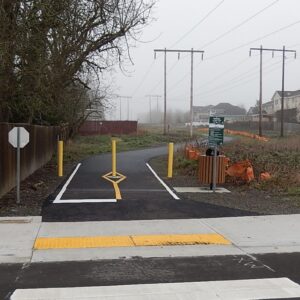
Noll was referring to lawmakers taking money away from the Oregon Community Paths program — a program partially funded by Oregon’s $15 tax on new bicycles — and spending it on highway operations and maintenance instead. The program has been a crucial source of funding for off-street paths across the region.
On Monday, Move Oregon Forward coalition members sent a letter to Governor Tina Kotek and leading lawmakers, urging them to take a different course. Instead of raiding these popular, vital programs, they offered a different path to save the budget. Their proposal included: internal savings and “smart housekeeping” within ODOT, a reshuffling of state capital project priorities, and reallocating up to $80 million of “idle funding” tied up in megaprojects that lack a feasible funding path. If those didn’t suffice, they told lawmakers to use short-term debt financing tools.
Move Oregon Forward says their suggestions were ignored.
“Our coalition is done waiting,” said Indi Namkoong, Transportation Justice Coordinator at Verde. “Lawmakers cannot continue to collect tax dollars from working families while cutting the very services those dollars fund. This budget is a failure of leadership and a breach of trust. Now that these cuts have passed, we expect our priorities to be served first in the 2027 transportation package.”
Like everyone else in Salem, Namkoong and Move Oregon Forward are already looking ahead to the next legislative session where Democratic party leaders have promised they will once again try to move a large transportation funding package forward.
Thanks for reading.
BikePortland has served this community with independent community journalism since 2005. We rely on subscriptions from readers like you to survive. Your financial support is vital in keeping this valuable resource alive and well.
Please subscribe today to strengthen and expand our work.
Unfortunately this could seen coming from a mile or 10 away.
Jonathan, thanks for reporting on this. And thanks to Move Oregon Forward for fighting the good fight.
The incompetence of our state government is breathtaking. We desperately need better leadership.
And we will never get better leadership when supposedly progressive voters keep on voting for corporate-fascist democrats.
Who would you vote for/have voted for?
Do you understand how OR’s primary system* works?
I always vote for anyone who challenges the DPO party list and is vaguely left/prog.
* anti-democratic to its core
There really aren’t many true novel candidates. Most “progressive challengers” (vaguely left/prog) are backed by public unions and activist nonprofits. That’s not outsider politics — it’s just a different power bloc.
Supporting the election of people who are not corp-fascists or racist misogynistic fascists (abbrev: Republican) is worth doing even if the candidates are not “perfect”.
I don’t think it’s incompetence, I think they just have different priorities, such as Moda Center giveaways, tax breaks for data centers, and highway expansion money pits.
“The incompetence of our state government is breathtaking.”
Didn’t forget to vote Kotek!
Does it seem more and more that the transportation advocates and corporate democratic party in Oregon have an abusive relationship? Where else can an advocate proclaim with a straight face “Our coalition is done waiting,” and then do precisely that.
Oh well, I know this is futile to mention, but primaries are coming and they count.
It’s fascinating how loyal all these progressive/labor/climate-justice dems are to the machine. It’s almost as if they prioritize waiting for their turn on the party list over their values.
lol, sadly, probably the case.
That said, what should this coalition of organizations do now? They don’t have the kind of money that truckers, AAA, road builders, and labor unions have to influence politicians.
Genuine question: Is it really to try and find folks who would primary the status quo D’s? The chances to find quality candidates to do that are so so slim.
I think finding decent, enthusiastic people to primary the entrenched corporatists is the best bet the transportation advocates have. Win or lose, they need to demonstrate that there are consequences for crossing them. The transportation community has a lot of smart, enthusiastic people that could do great campaigning and even legislating should they win. Problem of course is it’s hard to get good people to run, which is one reason we wind up with so many bad ones in office.
If we find enough of these people we might even create an open and democratic* primary system as opposed to the corrupt single-party system we have today.
* dark irony intended
Looks like some Dems jonesing to be primaried.
The 2025 legislative and 2026 short session were illuminating. I think it removed any pretense that Kotek and the state Democrats are working for the people of Oregon. They could have used these sessions to be a beacon of light for the nation in dark times, but nope.
They had a super-majority. And yet the biggest thing they could get done was a giveaway to the Blazers Billionaire and deep austerity measures for transportation. And the only reason the data center bill didn’t go through was the tidal wave of backlash from both sides. They will try to ram it through in 2027, no doubt.
People might rush to say, “it was the Republicans fault, they are putting the repeal on the ballot!” But the reality is the buck stops with the Democrats on this one. The bill that was passed was rushed, lousy, and all the funding comes from regressive taxation.
Here in Portland we have potholes everywhere and TriMet is on life support. How did we get here? It isn’t a lack of money. The amount going to the Blazers sure shows it. This session shone a stark light on who the real constituents of the Oregon Democrats are, those with deep pockets that certainly aren’t you or me.
Any of them that commit to anything less than serving the public interest need to primaried. All of them.
The money in Portland goes to PCEF, SHS, and Preschool for All. Look there for the money.
This bill will do terrible damage, but the one good thing it may do is help people draw a straight line between ODOT’s insatiable demand for dollars and their mega-project, freeway-widening mania. Legislators have shown that ODOT truly cannot walk and chew gum at the same time: we can’t have paths or transit or bike lanes or crosswalks or any of the human-scaled improvements we need as long as ODOT continues to gobble up every dollar of transportation funding – not just to maintain the highway system we currently have (since they aren’t doing that anyway) but to build bigger and wider highways and freeways!
Legislators should not allocate one more dollar to ODOT til this rogue agency can demonstrate that it can meet ALL of the priorities that Oregonians demand.
“Legislators should not allocate one more dollar to ODOT til this rogue agency can demonstrate that it can meet ALL of the priorities that Oregonians demand.”
Do you really mean this? There is a sizable group of people demanding, as an example, a new highway bypass around Portland to the west. Sometimes regular commenters post about it here. Should ODOT need to meet that demand, as well as other similar ones around the state to get more money? What about building the Rose Quarter and full IBR projects? Plenty of Oregonians are demanding those. ODOT should be defunded until they figure those projects out?
I don’t think requiring ODOT to meet all the demands Oregonians make will lead us to a better place. I am certain it will be an unaffordable one.
And what priorities are those, because I best most Oregonian’s priorities aren’t bikes lanes and public transit. I bet if given an option we’d want to reduce the oppressive tax burden we suffer under.
Guess Oregonians have to excel at something (some of the highest taxes in the country).
It’s hard not to notice the disconnect here. Many of the same taxpayer-funded or grant-dependent nonprofits speaking out about these cuts are silent about one of the biggest real-world barriers to active transportation in the Portland metro area: the widespread camping and open drug use on multi-use paths.
These paths are the lifeblood of everyday biking and walking—especially for families, kids, and people who don’t want to mix with traffic. Yet riders across the region routinely encounter tents, debris, and people in the grip of addiction along corridors that were built specifically to be safe alternatives to roads. If we’re serious about “removing barriers for kids, seniors, and people with disabilities,” as advocates say, then we should be honest about what those barriers actually are on the ground.
It’s also worth asking why organizations that receive large amounts of public funding are so quick to criticize how taxpayer dollars are allocated, while avoiding politically sensitive issues that directly affect the usability and safety of the infrastructure they claim to champion. When advocacy groups become heavily dependent on government funding streams, there’s a real risk that their priorities shift away from representing everyday users and toward maintaining alignment with political power.
Protecting funding for community paths is important. But protecting the ability for people to actually use those paths safely and comfortably should be just as important—and that conversation shouldn’t be off limits.
Its amazing how some people can make any problem about unhoused people.
The state government and ODOT are corrupt and taling funding away from people sized projects to build more highways and here you are focusing on the people who have the least.
Sky, this isn’t “making everything about unhoused people”—it’s about accountability. Taxpayer funded paths are meant for everyone, yet families, seniors, and daily riders can’t safely use them because some nonprofits and advocates refuse to confront the real barriers on the ground, widespread camping and drug use, since it conflicts with their narrative that the homeless are only victims. Pointing fingers at government corruption does not fix unusable public spaces; ignoring reality enables a system where public funds go to active transportation infrastructure nobody can actually use. The issue isn’t the unhoused, it’s the unwillingness of some to face the truth.
“Nonprofits and advocates” are responsible for “widespread camping and drug use”? Wow. I guess that’s good news. It means that a problem most people thought was systemic can be fixed just by persuading nonprofits and advocates to change.
Yes, stop giving money to nonprofits and instead have city employees oversee the funds.
WE’ve managed to change the mind of PBOT on several projects because it is run by city employees and we know who to go to to agitate for change.
The city really needs to create a Directorate for houseless operations and so we can know where the money is going, how it’s helping and if it’s not helping than how to redirect it so it does help.
The nonprofits are not only in the way, they use funds without transparency and without helping. How many years of increasing houseless with how many hundreds of millions gifted to nonprofits? It’s time to end that and make the city directly responsible for the money and results.
I never know what conservatives mean when they demand ‘accountability’, but your comment is certainly an example of invoking unhoused people in an unrelated debate. What do campers have to do with priorities in the state transportation budget?
This is flatly wrong in two ways. Firstly, anybody who can cycle around PDX can safely use the paths. Claims otherwise are common but not support by any evidence and contradicted by the everyday experience of many people that safely use the paths despite the fact that people are camping on them. Secondly, the campers are not there because nonprofits and advocates refuse to confront reality. That’s just silly hyperbole.
Micah, this isn’t about blaming unhoused people or being “conservative”—it’s about accountability. Portland’s multi-use paths are often blocked by tents, debris, and drug use, making them unsafe for families, seniors, and kids. Saying “anybody can safely use them” ignores the reality that many avoid these paths entirely.
Taxpayer dollars are meant to create safe, accessible routes. If public infrastructure isn’t usable, it’s fair to ask why—and whether nonprofits’ priorities or lack of transparency are part of the problem. Highlighting these barriers isn’t political—it’s making sure public resources actually serve the people who rely on them.
Thanks for engaging, Tropical Jo. I’m not accusing you (or Jose or any of the other commenters) of blaming the campers. I’m taking issue with the claim that the campers make the paths unsafe. It’s clear that removing the campers from MUPs is a high political priority for many bicyclists, and I understand that it is frustrating that significant public investment has not eliminated the camps. But bringing up the same thing repeatedly in every tangentially related discussion is not helpful. I hope Portland can get to a place where there are not many people living in makeshift shelters in the nooks and crannies around town, but, if that happens, it will be a divergence from the historical norm.
“I hope Portland can get to a place where there are not many people living in makeshift shelters in the nooks and crannies around town”
It’s always worth remembering that other cities do not have this problem to the extent we do.
I think it’s worth having a frank and open discussion of the relative prevalence of houslessness and the appropriate policy response. I’m very concerned that we have so many people without stable living arrangements. I’m relatively unbothered by the fact that many of them are in my city, and reducing their visibility is less of a concern of mine than making our society more comfortable for folks that are struggling, whether they have blown things to the point they are living on street or they are housed but living precariously.
“I’m very concerned that we have so many people without stable living arrangements”
I am too. Other cities seem to be doing a better job at helping people get off the street (or preventing them from getting to that point in the first place).
Much of our strategy has been trying to make people comfortable on the street rather than finding ways to get people indoors and into services that can help them.
“Other cities seem to be doing a better job at helping people get off the street (or preventing them from getting to that point in the first place).”
We should certainly look to other cities and regions to understand our local situation, but evaluation of the performance of different programs (including your judgment here that other places ‘seem to be doing a better job’) is a slippery and subjective task that requires at least the specification of the way success will be quantified. It’s my impression that the success you point out is success at preventing visible houselessness. Your final comment suggests that you think Portland’s stick to carrot ratio is too small. I’m not sure.
I’m not sure about what Portland’s stick to carrot ratio is or should be, but I’m pretty sure that handing out tents (a practice that has largely stopped) didn’t make things better.
Equally true: anybody who can cycle around PDX can safely ride on the streets. Claims otherwise are common but not support by any evidence and contradicted by the everyday experience of many people that safely ride on the streets despite the fact that people are driving on them.
Totally agree!
Um, both are great examples of governmental incompetence where the solution to the problem is always a few hundred million/billion dollars out of reach?
Really? You mean the people who have to wordsmith reality because their constitution about it is so inherently weak (i.e. using “unhoused” seriously) are the ones who are going to solve the problem? Talk about hyperbole.
Jose did not invoke homelessness as an analogy to illustrate government uselessness (as apt as it may be for that purpose). The claim was that the “real barriers” to riding on the paths are homelessness and drug use. I don’t think they are. Similarly, I don’t think the adoption of updated terminology (“wordsmithing reality” in your pithy vernacular) causes the evident social ills we both see. It may be a symptom of disfunction (your view) or an attempt to actually grapple with the full extent of the problem (my view) or something else. But we should be able to discuss the issues. As Sky pointed out above, conversations are often derailed by participants “making everything about unhoused people.”
Sky also said homeless people “have the least”. That’s super weird because we’ve not spent more money on any demographic in the region over the last 10-years than homeless people. We now spend 300% more per year on each homeless person in the region than we do our own students. If we’re spending billions, yet the homeless people don’t have anything, where did all the money go? Ah, not to the non-profits, right?
I get how easy the conversations are on spending if you ignore the largest spending failure in the region’s history, but I don’t think it’s advocates should get off easy, especially when they’re just groveling in a different bucket and asking for everyone to look the other way.
Do you mean “300% more” (i.e., 4 times as much) or simply 300% (ie, 3 times as much)? How many students do think a homeless person is worth? How much do we spend per prisoner?
Jose is right. Many of these advocacy nonprofits rely on taxpayer funding while lobbying the same government for more money. That’s a clear conflict of interest.
Too often the advocacy seems less about the public good and more about protecting and expanding their own funding streams. If these organizations believe their work is valuable, they should raise money through donations like other nonprofits.
And if the services they claim to provide are truly essential public services, then government should provide them directly with proper oversight, transparency, and accountability. The current system—where a sprawling network of nonprofits receives taxpayer money with limited accountability—needs serious reform
And yet the same people who decry the “Homeless Industrial Complex” (of which I am one), often are those who also think that publicly-funded housing support, with oversight, is “Socialism” and is better left to the private sector to figure it out.
Non profits don’t rely on donations–these days its government funding. That was the old days.
Hopefully now that government budgets are going down we will see some fat cutting in the non-profit world. There’s plenty of fat to cut.
And yes, the non-profit workers populate the little committees and what nots, their people lobby, they endorse, fundraise for politicians–all to get more of that sweet government money.
“ Dozens of nonprofits from across Oregon will not let lawmakers forget this betrayal.”
Honestly, outside of a few very strong nonprofits that I can name on one hand, I think our current city government just outsources most of the serious work that needs to happen to lots of nonprofits with literally zero results
Whether it is non-profits or for-profits, US local governments outsource a ton of the serious work. This is where “small government efficiency” often results in a lack of internal expertise that leads to governments and agencies being screwed over by contractors. There are a chorus of people that will eternally complain that government is too big or that the contractors doing government work are corrupt; whatever suits the moment. Out of habit, the blame is usually put on government decisions rather than the private sector that has captured elements of government decision making. It is the reason that many basic services in the US like transportation, or health care are much more expensive than in other developed economies.
SD, the issue isn’t just outsourcing—it’s a sprawling nonprofit network in Portland with loose oversight. Taxpayer dollars flow to groups that often produce little measurable results, face minimal audits, and reward politicians who keep the money coming. Some nonprofits even have an incentive to tolerate or enable camping, because it justifies more funding for them. Meanwhile, families, seniors, and daily riders deal with blocked, unsafe paths. This isn’t inefficiency—it’s a system that fails the public it’s supposed to serve.
Same could be said for the majority of for-profits, if you’re being honest.
Yep, and the nonprofit industrial complex uses taxpayer money to keep electing politicians that will continue to send them boatloads of our $$$$$$$.
Sam Adams was the early master of this. Award taxpayer money to non-profits to do un-audited work. Non-profit would then donate money to campaign of elected official, then elected official would award money to non-profits, and it would repeat.
It’s become a pattern ever since then for our elected officials.
It’s one reason why there’s such a problem with non-profits in Portland.
It’s even easier to do the same thing with for-profit corporations who can hide the expenses within very opaque balance sheets. It’s very common out here in NC. Another tactic is for elected officials to hire small MWBE contractors run by relatives and family friends – yeah, sure, it’s very unethical and illegal, you’re supposed to report conflicts of interest, but if everyone else is doing it, who’s going to stop you? Certainly not a city auditor whose job is dependent upon city council funding.
All governments are corrupt, it really boils down to how much corruption you are willing to tolerate before the revolution comes.
David it shows you haven’t lived in Portland recently…these for profit companies you mention are leaving PDX….the taxpayer funded nonprofits is the best grift going in the city that only works for them.
This sounds a repeat of the Metro’s 2020 Transportation Bond Measure. We need some new strategies and tactics.