

Hope your week is off to a great start. Below are the most notable stories that came across my inbox this past week…
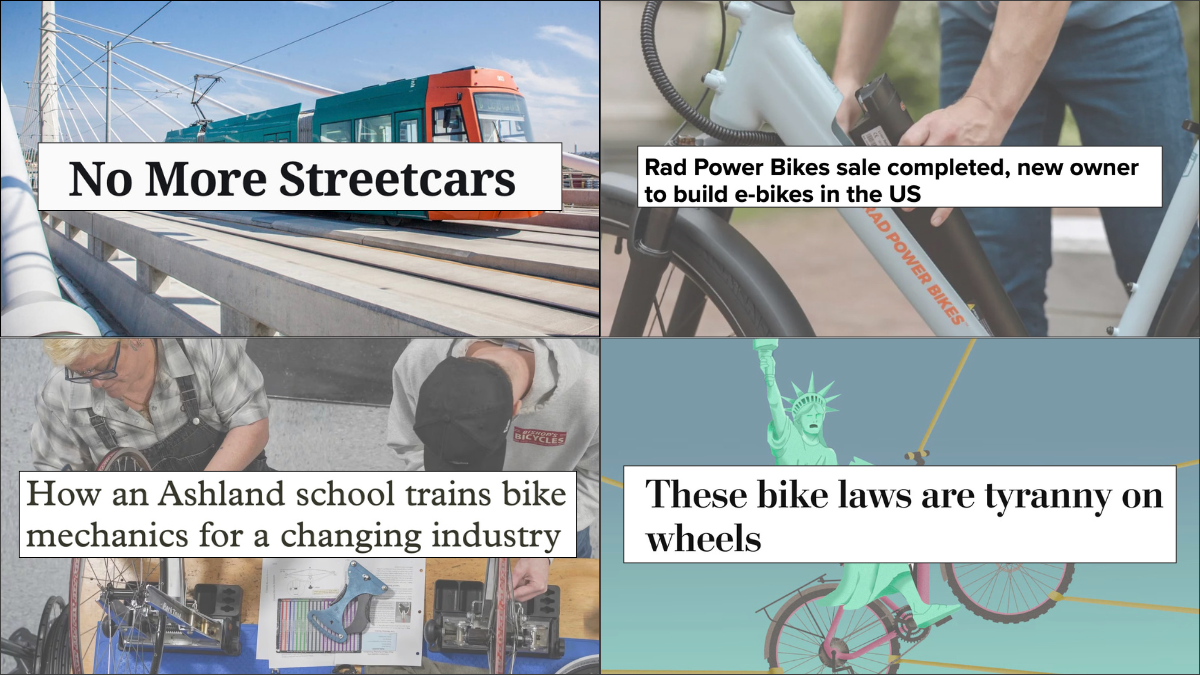
It’s about freedom: This wonderful opinion piece very clearly expresses why poorly crafted anti e-bike laws should be framed as nothing less than tyranny and government overreach that robs people of basic freedoms. (Washington Post Opinion)
Child seats banned on transit: Interesting story from San Francisco where transit agency Caltrain says crowded cars have forced them to crack down on cargo bikes with child seats. The new rules banning them are being vociferously opposed by some riders. (SF Chronicle)
New leader at Metro: In news that many local transportation reformers will not be mad about, Metro President Lynn Peterson could be leaving early. (Willamette Week)
Bike to birth: A Minneapolis lawmaker is making headlines after she hopped into a cargo bike to get the hospital where she gave birth. She credits protected bike lanes for giving her and her husband the confidence to make that choice. (Fox News Minneapolis)

A new alliance: Very effective nonprofit Seattle Neighborhood Greenways has officially rebranded as the Seattle Streets Alliance, a move that shows our friends up north have a healthy advocacy ecosystem we’d do well to emulate. (The Urbanist)
Rad’s next chapter: The company that bought Rad Power Bikes through bankruptcy, Life EV, says it will honor warranties and provide a path to service for existing owners. As for new Rads? They say they’ll open a U.S. assembly plant. (Electrek)
Are we over streetcars? Streetcars were a big part of Portland’s progressive transportation brand back in the Obama era; but times have changed and given the transit budget crisis we face, this transit booster thinks it’s time to question their existence. (Urban PDX)
Wrenching: I still miss having United Bicycle Institute in Portland, but I’m glad to know they’re going strong and finding a new niche in training folks on how to work on all the weird, non-standard parts on today’s high-tech bikes. (Oregon Public Broadcasting)
Thanks to everyone who sent in links this week. The Monday Roundup is a community effort, so please feel free to send us any great stories you come across.

Thanks for reading.
BikePortland has served this community with independent community journalism since 2005. We rely on subscriptions from readers like you to survive. Your financial support is vital in keeping this valuable resource alive and well.
Please subscribe today to strengthen and expand our work.
Streetcars (trams) in the USA were never built for ridership – they were always built to spur economic development, that is, to encourage overpaid developers to put in higher-density land uses in poorer low-density neighborhoods using federal Small Starts public transportation dollars in public-private partnerships. It’s a form of development-oriented transportation (along with subway’s bastard stepchild Light Rail) – slow, visible, and touristy. People have called it “Viagra for developers”. The basic concept was that it would be built by developers with federal subsidies then the resulting expanded tax base would pay for its maintenance and operating costs, but of course it never quite works out that way, the local government that built it then uses the resulting increased tax base to pay for other unrelated expenses such as police, fire, parks, and so on, and the streetcar system quickly goes to s**t. Moving people was never important in streetcar projects. Once the development reaches a certain density, it was always assumed the jurisdiction would either replace the streetcar with light rail (and add more ballast to support the heavier vehicles), or else expand the existing subway system.
I think you mean “modern streetcars (trams) in the USA were never built for ridership”.
The original streetcars that were in every major city in the USA pre-WW2 where, in fact, design for ridership.
Well, maybe some were, but most communities that put them in did it more for civic boosterism, because the next rival town down the train line had them too, a bit like light rail or minor league baseball stadiums today. It’s really quite amazing how many even very small towns under 10,000 had electric streetcars in the 1890s to 1910s, yet most towns ripped them out by the 1940s and so many replaced them with buses or did away with public transit altogether. Our “modern” city bus system here in Greensboro NC uses the exact same routing as our 1948 streetcar system even though the smelly factories are long gone and a few got converted into overpriced condos with acres of parked cars. Most of our city buses run nearly empty of passengers, serving people who are long gone to destinations no one wants to get to. Meanwhile the part of our city that has the good jobs has no public transportation.
I think it’s wrong to call light rail the bastard step child of the subway. It was always envisioned as the cheapest way to rebuild an urban rail system, and the visibility of something like the MAX downtown to developers is incidental to why it runs on the street there. It does because it was too expensive to do it any other way when it was built.
And while basically every streetcar built in the US since they started building them again is more or less bad, the reason they are appealing to developers is still because of their perceived utility. The “encouragement” is really just bureaucratic slight of hand, as there is no objective reason why higher density development couldn’t be done without the streetcar. There are policy reasons it’s been done this way, but those aren’t ever ironclad.
I’d also say that there are relatively few streetcar systems that have really “gone to shit”. There are good lines (like the NS) that are still doing well, some meh ones (like Seattle’s First Hill line, Milwaukee’s Hop) that are still fine but flawed, and there are bad lines (Dallas, Atlanta, Milwaukee’s L line) that never would have worked in a million years even without Covid. This last category of lines are ones that are structurally impossible to move any appreciable number of people, even if they had gotten some massive tax increment subsidies to run every 5 minutes or better.
Your last assumption is not something I’ve ever heard of being assumed, and I consider myself to be relatively familiar with streetcars in the US. The only line I can think of that was built as a pre-light rail thing (Tacoma Link) had very specific context driving it which is essentially irrelevant to anywhere other than Tacoma. Sound Transit was trying to spend money in a more regionally equitable way, but then backed out of street running light rail for busy segments after getting some experience operating that way.
It’s true that moving people was almost universally a secondary concern to vibes, which is why almost every new streetcar isn’t all that good, but I would honestly place that more on the incompetence of the planners and politicians who made the decision. They mostly thought they were building useful lines, they were just wrong.
Streetcars do serve a function of encouraging development around corridors due to their object permanence in the way buses don’t seem to be able to do, which makes them useful in a different sort of way.
I think Portland Streetcar would be a better performer if they added signal prioritization at intersections. It is such a slog to ride in its current form and that change alone would make a huge difference.
I’m not convinced that streetcars really make the difference there. The typically cited case of the original Portland Streetcar line is (in my opinion) borderline misleading. If you have a tract of land like the Pearl to do redevelopment on, then yeah it’s going to make an impact on how much redevelopment is happening. Few places have that, and I’m not entirely convinced that the overhead catenary and tracks are why the Pearl is what it is.
It’s a factor for sure, but if the reason why the denser redevelopment happens is because of zoning adjustments done in tandem with the streetcar line, then the comparison point should be a similar location that had zoning changes but no streetcar. I’d love to read that study if it exists.
“the comparison point should be a similar location that had zoning changes but no streetcar.”
Division Street?
Division doesn’t have dense enough zoning for a good comparison with the Pearl (or S Waterfront). But it is a fine anecdotal example of a place that was redeveloped without any streetcar incentives.
I agree. Streetcar lines often come with massive zoning changes and other development incentives, then the streetcar gets credited with the new development.
One area that might illustrate your point is N/NE Portland. The Albina Community Plan of 1993 did widespread zoning changes and other development incentives in much of N/NE, including along MLK, Interstate, Williams and Vancouver.
Of those four, only Interstate got Light Rail (I know, not a streetcar, but Light Rail along Interstate functions much like a streetcar, and it was viewed as a development catalyst much like streetcars). But I don’t think Interstate got any more development–and possibly got less–than those other streets.
Portland also tends to locate infrastructure (like streetcars) and programs that are intended to encourage development in “up-and-coming” areas. Then, when the development happens, those things (bike lanes, development incentives, etc.) get credited with creating the new development. The reality is much of that development was already underway, and the programs/incentives may have helped some, but not to the extent claimed by their advocates.
I’m generally supportive of streetcars coupled with dense development, but right now I see streetcar expansion as the lowest priority for transportation spending (although still ahead of actively harmful projects like freeway expansion).
At this point, I’d rather put dense development along the corridor first while promising a streetcar in the future. Run buses on the planned streetcar route to gauge ridership. Hold off on building the actual streetcar until transit use is high enough to justify it.
I don’t really see why bus replacement streetcars are justified. It’s very expensive and most of the benefits of a streetcar can be achieved through better bus planning. Relevant Jarrett Walker: https://humantransit.org/2009/07/streetcars-an-inconvenient-truth.html
But I’m admittedly fond of buses. They’re cheap, practical, and exist in the here and now.
The e-bike article is from the Washington Post. The opinion piece wasn’t bad but the comments, as far as I read them, were all over the map. I did enjoy this one from ‘Maggie’:
“75 years old here. I can no longer do hills on my old bike. A pedal assisted e-bike gets me around. Regulating this old lady’s bike seems utterly misplaced, and I won’t register it. Come and get me.”
It points up a key issue with e-bike laws, enforceability. These laws will be enforced unevenly if at all and will bear more heavily on minority groups. We can expect a certain number of ‘e-bike’ stops on people who don’t even have a motor but instead just happened to wake up that morning with brown skin.