
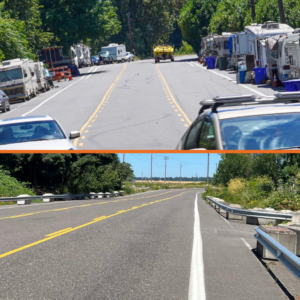
I made this video after I was nearly left-hooked while riding the brand new (and totally wonderful!) protected bike lane on SW 4th Avenue in downtown Portland last week. Then today I learned my friend Marley Blonsky was injured in a right-hook while biking on the new bike lanes on NE Broadway at 21st.
Portland is doing great work improving our streets. That’s a great thing. But I wanted to underscore that as long as we have so many drivers who don’t drive safely and who disregard the well-being of fellow road users, there will still be risks of collisions.
Watch the video in the player above or on the BikePortland YouTube channel (which you should totally subscribe to if you haven’t already!).

Thanks for reading.
BikePortland has served this community with independent community journalism since 2005. We rely on subscriptions from readers like you to survive. Your financial support is vital in keeping this valuable resource alive and well.
Please subscribe today to strengthen and expand our work.
I was almost hit crossing Morrison when I was using the new 4th ave bike lane last week!
I am on the far side of this debate: I doubt we will never make walking or biking safe if the City relies on drivers doing the right thing vs just eliminating the possibility of them killing someone.
4th avenue is still a 4-lane, 50 foot wide arterial street. It´s intersections still rely on driver care and awareness to provide for safety. (Original was too harsh)
There is no precedent for this. None of the cities that have gotten significantly closer to Vision Zero have eliminated the possibility of drivers killing someone. That can only happen through cooperative behavior on the part of drivers. Unpleasant to acknowledge that your very fragile and vulnerable life will always be in the hands of complete strangers – no matter how many roundabouts, speed humps, fancy signal phases, raised crosswalks, diverters, medians, jersey barriers, or closed streets – but that is our ineluctable starting and ending point.
Portland’s own last 10 years demonstrates the bankruptcy of “build it and they will come” as a largely standalone strategy; the rate of infrastructure investment and bike/ped facility hardening has become totally untethered from the outcomes we care about. Some at PBOT are beginning to acknowledge that. Not walking away from infrastructure improvement, but acknowledging there must be so much more.
It’s much easier to throw (other people’s) money at a problem and quibble about the details of infrastructure to explain to why people are being hurt and killed and how our various transportation agencies are inept to address this problem. It’s much harder to acknowledge and address our cultural sicknesses around mobility/driving/convenience in a state that practices “live and let live” to the extent it’s considered harmful to compel drug-addicted homeless folks to get serious treatment or to attach any accountability to a worst-in-the-nation K-12 education system.
You’re right, elimination is unfortunately out of the cards.
There are cities in this country and across the world that have actually made huge strides in safety, though. Hoboken hasn’t had a single pedestrian death in 8 years. Of course they have a much better urban form to start from, but from there you can see neighboring cities that didn’t go all in on protecting people and they are trending how Portland is trending.
When I was stationed in Germany, I learned that getting a driver’s license in Germany was much more difficult and much more expensive than in the U.S. One aspect of that was more driver training & testing around pedestrians and cyclists.
As more bike/ped infrastructure and micro-mobility comes to be, we should ensue that Oregon DMV is requiring that new drivers are trained & tested being able to safely drive through bike/ped infrastructure.
Also, obviously, enforcement of driving laws is necessary, but I sadly don’t have very much hope for this based on my 20 yrs of experience walking & biking in PDX.
However, maybe we need more camera enforcement. I don’t like government surveillance, but I’ll live with it, if it results in less carnage on our public streets.
Oregon could require simple testing for all license renewal and more for aging drivers. I wouldn’t mind if people had to understand that unmarked crosswalks exist, safe passing laws, etc. to get or renew an Oregon license.
I have lived in SE Portland for 30+ years. I witnessed the installation of pedestrian islands, marked crosswalks and warning signs on SE Woodstock.
In the first couple years after installation, it was an unexpected surprise if a motorist would even slow down as you contemplated stepping into the street.
I figure it took ten or so years before motorists were pretty consistent about stopping. Now, at least on Woodstock, motorists are really good about stopping for pedestrians.
I continue to believe enforcement can cause people pay more attention instead of simply engaging autopilot and driving without paying attention. Even a verbal warning by a cop or a letter and video clip from a temporary camera letting a motorist know they did something wrong could help. Can we please do that with new installations?
I’ll bet the driver of the black Yukon would swear there were no bikes present. Probably was not even aware of the bike lane. If you had been struck at least you would have had evidence that you didn’t “come out of nowhere,” which we have learned is the magic statement by motorists to avoid a citation and exempt them from any accountability.
We need more city counselors, DAs, cops and judges on bikes so they witness the reality of dangerous motorist behavior.
Although these conflicts still happen, I think the changes on this street and Broadway have slowed cars and monster trucks a significant amount, which helps.
This behavior affects all vulnerable road users; not just bike riders. Drivers often fail to yield to people crossing when turning, and stopping for crosswalks is spotty at best. It seems like small peanuts; especially behind the wheel, but I do believe it deters people from walking or biking. I wish that drivers would take more initiative to educate themselves and pay more attention.
At the very least, we gotta keep our eyes and ears open when walking, rolling, and biking.
I got a lot of hostility for raising the potential of being hooked when PBOT built “go straight” lanes to the left of “turn left” lanes. I’m very sorry this happened, but I can’t say I’m surprised. I’ve had similar close calls on 2nd.
As a cyclist, I like comfort provided by the wide buffer zone of between the vehicle travel lane and the bike lane. But such a wide separation of the two modes, which in places includes parked cars, may make drivers less aware of the bike facility and users. Perhaps a flashing strobe could be activated on the existing caution sign to wake up drivers when cyclists are present?
Drivers are barely aware of cyclists as it is. I doubt the design of this facility has much of an effect on that. But having a wide buffer does mean drivers are crossing the bike lane at more of a right angle, which gives them more opportunity to spot oncoming cyclists.
I haven’t ridden the new 4th Ave bike lane yet, but apparently it’s even worse than I thought. In an earlier post, you said that every intersection would be signalized. But apparently this one isn’t! So why are you surprised that a honking huge SUV turned left in front of you? The driver wasn’t even aware of the separated bike lane on the left. S/he is protected from the world by that huge vehicle.
I said, long before the 4th Ave project started, that putting bike lanes on the left side of streets is very risky. Drivers don’t look for bikes on their left. Only in Portland do we create non-standard infra and then we’re surprised when drivers don’t know how to use it.
NYC has tons of bike lanes on the left and I never had an issue when I was riding around there.
The classic formula to improve safety for people using active transportation is:
1) improved infrastructure for people of all abilities to feel safe as we bike and walk, so
2) more people on the streets on our feet and on bikes, leading to:
3) more awareness on the part of drivers.
Is there a missing step or two that you’re suggesting, Jonathan? Should we expect the state to strive for and require a higher level of driver competency? Should we expect the police to enforce more traffic law?
In the classic formula, the state and city are quite passive after building the infrastructure. The inherent wonderfulness of road users and the love we have for being outside on bikes and sidewalks are expected to bring changes in mode share and safety.
What does contemporary research suggest about this? Is the classic formula still good? How long do the changes take? Does a societal selfishness that we’ve seen since 2020 alter the process? Does the recently increased size of motor vehicles mean that driver oblivion, crashes, serious injuries and deaths will all remain high?
Been nearly t-boned more times than I can count when biking through the bike-specific green crossing stark at 30th. It’s unbelievable that almost 100% of the times I cross there a driver illegally turns on red (Both turning from 30th and turning from Stark). The infrastructure is perfect on paper, but people drive like d*cks there so I have to ride with my head on a swivel and yield to cars from all directions even though I theoretically have a protected right-of-ways
“The roads are just so confusing here!!!!” says the SUV driver with their phone in one hand and a meal in the other.
Exactly why we should ban all right turns on red IMO. Otherwise we’re relying on drivers to a) notice the exception to the rule and b) care enough to interrupt their normal behavior.
What about one way streets ? you would need to ban all turns since bike lanes can be on either side of the street.
Correct. Cars should stop and stay stopped when the light is red.
COTW
I think a dangerously high percentage of drivers think they have the right-of-way when turning, and are assuming any bikes they pass before the turn will (and should) yield to them.
Ironic that you almost got hit right in front of the 40′ long COMPASSION sign.
You may be right, but from the video, it appeared that the driver was completely oblivious to Jonathan’s presence. Which would make perfect sense, because where else in the world is there a traffic lane going straight to the left of the left-turn lane?
This picture says it all, in my opinion. Of course the driver of the black truck is not going to see you, especially if you’ve been in the same relative position for a couple of blocks.
https://imgur.com/LTKlGsS
When I was left-hooked on N Williams by an SUV that passed me just before turning into me, a crowd gathered to see what happened. When I dragged my bike out of the road, still in shock and with a concussion, a woman in the crowd yelled at me that it was my fault and the driver had the right of way.
Glad you didn’t get hooked. It looks like the new infrastructure did its job by making the vehicle take a wider approach so the bicycle could avoid hitting it.
Actually the videos you have made and my limited personal experience of the new 4th Av infra make me more nervous to ride there than before the project was implemented. Parked cars between the car and bike lanes obscure the users of the lanes from each other. Traveling in the bike lane at the speed of a vehicle feels more risky than traveling in the car lanes on 4th.
This is a frequent critique of “parking protected” designs like parts of 4th and its partner route Broadway. Based on Jonathan’s video, I don’t think this problem was a cause of this particular incident. It seems to me there is plenty of visibility. Unlike Broadway, this project includes some super wide concrete curbs that replace the parking area in the approaches to intersections to improve visibility of around the cross-walks and the bike lane. The driver of the SUV simply failed to yield. This kind of conflict will occur any time you have turns across bike lanes (or cross walks). It’s the same dynamic that was active in the Blonsky incident. That time the bike lane was neither parking protected nor on the left side, but the hook hazard is the same. As Jonathan points out, you can’t design away that danger — we need to rely on auto operators using enough caution to avoid running people over.
“you can’t design away that danger”
Really? It seems PBOT did exactly that on the downtown approach to the Hawthorne Bridge. There is very little danger of getting hooked by cars turning right onto SW First.
My comment was in the (explicitly stated) context of situations in which “you have turns across bike lanes,” which does not apply to your example.
If you believe that designing a facility where drivers turn across a bike lane is inherently dangerous, a danger which cannot be designed away, why are you defending the new status quo?
It’s actually insane how unsafe it is on 4th north of Morrison now due to these left turns. Of course cars aren’t going notice – you’re in a left side protected bike lane without even signage, much less signals (as there are south of morrison). I’ve been left hooked (though never struck, because I yielded) every single time I’ve ridden the new 4th – I’m now looking for a better route out of downtown. Unfortunately 2nd has the same treatment and the same problems. $500k wasted to make the target group less safe than the previous treatment, which had no bike specific infrastructure at all.
This particular problem isn’t because of drivers, though I will admit better training is needed there. I’m all for world-class bike infrastructure, but this ain’t it and we need to stop pretending like spending a half mil to make people less safe is actually a good thing.
4th north of Hawthorne Bridge was quite safe. I was never hooked there before the rebuild, and I rode that segment daily for years.
You simply cannot have left-turning traffic to the right of a go-straight lane. You would never, ever do that with cars, so why think it would work with bikes, which are even less visible?
I’m with you, resop. It’s performative safety for performative Portland. You and I were just as safe before the new lane went in – maybe even safer – when we took the right travel lane on 4th and bombed down the hill.
Not everyone is comfortable “bombing down the hill” in mixed traffic. It’s not all about you.
There is signage. You can see it in the video.
Clearly it’s not effective. Why isn’t there a dedicated signal like all the left turns south of Morrison? The lack of consistency within the treatment itself is part of what makes it so dangerous. All drivers see at these north of Morrison intersections is a green light..
Do you think the riding out in ‘car’ lanes is worse on 4th now than before installation of the bike lane? Why not just ride there?
Riding in the main traffic lanes on SW 4th is now illegal.
It was always illegal.
It was perfectly legal before PBOT built the new bike lane — and there were very few (if any) reports of people being hooked there.
Both of those things have now changed.
There were few reports of people being hooked because almost no one rode their bike on SW 4th Avenue before. An increased number of people bicycling through intersections will lead to increased conflict with cars.
“no one rode their bike on SW 4th Avenue before”
Is it your theory that BikePortland readers have started riding on this new supposedly safer facility so frequently that that alone would account for the multiple reports of left hook close calls?
If the facility were as safe as the street, I would expect no reports of near misses in the short time it has been open. And given that for many years the street was the best way to head north after crossing the Hawthorne Bridge, the idea that no one ever rode there is unsupported.
All the evidence suggests that the facility has made SW 4th north of the Hawthorne Bridge markedly more dangerous than it was before.
Why the apologies for a bad design from PBOT?
I’ll wait for more statistically significant evidence than a couple random anecdotes before I jump to any conclusions, thanks.
Saying 4th Avenue was the best street for bicycling north downtown is a little like bragging that you had the best smelling outhouse. In other words, it stank.
The evidence doesn’t support that claim. Hooks of all sort have always happened. We don’t know that they’re more common now, we just know (as was expected) that hooks are still possible.
Perhaps. This forum features a cross section of experienced cyclists, many of whom have ridden on SW 4th (which was, for decades, the best way north of the Hawthorne Bridge). If hooks were as common in the old design (which did not feature drivers turning across a bike lane going straight), someone would likely have posted about it, as several have posted about the new design (which does).
So sure, you might be right, but the old facility was open for decades, and the new one has been open for weeks, and all the reports of hooks have to do with the new configuration. So it seems far more likely that hooks/close calls have dramatically increased since the new facility opened.
You’re right that it’s not definitive proof, but it should be concerning. For some reason you want to dismiss what appears to be a new and potentially serious safety issue.
Why would it have been illegal before?
You have to ride as far to the right or left as possible. The vehicular cycling guys have all been talking about how they rode in the middle lane before “protected by moving cars in either side”, which was illegal. The same drivers hooking cyclists in bike lanes are also hooking cyclists riding in traffic lanes. They are also close passing and terrorizing cyclists but vehicular cyclists are so car-brained that anything that ruins their little adrenaline rush and makes riding a bike better for normal people is immediately dismissed because they just want to feel smart and enlightened.
Not if you can ride at the speed of traffic, which the vast majority of cyclists can do downtown. If you are riding at prevailing vehicle speed, you can legally take the lane and ride in any lane, including the center.
I don’t know if that constitutes “vehicular cycling” (and I don’t care) but it does prevent hooks, and is both easy and safer than the newly constructed facility.
Safety trumps riding aesthetics, right?
Wrong, you are allowed to be in whatever lane you want if you are not riding slower than traffic. Keeping up with traffic along 4th is pretty easy for that matter, as shown in the video (Johnathon rode next to the vehicle that ended up left-hooking him for several blocks). Whoever these adrenaline junky vehicular cyclists are (are they so buff they’re the size of a vehicle?) that you want to villify aren’t really relevant to a discussion about whether this piece of bike infrastructure actually increases or decreases safety compared to the old infrastructure. Please believe I would sing the praises of this new infrastructure if its design provided actual safer conditions and increased usability for cyclists, but the reality is a face-palm and we can’t be shy to admit it or we will just be given more and more face-palms in the future.
We’ve argued this point a few times before. The sensible way to ride 4th previously (in the center lane) was already illegal in the status quo ante, so the legal status of the way people actually ride in traffic there has not changed. Further, even given my low opinion of the Portland Police, I think it’s unlikely that a reasonable rider would be cited for riding in traffic instead of the bike lane.
This simply isn’t true. If you could ride 12mph (downhill), you could legally ride in the center lane, and many did. We agree that riding in the center lane was quite safe, and given the number of reports of near-miss hooks in the very short time the new facility has been open, it would be hard to argue that the safety situation has improved.
The argument that riding safely requires riding illegally, but that’s ok because the cops are unlikely to cite you doesn’t work for me. I want safe riding to be legal. And if the city is going to spend its few bicycling dollars on a new facility, I want it to improve the situation, not make things more dangerous.
I was wrong about the illegality of riding in traffic before the bike lane was installed. My bad. I agree that it’s unfortunate that it is illegal now to ride in the traffic lanes on 4th, and I also share your desire that the safest way to ride be legal. (I think the law should be amended to make clear that bikes can use whatever part of the road is best for the trip.)
I think whether or not infrastructure improves the situation is a nuanced (subjective) question. It’s my sense that a lot of the blowback is from seasoned cyclists who, in my opinion, have a pretty easy time navigating around Portland by bike. So while I agree that PBOT should make things better when spending their finite budget, I think focussing on less confident riders is a good move.
It’s also unfortunate that the center lane has been eliminated; this was the safe one — zero hooks, and very few people merging into it. Usually people would either drive in the curb lane or would merge out of the center to one of the outer lanes to make a turn.
The center lane virtually eliminated two entire classes of crashes. It’s gone now, so even if you were willing to ride illegally, you can’t get the same benefit.
The current facility is more dangerous for everyone, including less seasoned riders. It may feel safer, but trading the subjective perception of safety for an objective increased actual danger is a very bad deal in my book.
Look, I agree with your assessment of the center lane and most of your argument about the enhanced likelihood of left hooks. I further agree that “trading the subjective perception of safety for an objective increased actual danger is a very bad deal.” But I think you are dismissing positive aspects of the project that hold value for some users (traveling by all modes). You may think you have given the considerations of timid riders their due by noting that an inexperienced rider can be hit in a left hook crash as easily as an experienced rider. But whether the bike lane works for them is ultimately their call, not yours. When I read a bunch of regular cyclists complain about novice-focused improvements, it feels like we are unnecessarily restricting the boundaries of our community.
I don’t. I understand why some people like this (which I believe are mostly rooted in politics, appearance, and perception); but for me, safety for all is more important than comfort for some. And using the new facility is not anyone’s call — it’s mandatory, not optional if you want to use 4th (and since SW 2nd has the same treatment, there aren’t many good alternatives through downtown heading north).
We seem to agree on the facts, so I think we just may have different values; I prioritize actual safety over a sense of comfort for novice riders just as I prioritize actual safety over a sense of comfort for drivers.
I prioritize the political aspirations of novice riders because I see them as useful and natural political allies. I do think “politics, appearance, and perception” are legitimate and important things to think about regarding a project like this. If novice riders find this project unhelpful, that would be a much bigger red flag for me than my own experience (or that of you, maxD, resopmok, etc.).
The short answer is yes, I find the new infrastructure to be both less convenient and less safe, with one exception. When there was a lot of car traffic that, that made riding 4th very slow. Those times were maybe 1/15 of my trips along 4th, though. I’m would not ride there now for two basic reasons: 1) it’s now illegal and 2) with only two lanes, drivers now need to change lanes more frequently in order to access their turns or make room for traffic entering onto 4th, decreasing the safety of those lanes to all users.
Thanks for the reply. Do you really avoid 4th now because it’s illegal? I find that to be a surprising response to the installation of the bike lane. I do think the new configuration may not be as convenient for your particular use case. I also think a reasonable observer would expect that somebody that chose to ride in traffic before the bike lane was built could cope with the changes either by continuing to ride (illegally) in traffic as before or assuming the risks of riding the new bike lane. I’m sure there are many folks that feel more comfortable in a marked and separated bike lane. What I am sure of is that whatever PBOT put out, it would be mercilessly criticized in the BP comments.
Well I’m definitely not riding 6th to head north, nor sw park ave. 2nd has the same treatment but worse, so it doesn’t really leave any other through options if I want to go northbound through downtown. Why are you surprised? Of course I’m not going to take the lanes due to my spite for this awful infrastructure, I’m a reasonable law-abiding citizen who now has to ride even more defensively to dodge pedestrians who use the bike lane as a sidewalk extension and be wary of vehicles turning left into me. My point all along is that the new treatment is actually less safe than the old. Maybe someone at PBoT can write an apology letter and say “we are always learning and we promise not to make this particular mistake again and again, though we can’t make any promises.”
Dude, just ride 4th in the traffic lanes if you like it better there. Or 6th, which I frequently take. The claim that a seasoned vehicular cyclist has not been left any options to navigate S–>N through downtown doesn’t seem convincing to me.
My point is not that there is no route, but that the safest and most convenient route has been made less safe and less convenient to the tune of $500k. To me, that’s not money well spent and it’s worth making a fuss over. I understand you don’t see it the same way, which is fine, but may I have my perspective?
We need to put the fear of penalties back in the minds of drivers. They know that they can do anything in Portland because our police will not pull them over.
Motorists need to go back to fearing that behind every corner, there could be a cop ready to bust them if they drive dangerously.
We can’t rely solely on infrastructure and a hope that people will choose to do the right thing while driving.
Infrastructure is useless without traffic enforcement. Paint, bollards, and a hope that everyone just behaves is not enough.
I agree—but until Portland voters elect leaders who also agree, this is about as likely as drivers suddenly stopping at stop signs out of pure self-reflection. Right now motorists know the odds of seeing a cop are roughly the same as spotting Bigfoot riding a TriMet bus.
And if this reply mysteriously vanishes, don’t worry—I probably didn’t change my mind. Jonathan Maus just sent it to the shadow realm where many of my comments go to live out their days in silence.
“Infrastructure is useless without traffic enforcement.”
ABSOLUTELY!
I just returned from flying east to my niece’s wedding. Going through various airports I was reminded of by use of three things used in combination for security of the system. We’re all familiar with going through TSA screening as we enter the secure areas before boarding, but this combination approach is even evident as one is departing the secure area.
There are signs reading “Leaving a secure area; Reentry prohibited.” [Law].
One-way turnstiles or automatic closing doors. [Infrastructure].
A cop or security personnel. [Enforcement].
Yet, when it comes to urban ground transportation, we seem to think rely on participants conforming with the law with a bit of help from infrastructure. No wonder we’re failing.
There are as many people killed on the roads of this country every two months as there were on the one day tragedy that caused us to invent the TSA, pay security fees for every flight, and accept hours and hours of lost time to allow the security system to process us.
Let me suggest a fourth element. Mandate navigation apps to freak out when a driver blows a stop sign.
Glad I’m not going to be the one to have to maintain the dataset of every stop sign in the US
I’m so far from being an IT person. However, we have both private companies collecting immeasurable amounts of data about our streetscapes and road users tracking their road use in their daily lives. How hard is it to establish the existence of a red octogon, a stop bar, or a marked crosswalk? How hard could it be to figure out that the preponderance of road users give right of way at an intersection?
We’re able to figure out which route, of all possible routes, is faster between McMinnville, OR and NE Portland. We can get real time estimates of travel time from any residence to a Major Coffee Bar, and those estimates will be updated after any turn off line. Why can’t this tech figure out where a legal stop is mandated?
Ask the engineers at Tesla and Waymo.
You mention all of the sensors on recent cars (my car has none, but that’s beside the point).
Let’s say your computer vision system detects features that suggest a stop is mandatory in 70% of the cars that pass through. What do you do?
Legally, every intersection is a cross walk and cars have to yield to pedestrians. How certain should this system be that a pedestrian *doesn’t* want to cross so lets you blow through without yielding? How many distracting, possibly startling false positives are acceptable in the system?
What happens when it snows and the zebra strips aren’t visible and stop sign is iced over? What happens when the power is out and the stop lights aren’t even flashing yellow? What happens when a stop sign that was previously here gets removed? Stolen?
If you want an accurate up to the minute map of San Francisco, ask Waymo. Every time one of their cars passes an intersection, they’re going to update their database if something has changed. And this applies to things like potholes, vegetation, and road cracks as well as formal signage.
It would be so easy for the city to work with Waymo to ensure that both of their databases are up-to-date and on the same page that I’d be shocked if it wasn’t already happening.
Yes. It’s easy to collect data and stuff it in cloud storage.
It’s much more difficult to know if the recently collected data is better than what you had before, which is the complicating factor of Robert’s wish (“why can’t they just…”).
I had a driver at SE 41st and Hawthorne intentionally run a red light and nearly hit me last week. No amount of infrastructure will keep us safe from people with a complete disregard for the rules. There must be consequences for the egregious behavior I see every day or there will never be change.
Alex, I don’t doubt you, I’ve seen drivers intentionally run reds —- but how did you know it was intentional in this case? Because sometimes people fail to see what is patently obvious.
just published by Bloomberg City: https://www.bloomberg.com/news/features/2025-07-15/dutch-style-road-intersections-offer-a-safer-way-forward-for-bikes-walkers?cmpid=BBD122325_CITYLAB&utm_medium=email&utm_source=newsletter&utm_term=251223&utm_campaign=citylabdaily
That’s exactly the kind of intersection now in place where NW 19th crosses W Burnside, and it has indeed helped.
I believe that drivers from out of town are a big problem for bicyclists and walkers, because they are unaware of the law and road infrastructure that we have here in Portland. That black SUV is the kind driven by ICE. I wonder if it was driven by an ICE person from elsewhere.
I’ve been using the 4th Ave bike lane since the day it opened to commute home from work and I’m surprised that you were so surprised by this incident. I would guess that I get nearly left-hooked about 2-3 times a week, often by drivers that actually have a red light but go as soon as the other lanes (bike lane and going straight lanes) turn green. I assume that a driver is going to turn across my path at every single intersection, even if it would involve them driving the wrong way up a one way street, because I see that constantly too. I work swing shift and ride home around 10pm and I see a lot of crazy stuff on the streets of downtown.
I wanted to mention a weird incident I had last week actually. I got pulled over on my ride home because the cop thought I ran a red light. It was one of the intersections where there’s a tiny sign that says bikes should use the pedestrian signal, which I do not like and have had several drivers yell at me because they thought I ran a red light. This time it was a cop, and I had to walk with him back to the other side of the intersection to show him how the pedestrian light changes a few seconds before the main traffic lights. He wasn’t aware of the signs about using the ped signal until I showed him. Unfortunately I don’t have more details like even exactly which intersection it was because I was really anxious about dealing with a cop.
That sucks on so many levels. Couldn’t that cop go after drivers who pose a real threat? Like they had nothing better to do than harass someone biking home from work?Good on you for standing your ground regardless. I wish PBOT would stop doing “bikes use ped signal” unless the bike path is actually on the sidewalk. They outta just wire in a bike signal to all those ped signals to get rid of the ambiguity.
Sure would be nice if police knew what they were doing. Another example of selective and erroneous enforcement choices showing why more policing is not the cure-all some enforcement advocates imply.
Police are car drivers. There are not enough exceptions to round up to 1%. If you’re out there I’d be interested to know but even if six officers ride a hundred miles a week on streets it’s not enough to matter.
Drive to work, drive all day, drive home. Equally car headed as the Oregon legislature. Hope and change baby.
If SW 4th were in my way (it’s not, I’d be a tourist) I’m fully capable of taking a 10 foot wide lane down the hill and if I had to talk to a police officer every three years or so it’s just the cost of doing business.
Maybe “culture change” could start with police learning about laws.
Which Oregon statute covers that intersection?
What seems to be the crux of the matter to me is that we have non-standard infrastructure design that no one is really familiar with. On top of that, instead of give bikes their own signal, they used a sign to indicate that there was an exception to the exceptional design and that bikes should use a pedestrian signal instead of the main signal or their own dedicated signal.
I haven’t ridden down the reconfigured SW 4th yet. When I do, it’ll be the first time I see such a sign.
The Oregon statute that says obey traffic signs. Maybe this is the first time you will see it, but you are not a professional law enforcer whose job it is to enforce traffic laws.
This little sign was probably a lot cheaper than a separate bike signal, and given that many bikes travel with LPIs already, it makes sense to use this signal. However, it requires PPB to be reasonable and not target people on bikes out of spite, which I get is a huge ask.
Is it too inconvenient for police to know how the infrastructure on the roads that they drive on everyday works? It’s not that complicated. Or that bikes can use crosswalks, which is pretty obvious.
Maybe people who bike just aren’t important enough for police to waste their time treating them like equal members of society.
My point is that this street is new infrastructure, and even within itself it is inconsistent.
I don’t expect anybody, even police officers, to know every traffic sign from heart. I do think officers should be calm, and listen to people reasonably (though I don’t expect it)
Judging from BP’s previous videos, most of the intersections have bike signals. Why is this one different. If you went by say, 5 intersections all with bike signals, what design elements leading up to this particular intersection would lead to expect something completely different from almost every other intersection in the city?
What does it say about our bike infrastructure if this conflict point is just one of many fraught intersections within a project that can be described as “maybe it’s the best piece of bike infrastructure now that we have in the city”?
That’s an atrocious design, and I’d imagine countless folks on bicycles will face persistent close calls and worse with left turning autos. It’s more than a hassle; it looks harmful. I’ll be steering clear.
Each intersection along the new route is treated differently, so I can’t blame drivers entirely:
1) Some left turns have a left turn arrow.
2) Some left turns have a flashing beacon that illuminates as bikes approach.
3) Some have nothing but a sign.
How are drivers expected to understand that at some intersections you are fine on a green and on others, you’re not? I am a bicyclist and the varying treatment is infuriating. Is PBOT studying how many crashes at each site to determine which is better?
It’s easy ORS 811.050 says drivers must yield to a cyclist in a bike lane. It doesn’t matter if there’s a turn arrow, flashing beacon or a sign. All of those things are extra in an attempt to get shitty drivers like the one in the video to understand they have to yield to cyclists in a bike lane.
Most bike infrastructure is car infrastructure and wouldn’t be necessary if drivers would stop killing people and drive as the law requires them to.
In this case the infrastructure is confusing and sets drivers up to fail, exactly the opposite of what it should be doing. While you are right that bad drivers should drive better, we should also be installing infrastructure that helps them in that endeavor instead of providing inconsistent, experimental treatments that only serve to confuse.
You are a fine human, I love you, you’re totally right about the ORS! But. The motor vehicle operator here can’t find their ORS with both hands. The hodge podge on the street is NOT helpful. WTF are we doing?
COTW- the design is unnecessarily confusing
COTW
Ban left turns. It’s been shown that banning left turns speeds up traffic (I know not a good thing.) and reduces collisions. To get to the same target street, the drive turns the next block into a cloverleaf by turning right, right, then right. This eliminates all the waiting for on coming and/or bike lane traffic to clear.
https://theconversation.com/sick-of-dangerous-city-traffic-remove-left-turns-161397#:~:text=According%20to%20a%20transportation%20engineering%20professor%20at,moving%20very%20fast%20and%20in%20different%20directions.
https://www.rnelsoninsurance.com/why-making-left-turns-may-be-riskier-than-you-think/#:~:text=What%20the%20Experts%20Say,lanes%2C%20and%20restricted%20intersection%20designs.
None of this applies to one way streets.
What PBoT has done is classic bad design. Good design is predictable, intuitive, and fail-safe.
What we have in Portland is a collection of experiments all over the city. Here we have bike boxes, others none. Some roads have bufferd lanes, while others have candlesticks. Some have sharrows. Here we have bikes on the left separated by parking, there on the right adjacent to the travel lane. We have contraflows, we have inflows, we have signals, countdowns, signal priority, roundabouts… it goes on and on. I am sick of it.
The most robust infrastructure means nothing without meaningful enforcement. No one cares because no one pays a price for driving 20 over the limit, parking in bike lanes, driving the wrong way, leaving trash bins in the lanes or ignoring signage. And the city can’t be bothered to clean and maintain all this stuff which is full of leaves and road trash.
All this is of a piece with a city permanently preoccupied with virtue signaling over solutions. Congrats!
Aren’t kittens the best? COTW!
The other element that has changed in the last 15 years (other than iPhones / more screen distraction / poorer car control interface) is that many states have ended public drivers education and moved to a privatized pay to drive model (Washington State etc.). This happened at a very critical time when road design became more dynamic (roundabouts), complex (NACTO type bike / ped treatments), and unforgiving (faster cars, tinted windows, larger cars / poorer windshield visibility with stressed drivers).
There are more than 2 paths to a reduction in the driver behavior we see in this video.
It feels like your perfect balance between two things is a warning sign you need to try harder at journalism. You say the solution is not a binary. Your main point is that the path to safety is neither A nor B but a balance of both. a) safer infrastructure and b) peer pressure
You say we need a balance of A and B.
You might expand the list of root causes and solutions.
yes A, yes, B, but also we need C
c) We must take cops away from the duties of responding to crashes and drivers who may not crash but are reckless and prevent safe passage for others. We need a civilian set of staff to show up and cite drivers who operate recklessly or cause damage to people or property. I have seen at least 2 poles taken out and replaced every year due to drivers of motor vehicles. You cause a guard rail or pole to be replaced you pay the 200k to get that fixed.
d) We must repeal the tax on bike sales
e) We must admit that ODOT is a barrier to road safety. We need performance metrics for ODOT.
f) We need a way to send in video evidence and get drivers fined and given negative points that jack up their insurance . This is done in England. Look at the youtube videos of cycling mikey.
g) We need high frequency and frequently spaces bus only arteries that cross the city in a dense grid. This will mean travel times go up by 14 minutes when crossing the city. People who drive alone can pay this time penalty. The result is the people who don’t drive alone will start to get to/from their destinations faster than people who drive alone.
h) we need a lot more bike parking that is secure. This SUV event in your video would be a lot less common if the streets were full of bikes like Amsterdam. To get that density we must charge more for car parking and provide a lot of safe luxury bike parking.
i) we need greeways to be closed to car pass through every 5 blocks. That will create the density that provides safety. Geenways need a lot more parking removed for corner daylighting. Greeways should be so safe that a kid in 3rd grade could ride alone to/from school for a mile or more. We should not need a bike bus full of parents who take off work or just happen to have a white collar job. I am not shocked when I see rich white parents on a bike bus outnumber the kids. Yes I see this ratio often, and it’s affluent parents on high end bikes.
Yep. Presence of formally organized bike bus indicates it’s unsafe to let the kids ride in uncontrived ones and twos and threes.
“I am not shocked when I see rich white parents on a bike bus outnumber the kids. Yes I see this ratio often, and it’s affluent parents on high end bikes.”
Hey, Joe. I’m a “rich white parent” and ride a “high end bike.” It’s possible you might have seen on a neighborhood school bike bus ride. I am contributing to the high adult/child ratio. But it’s not what it appears.
I’m retired and when my schedule allows, I join the ride for my neighborhood elementary school, which my children attended many years ago (they all now live in other states). So, it’s just me and no kid. My objectives are to model good cycling behavior; serve as another set of eyes watching for whatever could go wrong (equipment issues, debris in the road, etc.) and to make the bus even more obvious to all and discourage some motorist from doing something stupid and dangerous.
I rode to elementary school unaccompanied sixty some years ago. If bike buses can help us find our way back to that way of life, let’s give it a try. I’m sorry if it is only available in selected schools and participants seem to be mostly in more affluent areas.
If this comment were ten comments I would nominate several of them for COTW. Maybe four, maybe seven?
Good and better infrastructure is important. But as this recent death in Portland reveals lawlessness in Portland against our present infrastructure had deadly consequences. Due to our understaffed police force and lack of detectives in Portland, I’m doubtful the individual that caused this death will be caught and prosecuted.
Copper wire thief breaks traffic light, causes deadly crash in NE Portland
https://katu.com/news/local/police-copper-wire-thief-breaks-traffic-light-causes-deadly-crash-in-ne-portland-semi-truck-motorcycle-collision-airport-way-interstate-i-205-oregon-december-11-2025
Although our transportation system is far more dangerous for pedestrians and bicyclists, I think it important to note that there are 6 million car accidents a year with 40,000 fatalities, dispite decades of research and follow-up efforts to reduce those numbers. Many of the factors resulting in car-car accidents result in car-bike or car-ped accidents. Personally, I doubt if an educational effort would be effective. Better infrastructure, better enforcement, smaller cars driving slower, and a better built landscape all would help, but ultimately the only solution appears to be self-driving cars despite the risk of increased traffic and more urban sprawl.
It’s definitely not the only solution! Getting people out of cars by improving walking and cycling infrastructure, and building out fast, reliable public transit would all help reduce driving crashes, and without adding to the traffic and sprawl issues.
I finally actually watched the video. Before I make any judgement about the driver, I have to ask, what legally disallows the driver to pass the cyclists and turn left in front of them? I note that the green bike lane AND the pedestrian crosswalk are both hatched, not solid, so presumably the city allows, per MUTCD, for traffic in the car lane to make such left turns without stopping – am I wrong? It’s not like the driver made a fast turn, they clearly slowed down before the left turn. Why did the city put in hatched crossings for both pedestrians and cyclists and not solid crossings at this particular intersection?
I also note that there are no stop bars anywhere at that intersection in spite of the signals.
It’s a violation of ORS 811.050, Failure to yield to rider on bicycle lane. The bicycle lane continues through the intersection even if unmarked. Not to mention the gigantic sign seen in the video telling drivers to stop for pedestrians and bicyclists.
“It’s a violation…”
Nonetheless, if you design an intersection in a way that almost guarantees more car collisions with cyclists (because, say, you’ve put your left turn lane to the right of where cyclists are riding, and hidden it behind a row of parked cars), there will be more people hurt than if you used a different design, regardless of what the law says.
You know, improve infrastructure to reduce crashes, which is what most of us here think the solution is in other cases.
I agree the design could be improved. But there were no parked cars between the driver and the bike lane. There’s even a wide concrete island seen in the video extending about 50 feet back from the intersection to make sure no one parks there.
Parked cars between the bike and car lanes are only useful if the improve safety.
I’m this case, they seem to have radically increased the risk of being hooked, at least along the stretch north of the Hawthorne Bridge.
The concrete island (and lack of parked cars) is even in the screenshot you posted earlier.
Yes. And the concrete island did nothing to prevent the near miss Jonathan reported.
How exactly is the concrete island improving safety? I’ll go as far as to say that if the island we’re not there, and Jonathan had been riding in the traffic lane as he would have before the project, the left hook would not and probably could not have happened.
Nothing about the infrastructure is stopping anyone from riding in the traffic lane.
This is false. In addition to the physical difficulties of entering and exiting the bike lane mid-block, the existence of the new facility makes it illegal to ride in the traffic lane.
That’s a legal issue, not an infrastructure issue.
It’s a legal issue created by the infrastructure issue. The infrastructure changed the legal situation, and it no longer allows me to ride outside the hook zone.
Like I said, nothing is physically stopping you from riding in the traffic lane if you really feel safer that way.
I’m guessing you never rode on SW 4th. The safe, hook free, merge resistant, low traffic center lane is physically gone.
I rode on SW 4th plenty of times before the redesign, and the idea that it was ever “safe” is a fantasy.
Perhaps you could be more specific about the nature of the grave danger you saw on SW 4th that has escaped the attention of everyone else.
Or is it just “there’s cars there”?
It had not escaped the attention of everyone else, hence the redesign.
I and others have told you specifically what’s dangerous about the new facility, and Jonathan wrote a story and made a video about it.
You’ve declared the idea that the old facility was safer to be a “fantasy” but you can’t say what specifically was dangerous about it?
You’re not making much of a case. In fact I think you’re only here to argue with me. You can have the last word.
The video you refer to says the new facility is “a safe north-south bikeway on 4th Avenue” that may be “the best piece of bike infrastructure” in Portland. The words “good bike infrastructure” are literally in the headline.
You haven’t specified what was “safe” about the old facility beyond the fact that you, a presumably fit, experienced, non-elderly cyclist, were never hooked there nor heard about it in the comments on this website (plus some hand-waving about traffic volume, which hasn’t been affected by the redesign). You’re not making much of a case.
Actually, that might be the one thing that gets drivers to notice that there’s a bike lane.
ORS 811.050 Failure to yield to rider on bicycle lane. It’s no different than if they didn’t yield to oncoming traffic while turning. This wouldn’t even be a discussion if they made a left in front of another driver requiring the driver to stop or slow down.
Just because they could do it fast enough to allow the cyclist to keep from crashing into them doesn’t mean they weren’t in the wrong. End of the day they would be liable if a crash did occur.
ORS 811.028 – Failure to Yield to Pedestrians and Bicyclists: This statute mandates that drivers must yield to pedestrians and bicyclists when they are in a crosswalk or when they show intent to cross. This includes situations where a driver is turning and a cyclist is approaching.
The primary law defining crosswalks in Oregon is found in the Oregon Revised Statutes (ORS) under section 801.220. This statute states:
A crosswalk is any part of a roadway at an intersection or elsewhere that is marked for pedestrian crossing.
Marked crosswalks must conform to standards established under ORS 810.200.
If no marked crosswalk exists, a crosswalk is defined by the area between the lateral lines of sidewalks or shoulders on opposite sides of the street.
In my experience, stop bars–painted lines behind which vehicles are expected to stop when required to stop–are rarely present in Oregon.
Oregon Law on Motor Vehicles and Bicycle Lanes
General Prohibition
Oregon law generally prohibits motor vehicles from operating in bicycle lanes. This is outlined in ORS 811.435, which states that motor vehicles should not enter bicycle lanes except under specific circumstances.
Exceptions for Turns
ORS 811.440 provides exceptions where motor vehicles may operate in bicycle lanes, particularly when making turns. The key points include:
Making a Turn: Motor vehicles are allowed to cross into a bicycle lane when making a turn. However, they must yield to any bicycles already in the lane.
Entering or Exiting: Vehicles may also enter a bicycle lane when entering or leaving an alley, private road, or driveway.
Emergency Vehicles: Vehicles operating in the course of official duty, such as police or fire vehicles, are exempt from this prohibition.
Important Considerations
Yielding to Bicyclists: Even when allowed to enter a bicycle lane for turning, drivers must always yield the right of way to cyclists.
PPB: “talk amongst yourselves”
Raised crosswalks (i.e. “continuous sidewalks”) would do a lot to slow turning cars here and elsewhere, which would go a long way toward preventing right- and left-hook collisions (video).
That left hook reminds me of how drivers started treating the 2nd Ave bikeway in Seattle when it was first installed. Very similar driving mindset, also in a downtown core, and also had cyclists somewhere a driver wasn’t expecting to be looking for them. What made the 2nd ave issues worse was they would have a red light and take a prohibited free left into the cycle track.
I don’t know how we prevent this in Portland. We could restrict lefts, but bad drivers will ignore the restrictions.
We could and probably should, eliminate parking spots so close to the intersection. (Political minefield that it is).
But ultimately this feels like we have to change the driving expectations. Which is a tall order. Portland has a ton of out of town drivers, folks who come in for a work meeting, the hospitals, the federal and state government functions, the educational institutions, these folks are normalized to driving in McMinnville, or Dayton, or suburban Hillsboro. They already struggle with roundabouts, greenways, and taking free left turns. I don’t expect them to get any better with the 4th ave situation.
I rented a car for a last minute drive the last few days, and I completely agree. I was in the suburbs for Christmas, Beaverton area, and I couldn’t believe how awful they were at doing a task they have to do for hours every day.
One more fine comment in this thread. I’d say banning turns on all red lights is a great first place to start and a good exercise in grass roots lobbying to get a satisfying win.
I’d probably follow up with a hundred days of roving neighborhood stop sign enforcement, well publicized. “This hurts me more than it hurts you, here’s your ticket, we have video, have yourself a fine day and say hi to your dog!”
I’ll take “why one ways are mental race tracks for drivers” Alex. One ways are a hold over from the bad old days and should be returned to standard two way traffic.
The overkill in concrete tells one story as to why Portland can’t do more. That separation could have been solved by plain old armadillos (parking lot curbs for cars) . But millions later…
I drive relatively infrequently. I consider myself a good driver, and I credit biking and walking a lot with making me a better driver. Yet I still have moments where I realize I made a mistake or visibility makes it difficult to be a better driver.
We have to admit that driving is inherently dangerous regardless of good or bad drivers. Ultimately making alternatives to driving more attractive and convenient, and eliminating car trips, is the only long term solution I will be satisfied with.
I hate the term “weak sauce” but when it comes to bike lanes I take another pensive look at the John Forrester icon up in the NW corner of the room. Goddamnit they are sorta infantilising. If a person feels safe on a particular street they should at least be able to ride there.
Traffic circles seem to be mainly used in Greater France, Carmel Indiana, and oddly enough a three mile radius of Verboort. We can’t have those nice things because of (stuff) so may I have Super Blocks for $600 please?
What is a way we can accommodate many types of road users, keep people safe, increase density, and create an interesting urban fabric, using a design philosophy that lends itself well to cities laid out historically on a grid pattern?
“Sidewalks are so goddamn infantilizing. If a person feels safe walking down the center yellow line of a busy road, they should be able to walk there!”
When driving south on I-405 and want to head wet on NW Glisan, one takes the Glisan exit.
https://maps.app.goo.gl/DGAKFCXMnNX5VpR48
At Glisan, a driver cannot turn right on to Glisan because NW 16th (a driving lane and a bike lane) continue straight. To head west, drivers continue straight, left on Everett, left on 15ht and finally left on Glisan to head west. This protects cars from bumping into each other, something ODOT and PBOT care a lot about. If we could ever convince PBOT to car about cars bumping into people on bikes, they could apply the same strategy to SW 4th and ban all left turns for people driving. This would similar to driving on the transit mall (no turns across the MAx tracks)
I admit I don’t understand how this intersection is supposed to work. Do bikes and left-turning cars both have a green light at the same time?
Even IF we could somehow, miraculously, create the ideal biking infrastructure. there would STILL be somebody in a car who was not paying attention, didn’t care, or had some malicious intent.
The best we can do is create the best we can with penalties for those who don’t care they might, maybe, possibly injure another person, & even steeper for those who may do so on purpose.
sigh
4th should’ve had a center running protected bike lane
Yes — give it the Oak St. treatment, and spend the remaining money where it will help.
For a very long time, data has said that protected lanes prevent a category of incidents and crashes that is an order of magnitude less frequent than with crossing traffic. I don’t know why anyone expects more from such a marginal gain, or why we have to move the goalposts again.
The video hits hard because it shows exactly what we all know – you can build the best bike lanes, but you can’t fix a driver who isn’t paying attention. I had a close call last year in a protected lane where a driver turned right across the bike path without signaling, and I ended up on their hood, staring at the sky. Insurance tried to blame me. Bicycle Accident Lawyer Group (BALG) helped me push back. Better infrastructure matters, but until drivers actually watch for cyclists, we’re all one distracted moment away from becoming a headline.