

How bad have things gotten for the I-5 Rose Quarter project? So bad that the Oregon Department of Transportation has finally called the question: Is it time to mothball the project and transfer the funding to other priorities?
That’s one of three options on the table according to documents uploaded in advance of this Thursday’s meeting of the Oregon Transportation Commission — the five member body appointed by the governor to oversee ODOT. It’s also the latest in a string of very bad news for the beleaguered megaproject.
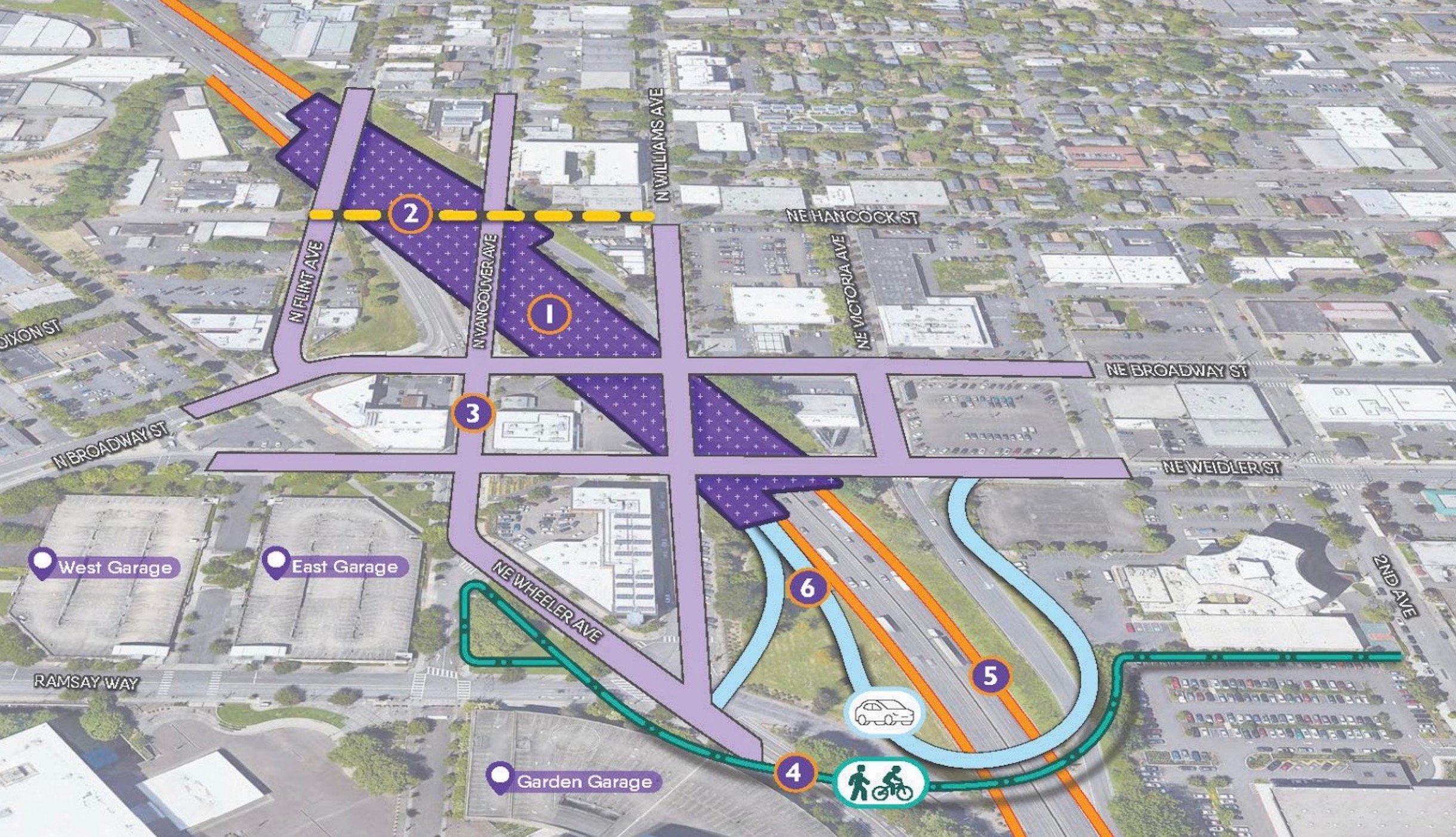
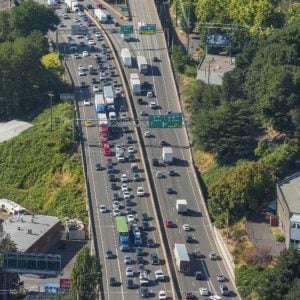
The project aims to widen about one mile of I-5 between I-84 and I-405. It would also add a lid for future development and make major investments in surface streets in the area of the Moda Center. I was originally estimated to cost $450 million, but that price has ballooned to over $2 billion with the start of construction nowhere in sight.

But it was a brutal summer for this project. The Trump Administration took back $382 million of a $450 million grant previously awarded to the project (when it axed the equity-related program that funded it) and the Oregon Legislature failed to pass dedicated funding for it in the heavily-compromised, anemic transportation package.
Eight years into planning the project and ODOT says it currently has just $487 million in the bank — about 25% of its total currently estimated price tag. And the cost of the project is likely to go way up, since it’s still only at the 30% design stage and isn’t slated to make it to 60% (a key milestone necessary for more precise budget estimates) until the second quarter of 2026.
One reason for the slow progress is pesky nonprofits who’ve joined forces to file multiple lawsuits against the project. Among their concerns are that the plans run afoul of already-adopted city and regional planning documents.
Amid all this bad news, key leaders of the project have recently resigned, including the former project director and leader of ODOT’s (now closed) Urban Mobility Office which included the I-5 Rose Quarter as its top regional priority.
For their part, the OTC has expressed grave concerns about the project. The last time ODOT came to the OTC asking for permission to move forward, commissioners reluctantly offered support for some preliminary work. “Everyone in this room needs to understand that beyond that, there is no money,” said OTC Chair Julie Brown at that meeting. “We are not saying that we are going to move forward with a complete Rose Quarter.”
And that was before the Oregon Legislature failed to put any money into the I-5 Rose Quarter piggy bank.
At this point, ODOT has already begun the dreaded work of cost cutting and value-engineering to try and create a more palatable project — an exercise that could further weaken the project’s political viability and curb appeal.
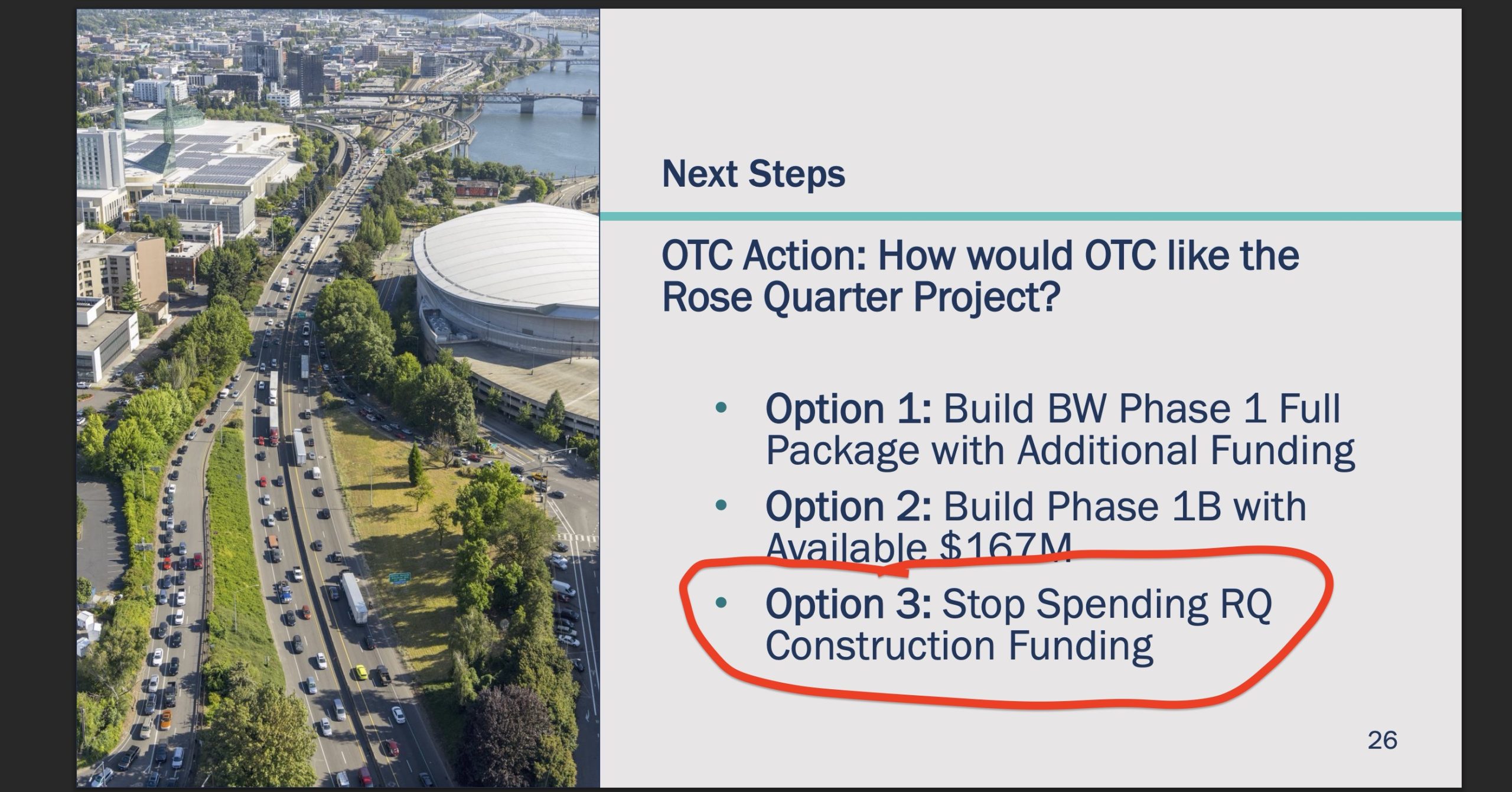
That’s the context of what is likely to be a very tense discussion at the OTC meeting on Thursday where ODOT staff plans to present three options for consideration: 1) a full package that would begin construction without the funding to complete it; 2) a partial package that would spend $167.5 million to build partial elements of a reduced scope project; and 3) the “stop spending” option.
If the OTC chooses that third option, the $167.5 million could be reallocated to the I-205 Abernethy Project (another freeway widening south of Portland that has been beset by cost overruns), or it could be transferred to any other project in the state. If the OTC directed ODOT to “stop spending” they would use $67.5 million (the portion of the federal grant they had already obligated to the project before Trump rescinded it) to work on design and some preliminary construction projects.
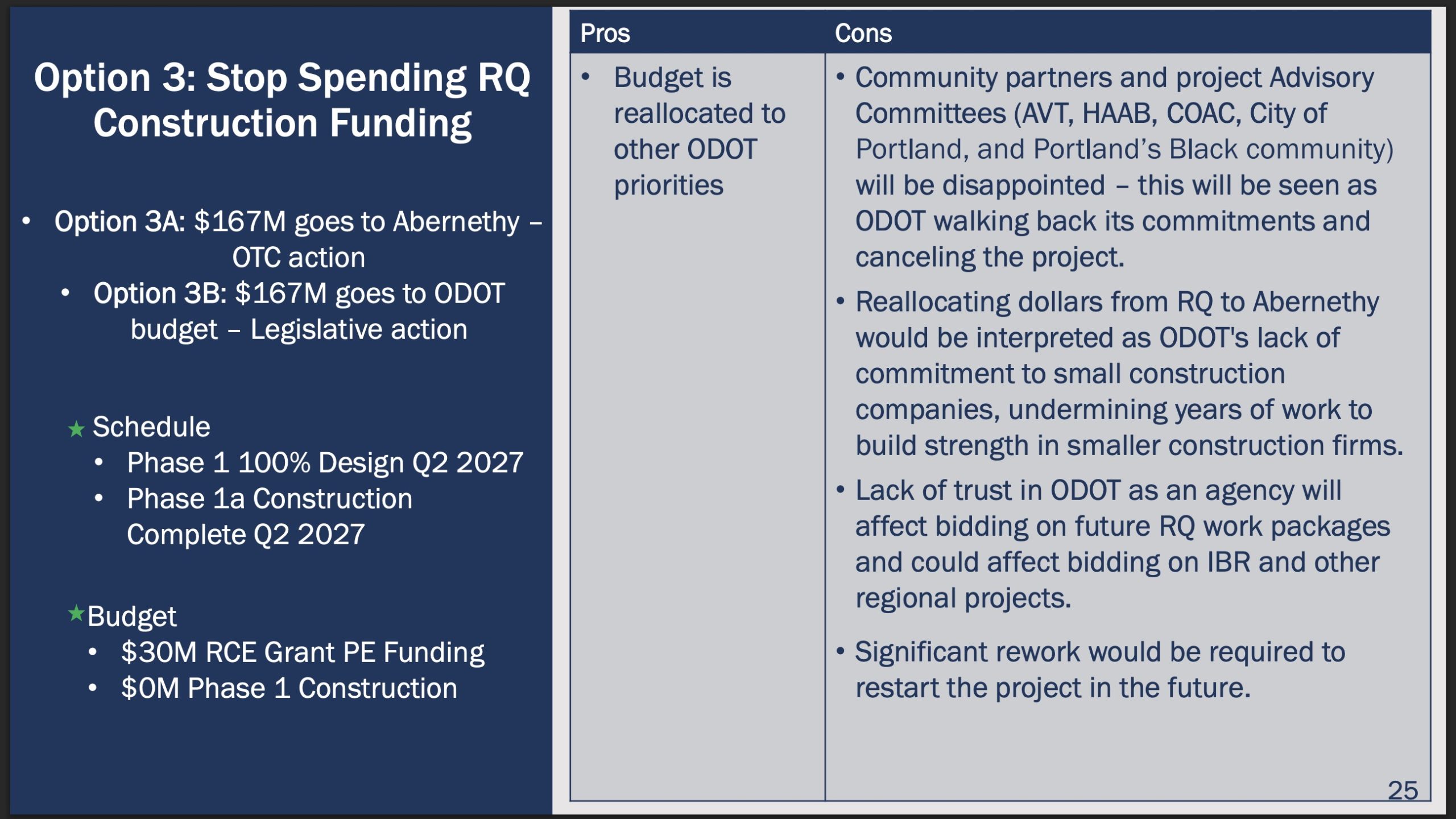
ODOT is well aware of the pitfalls that come with option three. In a slide (above) that shares “pros” and “cons” they state that community partners, “will be disappointed” and that the move would be seen, “as ODOT walking back its commitments.” This underscores years of relationship-building between ODOT staff and construction companies — many of whom are owned and/or led by Black Portlanders as part of an intentional effort to create wealth that was stolen when the initial construction of I-5 decimated the Lower Albina neighborhood. Project staff also say ODOT would lose trust
Lack of trust in ODOT as an agency will affect bidding on future RQ work packages and could affect bidding on IBR and other regional projects. • Significant rework would be required to restart the project in the future.
Beyond that, the project documents state: “Progress on the remainder of the Rose Quarter would await future funding opportunities, and the cost of the project would grow with each year.”
— View the Rose Quarter funding letter and the presentation.
UPDATE, 11/12 at 12:48 pm: ODOT has just updated the agenda for this meeting and they have removed this item from the agenda.
Thanks for reading.
BikePortland has served this community with independent community journalism since 2005. We rely on subscriptions from readers like you to survive. Your financial support is vital in keeping this valuable resource alive and well.
Please subscribe today to strengthen and expand our work.
How much local bike infrastructure could you get for $167.5 million?
About $100M worth.
lol, less maybe. Oregon tax money just vanishes. I think it’s vapor does have some effect like sustaining the entrenched non-profit/activist/ impassioned bureaucrat/business owner class (many of these people are married to each other and fund those craftsman remodels thanks to taxes)
So our tax money allows them to browbeat the majority of well-intentioned but tribal thinking residents into quiet obeisance to their tax and spend schemes that always seem to benefit their friends.
When the original CRC was cancelled, the state of Oregon was prepared to pay $27 million annually on construction bonds for the project. When I was advocating in East Portland, we encouraged our state legislators (we had 10 of them representing bits and pieces of East Portland at the time) to redirect as much of that potential funding as they could towards eligible East Portland projects, including state highways like outer Powell, I-205, and outer Sandy, as well as city streets on the SDC list like SE 136th. In all, we were successful in re-directing over $150 million of state highway money through our state legislators and eventually the governor.
Seeing this project now in the process of getting dismantled, I would think it would be a “golden opportunity” to get your state legislators to re-direct a substantial portion of the funding towards various virtuous pet projects citywide.
Is it possible for them to decide to build the caps without the widening? Then they could keep one of their promises, to AVT.
The caps will be the first thing cut, not the last.
The project will be zombified before the caps are cut. The caps are the only thing that has political support.
Jonathan, I honestly appreciate your optimism, I think we need it more than ever in these dark times. It does give me a bit of hope and I’m not being sarcastic.
Unfortunately the cynic in me thinks if they do somehow keep the caps in the plan it will just be to keep the project going and which point they will announce they only have money for the freeway expansion, and magically the caps will disappear from the plan.
I agree with Mark, i believe the caps are the first thing they will cut.
Jay Cee,
It’s not optimism that’s saying that. It’s understanding the political reality. Projects must have political support at the end of the day. If ODOT tried to remove the caps, every regional elected official would face intense pressure to pull their support, and that lack of support would cause the project to come to a halt. I don’t think people really appreciate enough how the caps and the Albina Vision Trust are the only thing allowing this project to move forward. Remove that, and remove support of AVT, and it’s political suicide to support it.
I would like this to be true but I think the caps will be the first to go
I don’t read the politics the way you do. Certainly the caps are very useful, politically, but nearly every elected official supports highway expansions, even those like Christine Lewis who were OLCV’s volunteer of the year. See: IBR, I-205 widening, Highway 217 widening, Boone Bridge boondoggle, and so forth. See what happened to Lynn Peterson.
The freight/business lobby combined with the construction unions just cause most electeds to suck up and climb for higher office.
Again, look at the record of this project and my reporting here on BikePortland. This project would already be dead if not for AVT and the caps and it will absolutely die without them.
When it comes to Portland-area politicians (and Kotek), the freight/business lobby is nothing compared to displaced Black Portlanders who lost everything when ODOT built I-5 and who stand to gain some of it back with the lids.
If the people who were relocated to make way for I-5 (and I-205 and I-405) were inadequately compensated, then it would be far cheaper to just give them what they are owed than to build this crazy project and try to give them discounted apartments or whatever.
The damage was done over 60 years ago, and there’s no going back. Albina will never be what it was. The lids are a fantasy.
Very true.
The caps were predicated on massive free-way widening. Without more lanes for cage-drivers the right-wing democratic party has zero interest in righting past wrongs.
I talked to an ODOT freeway engineer about this when they did their big launch of this project at Tubman Elementary this last summer. They said that the widening is necessary for the caps because the widening also strengthens the infrastructure so that it’s possible to build on the caps. Without the widening/strengthening, nothing could be built on the caps
One can only hope.
The caps were a good idea, though. Portland or Metro should look into the project cost for the caps alone, without the freeway expansion underneath.
The caps become geometrically more expensive the wider the proposed freeway becomes. This is one of the main points that NMFs has been pressing.
Worth noting that ODOT’s ruling out of cost savings from cover width reduction is wildly disingenous.
Apparently they studied reducing the cap widths and concluded that there was absolutely no way it could be done due to construction logistics (“NO Solution identified, NOT PRICED)” even though putting four-lane roadways on three-lane bridges/tunnels by utilizing shoulders during construction is standard practice.
https://www.oregon.gov/odot/Get-Involved/OTCSupportMaterials/Agenda_J_Rose_Quarter_Update_PPT.pdf
Also hilarious that ODOT thinks that “lack of trust in ODOT as an agency” could be one of the results of pausing the project.
There is SO MUCH work to be done to maintain this state’s transportation assets. OTC should walk away from this boondoggle.
State DOTs and transit agencies overpay for what they build because they have been captured by the firms that they pay. This story that is linked below is related to the IBR but is likely the same story. Europe does builds much more for less because they have stronger in house expertise that does more than just give away tax payer dollars to their freinds. https://www.clarkcountytoday.com/opinion/opinion-outrageous-32-wsp-profits-for-ibr-consulting/
This is actually common practice unfortunately. It’s not just in house expertise. It’s often framed as high cost of labor, but that’s misleading. There is an NYU report that’s linked on the HSRA site where the study info originates. In the US the same transit project often runs more than twice the cost as in other developed countries. The causes:
Thanks for the link. I especially liked the final quote “If you have a governor, mayor, head of agency who is laser-focused on that stuff, it solves all of these downstream problems.” I also enjoyed this interview with Alon Levy about the same issues. https://www.volts.wtf/p/us-transit-costs-and-how-to-tame
Too often, it seems like our elected officials do not have the motivation to be good stewards transportation dollars and the people that they put into leadership are primarily focused on making transportation the biggest slice of the state budget.
Gives me hope that good things can still happen
If this project is put on the shelf, we can all savor the delicious irony that the Trump regime – dedicated 110% to moving cars and trucks ONLY – killed it by defunding the caps, which were added to buy off opposition by the local community.
In a way I find the Trumpers’ naked advocacy for automobility to be rather refreshing. It’s much easier to understand than the position of Dems, who say they support alternate transportation and GHG reduction but then drive everywhere AND support highway-widening projects like the RQ project.
“It’s much easier to understand than the position of Dems, who say they support alternate transportation and GHG reduction but then drive everywhere AND support highway-widening projects like the RQ project.”
I find myself defending the Democratic Party all the time, but I gotta say, this is pretty funny!
I think it’s one of the challenges of a “big tent party”- how could we possibly satisfy de-growth environmentalists, or even green/abundance YIMBY voters, as well as union construction firms?
And personal choices create some of the greatest ironies: of all of my friends and co-workers, it’s the three “bootlicker/liberal/politically incorrect” guys who ride their bike to work the most. My most leftward colleagues always drive.
I don’t know what it all means!
How much to just fill in with soil that part of i5 up to where it merges with i405? It’s a useless redundancy that only exists because it was supposed to connect to freeways that were never built.
more than you’d think
The RQ item was just pulled from the OTC agenda. Business as usual …
Meanwhile CO2e emissions keep on increasing:
So every single lane and mile of odot lanes are completely paved and pothole free ?all the bridges are good? No? Then why are we constantly expanding when they can’t maintain what they have?