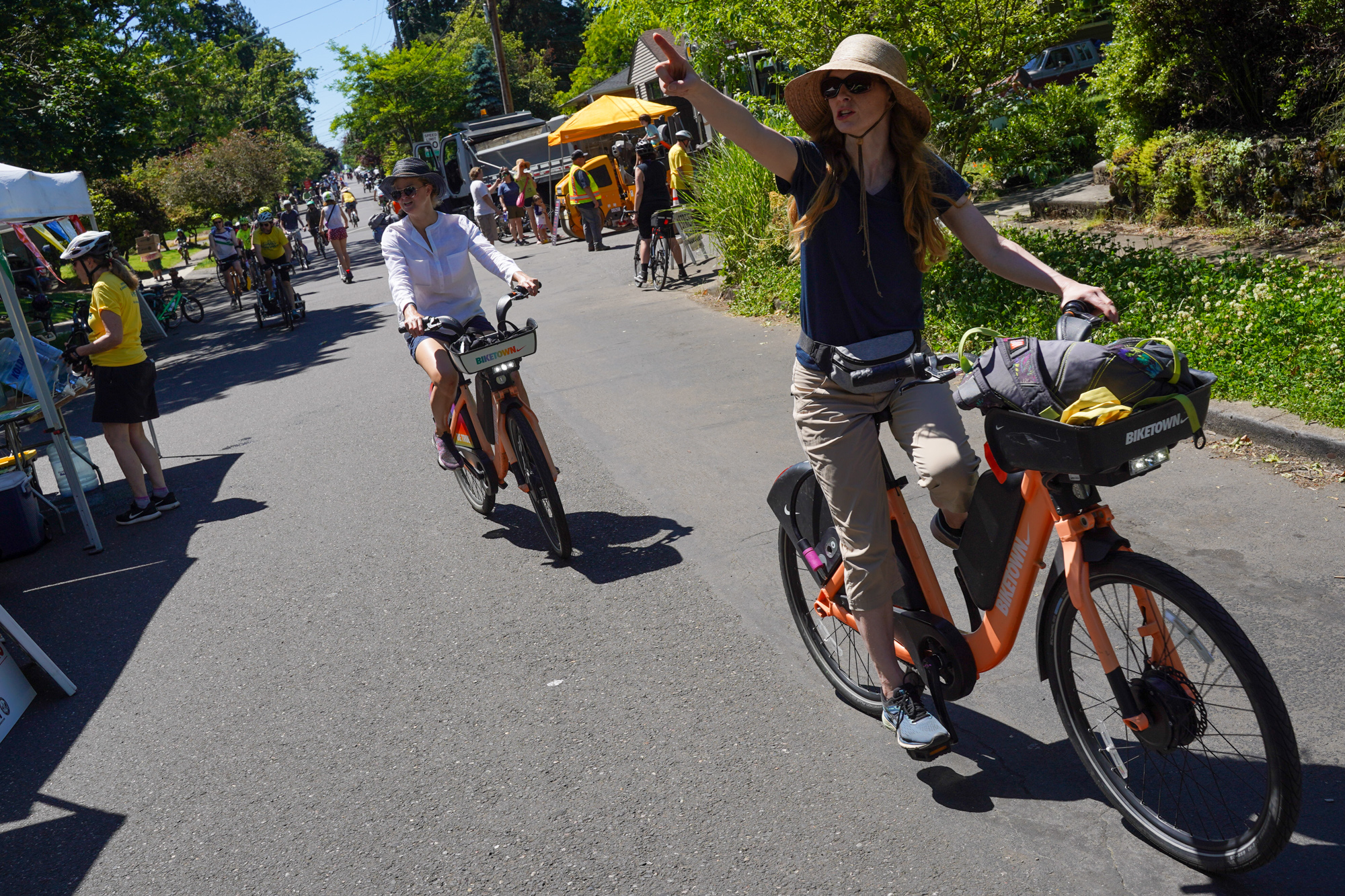
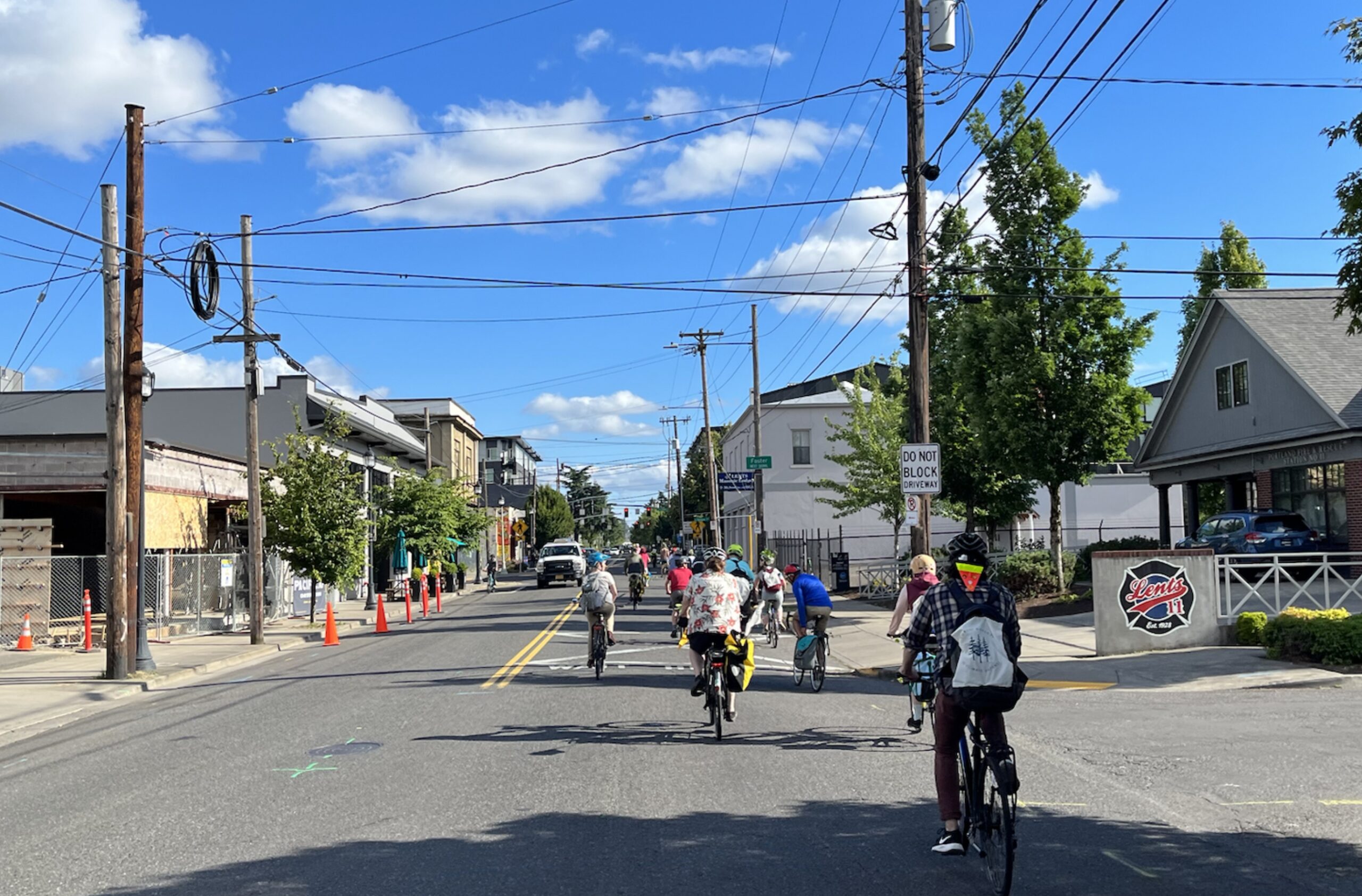
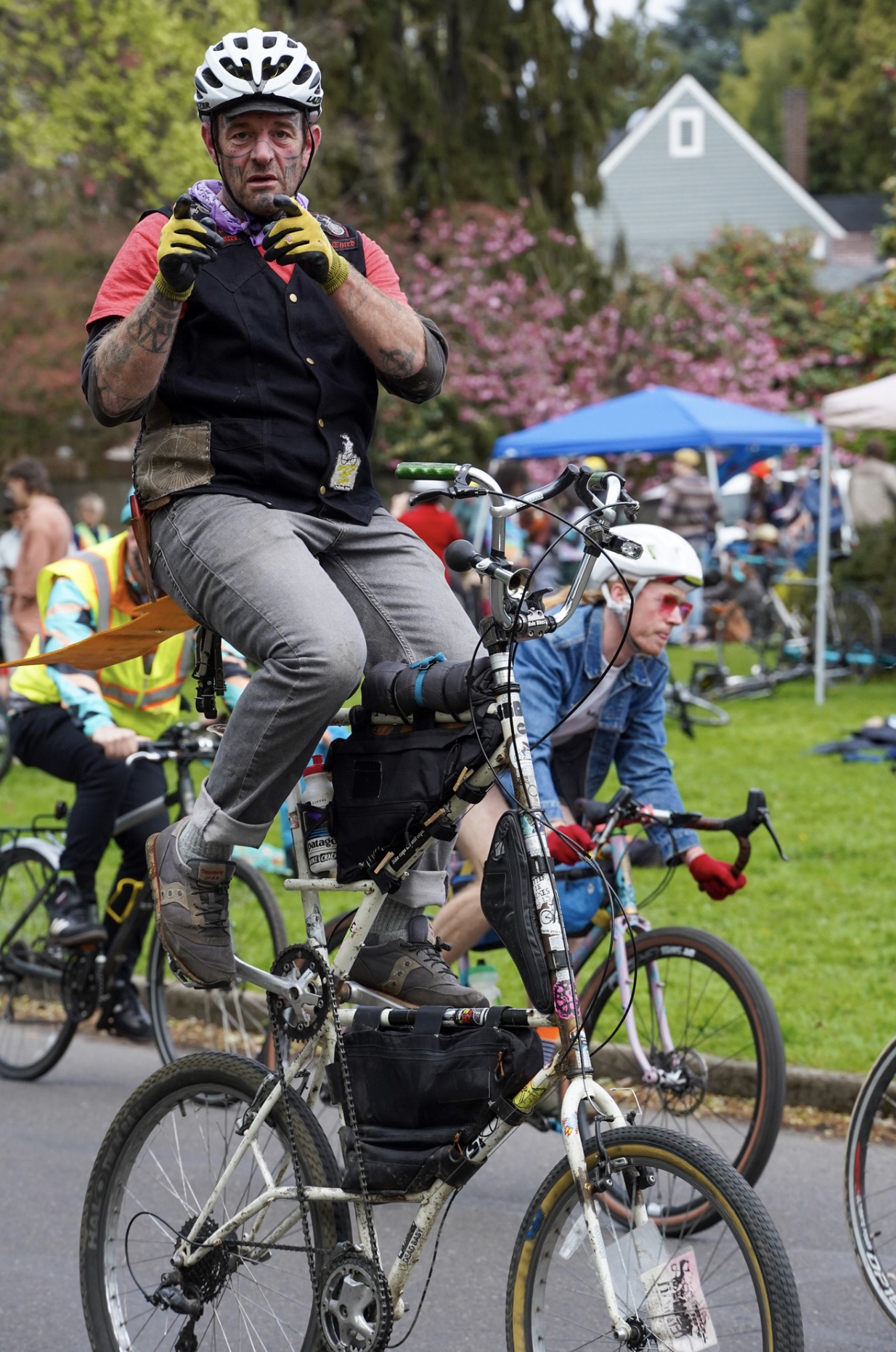
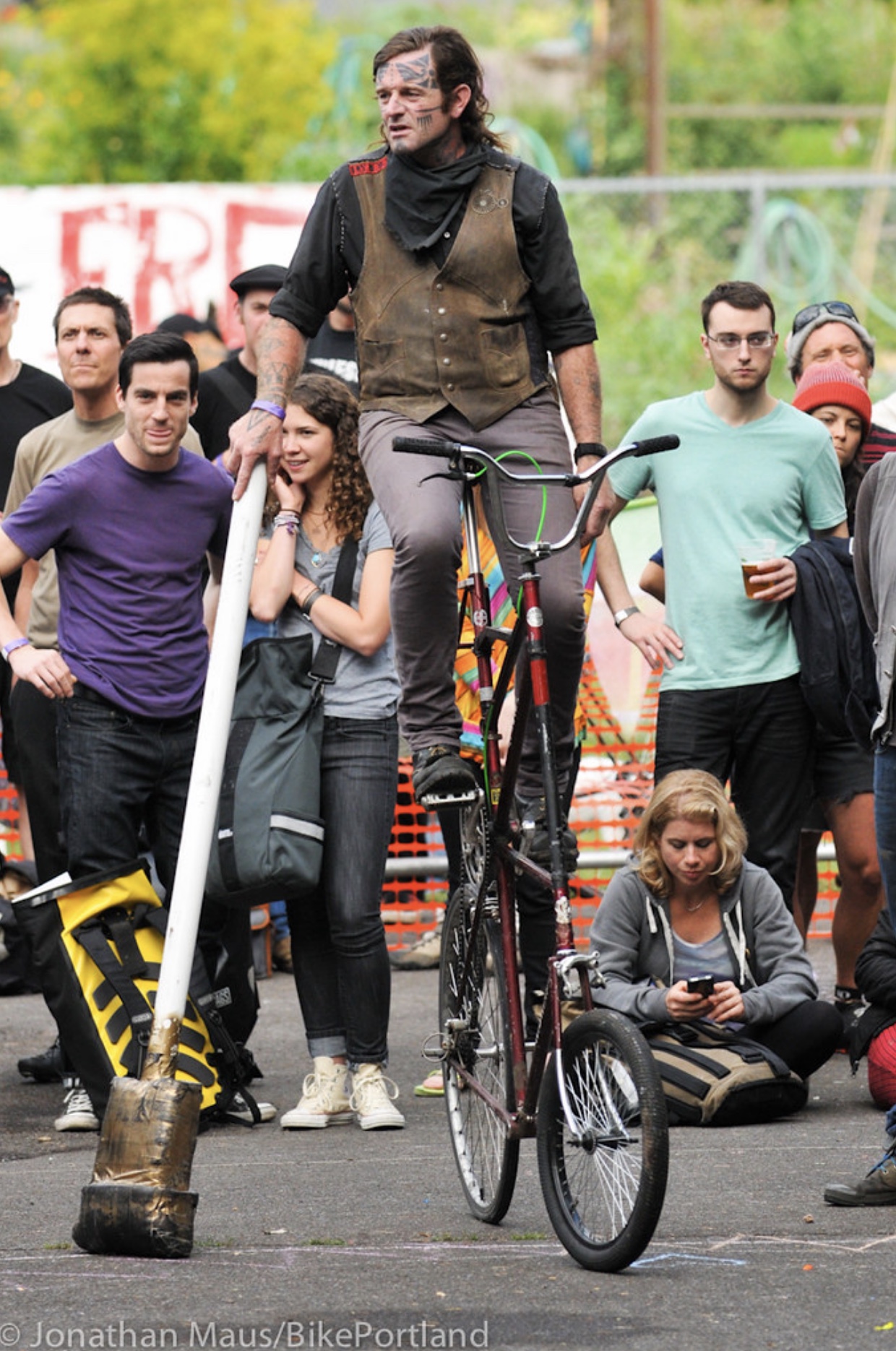
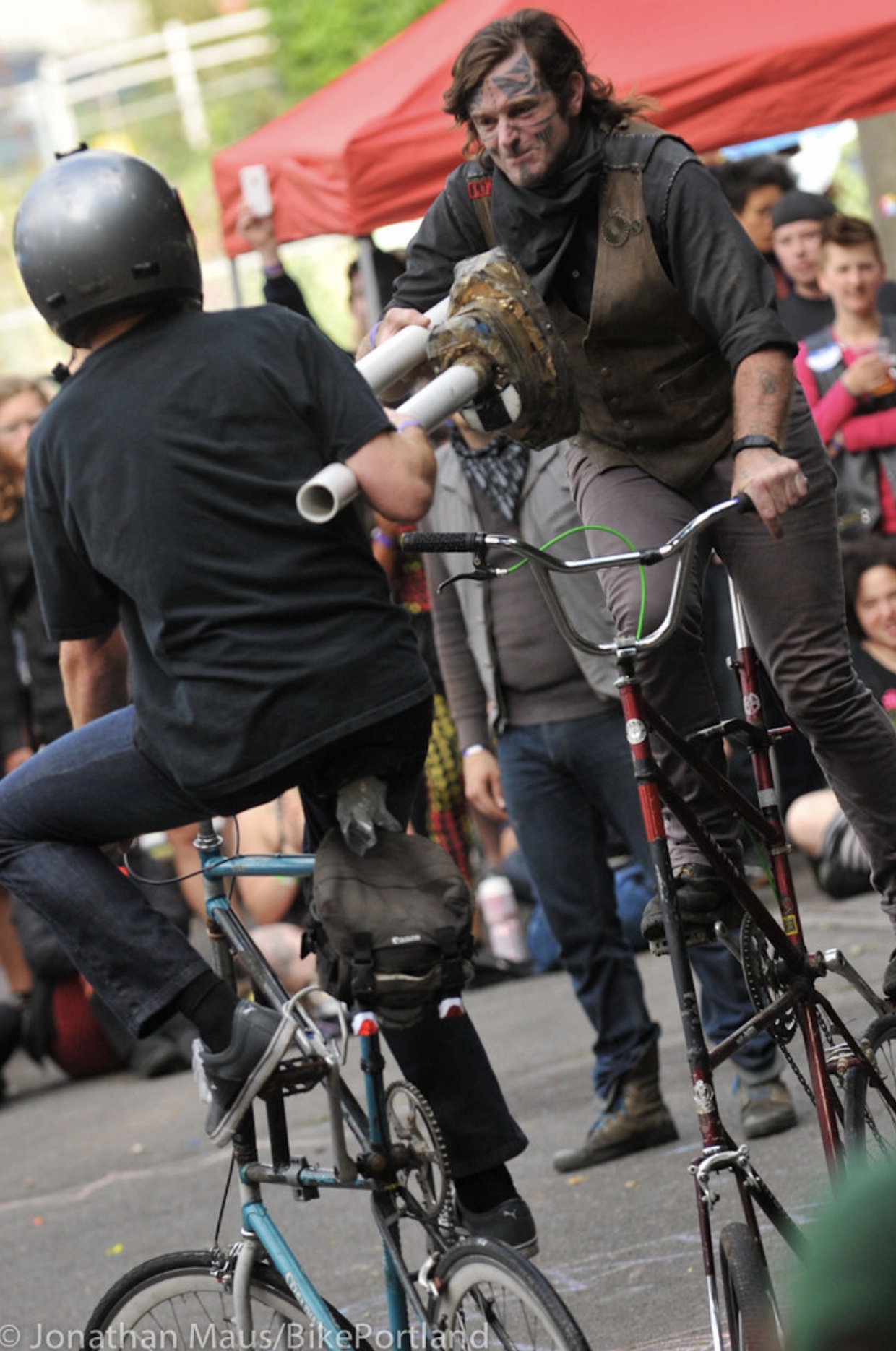
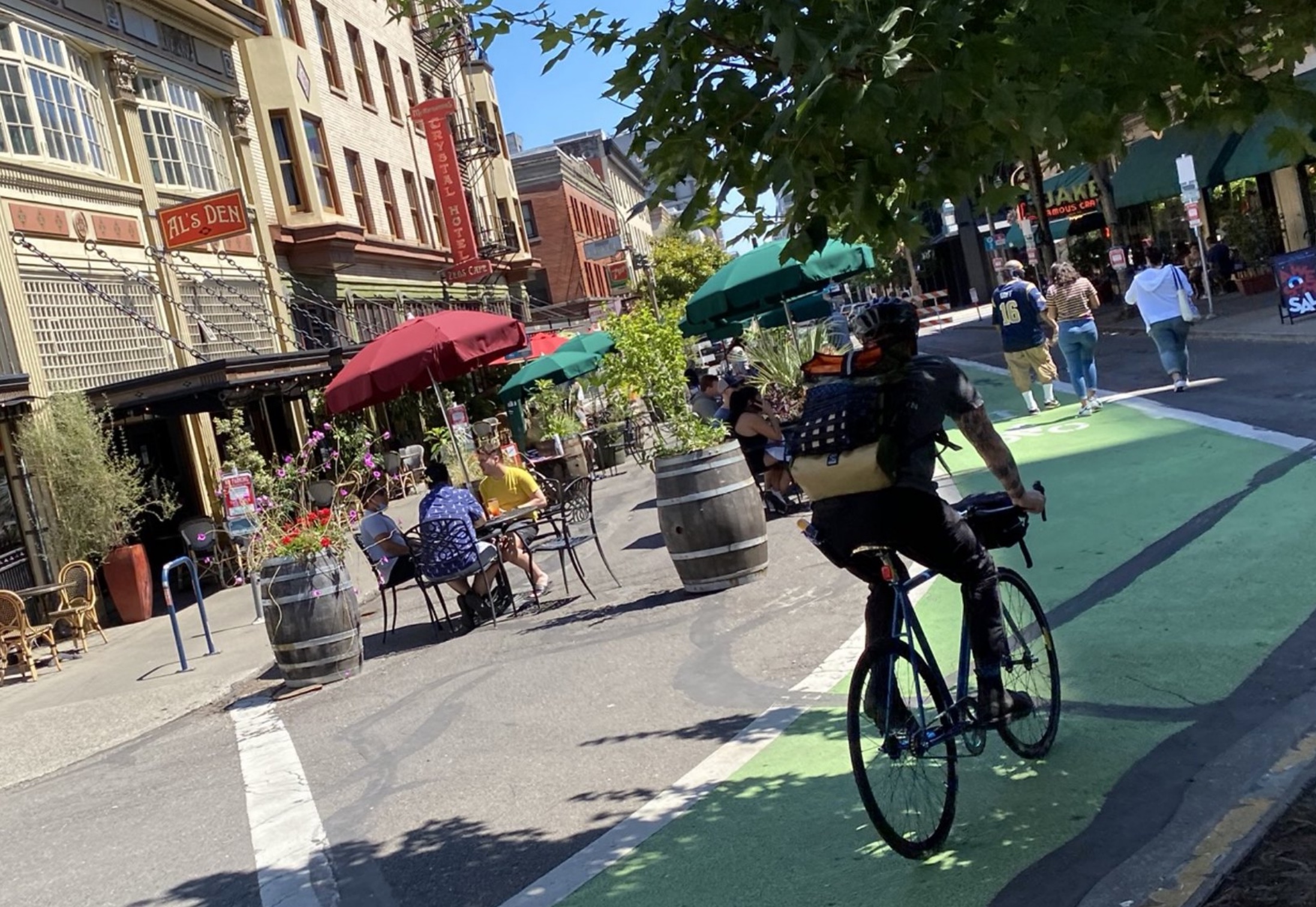
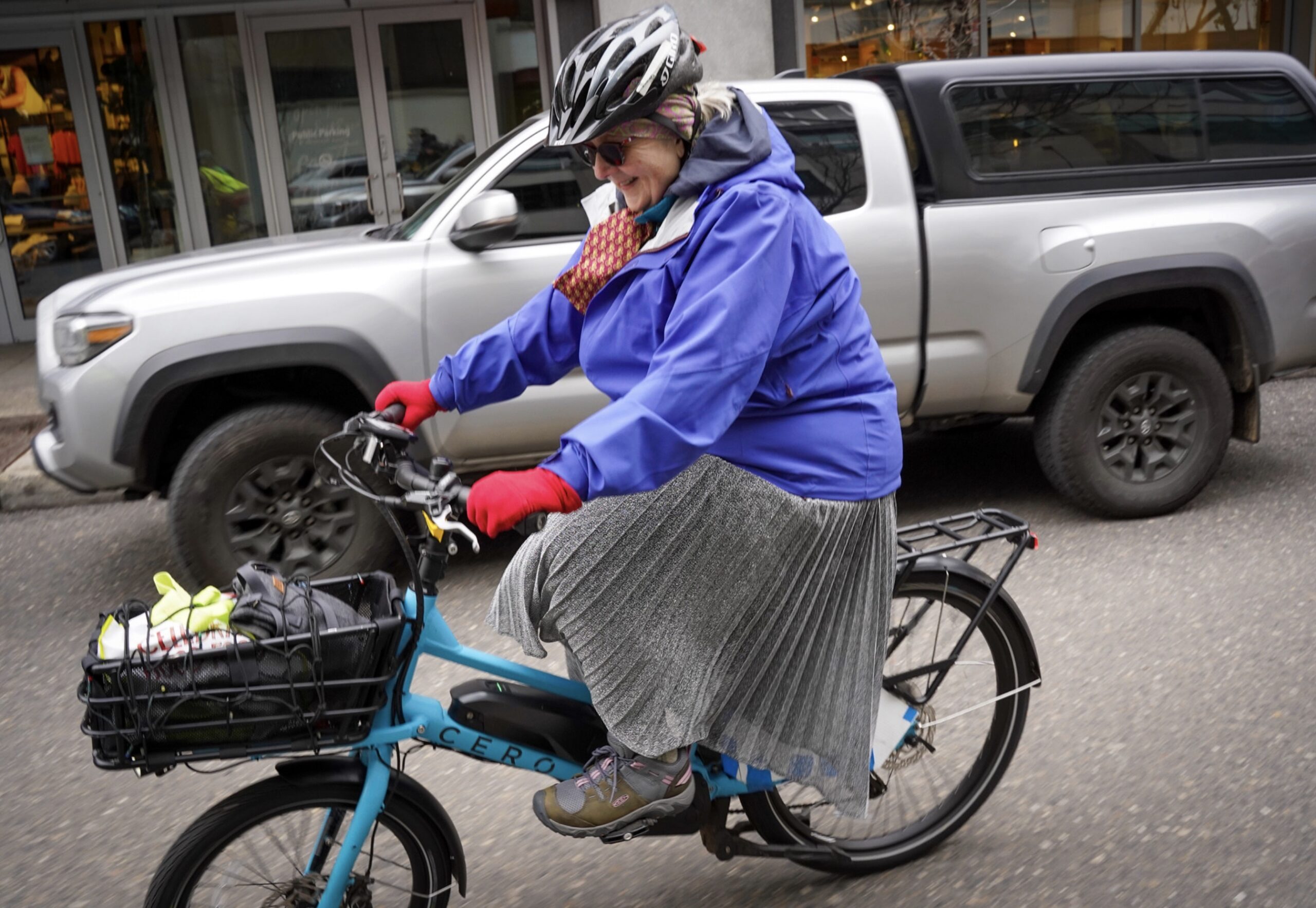
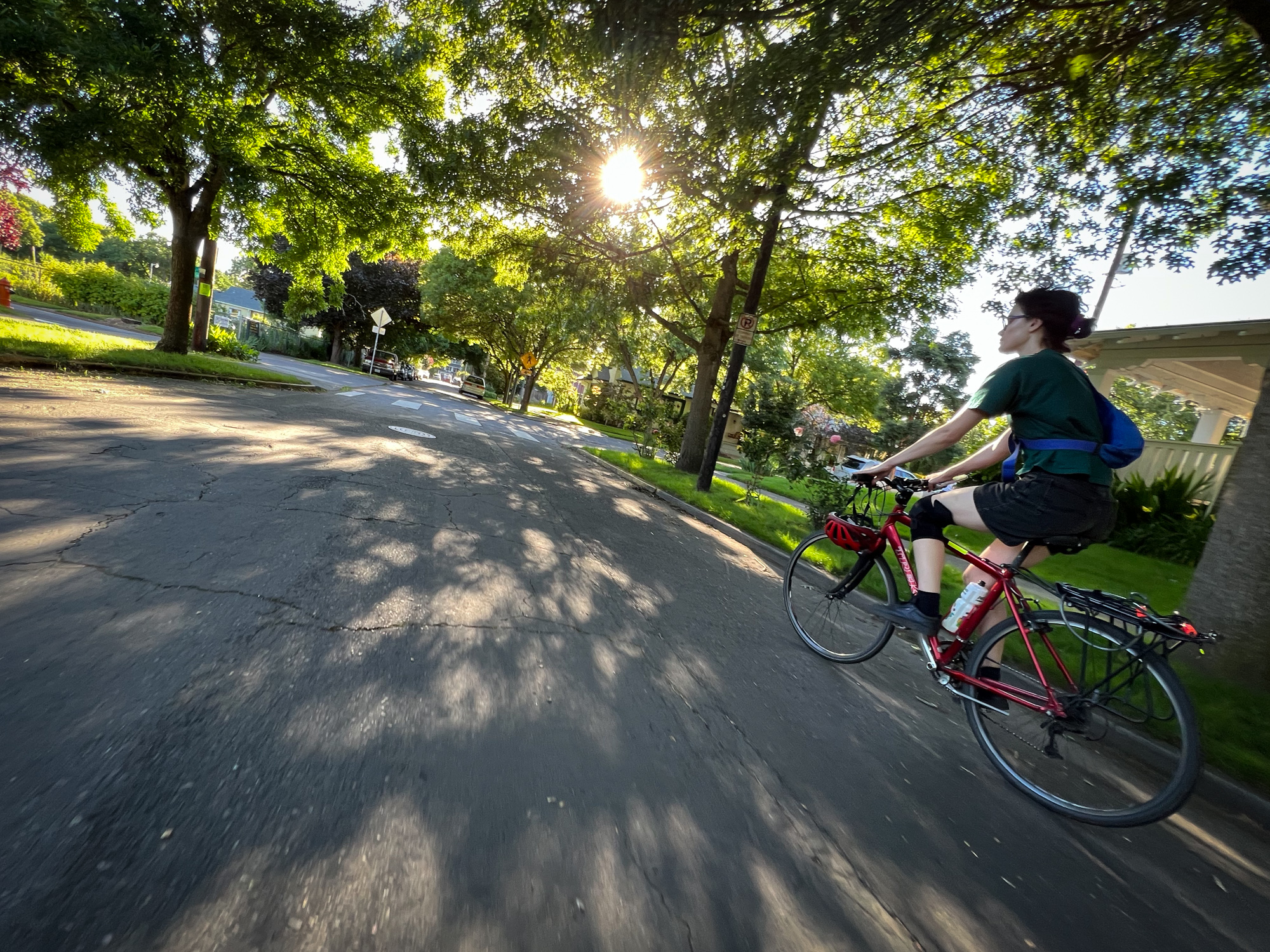
Look! Over there! Fun bike events! (Photo: Jonathan Maus/BikePortland)
Hi everyone. We’re halfway way through the year. Can you believe that?! Let’s celebrate with a weekend where the weather will be fine and the streets will be filled with powerful Bike Summer energy.
Jock Jams Ride – 7:30 pm at Laurelhurst Park (SE) Teenage Dirtbag Bike Club kicks off their first ever Jock Jams Ride. Folks are invited to put on that old nostalgic sportswear you have and show some vibes out on the streets. More info here.
Saturday, July 2nd
Sew Many Bikes – 2:00 pm at Bolt Neighborhood Fabric Boutique (NE) Attention sewing enthusiasts! Join Marne Rowland Duke on a tour of Portland fabric stores, pattern makers, and sewing studios. Wear your best makes. More info here.
Champagne Ride – 6:00 pm at Ladd Circle (SE) It’s a dress-to-impress occasion where bubblies are the cornerstone of one of the fanciest rides of the season. More info here.
Sunday, July 3rd
Victims of Vehicular Violence Ride – 11:00 am SE 17th Ave & Linn St This ride is an act of celebration for the lives of all those who have survived vehicular violence or have been impacted by it. Hosted by a survivor, we’ll come together as victims, friends and family members to raise our voices. The ride is organized by Estelle Morley, just a year after she became a victim of a serious collision. More info here.
Sundays on Going – 12:00 pm from NE 6th and Going Your weekly summer Sunday neighborhood meeting goes red, white and blue. Join Bike Loud PDX on its very own mini Sunday Parkways. Every Sunday through August, meet at 10:00 am and set on a slow roll eastbound along the Going greenway at noon. More info here.
Pupperpalooza – 1:00 pm at Irving Park (NE) This human-friendly bike ride is an opportunity for furry four-paws to meet their friends and play while being ridden by several dog parks in N-NE of the city. Humans are accepted even if they don’t bring a pup. More info here.
Stay plugged into all the bike and transportation-related events around the region via our comprehensive event calendar.
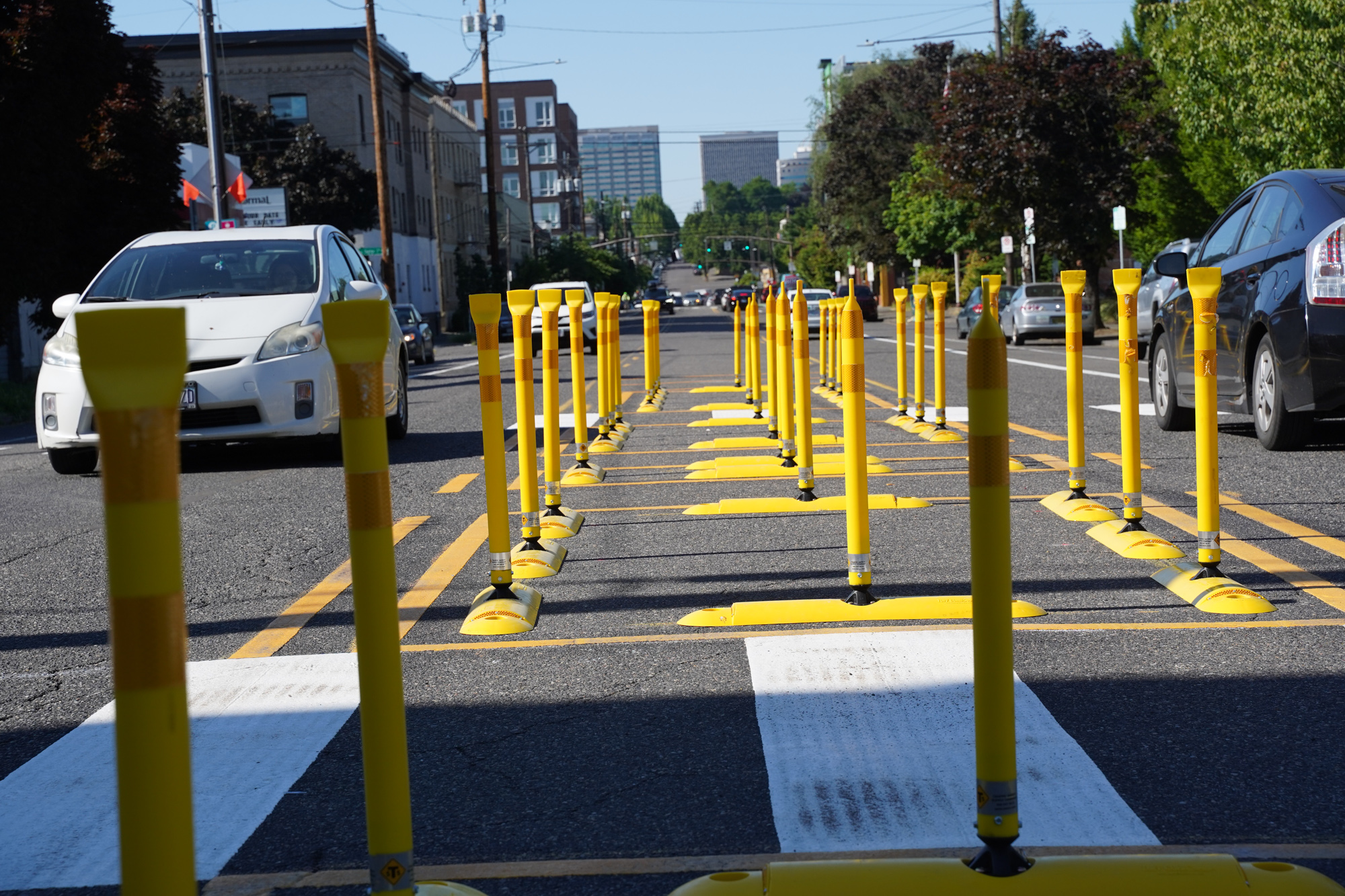
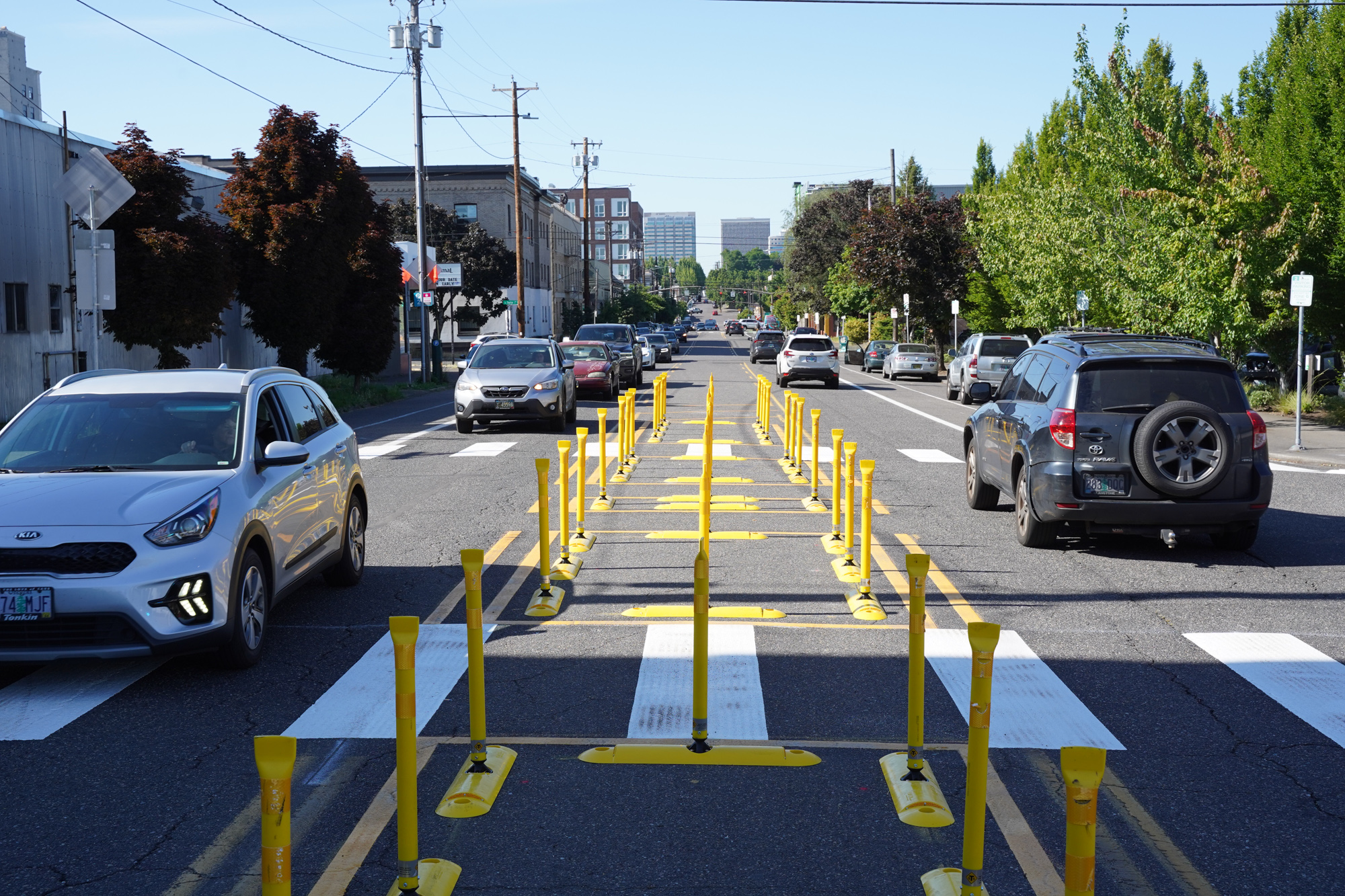
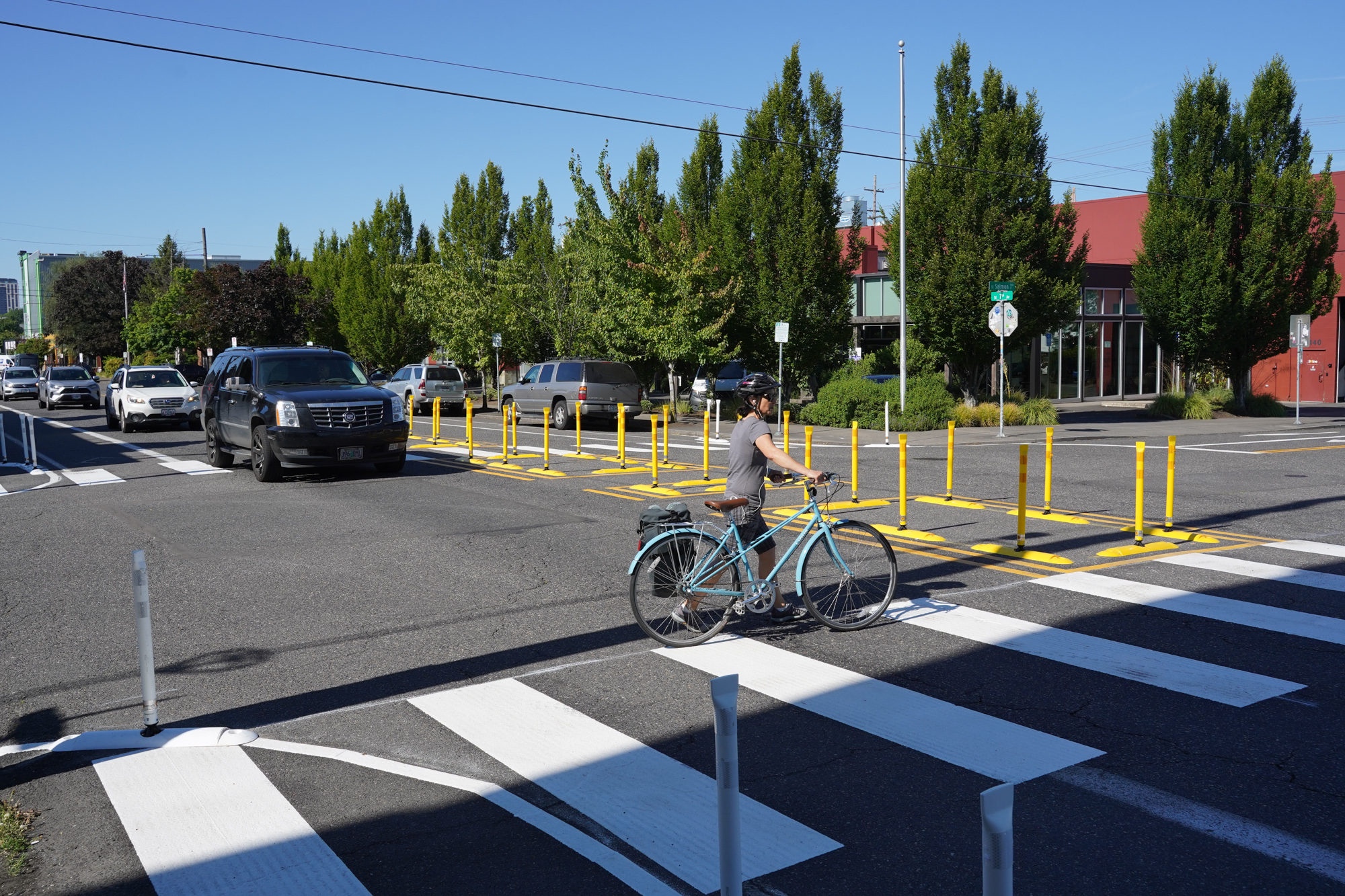
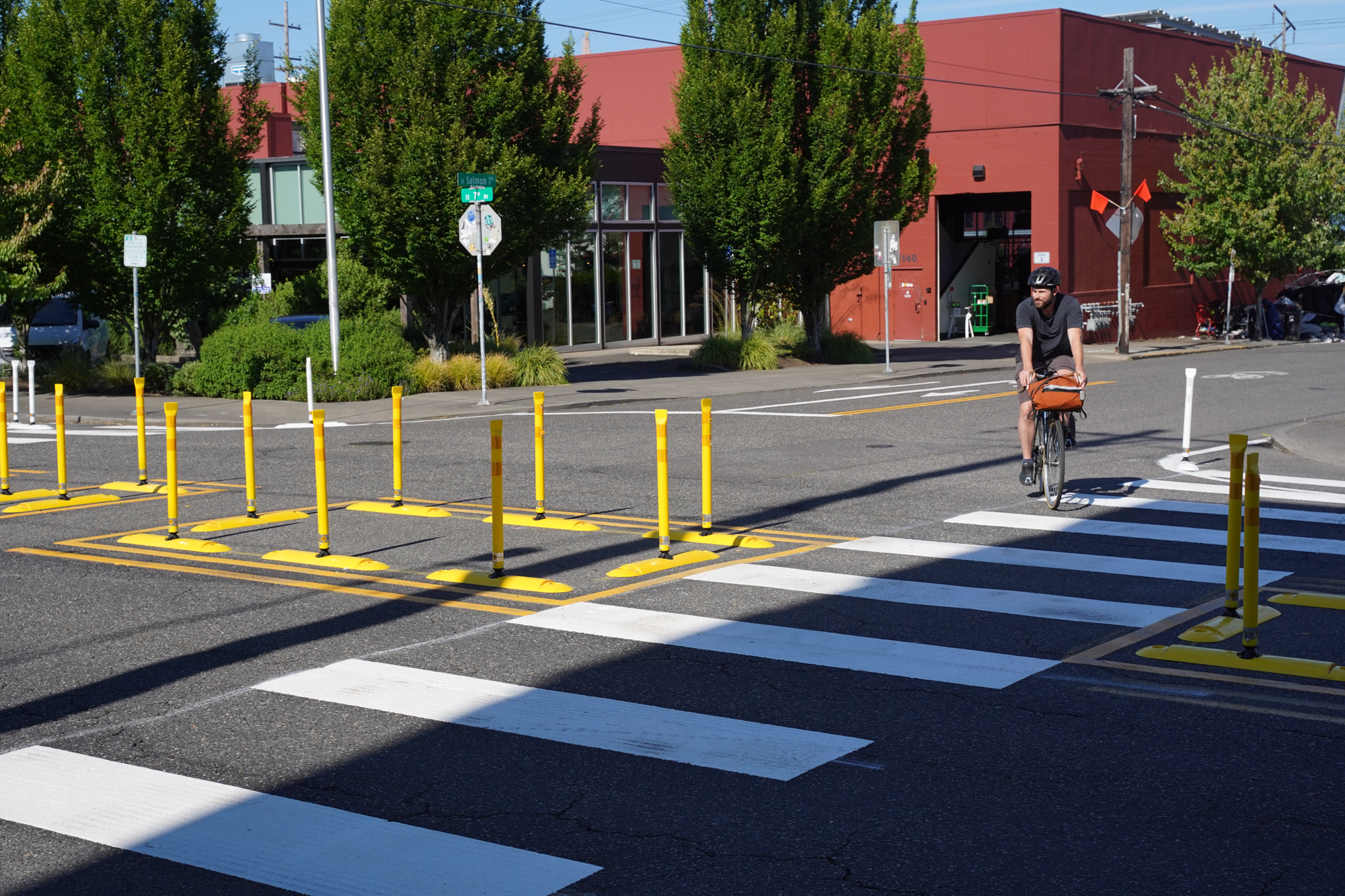
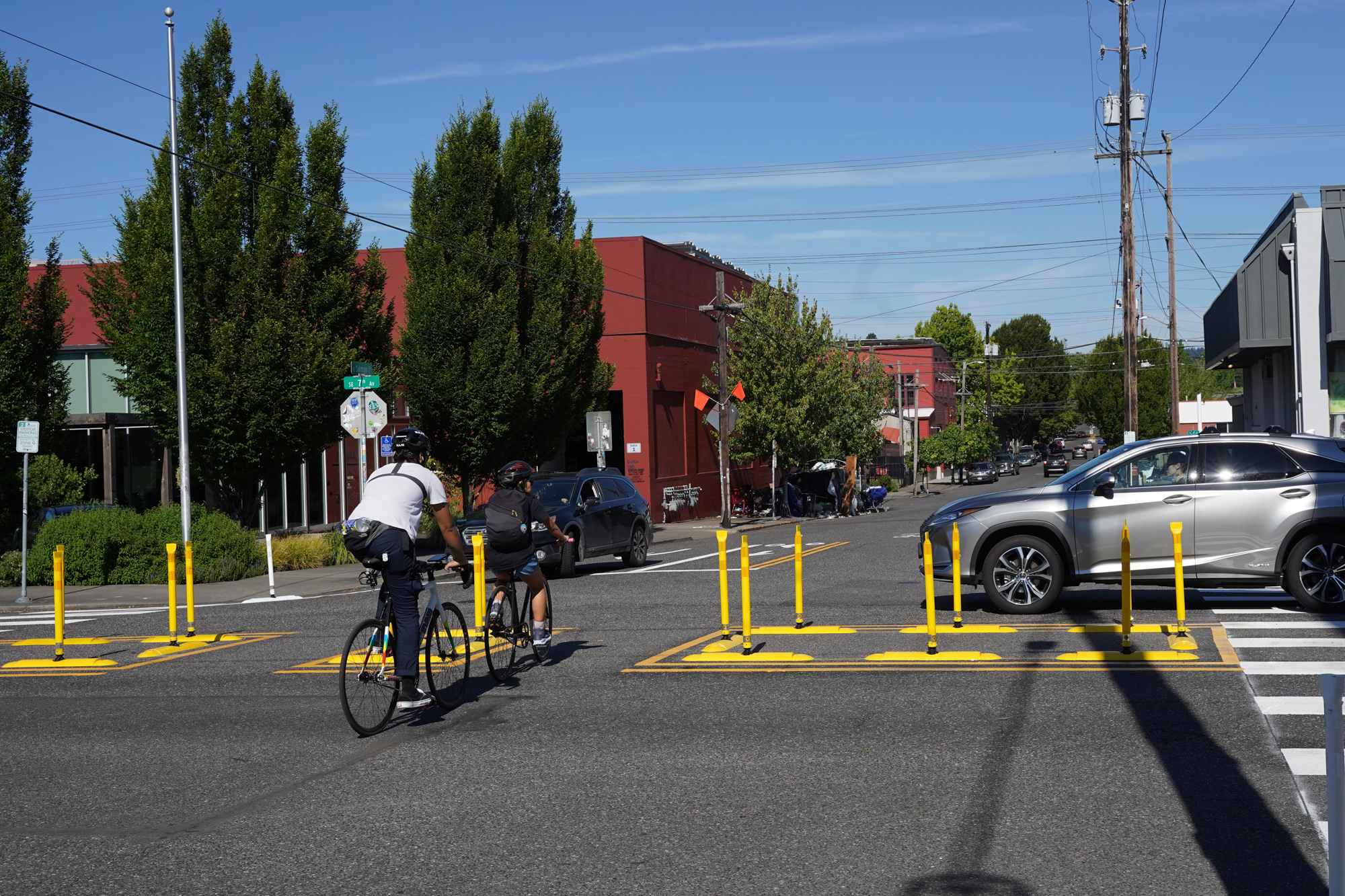
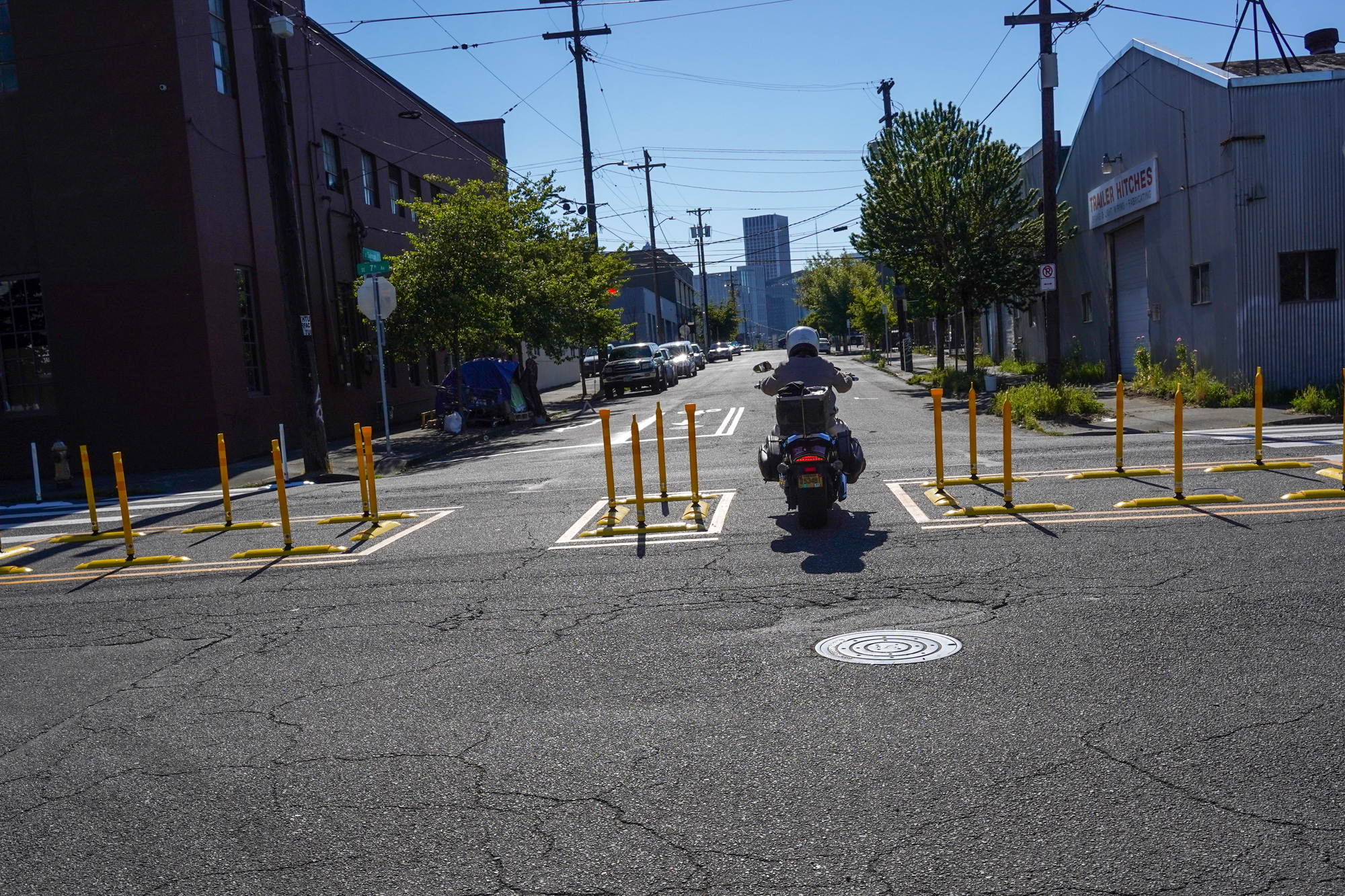
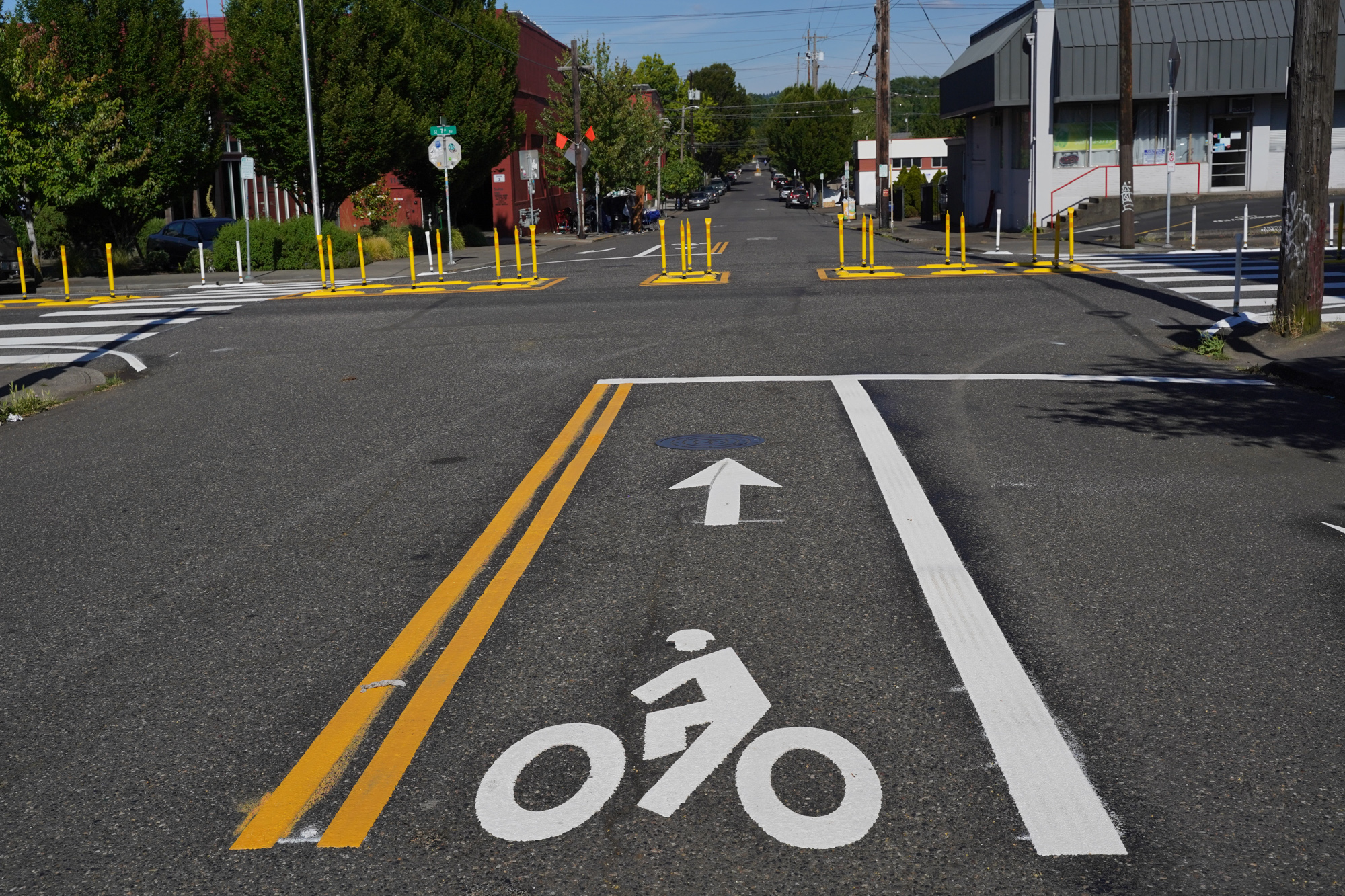
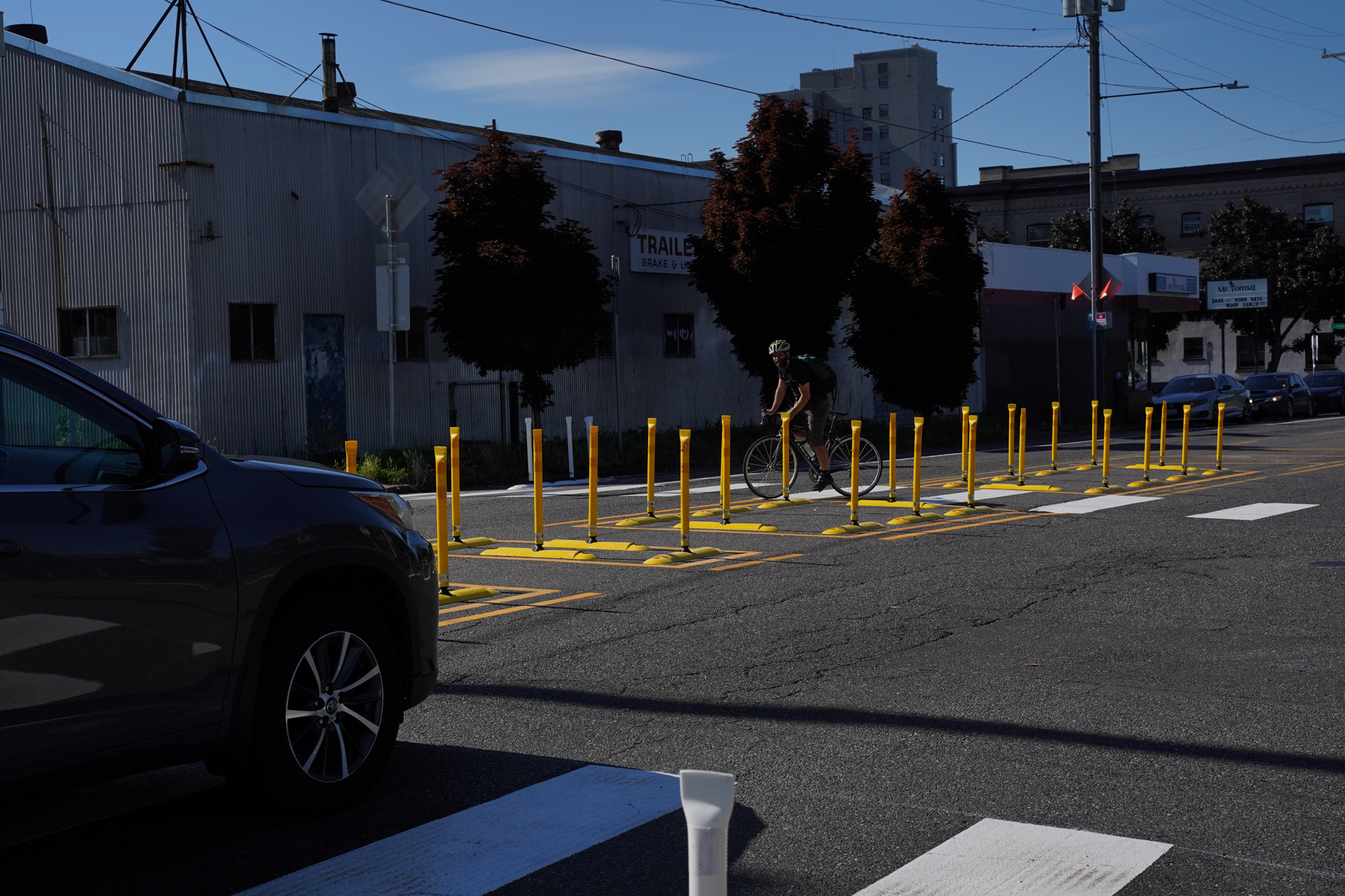
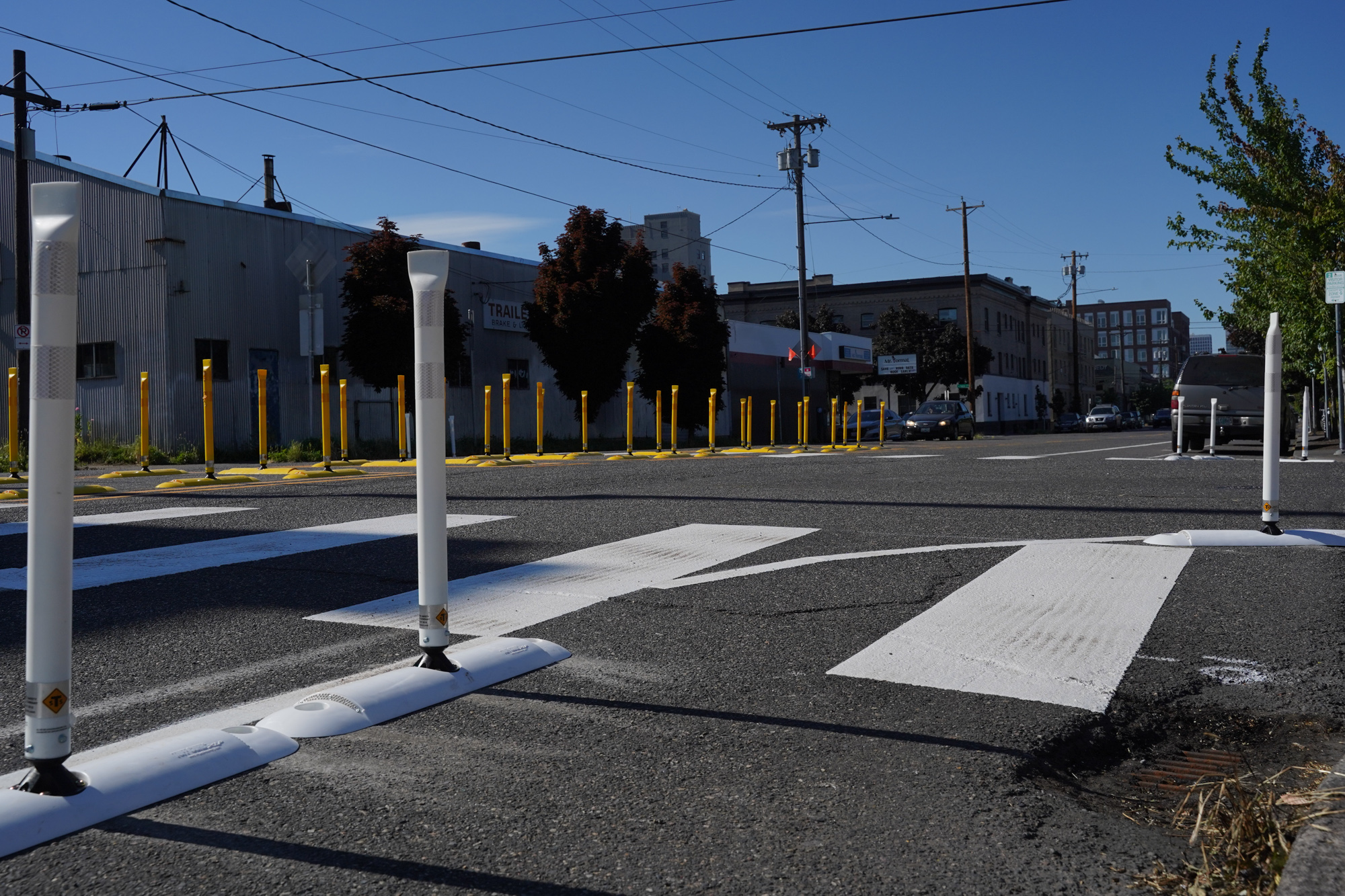
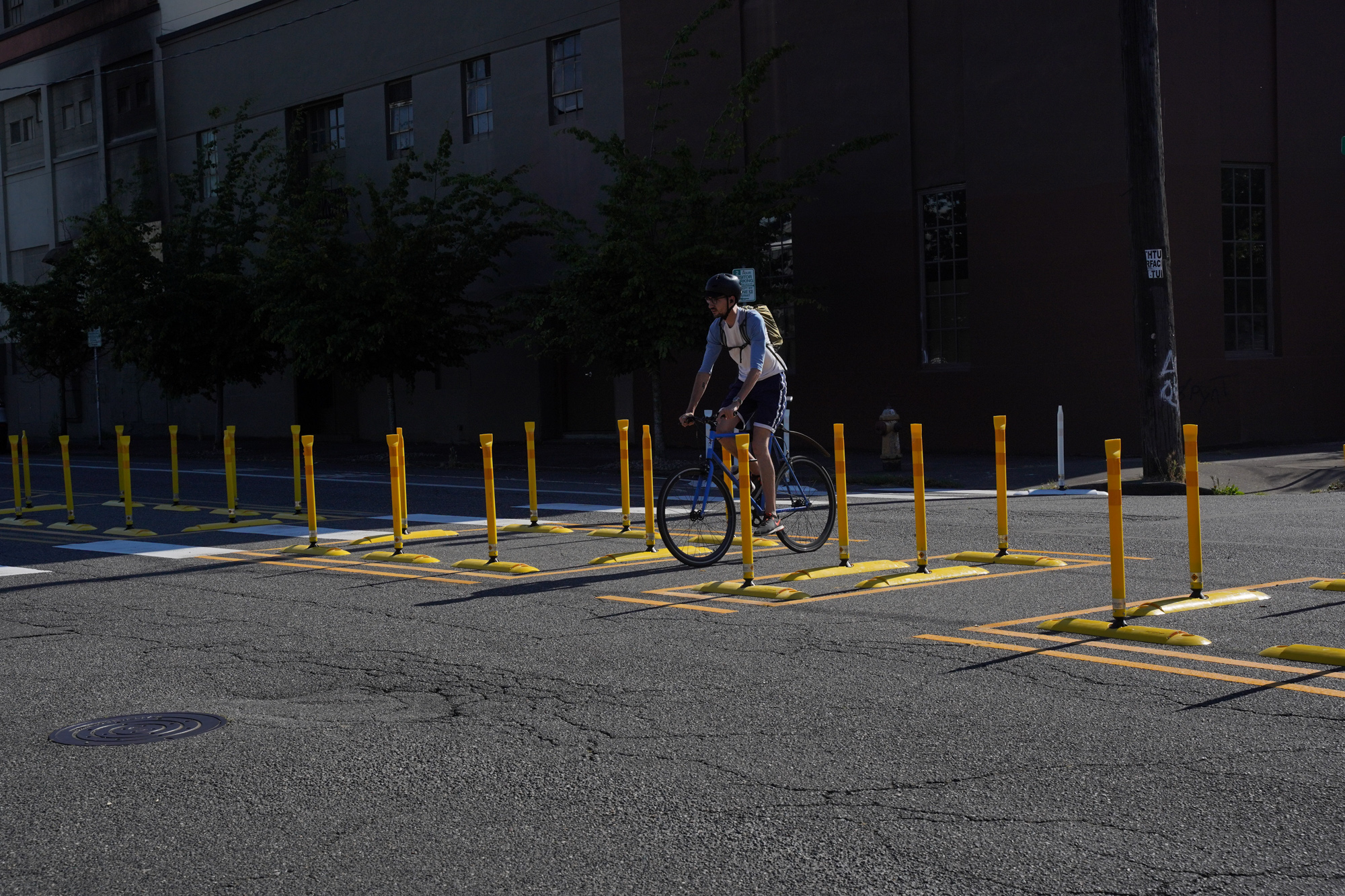
PBOT has also added curb extensions and striped crosswalks. Full gallery below. (Photos: Jonathan Maus/BikePortland)
One of Portland’s most important bike streets has received a big upgrade. The intersection of SE Salmon and 7th now has a full median made out of bright yellow plastic curbs and wands. There are also two new striped crossings and all four curbs have been bumped out.
The new median was installed mainly to discourage car drivers from using Salmon as an alternative to the larger SE Hawthorne Blvd, which is just two blocks over. After the transportation bureau restriped Hawthorne with fewer driving lanes in early 2021, they wanted to make sure people didn’t use Salmon as a cut-through to avoid congestion.
In addition to preventing drivers from crossing 7th east to west, the median also prevents them from turning left from 7th onto Salmon. The new media and curb extensions also improve safety for walkers and rollers who use the popular route to access the Eastbank Esplanade and southeast Portland neighborhoods.
The presence of the wands and curbs calms traffic and makes it more likely people will drive more slowly and stop for people waiting to cross.
According to PBOT, the project cost just $15,000 using these temporary materials and they plan to replace it with higher quality concrete curbs and other features in the coming years once they build the full SE 7th Avenue project that’s called for in the Central City in Motion plan. That project will make a number of upgrades to the bikeway on 7th between SE Division and Stark, including new signals, crosswalks, and wider bike lanes.
“The temporary materials [at Salmon and 7th] allow staff to evaluate if this is the right crossing improvement for both the SE 7th and SE Salmon corridors,” PBOT’s Interim Communications Director Hannah Schafer shared with us today.
The project is also part of PBOT’s effort to improve the Salmon greenway with better connections between the Willamette riverfront, through the Central Eastside Industrial District, and inner southeast neighborhoods.
Later this fall, PBOT will break ground on the related Central Eastside Access and Circulation project that will add long-awaited traffic signals to Salmon at SE Martin Luther King Jr Blvd and Grand.
Hami Ramani, a local bike advocate who volunteers with BikeLoud PDX, said he’s happy to see it. “We’ve been waiting for this for a while and I think it’s going to complement the rest of the work at MLK and Grand.” While Ramani isn’t a fan of the temporary aesthetic, he thinks the visual distractions for drivers will slow them down. “Overall, I think it’s a good thing,” he said.
One issue that I saw pop up on Twitter is that, without an accessible center turn lane, bicycle riders going north who want to turn left onto Salmon will now have to make a slower and more awkward approach.
While I observed the intersection for several minutes Wednesday night, it seemed to work well. Drivers stopped nearly every time a walker or biker was present at the corner.
Have you ridden through this yet? What do you think?
(Note: This project isn’t 100% complete. Please see update from PBOT at end of post.)
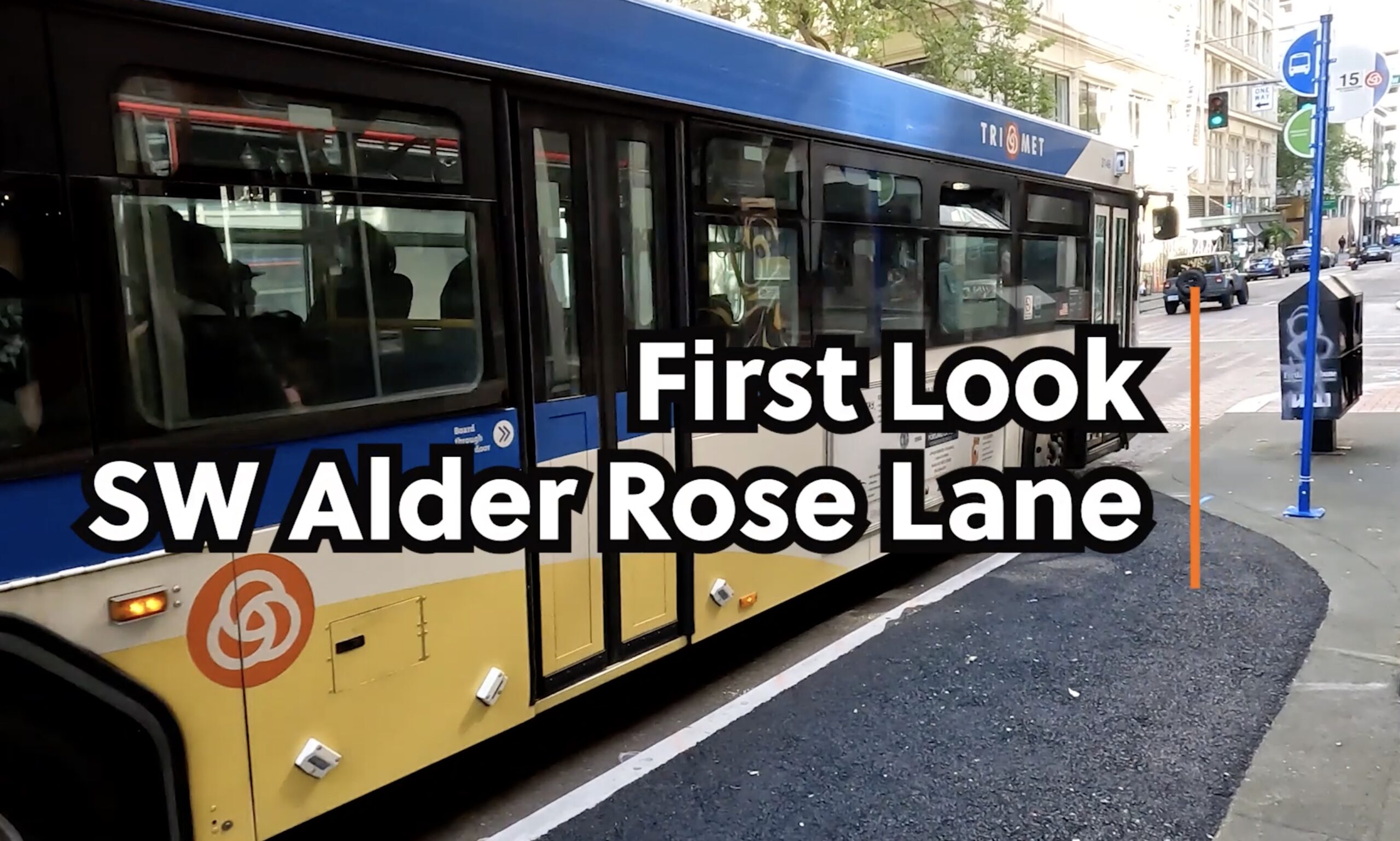
The Portland Bureau of Transportation celebrated the opening of their latest Rose Lane on SW Alder on Wednesday.
The Rose Lane initiative was launched in 2019 under former PBOT Commissioner Chloe Eudaly and its development has remained a priority under Commissioner Jo Ann Hardesty. The goal is to speed up buses to make them more competitive with driving and deliver better service to bus riders. When it launched, Eudaly said it was the most effective way to simultaneously address climate change and racial disparities with transportation infrastructure.
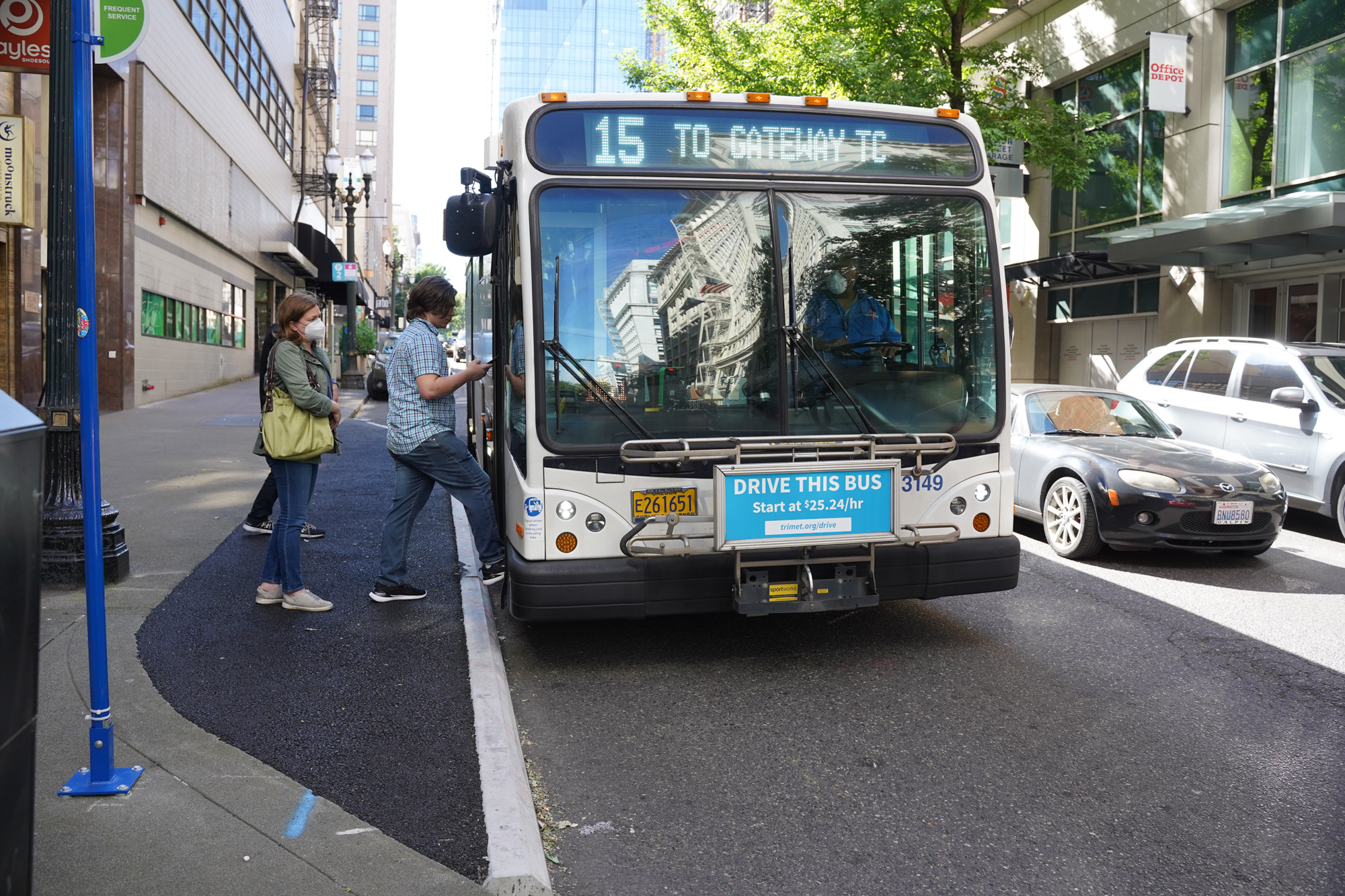
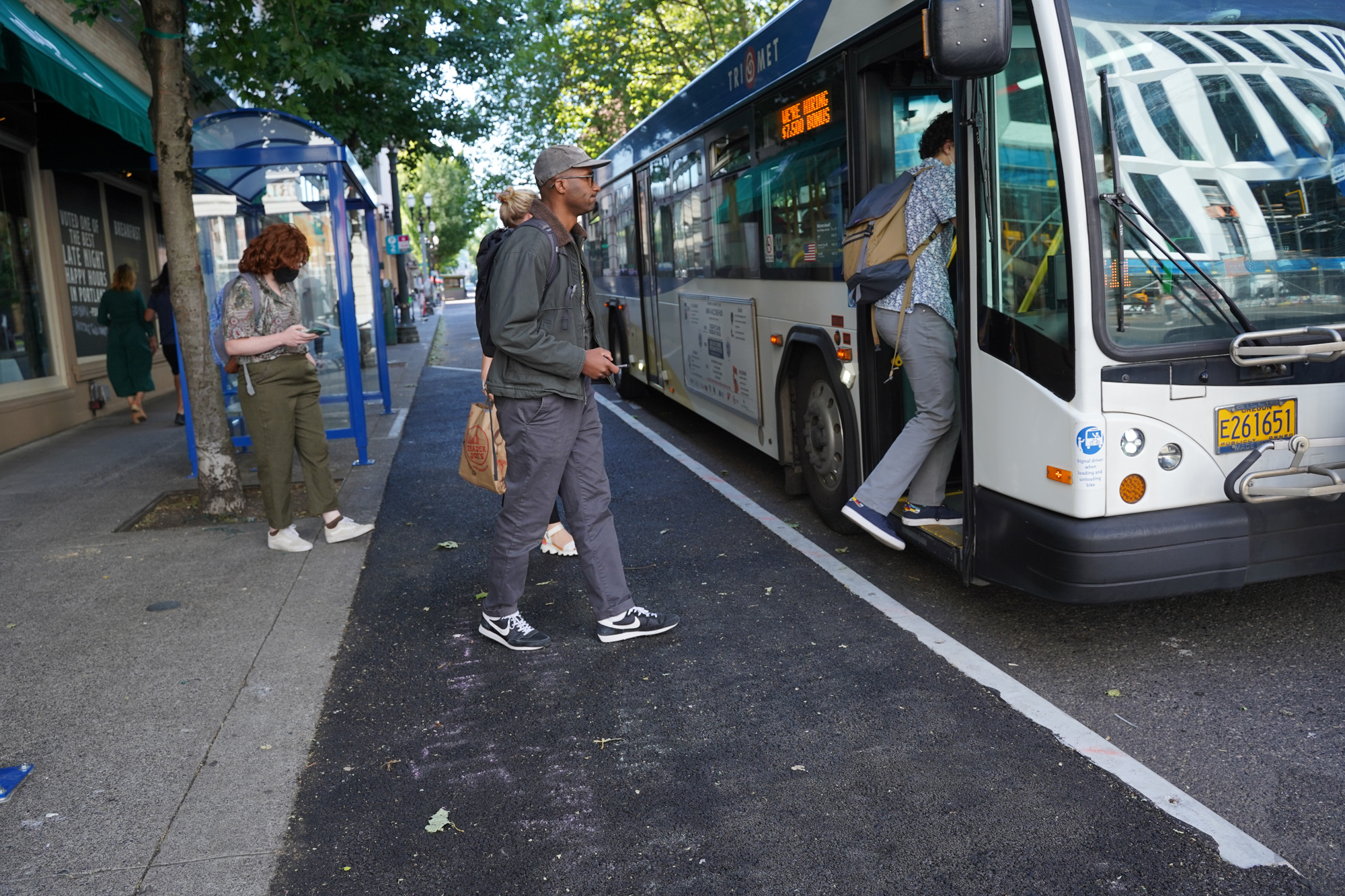
With the SW Alder project, PBOT’s work complements TriMet’s Line 15 route change that moved the eastbound bus from SW Salmon to Alder to reduce travel time and simplify the route. To keep buses moving faster, they’ve built two new bus platform extensions (at 10th and 6th) and have created a dedicated bus lane between 4th and 2nd as Alder approaches the Morrison Bridge. The project also includes new crosswalks and several new stations.
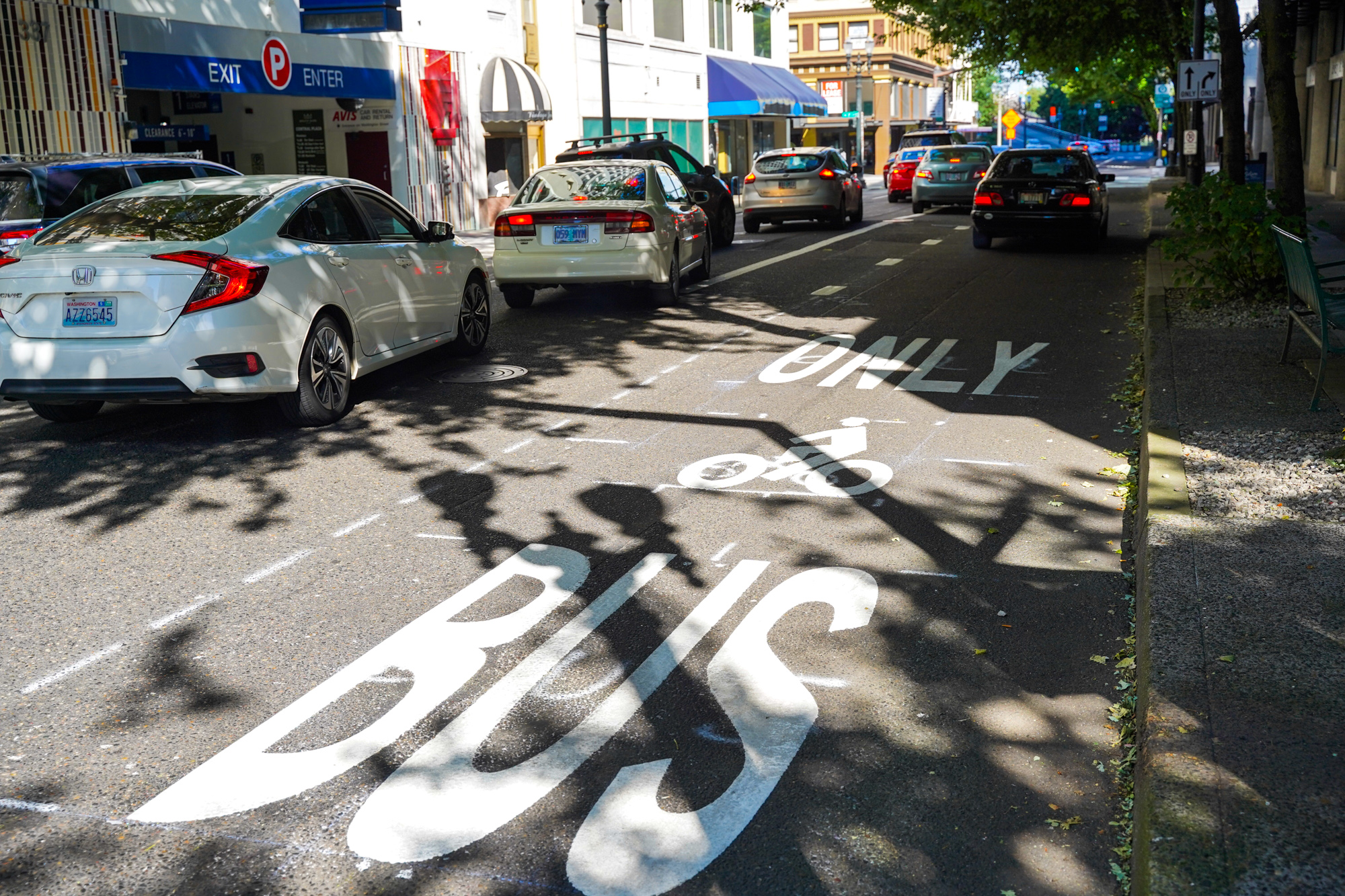
Bus/bike only lane between 3rd and 4th.Extended bus platform at Alder and 6th.New asphalt bus platform on Alder at 10th.Extended bus platform at Alder and 10th.
At an opening event yesterday, PBOT staff talked to passersby and handed out free ice cream at Firefighters Parks at the 18th/Alder/Burnside intersection.
As you can see in the video, PBOT Director said the project is a “win-win” for transit and bicycle users. On the project website, PBOT says the project creates a “comfortable”, “safer”, and “protected” bikeway. Unfortunately I didn’t see or experience much of that while biking through it yesterday. I didn’t see the protected bike lanes (that we expected as per our story in April) and I experienced a mish-mash of disconnected bikeway treatments. One block I was in a door-zone bike lane, then a bus/bike mixing zone, then I was surrounded by car users, then I was in a bus/bike only lane (that was being illegally used by drivers).
This is unfortunately what I’ve come to expect biking downtown. It doesn’t feel like something that would entice a more novice rider onto a bike. It’s not comfortable and it doesn’t feel like the scale of progress we so urgently need.
Rose Lanes are necessary because we have too many people using cars and they make our system unsafe and inefficient. So while relatively tiny upgrades to the transit system are a great thing that benefits all of us, if we want our streets to reach their full potential, we must do more to reduce service levels and access for car users. Incremental steps for “alternative transportation” while letting drivers run amok, is not progress. And it just doesn’t make sense to me why PBOT would do any project these days that doesn’t make significant and tangible upgrades to the bike network.
These projects often take a bit of time to settle in and perhaps PBOT has more to do. Based on my experience yesterday, I certainly hope so (see update below).
Take a look at the video and roll through it next time you’re downtown and let us know what you think.
UPDATE, July 1st: I should have checked in with PBOT before doing this video and post! Sorry about that. Below is more information about this project from their comms person Hannah Schafer.
This project was designed and scoped specifically to be a transit project, but we also improved some of the more critical bike connections including from the future 4th Avenue bike lane to the Morrison Bridge as well as extending the SW 2nd Avenue bike lane from Alder to Washington. Because of existing curb extensions at 5th and 6th, and the need for bus platforms at 6th and 10th, there just wasn’t space.
The project isn’t fully complete. We have items that still need to get done. The block from 4th to 3rd still has right turn arrow signage, but the project will actually be prohibiting that right turn. There are also some blocks in Goose Hollow that will be improved for bikes once some building construction is complete. Finally, we also have plans to add tuff curb but, like many things, tuff curb is currently on backorder so it may take a few weeks until that goes in.
There’s more pavement than shade in Lents. (Photos: Taylor Griggs/BikePortland)
The heat dome that enveloped the Pacific Northwest last June was catastrophic and traumatic for people across the region. Temperatures skyrocketed to unprecedented heights: on June 28, 2021, Portland heat reached an average of 116 degrees. This surpassed not only local records, but also shot past the historic high in Dallas, Texas. At the time, it was all anyone could talk about.
But a year has passed, and people tend to forget. In order to make sure that didn’t happen, Portland activists and scientists organized Heat Week to commemorate the anniversary. Throughout this week, they’ve hosted events to remind people what it was like to experience such a remarkable event and recognize the people who were most impacted by the heat, including the people who died because of it.
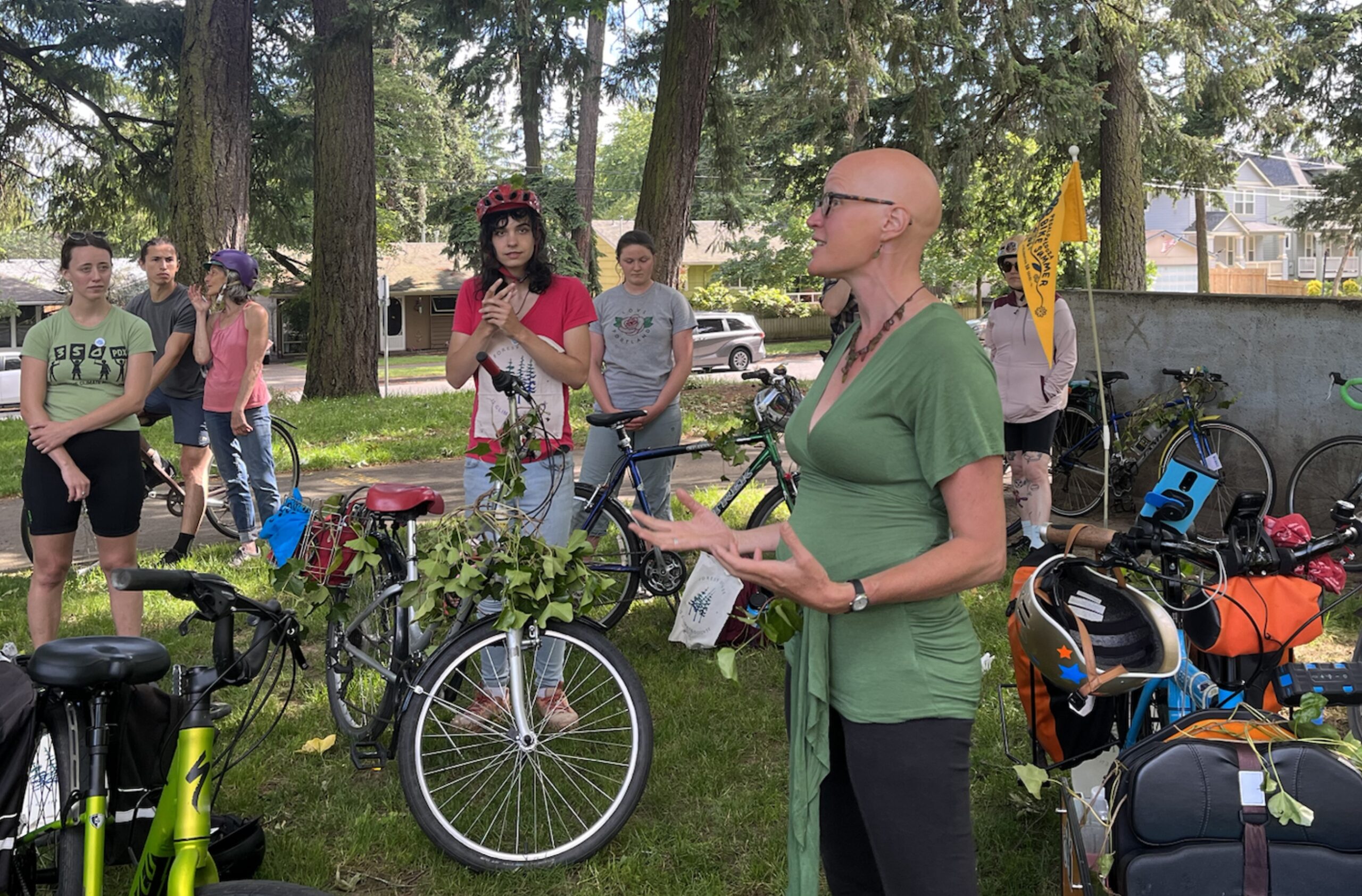
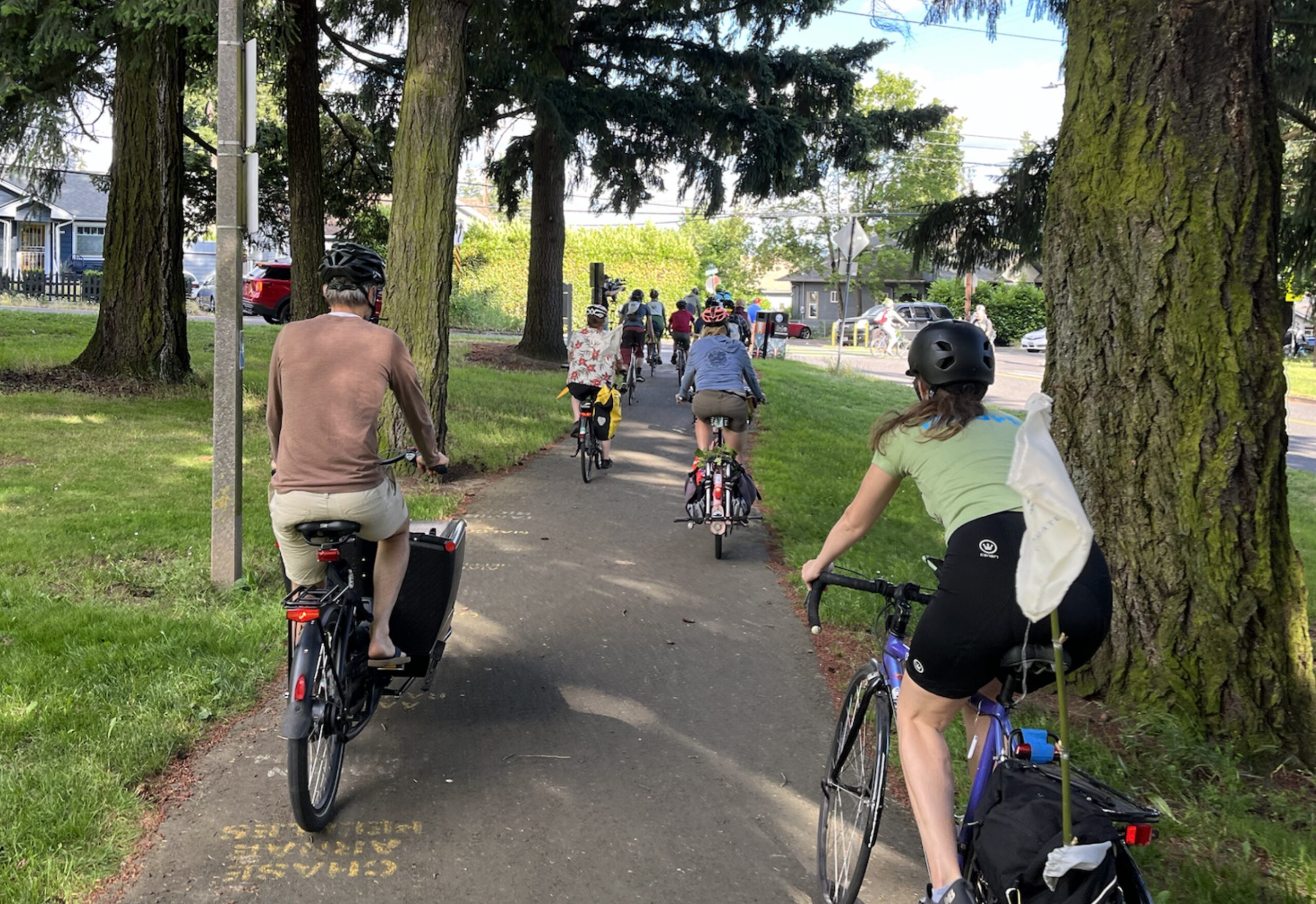
Last night, I attended one of these events: the Heat Week Climate Resiliency Ride. Activists from environmental justice group 350PDX wanted participants to learn about “shade equity” and how tree canopy coverage — or lack thereof — impacts people in different parts of the city. They led a group of about two dozen people from the lower-income Lents neighborhood near the edge of southeast Portland to Colonel Summers Park in the wealthier, whiter Buckman neighborhood in inner southeast, and the difference in greenery was stark to see.
Brenna Bell
“Shade equity is part of building a city that works for everyone, and everyone deserves shade.”
Brenna Bell, 350PDX
“One of the things we’re going to be doing in the ride is visually and sensorially taking in the shade,” Brenna Bell, one of the ride organizers and 350PDX’s Forest Climate Manager, said to the group at the beginning of the journey. “We want to help people not just hear about [tree canopy coverage], but also see it and feel it.”
“Feeling it” wasn’t as easy yesterday, because the weather was lovely in and out of shade. Organizers (somewhat) jokingly expressed disappointment about how nice it was – a breezy 75 degrees with some clouds. Fortunately it was nearly 100 just one day before, so it was easy to use our imaginations.
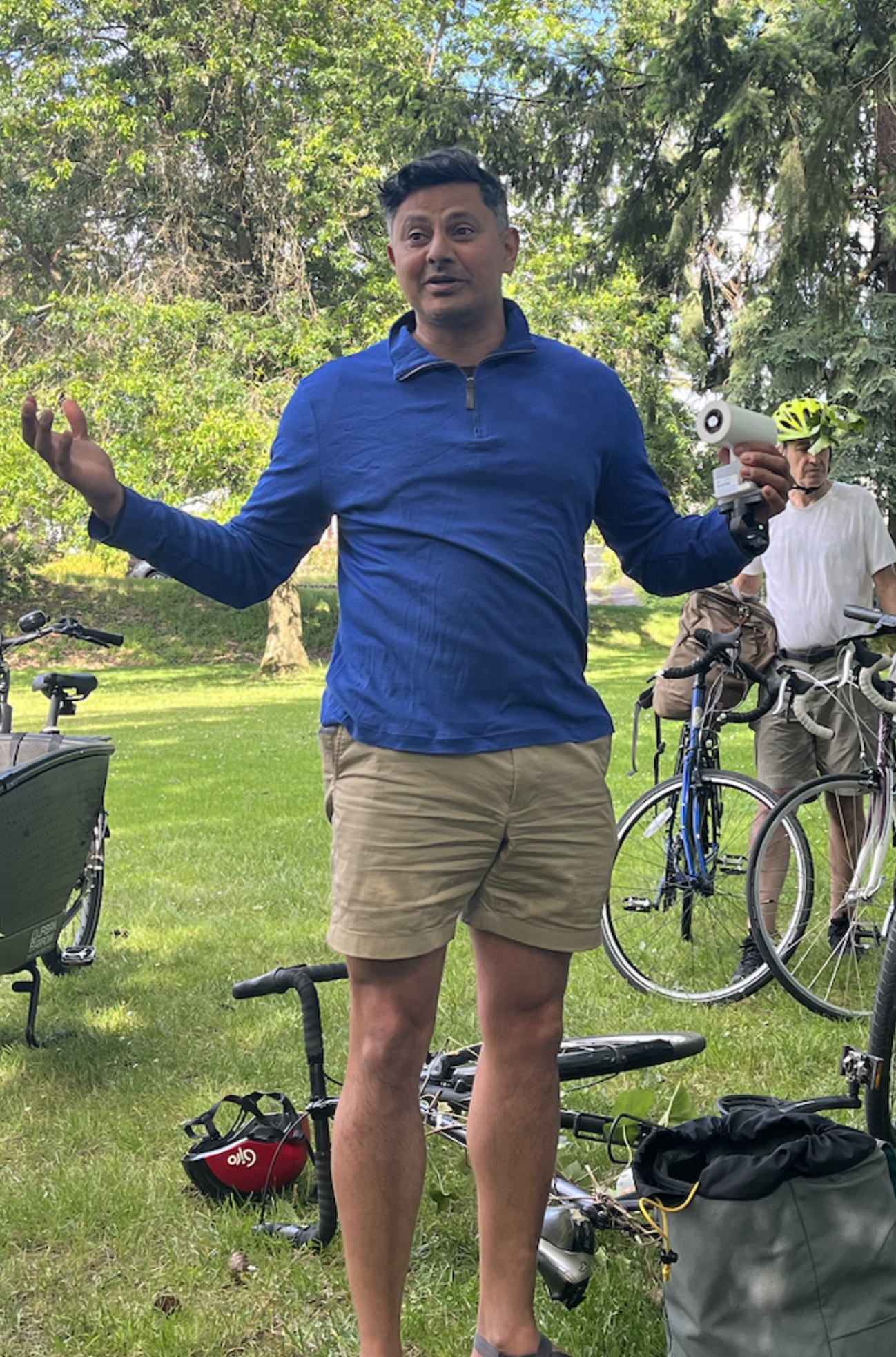
After we left the nicely forested Lents Park and headed on the route, we didn’t see much shade for quite some time. We made our first stop in a parking lot on the corner of Southeast Woodstock and 92nd. Portland State University professor Dr. Vivek Shandas, who researches climate change adaptation and urban heat islands, came out to measure the temperature in this parking lot last year. He found that thanks to an unbalanced ratio of pavement to trees, this spot was the hottest place in Portland during the heat dome, with temperatures reaching an astonishing 124 degrees.
“If we don’t bring attention to the fact that so many people died last year, it’s going to be a forgotten topic. And it’s going to be something we just don’t really make much progress on,” Shandas said.
Shandas passed out thermometers so people could see the temperature difference under varying levels of shade and get a taste of the data collection process.
“You can think about what it means to be doing science in a moment of massive transformation on a planetary level,” Shandas said. “This is a way of taking those big global climate models and bringing them down to our backyards.”
One of the most dangerous parts of the heat dome last year was that the temperatures just wouldn’t let up. Usually night time offers a respite, but in Portland’s urban heat deserts, temperatures remained high all evening. In Lents, it remained 91 degrees at night. In places with more shade, evening temperatures dropped to the 60s and 70s.
At the planet warms, urban forestry is becoming a key intersectional issue with transportation infrastructure. Community feedback for the Portland Bureau of Transportation’s 122nd Avenue Planindicated a strong demand for trees in new streetscape projects – and as more extreme heat events happen due to the climate crisis, the need for trees will become even more evident. Many concerned Portlanders have noticed that TriMet’s soon-to-open Division Transit Project came with large center median islands that are completely devoid of trees.
New (treeless) medians on SE Division. (Photo: Jonathan Maus/BikePortland)
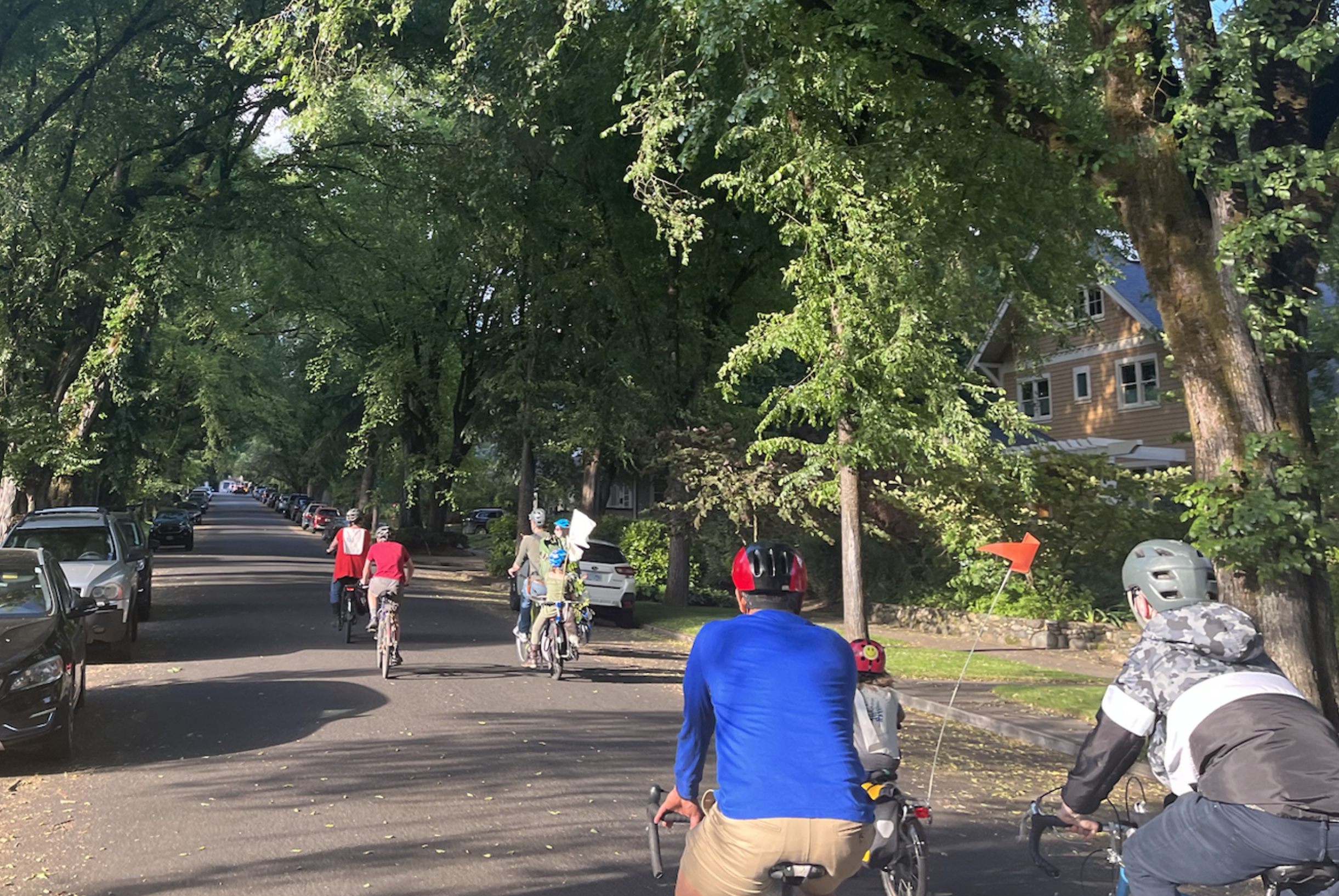
As we made our way northwest, crossing 82nd Avenue and moving through the Foster-Powell, South Tabor, Richmond, Hosford-Abernethy and Buckman neighborhoods, we saw less concrete and more trees. I could sense the group relax as we headed west onto more tree-lined and bike-friendly streets.
Bringing the benefits of trees to more streets will be essential to reach many of Portland’s planning goals, but some advocates say the City of Portland is falling short on this front. Earlier this year, Portland ended its relationship with non-profit tree-planting group Friends of Trees. The city says it will continue planting trees on its own, but they’ll have their work cut out for them as the canopy is already shrinking due to inclement weather, tree diseases caused by pests, and urban deforestation.
It shouldn’t be difficult to plant more trees. It’s relatively uncontroversial that they’re nice to have around. Trees are a big part of Oregon pride – the big evergreens and Oregon maples are what makes our landscape here so unique and enticing. It’s a luxury more people should benefit from.
“You walk around Portland and it’s literally like being in the forest. It’s is such an amazing place to live, but we have to build it out, and we have to build it together,” Bell said. “Shade equity is part of building a city that works for everyone, and everyone deserves shade.”
Rabbitt Fox, a person who inspired many people in many different ways, is no longer with us.
As word has spread throughout the community this week, people are mourning and sharing memories online, in group texts and in sad conversations.
You might have known of Rabbitt, even if you didn’t actually know Rabbitt. That was the case with me, before we built a friendship forged over years of bumping into each other at local bike events. As a wide-eyed new Portlander in 2005, I first met him when he was a member of the Alberta Street Clown House troupe and my family and I would visit Last Thursday. The Clown House and its creative and fun denizens was one of the first things that inspired me to document this community, and Rabbitt was always in the middle of the creative chaos on the corner of 25th and Alberta.
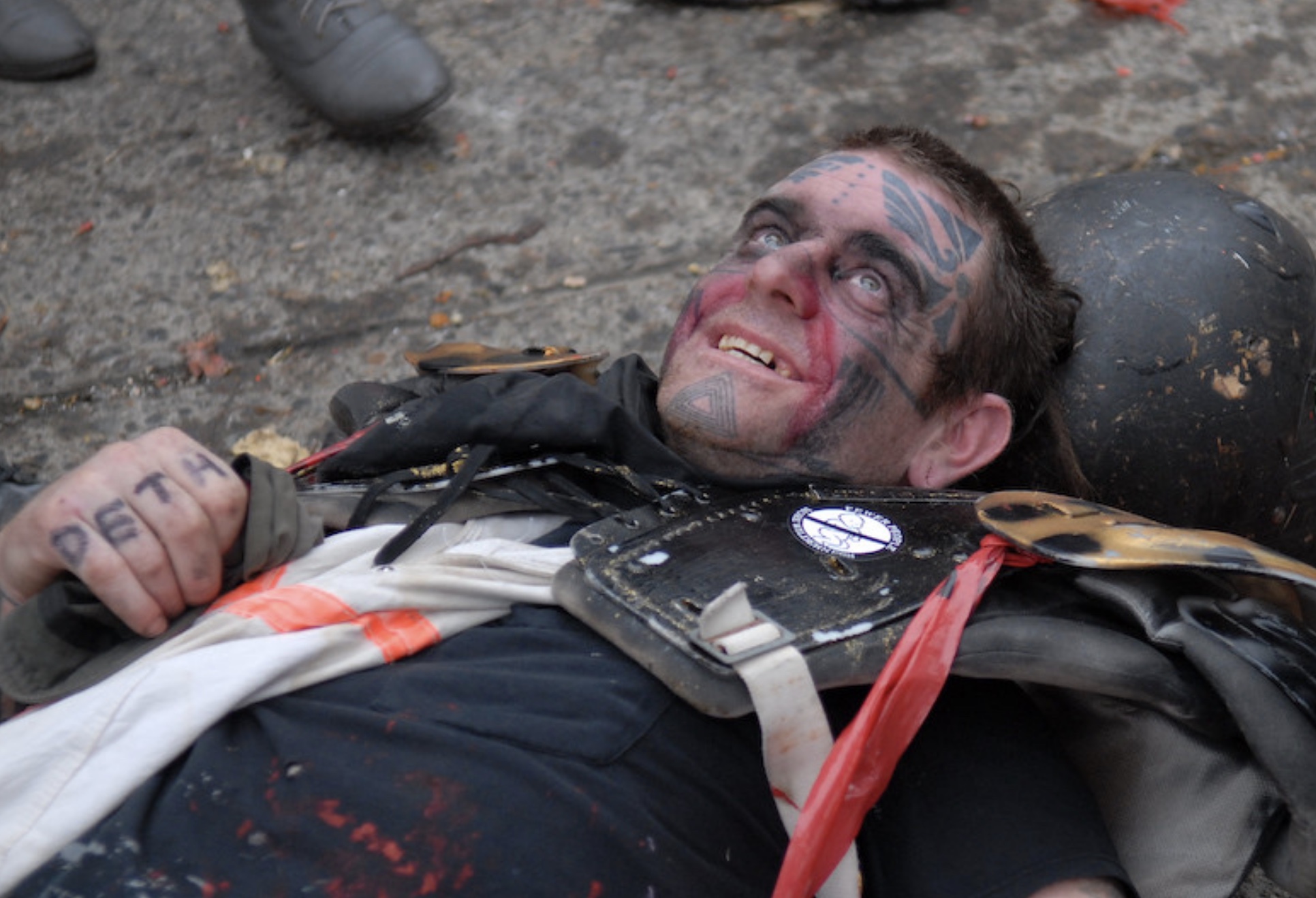
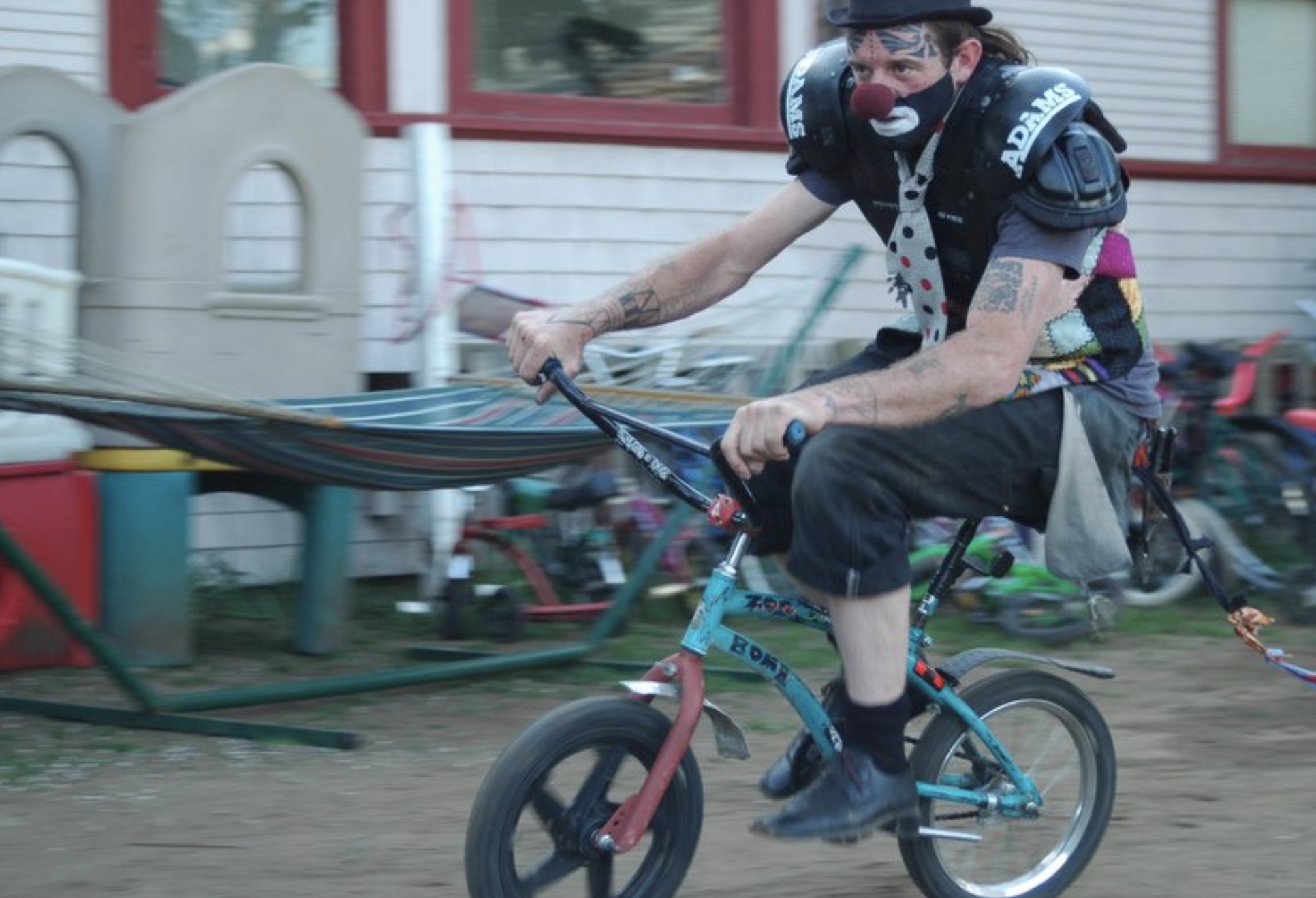
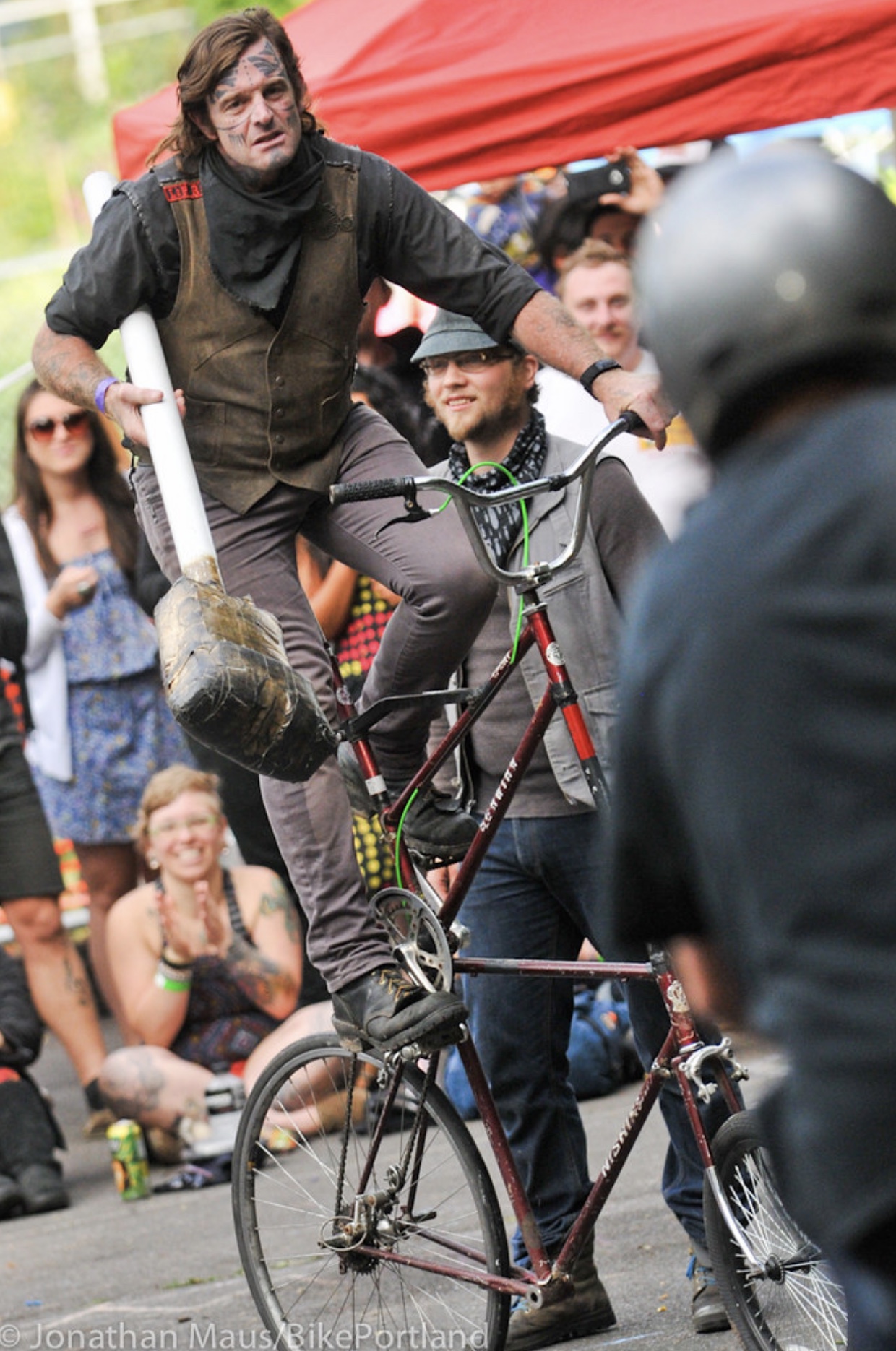
Mini-Bike Winter Chariot Wars, 2010Ladds 500, 2022.Burnside Bridge, 2009Multnomah County Bike Fair, 2014Mini-Bike Winter Chariot Wars, 2010Alberta Street Clown House, 2006.Multnomah County Bike Fair, 2014Multnomah County Bike Fair, 2014Multnomah County Bike Fair, 2014(Photos: Jonathan Maus/BikePortland)
Then I’d see him at Zoobomb events like Chariot Wars. And then there was jousting. He was one of the best. A fearsome warrior on the bike who had no care for consequence when a crowd was there to cheer him on.
He was tough on the outside, but kind and sweet on the inside.
I didn’t know Rabbitt deeply, but we shared an important bond that runs deep: We both loved Portland bike culture and the community around it. I admired his role in creating it, and I think he respected my role in documenting it.
I knew Rabbitt had a hard life and that I only saw him during his happy times. He would tell me about his love of hopping trains (he also went by “Railroad Rabbitt”) and this week a friend of his told me when he got in a down mood, he’d skip town on the rails to try and clear his head and figure things out.
He was a skilled carpenter and builder and would do odd jobs to get by. One time we heard he was looking for work and had him build our backyard shed. It still looks great and is still standing tall!
I’ve seen a lot of people come and go from this scene in the past 17 years, and Rabbitt was one face I was happy to know was still around. When I saw him riding at the Ladds 500 back in April, I was eager to include him in my video. What he said that day, totally unscripted and unprompted, was something I’ll always cherish:
“I’m actually having a great time out here, this is a big family and this is an annual event. Ladds 500! Tall bikes, all kinds of freak bikes, six-wheel bikes. Clowns! You know, we’re having a great day here. I’ve been part of the bike culture since ’92. Originally, I rode bikes with Hard Times Bike Club and the Black Label and I was a Dropout for a long time. I was a clown and a feral clown and with Rebel Alliance. And now I’m Dead Baby Bikes, a Seattle original club and there’s a chapter here in Portland. I mean, we all Zoobombed like crazy back in the day. A lot of us were pretty hardcore about it. There’s been some flux in the bike community, but it’s definitely coming back to life and it’s a lot of the new school people riding bikes and they’re kind of picking up where a lot of us are growing older. While we’re still crushing it, we’re running out of steam you know. OK. I got two laps and I gotta go. See you all later. Thank you Jonathan.”
We love you Rabbitt. We miss you. Rest in peace friend.
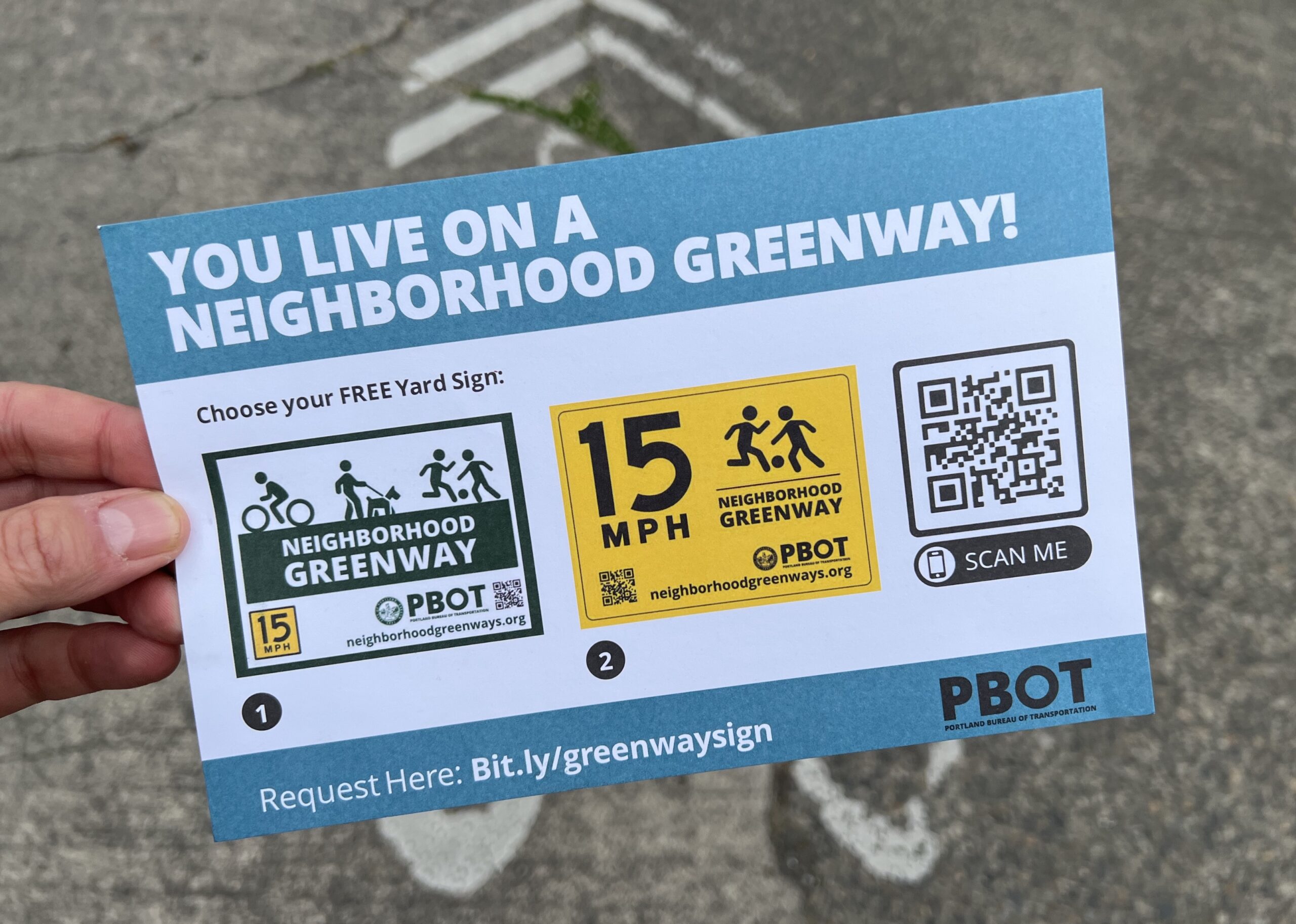
Postcard mailed to people who live on greenways. (Photo: Jonathan Maus/BikePortland)
Portlanders love yard signs and neighborhood greenways and a new initiative from the Bureau of Transportation wants to take full of advantage of it.
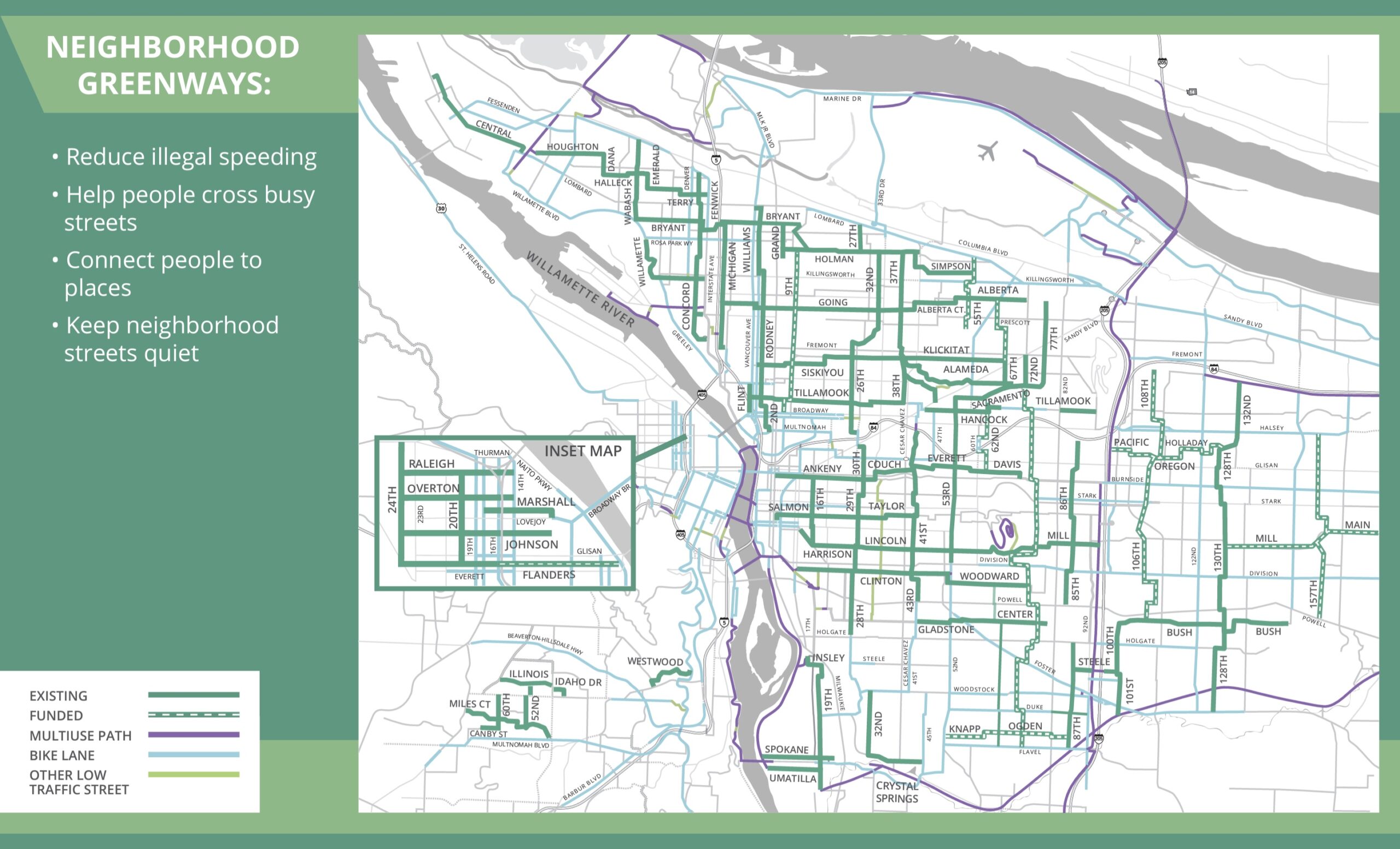
About 25,000 people who live on our 110-mile network of neighborhood greenways citywide received a postcard in the mail this week that exclaims: “You Live on a Neighborhood Greenway!” The postcard offers all recipients their choice of two sign designs. One of them is a general neighborhood greenway sign with stick figures biking, walking a dog and playing ball; the other is yellow to mimic a traffic caution sign and includes “15 MPH” in large font.
In passive-aggressive Portland, anonymously planting a sign in the grass that tells other people how they should act is the perfect way for many people to exercise their activism muscles.
PBOT says they hope this latest effort helps raise awareness about the 15 mph advisory speed limit and other traffic calming installations they’ve recently installed on greenways.
PBOT Interim Communications Director Hannah Schafer says, “Our goal is raise awareness among people traveling and living along greenways that they are great streets for walking, biking and rolling.” Funding for the signs comes from the Slow Streets program.
Schafer said they’ve printed 1,000 signs, 500 of each design. If you want one, you better act fast as she reports they’ve had 287 orders in the first two days of the campaign.
This free sign program is available only to people to who live on neighborhood greenways. If you’re one of them, you can request yours here.
Riding through plaza on SW Harvey Milk. (Photo: Jonathan Maus/BikePortland)
The honeymoon for free use of Portland’s public right-of-way will soon be over. The bureau of transportation just announced a new fee structure for their Healthy Business permits that have been awarded to over 1,000 businesses since May 2020.
Starting September 1st, businesses will have to pay $150 for an application, then pay $500 for every parking space and $6 for each linear foot of sidewalk space they use.
These permits have been extremely popular with restaurants who were eager to expand onto streets and sidewalks in order to keep patrons healthy during the pandemic. Back in March PBOT announced the program would become permanent. Up until now, businesses have been using public space at no charge. PBOT has offset the expenses with federal pandemic relief funding and their own generosity borne out of a goal to help keep businesses alive during a difficult time.
In a statement today, PBOT said the new fees will cover administration costs and allow them to support and evaluate permit holders. Current Healthy Business permits are valid through August 31st of this year. The new fees go into effect September 1st and permits issued under the new system will be valid through December 2023.
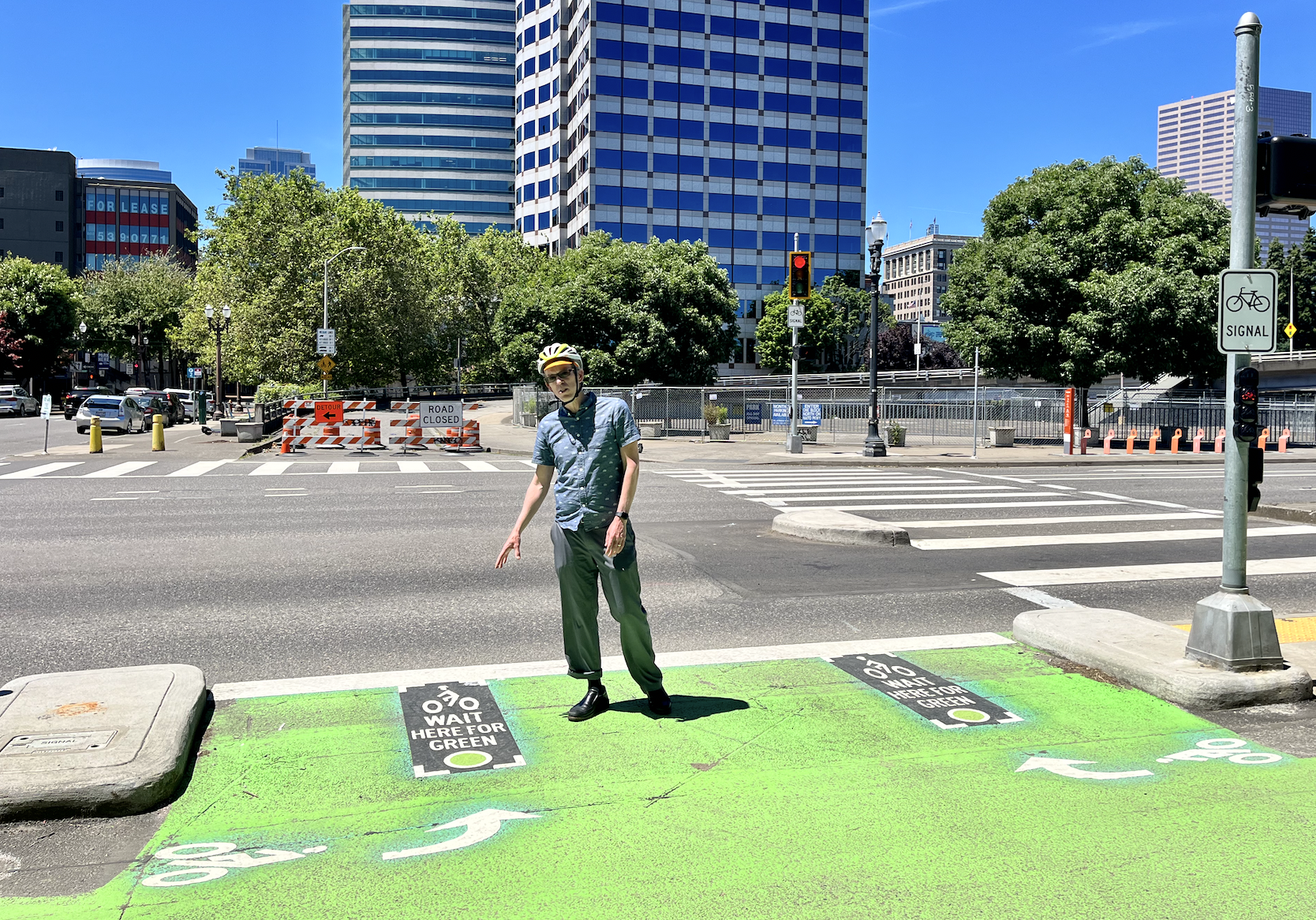
PBOT Signals and Street Lighting Division Manager Peter Koonce pointing out spots for people on bikes to stand while waiting for the light to turn green across Naito Parkway. (Photos: Taylor Griggs/BikePortland)
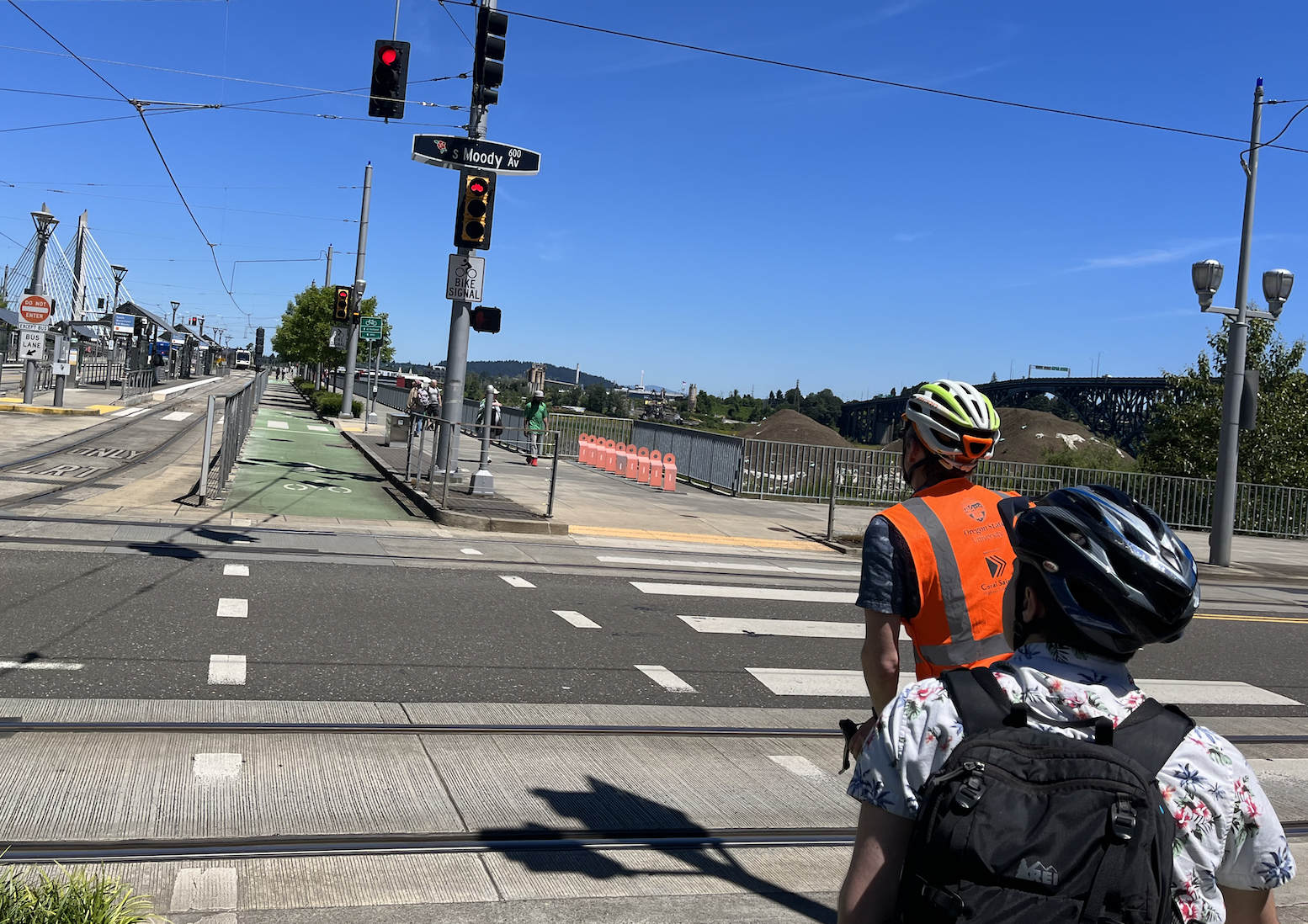
Taking a look at a bike signal headed across Moody in the South Waterfront next to the Tilikum Crossing bridge.
Good urban planning means the average person traveling around a city doesn’t need to know anything about what went into designing it – they can just get around intuitively. Peter Koonce, who manages the traffic signals and street lighting division at the Portland Bureau of Transportation, is keenly aware of this. Koonce and his team oversee signals many people use without much thought. But that’s okay with him, as long as they work.
On a ride last Thursday, Koonce led a group around Portland’s central city to talk shop about a few of the 1,200 traffic signals he manages. It was just the latest “policy ride” hosted by local bike advocacy group Bike Loud PDX that give the urban planning-curious a backstage look at what’s going on with projects around the city.
When it comes to signal operations, they’re much more complex than you think, especially when you take into account all the different transportation modes that need to function together. Koonce and his team at PBOT do take all these modes into consideration. And since private cars are at the bottom of Portland’s transportation hierarchy, PBOT always has an eye toward using signals to improve safety and be easy for non-drivers to use.
One way PBOT uses traffic signals to make it safer to walk and bike is to install a lot of them.
“We actually manage the speeds of traffic by using the signals frequently,” Koonce said.
The more signals there are, the more traffic will have to stop, unless people are going a safe speed. Most signals in the central city are timed to reward users with a string of greens if they’re going about 11-12 mph. That happens to be an average cycling speed. It’s also fast enough to get around, but slow enough to prevent calamitous crashes.
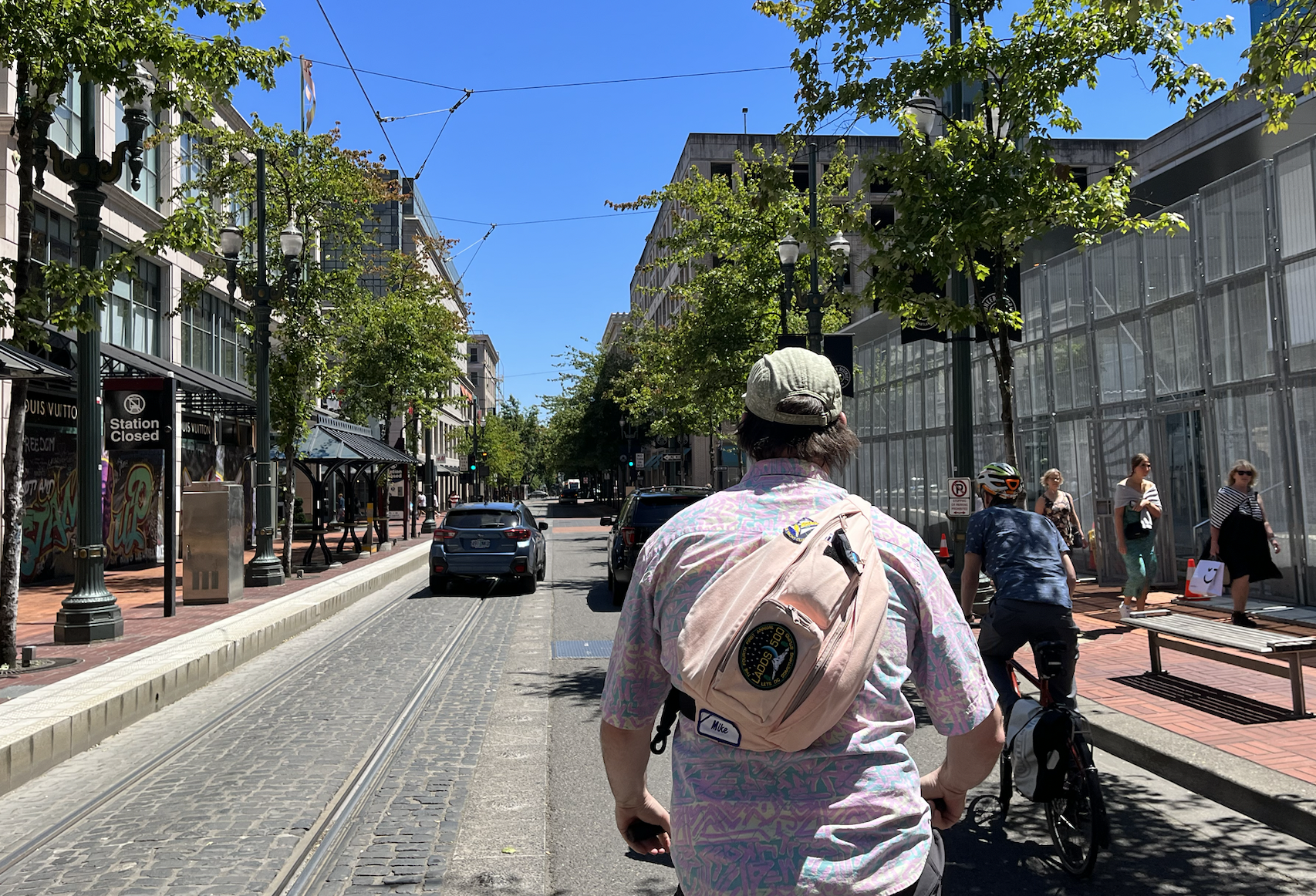
Making our way downtown, riding fast, relying on traffic signals to keep multiple transportation modes functioning correctly.
While some of Portland’s traditional signals are programmed with bicycle riders in mind, there are also bike-only signals installed specifically for them.
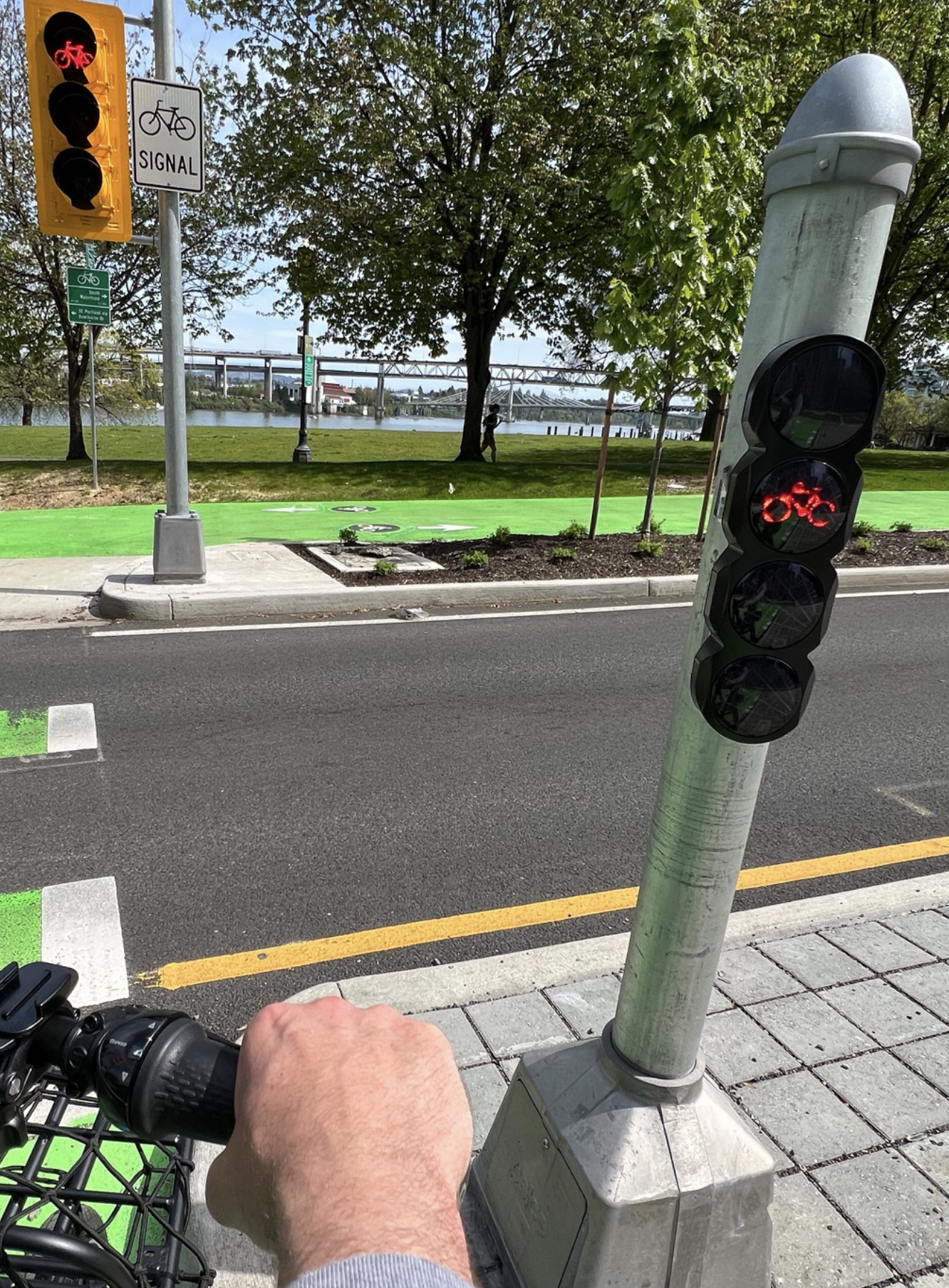
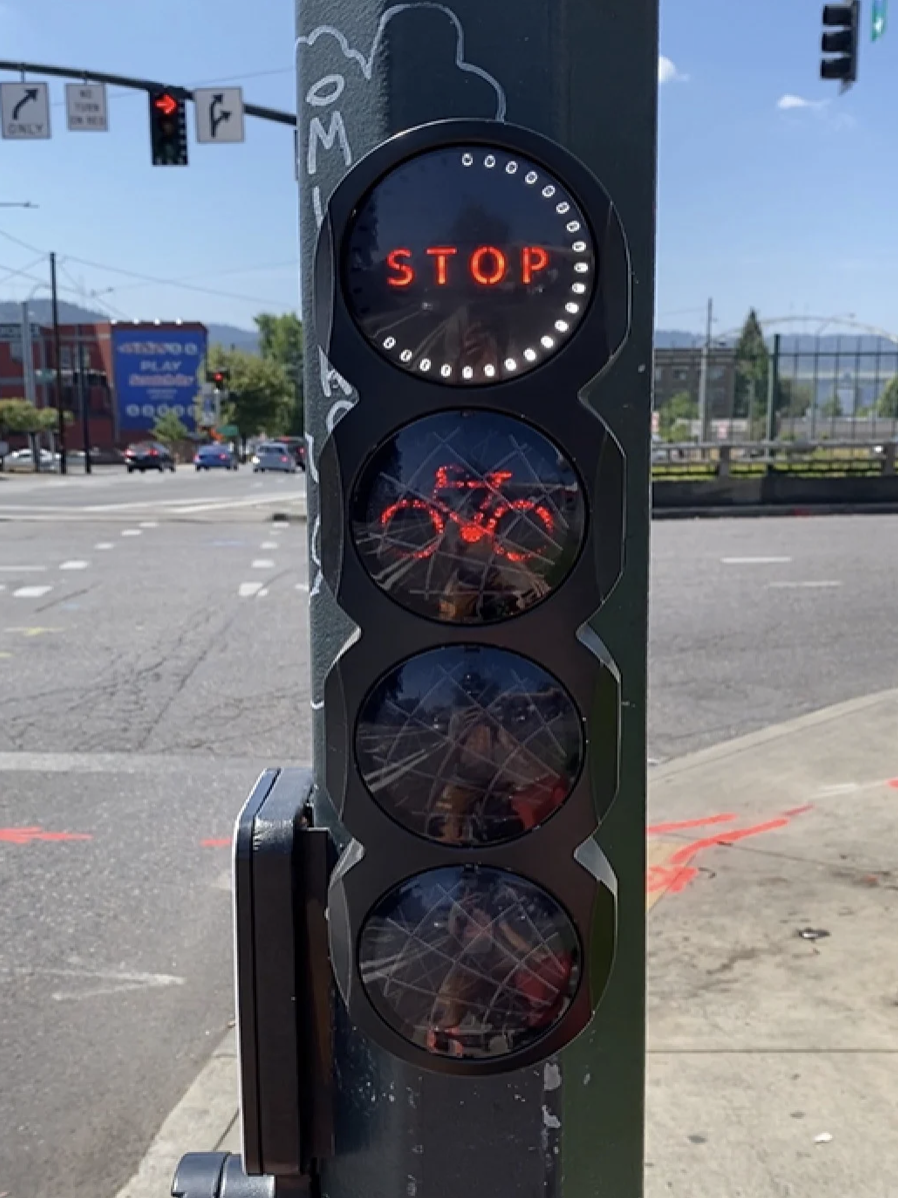
Koonce talked about a particular kind of bike signal they’ve imported from the Netherlands. It lets people on bikes know their presence has been registered and then offers a countdown so they know how long they’ll have to stop. In the gallery below, you can see a new signal on Naito Parkway on the left and a close-up of a similar signal installed on Broadway at North Williams Ave in 2020.
New signal on Naito Parkway. (Photo: Jonathan Maus/BikePortland)(Photo: Jonathan Maus/BikePortland)
Using imported bike signals is not normal for American traffic engineers. PBOT’s Koonce happens to be an exception to the rule. He’s also a national expert who travels the country sharing insights about what we do here in Portland. His motive for encouraging other cities to try bike-friendly signal treatments, he said at the ride, is a roundabout way of influencing national signal standards (something he also gets to do in a direct way as an executive board member of the National Committee on Uniform Traffic Control Devices, a Federal Highway Administration advisory body).
“When Portland does something that’s new and innovative, [the FHWA, who authorizes new treatments] will say, ‘oh, that’s just Portland. That’s not in New York. That’s not LA. It’s not Boston. It’s just Portland,'” Koonce said. “So we’re hoping other cities will actually use them so it’ll become a more of a de facto standard.”
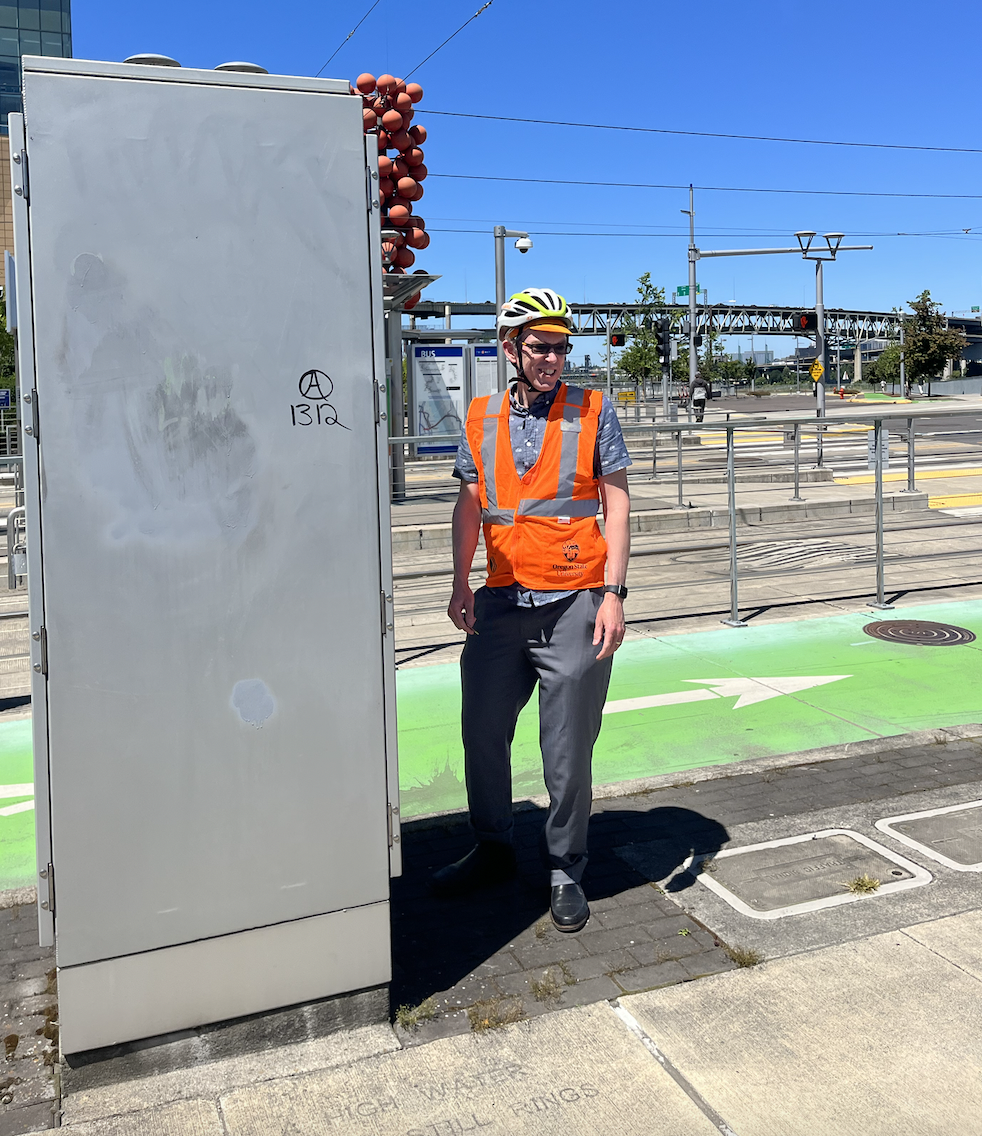
Koonce by a traffic signal box in the South Waterfront.
Koonce is known to push the envelope with what the (traditionally very conservative) FHWA allows, so he and his team have to carry out federally-mandated experiments when implementing signals like the ones used on Naito. They monitor data and usage patterns for the new signals, then report back to the feds. Recently, OSU and PBOT have partnered to analyze the Better Naito Forever bikeway and upcoming SW 4th Avenue Improvement Project to evaluate “bicycle safety and comfort, especially with respect to conflicts between turning vehicles, buses, and bicyclists at signalized intersections.”
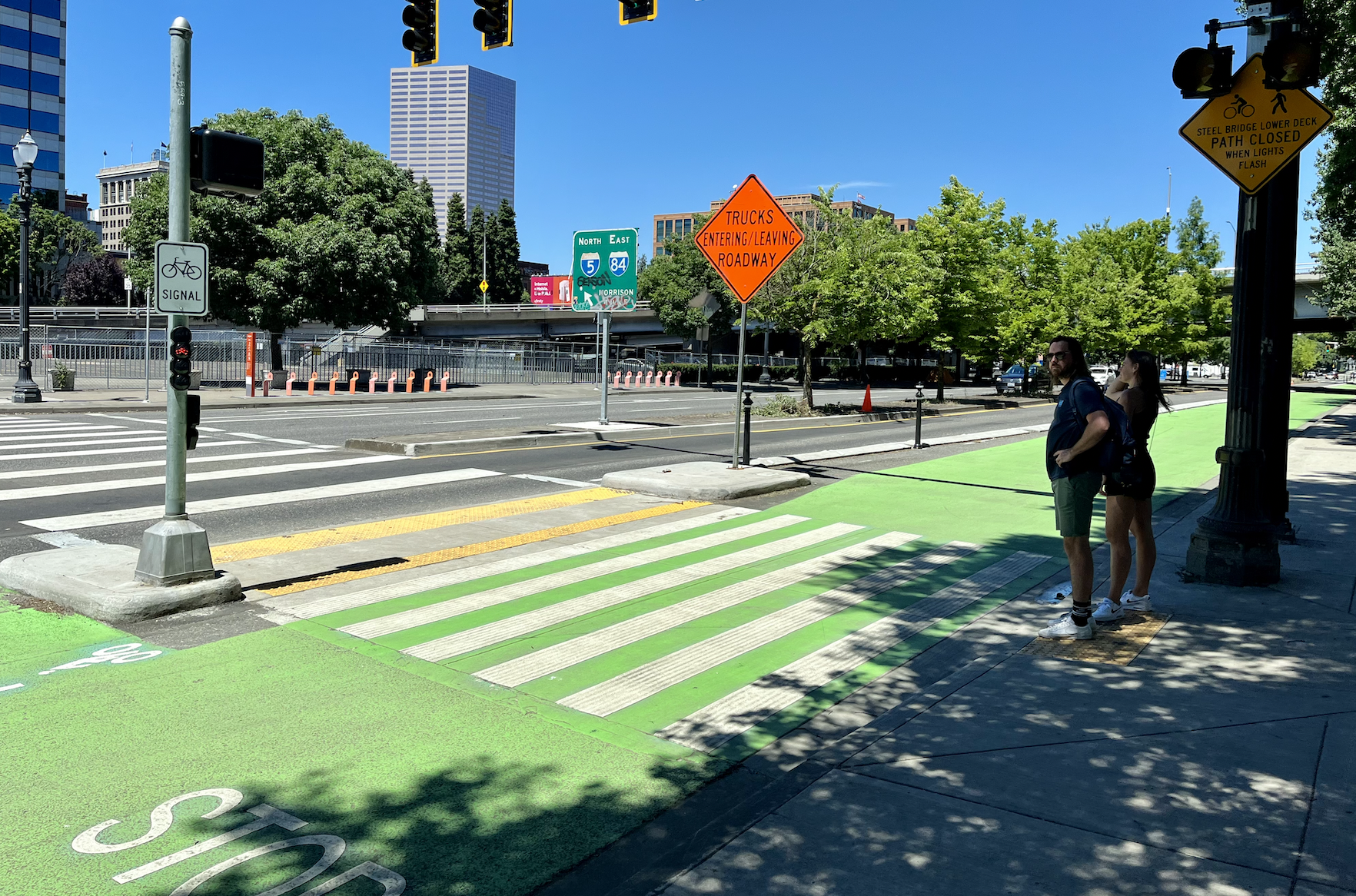
The Bike Loud group looked at several different signal types on the ride. The one I found most compelling was on the new Naito Parkway protected bikeway at the intersection with Morrison Street. At this crossing, walkers need to cross the bike traffic lanes to get to the pedestrian beg button, which is on a concrete median island between the lanes (see image below).
While we were there, two passersby became unwitting participants for us to observe. Koonce pointed out they were good subjects because they did what PBOT doesn’t want people to do at that intersection: After crossing the bikeway to press the beg button on the island, they moved back to the curb they started on to wait for the signal (so they ended up crossing the bike path three times instead of just once).
Two people walking downtown gave us a chance to see human behavior in action.
“They’re walking out, not feeling comfortable waiting out there and walking back,” Koonce said. “We were actually worried [people would do that.]”
This was an important scene to witness because it demonstrates one of the most vital parts of Koonce’s job: to understand human behavior. Good signal design shouldn’t force people to do things that aren’t natural based on the transportation bureau’s agenda. That can lead to low compliance and dangerous outcomes. Koonce instead aims to constantly tweak the system so it achieves the city’s goals while also being intuitive. And he’s a sponge for data, always asking for more input.
“We’re ironing out those kinks, and so continue to give us feedback as you experience Better Naito,” Koonce said. “We’re always debating: Is this really going to work for people? How do we communicate to people? And how do we make things better?”
An e-bike rider in downtown Portland, January 2022. (Photo: Jonathan Maus/BikePortland)
“The increased popularity means greater demand on already subpar active transportation infrastructure that fails to meet our climate or safety requirements and goals.”
– Electric Bikes For All coalition
A broad coalition of business owners and nonprofit organizations who are pushing for more electric bicycle use in Oregon are sounding an alarm about the lack of safe infrastructure after a fatal crash in northeast Portland earlier this month.
The Electric Bikes For All coalition has written a letter to Oregon Department of Transportation Region 1 Director Rian Windsheimer and Portland Bureau of Transportation Director Chris Warner that warns of more deaths as the popularity of e-bikes skyrockets far above the safety of streets they are used on.
The crash that spurred the letter happened on June 7th when a man was hit while riding an e-bike on NE 102nd at Glisan. As we reported at the time, the victim was dragged 600 feet as the driver of the truck sped away and fled the scene.
“Electric bikes continue to grow in popularity, expanding the types and distance of trips that people are able to make,” the letter states. “The increased popularity – not just for e-bikes but for all individual mobility from classic bikes to e-scooters – means greater demand on already subpar active transportation infrastructure that fails to meet our climate or safety requirements and goals.”
The group goes on to say that the top excuse Oregonians make for not buying an e-bike is that roads are unsafe. Urgency for better bike infrastructure grows when you consider that e-bikes are a feasible and attractive option for a much wider range of people than acoustic/analog bikes. As the price of e-bikes falls, so does their appeal and the need to expand the network of safe routes well beyond Portland’s central city.
Here’s more from the letter:
“It is imperative that we create and maintain safe streets for these new riders… While there are many benefits to light transportation, without separated facilities they add vulnerability to users when competing with automobiles.”
The group makes two specific recommendations: Make protected bike lanes a default treatment and add automated traffic cameras across the city’s entire “high crash network”.
Below is the list of signatories:
Kiel Johnson Chair – BikeLoud PDX
André Lightsey-Walker The Street Trust
Brenna Bailey ABC (Andando en Bicicletas en Cully)
Barrett Brown Forth
Sara Wright Oregon Environmental Council
Neil Bausgard The Environmental Center
Sarah Waits The Outer Rim Bike Shop
Lenny Dee Onward Oregon
Alan Acock Mid-Valley Bicycle Club
Steve Abbott Climate Revolutions by Bike
Molly Conroy-Schmidt Go By Bike Valet
Helen Hitt Cynergy E-Bikes
Claire Vlach Oregon Walks Plans and Projects Committee
Melinda Hanson Electric Avenue
Eli Spevak, CEO – Orange Splot LLC
Megan Ramey Bikabout.com and Active Transportation Rep-at large for ODOT Region 1 ACT
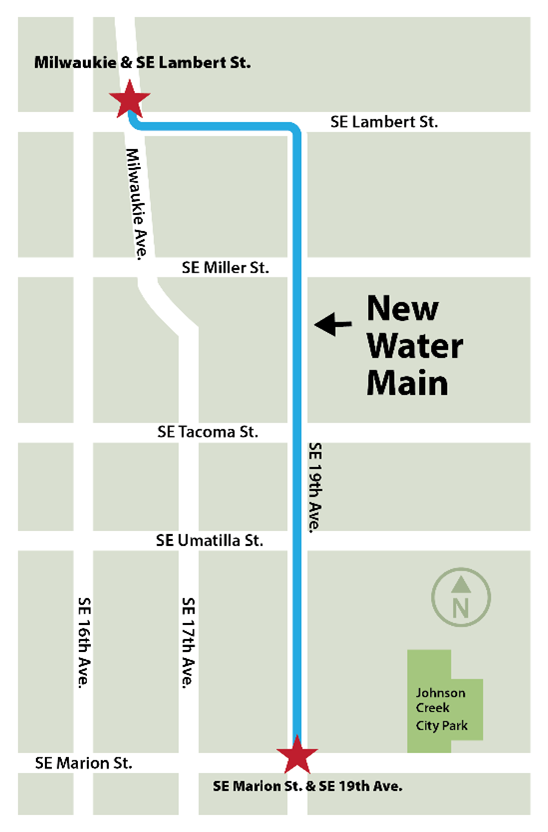
The traveling public is advised to plan ahead and choose an alternate route around construction taking place on SE 19th Avenue and SE Lambert Street in Sellwood this summer and fall. Sections of Southeast 19th Avenue will be closed starting June 20th as a contractor working for the Water Bureau replaces more than 4,800 feet—just under a mile—of aging water main.
Street closures: Streets will be closed during work hours, Monday through Friday between 7 a.m. and 6 p.m., and detours will be in place. For limited local access, please talk with a member of our crew before driving into a work zone. We want to keep you and your vehicle safe.
Traffic detours on SE 19th Avenue: People walking, cycling, and driving will likely be detoured at least one block east or west. Plan to detour around the work zones. If you live in the work zone, plan for it to take extra time to get to and from your house.
“We want everyone to get home safely to the dinner table, the dog park, or the ball field. Much of the work is underground. Work zones around trenches protect those workers you may not see,” said Water Bureau Chief Engineer Jodie Inman. “We thank our neighbors for their patience while we do this crucial work in your neighborhood. It may seem inconvenient now, but we believe that the results of our investment in Sellwood’s water system will be worth it.”
The Water Bureau encourages people to keep their distance from crews at work and to slow down when traveling through work zones. Changes in traffic patterns combined with the presence of workers and the frequent movement of work vehicles could lead to crashes, injuries, and fatalities.
To protect yourself and city workers from death and injury, we ask Portlanders to follow these safety steps:
Keep your distance. For the health and safety of everyone, please give our crews the space to complete their work while maintaining proper distance. City bureaus will send mailers or door hangers to homes and businesses in an area before major work.
SLOW DOWN. Speed is a major factor in crashes. If you must drive, follow the work zone speed limit. Slow down, don’t tailgate.
Use an alternate route. When you can, avoid streets with posted work zones.
Obey all speed and warning signs. Work zone signs apply to everyone traveling through—whether the person is walking, biking, rolling, or driving.
Be alert and look out for all road users. Put down your phone and pay attention to the road conditions ahead of you.
Stay clear of construction vehicles. Heavy vehicles travel in and out of the work areas and can make sudden moves. We know it’s interesting to see our machines at work, but please keep a safe distance from the work zone if you plan to watch.
Expect delays and be kind. Our goal is to get you through our work zone safely, while also completing our street improvements in an efficient manner. We appreciate your understanding.
Project improvements
The existing main was installed in 1927 and has had six breaks in the last 10 years. This new ductile iron pipe will make Sellwood’s water service more reliable, reducing the likelihood of breaks in the future, and is expected to last at least another 100 years. The project also improves neighborhood fire protection. Six new fire hydrants will improve firefighters’ access to water and help the bureau continue to meet state fire codes. Several new ADA accessible crossings will also be installed as part of this project. To learn more about the project and sign up for project updates, visit portland.gov/water/Lambert19.
Water Bureau contractors plan to take this project on five blocks at a time. The affected areas are:
Southeast 19th Avenue from Southeast Marion Street to Southeast Lambert Street
Southeast Lambert Street from Southeast 19th to Southeast Milwaukie Avenue
Rep. Blumenauer at the launch of Portland’s Biketown bike share program in 2016. (Photo: Jonathan Maus/BikePortland)
“I don’t want to sound like ‘Johnny-one-note’ with our cycling agenda, but burning calories instead of fossil fuel is something that will make a difference right now.”
-Earl Blumenauer
Thanks to inflation and the war in Ukraine, gas prices have hit record highs, and in the car-dependent United States, a lot of people across the political spectrum are unhappy.
But instead of using this as a wake-up call to shift toward low-car transportation and loosen the Americans’ grip on their steering wheels, many local and national officials have proposed band-aid policies to make gas cheaper. Recently, President Joe Biden announced a proposal to temporarily lift the federal gas tax – about 18 cents per gallon for regular gasoline – to lighten the financial burden for Americans who drive petrol-powered cars.
But this idea has not been very well-received. Critics say it’s a political gimmick at best. At worst, it’s outright climate arson to continue encouraging people to drive gas vehicles.
One of these detractors has been Earl Blumenauer, the U.S. Representative from Oregon who represents most of Portland east of the Willamette River. In a June 16th letter to Biden, Blumenauer urged the President to seek alternate solutions.
“While there is undoubtedly a need to provide American consumers relief from spiking costs, there is no guarantee a gas tax suspension would reduce prices at the pump or stem the broader inflation affecting the global economy, and it may only increase oil companies’ bottom lines,” Blumenauer wrote. “Suspending the federal gas tax would not lower prices for consumers, and would not have the desired political effect; it also would seriously damage important policy opportunities, and should be rejected by your administration.”
I spoke with the Congressman on the phone Monday morning and asked him to elaborate on what he thinks about the future of transportation policy given the political temperature in D.C. and the bipartisan fixation on ‘pain at the pump.’ One thing Blumenauer (who is the co-chair of the informal U.S. Congressional Bike Caucus, by the way) thinks would help? Bikes.
“One of the things we routinely emphasize is there are things we can do that would cost a fraction of this and would actually help people,” Blumenauer told me. “I don’t want to sound like ‘Johnny-one-note’ with our cycling agenda, but burning calories instead of fossil fuel is something that will make a difference right now.”
For the last year and a half, Blumenauer has been trying to use infrastructure talks to propel bike legislation, specifically with a bill to make electric bikes more affordable as a way to reduce car dependency.
“Electric bikes can transform even nominal cyclists into bike commuters. It really makes a difference.”
“Electric bikes can transform even nominal cyclists into bike commuters,” Blumenauer says. (We concur.) “It really makes a difference.”
One particularly troublesome element of the gas rebate discussion is how it ignores the fact that many lower-income Americans don’t drive cars. They need better active and public transportation infrastructure, not prepaid gas credit cards. Blumenauer agrees these people have been left out.
“Low income people and people of color are heavily transit-dependent. But [gas tax holiday proposals indicate] we shouldn’t be as concerned with them as we are with the suburban single-occupant vehicle commuter. It’s not rational, and it’s not fair,” he says. “It’s been really frustrating they don’t get the they don’t get the same attention.”
At this point, it seems unlikely Biden will be able to shore up support for a federal gas tax holiday. But several state governments, including in states with liberal governors, are going for it. And just the fact that it’s on Biden’s radar at all is cause for concern.
Even with these disappointing trends, however, Blumenauer appears hopeful for progress in the future. While bold transportation infrastructure investment may seem like a lost cause should Democrats lose control of Congress in the fall, Blumenauer says he still trusts Biden’s administration and Transportation Secretary Pete Buttigieg to make moves.
“Working with federal, state and local agencies, we can have a profound influence, regardless of the outcome of the midterm elections,” he says.
Blumenauer points out the transportation provisions in the $1.2 trillion infrastructure bill passed last year, acknowledging it’s only a “modest breakthrough” (advocates say it may actually increase carbon emissions) but that some of its funding will help fund active transportation projects across the country. He also says he is seeing a cultural paradigm shift against freeway expansions, including in very car-centric communities like Phoenix and Los Angeles. (Check out the Freeway Fighters Network map to see other places – including Portland – where this battle is playing out.)
“Communities all over the country are struggling with the same challenges. A more diverse set of low-carbon transportation alternatives – with less reliance on single-occupant vehicles and more on bikes, pedestrian and transit – is key to success,” Blumenauer says. “We’re in it for the long haul.”
There are lots of things we need to do to create more heat-resilient cities. One of them is very simple and cheap: Maintain and expand our tree canopy and access to shade. Planting trees sounds obvious and trite, but we should not underestimate the power of this simple act.
For those of us who use vehicles — like bicycles — that require human energy to propel and don’t have air conditioning systems, shade takes on even greater importance. It’s one thing to create shady destinations like parks and plazas; but for bicycle riders, a shaded journey is essential too. After all, streets are Portland’s largest public space.
That’s why we are so grateful for Portland’s street tree canopy and for our neighborhood greenways — a citywide network of bike-friendly streets that were designated as such in part due to having more trees and shade than larger arterials.
We’re also grateful for a nascent local movement that’s helping folks connect the dots between heat, trees, and mobility.
Heat Week is a new effort to commemorate those lives lost in 2021 and to raise awareness of the issue. It kicked off Sunday and continues with a bike ride tonight (6/28) as part of Pedalpalooza. The ride is organized by 350PDX and meets at Lents Park (SE 92nd and Holgate) at 5:00 pm. If you can’t make the ride, you can join the picnic starting at 7:00 pm at Colonel Summers Park (SE Clinton and 21st). Along the route you’ll hear from tree experts and experience the impacts of tree canopies firsthand.
So next time you’re riding under stifling sunshine and find yourself steering toward shade, remember it doesn’t just happen. It’s the result of advocacy and smart planning. Cool huh?
Check out our latest TikTok below to learn more and experience some of Portland’s natural air-conditioning:
If you rode a bike in #Portland during the heat wave the past few days, you should thank trees! Streets are our largest public space and trees keep them cool. Don’t miss the #heatweek#pedalpalooza ride Tuesday night to learn more.