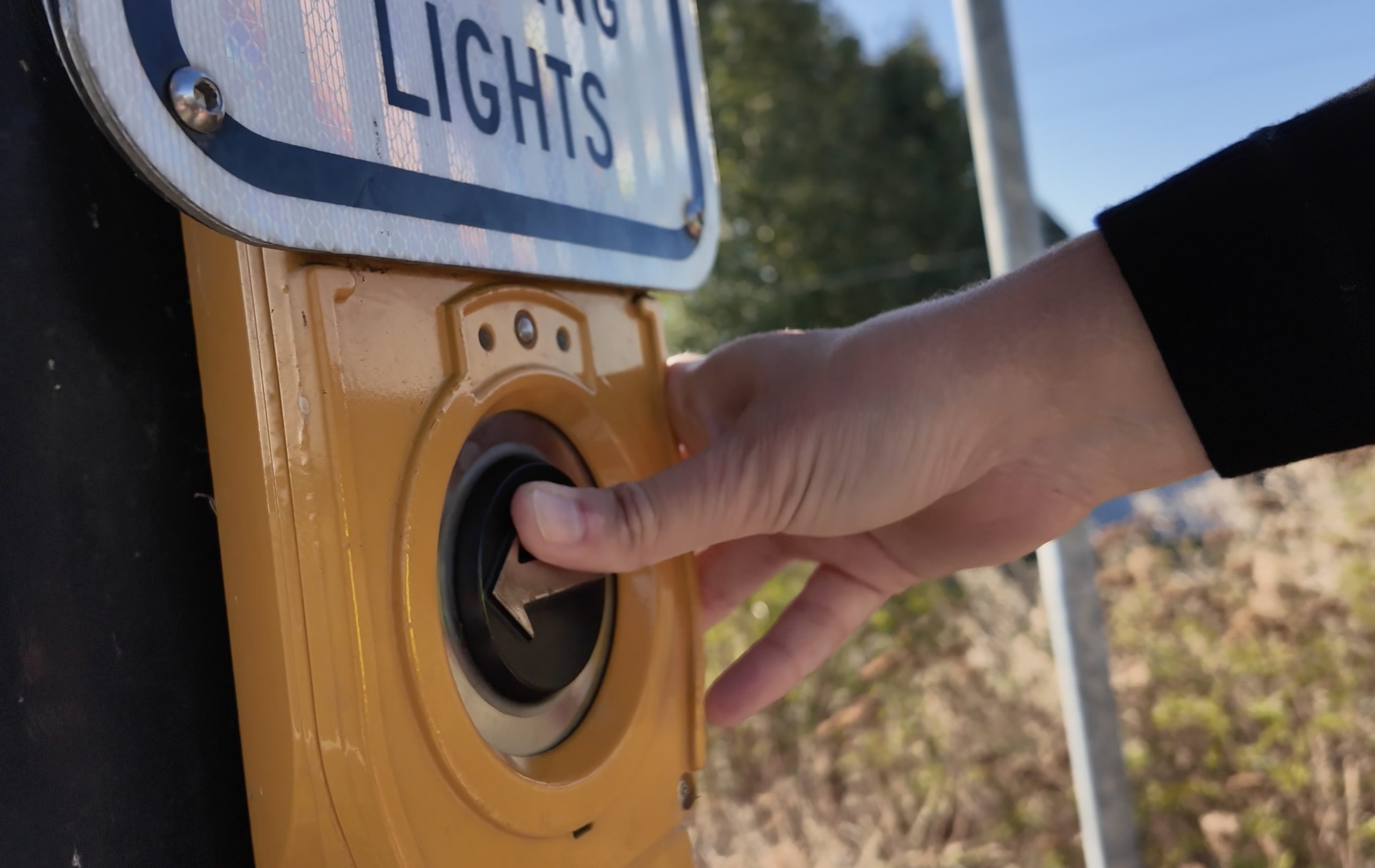
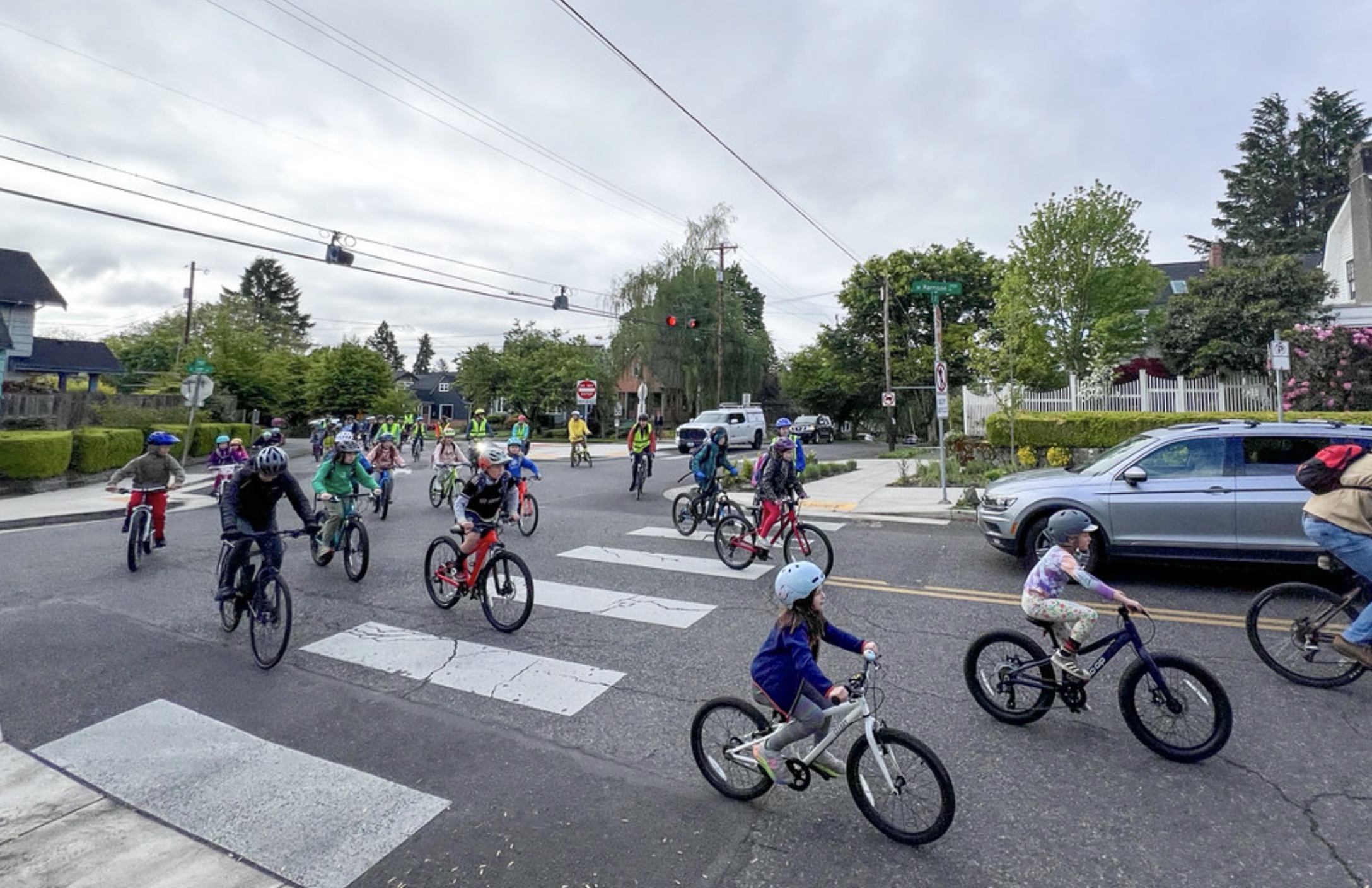
When bike bus leaders push and hold certain beg buttons, they get more time to cross. (Photo: Jonathan Maus/BikePortland)
The latest illustration of how the City of Portland supports bike buses is a novel innovation that gives school ride leaders superpowers: At several locations across the city where bike bus routes cross busy intersections, the Portland Bureau of Transportation has programmed traffic signals with a custom, bike bus-friendly timing plan that is activated by a longer push of the beg button.
We’ve heard of transit signal priority to move buses through traffic. You could think of this as bike bus signal priority. I first heard about this from PBOT Director Millicent Williams when she spoke at the Bicycle Advisory Committee meeting last Tuesday. I then reached out to PBOT for clarification.
According to PBOT Communications Director Hannah Schaffer, signals engineers have re-programmed several traffic signals with added green “Walk” times that are initiated by a longer push of the pedestrian “beg” button. When activated, the new “Walk” signals give a significantly longer period of green crossing time than usual — in some cases over one minute (when combined with a shorter, flashing “Don’t Walk” signal), compared to just 10-15 seconds for a typical “Walk” signal. The extended walk signals are available for only a short window of time during the morning bike bus commute.
Below are just three examples Schafer was able to share with BikePortland:
Location: SE Division at SE 80th. Timeframe: 7:00 to 8:15 am. Push and hold the pedestrian button crossing on SE Division to receive an extended walk up to 45 seconds (plus another 18 seconds flashing “Don’t Walk”)
Location: SE Powell at 71st/72nd. Timeframe: 7:00 to 8:30 am. Push and hold the pedestrian button crossing Powell to receive an extended walk up to 45 seconds (plus 15 seconds flashing “Don’t Walk”). This also activates a pedestrian extension timer at 72nd and Powell crossing Powell, so these two intersections can stay red for Powell and allow for the bike movements heading south to east to south.
Location: SE Holgate at 72nd. Timeframe: 7:15 to 8:30 am. We’ve installed a specific button on the NW corner that shows a “bike” symbol on it. The pedestrian movement will be served every cycle, as usual, but if you push and hold this button it will extend the walk up to 55 seconds (plus 8 seconds flashing “Don’t Walk”). We’ve also installed a pedestrian head start [also known as a leading pedestrian interval, or LPI] at this location for the crossing of Holgate (delays vehicle green for 4 seconds, in this case, and gives pedestrian movements a “head start”).
Getting them through safely is the priority. (Photo: Jonathan Maus/BikePortland)
Keep in mind, these traffic signals weren’t designed to accommodate this type of use-case. What we have here is a government agency empowering knowledgable staff to use existing technology to support adopted policy goals and provide better service for road users. Longer “Walk” times will allow bike buses to stay together and might reduce the need for “corking” intersections — an often stressful move where a volunteer steps in front of opposing traffic to make sure everyone gets through the intersection.
These novel new signal adjustments are just one way PBOT is supporting the growth of bike buses, which now happen weekly at 20-25 schools across Portland’s five school districts. In April BikePortland reported on $650,000 from various sources that has been earmarked for bike bus-related investments. This includes a new wayfinding and signage program, intersection daylighting adjacent to school campuses (which is currently happening at nine schools, with another nine to be completed by the end of the school year), modal filters, and other traffic calming projects.
Yesterday PBOT launched a new survey seeking input on where and how to spend that money. The email announcing the survey was titled, “Greenways were made for bike buses.” It’s an acknowledgment that, while the latest bike bus revolution is only a few years old, PBOT’s robust network of 122 miles of neighborhood greenways are the foundation that makes it possible.
“As we continue to have conversations about what we do to support the bike bus movement,” PBOT Director Williams said the BAC meeting last week, “some of that will require some changes.” “There is a deep interest in making sure that we do that well and do that right.”
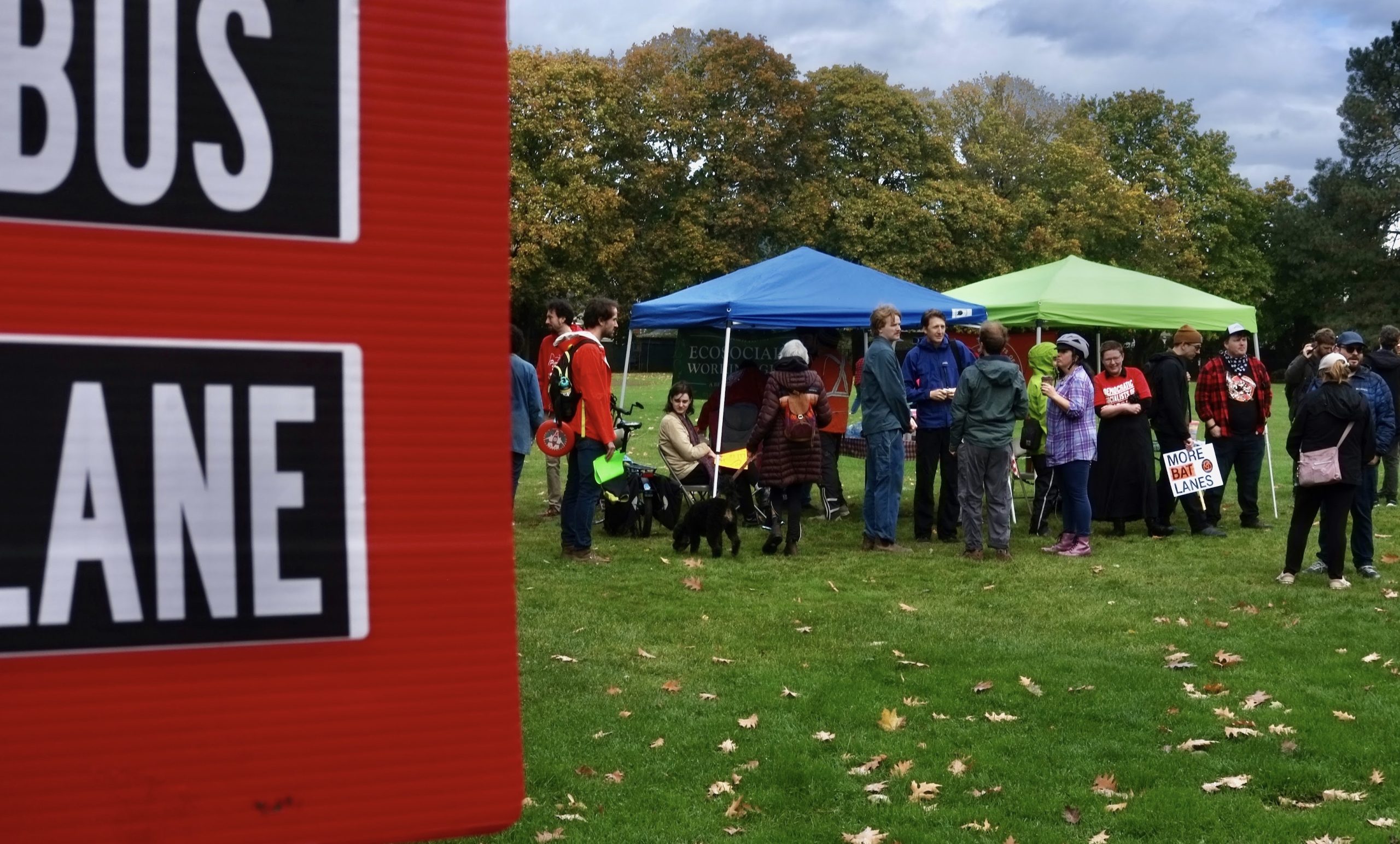
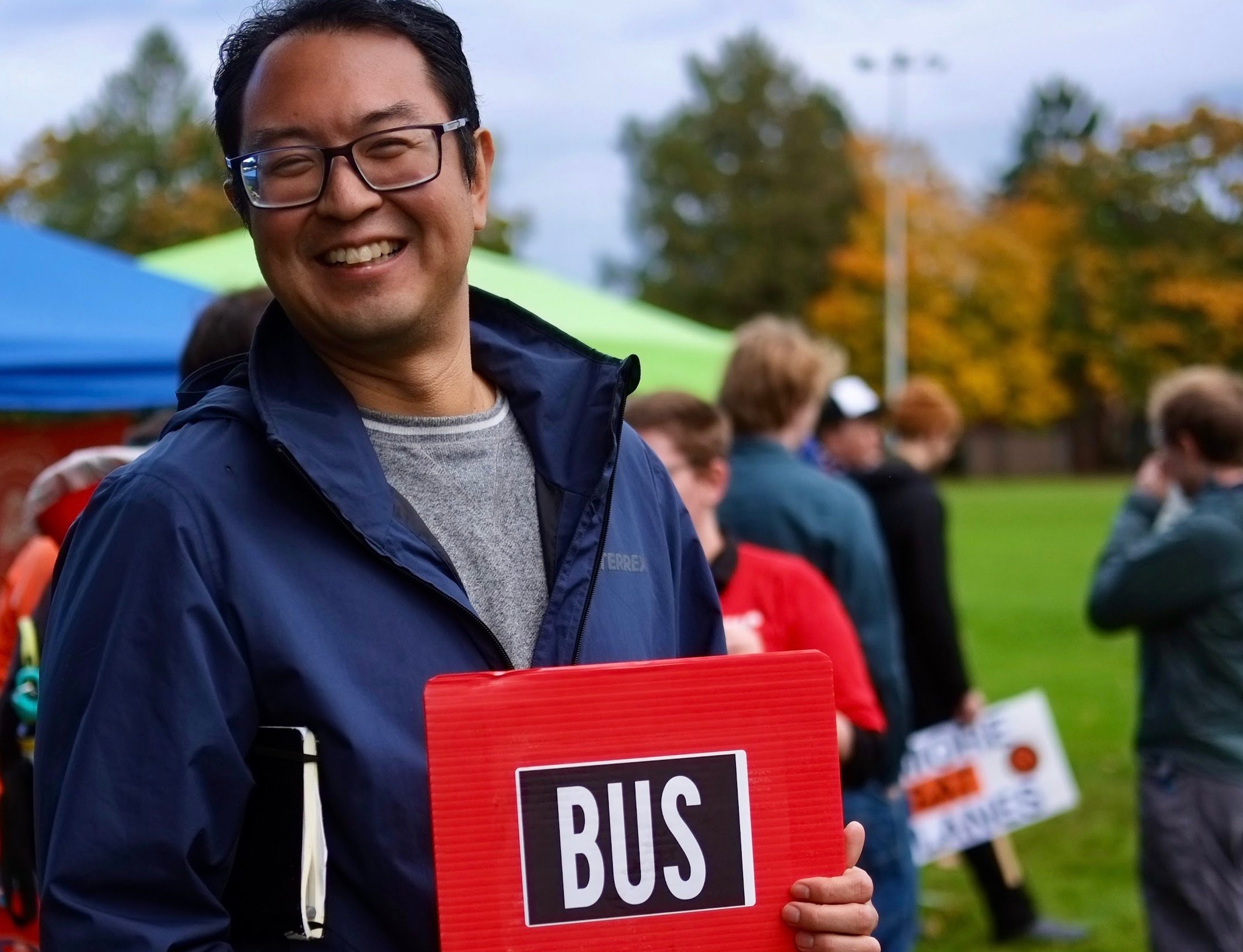
Metro Councilor Duncan Hwang was among the dozens of folks who showed up to support bus lanes on 82nd in Montavilla Park Saturday. (Photos: Aaron Kuehn)
Advocates for better bus service on 82nd Avenue have swung into action after the shock decision by TriMet staff last week to opt for just three miles of enhanced bus lanes on the 10-mile project corridor. Many hoped TriMet would recommend seven miles of “business access and transit” (BAT) lanes.
This post is a roundup of the latest news and notes I’ve collected on this issue…
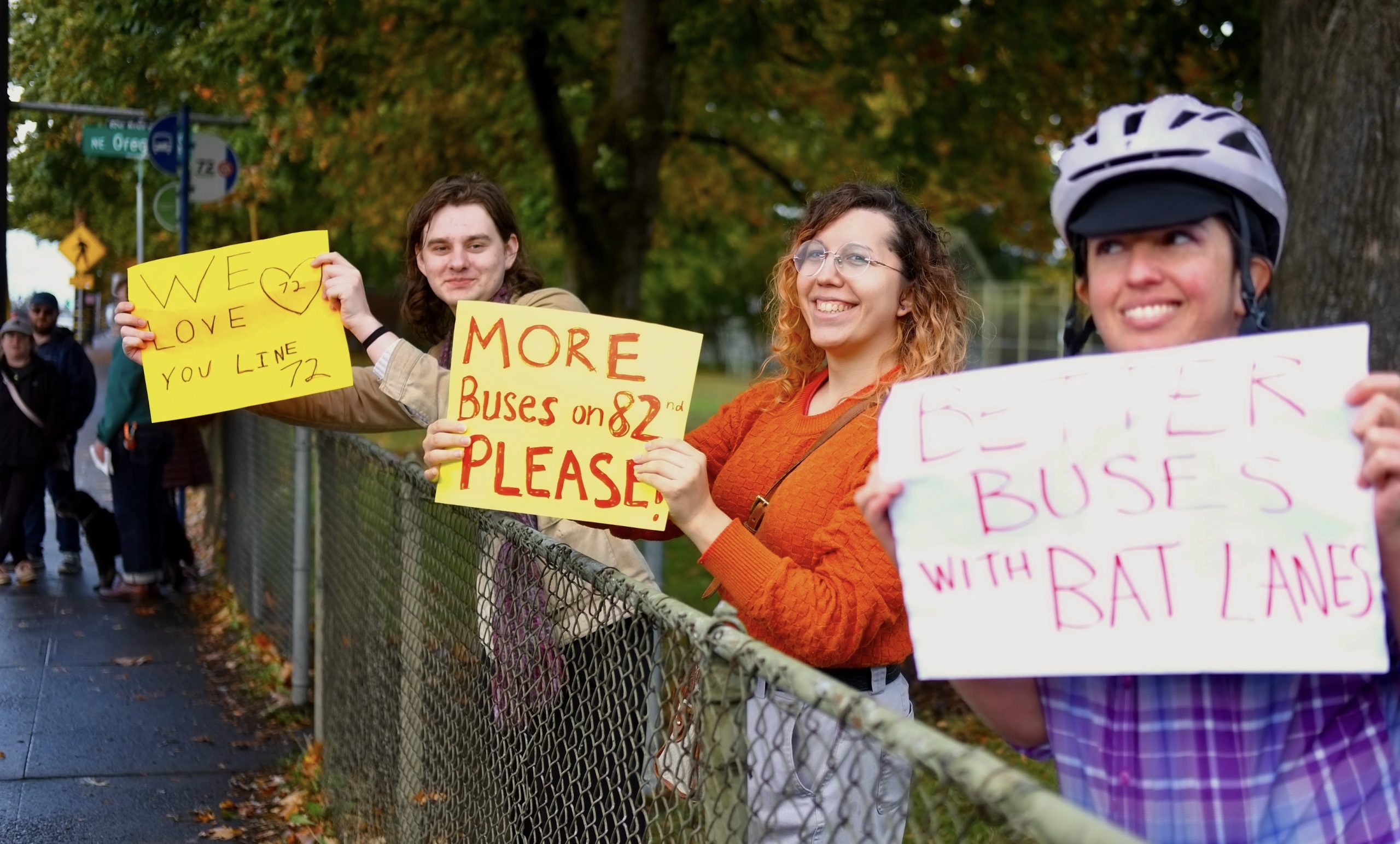
Dozens attended a rally on Saturday in Montavilla Park organized by the Portland chapter of Democratic Socialists of America. They held signs for passing traffic that read: “We Love You Line 72,” “More BAT Lanes!!!,” and “More Buses on 82nd, Please!”. Among them was Metro Council Duncan Hwang.
Left: Councilor Hwang at the rally.
In addition to DSA, a volunteer from BikeLoud PDX is encouraging folks to contact TriMet Board members and there’s a testimony guide for upcoming meetings. Advocates are targeting five upcoming meetings: A Southeast Uplift Neighborhood Coalition meeting tonight; a rally for the bike bill settlement (which includes a push for PBOT to build BAT lanes on 82nd) prior to Portland City Council meeting Wednesday morning, a TriMet Board Meeting also on Wednesday morning, a project Community Advisory Committee meeting on Wednesday night, and the project’s Policy & Budget Committee meeting on November 7th.
Councilor Hwang is on that Policy & Budget Committee. He also lives along 82nd. In a post to the BikeLoud PDX Slack channel Friday afternoon he wrote that, when it comes to the TriMet staff recommendation, “Myself nor Metro [Council] are aligned on that.” “I was very frustrated I learned about this from BikePortland (excellent reporting) and not from our own staff… I don’t support this current proposal.”
Councilor Hwang, who showed up and took part in the DSA rally for the project on Saturday, also brought up a key question with this design decision: Which government body gets to make the ultimate decision?
Who will make the call?
There are three agencies working on the 82nd Avenue Transit Project: Metro, PBOT, and TriMet.
According to a source (who I will keep anonymous) with deep knowledge of PBOT transportation projects and contracts, the ultimate decision for the lane configuration on 82nd lies with PBOT. That’s because TriMet must ultimately get a permit from the city for the project. Metro’s influence is limited to just holding the pursestrings (as the federal funding conduit).
Even though PBOT has permitting power, it’s unclear whether they’d simply accept TriMet’s recommendation, or if they’ll flex that power and give TriMet an ultimatum about the design.
Because the City of Portland has final say, the decision could become political. And as we’ve seen in several recent cases (northwest diverter removal, paid parking extension, and the bike bill settlement), we could be headed for another legislative versus administrative branch showdown.
How the bike bill settlement figures in
As I reported last week, BikeLoud PDX successfully negotiated a settlement with the City of Portland (approved by both PBOT staff and the City Attorney) to resolve their lawsuit that was based on a contention PBOT has not followed the Oregon Bike Bill for many years. That settlement was unexpectedly put on pause when City Council did not approve it as expected last week.
One of the elements of that settlement that both sides agreed on was about BAT lanes on 82nd Avenue (BikeLoud’s lawyers intentionally sought out relevant projects in the settlement). The settlement requires PBOT to support continuous BAT lanes shared with bicycle riders (almost all PBOT’s BAT lanes already permit bicycle use). If the lanes are not ultimately part of the 60% project design, BikeLoud would have the ability to return to mediation.
Next steps
This is one of those stories where it’s not yet clear what will happen next. One person who attended the DSA rally on Saturday posted on Bluesky that, due to all the public pressure that has followed the initial staff recommendation, TriMet no longer plans to vote on the 60% design at the November 7th Policy & Budget Committee meeting. I haven’t confirmed that yet, but stay tuned for updates as I learn more.
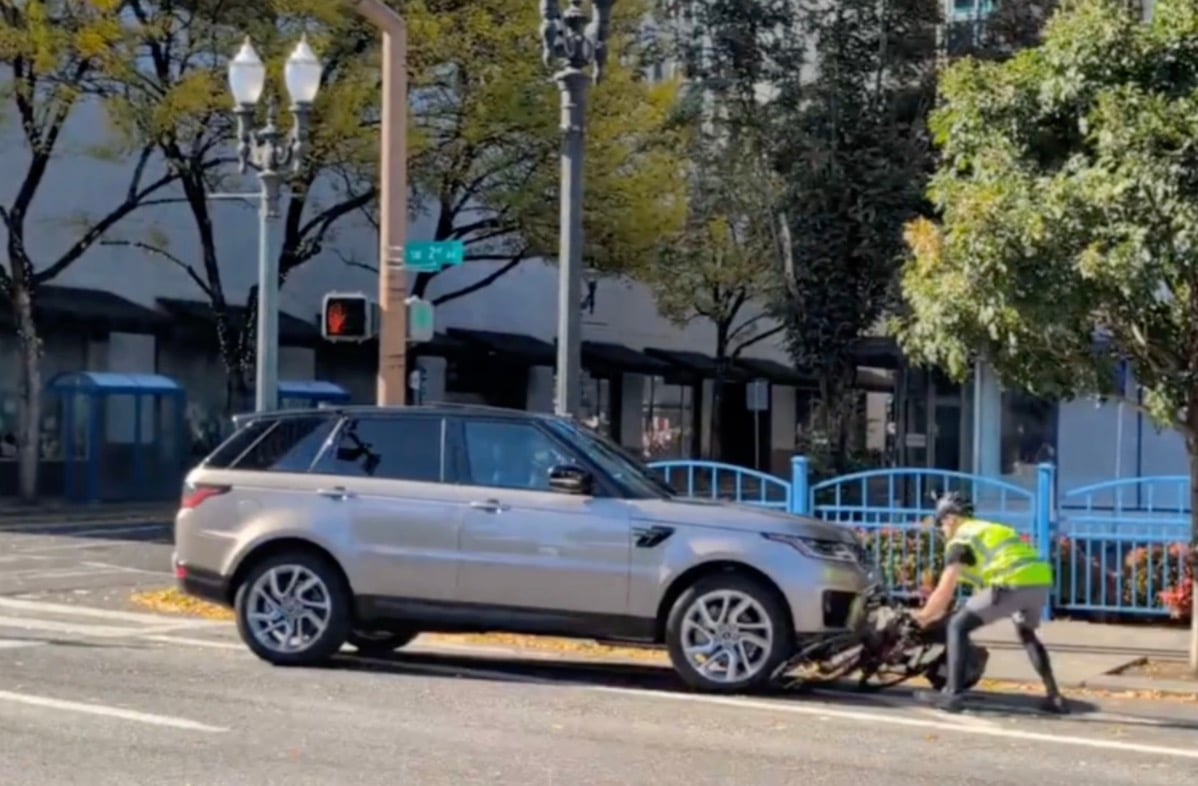
Still from video (see below) posted on Reddit by HughAnnus (used with permission).
A bicycle rider was repeatedly rammed by the driver of a large SUV at the No Kings rally and march on Saturday. Footage uploaded to Reddit by user HughAnnus shows the driver of a late model Range Rover attempting to drive northbound on SW 2nd just after Alder. The bicycle rider is wearing a yellow hi-viz vest and appears to have been a volunteer corker for the march.
As you can see in the video (below), the cyclist remained calm throughout the incident. After being rammed and having their bicycle go under the SUV’s front grill, the cyclist simply picks their bike back up and returns to their post. Several bystanders approached the scene and began to address the driver, film, and shout out the license plate. A photo of the driver and the license plate was posted to social media.
The person who shot this video says the woman rammed the cyclists another time before they began filming. They also say the police responded and let the driver go. This was due in large part because, “Biker was okay and didn’t push it with the cops,” the person shared on their Reddit post.
Portland Police Bureau Public Information Officer Mike Benner told BikePortland today that they are not currently pursuing this case. “The Incident Management Team overseeing this event was not made aware of this,” Benner shared. “Perhaps due to what the post suggests – the cyclist not wanting to press charges. If the cyclist has a change of heart and wants to move forward with a case, PPB would be open to reviewing this incident further.”
UPDATE, 3:17 pm: I’ve received an additional video clip from another witness and have not posted a longer video. The new clip shows a PPB Liaison Officer (special unit trained for dialogue and deescalation at protests) talking to the driver. In the video, the officer tells the driver she can either park and wait and that no matter what she does she will probably have to wait. At one point the cyclist interjects to say, “Do not endanger peoples’ lives.” The driver then responds, flippantly, with, “You know what, go give a speech to someone else.” As the woman drives away, the cyclist can be heard questioning why the officer didn’t give her a citation. “That’s pretty fucked up,” the cyclist says upon realizing the officer doesn’t plan to issue a citation.
UPDATE, 4:22 pm: After viewing the second clip where the cyclist requests that the officer cite the driver, I reached back out to PPB for clarification about why the officer chose to not cite. Here’s what the PPS spokesperson said:
“PPB understands the intention of people who want to help facilitate a march, in this case the cyclist, but it is not safe for someone to put themselves in harm’s way in front of a moving vehicle which is what our officer witnessed. As the video shows, our officer spoke with both the cyclist and driver and de-escalated the situation, allowing the driver to find an alternate route and the cyclist to return to the march. The officer then continued their role in facilitating a march that drew tens of thousands of people into the city.”
Below are the most notable stories I came across in the past seven days. Thanks to everyone who suggested links this week!
But first I want to give a shout-out to this week’s Monday Roundup sponsor, Duer Performance Jeanswear, who just celebrated the opening of their first Portland retail store (820 NW 23rd Ave). Their pants are perfect for cycling — and they even have thermal, rain-resistant versions. Check them out on NW 23rd Ave or at ShopDuer.com.
How to get better bike storage: Covered and secure bike racks called “cyclehangars” are an excellent solution to residential bike parking, but for some reason we are yet to embrace them. If you’re a believer (or just curious), this article from the UK is a must-read! (Move People/Substack)
How to get slower streets: This is a really good, concise article that explains how to effectively communicate with city traffic engineers when advocating for slower streets. (Fast Company)
Seattle’s big decision: One of the favorites to become Seattle’s next mayor is a former transit activist and everyday bus rider. Here’s how Katie Wilson compares to incumbent Bruce Harrell on transportation issues. (Seattle Times)
I hope folks in City Hall read this one: “Cardiff Council is set to become the first local authority in the UK to introduce higher parking charges for SUVs and other heavy vehicles, in a move campaigners say will make city streets safer and fairer.” (Nation CYMRU)
A magical invention: “They turn humans into this hyperefficient terrestrial locomotor because they make being on land more like swimming,” says this article that says a human on a bicycle is the most efficient form of movement in the animal kingdom. (Scientific American)
Family vehicle: Feels like this is pretty old story by now, but it’s always good when major national media outlets cover the family cargo bike revolution. (NPR)
Criminals on bikes: An interesting element of this story on mass iPhone theft in London is the fact that police are sounding alarms about the growing number of thieves who use e-bikes to carry out their crime. (NY Times – unlocked)
An American revolution: 2026 is the 250th anniversary of the American Revolution — and who knows, maybe it will also be the year that the cycling revolution that’s sweeping the globe finally takes hold in a major way. This article makes it seem possible. (Vox)
Riding the Rhine: A nearly carfree path across Europe? Yeah sign me up for that! (BBC)
BikeLoud attorney Scott Kocher (center) at Multnomah County Courthouse after filing lawsuit in November 2022. (Photo: Taylor Griggs/BikePortland)
After years of work to establish that the City of Portland’s transportation bureau was not following through with legal obligations outlined in what’s known as the “Bike Bill,” and with a settlement negotiated and approved by the City Attorney and top leadership at the Portland Bureau of Transportation, advocates expected this week to be one of celebration.
Instead, they’re left in limbo due to a highly unexpected move from Portland City Council.
Nonprofit BikeLoud PDX and their lead attorneys on the lawsuit — Scott Kocher of Forum Law Group and Chris Thomas of Thomas, Coon, Newton & Frost — had a date (October 15th) on the city council agenda where council members were expected to rubber-stamp what would have been one of the most consequential transportation-related legal decisions in the history of Portland. Approval of financial settlements are usually a weekly council exercise and most are subject to no debate.
Kocher and BikeLoud had already begun to plan a PR strategy around the decision when they received word from the City Attorney that the settlement had been rejected by city council.
BikeLoud filed a lawsuit against the City of Portland in 2022, alleging that PBOT had repeatedly not met requirements laid out in Oregon Revised Statute 366.514, more commonly known as the Oregon Bicycle Bill. Sponsored by a (Republican!) Oregon lawmaker in 1971, the bill sought to make sure road authorities invested a minimum of 1% of major highway project costs into bicycle and pedestrian infrastructure. More germane to this lawsuit, the law requires bicycle and pedestrian facilities whenever a street is “constructed, reconstructed, or relocated,” with narrow exceptions.
With the help of volunteer advocates from BikeLoud, Kocher painstakingly cataloged numerous completed projects where he could prove the Bike Bill should have applied, but where PBOT failed to make the required investments in bike infrastructure. City attorneys fought vociferously for dismissal of the lawsuit on grounds that BikeLoud didn’t have legal standing to pursue the case. In May 2023, a Multnomah County Judge affirmed BikeLoud’s standing and permitted them to proceed with the case.
Kocher and BikeLoud spent the last two years working on the case. They found individual plaintiffs willing to add their names to the lawsuit as being negatively impacted by the lack of bike facilities on specific roads. They participated in hours of depositions with top-level PBOT staff. And their work paid off when the City Attorney agreed to go into settlement negotiations. That process took hundreds of hours of work, and according to Kocher (who represented the case pro bono), the two sides ultimately hammered out an agreement.
From what I’ve learned, the settlement agreed to by PBOT and BikeLoud would have included several million dollars in specific planning and capital projects including: $3 million to upgrade neighborhood greenway routes used by weekly bike buses, $2 million of investments on Sandy Blvd in connection with upcoming paving and sewer projects, various commitments related to the 82nd Avenue project, and $1 million for neighborhood greenway upgrades around Hawthorne Boulevard. In addition to those investments, PBOT would also agree to an internal decision making process that would ensure compliance with the Bike Bill going forward.
Kocher told me in an interview this week both sides compromised and looked to find “win-wins” that helped cycling in general and would bolster projects and policies PBOT was already invested in.
That’s why Kocher was blindsided when he learned council voted it down.
Because these settlement decisions are not made in public city council session, I don’t have all the details on what happened. I have learned that due to quorum rules, the city holds two separate meetings with six councilors each (known as “six and six” groupings). It was in these meetings where the settlement was discussed. Councilor Sameer Kanal was one of the councilors who was uncomfortable moving it forward at this time. In a conversation last week, he said he doesn’t believe the settlement is dead, but that it’s simply been delayed so council can get questions answered.
According to Kanal, the BikeLoud settlement was complicated and unique relative to others they typically approve. Because it would force the City of Portland to make specific policy changes and project investments (something Kanal is not necessarily opposed to), Kanal believes it warrants more consideration by council.
Looming over this issue are questions of city governance. That is, what power do council members have to impact decisions already made by the administrative wing of the city? We’ve seen this play out several times in high-profile cases lately: A plan by an office overseen by Mayor Keith Wilson to remove diverters in Northwest Portland was strongly opposed by councilors who felt it was administrative overreach and that council members should have power to make that decision. A decision by PBOT and Mayor Wilson to extend paid parking hours to balance the budget was also opposed by city council members, who ultimately reversed it.
Kocher believes this is another example of tension between the administrative and legislative arms of city government.
“It’s extremely unusual for council to not approve a settlement that has been reached and recommended by the city attorney,” Kocher shared with me in an interview Thursday. “It’s concerning that it didn’t happen in a timely fashion in this case and we are trying to learn more whether this is a case of miscommunication, or whether council is actually rejecting the advice of the city attorney.”
“The settlement is the result of a multi-year litigation process,” Kocher continued. “It was reached after extensive negotiations with top-level leadership on both sides, so it’s unclear how a settlement could be reached and then not have it be approved.”
The way Kocher sees it, the settlement comes with significant benefits for both sides that will all be lost if the case goes to trial.
At this point, Kocher and BikeLoud are still in the dark and are waiting for more answers.
In the meantime, BikeLoud is planning to rally in front of City Hall this Wednesday (10/22) at 9:00 am. They plan to speak about the issue and then deliver a letter to city council. Stay tuned.
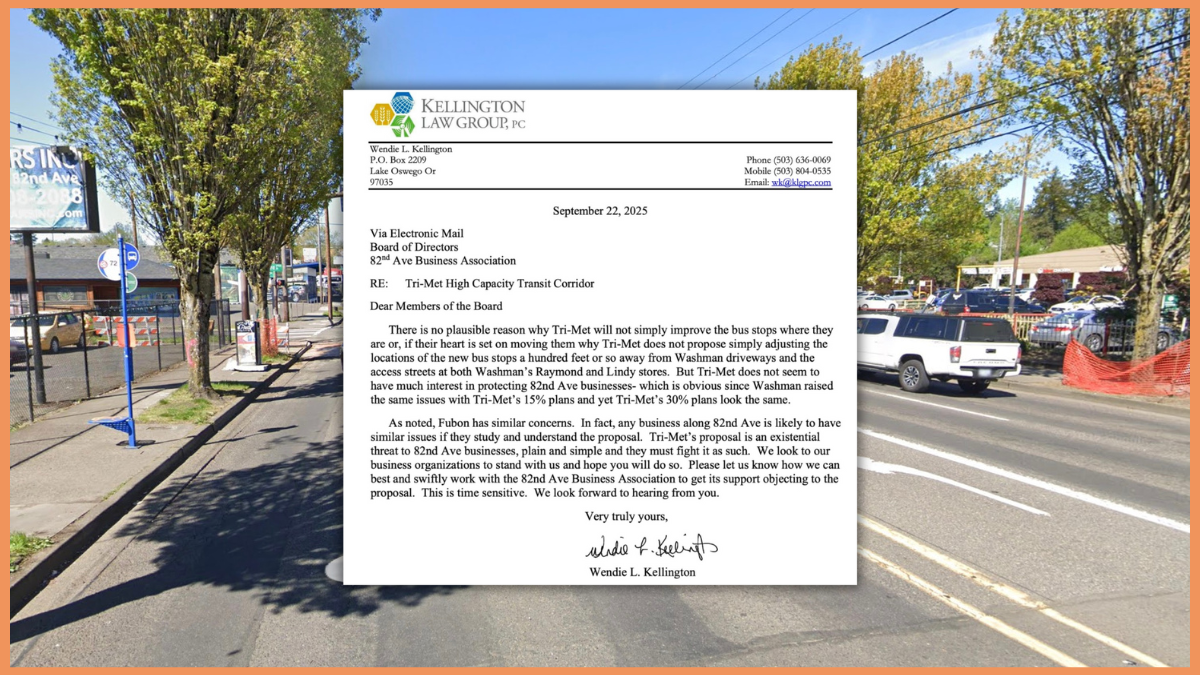
(Image: Google Streetview outside Fubonn at SE Woodward and 82nd. Inset: Kellington Law Group letter.)
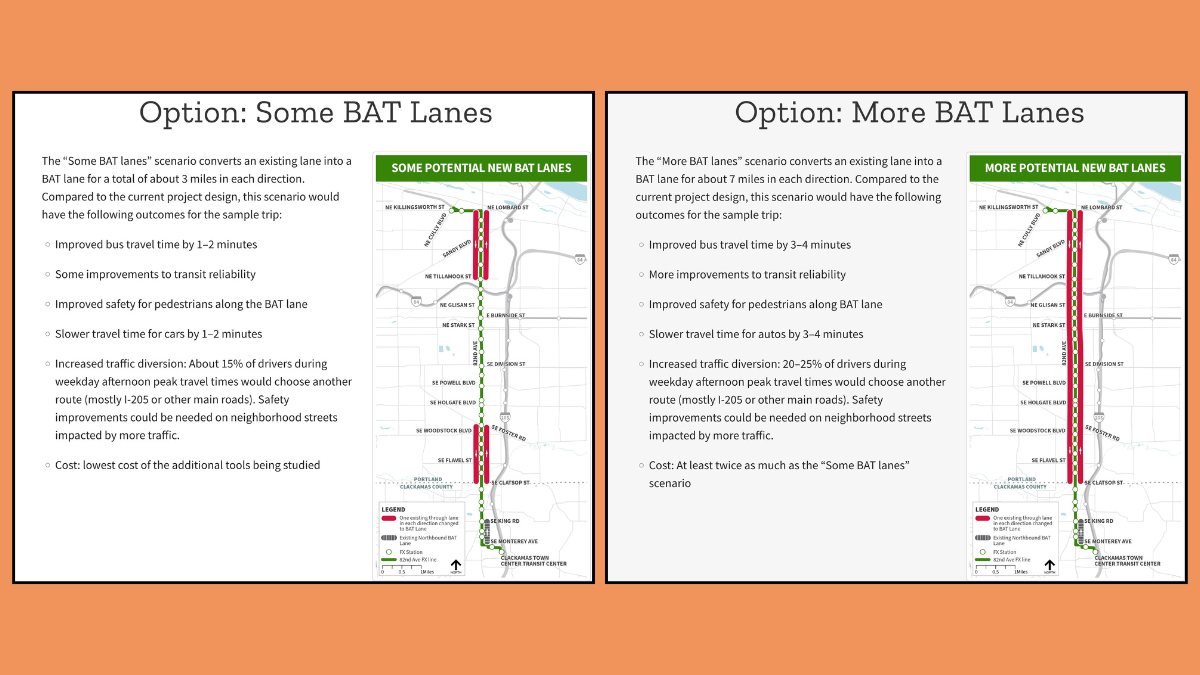
In a move that has stunned transit advocates, TriMet 82nd Avenue Transit Project staff have recommended just three miles of semi-dedicated bus lanes along the entire 10-mile project corridor. In a memo shared with members of the project’s Community Advisory Committee (CAC) Wednesday night, the staff recommendation for 60% design scope clarified the intention to move forward with BAT lanes in just two sections: between NE Lombard and Tillamook, and between SE Foster and Clatsop.
The decision comes after advocates publicly aired concerns that TriMet might cave to 82nd Avenue business owners who oppose BAT lanes in the most dense commercial areas of the project. It turns out those concerns were valid.
The Line 72 that runs north-south on 82nd Avenue is the busiest bus line in the entire state of Oregon and has around 10,000 daily boardings. Back in 2023, TriMet launched a $350 million project to upgrade transit service on a 10-mile section of the corridor between Clackamas County and Northeast Portland. The project is part of a massive effort from the City of Portland, Metro and TriMet to remake what was once a highway into a local street that reflects local visions and values following its transition away from state ownership that became official in 2022.
(Source: TriMet)
At issue for TriMet is how much of the 10-mile project length would get its “Business Access and Transit” or “BAT” lane treatment. BAT lanes are TriMet’s version of high frequency bus service. They come with signal priority, major stop upgrades, and other improvements aimed at speeding up buses. Essential to the BAT concept is that car users are not allowed in the (usually red-colored lanes) unless they’re turning right and/or access driveways. In May TriMet released results of a survey showing that, despite its higher price tag, 70% of the 1,400 respondents said the agency should build seven miles of BAT lanes along the corridor. An option to build just three miles of BAT lanes received 58% support.
Transit advocates supported the option to implement BAT lanes along the entire corridor. Back in June The Street Trust submitted a letter to TriMet that read: “We strongly urge TriMet… to prioritize Business Access and Transit (BAT) lanes along the entire corridor, not as an isolated goal but as a means to make alternatives to driving faster, more reliable, and more appealing.”
Last month BikePortland reported heartburn among some advocates who felt TriMet was setting the stage for this recommendation. In slides presented to the CAC last month project staff said they’ve heard “significant concerns” to BAT lanes from businesses, specifically around “customer access,” “construction impact,” and “traffic and vehicle diversion.”
In the official recommendation issued last night, TriMet says budget constraints were mostly to blame. The seven-mile BAT lane option (known as “More BAT” in project documents (see above), which also includes widening one intersection) costs $10.8 million while the three-mile option (known as “Some BAT”) is just $2.8 million — a difference of $8 million, or just 2% of the total project cost.
While cost figured into their calculation, it’s likely that intense pushback from some business owners along the route also influenced this decision.
Through a public records request, BikePortland has obtained two letters submitted to TriMet that strongly oppose BAT lanes. Both letters come from law firms who represent business owners on 82nd Avenue and make it clear legal action would be taken if TriMet didn’t change their proposal.
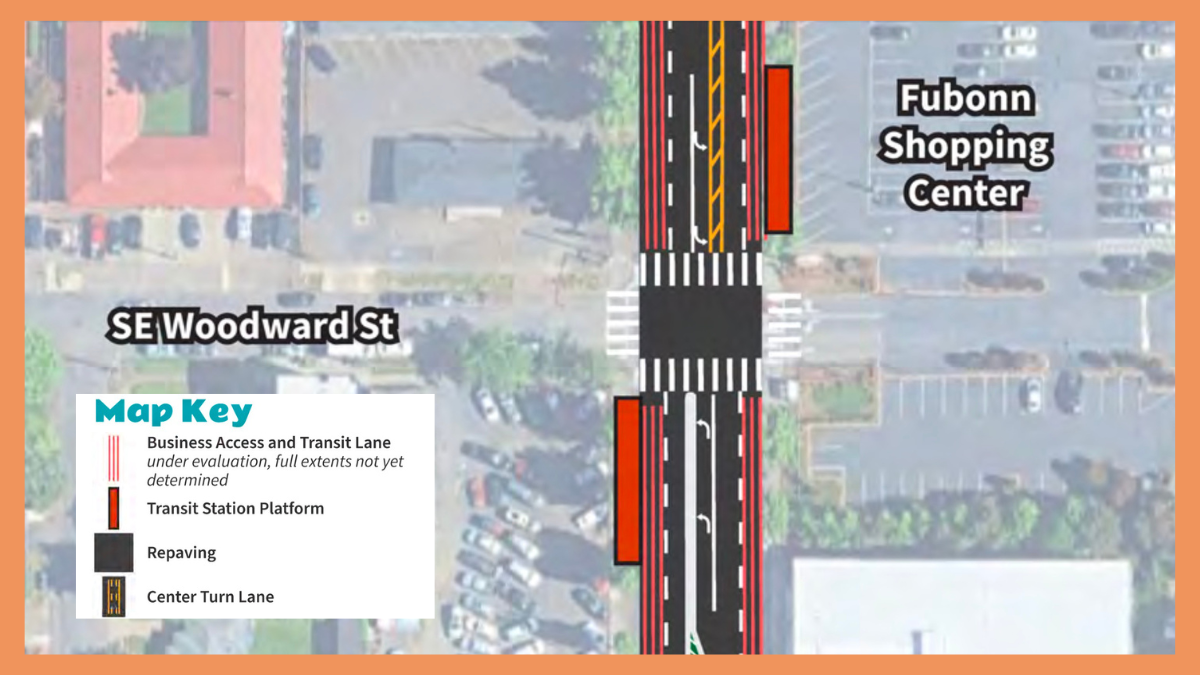
TriMet proposal at Fubonn location.
On September 22nd, Wendie Kellington of Lake Oswego-based Kellington Law Group, sent a letter to TriMet on behalf of her clients Washman and Fubonn. Washman has two car wash locations where BAT lanes were proposed — one at NE Glisan and another at SE Raymond. Fubonn is located in a large shopping center on SE Woodward.
In the letter, Kellington described the “More BAT” option as, “an extreme proposal” that “should simply be a nonstarter” and complained that, “the voice of business is simply not being heard.” Here’s more from the letter:
“The proposal is that two entire lanes of 82nd Ave (both northbound and southbound), will be closed to motor vehicles and that “bus lanes” will take their place, dedicated to 4-5 buses every hour, creating serious additional congestion – taking away 50% of 82nd Ave.’s capacity to speed up transit times by an just a few minutes, but causing the same or worse corresponding delays for motor vehicle traffic.”
Kellington says her client’s opposition to the proposal is rooted in their claim that busses represent less than 1% of the vehicles traveling on 82nd Avenue, but would get half the lane capacity. This proposal would, “add serious impediments to the 99% of vehicles trying to get to 82nd Ave. business destinations,” and would lead to frustrated drivers, empty bus-only lanes, and more traffic diversion into local streets.
TriMet’s plan for BAT lanes in the central portion of the project is, “dangerous and poses an existential threat to 82nd Ave businesses,” Kellington contends in her letter.
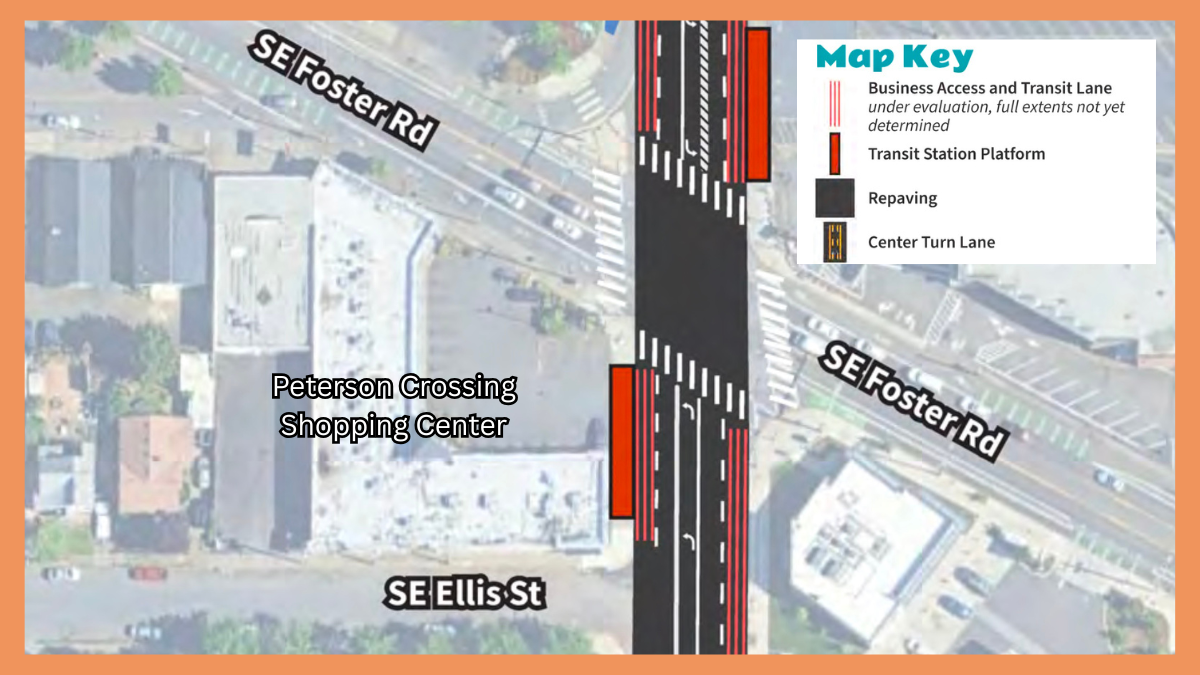
TriMet proposal at Peterson Crossing location.
Lawrence Wagner, an attorney from Portland-based law firm Sokol Larkin, who represents the owner of the Peterson Crossing shopping center on the corner of SE Foster and 82nd (at 8136 SE Foster Rd), sent a letter of opposition to TriMet on October 1st. The letter, which threatens legal action if the project moves forward, came after the business owner met with a Portland Bureau of Transportation staffer and learned about the BAT lane proposal. Wagner says his client was told the project would “completely take away” the shopping center’s “critical driveway access to 82nd Ave.”
“Peterson cannot lose that access,” the letter warned (emphasis Wagner).
Here’s more from Wagner’s letter:
“Tenants have indicated that their businesses will not survive without the 82nd Access. Given the various other issues along 82nd Avenue, we cannot imagine that TriMet wants another shopping center to go dark, and we assume that TriMet has no interest in seeing these local businesses fail. If these businesses need to close or move due to loss of the 82nd Access, then Peterson will also suffer significant financial hardship, and it may be left with a valueless property.”
The businesses have another driveway entrance along SE Foster, but Wagner says having only that one driveway isn’t feasible for his clients due to space constraints and access issues.
Reached for comment about TriMet’s decision, CAC member and local resident who uses Line 72 regularly, Meghan Humphreys, told BikePortland she is “disappointed”. The decision, “Runs counter to what we heard support for in community surveys, especially from transit riders and residents,” Humphreys said. “The ‘more BAT lanes’ option is what would actually make the 72 bus run reliably and be a real asset for the neighborhood and its residents like me.”
Zachary Lauritzen, a CAC member of executive director of nonprofit Oregon Walks, said he was caught off guard by TriMet’s decision. “PBOT did their analysis and said full BAT lanes were possible. Amazing! To have Trimet, our transit agency, the folks who should be the biggest advocates for excellent transit, choose to recommend this half-measure is mind boggling,” Lauritzen shared with BikePortland this morning. “The project team has moved further and further away from BRT and should call it what it is: a nice transit improvement. It’s not BRT and it’s not going to transform 82nd Avenue as people have asked for and been expecting from half a billion dollars in investments.”
Lauritzen is calling on TriMet to live their own values. “You can’t say, ‘We think transit is a priority. We want to give people the best transit experience. We think transit is a climate solution,’ and then choose to give all the space to cars where it matters most,” he said.
TriMet says there’s still a chance more BAT lanes could be built; but only if additional funds become available.
Given the hints coming from TriMet in recent weeks, advocates were already ramping-up organizing efforts. There’s a rally to push for more BAT lanes planned for 1:00 pm on Sunday at Montavilla Park. Some activists are planning to attend a meeting of the SE Uplift Neighborhood Coalition Land Use & Transportation Committee meeting on Monday (10/20) at 7:00 pm (via Zoom or in person at 3534 SE Main St.). where PBOT and TriMet are expected to make a presentation about the project. The project’s next CAC meeting is Wednesday, October 22nd from 6:00 to 7:30 pm at Portland Community College Southeast Campus.
TriMet’s staff recommendation will now be forwarded to the project’s Policy and Budget Committee* meeting on November 7th where the final decision will be made. That meeting is set for 9:00 am at TrMet’s Public Safety Office on 1020 NE 1st Ave . You can sign up to attend by emailing salgadop@trimet.org.
For transit riders who rely on 82nd Ave, all they can do is hope there’s still a chance to salvage this project. “This is our city’s opportunity to make 82nd Avenue safer for more than just cars only,” Humphreys said. “And I would hate to see us lose this chance.”
UPDATE, 4:18 pm: *Members of the TriMet 82nd Avenue Project Policy & Budget Committee are: TriMet General Manager Sam Desue Jr. (Chair), Clackamas County Commissioner Diana Helm, Metro Councilor Duncan Hwang and Councilor Christine Lewis, ODOT Policy & Development Manager Chris Ford, PBOT Director Millicent Williams and Community Advisory Committee (CAC) Representative Franklin Ouchida.
UPDATE, 10/17 at 11:24 am: Metro Councilor and 82nd Ave Transit Project Policy & Budget Committee member Duncan Hwang just posted on BikeLoud PDX Slack that he disagrees with TriMet staff recommendation:
“Hi all, just thought I’d pop in here as someone on the Trimet Policy and Budget committee, resident of 82nd, and longtime 82nd Ave advocate. First thanks for all you advocacy. It means a lot. Trimet’s current proposal here is the Trimet recommendation and myself nor Metro are aligned on that. I was very frustrated I learned about this from Bikeportland (excellent reporting) and not from our own staff… I’m also not sure we will be allowed to vote on this on Nov 7 since there are unknowns around who is the decisionmaker still unfortunately. Mainly just wanted to say I don’t support this current proposal.”
Hands Off Rally back in April. (Photo: Jonathan Maus/BikePortland)
It’s No Kings weekend. I suspect many of you will join in the mass protest against the Trump Administration. It’ll be massive and a lot of folks will show up and march with bikes. Whatever you do, I hope you have fun.
I also hope you are able to roll over to NW 23rd to check out the new Duer store! BikePortland is helping this cool Canadian company spread the word about their awesome apparel and the opening of their new Portland store. The founder of Duer was initially inspired by his bike commutes and the pants are really fantastic to ride in. I’ve had a few pairs over the years and they’re my favorites for sure. Please support companies that support BikePortland! They’ll have special celebrations and events at their store on 820 NW 23rd Ave all weekend long.
Here are my picks for this weekend…
Saturday, October 18th
Saltzman Century – 7:30 am at Saltzman Rd Lower Gate (NW) NW Saltzman Rd is one of the most revered and wonderful unpaved climbs in the region. The folks organizing this ride plan to spend the entire day going up and down it. Whether you love to climb or just feel like doing something silly in the “because why not” spirit, this is for you. More info here.
Ride to No Kings Rally – 10:30 am at St. Johns Plaza (N) Join a group ride to the big protest and rally downtown. Meet in St. Johns and head down N Willamette into the Central City. More info here.
NOISE Ride – 11:00 am at Fresh Pot (N) A rowdy and fun, unsanctioned gathering that’s been going on for 20-ish years, the North Oregon International Singlespeed Exhibition (NOISE) guarantees, “Hills, mud, blood, jumps, limbo, buzkashi, singletrack, alleys, cogs, logs, bike toss,” and other shenanigans. More info here.
Sunday, October 19th
Cyclocross Crusade #3 – All day at Portland International Raceway (PIR) Take advantage of a fun ‘cross race in our own backyard. It’s the “Coyote Run” course at PIR, just a bit north of Kenton. More info here.
Winter Cycling Workshop – 9:00 am at Lents Farmers Market (SE) Staff from Portland Bureau of Transportation will host this informative workshop that will get you informed and inspired to tackle winter by bike! More info here.
Fall Colors to Springwater Wetlands – 11:45 am at Lents Farmers Market (SE) Join experienced ride leader Tom Howe on a jaunt to newly restored wetlands adjacent to the Springwater Corridor bike path where you might see all types of natural beauty. More info here.
82nd Avenue Transit Rally – 1:00 pm at Montavilla Park (SE) The Portland chapter of Democratic Socialists of America (DSA) has emerged as a transit advocacy group right when we need it most. They are working to push TriMet for great bus lanes on 82nd. Join them for a rally and get plugged-in! More info here.
— Did I miss your event? Please let me know by filling out our contact form, or just email me at maus.jonathan@gmail.com.
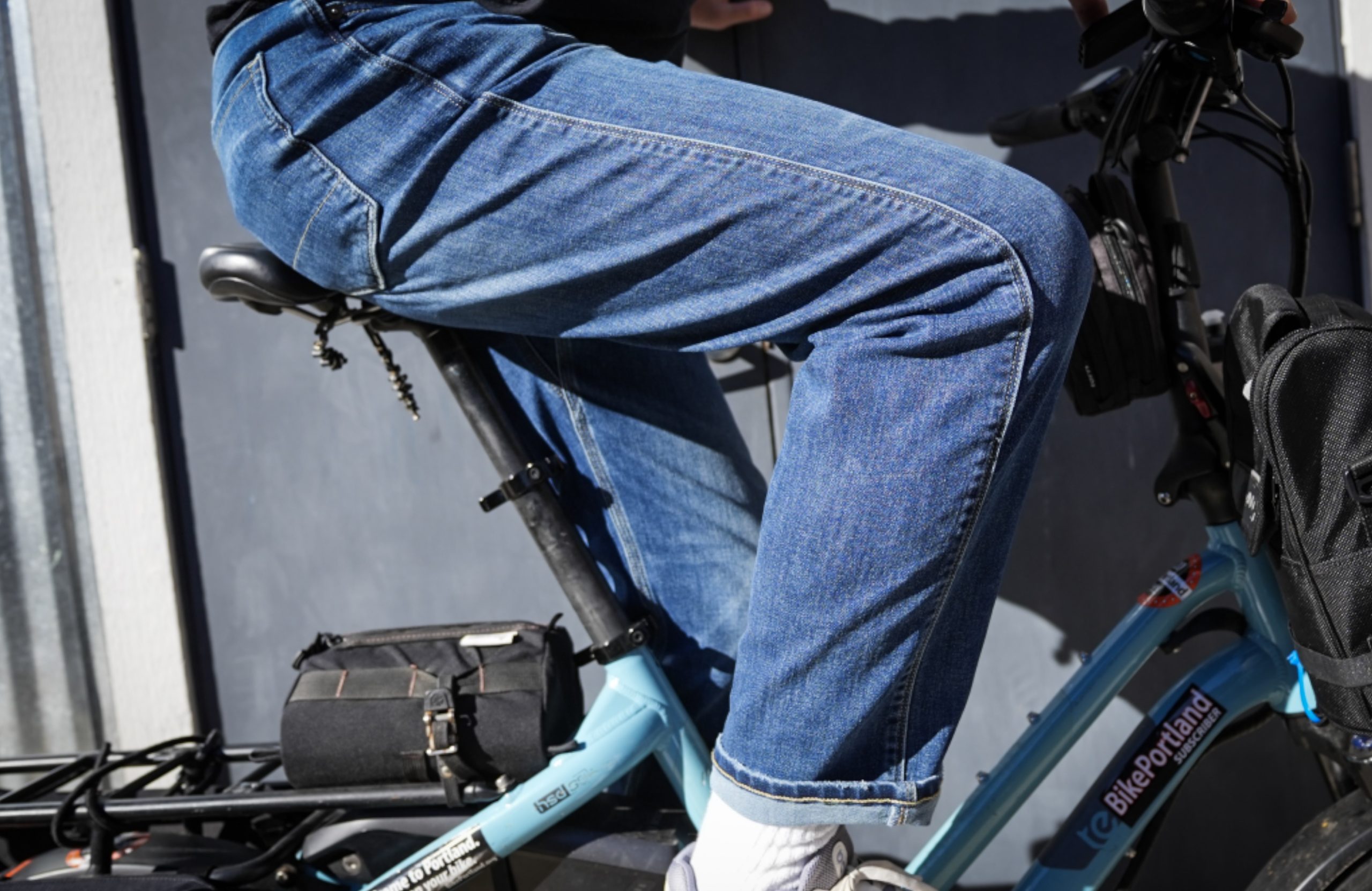
I can attest, these pants are great to bike in! (Photo: Jonathan Maus/BikePortland)
Disclaimer: This post is part of a paid advertising campaign.
It’s yet another sign that Portland’s bike scene is on the upswing when a company with an inception story tied to bike commutes chooses to open a store here. That’s why I was thrilled to hear that Vancouver, Canada-based Duer planned to launch a retail store on Northwest 23rd Avenue.
I’ve had a pair of Duer jeans since 2016 when they were just a start-up and one of their marketing folks sent me a pair. Given how comfortable they are on the bike and how good they look off of it, I wasn’t surprised to hear almost a decade later that they were not only still around, but would expand into Portland.
Duer specializes in what they call “performance jeanswear”. Their founder, Gary Lenett, was inspired to start the brand in part because of his daily bike rides into work. Lenett spent decades in the denim industry designing jeans for brands like Levi’s, Ralph Lauren and Nordstrom. After biking to work in stiff denim, Lenett knew he could do it better. “I was looking for jeans with enough comfort and class to take me from the commute to a full day of meetings,” he shared with BikePortland. “That search led to where we are today.”
So what’s the big deal? Duer’s jeans are designed for movement. Their signature “motion gusset” in the Men’s collection reduces wear from your saddle and makes their pants more comfortable for folks who ride. And the fabric stretches just enough to feel good while still retaining the rugged feel and durability you expect from jeans.
I’ve been wearing a new pair almost every day for the last few weeks. They’re my favorite pants! And their stretch canvas utility pant is my new go-to for BikePortland work assignments. They’ve got extra pockets where I stow mics and small cameras, and I love how they look. I have this thing where I never want folks to know I arrived at an event by bike. Duer’s pants and tops fit right into that: They’re not trendy or overly-technical, and definitely not “bike clothing,” but I can wear them and ride in comfort and with style.
(Photos: Duer)
The new shop at 820 NW 23rd Avenue (just a few doors down from Salt & Straw!) is already open, but grand opening festivities are set for this coming weekend October 17-19. To kick off their Portland era, Duer will have live music from local artists, free craft beverages, giveaways and in-store specials.
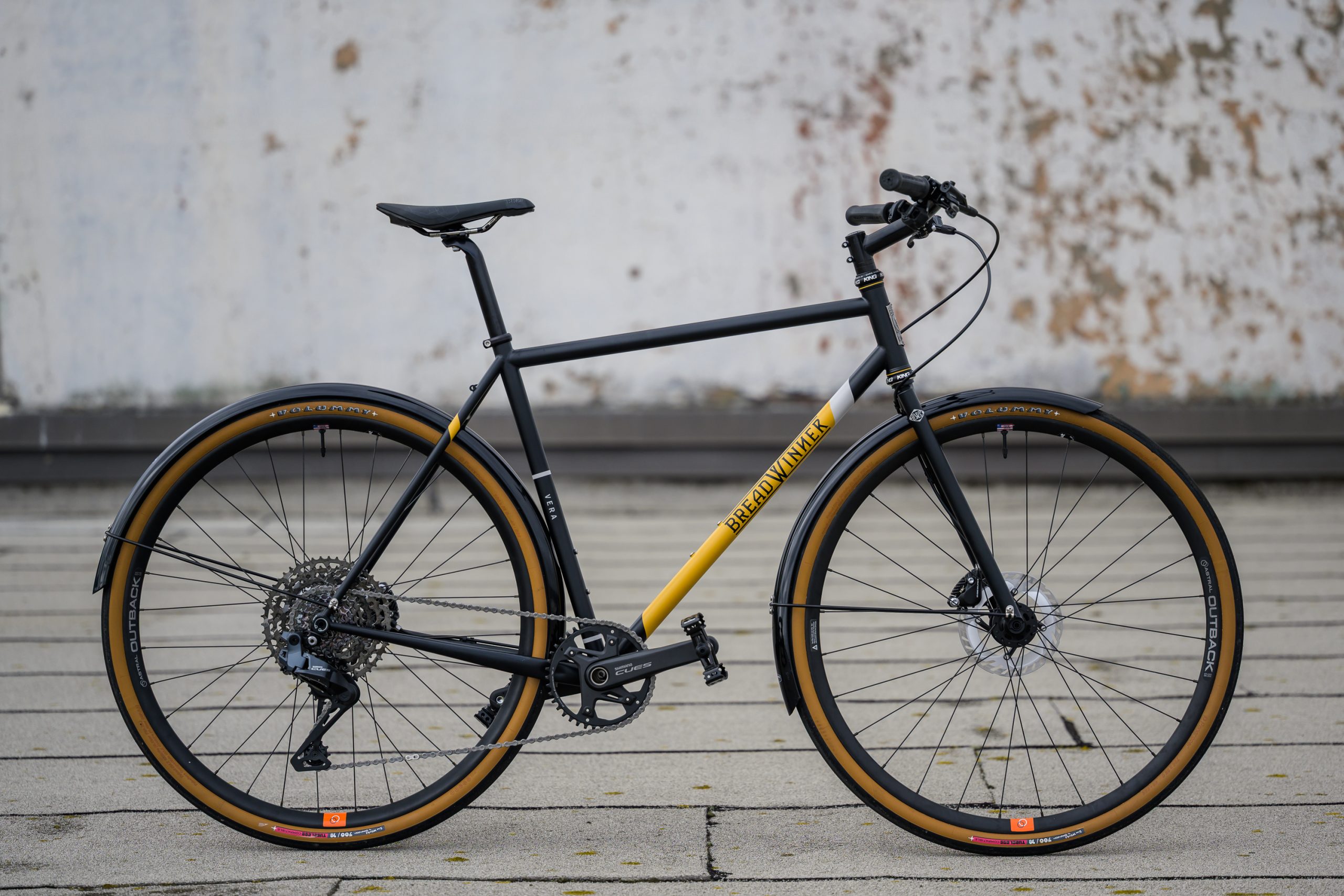
To celebrate their Portland store, Duer teamed up with local bike builder Tony Pereira of Breadwinner Cycles. Pereira built up a custom steel Vera City Bike and Duer is having a contest to give it away. One lucky winner will get the bike and a $300 Duer gift card. To win, just go to this page on Duer’s website and enter your name and email before midnight on October 20th.
Custom ‘Vera’ from Breadwinner. (Photo: Breadwinner)
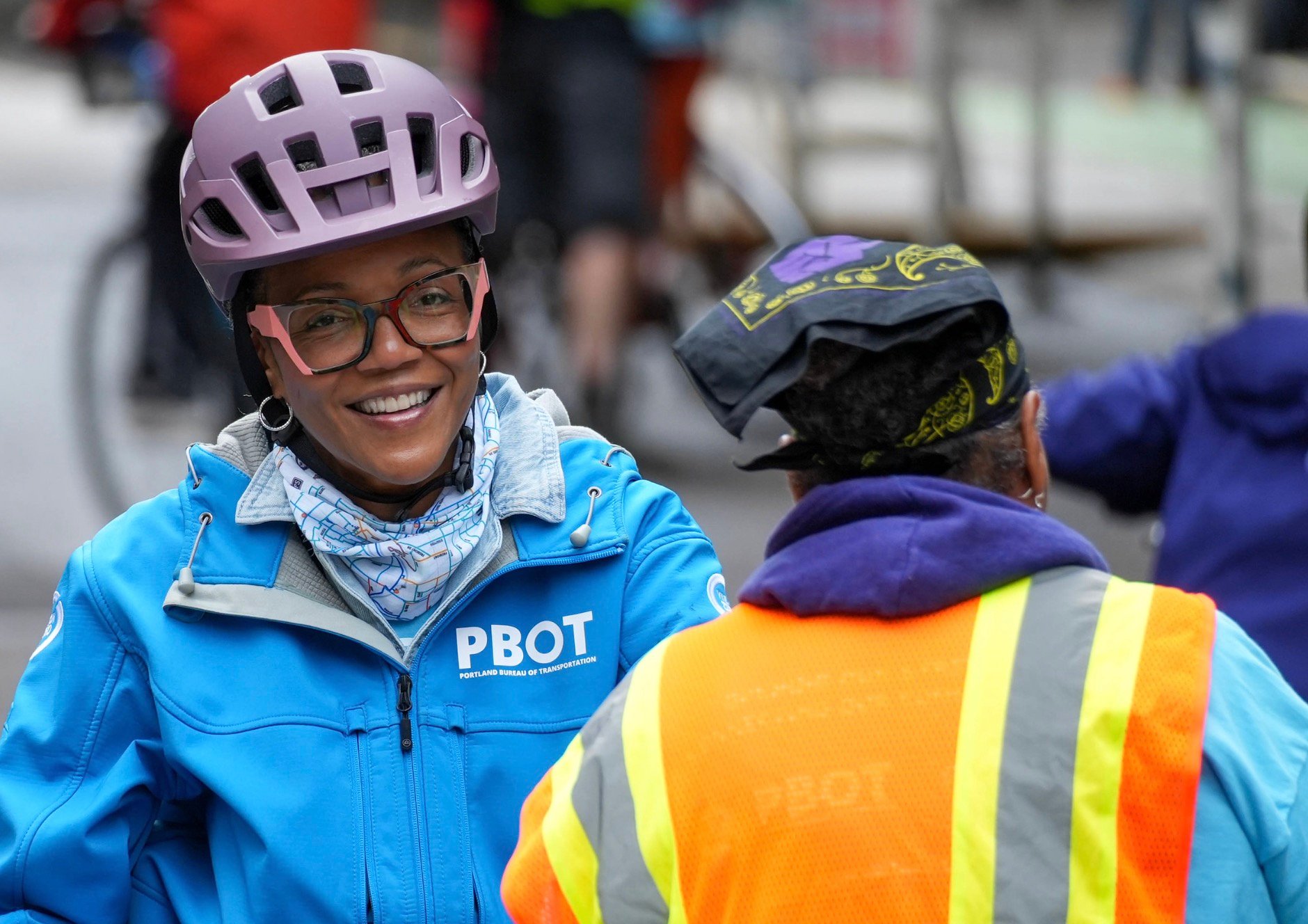
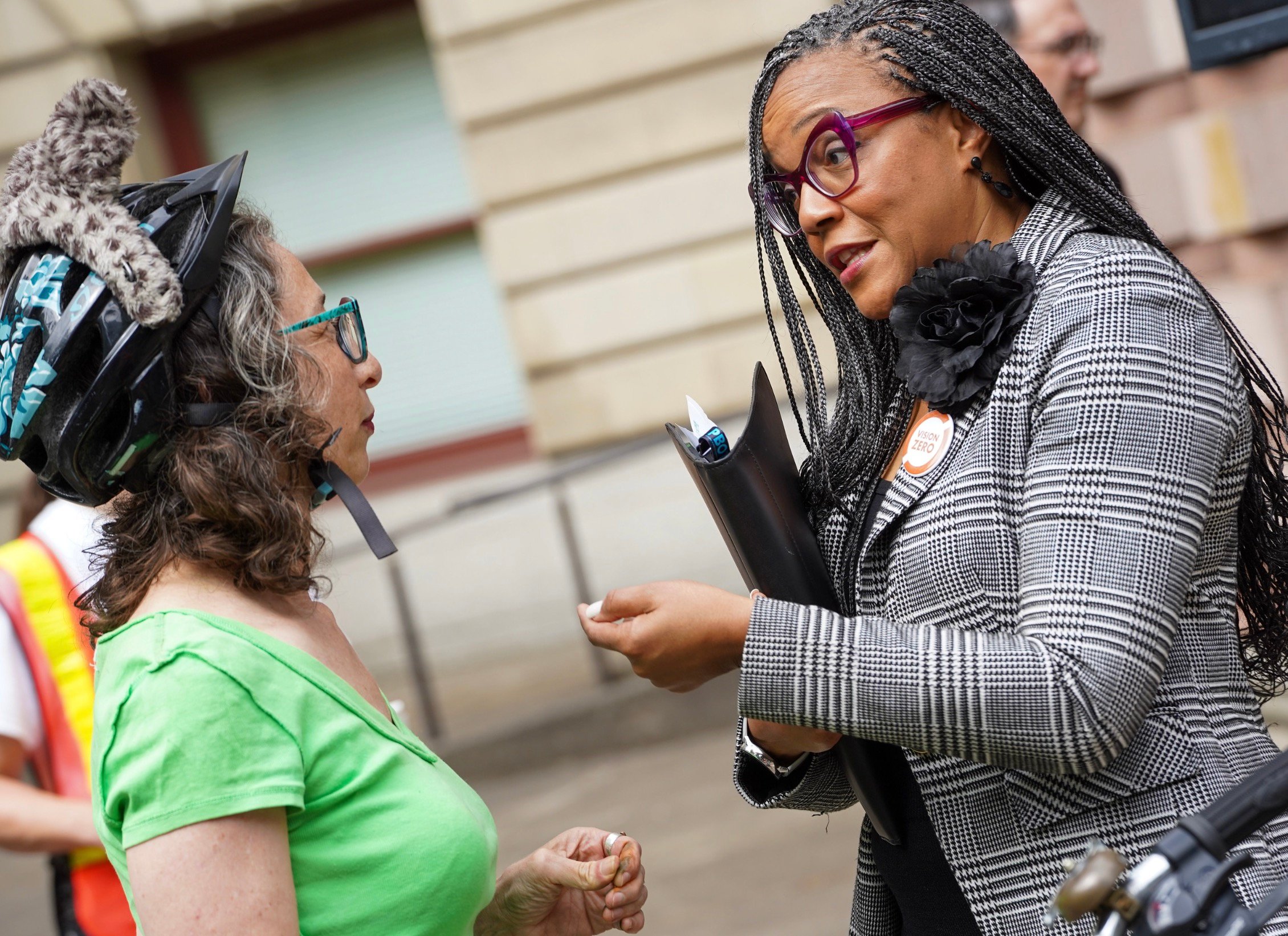
PBOT Director Millicent Williams at Sunday Parkways Downtown on September 14th. (Photos: Jonathan Maus/BikePortland)
In remarks at last night’s Bicycle Advisory Committee meeting about what to do when cycling advocates and the City of Portland have “uncomfortable conversations,” transportation bureau Director Millicent Williams urged folks to be willing to compromise and see the big picture.
At the outset of her visit — where she touched on a wide range of issues speaking from both her own perspective and from pre-written statements prepared by PBOT staff — Williams said, “I’ll use the freight example: There are some routes that are just freight routes. And if in fact we are going to ensure that all users use the system safely, we have to be honest with ourselves when we say, ‘Hey, this is our freight route.’ Can cyclists choose this? Yes. Should we make that safe for them? Absolutely. But there may need to be a real conversation about where and what we do.”
“So I wanna share that because I can’t fail to see the whole community,” Williams continued. “And sometimes it’s an equal vision, sometimes it’s a preferential vision. But I have to make sure that you aren’t closing our eyes to the whole city and the whole set of solutions that are in front of us.” It’s unclear what specific project or policy prompted Williams to say that, or if it was just something she wanted to get off her chest.
Williams spent about thirty minutes at the monthly meeting where she was on the agenda to “share her vision about bicycling in Portland.” Williams gave an overview of major bike projects, then responded to questions collected from Bicycle Advisory Committee (BAC) members. The questions had been given to PBOT staff beforehand and Williams switched between personal comments and answers to the questions that had been pre-written by staff.
“Cycling in the city is something that is broadly supported. And people do not want to see that compromised upon.”
– Millicent Williams, PBOT
In addition to the comment about seeing the ‘whole city,’ Williams addressed many issues — from how PBOT is navigating the new form of city government, to how her agency has aided Mayor Keith Wilson’s drive to end unsheltered homelessness. And even though she wasn’t asked about it by the BAC, Williams addressed the controversial plan to remove traffic diverters on neighborhood greenways in Northwest Portland back in August.
Director Williams acknowledged that when PBOT was first told about the issue by the city’s administrative wing (specifically, a group known as Problem Solvers that was formed to address things like graffiti, homeless camps, and other related issues), the agency opposed the plan to remove the diverters. When Problem Solvers urged PBOT to reconsider and look at how the diverters impact a wider range of “nuisance behaviors” in the area, Williams said the agency once again demurred. Ultimately, Williams said PBOT agreed to “look more broadly” at the concerns and the agency came up with an alternative plan that, “would create an opportunity for cyclist safety, for pedestrians, and hopefully, be able to create the opportunity for some of the nuisance behaviors to be curbed.”
As for an update on the diverter removals (which are still in a state of pause), Williams said PBOT is continuing to gather data, “On whether or not some of the nuisance behaviors are continuing to happen in that space to determine whether or not we need to move down that path [of implementing an alternative plan].”
Williams clarified to the committee that when PBOT is asked about a proposal that has a transportation-related solution (as was the case with the diverter removal proposal), the agency will be happy to weigh in; but not without doing necessary outreach and gathering data first. “They may need to pay for us to do the outreach, but we will make sure that we do our part to bring forward the concerns and a series of responses that reflect the best thinking we can.”
She added that sometimes the bureau will need to act quickly (“sometimes extreme circumstances require extreme measures” is how she put it), but when that happens PBOT will communicate directly with BAC leadership. Her final comment on the topic made it clear the city heard community pushback around the diverter plan loud and clear: “Cycling in the city is something that is broadly supported,” she said. “And people do not want to see that compromised upon.”
Here are a few other updates and tidbits she mentioned at the meeting:
Portland has a total of 463 miles of bikeways and PBOT has 36 more miles that are funded but not yet built.
PBOT expects the SW 4th Ave protected bike lane to be completed next month. “I believe it’s going to be quite lovely,” she said.
PBOT has implemented custom traffic signal timing on some bike bus routes to help the larger groups get through intersections together. I’ve asked for details and will share more soon.
Daylighting intersections (a.k.a. “vision clearance”) is currently happening at nine public schools and they plan to complete nine more by July 2026.
PBOT and City Councilor Olivia Clark (in her role as chair of the Transportation and Infrastructure Committee) are currently in talks about a new transportation revenue source that would provide “sustainable funding”. Williams said they’re discussing strategy and a plan for moving forward on that right now.
Williams said PBOT and the Mayor’s Office are now working together to keep streets cleaner. In the past, PBOT couldn’t maintain streets due to encampments, but Williams said there’s now a better understanding with the mayor that if camps are removed, PBOT can take care of right of way maintenance more easily.
When it comes to the new government structure, Williams said, “We do have to make sure that everything that we’re being asked to do conforms with mayoral expectations and are aligned around the budget and his objectives,” and that, “It’s a carefully curated relationship that we continue to navigate on a daily basis.”
Portland’s new city administrator is expected to be in place by the end of December.
Williams at a rally outside City Hall in August 2023.
Asked how the BAC can best support PBOT in reaching the goals outlined in the Bicycle Master Plan for 2030, Williams said she hopes advocates don’t lose perspective on how good Portland already has it. PBOT’s longtime Bicycle Coordinator Roger Geller often reminds us our existing bike network is better than it ever has been, Williams pointed out. “And I believe him. I think it’s rather impressive,” she said. “We are looking to encourage people to use the bike infrastructure that we have while continuing to invest in the system.” Then she encouraged BAC members to partner with PBOT in sharing the narrative that “cycling is a safe, convenient choice.”
What about responding to haters? The final question from the BAC was about how PBOT responds to pushback on bike-centric projects. “We always hear from people who are supportive, but we also hear from those who are not,” Williams responded. At this point she was speaking from her own voice and not reading a pre-written answer. “And it’s our opportunity, to not convince people, but demonstrate to people that you can have a project that serves many, many interests and often recognize…” And then she abruptly said: “I’m gonna stop.”
Williams then added: “We can serve many, many interests. Period.”
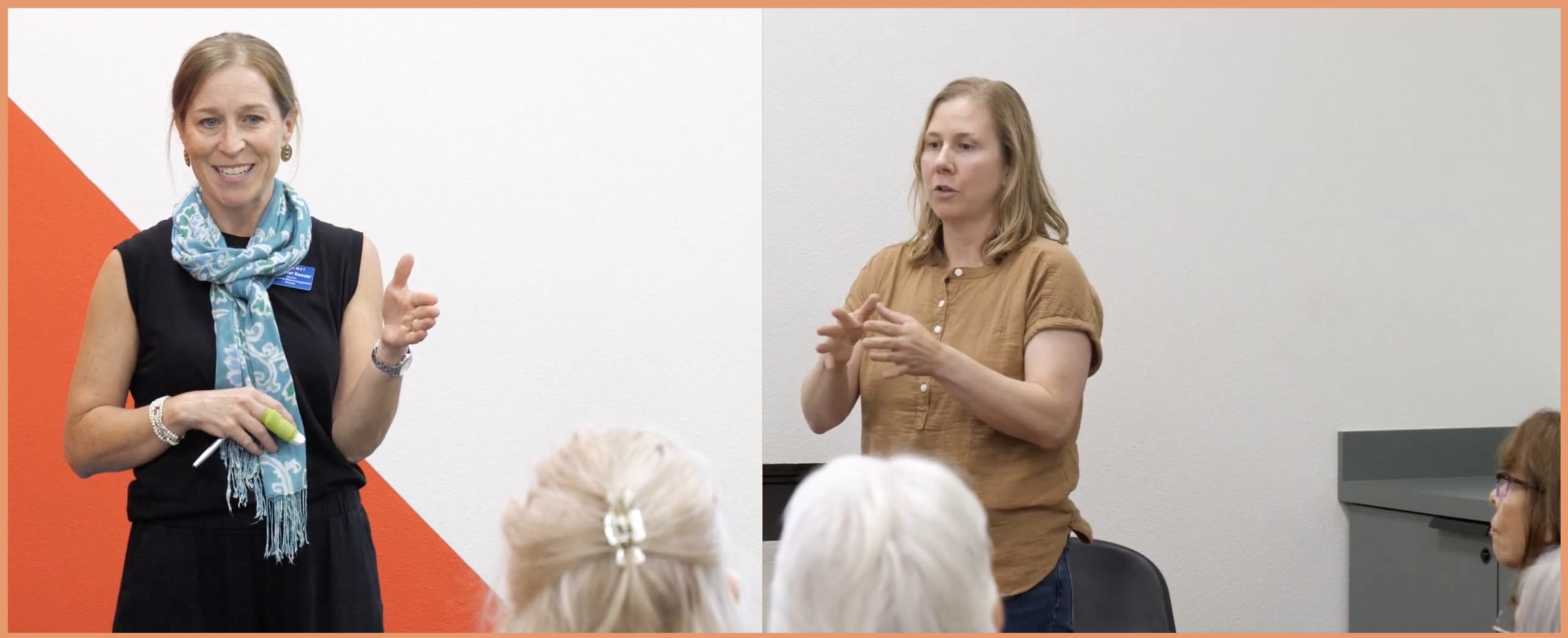
TriMet’s Jennifer Koozer (left) and PBOT’s Julia Reed at a recent meeting of the Lents Neighborhood Livability Association. (Screenshots from LNLA video on YouTube)
When I last checked in on TriMet’s 82nd Avenue Transit project, I warned that as the project creeps closer to a final design, some advocates worry the agency might decide to cut back on the quality of bus access. In a tale as old as time, it turns out some folks don’t like the idea that the project will decrease driving space on this former state highway, and opposition to the tradeoffs required for faster bus service is mounting.
Since my story last month, I’ve come across video of a meeting of a Southeast Portland neighborhood association that illustrates those concerns (the ones from transit advocates and car users) and I can report an escalation of tactics from bus activists who want to counter project criticisms.
Heated meeting
A headline from East PDX News that read, “PBOT and TriMet get an earful about ‘82nd Avenue Plan’ from Lents neighbors,” recently got my attention. Reporter David Ashton linked to a video of last month’s Lents Neighborhood Livability Association (a splinter group not officially sanctioned by the City of Portland) meeting where Portland Bureau of Transportation and TriMet staff gave a presentation that was repeatedly interrupted by questions and angry comments.
TriMet Director of Community Affairs and Engagement Jennifer Koozer and PBOT Planner Julia Reed remained calm and respectful, despite getting an earful from the crowd.
Screengrab from East PDX News article on the meeting.
After hearing about plans for new concrete center medians, one man spoke up to say: “It’s mind boggling! I mean, I’m 82 years old, and I I’ve seen a lot of changes in this city, but… how in the world are they going to get from one side [of the street] to a business on the other without having to go three blocks, make a u-turn, and come back? It’s stupid!”
“It’s inconvenient and it takes up time,” another man chimed in. “That’s wasted time. It doesn’t make any sense because you’re making it inconvenient for the residents and for the businesses.”
“Yes, it can make it less convenient to drive when you have a more circuitous route,” replied TriMet’s Koozer. “But it makes it safer for people who are walking and biking annd prevents the crashes that happen when vehicles are turning left.”
Another man then spoke up: “You guys are cutting down travel for all of us trying to get to work, pick up our kids, for the hospital… You’re making inconvenient and take longer, for what? Why should TriMet get a dedicated lane? We paid for that street over and over and over again. Now you’re taking it away?”
To which Koozer replied, calmly, “I want to think about the people on the busses. We have so many people who use 82nd to get to their jobs, to get to school, to do their shopping — to do their everyday needs… the people who don’t have the choice of using a car — this is to help make their lives easier.”
None of Koozer or Reed’s responses could change the tone of the folks at this meeting — some of whom (only the men) rudely spoke over them and cut them off mid-sentence several times.
“They they want to eliminate the cars!” one man shouted. “That’s the bottom line,” someone in the crowd concurred. “And put everybody on buses and bicycles!”
“TriMet riders are extremely subsidized per ride,” he continued. “Car drivers, with gasoline, maintenance, insurance, etc…, we’re not subsidized. So to put them ahead of us in any kind of priority is demeaning. It’s insulting.”
(Video of the exchanges at the meeting below)
I know neighborhood meetings have a bad reputation and this type of backlash to road projects is relatively common, but I was still shocked by the stuff being said and how the agency staffers were treated. At one point, an elderly man referred to a 1971 memo by a Portland City Hall staffer titled, “Disincentives to the Automobile.” “This outlines everything they’re trying to do… my buddies and I on our hot rods down on Broadway — we were some of the first casualties in [former City Councilor and Oregon Governor Neil] Goldschmidt’s war on cars.”
“So, I can’t believe that this is all just rainbows, unicorns and lollipops. This is premeditated and being done,” he contined.
Despite these disrespectful outbursts, Koozer and Reed maintained their composure. The duo had to repeatedly bat away assumptions that a decision about the business access and turn (BAT) lane was final. Reed said that decision will ultimately be a political one and we should expect it to come from the projects Policy and Budget Advisory Committee at a meeting scheduled for November 7th.
Flyer for DSA event 10/19.
Transit advocates respond
Maybe it’s meetings like these that various activists have heard about. Or maybe it’s the opposition to continuous BAT lanes that have been voiced by some business owners along 82nd. Either way, there’s organizing going on to combat these voices and ensure PBOT and TriMet hear support for a high-quality, dedicated bus lane.
I’ve heard through the grapevine that transit advocates will attend the upcoming Southeast Uplift Land Use and Transportation Committee meeting where TriMet and PBOT will present the project. That’s being held Monday October 20th from 7:00 to 9:00 pm via Zoom (and in person at 3534 SE Main St.)
And the Eco-Socialist Working Group of the Portland chapter of Democratic Socialists of America is organizing a rally to show support for BAT lanes on 82nd on the Sunday before TriMet’s next project community advisory committee meeting. The “Rally for a Safer 72” will take place on October 19th from 1:00 to 2:30 pm at Montavilla Park. Then they encourage everyone to attend the CAC meeting on Wednesday, October 22nd from 6:00 to 7:30 pm at PCC Southeast Campus.
According to DSA’s website, the Eco-Socialist Working Group, “fights for both the long-term and short-term actions necessary for a working class response to the climate crisis, focusing on transit, the relationship between labor and the climate movement, and the defense of Portland’s ecology and environment.” They canvassed 340 riders on 33 different transit routes last spring and found 57% of riders preferred increasing service over any other proposed improvement.
TriMet is about halfway through the design phase of the 82nd Avenue Transit Project. Construction is slated for early 2027.
Conference artwork by Portland-based artist Mika Rane.
If the thought of fast, frequent bus service makes your heart go pitter-pat; or if a five-story housing development above a transit stop gives you goosebumps, I have some good news: A major urban planning and transportation conference is coming back to Portland. Mpact Transit + Community, formerly known as Rail~Volution, will be four days of panel discussions, speeches, networking, and and mobile workshops devoted to making cities work better. It all happens in venues throughout Portland from October 26th to 29th.
Portland hosted the first Mpact in 1995 (and again in 1998 and 2010) when it was spearheaded by retired U.S. Congressman (and then city commissioner) Earl Blumenauer. It was 10 years after Portland’s first MAX light rail line and Blumenauer wanted to bring transit and land use advocates and insiders together to make sure the system got its first extension (which opened two years after the conference).
Mpact coming home to Portland for the first time in 1is just the latest sign of a renaissance in a city once known (thanks in large part to the aforementioned congressman) as America’s epicenter of urbanism and livable city policies.
“The 2025 conference arrives at a time when cities and transit agencies everywhere are grappling with challenges related to funding, the evolving role of downtowns and the necessity for diverse housing options,” reads the Mpact website. “As it has since its inception, the conference will highlight the interplay of multimodal transportation, housing, and economic development in creating vibrant places for everyone to live.”
Metro Council President Lynn Peterson was at that first Rail~Volution. “So much of what we envisioned 30 years ago has come to fruition here in Portland,” she said in an official statement about the event. “Our region is again at an inflection point. It is a time for big ideas and a bold vision.”
Peterson is right. Portland’s new form of government and the ongoing destruction of the federal government by the Trump regime, presents an opportunity to think differently about the future of mobility in our city.
1995 conference flyer.
If you are fluent in BRT, TOD, TSP, and LRT, and/or just care about transit, cycling, housing, land use — or any facet of transportation and urban planning — you should find a way to participate in this conference. The schedule is packed with interesting topics, speakers, and workshops — from trails in Forest Park, to transit-oriented development (TOD) in East Portland. It all kicks off with a welcome reception at Oregon Museum of Science and Industry on Sunday, October 26th.
Welcome to Monday. A bit late with the Roundup because I was working on naked ride stuff from yesterday. I hope you’ve got a great week planned.
Below are the most notable stories I came across in the past seven days. Thanks to everyone who suggested links this week!
Big win for housing: California’s governor has finally signed SB 79 into law, a groundbreaking policy that is expected to open up construction of housing units adjacent to major transit stops. (Human Transit)
Inhaler emissions: A new study found that asthma inhalers cause about the same amount of climate change inducing emissions each year as 500,000 cars. It’s unclear if the researchers considered that many of those inhalers are necessary because of cars. (Al Jazeera)
It’s a trend: Maybe this cultural moment of reconsidering our relationship with automobiles might actually stick? I mean, according to David Zipper there are three new books on the topic that are worth your time. (Bloomberg)
Smartphones with wheels: It’s hilarious to me that Big Auto is so excited about making cars feel like tech gadgets that now they have glitches just like tech gadgets. Case in point: A Jeep software update recently rendered many of them machines un-driveable. (The Stack)
E-bike rebates work: Denver, Colorado was the first city to launch an e-bike rebate program and in the past 3-4 years they’ve handed out a whopping 10,000 rebates. Portland’s program follows their lead and we can only hope it goes as well. (City of Denver)
Bike bus is rockin’: Portland’s Sam “Coach” Balto continues to transcend typical advocacy channels by luring massive pop stars onto the bike bus. Learn more about who he is and how he does it. (Cycling Weekly)
Potholes: Major e-bike news outlet uses a tragic case of an e-scooter rider in Portland to illustrate their argument that road conditions — not car drivers — are another major threat to rider safety. (Electrek)
Culture shift: “In cities that have made [bicycles] mainstream, the idea of going back to car-clogged streets is considered ridiculous.” The fact that this outlet wants to see a bike boom in cultural terms is both frustrating and welcome. (The Economist)
Get it right, media!: An unfortunate story from north of our border where the legit issue of electric vehicle safety is covered, but the imagery shows a bicycle that is almost never the cause of concern. This story should have made it clear that the “safety problem” is with e-motos and not traditional e-bikes you find in traditional bike shops (or in their lead image). (The Columbian)
Dieselgate back in court: Whether or not five automakers cheated on emissions tests and then lied to customers about how toxic their engines were, will be decided by a judge. The case is back in court and a decision is expected early next year. (BBC)