

At a press conference in Vancouver today, Washington Governor Bob Ferguson announced that the Interstate Bridge Replacement Program will finally live up to its name.
Instead of five miles of freeway expansions and seven new interchanges, the project will be phased to include just the bridge replacements and an extension of MAX light rail across the Columbia River. Also making the cut in this “core set of projects” is the shared-use paths that will give bicycle riders and walkers new connections across the river.
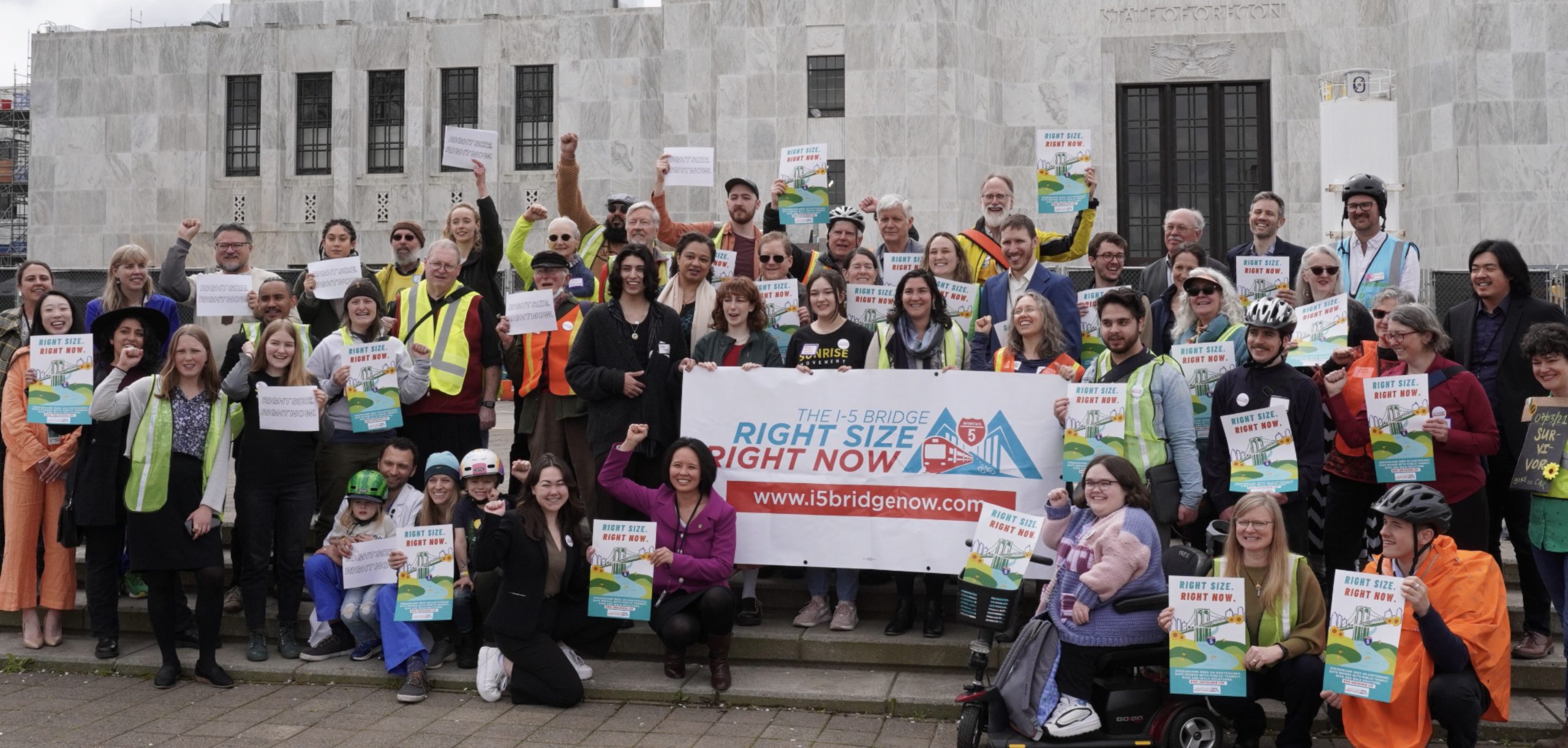
Yes, project officials have finally relented and have decided to right-size the project in the way dozens of environmental and social justice organizations in the Just Crossing Alliance have been encouraging them to do for years now.
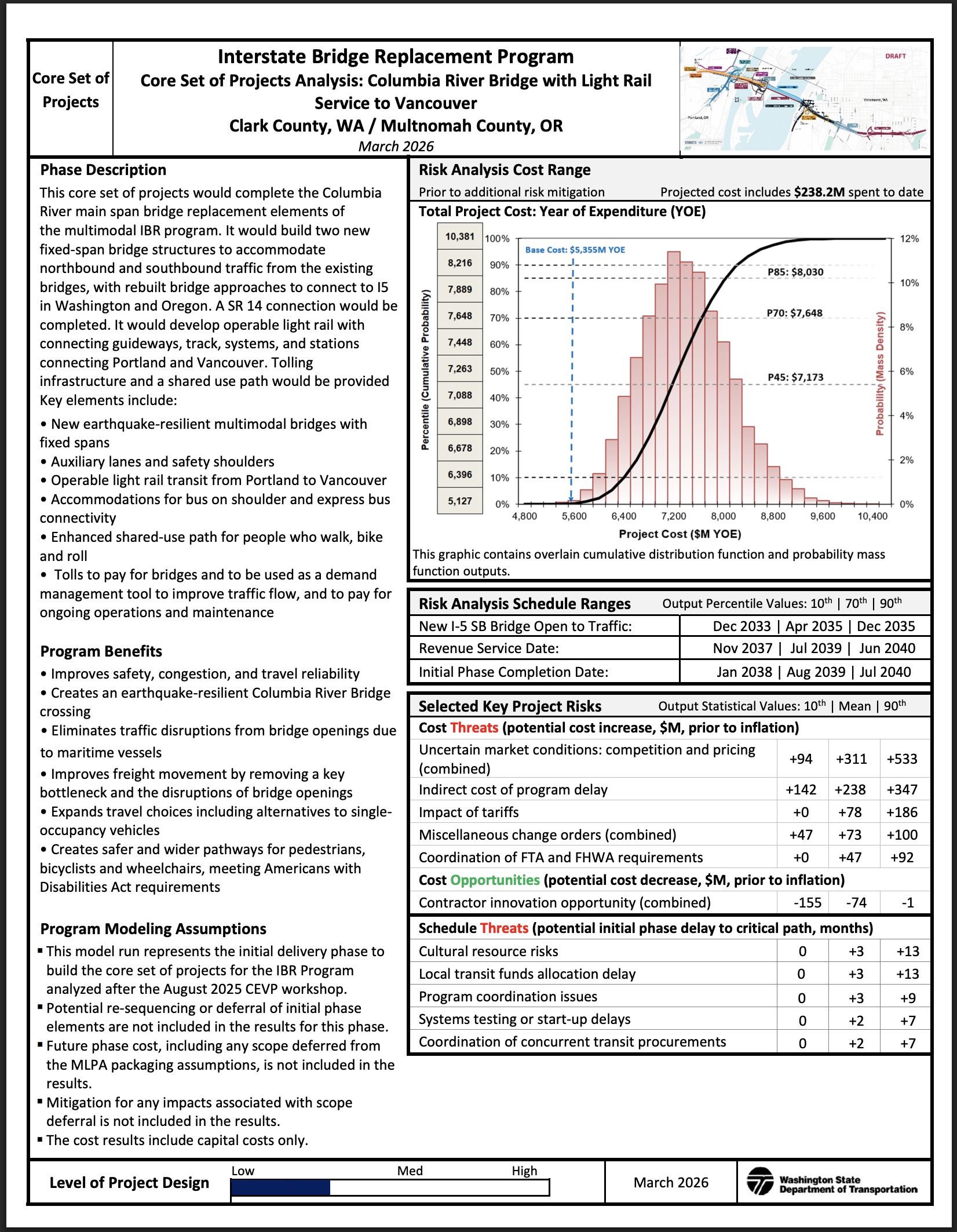
Ferguson also revealed a $7.65 billion cost estimate for this smaller project and said he’ll personally ensure construction begins by 2028. That’s still not a guarantee because the project has just $5.5 billion committed to the project so far. According to new cost estimate documentation shared today, that amount is enough for them to begin the major elements of the core set of projects.
“The first thing I want to say is we’re going to build this bridge,” Ferguson said at the outset of today’s press conference. “That’s going to happen. There’s just far too much at stake for any other option” Ferguson, flanked at the podium by project leaders, elected officials, and construction workers in helmets and hi-viz vests sought to tamp down skepticism of the project after a bombshell report by the Oregon Journalism Project back earlier this year that the full project would cost $12 billion to $17 billion.

That cost estimate, which project officials dismissed as being just a draft when that report came out in January, was confirmed by project officials today. The new, official estimate for the full, five-mile corridor is now $14.4 billion.
The full project is still on the table, but Ferguson made it clear that it’s being pushed back for now. “We will continue to work toward the larger corridor down the road, in phases, as funding becomes available,” he said.
TriMet General Manager Sam Desue was also at the press conference. In his comments he touted light rail’s first extension into Washington as opening up, “one seat ride from Evergreen into downtown Vancouver to downtown Portland, the Moda center, shopping, health care and so much more.”
Toward the end of the press conference, someone in the media asked Governor Ferguson why the project had to include light rail at all, especially since many people in Clark County don’t want it. “That train has left the station,” Ferguson replied, without skipping a beat. “I want to be clear,” he continued. “I’m not interested looking backwards. We’re building this damn bridge. That’s happening, okay?!”
Ferguson’s enthusiasm is music to the ears of IBR project backers. But he’s only been on the job for 14 months and he’s also smart enough to understand that this project has been anything but easy since it first began in 2007. “We’re gonna have good days and we’re gonna have bad days ahead,” he cautioned folks at today’s presser (which included Portland Metro Chamber President Andrew Hoan, Oregon Trucking Association President Jana Jarvis, and many others). “That’s the fact. But I just want to be really, really clear that I’m super committed to this.”
Oregon State Senator Khanh Pham, who was a supporter of the “Right Size Right Now” campaign, told BikePortland today she’s encouraged that Governors Kotek and Ferguson have taken the project in a new direction. “I hope today’s decision marks a turning point in the IBR project in which the agencies acknowledge the financial realities of our state budgets and the imperative to curb excessive megaproject spending to preserve funding for core functions of our transportation system,” Pham shared in an email. “It’s imperative that policymakers in both states continue to push back against an oversized, bloated project and demand that ODOT propose and deliver a right-sized bridge with a right-sized budget that doesn’t bankrupt our state.”


Thanks for reading.
BikePortland has served this community with independent community journalism since 2005. We rely on subscriptions from readers like you to survive. Your financial support is vital in keeping this valuable resource alive and well.
Please subscribe today to strengthen and expand our work.
this sounds good, but I have so many questions: If we are just rebuilding the bridges, does that means we are keeping the lift/drawbridge? Would that mean the immersed tube is on the table? Are the MAX and bike/ped connections being considered as part of the bridge or as separate structures?
Coincidentally, I read this article this morning: https://www.clarkcountytoday.com/opinion/opinion-i-5-bridge-replacement-project-does-not-accomplish-the-needs-of-the-project/
The one-sheet Jonathan included in the article explicitly states that the “main span” project will be two new fixed-span bridges.
I can’t understand how that would work- fixed span without new interchanges means the bridge is way too low.
The project height was previously approved at 116 by the CG, and according to today’s IBR PR post this was reinforced by a recent meeting with Ferguson. I think he means business.
116′ is not as high as the bridge when it is opened, but is A LOT higher than the current bridge. I am not sure how you get on to that bridge without rebuilding interchanges. the current bridge is at about 40′ above the river, so the new bridge will be about 76-feet higher. The MAX approach is limited to about 4% which could take around 2000′ (+/- 1/3 mile) to achieve. So maybe no exit at Hayden Island and no ramps to SR-14?
This also includes the Harbor (but not Slough br) all likely because of the new height.
That’s the original $14B project. The $7B project only includes: Replacement Columbia River Bridge, Bridge connections to I-5, Extension of light rail to Waterfront Station in Vancouver, Removal of existing bridge
Easy. Remove the interchanges at both ends. The Hayden Island interchange doesn’t need to be there, since they already decided to build a separate bridge connection to Hayden Island. The interchange with Hwy 14 on the Washington side can easily be removed, given there are many interchanges to the north and traffic can work their way down from there.
According to City of Portland and Metro land use plans, Hayden Island is planned for lots of residential and commercial development. Yes, there is a new bridge planned to connect Hayden Island to Marine Drive, but without a connection from Hayden Island to I-5, what would be the impact of this new development on the St. John’s and Kenton neighborhoods?
The SR14 interchange is also what provides access from downtown Vancouver to I-5. There has been lots of development on the west side of downtown Vancouver in the last decade. If there is no SR14 interchange, what’s going to be the impact on Mill Plain, Fourth Plain and SR500?
I don’t think it’s “easy” to eliminate two interchanges.
My understanding is that the project team has received the permits it needs from the Coast Guard to build low enough to avoid the Pearson approach. Perhaps that means that river traffic will be more restricted than it is now, but I doubt it, at least in any practical sense.
I’d love to see them keep the current bridge for bikes, Max and pedestrians while moving cars to a tunnel. According to the guy advocating for it, Bob Orbland, he says it would be cheaper. Time to reevaluate?
Until it falls down in an earthquake and blocks the river for months, if not years. It’s too much of a liability.
My theory is that libs love to be concerned about earthquake risk (oh my gersh, the big one) as a psychological defense mechanism for the poly-crisis. Here is the one fake and evidence-less crisis that we can join a NET and feel empowered about (illusion of control while our ecosystem collapses)!
An actual seismic engineering professor who used state of the art modeling:
https://www.opb.org/article/2022/12/05/some-freeways-may-be-useable-following-the-big-one-per-new-modeling-by-uw/
vs — the state of OR which used some consultant an e-Con-nw* with an undergrad degree that has nothing to do with seismic sciences writing a fluff-piece report that simply mined existing geological data and made up risk scores.
* a notorious OR consultant group with a constantly swinging door between government jobs that creates an enormous conflict of interest
What happens when there is a bridge lift? It may not be much of an issue for bikes and pedestrians, but think of the disruption to the Max trains. Bridge lifts would stop Max trains in both directions across the river. A stoppage would impact the entire Max system at least as far as the Steel Bridge and maybe beyond. A ten-minute bridge lift would likely affect the system for at least an hour before the trains got back on schedule. Getting people to use transit requires a dependable, predictable schedule. A couple ten-minute stoppages per day would destroy people’s confidence in transit.
This strikes me as nothing but good news. I still see the added auxiliary lanes as likely superfluous, but probably a necessary compromise to get the Yellow Line into Washington and largely mitigated by the inclusion of dynamic tolling.
Funny what happens when the high cost of inefficient transportation infrastructure catches up to you.
Is tolling part of the equation?! (it seems like it’s got to be, right, with that budget hole?)
From the “Core sets of projects” doc.
It is, at least as debt repayment instruments. I am under the impression that there would be some legal hoops to jump through before OR can implement a permanent toll a bridge, but I could be wrong (the bridges in the Gorge have tolls and are ancient).
When the I-5 bridges were first put in, up to the 1950s, they had toll booths in the wider part of the roadway just before the bridges, where the Hayden Island onramps are now. PBOT has the original bridge and highway plans in their archives that show the booths.
Does this mean the Columbia Slough bridge will be replaced? It currently seems like a good bridge even though it has pedestrian access only on the eastside. I don’t think it needs replacement.
That’s a good question rick. I don’t think so, but I’m not sure anyone knows for sure yet. I think the Slough Bridge and Harbor Bridge are both in fairly good shape AFAIK (neither are listed as structurally deficient). Just for reference all of these would be replaced and much much more in the original design. Here’s a video for your mind to be melted into ecstasy if you’re a traditional traffic engineer.
Even the Portland Harbor bridge is not included in the scaled-down project as far as I can tell.
This has been coming for so many years now… You can’t just spend forever on inefficient infrastructure.
I hope Metro, ODOT, or PBOT will figure out a way to build a local access bridge from Marine Dr to Hayden Island. That would help traffic and connectivity in this area tremendously.
It’s about damn time. Unnecessary freeway expansions aside the cost was always ridiculously prohibitive. ODOT has really failed the state once again by dragging this process out trying to shoe-horn in a massive expansion. How much money could we have saved if they just built the bridge like we asked them to? See also the Rose Quarter expansion and their decade of lies about its cost and utility.
The light rail portion in the initial phase only extends to the Vancouver Waterfront station. I am curious how this will connect with C-Tran’s bus and BRT system, and what the expected ridership from that station will be.
I’m guessing that it’s still possible for light rail to expand from the north end of the bridge, but that’s beyond the scope of this particular project.
The beauty of BRT is that buses can drive on existing streets. Surely they can just extend the Vine Red and Green lines a few blocks to an already-built MAX station. The Vine mostly runs in mixed traffic anyway. And they can spiff up the end of the lines as a part of the new Blue Line project to WSU Vancouver. Vancouver will want to improve transit access to the new waterfront developments anyway.
Here’s a crazy idea, put bus (and emergency vehicles) only lanes on the new bridge nixing the need for a multi-billion dollar train, and have C-Tran go to the Expo Center (or nearby location) and have their riders get on the Yellow line? Accomplishes same thing without the monumental waste of money adding inflexible MAX to the bridge.
What’s the difference which side of the bridge riders get on the MAX trains at?
I assume buses could also use the MAX lane, as is the case with Tillikum Crossing, so the current C-TRAN routes into Portland could bypass traffic jams and perhaps get riders to their destinations more quickly. But I would be in okay in principle with a dedicated transit lane that is track-ready but simply paved for buses at first. But I doubt that that would reduce the cost very much.
CTRAN is in the process of building a new BRT line that runs from the Waterfront to the WSU Campus.
The Vine on Highway 99
I love the fact that, in response to the question about light rail, Ferguson basically told the naysayers to shut the f*** up already. Light rail to Vancouver is happening. Get over it.
This announcement is a big deal in that – finally- they’re acknowledging it’s not about increasing auto capacity, it’s about building a bridge that will accommodate the projected future of transportation across the Columbia.
Sure, and the constructions companies won’t profit off of building an outdated and inflexible mode of transportation that Clark County doesn’t want. Yeah, that’s how to make friends of your neighbors by cramming garbage down their throats. TriMet can’t even afford to maintain its current failed MAX system, and we have to add even more?
Just remember, Oregon has no laws limiting the profit a company can make off of a taxpayer funded project. So having already rich companies making 10, 15, or even 20% profit is ok with you as that’s exactly what they’ll be taking home? Let’s pretend they make 15% off that $14.4 Billion project . . . that’s $2.2 Billion in profit. Obviously, you’re ok with that kind of waste.
It really is unfathomable the idiocy in Salem and Portland and how our politicians are bought and paid for by the rich.
It’s 7.6 billion for the bridge, rail and bike connection.
Duuuude take a breath. Look north. Link shows how you build good light rail and how much demand is there when the service is useful and well connected.
C-Tran is already running successful frequent/BRT-Light busses in the Vine System (equivalent to FX2, or the Letter Lines in King County Metro’s system). They will be able to serve the connection at the waterfront with some modifications.
Long term, yes, MAX needs upgrades. Especially the section that will connect to Vancouver. Ideally they need to get rid of the surface running alignment on Interstate. Link has shown that elevated running makes sense in this context, we could keep it aligned with Interstate before sending in into a new downtown tunnel. A tunnel that is desperately needed as the bridge crossings are ancient, slow, and seismically unsound.
MAX’s basic issues are that it was built in the 1970s with a very suburban ridership mindset. It’s not built for urban high density uses, or fast interurban service. We likely need to work on both parts of this compromise to make it work well again.
As opposed to the mentally ill pickup truck drivers with Washington plates endangering my family’s lives by using my neighborhood as a cut-through in a bid to save 30 seconds on their 2-hour commute back to Ridgefield.
We get it, you don’t like MAX, but calling it ‘failed’ is such an unproductive hyperbole.
If the choice is between planning for a transportation future that’s not dependent on single occupancy vehicles, and “making friends with your neighbors,” that’s a no-brainer for me. The whole “cramming garbage down their throats” dog whistle gets trundled out by the Clark County opposition like clockwork. As someone who taught middle school for 30 years, I know that giving petulant 13-year-olds (or adults who act like them) what they want because of how loudly they complain rarely works out to anyone’s benefit. They also don’t want to pay tolls. So what? As a matter of fact, they have a shameful history of not wanting to pay for the bridge at all; their opposition to paying a share of the original Columbia Crossing in the Washington legislature in 2013 is a big part of why we’re now looking at a trimmed down bridge plan that’s still more than double what the Columbia Crossing would have cost. https://www.seattletimes.com/seattle-news/state-senate-deadlock-kills-columbia-crossing/ That argument was also about the inclusion of light rail (or at least that was the excuse they used). Personally, I’d love to see tolling rates based on what amount of money it will take to convince enough Clark County commuters to take light rail so that every rush hour train is full. That might also include raising the price of parking in Portland and creating more metered parking zones. I’m all for using the new bridge to socially engineer less single-occupancy commutes across the Columbia.
And as for equating profit with waste, C’mon. I’m not going to build the bridge. I assume you’re not either. The number of companies that have the manpower and expertise to build an interstate bridge across one of the largest rivers in the world has got to be a pretty select group. the 7.65 billion isn’t just for concrete and steel, it’s paying for expertise in a rarefied construction field. Of course whoever gets the contract deserves to make a profit on a huge multi-year construction project that employs thousands of people in living wage jobs.
Dude you have quite the fantasy if you think you’ll be able to coerce folx in the Couv to ride Trimet into Portland by having tolls and making driving more and more inconvenient. Ignoring that significant amount of bridge traffic is transport of goods and people traveling through the region during interstate travel.
Except for maybe a Blazers game (if they are still here once the bridge is complete), most people in the Couv don’t visit Portland to hangout nor to do their weekly shopping. Those that must come into Portland for work aren’t about to ride the bus to the downtown waterfront, to wait for the Max, then potentially have to catch another bus or walk 10-15 mins to their office.
Maybe Portland voters should have made alternative choices rather than running people out of town due to high taxes, rampant homelessness, and other ongoing problems if their goal was to limit car commuting.
“Those that must come into Portland for work aren’t about to ride the bus to the downtown waterfront, to wait for the Max, then potentially have to catch another bus or walk 10-15 mins to their office.”
First, you lack imagination. There are many other scenarios that don’t involve the bus, or waiting or (gasp!) walking 10-15 minutes.
Second, if the tolls/parking/gas are expensive enough, and the congestion slow enough on I-5, you might be surprised what commuters will do. Millions upon millions of commuters around the world ride trains every day without any yearning to hop in a car.
I can think a few options
1. Threaten to quit if one can’t work remote Company caves for those essential.
2. Move out of the region to a hotter job market.
3. Don’t move and hire on a different job that is in the Couv or allows remote work.
4. Retire
IDK I still think that the transit network needs a lot of improvement before expensive tolls are anything but just another expense that people begrudgingly pay. I’d wager most people going across the bridge probably aren’t driving to downtown Portland, even in its’ heyday and (hopeful) next iteration. I think the ‘interstate commerce’ thing is a bit of a red herring in these discussions but tons of daily commutes are suburb to suburb. Jobs are spread all over the area. There’s just too many transit commutes that would involve 2-3 transfers to make it work out for people.
The bridge should be tolled but only to pay for its’ construction & maintenance, not as a punishment for people who don’t want to quadruple their commute time.
Agree that transit needs improvement. And about the interstate commerce red herring. I do know that when I cross over I-5 on my bike in NoPo during rush hour, the freeway is absolutely jammed with bumper to bumper single occupancy vehicles with Washington plates, and I assume they’re not shoppers or tourists.
Honest question for whoever is reading this. If taking Max was a faster and cheaper way to get to work from Clark County, would you still drive?
Including, presumably, time and effort door-to-door, including things like stopping at the grocery store or picking up the kids on the way home.
I’m interested in what other people say, but I presume that many of the folks for whom CTran is faster and cheaper are already using it, and if some of those trips are replaced by light rail, the population of users will adjust accordingly.
To my mind the major difference between C-Tran and Max is that Max will never get stuck in traffic.
C-Tran also works like an express service, and may be more convenient on the Vancouver end.
I’m not trying to pit C-Tran vs. Max; I only wanted to say that I do think people will take either if they’re faster and more convenient, but that for most people, the trip involves a lot more than the actual ride.
Finally, some good news!!
Maus reckons they “relented to advocates.”
Yeah nah — they relented to the spreadsheet, mate.
Funny how it’s all kumbaya until the price tag jumps from $7.65B to $12–17B… then suddenly it’s “core project,” “phasing,” and a bit of creative trimming. Love that for them.
Not a values shift — just a budget reality check with better PR.
Hang on just a minute: Is it possible that Ferguson is pulling an ODOT?
“Pulling an ODOT” is starting a project knowing it’s underfunded but counting on the fact that “emergency” funding will have to be granted halfway through, just to finish the darned thing. The key to “pulling an ODOT” is low-balling the initial project cost to make it palatable to decisionmakers.
I say this cuz the higher bridge design will necessitate all new connections. So while Ferguson may say, “We’ll build just the bridge,” building the taller bridge means an entire rebuild either side of the bridge.
Yes. They are not “right-sizing” the project, they are merely “phasing” it. They are not changing the Supplemental EIS to be a smaller project, and they say they are committed to the full bloat, once more money is available. This is a concession to the fiscal reality, not a change of values or a change in direction. Legislators need to send a message that no more general fund money will be pledged to pay for cost over-runs on highway projects, and the money stolen from ODOT’s non-highway budget needs to be repaid, not stolen again.
That’s exactly what this move is. Jonathan should reach out to Joe Cortright at City Observatory, because the entire premise of the fixed-span segment is that you will need to rebuild all 7 interchanges due to the much, much higher span.
ODOT continues to try to low-ball and then pull the rug out from under us.
Hey RJ,
Yeah I saw Joe mention that today. I’ll look into it.
Phasing is VERY common in WSDOT-land. It lets key, often high cost, sections of projects get built quicker.
The largest one to date, iirc, was/is rebuilding I-90 through the pass. Getting the snow sheds replaced (and ultimately value engineered to be mostly bridges with snow flowing under the roadway) was only part of the total project. Other very expensive phases have widened to three lanes eastern sections, repaved others, and installed in bridges and overpasses.
Similarly the much maligned 167 completion and 395N expansion projects were phased to get the ball rolling and spread out the risk over several legislative sessions/funding bills in Washington. It’s good politics as it does allow WSDOT or the Leg. to walk away from projects if the economy tanks, and then pick them up again a decade later (395 for instance) if the need really does show up/local political pressure requires it.
Common – and dishonest. It needs to stop.
Alright, but phasing is also what got the 2 Line partial service on the east side of the lake between southern Bellevue and downtown Redmond, which has been operating in revenue service for over a year now. It’s relatively pennies compared to the cost of construction, of course, but the point is you start getting utility from what you’ve already built ASAP. It’s obviously kinda tenuous, given that most projects need a full build-out to really function, but if you have partial projects that can still be useful, there’s every reason to phase things in like this.
Of course in this case, the correct move is to realize that further “phases”, composed almost solely of highway bloat, are completely superfluous wastes, and then not build them. We definitely can’t count on ODOT to be rational about that, but it’s not an impossibility.
It sounds to me that the IRB project has become “Too Big To Fail” and that WaDOT and ODOT between them have found a federal mass transit bridge fund to draw funds from to fill the gap in funding – no transit and the bridge simply becomes unaffordable in any configuration – and to complete the bridge at minimum cost requires the plainest and most boring of designs.
14.4 Billion for a dumb and unnecessary freeway bridge or Medicare for All.
14.4 Billion for a dumb and unnecessary freeway bridge or billions for transit.
14.4 Billion for a dumb and unnecessary freeway bridge or billions for high-speed rail.
14.4 Billion for a dumb and unnecessary freeway bridge or hundreds of miles of protected bike lane.
When I look at libs/progressive who support spending 14.4 billion on a dumb freeway bridge and car-brained republicans who want to build a bigger dumb freeway bridge I struggle to see much of a difference.
While we’re at it; two days of bombing Iran or all the things you listed AND a big dumb freeway bridge. Good thing our zogged out congress is looking out for the people of Israel.
“Good thing our zogged out congress is looking out for the people of Israel.”
Pathetic and ignorant comment that has no bearing on the discussion. I’m guessing you’re one of those who think our congress was “hypnotized” by the Israelis or perhaps bribed with baskets of diamonds into doing their secret bidding?
You are absolutely correct because congress had nothing to do with Trump and Bibi’s war of choice.
Congress didn’t do Israel’s bidding , they weren’t asked.
Trump did this all by his little self.
The branch of government specifically empowered by the constitution to decide war-time powers not only allowed their great leader to wage illegal war but cheered them on.
Lol talk about pathetic and ignorant. Let me guess, criticizing AIPAC is anti-semitic?
The fact that we’re giving Israel billions of dollars to enact their far-right agenda of genocide and territorial dominance absolutely has bearing on the discussion. If our government would stop shoveling money toward forever wars we wouldn’t be fighting over scraps for infrastructure at home.
Roughly 188 billion (with a “b”) to Ukraine since 2022 and a little over 33 billion (again with a “b”) to Israel during that time frame.
Do the math and ask yourself why you are blaming the Israelis for draining our coffers by defending themselves when the Ukrainians have been given over 5 times as much to defend themselves.
Also, this is a tiresome argument as there is no genocide going on and if you can explain why there is in your own words I will be impressed.
Forever wars are bad as is our funding of them and they are also burning all over the globe.
The Iranian theocracy has seen itself as being at war with the US for 47 years, has killed roughly 600 US soldiers in combat, countless civilians and 10s of thousands of Persians.
War is indeed horrible.
The Gazans have been trying to eradicate the Jews since the Gazans conquered the area in the early 700’s. They blew their chance to finish the job in 1948 when 5 countries invaded Israel and lost. Those neighboring countries would invade twice more and lose and the Gazans conducted multiple intifadas including using women suicide bombers and still Israel withdrew and left them to their own devices. Too bad Hamas chose forever war.
Middle Easterners have a different sense of time than we do. Events that happened centuries ago are passed down and remembered to this day. I’m not sure you quite understand the depths and breadth of what forever wars are.
There is simply no productive discussion to be had if you genuinely believe that the mass murder in Gaza is Israel simply “defending themselves”. Yes, the history is nuanced and complicated but that does not undo or justify this genocide unfolding right now. I sincerely hope that you can come to see that.
Have a nice day.
So you’ll only have a discussion with people who already think as you do and believe the same things as you? And seriously, mass murder? Of who, the Hamas soldiers? Anyway, have a good day.
If you are concerned about the rather legalistic question of “is it genocide”, I’d highly recommend listening to this:
https://www.nytimes.com/2025/08/13/opinion/ezra-klein-podcast-philippe-sands.html
My conclusion after listening is that it’s not really the right question.
Would have been so much cheaper to have built it the first time, instead of talking it to death.
Pretty amazing huh.
Here we elect our public officials to go and make the difficult decisions for us, not to create committee after committee. Not to consensus build. Not to do surveys. Not to do . . . well you get the idea.
It’s almost like they are afraid that they’ll be voted out of office for doing their job.
I needed something not awful in my life – this’ll do nicely!
We would save even more with a tunnel. Time saved, money saved, disruption to river creatures saved, lives saved because no steep ups/downs/curves on ice etc. The rest of the world is building tunnels because it is a better long term vision. This new news is a baby step in a good direction. Sadly Greg Johnson and Kris Strickler are still on the PERS gravy train and we will pay for their lies for decades.
I agree Joe! For starters, a tunnel would mean we would not have to pay $140 million in mitigation fees for impacts to river-based industries due to the low height of the proposed bridge.
Do you even know why ODOT thinks a tunnel won’t work?
Because they don’t have any friends or family members who own tunneling companies?
This is my understanding: The design team concluded it was not feasible because it didn’t connect directly enough to SR-14. The connections introduced out-of-direction travel for freight and transit. It doesn’t look like they studied an immersed tube tunnel with keeping the existing bridge(s) for bike and transit. If no connecting to SR-14 is a deal breaker for a tunnel, is it also a dealbreaker for just building the bridge and not the interchange?
I like the idea of a much simpler bridge replacement project. I think the project would benefit from not trying to be everything for everyone. If we just need through lanes, a tunnel might be great. A separate bridge for bikes/peds/transit that connects Hayden Island with Downtown Vancouver seems a lot more desirable than adding that to a freeway bridge. Maybe local freight connection to the freeway are handled by improving frontage roads or connection to I-205?
“is it also a dealbreaker for just building the bridge and not the interchange?”
Not if they think they can build it later.
The bigger vision isn’t dead, it’s just being phased.
I agree with you, but I am disappointed about it
Wasn’t this going to be a $4 billion project 10-12 years ago?
At least there will be bike lanes when this is finished in 2057! I’ll be too old to ride, most likely dead, but I bet that they will be just swell. Hopefully, those lanes will be wide enough to accommodate all of the 80MPH electric bikes and mobility scooters of the future.
This is qualified good news. It seems that Gov. Kotek was not at this press conference…? Or not visible at least. I know transportation funding is a sore issue politically in Oregon right now…she may just be letting Ferguson have the visibility for the time being. It would be interesting to know her perspective, however. Like others on this thread, I do wonder how a high bridge could be built without rebuilding at least a couple interchanges. Hayden Island would need a local bridge if the interchange is eliminated, and SR 14 likely needs something.