
Publisher’s note: This essay is from Southeast Portlander, former PPS School Board candidate, and Bike Bus PDX organizer Rob Galanakis. Last we heard about the Bikeable Portland plan it was being considered for funding amid a special allocation from the Portland Clean Energy Fund. It was not chosen for funding, but backers plan to re-apply for PCEF funding at a later date. You can learn more about the plan via a presentation from its creator, City Bicycle Coordinator Roger Geller, at the monthly meeting of the PBOT Bicycle Advisory Committee on Tuesday, March 10th.
City leadership is largely united on a goal: make Portland the most livable city in the United States. And though it doesn’t always feel like it, there is broad agreement on how to get there: more housing, more jobs, more transit.
And more biking.
You and I and endless “beautiful PDFs” already know why getting more people riding is essential. What I’m here to explain is how the Bikeable Portland plan from PBOT does that. The plan seeks to boost ridership by activating people where they are: in their neighborhoods. It would fund ride organizers to go door-to-door, help them get riding (again or for the first time), and invite them on regular rides. There’d be minimal infrastructure built — just enough to stoke the flames being lit by those organizers and to get bicycling back into the headlines.
“My initial response was unapologetically harsh and expletive-filled. But I’ve come to believe, enthusiastically, that the plan provides our best – perhaps only – lever to get more people riding quickly.”
I’ll admit, it took a lot of discussion and consideration for me to come around. My initial response was unapologetically harsh and expletive-filled. But I’ve come to believe, enthusiastically, that the plan provides our best – perhaps only – lever to get more people riding quickly.
Bikeable Portland is focused mostly on the “social infrastructure” of our bike transportation network. If done for the wrong reasons, this is destined to fail, like sharrows on a 40 MPH road. But the plan’s reasoning, rationale, and practicality is sound.
This does mean we have to take a bit of a detour to understand why the plan will work. We’ll put Portland infrastructure and ridership in context, look at the role Bikeable Portland can play, and see why it sets us up for Portland’s next chapter in livability.
Portland’s Greenway-focused bike network
There are two globally unique aspects of Portland’s bike scene: our culture, and the fact that we created a bikeable city while building little hard infrastructure (off-street paths, Protected Bike Lanes (PBL), and diverters). Instead we lead on neighborhood greenways. We have a much higher proportion of miles of greenways to protected bike lanes than any other city.
Greenways are much easier to create than a protected or off-street network. Find a low traffic street, paint some wayfinding, change some maps, and voilà, you have a new greenway. Add some signals to crossings as funding becomes available.
The problems here are obvious:
- Greenways don’t pass through commercial areas, where people want to be.
- Greenways wind and detour instead of being direct.
- Signal timings are often slow when crossing higher-traffic streets.
- Greenways are undiscoverable unless you’ve been educated about them.
These are well-illustrated on our Micoromobility Dashboard, which shows trips counts on commercial corridors like SE Hawthorne similar to parallel greenways. Greenways are simply less practical for unfamiliar riders.
That said, Greenways have some major benefits:
- They can be extremely pleasant.
- They are extremely safe.
- They allow more social, side-by-side riding.
- They can be relatively cheap to create and improve.
The problem with “if you build it, they will come,” is that you need to build a network. And right now our protected bike lanes on their own do not form a network. In fact, there are very few places they even intersect. Greenways, because they are undiscoverable, don’t augment our protected network for most people.
Diagnosing the decline of ridership
If we’re going to turn around the decline of biking in Portland, it’s useful to know why it declined in the first place. PBOT’s Bicycle Coordinator Roger Geller has research and diagnosis from last year that is well-sourced and evidence based:
- Bicycle ridership, in both absolute numbers and as a percentage of trips (mode share), has declined since peaking in 2014/15. Areas of Southeast and Northeast Portland had well over 20% of commuters riding bikes to work.
- Trends on the street in Portland (declining bike mode share, rising overall traffic deaths) largely mirror national trends. These trends pre-date COVID-19. That is, “drivers are acting crazy post-COVID” is both true (and may explain part of the rise in non-cycling traffic deaths), but it obviously cannot explain the decline pre-2020.
- Portland has built many miles of protected bike lanes and neighborhood greenways. The physical network is better than in 2014.
- Riding a bike in Portland has been, and remains, statistically very safe. Our greenways in particular almost never see fatal crashes. However the comfort of many greenways has likely gone down, given larger vehicle sizes and more car trips.
- The Central City, where most of our bike infrastructure and ridership was, has seen significant population turnover, with an influx of residents who chose to drive. This both eliminated people with greenway knowledge, and also put more cars on our greenways, which are often convenient cut-through streets.
Given what we know about greenways, this ridership decline is easy to understand. What can be done about it?
Bikeable Portland is “educating by doing”
Bikeable Portland has been called a “marketing” plan for biking. And in a sense it is: bikes are an incredible product, and Portland has a good network to use them on, but we need to help people learn how to use the product on that network.
That’s really all there is to it: Bikeable Portland is “educating by doing.” Get people onto bikes, help them learn the network to get them where they need to go, give them the information and skills necessary to continue biking. Everything in the plan is designed to get more people onto bikes. The coaches, the wayfinding, the street paintings, the evaluations, everything.
Greenways require minimal hard infrastructure, but because of their inherent limitations, they require more social infrastructure. When we spend money on hardening a buffered bike lane with curbs, we expect more people to use it, because they will feel safer. But greenways also need hardening, but instead of pouring concrete, we’re pouring knowledge, skills, and culture.
There is reason to be confident this will work: this is exactly what the Bike Bus movement in Portland has been doing. At schools with sustained effort and existing infrastructure, bike mode share has grown massively. Similar work has been going on in different communities through various non-profits. Bikeable Portland scales these concepts up to the city level. We can (and will!) debate the tactics of what interventions in the plan are most effective, but it’s pretty clear that an investment in the “social infrastructure” of biking will increase ridership.
Whether that can be sustained is a different story.
A Bikeable Better Portland
How do we make sure the gains from Bikeable Portland are sustained and expanded, and we don’t fall right back into the current baseline?
Ultimately, transportation isn’t that complicated: most people will make the choice that is least expensive for them, where “expense” is some combination of time and money. As a society, we’ve spent a massive amount to subsidize and externalize the cost of driving to make it seem cheaper and faster than alternatives. This has put us all on the road to financial and ecological ruin.
As a City, we have limited ability to change this. Undoing the damage of urban freeways, for example, is far beyond our own resources. It will take decades of effort.
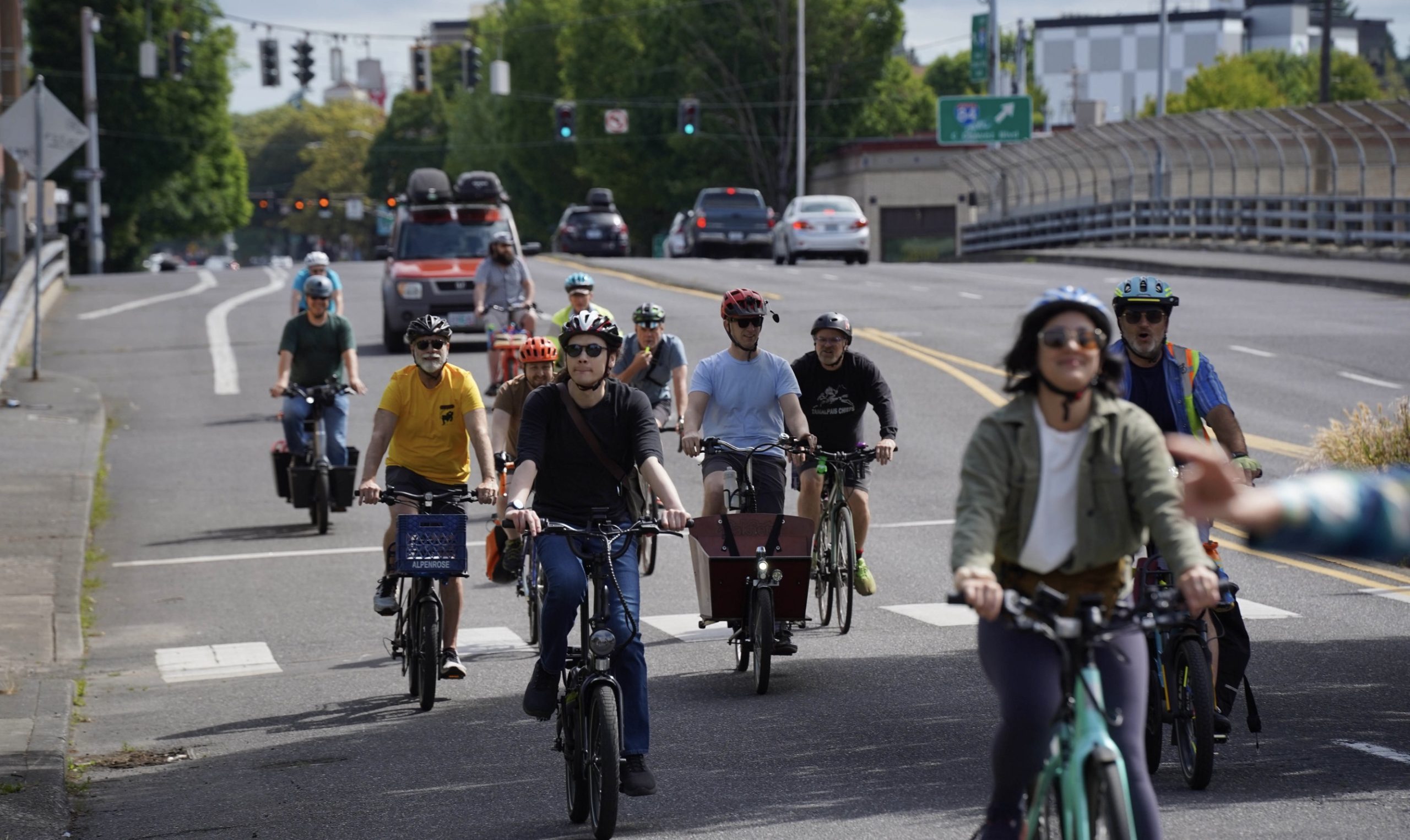
But, as a City, we can do a lot more than we’ve been doing. We could have built out a full protected network in the last 10 years. We could have installed dozens of miles of bus lanes. When we decide against putting bike lanes on a commercial street or force buses to sit in traffic, these aren’t financial or practical decisions. These are political decisions.
Getting more people on bikes through Bikeable Portland has a direct impact on City goals, like reducing emissions. But more people on bikes changes the political environment that has resulted in Portland moving backwards on many of its goals. This isn’t necessarily about changing who we elect, but creating the environment where electeds have more confidence in taking a swing on transportation policies that are sure to ruffle feathers before they’re accepted and appreciated.
Or put differently: spending $6-$9 million (there’s no formal ask on the table at this time) on Bikeable Portland makes it more likely we have the political will to spend another $6 million on hard infrastructure. Getting more people on bikes, quickly, will get an infrastructure network built faster than just spending directly.
I don’t know yet where this money will come from. But I do know, and the evidence is clear, that nothing we could spend this amount of money on – no bike lane, no diverter, no bus lane – will go further to advance our City’s transportation goals than implementing Bikeable Portland, to leverage the investments we’ve already made and strong culture we’ve created. If Portland needs to transform from the “City that Plans” to the “City that Does,” if we’re going to be the country’s most livable city, we’re going to need Bikeable Portland.
Thanks for reading.
BikePortland has served this community with independent community journalism since 2005. We rely on subscriptions from readers like you to survive. Your financial support is vital in keeping this valuable resource alive and well.
Please subscribe today to strengthen and expand our work.
I think you overlooked a couple of greenway problems:
I don’t doubt that clever marketing can trick people into riding bikes, but unless we address the gaps in our network, it will not be sustainable. I can see that this may build some political pressure for better bike infrastructure, but I think it could just as likely fail when people get frustrated by the gaps, pinch points, and dangerous spots. This seems like a big gamble to me, and not a good use of limited funds or PBOT time/effort. If a non-profit wants to fund this, I think that’s great. PBOT should focus on delivering infrastructure.
What greenways are you riding where there are “no safe crossings at arterials/busy roads”? I ride greenways all the time and find that all the crossings work just fine.
“Wayfinding is poor” Are you getting lost a lot?
“high risk from cross streets” Really? “High Risk”. Not in my experience. Where are you experiencing high risk? As article noted, [very] limited crashes on greenways so whatever risk you’re experiencing is not translating into actual harm.
Perhaps you’re overstating some minor issues a bit? They don’t seem to be deterring the many families, kids, adults, seniors, etc that I see riding on greenways all the time.
I was hit and run by a driver blowing a stop on a greenway my first week in town.
Cars use greenways as cut throughs because of the lack of diverters, drivers never come to complete stops on the side streets.
The way finding absolutely sucks in north/northeast as the greenways snake back and forth between streets, it’s even worse at night.
I hate greenways.
It is absolutely true that greenways are not much safer, if at all, vs. any other streets. I routinely see drivers on greenways speeding, passing unsafely, turning without looking, rolling through stop signs or ignoring them outright. I’ll never forget biking west on Ankeny and watching a driver just blow through a stop sign maybe 20 feet in front of me, racing across Ankeny going at least 40 mph. Didn’t even slow down.
I caught him waiting at Burnside. He told me he was “late for an appointment.”
Paint and plastic wands are a joke. I’ll say it till I’m blue in the face: The only things that reliably slow drivers down and make them pay attention are things that could damage their cars.
That means concrete and steel, in the street, e.g., those large, round concrete planters.
People drive like oblivious, entitled assholes for one simple reason: Because they can.
Until we’re able to acknowledge that fundamental fact, anything we do in the name of “safety” is just window dressing.
I have numerous close calls on NE Going and SE Ankeny. My friend’s office is on the Ankeny Greenway and he says says close calls are a daily occurence. The N Going Greenway is almost impossible to follow and lacks safe crossings, the 70’s Greenways is tough to follow and has terrible crossings. Trying to follow the SE/NE 41st route in the dark is difficult, even after riding a bunch of times during the day. I am not overstating. True, I haven’t been hit and I have alsways found my way, but I have gotten off course a bunch of times and I regularly have close calls with people running stop signs or creeping through and not seeing me on a bike.
Maybe your experience is different. Do you ride a t night? Do you ride in the rain? Do you ride for transportation, where efficiency is critical?
Maybe a fair statement is that some greenways have problems and some are great. My experience is closer to Steve’s (and I do at times ride in rain and at night, almost exclusively for transportation), but I don’t often ride on the greenways you listed.
If I were to prioritize, I’d start with making difficult crossings easier, and go from there.
Were the conditions you’re describing better 10+ years ago?
Nope! Just a couple of weeks ago I had 2 cars fully run their stop signs across Going within a quarter bock of me. Within the last year I has someone tailgate and honk at met on the Concord Greenway. Crossing 24th?wesstover on the Flanders Greenway is regularly fraught for me and pedestrians/joggers I see. I don’t need to tell you a hundred stories of close calls and dangerous conditions. Its fine if you don’t believe me, but my experience are real, regular, and reflect the reasons why a lot of my friends and neighbors have stopped riding and do not let their kids ride. Its mostly fine, and I keep riding, but it is not good enough. PBOT know how to make it better (diverters, daylighting, removing parking spaces or turn lanes to make bike connections, etc), but they don’t do it because it upsets drivers. The system in its current condition is bad enough to turn off a lot of riders. Despite my frequent criticisms, I am huge booster of cycling in Portland- I have taken a dozen people on their first rides- but people tend to give up when they navigate on their own and have a close call or encounter a dead end or a gap.
I’m not trying to deny your experiences. I have the same. Last year I was in Bike Portland because a driver was honking at our bike bus, and when I went to cork and deescalate, he got out of his car and assaulted me. You’re preaching to the choir.
What I’m asking is, given material conditions were at best the same, and in many ways worse, 10 years ago, but absolute trips and mode share was much higher, how certain are you that there aren’t significant gains to be made outside of improving infrastructure (which we will continue to do in any case)? What makes you certain? How would you test those assumptions?
I am not certain, but I have seen evidence of people giving up on cycling because of these gaps and sketchy safety things that PBOT does not address. I have also not seen evidence of PBOT being able to deliver marketing very well. This idea may be somewhat effective, but I don’t think PBOT can deliver it, and I don’t think it will move the needle long term if PBOT continues to ignore safety issues.
100% agree. People do give up because of this. PBOT cannot deliver “marketing” well. It won’t move the needle long term if we ignore safety issues.
What should we do? Is the status quo working? Is there value getting more people riding? Can we accomplish our goals without getting more people riding?
I ride for everything, year-round, in all weather and all times of day.
I ride Ankeny and Going often. I never have what I would describe as a “close call”. “Impossible to follow”? Really? Do you get lost often?
Is everything on Portland’s bike streets perfect? Of course not. But it’s really good. What I typically experience riding around Portland is pleasure and joy.
Perhaps our riding styles differ so much that you’re somehow having “numerous close calls” while I’m experiencing joy. Or perhaps we have different perceptions of what constitutes a “close call”. But, the riding experience you seem to be having is nothing like the riding I experience I have–and observe many others experiencing, too.
lucky you! I don’t get lost often, but I am mostly riding routes I know well and in the day. I do get lost trying to follow greenways I am less familiar with in the dark and rain. Dismiss it if you want, but the wayfinding is not functional at night, and many of the routes or pretty tortured and counter-intuitive.
Here’s a tip that works for me: forget about the designated greenways and follow your intuition and sense of direction.
that is fine for me. Getting lost is ok for me too. My point is that the infrastructure is lacking and frustrating for someone with decades of experience and who cycles thousands of miles yearly. It is not bad enough to deter me, but it certainly is bad enough to deter many people. That alone is not terrible, but PBOT/Geller going around trumpeting about how great the network is and how we just need some marketing is not a workable solution. At a minimum, we need a bit of honesty about the shortcomings of our system and how we are going to address them.
Is it? Ten years ago, the infrastructure was good enough to support 7% ridership, but now it’s only good enough to support 3%. That’s the basic conundrum that the infra-bros need to contend with.
Infrastructure can always be improved (and I hope we do just that), but there isn’t much evidence that its the reason Portlanders aren’t riding in greater numbers, especially on routes like Clinton that are quite good.
Steve, there are plenty of awful greenway crossings at busy roads. I invite you to cross NE MLK on the NE Bryant greenway, or NE 57th on the NE Klickitat greenway, or SE Divison on the SE 77th greenway, or SE Powell on the SE 79th greenway, or SE 28th on the SE Ankeny greenway, or… I could go on but hopefully you get the point.
To me, it didn’t sound like Steve was claiming that there are no dangerous crossing. Rather, It sounds like Steve (like me) interpreted the OP as saying that there are no safe crossings (which isn’t true)
Paul H,
I’m sorry if I implied there are NOT safe crossings. There are plenty of safe crossings. My point is there are enough unsafe crossings that people new to cycling are going to encounter if they start biking around. Depending on their experience and risk tolerance, that might be enough to keep them off the bike for a while. PBOT could and should start addressing these if they can scare up an extra 6 million bucks.
Sure, some of those crossings aren’t great. I do cross those intersections you mention. They are all clearly navigable. They may require waiting longer, taking more care to wait until there are no cars. But they are all easily crossed without stress. At least, that’s my experience.
They clearly haven’t been treated appropriately. But you list 5 crossings out of hundreds. Most intersections ARE treated–with a signal, or a crossing island, or–at the very least–green and white crossing markings. Portland drivers often stop to let me cross when they see me waiting. Again, my experience riding in Portland–at all the places you mention–is that it’s pleasant and enjoyable.
The bikeway system will clearly benefit from more treatments, but even the five “worst” places you mention still work.
And really, you think Ankeny at 28th is “pretty awful”!? That’s a little two-way crossing with both green and white marked crossings. Most of the time people driving stop for me there. Otherwise, I wait about 10 seconds and then the intersection is clear. If that’s one of the worst intersections on the greenway network then we’re doing really well. What’s your experience at 28th?
To clarify-my negative experiences are actually not at 28th, but between 28th and 12th. I think it is the lack of daylighting combined with the nature of the grid that encourages people to cut through the neighborhoods and miss stop signs or roll through them. PBOT could daylight thee intersection, paint stop bars/crosswalks, maintain vegetation, and highlight the stop sign posts to highlight the greenway to help address this
Steve, the issue is that you are refusing to acknowledge that not every person on a bike has the same level of experience or confidence that you have.
Great, YOU dont find those crossing dangerous. Fantastic that either you have no close calls, or youre so comfortable with close calls that you dont view them that way. Thats all great for YOU.
You are incredibly dismissine of other peoples experiences, and you are refusing to look at our bike network from the point of view of someone who has never ridden a bike in a city.
You really need to try and view things from other peoples perspectives instead of being dismissive of other people not feeling safe on a bike. Its gross.
“Its gross”
Says the person who said “screw the low income woman struggling to care for her elderly mother with Alzheimer’s.”
With today having such great weather I’m sure you were the first one to visit the building and left your contact information offering to help anyone, not just the woman with an elderly mother, with errands, appointments, etc.
Afterall you are the type that doesn’t expect others to do what you can do yourself, right?
I think NE Bryant is getting upgraded but don’t quote me on that. I know for a fact that the SE Division & 77th is going to get some kind of treatment. SE Powell & 79th already has a new crosswalk/modal filter built, they just need to activate the RRFB lights. SE 28th and Ankeny is annoying at worst. My bigger issue with the Ankeny greenway is the crossings Cesar Chavez and Ankeny/Davis (depending on the route you take). Driver yielding is very low especially at busy times there. I think a light or RRFB would make sense there.
I think my point is that while there are gaps, they are being addressed. Will it happen overnight? No. But it will happen. More people on bikes would motivate PBOT/City Council to prioritize these tricky connections.
That is a good point- building advocacy for bike improvements would be a great outcome. I have not seen any indication that teaching people how to advocate is a planned part of this campaign though.
I agree that this is a bad crossing. However, NE Bryant is a lot less important as a route now that most E-W bike traffic through the area takes Holman/Rosa Parks, which has a good crossing and is only 2 blocks S.
“Not in my experience”
Have you ridden every mile of greenway?
Do you understand your threshold for danger is higher than others?
Personally, Im tired of cars being able to fly by me on greenways and the terrible crossings at every major arterial road.
A small number, let’s say 50 to 100, diverters on greenways through the city could make such an amazing difference in the vibe of greenways.
YES–this is a crucial point. And this would make an enormous difference–it would reduce traffic volumes, increase safety, and give a serious boost to the appeal of greenways for diverse users. And they should be a no-brainer for a low-volume street titled “neighborhood greenway.”
The choice not to install full concrete diverters at periodic intervals along greenways is, as one commenter rightly notes, a POLITICAL choice. And it’s a choice that has had real negative consequences for the possibility of increasing biking in this city. Shame on the city officials and electeds who’ve been cowed by the car and business lobbies. Going forward, when bike advocates demand diverters and hard infrastructure for safety, the answer from PBOT needs to simply be “yes.”
Totally agree. Put them in already. I’m waiting for the diverters on Ainsworth and Omaha particularly.
What *would* be a good use of limited funds? How *would* you spend, say, $6m to increase ridership meaningfully (not just make existing riders more comfortable)? What would you base that assumption on? Ie, why would $6m more of infrastructure increase ridership meaningfully where the last $x million hasn’t?
Thanks max. I understand why you think it would be a good use of funds, as I think it would make existing riders more comfortable. Why do you think it would create a break from declining ridership? Can you square that with the last decade of declining ridership? Do you think at some point the network will be in good enough shape that more people “should” be riding it than do? Do you think we can get more people using that improved network before the entire city has a complete and hardened network? These are not just rhetorical questions- these are the questions Bikeable Portland has answers for, and for folks who think it’s a bad plan, I am trying to understand why their alternatives would work.
I will also point out this work is not in lieu of any of the things you’re describing; I have worked as hard as anyone on getting more diverters in the last couple years. We could get Bikeable Portland deployed across its target area in the time it takes to get one diverter installed (which is, of course, a problem, but one that will require new *political* leadership, not money).
“I am trying to understand why their alternatives would work.”
Why are you convinced that declining ridership can be reversed by giving PBOT a small bag of money? I am pretty convinced it cannot.
I believe ridership levels are primarily cultural, and it is hard for transportation departments to change culture except in some narrow ways.
I mention this in the article, but my experience organizing bike buses is that support can increase mode share by many multiples over baseline. A significant proportion (30%?) create permanent modal change.
Given the trends of the last decade, and where we’re at culturally (we are not going to be the best bike city in America with our current director, but we are at the edge of two possible futures regarding transportation and climate right now, look around at other cities too), I feel strongly this is a bet worth taking. Big upside, minimal downside.
I think it’s very reasonable to be skeptical of this plan, but there are also reasons to be optimistic, and there aren’t really alternatives I’ve seen presented that have similar upside/downside dynamics (mostly it’s just the status quo).
I really do appreciate your dedication and your optimism, Rob! I am not trying to be a downer. I have been hearing Roger Geller hype up the system for years, and I guess I am a bit concerned that he believes his own BS. I have never heard him acknowledge PBOT shortcomings or failures- it is always bragging about XX miles of greenways, XX LF of protected bike lanes, etc. Those are critical and important, but there ARE well-known problems and shortcomings. Maybe he should acknowledge those occasionally and give some indication that there is a plan to address them. This plan has some promise, but I think it is too expensive, the source of the money is problematic, I don’t think PBOT is the right organization to pull this off, and I think it needs to come with actual improvements or at least a plan to fix some things. The boosterism is bordering on denial, IMO
Thanks max. I will tell you that this op-ed was in the works for over a month, and I almost abandoned it multiple times because of exactly these types of disagreements with Roger.
But I am still a booster of the plan. Because ultimately if we want things to change, we need a theory of change. I simply don’t see how the status quo gets us there (ie, it cannot explain how to turn a decline into a gain); I don’t see alternatives proposed for how to get us there; I see the ability to juice our riding numbers for relatively cheap as a huge potential benefit. This doesn’t mean it will work long term; we will need something to kick off a larger change. I am looking at what is going on at the city, state, and country, and don’t see how we stumble through the next 5-10 years without a big change. Is there a better plan to get us into the position we want? Even if, on its own, it doesn’t get us there?
I hope you’re right. I would like this money spent another way or by a different organization, but if PBOT does launch this I will cheer it on from the sidelines.
“I feel strongly this is a bet worth taking”
I have no problem taking the bet, so long as the funds don’t come from PCEF.
I moved to Portland in 2008 and have been riding as my primary more of transportation the whole time. A lot of my friends and neighbors ride. I raised a kid and we got around on bikes. All the kids had bikes, many rode to school. I am also a consultant who has worked on transportation projects in Portland. My experience is anecdotal, but not uninformed. I have talked to a lot of people who have stopped riding for commutes, pleasure trips around town, or for recreational rides. I have also had conversations with a lot of parents with kids heading into middle school about whether their kids can ride on their own to school. I try to be encouraging- I explain that it is not that bad. I advise that there are a few tricky spots here and their to watch out for. I have ridden routes with people wanting to start a commute or recreational program. I don’t think a complete system is necessary to improve bike percentages, but I do think fixing some of the worst problems is necessary. I think their a lot of former riders who might return if safety was improved, but I doubt they will be swayed by a marketing campaign. Further, I think a marketing campaign may get people to try biking, but if PBOT continues to ignore well-known safety issues, they are not likely to stick with it. Also, while the marketing concept has some merit, having it developed and administered by PBOT does not seem like a good idea.
Not the OC, but Diverters and Safer Crossings would be my #1 focus. The combinations possible via these treatments for intersections are nearly endless (particularly for the arterial and residential streets on the Eastside). Safer crossings can be built to a number of standards and access different funding pools, so the actual project budget can be supplemented.
The “difference” would be trickier- these are often projects that live or die based on neighborhood input. Certain traffic patterns prevail during the modeling process, too.
I don’t think the $6M for publicity will actually do that much to move the needle and I basically think PBOT consistently points to greenways as a reason not to put bike lanes on, for example, Hawthorne. I would rather have $6M spent on diverters or repaving projects that add new bike lanes (which *will* increase safety) than something that *might* increase ridership.
Will it increase safety? Very few cyclists are killed or seriously injured on our roadways (one of the bright spots in Portland’s road safety difficulties). Is increasing bike mode share a worthwhile goal?
“Is increasing bike mode share a worthwhile goal?”
I would also ask if it is a goal that can be achieved through $6M (or even $60M) of government spending (while staying within the confines of political and physical reality).
I’ve never been killed in a crash with a motor vehicle. I’ve been knocked down three times while riding legally, once while waiting with my foot down at a red light, but nevered injured beyond maybe a little road rash, so that fits with your assessment, right?
However, I watched my friend go over the hood of a Mercedes at 20 mph when the driver accelerated from a stop at NE Going St into her path. Maybe they made a full stop, maybe they didn’t, but >they were not looking for bikes<.
For a person coming from a side street there is NOTHING that indicates a greenway. No signage, no crosswalk stop bar, no daylighting. All should be standard, not a person-hurt-here retrofit, at every intersection of every so-called greenway in Portland.
Greenways appear to be how Portland intends to support the demand for bike travel routes. They are our freeways? We didn't build freeways without exits, with nothing more than a stop sign where a side road crosses the right of way.
Greenways offer little more than any assortment of grid streets chosen to align with favored crossings of freeways and arterials. Speedbumps do little to slow or redirect aggressive drivers. Since Oregon adopted Idaho stops there's little difference in the care I have to take rolling alternate stops in the grid versus traveling on a greenway with the right of way for half a mile. Actually I prefer the unaltered grid in many cases because there's no false promise of safety or suitability, and often the pavement is better.
Thanks Robert. Sorry to hear about your friend. I have friends who have been injured as well.
There are a couple important parts of Bikeable Portland relevant to what you’re saying though:
I think your ideas about improving Greenway treatments are great. Most of it is already standard on new Greenways, but we need money to retrofit. Having more people riding helps build support to get that money.
If the plan includes predictable pelotons (e.g., at specific times/places), this might be effective at mitigating conflict with cars where that conflict occurs more often. There is evidence to support increased safety/visibility with large numbers of riders. It’s a potential strength of the plan.
On the other hand, relying on large numbers riding together en lieu of physical separation at consistent conflict points is inherently limiting. As maxD has said, this might work to set up newly-independent, inexperienced riders for unrealistic expectations, potential conflict and ceasing altogether. That is one of the parts of the plan I would like to see given the most forethought.
I’m in favor of all of those things, the bike buses have huge potential. Even before BB took off I’ve seen the extensive bike parking at Grant filled, not crowded but filled, with bikes.
But, just this morning the driver of a Sabaru wagon, stopped in the crosswalk on an Avenue in the 30s on Going Street, false started as I approached wearing a yellow rain suit head to foot, white helmet, ridiculous green gloves, on a cargo bike, in full daylight. It wasn’t a “close call”, no braking, I had time to point at the stop sign etc.
There’s nothing in the landscape here that indicates frequent bike crossings. It’s bullshit.
“Educating by doing” is exacly right. People wanna do what other people are doing. Look at the popularity of the bike buses.
You get the behavior you model and facilitate.
I agree. To that end, should not PBOT totally ban the use of automobiles and SUVs by their staff for meetings, public open houses, inspections, and so on, and require staff instead use public transit and bicycle/walk while on the city dime? Might that not also encourage other city bureaus to do the same such as planning, water, BES, PCEF, and so on? Maybe vastly increase the number and percentage of city police using bicycles and public transit on the job? Think of the savings on fuel, vehicle purchases, maintenance, and parking space – maybe the city could even make money on opening city parking spaces to the public?
Most of the PBOT staff I’ve talked to are regular cyclists and/or transit users.
You had the better part of two decades to do something. And instead of getting a complete system in place, advocates spent all their capital on redesigning existing lanes over and over, and supporting “better than nothing” lanes because you cared more about the appearance of safety than actual safety. Content to get people killed in bike lanes because “at least they felt safe”.
Anyway… My actual point was that the city is well on its way to a collapse. Money to redesign a bike lane for the 3rd time isn’t going to be there soon enough.
“Most liveable city”… Thanks for the laugh Rob.
?? Which bikes lanes were redesigned “over and over”?
Who has been killed in a bike lane recently?
The article makes some good sense. Thanks, Rob, for pulling it together. I have been perlexed by why bicycle use has been seen to be declining.
I am a big fan of greenways in North and Northeast and find the wayfinding quite easy to follow. I ride at about 11mph average and have two front lights on my bikes, one for the road and one set higher for reading street signs and wayfinders. I also have good distance vision. Maybe people unable to follow greenways are not so well equipped?
I committed to the bicycle as a primary mode of travel and took some time to explore routes, as I used to do when moving to a new place in a car. The Portland By Cycle program of guided rides gave me a better understanding of how to navigate the city’s mixed assets for bikes. It did take some commitment and effort. Is this really what’s keeping people from relying on a bicycle? If so, I support the Bikeable Portland idea enthusiastically.
I hear a lot of people sound traumatized by the large vehicles and near misses out there. Riding on Willamette Blvd multiple times just today in the painted extra wide buffered lanes, my nerves were rattled by several oversized pickup trucks, even when they stayed in their lane. A jacked up monster truck cutting into the bike lanes so they don’t have to slow on the turns makes even this dedicated space for bikes seem unfriendly. How will we reduce this kind of menace?
This should mitigate some of that aggressive steering behavior on Willamette Blvd.
I would give $500k to Pedalpalooza to keep doing what they’re doing with better outreach to more diverse populations, because they’re already doing most of what you’re describing and once people get hooked into the joy you have converted advocates. The rest of the 5.5 million Id put to diverters to keep cars off greenways (cut-through traffic is a major problem especially during rush hours) and daylighting (via red curb paint).
I totally agree. I think outreach is great, let’s support where it’s happening organically rather than trying to have government create culture. It’s dissapointing to continue to see the City’s bike leadership endorse the notion that our infrastructure is fine and we just need better marketing. I think we are missing a critical piece of the biking decline: dangerous driving and a pervasive sense of lawlessness.
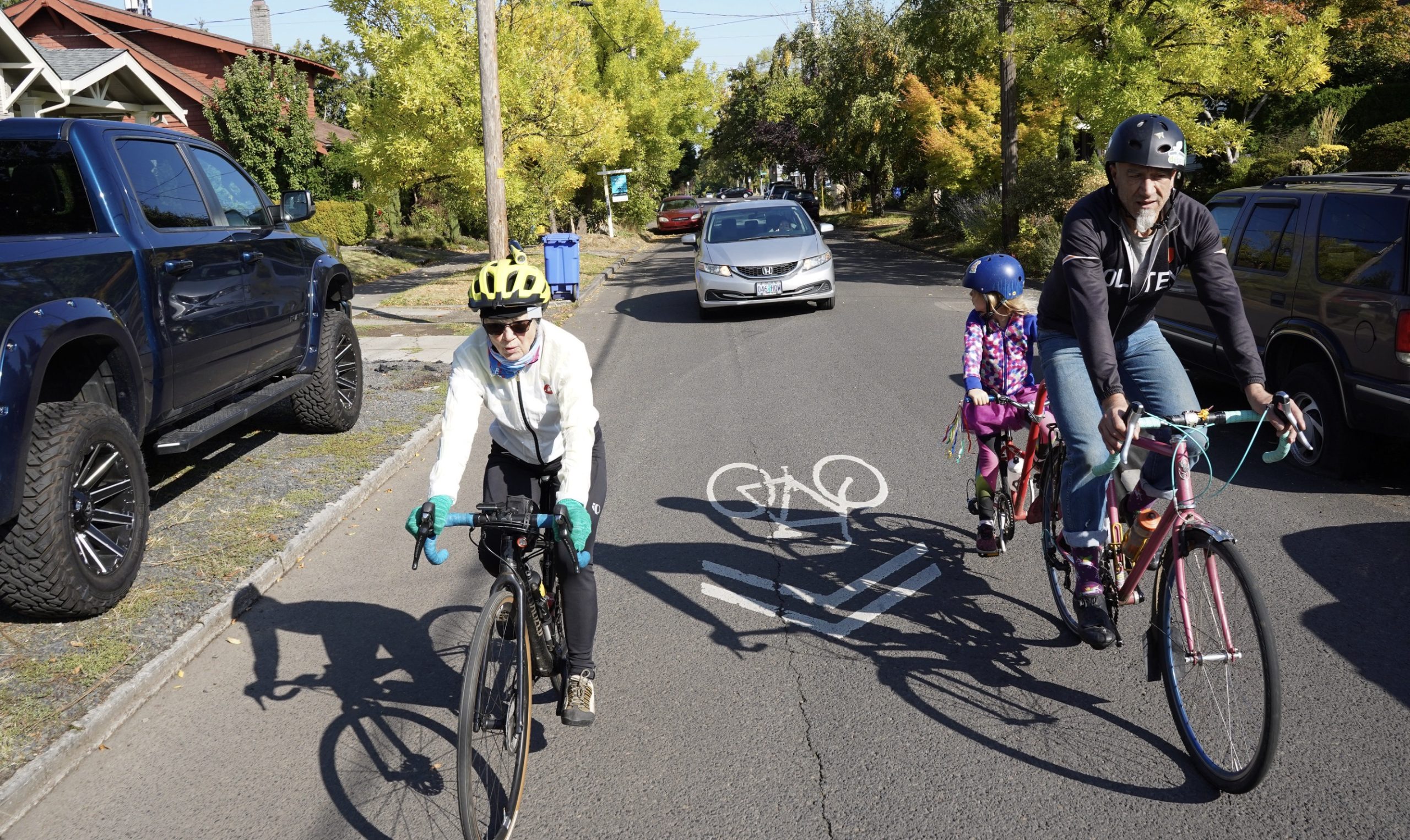
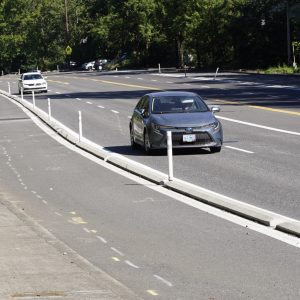
When you remove stop control from greenways, they very obviously become attractive cut-throughs for cars who use them for the explicit purpose of traveling faster than they could on other neighborhood streets or even on the adjacent arterial. Now you have impatient, speeding cars who don’t understand that you can’t actually pass a cylicst safely on most greenways if there are cyclists moving in both directions and parked cars. Now layer on the number of cars with no license plates, no tags, tinted windows such that you can’t make eye contact withthe driver, and a sense of entitlement grounded in the fact that drivers in Portland rarely – if ever – face consequences for disobying driving laws. Cars parked right up to stop signs at cross streets and consistent failure to stop at stop signs definitely doesn’t help. Sure, it’s fine for most of us here in the comments who are going to ride basically no matter what. But I keep thinking about at what age I would let me son ride on Tillamook to elementary or middle school, and it absolutely terrifies me to have him side-by-side with aggressive, speeding drivers. The picture in this article illustrates perfectly the child’s discomfort with the car impatiently “looming” behind.
Until the City signals to DRIVERS that greenways are for cyclists by placing diverters, doing enforcement patrols, daylighting intersections, and eventually prohibiting all but local access on greeways, they will continue to be extremely sub-standard. Even Seattle’s greenways are oftentimes better to ride on because they are so meandering as not not create induced car demand.
Good points Breeze. Why hasn’t the city done this already? What can be done to change the political equation so our city will do this?
I don’t know! Part of my concern is that I don’t hear the person in charge of the City’s bike strategy and programming talking about diverters, signage improvements, enforcement, and the whole basket of tools needed to get cars off greenways. I described to him getting honked at multiple times while riding with my young child riding his bike and he seemed totally shocked that such a thing would even occur. I don’t hear elected officials or broader City leadership making this part of their platform either.
I would love this conversation to be “both and”. I think Portland might benefit from an advocacy group dedicated strictly to greenways, like Seattle’s Neighborhood Greenways group (although I just saw they re-named themselves). Such a group could advocate to fund infrastructure, programming, and outreach as part of a cohesive strategy to boost ridership on greenways specifically. If the amount was $6M, $9M, or another number, the funds could be divied up. I like the idea of maybe focussing on a couple of priority greenways with both the outreach and infrastructure and seeing if we can measure improved ridership over time. If we wanted to get really crazy we could also test just infrastructure and just outreach on others to compare findings.
I really believe that if they were better, greenways could be one of Portland’s biggest assets because the city is so flat and grided – they routes are great for biking and go a lot of places throughout the city, and there are always good alternatives for cars, so this should be extremely low-hanging fruit.
“What can be done to change the political equation so our city will do this?”
Get the public to demand it, and it will happen. That leaves the question of how to build public support for bicycling, and that I don’t have an answer for.
But I am reasonably confident that projects with a visible bike component that piss people off, like the project on outer Division, do not help.
Great idea Monika! PBOT is not well-equipped to launch a marketing campaign
This is great idea. Instead of a City-wide marketing campaign, lets focus on a key corridor. I would suggest NW Flanders or SE/NE 7th. Both have received what should be a game-changing piece of infrastructure, but neither seems to be living up to the hype. I think PBOT failed, in both case, to match the corridor improvements to the bridge, but I think rider awareness may be a factor.
It depends entirely on how much PBOT is willing to allocate to quick-build infrastructure. It would be prudent for PBOT to focus on the existing locations where the bike count data shows the most use (pg 28 for the 2024 map). These locations have been fairly consistent over time in their relative usage, and if we want this plan to have an auspicious start, it makes sense to start there.
Relying on Ankeny, for example, would make those yellow dots (lower counts) on the Burnside Br, and Ankeny/6th stand out like a sore thumb. It’s not too presumptuous to say that people generally avoid riding with fast/lots of cars (particularly learners), and inner Ankeny and the Burnside Br. would require significant hardening/diversion for this corridor to garner more new riders.
Broadway->Williams/Vancouver, Hawthorne/Madison->Salmon, Morrison/Belmont all generally suffer from the same problem as so many people have pointed out. But the effect of these gaps in the CEID on ridership is multiplied a thousand fold more than a missing divertor on Ainsworth, for example, because of their location.
The corridor that is likely the cheapest (infra-wise) to focus on would be Clinton-> Tillicum. Divertors/plazas at 12th, 20th, 26th (E-bound), and maybe a few more places would limit cars to <500 ADT. But this corridor would also be relatively limited in its visibility to the public, since it’s largely residential.
Personally, I would like to see a quick build on the east bank of the Broadway Br, and Williams/Vancouver be the focus. Not easy upgrades politically.
FWIW the plan does focus on raising levels of ridership in areas that have had historically high levels of ridership and have good facilities already. There is also a fair amount of money held back for evaluation for all the reasons you mention.
Otherwise these are great implementation ideas. I hope PBOT will listen!
Getting a handful of people onboard in the present won’t help retain them in the long term. The reason for attrition since 2014 is not due to a lack of marketing, it’s due to a lack of connected, safe facilities. By trying to market biking again, we might dupe some well-meaning newcomers to the city to give biking a try, but they won’t last because they will find it’s simply not worth the hassle for most of their trips. We need:
– More and better enforcement of driving laws to make being around mixed modes safer for cyclists.
– Connected routes (not disappearing lanes) that allow people to get where they want to go without excessive wayfinding and meandering.
– Bike lanes on major arterials and business districts for direct routes to places they want to be.
– Whole city planning and build-out that includes SW hills and other currently underserved areas.
– A planning bureau with the balls to follow through instead of caving to neighborhood groups because they say they don’t like it, NE 7th (never built) and NE 33rd (facilities removed) as examples.
They stopped building it and the riders stopped coming. A few better greenways and a handful diverters won’t cut it. A line of marketing cocaine might give a temporary high but that’s about it.
“The reason for attrition since 2014 is not due to a lack of marketing, it’s due to a lack of connected, safe facilities”
This is entirely speculative. We had great ridership levels with 2014 infrastructure.
The culture shifted, as it periodically does, and riding became less popular, just as it shifted before that to make riding more popular (after another rise and subsequent decline in the 1970s).
While cultural shifts, driven by demographics mostly (though not entirely) can happen, it does seem that when places build out complete infrastructure, the ridership bumps up relative to the amount and safety of the infrastructure. Obviously with poorer infrastructure, the bumps aren’t as large or are seasonal, etc. And while the obvious long-term example of this is northern Europe, there are both Asian and North American cities that have done the same. (Oh the Urbanity!’s video on Victoria, BC, is a great discussion on the topic.)
This, and scientific studies that show the same, would suggest the idea that you can’t drive biking through infrastructure as incorrect.
Where I have issues with Portland’s bike design methodology is that its all “glued on”. Instead of changing the city’s typical sections (I know, its a dead horse I beat all the time), they do every potential change as a separate item that eats up a lot of cost and time.
Just FYI Cyclekrieg, this is Watts if you’re not already aware. He’s kind of made a name for himself ignoring any evidence that doesn’t fit his intransigence. There are no studies he will accept regardless of the level of evidence, nor examples that seem to question his clear eyed realism. I imagine him being the last one left in Portland holding his fist to the protected bike lane shaped clouds saying, “Why John Forester?!? WHY have you forsaken us!?!?”
To be fair as our local culture shifts and we get more acclimated to separated bike lanes, the newness wears off, and the normalization of cycling shifts us “cyclists” to just normal boring people traveling. That’s happening in Victoria, and this exact progression has happened thousands of times. Some people just need to live in it before their ideas adjust. It’s also why this plan gives me a tiny drop of hope that PBOT is finally attempting to target everyday people, not just cyclists.
If the claim is that a single bike facility will increase the number of bike riders using it (not just attract them from nearby, inferior facilities), as the linked paper seems to claim, we should be observing more riders where we add/improve new bike facilities, even if the impact elsewhere is marginal.
I’ve not seen more riders on Clinton now that it has diverters, or along Better Naito (which is almost empty most days). Ridership on Hawthorne fell sharply after protected bike lanes were added.
Where are the new riders? Where did the ones that were on these facilities before they were improved go?
The common answer to this question is that we need to improve the entire network before we see an increase in ridership, which is not what your paper claims, nor is it compatible with Portland’s experience (we saw a surge in ridership without much of a network, and a decline as we built it out). Nor are we likely to complete the network in the foreseeable future.
If PBOT had the data to show their building efforts were working, they’d trumpet it. Instead, Roger has concluded facilities aren’t the solution, and the folks I’ve talked to on city council agree. The only place I hear people claim “build it and they will come” is on these forums. So as a practical, political solution to increasing ridership, the idea isn’t getting much traction among the people who have all the data and can implement policy.
I should add that I am concerned here only with Portland’s experience. We’ve always been somewhat exceptional when it comes to biking, and it is quite possible that what works elsewhere doesn’t here for one reason or another. (One thought is maybe new facilities only help when riding is on the upswing and matter less when ridership is collapsing.)
No one looking at the evidence in Portland can believe the solution to increasing ridership in this moment is for us is to keep building bike facilities. I hope we do keep building, but I don’t expect that to attract new bike riders.
Clearly it’s my opinion since the reasons for the decline are in reality multifaceted. But then again, this entire story/opinion is speculative so I don’t feel bad adding my own speculations. To me there was a lot of optimism and bike facility installation in the first decade of y2k, leading to increasing ridership. I moved here in 2007 and the installations were petering out by 2010, followed by declining numbers a few years later. I think saying the culture has shifted doesn’t really mean much; it’s just another way of saying there has been attrition. I think the why, which we can’t seem to actually get to with any data, is the important question. I’m just assembling the puzzle pieces I see after cycling here 19 years.
I remember when I first was commuting here that I was angry with other cyclists because some didn’t equip their bikes with fenders, and I ate a lot of spray during rainy commutes. It hasn’t been a worry for some time now, as I often find myself the only commuter on rainy days. Sad times.
“the installations were petering out by 2010”
It sounds as if you see bike facilities as exhaustible goods, that need to be constantly replenished to keep ridership up.
I see them as more-or-less permanent improvements to the system that current and future riders will benefit from on perpetuity.
“I often find myself the only commuter on rainy days. Sad times.”
I, on the other hand, greatly enjoy having the place to myself. Not worrying about what other people are doing was a huge upgrade in my quality of life.
Not exhaustible goods, they just stopped partway through. To me it would be more like putting a bathroom in your home but then not installing a toilet and telling your guests it’s fine, they can just use the hole in the floor.
“they just stopped partway through”
“Partway” was good enough to convince more than 7% of commuters to bike to work every day. Why would stopping building when we’d achieved that level of ridership (we didn’t actually stop — we’re building now at unprecedented rates) cause ridership to collapse?
The infrastructure narrative doesn’t fit the facts.
Maybe the infrastructure needs to change because other external conditions changed.
If I were coming up with a list of things could have altered people’s desire/willingness to ride bikes throughout Portland, they’d be:
1) More auto traffic overall
2) Increase in aggressive driving post covid (this feels less acute lately, but I’m mostly commuter or mountain biking lately. I take very few long road rides these days)
3) Poorer driving in general. I see so many people buried in the phones on my daily commute. Enough to make me question my own choice.
I’m sure there are others. But this is my list.
Rob,
I love biking. I ride all the time. But spending $6 to $9 million so someone can knock on doors and ask if folks have heard the good news about bicycles is a bit rich.
People are not avoiding bikes because they lack a motivational speaker. They are avoiding bikes because riding next to traffic feels like a live action Mad Max audition.
If we actually want more people riding the fix is simple. Build safe protected lanes where people actually go. Shops. Schools. Work.
And maybe make sure our multi use paths are not blocked by homeless drug zombies camping out on them. Hard to sell the family bike ride when the trail looks like a scene from The Walking Dead.
Spending millions on “bike encouragement” instead of fixing the basics is like spending $9 million teaching people to swim when you never built the bloody pool.
Love bikes. Ride bikes. But this plan? Yeah nah.
I find myself agreeing with the comments of Angus so frequently these days, it makes me wonder if a different person is using the handle. Great comment. COTW
Yep….definitely COTW material.
Though Rob’s piece minimized the element of ride “coaches”, that is a prominent part of the plan. Those same people who are door-knocking are also offering guided rides so that people who are interested can have somebody show them the way. That came across at Council sessions, but less so in this op-ed. It’s not just door-knocking. It’s opportunities to ride. Like Rob said, a bit like the bike bus model.
“coaches”
BikeLoud is doing something like this. How about getting some data from them that might inform the efficacy of coaching on a wider scale?
Good idea! My sense is that the bike buddy program has been a great success, despite the fact that it was panned by many of the folks dissing this proposal using many of the same arguments.
I don’t recall anyone dissing that proposal — who would oppose a volunteer run program that used no public funds? BikeLoud’s only obligation is to it’s donors.
There’s a lot of good data that could be collected to demonstrate whether this approach is effective and whether it can be replicated and scale, and I hope they’re collecting it (though they have no obligation to do so.)
I think Bikeloud’s bike buddy program is funded by a PCEF grant. IIRC (and I certainly may not), there were quite a few derisive comments of the usual variety posted here (“slush fund”, “non-profit industrial complex”, etc.) in relation to the program. I, too, hope good data is produced by the program, but, as I’ve said before, I think this is pretty subjective subject matter. I think it’s significant that lots of participants (both mentors and mentees) seem to have a good experience with the program. As long as there are potential riders that can be induced to ride bikes for more of their transportation out there, volunteer mentorship seems like a good idea, even if it’s hard to quantify the gains.
You’re right, it is funded by PCEF, which gives us the right to demand good data which we we can evaluate to see if this is a cost effective way to spend PCEF money before doubling down.
For PCEF, “good experience” is much less important than “reduces CO2”. For donor funded programs, good feelings might be enough.
Thanks Angus. I agree. If we had a couple hundred million dollars and the political capital to build a network of PBL I would totally support it. But we don’t have either. What should we do in the meantime?
Also, no one is saying we will stop building PBLs. We can and will do both at the same time. The $$ that would fund this plan is absolutely, 100% unrelated to any $$ that would fund PBLs.
And anyone who thinks grassroots organizing and marketing doesn’t work when the underlying product is awesome but just suffers from a bad reputation, has been living in a cave.
Maybe we should start by building actual Greenways- diverters, daylighting intersections, stop bars, street lighting, wayfinding…
The City claims a lot greenways that are not really greenways at all- they are unimproved streets with a couple of tiny signs. It doesn’t have to PBLS everywhere. The underlying product (greenway network) is not awesome, it is about 30% built and disconnected
maxD,
We can debate the quality of our greenway network all day. I think you and I disagree about it. It’s all relative to me. Yes it sucks in some ways — but seen as a network and in a US city, I think it’s pretty damn awesome that I can ride all across town on the greenway network and know that the design at least prioritizes my existence as a bike rider and is most legible from a wayfinding standpoint. And all that other stuff you mention – daylighting, diverters, stop bars – all that stuff PBOT is doing right now as quickly as they can.
I think folks are projecting their anger about our network not being great onto this plan and I think that’s unfair. I think we should be able to support this plan while also acknowledging that yes, Roger is extremely biased in support of the network he’s largely responsible for!, that we still have a lot of work to do to make it great, but that a lot more folks can and should be using it and they just need a bit of hand-holding to get out there.
Totally agree that mostly people are upset about where the City has let us down on greenways, not upset about the idea of community rides, which are generally a very positive thing. I think the idea of expanding the bike bus momentum beyond schools is great.
Honestly I think it would go a long ways if the City could just awknowledge that the current system is failing in important ways. Like hey – we are hearing that people don’t FEEL safe on these streets, and that is a huge problem. Maybe 2,000 daily cars or 100 per hour – especially when they are only on this street to take advantage of the lack of stop control – is actually is not compatible with a safe, all ages bikeway. We are going to use our might to do better and here’s our plan – here’s out infrastructure and outreach and enforcement can work together to make change. I have not seen the City make a serious committment to getting cars off greenways, and as we all know there have been huge battles just to keep the diverters we have.
We supposedly live in one of the most liberal, best biking cities in America. Why doesn’t it feel that way?
And just to underscore this – I live on a greenway that I ride nearly every day. I was so excited when I moved in. Instead, I’m just continually depressed by the number of speeding cars, cars I see barely stopping at the stop sign, numerous close calls I’ve seen, and just the pervasive feeling that cars dominate, not bikes. It really makes me sad.
Hi Breeze,
I think the city is closer to doing what you want than you think. If you look at the work they’re trying to do, you see that they are well aware that there are too many drivers on greenways and that they are very well aware that far too many Portlanders don’t feel safe on greenways. I hear PBOT staff say exactly that all the time. Let’s not lose sight of the fact that PBOT isn’t exactly a monolith and that Roger Geller’s plan is just a very very very very small window into what’s going on over there.
And we need to remember that PBOT works under a ton of constraints: They have had shit for budget for many years; the morale is extremely low due to bad public treatment constantly that they don’t deserve, layoffs and political uncertainties, and so on. And even if PBOT rank and file feel a certain way, everything at the end comes down to politics and whether or not certain elected officials feel like what PBOT wants to do helps or hurts them with voters.
And as to your question, “We supposedly live in one of the most liberal, best biking cities in America. Why doesn’t it feel that way?” What’s funny about you asking that in the context of this plan is that this plan would actually make you start feeling that way! That’s the thing. A big part of this plan is to help PBOT get its groove back by putting bicycling back into its rightful and central place in Portland’s cultural milieu. Instead of lamenting that we lost our cycling swagger, Geller’s idea is to force it back by pounding the pavement with the Good Word and backing that up with a major priority on bicycling going forward.
Preach it! Turns out the choir may actually need to hear the message.
I’m taken aback by how much negativity there is among even alleged bicycle enthusiasts about the prospects of any initiative offered by the city. Have I lost perpective, or have the naysayers? I see a regularly improving network, with some disapointing setbacks like diverter removal proposals or actuals. We do need infra improvements. $6M was the projected cost of the in-progress three-mile update to Willamette Blvd, which will be a great enhancement and might serve as another standard going forward, but can we afford to apply it in as many places as need improvement in our 2000+ miles of streets? We need some nimble work as well as the hard infrastructure improvements. Getting more folks out there in city-sponsored guided rides brings more folks into the conversation and creates a more active feedback loop into PBOT planning.
Great!
So they should focus on fixing these glaring defects in our basic bike network and can the PR campaign hopium.
I think it’s completely fair:
$6-9 million would do a lot to correct some of the most glaring defects of our GINO (greenway in name only) network. Heck a single diagonal sewer barrel diverter costs as little as $75,000 for labor and materials. Just imagine how much less stressful our faux greenway network would be with an additional 60-90 diverters sprinkled around Portland.
And for those claiming that it’s politically impossible to cajole PBOT and the city to install diverters, actual diverter campaign history proves you wrong.
It takes years, detailed traffic modeling, and a corridor study to get pbot to install one or two diverters. And then, due to public pushback and outcry from five or six people, pbot scales back from a full diverter to a half diverter.
It is getting more and more difficult to do diverters on greenways, even on the most popular routes.
This is what PBOT wants you to believe but it ignores the fact that feisty activists forcing PBOT to install multiple diverters on Clinton despite absolutely bonkers neighborhood association opposition.
I’m not sure what this even means but in my experience GINOs (greenway in name only) in no way prioritize people cycling. Most of the neighborhood greenways I use every work day are full of cut-through cage-drivers who drive like the don’t expect to ever see a person cycling. I think that much of the positive attitude towards neighborhood greenways comes from people who are not using them for utilitarian transportation during peak commute hours. I’m sure GINOs can be pleasant when you are toodling along during non-peak hours on a non-commmute route but for those of us who use them every work day they are a bike infrastructure joke.
What should we do? Start by not spending $6–9 million on performative bike marketing.
Portland doesn’t have an “awareness” problem. People already know bikes exist. The problem is conditions.
If you want more riders, fix the basics: install diverters so greenways aren’t cut-throughs, daylight intersections, improve arterial crossings, and keep multi-use paths clear and usable. When someone tries biking and immediately hits dangerous crossings, aggressive traffic, or blocked paths, no amount of “education” will keep them riding.
Culture didn’t make Portland a bike city by itself. Practical, usable routes did. If we want ridership back, invest in the things that make biking actually work—not in trying to market around the gaps.
“install diverters on greenways”
This is an article of faith here, but there is no reason to think this is true. Look at Clinton: it is a well established bike route, has good crossings and diverters, is easy to follow (inside 50th at least) and connects to a bunch of car-free infrastructure leading to and through downtown.
There are still a few people who ride there, but hardly any compared to as decade ago.
The answers from folks here are predictable: “it’s not good enough”, “we need to build a huge network before anyone will ride”, “build it and they will come”, etc .
Our maybe it’s just not the problem. Lots more people rode Clinton before most of the diverters were installed, and before it connected to any low car infrastructure downtown.
BTW, Roger says that PBOT will build diverters if the local community asks. If there really is the latent desire for diversion that people here seem to think there is, finding would-be bicyclists to lead the charge locally shouldn’t be so hard.
I don’t think WFH is the only explanation for the collapse of transportation cycling in Portland but it probably does explain much of the relative decrease in people using Clinton to bike commute.
Signal timing is easy to change and the Portland policies are there to support the change. That work could happen quickly under the right circumstances.
I ride through the Interstate/Overlook intersection almost daily. For the last 9 months or so, they have building an apartment building there and have had Overlook St. closed for construction staging. Having all that gear on the signal inductor loops means the traffic signal functions as “dumb” signal- providing time for each direction without having to push a button or trigger an induction loop. It has been an enormous improvement! Drivers are regularly slowed down, bikes have a good chance catching a green. I think giving bikes and pedestrians dedicated signal timing would be transformational very positive way! I get that Peter Koonce is very smart and very clever at programming signals, but the effect always maximizes benefits for drivers while people biking and walking have to push a button and wait.
I cross two terribly timed signals on my daily commute. One at se eighth and division place, one at se Harrison and naito. Both have excessively long phases for what is presumed to be the street with the heaviest flow of traffic. Both intersections have bike detecting loops, but I still end up waiting upwards of a minute in each location. Because the phase is so short for my direction of travel, the likelihood that I’ll get a green and get to continue without stopping at either location is miniscule.
Hmmm, that’s not the Peter Koonce I know, so there are some past Bikeportland articles that might be worth reviewing: https://bikeportland.org/2022/06/29/portlands-top-traffic-signal-staffer-takes-bike-advocates-for-a-ride-357987 or the podcast from 12 years ago https://bikeportland.org/2014/06/05/podcast-invisible-urbanism-traffic-signals-106893 where Peter talked about his approach.
It’s almost like you didn’t hear the podcast where the War on Cars was raving about how Portland gets some of the details right, a quote I appreciated was when Doug said: “And I think it’s good that the infrastructure has really advanced in the last year and that you have folks here who are working on it… ” https://bikeportland.org/2025/11/13/podcast-life-after-cars-authors-live-at-bike-happy-hour-398075
Maybe it’s time for someone to bring back the bike-friendly signals Pedalpoalooza ride?
Having grown up two blocks from Interstate & Oregon, I know that signal well. That intersection was designed in the 1990s, and policies and technology were different. North Interstate is prioritized for the train and people walking north-south. Unfortunately, without detection for pedestrians north-south, the assumption is there is a pedestrian there and you have to provide time for that movement to clear.
In summary, signal timing is a series of tradeoffs and there’s limits in what can be done unless there is investment or we plan for the Bike Bus is coming through: https://bikeportland.org/2025/10/21/pbot-gives-bike-bus-leaders-traffic-signal-superpowers-397607
There’s been support for proactive improvements in the past, like this: https://trec.pdx.edu/sites/default/files/Bussey_Half%20Signals%20Report%20FINAL.pdf?crpt=article
If there are particular intersections where there is a easy change, you can contact the City. I am thinking that they have the kind of folks that read 100ish comments on a Sunday night to find what they can do to improve.
OK, I checked out the links you provided. IN the first post “Portland’s top traffic signal staffer takes bike advocates for a ride” the write-up starts with an explanation of using signal timing to control traffic spped- great, love it! More of this please. Then it goes on to discuss complex signals imported from Amsterdam and how the intricate timing/signals/buttons don’t work well in real life. This is what I am questioning: Buying a lot of expensive gear to sense bikes/peds, and try to communicate that users have been sensed, and then carefully orchestrating who waits in what location-it is not very realistic. It seems like a lot of bending over backwards to make sure the road works efficiently for cars by default. I am questioning if all these resources are well spent? I suspect things would work much better for people walking and biking if there was simply dedicated time for crossing in every cycle. Get rid of the sensors, the special signals, the mysterious blue lights and the beg buttons, and just give people time to walk across the street.
An ironic aside: the last photo in the article that was linked is of Naito/Morrison, a location where PBOT closed a crosswalk between a Hotel and Waterfront park to make it faster and easier to make left turns from Naito on to the Morrison Bridge/I-5.
The cynicism in the comments on why this tiny $6M investment won’t be successful is very understandable. It is so sad because the region has collectively spent over $1.5B since 2020 on homelessness and drug addiction with really nothing to show for it. Just imagine what half that could have done for active transit all over the city/region. The core would have a complete network, the western suburbs would all be connected, the springwater could be expanded, etc.
There is just a palatable sense that once the government is involved, the likelihood of success goes down dramatically. I just don’t see how that changes because everywhere you look there is high cost and no results.
For me its not so much the government spending in and of itself that is the failure, it’s the government giving the money away to NGO’s and “Non Profits” that is salt in the wound. At least when PBOT does something wasteful or odd, there is a Director to complain to and who is responsible for it. Activists have of course been able to change PBOT’s mind several times and those were great successes because there was a government person in charge and was responsible for the work and money involved.
With the houseless and drug addicted, there is no Directorate that is really responsible. I mean, we can say the Mayor’s office is, but once that money gets in the hands of NGO/”Non-Profits” there is no accountability.
Houseless and drug addiction is one area where I would prefer to have all that money that is gifted into the community be administered and spent by City employees overseen by a Director who is at least known and responsible for all those funds.
You’re forgetting, huge, absolute huge amounts of money that have been wasted on just TriMet’s failed MAX trains.
Orange line: $1.5 Billion (2009)
Yellow line: $350 million (2004)
“Better” Red: $215 million (2024?)
Just think if a fraction of that had been spent on buses and their drivers how much better and inclusive our transit system would be today instead of a failure.
What’s your beef with the red line? The better red upgrade was a significant improvement (although it does make transfers at gateway a pain).
I was a daily bike rider from age nine until my late fifties. I still don’t own a car. For a long time, for literally decades, the bicycle life was great.
But due to age and health concerns, I’ve gone from being a daily bike rider to being a daily transit rider and walker.
I simply cannot keep up with the traffic flow on most busier city streets anymore, and no longer feel as steady or as safe in bike lanes as I once did.
I would bring my bike on MAX and shorten the distance ridden to make bike riding more manageable, but half the time I can’t find a place to hang my bike because it’s being blocked by someone with several large leaf bags filled with returnable bottles and cans. Or a large cart filled with bottles and cans, and sometimes a big dog.
So I walk and take transit and save the bike for easy rides around my neighborhood, and I tend to skip the big bike culture events these days. I just can’t keep up anymore, and would rather not be reminded of that every time I’m able to ride a bike. I suspect that other older and slower bike enthusiasts feel similarly.
A marketing campaign and cultural activities won’t change that.
It will be great to have easily accessible, community driven and cheap/free bike stores in each neighborhood, sponsored by PBOT. Along with neighborhood associations and non-profits, they can provide support for local cyclists or cyclist-curious people. I can only imagine what Bikes for Humanity could do if they had more space and budget to hire some full time employees.
Is that an alternative to proper bike infrastructure? It is not. Also, I still am a firm believer in BIKETOWN as a way to improve ridership.