Clackamas County residents invited to apply to serve on county walking/biking advisory task force
Clackamas County will update its master plans for walking and bicycling facilities in unincorporated areas of the county over the next 18 months. Fourteen community volunteers are being sought to serve on an advisory committee with technical experts to advise and help oversee the project.
The Walk Bike Advisory Committee (WBAC) will help guide plan development by advising the county at key milestones. Committee members will be expected to meet four times during the project to review and provide feedback on project materials.
County residents with an interest in pedestrian and bicycle travel who would like to be considered to serve on this committee are asked to complete an application form and submit it no later than Monday, August 15, 2022. Application forms are available online at https://www.clackamas.us/engineering/bikewalk.
The Walk Bike Clackamas County project will take into consideration issues related to health, equity and climate change to guide plan development. Key outcomes are expected to include: • Policy priorities related to biking and walking; • A prioritized list of construction projects to make biking and walking safer and more accessible throughout unincorporated Clackamas County; • A list of program investments to support active transportation by: a. increasing access to pedestrian and bicycle facilities and b. encouraging more people to walk and bike; • Performance measures to track progress toward plan implementation.
For more information, contact Scott Hoelscher, Senior Planner-Multimodal Transportation, at 503-742-4533 or scotthoe@clackamas.us.
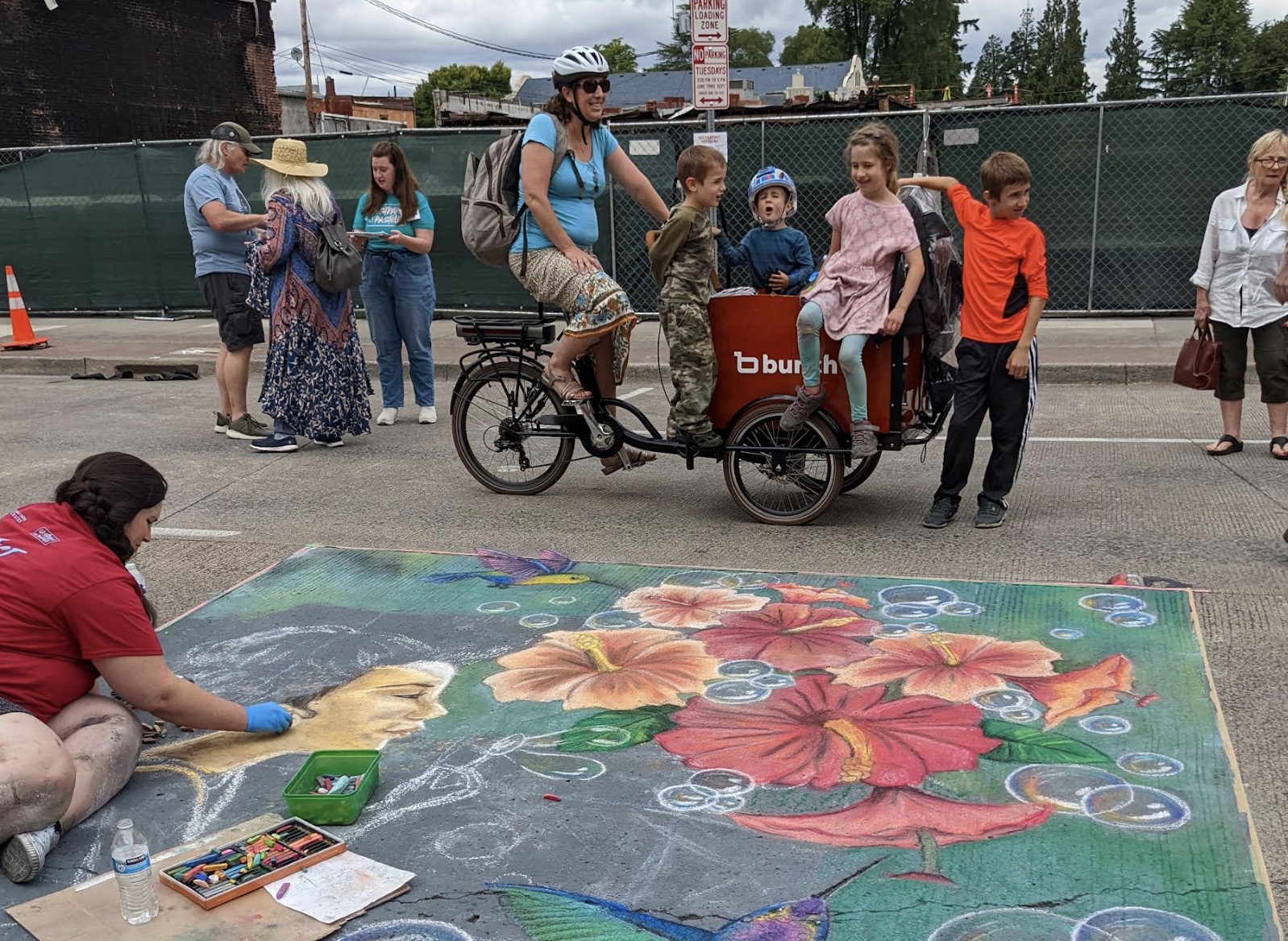
Our new family bike at the chalk fest! (Photos: Shannon Johnson)
Aren’t you loving these carfree summertime streets?
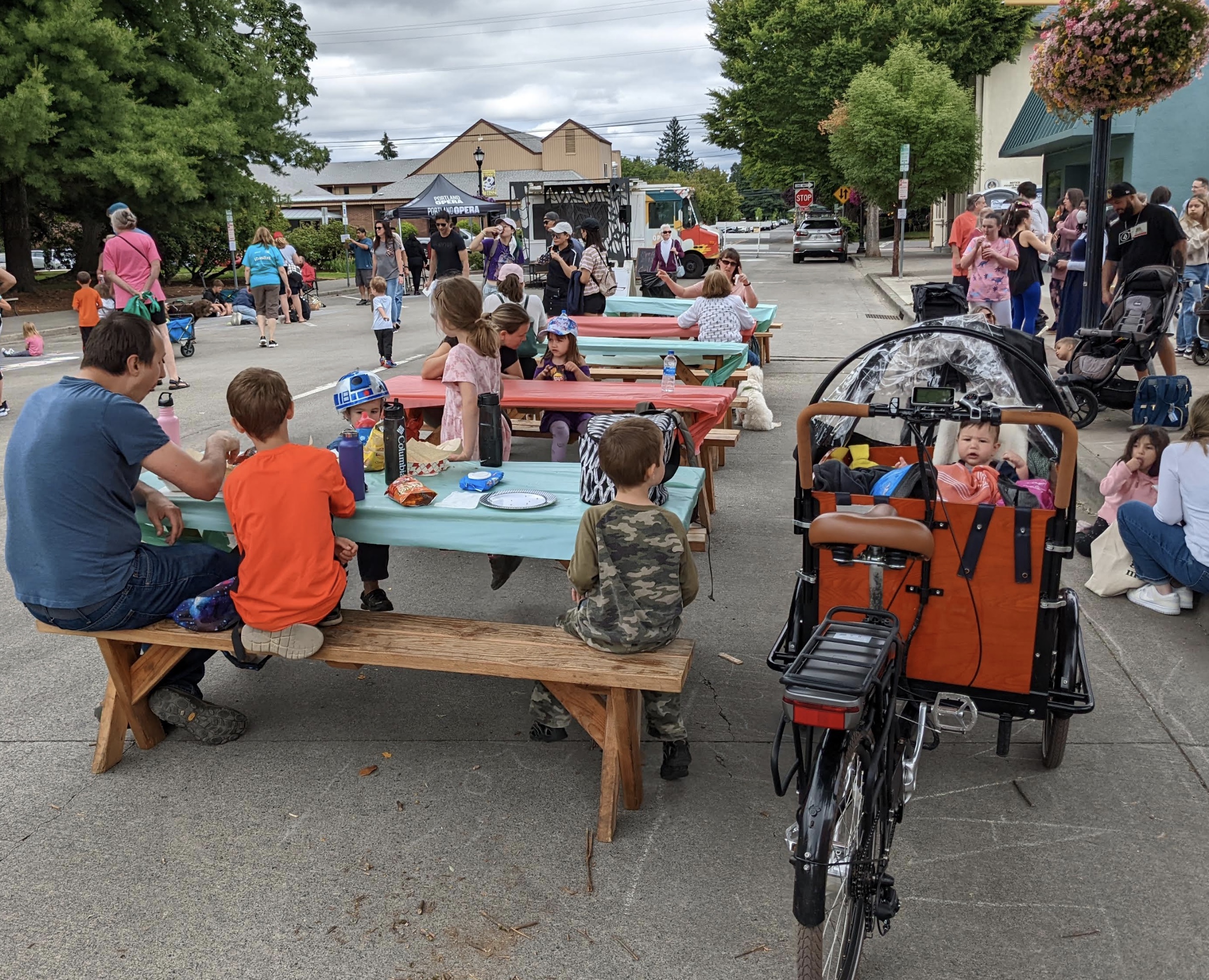
We recently enjoyed Hillsboro’s La Strada dei Pastelli Chalk Art Festival. Downtown Hillsboro’s main streets were closed to cars for the occasion, and instead filled with vendors, food trucks, children’s activities, artwork (including chalk art being created by professional artists), and even our personal favorite: Opera. Portland’s Opera a la Cart brought a truck with a fold-out stage and performers who sang their hearts out.
We look forward to events where we can enjoy the arts with our children. The Chalk Art Festival was perfect. We treated ourselves to some food truck fare and then got to listen to favorite opera arias, while our kids colored with the abundantly provided chalk. Later we rolled past the impressive chalk murals as they took shape before our eyes. And best of all, we did it all by bike.
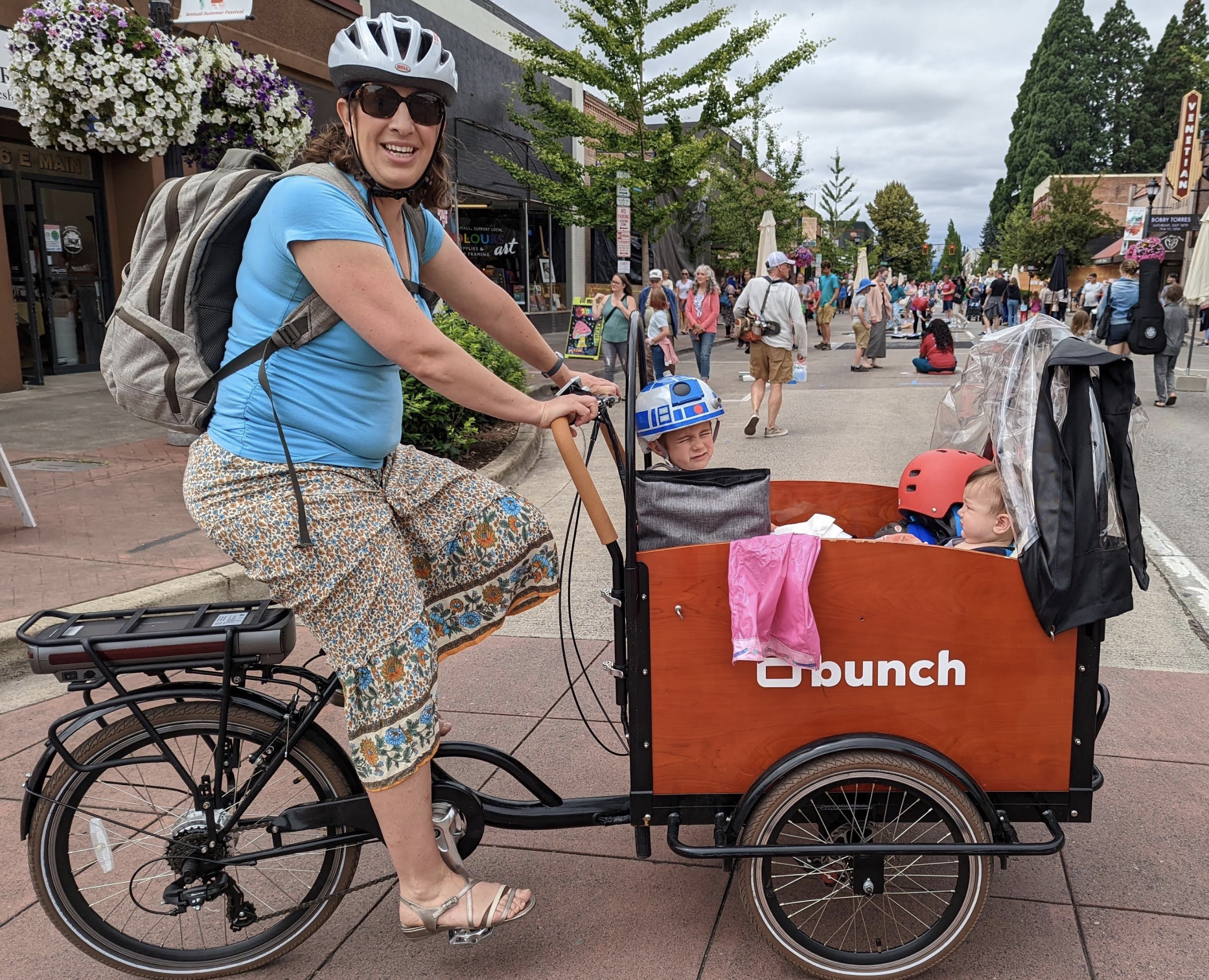
Yes, our new-to-us electric bike!
Advertisement
It’s a 2017 Bunch Bike with a brand new 36V battery and fully loaded with accessories including a rear rack, front and rear lights, rain cover, and a large front box that can seat four children (including my 7 and 8 year olds). I was able to purchase it (used) for a very generously low price, thanks to the kindness of a fellow park goer, who I met at the playground. After she watched me heave my manual bike-train into motion, she was surprised I didn’t have a motor. “I have an electric bike I’m ready to sell,” she said. “My girls have outgrown it.” (Oh, how tempting!) She offered to let me try it out for a few days. And that was how we met our new kid-hauling electric bicycle.
The Chalk Art Festival provided the perfect opportunity to cruise around on our new ride. We got to see how this electric bike can serve us in a variety of settings, from riding longer distances, to meandering through a hopping festival and market. It’s exciting, incredibly fun, and a wonderful gift for our whole family. I look forward to telling you more about it, as we get to know our new-to-us Bunch. (But don’t worry…I’m not parting with my “acoustic” bike either, though, for the record, I prefer to call it my “manual bike.”)
In either case, I hope you are enjoying the summer festivals and car-free streets. There is plenty of summer left. Don’t let it pass you by. Check a few more items off that Bucket List. And if nothing else, just get on your bike. Happy riding!
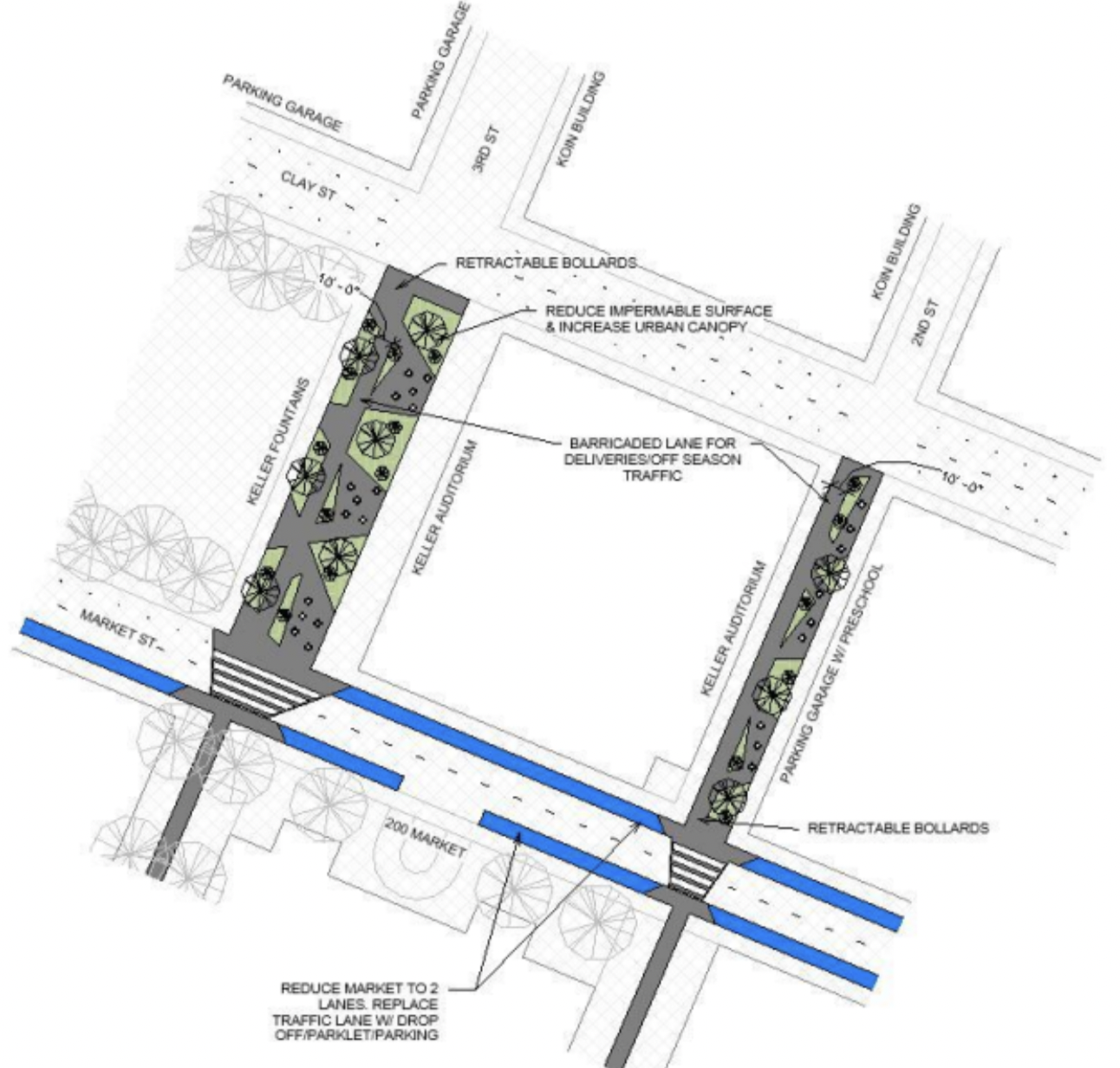
A rendering of the PSU students’ carfree Keller plan. (Source: Better Block PSU)
In an area of downtown Portland currently heavy with car traffic, planners see the potential for a place comparable to the great European city centers, with pedestrian-focused plazas and plenty of green space.
A project designed by four Portland State University students – Emily D’Antonio, Ryan Martyn, Michel Rojas and Aidan Simpson – aims to turn the streets surrounding the Keller Auditorium into one of these carfree plazas.
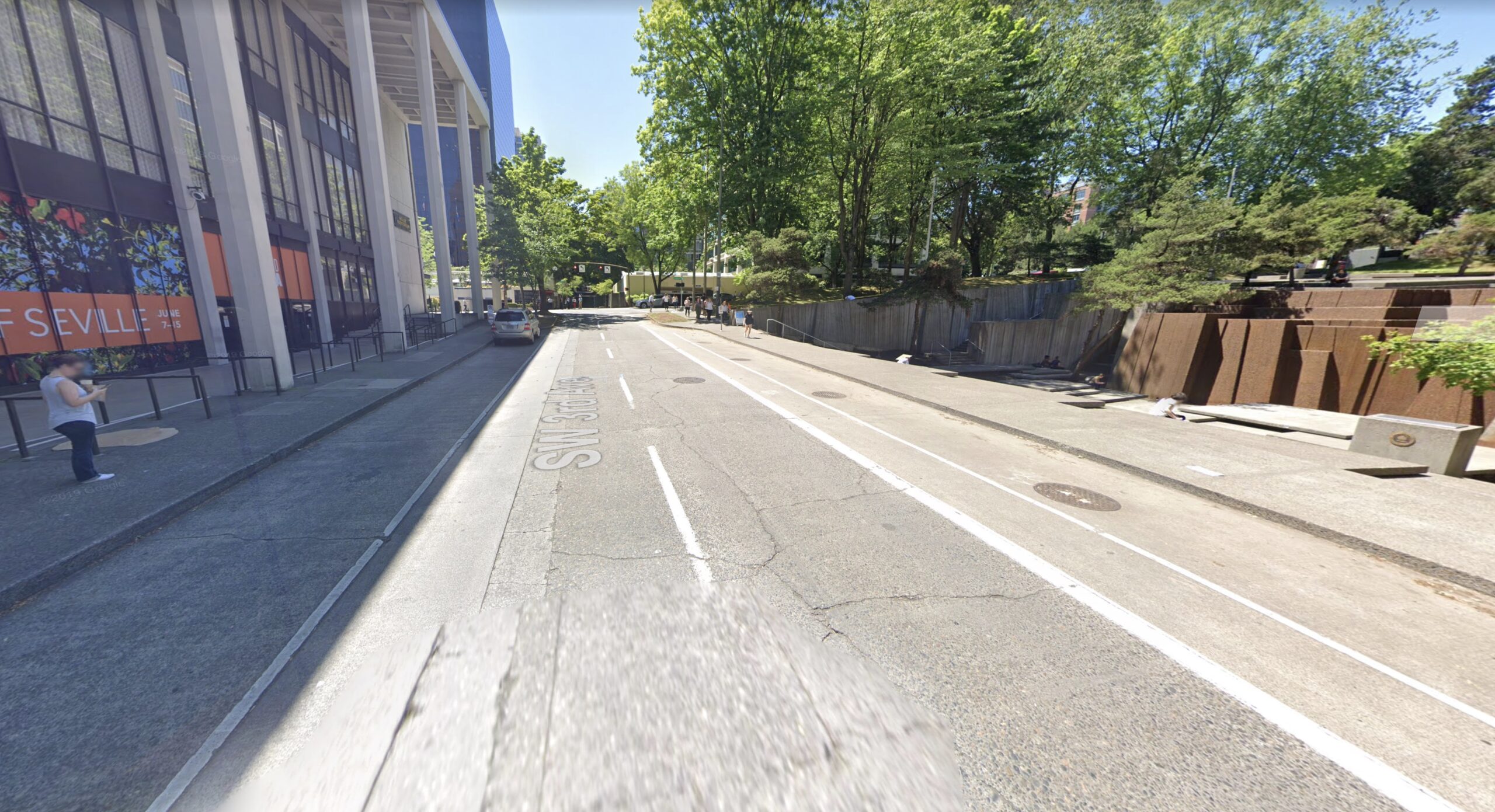
SW 3rd Avenue in front of Keller Auditorium.SW 2nd between Clay and Market (behind the auditorium).
Currently, SW 3rd and 2nd streets adjacent to Keller Auditorium and the Keller Fountain Park are typical downtown streets. Both are one-way and allow on-street car parking. The PSU students’ plan will prohibit through car access both streets while adding planters and other elements to create a plaza, while still allowing for some car drop-off at Keller Auditorium events.
The plan also includes closing portions of adjacent SW Market Street and replacing the stairs in the traffic-free blocks south of Market with ADA-compliant ramps so various modes can “move freely throughout the traffic-free blocks, inducing demand for active transportation.” Nearby Pettygrove and Lovejoy Fountain parks are also part of the plan, which proposes to “activate them with food and beverage services tables, chairs, and benches as well as increasing green space and tree canopy at Lovejoy Fountain Park.”
Advertisement
To develop the project, PSU students spoke to experts like Portland Bureau of Transportation Senior Planner Nick Falbo and Executive Director of Friends of the Green Loop Keith Jones, and gathered community input. In their report, they say they had four goals with the plan, all of which are met in their final proposal:
Reduce Emissions within the Portland Downtown Area
Improve the Walkability of the Downtown Area
Provide better connectivity for the Portland Open Space Sequence
Create a reason for people to come and interact with the space
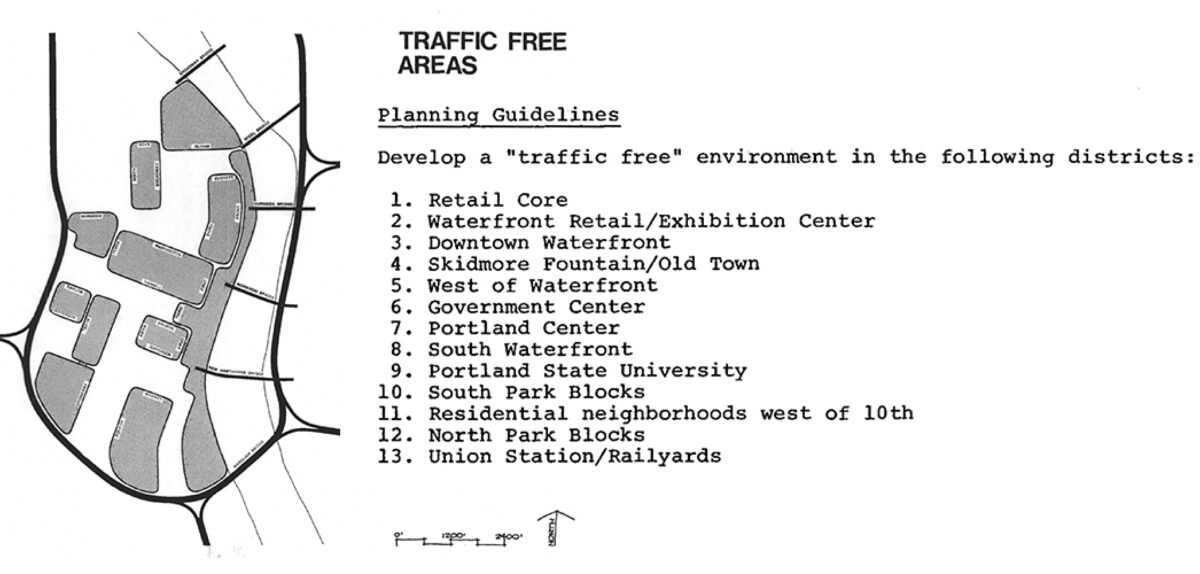
The 13 proposed traffic free areas in the 1972 Portland Downtown Plan.
While it might seem radical to close downtown streets to car traffic, the city of Portland had a comprehensive plan to do so in their Portland Downtown Plan way back in 1972. Within that 50-year-old roadmap, city planners outlined their goal to “create a pleasurable human environment” by providing safe routes for people to walk and bike from nearby neighborhoods to downtown amenities, as well as with public-use spaces where adults and children could “talk, play, look, think and enjoy.”
In order to do this, the plan sought to develop a “traffic free” environment across essentially the entire downtown corridor, from the South Waterfront to the area now known as Slabtown to more residential areas west of 10th Ave. Closing off parts of a few streets around Keller Auditorium is just a small piece of what advocates see downtown Portland could become.
The development of this plan is still in process, but it will be part of Better Block’s 2022 line-up, so we can expect to see work on it this fall. We’ll keep you posted.
View of the Burnside Bridge from the Eastbank Esplanade. (Photo: Jonathan Maus/BikePortland)
“I see the city’s role of making sure that we are walking our talk when it comes to climate mitigation.”
– Jo Ann Hardesty, Portland city commissioner
The City of Portland wants to make sure a new Burnside Bridge has a design that lets walkers and rollers easily access the Willamette River and that has a cross-section that reflects adopted climate change goals.
At a meeting of Portland City Council today, Portland Bureau of Transportation Commissioner Jo Ann Hardesty led a 4-0 vote (Commissioner Mapps was absent) in favor of a resolution makes small but significant amendments to Multnomah County’s Locally Preferred Alternative for the Earthquake Ready Burnside Bridge Project.
The amendment was related to two issues we’ve been paying close attention to: the lane configuration on the bridge and how it connects to the Eastbank Esplanade.
Advertisement
“My preference is that we would not be doing this amendment,” Hardesty said at council today. Here’s more from her comments:
“But we felt that we could not enter an environmental assessment phase without being really clear about the need for a ramp versus an elevator. I wish the county had concurred and actually put it in their original application; but I see the city’s role of making sure that we are walking our talk when it comes to climate mitigation, when it comes to access to the water, when it comes to making sure that pedestrians, bicycles and walkers and rollers are safe on any new bridge that will be within the city of Portland.”
Due to cost concerns, the County initially recommended that the new bridge be built with stairs and an elevator, both of which are considered woefully inadequate by disability rights and active transportation advocates who know elevators are unreliable and stairs are difficult and/or impossible for many people to use.
From the City’s perspective, both Burnside and the Esplanade are classified as “Major City Bikeways” and “are designated with Portland’s highest classifications for walking and biking.” In a presentation shared at council today, PBOT said, “the connection between them should be of the same caliber.”
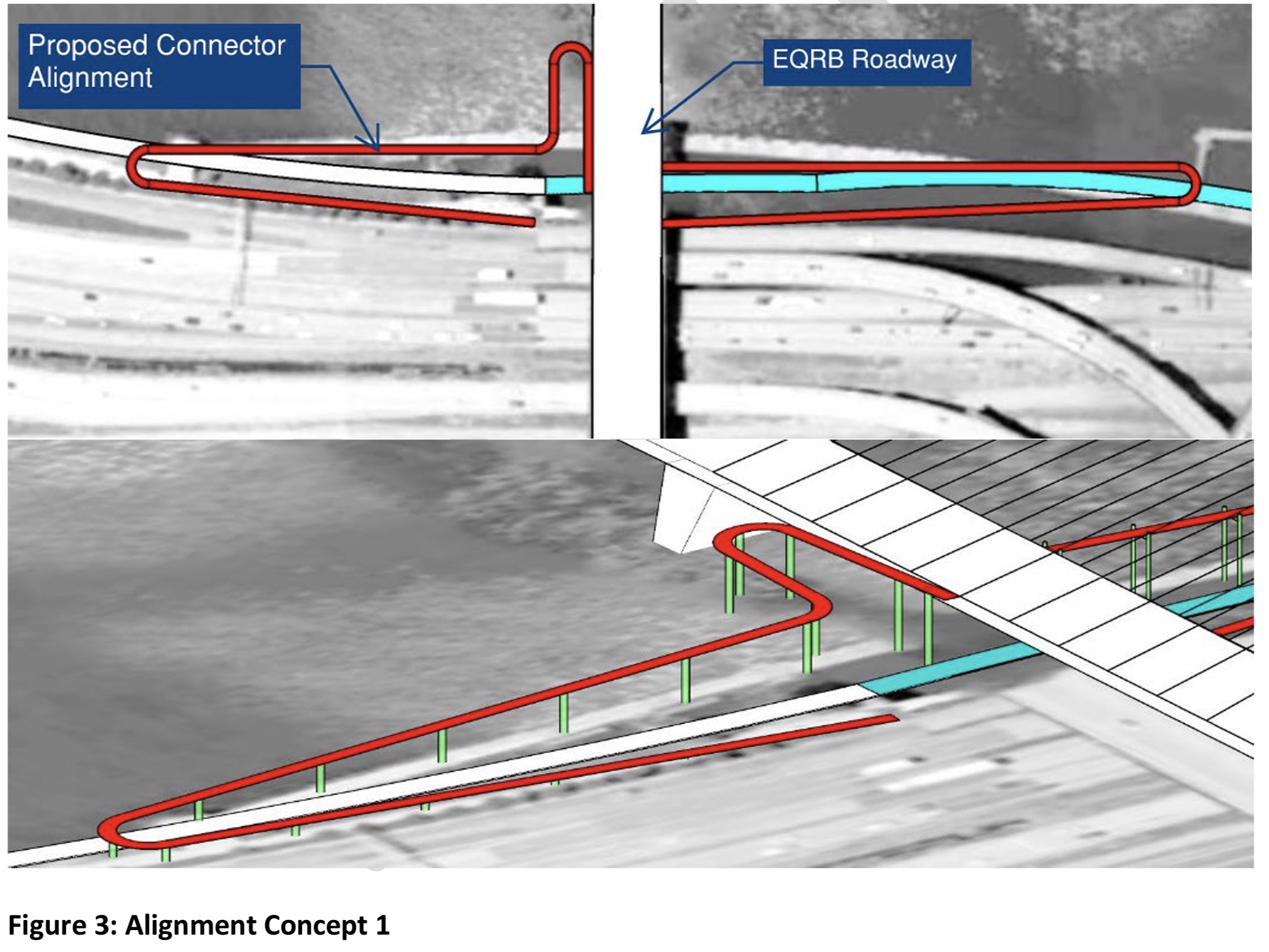
Here are the four options PBOT studied:
Alignment Concept 1 This concept provides a direct path from the bridge along the riverbank to connect the bridge to the esplanade. It also demonstrates the scale of the length of connector pathway required to meet ADA limits on deck slope. Two options for this direct approach are shown in Figure 3 below.
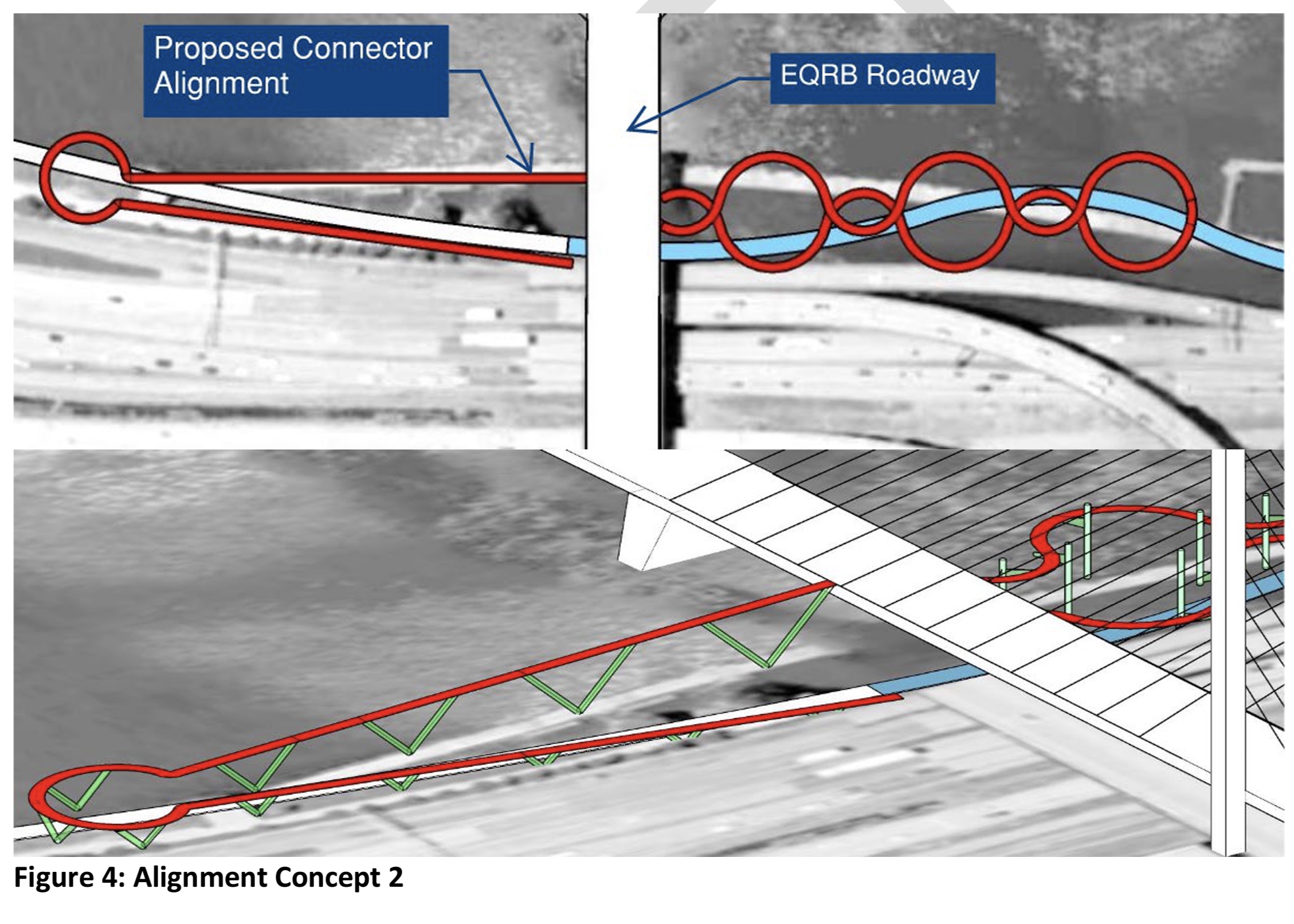
Alignment Concept 2 This approach uses meanders to gain travel distance within a more compact footprint while providing a more enjoyable experience. It also provides opportunities to slow bicycles and skateboards through the use of curves and out-of-path travel features. Two options for this approach are shown in Figure 4 below.
Advertisement
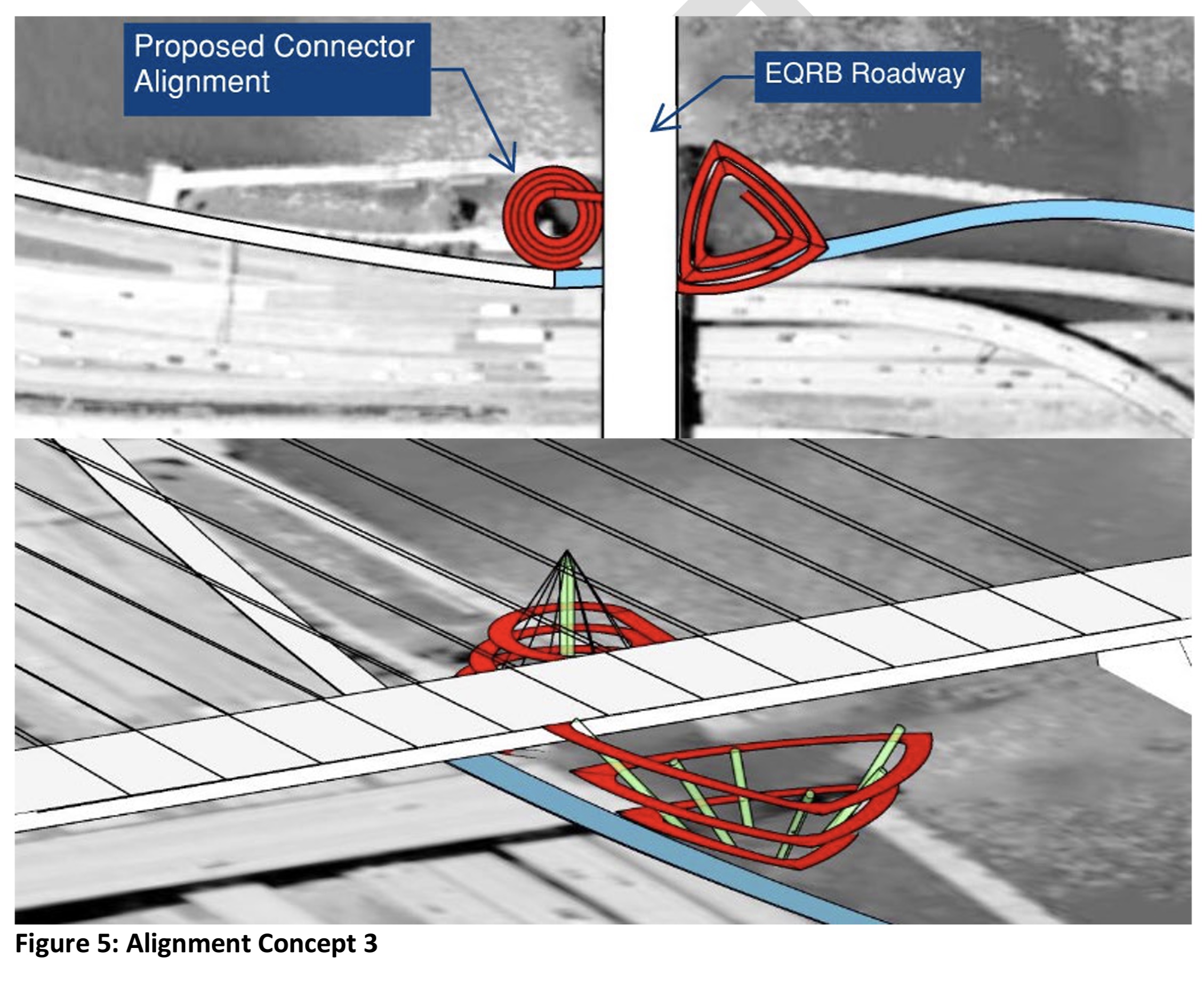
Alignment Concept 3 This approach provides a compact footprint with tightly radiused alignments to limit bicycle and skateboard speeds and reduce foundation footprint. Widened sections would also be included for resting/refuge. Two options for this approach are shown in Figure 5.
Alignment Concept 4 This concept incorporates an asymmetric structure that provides access from both the north and south sides of the bridge walkways and merges them under the bridge to touch down at the esplanade on a single walkway. This section could be flipped to place the helix on the north side so less structure is constructed within the zone of highly liquefiable soils.
The final ramp design will be decided later, but because PBOT passed the amended LPA language today that includes, “as a condition of approval, the EQRB [Earthquake Ready Burnside Bridge] program shall provide for an ADA accessible ramp connection to the Eastbank Esplanade from both the north and south side of the EQRB,” the stair/elevator option is even more unlikely to be built.
“The City of Portland resolution is not legally-binding, but Multnomah County is committed to collaborating with the City-led ramp project in the Final Design Phase,” said Earthquake Ready Burnside Bridge Project Manager, Megan Neill in an email to BikePortland after the vote. “Multnomah County is preserving the existing City of Portland owned staircase that’s already in place. Multnomah County is not precluding the City of Portland from connecting a ramp to the bridge in the future.”
A big sticking point will be who pays for it. PBOT estimates the ramp will cost about $90 million (and HAP’s concept could be as much as $149 million).
Advertisement
One big reason that Hardesty and the rest of council were able to pull this off is because of the work of a coalition of advocates. Human Access Project, The Street Trust, Disability Rights Oregon, and Bike Loud PDX were among the groups who wrote letters of support and testified in support of a ramp today’s meeting.
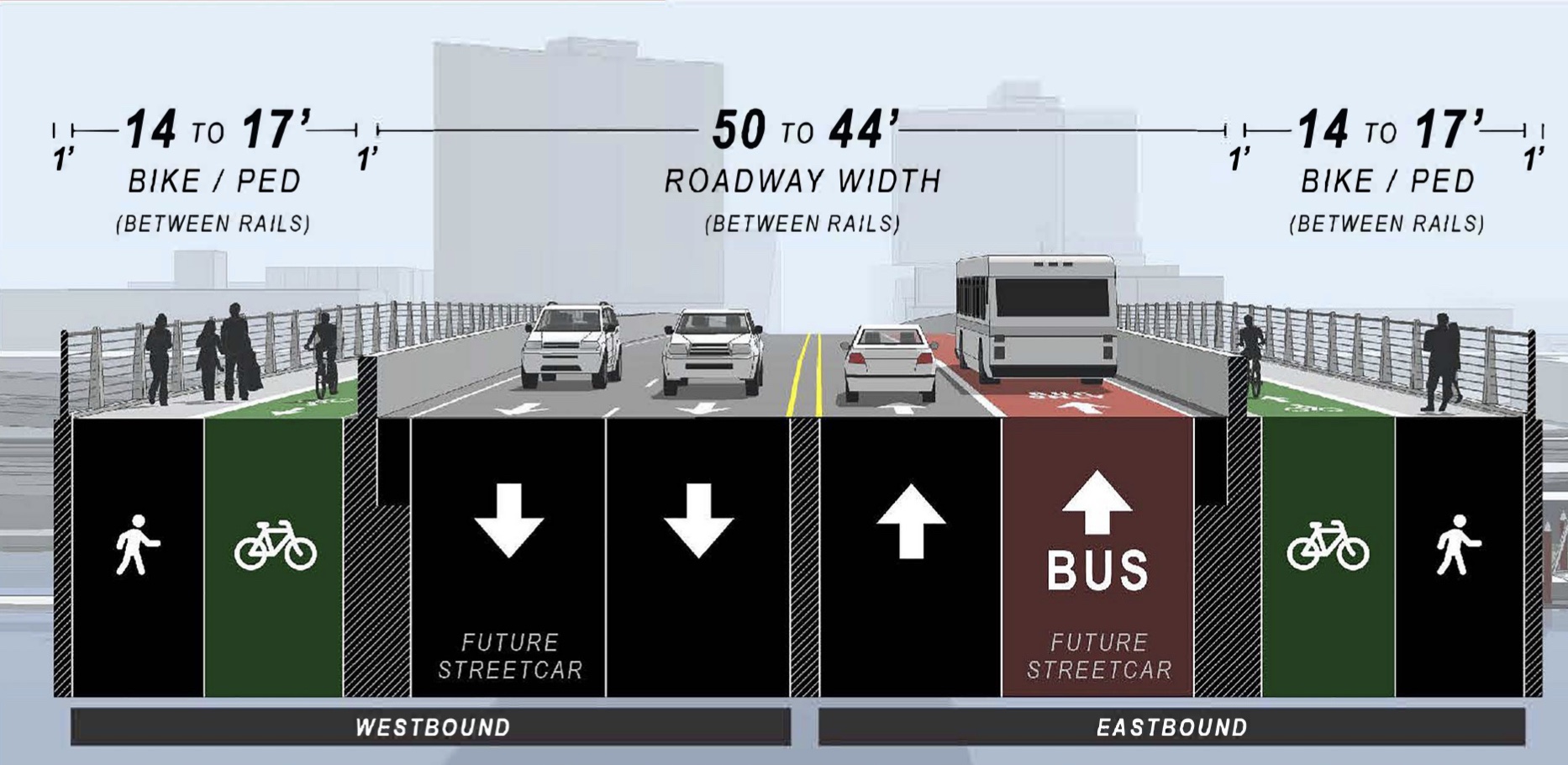
City of Portland agrees with this overall width, but County will have to erase that “14′ part.
“We’re very excited that there will be an opportunity to have ramps as opposed to an elevator,” Kiel Johnson with Bike Loud testified. And Serenity Ebert said, “As a disabled cyclist, I believe a ramp is the superior choice. An elevator cannot be relied upon for reliable access.”
As for lane cross-section on the bridge deck, the County’s latest concept says the width of the bicycling and walking lanes on both sides of the bridge would vary from 14 to 17-feet. But the resolution adopted by council today said the County must provide a minimum of 17-feet. PBOT, who holds authority on the lane configuration question even though the County owns the bridge, also said they support a 10-foot wide inside general purpose lane — that’s narrower than the 11-foot width the County had recommended.
From here, the project goes into the design phase where final details will be hammered out. Multnomah County says they expect construction to start in 2025.
CORRECTION 7/21: This story originally said the County must have the City’s LPA endorsement for the project to move into the next phase of the NEPA process. That is not true. It’s a common/best practice, but not a requirement. We also stated that the County must scrap the stair/elevator option as a result of the City’s resolution. That is also not the case. We regret the errors.
(Photos of signs on NE Sacramento sent in by readers.)
Another neighborhood association is taking the City of Portland’s transportation bureau to task over a traffic-calming project.
An 10-block section of Northeast Sacramento Street west of 60th has become one of Portland’s most people-centric, calm and quiet streets for many reasons. Part of its appeal is organic — the low-volume, neighborhood street is perched on a ridge above a big golf course and boasts excellent views. But the Portland Bureau of Transportation has also had a big hand making this a destination for bikers, walkers, and rollers of all kinds.
When the pandemic first began, we highlighted NE Sacramento as one of the streets where droves of Portlanders flocked to for some much-needed exercise and social interaction. It was one of the first streets the Portland Bureau of Transportation targeted for their nascent Safe Streets campaign. Then in May we reported on how PBOT doubled-down by adding paint, plastic curbs and wands, large concrete barricades (which are planters turned upside-down), and “15 MPH Shared Street” signage to the excessively wide intersection of Sacramento, 64th and Brazee.
Advertisement
One of the concrete barricades on NE Sacramento photographed in May. (Photo: Jonathan Maus/BikePortland)
These traffic-calming additions have helped solidify NE Sacramento as a low-car street that, from my perspective (as someone who bikes through it somewhat regularly), were a big success. But now I’ve learned that some nearby residents strongly object to the changes.
Two large, hand-written cardboard signs placed on a pair of newly-installed concrete barriers at NE 64th and Sacramento read: “This traffic has destroyed what PBOT and Portland city claims ‘Is a view corridor’… the view is ugly now!!!”
When I posted a photo of the sign on Twitter yesterday, another reader shared a flyer that’s been posted that expresses a similar sentiment:
“Unhappy about the ‘bollards’ on NE Sacramento and NE 64th? Think they destroy the view and the livability of the bluff? Wondering how they could be installed by PBOT without the support of the neighborhood? Then come to the Rose City Park Neighborhood Association’s Land Use and Transportation Committee meeting this Thursday July 21 at 7pm. Make your voice heard!!!”
Advertisement
Zoom screengrab from May 2022 Rose City Park Neighborhood Association meeting.
A quick glance at the May 2022 Rose City Park Neighborhood Association (RCPNA) newsletter (the most recent one available on their website) tells us that their board weighed in on this project at their April meeting. The RCPNA Board recommended to PBOT that they install the concrete barricades without the signage mounted on top. They also said there should be “No easterly bollard installed as it would interfere with the established view corridor.” At the RCPNA’s May Land Use and Transportation Committee meeting, it was clear by comments made by board members that a lot of residents who live on/near Sacramento object to the aesthetics of PBOT’s work and want something more “visually appealing”.
There’s seems to be a big mix of opinions from neighbors. According to what I’ve heard from LUT Committee member Ben Joy in a May 2022 meeting, some people think the changes have actually made the street less safe, others like the idea behind it but just think it looks terrible and hurts their property value, and others are very supportive of the project and are grateful for PBOT’s work.
Advertisement
There’s a long and frustrating legacy of neighborhood objections to PBOT traffic calming projects. Just yesterday we reported on how the Beaumont-Wilshire Neighborhood Association is fighting a PBOT diverter on the grounds that it causes inconvenience for drivers and isn’t necessary at all. In that case, city staff have made it clear that neighborhood associations do not have veto power in these matters.
Rose City Park’s main objection to the project on Sacramento is more novel. I have never heard a neighborhood group use view corridors as a reason to protest a traffic calming project.
“The view is anything but ugly,” wrote the reader who emailed us photos of the sign. “Strange how something so relatively unobtrusive, which will enhance the enjoyment of the street and area for more and more folks, is met with such immediate overblown consternation.”
Velotech, Inc. is a locally owned business that has operated in Portland since 2002. Velotech is the parent company of BikeTiresDirect, Western Bikeworks, and Trisports.
This position is responsible for picking, packing and shipping customer orders. Qualified Shipping Specialists also execute product put-away, clean their work area, execute physical counts, and available for general physical and/or minor administrative labor.
Starting rate is $17.25 per hour.
ESSENTIAL FUNCTIONS INCLUDE BUT ARE NOT LIMITED TO:
Pick incoming web orders and warehouse pick up orders
Pack and ship orders according to supervisor’s guidelines
Maintain accurate inventory through regular cycle counting
Assist receiving department with put away of new items
Maintain a clean and organized workspace
Assist with any projects, or assist in other departments as instructed by supervisor
Perform all duties in a safe manner and report all safety concerns immediately to supervisor
MINIMUM JOB REQUIREMENTS:
Wear closed toe shoes at all times in warehouse
Be able to lift 25 lbs above your head without assistance
Stand for long periods of time
Be able to lift 50 lbs without assistance
KNOWLEDGE, SKILLS, & ABILITIES:
Excellent communication and organizational skills
Solid knowledge of cycling products
Ability to work in a high volume, fast-paced environment
Ability to work independently or with others to manage multiple task with minimal supervision.
BENEFITS
Generous Employee Discounts
Flexible Schedules
Medical/Dental/Vision for all full & regular part-time employees
Paid Time Off – up to 15 days your first year
Quarterly ‘Get Outside’ days
PHYSICAL/MENTAL DEMANDS:
The physical demands described here are representative of those that must be met by an employee to successfully perform the essential functions of this job. Reasonable accommodations may be made to enable individuals with disabilities to perform the essential functions. While performing the duties of this position, the employee is regularly required to talk or hear. The employee frequently is required to use hands or finger, handle, or feel objects, tools or controls.
While performing the duties of this job, the employee is regularly required to stand; walk, reach with hands and arms, stoop, kneel, crouch and sit for extended periods of time.
The employee must occasionally lift and/or move up to 50 pounds. Specific vision abilities required by this position include close vision, distance vision, color vision, peripheral vision, and the ability to adjust focus.
The noise level in the work environment is usually moderate.
This description is intended to provide only the basic guidelines for meeting job requirements. Responsibilities, knowledge, skills, ability and working conditions may change as needs evolve.
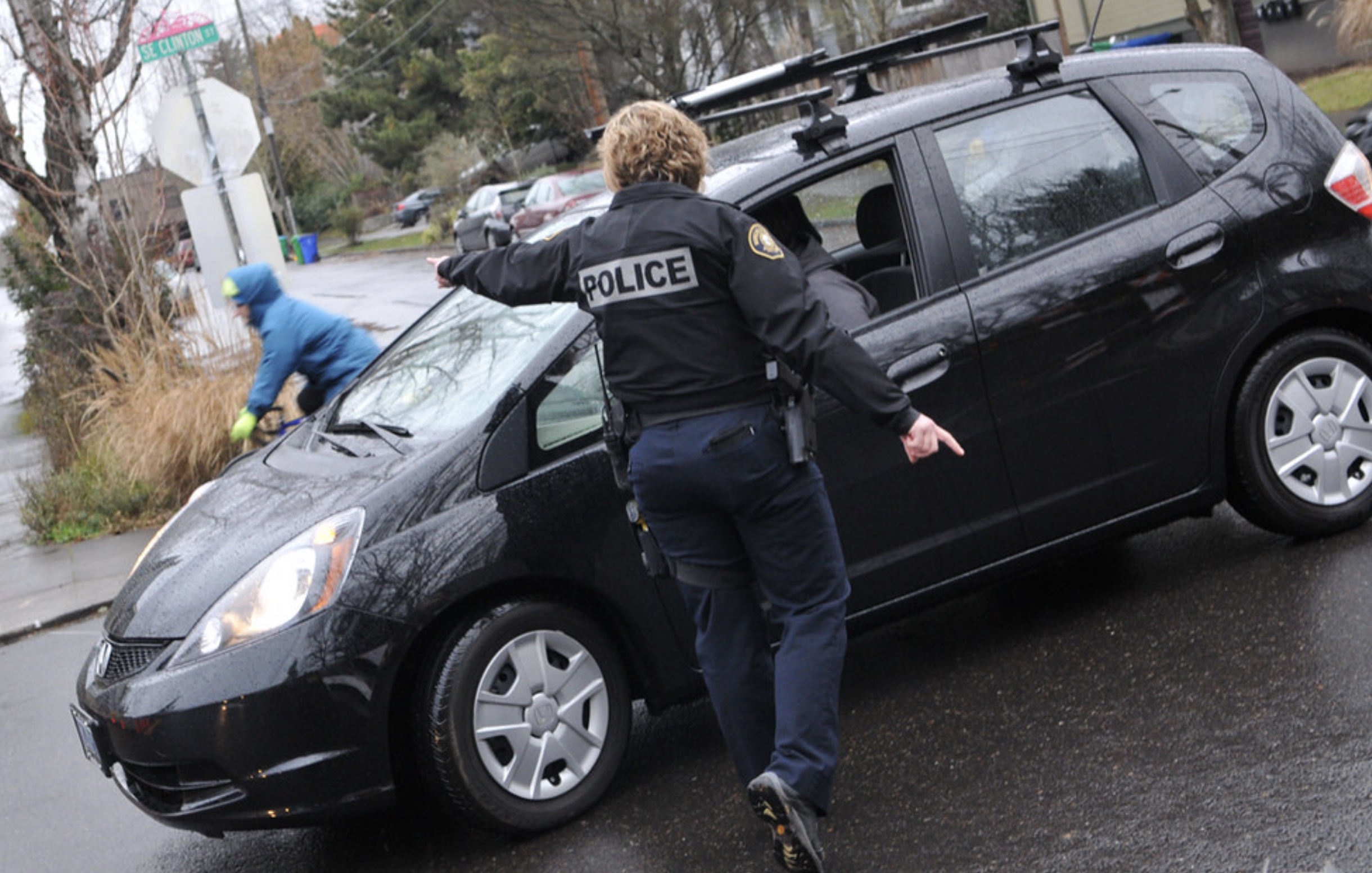
A Portland Police officer approaches a car user on SE Clinton Street. (Photo: Jonathan Maus/BikePortland)
The racial demographics of drivers PPB has stopped since 2017 broken into the Traffic and Non-Traffic Divisions. (Source: PPB)
Being stopped in traffic is the most common way most people come into contact with the police, but we don’t all experience those stops equally. In Portland (and throughout the United States), people of color are overrepresented in traffic stops, with Black people experiencing the most drastic effects of this bias. And this is more than an inconvenience: Black people across the country have been killed by cops using lethal force during otherwise routine traffic stops.
As a result, advocates have taken on this issue as both a racial and transportation justice cause, and Portland officials have indicated they want to make a change. Last summer, Mayor Ted Wheeler and Police Chief Chuck Lovell directed Portland police officers to make fewer traffic stops, especially for offenses deemed low-importance, where racial bias is more prevalent.
“We need to focus on behaviors that result in serious or fatal crashes, such as speeding, driving while impaired, distracted driving, etc.” Lovell said in a press release last year. “Stops for non-moving violations or lower level infractions will still be allowed, but they must have a safety component or have an actionable investigative factor to it.”
PPB’s traffic stop rates were way down in 2021 – the report says PPB officers “performed 44 percent fewer driver stops and 80 percent fewer pedestrian stops than in the prior year.” But this is not necessarily as a result of Wheeler and Lovell’s instructions, and it didn’t appear to make an impact on the racial biases shown against Portlanders of color. Instead, it appears to be because of a staffing shift that sent the Bureau’s Traffic Division into disarray.
Before 2021, there were two groups of officers – from the Traffic and Non-Traffic Divisions – making roughly the same number of traffic stops each year for different reasons. The stated mission of the Traffic Division is to “address behaviors of road users, including drivers, bicycle riders, and pedestrians, that might lead to a collision.” The Non-Traffic Division’s goal “primarily relates to the reduction and prevention of violent crime in the City” and involves “discretionary traffic stops to contact potential subjects of interest.”
These discretionary stops are often made for offenses Wheeler and Hovell deemed “low-level” – i.e., an expired license plate or missing tags. They also leave a lot more room for officers to use their own – potentially racially biased – judgment. Even after Wheeler and Lovell guided officers to avoid those stops, the bulk of Non-Traffic Division stops were for offenses deemed minor.
Differences in calculating racial disparities
PPB’s internal data indicates Black Portlanders were not overrepresented in traffic stops in 2021. This is not the case when compared with census data. (Source: PPB)
PPB uses its own benchmarks to compare their data on citywide racial demographics to calculate disparities. Recent census data indicates Portland’s Black population sits at about 5.9% of the total. Even though the actual number may be slightly higher due to census counting errors and a growing population, this percentage is generally accepted and has been used in the past to indicate racial profiling within PPB traffic stops.
According to the report, Black people made up almost 18% of the population stopped in traffic in 2021 – meaning they are overrepresented threefold. But PPB’s internal data says otherwise.
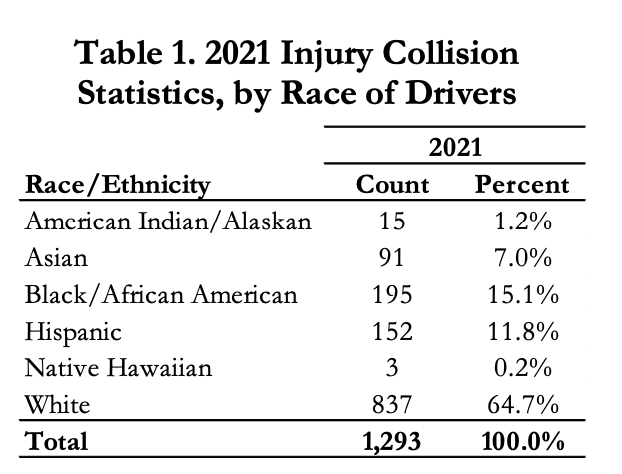
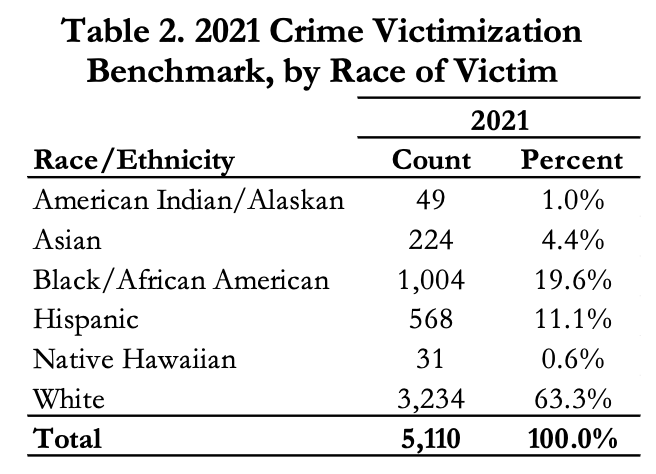
PPB uses injury collision rates – the demographics of people involved in injury collisions investigated by PPB officers – as a benchmark to use when comparing their traffic stop data to the general population. For the Non-Traffic Division, PPB uses the demographics of crime victimization rates as a benchmark. Both of these benchmarks (see charts below) present a far higher percentage of non-white Portlanders than actually live here.
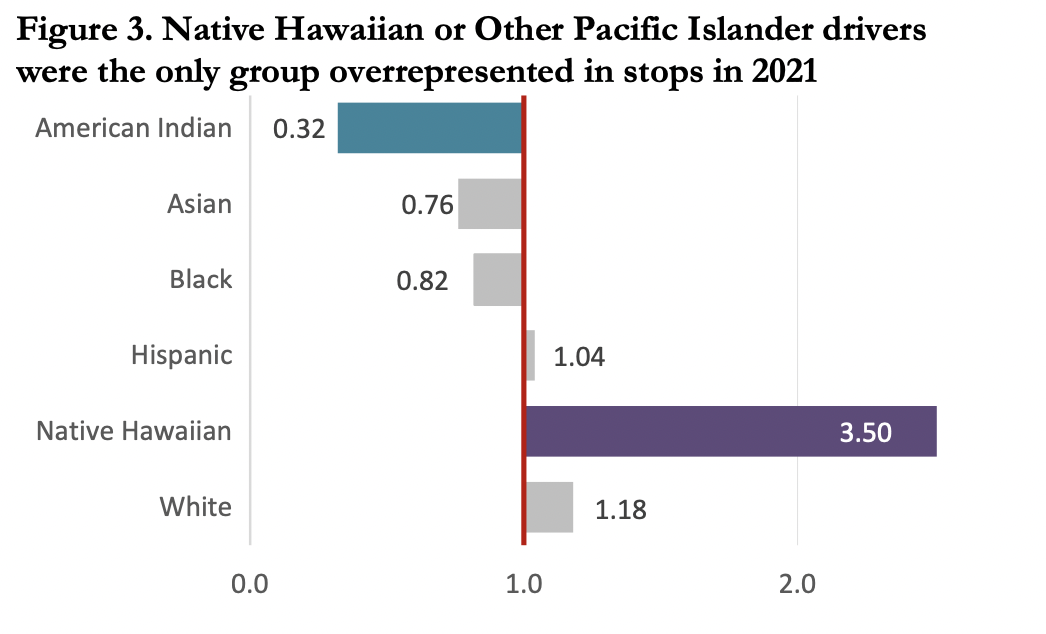
According to their internal data, Native Hawaiian or Pacific Islander drivers were the only group overrepresented in PPB traffic stops in 2021, and otherwise, PPB officers did not show racial discrimination within their traffic stop procedures. But given the lack of substantial police oversight within the Bureau and its history (and ongoing demonstration) of institutional racism, some people have called this practice into question.
Advertisement
What’s next?
The report states the “slight declines witnessed in Minor Moving Violation and Non-Moving Violation stops” are “an encouraging step and demonstrates the Bureau’s willingness to act and change.” But the racial disparities have not improved, which Lovell himself has acknowledged.
It’s unclear the effect the Wheeler and Lovell’s instructions and the PPB staff shortage had on Portland’s traffic crash fatality rates, which were exceptionally high last year and aren’t too much better this year. Even if PPB officers had directed their attention to the most dangerous offenses, data suggests increased policing doesn’t work as a method of preventing traffic crashes and deaths.
Instead, advocates say infrastructure changes are what’s needed to improve street safety. Some advocates are in favor of solutions like traffic camera speed enforcement, which can now be processed without costly and time-consuming police involvement.
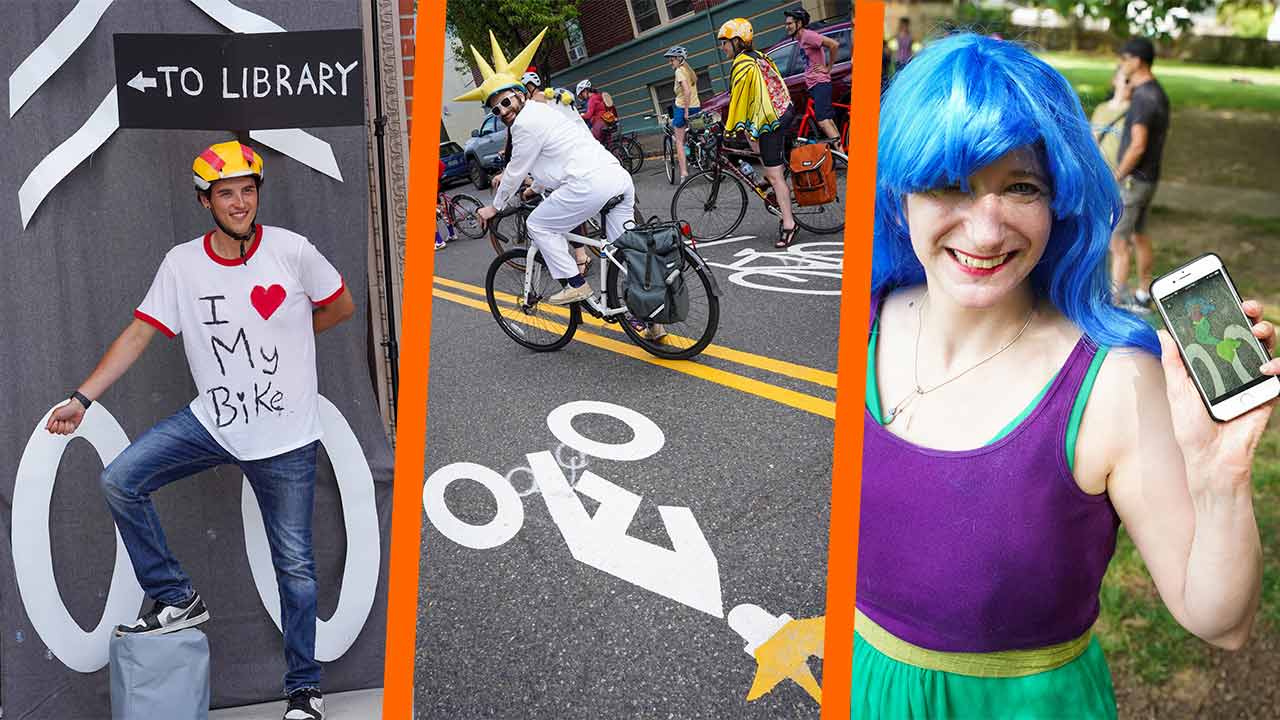
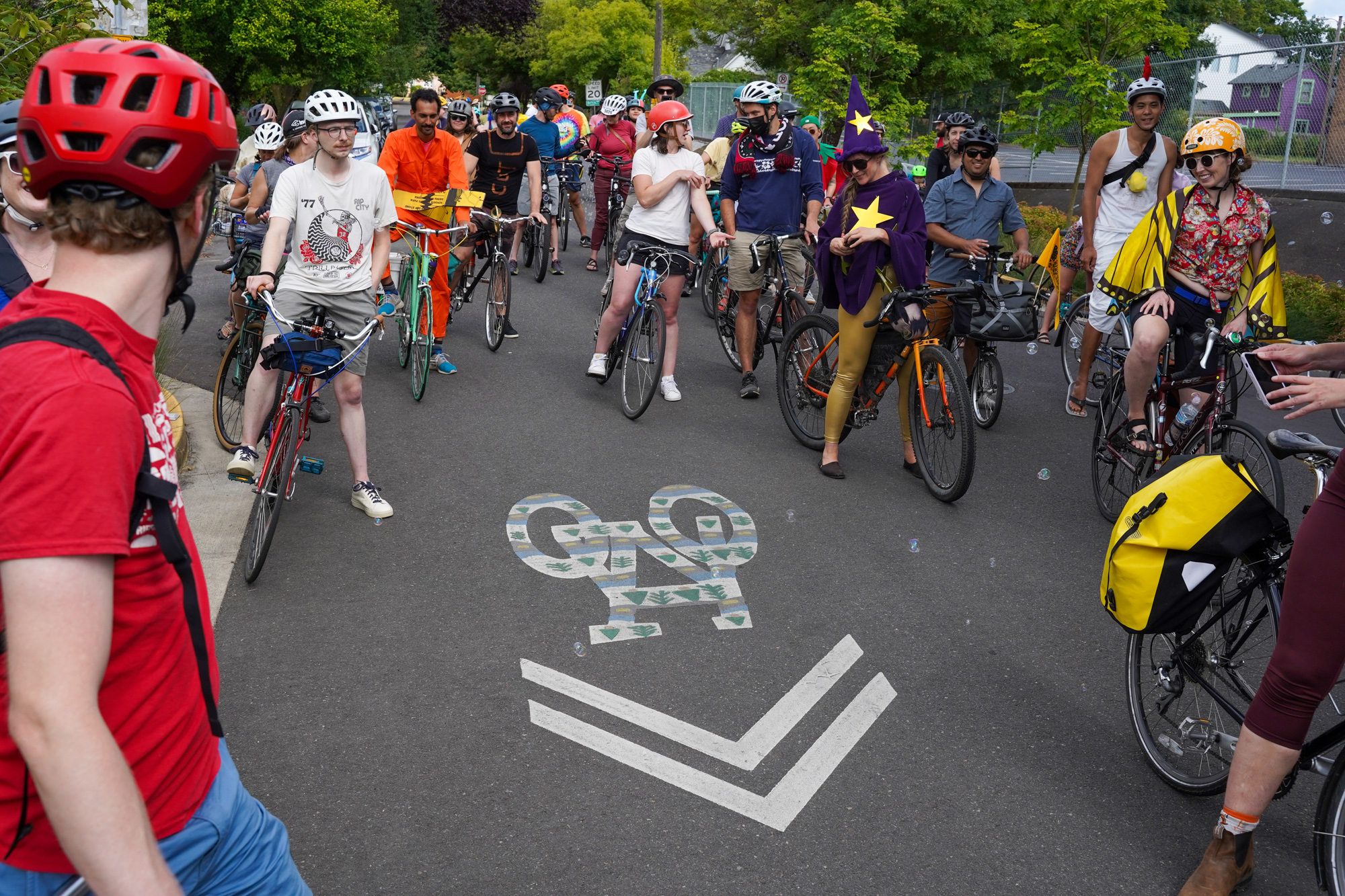
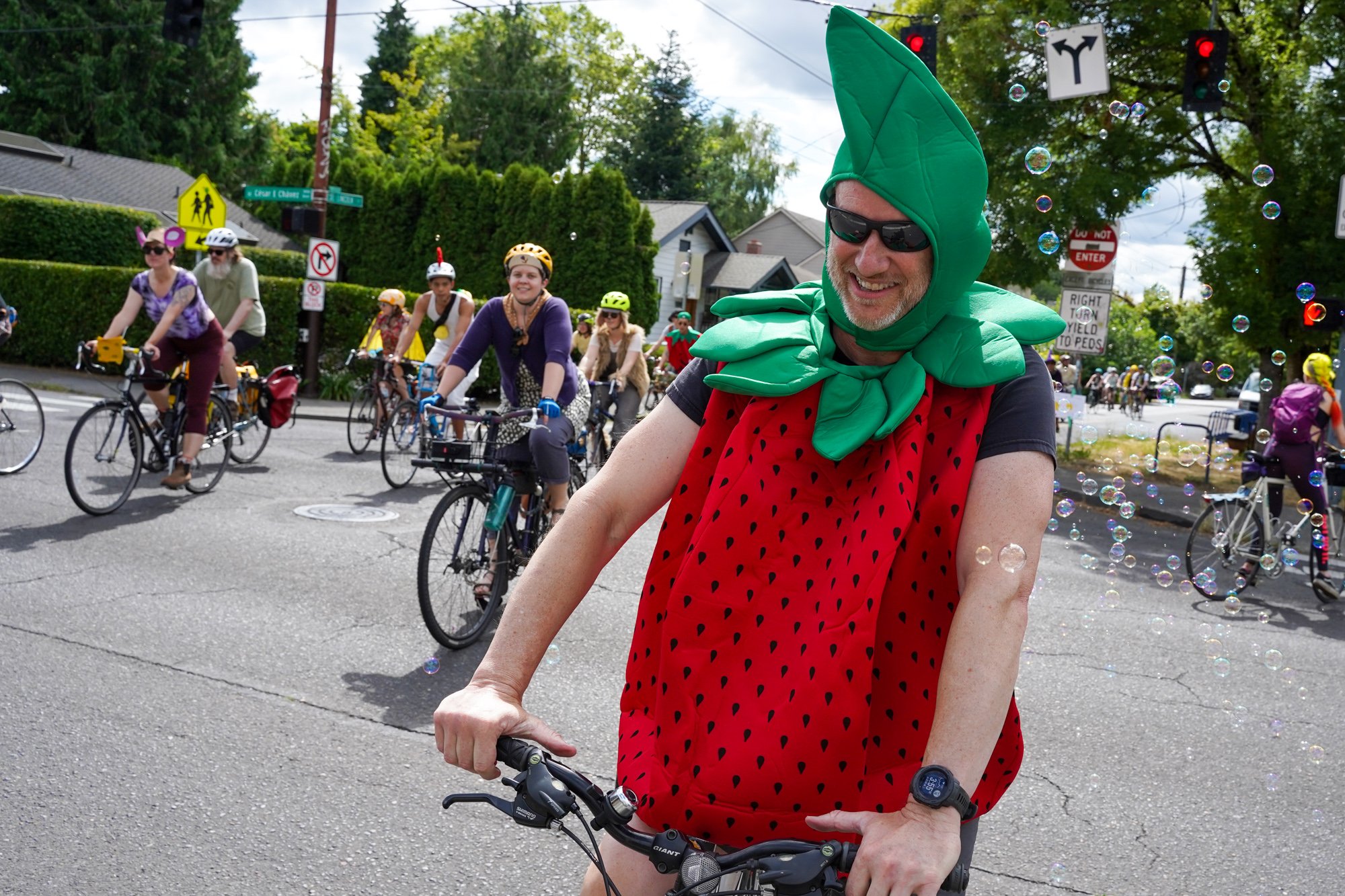
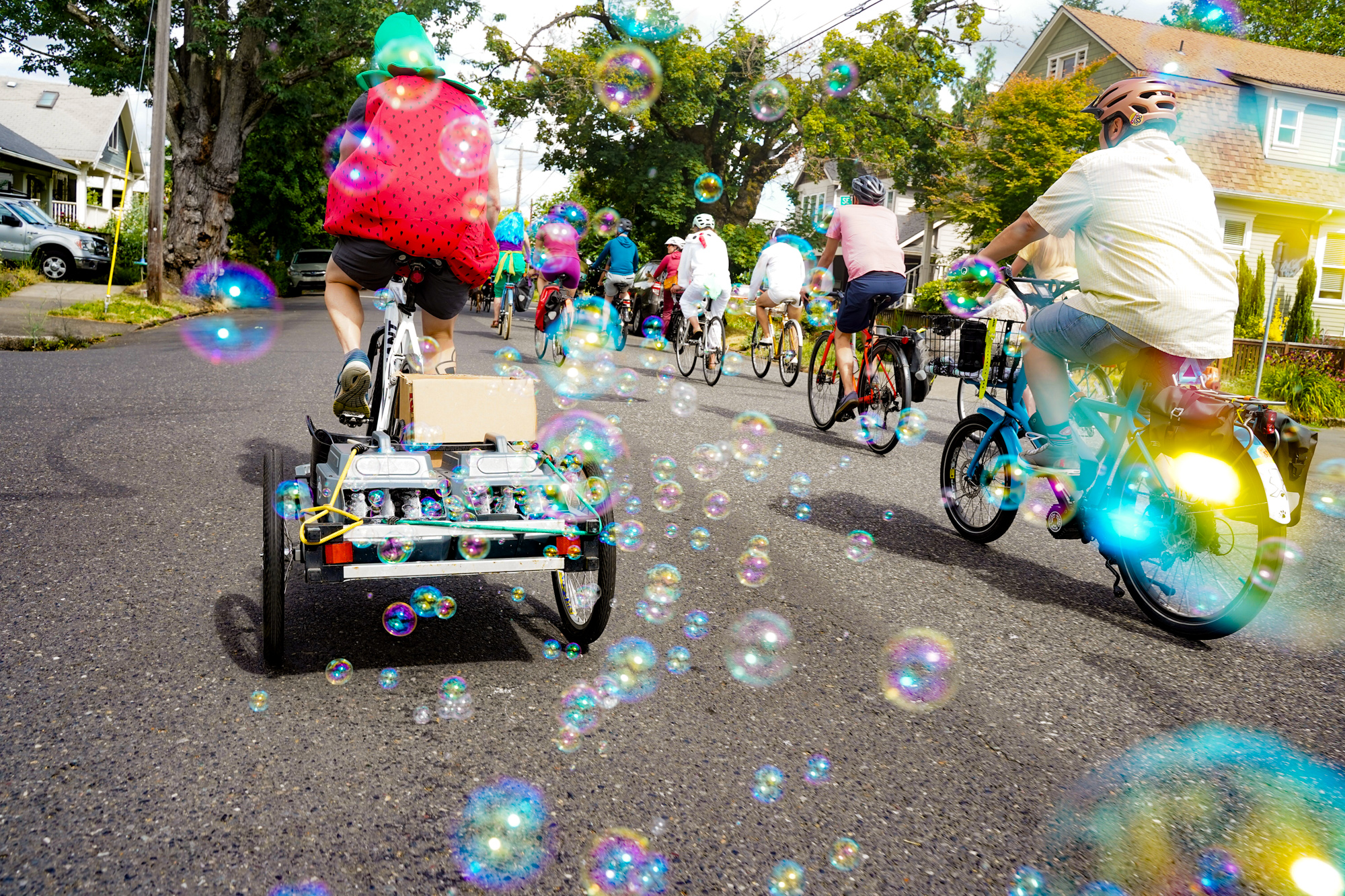
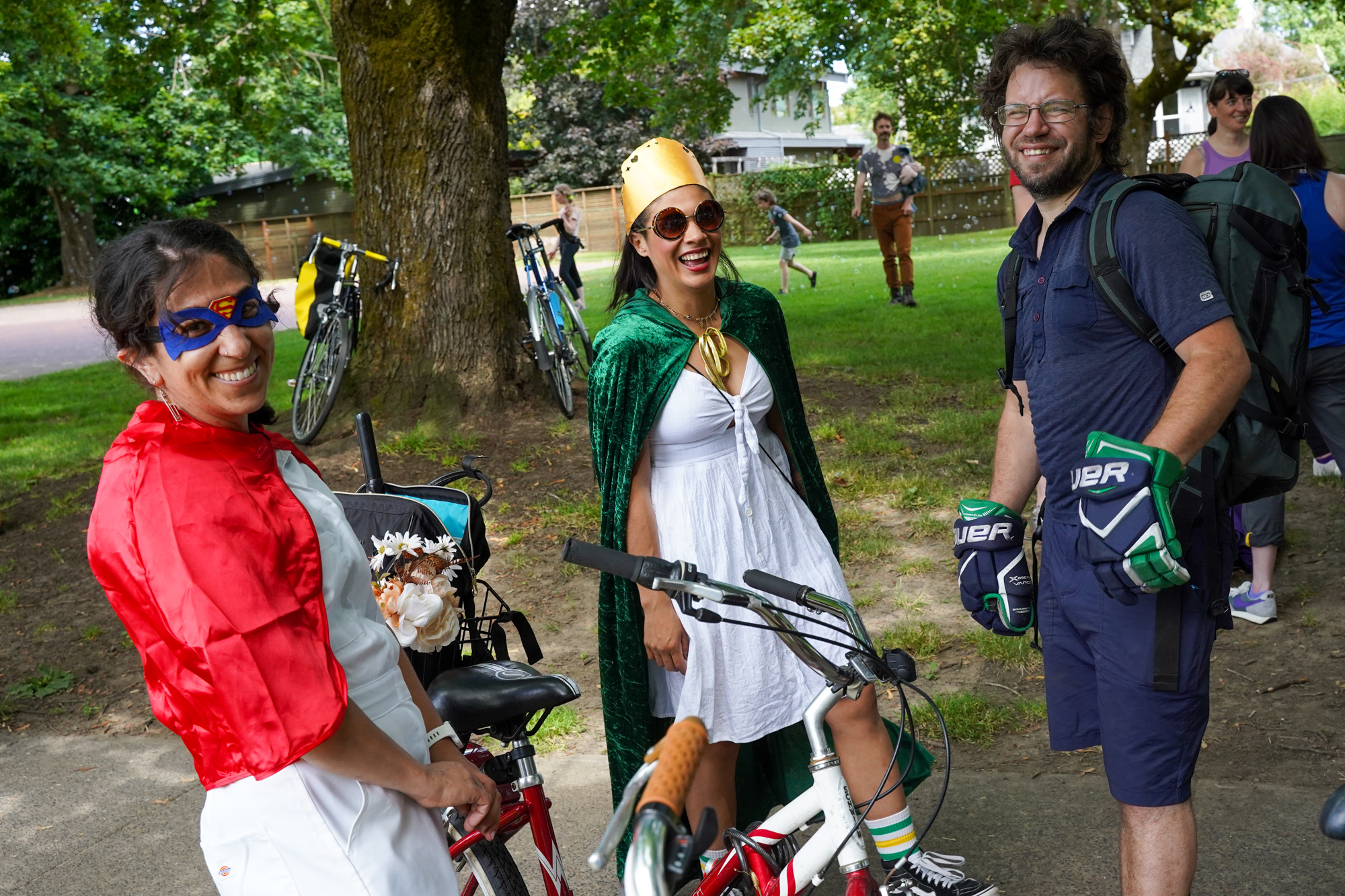
Pedalpalooza is saving Portland right now. Every day, people are coming together around shared passions and connecting on our streets with open arms. It’s exactly the kind of community-oriented, free fun so many of us need right now, and the Art in the Bike Lane Ride held on Saturday was a great example of this.
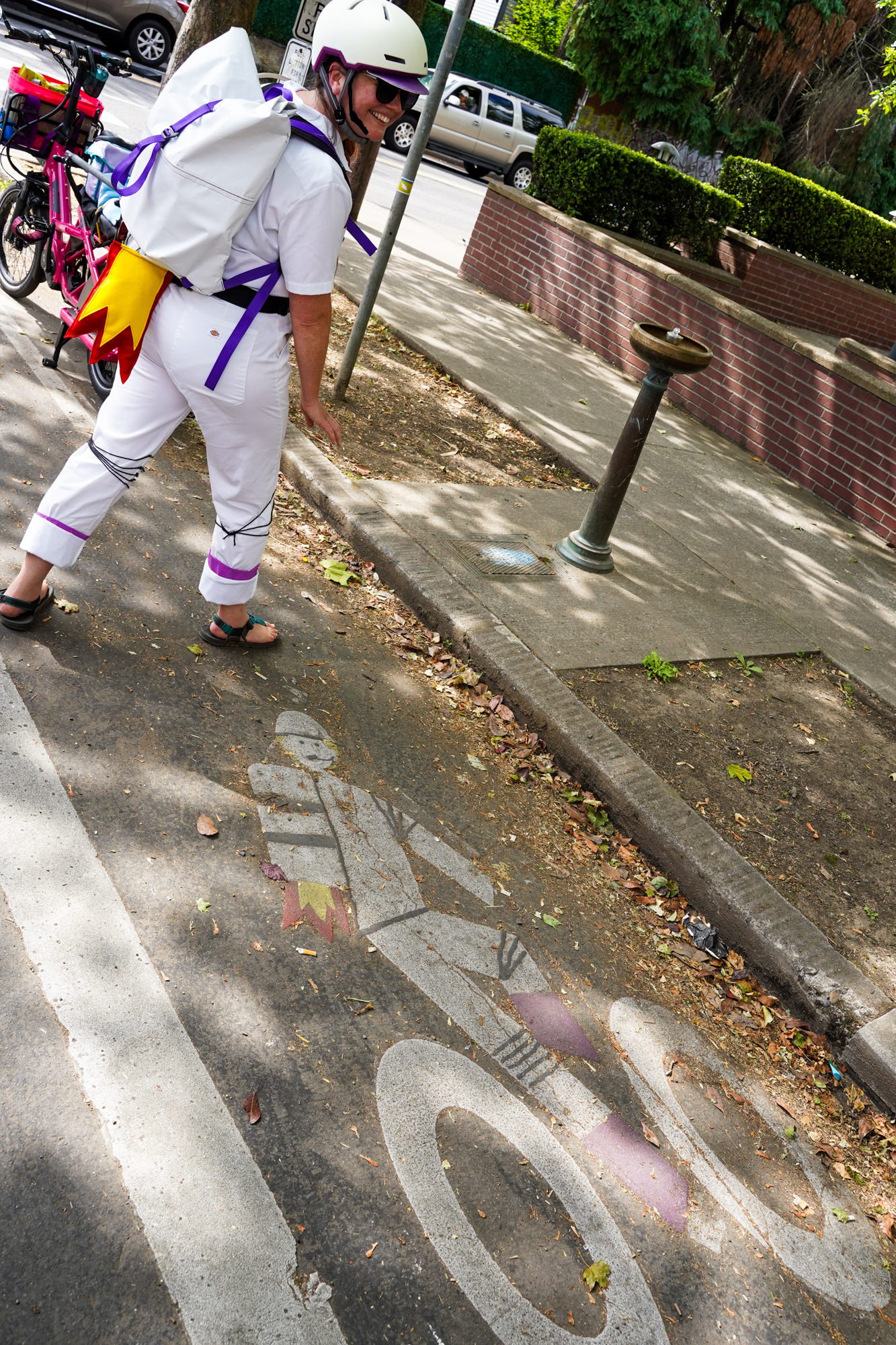
Leaders Whitney Mercer and Haley Miller love the quirky and cute bikeway characters that the City of Portland creates. I mean, loove them. Mercer, who showed up with an impeccably detailed rendition of the “Cyclist in Space” character that lives in a bike lane outside the Belmont Library, wears fashion accessories inspired by the designs and said one of her life goals is to meet the Portland Bureau of Transportation staffer who established the program.
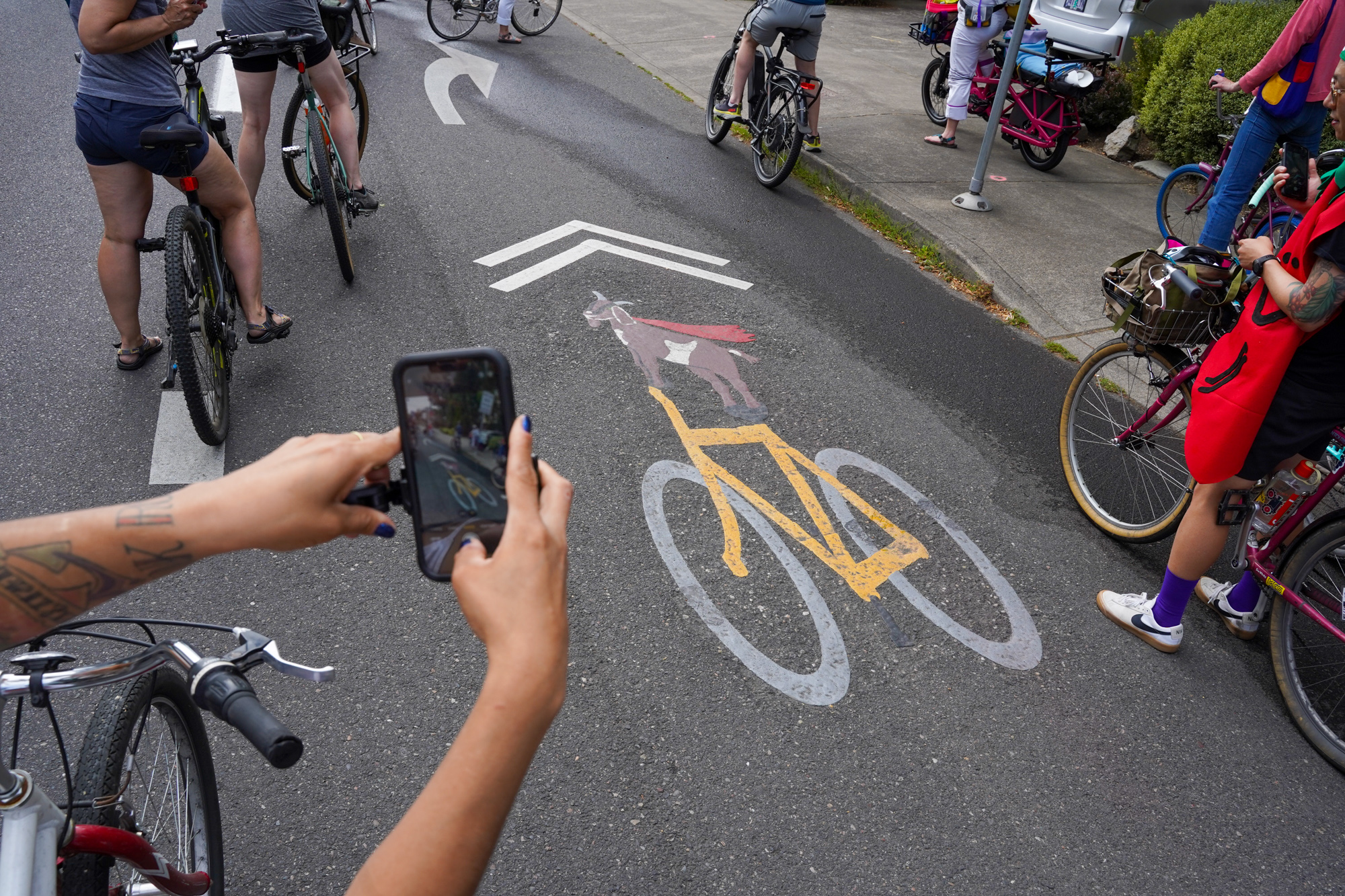
Mercer’s co-leader, Haley Miller, donned a cape and eye-mask just like the “Transportation Superhero” character she loves most, which can be found in the bike lane on N Vancouver just before Russell. “It was the first one I saw and it was like the gateway drug to finding them all and documenting them,” she says in the video above.
Advertisement
The tradition goes back to 1999 when a PBOT maintenance staffer was bored and used excess scraps of thermoplastic used in pavement markings to give bike lane characters a bit of extra personality. The tradition was embraced by a subsequent person at PBOT named Kirstin Byer who expanded the program and made sure it became standard practice. Byer thought of herself as curator of Portland’s “random bike art museum” before she retired in early 2021.
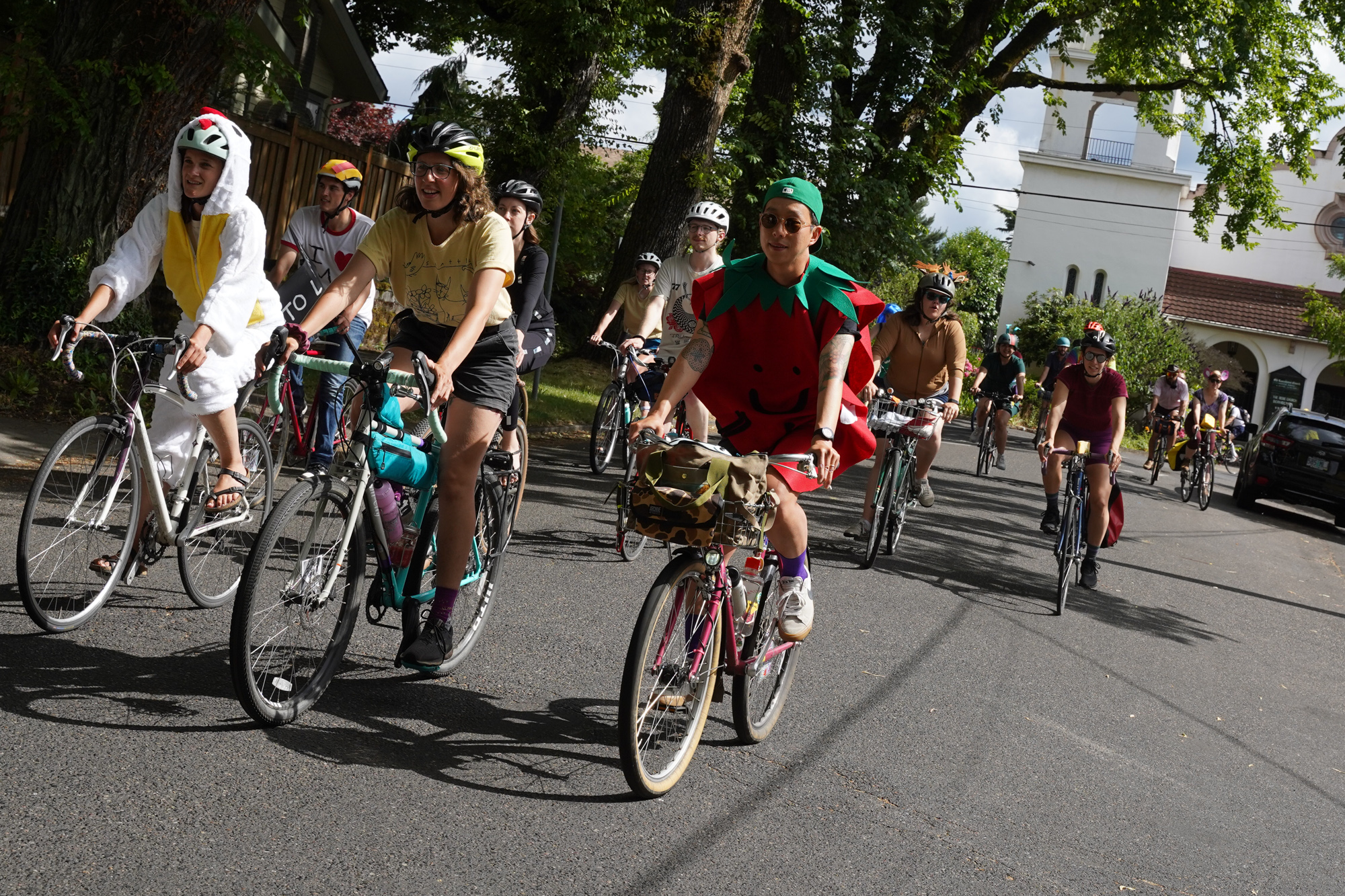
As you can see in our video and photos, there was plenty of life on Saturday’s ride! Take a look at the full gallery below and don’t miss our Pedalpalooza Hub for more coverage.
(Photos: Jonathan Maus/BikePortland)
Special thanks to BIKETOWN, operated by Lyft for being the financial supporter of our Pedalpalooza 2022 coverage.
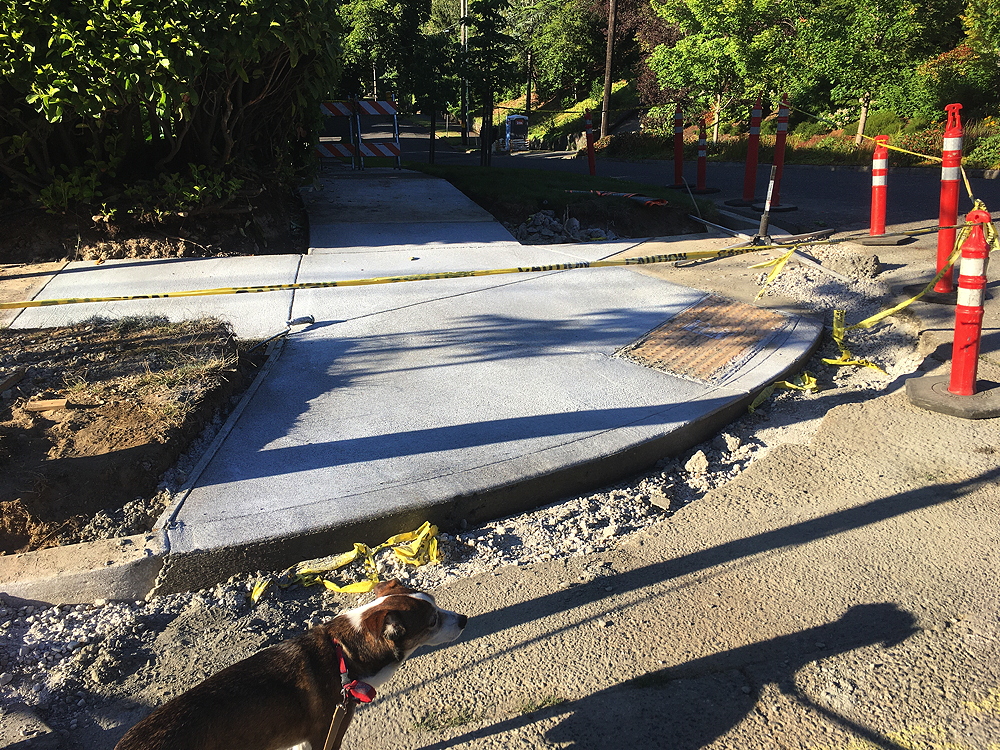
A peaceful corner in Portland Heights, before the ADA ramp upgrades. (Photo source: Google maps)
This is the story of the little ADA ramp that could.
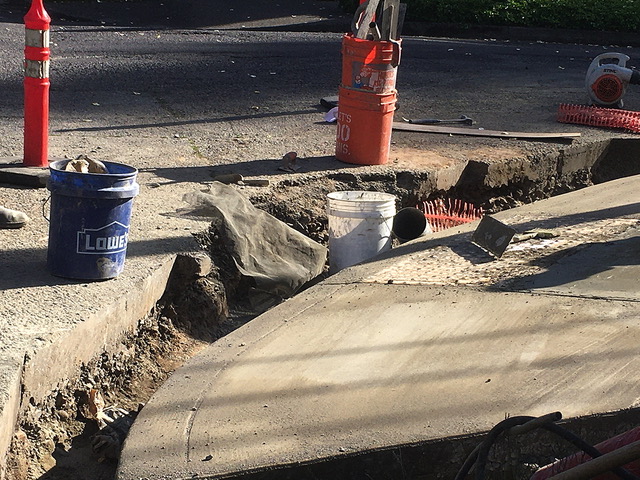
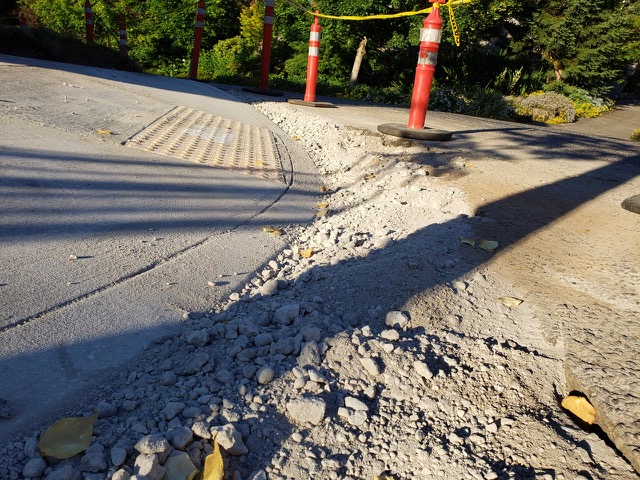
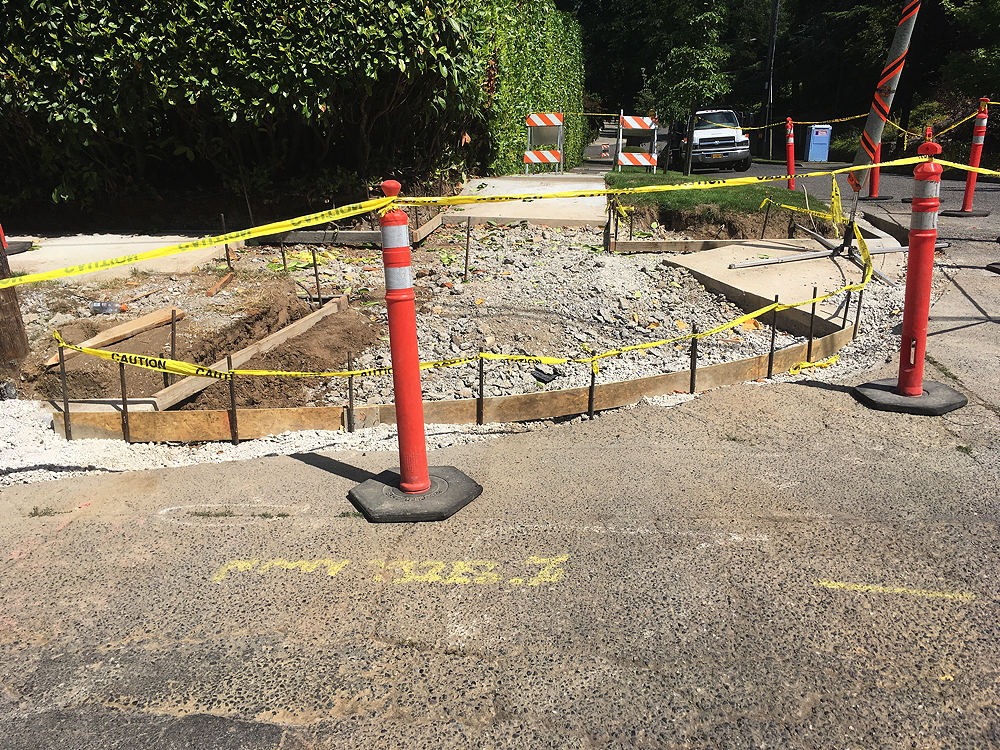
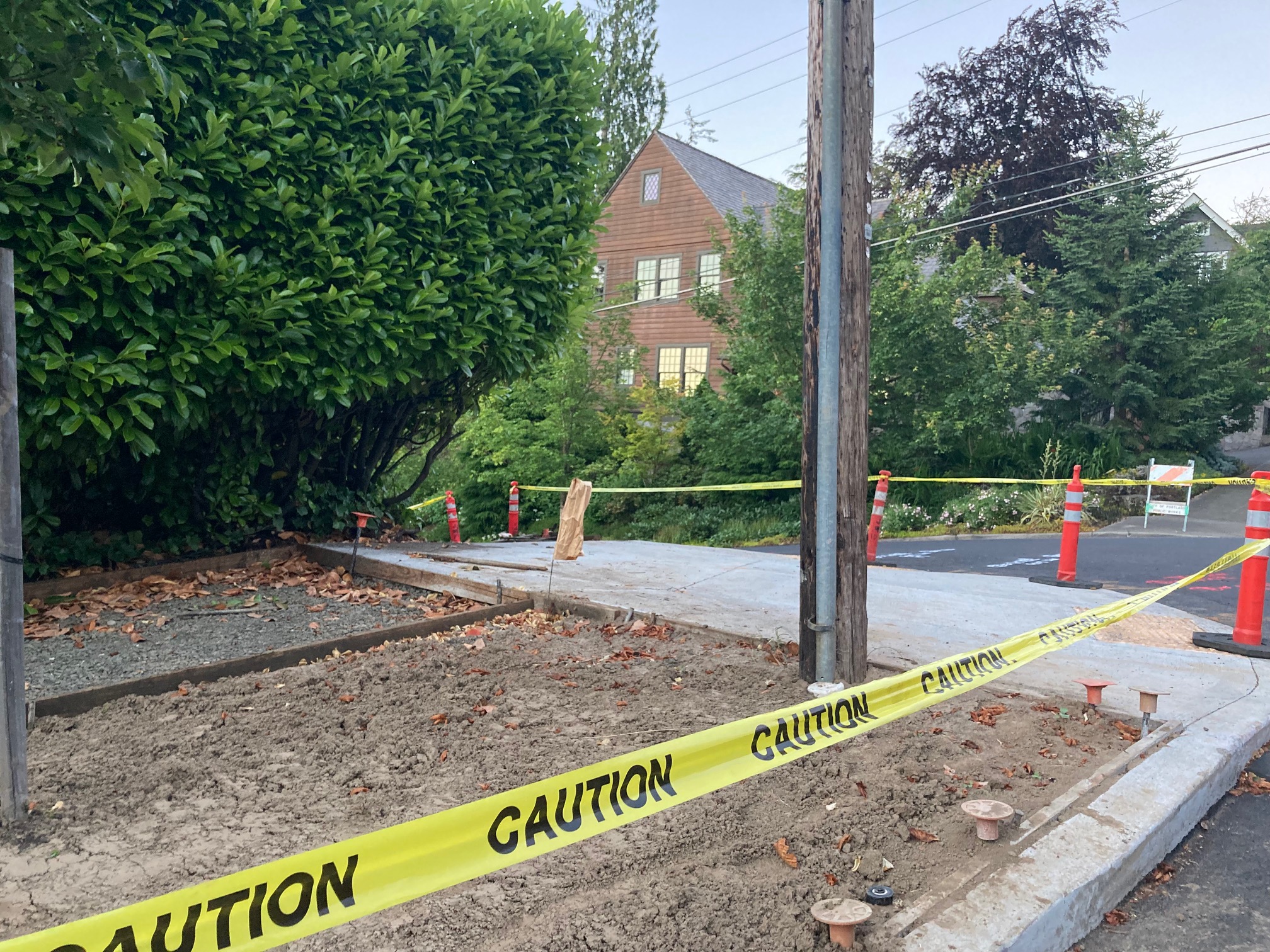
For 14 months now, I’ve watched a new ramp in the Portland Heights neighborhood (south of Goose Hollow) get built, fail inspection, be torn down, get rebuilt, fail inspection, be torn down, get rebuilt again . . . you get it. Apparently the third build still needs some adjustment to the adjacent sidewalk.
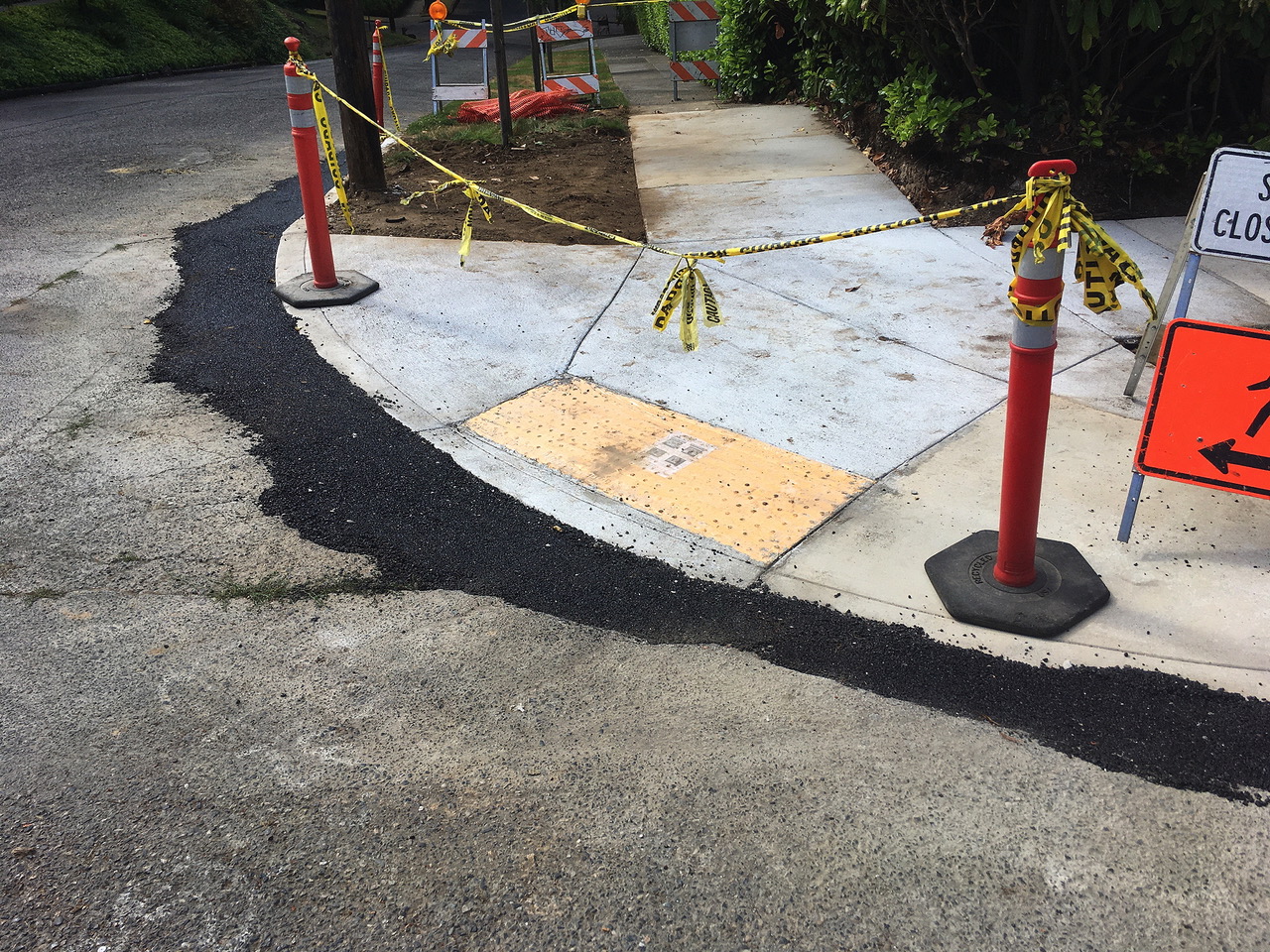
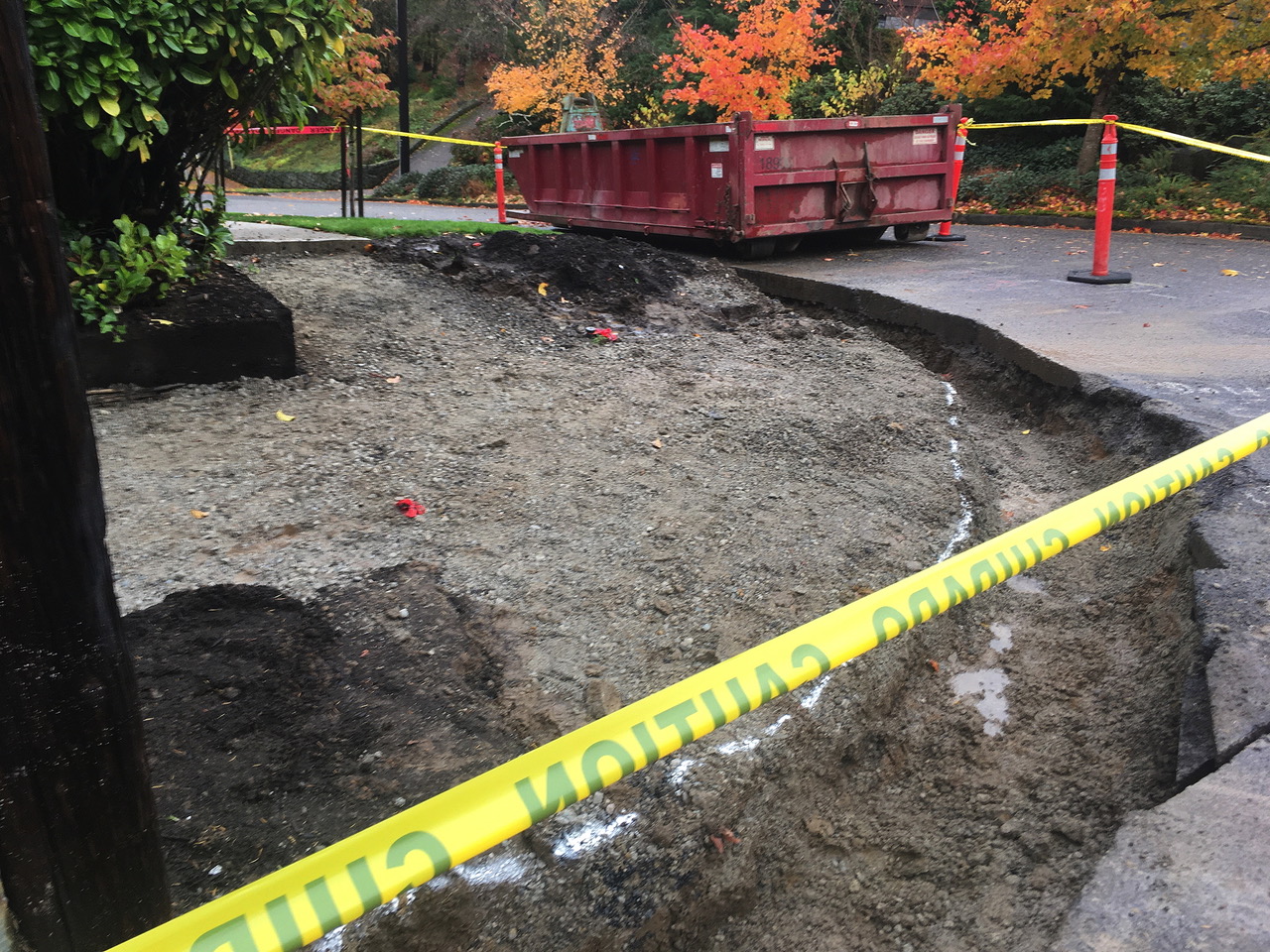
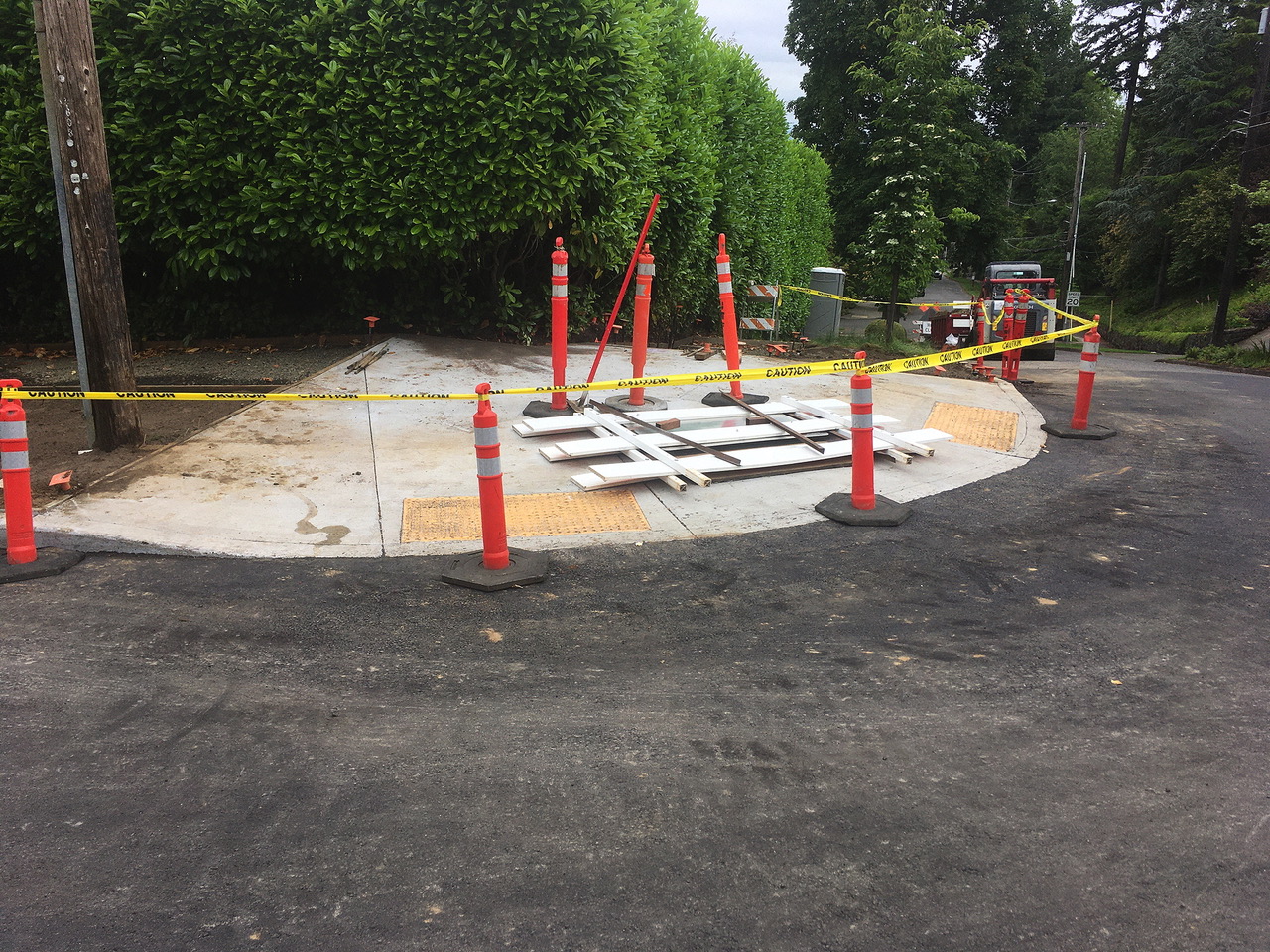
Here’s a photo diary of the recent attempts to build the new ramp at SW Spring and 16th streets:
The first concrete pour, June 24, 2021. (Photo credits: Southwest Hills Residential League)
Whoops, the ramp sits below the grade of the road.
The tear down on July 16, 2021.
Advertisement
July 22, 2021, the second pour.
August 2, 2021. The margin between the street and the ramp is patched with asphalt.
But three months later, the 2nd build is torn down, November 10, 2021.
Over six months later, the third pour, July 2022.
And the adjacent sidewalk to the west will be re-poured to better meet the ramp. July 16, 2022. (Photo credit: Lisa Caballero/BikePortland)
Advertisement
If this were the story of just one hapless corner I probably wouldn’t be posting about it. But there are two nearby locations with new ramps which have also had to be rebuilt.
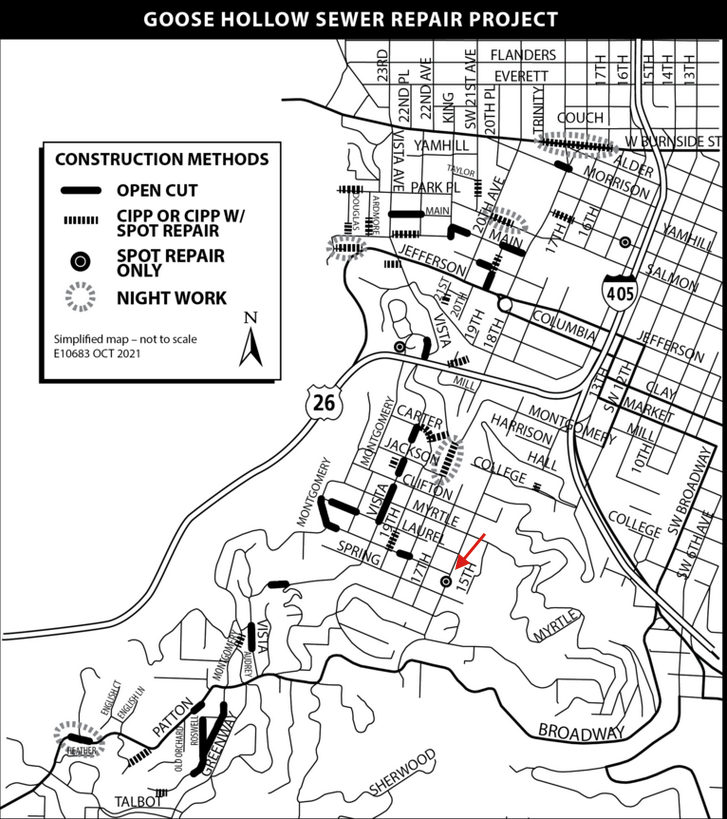
The ADA (Americans with Disabilities Act) work has been triggered by the Goose Hollow Sewer Repair Project, a Bureau of Environmental Services project to upgrade aging and deteriorating sewer pipes in Goose Hollow and Portland Heights. These old pipes have been around between 80 and 100 years, as have some of the sidewalks.
The primary work of the project, replacing sewer pipes, has gone well. The crews work their tails off, they have been friendly, accommodating, communicative, and aside from all the dust, a pleasure to be around. They have replaced two and a half miles of public sewers.
If this were the story of just one hapless corner I probably wouldn’t be posting about it. But there are two nearby locations with new ramps which have also had to be rebuilt. So far that totals seven pours for three ramps. I’m not trying to find the weak link(s) in a work-flow that involves many subcontractors. However, at some point(s) the city has to have touched the process (at least through inspections) before the concrete pours.
This week, it looks like the strategy with the third rebuild is to call the ramp good, and instead to adjust the slope of the adjacent sidewalk. Hopefully, the job can be finished with this new approach. It’s a tough corner, the high point of both a north-south and a east-west slope. And the specifications for contemporary ADA ramps don’t easily sit on legacy sidewalks.
I don’t know who eats the cost of these rebuilds in the short-term — the contractor or the city — but in the end, the taxpayer gets the bill.
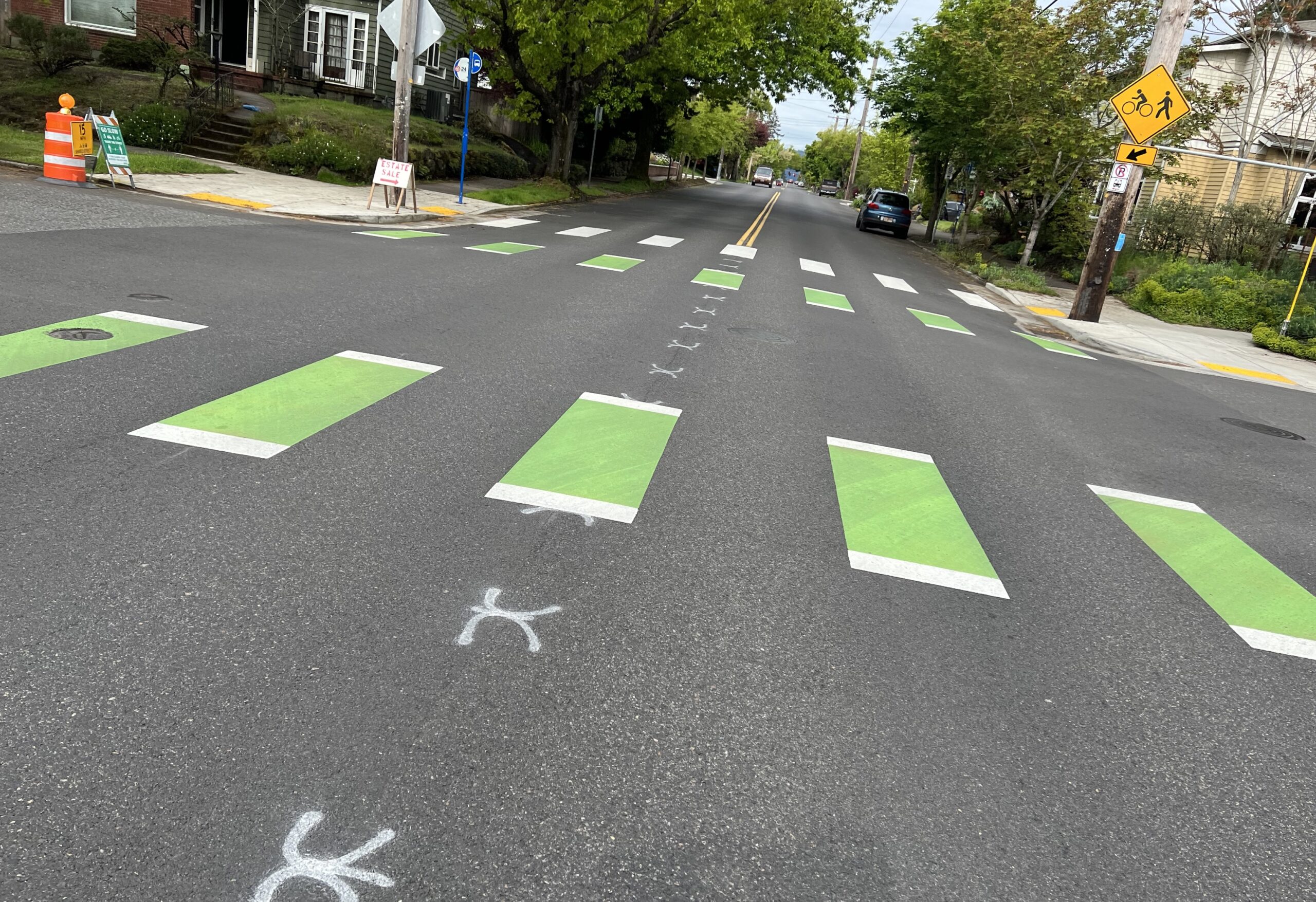
PBOT will finally fill in the outlines that have been on the ground since early this year. (Photo: Jonathan Maus/BikePortland)
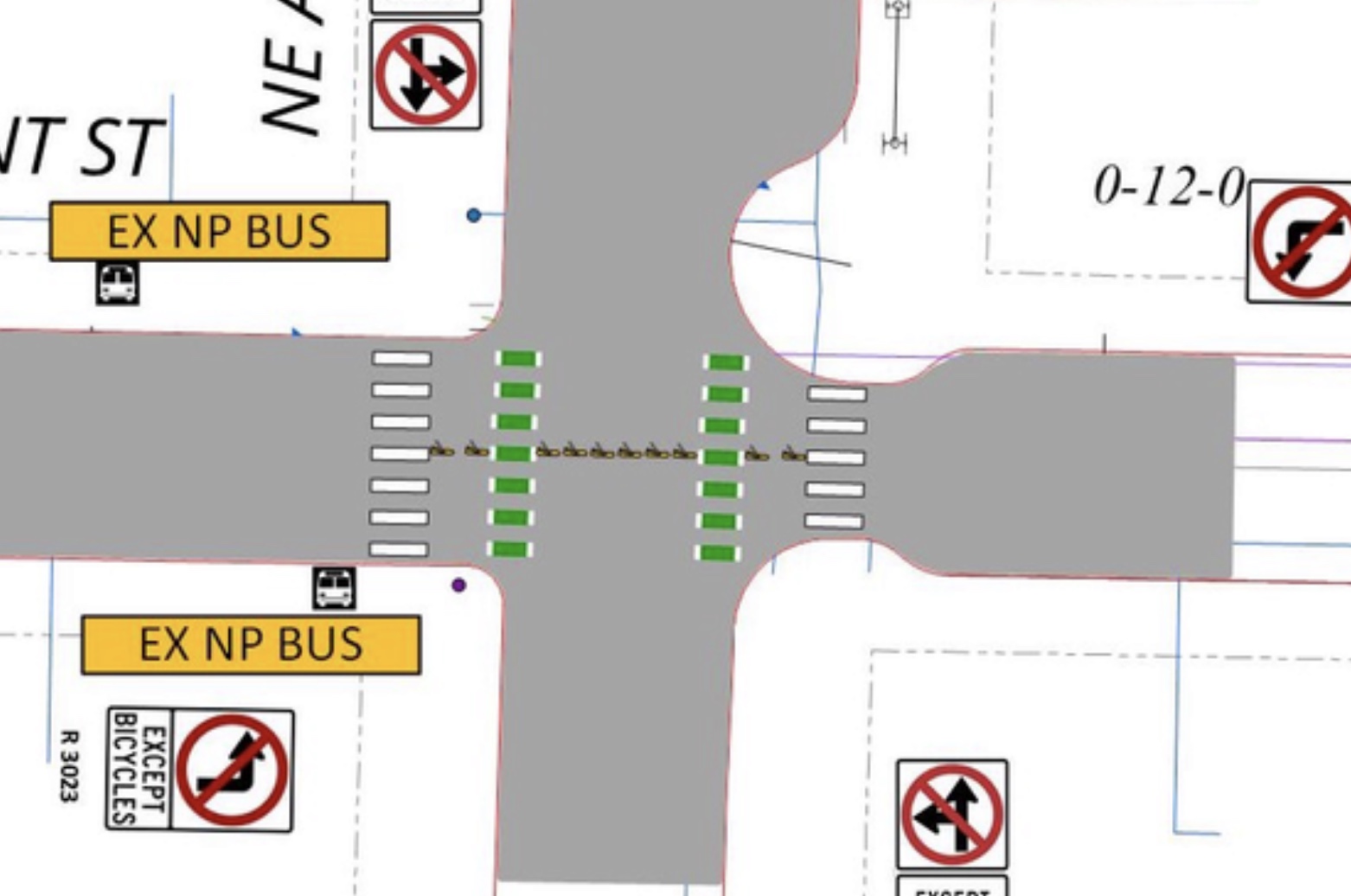
PBOT plans for NE Fremont and Alameda.
The Portland Bureau of Transportation will move forward with a pilot of a full median traffic diverter on Northeast Alameda at Fremont.
The move comes after months of back-and-forth with the Beaumont-Wilshire Neighborhood Association after they voted against the idea back in March.
At issue is an effort to improve safety on Fremont, a neighborhood collector that has come under scrutiny by both neighborhood residents and PBOT for excessive driving speeds and crashes. Alameda rose to the top because it’s a major north-south bicycle greenway that has seen an increase in cars and cut-through traffic.
Advertisement
When PBOT proposed a full diverter at the intersection, some BWNA leaders and residents objected to it. They cited myriad reasons for their opposition and ultimately the BWNA board voted 7-4 against it. While some people thought the vote was binding, PBOT never saw it as such and continued to work toward a solution.
In April, the BWNA formed a sub-committee to come up with their own proposal. Leaders of that committee maintained that Alameda was wide enough for the car and bike traffic to co-exist and that, perhaps it shouldn’t be considered a greenway at all. PBOT wasn’t having it.
“Since [NE Alameda] functions as a neighborhood collector, the volume is higher than narrower local streets. This begs the question – Why was Alameda selected and is it the widest street identified as a Greenway?” a BWNA leader emailed to PBOT Neighborhood Greenways Program Coordinator Scott Cohen.
“Despite your consistent suggestions, NE Alameda does not function as a collector, it functions as a cut-through route for people avoiding the collectors,” Cohen replied. He also made it clear he was tired of all the process-related back-and-forth. “Slow Streets [Program] staff has been connecting with the neighborhood about this intersection since April 2021 on a solution and delaying is not an option,” he wrote.
Advertisement
For the past three months, Cohen and PBOT have worked with BWNA to create a different design proposal at Alameda and Fremont. But in the end, PBOT decided their proposal that the neighborhood voted against in March achieved more of the goals of the project.
According to the project website that launched today, PBOT plans to install plastic curbs and posts on the centerline of Fremont with cut-outs so bicycle riders can pass through. Car users will be prevented from turning left from Alameda to Fremont or vice versa.
PBOT says the design will reduce crashes, create a safer crossing, and reduce car use on the Alameda bicycle greenway. They will consider this a pilot installation and will monitor street usage at 15 locations for one year to decide if the new diverter should be made permanent. They expect the work to be done on the estimated $10,000 project sometime this summer or early fall.
UPDATE, 7:50 am on 7/20: This post initially said that PBOT and the BWNA neighborhood association agreed on the diverter in the end. That was inaccurate. BWNA did not support PBOT’s ultimate decision to move forward with the diverter. I’ve edited the story to reflect this and regret the error.
Exciting news! On July 14, the Oregon Transportation Commission approved $4 million in state Transportation Operating Funds for the Community Paths Program 2022 solicitation. There is also $3 million in federal Safe Routes to School funding for community paths projects that address a transportation need of local students.
That’s $7 million in additional funding for the 2022 solicitation!
Pre-applications will be accepted starting August 1. Here is what you need to know about this round of funding:
$30 million is available in federal funding for construction or preliminary planning (Project Refinement) for projects between $500,000 and $6 million. Federal-funded grants will require a 10.27% match.
$3 million is available in federal funding for projects within one mile of a school (K-12) that have a letter from the school detailing the need and how the project addresses that need. These are also for projects between $500,000 and $6 million, and they also require a 10.27% match.
$4 million is available in State Transportation Operating Funds for smaller construction projects ($300,000 – $1 million). State-funded grants require a 30% match.
Oregon Community Paths, or OCP, is a competitive statewide transportation program that supports investments in multiuse paths that are not part of a roadway. Examples of eligible projects may be routes or segments that pass through a park, along a greenway, or follow abandoned rail corridors to connect community centers, services, housing, employment, schools, and recreation. Some on-road projects, such as roadway crossings for existing paths, are also eligible. OCP projects must serve a transportation purpose (not recreational) and must be open for public use. This program funds two types of community paths:
Critical Links – walking and biking connections to schools, downtowns, shopping, employment, and other essential destinations.
Regional Paths – connecting communities no more than 15 miles apart, or traversing one community with a path 10 miles long or greater; examples include southern Oregon’s Bear Creek Greenway or Portland’s Springwater Corridor.
Key dates to remember
August 1 to September 15 – Pre-Applications accepted.
November 1 to January 31, 2023 – Applications accepted.
May 2023 – Oregon Bicycle Pedestrian Advisory Committee makes recommendations.
July 2023 – Oregon Transportation Commission approves projects.