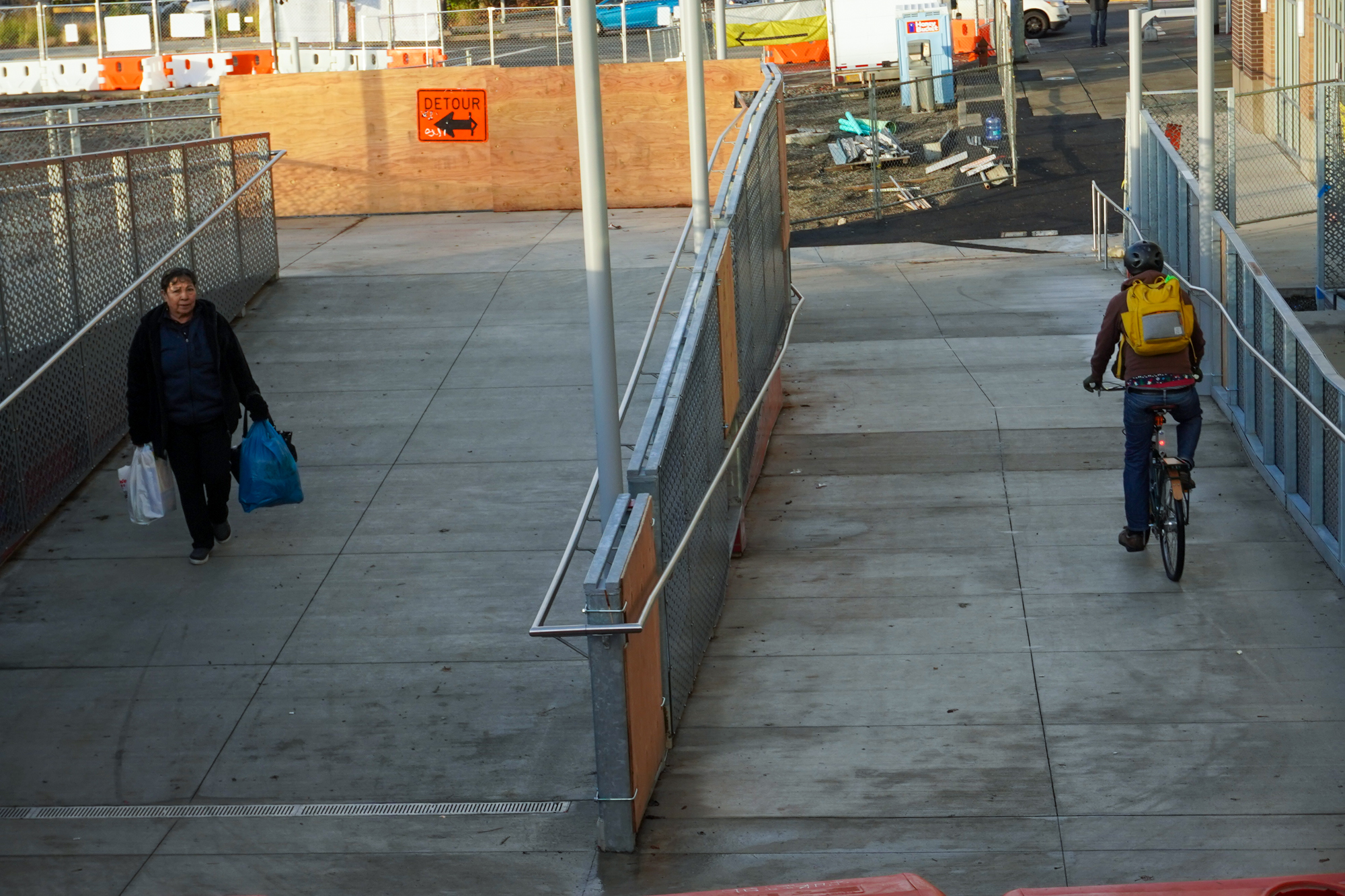
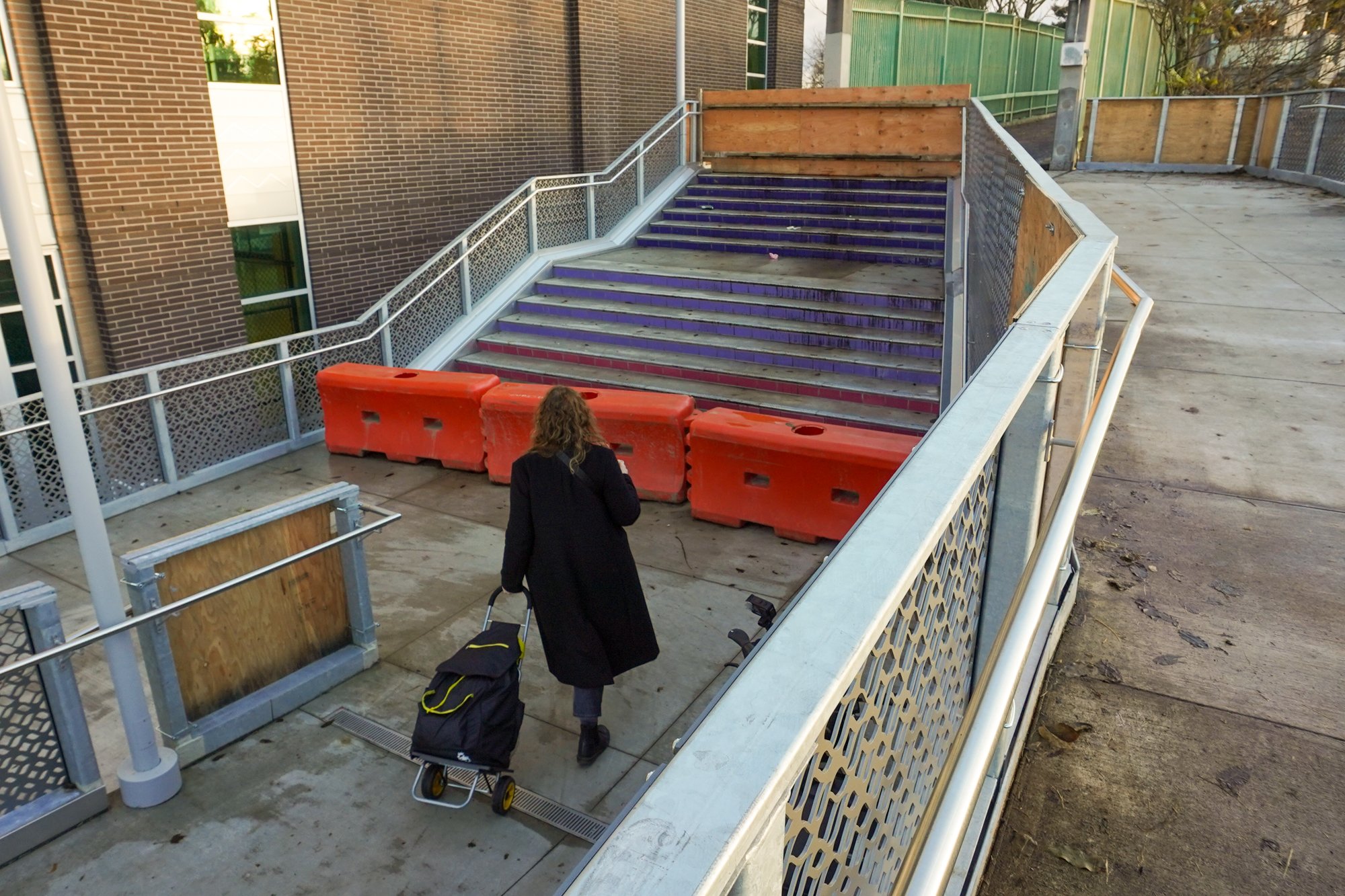
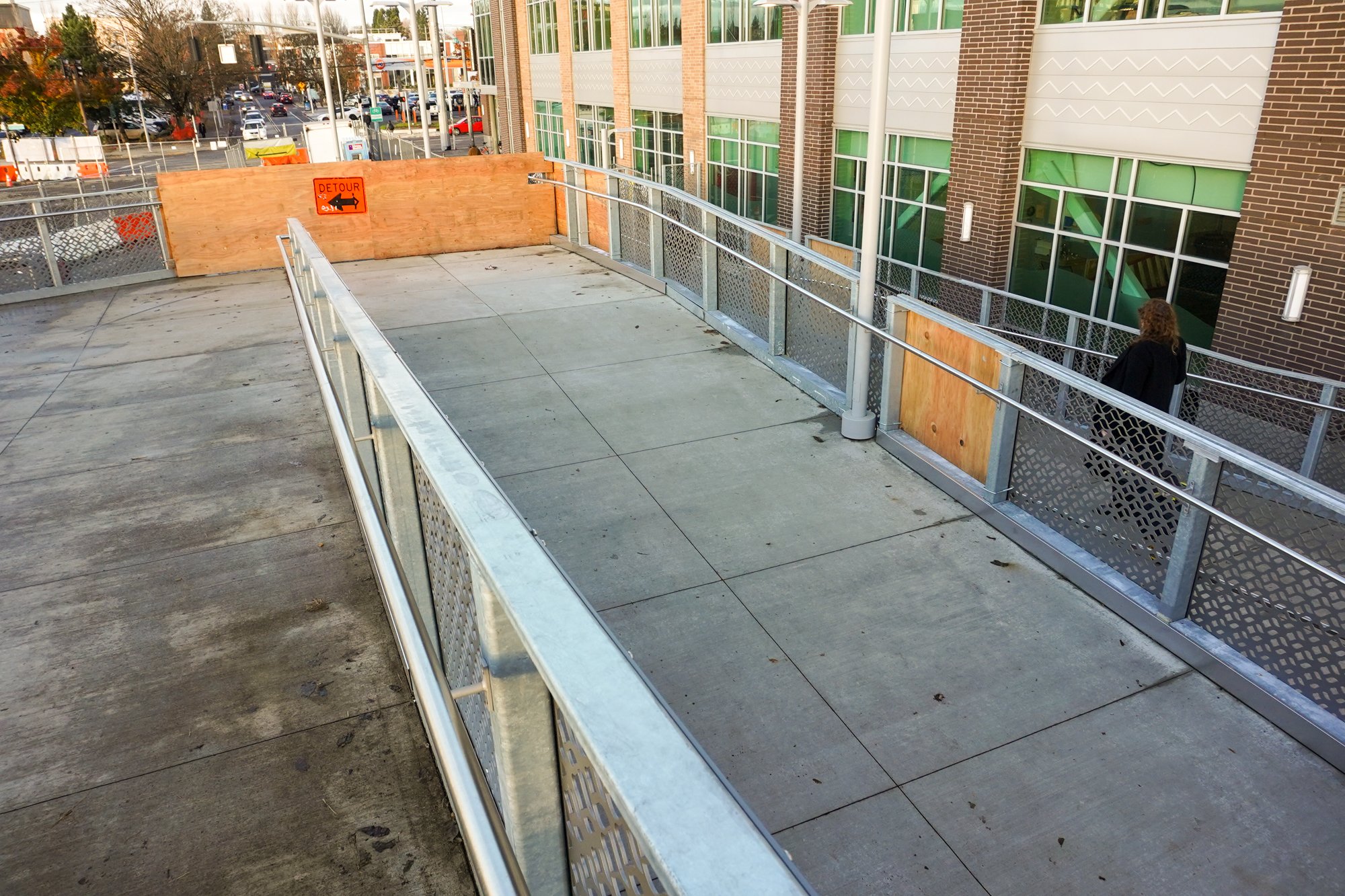
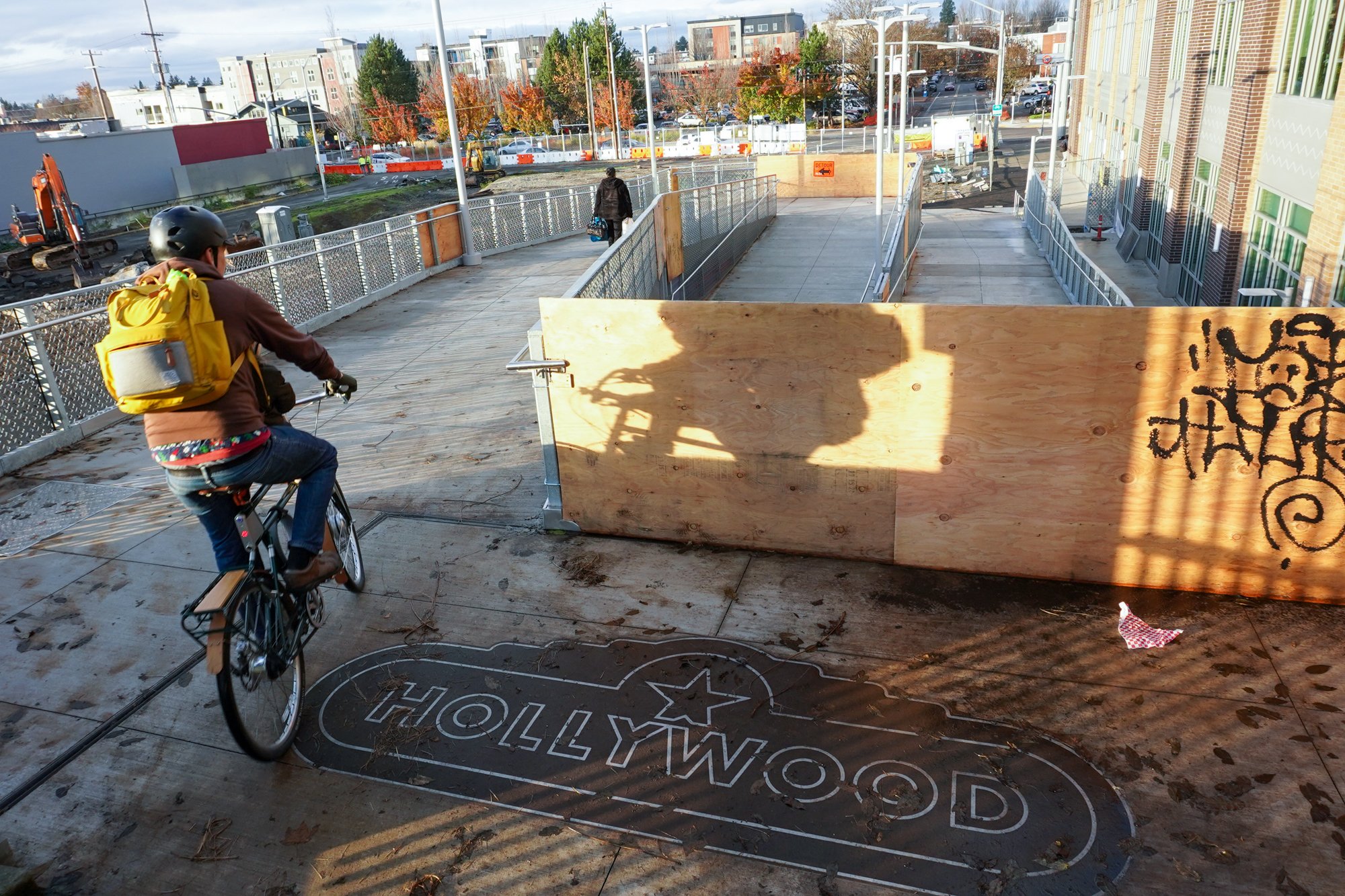
TriMet has opened a new bike ramp at the Hollywood Transit Center and it’s a huge improvement over the old one.
The ramp is part of a transit-oriented development project at NE 42nd and Halsey that includes a mixed-use development and plaza in addition to the rebuilt ramp and stairs. We’ve covered this project a few times in the past and if you recall, there was an initial proposal that didn’t include a ramp at all. Thankfully, TriMet listened to bike advocates and the City’s Bicycle Advisory Committee and today we’ve got a nice connection from the I-84 overpass to the street network.
After TriMet demolished the old ramp, they had a temporary ramp in place for the past year or so.
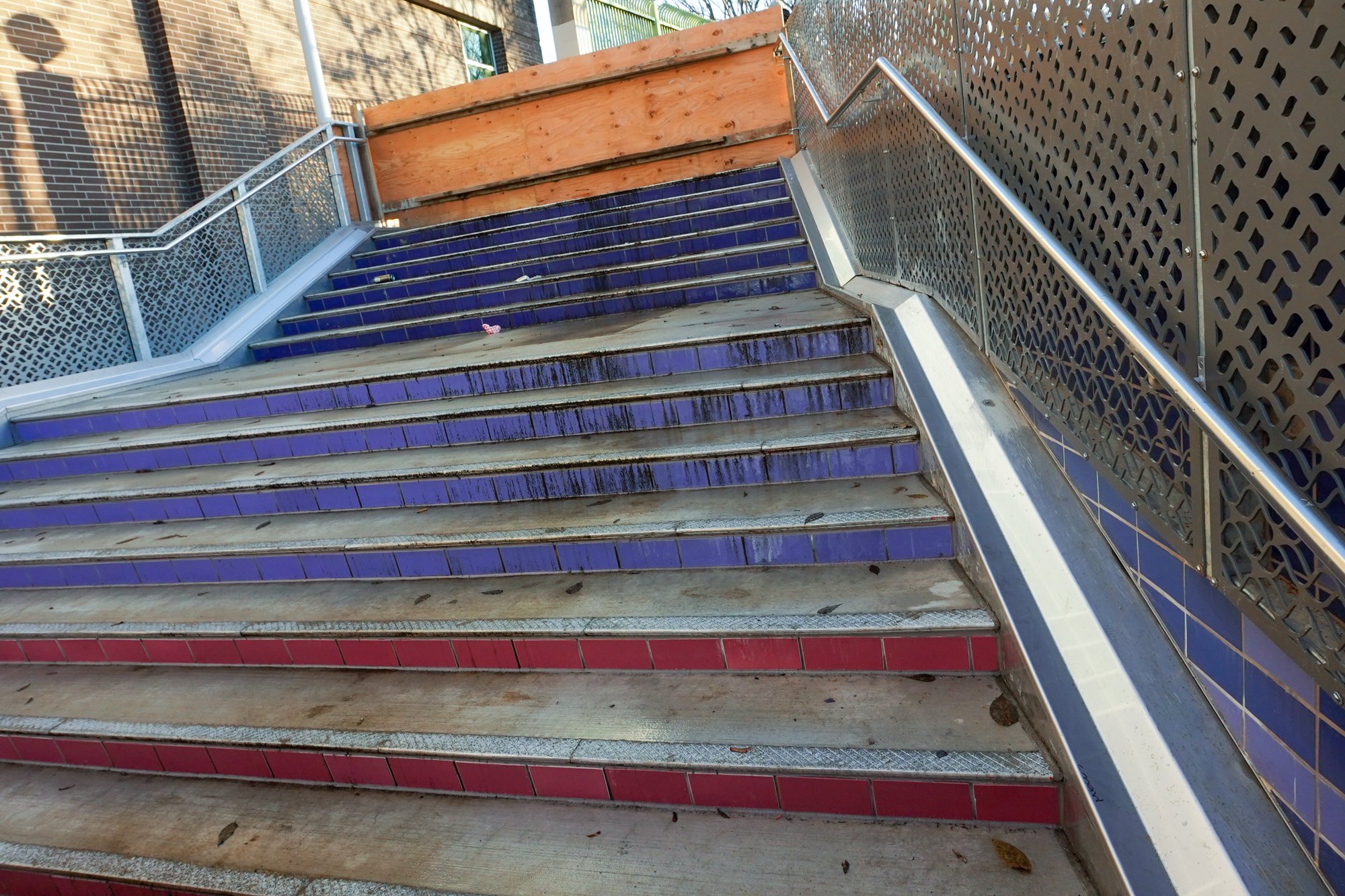
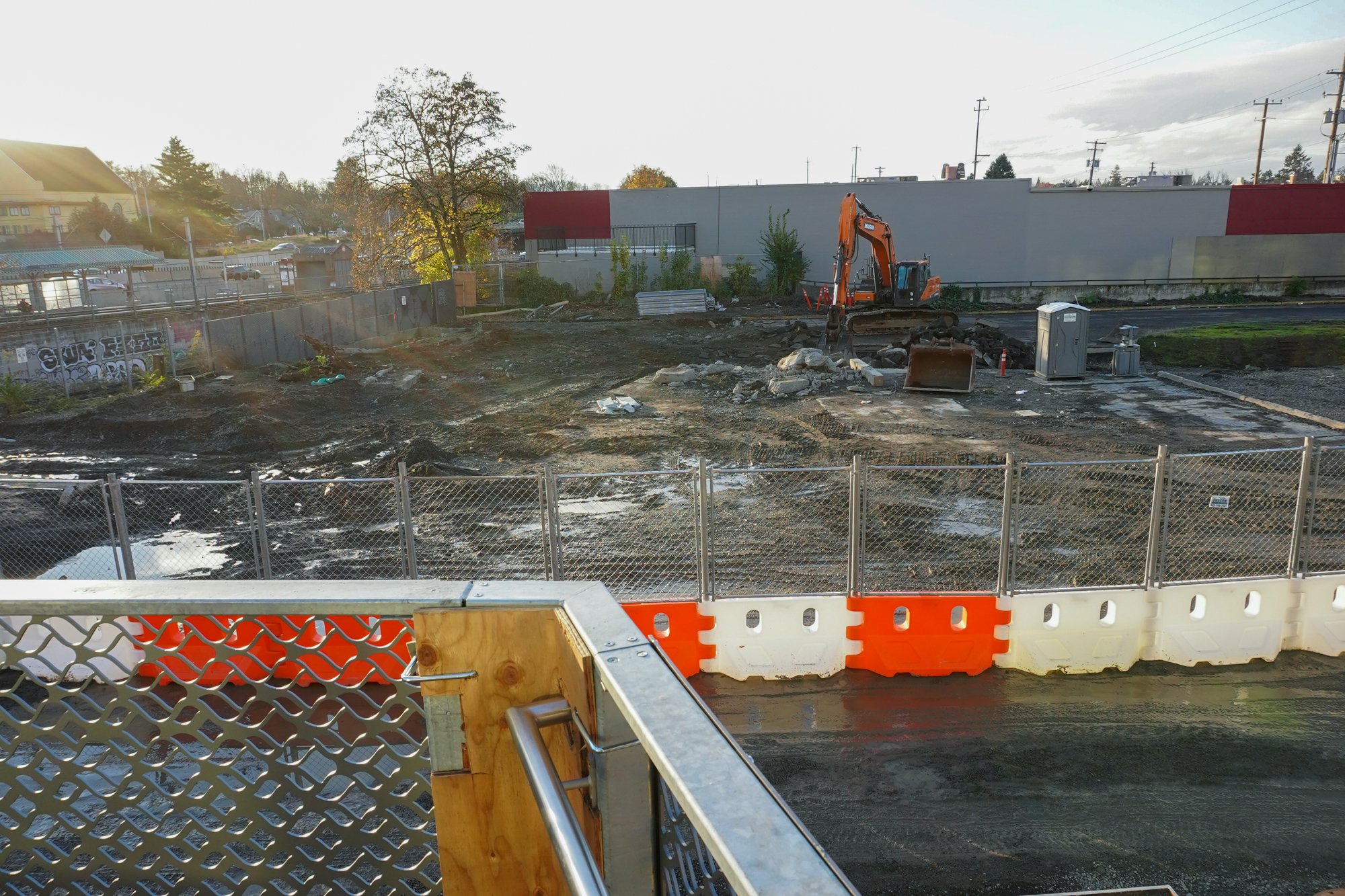
Nicer wheel gutters and less incline than old stairs.View west at site of new mixed-use development.
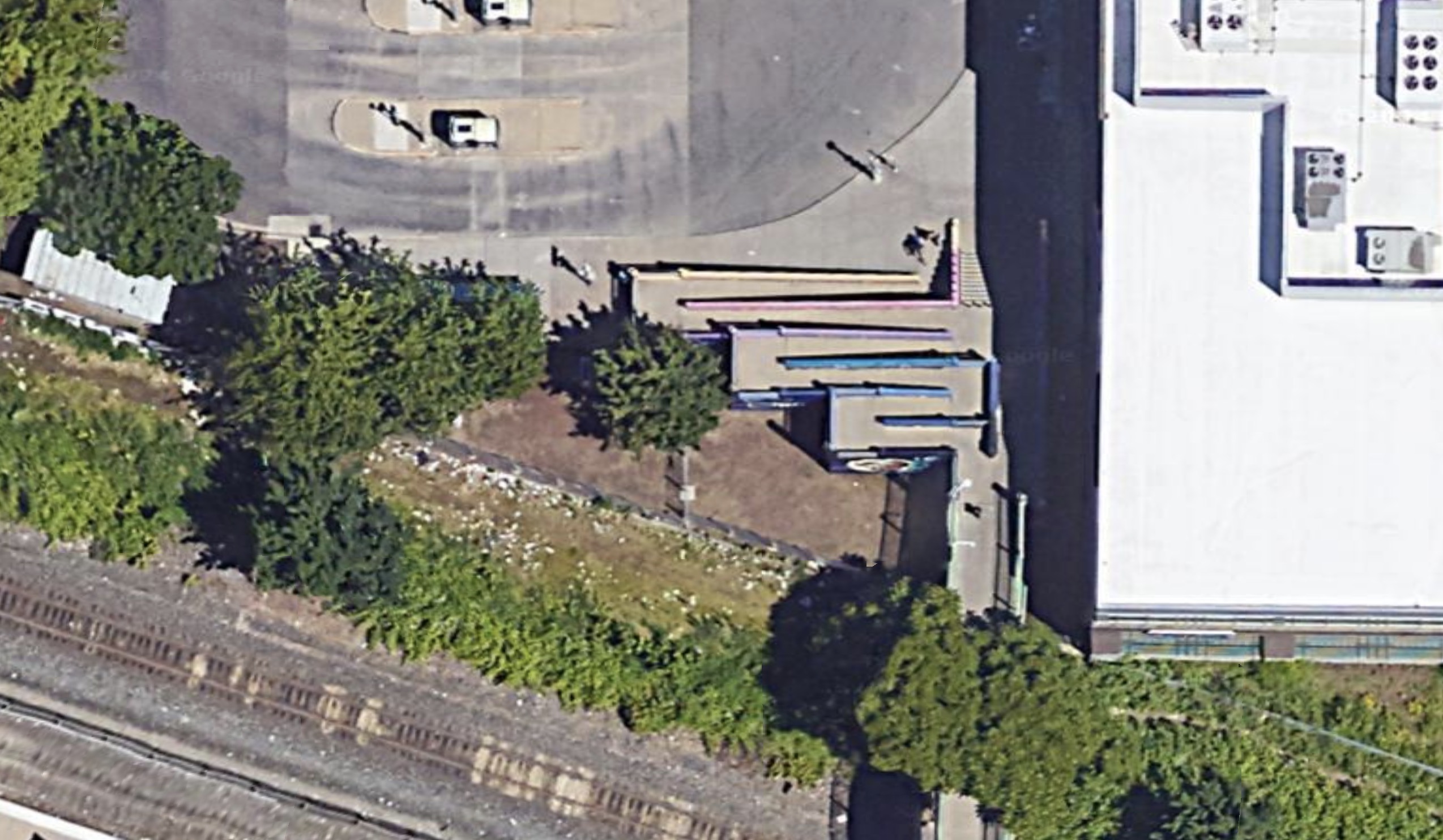
As you can see in the photos and video, the new ramp is nice and wide. It has enough room to comfortably pass by people who are walking and there’s good visibility in the corners (except at the top where it transitions to the existing overpass). Compared to the concrete walls, five switchbacks and very narrow profile of the old ramp, this new one is a major upgrade. The old ramp was so difficult to ride up and down, it was a fun challenge to see if I could do it without putting a foot down.
Aerial shot of old ramp.
I ran into a BikePortland fan named Patrick and his little one. They like the new ramp so much they rode up and down it several times.
The ramp was getting a lot of use when I was out there Thursday afternoon. But it handled the crowd well. And TriMet says the stairs will open very soon, so that will relieve some of the traffic on the ramp. Keep in mind that the ramp and the plaza (once the development is completed) are pedestrian-focused areas where bike riders should ride with caution and courtesy and always be ready to dismount if necessary.
As for the stairs, I was glad to see they have ample wheel gutters, so if the ramp is ever closed for any reason or you just want to use the stairs with your bike, you’ll have an easier way to do that. The old stairs were much steeper and the wheeler gutters were almost unusable for many folks.
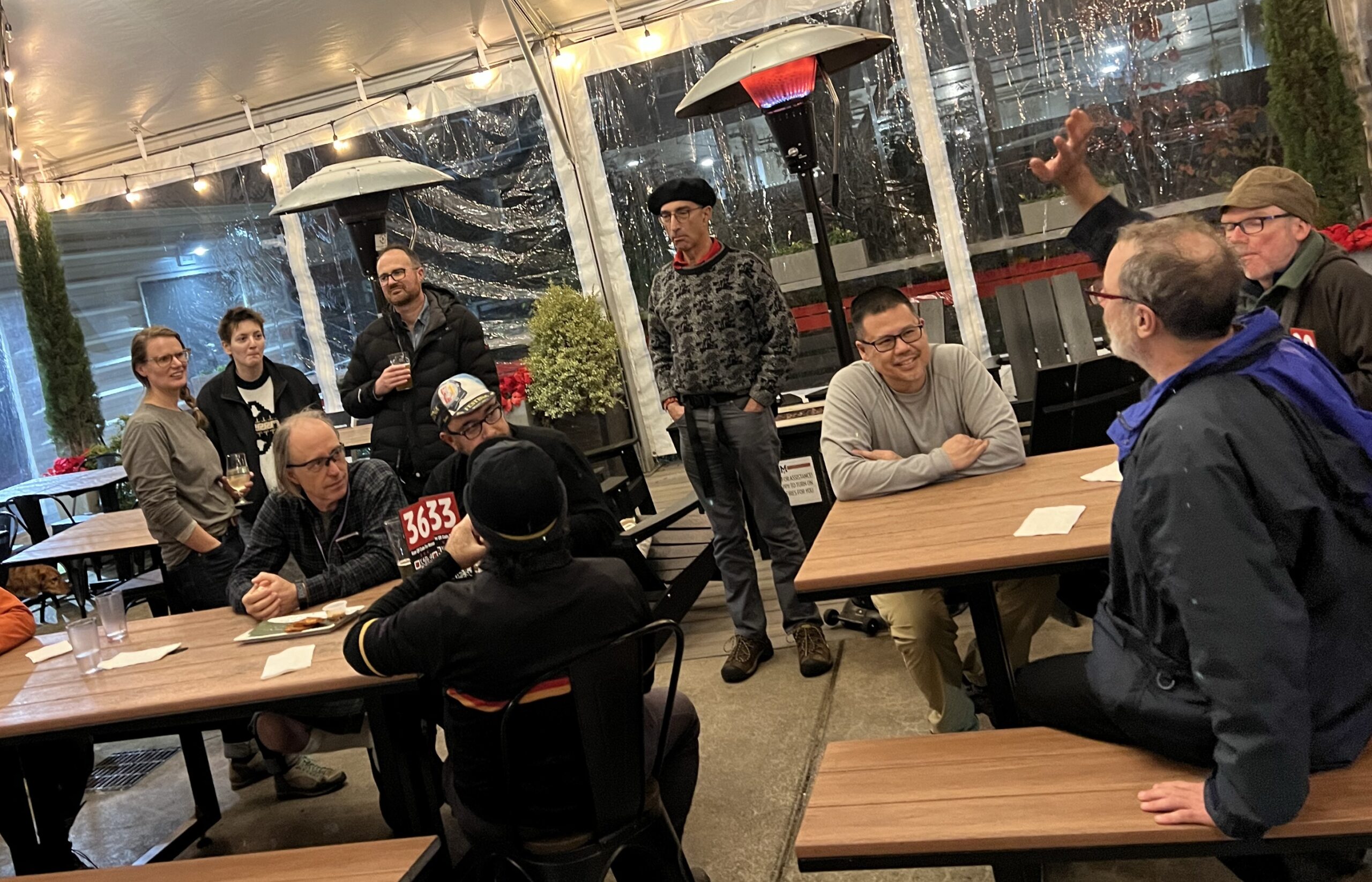
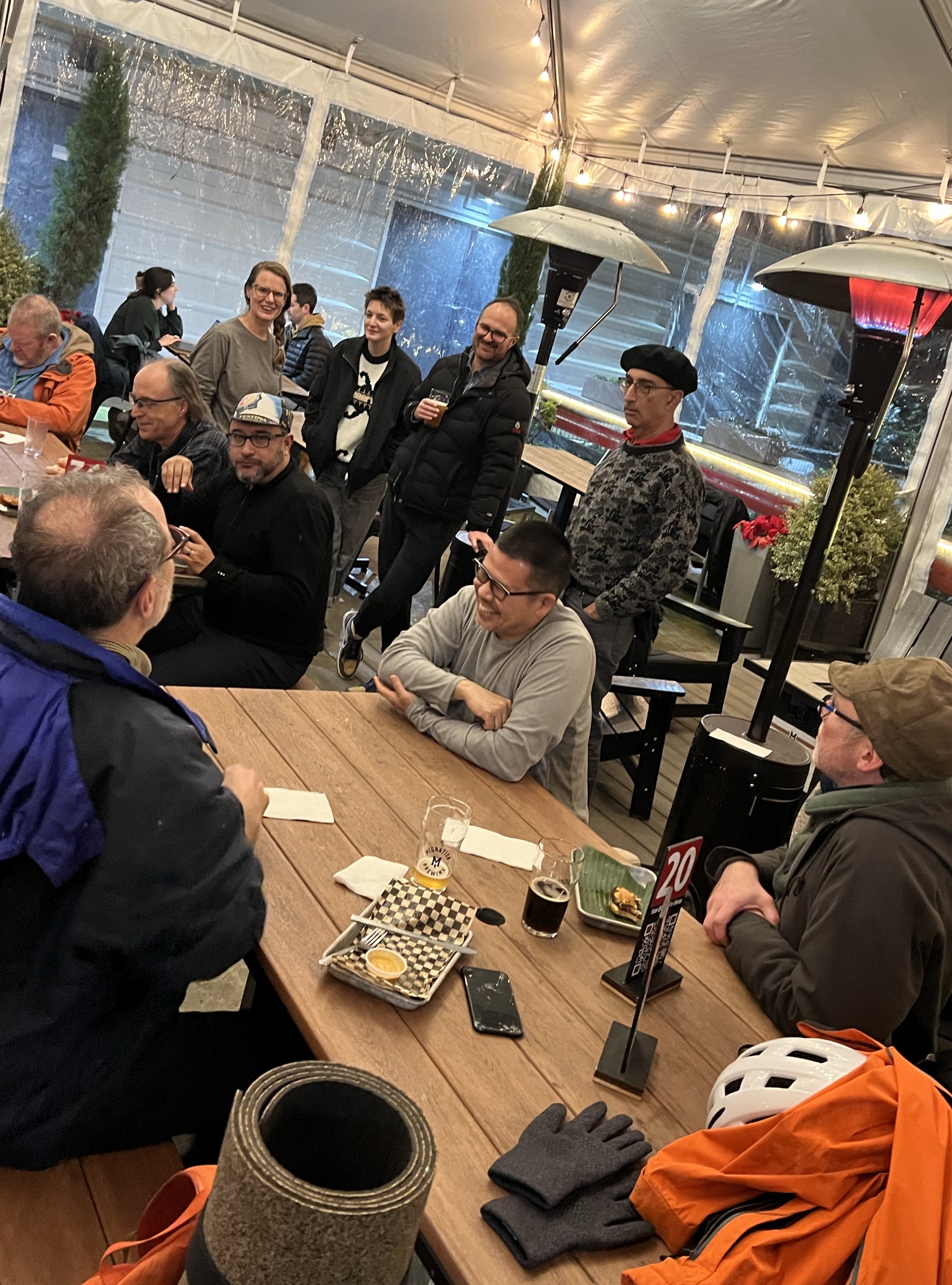
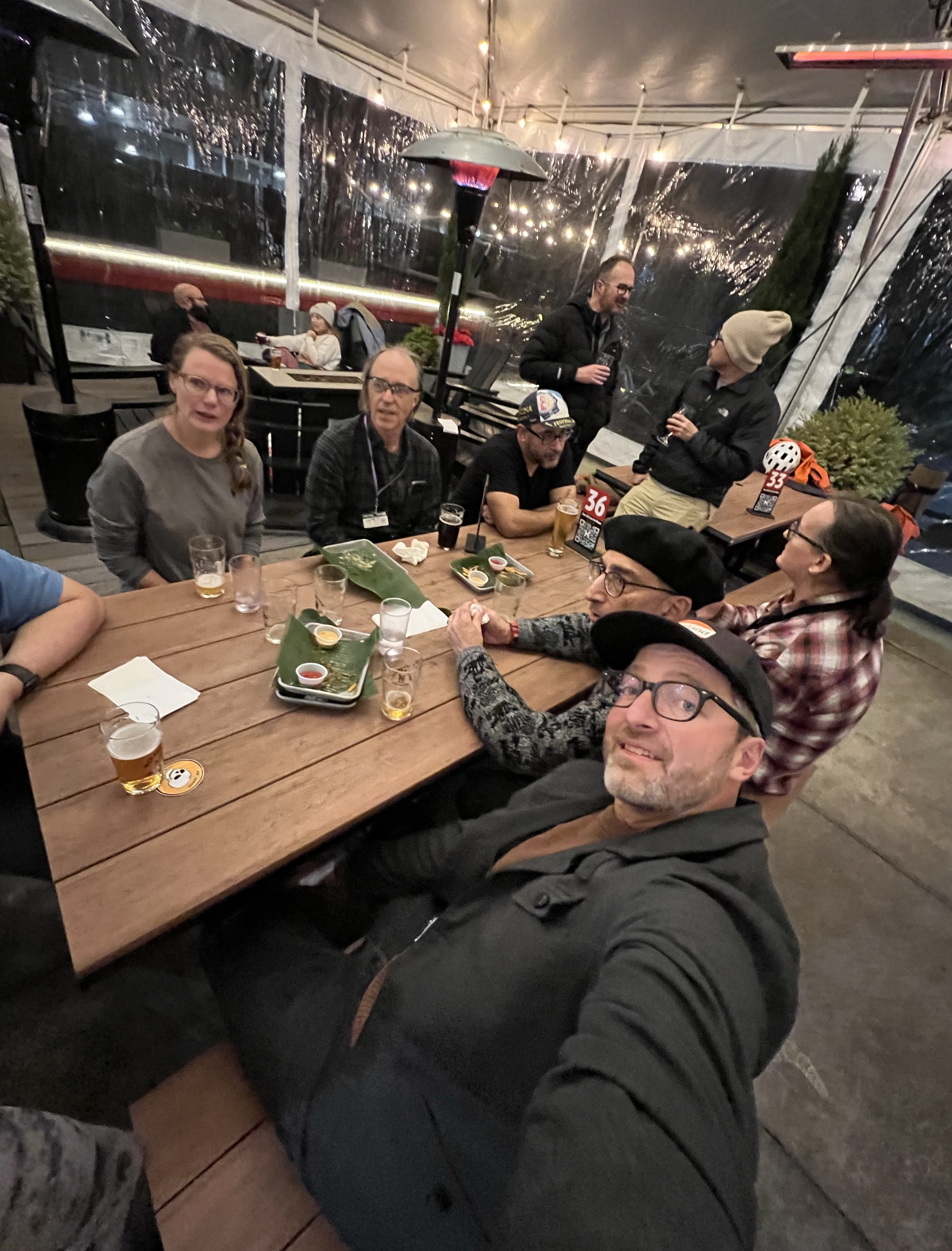
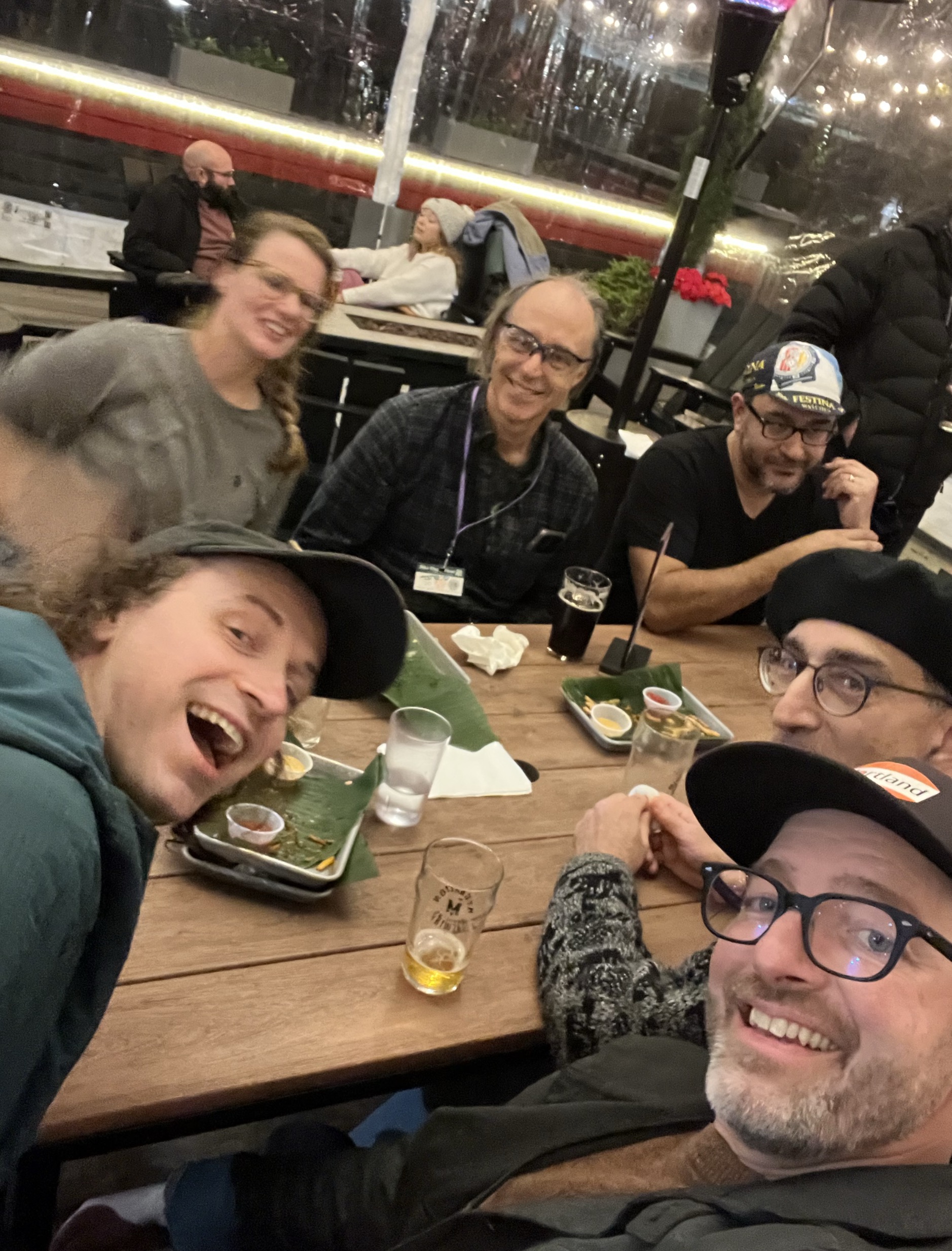
The beat goes on. We gathered last night at Migration Brewing on N Williams Ave. (Photos: Jonathan Maus/BikePortland)
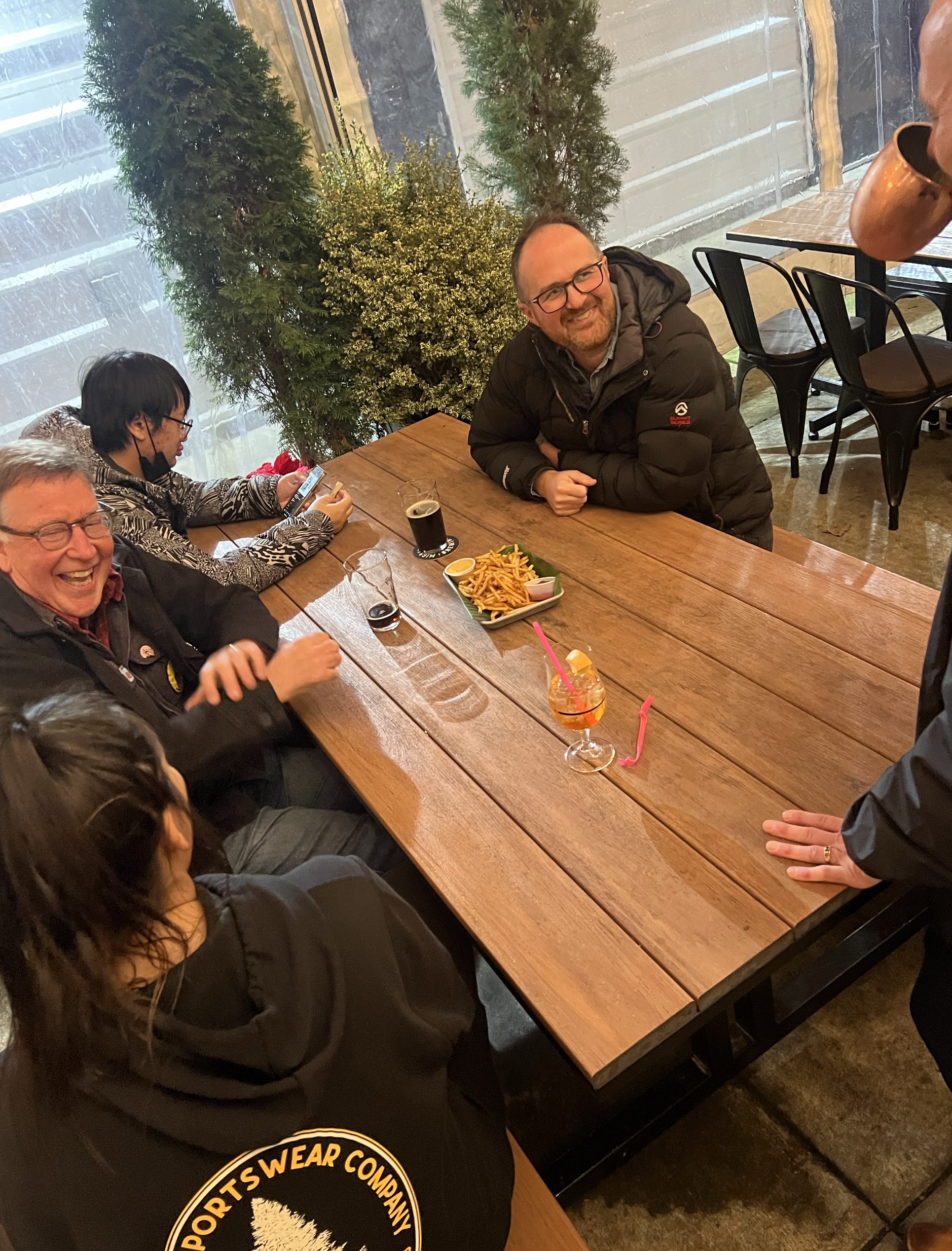
Well it finally happened. After 84 weeks in a row, our run on Ankeny Rainbow Road has come to an end… at least for now. Bike Happy Hour will no longer gather every Wednesday at Gorges Beer/Ankeny Tap & Table; but we’re still coming together. Last night we tried out a new location: Migration Brewing on N Williams Avenue (between Shaver and Failing). It felt good and cozy and we had a nice little turnout.
Here’s what happened and what’s next…
Travis Preece, the owner of Gorges Beer and Ankeny Tap & Table (the two spots across the street from each other on PBOT’s carfree Ankeny Rainbow Road Plaza between SE 27th and 28th), has closed temporarily to figure out a few things. I just talked to him on the phone this morning and he wants to re-open by the start of 2025. Travis has four years left on his lease and believes in the value of Bike Happy Hour, the plaza itself, and the community it fosters. He didn’t want to close, but we all know how challenging the food and drink business is right now.
[A note to all organizers and advocates: Travis said even while he’s not open normal business owners, he’d love to host events, food cart pop-ups, or meetings at Ankeny Tap. If you’re interested, drop him a line at events@gorgesbeer.com.]
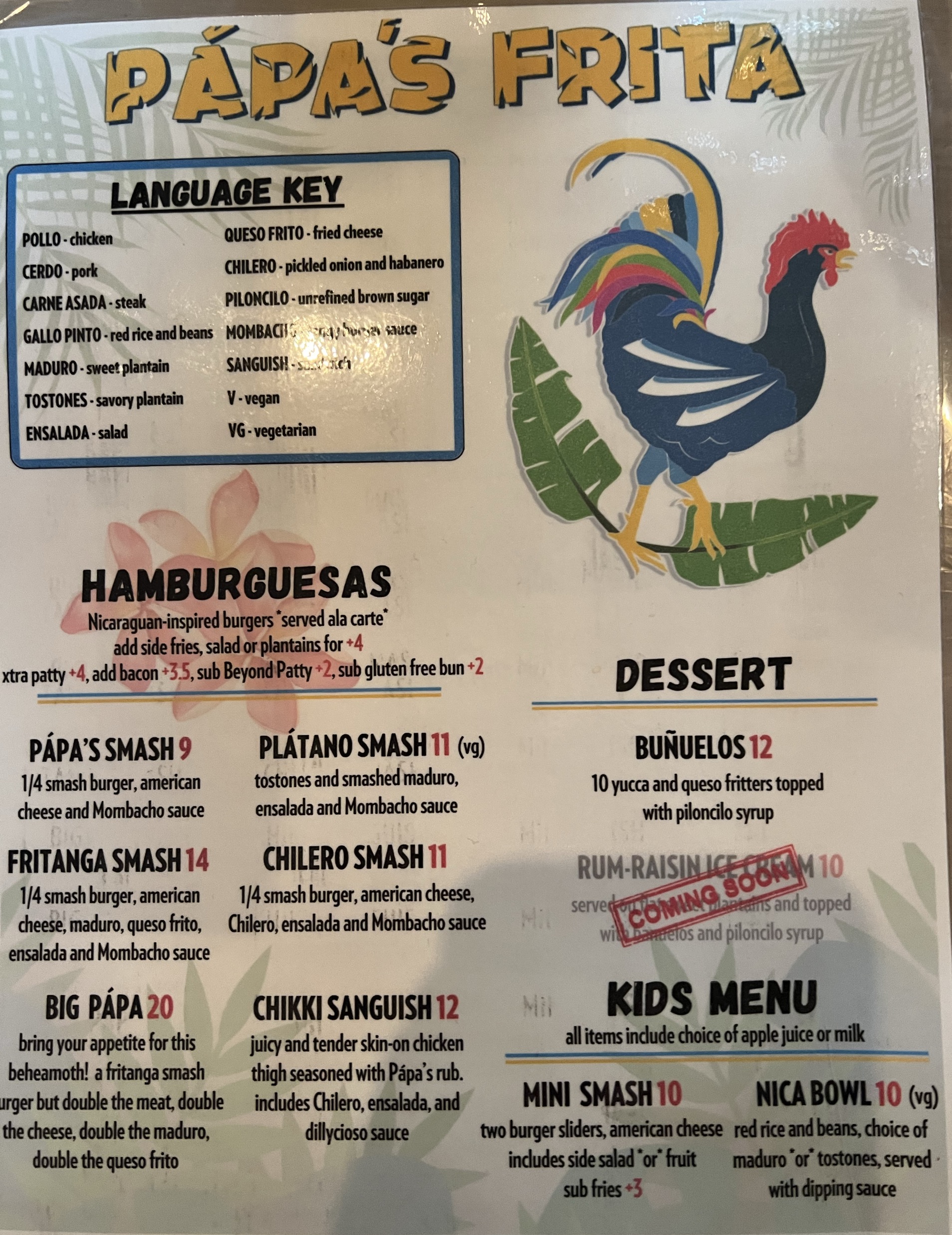
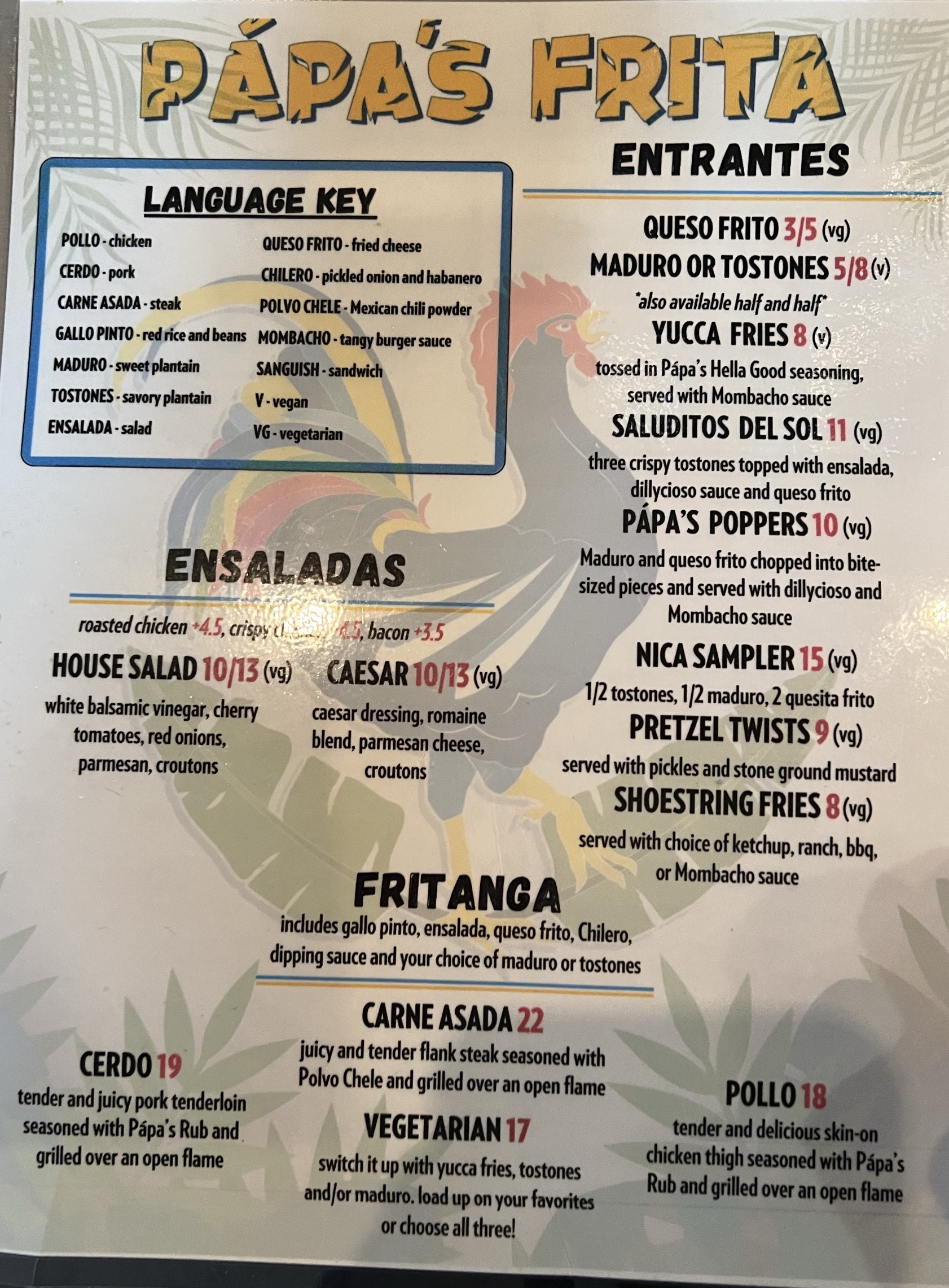
With the temporary closure of these two spots, Bike Happy Hour needs a new home. For now we’ll move to Migration Brewing on N Williams Ave. I’ve met the staff and they’re thrilled to have us! There’s a big warm patio with Adirondack chairs and heaters, and we pretty much have it all to ourselves. They serve an excellent menu (above) of Nicaraguan food from Pápas Frita and they great beer as well as non-alcoholic options. I hosted a BikePortland event there in 2022 and the location has lots of warm-fuzzies for bike people because it used to be a well-loved bike-themed Hopworks location. Last night, even with a very short notice via Instagram, we had about two dozen folks show up. We even welcomed some non-BHH folks who sat with us and added fun and smiles to the party.
I realize N Williams Avenue isn’t as central as SE Ankeny, but this location also helps lower my stress levels. In case you haven’t heard, I’ve started a new side hustle as head basketball coach for a 7th grade Roosevelt High School team and we have practice at 6:30 on Wednesday’s through the end of February up near University of Portland. The Migration location allows me to attend Bike Happy Hour for a bit longer before I need to get to practice. This temporary location shift also allows us to try something new: I’ve always been curious about what would happen if we moved the meeting spot around every once in a while to see if that allows new folks to be able to attend.
See you next week!
My plan now is to consider Migration a temporary spot and wait to hear how Travis’s plans evolve. He’s made it clear to me he wants us to return to Rainbow Road.
In the meantime, I hope to see you at Migration on Wednesdays from 3:00 to 6:00 pm. Stay tuned for fun themed nights and special guest speakers. On that note, next week 11/27 we’ll be joined by District 1 City Councilor-elect Jamie Dunphy. My mom will also be in town so you might be able to meet her too! If you’d like to speak and share with our group, just grab the mic around 5:00 pm and go for it.
Things change. But one thing that stays the same is that I’ll… see you next week!
Incoming Portland City Council members at Sunday’s event: L to R: Tiffany Koyama Lane, Eric Zimmerman, Angelita Morillo (blue coat), Steve Novick, Mitch Green. (Photo: Jonathan Maus/BikePortland)
There were a few notable things said by newly elected Portland City Council members at Sunday’s World Day of Remembrance event. And while I already did a story and video, I wasn’t able to really underscore these comments and share my thoughts about them previously because I wanted to keep the focus on the event itself.
“I frankly am not worried about the Big Brother aspect of putting speed cameras at every goddamn intersection in the city.”
– Steve Novick, D3 councilor-elect
So I pulled an audio highlight reel together that features four speakers. In the episode available now on our podcast feed or in the player above, I intersperse my personal commentary and thoughts after each audio clip. The speakers in this episode are: PBOT Vision Zero Coordinator Clay Veka, District 4 Councilor-elect Mitch Green and District 3 councilor-elects Tiffany Koyama Lane, Angelita Morillo, and Steve Novick.
The reason I’m pulling these clips out and shining a light on them is because they offer important takeaways about how these new electeds will lead and govern in the coming months and years. And with PBOT’s Veka, she gave us notable clues about how the City is framing its Vision Zero work.
Have a listen to this episode and tell me if you agree that:
It’s cool that PBOT admits they’re not meeting their goals, they are smart to spread responsibility for Vision Zero to other agencies, and we should be happy they are talking about the need for a cultural shift and the role change management will have in making progress;
Mitch Green wants to be council’s main bike and safe streets champion, is someone who wants to focus on prevention instead of punishment and how that could create friction with more enforcement-first councilors, and that he’s done his homework when it comes to transportation policy.
Tiffany Koyama Lane won’t soon forget what she heard at the Remembrance event and she’ll be a reliable vote for good safe streets policy on council going forward.
Angelita Morillo will tell it like it is, wants to shake up the status quo, is a great communicator, and will be in front of the freeway fights.
Steve Novick is sick and tired of lawless drivers and will push expansion of PBOT’s automated enforcement camera program, isn’t afraid to push bold policy ideas, could be city council president, and has the guts to propose new revenue ideas.
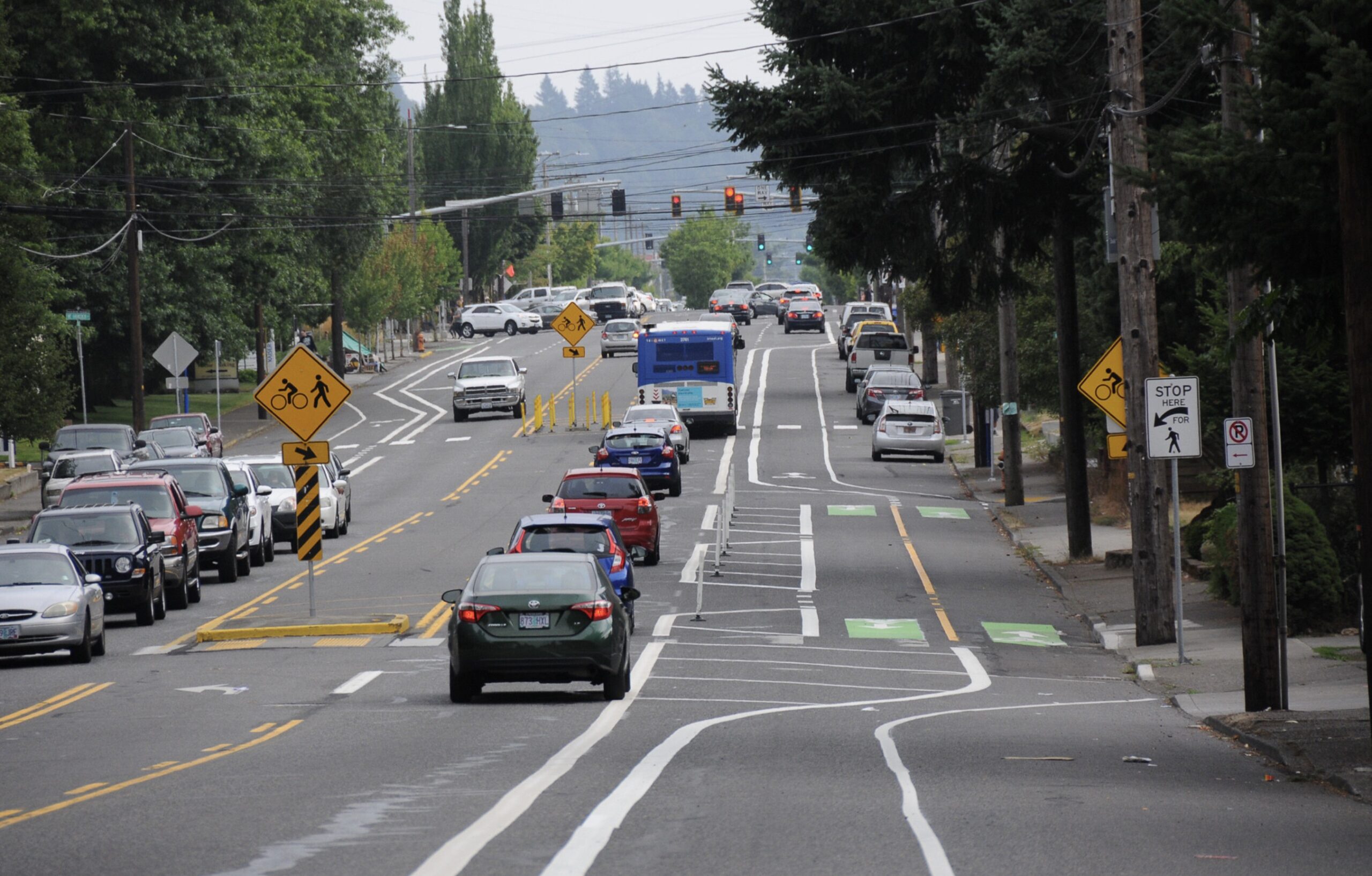
Looking south on NE 102nd toward Halsey-Weidler couplet in August 2019. (Photo: Jonathan Maus/BikePortland)
As road deaths climb and opportunistic politicians cling to populist, divisive rhetoric to win support, Portland’s approach to building safer streets is in the hot seat. And it’s not just a local thing. Just this morning I read an opinion piece from the Washington Post where one of their editors framed road diets and bike lanes in D.C. as nothing more than a ploy by White people who want to promote cycling (“them”) to make life terrible for drivers (“us”). Sigh.
Beyond the punditry, do fewer lanes for drivers and more room for bicycle riders actually make streets safer? A recent analysis of an infrastructure project on the NE 102nd Avenue corridor gives us a chance to talk about design changes in a way that focuses on facts and data, instead of hot takes.
With all the changes the Portland Bureau of Transportation has made to streets east of I-205 in recent years in the name of safety and active transportation, they’ll face continued political pressure if they aren’t able to point to results. If you care about living in a place with more humane and welcoming streets, the good news is the results speak for themselves.
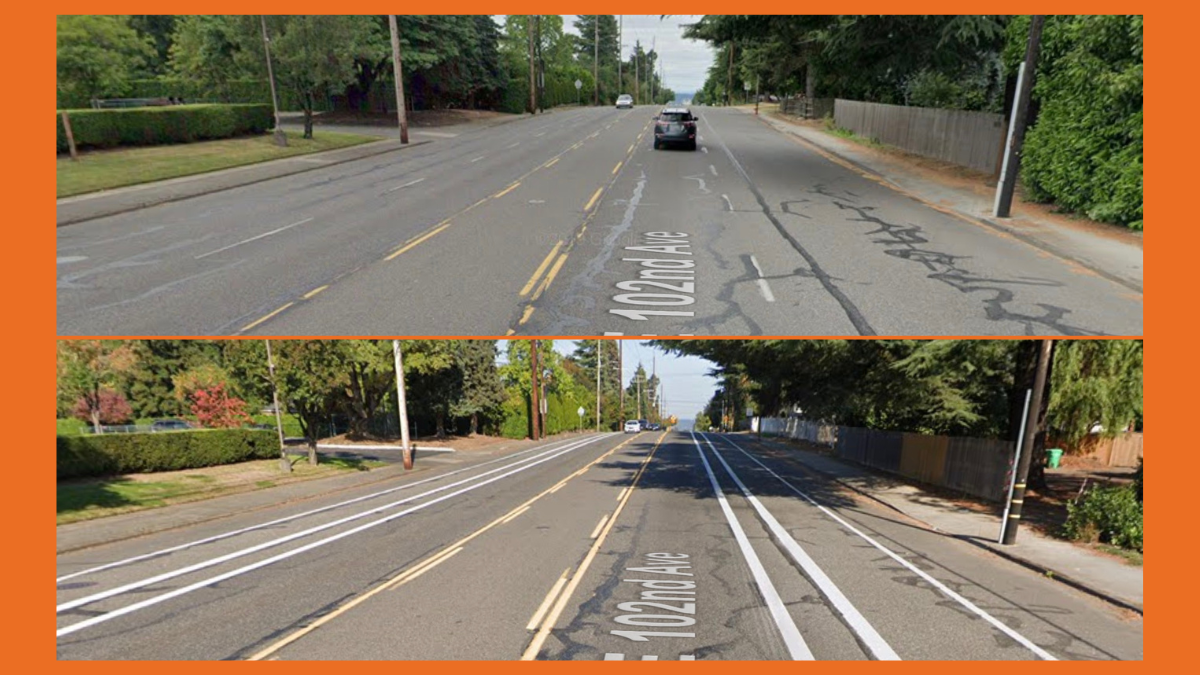
Going from five general purpose lanes too three gave PBOT room to add bike lanes and on-street parking. This is NE 102nd near NE Brazee in 2018 (top) and 2024 (bottom).
PBOT Vision Zero Coordinator Clay Veka spoke on the steps of City Hall at Sunday’s World Day of Remembrance event. She mentioned new crash data for their NE 102nd Avenue Corridor Safety Project: NE Weidler to NE Sandyproject and said results offer “encouraging news that we’re seeing success.” This $2 million project was built in three phases between 2019 and 2024 (locally funded through gas tax revenue, system development charges, and the cannabis tax) focused on a two-mile corridor of NE 102nd between NE Sandy and NE Weidler that’s included on the City’s High Crash Network, a list of 30 streets that have a higher than average rate of crashes, fatalities, and serious injuries.
To improve safety and encourage more active uses of the street, PBOT reduced the amount of lanes for drivers from five to three. They also added buffered bike lanes and on-street parking. In addition to the lane reconfiguration, they enhanced several crossings with curb extensions and concrete median islands, and lowered the speed limit to 30 mph.
In a 27-page report initially published in 2020 and updated last week, the agency says key findings of a public survey and internal analysis show an “overall improvement of safety measures.” Crashes and speeds are down and the street works better for people walking and using bicycles.
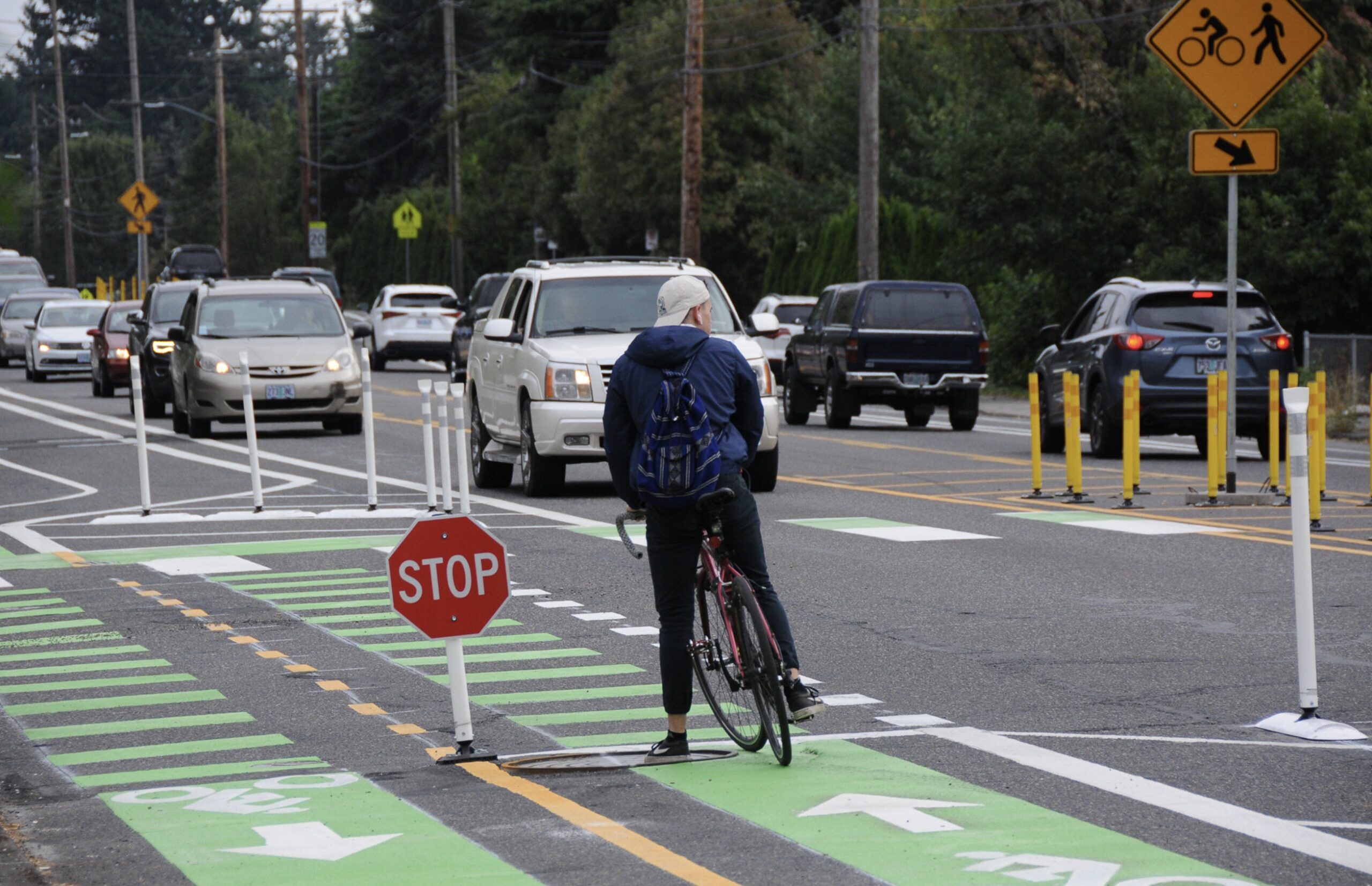
Two-way bike lane at NE Morris Ct. (south of I-84). (Photo: Jonathan Maus/BikePortland)
PBOT’s analysis of all crash types (see graphic below) based on annual averages taken before and after the project was built reveals the interventions on NE 102nd led to a 14% reduction in crashes.
When it comes to speeding, there was a “drastic” decrease in what PBOT calls “top-end speeding” (over 10 mph over the posted limit). PBOT also looked at changes in median speed (where half drive faster and half drive slower) and prevailing speed (the speed 85% of drivers travel at or below, a standard engineering measure). Measurements taken at NE Shaver and Sacramento found that there were significant decreases across all speeding types. At Shaver, median speed went down 9.5%, prevailing speed went down 11%, and there were 85% fewer top-end speeders.
And according to PBOT’s Veka, the reduction in top-end speeding is consistent citywide. Of eight road diets evaluated so far, there’s been a 52% reduction in top-end speeding overall.
Graphics from the report
With drivers and bus operators having less room to operate and no passing lane, folks might think congestion would be a problem. However, PBOT’s analysis found there was little to no change in transit time and reliability for the Line 87 and 22 TriMet buses. Results of their analysis also showed no significant changes in travel times for car and truck drivers.
PBOT also analyzed how traffic on nearby residential streets changed after changes were made to 102nd — this is the dreaded “diversion” effect many neighbors worry about when larger streets get road diets. Despite the significant reconfiguration of lanes, there were no notable speed changes on residential streets and while some streets saw an increase in car traffic volumes (and others saw decreases), none of them rose to the level PBOT has for mitigations (1,000 cars per day or 50 cars per peak hour).
Transit access.
The report also analyzed how the new street design comports with active transportation goals. In addition to a focus on safety, PBOT used the project as an opportunity to make the street more appealing for walkers, bike riders and transit users.
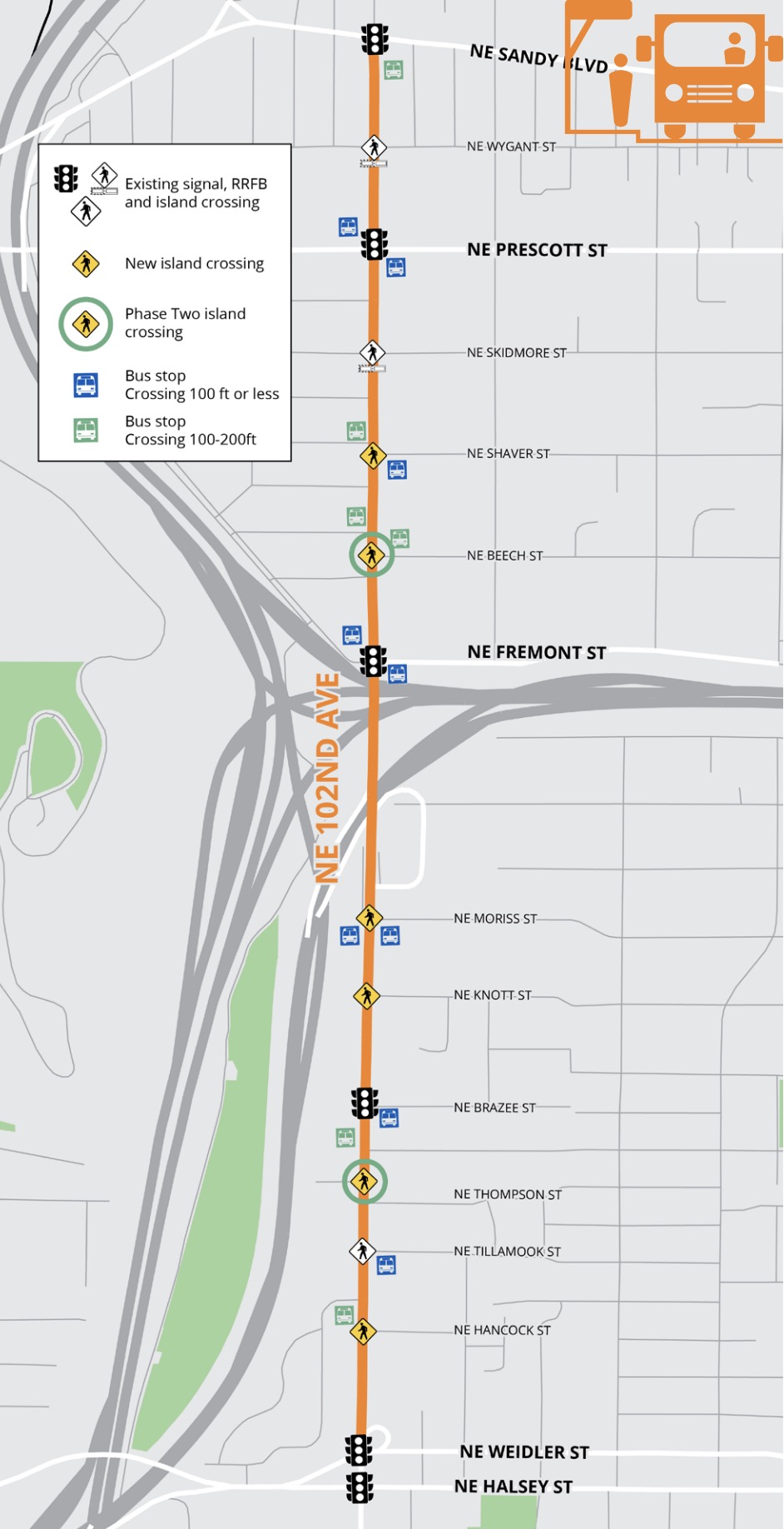
With addition of six new crossing treatments, all segments of project now meets PBOT’s PedPDX plan guidelines for crossing spacing of at least every 800 feet. That compares to just one segment meeting this goal before the changes were implemented. That plan also established guidelines that call for crossings to be within 100 feet of a transit stop. Before the project, just six of 15 stops in the corridor met this guideline. Now 9 of 15 do and PBOT says all 15 transit stops are within 200 feet.
Before the project, there was no dedicated bicycle infrastructure along the corridor. Now there’s a buffered bike lane with some segments having concrete curb separators and/or plastic delineator wands. PBOT says prior to the changes NE 102nd scored a 4 on the “Level of Traffic Stress” or LTS scale (with 4 being highest stress and 1 being lowest). With the addition of bike lanes and a lower speed limit, PBOT now says the street has been upgraded to LTS 2 for bicycle riders.
Public survey
PBOT also gauged opinions of 1,000 people who either shared comments or responded to a survey about the project. PBOT admits the results of their surveys are not a representative sample and that there is “high potential for bias.” Even so, they say it offers “useful ideas and suggestions for improvements” and gives the agency a “sense for how respondents feel about the project.”
Of 563 people who responded to a survey about how people feel about speeding, crossing, and biking on 102nd, the results were very positive. Before the changes, 64% of respondents were concerned with drivers going too fast, versus just 35% after. Crossing concerns were noted by 62% of people before and just 33% after. And biking was a concern for 42% of people before and just 25% after.
Notably, 64% of respondents opposed the project after it went in. Just 27% expressed support and 9% were undecided. PBOT says comments shared reveal many people are concerned about congestion and side-street traffic, that bike lanes didn’t have enough protection, and that there still are not enough crossings or street lights to improve visibility at night.
Perhaps the most interesting part of this report are summaries of what people shared in response to open-ended questions. PBOT asked what part of the project works best, what could be improved, and if folks had any specific concerns or suggestions.
The most common topic in these responses was bicycling and bike lanes. Not surprisingly, there were a variety of opinions and observations — many of which contradicted each other. Notably, PBOT went out of their way in this section of the report to express that adding bike lanes was something of an afterthought. “Adding bike lanes was a fortunate opportunity that became a part of the project [because of space available after the lane reconfigurations] and brings NE 102nd Avenue in line with the Transportation System Plan and the 2030 Bike Plan. However it was not the motivation or priority for this project,” the report states. It’s interesting PBOT feels the need to point this out. Are they afraid to admit they want to install bike lanes? A statement like this reflects PBOT’s unfortunate sensitivities around being seen as aggressively pushing bike lanes — especially in east Portland where fewer people tend to ride in them.
I recommend reading through these project evaluations every once in a while. Not only will you learn about how and why PBOT approaches safe streets work, you’ll get a better sense of the results of those changes. And while I appreciate having a 27-page analysis of one project, I couldn’t help but think of the time and energy it took for PBOT staff to complete the evaluation and share it with the public. It’s yet another layer of process and planning in addition to all the pre-construction outreach, open houses, and surveys. I can’t wait for the day when PBOT can just look at adopted plans, find some funding, design a project, implement the changes, and then move onto the next one — without having to spend so much time justifying their actions and assuaging haters who will criticize them no matter what they do.
Portlander Sam Balto, known as “Coach Balto” by millions of adoring fans on the Internet, is riding a wave of enthusiasm for bike buses that is transforming transportation policy across America.
But before his viral videos, national media attention, and meet-and-greets with bigwigs like US Department of Transportation Secretary Pete Buttigieg and members of First Lady Jill Biden’s staff; Balto was just a summer camp counselor who just loved to work with kids. When he moved to Portland, I noticed his tactical urbanism projects and watched him evolve as an advocate. On Earth Day 2022 when I showed up to his first-ever bike bus at Alameda Elementary School, he told a crowd of kids and their families, “I think this is the start of something special.”
I don’t think any of us realized how prescient that statement would be.
Two years later, Balto has gotten so busy being a bike bus advocate and influencer that he’s taken a year off teaching duties to focus on growing the movement full-time. He’s a co-founder of Bike Bus World, a new organization that just received official nonprofit status (which gives him the fun title of Bike Bus World Leader).
In this episode, you’ll hear Balto share how he thinks bike buses (and walking school buses, traffic gardens, and other things that get kids doing active transportation) can help restitch our country’s social fabric. He also talks about how he wants to help build bike buses into something that has a greater impact than just the ride to school. When I asked if he wants bike buses to be funded on par with yellow school buses, he scoffed and said he’s shooting even higher: “I think we should put this on par with federal highway funding… anything is possible with money and political will.
“We demolished entire communities to make it easier for people to drive. The amazing thing about making it easier for children to walk and bike to school is that nobody’s gonna lose their houses. What are we waiting for?”
We also talked about how barriers to staring bike buses and a critique from some that they are only possible in wealthy areas. Balto said equity-based critiques might just be trolling from people who don’t like the idea of bike buses. And if they aren’t, he says the solution is more funding. “If that’s an issue that want you want see a bike bus in a less affluent communities, it’s going to require more resources, and our government has those resources, so let’s go to them to get those funds and resources.”
When it comes to the future of how bike buses interact with schools, Balto is very excited about recent grants from federal and local sources and says the vision of Bike Bus World is where every school has an active transportation specialist.
Yes his plans are grand. But Balto and his crew at Bike Bus World have momentum and they aren’t afraid of the moment. Next week Balto heads to Washington DC to visit a local school and join their bike bus. Through his connections with Sec. Buttigieg, Balto has connected with First Lady Jill Biden’s staff.
“You don’t get what you don’t ask for. So I reached back out and I was like, ‘Hey, can we do a bike bus to the White House? We’ll see what happens.”
Whether you want to lead a bike bus, already lead one, or are just excited at how this movement has potential to change neighborhoods across this country for the better, you don’t want to miss this conversation. Watch the video or listen in the players above or on YouTube or wherever you get your podcasts.
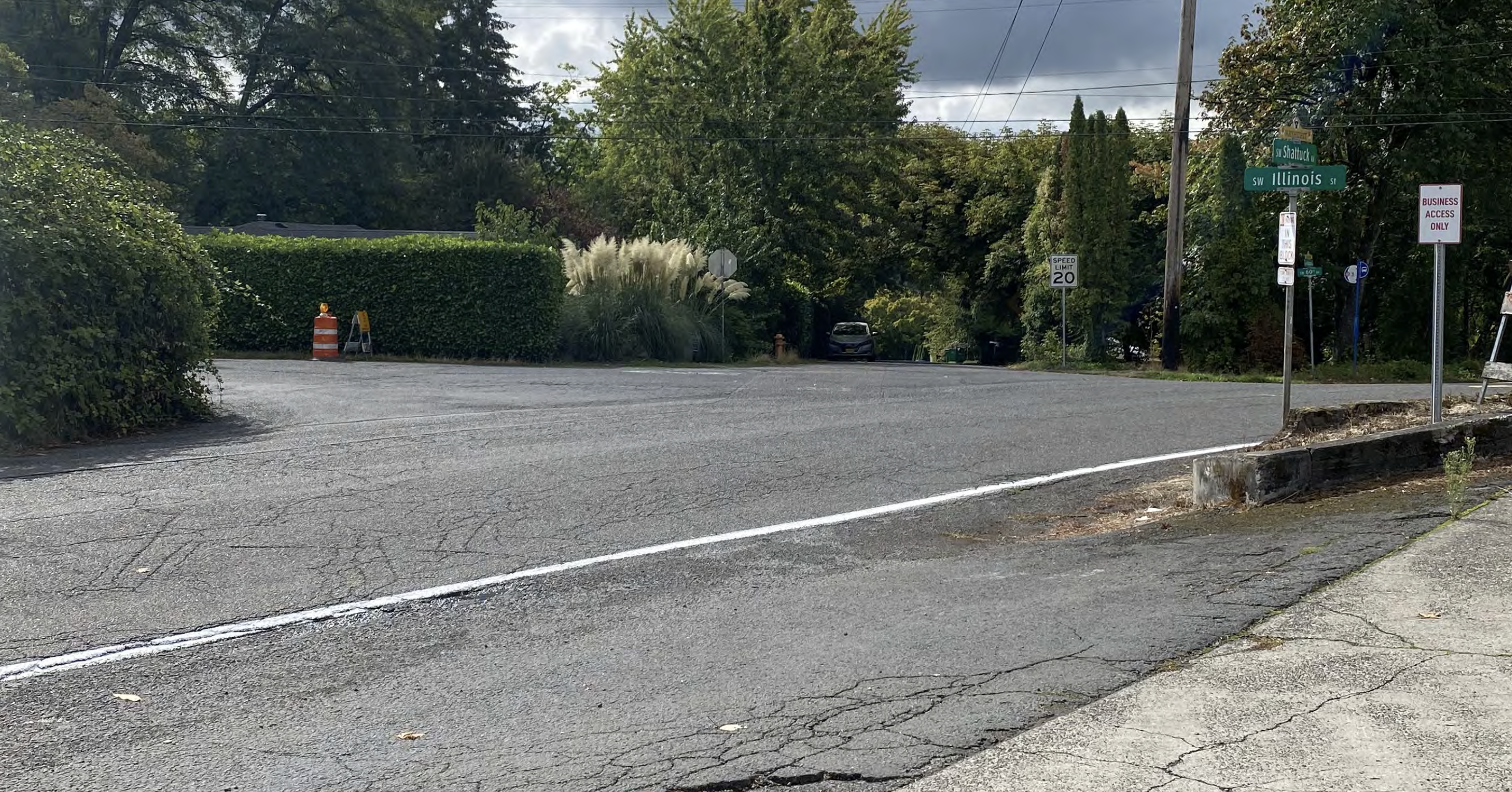
The intersection of SW Shattuck Rd, Illinois Street and 60th Avenue, looking south-east. Source: PBOT.
There’s some hardball being played at Alpenrose, and it’s not on the baseball diamond.
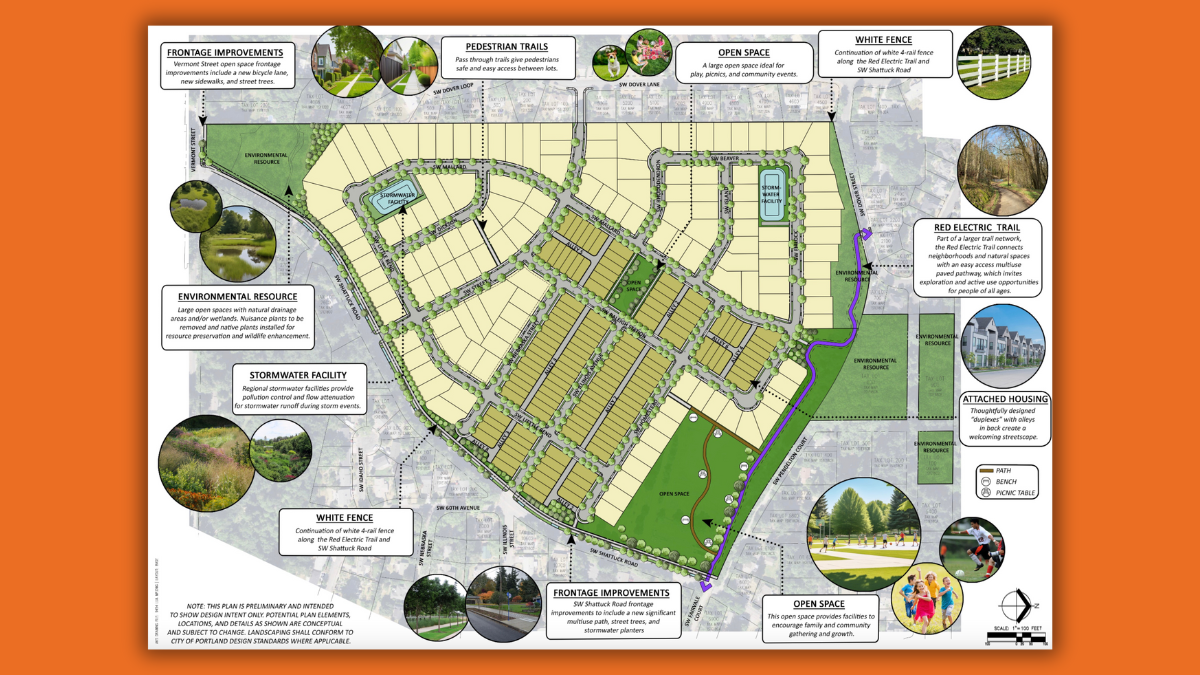
On November 8th, the Hearings Officer (HO) for the Raleigh Crest Land Use application approved, with conditions, the developer’s plan to divide the 51-acre site of the old Alpenrose dairy into 263 lots of attached and detached houses. The Alpenrose site is in the Hayhurst neighborhood of southwest Portland, and its subdivision would be one of the largest housing developments Portland has seen in recent years.
Readers might remember that City staff had recommended against approving the application in mid-September, citing a number of issues which had not been resolved. Since then, the city and developer have hashed out those problems and come up with agreements on: the placement of the Red Electric Trail which crosses the northern edge of the property; environmental concerns about disturbance of the sensitive riparian environment at the site’s southern tip; inadequate sewer facilities, and stormwater management issues.
Despite the developer and City coming to terms on a range of issues, on November 11, the Hayhurst Neighborhood Association (NA) voted to appeal the HO Decision to the Portland City Council,
due to the impact of increased traffic on the safety of SW Shattuck Road and its intersection with SW Illinois St and SW 60th Ave. Neighbors also would like wildlife crossing signs to be installed on Shattuck during Stage 1 instead of Stage 4, and to be informed of the results of the wildlife crossing camera monitoring.
Traffic monitoring of SW Shattuck Road conducted by PBOT in August, 2024 showed that 91% of drivers were over the speed limit. Neighbors question the city’s decision to override the recommendation in the developer’s traffic study to install speed cushions on SW Shattuck, stating that there needs to be a “systemic evaluation” of changes to Shattuck. The neighborhood wants greater safety protection for crossing the future five-way intersection of SW Shattuck at Illinois St, which is a Neighborhood Greenway and Safe Route to School.
Before getting into the details of the intersection design, it is worth noting the interests of the three parties involved: the developer, the Public Infrastructure team of the Portland Permitting and Development Bureau (PP&D) and the Neighborhood Association.
Alpenrose development preliminary plan.
The developer, the neighborhood association and the city
An appeal is a quasi-judicial hearing, in which the City Council acts as jury, and the appellant (in this case the NA) and city/developer present their cases in a trial compressed to fit into an afternoon session of City Council. It’s a chance for everyone to play Perry Mason, with professional lawyers guiding the show. Given the upcoming holidays, an appeal could very likely not be heard until 2025, after the brand-new Council is seated. The new Council structure, with its district representation and larger body, introduces uncertainty into the outcome.
Delay is a developer’s worst enemy. So it is in the developer’s interest to avoid the legal and financial costs of an appeal. The expense of a few speed bumps and stop signs is a rounding error compared to the cost of firing up their attorney and the expense caused by the delay.
The Hayhurst neighborhood association has genuine concerns about the safety of the children who will be walking and riding bicycles from Raleigh Crest, across Shattuck, to the Hayhurst Elementary School a few blocks away.
The task of the City’s transportation review is to try to apply rational and standard roadway treatments to an area of town with a very non-standard roadway network. For example, Shattuck Road runs for nearly a mile between Vermont St and Beaverton-Hillsdale Hwy without a single through cross-street or stop sign— and without any sidewalks. That lack of connectivity and infrastructure encourages some drivers to speed, and is dangerous to any road user outside of a car.
Contrary to what often gets simplified to “NIMBY’s opposing development,” the NA’s conflict is with the City, not the developer. The role of neighborhood associations is to hold the City accountable to its own code and policies — that is a big part of why NAs were created. In recognition of that role, City code waives the $6,566 City Council appeal fee for qualified NAs.
The developer is caught in the middle, between the neighborhood and the Portland Bureau of Transportation (PBOT) engineers, holding the wallet and listening to the clock tick.
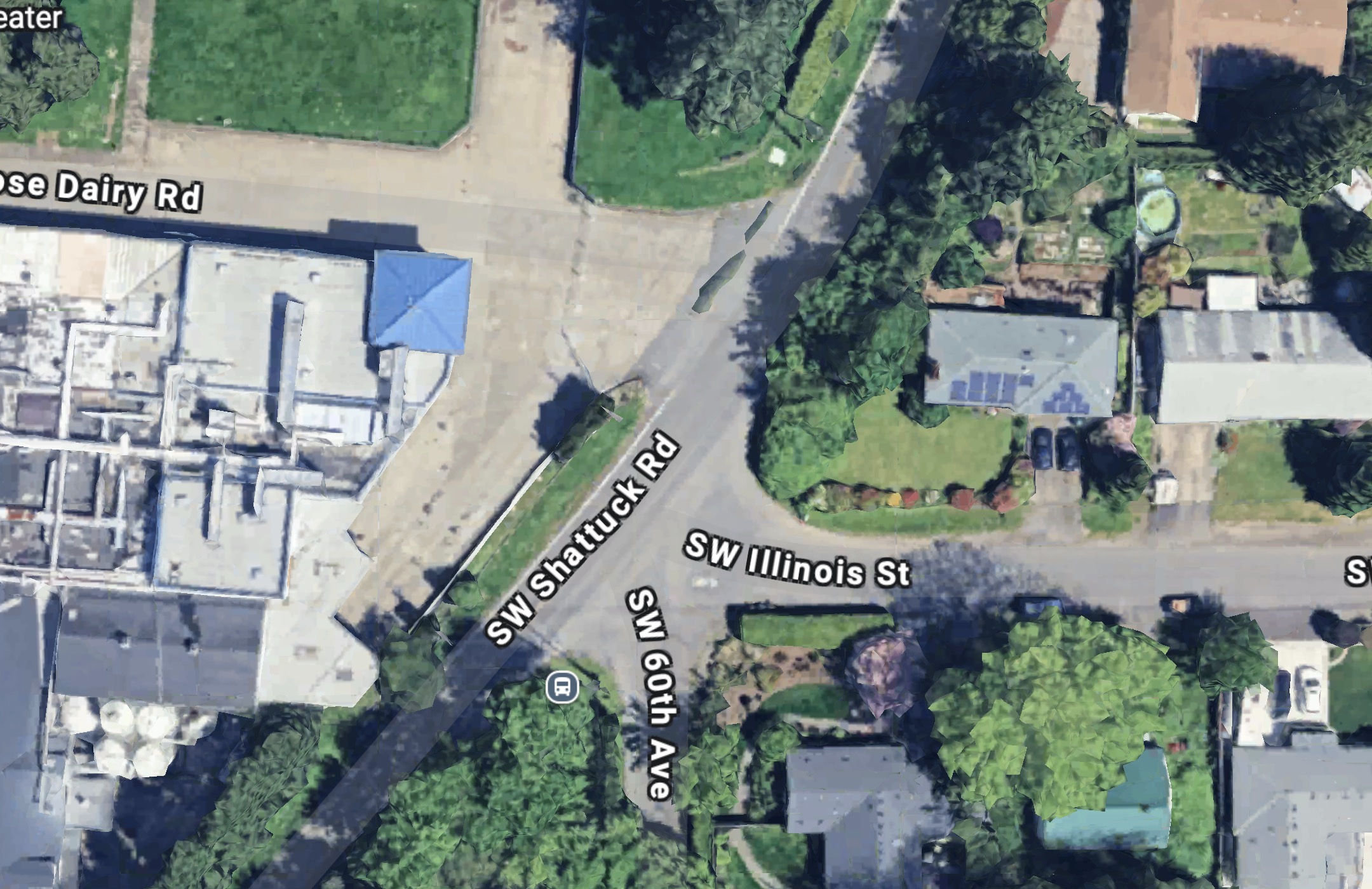
The intersection of Illinois and Shattuck
The intersection of SW Illinois, 60th and Shattuck sits at the crest of large hill. As noted above, Shattuck doesn’t have through cross-streets, stop signs or sidewalks, a common enough configuration in the southwest that I have a name for those roads — toboggan runs. Cars speed on them. Shattuck’s posted speed is 25 mph, but the developer’s traffic study, conducted in 2022, showed the average 85th percentile speed to be 11 mph faster. Also at issue is that the sight distance calculations for the intersection were based on posted, rather than on observed, speeds. And that the intersection’s situation at the top of a crest makes crosswalk marking less visible to a driver approaching from below them.
The developer’s initial traffic study, from April 2024, suggested that “The City and Applicant should collaborate to install speed cushions and the associated signage and pavement markings along the frontage of the new neighborhood on SW Shattuck Road,” per PBOT’s Traffic Design Manual. A month later, PBOT returned the study with comments, including that “Speed cushions require approval of the Fire Bureau prior to installation.”
The revised traffic study which the developer submitted in June dropped the speed cushion suggestion.
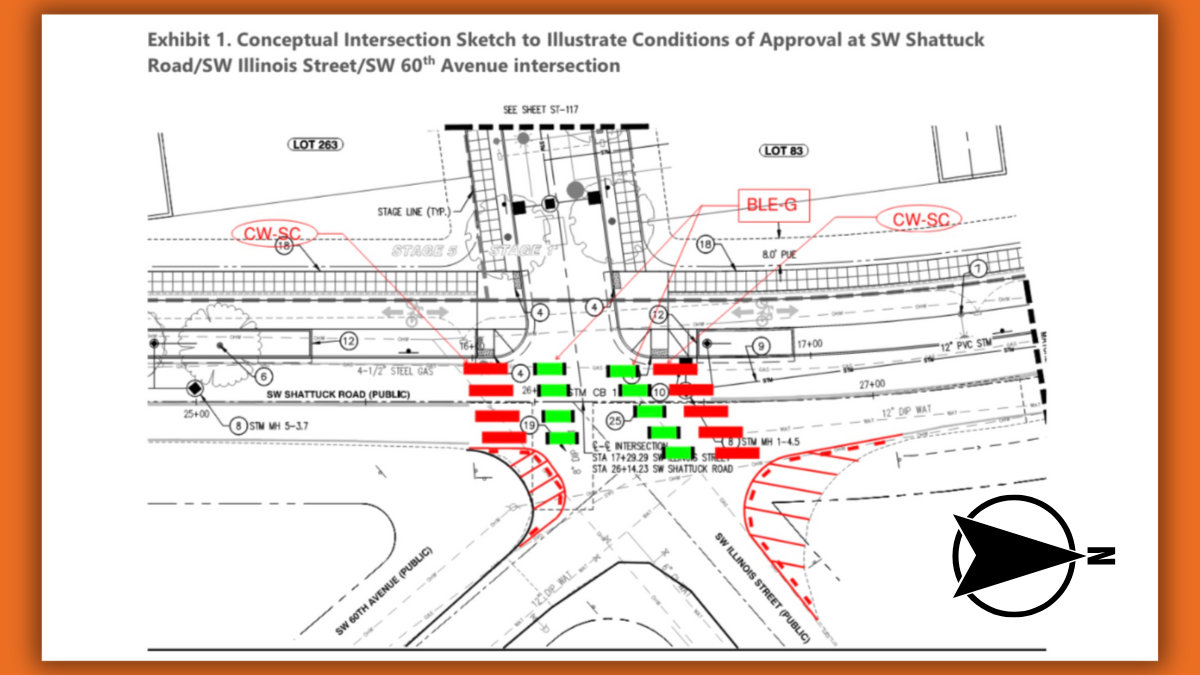
Source: EKS Engineering & Forestry
As part of the ongoing dialogue between PP&D and the development team, the developer submitted a conceptual design (above) of a tightened intersection box at Shattuck and Illinois, with striped crosswalks and bike crosses.
I asked PBOT to comment on their requirements for the intersection, specifically whether “the finding that stop signs and speed bumps are not warranted is so strong that it justifies the delay and expense of a City Council hearing.” PP&D Public Information Officer Ken Ray, relayed this response from PBOT:
As you are likely aware, the City of Portland has been working with the community and applicant on this project to identify solutions that meet PBOT’s goals for a safe, accessible transportation system, that align with traffic control best practices given the context of the land use case, and PBOT’s authority through that review.
PBOT is aware of the concerns related to speeding on Shattuck Road and the desire to ensure the crossing at Shattuck and Illinois is safe for all road users. The City shares those goals. Through the land use process, PBOT worked to evaluate a variety of options to improve conditions across the Raleigh Crest development site.
The design of the intersection at Shattuck and Illinois evolved through the public comment and hearing process, leading the applicant to include some additional improvements to narrow the existing intersection along with marked crosswalks and crossbikes were included in the design. Separate from this development, concept development for a new gateway treatment to enhance the existing neighborhood greenway on Illinois Street is underway.
All-way stop control at Shattuck Road and Illinois Street was evaluated through the traffic study, and it was determined that the volume of activity and the reported crash history at this location did not meet PBOT’s standards for stop sign placement. More information about the use of stop signs can be found here: https://www.portland.gov/transportation/traffic-operations/stop-sign-overview.
Speed cushions were also considered through the land use process. PBOT no longer has a traffic calming program due to equity concerns and lack of funding. It only installs speed bumps or cushions as part of projects for Neighborhood Greenways, Safe Routes to School, on known cut-through routes through Fixing Our Street funding, and at locations with known safety issues. Shattuck Road is classified as a Neighborhood Collector and Major Emergency Response street. Per the Transportation System Plan, “Major Emergency Response Streets that also have a Local Service or Neighborhood Collector traffic classification are eligible for speed cushions, subject to the approval of Portland Fire and Rescue.” It has been PBOT’s recent experience that Portland Fire has not been supportive of long stretches of speed cushions on Major Emergency Response streets. To be effective, speed bumps or cushions need to be placed at regular intervals along a corridor. In this case, review by City bureaus including PBOT and Portland Fire and Rescue did not establish that speed bumps or cushions are so critical the Portland Fire should consider their placement on a Major Emergency Response Route.
And that is where things stand for the moment.
I’m writing this post less than a week after the City Auditors Office wrote a critical report about PBOT’s Vision Zero program. One thing is clear to me: Vision Zero will not be successful if it is the purview of only a small group within PBOT. Everybody needs to share the Vision and make it a priority — PBOT Maintenance and Development Review, Water and Environmental Services, Fire and Police, the City Attorney, and the City Council and Mayor. I am hopeful that Portland can do this.
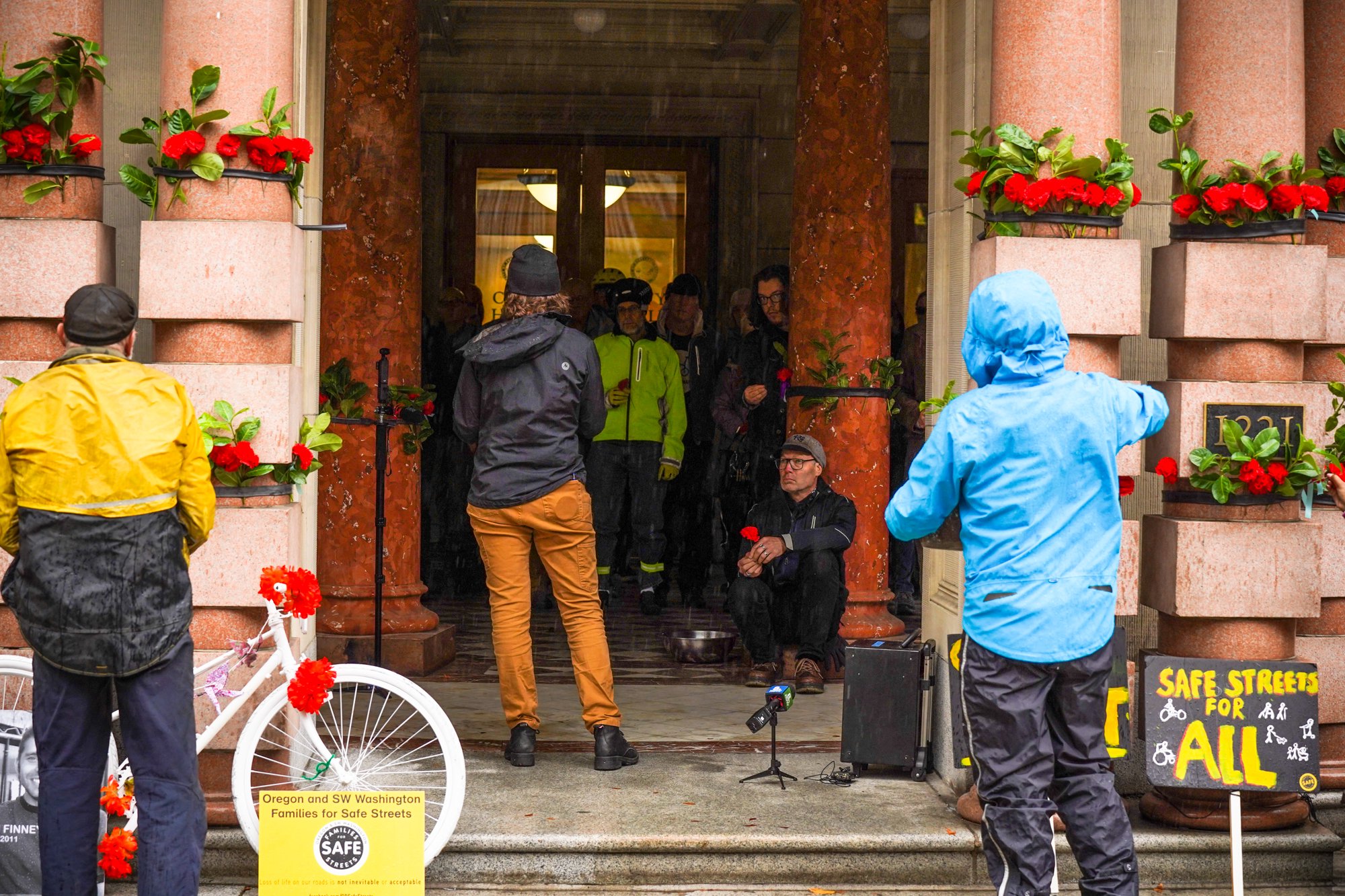
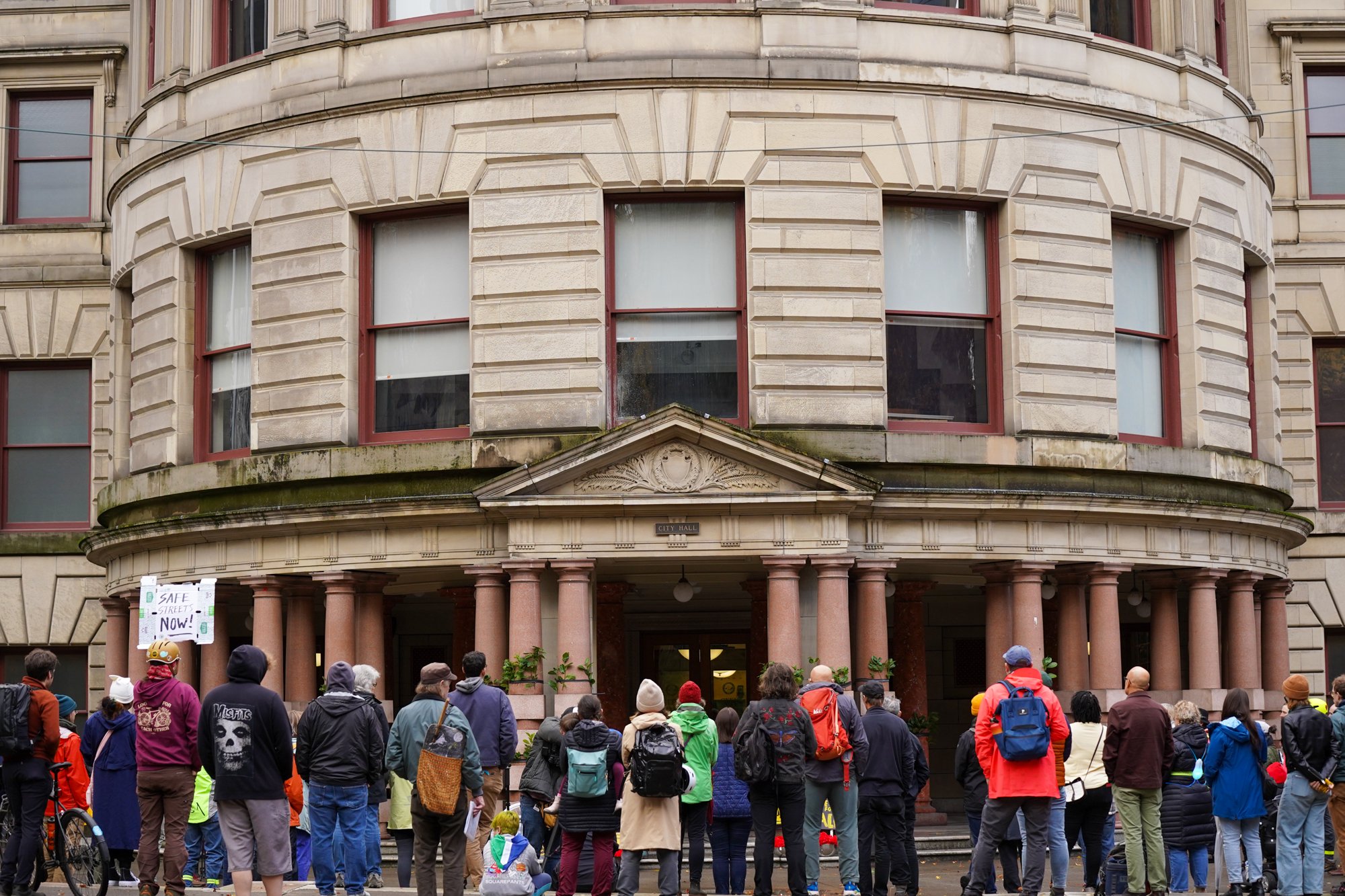
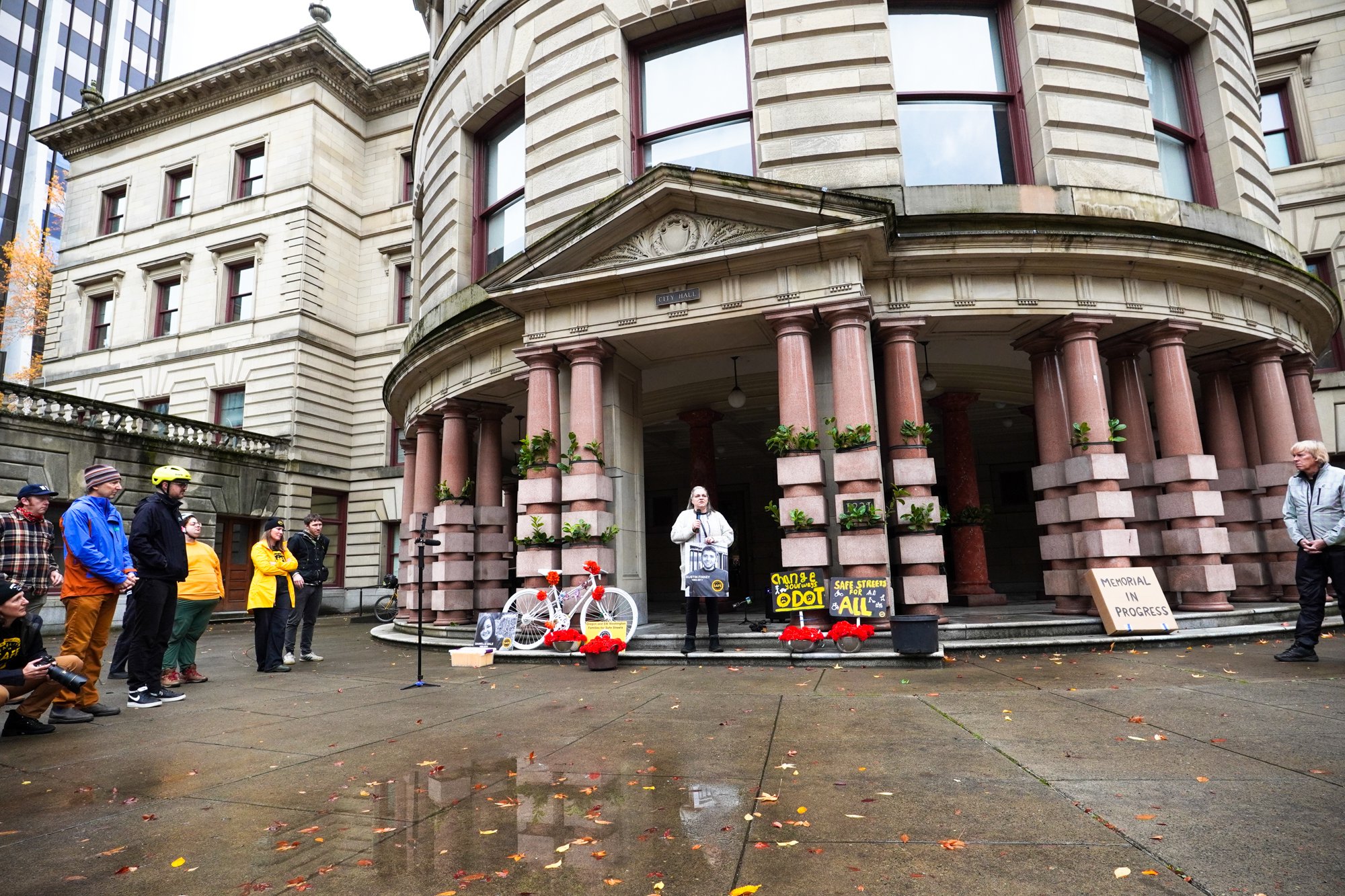
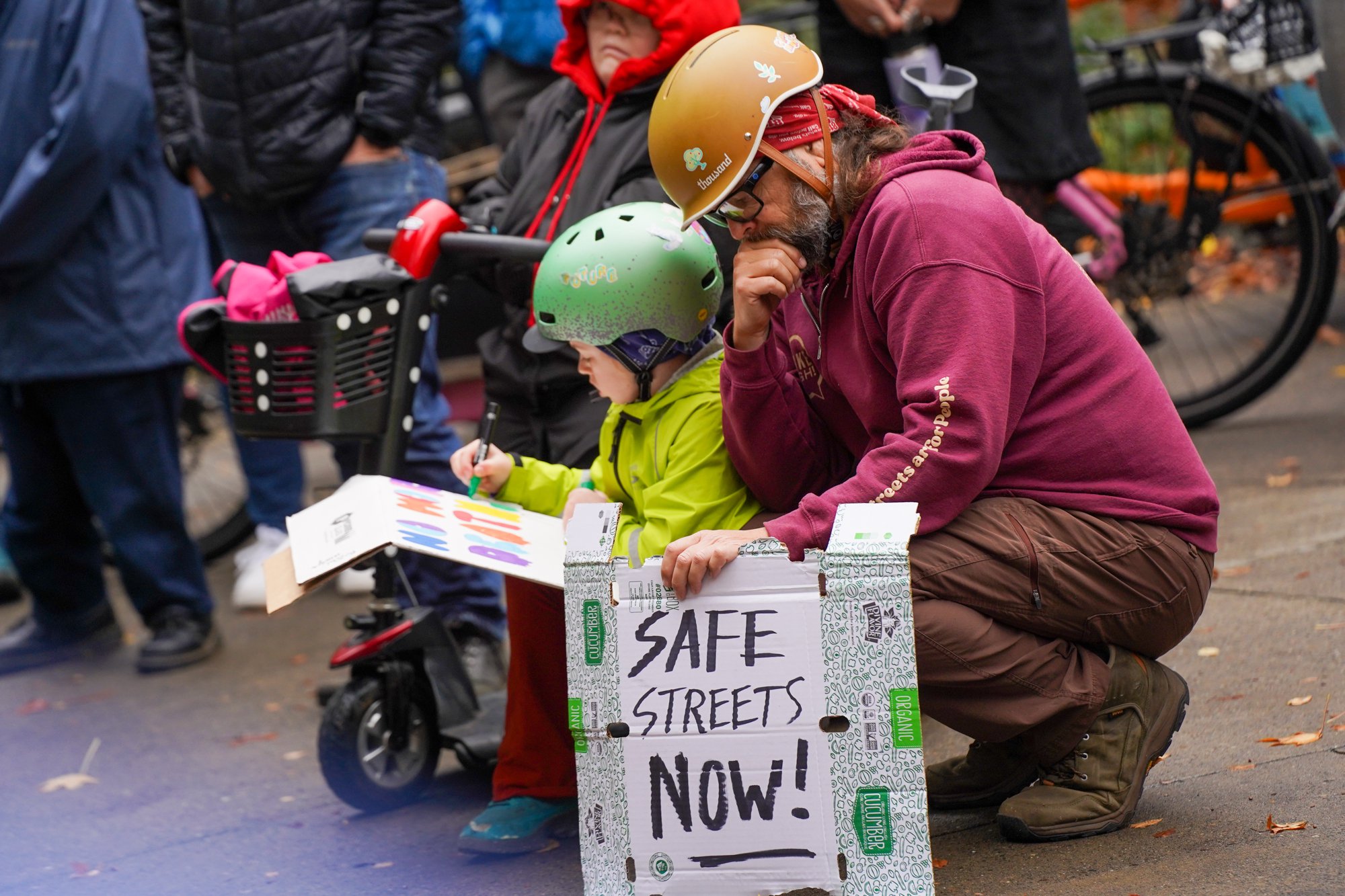
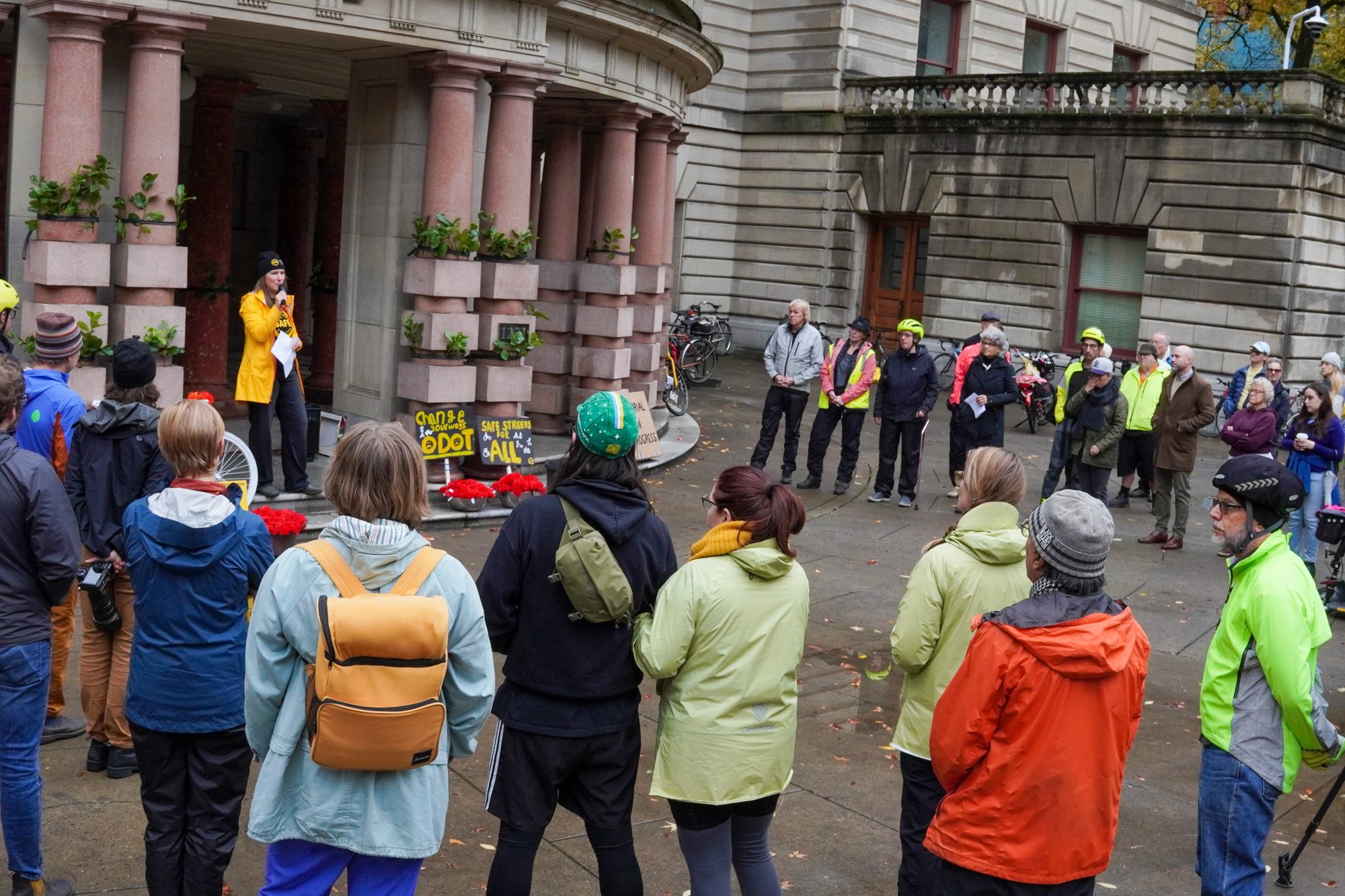
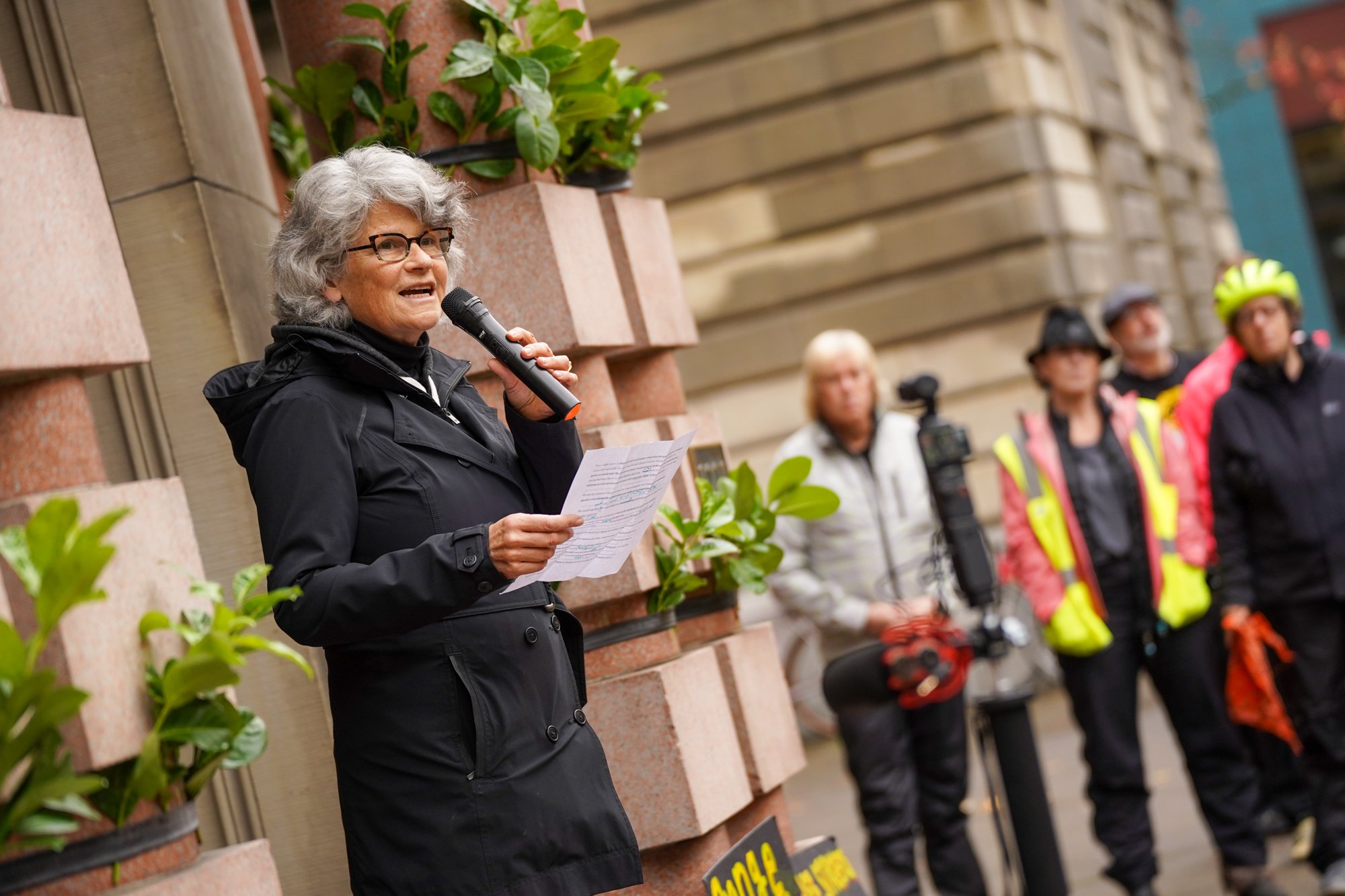
Street chaplain Sara Fischer on the steps of Portland City Hall. (Photos: Jonathan Maus/BikePortland – Full gallery below)
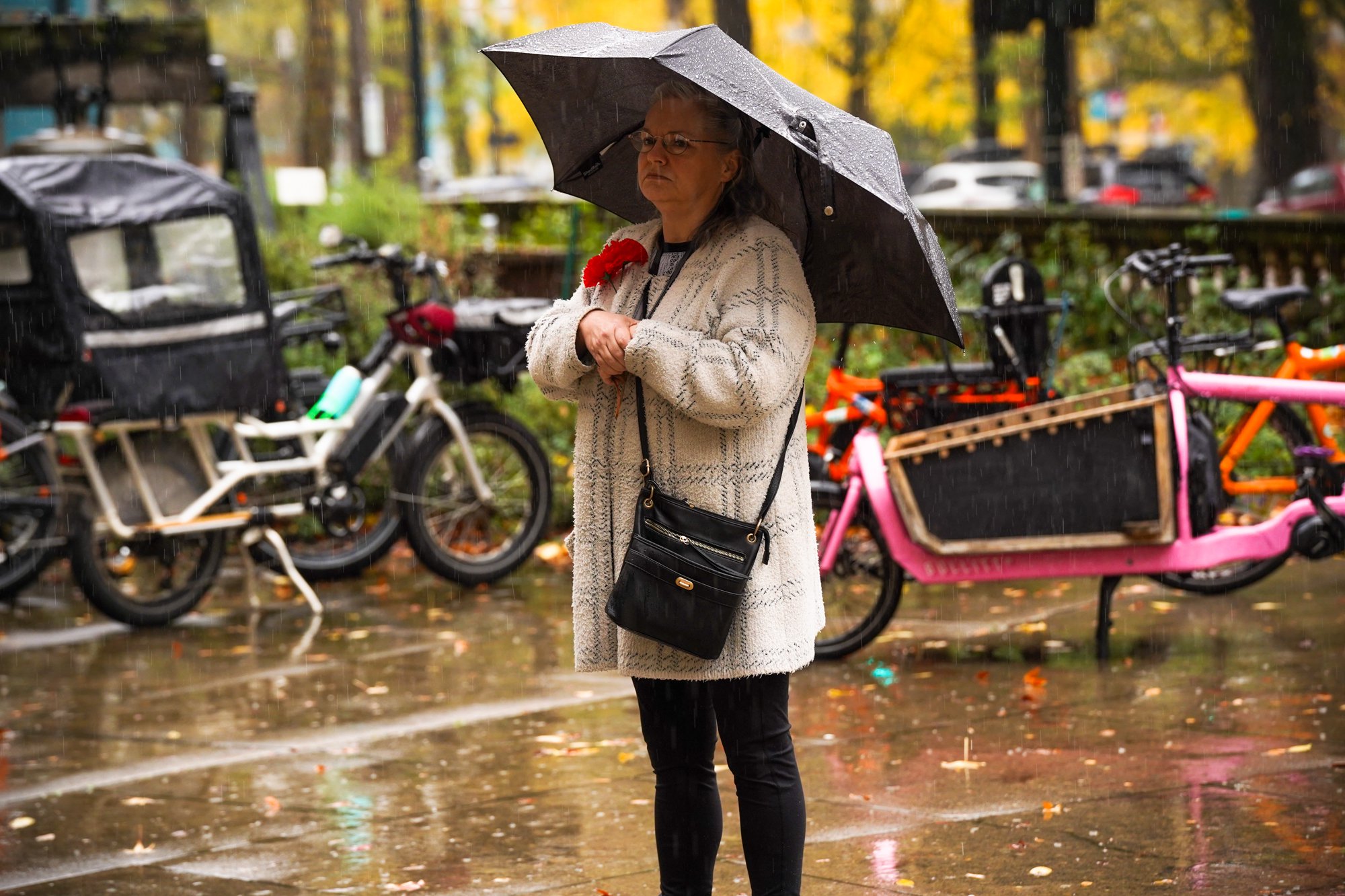
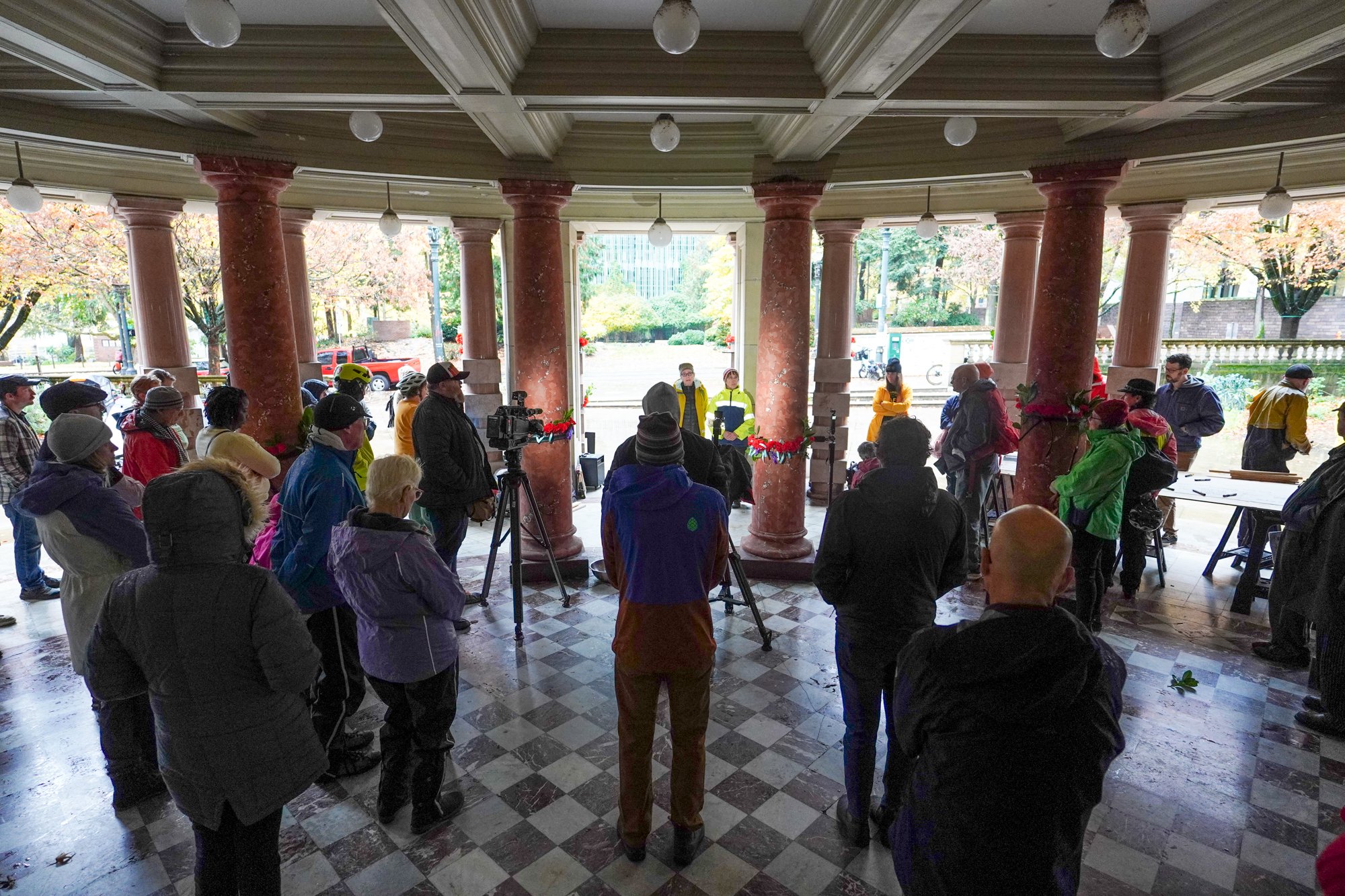
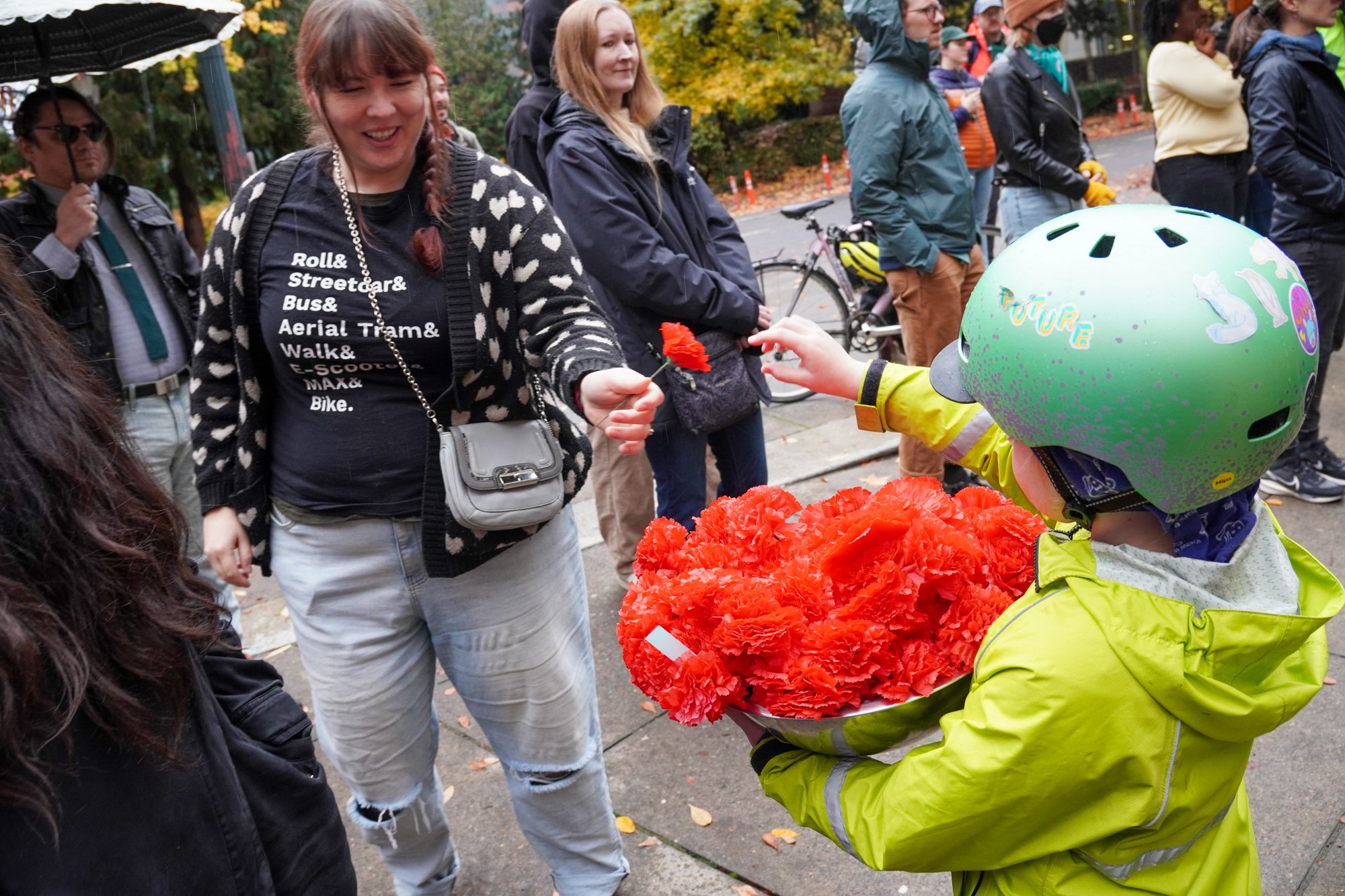
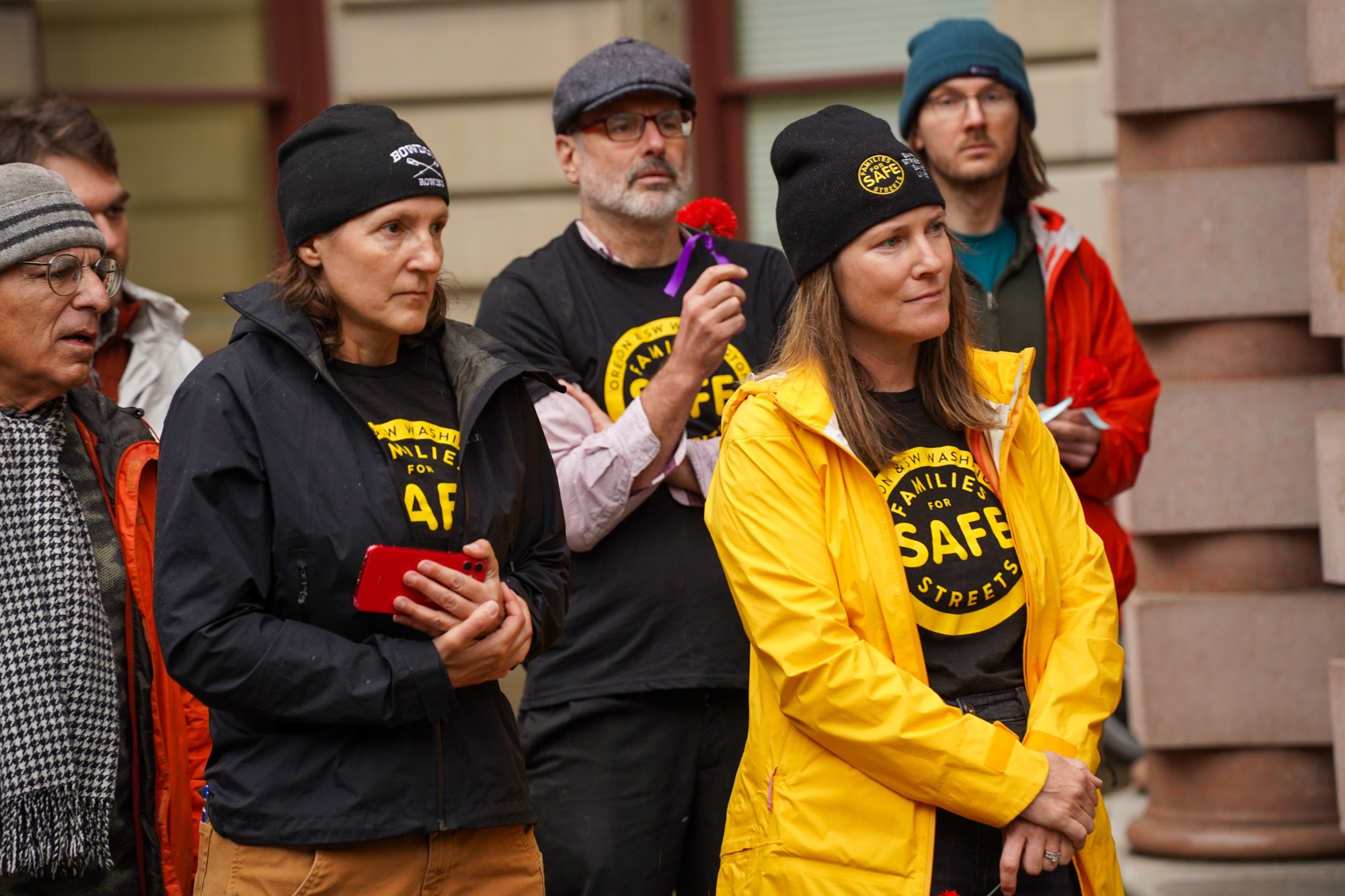
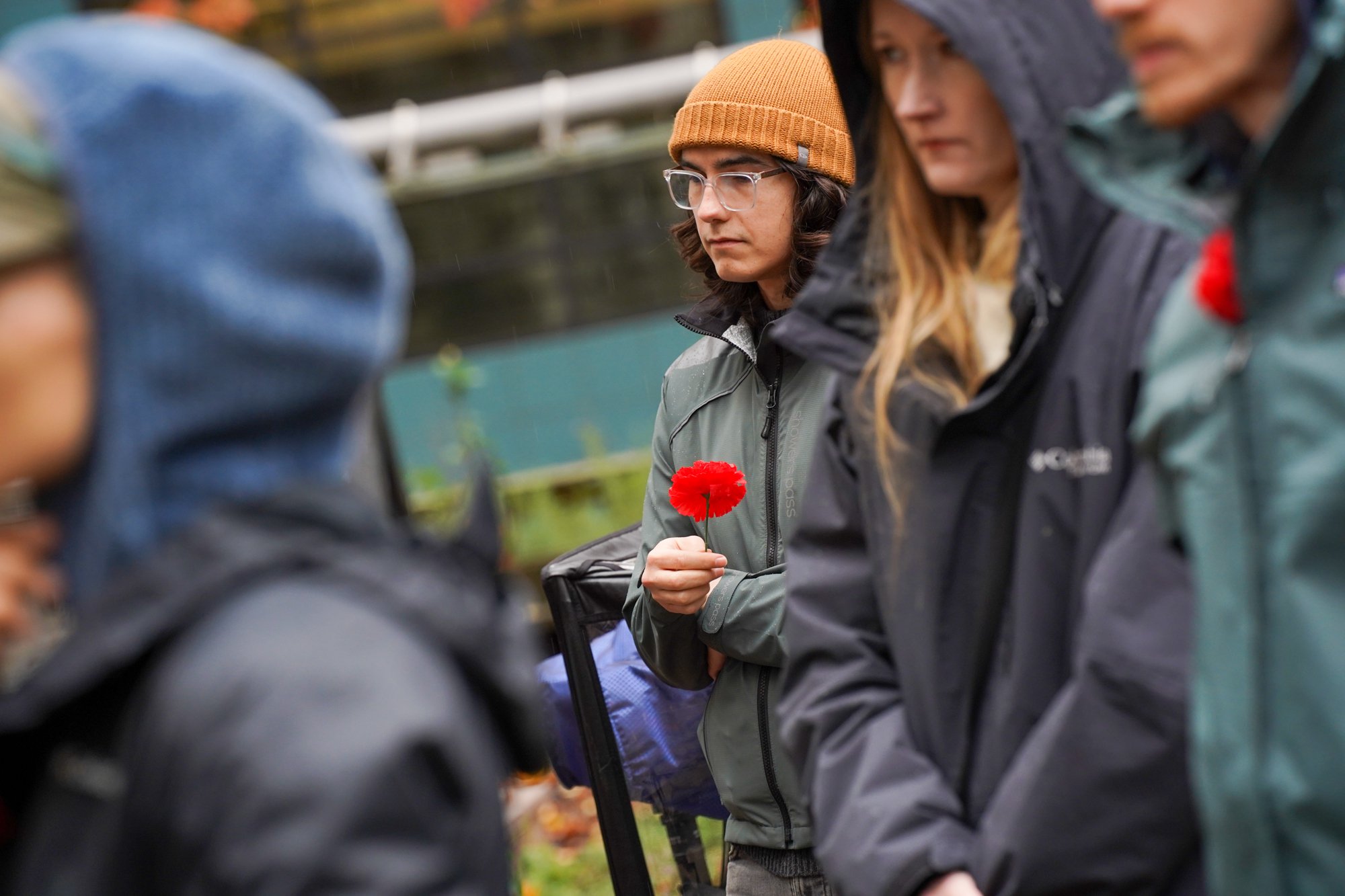
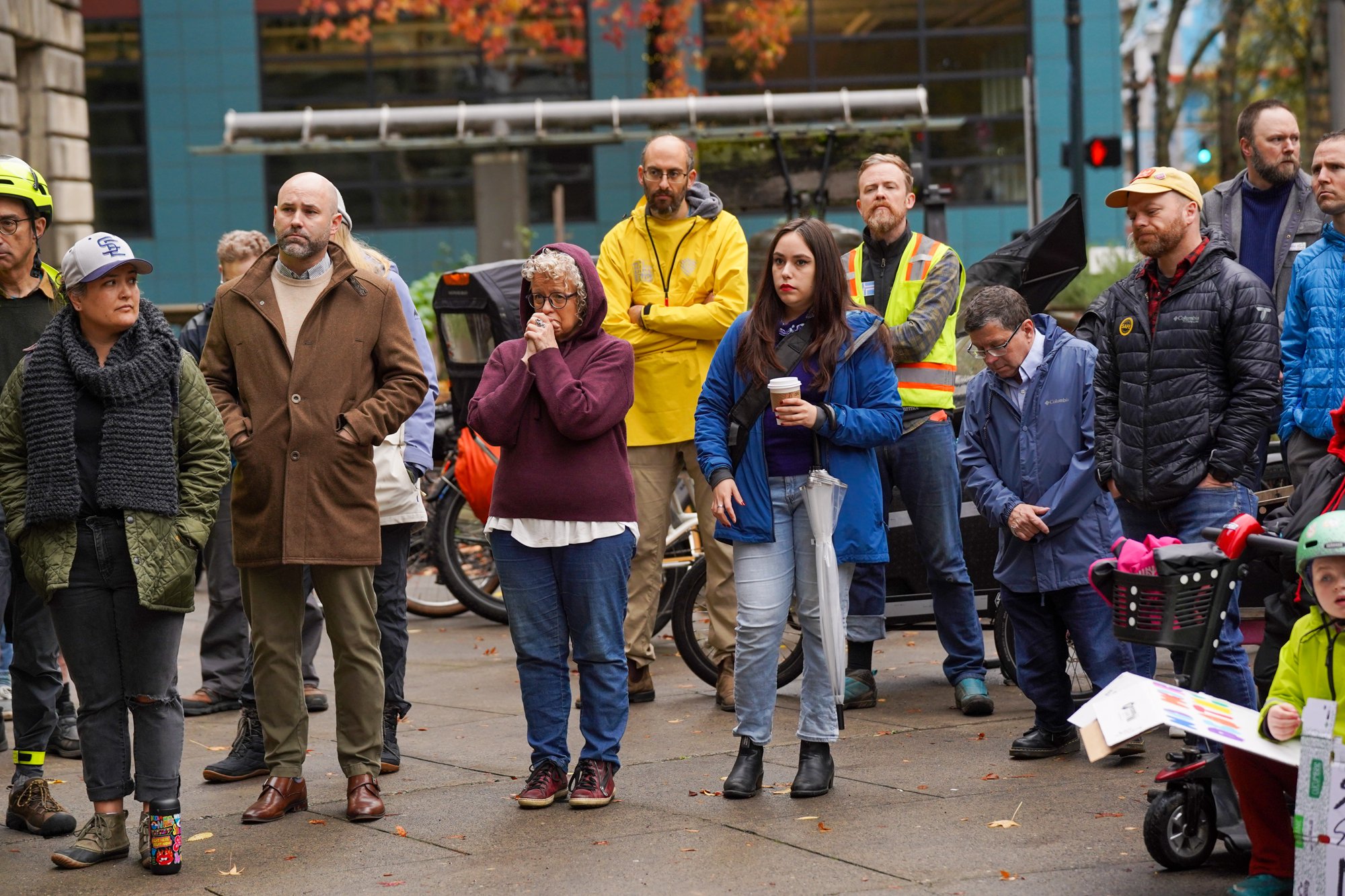
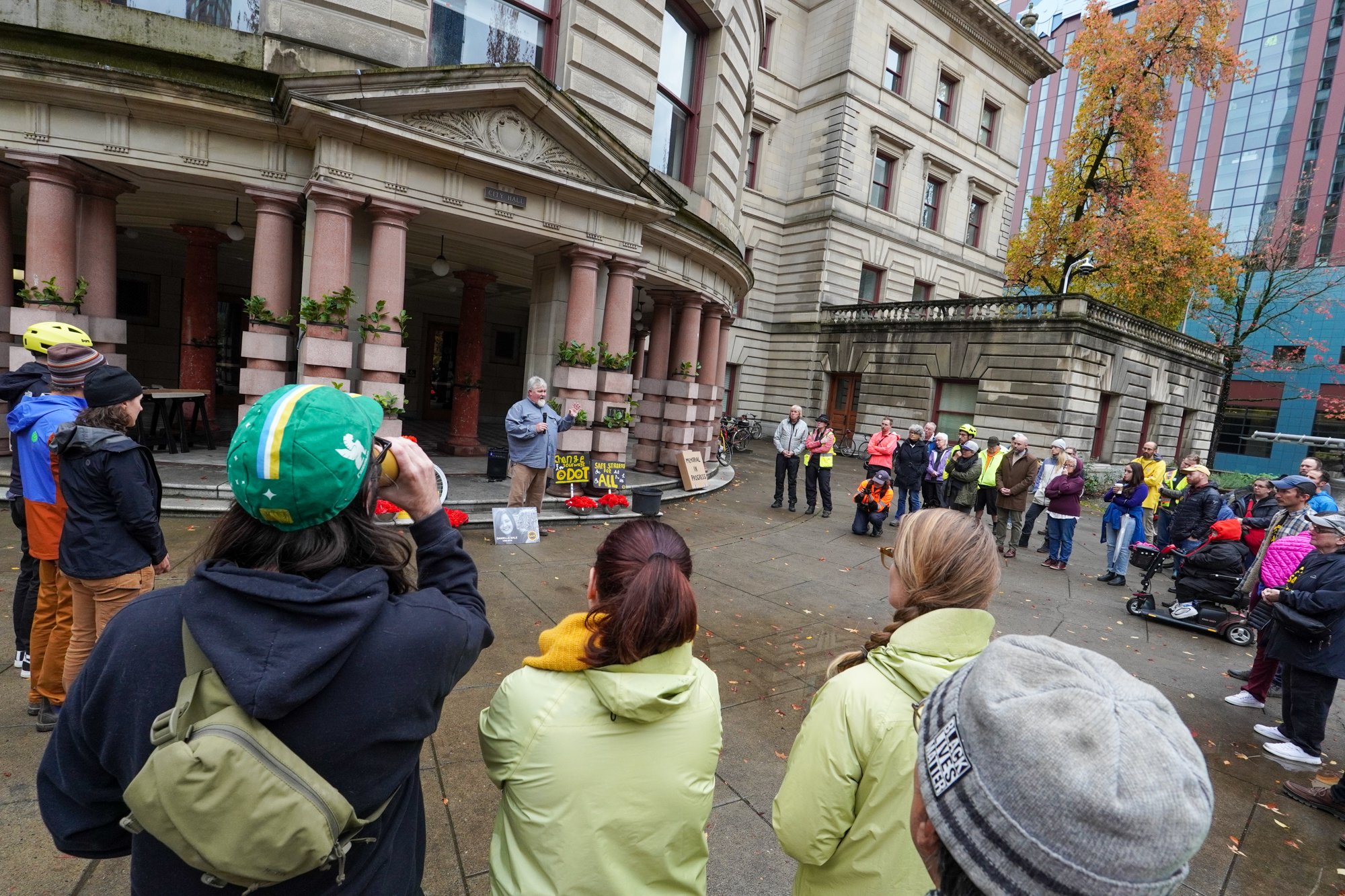
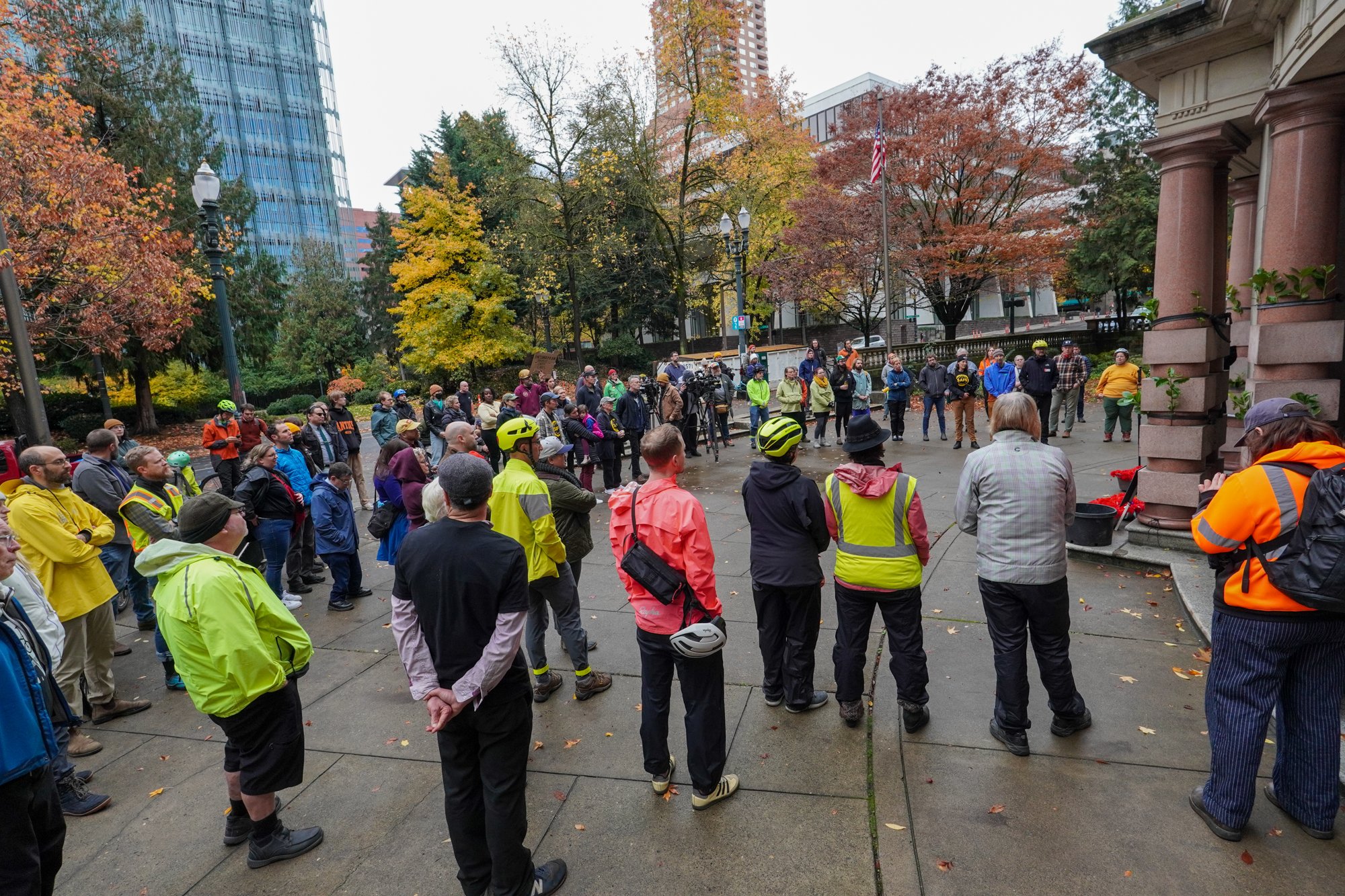
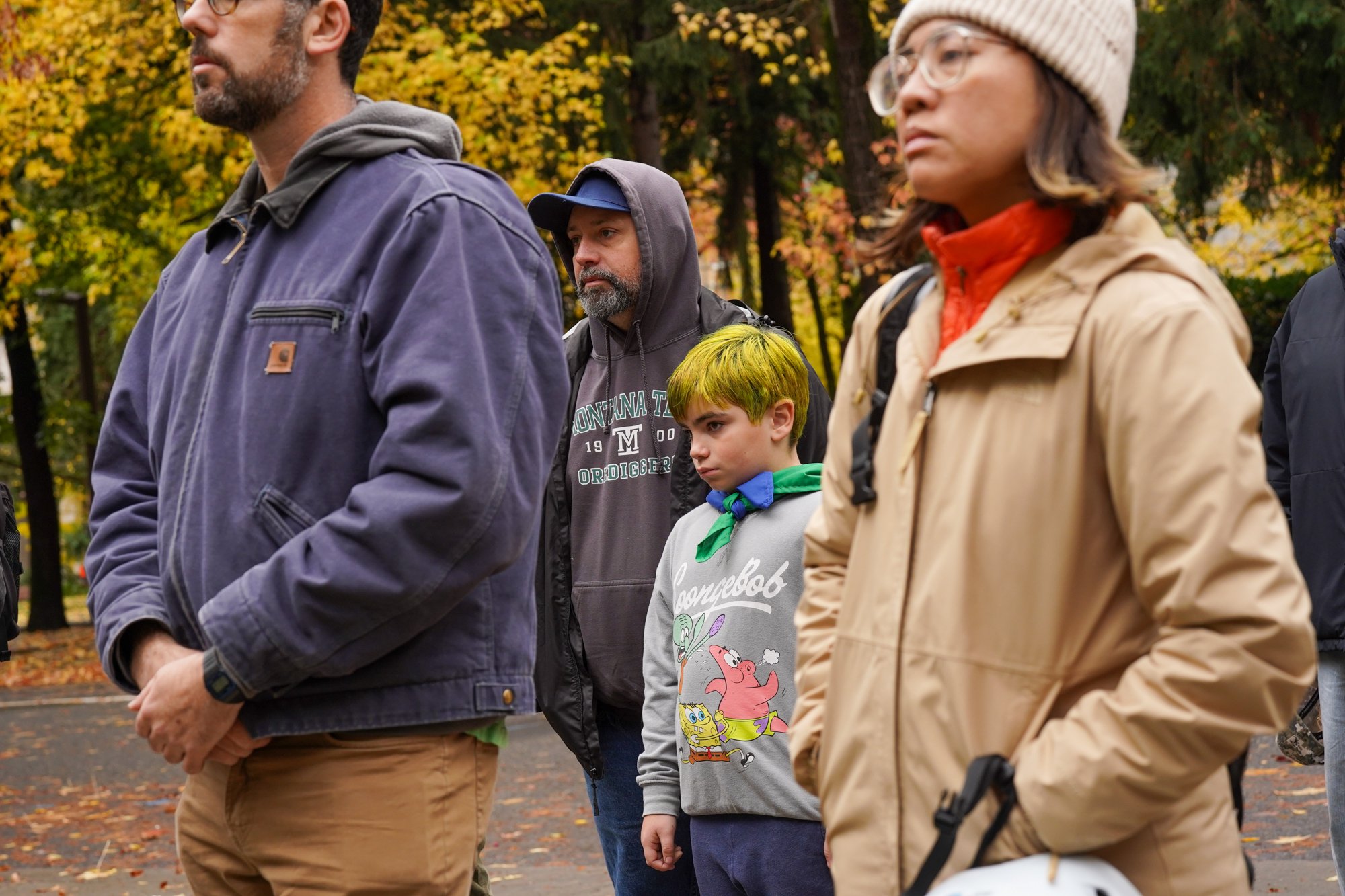
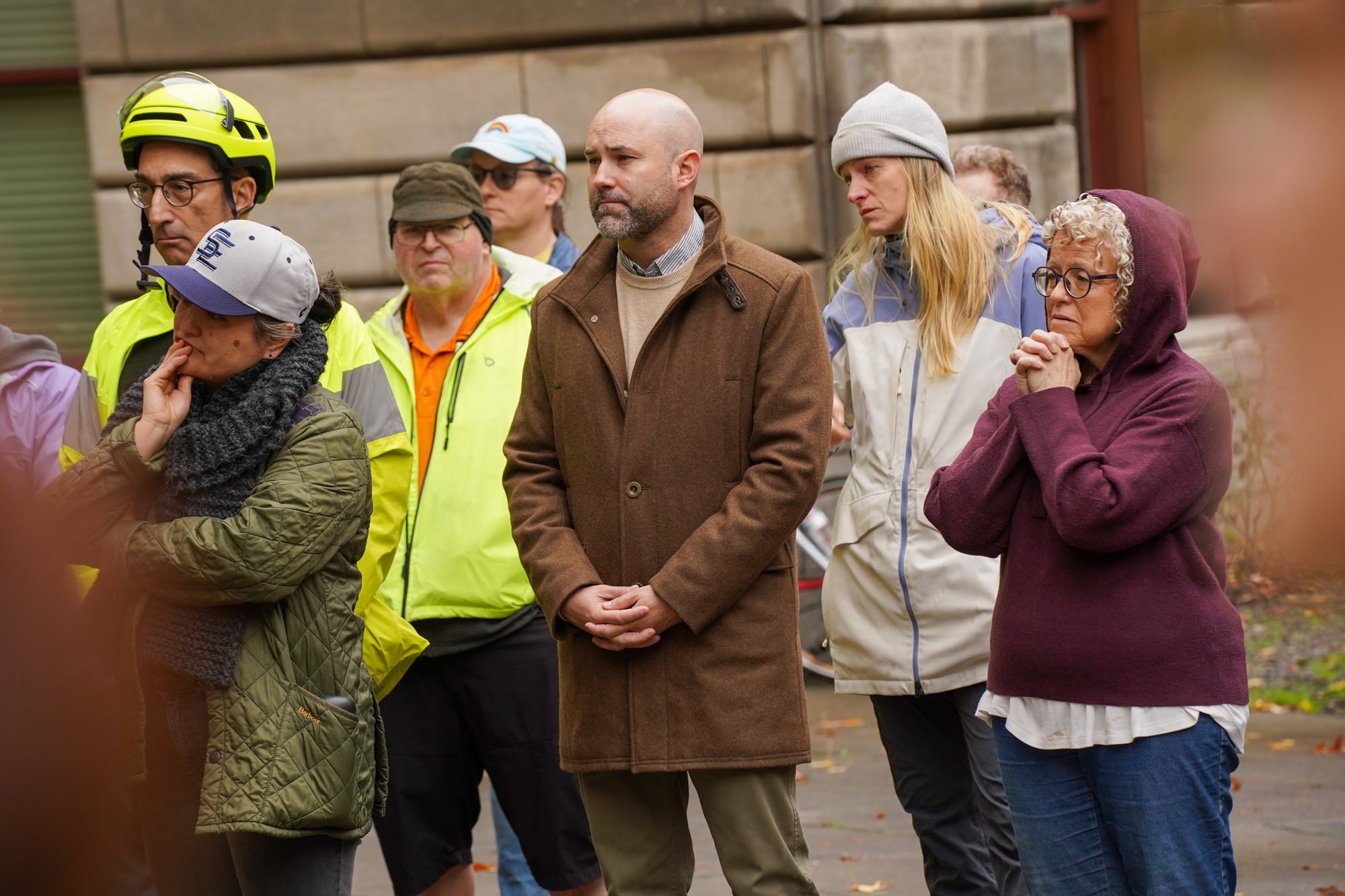
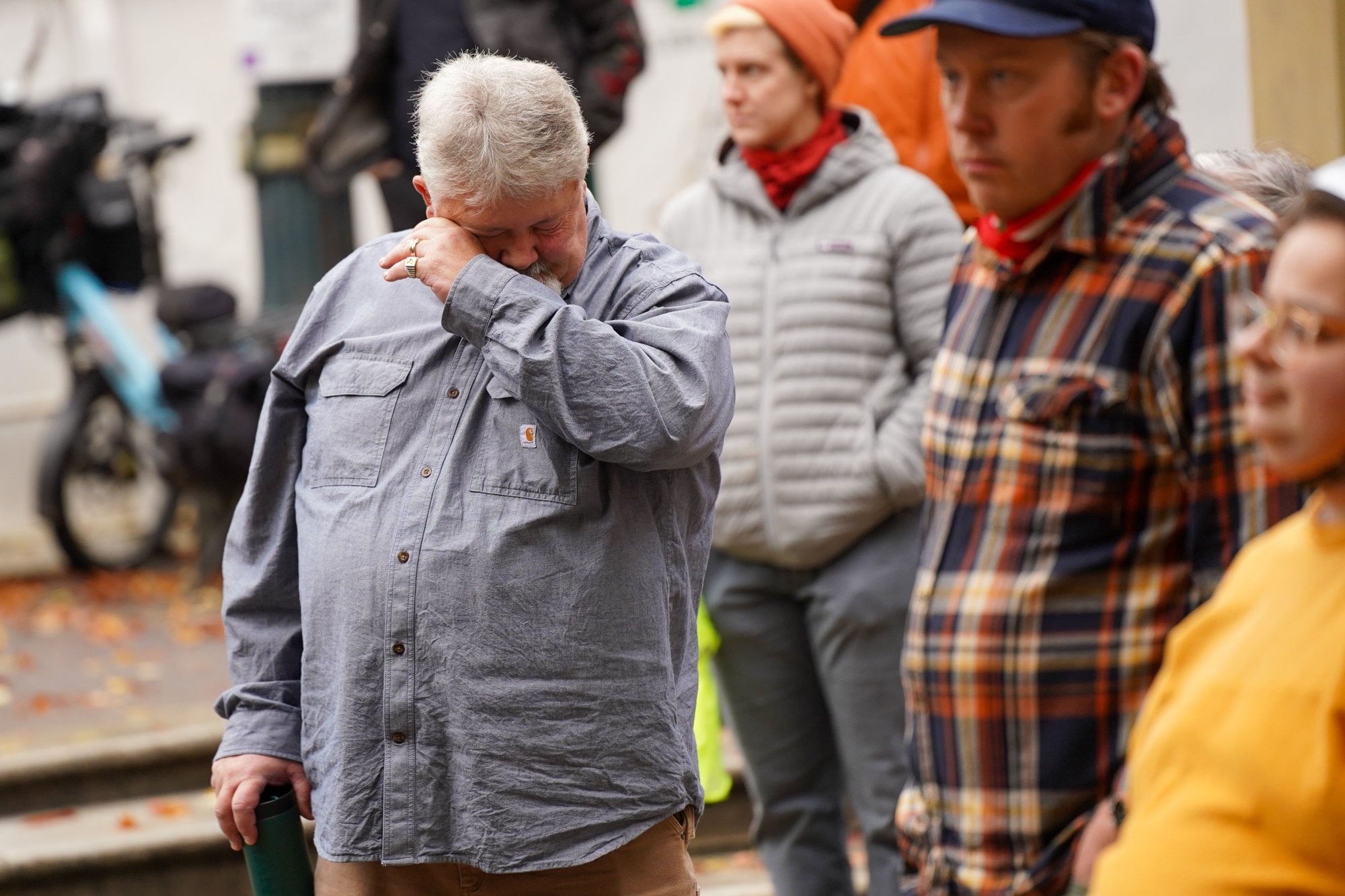
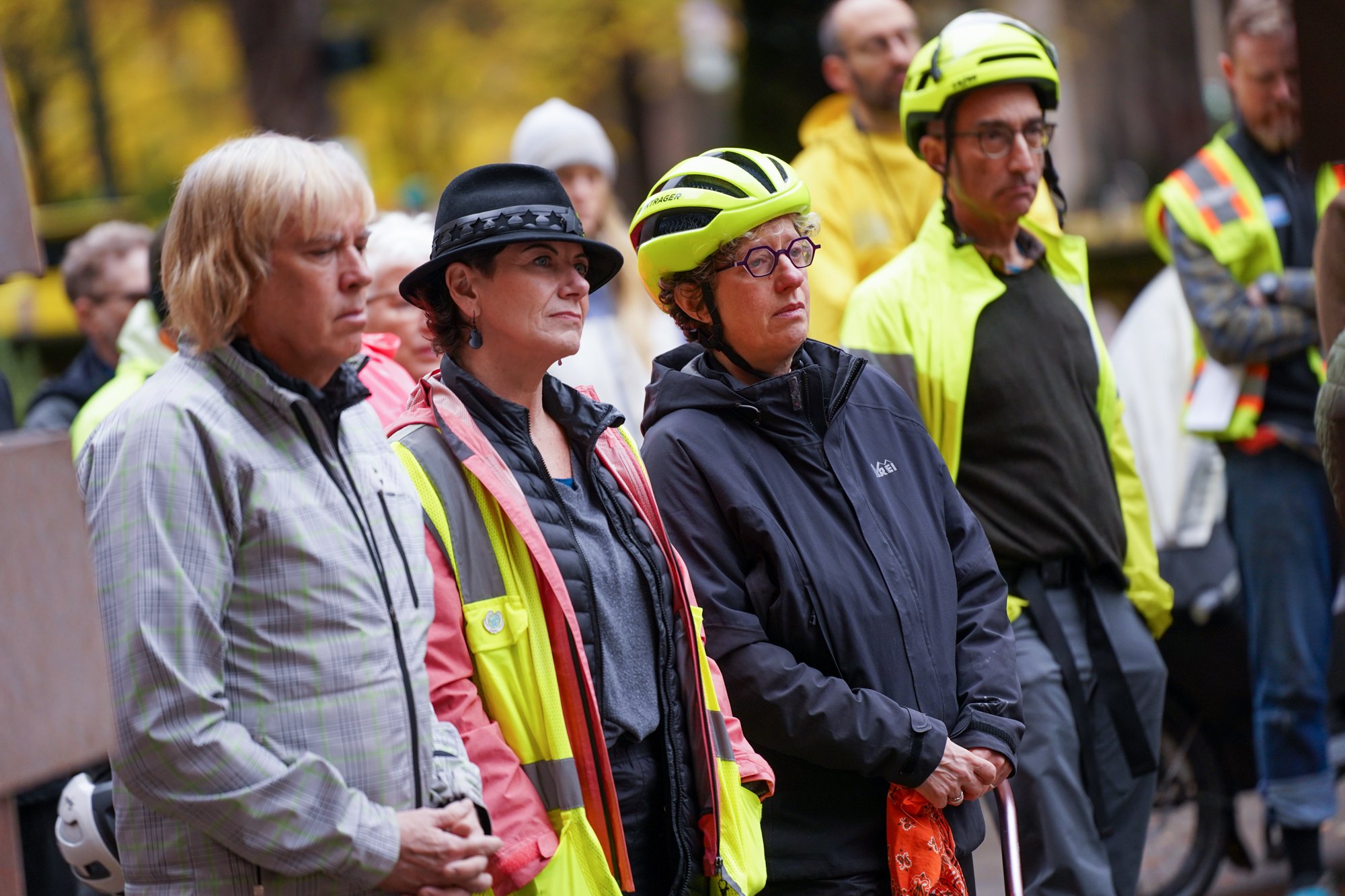
The annual World Day of Remembrance brought advocates, elected officials and survivors together in front of Portland City Hall Sunday. It was a powerful event where five newly elected city council members were moved to speak and many were moved to tears. The energy was part rally and part memorial ceremony as the crowd heard speeches aimed at inspiring policy changes, and songs aimed at spurring emotions.
The event was held in cities across the globe to force people to recognize the senseless and preventable deaths that happen on our roads. Around 40,000 people are killed in traffic crashes every year in America. Oregon has at least one fatality per day and Portland has seen a stubborn increase in road deaths despite working to reverse the trend. But Sunday’s event went far beyond sad statistics. Attendees heard mothers and fathers share graphic details of how their children were killed and held space for expressions of loss mixed with anger and confusion about a culture that doesn’t seem to care.
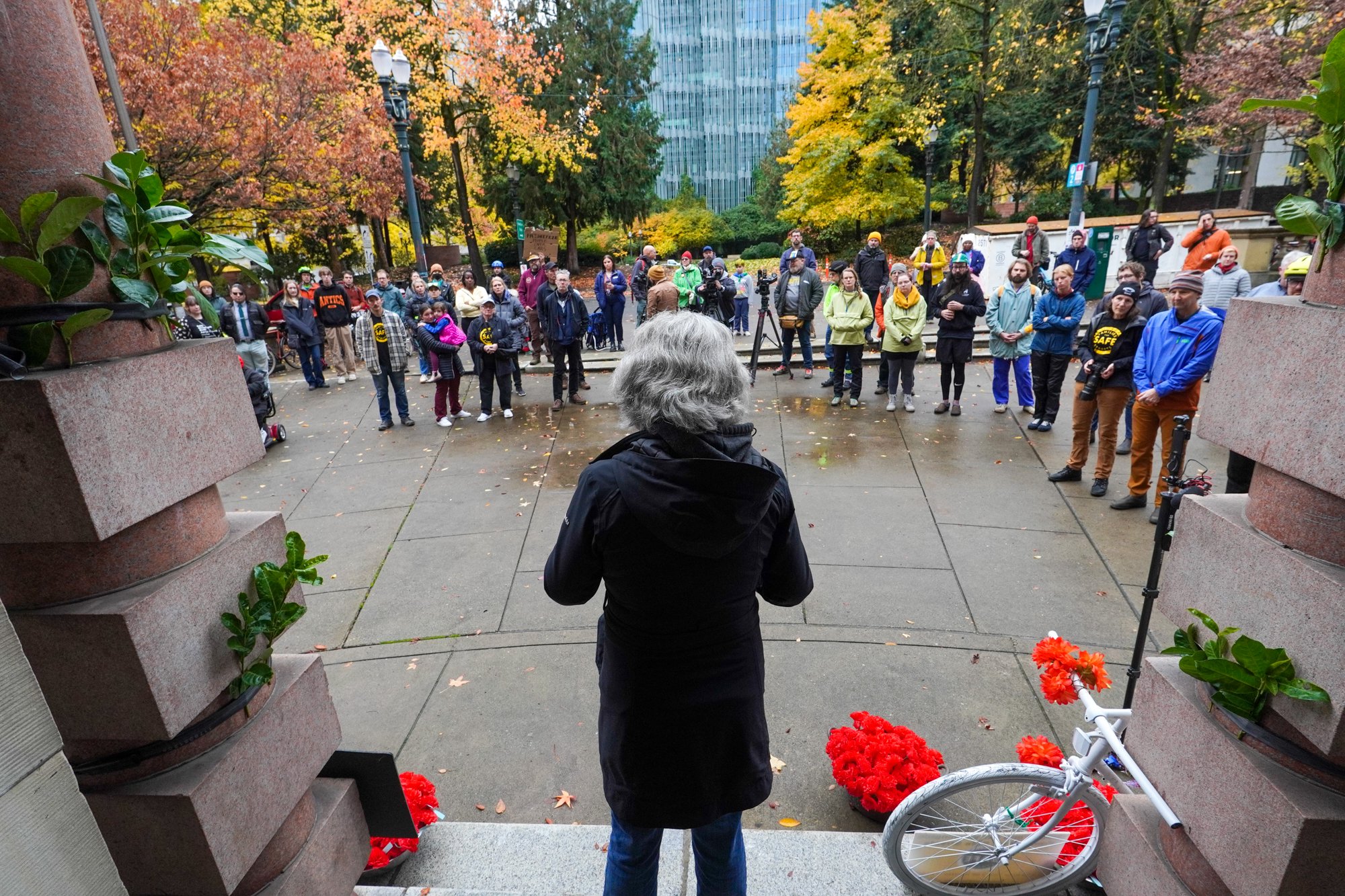
“I am here this morning for everyone that has died due to traffic crashes and I’m here for the communities they left behind. Which is all of us,” said street chaplain Sara Fischer at the outset of the ceremony.
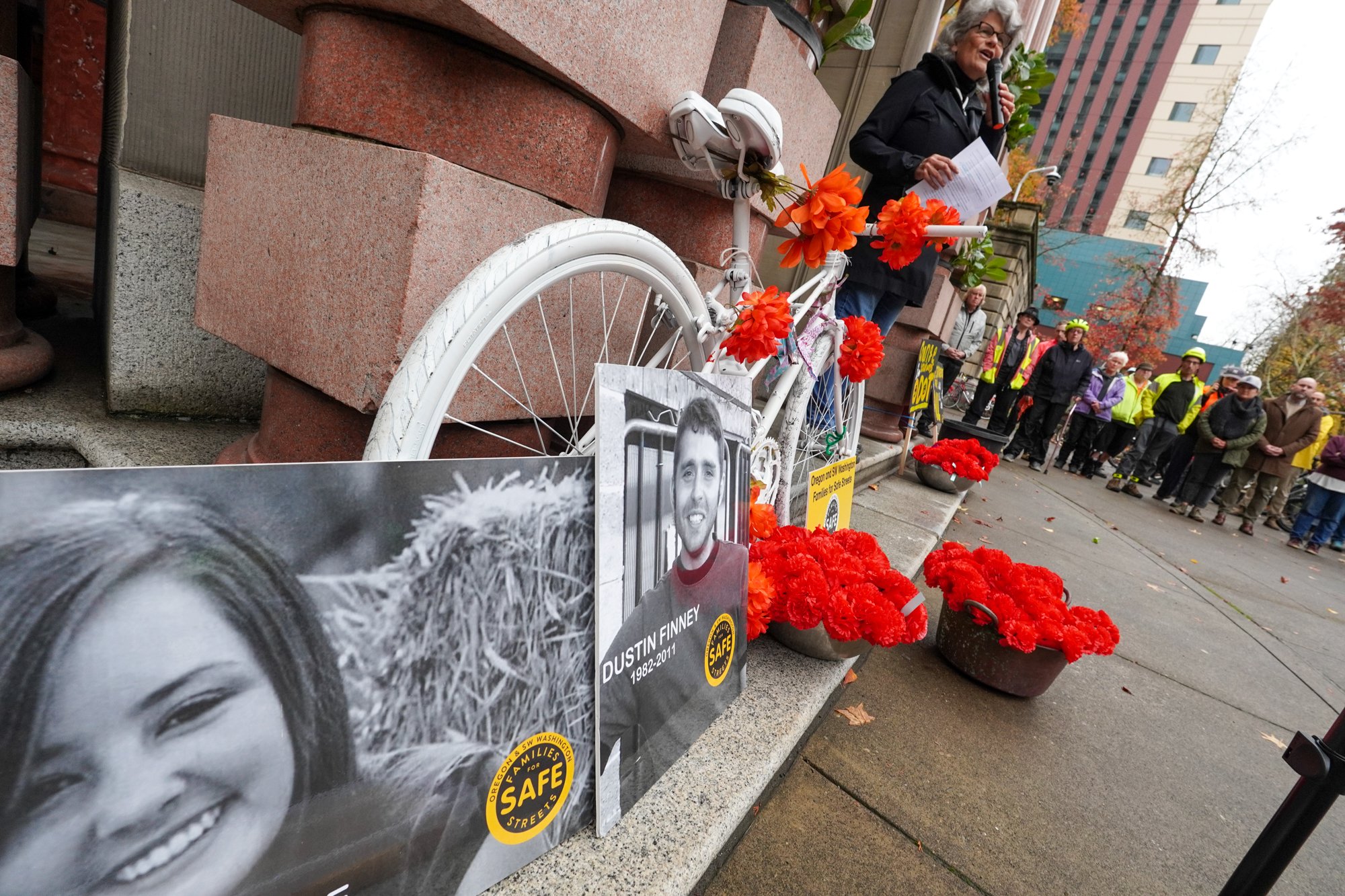
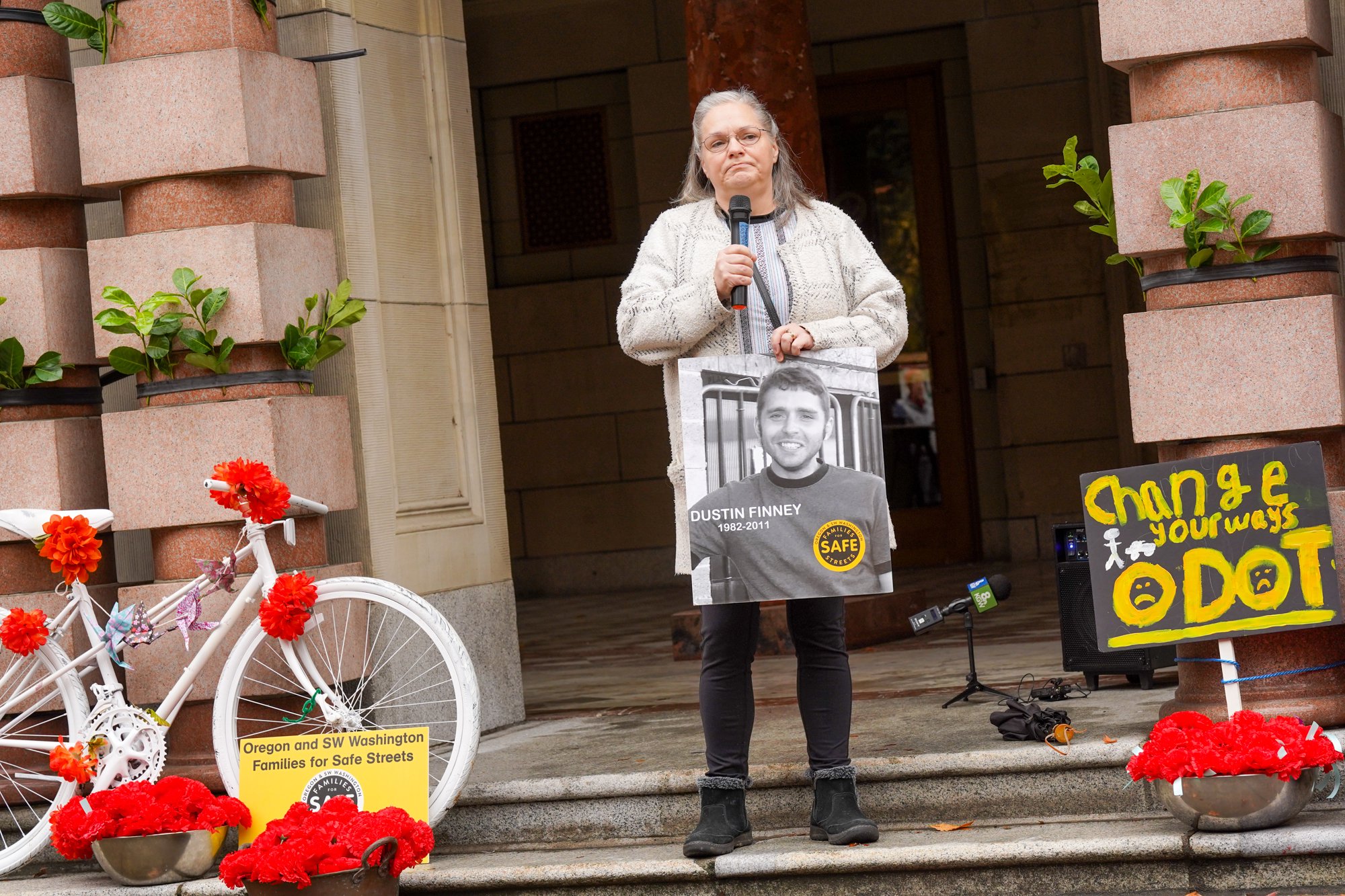
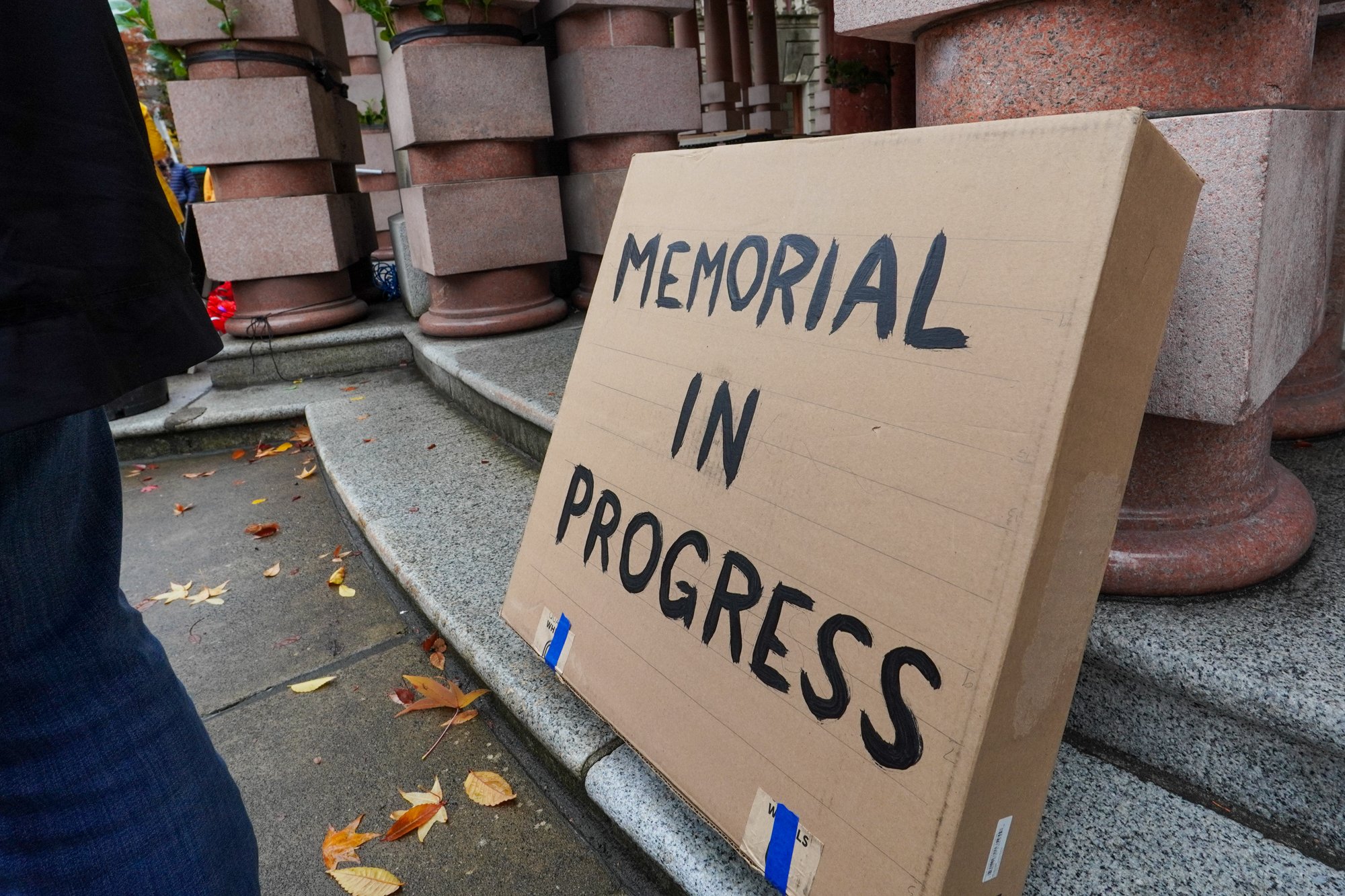
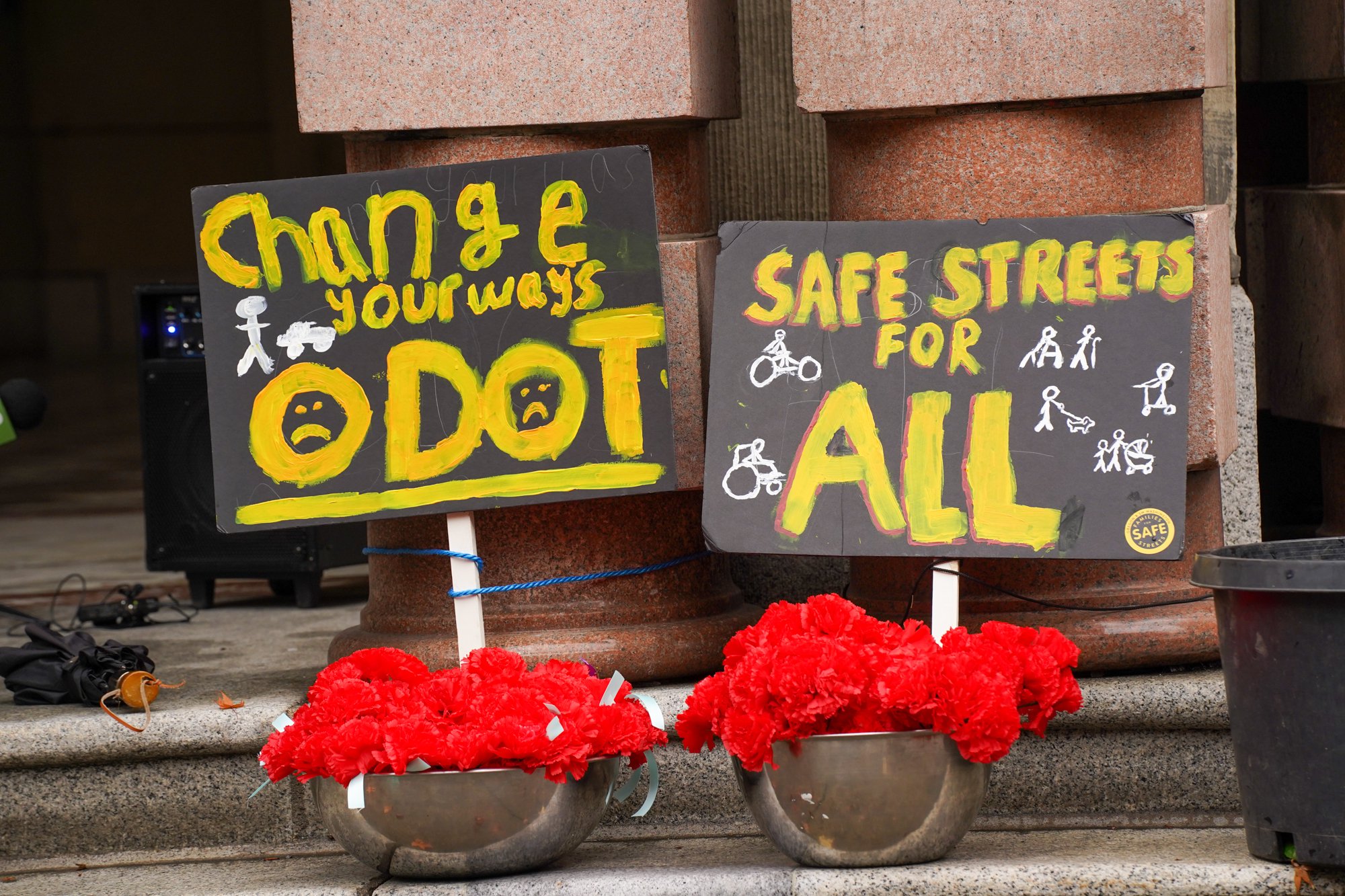
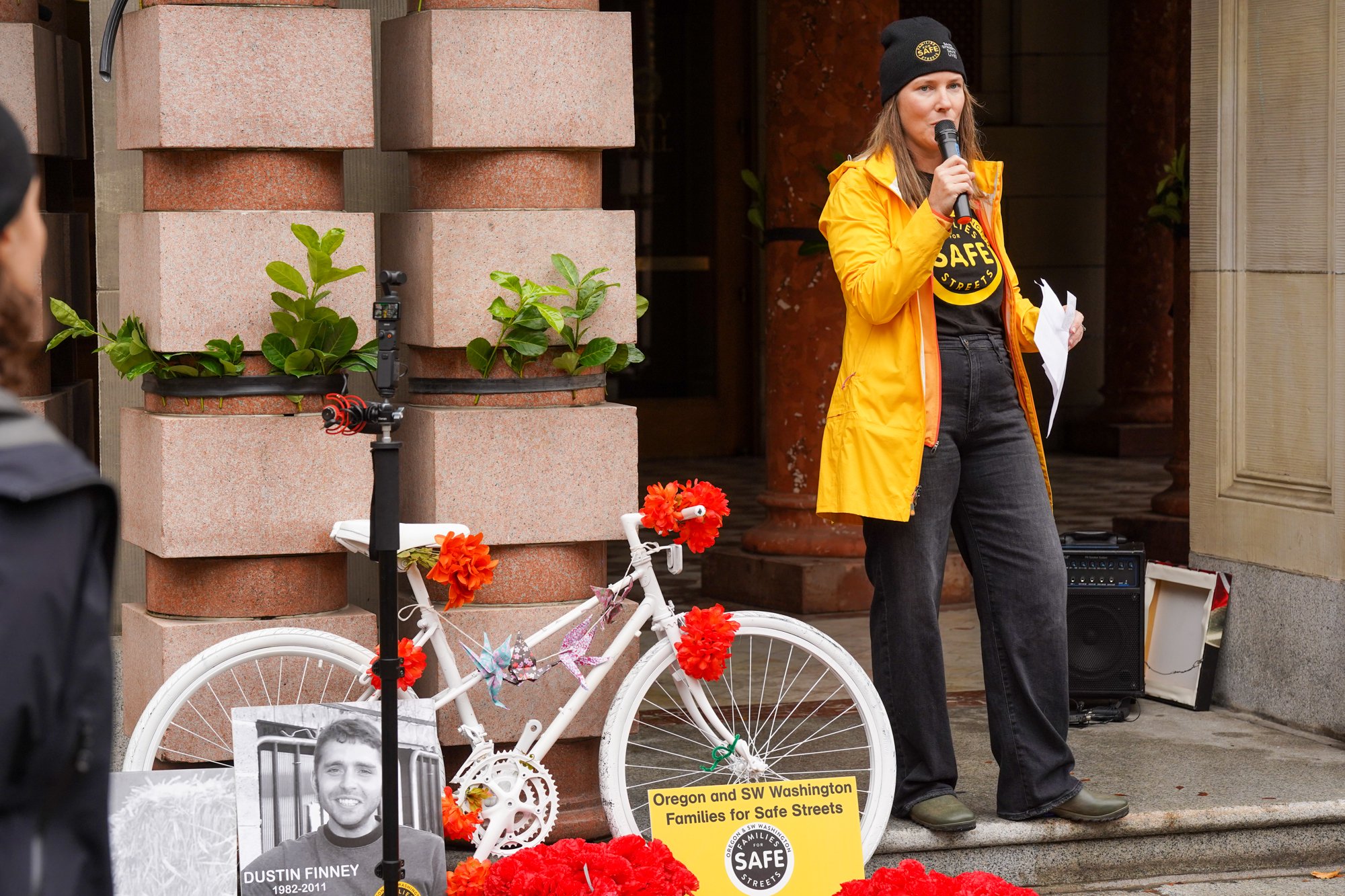
Behind Fischer, bicycle inner tubes wrapped around the marble columns of City Hall held twigs of green laurel. To each side of her were protest signs and buckets of red flowers that represented someone killed in traffic in Oregon. A bright white ghost bike was a stark symbol of the gathering’s purpose. Fischer spoke of the need for more advocacy to fight for safer streets and buoy the strength and spirit of families who’ve lost loved ones. “They should not do this work by themselves,” she said.
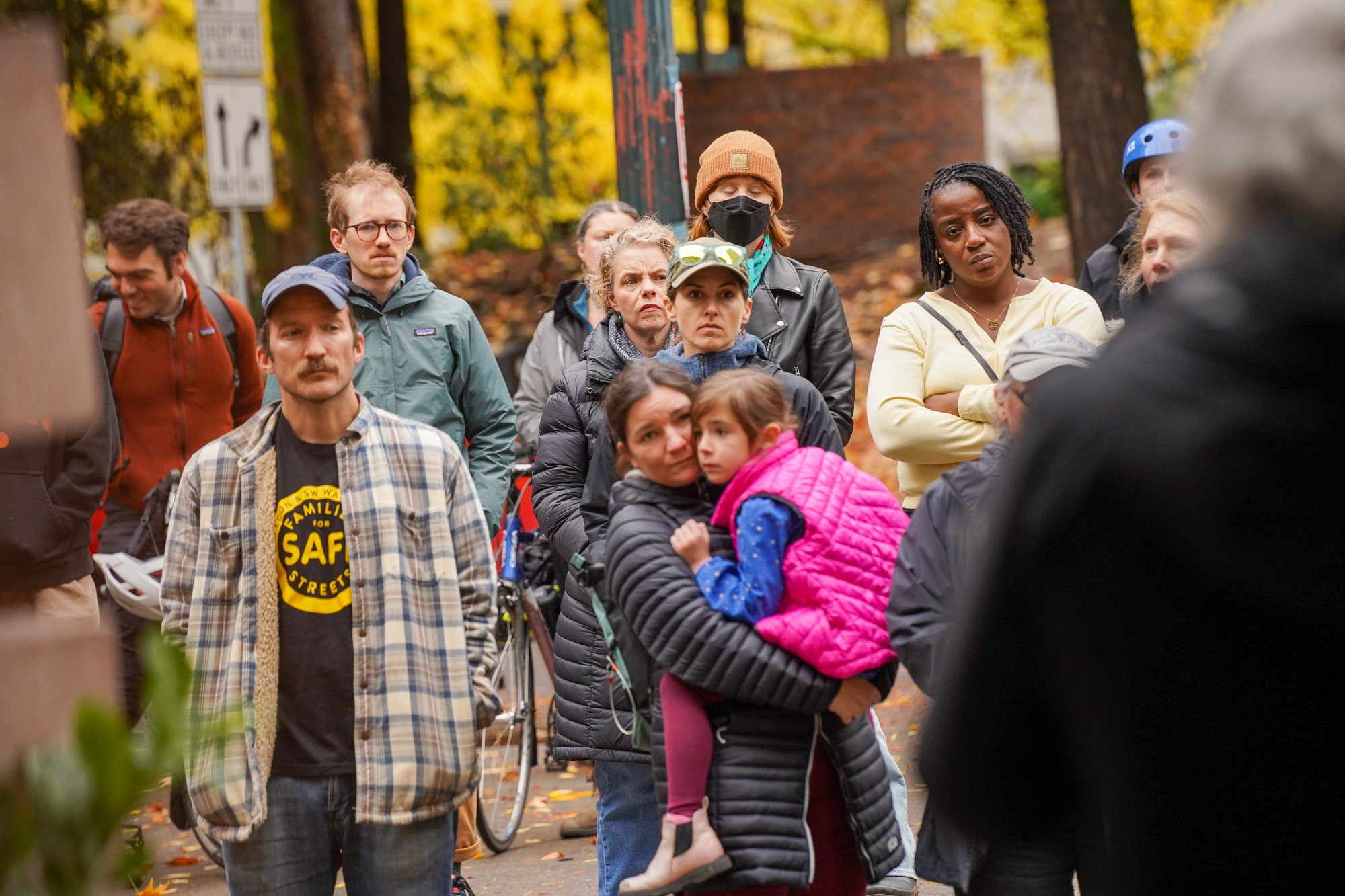
In addition to short speeches, there was a large canvas banner spread across a table where people used pens to scrawl names of crash victims. Co-organizer and Families for Safe Streets volunteer Ted Buehler said, “We’re here to remember that they were each a unique person and unique tragedy.” The canvas will be at more events in the future and Buehler says they’re in talks with incoming city council members to have it hang in the City Hall atrium next year, “to motivate city staff and elected officials to change the way things are run in the city, so that not nearly as many names appear on this in the future.”
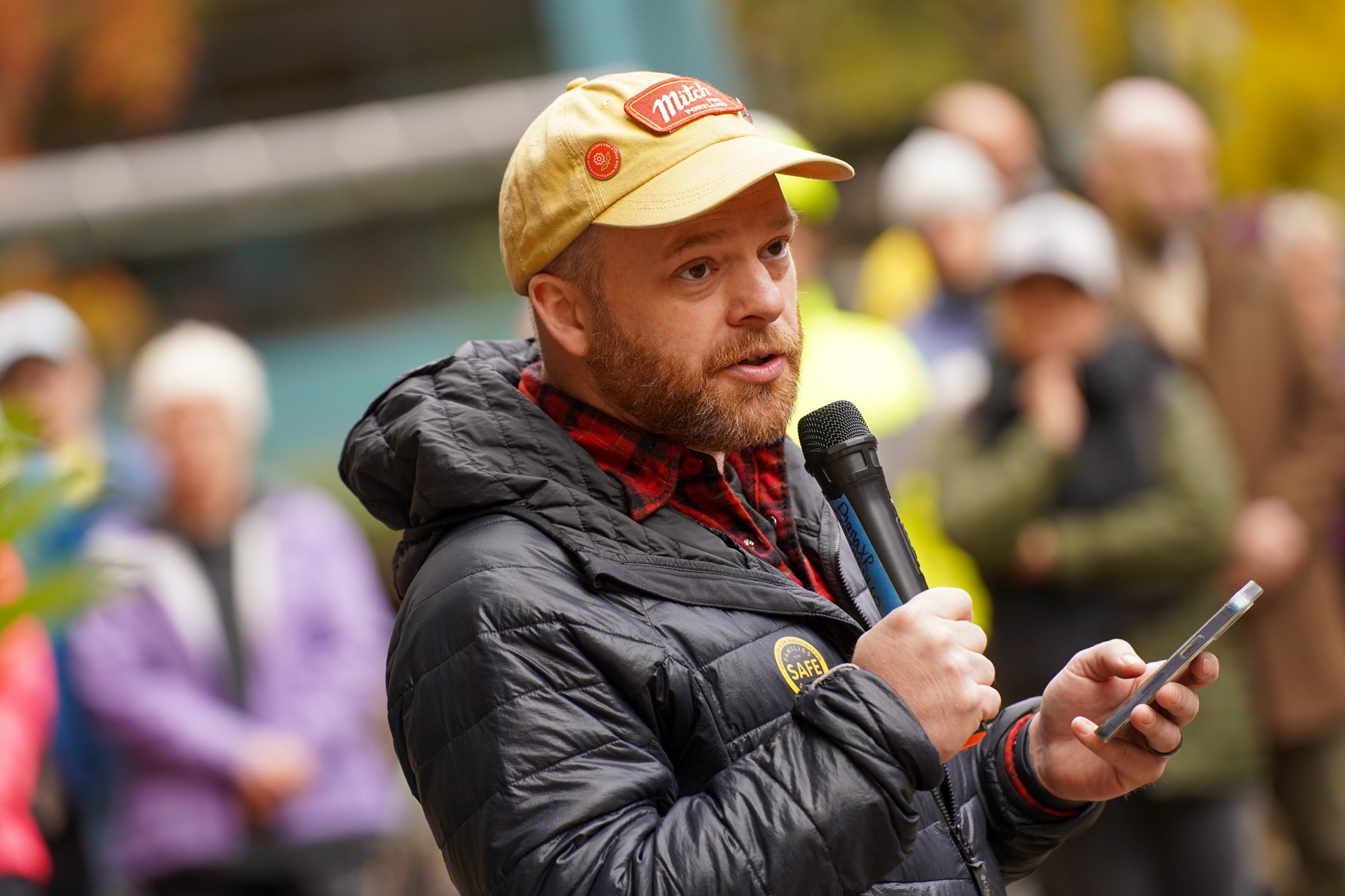
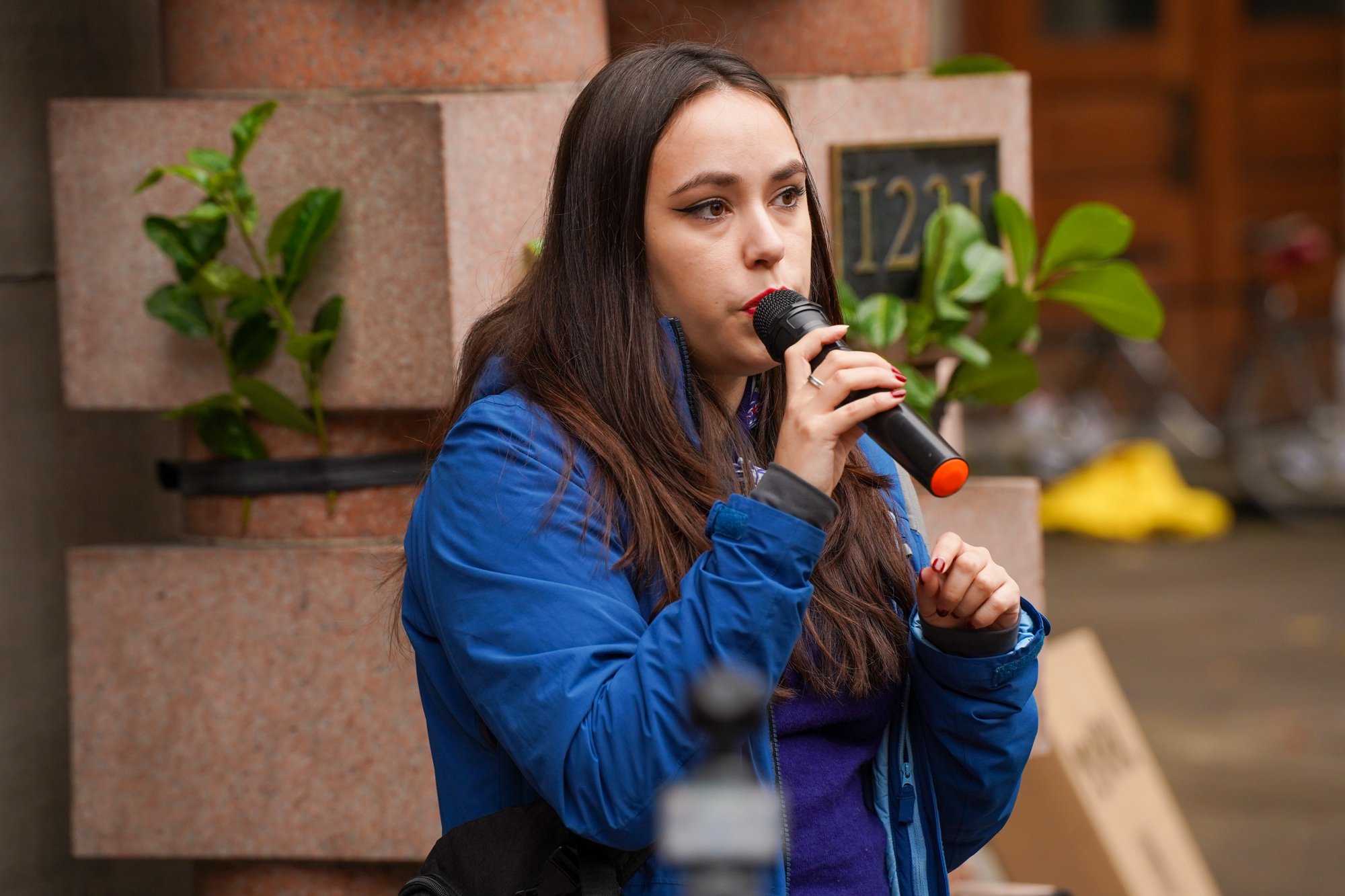
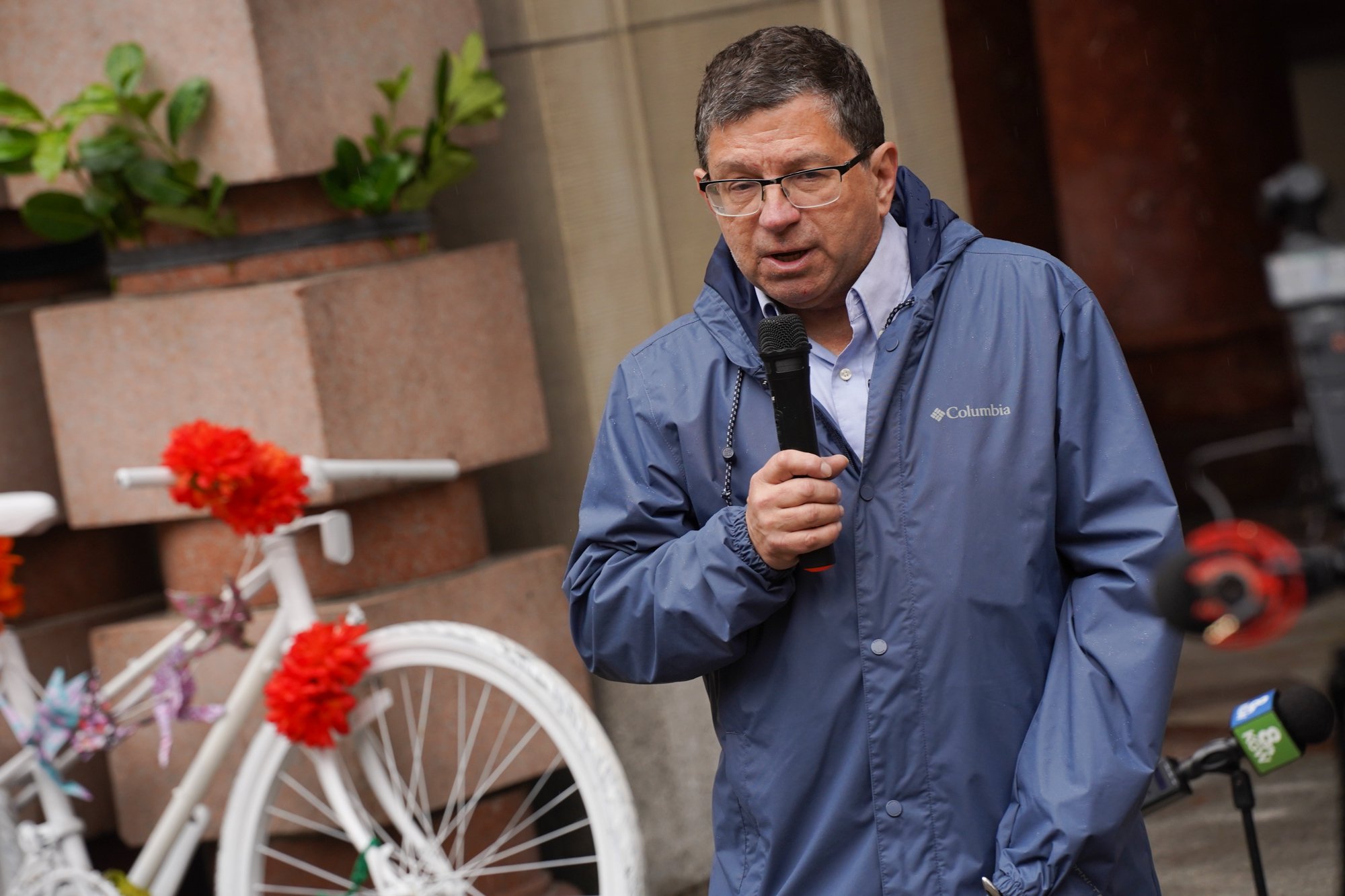
In a very positive sign for Portland, five recently elected city council members spoke at the event: Tiffany Koyama Lane, Angelita Morillo, and Steve Novick from District 3 (Southeast); and Mitch Green and Eric Zimmerman from District 4 (West/Sellwood). Council candidates Marnie Glickman (D2), Chad Lykins (D4) and Nat West (D2) were also in attendance.
Councilor-elect Mitch GreenCouncilor-elect Tiffany Koyama LaneCouncilor-elect Eric ZimmermanCouncilor-elect Angelita MorilloCouncilor-elect Steve Novick.
Green said he was almost hit by a car driver while biking to the event on SW Barbur Blvd. He used his speech to talk about the need to take a systems-level approach to road safety. “Because we lack infrastructure for safe, active transportation, many people will default to wearing a car as armor. And as one person does, so does another and another, so we engage in an arms race of driving larger cars to keep our loved ones safe — meanwhile those who do not drive are increasingly exposed to the collateral damage of this arms race,” Green said. If the city built more sidewalks, installed more modal filters (aka diverters) and did more road diets, “It’d be much easier for people to make the choice to leave the car at home.”
And then Green, speaking like as if he wants the title of council’s cycling and road safety champion, said he sees it as his job to make streets safety, that he’ll lead the “fight” for more funding and better policies, and that Portland City Council should have a permanent Safe Streets Committee. Then he looked over at fellow District 4 candidate Chad Lykins and said, “You can be sure if I don’t make progress on this, Chad will take my seat.”
“I’ve wanted to make that turn. I’ve wanted to drive faster. But what I’ll take from today is that none of that annoyance can outweigh the impact when tragedy strikes.”
– Eric Zimmerman, D4 councilor-elect
Koyama Lane, who will represent southeast Portland on City Council, fought back tears as she recalled walking and riding her scooter by roadside memorials in her neighborhood. “This shouldn’t be normalized,” she said. She talked about fighting for more safe streets funding and added that she wants the community to hold her accountable once she takes a seat on the dais: “This isn’t a topic that we’re just supposed to talk about when we’re running for office and it’s cool to go to Bike Happy Hour… we will keep fighting.”
Zimmerman, the District 4 councilor-elect, admitted that he’s been annoyed as a driver by some of the changes the Portland Bureau of Transportation has made to our streets. “I’ve wanted to make that turn. I’ve wanted to drive faster,” he shared. “But what I’ll take from today is that none of that annoyance can outweigh the impact when tragedy strikes.”
Former city commissioner and new District 3 rep-elect Steve Novick has a special place in this conversation. During his last stint at City Hall he was in charge of PBOT and knows how the transportation policy sausage is made (or at least was made before the charter changes). Novick also spoke impromptu after being moved by what he heard from survivors. He was at times defiant during his speech, saying, “Drivers have become crazier since the pandemic, and cars have become bigger, and that’s a problem.” Because of that, he said, “Frankly, I am not worried about the Big Brother aspect of putting speed cameras at every goddamn intersection in the city.” Novick also vowed support for higher registration fees for larger SUVs and trucks.
Kristi Finney-Dunn
When emcee and co-organizer of the event Michelle DuBarry introduced Kristi Finney-Dunn, I was surprised and heartened. Finney-Dunn’s son Dustin Finney was killed in August 2011 while riding his bike on Southeast Division near 84th. It was a hit-and-run that resulted in the driver serving a five-year prison sentence and I’ll never forget being in the courtroom that day while Finney-Dunn stared across the room at the man who killed her son and stood to address the court holding her sons ashes in her arms.
Finney-Dunn was a fixture in local safe streets activism for five years or so, but had fallen completely off my radar since about 2016. She was reluctant to even show up Sunday. “Part of the reason I didn’t want to come today was that I feel so pessimistic,” she said, as her hand on the mic shook with a mix of rage and sadness. “Why are there not thousands of people here today?! Why?!” she asked a rapt crowd. “This is a small crowd compared to the numbers of people we know are impacted every single day by these traffic crashes.”
Finny Dunn’s anger was palpable and warranted.
PBOT Vision Zero Coordinator Clay Veka was not only present to hear the speakers, she was also invited to speak. “We have a vision for streets that is different than today’s reality,” Veka said. Then she admitted she and her colleagues can do more. “PBOT has not moved fast enough or invested sufficiently to fundamentally transform our streets to advance our Vision Zero goal.” Veka said PBOT can’t reach Vision Zero on their own and it will take partnerships on housing, land use, addiction services, and transit to make it a reality.
Sarah Risser sharing the story of her son’s death.
The final person to speak was event co-organizer Sarah Risser from Bike Loud PDX. Risser was in the car as a passenger with her teenage son Henry at the wheel when they were hit by a semi-truck on a rural road. Henry died next to her while they waiting for first responders to arrive. Risser has dedicated herself to helping survivors — and the community-at-large — remember crash victims. A few weeks ago she stood on the corner of NE 105th and Marx with the mother of Damon Cousins, who was killed by a driver while bicycling to work October 21st.
When Cousins’ mom shared a photo of him with Risser, she thought it conveyed strength and beauty. “Another young adult with so much to offer the world, lost to a crash. I thought, ‘Why do we tolerate this?'” Risser said to the crowd that had assembled under the City Hall portico to escape heavy rainfall.
Risser recounted how moved his grieving mom was when a long line of cyclists showed up to remember her son. “The community showed up. The community cared,” Risser said. “We stood together around a memorial mostly in silence with the victim’s family. I’m not sure there is more important work than this.”
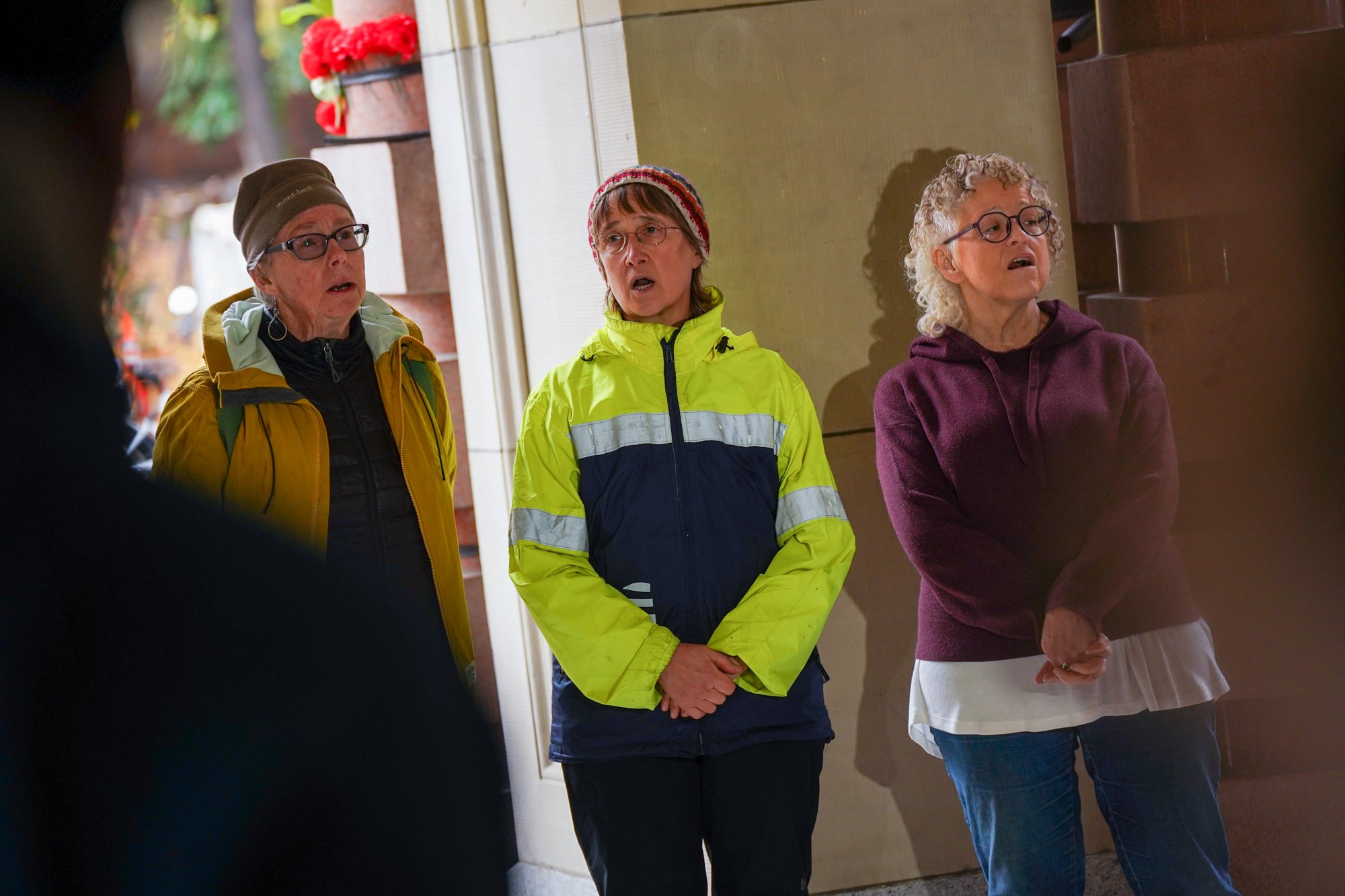
Threshold Choir singers.
The event ended with the Threshold Choir singing into the space where advocates and survivors huddled together in relative darkness as rain fell all around.
“They are sending you light. To heal you. To hold you. They are sending you light. To hold you in love.”
Sarah Risser and Michelle DuBarry.David Sale’s daughter Danielle was killed by a TriMet bus driver in 2010.Sara FischerMichelle DuBarry
I was drawn to Dan’s comment partly because of his writing “voice” — it goes down easy, and is unpretentious and authoritative at the same time. Like someone who knows what he is talking about, but parked the ego at the door.
Here are Dan’s ideas for sparking a resurgence in cycling:
I have spent 45 years riding my bike everywhere, including over 35 years commuting and riding for fun in and around Portland. In my view, marketing ain’t gonna cut it.
For example, there’s a bike lane on Beaverton-Hilldale Highway, which is an important transportation corridor to the west. And even I hate riding on it. I used to ride my bike to meetings and events in downtown Portland, parking and locking it on the street. The idea of doing that now is laughable. People in cars have become more and more lawless, and the streets more dangerous. To really make bikes a meaningful part of our transportation system, here are a few ideas:
1) Step up enforcement of traffic laws — a lot. 2) Build more off-street bike paths. This includes both in town and long-distance bike paths to far-away places. 3) Create a secure, staffed bike parking facility downtown. 4) Improve and maintain existing bike infrastructure, including sweeping. 5) Tax gas and cars a lot more. 6) Close some streets downtown and in business hubs and create pedestrian areas. 7) Provide tax advantages for buying and using bikes and electric bikes. 8) Crack down on bike thefts and theft rings. 9) Dramatically increase civil and criminal penalties for drivers that hit, harass, or otherwise harm cyclists. 10) Elect leaders who think of cycling as a form of transportation at least equal in importance to all others, not just a niche segment to wink at now and then to be politically correct.
Many will dismiss most or all of these suggestions as unrealistic, and indeed perhaps they are in early 21st century America — even in a place that at least thinks of itself as progressive like Portland. But in other places in the world, all of these things are simply reality — and they work. Marketing is basically wishing something will happen. We need to do the hard work to try to make it actually happen. We get the society we collectively decide to make.
Here are the most notable stories our community came across in the past seven days…
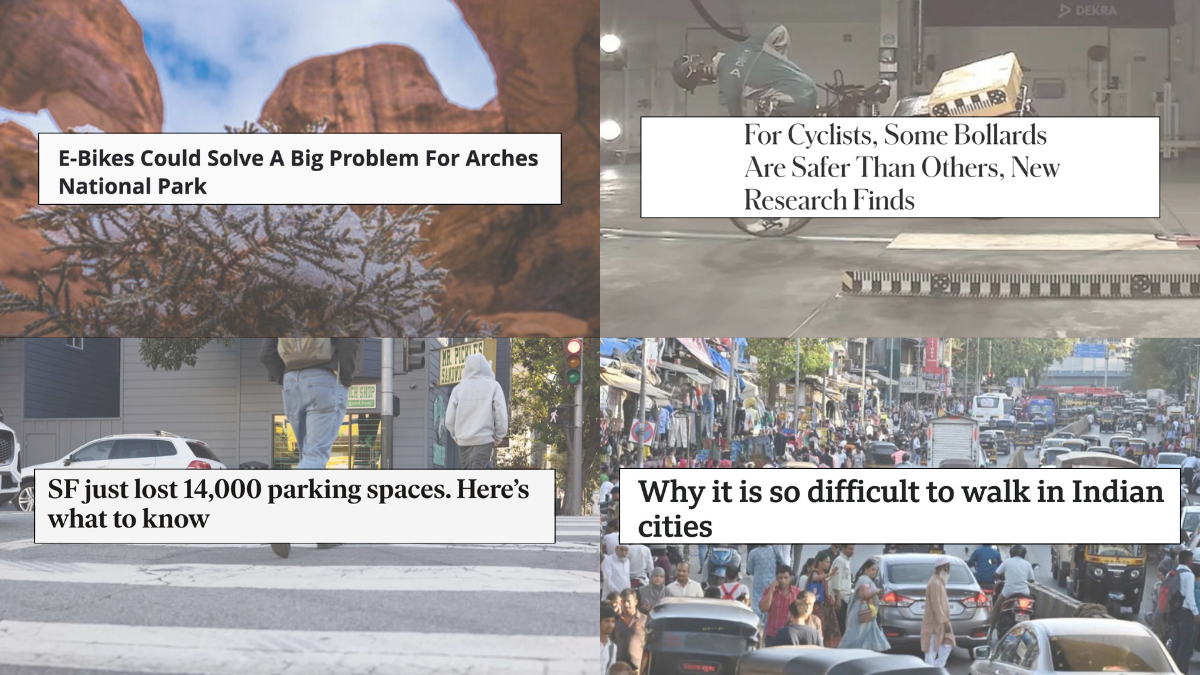
Open streets forever!: I love that advocates in San Francisco put an open street project on the ballot… and won! Now a two-mile section of a coastal highway will be permanently closed to car users. What street should we do this for in our region? (SF Gate)
Echoes of North Williams: A debate over a road diet and bike lane in a Washington DC neighborhood reminds me of the conversations about race Portland had in 2011. (Washington Post)
Pedestrian solidarity: This article about the pitfalls of walking in cities in India is a good reminder that pedestrian advocacy is a global pursuit and there are advocates working to make it better across the globe. (BBC)
Daylighting in effect: A new law passed in California requiring cities to prohibit parking near intersections in order to improve safety and visibility. Now the question is, will the daylighting happen and will the law be enforced? (San Francisco Standard)
The state of state-owned roads: A solid rundown of why urban highways (“stroads”) are so bad and the relationship between city and state governments — with a nod to Portland’s 82nd Avenue. (Vox)
Bollard considerations: A rare bit of new research on how different types of bollards impact bicycle users. (Forbes)
Bikes in national parks: Every national park in America (not just Arches National Park) could benefit from a traffic plan that embraces cycling — especially now that e-bikes are so popular and readily available. (Clean Technica)
Get more out of your bike: If you got a new gravel bike this past season, it could become a really solid around-town bike through winter with a few key changes. (Cycling Weekly)
Paris growing pains: It’s not all good news in the budding cycling capital of Paris. All the new cyclists have spurred a backlash due to how chaotic their traffic behaviors can be. (Le Monde)
According to a description of the grant application provided by Metro, the funding will be used to invest in walking schools buses and bike bus programs. The aim is to see what happens when these activities are funded and supported by more than just a parent or two and if the availability of a safer route to school and supportive school environment gets more families to leave their cars at home.
Bike parking at Roosevelt High School. (Photo: Jonathan Maus/BikePortland)
The pilot activities will take place in the Roosevelt High School cluster in north Portland with programming at five elementary schools (Astor, James John, Sitton, Rosa Parks, César Chávez), one middle school (George), and one high school (Roosevelt). That cluster has 68% students of color, a 45% absentee rate, and 43% of the families have low incomes. Metro crash statistics reveal that the routes kids at these schools take are much more dangerous over average than the region at-large. The grant application also cited concerns with gun violence as a reason families don’t walk and roll to school.
“The combination of school demographic needs, crash data, and strong community infrastructure are why this pilot project area was chosen,” reads the Metro project description.
Metro applied for the grant. In addition to PPS, partners on the project include nonprofits Oregon Walks and Community Cycling Center, Portland State University, and Portland Bureau of Transportation.
The grant will allow Metro to pay adult leaders at elementary schools to to establish weekly walking school buses and bike buses. There will also be monthly events to bolster the programs and encourage participation. Two elementary schools in the program will receive “learn to ride” education and teachers will receive training on bike and pedestrian safety.
For high schoolers, the program will fund transit trainings that will include a field trip to ride the TriMet system. And students will receive hands-on training on how to use the Biketown bike share system.
The grant will also fund an annual adopt-a-bike event and free bike locks and helmets for students. Social media training, so bike bus leaders can spread the word about their program and reach more families, will also be part of the program.
While this is mostly a planning and organizing grant, there will be some investment in demonstration projects. Temporary wayfinding for the walking and biking routes will be installed and there’s a plan to paint “traffic gardens” on the campus at each elementary school. “Temporary or pop-up circulation improvements to guide traffic during pickup/drop-off times,” is also included.
Everything will be analyzed and evaluation by PSU’s Transportation Research and Education Center to see how the various interventions are impacting safety and perceptions about walking and biking to school.
If the pilots are deemed successful, Metro and their partners will integrate walking schools buses and bike buses into more schools and “apply lessons learned regionwide and support broader implementation of the most successful initiatives.”
Work is expected to begin July 2025 and will take place over three years. This news comes just weeks after the nonprofit Oregon Walks received a nearly $1 million grant through the Portland Clean Energy Fund to develop walking school buses citywide.
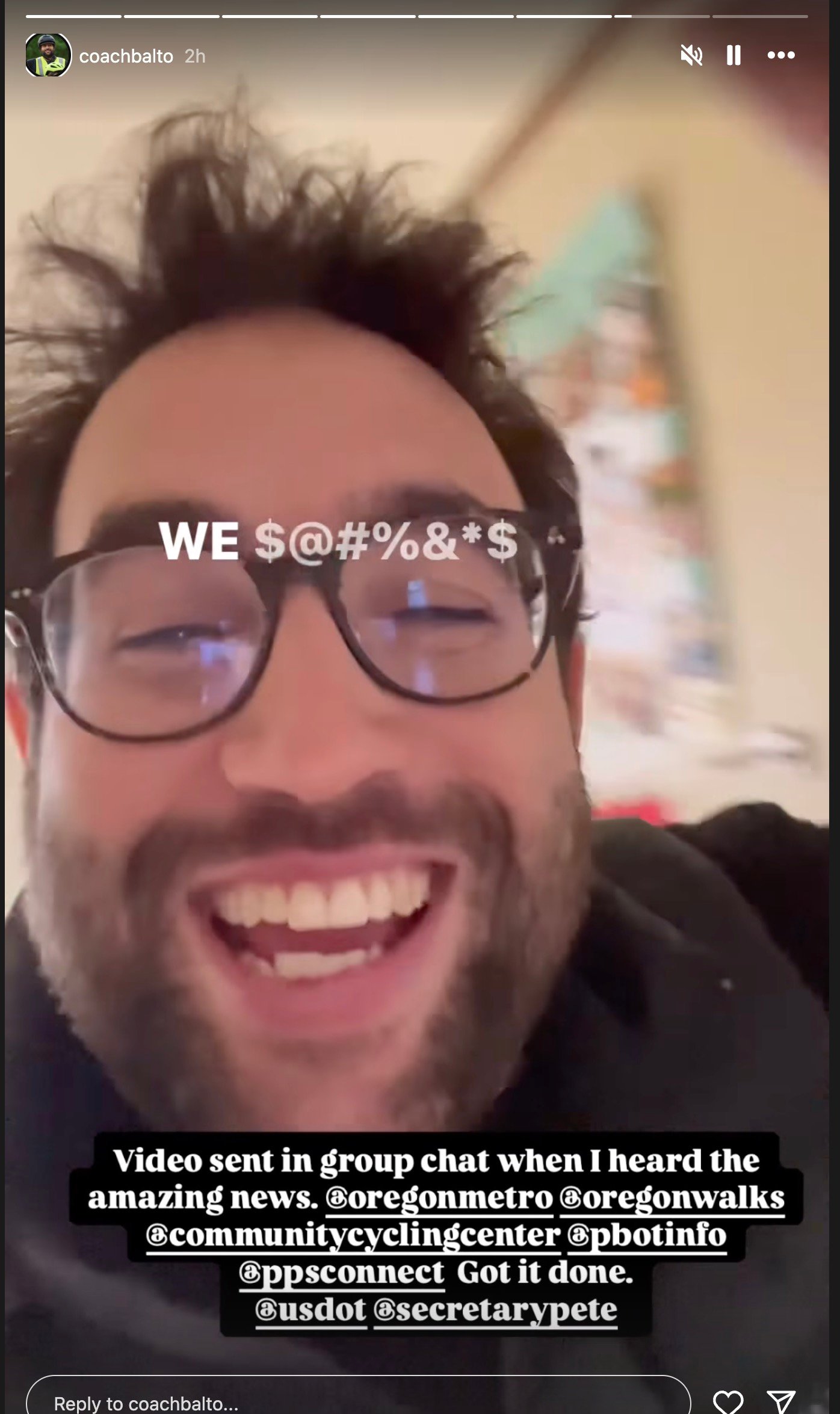
Balto on Instagram a few hours ago.
“It is a wonderful day for children’s mobility,” said bike bus leader Sam “Coach” Balto. “SS4A is incredibly meaningful funding. A humongous ‘thank you’ goes to the staff at Metro who are always open to try new things and take risks.”
Roger Geller (black shirt) leading a bike tour in 2023. (Photos: Jonathan Maus/BikePortland)
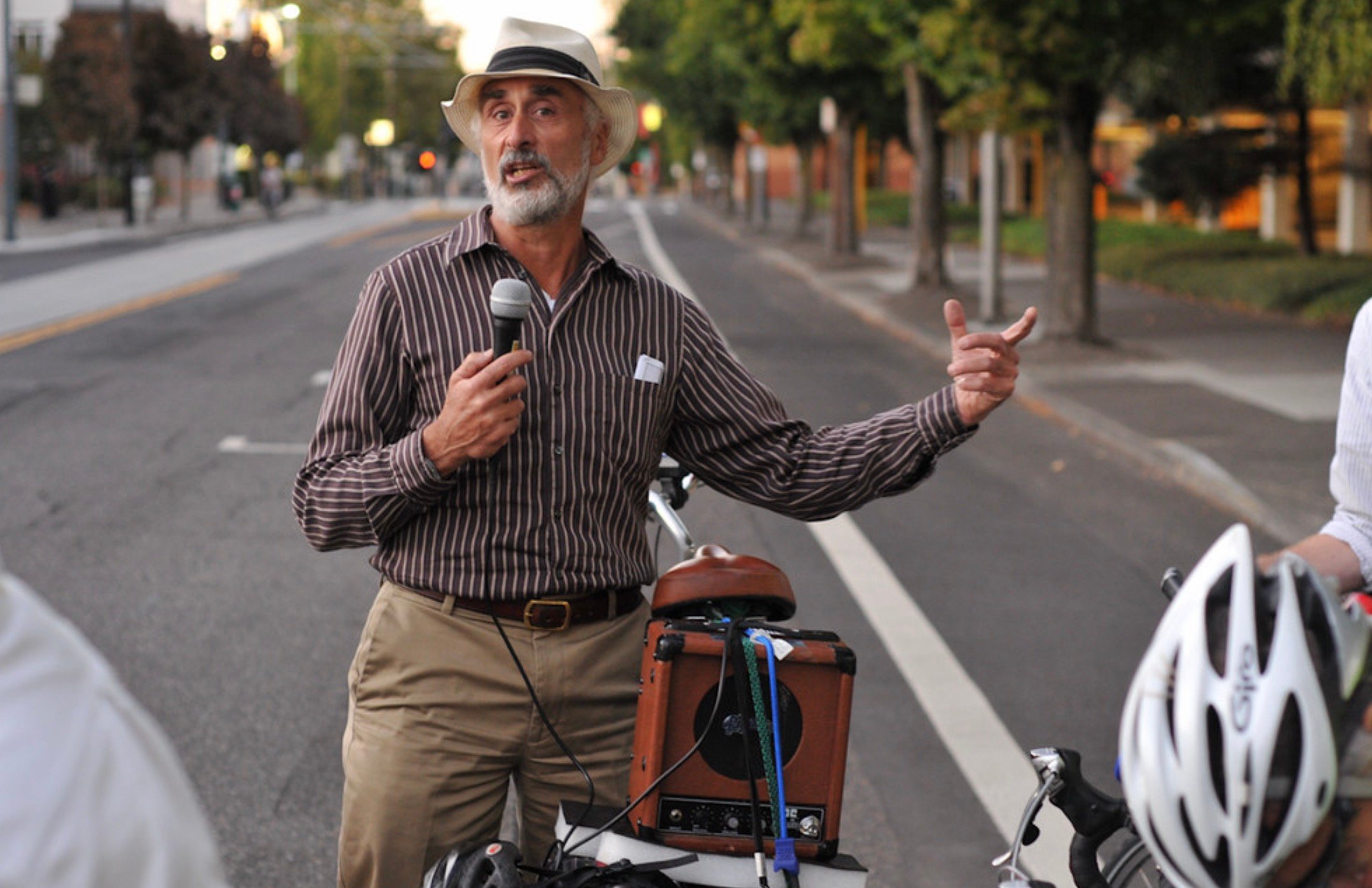
Roger Geller has been the City of Portland’s bicycle coordinator for over 30 years. For most of that time he worked for a city that was a leader in his field. That’s not the case anymore and Geller has a plan to put Portland back on top.
In 1997, early in Geller’s career, Portland was the first American city to add color (blue) to bike lanes. 11 years later Portland was still an innovator, becoming the first US city to install bike boxes in 2008. Then we layered something even greater on top of infrastructure accolades: the best bike culture in the world.
Between 2007 and 2014 Portland was one of the greatest cycling cities in the world. What we lacked in ridership and bikeway infrastructure compared to great northern European capitols, we made up for with a cultural milieu so steeped in cycling it was the envy of Dutch planners and its tendrils reached anyone who spent time here. Industry, events, political support, economic development, advocacy groups, racing, media — the influence of biking was everywhere!
Geller in 2012.
As head bike planner for the the Portland Bureau of Transportation, Geller was a key architect of that golden age. So when things started to cool off in 2014 or so (following a few years of shaky politics for cycling), Geller felt the shift. In a new white paper released this week, Geller wrote, “Portland’s bicycling strategy has not been producing desired outcomes since 2016,” — a notable acknowledgement from the city staffer largely responsible for that strategy.
“I think it’s really important for the city to demonstrate its commitment to bicycling by taking potentially disruptive actions.”
After a decade or so of stagnation and decline, there are signs of life for cycling in Portland. And Geller thinks the time is right for a local cycling renaissance.
At the Tuesday night meeting of the city’s Bicycle Advisory Committee (Geller has been PBOT staff liaison to that committee to for at least 20 years) Geller unveiled a 14-page plan he calls, “a comprehensive program to immediately focus on increasing ridership.”
After painting a picture of cycling’s political heyday for a new crop of BAC members, Geller said, “And here we are today. And I can’t remember the last time I heard any elected official say something positive about bicycling. It’s kind of dropped off the map.”
To get it back on the map, Geller wants to act fast — maybe even circumvent the city’s typical approach of incremental, politically-safe progress. Geller’s thesis is that how we get around is simply a rational choice people make. And right now, more people choose to drive than to bike.
“So how do we get people to choose to ride a bicycle rather than to drive a car? I think that is our challenge,” Geller said.
A typical response to this is to build more and better bike infrastructure. At a rally outside City Hall in 2010, before Portland City Council voted to adopt the Bike Plan for 2030, advocates held signs that said, “Build It!” as in, “build it and they will come.” Even today the “paint is not protection” mantra remains strong.
“You can’t watch anything on TV during the football season without seeing five Bud Light ads over the course of an hour right? That’s the level of campaigning that I want to do for biking. That’s what I think we need.”
Geller acknowledges that great cycling facilities matter, but those can take years to design and install. “We don’t have time to wait to build protected bike lanes on every roadway where we want them,” he said. Instead, Geller wants to go big on marketing, lean on existing advocates and early adopters, make bold yet inexpensive capital investments, and organize mass bike rides that will convince people to hop on a saddle.
Here’s an excerpt from the plan’s introduction:
Portland has strong policies and plans to reduce motor vehicle miles traveled. But, unless there is a dramatic shift in local politics and culture, Portland will be unable to rely on similarly strong driving reduction incentives to encourage increased bicycling. Portland will instead need to rely on persuasive tools to re-elevate the possibility of bicycling, on providing compelling reasons to do so and creating opportunities for a new generation of Portlanders to discover the joys and benefits of biking in the city.
Portland needs to re-awaken an awareness of bicycling and its many benefits. A reinvigoration of bicycle culture will create forums through which bicycling can re-enter Portlanders’ collective consciousness as a desired transportation choice. Through multiple polls and surveys, we have clear indication that Portlanders are interested in such a choice8 . Here is where we need to summon faith in our product (bicycling and what it creates) and our policies that elevate it as a tool toward achieving our desired outcomes.
Geller knows talk of marketing and communications will rub some infrastructure-first folks the wrong way. But in his calculation, Portland’s problem isn’t a lack of good bike infrastructure. Our problem is that not enough people are using it.
“This might be a controversial statement,” he said at the BAC meeting Tuesday night. “But I think there’s really not much we could do more immediately that would create safer conditions for biking than just getting more people out biking.”
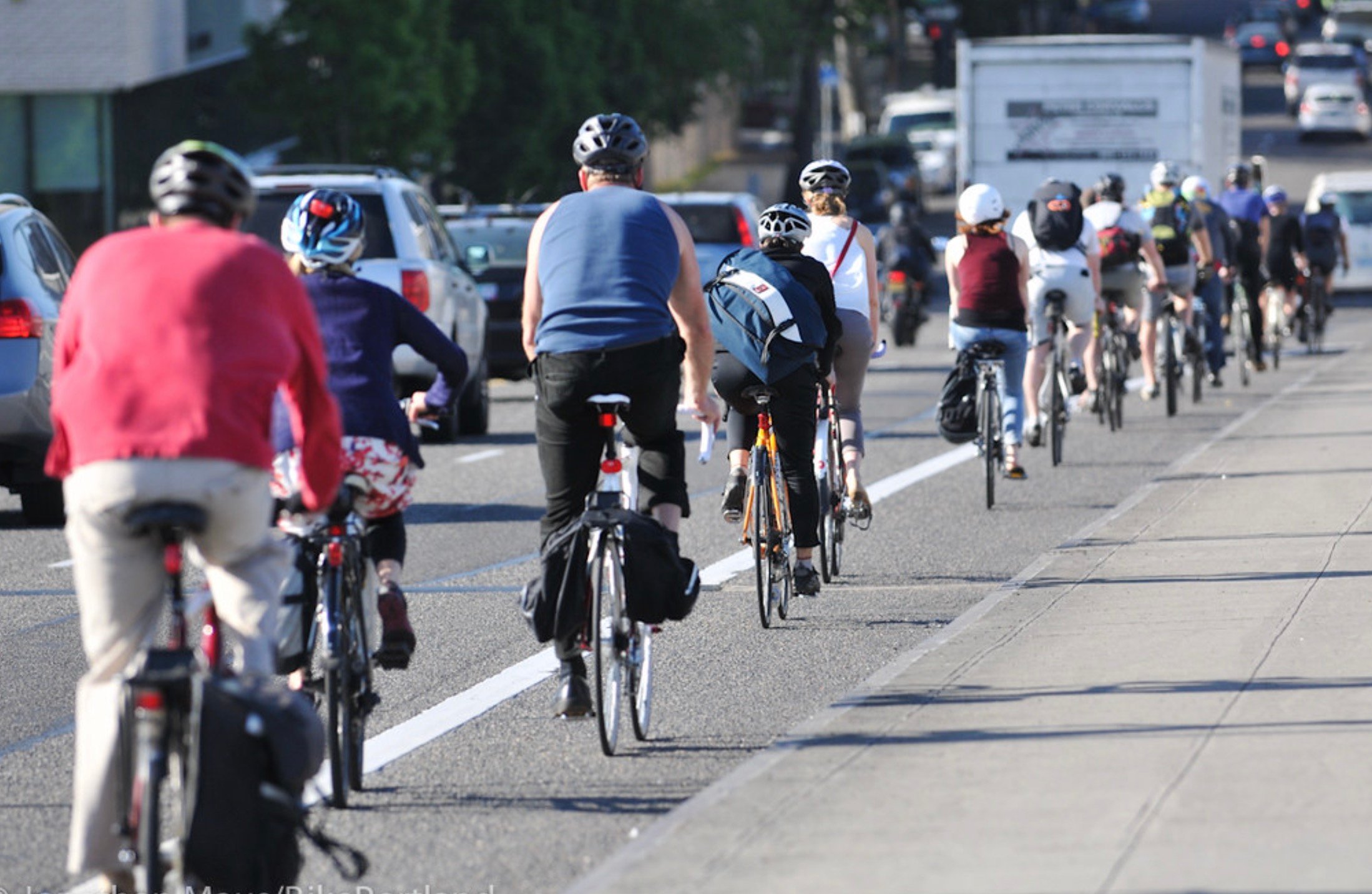
Ordinary Portland bike traffic (these are not group rides) in 2013 and 2016.
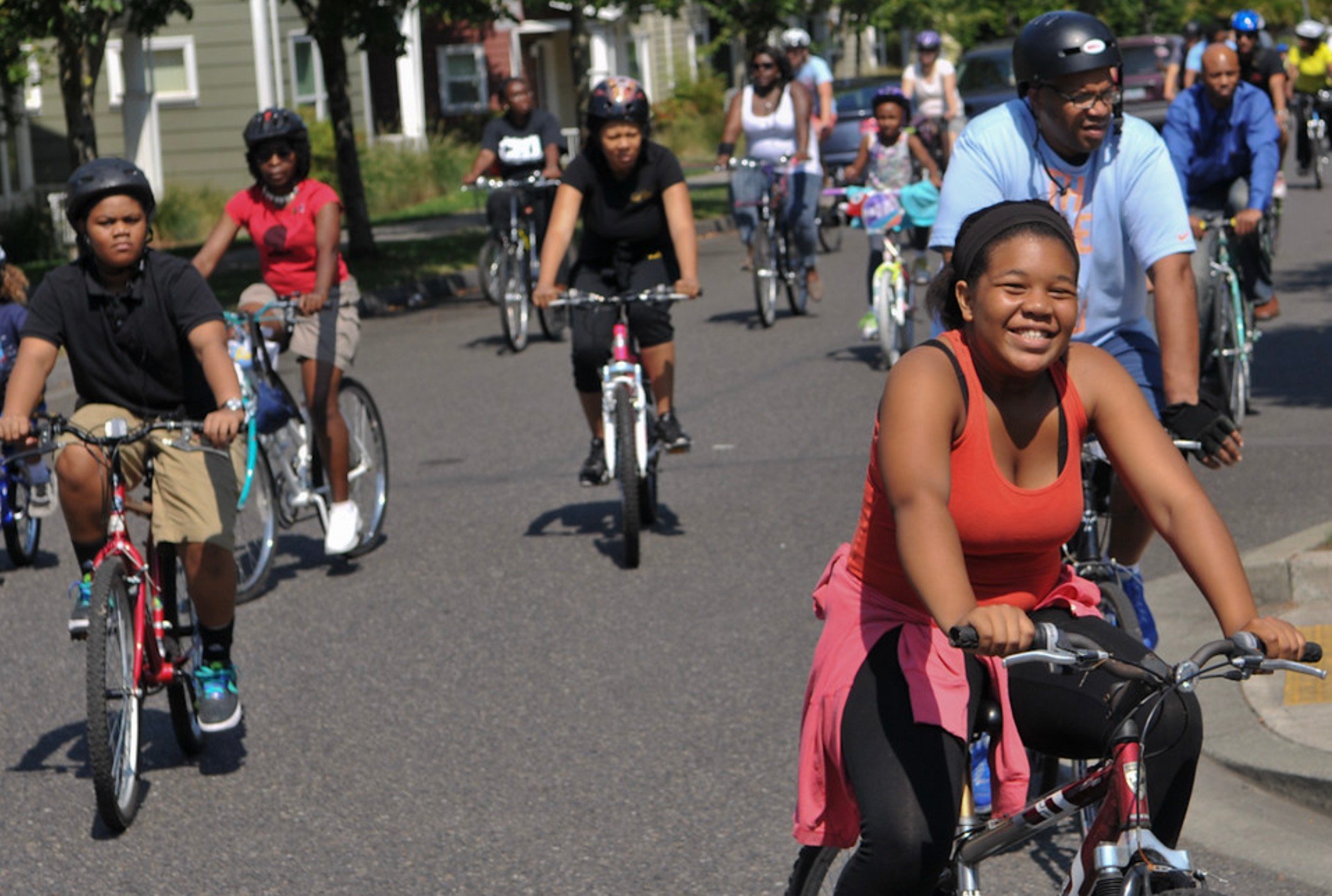
That’s the “safety in numbers” philosophy. And it works in practice. I’ve experienced it in places like Amsterdam where there’s no bike-specific facility to ride on, but it feels safe because there are people on bikes all around me. It’s also why so many people love Sunday Parkways or mass group rides during Bike Summer. And Portland has already tasted this phenomenon when bike traffic would spike during peak hours on streets like N Williams and NW Lovejoy back before The Decline.
How does Geller think we can get a massive number of Portlanders on bikes as “quickly as possible” (his words)?
His plan outlines six categories of action:
All actions are to be considered in the context of how they can contribute to messaging about bicycling and the city’s intent.
Capital and programmatic elements to display bold steps to both demonstrate institutional / leadership commitment and to get people to pay attention.
Undertake actions that will inspire and activate advocates for bicycling, including opportunities for volunteering, proposed capital improvements and campaigns.
Create an organized framework of rides to provide easy access to multiple ride opportunities.
Initiate and execute a professional marketing campaign to promote bicycling.
Start immediately with inexpensive efforts that feature rides, home-grown messaging campaigns and capital improvements.
He wants to hire a professional firm to poll Portlanders and figure out effective messages — then put them on billboards, run ads on social media, infiltrate all City of Portland communications with pro-bike messaging, and so on. And he wants the city to stop dithering and start doing. While large-scale capital projects with lots of curb work and concrete aren’t part of this plan, Geller thinks striping bike lanes in certain places and re-allocating lane space away from parked cars could be done quickly with great effect.
“I think it’s really important for the city to demonstrate its commitment to bicycling by taking potentially disruptive actions,” Geller said, in response to a question from a member of the public about PBOT’s reluctance to make driving less convenient (something that’s politically difficult, but imperative to influence choices).
Stop and note: This is a city employee saying he feels it’s time for his own agency to take “potentially disruptive actions.”
What does he mean by that? Geller, like many of us, is tired of PBOT plans gathering dust on a shelf. He used the example of Central City in Motion — a plan now 11 years old that still hasn’t reached its promise.
“Central City in Motion for example,” Geller said on Tuesday, “calls for bike lanes on 11th and 12th through southeast and northeast Portland. If we striped those bike lanes, eliminated a travel lane, or eliminated on street parking — whatever we choose to do — that would gain people’s attention and demonstrate a commitment on the part of the city to follow its policies and achieve its goals.”
Read that again. This is a leader who works in the same agency that removed a newly-installed bike lane because a few neighbors said it was a hardship they weren’t given proper notice about (by the way, it’s been almost a year since they were removed and PBOT has made no announcement about putting them back).
Once a project is in the news and people are paying attention, Geller says that’s the moment to deliver the message. For Geller, the message (which would have been professionally crafted beforehand and city staff would have been trained to deliver with confidence) should be something like: “‘Yes, it is important to us to limit driving for these reasons, or to encourage bicycling for these reasons.'”
Before your cast stones at Geller’s plan because it relies mostly on words and intentions, keep in mind he’s operating from the very reasonable assumption that the power of marketing and trends is the best option at our immediate disposal. It’s a pragmatism forged from three decades working in government under a dysfunctional political system (that is thankfully gone in six weeks).
“We don’t have the tools Copenhagen has. We can’t make gas $8 a gallon. We’re reluctant to make parking very expensive. We can’t have the registration cost of a car be 100% the cost of the car,” Geller lamented at the meeting. “So we don’t really have those strong financial tools that help with the decision making in those other places. So we have to find something else that resonates with people and encourages them to choose [bicycling].”
If Geller had it his way, he’d fund this plan with a $40 million budget over a few years. That kind of money, he said half-jokingly, would allow him to “run the Bud Light campaign for biking.”
“You can’t watch anything on TV during the football season without seeing five Bud Light ads over the course of an hour right? That’s the level of campaigning that I want to do for biking — both at the grassroots and a high-end, professional level. That’s what I think we need.”
The man the Oregon Department of Transportation tapped nearly five years ago to deliver billions of dollars in freeway expansion projects in the Portland region is leaving the agency.
According to Willamette Week, ODOT Urban Mobility Office Director Brendan Finn has taken a job as chief of staff for Multnomah County Commissioner Vince Jones-Dixon.
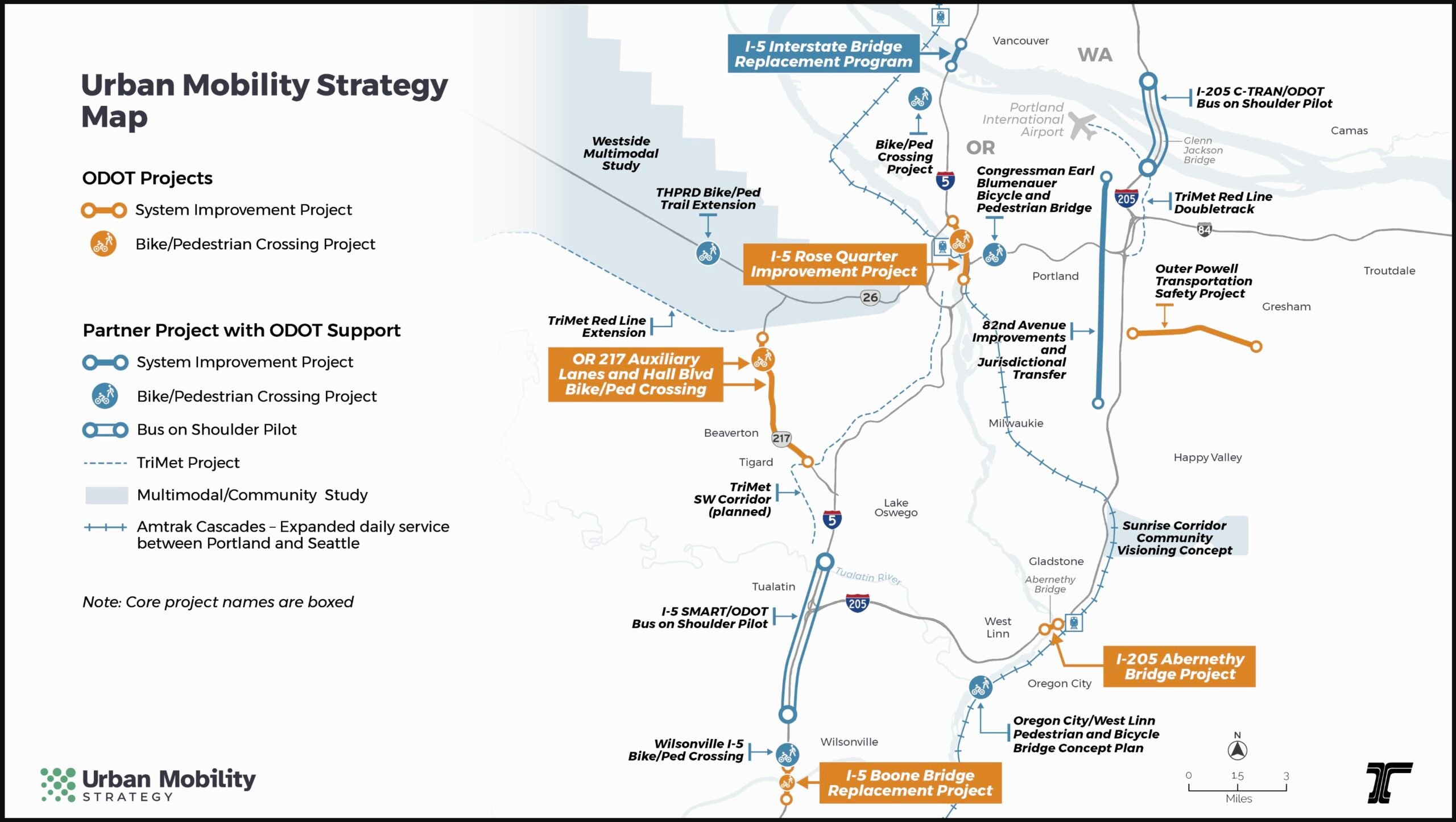
Finn was the first ever director of the office and assumed the role just six months after it was launched. The Urban Mobility Office (UMO) was created in 2019 (initially called the Office of Urban Mobility & Mega Projects) with the goal of completed a suite of freeway expansion projects funded in the 2017 legislative transportation funding package known as HB 2017. That bill included earmarks for several megaprojects that ODOT claimed would reduce congestion in the region: the I-205 Tolling project, the Regional Mobility Pricing Project, the Boone Bridge Improvements project, the I-5 Rose Quarter Improvements project, and the I-205 Improvements. The projects became known as ODOT’s “Urban Mobility Strategy” and it was Finn’s job as UMO Director to get them done.
(Source: ODOT)
Finn earned a salary of $222,650 from ODOT in 2023 and oversaw a staff of 37 FTE with annual payroll of around $4.5 million. I’m not yet aware of why Finn left, but he appears to be taking a big paycut. A typical chief of staff at Multnomah County makes about $130,000 per year.
The last five years at the Urban Mobility Office have been a roller-coaster and Finn has been sitting on the front row.
When he took his position in 2020, the I-5 Rose Quarter project, which will widen I-5 through the Lloyd Center and adding highway covers with surface street improvements and real estate development on top, was in shambles. It lacked support from the City of Portland and ODOT was taking heat from activistsand elected officials. Even Metro called ODOT’s assessment of the project “inadequate” and “highly misleading.” In June 2023, Finn became emotional and walked out of an I-5 Rose Quarter advisory committee after members expressed disappointment about a lack of funding and progress. While there’s been some great news for the project earlier this year, it’s still dogged by lawsuits and lacks funding to be completed.
Finn’s mission received another big blow back in March when Governor Kotek paused work on the Regional Mobility Pricing Project. That plan that would have added tolls to freeways in the Urban Mobility Strategy that would pay for the projects and for continued operation of the Urban Mobility Office (UMO) itself. The lack of funding from ODOT and other sources to complete the projects has put the UMO in difficult straits.
Prior to leading the UMO, Finn was a transportation policy advisory for former Governor Kate Brown and previous to that he was a chief of staff for former Portland City Commissioner Dan Saltzman.
ODOT has yet to name a replacement for Finn. Stay tuned to see how his departure might impact the UMO and it’s projects going forward.