

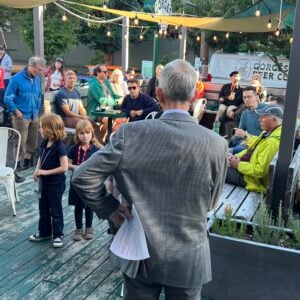
Portland Mayor Keith Wilson has thrown down a gauntlet. At an event to celebrate the opening of the Southwest 4th Avenue Improvement Project last week, Wilson told a crowd of business owners and tourism officials that, “We are and have to be the biggest bike mode city in the nation. Our multimodal focus has got to be at the center of every decision we make.”
Wilson called the SW 4th Avenue project — which includes one of Portland’s most high-profile protected bike lanes and less space for driving — “a physical manifestation of the change we wanna see in our city.”
I wasn’t at the event, which was held at the Hoxton Hotel on SW 4th, but someone who was in attendance shared a clip of Wilson’s speech with me. These are very positive and exciting words for anyone who cares about making biking and transit better in Portland.
Below is an edited version of Wilson’s remarks at the event.
“You can see the green shoots all around and the green shoot that is the 4th Avenue project.
There were a lot of headwinds. Thank you [to PBOT Director Millicent Williams and Deputy City Administrator for Public Works Priya Dhanapal] for your absolute clear focus on our bike infrastructure.
Our multimodal focus has got to be at the center of every decision we make. TriMet has to be at the center of every decision we make. They [TriMet] set a very aggressive goal for 2030. They want 80 million riders on their network. So do I. So do you. The more we focus on a multimodal transportation system where a travel-shed is focused on safety and pedestrians and bikes and bus, we have a more vibrant community that’s focused on community health and safety.
I love working with TriMet. I love working with our PBOT partners because you understand transportation is the intersection of every healthy life.
Now, I wanna talk about just two goals, clean streets and safe places. It’s back to basics. We are focused on budgeting street sweeping, making sure that when you ride a bike that there’s not leaves on the ground creating a slippery, dangerous circumstance. We have to invest in safety, which means we invest in maintenance. At the same time, invest in safe places. When you go somewhere, you have to make sure you’re going to arrive safe, that you’re comfortable, knowing that we as your leaders are caring for you.
The 4th Avenue project is our future. We are and have to be the biggest bike mode city in the nation. It is my absolute goal that I want to deliver with these partners along with this city to show the world how a community comes together that really lives, breathes, and is successful through our transportation system. The Renaissance is real, but it has to be created and sustained by us.”
Watch his comments and my commentary in the video above.
Thanks for reading.
BikePortland has served this community with independent community journalism since 2005. We rely on subscriptions from readers like you to survive. Your financial support is vital in keeping this valuable resource alive and well.
Please subscribe today to strengthen and expand our work.
Hmmm, didn’t the City do that in regards to DEI? Seemed like they were a success at making decisions (good and bad) around someone’s skin color.
So why can’t they do the same with multimodal transportation to server many different methods of getting around and not just cars in our “car supremacy” world?
I’m not going to hold my breath that anything meaningful will happen in my lifetime.
I’m not even sure what it is you’re trying to say here, except that you don’t understand DEI and harbor a little bit of racial resentment about it, which is entirely separate from anything anyone is talking about anywhere on this webpage. Huge crazy uncle at Thanksgiving vibes.
You are right about the vibes but Solar is also right about city govt’s lack of focus and general ineffectiveness. Mitch says they can walk and chew gum at the same time when in fact they can barely crawl.
Sure, there have been problems with the city and how it’s done everything. That’s just the nature of a large organization, especially a political one. And it’s of course good to keep those failures in mind to hopefully learn lessons and get better. But a councilor proposing some leadership and improvements shouldn’t just be cynically shot down because his predecessors failed in some ways. Rather, the initiative and show of leadership should be applauded and encouraged. Anything less is just an exercise in destructive nihilism. Nitpick about the details, sure. Call out the problems where you see them. But don’t lean on the existence of healthy public debate as a reason to give up and shut down the debate altogether.
“good to keep those failures in mind to hopefully learn lessons and get better.”
Nearly all levels of government in Oregon seem hell-bent on not doing this.
I’m still waiting on our bike commuter % to reach 2012 numbers again….
Stop being such a negative nellie!
We are temporarily “stagnating” prior to the inevitable climb to 25% by 2030!
Outlier here. 4th Street project fine, whatever. But to my mind, an unnecessary expenditure. You’ve got a northbound downhill arterial. Biking effectively the pace of traffic. Sharrows and/or a painted bike lane would have more than achieved the same result. More, because now both drivers and bikers are twitchy and halting because of light sequencing and turns. Realize funding is not necessarily fungible, but I’d take way more smooth asphalt and paint over these over engineered, allegedly safer projects. They’re not, in my view. They also serve to diminish a vernacular between drivers and bikers in Portland that has developed over the last three decades or so. There are places for separated bike lanes; this isn’t one of them. Bikeways, asphalt, and paint would take a dollar a lot further, and biking would be net, more safe.
I’ve seen that far too many cities do this – they build really nice bike facilities where they can do it without impacting car drivers (on a relatively minor street), and not where it’s most badly needed and will benefit bicyclists the most – yet in each case it still costs about the same amount of money (on the minor street versus a major arterial) – and then the city officials and politicians will lament that those ungrateful bicyclists hardly use the new facility.
Good observation David. Lets add bike lanes on West Burnside from the bridge to 24th Pl.
I said the same thing over and over, but no one listened and the cheerleading for over-engineered infra continued – and then even JM complained about drivers turning left in front of him.
The fact that Mayor Wilson thinks 4th Ave is great just shows that he doesn’t bike.
Lol, hardly an “outlier”. Most of the comments about 4th I’ve seen on this site are incredibly critical. Usually from “Like to ride in traffic” cyclists.
Most of the project cost was repaving and putting in new signals. Calling it a “waste of money” is a red herring.
Being comfortable biking in traffic isn’t necessarily just about ‘keeping up’. It’s about being surrounded by cars and having a McTruck bearing down on you from behind. Many folks are not comfortable doing that. That’s the whole point behind limiting traffic volumes on neighborhood greenways. PBOT couldn’t put a diverter on 4th because it connect to a freeway.
Could the money have been spent “better” elsewhere? I guess, but that depends on your perspective. Hell, I like the 4th ave bike lane but if I could pick and choose I’d rather they improved some key spots on my commute to work. They were re-paving 4th anyway so why not do a project that is in the CCIM plan?
I disagree with your assessment that cyclists and drivers are “twitchy and halting”, but I probably ride slower than a lot of chronic BikePortland commenters. Regardless of what either of us think the concrete’s in the ground now I guess.
And not for nothing, but we’ll never achieve the mode share, climate, and Vision Zero goals the city has set unless complete, safe, and fast networks for those alternative modes have been created. The greenways are great and all (I and my family use them all of the time!), but they’re largely in residential neighborhoods that don’t actually take people to any destinations. I.e. eventually you have to get off of the greenway and brave the other streets. Fourth Ave may or may not be a major needed connection–I don’t know, because I don’t really have much occasion to bike down in that area–but it is a street with a lot of destinations on it. To me, putting good non-car infrastructure in place along those streets is a big win for that reason alone. Complete networks aren’t complete until the last (quarter) mile is accounted for.
I think 4th Ave is a good spot for bike infrastructure. My criticism is that they did not get their money’s worth out of the designs. They rebuilt the street but did not address the drainage so we end up with brand new lanes with puddles. They could have drained the water to run on the west side of the separator curbs with inlets between the separators. They spent a lot on signals and sings that slow down bikes and cars, but failed to address the left hook danger. They could eliminated lefts (like they do on the transit mall) and instructed cars to go around the block. I think it was a waste of money not because it exists, but because they spent a lot of money on bike-specific infrastructure and I don’t think it works as well as it could or should.
Still harping on the critics eh? Serious question, does it seem logical to build a facility which seems safer than it is to try and attract riders, only for them to have dangerous and potentially life-threatening encounters with traffic? How does that play to the narrative that cycling can be safe, when the some of the “best” infrastructure we have is low-key not actually safe? For my money, I’d rather have streets which are actually safe for everyone that uses them.
“Harping on the critics” yes I still disagree with you. Do you have any data to support the claim that the design is more dangerous? Show me how it is actually illogical.
Drivers who aren’t looking for cyclists when turning left across a bike lane are also not looking for cyclists while turning right. They are also probably not passing at a safe distance.
Like good lord do you people also oppose sidewalks?
There’s been plenty of anecdotal data from experienced cyclists who have ridden the new facility, in fact that seems to be where most of the criticism is coming from. But the data you want simply doesn’t exist. What data did you have to show that people turning right also don’t look?
I definitely don’t oppose sidewalks, a facility that is in no way comparable to the 4th ave bike lane.
Good lord, are you always this incoherent?
You’re the one who made the claim the facility is less safe; the burden of proof is on you.
I use it a few times a week and it is fine. My friends who bike all think it’s fine. I have my nitpicks but that’s any project. So I guess if we’re going with anecdotes and vibes we’re at an impasse.
There are lots of reports here of near-miss left hooks. That’s not data, but when a facility is as new as the one on 4th is, that should make you pay attention.
I’m not super stoked about the SW 4th creation, but have yet to ride it.
I remember the freakout over Williams Ave. which actually seems to be working pretty well.
I ride SW 4th Ave several times a week. I am comfortable riding in traffic (though I know many, many people are not). I was skeptical about the protected bike lane project after giving up on SW 2nd after many scary close calls with drivers not looking before turning.
But I have been pleasantly surprised by how nice it is to ride in the new SW 4th Ave lane. A big, big part of the success is the advance signal timing for people walking or riding.
This new protected lane will do what it is supposed to do: give people who are concerned about riding in the same lane with cars a comfortable route. It removes a barrier to new riders.
And so far the 4th Ave lane is staying pretty clean (another common issue with protected lanes). Just yesterday, I came across one of the mini street sweepers at work.
Mayor Wilson also promised to end unsheltered homelessness by 12/1/2025.
This guy is all talk.
https://www.portland.gov/mayor/keith-wilson/news/2025/4/24/update-mayors-plan-end-unsheltered-homelessness
While he may have failed to “end” unsheltered homelessness, it’s hard to deny that the situation has gotten much better in recent months. I use the underpass on Powell that goes under the train tracks a lot and the city has been doing a great job of keeping mega-camps from setting up like they have for the last few years.
I’ll second this- there are so many places that have been difficult to impassable for the last years that are once again just fine. That is a massive improvement.
Don’t forget Ted Wheeler saying we were going to be the cleanest city in the country.
https://www.oregonlive.com/portland/2018/09/portland_must_clean_up_trash_a.html
This city if full of aspirations.
There’s no mayor in the country who is all walk and no talk. Talking is part of the job!
Mayor Wilson talks a big game, but he actually walks a big game, too. They’ve gotten hundreds of new shelter beds up, for example.
Given how weak the new Charter makes his position, I’m impressed how successful he’s been.
All empty talk (as usual) from city hall. How about showing how much they care by enforcing some laws around here? Pull over speeders, impound the vehicles of street racers, don’t allow vagrants to block bike lanes with their camps, and on and on and on.
Tow unregistered vehicles and abandoned vehicles and ticket vehicles parked in the wrong direction. There is free money just sitting on the streets.
Some people have suggested to me that wrong way parking is a victimless foible but it is an actual hazard contributed by somebody who already may not be looking for bike riders.
On narrow residential streets that function as queuing streets, I actually think wrong way parking is preferred as it reinforces the fact that the street is unpredictable and shared like a woonerf.
As they pull out a wrong way parker has a severe blind spot for people biking the opposite direction, especially if the biker is riding to the right just out of dooring distance. It’s a clear violation of existing law and a needless head on crash hazard. A bike rider who makes an instinctive move to their left could also crash head on into a third vehicle. It’s all bad.
This may seem like a hypothetical situation but I can say it’s happened at least once. The motor vehicle driver was very unclear about what the issue was. There’s a hazard for a car vs. car crash but that’s more of a fair fight.
But do you vote for local officials that will actually have us enforce these laws?
Parking enforcement actually will come around and ticket vehicles parked the wrong way. I may have tested this out with the Air B’n’B next door when they were being particularly unneighborly.
If Wilson loves working with TriMet and thinks that the nexus between public transit and cycling is key to the city’s multimodal future, one of the simplest ways to advance that agenda is to encourage TriMet to upgrade the capacity of the bike carriers on its buses. That is especially true at a time when TriMet is cutting service due to a declining operating budget.
Bicycles can help bridge some of the connections between bus lines, and beyond bus lines, which are being made less reliable and timely by reducing service and even removing entire bus lines. And by carrying up to three bikes instead of only two, TriMet can increase its bike carrying capacity by 50% with this simple upgrade.
Most of the public transit districts that TriMet connects to, such as Sandy’s and Tillamook’s, have long ago adopted Sportworks Trilogy (DL3) three-bike racks. Not only do they carry up to three bikes at a time, but they accept wider tires and longer wheelbases (despite what the manufacturer’s description says) than the bike carriers TriMet has been using for many decades. And they are easier to load and unload for people who struggle with that because bikes can be rolled down the length of the slot for each bike instead of lifted from the front edge of the carrier to get each wheel into separate wells. That improves efficiency as well as accommodates a wider range of physical abilities and bike rider heights.
This is the time for TriMet to make a modest capital budget investment to boost the multimodal capacity and convenience of its buses, while it reduces the hours, frequency and locations served by buses due to operational budget cuts. I think we should be getting Wilson up to speed and onboard with that concept as one of the first steps to building a strategic campaign to bring TriMet’s bicycle carriers beyond the 1970s, when short and skinny-tired tenspeeds were the norm.
Great comment. What if Trimet ran bike buses – ones where bikes could be brought aboard at certain times on certain routes?
But it’ll never happen b/c Trimet cannot think outside the box.
The new FX branded articulated buses with the green livery have racks inside the bus accessed through the rear doors.
Todd from another Todd: I remember cycling in the ‘olden days’…’We’ forget Trimet’s bad Yakima racks of the 1990sthat you needed an in person training and carry a card to use thru the 2000’s; those were easy to remove to replace early…your general point is a good one – add racking that reflects the bike equipment of its customers – the tough point is that the early Sportsworks made racking is almost bombproof and thus hard to ROI it for a new racking for an agency short of funds for things that have a much poorer design lifetime.
Speaking generally: The other thing that ‘may’ be keeping an agency from adopting the higher capacity bike racking may be older bus washing equipment or bus headlamp placement or ‘corp council’ legal opinion that there is too great a ‘risk’ of the wider layout striking other vehicles, etc. [Anyone: feel free to add insight on Trimet’s thinking.]
What a load of codswollop. I’ll believe mode-share is a priority when every bike-lane pinchpoint in SW is fixed, and when all bike-lane surfaces are repaved and MAINTAINED.
Mayor Wilson says a lot of stuff that sounds good but I guess that’s kind of his job. I’m not sure that getting people on bikes is truly foundational to his decision-making; but I think he understands that it is important.
I wish our city council would focus on figuring out how to get our streets back in good repair instead of internal drama and mulling whether or not to ban foie gras.
What percentage of his daily trips are by bike?
Not enough.
You should run for mayor.
As someone who’s lived car-free and been a year-round bike commuter for almost 20 yrs now, I disagree w. this for a couple of reasons.
The weather for most of the year just isn’t conducive to this. The average, non-cyclist, person generally wants to get to where they’re going w/o being cold, sweating or getting wet nor do they want to carry a change of clothes and/or multiple layers to stay warm, cool, dry.
Most folks live and work in climate controlled environments who’d consider riding a bike when the weather is ideal for doing so and they’ve the time & energy to go by bike.
I’d much rather work towards a robust multi-modal transport system that provides affordable, accessible and timely transportation to where people want to go, when they want to go.
What does this look like?
The mass expansion of PBOT’s transportation wallet is a good starting place.
“The Transportation Wallet offers passes and credits so people have more choices to get around: transit, bike-share, e-scooters, and ride-share. Programs exist in parking districts, for people on low incomes, and in new multifamily buildings.”
But what also seems to be missing is a transportation app, that’s multi-modal oriented and can provide multiple options.
For example, walk a few blocks to a scooter, ride scooter a 1/2 mile, ride bus 20 stops, take max train 5 stops,, ride scooter 1/2 mile to destination.
Although, I worked in the Info Tech industry for most of my life, I’m generally very skeptical of AGI, but when AI is applied to solve very specific problems, it’s a very useful tool that could quickly & easily do these logistical calculations and make reservations for a scooter, e-bike, and even make real-time adjustments en-route.
Of course, a very high level of personal information security is a requirement.
But I also once again, make the argument for the collection and analysis of transportation data to learn from to solve problems and make improvements.
I disagree with the weather take. Weather is a cultural issue. Amsterdam has shitty weather, and they manage to be the north star when it comes to converting a city from an open car sewer to a multimodal, bike-heavy transportation near-paradise. Biking doesn’t have to be the end-all-be-all to have a functional multimodal transportation network in a dense city (see, for example, Tokyo), but aspiring to include it as part of the solution is no vice. To the extent that the weather is an obstacle, that is remedied organically as people adapt to the commute that makes the most sense for them. Driving in your car? Grab an umbrella and a light coat to walk the 50 feet from the door to your car. Taking the bus? Grab your umbrella and a more robust warming layer to keep you comfortable while you wait at the stop. Biking? Ditch the umbrella and grab a poncho and rain pants. People are able to get the clothing and gear they need to deal with the weather in any other scenario, so why should bicycling be any different?
And yet it is. We can all readily observe that fact.
Can we? Is San Diego a biking paradise? Have you heard about Oulu Finland, or Bergen Norway? This is just such a lazy take that is disproven by nearly every study on the subject and by many more counterexamples than I mentioned. No one is arguing that EVERYONE should bike EVERYWHERE in ALL weather, but cities all over the world have shown just how resilient people are when provided with quality infrastructure.
Yes, we can. There are far more cyclists on Portland streets when the weather is good than when it is lousy. We can all readily observe that.
Nordic cultures are in no way American culture. There are more differences than just the weather.
Small size.Lack of a 100 year old car culture.Imagined “freedom”There are many reasons why Americans don’t embrace walking or cycling. Until the politicians we elect, and yes it’s on all of us to quit electing politicians, that don’t put transportation safety for all first and foremost then we are all just spitting in the wind.
Before COVID my work would have bike to work week in the summer. About 20% of folks would bike that week from all over the Portland area. After the week was over, all but the “hardcore” cyclists went back to their normal commuting methods, which at the time was Trimet.
Now that COVID is over my co-workers predominately drive despite our employer providing a small Trimet subsidy. Asked why, almost universally they don’t find Trimet to be safe anymore and Trimet isn’t doing anything to change that perception.
So, my long story, if the politicians who control PBOT, ODOT, and Trimet’s budgets are unwilling to hold their feet to the fire about making transportation safe for all, walkers, bikers, skateboarders, drivers, transit riders, etc. then all our collective comments in these forums will lead to nothing.
Your political reps contact information is easily findable on the net . . . let them know now!
I’ve had similar experiences at a couple of different workplaces. That suggests many more people know how to bike to work, know the routes, have the equipment, and have tried it than are willing to do it every day and make it a regular habit.
I actually can’t think of a single person who changed their habits after bike to work week. I’m sure someone did, but trying it a few times didn’t convert most people into bike commuters.
What will this program do that’s different?
Many people, like myself, build up a hefty sweat even with a casual bike ride. There are no showers at my workplace. So it’s not just weather that people make the decision transit vs. car vs. bike vs. walk. There are many factors.
Afterall, most people, including myself don’t need a shower after taking transit or driving a car.
Portland is not snow country. We’d have better winter biking if it were. Our state of the art for plowing is to wait until a good layer of slush has formed, then deliver it into the nearest curb cut or bike thingy.
Funny that this post calls out AGI but sounds as though it was written by AI.
Especially the double comma, a sure AI tell. Not to mention the use of &s in place of “and”.
Glad you’re on the case!
In my delivery rides on the west side of the river, I’ve ridden the entire length of the new SW 4th Ave bikeway. I love its practicality. Sure, I have nitpicks* but overall, it functions exactly as intended, letting me enjoy that sweet 12-13 mph green wave.
* the nitpick is that the signaling alternates (because of the one-way cross street pattern, from dedicated bike signals and “cyclists use ped signal”. But if that’s the worst of it, I’ll take it.
Are there City-wide things Wilson could do to improve cycling? @ big items that I would love to see are:
I totally agree. Also, h
ow about opposing the Rose Quarter I-5 expansion, which will result in higher speeds on I-5, which in turn will result in higher speeds on every other street in Portland, which will result in less safe streets for bikes and pedestrians, which will result in less people wanting to bike and walk because it is unsafe.
4. Use signal timing and speed limits to keep car traffic near freeway on ramps at safe speeds.
If the Peacocks get upset over that then they should work to repeal the laws they find don’t meet their ideas of social justice. Somehow, I bet, repealing laws around shoplifting won’t go over very big.
All 3 of those items are excellent suggestions and, more importantly, quite easy to accomplish.
The recent and increasing addition of no turn on red at numerous signal intersections has been a welcome development. It’s chilled out the incessant impatient (and dangerous) driving habits and feels easily expandable. We could even do it in stages, such as Wilson having PBOT implement a no turn on red signals in downtown.
The variety of speed limits in the city is unhelpful, unwieldly, and counterproductive to safety. Most people in town probably live just a few blocks from quickly changing speed limits, where the limit fluctuates between 20, 25, 30, or more. A uniform 20 on city streets brings predictability to the process.
And reopening the crosswalks would be a victory for the spirit of the urban explorer and applauded by flaneurs of every description.
Portland Mayor Keith Wilson has thrown down a gauntlet.
At an event to celebrate the opening of the Southwest 4th Avenue Improvement Project last week, Wilson told a crowd of business owners and tourism officials that, “We are and have to be the biggest bike mode city in the nation. Our multimodal focus has got to be at the center of every decision we make.”
Now, I wanna talk about just two goals, clean streets and safe places. It’s back to basics. We are focused on budgeting street sweeping, making sure that when you ride a bike that there’s not leaves on the ground creating a slippery, dangerous circumstance. We have to invest in safety, which means we invest in maintenance. At the same time, invest in safe places. When you go somewhere, you have to make sure you’re going to arrive safe, that you’re comfortable, knowing that we as your leaders are caring for you.
I HOPE AND EXPECT that the Mayor’s budget, which will be released in a few months in April, monetizes these words.
Any successful strategy needs to focus on re-creating the sort of bike bliss we have for everyone commuting from the eastside & western waterfront to OHSU. Safe, drama free, bike parking at work really really matters. It anchors the behavior! So does an uninterrupted, easy to navigate, network of low stress streets (Clinton, Lincoln, etc) connected flawlessly to major infrastructure (Tilikum, GoByBike & Tram).
Also, let’s start advocating for organized/registered/secure!!! bike parking at major destinations.
I want to ride my bike to the movie theater and not worry. I want to ride my bike to the art museum and not worry. I want to ride my bike to a concert and not worry!
Changing bike share requires more than fancy bike lanes. It’s a cultural shift grounding in solving some real world issues that only arise when you start riding everywhere.
A bait bike program could help a lot. Hard to ride your bike for dinner / to see a movie etc. when you’re worried about it getting stolen.
Yes it could. One big bust helped cut the chain of catalytic converter thieves. Bike theft is probably more distributed but we might find out that relatively few people are doing a lot of the crimes.