

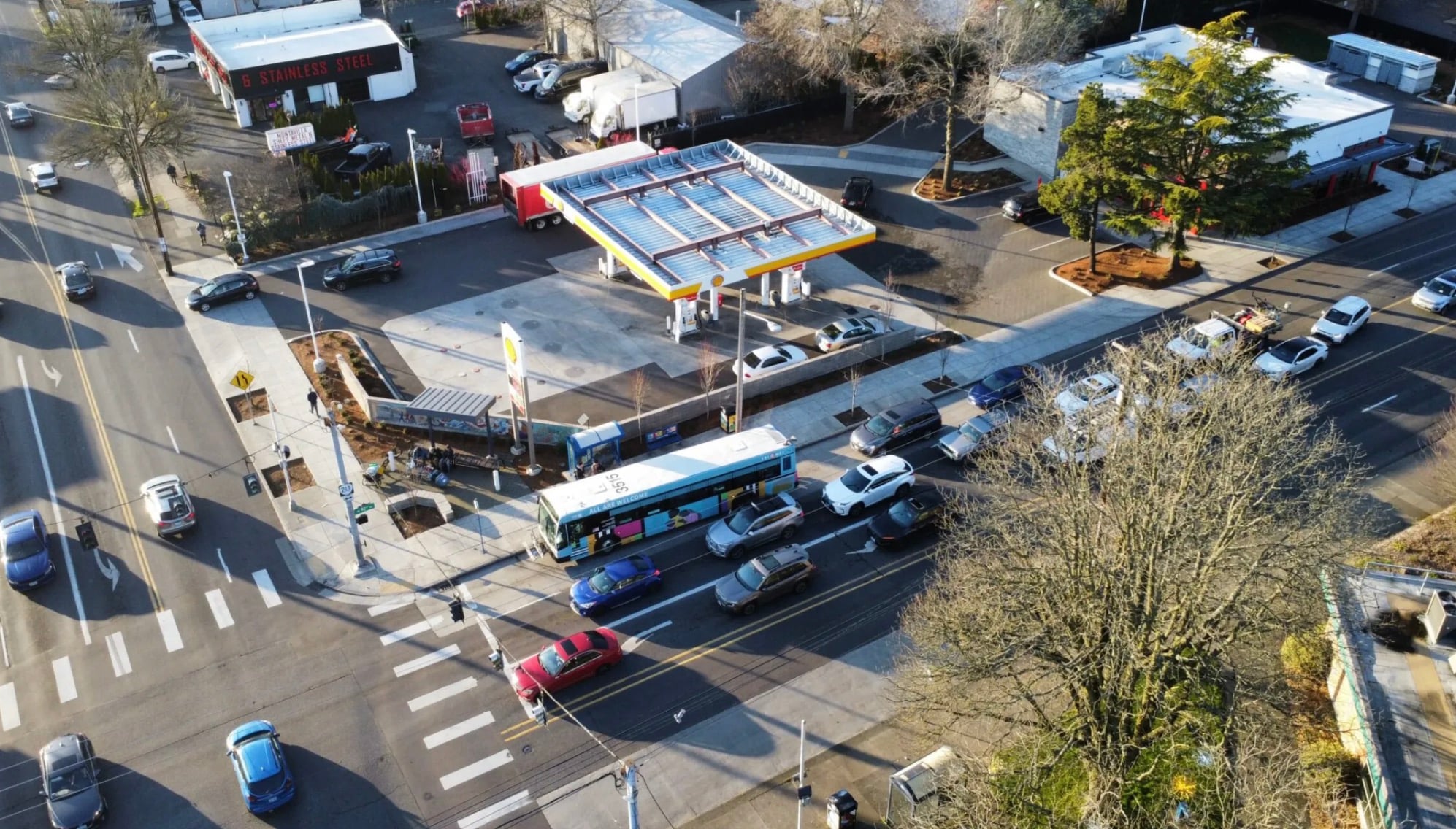
People who understand that excellent transit service is key to thriving 82nd Avenue corridor are celebrating a big win. That’s because at the project’s Policy & Budget Committee meeting on Friday, TriMet announced their intention to build semi-dedicated bus lanes on nearly the entire scope of their 82nd Avenue Transit Project — between Southeast Clatsop Street (Clackamas County line) and Northeast Lombard. One very notable compromise made official on Friday was the plan to drop the bus lanes at the Southeast Powell Blvd.
While the absence of bus lanes at Powell is a surrender to the status quo, getting semi-dedicated space for bus operators on what one committee member called “Oregon’s greatest main street,” is no small thing.
Back in October, project staff recommended just three miles of bus lanes as they faced threats of lawsuits from business owners and other serious concerns over how a major change in roadway space allocation on such a busy corridor might impact the project scope, budget, and timeline.
But on Friday, the same project officials who recommended three miles of “business access and transit” or “BAT” lanes (known as the “Some BAT” option) changed their recommendation to seven miles of BAT lanes (known as the “More BAT” option). PBOT Director Millicent Williams said during Friday’s meeting, “With this approach, the 82nd Avenue corridor will be the city’s largest investment in transit priority treatments with a cumulative 14 miles of BAT lanes. That is something to celebrate.”

The $320 million project has always come with major transit upgrades including longer buses, station improvements and signal upgrades. But given that 82nd Avenue carries the state’s busiest bus line and that many of the community leaders and elected officials around the table want a transformational transit upgrade, TriMet officials agreed to consider going even further by turning two of the former state highway’s four lanes into BAT lanes.
When they opted for a paltry three miles of BAT lanes in October, many Portlanders — including several Metro councilors and even TriMet board members — opposed the recommendation. The pushback forced project staff to reconsider their opinions and it put added scrutiny onto the final decision.
TriMet was put in the difficult position of having to balance needs of many groups including: business owners (who equate any loss of driving space with a loss in business), Metro (whose regional plans call for safe, thriving main streets served by transit), the Oregon Department of Transportation (who opposes the BAT lanes on diversion and congestion grounds), the Federal Transit Administration (who wants to make sure their money is well-spent), the City of Portland (whose adopted plans call for great transit and a reduction in driving), drivers (who repel any change to the status quo), and thousands Portlanders who want better transit.
ODOT’s concerns took front and center after a meeting last month revealed their influence over the project. Since their Highway 26/Powell Blvd crosses 82nd, they have authority to veto changes they believe would negatively impact how the roadway functions. ODOT made it clear on Friday they do not want BAT lanes in the project because of how they might cause drivers to avoid the corridor and clog nearby roadways. ODOT Region 1 Policy and Development Manager Chris Ford told the Policy and Budget Committee on Friday that, “A lot of the caution that you hear from ODOT around is because we need to make sure that the system is working really well for all modes.” Ford said ODOT’s position is no BAT lanes because less space for drivers, “limits the overall system,” and, “Because it squeezes a system that already doesn’t have a lot of capacity and isn’t going to get a lot more added to it.” Ford acknowledged that while BAT lanes might add capacity to the system overall (if more people take transit), “It also just takes some (capacity) away.”
As for just how much the BAT lanes will be dropped at Powell is still being negotiated by ODOT, PBOT and TriMet. One source told me it will likely be 2-3 blocks on either side of the street.
The biggest fear from TriMet staff (and likely why they came out with the unpopular initial recommendation) is that BAT lanes require design changes that make the project significantly more expensive (adding about $8 million to the overall cost) and could slow down their timeline. TriMet has a tight window to finalize the additional funding needed to implement the BAT lanes and an economic impact study. They plan to apply for a $150 million FTA “Small Starts” grant this coming September, which means they need a rock-solid funding plan secured by August.
At Friday’s meeting, TriMet project staff and GM Desue emphasized that just because they’ve settled on the “More BAT” option, it doesn’t mean the bus lanes are a done deal. ODOT permitting and funding could still poke holes in these plans.
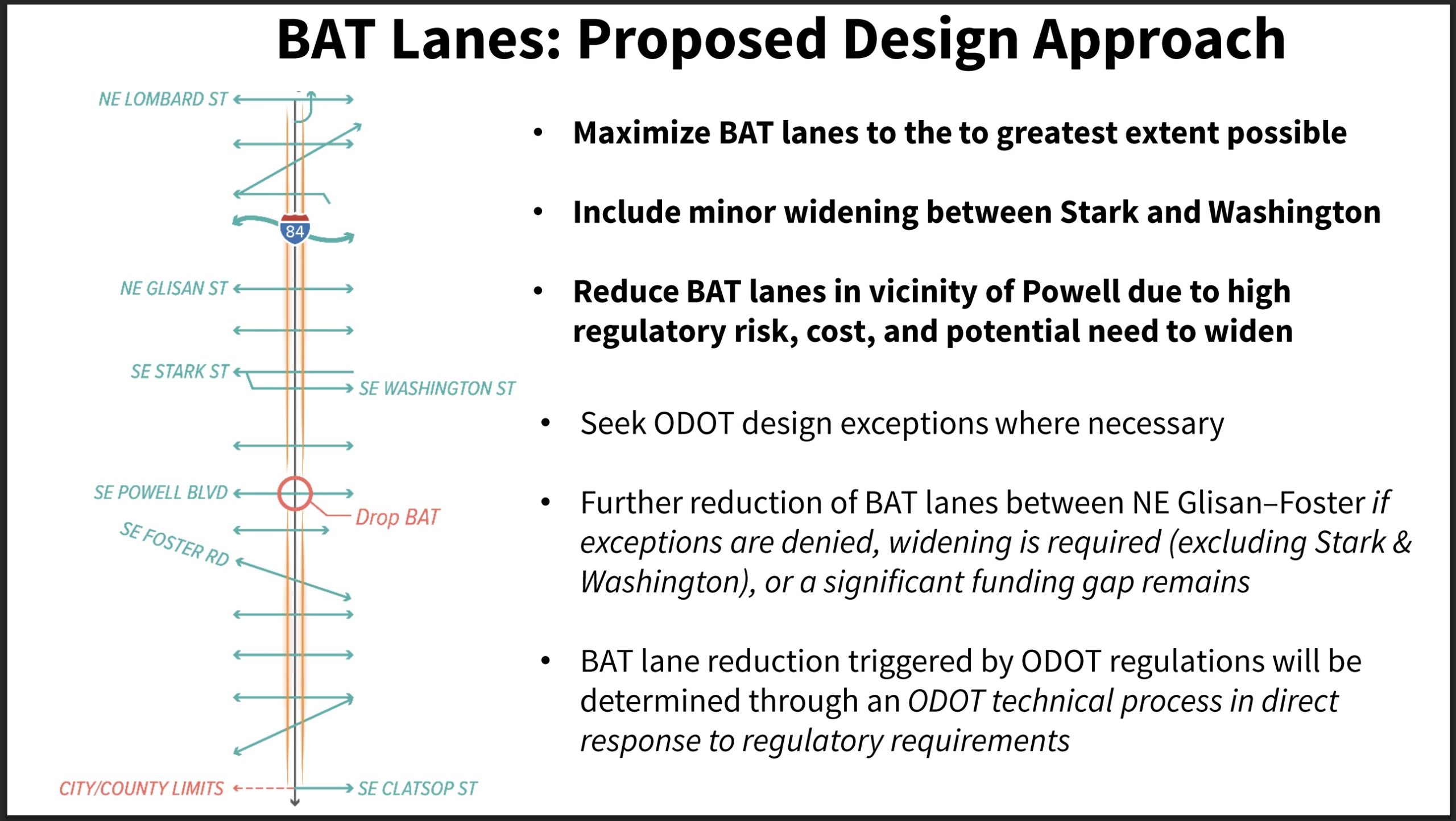
Because the new lanes could make significant changes to auto capacity at busy locations (like the stretch between SE Foster and NE Glisan and at the SE Stark and Washington couplet), TriMet will need to be granted “design exceptions” (DE) from ODOT in order to move forward. Both the DE and funding talks have begun, but GM Desue and TriMet staff issued clear warnings at the meeting that if either don’t resolve positively, BAT lanes might be dropped at more locations.
82nd Avenue Transit Project Manager Jesse Stemmler made it clear that the design decision made Friday needs to “retain some level of flexibility.” “Further reduction of BAT lanes may be needed,” he warned, “either in the case that design exceptions are denied, or widening is required, or a significant funding gap remains.”
TriMet Interim Director of Major Projects Michael Kiser dampened the celebratory mood when he explained the possibility of cutting project elements to save money and underscored the seriousness of keeping the project on time and on budget. Kiser explained that if the FTA feels the project has too much funding and/or design risks, they would require TriMet to have more money in a contingency fund before authorizing any grant funding.
“We could end up in September or August with too many risks, requiring too much contingency, so more of our funds would have to go towards contingency,” Kiser said. “And we’d have to look for additional cuts within the budget.”
Given what committee members said Friday, any further reduction of BAT lanes would be controversial. Metro Councilor Duncan Hwang said he believes a slightly longer commute (about one to two minutes) is well worth the added safety and reliability that dedicated bus service will provide. He also pointed out that 172 units of affordable housing near 82nd and Division have just 42 car parking spots between them. “These are TOD [transit-oriented development] projects,” Hwang said. “And we’ve made that decision that we’re going to build housing for people and not for cars.”
“So, how are our community members that are in these housing units are going to get around? It’s going to be by transit,” he continued. “And that was by design.”
Committee member (and wheelchair user who sits on the TriMet Community Advisory Committee) Franklin Ouchida echoed Hwang’s sentiment. “Those people [who live in affordable housing and don’t have cars] are going to have to get around. They’re not going to be able to afford an Uber ride everywhere they go. So [this project is] going to be revolutionary and a way to break the the idea of car-dependency, as well as having a viable community there.”
If all goes according to plan, TriMet will begin construction next year and the project would open for service in 2029.


Thanks for reading.
BikePortland has served this community with independent community journalism since 2005. We rely on subscriptions from readers like you to survive. Your financial support is vital in keeping this valuable resource alive and well.
Please subscribe today to strengthen and expand our work.
Thanks for the comprehensive article Jonathan! The aerial image at the top didn’t quite feel like my nearby intersection so I mapped it. Looks like that’s NE Glisan and 82nd.
Ahh yes. Thanks for checking that. Believe it or not I actually opened Google Maps and checked it first.
FYI, the picture looks like the intersection of 82nd and NE Glisan, not Foster
yes I’m aware of that as per the comment above. It’s already fixed but your browser might just be showing an older version. Thanks for pointing out the mistake.
ODOT’s takeaway seems to be “while the BAT lanes appear to add capacity to the overall system, they also appear to take away capacity from the overall system”.
ODOT is not a serious organization. The incredible responsibility* and privilege we’ve vested in them ensures they don’t have to become one (rather than causing them to be respectful of the power we’ve let them exercise).
*to preempt local jurisdictions’ attempts to express in infrastructure the values of their constituencies by showing up to projects late in the game, unprepared, and then leaning on the most threadbare of justifications couched in debunked modeling (whose result shows an increase in future traffic so small as to be swamped by normal day to day variations in travel patterns) and self-serving not-regionally-supported definitions of safety driven by preventing non-recurring congestion, not lives and limbs saved
ODOT is an organization controlled by the democratic governor that you likely voted for.
And will likely vote for again.
Oregon is almost a perfect state for a protest vote against our climate-skeptic pro-fossil fuel democratic governor but liberals/progressives keep on voting for business as usual.
Yep, protest voting in a Republican government can’t backfire at all. Just because the Dems don’t care about climate change and care little for human lives doesn’t mean the Republicans magically *DO* care.
In fact, they’re the ones who think people who can’t drive should just lump it and want to remove Transit from the Oregon Department of *TRANSPORTAION*.
Note that doesn’t say “Roads”, “Freeways”, “Cars”, “Freight”
TRANSPORTATION encompasses far more than the Repubican vision of it – as demonstrated by their counter proposal last term.
Meanwhile we’d also get the full mysogyniist, racist, police state package.
No, that can’t backfire at all.
What we’re doing isn’t working so well either.
If you’re never willing to vote the bums out, then you’re stuck with the bums.
If you vote the bums out and replace them with worse bums, then you’re stuck with worse bums.
If we’re unwilling to think beyond the next election, we’ll never get better leadership.
Surely, voting for a non-dem governor will solve all of our problems, right? … Right? How do you folks not get tired of deflecting all the time?
It’s instructive that a person who mechanically votes for the D party list always assumes that the only possible (legal?) choice is to vote for the authoritarian fascist Rs.
I have repeatedly voted for genuinely left-leaning candidates in the primary (and several times in the general) because I view Oregon’s electoral system as an autocratic duopoly with deep structural and legal barriers to candidates who are not on D or R party lists.
So-called progressives who mechanically vote for the D list are, in essence, blocking any chance of ever implementing genuinely progressive policies. (And this applies as much to transportation as it does to economic inequity.)
What folk are you referring to? How do you explain the ODOT failure to support human and public transportation in urban and rural areas? Honestly, how do you explain it?
The culture, Director and Board of ODOT come directly from the Governor. There is no way to gloss this over. ODOT’s support of megaprojects is because of the last three Democratic Governors. Just because people are fed up with ODOT’s and the Governor’s office continual contempt for human and public transportation does not equal a desire for Repbublican social wars to be enacted in Oregon. It means people are desperate for a way to make ODOT and the Governor’s office realize they need to do more for us.
Once people internalize that there is no sneaky Republican plot or crazed Republican fifth columnists hiding deep within ODOT manipulating ODOT against the wishes of it’s leadership or the Governor’s desires the sooner change can happen.
ODOT is enacting and reflects what the Democrtic Party and Governor want to happen with transportation in this state. It’s okay to understand this while simultaneously not wanting Rebpublicans to be in charge.
The lead pic is appropriate for the possibilities of future transit changes and development along 82nd. This intersection has a gas station, car wash, Burgerville, and a park with a community center. When they started demolishing the old gas station, and the old Pizza Hut restaurant next to it, I was hopeful it would all turn into housing or retail that could help transform this corner, and take advantage of the location across 82nd from a park. I was hoping for anything other than a gas station to be built. Then they built…an even bigger gas station! But wait, it’s “more walkable”, with less entrances and wider sidewalks, and we added a “public plaza” at the corner, and check out the new trees! And yet cars still cut through the gas station to avoid the light, the sidewalks and plaza are full of trash and next to lanes of speeding cars, and Glisan and 82nd is still a dangerous intersection to be drive through, much less walk across/be around.
To borrow from Ouchida’s quote above; This project HAS TO BE revolutionary to break the idea of car-dependency, and to support having a truly viable community along 82nd.”
I think the project just needs to make the already busiest bus in Portland better. Folks riding the 72 are already not car dependent, and one bus line is unlikely to represent a categorical shift in the way our society is constructed. It can only play a small role, and while I’m hopeful the project as designed now can be that, I’m also not holding my breath
This project won’t break my car-dependency for that area. It *will* make it painful enough for me to avoid patronizing businesses in that area.
If we want the metro area and state to stop swirling the drain, we can’t keep kneecapping businesses. We need their tax revenue.
Nobody will go to 82nd businesses anymore because it has too much traffic!
Oh wait.
This is such a ridiculous line of thinking! You don’t want to spend an extra two minutes in traffic, so what are you going to do, spend even more time going further afield to somewhere with “less traffic”? If and extra two minutes in traffic is what separates you from going somewhere, sounds like you don’t actually care about supporting the businesses.
“Painful” Jesus Christ like it’s so painful to be sealed up in your climate-controlled cocoon for an extra two minutes.
It’s not like the bus will improve much either, and may get worse if we allow bikes to use the BAT lane (as BikeLoud is demanding in their lawsuit).
Is this one of those rare projects where everyone loses?
(Except people biking in the BAT lane and those crossing, though crossers will get their improvements no matter what.)
Is it the 3-4 minutes of extra driving along those 7-miles that will keep you from patronizing businesses on 82nd? You’re going to drive elsewhere, and it will be faster and more convenient?
The BAT lanes are turn lanes for cars; you can still just turn into the businesses on 82nd like now.
To say the least, having almost all BAT lanes on 82nd Ave is still better than nothing. Major disappointment that the BAT on Powell Blvd got dropped (thanks, nosy ODOT), but at least not too big of a deal knowing that BAT will still be added. But still, BAT is needed on Powell Blvd. Now if only ODOT can transfer Powell Blvd from state to city.
Seriously! I hope this whole thing motivates advocates and elected officials to work toward a jurisdictional transfer for Powell Blvd. There was some talk about it a few years ago, but it didn’t really go anywhere.
From what I’ve heard from someone in college, it was originally going to be the Powell-Division transit project that ended up being shelved and later changed to Division transit project because of that reason of the ODOT keeps hogging up Powell Blvd as a state highway that made the transportation agency look bad. It’s cringe that ODOT continues to hog Powell Blvd.
For 82nd Ave, businesses on said 82nd Ave better not threaten to put funding on BAT lanes for 82nd Ave as a referendum for the voters. Otherwise, it’ll end up being Portland-Milwaukie light rail all over again where the unincorporated Clackamas counties threatened to put funding for the light rail on McLoughlin Blvd as a referendum for the voters.
PBOT and TriMet: “We need these BAT lanes to improve safety and livability, and to fight climate change.”
ODOT: “Sorry – we can’t let you do that.”
lmao when has ODOT ever seriously considered whether a system is working really well for pedestrians, cyclists, or transit? How many people have been killed trying to cross Powell?
An earlier comment from ODOT was that rear end collisions between people backed up on I-205 access ramps could be a serious problem and perhaps fatal. It could happen. But almost all those people are in cars, and any car built in the last 25 years has seat belts, front seat airbags, etc. Pedestrians: no airbags.
Yeah that was a very unfortunate comment. Still can’t believe he said that.
This is the same BS narrative they used and are still using for the Rose Quarter expansion. “It’s a safety project because it reduces crashes.” Never mind the fact that almost all the crashes are fender benders and there has been only one fatality along that section in a decade. Compare that to the multiple deaths we see every year on Powell or 82nd.
The BAT leaves won’t improve safety — is the enhanced crossings that will, and ODOT is not criticizing those.
The BAT land will absolutely improve safety! They will vastly decrease the number of car users in that lane.
Obviously you don’t spend a lot of time walking on 82nd. That extra buffer will certainly improve pedestrian safety. Not to mention it will make it clearer to pedestrians that a car in that lane is turning even if they fail to use their turn signal. The single through lane will also slow drivers down because they can only go as fast as the driver in front of them.
Of course none of that has anything to do with my comment. ODOT is saying the BAT lane by Powell will increase fatalities on 205 access ramps which as Robert pointed out is absurd. The only fatalities occurring on those ramps is from drivers hitting pedestrians or in one case a person sleeping in a tent on the embankment.
Great news overall. Hopefully ODOT backs down and we can get better transit. Reliable, frequent transit service will reduce car trips and I’m guessing that’s not in the calculation from ODOT
Hopefully
ODOTthe democratic governor backs down and we can get better transit.Tina Kotek has very little to do with this kind of decision making. It would be unusual for a governor to intervene on such specific policy relating to traffic management on a surface highway. This is ODOT policy that has been in place for years.
I really hope this is disingenuous spin and that you don’t believe that it’s not possible for Kotek to provide direction to ODOT about prioritization of motorvehicle throughput vs transit on major urban transit routes. This is especially absurd given what a high legislative priority this project has been for the metro region.
Kotek has the ability to dismiss and replace everyone on the OTC and to replace ODOT leadership. She can do this at her whim.
Our climate-skeptic governor has literally instructed both ODOT and the OTC as to her priorities with the clear understanding that she expects them to be carried out (as is her constitutional right).
For example:
https://www.oregon.gov/odot/tolling/pages/advisory-committee.aspx#:~:text=At%20the%20direction%20of%20Governor%20Kotek%20in,to%20the%20Washington%20State%20Department%20of%20Transportation.
Surely you can recognize that a statewide toll program is different than the policies governing how ODOT manages the minutiae of how they make decisions relating to something like this. The blame is more generally with ODOT policy (that has existed for decades) than one particular Governor.
Kotek could appoint Jonathan to Director of ODOT tomorrow if she wanted to. ODOT policy is likewise hers to dictate.
I guess you don’t realize how much power the Governor’s office has over ODOT which makes the organization’s continual failures under democratic governors so infuriating.
Yes, I am aware of all that. But the point is that this very minor specific relating to how ODOT manages policies relating to traffic management on surface streets is just not something the governor is going to care about. No Governor is going to dictate implementation of specific technical policy, and it’s stupid to blame Kotek for this. Blame her for the utter failure of ODOT in general, or their horrible mismanagement of all capital projects.
What nearby roadways? Has ODOT looked at a map of the nearby roadways? The North/South greenway sucks ass because there isn’t a nearby roadway that consistently parallels 82nd. Even if there was we have options for addressing that. Is ODOT unaware of diverters? Maybe they mean 205. If that’s the case GOOD that’s where drivers cutting through the city should be. They shouldn’t be using 82nd as an alternative.
Also the fact that they’re not allowing BAT lanes at Powell is absurd. It’s only their road still because they refuse to improve it and transfer it to the city like they should have done decades ago. Just like 82nd. I wonder how many people will have to die on Powell in a week before the Governor and our legislature forces ODOT to do what they’re supposed to do.
ODOT, quite reasonably IMO, is worried that motorists will use 92nd, 96th/99th, 102nd/112th, 117th, and numerous local streets as cut-throughs for 82nd, as drivers already do throughout the rest of the city for other busy congested stroads such as MLK/Grand, 122nd, Chavez, etc. The city badly needs a major overhaul and diverters citywide to funnel traffic onto the already congested main streets. By focusing congestion onto main streets and making congestion effectively gridlocked, the city might finally get its residents to walk and bike more even out in its more suburban areas.
“Gridlock is good” should be an active transportation motto (but it’s not). The more SUV gridlock the better!
Those 90s streets don’t go the length of 82nd and basically cease to exist in the entire NE section. The 100s streets are a 2+ mile detour. Anyone with a map app on their phone will realize they’re not faster alternatives. Like I asked about ODOT did you look at a map before making this comment?
205 is the only realistic alternative to cutting through the city. Which is where we want those drivers. Drivers with destinations on 82nd won’t save a ton of time or any diverting to streets that don’t go the length of it and that are already significantly slower than 82nd.
Are local streets ODOT’s responsibility? What cut-throughs are drivers using for MLK/Grand?
I’m fine with leaving a gap in the BAT lanes at Powell (and maybe even a couple of other intersections if they can’t get design exceptions) as long as the project gets mostly built. Nothing wrong with getting 97% now and going back for the remaining 3% later.
I would love a future post about the governance of TriMet. It seems like it is pretty directly controlled by the governor (who both appoints and can dismiss directors at will), but I am curious how much independence they tend to have/responsiveness to their “districts”. Is the most effective lobbying route via the governor (as a crude power map might presume), or are they generally given a fair amount of independence or responsibility for cultivating a constituency?
The idea that TriMet board members represent “districts” is kind of a joke given they’re all appointed by the governor. The only connection is that they have to live in the district, which I suppose just functions to ensure there aren’t people appointed to the board who have no connection to the TriMet district. But without democratic elections for the board, I don’t think it’s reasonable to say they “represent” the residents of their districts. They are there at the pleasure of the governor, and are ultimately accountable to the governor.
Many people have pointed over the years that there is a state statute that allows Metro at any time to take over control of TriMet. If they did, that would solve the governance problem since the Metro Council members are elected by voters of geographic districts, and the Metro Council President is elected by the voters of the entire Metro region. But Metro has always balked at the idea of absorbing a much larger agency into their portfolio, plus the TriMet and Metro boundaries are somewhat different, so it would be complicated. But I think it would still be worth considering at some point. TriMet is far too dependent on the State of Oregon in terms of governance and funding, and perhaps regional governance and funding would be a better approach.
Does removing the BAT lane in one section moderately affect the efficacy in that immediately area, or does it undermine the efficacy of the whole project? I would love to have an expert weigh in on this.
Is it my imagination or does Portland not have a SINGLE big bike infrastructure project planned at this point? It somehow seem that the powers that be don’t believe in biking as a mode of transportation anymore.