Is ‘Bikehangar’ a residential parking solution for Portland?

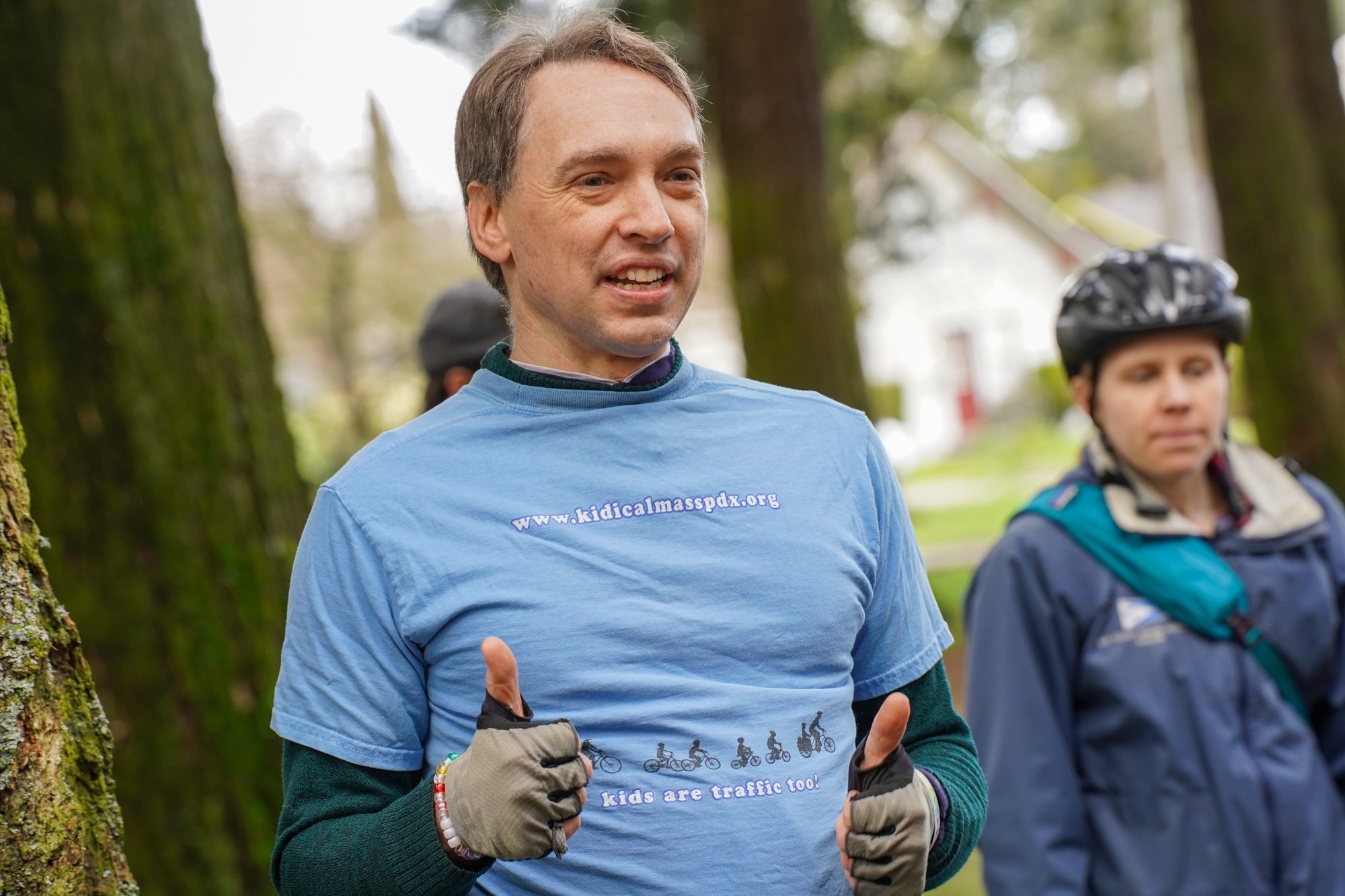
Sam Balto and his new bike hangar. (Photos and video: Jonathan Maus/BikePortland)

I’ve seen a lot of backyard bike sheds over the years. And even a few folks who’ve installed steel bike staples in their yard. But the small metal shed in the driveway of Sam Balto’s house in northeast Portland is something different. Balto recently installed a “Bikehangar” from a London-based company called Cyclehoop and invited me over to take a look. It’s the first one of its kind being used in Portland.
“We don’t have a garage and we like to ride our bikes a lot, and having to move them in and out constantly really becomes a deterrent to riding,” Balto said, as he unlocked and opened the wide steel door, revealing several bikes inside. “So being able to have secure bike parking in front is really nice and convenient.”

Balto has the Cargo Bikehangar, one of three models offered by Cyclehoop. He said it cost $5,000 to get bought, shipped, and installed (cost can be as much as $7,000 depending on model and other variables). It’s an interesting solution that could expand beyond the use of a single family if the city embraces the concept.

While Cyclehoop started in the United Kingdom, they spun off a separate entity in the United States in 2022. Cyclehoop US has a warehouse and fabrication shop in Minneapolis, Minnesota. Cyclehoop US CEO Andy Lambert says they’ve worked on installations with the City of Minneapolis, and the Minnesota Twins and Vikings (pro baseball and football teams).

“The response has been really positive from public and private sector customers, including residential homeowners,” Lambert shared with BikePortland today.

The Portland Bureau of Transportation (PBOT) has hundreds of “bike corrals” in parking spots adjacent to businesses citywide. But they don’t have something similar for neighborhood streets. It makes sense in some ways, because business customers usually fit under the definition of short-term parking, which is two hours or less according to PBOT guidelines. And bike corrals in commercial districts have a much higher demand than most Portland neighborhoods. Even so, Balto sees a future where these hangars are shared by several neighbors.

“I was in London a couple years ago and saw them all around the city,” he said. The City of London has contracted with a third-party vendor to manage thousands of Bikehangars. People on a block get access via a secure code on a smartphone app and pay a small fee for the service. In areas with apartments and multi-family dwellings, the hangars have been especially popular, Balto says.

Getting these hangars off private property boundaries and into the street, where PBOT already allows people to park private automobiles, is the next step. Right now that would be illegal without a permit.

Security will also be a big concern if these are to be taken seriously in Portland. Traumatized by years of rampant and brazen bike theft, many folks will be wary of leaving bikes on streets or in front yards in a metal shed. But Lambert says his company does third-party testing and receives the highest ratings. “The testing company uses all of the same power tools that bike thieves commonly use, including angle-grinders, reciprocating saws, crowbars, and anything else you can think of.”

Lambert added that Cyclehoop has 6,000 bike hangers serving 20,000 users in the U.K., and since 2012, bike theft has occurred in less than 1% of all use cases. “We’ve also had hangars on the streets of San Francisco since last June with no problems,” he said. The company recommends locking bikes inside the hangar and is testing a lock that would attach to the racks inside the hangar. They also offer a lock ring anchored to the ground (as seen in video above).

Balto isn’t worried about theft. His day job is to promote and advocate for bike buses and he sees the Bikehangar as a powerful way to get more kids and families riding.

“We want to make it easy for people to bike and store their bikes and lock them up when they go to friends houses, and our current system doesn’t offer that,” he said. “I’ve had students who we’ve been able to give them a bike, but their parents say, ‘we can’t accept it because there’s no room in their apartment complex.’ One of the biggest barriers to communities being able to do bike busses is secure bike parking, and so this is a super easy, affordable way — with some municipal support — to be able to remove barriers to make it easier for children and families to choose biking and instead of driving their kids to school.”

Balto thinks the Portland Clean Energy Community Benefits Fund (PCEF) could be a perfect source for funding bike hangars citywide. He wants to do a pilot project this summer where a network of hangars are purchased and installed in a neighborhood and then ridership numbers are tracked. Balto is confident more people will ride with convenient, weatherproof access to their bikes.

What do you think?

Man who used his truck as a weapon convicted of attempted murder

The section of SE Center Street in Eastport Plaza where Frederick Moore waited prior to killing Timothy Vincent.

A man who ran over and killed one person with his truck and then tried to run over a witness who was bicycling nearby, has been convicted of manslaughter and attempted murder by a Multnomah County jury.

Frederick Moore killed Vincent Timothy with his truck on June 6th, 2022 outside of Eastport Plaza Shopping Center on SE 82nd and Center Street. Here’s what happened, according to a statement released this morning by the District Attorney’s office:

“Vincent Timothy [42 years old] was walking northbound on SE 82nd Street. Frederick Moore had already turned into the parking lot of Eastport Plaza. When Timothy emerged from behind some buildings, Moore moved his vehicle onto SE Center St and waited about 30 feet behind the stop sign. As Timothy began walking on the sidewalk near the truck, Moore quickly accelerated and struck Timothy, who was dragged under Moore’s GMC Canyon. Timothy sustained significant injuries. Moore continued to drive across the street, conducted a U-turn and returned now facing eastbound. Witness Todd Henderson saw the incident and began yelling at the driver that he had killed the man. Moore then accelerated and aimed the truck at Henderson. Henderson jumped out of the way, but his bicycle was run over by Moore’s truck. Moore conducted another U-Turn and exited his truck.  A citizen followed Moore’s vehicle and the license plate was relayed to 911. 

Portland Police Bureau Detectives quickly learned that the suspect vehicle was registered to Moore’s wife.  Detectives executed a search warrant on June 7, 2022 to seize the suspect truck.  Detectives noticed damage that corresponded to evidence left at the scene.” 

Vincent Timothy (Photo: Portland Police)

The jury convicted Moore of Manslaughter in the First Degree, two counts of Failure to Perform the Duties of a Driver, Attempted Murder in the Second Degree, and ttempted Assault in the First Degree.

Multnomah County Senior Deputy District Attorney Kristen Kyle-Castelli described Moore’s actions as “incredibly violent” and “shocking.” There’s still no known motive for Moore, but it’s notable that he was already a convicted murderer who finished a sentence for that crime in 2018. Moore remains in custody and faces a minimum sentence of 10 years in prison.

Shockingly, this was the second fatal hit-and-run crash involving a driver and vulnerable road user in Portland in less than 24 hours. The previous day, a driver hit a bicycle rider and dragged their bike under their car for a full block before stopping and then trying to escape. The driver was arrested shortly after.

Sunday Parkways will expand to four events and return downtown this season

Big crowds on NW 13th during Sunday Parkways 2010. (Photo: Jonathan Maus/BikePortland)

Sunday Parkways will return to downtown Portland in 2025. The Portland Bureau of Transportation says a funding boost via a grant from the Portland Clean Energy Community Benefits Fund (PCEF) has allowed them to expand their offerings. Now in its 18th year, the annual open streets event will also expand to four events this season, the most since 2019 (which is also the last year the event was held downtown).

Last year, PBOT reported an estimated 50,000 Portlanders took part in the three events. This year, Sunday Parkways will return to southwest on May 18th, northeast on June 29th, east Portland on July 27th, and downtown on Sept. 14th.

Routes for three of the four routes are available now, but PBOT says they’re still working on the downtown route. “This route will be unique as there is so many gems to feature in the heart of Downtown Portland for Portlanders and visitors,” reads a PBOT press release. “The event will have a block party feel to celebrate the spirit of Portland and spotlight what makes our city truly unique…. This event route is designed to showcase Downtown businesses, public spaces, and cultural destinations.”

I’m so excited for a return downtown. When Parkways was first held downtown in 2011, I wrote that it was, “Like a living concept drawing sprung from the pages of a visionary planning document, or a scene stolen from a transportation activists’ dream… Of all the Sunday Parkways locations, the downtown edition holds the greatest potential in terms of opening the eyes of Portlanders — and our elected and civic leaders — to the vision of what our city could look like when we put people first.”

It’s also great to note that PBOT is already putting business front-and-center. In 2011, my one quibble with the event was how businesses failed to take advantage of tens of thousands of potential customers cycling by. I hope PBOT continues to partner with business to make sure they get involved.

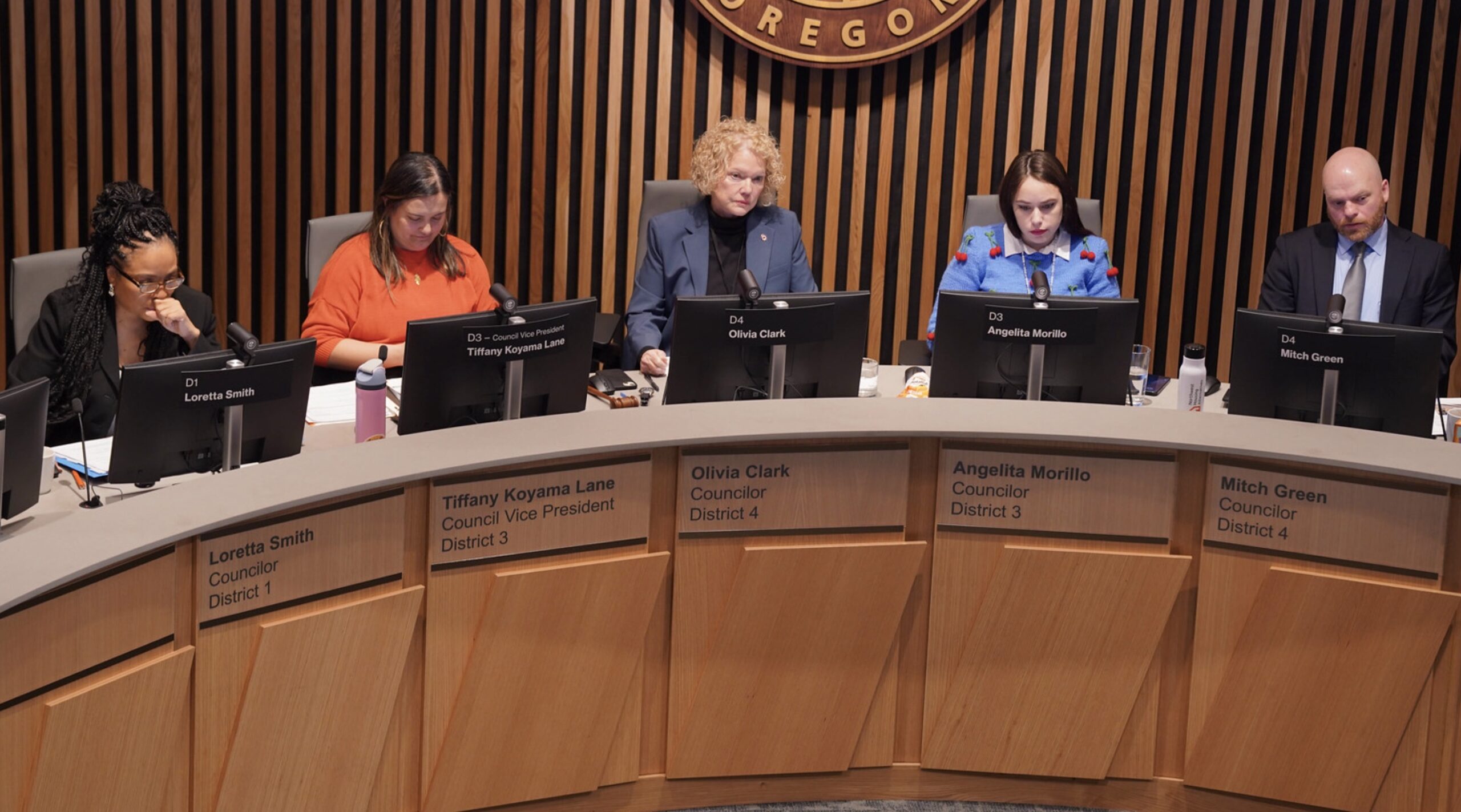
This will be the first time Sunday Parkways has taken place under our new form of government, where we have district representation. I expect commissioners from each of the four districts represented in the routes to participate.

Get all the route info and more on the official Sunday Parkways website.

Bike projects at risk with Trump Admin’s latest language purge

Bike lane on NE Weidler. (Photo: Jonathan Maus/BikePortland)

The Trump Administration has reportedly issued a new memo to state transportation agencies that could have sweeping impacts on millions of dollars in Portland transportation infrastructure projects. According to Yonah Freemark of the Urban Institute, who shared the news via Bluesky Monday morning, an email from US Department of Transportation Secretary Sean Duffy has ordered DOTs to re-examine all projects funded with federal grants since 2022 to make sure they comply with Trump’s priorities and executive orders.

Duffy said any grant awards, “when the primary purpose [of the project] is bicycle infrastructure” could get the axe. Duffy’s memo says projects will also need to be scaled back or unfunded if they specifically address: “Equity activities, diversity, equity and inclusion activities, climate change activities, environmental justice activities, gender specific activities, when the primary purpose is bicycle infrastructure (i.e. recreational trails and shared use paths, etc.), electric vehicles, and EV charging infrastructure,” or if they, “improve the condition for environmental justice communities or actively reduce greenhouse gas emissions.”

“Where the scope of the project includes elements noted above,” the memo reads, “update project scopes to eliminate and, where possible, replace those identified elements with relevant elements that align with… current Administration executive orders.”

The new order would apply to projects that have been awarded a grant, but that have not yet spent the funding.

The League of American Bicyclists said in a statement yesterday, “These grants aren’t ideological, they are based on the local priorities for safer streets. People in these communities want these projects, and the states applied for these grants to better serve their citizens.”

As of January 28th, 2025, the City of Portland has $163.6 million in active federal transportation grants (which account for $48% of all the city’s federal grants, the largest portion of any category).

Here are some USDOT-funded transportation projects in Portland that could be subject to this new directive. Please note: I found these grant awards using the USA Spending website and by creating search filters that matched the USDOT memo; but this list has not been confirmed with the City of Portland:

  • Protected bike lanes in the Portland Bureau of Transportation’s $3.5 million “Safe Streets & Roads for All” grant to improve safety on 122nd Avenue.
  • PBOT’s $2 million Zero-Emission Delivery Zone project grant, which seeks to reduce emissions in the urban core.
  • An $800,000 grant to PBOT for their Reconnecting Albina Planning Project that aims to create a governance structure for new land created by I-5 freeway covers in the Lloyd area.
  • A $1.7 million PBOT project that would build bicycle and pedestrian upgrades on NE 57th Avenue/Cully Blvd between Klickitat and Prescott.
  • A $1.6 million grant to PBOT for the 148th Avenue Safety and Access to Transit project that would build protected bike lanes and other safety upgrades on 148th between SE Powell and NE Halsey.
  • A $585,000 grant for protected bike lanes on SE Stark and Washington Streets between SE 92nd and 109th.
  • $3.4 million in multiple grants for the Jade and Montavilla Multimodal Improvements Project.
  • A $2.4 million Metro grant to, “advance equity outcomes and pedestrian safety in the greater Portland region.”
  • An $866,000 grant to build a new, carfree bridge over N Columbia Blvd to connect the Willamette Greenway Trail between Pier Park and Kelley Point Park.
  • A $1 million PBOT grant that will add new bikeways and multi-use paths on NE Halsey near I-84.

The City of Portland has not yet responded to a request for comment, but a webpage on federal policy impacts published after Trump’s initial grant funding pause back in January states, “The City will continue to monitor decisions at the federal level and respond to the changing grants landscape. While any long-term impacts remain unclear, potential outcomes could be delays in reimbursements and project work, modifications in grant terms, or attempts at contract cancellations.”

The Oregon Department of Transportation also has a new federal funding webpage, but it hasn’t been updated to respond to this latest policy order.

Stay tuned for developments.

Learn more via Streetsblog.

‘I want justice!’: Family of man killed while biking enraged after driver gets off scot-free

Polk County Courthouse in Dallas, Oregon on Monday morning. (Photo: Mara Stine)

The family of a man killed by a truck driver while cycling on a rural road outside of Salem two years ago says they’ve been robbed of justice. The driver, 48-year-old construction company owner Robert Weeks, faced a charge of criminally negligent homicide for his role in the death of Adam Joy in June 2023. Weeks was driving his Ford F350 truck on Wallace Road NW between Salem and McMinnville when he struck Joy from behind. Joy, who was riding behind his teenage son, died on the side of the road.

The felony charge carried a maximum sentence of up to 10 years in prison and a fine of up to $250,000; but Weeks worked out a plea agreement with Judge Monte Campbell and Polk County District Attorney Aaron Felton to dismiss that charge and plead “no contest” to a lesser charge of attempted assault. The agreement also includes a deferred sentence, so if Weeks stays out of legal trouble for the next two years and writes a letter to the family, the assault charge will be dismissed. Weeks, who in addition to hitting Joy, had several speeding citations on his record (including a $2,000 fine for speeding in 2021), walked out of the courtroom without admitting guilt and with no restrictions placed on his driver’s license.

According to Joy family friend and former journalist Mara Stine, who was at the hearing, Weeks was unwilling to entertain any agreement that limited his driving because he said it would interfere with his job as a contractor.

“That’s not fair! I want justice!” Adam’s mother Masako Joy cried out through sobs as she absorbed what was happening in the Polk County Courthouse in Dallas Oregon on Monday morning.

The dozen Joy family members and friends who made the trip to Dallas knew there was a chance the felony charge would be dropped, but they held out hope for a trial and some sense of closure. They got neither.

When given an opportunity to address the family in the courtroom, Stine told BikePortland, “Weeks did not say anything to them. Instead, he cleared his throat and remained silent. Adam’s mother was a ball of fury and heartache.” Stine shared.

Adam Joy. (Photo: Joy family)

In an email to BikePortland Monday, Joy’s ex-wife Narumi Joy wrote,

“I have no words to describe what we all felt. Where is the justice? I no longer believe in the police or the justice system. [Weeks] was basically set free with virtually no punishment. Even his record of killing someone will go away if he behaves for two years. There’s no suspension or even limitation on his driving privileges. What kind of world is this?”

Oregon State Police officers who responded to the scene of the crash made initial statements that minimized Weeks’ role (saying he slowed down prior to the collision) and said Joy had fallen over in front of the truck prior to the collision. However, that initial police statement did not match what a witness shared with BikePortland two weeks later. That witness saw the collision from the opposite lane and said Weeks was “going pretty fast” and “the truck never moved over.” She came forward after seeing the police version of events and said, “I feel like they’re protecting the driver.”

Joy’s attorney Larry Sokol and members of Joy’s family have expressed serious concerns about the quality of the investigation that followed. They are shocked that Joy’s son, who was just a few yards a way from the collision, was never interviewed. And, despite repeated request from Sokol and his legal team, the Oregon State Police never gave them a chance to examine Weeks’ truck before releasing it back to him.

Robert Weeks (Photo: LinkedIn)

Three months after the collision the Polk County District Attorney said there was insufficient evidence to charge Weeks, but then reversed course in early 2024 and agreed to move forward with the charges and a trial. Hopes of a trial and some degree of justice is why so many members of Joy’s family drove to Dallas to be in the courtroom Monday.

At the hearing, DA Felton told the family he understood they were disappointed with the outcome. “But I also don’t think going to trial was appropriate,” he added. Since the standard for a criminally negligent homicide conviction is ‘beyond a reasonable doubt,’ the DA feared an acquittal if the case went to trial. Felton said that even if Weeks would have been found guilty, his lack of a criminal record means he would not have been sentenced to jail time.

The defense attorney found a driver who was behind Weeks at the time of the collision and provided a statement saying Weeks was not speeding. DA Felton said this testimony counter-balanced the witness who saw the crash from the opposite lane who testified he was speeding. Weeks testified before the grand jury that he thought he’d safely passed the cyclist, who must have fallen off his bike and under his Ford F-350 pickup truck as he drove by.

Based on comments he made Monday, Felton believes the plea deal provides at least some measure of accountability. It also provided a chance for the Joy family to address him in court and tell him how this devastated their lives and their family. Weeks sat facing the judge with his arms folded across his chest while Joy’s 17-year-old son and ex-wife shared emotional statements about what Joy meant to them and expressed grave disappointment about what they feel is a lack of justice. (DA Felton’s legal aide declined to discuss the case yesterday when asked about it in a phone call, and DA Felton has not yet replied to an email with questions seeking more information.)

The conclusion of this case has left Adam Joy’s family enraged and reeling.

In an email to BikePortland, his sister Gina Wilson wrote, “While I understand that it is not the DA’s job to find justice for a single family, it is his job to find justice for a community. He has failed miserably. He is a coward.”

Adam Joy was born in Japan and moved to Portland when he was five. He graduated from Parkrose High School and Reed College. (Photo: Joy family)

“To me, it seems that they did not take Adam’s death seriously because he was an Asian man bicycling (God forbid) in a conservative, bicyclist-hating community, who caused a major inconvenience to everyone on a beautiful Saturday morning,” Narumi Joy shared on Monday after the hearing. “I’m still trying to think what else I can do or should be doing, but I believe having Adam’s story out there is the most important thing.”

“Killing Adam might be erased from Weeks’ record in two years as if Adam never existed, but he did exist. Adam left such huge footprints in everyone he met in 55 years of his life. He was a superhero to his students,” she continued. “I miss Adam so much. Please do not let them erase Adam from existence.”

— Mara Stine contributed reporting to this story. Learn more about Adam Joy at this online memorial created by his family.

River City Bicycles celebrates 30 years in business (video)

River City Bicycles owner Dave Guettler smiles after cutting off the top of a champagne bottle with a saber in the store’s parking lot on Saturday. (Photos and video: Jonathan Maus/BikePortland)

If surviving 30 years as an independent bike shop were easy, everyone would have done it. With that perspective, the more you consider the dozens of bike shops that have come and gone in Portland over the past three decades, the more impressive it is that River City Bicycles has not just survived, but continues to thrive.

The shop celebrated its 30th year with a party at its central eastside location on Saturday. There was music, cake, and even champagne poured from bottles cut open with a traditional French saber. But the most important element of the party — just like for the business itself — were the people who showed up. The shop buzzed with customers, fans, and employees past and present.

Through myriad bumps in the bike industry and in Portland since 1995, River City has held a steady hand on the bars. Even through a 16 month closure during the pandemic, Guettler and his devoted staff found ways to keep Portlanders stoked on cycling. “That was the craziest moment of River City’s history,” Guettler shared in an interview last week. “If somebody would have told me that we would have to shut our store down to customers for 16 months, I would have said, ‘Well, let’s just close now, because there’s no way we could survive that.'”

But they survived. So it was fitting on Saturday that bubbly spilled from bottles onto the pavement of that same parking lot where River City set up tents to serve customers during Covid.

Guettler moved to Portland in 1994 with a clear vision to open the world’s best bike shop. Not just a place to buy stuff and get your bike worked on, but a destination in-and-of itself — a place he would love to hang out in, complete with fine wood furnishings he made himself, a shrine to one of his cycling idols (Eddy Merckx), his impressive personal bike collection hanging from the ceiling, and free espresso. It’s rare someone so keen on the business of bicycling (Guettler was previously part owner of a seven-store chain in northern California), builds a successful shop where “doing business” doesn’t feel like the top priority.

Don’t get me wrong, the customer experience at River City is more akin to a luxury department store than a greasy bike shop, but the vibe is often anything but transactional. Guettler has set River City apart by putting people first, staying creative, and keeping things fun.

The shop boasts several employees who’ve been on staff for over 20 years and Guettler is known for not just listening to their ideas, but for putting them into action. River City was named “Most Female Friendly” in the nation in 2008, and that same year ran a series of extraordinary ads in local newspapers and pulled off a publicity coup with a contest that awarded a free commuter bike to one lucky customer if they could guess when gas prices would hit $4.00. In 2011, Guettler said “yes” to an employee who wanted a concrete skate ramp installed in the parking lot and in 2023 hosted a cello concert where the star was shop mechanic and Oregon road race champion Erik Hammerquist.

As title sponsor of the venerable Cyclocross Crusade race series, Guettler himself has dressed up in a “Black Night” costume and chased people during races. If you’re caught, you get a prize. “That makes it fun for everyone, not just people who are the fastest and can win a prize,” shared River City customer Mielle Blomberg at Saturday’s party.

From providing a first landing spot for bike lovers no matter where they are in their cycling journey, to hosting hundreds of events over the years, River City is a welcome third place in a world of ever-increasing digitization and social isolation.

“It’s a cultural staple that I figured out was the place to go when I first moved here,” said a local rider naked Nikolai. “I think it’s really valuable, and I hope it keeps going for another 30 years,” said another fan. And former employee Kirk Whitemen, who went on to start a cycling and pilates studio nearby told me that, “Dave gave me my first job. I knew nobody when I got to Portland and went from zero to 65 friends in one day.”

Saturday’s party was full of people with similar comments and stories. River City Bicycles is an institution and an enduring symbol of strength for our local cycling scene. I hope lasts for another 30 years at least.

‘Critical Mass’ ride coming to Washington County

People on bikes crossed Tualatin-Valley Highway using safety vests and a crosswalk during a group ride in September. (Photos: Jonathan Maus/BikePortland)

The latest sign of Washington County’s burgeoning bike scene is a group protest ride planned at the end of May that organizers are calling a “Critical Mass party ride.” Details are still being finalized, but according to the group organizing the ride, the plan is to assemble as many riders as possible and roll en masse from Beaverton to Hillsboro. The route will intentionally use major arterials typically dominated by car users.

A group ride of this nature, planned specifically as a large-scale protest of cycling conditions and an attempt to bring about political change, will be a first for the westside.

Critical Mass, which began in 1992 in San Francisco, holds a significant place in American cycling history. The event galvanized cycling activists and helped push for safer cycling conditions in cities worldwide. Portland’s Critical Mass happened weekly from 1993 to 2007. It fizzled out (even after an attempt to revive it in 2014) as many of its organizers opted to pull different levers of cycling activism that didn’t require an overly policed, high-profile protest in peak-hour traffic.

“A piece of paint on a 55 mph road is not enough for a family to feel comfortable enough to want to go on a ride.”

– Rob Lewis, Ride Westside

Critical Mass almost never happens in suburban areas like Beaverton and Hillsboro in Washington County, but it’s not for lack of demand. Bike advocacy groups are typically more conservative in suburbs and activists who would be interested in protest rides are spread over a wide distance and lack a central, dense commercial area or meeting place they can all identify with. However, as cities like Tigard, Beaverton and Hillsboro have grown in recent years, so has the esprit de corps among a new guard of advocates who feel they’ve been left with no other choice to get their messages across.

Westside Bike Happy Hour crowd on July 23rd, 2024.

“Yes, we’re in a suburb of Portland,” said Ride Westside volunteer Rob Lewis in an interview Monday. “But we still have a boatload of cyclists out here — there’s people out here with families that would love to cycle with their kids — but they don’t feel safe.” Lewis said the upcoming ride was born from conversations at the Westside Bike Happy Hour gathering, a event he organizes that has met twice a month since last July at a food cart pod across the street from Beaverton City Hall.

I could hear the frustration in Lewis’ voice in our conversation yesterday. He cited an increase in crashes involving bike riders and walkers in recent years and a feeling of bureaucratic barriers to better bicycling within Washington County government.

“In the west suburbs we don’t have a Springwater [Corridor] trail. We have segments of a Springwater scattered across the whole county, with no connections and separated by five lanes of pavement where the only infrastructure is a piece of paint,” he said. “There’s a ton of big, mean roadways here in the west suburbs that, sure, they have a bike lane; but a piece of paint on a 55 mph road is not enough for a family to feel comfortable enough to want to go on a ride.”

Lewis says his frustrations are shared by fellow members of Ride Westside and he’s heard widespread support for a mass ride from people who show up to Bike Happy Hour.

“I see a Critical Mass and party ride as a fun way to bring the cycling community on the westside together and push for some positive change,” Lewis said. “We’re not here to antagonize the community. We’re here to celebrate cycling and hopefully bring about some effective change in our bureaucratic direction.”

Lewis, in his mid-30s, cut his teeth in cycling activism by participating in large rides in Portland when he moved here from the midwest in 2016. He’s never done a Critical Mass ride, but he understands its history and intent. And while he says he doesn’t want to antagonize anyone, Lewis is also not shying away from the consequences of putting a large group of people on bikes on roads with just a narrow — or nonexistent — bike lane. Lewis clearly wants attention for cycling, but hopes starting the ride on a Saturday morning and hosting a party at the end will balance out any of the unwanted kind.

Since the ride will be on major roadways without a parade or protest permit, the plan is to have volunteers on the ride who will use their bodies and bikes to “cork” vehicular traffic at intersections and make sure the entire mass of riders can get through signals without breaking up into smaller groups.

In the end, Lewis sees the ride as an evolutionary step for the bike scene on the westside. “Clearly, there are cyclists out here. So let’s bring that community together and let’s develop our community out here.”

— The Westside Critical Mass Party Ride is set for Saturday, May 31st at 9:00 am. Follow Ride Westside and see the ride listing on the Shift Calendar for updates.

Cyclists in the wild (Photo gallery)

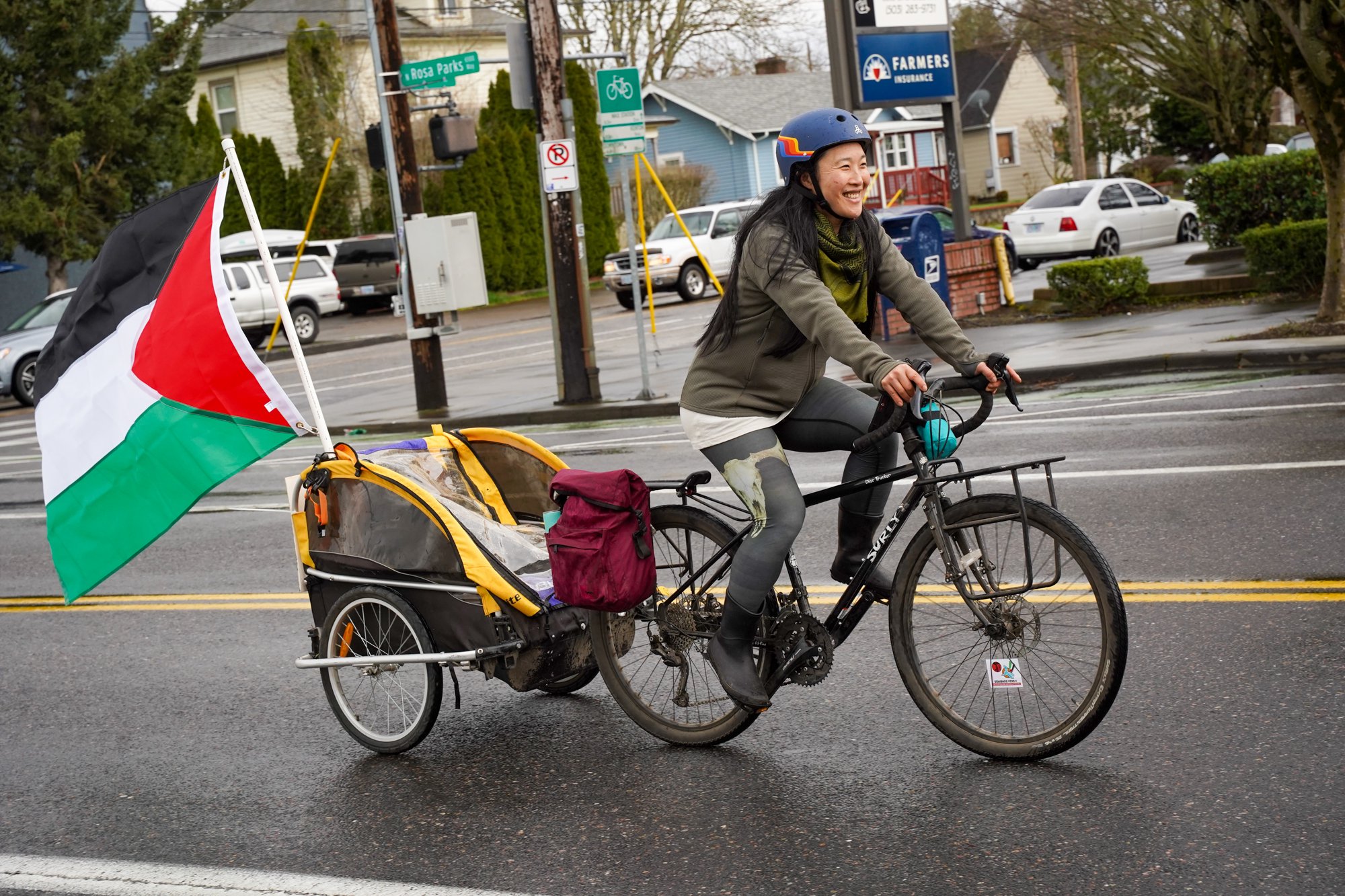
Rolling with a smile on North Rosa Parks Way across I-5. (Photos: Jonathan Maus/BikePortland)

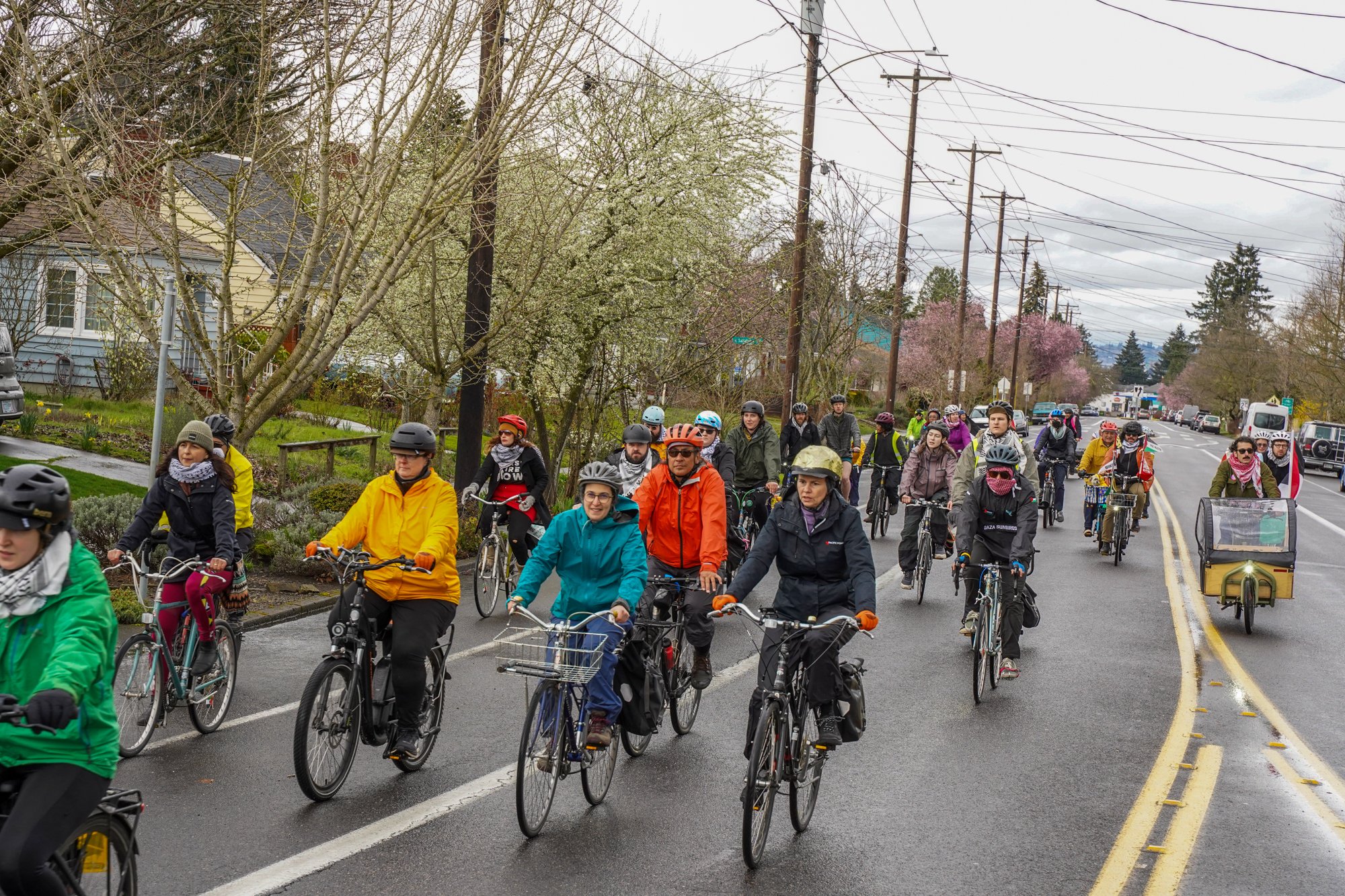
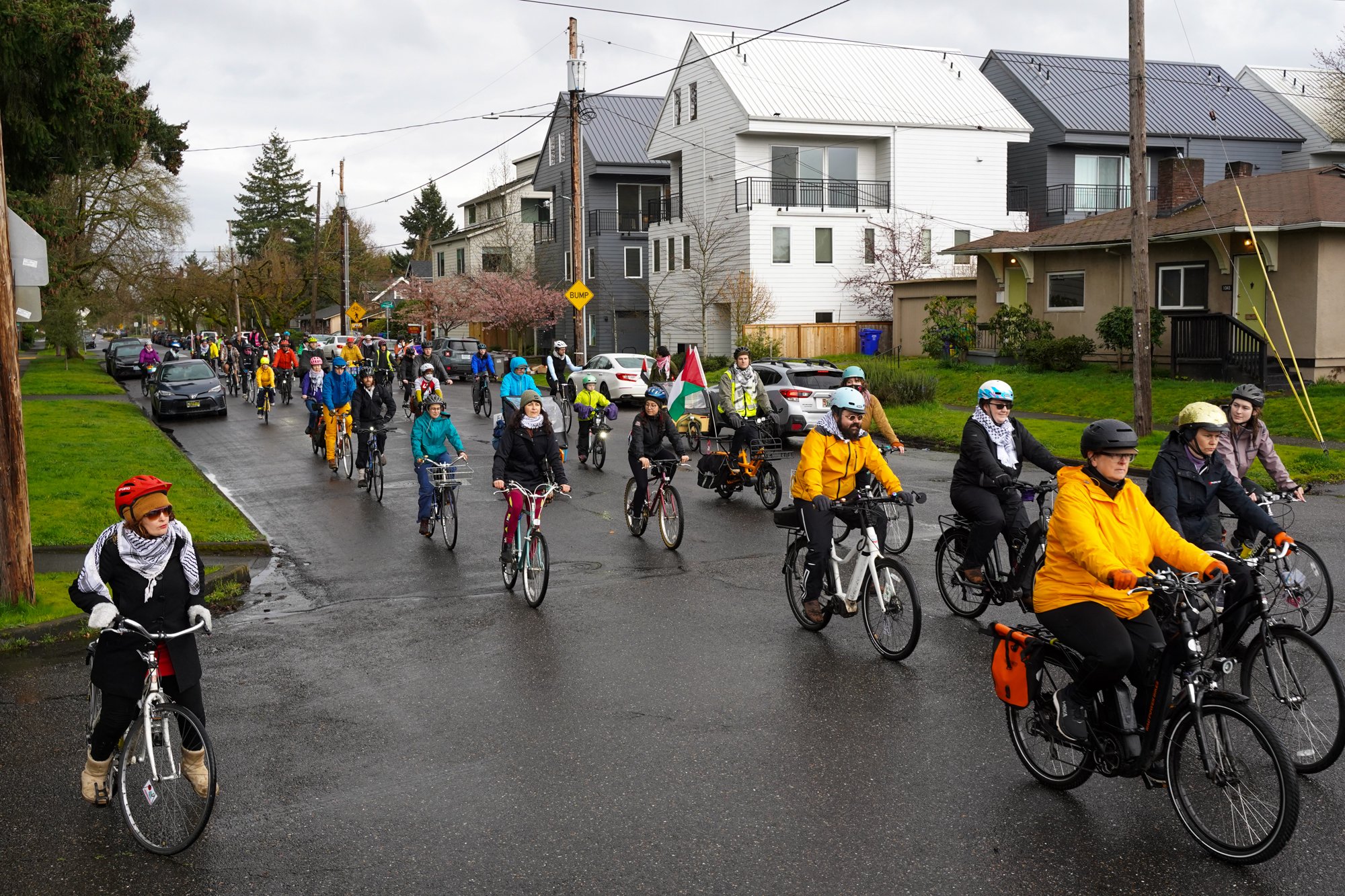
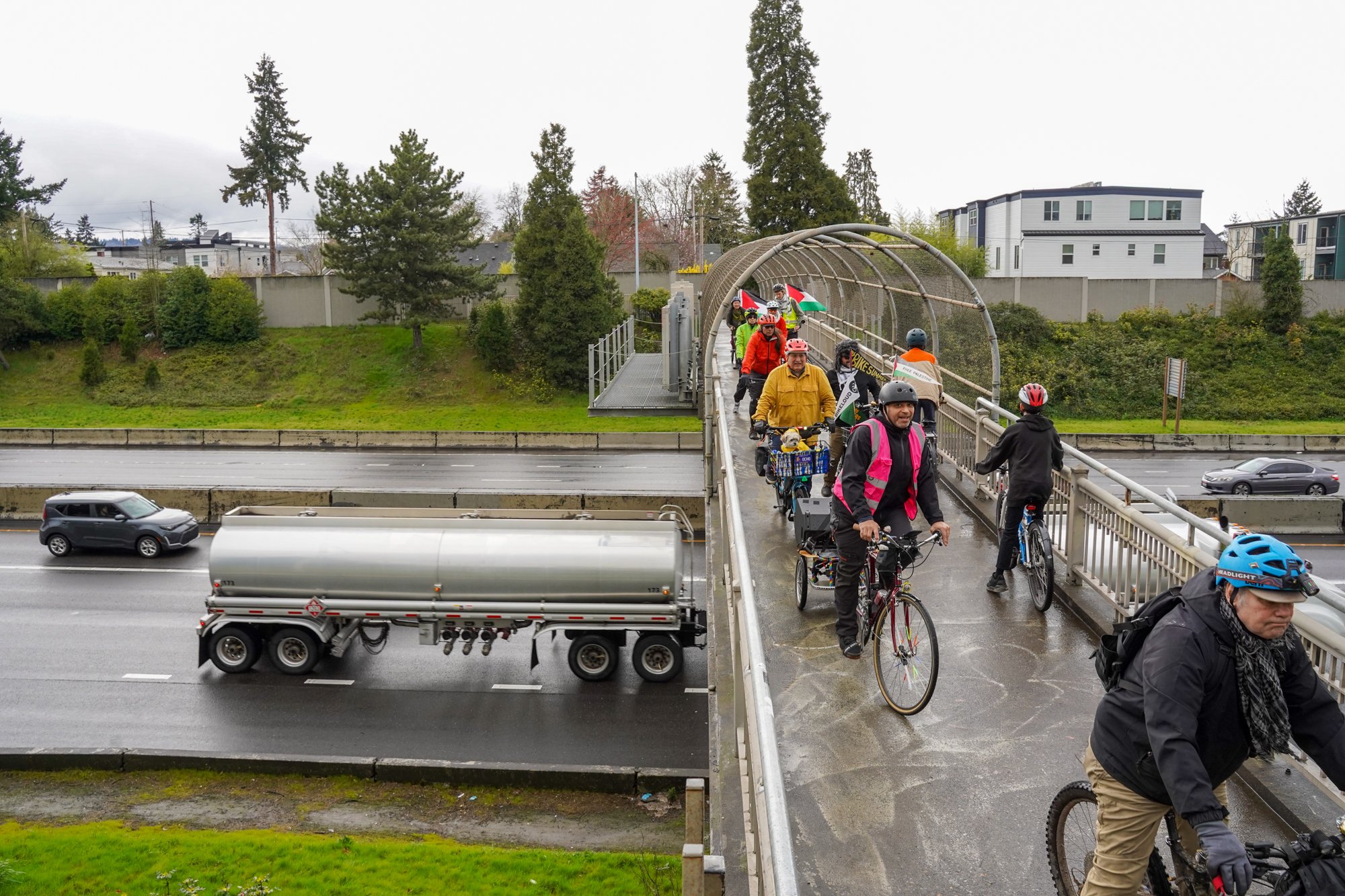
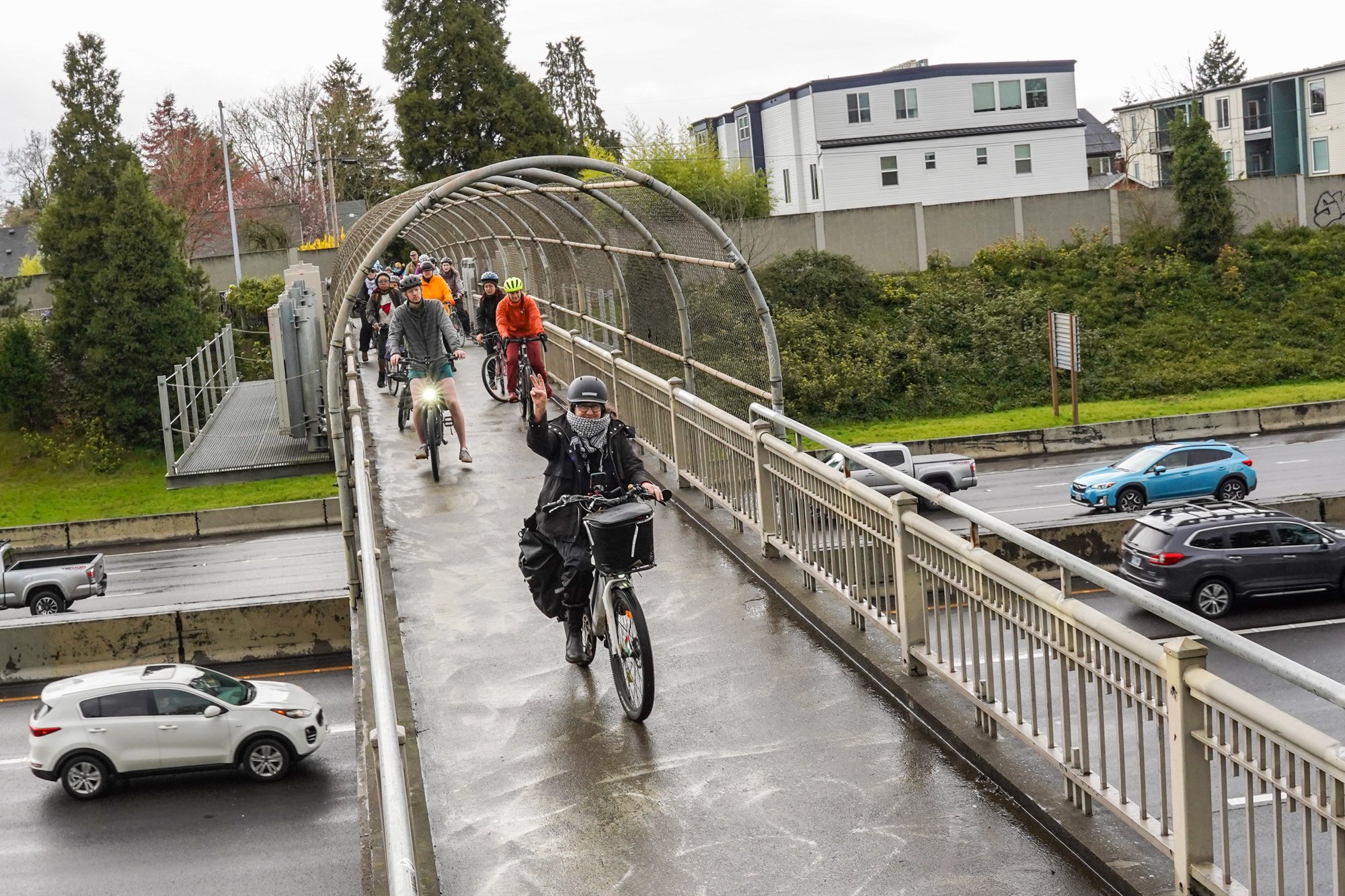
This spring weather has brought out tons of cyclists! I did some cyclist wildlife viewing on Sunday and in just a few minutes in the the Overlook neighborhood, saw dozens of folks out riding. Here’s a sampling of who was out there…

Keep riding everyone!

Monday Roundup: Talk a mile, European influence, concusssions, and more

Welcome to the week. Here are the most notable news items our community has come across in the past seven days…

Don’t knock it: An experimental, carfree neighborhood built from a vacant lot outside of Phoenix, Arizona has found its most rabid fans: the people who live there. (Dwell)

Heady stuff: An upcoming review of research will show that, “Road cycling has the highest proportion of head, neck, and facial injuries of all cycling disciplines and yet also has one of the lowest reported rates of concussions.” (Escape Collective)

Cycling and civil rights: A cycling club biked from Selma to Montgomery to retrace the famous civil rights era march and to show how riding bikes can play a role in preserving history. (Scalawag Magazine)

Display drama: Former motorsport engineer and OnlyFans personality Sabrina Fischer has co-developed a handlebar for roadies with a large digital display—and caused a stir in the industry while doing it. (Cycling Weekly)

Power of walking: A Portland nonprofit connects Black youth with police officers and trainees so they can literally walk a mile in each others’ shoes. (OPB Think Out Loud)

An American leader in Europe: A woman who grew up in a Chicago suburb is head of the European Cyclists Federation, a leading bike advocacy group that lobbies for cycling on a global scale. (NY Times)

Epic spring classic: It’s an exciting time of year for bike racing fans and the amazing Tadej Pogacar gave classics lovers a feast with his roller-coaster win at Strade Bianche, becoming the first male rider to win it back-to-back. (BBC)

How to clean up a city: London’s mayor is celebrating a new report that shows his Ultra Low Emissions Zone has cut toxic emissions and improved air quality for millions of his voters. (Guardian)


Thanks to everyone who sent in links this week. The Monday Roundup is a community effort, so please feel free to send us any great stories you come across.

ODOT will begin I-5 expansion project amid major budget uncertainty

A Metro committee vote this morning allows the Oregon Department of Transportation (ODOT) to step over a key procedural hurdle before they break ground on their $1.9 billion I-5 Rose Quarter project. The controversial project has been mired in lawsuits and budgetary uncertainty for years, so ODOT needed an emergency allocation from the Oregon Transportation Commission (OTC) of $250 million start construction.

But that funding pales in comparison to the overall price tag of the project, and ODOT says they’re still over $1 billion short. Add the federal funding pause and ODOT’s gap rises to $1.4 billion.

The latest funding came via an amendment to the regional project list managed by Metro known as the Metropolitan Transportation Improvement Program, or MTIP. The amendment was presented and discussed briefly before passing (with just one vote in opposition) at Metro’s Transportation Policy Advisory Committee (TPAC) meeting today.

When the OTC voted in December to dedicate $250 million to the project, ODOT was so eager to share the news they had an email drafted and sent before the OTC meeting ended. ODOT says they have a total of $850 million out of the $1.9 billion estimated price tag. But even that partial total isn’t nearly as solid as it seems.

Over half of what ODOT says is dedicated to the project is a $450 million grant awarded by the Biden Administration through the Reconnecting Communities program. The grant was ostensibly given to build the “Albina Vision” — the plan pushed by the nonprofit Albina Vision Trust to rebuild the black community displaced by construction of the freeway in the 1960s.

But a cloud looms over that grant because of President Donald Trump’s disdain for Biden-era investments, especially ones made in the name of racial justice. The federal funding freeze means no one knows for sure whether or not that $450 million can be counted on. On February 24th, I-5 Rose Quarter Project Director Megan Channel told Oregon lawmakers at a meeting of the Joint Committee on Transportation that the funds, “are currently subject to the current pause on federal grant funding pursuant to federal executive order.” A website published by ODOT on February 7th to track the funding pause says that just $37.5 million of the $450 million Reconnecting Communities grant has been obligated to ODOT thus far. That leaves about half of what ODOT claims as funding for this project still solidly under Trump’s control.

When Oregon Senator Khanh Pham asked Channel how ODOT would pay for the $1.4 billion needed to complete the project, Channel acknowledged that the grant funding pause by Trump is a “unique situation” and that if it doesn’t come through, “All options would be on the table to help full that gap.”

Despite all this uncertainty, ODOT plans to break ground this summer. In the first phase of construction ODOT says they’ll build a section of the highway cover, begin the expansion of I-5 between I-405 and the Morrison Bridge, and do necessary upgrades to the Fremont Bridge.

Where the rest of the funding for the project will come from — or if it will ever come at all — remains to be seen. But for ODOT, all that matters is getting a shovel in the ground.

Chris Smith testifying on Zoom at the Metro meeting today.

ODOT understands high-profile megaprojects like this rely on inertia. The hardest part is getting them going (the former head of ODOT’s Urban Mobility Office remarked in that email that a project to widen I-5 at the Rose Quarter “has been in development for a generation.”) But once started, the hardest part is stopping them.

“This is the classic Robert Moses move of getting shovels in the ground and then keeping the community on the hook to pay for whatever it costs in the end,” said No More Freeways co-founder Chris Smith in testimony at the Metro meeting this morning. “I hope you will see through that and reject these amendment.”

The amendment passed. The sole vote in opposition came from Indi Namkoong, a transportation justice advocate with nonprofit Verde. Namkoong said she couldn’t support the funding because of, “The level of uncertain information on how much of this is going to deliver on our key goals around safety and equity.” Namkoong feels $250 million in ODOT funding deserves more public review and scrutiny. “There’s a lot that we don’t know,” she said.

The Street Trust Executive Director Sarah Iannarone is also on the TPAC committee. She abstained from today’s vote.

Bollards coming to I-205 path thanks to $450,000 state project

ODOT installed these bollards on the I-205 path just south of NE Prescott in 2023. (Photo: Jonathan Maus/BikePortland)

After years of safety concerns, the Oregon Department of Transportation says they’ll install more bollards to prevent people from driving cars on the I-205 multi-use path.

The number of people illegally driving cars on the 205 path and other paths in the region has increased dramatically in the past decade. Official numbers aren’t available, but anecdotally it’s become common enough that for many people it’s the final straw (along with personal safety fears, trash, and other hazards) that leads them to avoid the paths altogether.

Today at the Transportation Policy Alternatives Committee (TPAC) hosted by Metro, ODOT Region 1 Policy Manager Chris Ford announced something will finally be done about it. “ODOT is funding the addition of bollards at key locations along the I-205 and I-84 multi-use paths,” Ford shared. “This is to prevent vehicles from driving onto the multi-use paths.”

I followed up with the ODOT Region 1 media spokesperson and have confirmed that a total of 29 bollards will be installed: 21 of them on the I-205 path and 8 on the I-84 path. The I-205 project boundaries are from SE Holgate to Crystal Springs Boulevard. On I-84 the bollards will go in between NE 122nd and NE 181st (in Gresham).

ODOT will spend $450,000 on the project, which they say will also reduce vandalism to lights and electrical systems along the path.

In April 2023, ODOT installed several sets bollards on the I-205 path between NE Prescott and NE Fremont where it goes through the City of Maywood Park (see above). In May 2013, the Washington Department of Transportation installed bollards at an entrance to the I-205 path north of the Columbia River.

ODOT says this latest attempt to prevent car users from accessing the paths has already begun and they expect all construction work to be completed by June 30th.

Check the ODOT project website for more information.

PBOT says deaths dipped last year, but worrying trends continue

Three teenagers were killed in this crash on Southeast Division in June. (Photo: Portland Police)

The initial promise of Portland’s vaunted Vision Zero plan will not be fulfilled. But we can’t stop trying.

10 years ago, when Portland City Council adopted a resolution to eliminate all traffic fatalities by 2025, it was considered “audacious” by some, doable by others, and many felt it was political folly to make such a potent promise. Now it’s clear why some local elected officials warned we should never have set a date in the first place.

Traffic deaths continued to plague Portland last year. Although the number of people killed, 58, was 16% lower than 2023, our dysfunctional driving culture and the rampant dangers it leads to still makes getting around a risky proposition for far too many. And while we seem to have broken the fatality fever of recent years, one year does not make a trend. Fatalities for people outside of cars have not gone down (last year’s death reduction came almost entirely from fewer drivers being killed), there’s been an alarming spike in deaths among young drivers, and we’ve just been through another year of disproportionate loss of life in east Portland.

Those are just a few takeaways from the Portland Bureau of Transportation’s 2024 Deadly Traffic Crash Report released today by their Vision Zero team. The report listed details on every person killed on Portland roads in 2024 and offered data to help understand why, where, and how they died.

But before I share more from the report, a quick note about the fatality numbers is needed. PBOT’s number of 58 deaths differs from the tally recorded by the Portland Police Bureau (PPB) and from BikePortland’s Fatality Tracker. The PPB list includes 63 deaths (the list isn’t shared publicly, but I confirmed it via a public records request) and BikePortland’s list contains 67 names.

PBOT’s number is almost always lower because they adhere to National Highway Traffic Safety Administration (NHTSA) reporting criteria that excludes people who die under the following circumstances: more than 30 days after a crash; intentionally (by suicide); in an act of homicide (a person intentionally crashes into another person); in a crash not involving a motor vehicle (a MAX train and a pedestrian for example); from a prior medical event (like a heart attack or drug overdose); or a crash on private property (like a parking lot). The police use a bit more relaxed criteria and only exclude deaths by suicide or medical events (although this year, the PPB included one death that was initially reported as a medical event). (It’s an open — and important — debate as to why PBOT doesn’t embrace all road deaths publicly while staying consistent on the back-end with federal statistics; but I’ll save that discussion for another day.)

BikePortland’s list is the most comprehensive and it’s the only one available to the public in real time. I also cross-reference my list with the PPB and PBOT lists at the end of each year to make sure it’s accurate. OK, back to the story…

Much of what’s contained in PBOT’s latest report is the same movie we’ve seen before: Speeds and wide arterial streets are the big culprits. Quite simply, where there are big streets and high speeds, more people die. In 2024, 71% of deadly crashes occurred on what PBOT refers to as “High Crash Network streets,” which account for only 8% of Portland streets overall. And speeding was involved in nearly half (48%) of all fatal crashes last year.

People speed on these “high crash” streets because the width gives them a false sense of security and a license to go fast. But they do so at all of our peril: 67% of the fatalities in Portland last year happened on streets with four or more travel lanes.

These stubborn facts are why PBOT works to narrow wide streets and why they’ve reduced dozens of speed limits citywide.

Changes like that can’t come soon enough for east Portland, where most of the city’s highest crash streets are intersections are located. In 2024, east Portland’s traffic death rate was 15 per 100,000 compared to six per 100,000 in the rest of the city. PBOT’s report also found that east Portland’s death rate remained the same as in 2023, while the rest of the city saw a decline.

A lack of light also plays a major role in road danger. In 2024, PBOT reports that 83% percent of traffic deaths occurred in nighttime conditions (dusk, night, and dawn). This year’s crash report was also the first time PBOT tallied data on vehicle size as part of their ongoing effort to fight the scourge of oversized trucks and SUVs. In 2024, 56% of the deaths to people walking and biking involved a collision with a large vehicle.

So while many people feel the goal of “Vision Zero” is unrealistic, if we just reduced driving space and speeds on major roads and invested in more street lights we could make immense progress relatively quickly.

But we can only control what we can control, and there are thorny outliers that will make reaching Vision Zero even more difficult.

(Source: PBOT)

A disturbing trend PBOT outlined in this year’s report is that youth deaths have spiked. Between 2015 and 2022 there were only about 1-3 people killed on Portland roads who were 18 years old or younger. But in 2024 (and 2023), that number rose to 7. PBOT says this is due in part to the increased popularity of speed racing and street takeovers.

In June, two teenagers (driver and a passenger) died while attempting to elude police in southeast Portland. A third teen who in the same car died two weeks later. In February, two teenagers died as their car crashed and burst into flames during a street race in northeast Portland. These tragedies — along with deaths to people who live on the street, people who use automobile traffic as a means for suicide, and people who are killed intentionally by someone driving a car — illustrate the urgent need to address our dysfunctional driving culture and myriad, underlying societal problems if we want to reach Vision Zero.

Regardless of why these deaths keep happening, the remedies will need to go through a political process. Now that we have geographic representation on Portland City Council for the first time ever, PBOT broke the fatalities down by district. In 2024, a plurality of traffic deaths (47% or 27 of 58) occurred in District 1, which includes east Portland. District 2 followed with 33% (19 of 58) of traffic deaths. Districts 3 and 4 each had 10% (6 of 58) of traffic deaths. The new slate of councilors has fully embrace the challenge of Vision Zero and it remains to be seen whether they will have a notable impact.

While 2024 continued grim trends, 2025 has been surprisingly quiet. So far this year there have been four traffic deaths. Last year we already had 15 deaths by this date — the lowest year-to-date total in many years. So while we haven’t met our first Vision Zero goal, Portlanders deserve nothing less than a continued commitment to save every life.

Portland 2024 Deadly Traffic Crash Report