

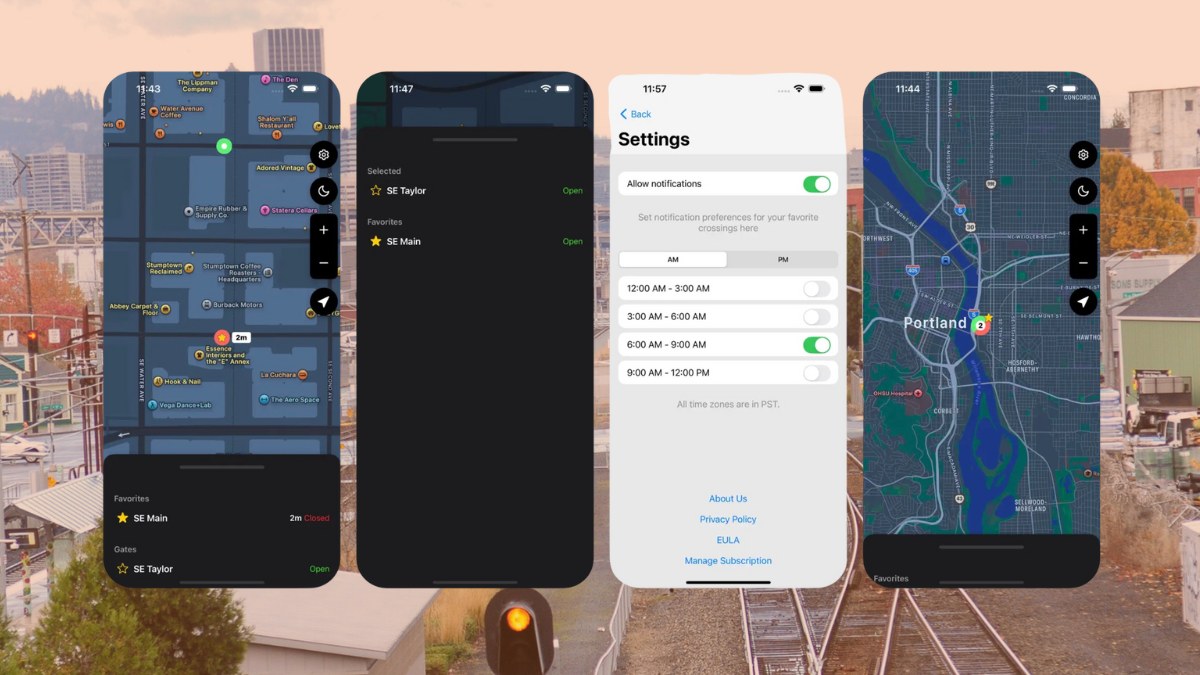
If you travel across the infamous railroad crossings in Southeast Portland where long delays are the norm, you’ve got to know about an app called TrainSnap. I heard about it recently and it works well.
You know the spot I’m talking about — where SE 11th and 12th cross four sets of rail tracks just south of Ladd’s Addition. The problem tracks are the two heavy freight rail lines that come out of nearby Brooklyn Yard. Because of outdated switching hardware, trains are known to sit and block busy cross-streets for up to an hour. The problem is so acute that the City of Portland applied for and received a grant from the Federal Railroad Administration to study the problem.
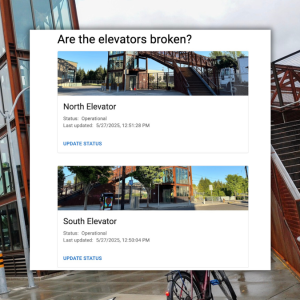
TrainSnap (available for iOS and Android) users a way to receive real-time alerts so you can reroute. The app is free and is easy to set up and use. You can even turn on notifications for the crossings you make most. The app will tell you if a specific crossing is open or blocked and how long it’s been closed.
And I hope the app developer doesn’t take this the wrong way, but I hope this app is useless in the near future! Hopes were high in 2023 when the City of Portland received the $500,000 FRA grant to study the problem and make recommendations. But here we are at the end of 2025 and it appears the grant is still not signed.
The last official news I heard about the grant was at the September 4th Portland Freight Advisory Committee meeting where the Portland Bureau of Transportation staffer in charge of the issue said they were still waiting to get the contract with FRA signed following a review from the city’s legal team. (A different PBOT staffer also said the city was in final stages of signing that as far back as February, so there’s clearly something amiss.)
Once the grant agreement is signed, PBOT will begin an 18-month planning effort. So it would likely be 2027 before we even have recommendations on how to tackle this problem — about a decade after the issue first made headlines. So for now, get the app!
Visit TrainSnap.us for more information and downloads.
Thanks for reading.
BikePortland has served this community with independent community journalism since 2005. We rely on subscriptions from readers like you to survive. Your financial support is vital in keeping this valuable resource alive and well.
Please subscribe today to strengthen and expand our work.
Where does the app get its blockage data?
The website that was run 6 years ago used a webcam overlooking the crossing.
This is a really good question. I installed it today and allowed it notifications and now I’m getting a string of open closed open closed open closed… an hour ago I got like 40 in a row. Turning that off!
What’s to study? The 19th Century rail alignment no longer works for the 21st Century city. The obvious infrastructure solutions would be very expensive to build. I bet the city study results in the government designing a less functional app than TrainSnap and letting people know to track train crossings. Maybe they put up some signs that light up when the train in crossing, like they have when Hawthorne Bridge is lifting. I’ll happily take $500,000 dollars from the city for these observations and recommendations.
It’s easy to be snarky, but the issue is not as simple as it might seem on the surface. Obviously, the current alignment doesn’t work. That still leaves open the question of the best way to solve it, which requires digging into the details of what doesn’t work and why. What are the pain points? What is the intensity of pain at those points? What are potential upgrades that might be made? What are the constraints? What are the benefits that each alternative might have? How much might each alternative cost? How long might each alternative take to be implemented? Which alternatives might be eligible for current grant funding? These are all questions without obvious answers, and if you guess wildly you might end up making a billion-dollar mistake. So yeah, it’s a good idea to pay six-figure sum to a handful of professional experts for a year to dig into the problem so that you can maybe save eight, nine, or ten figures over the next decade.
The existing level crossing in this area would be much less of an issue if it weren’t so close to the Brooklyn yard. The prolonged delays occur because the UP trains are too long for the yard.
The city/county/state needs to think big and long-term here. A land swap agreement that moves this yard further south would eliminate this parked train issue and eliminate a massive source of air pollution in SE Portland. A yard located near Canby/Aurora with double track mainline upgrade between the new yard and Milwaukie would be a good use of state rail funds, and city PCEF money.
While proximity to Brooklyn Yard is definitely the most relevant part of the broad issue of long trains blocking the crossing (and inducing dangerous behavior from people trying to “beat the train”), any solution will also be constrained by the junction with the line through Sullivan’s Gulch, the Steel Bridge, and Albina Yard. These are all more relevant for the grade crossings through the Central Eastside than the one at 11th/12th.
A land swap and a publicly funded intermodal terminal for UP in Troutdale or North Portland May lessen the need for grade separation in terms of annoyance to the traveling public, but the safety issues related to the colocation of the MAX and the mainline tracks will remain difficult to solve. And Canby/Aurora would be a less than ideal place for an intermodal yard. I believe most of the UPRR intermodal traffic is heading to the line through the gorge (UPRRs northernmost transcontinental line), so a yard closer to the ports of Portland and Seattle/Tacoma (especially Seattle/Tacoma) is more important than one closer to California by rail. Anyways, that’s a bit beside the point though since the important thing is moving the yard away from the busy streets of central Portland.
Don’t hold your breath. Union Pacific will continue to assembly double-length trains at the Brooklyn yard for the foreseeable future, and no study is going to stop them. It would take Federal action to stop this behavior.
Note that it also causes problems for Amtrak on time performance. These trains are so long that they don’t fit into many of the sidings:
https://www.trains.com/pro/freight/class-i/railstate-data-shows-prevalence-of-long-trains-on-bnsf-up-in-southwest/
They do this to save on labor costs. They don’t care about the impacts to everyone else.
As someone who tried the app recently, a word of advice: do not turn on notifications. Between freight and max and amtrak, your phone will explode due to all the alerts. 🙂 That said, a nice thing to have since we lost the webcam!
I wish it also included the NW Naito and NW 19th crossings.