

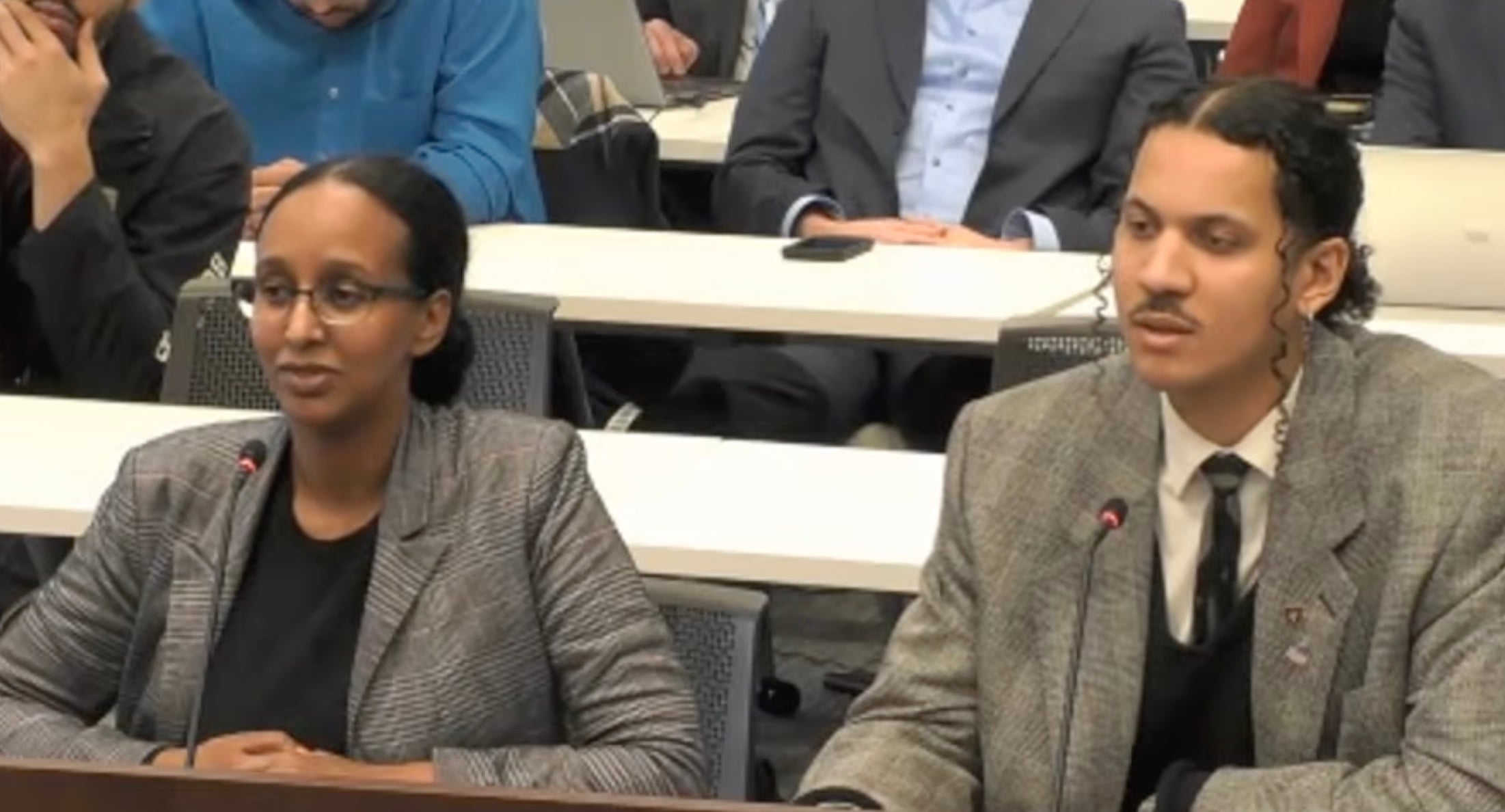
The I-5 Rose Quarter project received a stay of execution today thanks to last-minute maneuvering from leaders of Albina Vision Trust, Portland Mayor Keith Wilson and three Metro councilors.
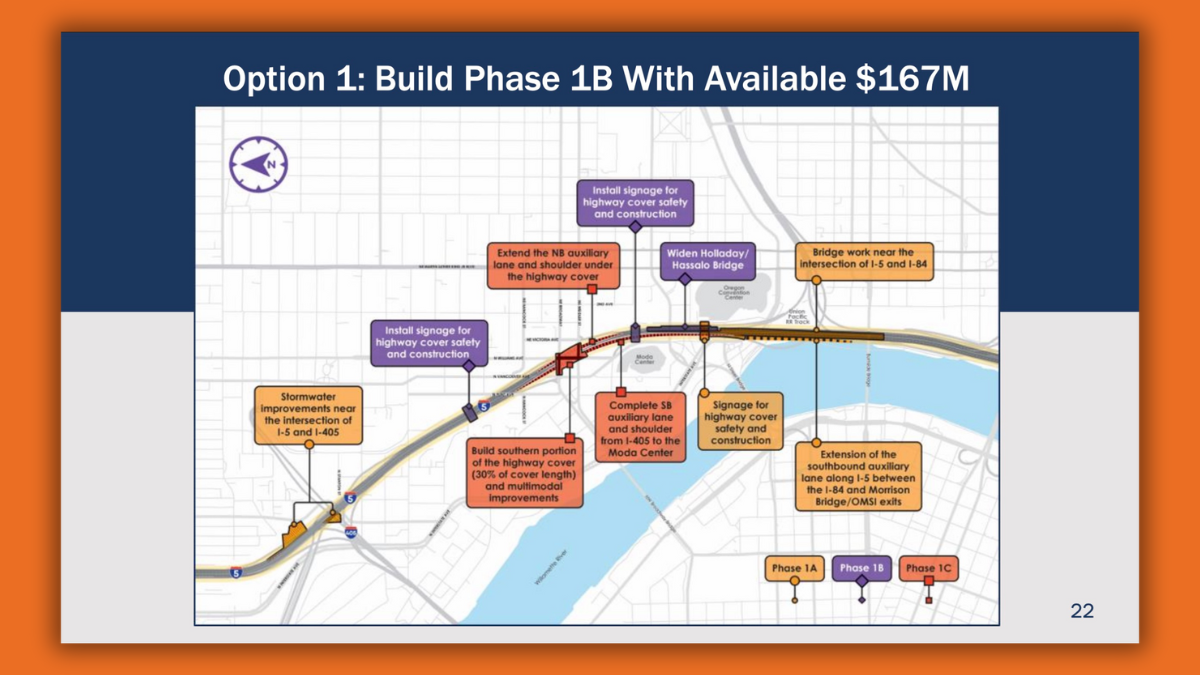
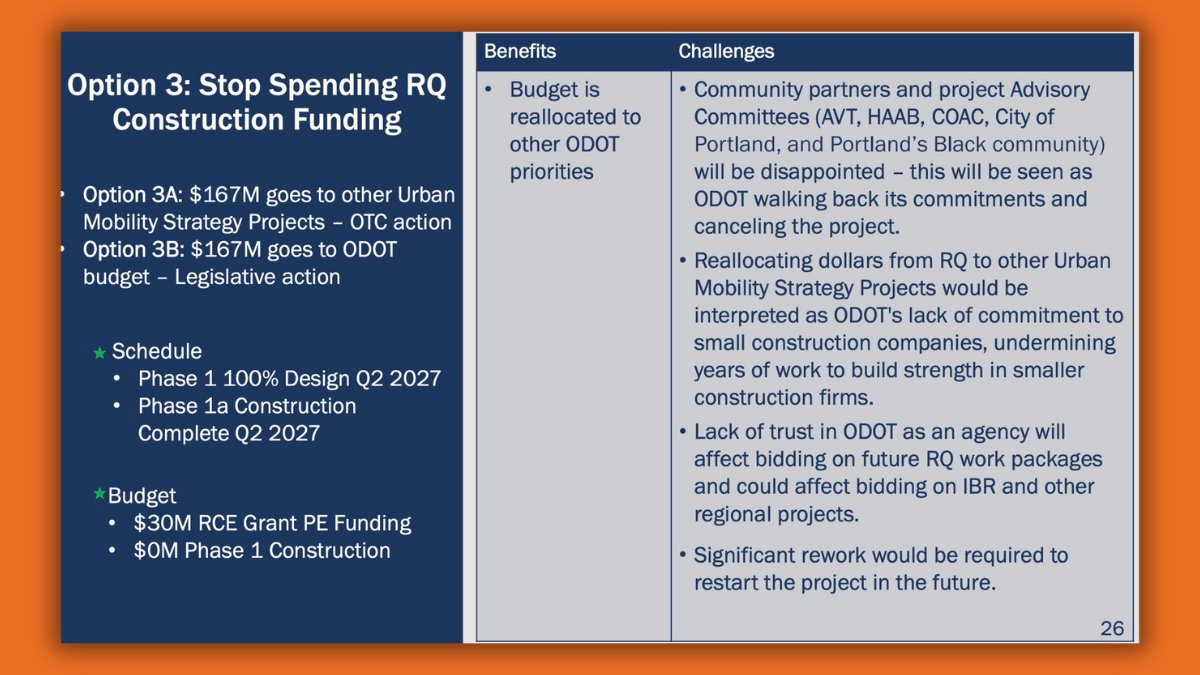
As I reported last month, the beleaguered, $2 billion project that aims to expand I-5 between I-84 and the Fremont Bridge and build highway caps and other surface street improvements, faced the possibility of being defunded by the Oregon Transportation Commission (OTC). After years of delays due to lawsuits, a skyrocketing price tag, and a political roller coaster ride, the project is at a low point. Desperate to maintain inertia, the Oregon Department of Transportation asked the OTC how to spend the remaining $167 million in the project’s construction coffers. Option 1 would use the money to begin an early phase of construction, Option 2 would use the funds to finish design and make it shovel-ready for full construction later on, and Option 3 would pause funding and re-allocate it to other projects (note that ODOT claims the funds could only be used on other regional highway expansion projects).
ODOT Rose Quarter Program Director Monica Blanchard poked serious holes in Option 3, saying that, in addition to ODOT staff and project advisory committees being against it (big surprise), “Portland’s Black community would see this as walking back on commitments, and cancelling the project would be further eroding their trust in ODOT.”

Even facing steep odds, the fact that a defund option was even on the table was a huge development.
No More Freeways (NMF), a nonprofit that’s filed multiple lawsuits against the project, put out a call to action among its members that resulted in over 200 comments in favor of Option 3 filed with the OTC before today’s meeting. NMF sensed an opportunity to strike a mortal blow to the project. But Albina Vision Trust, a nonprofit that supports the project and wants to rebuild a neighborhood on top of the highway caps, also sensed an opportunity — not just to save the funding, but to bend the project even closer to their vision.
And they called in some influential partners to make it happen.
In a letter to the OTC dated December 10th, AVT Executive Director Winta Yohannes — along with Portland Mayor Keith Wilson, Metro President Lynn Peterson, Metro Councilor and Joint Policy Advisory Committee on Transportation Chair Juan Carlos Gonzalez, and Metro Councilor Ashton Simpson — said all three options proposed by ODOT, “fail to adequately balance investment that would concurrently advance I-5 mainline (freeway widening) and highway cover related improvements.”
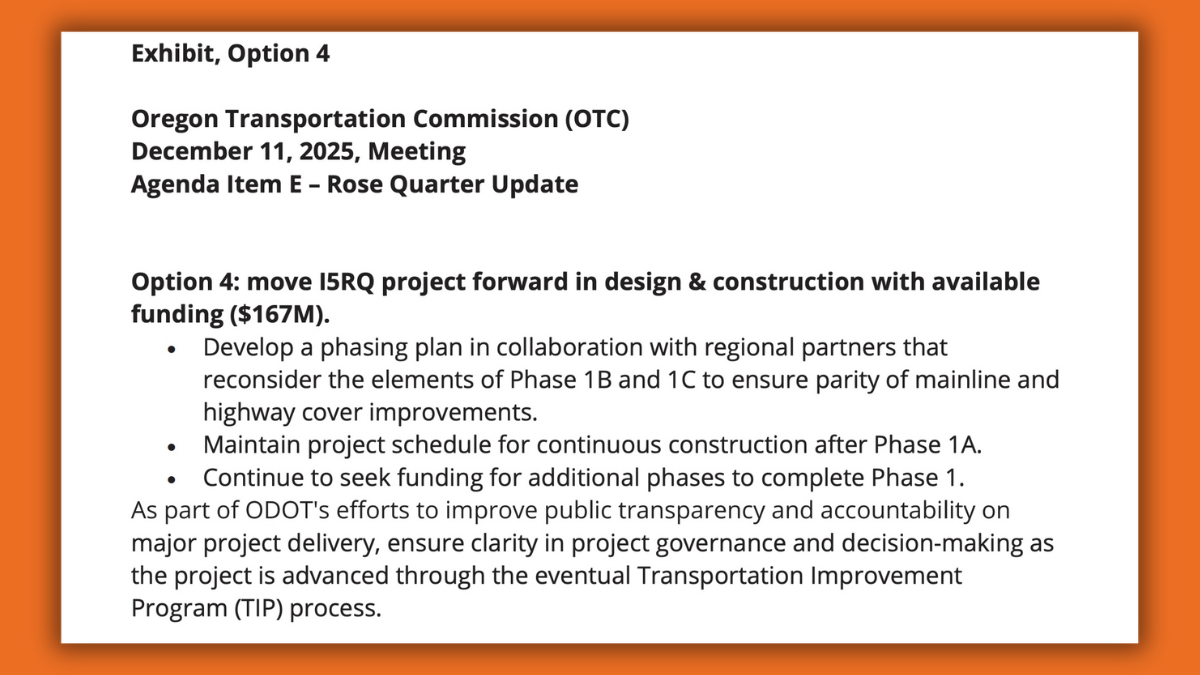
These influential partners proposed a fourth option, one that wasn’t known to the public until the meeting was already underway. Their Option 4 sought to use the $167 million to move the project forward, but to spend that money on project elements identified, “in collaboration with regional partners,” and “to ensure parity of mainline and highway cover improvements.”
Yohannes, speaking at the OTC meeting today, said, “We need to make sure that what’s [constructed] at each stage maintains the coalition that is ultimately supporting this project… we’re saying, ‘We want to work with you.'” “At a time when this project is facing so many threats,” Yohannes continued. “We think that our power is working together… we believe we can come to a thoughtful phased approach that everybody supports and that ultimately contributes to the overall success of the project.”
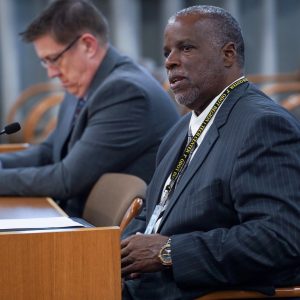
“I find your comments very persuasive,” responded Commissioner Lee Beyer (a former state legislator and one of the architects of the 2017 transportation bill that funded the Rose Quarter project). And so too did the other three commissioners present at today’s meeting. They all voted to support Option 4. The plan now is to bring this issue back to the OTC in February or March with a more detailed preliminary construction plan — a plan that is shaped by project partners and not just ODOT staff.
So the I-5 Rose Quarter project lives on, and AVT — the group that has held the keys to the project for years now — found a way to assert even more influence over its future.
In the end, Option 4 is much better than Option 1 (which was a very likely choice going into the meeting). It’s not the defunding some project skeptics wanted, but Option 4 introduces a bit more delay and more accountability about what gets built first from AVT, the City of Portland, and Metro. That should provide some checks on ODOT’s worst impulses and make it more likely that the agency won’t build the wider freeway first and value-engineer the caps out of the project down the line.
What about those 200-plus folks who sent in comments hoping to defund the project? Commissioner Jeff Baker acknowledged them at the end of the meeting.
“There were a lot of impassioned comments that come into us on Option 3, and I would encourage those that have a real strong feeling on Option 3 to do what I did: to learn about this project, go take a walk with Mr. [JT] Flowers… I think an understanding of this project and what it all means, not only the public investment, the private investment from Mr. [Phil] Knight, the [Portland] Trailblazers, and what this project means to the community — it’s very enlightening. And by walking it and seeing it, and hearing from somebody who grew up in the neighborhood, I think it would be really good to at least understand what it’s all about. It may harden their feelings, but I have a feeling that once they really understand and walk through it, it might be very enlightening.”
— See ODOT’s press release about the decision here.

Thanks for reading.
BikePortland has served this community with independent community journalism since 2005. We rely on subscriptions from readers like you to survive. Your financial support is vital in keeping this valuable resource alive and well.
Please subscribe today to strengthen and expand our work.
As someone that despises freeways with my whole being, and who felt incredibly conflicted by this project initially, hearing the perspective of JT Flowers, and especially this “Option 4” proposal, has turned me towards supporting this project. Obviously, in a perfect world, we’d get a freeway cap without freeway expansion, but it doesn’t seem like that’s a possibility. So I’m sincerely hoping that AVT can actually prevent ODOT from pulling a bait-and-switch by widening but not capping.
I believe it is essential that Portland does anything it can to repair the historical and ongoing fracturing and marginalizing of its Black community. And this freeway cap project seems like an essential step towards righting our wrongs, and putting real commitment towards the cause of racial justice.
You’ve been sold a bill of goods, Jen – in the same way ODOT has sold AVT and the community a bill of goods. The caps aren’t going to happen, and even if they do they won’t amount to much. Everyone currently in office will be out of office by the time anything actually happens, at which point the incumbents will shrug their shoulders and say “Not our fault.”
This is the usual Performative Portland crap. Don’t fall for it.
The caps will improve circulation, but most of the “buildable” area does not seem very desirable to me. Much of it going to be adjacent to even wider/faster, louder freeway- not something anyone wants to live near or spend anytime next to. Plus this “land” will be owned by ODOT, so no real wealth building and likely a lot of constraints that will make construction costly and complex. There is massive redevelopment happening across the Broadway Bridge at the former Post Office site, and another at the Lloyd, and a third at OMSI; additionally Zidell yards and the South Waterfront have a lot of open land. Buildings downtown are selling at unbelievably low prices. It seems incredibly far-fetched that construction on these caps is going to pencil out ahead of the alternatives. If we want to unlock potential and transformation, lets talk seriously above removing I-5 from the waterfront (re-route to I405 and cap 405)
“”Portland’s Black community would this as walking back on commitments, and cancelling the project would be further eroding their trust in ODOT.””
This is nonsense. Erode their trust in what? ODOT giving them bribe money or reparations or whatever you want to call it or for ODOT to do the right thing which would be to invest in human/public transportation?
At this point I vote for option 5 which is simply to give the 167 million to the AVT and not widen or cap anything. They get the money which is clearly all they want and everyone gets better health and a better environment by not widening the road for more ice vehicles. (Sorry 2Wheels, I don’t share your rosy future of electrics with the current administration)
It’s a bad solution, but at this point in the insanity not widening and capping the freeway is paramount.
I wonder, were these so-called representatives of the Black Community voted in by African Americans in Portland, or did they just declare it themselves one day?
Would be great to have an ‘option 4’ where they build the caps without the freeway expansion. I really want to see the caps happen. Regardless, if they choose to move the project forward there needs to be assurances that the funding for the caps is guaranteed.
That won’t happen John. There’s a clear understanding now that — if the project continues to move forward — it will be done in a way that makes relatively equal progress on the widening and the caps, at least that’s what I think AVT and their partners did today.
Exactly, Jonathan. I think yesterday was more a show than substance. In no way can the OTC take the construction funding away from ODOT. That money was given to ODOT in 2017 from the legislature in House Bill 2017. It will take legislative action to shut this project down. The OTC can — and will — direct the project, but it’s existence will continue until the legislature decides it won’t. The OTC doesn’t have that power.
Yes for sure. I’ve had that exact convo with sources yesterday. The real action will be in the legislature where lawmakers will have to decide if it’s worth it politically to support the project. There’s good reason to believe that given ODOT budget crisis, they might not support spending more money on Rose Quarter. But we’ll see. The momentum behind this project is still there. I can argue that it’s on life support, but I can also make an argument that it still has inertia to move forward.
Option 3 was never really an option. They just put it out there to act like they’re considering all options and taking public opposition seriously. They aren’t. Honestly Option 4 is better than what ODOT originally proposed which would be to start the widening and get to the caps later (assuming they have the money.) Then when the legislature can’t fund it and and the feds won’t they just throw up their hands and say oh well we tried here’s your nice wider freeway!
I don’t fully understand what “option 4” is hoping to get to. Are the “mainline” improvements the widening portions? It looks like the way the project is currently phased, the widening and expansion of auxiliary lanes are supposed to happen before any caps are built, would this proposal be able to change that order? If AVT is getting more of a say would it be possible to get caps without widening?
Option 4 is clearly AVT using their leverage with local politicians and from recent wins to ensure that the highway cover proceeds in tandem with mainline I-5 improvements, which includes the auxiliary lanes. Remember that a wider I-5 provides more buildable cover space on top, so there would be interest in doing both, even if it was possible to direct the available funds to build the cover only, which they can’t. Option 4 also puts more pressure on the legislature to come back with a funding mechanism, as Commissioner Beyer noted. No small feat. At this point I wouldn’t vote against AVT – they have the wind at their back.
It’s a pinky promise that means absolutely nothing, but gives OTC plausible deniability.
I still don’t see any real consideration of whether or not it makes sense to keep spending on a project that no one knows how to fund. It’s just two well meaning groups pitted against each other as if this were a purely ideological issue. It’s not. There’s no money for this. It doesn’t matter who would or wouldn’t benefit.
I know how to fund it; toll I5.
Why would you want to fund freeway expansion?
For the record; I don’t. But if pro-highway expanders want to pay for it, tolls are the way.
Got it, thanks. I agree with you there is a straightforward way to pay for it if that’s what will end up happening. I certainly hope it’s not though.
Congestion tolling is an extra cost to blue and some white collar workers who can’t change their schedules and don’t have access to safe public transportation. Toll a set amount to raise money, invest in improved public transportation for the carrot and then go to congestion tolling for the stick. Instead, any toll money seems like it will just go into the endless freeway fund whose only purpose seems to be to distribute money to organizations rather on positive results.
It’s not quite dead yet; It’s too big to fail.
This project would already be under construction if ODOT would just do tolls (rather, be allowed to do tolls) like the 2017 transportation bill stipulated.
ODOT wants to do tolls- in fact it has full designs for tolling stanchions for the Abernethy Bridge project. This was fully vetted and negotiated and Gov Kotek made an autocratic 180 and cancelled them mid-project. She alone deserves all the blame for the funding and traffic problems.
Yep, March 11, 2024. She killed it for political protection.
We can blame Kotek for traffic problems?
yes. Tolling has been shown to reduce congestion and support alternative transportation
Particularly dynamic pricing like in DC/NYC
The idea that a governor who has been in office since 2023 is responsible for traffic is a stretch when you consider the long line of decisions and actions that led us to this point. If she had slapped tolls on I-5 the day she took office, the region in general and I-5 in particular would still have a traffic.
Jeff Baker’s comments are incredibly condescending. As if the people who supported option 3 don’t understand the project or walk around North and NE Portland every day. AVT persuaded people to maximize money flowing in their direction. It’s that simple. I don’t mind that they do this. It is part of their mission. However, chumps like Baker, and the AVT are happy to compromise as soon as the rubber hits the road and just build bad infrastructure that is bad for the community as long as the money comes in.
I came here to say the same thing. Anyone who bikes or walks the area regularly – as I do and many other BP readers do – already knows the situation on the ground. Baker doesn’t have some magical insight cuz he once took a walk with JT Flowers.
Most people don’t really walk other than recreationally.
Those of us who can’t afford to own a car would like a word.
I agree. I attended my first ODOT I-5 Rose Quarter Project open house on 9/12/2017. At that time, I was optimistic based on what I heard and read on one of ODOT’s display boards: “This project will upgrade and add new bicycle and pedestrian facilities on local streets in the vicinity of the Broadway/Weidler interchange to provide a safer travel experience and encourage people to walk and bike.” I also joined the 10/7/2017 Community Bike Ride and Walk and shared my thoughts. Since 2017, I’ve patiently waited to see some (any) progress on ODOT’s original project objectives, and here we are.
I’ll add that I’ve also been walking through the Lower Albina area for many years. I say more here: 9/12/2017 ODOT I-5 Rose Quarter Open House | Albina Vision Trust | No More Freeways
Option 4 is just Option 1.
With only $167M (yes, only), the project will be able to make no meaningful progress on capping the highway or improving the surface streets that isn’t widening the highway or preparing for that widening. Earlier in the project process, when ODOT had the $450M reconnecting grant, ODOT needed more than $200M of it to prepare the highway for the cap, on top of the several hundred million they had in HB2017 money (that has since been moved away to other highway widening projects) they needed to spend on other highway improvements. The only thing that has changed in that time is inflated costs.
AVT should be smart enough to know this. Why they continue to use their substantial skills in storytelling to reskin a project that won’t benefit their cause until after the highway needs are addressed is beyond me. What they’ve done is—without changing a thing about the project or how it will be done (including the fact that it is $2B short in a state that can’t/won’t meaningfully change its transportation revenue picture)—is brought fresh excitement to the same old approach that, at best, needs to be reset to a discussion of Purpose and Need.
“ AVT should be smart enough to know this. Why they continue to use their substantial skills in storytelling to reskin a project that won’t benefit their cause until after the highway needs are addressed is beyond me”
They are smart enough and they are using their substantial skills to enrich themselves at the expense of the Black community and every Portlander. Their cause is to be the ones getting all the contract money and if they continue to play their cards right as they did yesterday, they will have control of the building of anything on whatever caps are built.
2 years ago, BikeLoudPDX Board Members attended a Word Is Bond “In My Shoes” community walk in the Albina neighborhood. It was thought provoking and informative. Many people involved have walked the area and talked with neighbors. I hope that we can reach a positive outcome for all.
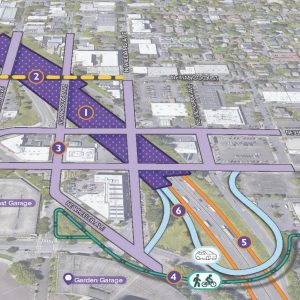
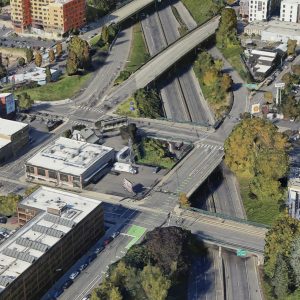
Looks to me like AVT is getting 30% of what it wants while ODOT is getting almost 100% of what it wants, freeway expansion and people riding bicycles and walking get even less.. The Option 1 photo shows:
This looks like another exploding whale project…
In the ODOT PROPOSED IMPROVEMENTS figure, we can see that SB I-5 users will have to change lanes TWICE for the I-84 exit, first weaving to their right across the Morrison Bridge auxiliary lane and then changing lanes into the Greeley auxiliary lane to I-84 exit. SB I-5 users wishing to exit at Morrison Bridge will have to decide when to weave and change lanes, at Greeley, at 405, or after I-84 to take the Morrison bridge exit. For the on ramps, SB I-405 users will have to change lanes TWICE to get onto SB I-5 and SB Wheeler users will have to change lanes TWICE to get onto SB I-5
A similar hazard will be present for northbound traffic. NB I-5 users will now have to change lanes TWICE to exit at Weidler/Moda Center or I-405, first weaving to their right across the auxiliary lane ending at Greeley and then changing lanes into the auxiliary lane to I-405 Weidler exit. NB I-5 users wishing to exit at Greeley will have to decide when to weave and change lanes at I-84, at Weidler, or after I-405 to take the Greeley Ave exit. Users from Broadway on ramp will have to change lanes TWICE to get onto NB I-5 and users in one of the I-84 on ramp lanes will have to change lanes TWICE to get onto NB I-5
This lane changing and weaving between on ramps and off ramps for I-405, I-84, and I-5 will take place across three lanes in just 540 feet – 1450 feet of each new auxiliary lane. There is research that shows “crash frequency is positively proportional to the number of lanes on the freeway and the average daily traffic per lane on the freeway, but negatively proportional to the length of the auxiliary lane and the percentage of heavy vehicles on the freeway.”1
Another study found that “if the weaving segment is followed by an entrance/exit ramp and this ramp has high traffic volume, it can be less operationally favorable to extend and terminate the auxiliary lane at this entrance/exit ramp location. Instead, dropping the auxiliary lane before this entrance/exit ramp represents a more operationally effective option.”2
A third study finds: that for an auxiliary lane diverging and merging from outside, the optimum length should be “1,000m – 1,500m and be added from around the start of vertical curve to several hundred meters beyond the end of vertical curve.”3 If you don’t know the metric system, 1000m – 1500m is 3280’ – 4920’, not 540 feet to 1450 feet.
From a fourth study, “Providing an auxiliary lane was expected to decrease crash frequency, although this reduction appeared to be primarily in crashes that were less severe (possible injury and property damage only). “4
1-Safety Impacts of Auxiliary Lanes at Isolated Freeway On-Ramp Junctions: Journal of Transportation Safety & Security: Vol 5, No 4. https://www.tandfonline.com/doi/abs/10.1080/19439962.2012.761661
2-Methods of dropping auxiliary lanes at freeway weaving segments: Transportation Planning and Technology: Vol 41, No 4. https://www.tandfonline.com/doi/abs/10.1080/03081060.2018.1453462
3-Effective Installation of an Auxiliary Lane at Sag Sections to Mitigate Motorway Traffic Congestion. https://www.sciencedirect.com/science/article/pii/S2352146516305452
4-Combined Crash Frequency–Crash Severity Evaluation of Geometric Design Decisions: Entrance–Exit Ramp Spacing and Auxiliary Lane Presence. https://journals.sagepub.com/doi/10.3141/2521-06
https://i5rosequarter.org/pdfs/sea/supplemental_environmental_assessment_508.pdf
What a waste of money. Put I-5 in a tunnel between OHSU and NE Portland instead. Demolish the obsolete Marquam bridge, cap I-5 to Lombard, and reclaim the east waterfront and dozens of city blocks in NE Portland. That is a lot of real estate for much needed housing. This was the vision put forward by an OSU professor in the 1980s. Forty years ago tunneling was risky and expensive. It is much less so now as proven by dozens of Cities around the world and our own CSO projects. It is certainly not without risk but that is true of any major infrastructure project.