

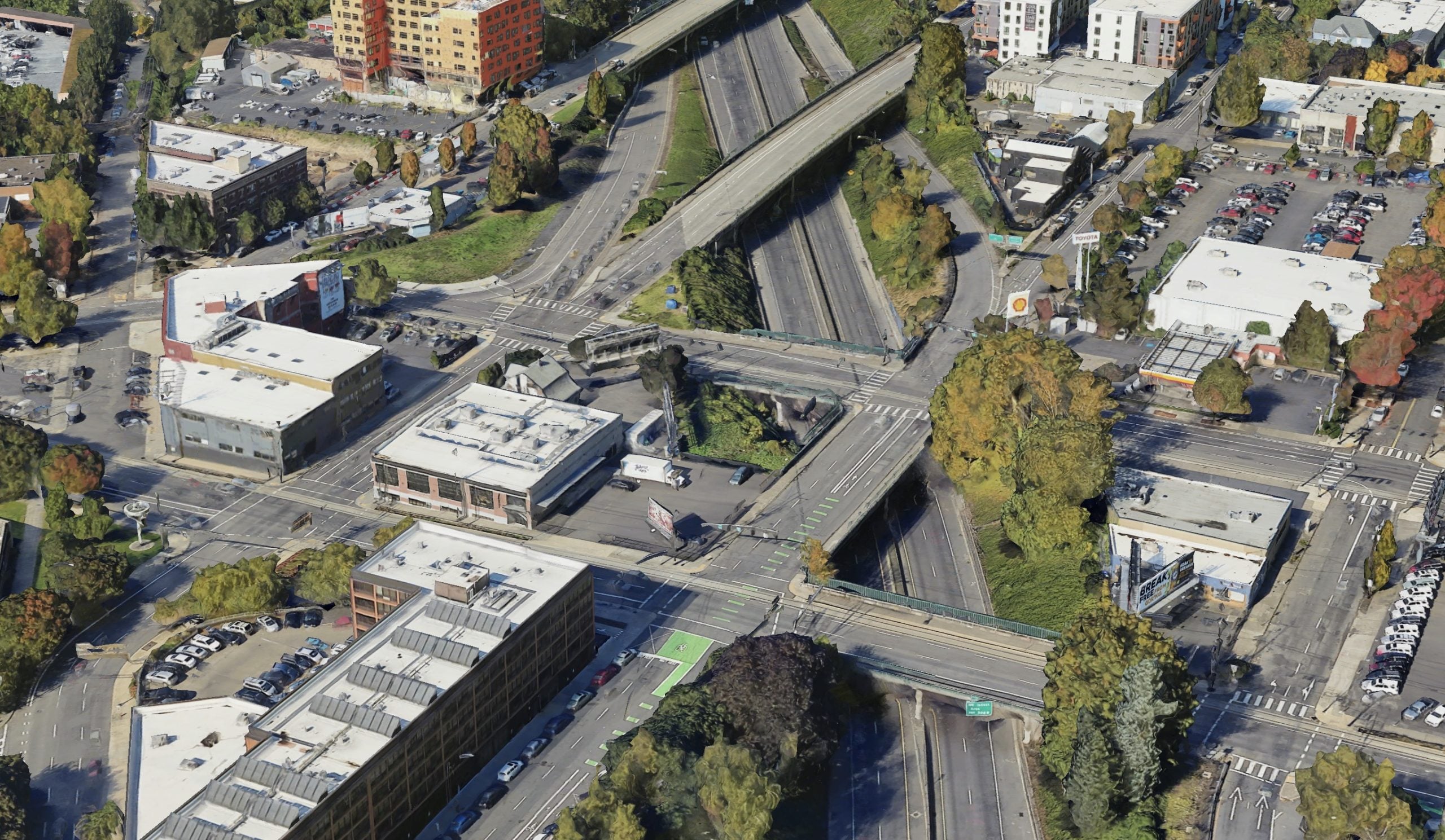
When people talk about racism and the I-5 Rose Quarter project, they usually talk about how government agencies destroyed hundreds of homes in the vibrant Albina neighborhood where many Black people once lived, in order to build parking lots and a freeway.
But race has simmered under the lid of this project for years as advocacy groups plant their flags and the Oregon Department of Transportation tries to navigate various constituencies.
In 2020, ODOT disbanded an advisory committee that had become skeptical of the project and hand-picked members of a new one to replace it. ODOT said the move was made to “intentionally center Black voices,” but the folks pushed out felt it was done to silence opposition. In 2021 BikePortland published a guest article by climate attorney Ka’sha Bernard, who attended an Oregon Transportation Commission meeting where ODOT brought in Black construction firm owners to, “say how good the minority contracts granted by the State would be for the community, while a bunch of young white kids got up there in tears proclaiming how their climate fates would soon be sealed.” “I thought ODOT would not stoop as low as to pit Black community members against young environmentalists,” Bernard wrote.
I’ve watched committee meetings where Joe Cortright, the White co-founder of No More Freeways (the nonprofit group that has done the most work to stall the project through lawsuits and community organizing) is vehemently criticized by Black committee members. “I take great offense to some of these comments,” Historic Albina Advisory Board member Leslie Goodlow shared at a meeting in March of 2024. “It’s the paternalistic tone. These people think they’re educating us? Hard pass.” “Joe Cortright’s on here talking about ecological stuff,” another HAAB member said after his testimony. “And I’m with some other people who say: ‘Where was he when they was building all this stuff and they took all this money and gentrified our community with all that money?!'”
That dynamic — where many of the project’s most ardent supporters are Black and many of its most ardent detractors are White — remains to this day.

With a pivotal vote about project funding looming at Thursday’s OTC meeting, No More Freeways put out an action alert telling supporters to demand that commissioners vote to defund the project. With $167 million dedicated to the project, the OTC can tell ODOT whether to begin partial construction, delay full construction, or to stop spending entirely.
No More Freeways says ODOT simply cannot afford to keep spending money on the project while the state’s lack of transportation funding is an “existential emergency.” “We simply cannot afford to let the Oregon Transportation Commission continue to throw good money after bad and allocate another $160 million towards this boondoggle when the state has so many other needs,” No More Freeways writes.
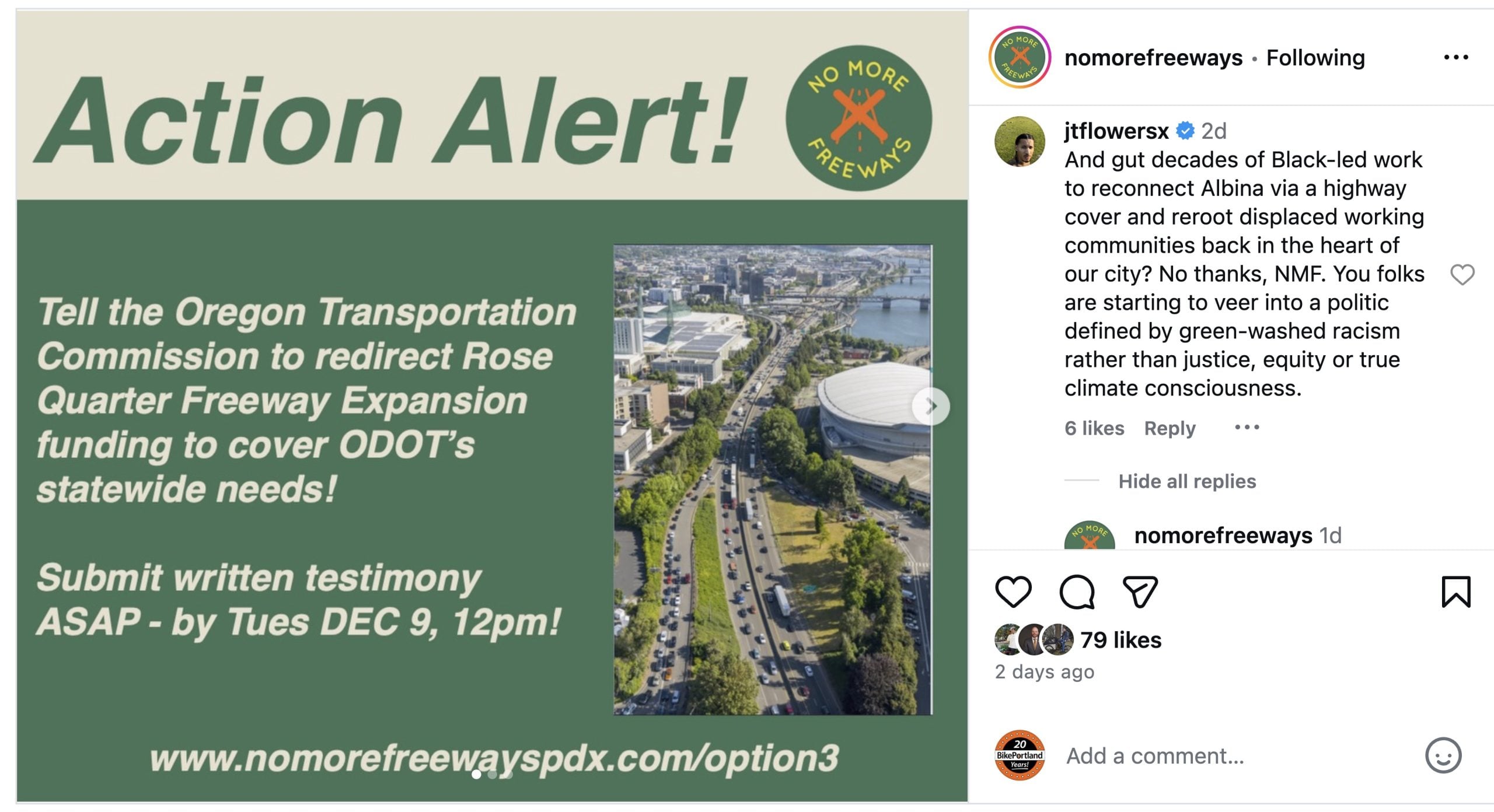
When the group posted their message on Instagram, JT Flowers replied in the comments. Flowers is director of government affairs for Albina Vision Trust, the nonprofit that in many ways controls the future of the project. To be clear, Flowers was writing from his personal account (I’ve reached out to him for comment and have not yet heard back), but his candor and critique of No More Freeways raised eyebrows.
“And gut decades of Black-led work to reconnect Albina via a highway cover and reroot displaced working communities back in the heart of our city? No thanks, NMF,” Flowers wrote. “You folks are starting to veer into a politic defined by green-washed racism rather than justice, equity or true climate consciousness.”
Someone from No More Freeways replied that they are in full support of the highway covers and that there are no current plans to spend any money on them. “Our grassroots opposition has consistently focused on our concern about the doubling of the width of the freeway that adds more car traffic, air pollution and carbon emissions into the neighborhood and makes building caps significantly more expensive and difficult,” No More Freeways wrote.
To which Flowers replied:
“‘Supporting’ the highway covers actually means heeding nearly six years of combined community engagement through which thousands of community members across Oregon (many of them being Black folks whose families, like mine, were displaced by the construction of I-5) collectively pointed towards an imperfect compromise: a partial expansion of the 28th worst bottleneck in the country built alongside an 8 acre highway cover that offers true vertical development opportunity on top of the cap, reconnecting Albina in a generationally transformative way. This is a statewide transportation project, meaning that it only has legs if it can appropriately serve the many competing needs of stakeholders of differing beliefs and ideologies. As someone who is an active champion of transit and an unapologetic defender of a transit-oriented, anti-single-driver-vehicle future in our city, it is still crystal clear to me that this project is not about the expansion of the highway — it’s about the statewide politics that make a restoratively redeveloped future possible for the daughters and sons of Lower Albina. You folks cannot continuously claim to be supportive of the cover while actively undermining the community-driven compromise that made it possible in the first place.”
Based on this comment, Flowers is no longer agnostic about the freeway widening element of the project. He believes it’s better to allow ODOT to move forward adding lanes to I-5 if it means the highway covers — and the Albina Vision — can be realized, rather than risk the entire project.
As if the OTC’s decision Thursday wasn’t difficult enough.
Stay tuned for more coverage.
Thanks for reading.
BikePortland has served this community with independent community journalism since 2005. We rely on subscriptions from readers like you to survive. Your financial support is vital in keeping this valuable resource alive and well.
Please subscribe today to strengthen and expand our work.
The only folks that have consistently veered into racism have been supporters of this project.
Hey Jay Cee—just want to make sure I’m reading you right. When you said ‘the only folks that have consistently veered into racism have been supporters of this project,’ are you saying the leaders of Albina Vision Trust are some of those doing the veering?
I’ll admit that I read Jay Cee’s statement this way, as a suggestion that some kind of reverse racism is going on here. Jay Cee, can you clarify?
I do not subscribe to the grievance politics of reverse racism. Either someone is being racist, or they are not.
In this case, the supporters of the freeway expansion have been using race to discredit their opponents arguments.
Using an opponent’s race to discredit their arguments is a form of racism.
Racism is racism, no matter which direction it comes from.
It’s interesting that there isn’t really constituency for highway widening that will speak to it directly so that we can have the conversation about whether it makes sense (or not … induced demand and all). Albina Vision Trust supports it because they want the caps and believe widening is necessary for any project to move forward here. My sense is that NMF respects that position but disagrees with it. Meanwhile, anti-freeway activists are continually told to sit down and be quiet when they question the widening proposals with arguments around ROI, increased cost for caps on a wider freeway, induced demand, ODOT’s financial situation, etc. The 2024 Oregon Active Transportation Summit had a panel on this project with a similar vibe. I’m glad NMF continues to engage in good faith.
Obviously in the current funding environment the Rose Quarter project should be cancelled because there is no money for it, and so even if they did move forward the most likely outcome would be a freeway expansion with no caps because there was no money for them, and then of course the same level of congestion because freeway expansions don’t really solve that problem.
Even if it were somehow the case that federal funding for the caps magically reappeared, the impression that I always got was that the restorative justice components of the project were afterthoughts to ODOT and the freeway cap portion of the project was likely to be quite underwhelming. Until federal funding got pulled, the outcome that I expected was a freeway widening project that increased pollution in the area and half-assed caps that had the veneer of restorative justice but more or less failed to really reconnect the community or rebuild lost wealth.
And even if the project was completely successful in every way, it always seemed to me like it would be reinforcing environmental racism in the sense that the desired goal was a newly reconnected, vibrant black community still breathing poisonous freeway air and thus at heightened risk for asthma, heart disease, stroke, etc as a result of that pollution.
So, it was always sort of bewildering to me that a project whose best-case scenario is “we’re gonna make more black people sicker than we would have before this project” was hailed as making amends for the racism of the past.
Thank you for pointing out the illogical nature of the freeway cap. I have often wondered who would actually want to live in a residential unit above a highway tunnel, where you would feel the rumblings and vibrations from traffic at all hours of the day. Not to mention the air quality issues.
How exactly do they plan to “rebuild” the black community? Are they going to build the freeway caps and then legally force black people to move back to this part of town? Are they going to legally prevent white or other non-black people from living there or starting businesses there? How exactly does this “rebuild” what was lost several decades ago?
COTW: “…the restorative justice components of the project were afterthoughts….”
I think to make sense of it you just need to ingest a dose of cynicism, and suppose that maybe proponents are developers and others who want to enrich themselves and not the black community, or any community.
I’d be a lot more supportive of JT’s POV if there was any legal obligation on ODOT’s part here but we know how this has gone in the past: they promise a bunch of extras which are cut at the last minute for budgetary reasons, so the only work that actually gets built is the freeway widening. There’s no actual legal obligation for ODOT to fund and build the covers, right?
No. Not that I’m aware of. And remember, the only thing that matters with these projects in the end is the politics. I don’t care about any law or legislative intent or promise made – if the politics don’t line up, the project will not be built.
The federal grant money comes with strings attached that require certain proposed design features to actually be implemented. Given that the bulk (only?) of the federal money that’s been awarded is for the caps, it’s reasonable to expect that those caps will be built in order to not have to refund the feds at the end. That said, whether the Federal government actually holds that standard is very much in question, given what we’ve seen since last November.
Can someone who followed those “nearly six years of combined community engagement” say how much discussion was given to only building the caps without the widening? I know ODOT never formally studied it, and I know people on both sides have expressed support for that option, but I want to know whether that option was brought up in meetings and how ODOT and others responded to it in those meetings.
I’m not saying anything new here, but it really seems like everybody wants the caps, and all the arguments I’ve seen from AVT and co center around the benefits of the caps, not the freeway expansion, and the main disagreement is whether those benefits justify the negatives of widening. It really seems like a cynical move on ODOT’s part to intentionally rule out the option that could have gotten wide support in favor of an option that would pit groups against each other.
And like NMF and other groups, I’m deeply skeptical ODOT will actually keep its promise to build the caps, especially given the rising costs and budget crisis.
As someone who worked directly on this project for almost five of the “nearly six years of combined community engagement” I can speak from direct knowledge that building the cover without widening I-5 was never part of the planning or formal agendas. Why is that? Because ODOT is in the transportation business and the purpose of the Rose Quarter project first and foremost is to address the bottleneck there. The highway cover component of the project evolved from the original proposed smaller, lighter caps incapable of supporting buildings to the single, larger, and more substantial footprint in the current plans that can support development and multi-story buildings. This is the direct result of engagement with the community most affected by the original construction of I-5 and is consistent with AVT’s vision. The first CAC advocated for more engagement with Portland’s Black community, which is the direction ODOT took and is what led to the current design. People advocating for “highway covers, not highway widening” are missing the point. The highway cover can’t happen without the freeway improvement to support it. The two go hand in hand.
Where is the ownership at of the land on any caps that are built? Who is going to be able to sell the new land to developers on the very low chance the caps are built?
By federal law, ODOT must own the land created by the highway cover since it’s technically part of the interstate highway system. When I was working on the project 99-year leases at very low cost to a community development corporation (presumably AVT) was the consideration.
Thank you!
The info I could find online really left it vague who would own it, but I figured there was an actual answer somewhere.
Yeah! Where was Joe Cortright when the City abused eminent domain to destroy large parts of the Albina neighborhood to give the land to Emmanuel Hospital in 1973? Or when Interstate 5 was put through the neighborhood in … checking … 1961?
Perfect example of bad-faith argument.
He was eight years old.
I think that’s the point.
There are so many things about this project I wish I could get straight. Here are some of them:
In the scope of all of I-5, what fraction of lane-miles would the full project add?Do the additional lane miles actually relieve the bottleneck?’If yes: What kind of induced demand can we expect from that increase in lane-mileage? What sort of annual increase in carbon emissions would that induced demand create? (Note: I’m assuming stormwater will be sufficiently managed to mitigate e.g., tire wear particles)If no: Would there still be induced demand? If there’s no induced demand, are there still climate implications of the project? Aside from the caps, then why bother with the project at all?Is this project one of many in I-5’s long-term plan to remove the bottleneck?Can we build the caps without widening the freeway in such a way that it doesn’t compromise the original design of the caps and leaves options to at least redesign the freeway under the caps?
I don’t support this project whatsoever for various induced-demand reasons, not that my voice in NC matters one iota in Oregon, but I do see the point of JT Flowers – at some point the current POTUS administration will end, likely by Jan 20th 2029 – and being there’s probably a better than 50/50 chance the new POTUS will be from the other political party, this project with the covers may get a second green light by then. Given the usual construction delays for all federal highway projects, by the time they need the extra funds beyond the $167 million, the new administration and congress should be in place by then – it’s all a matter of good timing and being in the right place at the right time. Of course, if the current governing party in Washington wins in 2028 all bets will be off and Albina Vision will have to wait for 4 more years, and so on – we’ve all seen various lobby groups wait patiently for decades if necessary to get funding.
It is very disappointing to see AVT devolve into a group of people that make bad faith arguments for personal financial benefit. Flowers must be aware that when he clumsily starts accusing everyone who disagrees with him a racist, that he undermines real efforts to create equity. But he does it anyway. Sad.
Is this AVT devolving? Hasn’t it always been like this?
Sorry, but I don’t buy JT Flowers’s argument – that the only way to heal a community is to widen a freeway. He could have the caps he wants *without* widening the freeway, and in fact that could have been done when the highway was built.
No – the whole reason and the only reason the caps were added to the project was to mollify the Black community and create exactly the argument that Flowers is now making.
Ka’sha was right: you don’t need to pit people against one another. You can help the climate and still help the community.
I agree Fred! The highway is the original sin- if we advocate to remove it, we don’t need the caps!
By the time this might happen we will have blown way past 1.5 degrees warming and the harms will escalate enough that this won’t even be considered due to financial recessions, broken budgets for adaptation. The cars and semi will be electric, spewing way less and mostly tire and a little break dust particulates, such that environmental impact studies will be anachronisms. The length of time really makes this discussion moot.
I wish you were prediction were correct but I’m not sure it will be in light of all the Trumpers are doing to unwind climate-protection efforts.
Wait, now PBOT are trumpers??
Apologies for the snark Fred! What a morning. I realized I put PBOT instead of ODOT, tried to edit it, realized it was snarkier than I meant it to be, tried to delete it, but was too late.
Several things:
VMT will likely continue rising at ~1%/year, resutling in a 35% increase by 2055 (this is a far cry from the 300% increase in my lifetime so far).
Tailpipe pollution is already down 50%-90% (depending on pollutant) since the 90’s. This is expected to continue to get better with retirement of older vehicles, tech improvements and EV adoption.
CO2 – it depends on how optimistic you are:
Scenario A (optimistic-ish, strong EV uptake):
Scenario B (moderate, some policy backsliding):
Scenario C (worst-ish “SUVs forever, slow EVs”):
But, in essence you’re right, for air quality the higher # of cars today is still better than the traffic in the 90’s.
The world is adopting EVs very quickly, and if our car industry can’t or doesn’t adapt, they’re toast.
US auto manufacturers know this, so I think Scenario C is unlikely, regardless of Whitehouse policy (and, in any event President Newsome [ugh] seems almost certain to reverse most or all of Trump’s environmental policy, something else US manufacturers know).
Do they need to adapt? Electric car sales in the US peaked in August of this year and are now falling sharply. They can’t compete without heavy government incentives.
January 2025: Over 102,000 new EVs sold, the 10th straight month over 100k; strong growth for VW ID.4, Cybertruck, Prologue.
February 2025: ~95,700 units, highest ever for February, but down 5.9% from January; luxury brands like BMW, Rivian grew.
July 2025: Hit 130,082 units, second-highest on record, 9.1% market share; strong gains for VW, Audi, Cadillac.
August 2025: Likely an all-time monthly record (GM announced its best month ever); surge due to tax credit expirations.
September 2025: Record 11.7% EV share; Tesla, Ford, Hyundai, Cadillac, Kia, GMC, Rivian all saw strong volume.
October 2025: Sales fell sharply (74,835 units, -48.9% MoM) after the expected post-credit lull, with EV prices slightly up.
EV sales might have fallen because everyone who was going to buy one in the later part of this year did so before the subsidies went away. Will sales rebound next year? Stay tuned to find out!
If you believe that the trend since September is indicative of where care sales will go in the future; that Trump’s energy and tariff policies will be enduring or permanent; that American car makers are prepared to give up on the international market; that foreign EV manufacturers will be forever locked out of the US market; that American consumers really want gasoline powered vehicles; and that batteries (the most expensive component of EVs) will not get cheaper, then, maybe you could see a world where Americans don’t take up EVs over the long term.
I don’t believe any of those things, but that’s just like, my opinion man.
Lithium suppy vs. demand *looks* like it should get a little better, but not hugely.
If a market grows for lower range, smaller commuter vehicles grows then sodium ion batteries might take up some of the slack.
Batteries are changing fast. If you are not an industry insider, it is very hard to predict where the tech will be in 10 or 20 years, and perhaps even if you are.
I certainly don’t know what the future is. What I do know is that there are a lot of very well resourced, extremely smart people who are well aware of the issues and who have a very strong incentive to find better/cheaper/more environmentally friendly technology.
Everyone knew LED lighting wasn’t going to work because there was no way to make reasonably priced blue LEDs (which are needed to generate white light). Then one dude figured it out, and changed the world (winning a Nobel prize in the process).
Obviously predicting 25 years out is prone to a lot of estimation – but the combination of needing a *lot* more lithium, building out charging infrastructure and getting people to spend the money to move to an EV will likely result in about 50% of the light duty fleet being electric by the early 2050’s. Add in further improvements to fuel economy in the modern ICE vehicle and we could very well see scnario A.
What is the beneficial effect of the progressive caucus in Portland–other than the virtue signaling? (super important to their online junkie base whose primary goal in life is to feel like a “good guy”).
Back in the real world, Portland progessives seem to only increase bureaucracy around the existing housing stock, create slush funds, and tinker with city government procedure.
Where are they on actually important issues like this one? Crickets.
This comment really is the epitome of “I have an ax I must grind so I will try to shoehorn it into every conversation I can find regardless of relevance”. Just a rant about the city council and an ad hominem attack on progressive voters and then a half-hearted attempt to tie it back to actual topic at hand with “well they should focus on this instead”.
Its completely apropos: why have they not commented on this topic which is more important than the other things they are doing?
They could be preventing a project that will spew out so much carbon and particulate matter and needlessly excavate gravel and god knows what else at the expense of improving non motorized transport.
But they aren’t because it involves a conflict they arent ready to face involving racial politics against progressive transport ideology. And they’re cowards. And also I just don’t think they’re interested in getting things done.
Isn’t saying my comment is ad hominem itself ad hominem? I’ve characterized the base of the Peacock councilors as terminally online and more concerned with self validation/ideological purity than effecting change–something I stand by fully and again, totally relevant.
Is Peacock councilors a useful term? I think the councilors probably split up different ways on different issues, and some of them absolutely work for change, and will get it if they can assemble a coalition around an issue. There’s nothing inherently wrong with people who make effective use of social media.
Useful or not, it’s a term the coalition created themselves…
“ Recently, Willamette Week’s Sophie Peel opened our eyes to a group of six councilors who call themselves “Peacock,” short for “progressive caucus.”
The members are Candace Avalos, Jamie Dunphy, plus four self-described democratic socialists: Sameer Kanal, Tiffany Koyama Lane, Angelita Morillo and Mitch Green.”
I’m still not sure how they dragged”Peacock” out of “progressive Caucus” or why they’d want to be associated with loud, obnoxious, vainglorious and poop depositing bird brains, but it was their choice. Maybe they’ve never been around actual peacocks?
Because it’s better than “progus”?
LoL, definitely better than “progus”!!
We should resist expanding I-5 not even because of climate change in some global sense, but more importantly, because of how any I-5 expansion will straight up increase the pollutants dumped into our air. Pollutants that we know for a fact will directly lead to all sorts of illness, from asthma to cancer. Spending billions to harm the health of everyone unfortunate enough to live or work nearby (not to mention those who drive it!) is ridiculous.
In addition to the pollutants, it pumps cars on to our City streets. The proposal includes 2-lane, high speed ramps with large radii corners. These are going to be dangerous and unpleasant intersections
NMF could definitely do a better job of making their position of wanting the caps clearer (that post JT commented on doesn’t mention it at all)
I feel as if JT is granting ODOT way too must trust – there isn’t anything preventing ODOT from expanding the lanes without the cap. It seems likely they would build the lanes and they just say they ran out of money.
What does it matter? There is no way ODOT would build the caps without the freeway work (for many reasons, one of which is that the current retaining walls won’t support them).
“Wanting the caps” without expanding the freeway is purely performative since it isn’t an option. But this is Portland, so maybe that’s enough. Maybe it would help if they also made a statement about Gaza.
My god, people. It’s a few hundred feet of ONE LANE. From day one y’all have acted like we’re building some 12 lane monstrosity. This city barely has freeways to begin with, and this whole outrages is a textbook example of treating a mountain like a molehill.
Also, YES, it IS racist AF to hurt my community again in order to “win”. White supremacy and bicycles are deeply intertwined but y’all will never admit it.
Do you believe it is possible to make a good-faith case against expanding the highway that isn’t inherently racist?
I’d argue that freeway expansion and white supremacy are historically deeply intertwined, but here we are.
The caps are not going to be built. There is no money for it, no finalized plans for it, and no legal binding contract that says it will happen.
No matter what horrible things you say about people who travel by bike, ODOT will not fulfill their end of the bargain.
The same ODOT that destroyed lower Albina 60 years ago promises are worthless. There will be no developer payday, only further destruction of the community.
The community would be better served by Flowers and others that are heavily invested in real estate development in N/NE, if they moved on to more important projects that are actually good for the community and not just a few pocket books.
I agree that some of the arguments at times exaggerate the width of this project and how many lanes (which can easily be repainted) could fit.
But this a $1,500,000,000+ (likely $3,000,000,000 the way ODOT manages projects) expense.
So that is a mountain of money. This is seriously a big deal.
One of the most expensive infrastructure projects in Oregon history.
The question is: how best can we use that money to serve the community, including the Black community so often harmed by our past choices?
For me, I don’t think making it slightly faster to drive everywhere for about ten years is the best way to improve the community, when we have so many Oregonians – disproportionately Black and brown and poor Oregonians – killed or injured in traffic each year.
We can’t just use that money to “serve the community” in a general sense. It’s money that comes from bonds issued against transportation revenue, which, under our state constitution, can only be used for certain kinds of transportation projects.
Maybe there are better transportation projects to fund, or maybe it would be better to not borrow against future revenue, but we could not use it for, say, housing or education.
> a few hundred feet of ONE lane
That’s a very casual way of saying “millions of dollars per foot.” For the price of six square feet of pavement, you could change someone’s life.
You clearly haven’t looked at the project documents. They are doubling the width at the current narrowest point, and the breakdown shoulders would allow the addition of another through lane. You are minimizing the cost and the impact to the community because you will personally benefit from this money.
Car culture, freeway expansions, and white supremacy are whats deeply interwined. Mote freeways creates more demand, whch creates more pollution, which harms more communities.
Have to nitpick the idea that car culture and white supremacy are intertwined. Freeway expansion and white supremacy? Sure, the evidence is there. Car culture is very multicultural though and I’ve seen some extreme auto fandom from many varied cultures and skin pigments. The car mind affects everyone.
Agreed — cars are a white people thing.
Another 20 years from now we’ll still be talking about restoring a neighborhood that’s been gone for 70 years
It’s not coming back
I agree, and for good reason: the black community was forced there by racist laws. Those laws no longer exist, and black Portlanders can live wherever they want. The highway did destroy the wealth of the black community and restoration is owed. This project has promised some large contracts to a few black-owned contractors. That may be a good thing, but it does not equal restitution to the larger black community in my opinion
When the US paid reparations to the Japanese Americans we had locked away in camps during WW2 the money went to the specific people who had been locked away.
If you want your tax money going to the specific Black citizens that were pushed out then fine.
I object to the idea though that skin color represents a monolithic group and that everyone who is Black in Portland now is due restoration. Also, once we go the financial restoration route for assumed loss of wealth of distinct cultural groups, we would need to consider the Italians and Jews and all the other cultural neighborhoods that were destroyed due to auto worship and hostility to anything not white.
https://www.pdxmonthly.com/news-and-city-life/2019/02/where-are-portland-s-vanished-immigrant-neighborhoods
maxD kudos to this. Great perspective. It’s always hard to divine the knee jerk MotRG tea leaves, but I’m guessing your passing on the baton to keep the dialogue going on how to restore the larger black community in Portland was not his original intention.
In any case it’s our job to continue to shine a light on history, both it’s mistakes and successes, which is how we grow as a culture. We can throw our hands up in the air, while sticking our heads in the sand (special type of convenient contortionist nihilism), and say “It’s not coming back,” whatever that means. Or we can work to rebuild a physical neighborhood. It is already slowly returning in some form or another, and has a literal vision. Returning the economic and cultural powerhouse that was Albina of the 50s is going to be a much more intangible and indefinite goal that may take generations. That process will be a good measurement of Portland’s ultimate success.
It has the same clear meaning as “ultimate success”.
One of the implicit promises made is that minority owned contractors would perform part of the work for the Rose Quarter project. It’s big enough and so conspicuous that they couldn’t be cut out without really conspicuous discrimination. I’ve been skeptical of the freeway caps but I support keeping contracts and wages in the community because it rewards initiative and supports local economic stability and prosperity.
Bike infrastructure in Portland happens in a piecemeal way and either city crews do it or a maybe a few contracts go out to private companies. If we had the vision to spend a billion or more dollars over ten years building sidewalks and bike infrastructure across the region that could be designed to engage local and minority owned contractors.
I’m damn sorry that bike infrastructure appears to track with gentrification so that it looks like a white project. I’m white but it seems to me that there are surely people of other races that could, and do, use a safe street crossing or a bike lane. I’m still for transit first, walking second, and biking third but I feel they go together really well. All three benefit any person with low income who can’t spend five to fifteen hundred dollars a month to operate a car.
I’m frankly jealous of the Utah initiative to link 95% of the state population AND JOBS within a mile of a multi use path.
Big round of applause going out to Joe Cortright. Leaning into logic is not about racism.
What feels like the elephant in the room is the aspiration for 90 acres for AVT. Is this a done deal? Were the tribes consulted or the state? Metro just signs off on that?
Seems like the same kind of colonizing land grab that got us into this situation.