
Crash leads to closer look at bumps on Esplanade ramps - UPDATED
Posted by Jonathan Maus (Publisher/Editor) on July 9th, 2010 at 10:15 am
(Photo © J. Maus)
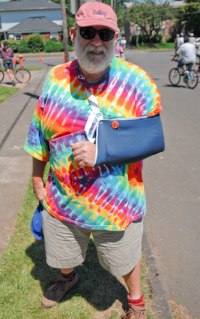
Vancouver, BC resident Ron Richings has visited Portland for the past several years to take part in the annual Pedalpalooza events. On June 26th, he was leading a ride of his own -- the Momentum Meander -- when he learned a hard lesson about one of Portland's most prominent bikeways.
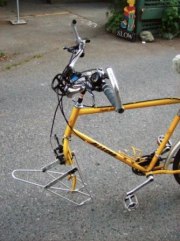
Richings was riding north on the Eastbank Esplanade. As he descended down the ramp that leads to the floating portion of the path (under the Burnside Bridge), his bike hit one four bumps that act as transitional lips between ramp sections. The bump shook his bike, causing a bungee strap to dislodge, become entangled into his wheel and crumpling his front fork. He flew over the handlebars and landing on the concrete walkway. Richings ended up in the hospital and still has pain in his shoulder.
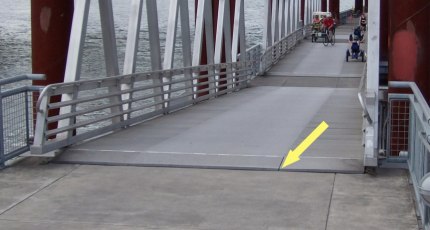
Doug Sottoway saw the crash and said, "It was a 10 in terms for crash horrifics."
(Photos: Ron Richings)
Many Portlanders have stories about these bumps. They are only an inch or two in length, but their extreme angle makes for a jarring experience -- both physically and audibly -- when you roll over them. The bumps have claimed numerous victims.
After his crash, Richings returned to the spot to examine the bumps and talk with other riders. "I heard repeated tales of injuries, ambulance calls, damage to equipment, and loss of accessories like headlights, blinkies, and similar stuff. Appears to be a well known hazard by those who live in Portland, and a potential trap for visitors like me."
"To have a major transportation route with a built-in hazard seems bizarre to me – particularly for a city putting so much focus on cycling infrastructure."
Richings then fired off an email to the City of Portland Bureau of Transportation (PBOT) to share his experience and his concerns. "To have a major transportation route with a built-in hazard seems bizarre to me – particularly for a city putting so much focus on cycling infrastructure," he wrote.
The section of the Esplanade where these ramps are located falls under the jurisdiction of Portland Parks and Recreation (which might explain why no one from PBOT has replied to him yet).
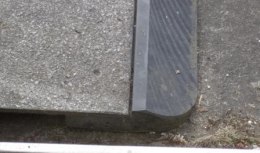
George Hudson, currently a consultant with Alta Planning, helped design the ramps as a member of Parks' staff when they were designed back in 2000.
When I asked him for information about the bumps (he calls them "aluminum transition plates"), Hudson pointed out that the entire system was designed to move with the tides. "Some people don't realize that the gangways and floating walkway are dynamic, they move. The transition plates on the gangways are the most dynamic pieces of the system, they move the most, making up the grade difference between each gangway."
Hudson also acknowledged that they make a loud noise when hit by someone on a bike, and that, "We did not see that as a bad thing when we designed the walkway, they give an audible warning by default, and I'd say they have an added affect of slowing people down, though the plates were not designed with that in mind."
Hudson says if there is evidence of crashes, he thinks the plates could be replaced with longer plates that transition the grade more evenly.
Parks department spokesperson Beth Sorensen says their Risk Management division has no reports of incidents. In the course of doing this story, I have brought the issue to Parks' attention and they have committed to visiting the site to do an evaluation. Sorensen says the first thing they might be able to do is add warning signs. She's also working to find out a hotline phone number people can call to report crashes in the future.
Meanwhile, Richings has begun physiotherapy for his shoulder (doctors say it will take 6-8 weeks for inflammation to subside) and he remains perplexed that the problem has persisted for so long:
"In a properly designed and built path the city would make sure that such hazards are corrected, not rely on riders to compensate for them. Would something like this be allowed on I-5? Of course not... It isn’t enough to build infrastructure. There has to be ongoing maintenance and review of problems to make sure that the system is cycling-friendly."
I'm planning to visit the site with a Parks employee and someone from the Bureau of Transportation in the coming days. I'll keep you posted on any developments.
If you have ridden over these bumps, please share your experiences and ideas for solutions below.
UPDATE: Here's the official statement from the Parks Bureau:
Two recent incidents on the floating docks along the Eastbank Esplanade have been brought to the attention of Portland Parks & Recreation. Specifically, two accidents by cyclists have occurred on the edges of the floating pathways.
All users of the Eastbank Esplanade, and specifically the floating walkways, need to be aware that this is a dynamic environment and the ramps and their edges are a complex structure designed to accommodate the location, which is functionally similar to entering a ramp to a boat dock. These edges were design to allow the dock to move with the rising and lowering water levels in the river. Because the river levels fluctuate daily, as well as seasonally, the edges of the ramp can become higher or lower in a very short amount of time.
Our Services staff is evaluating the site and any issues which might have contributed to the two recent incidents and will explore measures to mitigate the situation. Staff hopes to meet on site with cycling community representatives, to clarify issues and obtain their input from the cycling perspective.
In the meantime, staff is already looking at improving signage at those sites. While existing signs alert cyclists to use caution on the floating ramps themselves, additional signage is being considered that calls attention to the bump at the edge of the ramp.
Cyclists should exercise particular caution at those locations, just as you would crossing over a train or streetcar track. Slow down and approach the ramps straight on, and not at an angle.
Prior to these incidents, PP&R had not received notice of any safety concerns associated with this specific issue.
If people experience accidents or witness incidents on the Eastbank Esplande, they are encouraged to contact Barbara Aguon, PP&R Risk Manager, at 503.823.5478 and file an incident report.
Email This Post
Possibly related posts


I've ridden over the bumps, and while I never saw them as particularly hazardous, they are very uncomfortable and inconvenient. I can see though if you didn't know they were there and you were going a little too fast...
I agree with Richings comment, that it's unlikely something like this would be allowed to remain on a main road where the primarily impacted demographic was automobile users.
Granted, I feel the overall danger of this section of path is pretty low (relative to a lot of other things), but it should definitely be evaluated to see if there's a feasible way to make it better.
RecommendedSeems like the blame primarily lies with a weakened fork, and not a small bump. Folding a fork like that just doesn't make sense with a bump that small. It looks like he hit a curb head on at speed.
RecommendedSorry to hear about the accident, and I hope the gentleman recovers quickly, but I've ridden over those ramps on a carbon fiber racing bike(read: stiff) numerous times, and I've never had a problem. They are noisy and a little jarring, but I always stand to absorb some of the shock. Bunny hopping helps even more. I actually think that whole floating pathway system is a pretty impressive engineering feat.
RecommendedYeah, I hate those things. I ride south on the west side just to avoid the jarring bumps. If my tires are a little low on air, I always fear a pinch-flat when my wheel comes in contact with those plates. That would be sweet if Alta retro-fitted some longer, smoother transitions.
RecommendedI've spent a lot of time on the Esplanade--both on bike and on foot--and I've never seen or heard or experienced any problems with these bumps until I read this article.
RecommendedWas it the fork, or the bump that was the cause?
He is lucky he does not have more injuries from a front fork breaking.
RecommendedSeems like a longer plate would solve this.
In Waterfront Park during Rose Festival (and other events) they used to have covers where electric cords passed over the sidewalk that were short (about a foot or so) making an abrupt bump. More recently they have been using wider covers making them more like a street speed hump. Much better.
RecommendedI have wider tires so never have much risk there, but I don't like them. Those jarring bumps are hard on the bike. I wonder now how my fork is doing if his crumpled from the impact.
RecommendedI think they take a toll after awhile. They are jarring and in wet weather can create a bit of a slip hazard too.
This is my winter route to work (I have a new one for summer to avoid the crowds on the espalanade and now to the steel bridge as well)
I have thought to myself several times they could be smoother joins. I am bad a bunny hopping and it's still jarring even at a slower pace.
A little bump like that shouldn't fold a fork like shown in the picture, there's got to be more to the story here. I wonder if it was already weakened and ready to fail--if that were the case, any imperfection on his route could have done him in. I've seen people smack a curb head on at speed and wipe out, ruining their wheel but the damage to that fork just seems excessive according to the description of the accident.
RecommendedI lift the front wheel, but that goes without saying for high pressure tires. Making it easier to go faster may frighten pedestrians or lead to crashes for uncontrolled cyclists.
RecommendedThe wife and I saw someone's front fork crumple on these ramps last summer, a horrific sight to be sure.
RecommendedThose are more than just little bumps. I regularly have a choice of whether I exit the waterfront by going up the ramps toward the convention center, or continue down to Taylor Street; those bumps are definitely on the list of cons when making that call. I don't fear an accident from them, just wear and tear on my bike and my nerves.
RecommendedI've always found the bumps just a noisy inconvenience that is easily bunny-hopped. I too can't imagine that the bumps alone would cause a fork to fail that catastrophically.
Hell, to do that kind of damage on my old BMX bike I had to endo from 5 feet in the air!
RecommendedI bunny hop over the bumps at speed. If there are people in the way i either bunny hop over the people as well or just slow down to about 5-10mph to pass politely. Pay attention to the road and your surroundings and you will be fine.
RecommendedWow, sorry to hear about this and hope the guy recovers, but wonder what kind of condition the fork was in that it would simply crumple like that? I mean, sure these bumps can be somewhat "jarring" but it is not that easy to go fast on here with all the rollerbladers, joggers, pedestrians and baby strollers so I tend to go slow on them.
RecommendedThose bumps are the reason I switched my commute. I would love to ride the eastbank and drop over the morrison bridge right to my job. Instead, I go over the Steel and ride through downtown. To me, downtown traffic is safer and more comfortable than riding over those bumps. Also, what's up with that ramp on the east side of the Morrison bridge? Am I the only one who gets dizzy going down it?
RecommendedJonathan:
The bumps have claimed numerous victims.
Where's your evidence for this? In the story one person says he heard that they're dangerous, the other one says there are no incident reports. If you're going to write the above, shouldn't you provide evidence that confirms the statement?
RecommendedSlow down?
RecommendedThat 1" transition piece bent his forks BACK that far? Maybe he is too big for that model of bike, or the forks are defective. Looks like he hit a curb straight on.
Recommendedthese things are freaking annoying. i'm glad someone raised this issue. my thumb has been hurting from getting streetcar'd in NW :( and every time i go over these things it gets jarred. i have taken my injured hand off the handlebars to compenasate, but maybe we could smooth this out so that riders get a more comfortable experience.
just because it is tolerable for most doesn't mean it shouldn't be improved
RecommendedI was on Ron's ride, and called the ambulance for him. Glad to hear he's getting better. I avoided the Esplanade before because of these joints; now if there's a bridge lift and I am diverted, I slow way down to cross them.
RecommendedIt looks to me like this is a fork problem and not a facilities problem. There is no way that you could fold back a structurally sound fork like that on a transition as small those found on those ramps. It is hard to tell from the picture but that looks like an older lower quality steel bike that reached the end of its fatigue life. Even so, by the look of the deformation I would have to guess that the rider may have been surprised by the loud "clack" as he hit the transition and slammed on his front brake causing it to fold back. I hope the rider heals quickly. Accidents happen and I've had my fair share. It is often hard to remember exactly what happened when you are the rider.
RecommendedI see that it has a rack on front. Did he have something heavy on it? I could see that possibly being a factor.
But, seriously other than maybe some signage that says "Slow, Sharp Bumps Ahead" I am not sure what else the city could do.
RecommendedThose things are annoying. I've lost a couple lights before, but never thought they might cuase that bad an accident. Looking at the pic above, it appears that the fork bent back but didn't fracture. So it doesn't seem like it was due to old equipment. If there was a problem with the fork, I would expect one side or the other to fail. Not both sides at the same time and same rate. But maybe the picture is too small to tell.
RecommendedPlease note: I have updated the story to clarify that the bump did not directly crumple Rob's fork. The bump shook a bungee cord loose, which got lodged into his wheel and ultimately caused his fork to bend.
RecommendedI recently rode both the east and west portions of the esplanade with a friend visiting from out of town. She definitely falls into the "interested but concerned" category of bicycle rider. The up and down ramps scared her and were definitely her least favorite portion of the entire ride.
If we're serious about the Bike Master Plan (and I know I am) then I think we need to address trouble spots like these with more than just warning signs. While I imagine the majority of bikeportland readers don't find anything intimidating about bunny hopping the bumps, this is a piece of infrastructure that is meant to serve a much wider audience. We can do better.
RecommendedThat's a big guy, and if he had all his weight on the front...
RecommendedI'm going to venture that it's the <1" ramp toe that is difficult to negotiate on a bike, not the angle of the ramp itself as is purported in the article. Unfortunately, that dimension is probably a lot harder to change than the angle of the ramp. A slimmer toe with a longer bevel may not be durable enough, and a damaged ramp toe would cause more problems than the existing situation.
Seems a lot like streetcar tracks to me - just another known hazard to be cautious of. Potholes and other bumps get people all the time, but they're ubiquitous so people accept them. There aren't many other tidal-adjusting floating path ramps to compare this to, so it appears exceptional while the condition (a <1" bump) is really quite common. Nonetheless, it seems worthwhile for Portland Parks to check if there's a feasible improvement to be made.
Here's hoping Ron makes a full recovery.
RecommendedBTW, it sounds to me like the guy had a bad fork, and the reason why he crashed was because the fork failed as he went over the bump. I Aegis (carbon) frame with a carbon fork, I went over those bumps twice a week for two years, my frame and fork survived that without crumpling. I've never seen anybody crash on the bumps. Given the relatively small nature of the bumps I can't imagine a fully-functional fork failing the way this one did. That this guy is blaming the bumps for his crash says more about him than it does about the safety of the Esplanade.
RecommendedIf you're hitting those ramps at anything over 5mph. You're doing it wrong. You're descending to a floating causeway for crying out loud. You have no idea how much play there will be until you get to the bottom.
RecommendedUh, perhaps you could learn to ride your bike, sir?
OH MY GOD! A BUMP! exactly whom do I sue?
RecommendedSomeone mentioned that it looked like he hit a curb head on at speed....that's what going over those bumps feels like. I've never witnessed a crash but my friends and I have had multiple pinch-flats resulting from these, which are a pain when you are commuting to and from work. Longer plates seems to be the best solution. They would still allow for the tidal fluctuation. The noise is a much smaller issue.
RecommendedThanks Jonathan (#26), that changes things a bit.
And can we get off the bunny hopping thing? Should I really tell my mom that they aren't annoying because she should just bunny hop them?? How does my daughter bunny hop the trailer??
They are at least annoying and in certain, rare instances can be worse (lost lights are expensive, and suddenly released bunggies on a front rack are obviously a problem).
I'm not saying they NEED to be changed, but it sure would be nice if they were.
RecommendedIronic that the ride description said:
I hope he recovers well. Certainly seems like the transitions could and probably should be 200 to 300% wider in breath to ease the transitions as the level of the river can greatly influence the difference profile of the floating sections.
Recommendedit looks like the forks may have been defective. I've ridden across those numerous times with stiff carbon forks. I usually float my center of gravity way, way back when I get to them. I noticed that he's got low-riding pannier racks up front, was this bike fully loaded for touring? perhaps excess cargo weight may have contributed to the incident?
on a side note, those steep angle ramps, however small, do make for a sharp jab, especially at any reasonable speed. longer, and shallower ramps would make the floating portion of the esplenadé much more pleasant.
RecommendedNow that we've clarified the cause of the crash (#26), I don't feel this article takes an open and honest approach to the situation. Yes, it sounds like the bumps are worth a discussion, but they didn't cause this crash. They might have caused other crashes, and probably a lot of pinch flats for people with under-inflated tires, but not Ron Richings' crash. The bungee cord is the real "nasty little bugger" that should be in the photo.
There's no way the City needs to test whether bumps on its bikeways are capable of dislodging bungee cords.
Recommended"I've ridden over the bumps, and while I never saw them as particularly hazardous, they are very uncomfortable and inconvenient. I can see though if you didn't know they were there and you were going a little too fast..."
This kind of thing makes me a little mad--not because it's particularly dangerous (I don't ride here, so I don't know how bad they are), but because as Richings implies and Dave points out, it highlights the double-standard (intentional or not) between requirements for automobile travel routes vs. travel routes for everybody else. If such a thing were built into a roadway used by motor vehicles, signs would call them out ahead of time ("WARNING, bumps ahead") AND they would be painted in some way to make them visible. Hudson says they have an "added [unintended] effect of slowing people down", like it's a good thing. It may well be a good thing to get folks to go slower here (again, I don't ride here, so I don't know), but for crying out loud, don't "slow people down" by putting in sneaky hazards that slow you all the way down to the concrete.
RecommendedThat changes thing a whole lot. I knew there was more to this story and turns out there was a lot more to it.
RecommendedDamn those recalcitrant bungies. I hope the rider makes a quick recovery and gets back on the road.
I'm not sure how the city could ever reliably test for the bungie-busting ability of curbs and bumps even if they wanted to.
RecommendedMomentarily lifting the front wheel, and timing it right, is immensely easier than bunny hopping. Instead of jamming the front wheel in to the lip and getting jarred, it's lifted by pulling upwards on the handlebar while the rear wheel follows. Though slower than bunny hopping both wheels, it's more stable for the rider and easier on the bike.
Or they could just fix the damn problem by making subtler ramps. Girls don't have upper body strength along with cyclists with no arms.
RecommendedThose bumps are more than jarring. If you are riding a mtb or steel tank with 32s at 90 psi the bumps are not a big safety issue. But if you are riding a light road bike with 700x23 tires at 130 psi taking one of those "bumps" at 15 mph is a different experience.
And for those who are stating the fork is defective...perhaps you should read the post again:
"causing a bungee strap to dislodge, become entangled into his wheel and crumpling his front fork. "
RecommendedI am fully willing to blame the bumps. had he not ridden over them he wouldn't have had the problem, so they are at least partially responsible. Besides, noone is saying they love them, so why not spend a few $$ and fix them for good.
RecommendedHad he not gotten on his bike at all, he would not have had the problem - either...
Seriously? These things are moving ramps that go down to a floating dock-like structure that has to adjust to over 1 foot of daily tide influence and twenty or more feet of seasonal river volume adjustments. There is probably no fix that is "a few $$"
We have bicycle infrastructure needs all over the city and region, and we are having a discussion about spending money to improve a 1 inch bump?
How about the 1 inch bump at Tillamook & 16th where the bike boulevard crosses the traffic diverter? It doesn't even have an angled bevel, it is a solid edge and it's on both sides, both directions! I would like that "fixed". Anyone else? I bet we can make a huge list of 1 inch bumps.
When and where does common sense play in here? The "timid" riders already slow down in this spot, and it works out OK. My 9 year old daughter takes it nice and slow and does just fine - and she is as nervous as a rider gets. The bumps only really hurt people at speed. I myself have lost probably 10 blinky lights on those bumps, annoying as they are - and all I can do is curse myself for going too fast...
I have driven up and down lots of ramps to ferry crossings or floating bridges in my cars - and they have way more than 1 inch bumps on them usually, and the tires in my car are a smaller diameter than my bicycle tires... There are just some situations that demand prudence, some times you have to slow down.
Should we really spend our time and effort dealing with every 1 inch bump in town? Put up some clear signs, maybe paint the joints yellow. Done.
The scenic beauty, and amazing aspect of riding a quarter mile on a floating causeway way way outweighs the annoyance of what, at most 8 bumps...
RecommendedI know several riders who have had accidents there, one expert cyclocross racer included. I always feel these transitions are a problem, every time I cross them.
RecommendedProperly secure your bungee cords and ride at speeds appropriate for the conditions.
RecommendedThe article said he was going down the ramp, which means he rode over the edge of the lip. It was not a frontal impact which would more likely precipitate the fork bending backward. It seems in this incident that the dislodged bungie cord was the culprit which stopped his front wheel and flipped him over. It would appear from the bump photo that it shouldn't be a big deal to redesign and replace the nose of the ramp to eliminate such an abrupt transition.
RecommendedI avoid the diagonal diverter at Tillamook & 16th like the plague... that thing sucks for 2 reasons 1- you have to go really slow and turn and 2 you have bumps. generally i don't have a tremendous need to stay on tillamook or 16th so I'll just take the turn.
Recommendedsparewheel: Jonathan did not update the story until post #26. That is why so many of us wanted to know if it was a defective fork. We know now.
Recommendedyou guys are so mean, put yourself in his shoes. Why on earth should you have to prepare to evade a hazard like this. It would be like designing I-5 with a big pit in the middle that you have to avoid. Yeah you can go over it (might cause damage), yeah you can slow way down, but it only avoids the core problem. A problem evidently designed INTO the project. They are noisy as hell, dangerous and unnecessary.
RecommendedPS: keep the slats on the side of the ramps. I love the noise those make when you roll over them: roller-coaster.
Poorly secured load. User error, all hooks should have positive latching mechanism.
RecommendedBoy are we spoiled in Portland. It's a one inch bump for crying out loud. Yes, it's mildly annoying but dangerous...? Talk about making a mountain out of a molehill.
Recommendedok I just read all the comments and... well wow.... for the love of all that is Holy... what a bunch of timid posters! I love the Esplanade, ride it regularly on a aluminum/carbon road bike at 15MPH, and in the winter (when no one is around have hit 28MPH on that stretch with no problems or adverse effects to my cycle. It's a bump people, we live in a city! There are going to be potholes, speed bumps, garbage, leaves, gravel in the roadway! So be alert and ride your own ride, take the bumps at a speed you feel safe. Certainly they should be signed and painted yellow, but spending $$ on fixing such a minor issue is wasteful.
No I dont like those bumps either, but 5MPH really? why not just get off your bike and walk, or better yet stay home and roll yourself in bubble wrap?
Recommendedhow timely as I was just annoyed by these again on wednesday...
annoyed... but that's it... they're loud and bumpy and there's a lot of them... oh well... I've gone over them so many times without incident that they're just one of the usual tolerated parts of the route...
I've never lost a light, got a flat, or broke anything by going over these bumps...
from the looks of the "nasty little buggers" in the picture you could just remove that small lip and put on an extended lip... are those rubber? shouldn't be too terribly expensive... and it's part of the portland tourist trap so it warrants more attention than the bump at tillamook and 16th (which I don't think it THAT bad, but still annoying, but I understand the need to slow down due to peds and visibility)...
granted I ride a cruiser so I have plenty of rubber at low psi plus shocks in the front so I don't get nearly the jarring I used to but it's still a tolerable solution to a floating MUP...
also, when this incident was first reported after it happened I didn't realize this was the location is happened in...
RecommendedThe bumps have knocked my bike bucket off on more than one occasion. Fortunately, it just tumbled behind me, rather than locking up my rear wheel, still the experience was unsettling.
RecommendedDuncan, the point isn't whether or not the problem exists because it clearly does. This is a dedicated Multi Use Path and as such it needs to perform well for both modes. Sloppy design is what allowed this to happen. When you ride on a street you expect a certain level of danger. When you ride on a bike/ped path you are probably deliberately doing so because it is safer and easier to ride than streets.
RecommendedIf there are no pedestrians I have no problem going up and down these ramps at 20 mph. As many people have pointed out there are many more important places to spend money on bike infrastructure than smoothing a few small bumps. Now that it has been clarified that a bungie cord fell off and caused the wreck I hope the city throws his suggestions into the dumptster. What we have here is a stupid error by the rider. If this were me I would have just taken my lumps and shut up. I've crashed my bicycle many times due to my own dumb mistakes and have the road rash to prove it. I surely didn't ask the city to try to protect me from a mistake I made!
RecommendedI've bent a wheel on those bumps, and they are stressful on aluminum frames and other bicycle components and accessories. I tend to avoid that route if possible.
RecommendedI think we should bubble wrap the entire city and put pillows on each curb, free of charge of course.
Recommended"Should we really spend our time and effort dealing with every 1 inch bump in town? Put up some clear signs, maybe paint the joints yellow. Done."
Exactly. I think one of the main points people have made (in the article and in comments) is not that these bumps are super dangerous, but that if something similar were built into an automobile travel route, they would be called out in multiple ways to warn drivers about them. Speed bumps aren't dangerous either, but they are at least painted white or yellow to make them more visible. Why not give non-motorized travelers the same consideration?
RecommendedI have a hard time taking such small bumps seriously. The road has much more punishing hazards than this.
However, the bumps do seem to be an unnecessary engineering oversight that were probably mainly designed with pedestrians in mind. I doubt it's infeasible to smooth them out.
RecommendedAllan #47 = funniest post. "that thing sucks for 2 reasons 1- you have to go really slow and turn and 2 you have bumps."
Sorry, but I just find that post really funny! Slow+turn+bumps = sucky!
I'll now probably crash the next time I ride through there.
RecommendedI almost ate it on those last week. I was going fairly quick, and when I hit the bump the whole bike shimmied. I managed to control it, but it was unexpectedly violent and there was definitely a decent chance of crashing, even if I didn't.
RecommendedKtesh-
RecommendedYour bucket has the same issue as a bungee cord- an open hook is an accident waiting to happen. If your load was properly secured then it wouldnt be an issue. OSHA forbids the use of unsecured hooks for any time of list for a reason (CFR 1925) as does the ACOE (385 1-1). As a safety officer I deal with accidents and hazards, and the sign/paint option is a widely used and acceptable solution to hazards of this sort.
I still say that had Ron TIED his load insted of hooking it he wouldnt have crashed, and the same with KTesh (bike buckets are open hooks held in place with spring tension, I have quit using my for the same issue that K has.... only I blamed the tool not the road when it happened to me.
Secure things on your bike?
Slow down?
I'm consistently amazed at the whining.
More often than not, I'm embarrassed that other bikers complain so much for their own mistakes.
RecommendedHere is another option: Use Waterfront park instead if these bumps are too much. Both sides are connected by the steel and hawthorne bridges and there are no businesses that are near those bumps. Unless you are coming off the Morrison of Burnside bridges, it is avoidable.
RecommendedI'm surprised so many people are calling this whining. I know Ron and he's a stand-up guy and a very experienced rider.
I think these bumps are absurd and they need to be fixed immediately. They are simply too severe and they are unacceptable on a transportation thoroughfare. I hope the Parks bureau comes up with a fix soon.
RecommendedI love those noisy metal ramps...they startle pedestrians!
Glad this dude is okay.
RecommendedSeems to be a lot of ridiculous "it's his fault" commentary going on here.
RecommendedHave any of the people posting negative feedback READ the article or follow up?
As a note: Ron is as responsible a Cyclist as you would ever find anywhere on the planet.
He also takes very good care of his hardware.
That a bungee caused this is really unfourtunate.
It should be noted that those transition ramps are not ramps at all; they are more similar to a slightly curved curb.
I've ridden over them a handful of times on my visits to Portland and do think that there is a viable alternative to be had in the form of a more ramp-like plate...
Jonathan-
RecommendedI think that complaining about a one inch bump is absurd. I am sure Ron is a stand up guy... But the cause of his accident is not the bump but a poorly secured load. I mean was he only going to bike on MUPS? If you are urban biking you have to accept that there will be bumps in the road, and plan accordingly.
Why wait for the Parks bureau? Grab a can of yellow spray paint and go fix it.
RecommendedAnybody ever see someone in a wheelchair (especially a powered chair) struggle to get up and over these? It's not just a bicycle problem...
RecommendedI don't think there is any fault, it seems like a perfect storm of bad luck. Bungee cord get caught in the wheel at speed stopping the wheel with such force that it bends the fork,and it spits the rider over the handlebars. This situation is going to put anyone on their arse.
Those bumps are harsh, but I think a simple BUMPS 5mph yellow warning sign would do the job.
Recommendedyour kidding about 5MPH right.... how about "caution" let people figure out what works for them.
RecommendedI am not saying Ron is a bad guy or calling him a careless cyclist. He made a mistake by not making sure the bungie was secured properly. Live and learn. That could have happened anywhere, but because it happened on these bumps, it makes it on here.
RecommendedSeveral years ago I had the misfortune of being a first responder to a gentleman who hit one of these bumps and fell into the side rail (which forms a near 90 degree angle steel edge). He cut his cheek to the bone - it was not a pretty site and the blood stain was there for a year.
When riding alone, the bump may not be a big issue, however when people are passing on these bumps (opposite directions) they are often more nervous and that's when an accident can occur.
I've always thought these bumps were a little more aggressive than the needed to be. E.g., a one foot rubber ramp would improve the jolt siginifcantly.
RecommendedOne of the few places I'll get off the saddle to avoid the shock.
RecommendedI'd be worried that too much complaining or lawsuits will simply lead to an exclusion of bikes there.
Add signs and a OSHA type yellow and black diagonal stripe on either side of each of these joints. Getting that the in non skid thermoplastic might be tricky but it would also be a great scientific experiment in to how much automotive wear is affecting city wide application of thermoplastic versus bike and pedestrian only areas.
I avoid this route as often as possible due to these loud, jarring bumps. When the Waterfront is too crowded or closed, though, I have to take the Esplanade.
I feel like I can feel my brain rattle in my head when I go over these bumps. It's not a good feeling.
RecommendedAlways take this area slow anyways: never can tell when it might be wet even when the weather is clear and dry.
RecommendedIf you've slipped on wet metal or black ice before you know the best safety trick is to avoid it.
"The bump shook his bike, causing a bungee strap to dislodge, become entangled into his wheel and crumpling his front fork."
Sounds Like Operator Error, not the fork, not the bump, not the bungee, but the operator.
Maybe we could have the company that made the bungee cord also meet with the parks and PDOT people.
RecommendedGlad he is ok. But...
After calling an ambulance for his injuries, he should have called a whaaaa-bulance for his ego.
Total waste of time.
I totally agree with post #43.
RecommendedThis is one of those situations where I feel like we as cyclists are going to be percieved as a bunch of cry babies.
Like most everything else in life, riding a bicycle comes with a certain amount of risk. Someone crashed here - so what. Thousands of people (including myself) ride over these things all the time with no problem whatsoever. Personally, I think they're fun to bunny hop on the way down the ramp.
I've slipped and crashed on the Max tracks before. Unlike the gentleman in this story, I only blamed myself.
RecommendedI've had a pannier bounce of the rear rack before.
Maybe it is my fault for using a device with an open ended loop. OK, I tightened the bungee on it, but that won't help the next rider when he or she hits a loaded pannier bag. Fortunately the rider behind me dodged it.
Yeah this is probably safe most of the time, but given the high volume of traffic it should be improved.
RecommendedWow. This seems like the epitome of "Much ado about nothing."
The problem with his crash was not the bumps, it was that he *improperly secured his load*.
I've ridden over those "bumps" so many times I can't count, and they're certainly not problematic. If riding over those is a problem, it's a wonder he can survive on Portland streets.
RecommendedI take this route to and from work everyday for almost 3 years, even in decent rain. I ride a heavy steel 70's bike and haven't ever considered these things problems.
When riding South to North there are concrete posts to slow down riders. Going slow with a secured load, the 1 inch lip isn't a problem.
I'm glad that Ron is okay, this could have been much worse. Riding any vehicle is dangerous, but crashing on a bike is incredibly nasty. I wish him speedy recovery.
RecommendedThis story should be retracted and replaced with a more accurate story about the danger of poorly secured items on bikes.
As others have pointed out, there are plenty of other 1 inch bumps around town, and neither this bump nor the others usually cause accidents this serious. And emegency avoidance of dogs, small children, or sharp objects could result in the bike hitting a pothole or other bump of similar size. The rider in this case failed to secure items on bike properly and they came loose when he hit a bump of a size that is uncomforatble but should not cause a fall. While improved signage may be in order, Parks should not waste money on more expensive improvements here.
Recommended"I think these bumps are absurd and they need to be fixed immediately. They are simply too severe and they are unacceptable on a transportation thoroughfare."
The Eastbank Esplanade was designed as a 'transportation thoroughfare'!? That's news to me.
I don't know how these bumps became such an urgent problem since they've been there for years. Personally, I think it's absurd to blame a 1" bump for an accident when the obvious cause was an improperly secured load.
"They are simply too severe" in your opinion.
Recommendedget a bump call... wtf would the same crap be said if it was a safety hazard on a road way?
RecommendedAndy (#14) - I second your sentiment and love your comment.
RecommendedMake a tort claim against the City.
Recommended#84
Yep, it was paid for with federal transportation dollars and is open 24 hours, much like a public street, and unlike Waterfront Park, which is technically closed at night.
Recommendedroma,
let's forget about Ron's strap. These poorly designed bumps have claimed many victims and they are very abrupt and jarring. They should be re-designed to make for a smoother transition.
Nothing on a bikeway should rattle people's equipment off their bike.
And as for Ron's strap. If the bump was smoother it wouldn't have come loose in the first place!
I find it really unfortunate that simply because some people are experienced and do not have a problem with a bikeway quality issue they feel the need to voice an opinion that it's simply "whining" when someone expresses concern/dissatisfaction.
Many people that ride in America have become so used to being marginalized and neglected that they have become toughened to the point of criticizing people who speak out about poor conditions. That's too bad. Who cares if people perceive us as "cry babies". We need to speak up for better conditions and not worry so much about how we're perceived. If all we do is worry about what others think, we'll continue to be a minority user of the system, fighting for respect at every turn.
I completely agree with Ron on this one and have made my opinion known on this specific issue in the past (via a tweet several months ago).
RecommendedJonathan,
"And as for Ron's strap. If the bump was smoother it wouldn't have come loose in the first place!" is a patently ridiculous statement.
If his strap had been properly attached, it wouldn't have caused an accident in the first place, either.
As I said on Twitter, every road in every city in the world has "hazards" larger than that. From pedestrians, to rocks and sticks, rain grates, manhole covers, curbs, potholes, animals...
It's a one-half inch bump. It is not excessive, it is not any more dangerous than a curb transition (many of which are a lot larger than one half inch).
Nothing is perfect. Do you realistically believe that every riding surface should be planed smooth for your pleasure, swept clean hourly, and pedestrian, car and animal free? Maybe we cover every bike lane to keep the weather off, because those roads can get slick when they're wet...
This is the cycling equivalent of crying wolf.
RecommendedI have seen several accidents over the years, not to mention the miscellaneous bike lights and water bottles strewn over the path in this area. I am an experienced rider, but really detest these bumps on my daily ride. I particularly cringe when I see children or novice riders attempting to negotiate this area. While there is always a certain amount of "falling" risk in bike riding, if there is a relatively easy and inexpensive way to modify these it should be done to avoid even one more ER trip.
Recommended@Jonathan
I understand your point of view, I just disagree.
First, there still isn't any evidence that these have 'claimed many victims'. Even PB&R says this is the first they've heard of anyone having problems with these transitions, and it's been open for what, nine years?
I'm not criticizing people for speaking about poor conditions - I don't agree that poor conditions exist.
If I would have crashed after hitting this bump, the very last thing I would think is "wow - they need to fix that bump!" People's six year old kids ride up and down that thing all day without issue. Just because a few people have crashed on it doesn't make it a hazard. I'm sure there have been more accidents caused by off-leash dogs than have been cause by these bumps.
So yes, I think people who are complaining about these bumps are whining over a non-issue. I'll agree to disagree.
RecommendedI would also submit that the MAX tracks are much more a hazard than these bumps. What would you propose the city do about them?
RecommendedI lost a light off of a mounting on those bumps, the mounting did come off the light came out of the mounting - that tends to suggest pretty severe jarring.
I never thought much about them being unsafe but I also was not thinking of things like bungy cords that can come off and get in wheels.
I think most of us agree that they are annoying and potentially dangerous. Some of us may think that we can ride and avoid the danger but really we want people riding who are just starting out and this is a PATH not a road. It is specfically for biking and walking, definitely it should be fixed.
I also agree with the point that comparable level of "issue" on the highway would not be tolerated.
Fix it!
RecommendedOh yeah, Perry #71 has a great point, what about wheel chairs? That would suck to have to try and deal with those bumps and the sad thing is that it is possible to fix and have a great place for wheel chairs to roam.
RecommendedJohn-
I and others have offered a solution that could be easily applied (signage) and would be adequate. Your statement that "these bumps have caused numerous accidents" is at best anecdotal, and your one anecdote is arguable (and I am being very charitable). Is there a hazard... yes. In my industry (maritime safety) it is referred to as a tripping hazard, and the most common solution is to paint it yellow, and if necessary put a sign up. I don't go around telling ship captains to remove every bolt in the deck, I tell them to mitigate the issue. You are suggesting a very expensive redesign and rebuild when a can of pain will do.
Look I am guessing from your unusually curt tone that you are personally invested in this, and I understand that. But it doesnt make you right. People have opnions, and my opinion is that bump is a minor issue not a major hazard... and that the city has a lot of major bicycling safety issues to deal with first.
I also think that people who complain about every part of the road structure not specifically mandated for bikes and designed to their specifications are just whining. There will be cars, street cars, MAX tracks, pedestrians, potholes, stray dogs, kids that run out in the street without warning. We all have to deal with it.
The other thing I dont get is the many of the same comments about how these are a major issue are the same ones always saying everyone should bike 5MPH everywhere... have you not realized that these bumps (if properly marked) would act as "traffic calming"?
Yes I think it is whining. Generally I agree with you John. But not this time.
a properly secured load should be able to withstand the jarring of a one inch bump
RecommendedIf the river were to go up to flood stage, wouldn't the lips butt up against each other? I think we need engineers to explain this before proffering amateur solutions.
RecommendedRon,
no evidence of victims? are you serious? I've heard from several people via email/twitter/comments of crashes, ambulances, etc...
unfortunately, there's no reporting system to capture this stuff and many people do not think to call Parks.. why would they? who even knowns it's a parks facility? Simply because parks has no record of incidents doesn't mean this is not a problem.
And MAX tracks? definitely more of a hazard than these bumps. A huge issue, many victims, countless broken bones. The city should do a better job designing bikeways around them and should consider different track designs, investments in education/outreach about the issue etc..
but yes, you and I see this stuff differently apparently so it seems we'll have to agree to disagree. i'm fine with that! have a great weekend!
RecommendedDuncan #98,
Maybe you should tell the ship captains not to ride bikes on deck.
My point? Your analogy is not analogous.
Should this particular problem be fixed? Obviously, there are strong opinions on both sides. I would say there are more important issues. But, it sounds as though many people have damaged their bikes or lost equipment. Maybe it's worse that I thought. People expect to see curbs while riding around town and easily avoid them. This is a bit different.
Recommended"And MAX tracks? definitely more of a hazard than these bumps. A huge issue, many victims, countless broken bones. The city should do a better job designing bikeways around them and should consider different track designs, investments in education/outreach about the issue etc.."
I think this illustrates the main difference between you an I. Personally, I just accept the MAX tracks as potential hazard that I need to be aware of.
RecommendedJonathan:
let's forget about Ron's strap. These poorly designed bumps have claimed many victims and they are very abrupt and jarring. They should be re-designed to make for a smoother transition.
That's the second time you've said that. If you as a journalist are going to assert something YOU HAVE TO PROVIDE SOME EVIDENCE. Referring to anonymous comments and twitter posts does not count. Go out and actually interview some folks. Go down to the Esplanade and stop people. Ask them non-leading questions. (i.e. What do you think about the Esplanade? What do you think about this ramp? How often do you ride here? At what speed?) and see how many folks say it's dangerous. Too often you mistake a single incident for a full-on trend. I've called you out on this repeatedly and you don't seem the least bit intent on changing.
Evidence, evidence, evidence.
RecommendedSecure your load so that it doesn't lock up your wheel and break your fork. Maybe even check the rack specs and read what the manufacturer has to say about strapping bungee cords to it. Tighten your fenders while you are at it because they can be just as deadly.
After that, Get some data to back up the fact that these bumps are legitimately dangerous. Once you get the data, compare it to the countless other hazards that are out there and start prioritizing how everything's going to get fixed. Then think about how fortunate this city is to even have so many bike facilities, "floating docks", and multi use paths available to us.
You have your opinions, it is your site, and we all choose to read it. Thanks for bringing this topic to everyone's attention but there are probably more serious hazards out there.
Recommended"Many people that ride in America have become so used to being marginalized and neglected"
I can't stop laughing over how ridiculous this is. I'm in the smug "look I can ride with no hands over the bumps" camp
Come to think of it, I need to talk to my buildings HOA about the bump when I enter the building from the street
RecommendedMarginalized and neglected....
Duncan is absurdly advocating for use of bungee cords with non-existent 'latching hooks'.
You got a source for those, Mr. Safety Guru?
Recommended@BURR
I'm not the 'Safety Guru' you were refering to, but a with quick Google search you can easily find bungee cords with latching hooks:
http://is.gd/dmdCZ
RecommendedThere is also a carabiner style, though they might be a bit bulky for the use.
http://www.keepercorp.com/prod/carabiner.htm
RecommendedI ride over these often. I've never had a problem but I do worry about pinch flats and broken spokes every time I hit them. It would be great if they were less jarring.
RecommendedEven if they were just an annoyance they would be worth fixing. Probably cost about the same as fixing a few blocks worth of potholes, and as a major bike route I think it's a no brainer to put it on the priority list of potholes to fix.
Just because you personally haven't crashed on one of these bumps doesn't mean they aren't dangerous. I haven't personally crashed on the street car tracks either, but I know they are dangerous, and have heard dozens of people tell me that they have crashed on those. So even if you don't think sparing a few "inexperienced non local whiners that don't know how to secure their bike bags, and can't bunny hop" from going to the hospital a year is a worthwhile cause you gotta agree that they are annoying, and the cost of replacing a few rubber strips to make the nearly only problem with a 18 million dollar piece of transportation infrastructure go away permanently is probably worth it.
RecommendedDaniel (#110) - I suspect it would be a lot more expensive to "correct" the issue than a few blocks of potholes.
I agree with many of those commenting - this is a non-issue. I'm glad Ron is ok, and I respect that he feels these are not safe, but this structure was designed to be used at a walking speed, and to accommodate changes in river level due to the constrained (non-existant) right-of-way around the I-5 / I-84 interchange. The real issue is that bicycles have no good high-speed route through the area. The solution to the "problem" on the Esplanade is to pay attention, slow down, and maintain control of your equipment.
Jonathan, "cyclist" is right - a lot of your arguments generalize the experiences of one or two individuals. Your stories need to quote facts, or state unambiguously that there are no facts available if you want this site to be considered a "news" site rather than an editorial page. I appreciate the points you are trying to make as much as the next person, but a journalistic story rests on facts and logic, not speculation and opinion. (regardless of what the mass media tries to pull over the public's eyes)
Not trying to bash here, on the plus side, you are very proactive about adding items to a story, and about making corrections when in error - and your reporting and integrity are far above many in the local media.
Recommendedcorrection - change "a lot of your arguments" to "a number of your arguments".
RecommendedI fully agree with above comments about the root problem being a badly secured load. The rider happened to hit a bump on the Esplanade before he hit a pot hole in some other location that would have caused the same chain of events. The fellow was lucky to come out of it with a bum shoulder. There was a story in Bicycling Mag in the 1980s about a similar crash (front brake was not fastened properly after maintenance, fell off the frame and tangled in the wheel) where the victim broke his neck and went from an athlete to a quadriplegic.
First take-away: Do a routine safety check of your front wheel whenever you get on your bike. It takes less than 3 seconds to make sure nothing is going to cause you to do a header over the handlebars-- which could possibly ruin the rest of your life.
SECOND PART: I ride the Esplanade about once a week or so; I'm familiar with the bumps. They are like unavoidable potholes and I don't like to think about the way they can weaken a spoke until it snaps.
BUT these are not the only bumps designed in to Portland bikepaths. There are bridge approaches on the Springwater Corridor, for instance, that are as bad. On thinking about it, there is really no excuse for these designs-- they are almost certainly the product of engineers trained to build good roads, who don't have a clue that a bicycle is a very different animal than a motor car.
RecommendedSo I'm one of the many who have actually had an accident due to these bumps. Three years ago, heading southbound from the steel bridge, the bumps jarred my front wheel loose from my bike. The fork hit the road, I did a header slingshot over the handlebars and was in the hospital for five days with a broken vertebrae, cracked occipital bone, and fairly nice cut to my forehead (even with a helmet on).
RecommendedMy quick release was a little loose, so I can take some of the responsibility for the accident, but the wheel didn't come off anywhere else during my journeys for the day around town, it came off immediately after hitting the bumps.
Duncan, a yellow warning sign is a suggested speed, not a speed limit.
Recommendedcyclist and Matt,
I appreciate your lessons/advice on how i can become a real journalist.
thanks for reminding me that i need evidence. obviously i can go talk to a bunch of people... or i can do the story based on the fact that i know these bumps suck and need to be fixed.
how many people should i ask before doing a real story? I'd love to know.
maybe it's just me but i consider people who follow me on twitter, who email me w their experiences, who talk to me in person, and who comment on this site as being real people and real evidence. I didn't add them in the story for brevity's sake and because I didn't realize this would turn into a supreme court case.
and Matt, who says I want this to be a "news" site? This site is a bunch of things... sometimes stories are more newsy, sometimes they're a mix, sometimes they've got lots of opinion etc.
What sort of other facts would have been good to include with this story? I think there's a lot more to the story above than just my "speculation" and "opinions".
And yes, I admit, I often could do more reporting, knock on more doors, make more phone calls... but i don't. sorry. i have a million things to get to and i don't devote as much time to each story as i'd like.
Keep in mind the content of this site is created by one person. I have no staff and no steady interns at the moment and i can only do so much. i appreciate your feedback and i hope to meet your expectations in the future.
RecommendedMatt (#111)
The parts they are likely to use to fix the ramp will probably last a decade, or more whereas pothole repair will probably have to be redone annually, or on the street I live on every few months. Over the lifetime of the path I'm not sure you are right on the money issue in terms of materials costs. Has anyone visited a marina supply store to find out what these parts cost? I'm betting no one has so lets not argue about materials costs until we have some numbers instead of an uneducated guess. In terms of engineering I'm willing to bet enough stories of injury are going to pop up that the money gets spent on engineering whether or not it actually gets fixed. At an absolute minimum it needs signs warning people to slow down, and so some money will need to get spent.
I agree with you that there is no good alternative route for bikes. I'm betting it will be a long long time before the millions are spent to make a bike friendly route across I84, and through the Lloyd district. I tell inexperienced riders to "avoid the Lloyd". How about instead of wishing for a good route to happen someday that we spend a few thousand to fix a problem.
I'm trying to track down a person who ended up unconscious in traction after crashing on the ramp. I'd bet that a few days in the hospital cost a lot. If we are going to do a cost benefit analysis then lets find out the cost of not fixing it.
It amazes me how much push back the bike community will have for small improvements to our own infrastructure. I drive sometimes, and I can't think of anyplace on the freeway with a bump this jarring that didn't get fixed within a few weeks. It would be jarring even with thick car tires. How about instead of arguing against improvements we argue for more improvements. If we are fighting with ourselves for every tiny little thing we are going to get stomped on by other political interests. If we say "yes lets fix problem A, AND fix problem B" maybe we will will get both fixed instead of neither.
RecommendedOn another note I would like to say that I probably care about this route more than most people. Waterfront park is legally closed at midnight so a week from now when the Broadway bridge is closed the only route I can use to get home to NW that avoids the downtown drunk drivers at 1AM on a Saturday night is this one. Even the drivers that aren't drunk seem to be mostly from the suburbs, and show no evidence that they have any idea how to drive in the presence of bikes. I've heard stories like Matthaus (#114) before, and I always worry when biking home late at night that it will happen to me, and no one will be there to call an ambulance for me.
RecommendedI ride that way several times a week. I've never had an accident but I lost a headlight into the river from one of those bumps. I don't think it's dangerous if you just slow down a bit.
RecommendedWhile there are more critical problems to solve on this earth, I haaaate those clanky transitions. On the cargo bike I can bash through them and stress the equipment or slow down and then accelerate uphill loaded with cargo, stressing me. It's not a huge deal BUT it's a design flaw no doubt. Sure the system is dynamic but a redesign of the lip would cure all and be easy.
RecommendedI would think that it would require making longer steel planks that just replacing it with a longer piece of rubber if we want to make this less "jarring."
And I don't think that there is push back from the community for improvements as much as sometimes we just want cyclists to take responsibility for avoidable errors. Cyclist come in various skill levels. We ride different styles of bikes. We have different fitness levels. And, we are going to disagree with what "improvements" need to be made.
I do think these bumps are a hazard. Just not a big enough hazard for me to think it needs to be fixed. As I said, I think a warning sign would be appropriate and it would have been nice to have a warning the first time I rode across them.
RecommendedUsing the BikePortland.org's own crash reporter and examining reports for the last three years, I see exactly one incident reported on the floating portion of the esplanade and that was involving two bikes having a close call with each other.
http://bikeportland.org/closecall/view_reports.php
If so many people are having serious problems on these ramps, they should be reporting them.
RecommendedMatthaus,
Your front wheel coming off because of a bump is a lot more than your "quick release [being] a little loose". The fact that it was at that location is nothing more than coincidence, as it could have been any other location with a minor bump.
For instance, coming east across Grand down from the Hawthorne. That's one location that I've never personally had a problem at, but it is fairly clear to everyone who rides it that it needs attention.
RecommendedAs the cyclist whose crash is cited in Jonathan's report, a few comments and a bit more information that may clear up a few questions that have been raised in this amazingly long string of messages.
First, I don't have a problem with criticism about the use of bungy cords. I doubt that I will use them again in the same way. At the same time, I had ridden around town for a couple of hours, encountering the usual bumps and potholes, without any instance of the cords releasing.
When I came to the transition strip it was a VERY HARD bump, much harder than anything I have experienced in quite a while. That bump was the proximate cause of the bungy cord releasing, which of course led to the crash.
On checking, I discovered that there was an extremely low (minus one foot) tide at the time (a drop of ten feet or so from the previous high) and I suspect that that low tide, which affected the angle of the ramp, may have been the reason that the impact was so hard.
Second point. It appears to me that the rubber edge strip is a significant element of the general severity of the bump. I took a bunch of close-up photos that illustrate this, but that factor doesn't really come through in the small photos on the Bike Portland site. Perhaps I or Jonathan can post them on his Flickr page with a link for those who are interested.
What is important about this is that a major part of the 'solution' may be to simply remove those strips. I think that the transition planks themselves may be fine. There is one ramp that doesn't have such a strip, seems to work fine, and causes virtually no impact when you cycle over it. If I am right about this then at least part of the solution could be virtually no cost.
Third, I talked with several people after my incident and ALL of them had either had problems with that bump or knew of someone who had either been injured or lost equipment due to the bump. Not exhaustive, but there certainly appear to be many instances of problems, they just haven't been collected until now.
Finally, while cyclists who bunny-hop over the bumps are no doubt displaying some riding skill, based on their experience with the ramps, that is really not the point. What it really shows is that there is a problem that people who know about it are working around. And like any such safety issue, the answer is to FIX THE ROOT PROBLEM rather than training everyone to work around it.
In any event I appreciate Jonathan taking the time to write the piece, and everyone else for the comments and information that they have taken the time to share.
Ron Richings
RecommendedRiding full rigid, I like to shove my nose into the bumps and kinda pop out of them off the front wheel.
Not really a bunny hop, more like a nollie pop.
RecommendedOn a Ritchy fork from 1988....
Recommendedthis is idiotic--I'm sorry someone got hurt--but really, complaining about these bumps in this place seems odd to me--no one should be going fast down those ramps (though many do). For a careful rider they aren't a problem. BUT do get rid of the bungees!
RecommendedJonathan #116:
Following up on John Lascurette's post (#121), there were more than 900 incidents reported in the last three years on this site, none posted at that link. Of all the comments posted in this thread, there was one person (other than the subject of the article) who had an accident, and that was because they didn't apply their quick release correctly.
As to what you could do, well, you could do a whole lot more. You often assert that you've "heard from others" in a story without actually printing who these people are and what they have to say. If you're going to depend on anonymous Twitterers you could at least quote them. As it stands right now, you assert "The bumps have claimed numerous victims" without providing any such examples. When I'm asking for evidence, this statement is precisely what I'm referring to. You provide 0 backing to support that claim in your story, and an expert he contradicts it.
No matter how well you know that "these bumps suck and need to be fixed" you still have to actually prove that to the rest of us. Providing the story of one guy riding a bike with an unsecured bungy hardly qualifies, does it? Here are some ways you could prove your point:
Do a fully scientific survey to figure out how many people have had an accident on this section of the Esplanade
Do an unscientific survey on the website to find out how many people have had an accident on the Esplanade
Stand out on the Esplanade and talk to people about whether they've ever had an accident there.
Post quotes from the Twitter folks/emailers, etc who have had accidents there.
You saying simply that you know they suck and that's all the evidence you need is entirely unpersuasive. Offering a single account of a single incident is also unpersuasive if you're intending to prove a trend. You might not like the fact that people are telling you how to make an argument, but if you want to convince people that this is a problem, you're going to actually have to provide evidence that there are multiple incidents.
RecommendedBurr-
Positive latching simply means that you arent depending on tension or gravity to hold the hook in place. There are many ways to do it, but your so damn smart I am sure you can figure them out.
I use bungees on bikes and motorcycles, both of which uses can be harmful/fatal if the load fails and gets stuck in a wheel. Over the years I have seen enough failures with bungees that I always use at least two and cinch them tight enough that the load cannot shift enroute.
and Burr- dont be such an asshat, 'k?
RecommendedYou call that a bump? You must not have ridden in Boston! ;)
Seriously though, instead of signage, if they plan to put a longer reach in could it be painted or powder-coated yellow? If I was riding down that path onto a floating walkway I would assume there'd be a hefty transition, but I wouldn't assume everyone would think the same way.
I can relate to Ron's situation. I recently had my front wheel slip out in low speed in the rain on a ped path turn in Mt. View, CA, and hit a retaining wall just right, breaking my collarbone and pinkie and bruising my hip. I was avoiding the yellow line thinking it might be slick, but I think I just happened to have mud on my slicks. It wasn't raining when we left, by the way... can I sue the Tour of California for bringing rain in June?
I suspect a number of injury crashes happen at low speed on these mixed-use connectors. I notice the asphalt on many is the same type used for roads, but maybe it should be the (more expensive) water-shedding kind. Planners can't always be blamed for not thinking these things out in advance (or applying the tools they know from roadways), unfortunately there are victims in the learning process.
Speaking of learning, I have definitely learned not to hook my pinkies behind the bar when in the hoods...
Hope you heal up quick Ron!
Recommendedso I road my favorite summer ride last night (SE 72nd to Springwater, around the esplanade then Hawthorne/Ladd/Clinton) and I didn't find the bumps to be the most jarring part of that ride, but rather crossing MLK after the Hawthorne Bridge. Now I don't know the tide stage (good thinking Ron), but I hit those bumps at speed (ie 20 ish my speedometer is broken) and it didnt even cause me to hop after them... so after a site visit I still dont get the big deal.
RecommendedYeah, yeah, I know... you crashed riding in the rain? You must never have ridden in Portland! :)
RecommendedBunny hopping or lifting the front wheel is not an option on a recumbent; you just take it in the butt. Poor design needs to be redesigned with a more gradual slope; it's not rocket science - just common sense. We don't fix potholes in the road with a sign warning about them; we actually do something about them (pretty much, anyway).
Recommended"Hudson also acknowledged that they make a loud noise when hit by someone on a bike"
Not always. If you position your wheels to roll directly over the seam there's virtually no noise made.
This is the seam (on both sides) that runs parallel to direction that we ride. It's about two feet from the edge of the ramp.
Try it.
RecommendedI believe in personal responsibility and proper load securement.
A 1 inch bump is an obstacle a bicycle should reasonably be able to navigate, since obviously there are 1 inch bumps all over the city.
If people underestimate them, paint them yellow and put up a sign I guess... but this is the sort of treatment that would never make it to the I-5 bridge route.
I think some people will not be happy until everything is made of yellow nerf material. Novices and people on routes they are unfamiliar with should be cautious, unless they want to lose their lights etc.
RecommendedWow. So much to say here. I'll start at the bottom and work back.
RecommendedAnonymous-please understand a situation before making derogatory comments. Ron is not only a seasoned cyclist with more experience I bet than I have (and I've been biking almost 30yrs) but he's a strong advocate with a wealth of knowledge in this area.
I also strongly agree with El Biciclero regarding the double standard. I just rode down the ramp from Marine Dr to the max and the bike path is circuitous enough to slow people down to 8mph. Now why isn't that done on roadways like Powell? (and such a thing was proposed) Because the planners are also drivers. Planners often show a philosophy that slowing down traffic is bad because it hurts traffic flow, but slowing down anyone who's not in a car is good for safety (have you ever cycled across the bridge that crosses Going St in North Portland?).
I tend to do the same thing as Anne. The bumps often cause me to take a different route. Parks should realize that this is a stretch used by many novice cyclists, and people could lose more than a light or pannier on these bumps.
As for why nobody reports something, I believe it's partly due to the expectation that nothing will be done, and partly due to the maze of bureaucracy one would have to go through to find out if it's run by PBOT, Multnomah County, Parks, or someone else (thanks Jonathan et al for doing that). I find that these bumps are not only really annoying and potentially dangerous to cyclists but I'm certain that the jarring noise has horribly startled pedestrians many times. Thus fueling anti-bike sentiment among walkers and joggers.
And finally as for the comment that this is just an effect of the moving ramps, I call bul$%&t. The transition strips at the very bottom at each end are much smoother and cause me no headache (to clarify the strips that connect to the floating walkway itself). So it would be very easy to use the same strips on all of the other joints.
I hope that this helps to encourage some action. And I'm so sorry that Ron had to go through this. He's a great guy.
You want change? Put up signs with complaint numbers so people can call when they're pissed off after falling off their bikes.
RecommendedRon you're from Vancouver,that little bump is a joke compared to the streets in Vancouver, as I am also a resident. I've hit potholes so big you can lose a baby in them, especially Oak Street bridge.
RecommendedAlong with the inexpensive modifications cited above that add awareness to the hazard, here are my feelings on what might be new signs at each end:
What if the signs were also functioning tide meters that helped you realize you are actually on a live bridge that is floating on a live river? if you were walking you might linger and see at a glance that the first low tide of the day is past and soon the river will flow by at plus 9’ and right then you notice the Hawthorne horn start up in the distance. if you were bunny-hopping by on your daily bike commute you might eventually notice the warning signage actually changes color from a pale silvery yellow to a very bright orange-yellow and wonder about that off and on until a friend tells you how these signs are powered by the rise and fall of the river, and were placed there to give useful river information, and help create connection, and a reason to calm down and look around and see just where in the world you are in this exact moment...
findU Tides is a cool web example and is the inspiration for the above. it even has all the moon phase/rise/set data in it too:
http://www1.findu.com/cgi-bin/tide.cgi?tide=2431
Recommended@133 "on a recumbent; you just take it in the butt."
RecommendedPuerile, I know, but I got a laugh out of this. "Recumbent bicyclists take it in the butt" t-shirts/bumper stickers, anyone?
I've discovered that the noise is much less if you ride over the corner of the plate rather than the middle. The corners are mostly already in contact with the surface underneath, and therefore can't be knocked loudly against it like the middle, which is apparently bowed upward a bit.
The plates are kind of ridiculous and are designed a bit shabbily. They've knocked many a wheel of mine out of true. A 1-inch transition at 45 degrees is a design flaw and is inadequate.
And the noise... yeah sure... "built-in warning feature." Except that I'll bet you one gazillion dollars this is an after-the-fact attempt to justify something that turned out half-assed, rather than a pre-planned design goal.
PS: We tolerate 1" bumps elsewhere, because let's say some asphalt pavement is in a state of disrepair. This however was BUILT this way, brand-new. An important distinction. Probably spent good money on it too, and now there's none with which to fix it and do it right.
And for what I hope is the last time, the fork crumpled because a bungee cord got caught in the front wheel, temporarily attaching it to the fork. All the rotation of the wheel, backed up by the guy's moving mass, was transferred to the fork.
Forgive me for not reading through all 139 comments to see if the preceding has been said already.
RecommendedAny fix is liable to be very expensive and considering where the "fix" would come from, design and approval wise, is also highly likely to slove one problem and make others worse.
RecommendedReplacing the current transition plate with a longer plate will require that it is stronger. This will most likely mean metal and that means that we will have large unavoidable slip hazard when wet.
Ultimately I think that the backlash against fixing this is not about the denial of a hazard but the acknowedgment of funds to fix EVERY hazard in the Metro area.
How many other hazards can we fix for the price of fixing this bump issue?
There are areas in town that are more hazardous, have more bike traffic and are cheaper to fix: should we throw all our money at the most recent hot button issue or stick with a solid plan of prioritizing repairs and investment based on total users vs % total users that experience an accident per site?
"I think this illustrates the main difference between you an I. Personally, I just accept the MAX tracks as potential hazard that I need to be aware of."
Bike stockholm syndrome.
We should expect --scratch that-- DEMAND the same level of road hazard minimization as motorvehicle users.
RecommendedHere is an alternative to help getting over these that doesn't require a bunnyhop and is something that is good for any cyclist to do regardless of skill level. In other words, it is not that hard to learn.
Simply learn to "get light." When you approach them, slow down if necessary (I do), grad your bars slightly harder, get your pedals level with each other, and lift your butt off the seat. Even 2 cm is enough. It will put the stress on your bottom bracket which is much stronger than your spokes. Do it enough you will learn how to shift your body around, too, which helps minimize these bumps. Much like learning to lean into turns the more you ride.
There is a very harsh bump on the NE 28th street bridge over the Banfield. It is much worse than these bumps. I constantly had to retrue my wheel going over it. However, I learned to get off the seat, and the problem got a lot better.
RecommendedI like the ramps the way they are. Bunny hopping over them adds variety to my ride home from work. I ride the esplanade on 23C tires every weekday all year round and have not come close to any kind of an accident -- knock on wood. I did find a dislodged pannier on the ramp once.
RecommendedMaybe Richings' frame was made in China. Also, the bungee cord shouldn't have come loose if it had been securely attached.
Those aren't bumps they're jumps and I love them.
Recommended@134
I can't believe you gave away that secret Jimmy.
RecommendedI like many of the suggestions. My bike, and myself are light enough to manage these transitions, with minimal effort. However, a recumbent, a cargo bike, a stroller, or a wheelchair may face considerably more difficulty. They should be redesigned, with a longer plate, and a lower angle.
Note, that should they redesign these, for safety reasons, as cyclists, we still need to respect the safety and comfort of the pedestrians that use this walkway as well. These impromptu speed bumps do control some of the higher speed traffic.
Ron,
take care of yourself. those kinds of strains have lasting affects. I'm still recovering from a wipeout from more than a year ago.
RecommendedI was on those ramps again this morning. Sorry but these are some serious weiners complaining about these minor bumps. Are you hitting them with 4" wheels or something?
RecommendedBungee? Bungee cords don't bend forks. I wonder how loaded the the bike was.
He was leading a ride? That can tend to distract some riders' attention from what's in front of them. Those bumps don't look like a significant hazard, and it sounds like there was *some* sort of warning signage ahead of them.
If a guy had a (loose) load on the front rack, a load on the saddle, was going maybe a little downhill, was surprised by a noisy bump, and then grabbed the front brake...
(I never use bungees myself - although I see a *lot* of them that apparently let go laying on the side of the road. Cotton shock cord with a loop and "Mariner's Hitch" at each end are versatile, easy to use, and secure loads exceptionally well.)
RecommendedPaint them orange and call it a day. I love to sprint up and down those ramps when few folks are out and catch a bit of air bunny hopping those bumps. I love the sound when I hit the ramps at high speed and do a quick sprint across the low section before going back up.
Orange paint would do it, as one can see it coming up and either SLOW DOWN, or bunny hop it. I do the latter, both on 700 x 23s, or my fat tire bikes.
We are getting so picky here. One must learn to ride, and if whining to this detail, spend a week in Hollywood, FL, then you will see PDX as a near perfect world !!
WATCH WHERE YOU GO !! VERY IMPORTANT!
RecommendedAll you Monday morning quarterbackers and carbon heads - I was there. There was no great load on the front end; until THE BUMP caused the bungee to come loose and JAM the front wheel, which caused the entire mass and momentum of bike plus large rider to suddenly and irrevocably concentrate on the penultimate angle intersecting the point of contact tire on grating, through the pressure point of the head tube. Some force went through the main frame but the majority was concentrated through the rider's grip on the handlebars, and then his entire body when he became airborne. Whatever. Something had to give. Same thing happened to my son when he crashed with a parked Porche.
Steel vs. carbon, not the issue, how many folks have carbon forks, and should that be a requirement? I think not. It was the BUMP caused the whole chain of events. Not an old bike, distracted rider, load on the front etc. Granted, I will never put anything that can dangle anywhere near my front wheel from now on. So maybe there is a lesson there.
I see no reason the plates couldn't or shouldn't be extended to at least lessen the G-forces. These things could even trip a pedestrian in the dark, who would then possibly sue to recover medical expenses etc.
Speaking of which, good thing Ron is from the Great White North, maybe he won't lose his bank account & house in order to pay the medical bills. Just saying...
RecommendedBTW, keep up the good work, Jonathan.
RecommendedI've never had a problem on the Esplanade, but I've seen plenty of bicyclists go way to fast on what is supposed to be a SHARED path.
Slow the [bleep] down!
RecommendedJonathan (#116) - I said "if you want" specifically because I don't know your intent. It's meant in the "conditional" sense, not in the "well, you really should be doing X" sense. This of course is the difficulty of having discourse in the printed medium - it's easy to read a certain tone into comments where one does not exist.
I've heard you say a number of things as to your intent for this site, and it seems like most people you have a fairly clear but not simple to define vision for bike portland. I can respect that, and as someone whose life has been based around research, I can appreciate the amount of time it takes, as well as the fact that you have deadlines to meet before current events become old or stale.
Regarding this specific story, I'm saying "cyclist" has a valid point. That's it. This isn't the Spanish Inquisition, I would rather have you know my opinion and risk offending you than not sharing it and failing to give you feedback. One reason this site works is because we're not afraid to give feedback and you're not afraid to actually listen and respond to it.
I appreciate your politeness and directness on this site, as well as the obvious hard work and dedication.
Daniel (#117) - Potholes are typically not fixed annually. A repair is good for 2-5 years depending on road use and weather, as well as how good of a job the repair crew does. I'm not sure a marine supply store is the best source for a cost estimate - wholesale prices tend to be better than retail on the one hand, and on the other, the parts need to meet certain specifications and have to be custom manufactured, which tends to be a lot pricier.
"How about instead..." - Sorry, I don't agree that there is a problem, other than inexperienced / unfamiliar cyclists taking the ramp too fast. That's a problem of education and possibly signage.
If we fix even the smallest issues on EVERYTHING, we're going to create a bunch of cyclists who don't know how to handle even the smallest issues - and condemn them to only riding in provided infrastructure. These are minor bumps, and they're only an issue when the river level is low and the ramps become steep.
Ron (#124) - Respectfully, the real issue is getting people to report these incidents and for the data to be collected. City agencies aren't going to fix a problem until they know it exists - and they can't be MADE to fix a problem until someone proves there is a problem using data. That data isn't there, and it needs to be.
sparewheel (#143) - You're demanding more - the car community already accepts 1" bumps.
Folks, funding is just going to get worse - we have to start figuring out ways to use existing infrastructure rather than building new infrastructure, and teaching people how to deal with hazards rather than demand everything get smoothed to the nearest millimeter. The pavement backlog is growing - there will be more potholes, more rough surfaces, and less money to maintain and repave them.
Dan (#150) - Anything which stops the angular rotation of the wheel and translates it to the frame can bend a fork - sticks, bungees, squirrels, anything.
beth (154) - Amen, and I'm frequently guilty as charged. I'll try to slow it down also.
RecommendedI didn't really have time to read all the comments, but I'll say this. There are bumps, rail road track, seams, slipery concrete, etc. etc. all over this city. Learning to recognize and address these concerns is an important part of becoming an urban rider. If you want to ride on a perfect surface, people should then drive to a bike path like the Sellwood or Marine Drive bike paths. If we try to address ever issue, the system will cost way too much to ever add infastructure. If there are problem hot spots, then additional engineering should go into to try to improve it.
If the statistics support the need, then I think there are a bunch of issues with the ramps.
1. Speed
2. Lots of pedestrian and bikes in a close confines.
3. Bumps and seams
I think they need to stripe the ramps to encourage everyone to stay to their respective right. They could put in some kind of stripping and each end of the ramps that casues a little jarring (bike rumble strip)to get riders to slow down as they approach the down ramps.
RecommendedMatt,
thanks for that follow up comment. i always appreciate your honest feedback.
Also, as an update, I just got off phone with Parks staffer. I will be meeting with Parks and PBOT tomorrow on the site to assess the situation and to consider how to improve it. i'll report back.
RecommendedSheesh, some folks are harsh! It sounds like those things are a problem, and while they may not be the biggest hazard out there, it seems like it's worth trying to get them changed or at least get a sign posted.
Hope your shoulder gets better Ron!
RecommendedI saw an older gentleman with a bunch of bloody scrapes sitting halfway down the ramp alongside his bike last week. Pretty sure he had just crashed as people were tending to his wounds.
RecommendedBy saying that the ramps float and move, the officials try to change the subject. They imply that nothing can be done about those bumps. That is not true. Many floating structures have been built with low-angle ramp edges.
Their phrasing obviously means that they have no intention of changing the structure.
Why don't they tell the truth: changing the ramps would cost money, and the park bureau is not rolling in money. And the ramp edges serve as speed bumps in an area where bikes and pedestrians are in a confined space. If those ramps were smooth you would see bikes coming off them at 30 miles an hour.
Recommendedcarter,
yes, they were trying to explain away the issue by referring to the floating, "dynamic" nature of the ramps.... BUT you are mistaken in thinking they are not concerned about this. It's more a matter of them just not realizing how much of an issue it was (partly 'cause no one reports the crashes). now that they know, changes will be made. stay tuned.
RecommendedJonathan,
This is your site. You have a right to say whatever you want.
But you've lost me as a fan. I suspect others might feel this way, but I'll speak for myself.
Once, Elly chastised a poster for using language she found offensive. I jumped on this and said that we're adults and could handle it, that what she was doing was just shy of censorship.
Now, you're chastising some posters because they think that making every little "design flaw" into a human rights violation is whining.
Well, it is. Let's take this ramp issue: I ride on this path often and slow down when I approach the transitions. Simple. Takes a second out of my ride. I check out the river, smile at the walkers, and I thank planners for letting me and others ride/walk/skate in such a beautiful setting. Many other cities lack such great bikeways.
So a guy (as responsible and nice and kind and great as he may be) doesn't fasten his bungee cord enough to withstand a bump that might occur anywhere (think potholes, cracks in cement, tree limbs, something falls in front of him, a metal grate, whatever) and he gets hurt. I hope he's OK, but this hardly calls for thousands spent on a refit of these transitions. They are not spikes awaiting the demise of every biker on the road.
So, back to your forum. Have your opinions, fine. Don't call it journalism. You're not objective in the slightest. But, again, it's your site, so do what you like.
I post this because bike activism might increase to include those of us who take more personal responsibility and want to address what we feel are much more pressing issues than those transitions. We can call people who whine "whiners" if this is our opinions. You don't get to call us wrong for it. And if you do, you won't find that we support your cause.
RecommendedI generally avoid taking this route to work because of these ramps. I am not sure what the solution is, but I believe we can do better.
RecommendedSJ,
I'm not chastising anyone. If anything, I'm expressing frustration that people who ride bikes are for some reason against wanting to make our bikeways more comfortable, smoother, and safer for all users.
Did I say this is a "human rights violation"? no. i did not. Do I think it's absurd that hold our our motor-only thoroughfares up to a higher standard than our non-motorized thoroughfares? yes I do (potholes notwithstanding.. this is a totally different situation than a pothole, which is a product of deferred maintenance versus something that is just poorly designed).
Despite my strong feelings that this situation should be fixed and that it DOES warrant attention, I absolutely have not even considered deleting or editing anyone's comments who feel differently.
You are also making a classic assumption that addressing this issue means we have to give up addressing other issues. It's not an either/or situation! Please let me know the other issues you'd like to address and i'll certainly consider giving them as much attention.
I have never claimed to be objective. No one is... it's humanly impossible. I want more people to ride bikes and I use this site as a tool to make that happen. Read each of my stories and decide for yourself if my passion for biking makes my stories one-sided. I think you'll find that I often represent multiple sides of an issue.... but yes, in some cases, i will take more of a position.
Thanks for reading the site. I hope you consider remaining a fan. Again, I have nothing against people who call this a non-issue... but I will use the comments to express my own opinions when I have them... Actually it's kind of ironic you'd decide to not like this site simply because I express my opinion in the comments... which is exactly what you're saying you want to be able to do freely.
Cheers,
RecommendedSJ: so you can demean other people, but nobody else can call you on it? That's convenient.
I would agree with you if someone here was saying that these bumps were the equivalent of, say, the tangled mess that is SW Madison leading up to the west end of the Hawthorne Bridge, including the sidewalk onramp, or any of the numerous other on-street areas that are dangerous for cyclists.
But we're not. What we're saying is that, on a path that is specifically dedicated to bicycle and pedestrian usage, there should not be safety issues for bicycles and pedestrians designed into the path.
If you're confident riding over a particular area, great. Keep riding over it and keep it to yourself. If someone else feels it's an issue, it's not your job to tell them how incompetent they are, and how much they're whining because they should just buck up and ride like you do.
RecommendedMy problem with Jonathan is that he continues to insist that there have been multiple incidents on this bridge but refuses to post evidence to prove it. Regardless of how you feel about Jonathan or this site, I don't believe his word should be taken as gospel.
Jonathan, if you have proof that people have complained about the ramps in the past you should post it.
Recommendedcyclist,
i don't "refuse" to post the evidence... I just have not done so. There is a difference.
Also, I made a decision to do this story long before Ron's crash because I felt the bumps were severe and I wanted to get a dialogue about them started.
you guys make it seem like i've got some agenda to push here. Read the story again. Not the comment. The story. I present Ron's crash as a way of presenting the issue. I offer quotes about the design from qualified sources.
In the comments i share my opinion. As a reader of this site, I hope you can separate my stories presented as news from my comments... which consist of both opinion and of clarifying points about the stories.
back to the evidence... i think there have been enough people commenting here, in addition to what I've heard and what Ron has experienced and heard, to warrant Parks taking a look at the bumps.
thanks.
RecommendedWow, I didn't realize that this was a controversy. Seems really simple to me: If there a facility and it is potentially contributing to unnecessary injury, then it should be fixed. simple.
And how about laying off Jonathan for doing his job? Good journalism does not imply objectivity. There is no objectivity, for example, in the photojournalism of Jacob Riis - he had a point of view, he photographed from that point of view and people responded to that point of view. Objectivity is great for science. In journalism, it is the weapon of choice by the status quo.
RecommendedJonathan: I read the story, nowhere in it do you quote qualified people who have concerns about the existing design. You quote the guy who didn't properly secure his bungee cord and that's your only proof that there's a problem here. In your story you say The bumps have claimed numerous victims without any sort of support. That's my problem with the article.
As for evidence in the comments Jonathan, I suggest you re-read them. The majority of the comments here say there is no problem at all, and the large part of the remainder so that it's inconvenient or annoying, but not dangerous. Why should we pay to fix something that is at worst an inconvenience? If the majority of comments in this thread were in support of the change, you wouldn't have needed to post your response to the people taking issue with whiners, right?
On a side note, I think it's great that you give people this forum as a place to voice their opinion w/o fear of censorship. That's part of why people come here.
Recommendedcyclist,
i hear your concerns and I take them to heart. I really appreciate you taking time to give me your feedback. I will try to use more evidence on stories like this in the future. And, please keep in mind that nothing will fixed until Parks analyzes it and comes to their own conclusion. All i've wanted to do is make them aware of the situation. cheers.
RecommendedIf a gradual lip is installed while the floating ramps are in one position, they won't work when the the river tides raise or lower it to another position. Let's say the river is high and the ramps were all level relative to one another with a smoother lip. When the river lowers and angles the ramps, the smoother lip would then have its leading edge pointing straight in the air with a large gap not in contact with the ground. I'm sure the engineers designed the existing lips as a compromise and would have preferred a smoother transition between ramps.
Recommended@Jonathan RE #116
"On a daily basis I try to model the content I create with the most respected news sources…like NPR, the NYTimes.com, etc. I have always thought that the way to succeed in anything is to emulate the best in the business." Jonathan Maus
http://www.bicycletimesmag.com/content/interview-jonathan-maus-bikeportlandorg
Since that is the standard you set for yourself that is the standard I hold you too, which is why the site has been very upsetting for me.
Clearly what you want and what you do are in stark contrast to one another. "who says I want this to be a "news" site? This site is a bunch of things... sometimes stories are more newsy, sometimes they're a mix, sometimes they've got lots of opinion etc." JM
RecommendedThis is also a quote from Jonathan on 167 "As a reader of this site, I hope you can separate my stories presented as news from my comments... which consist of both opinion and of clarifying points about the stories." sounds like Jonathan categorizes his stories as "news."
RecommendedMemo,
thanks for holding me to such high standards.
Nothing has changed for me since that interview in Bicycle Times over a year ago. I still try to emulate the best news sites in the business.... but that doesn't mean every single story that appears on this front page does.
In your opinion, yes, they are.
Thanks for your comment. Hope you are less upset with what you read here in the future.
RecommendedMindful Cyclist #144 - Spot on! That's how you handle a bike over bumps, train tracks, traffic calming devices, etc. A big part of riding a bike for whatever reason you ride is knowing how to handle it in varied conditions and maintaining your equipment. I know those bumps and ridden over them safely numerous times in wet and dry conditions on a arcing frame with 23s without incident.
As for Ron Richings, just because the bungee cord didn't come loose on every other bump that you hit doesn't mean this bump is poorly designed. This just happened to be a very memorable bump on a structure that you could characterize as an "engineering flaw". Had this accident happened at a run-of-the-mill pothole or stone in the road ten minutes earlier or later we probably wouldn't be having this disussion nor calling for every Portland street to be re-designed and re-paved.
Jonathan - with the sizeable influence that you and this site have, may I ask you to promote the notion that all cyclists, especially new ones, acquire the proper skills and knowledge to ride as safely as possible? I think that those criticizing your reporting on this and similar topics feel that you are too quick to find fault with the infrastructure ( or policy, laws, etc.) without taking into account the skills, state of mind, attentiveness, equipment, etc. of the rider(s) involved. It does seem that most bike accident coverage here seeks to blame external forces to the exclusion of rider culpability.
Recommended@Brad: what if, with the sizable influence that Jonathan has, he would rather push for consistent, safe infrastructure so that every cyclist doesn't have to develop mad skillz just to stay upright getting where they need to go?
It is important for people to become comfortable on their bikes, but let's be honest, our infrastructure, policy and laws need a lot of work, and if we get comfortable with all of it being lackluster, we're never going to get anything better.
RecommendedBrad,
Sounds good to me. I hear you and will make a mental note of that.
Funny thing is that just a few minutes ago I was in a meeting with someone talking about how much we need to overhaul Driver's Ed to include bike training. Just for the record, I absolutely think that more riders need training in both how to ride and how to ride legally.
thanks.
RecommendedDave and Brad,
Guys! It doesn't have to be either or. I think you are both right with your concerns.
-- Yes we need higher-quality, novice-proof infrastructure.
-- Yes we need better training and education for biking.
... and Yes, we need to work together to make both of those things happen. I think we all want the same things right? More people riding bikes more often? Just want to make sure we can at least agree to that ;-).
Recommended@Jonathan: I agree with you completely - I think I've just felt like the comments on this thread have fallen heavily on the side of "if you crash, it's your fault. learn how to ride better."
I think there should be training for how to ride a bike, what laws apply to bicycles, and how to drive with bicycles in mind.
I just think we need to push hard for infrastructure that also supports people who will never be "cyclists", will never train or develop their skills or whatever, but just want to get where they are going.
RecommendedJonathan:
i hear your concerns and I take them to heart. I really appreciate you taking time to give me your feedback. I will try to use more evidence on stories like this in the future.
Why don't you start here, in this post? If you've heard a lot of complaints about this particular bit of bike infrastructure, could you please share them with us? I'm trying to ask politely as possible, I just don't see why you'd hold this information back if you could use it to help illustrate the problem here.
RecommendedP.S. I assume that when you said that "[t]he bumps have claimed numerous victims" you mean that they've injured many people, not just annoyed them. I'm interested in you sharing people's stories about getting injured on these ramps.
Recommended@ Jonathan #174: While it is my opinion, that opinion is backed-up by examples of you not reaching near the level of "NPR, the NYTimes.com, etc." such as the recent Tri-met series in which you even eventually admitted fault.
Recommendedplus I have never heard of those organizations lowering their standards for any story let alone allowing for something close to your quote of "that doesn't mean every single story that appears on this front page does [live up to said standards]."
RecommendedMemo,
awesome. you've pointed out my shortcomings. thanks! seriously. it helps balance out all the darn compliments I get all the time
And you're absolutely, 100% right... BikePortland is nowhere near the quality of NPR or the NYTimes... if it was I wouldn't be struggling to pay my bills!
cheers
RecommendedMemo,
and btw, while I have utmost respect for NYTimes and NPR, I never have said I want BikePortland to be exactly like them. They inspire me and I emulate them, but this is BikePortland... It is unique. It is my creation and it is defined by me and me alone... of course with the constant refinements of my experiences and the 100,000+ comments people like yourself have left in the last 5 years.
RecommendedIt's interesting that the "Challenging conditions test bike commuter tolerance" article from several days ago which touched on many difficult route choices and infrastructure shortcomings around Lloyd Center area and 12th & Burnside has only garnered 23 comments.
While this story about a very specific, very localized set of annoying, but not yet lethal, bumps on the Esplanade has generated over 180.
An interesting quote from the "Tolerance" story:
I work with ecologists and we often frame species in terms of what they will tolerate in their habitat. I think the same can be said of cyclists, they will tolerate a certain mix and level of stresses before they give up. A cyclist already has to tolerate certain stresses no matter what; things like safety, weather, and so on. But a rider also needs to tolerate the infrastructure.
Apparently quite a number of people can't tolerate and may give up on the Esplanade because of this bump habitat.
RecommendedOne other thought about these bumps. We have to understand that there are a high number of bicycles that ride this daily. If there are a high number of accidents on here, the number of crashes is likely going to be higher. Let's not forget that it may not be the bumps doing this, but perhaps cyclist lose their balance due to a pedestrian walking in front of them or they were simply distracted. On most of the organized rides I have completed, I notice a very high number of cyclists that are distracted. They are chatting with friends and commenting on someone's costume or bike. Not saying that this was the case with this incident, but I do wonder.
Jonathan: If I could give you any feedback, it would be to get feedback from people through survey monkey or something like that. I know you don't have loads of times, but perhaps when you get an steady intern. I don't do Twitter, but notice that you currently have 672 friends on Facebook. I would think a survey could produce many responses.
Simply ask pointed and non-leading questions like:
On a scale of 0 to 10, how much would you rate these bumps/transitions a hazard?
Have you personally ever had an accident on these transitions?
If yes, what do you attribute to the crash? (eg. going to fast, bumps were too hard, it was wet, etc.)
Simple questions like that. While it may not produce scientific results, it would at least show some possible trends.
As far as cyclist education, I know that I would have appreciated learning about it in my physical education classes in my K-12 years. I would have gotten a lot more of that than ballroom dancing or some hybrid of basketball and football (I think it was called speedball).
RecommendedMindful Cyclist,
Several months I rode over these bumps and thought they were too harsh. I took a photo of them, uploaded it to Twitter and asked, "Am I the only one who thinks these jarring bumps on the Esplanade should be fixed?" or something of that nature.
At the time I had 4,200 or so Twitter followers... that update got more retweets and replies than almost anything else i've ever put on there. The responses were overwhelmingly in agreement that 1) the bumps should be fixed and 2) people shared their bad experiences.
After that, I had a contributor/intern look into the story but it never came together. Then, when I heard about Ron's crash, i was finally motivated to put the story together.
Unfortunately, I can't find that status update or the replies it got (if anyone knows how i can find it, please share). I wanted to link to them in story.
thanks for your question suggestions.
RecommendedJonathan, it would be nice if you actually defined Bikeportland then to at least clarify things. Right now all I getting is conflicting statements. You also defend your reporting on other sites (not just in the sited article) but then seemingly retreat from them very quickly. It would be nice to for once have you spell things out.
RecommendedThis might help http://www.spj.org/ethicscode.asp
RecommendedMemo,
I'd rather not attempt to define BikePortland. It is what it is. I appreciate the SPJ link. Some good stuff to consider.
Recommendedas cycling continues to grow in popularity, the flaws, gaps and short-comings in the current infrastructure will be increasingly be revealed..
RecommendedI was riding down those with my son on a trail a burley trail a bike at a moderate speed when one of those bumps tore my trail a bike rack off. Luckily it was attached with braze ons on the dérailleur hanger.
But I had a dangerous skidding stop and a long walk home.
I hate those things.
Recommendedthe lesson I'm taking from this article and all the comments is that bike/ped infrastructure should get the same high standard as cars...
it's not about it being a 1" gap for a bike vs a car... it's about it being over 50% as tall as the sidewall of the tire... car tires are often over 4" tall and if there was a bump in the road greater than 2" you know that DOT would be out there fixing it ASAP...
but for some reason the same type of bump for bicycles is not given the same priority...
could cars safely navigate a 2" bump? yes... and they could paint it yellow and put up signs to slow people down... but it wouldn't be a solution...
RecommendedThere is no doubt that these bumps are annoying. I question if smoothing out the bumps would increase safety. Riders would go faster down the ramps, which during low water, can be steep. Riders who are prone to distractions could glide smoothly while not paying attention to the narrow, often crowded ramps and floating dock.
RecommendedWould Portland Parks be inspired to install speed bumps to heighten rider awareness if the ramp transition joints are removed? Oh the irony
This is really funny for me because this Saturday was my first time on this trail and I was honestly afraid of busting a tire. I just got this new mad1 road bike and would not have been surprised at all if I took one of those bumps too fast and burst a tire.
RecommendedRocking hore...
RecommendedI take my mad road bike over those bumps full tilt boogie all the time withour issue. They arent a problem.
Serious roadie with a Madone and can't negotiate a bump? you might wanna park it until you're proficient with a cheaper bike
RecommendedMad1?! I believe the French pronounce it, "Mahhhdooone". "Burst" a tire? LOL! It still has that Nu-Fred smell!
RecommendedBummer for Ron. I have followed his work and comments here and he seems like a great guy.
Count me among those who have had secured stuff jarred off of his bike by these things.
If you want evidence that they cause problems for people, just go watch newer cyclists ride them.
For me the bottom line is that they are somewhat of a hazard, but they are an obvious and visible one. In other words, it doesn't seem like the risk is difficult to see. But, erring on the side of caution, perhaps a simple warning sign (like the ones for the Max tracks) is in order if they cannot be altered without spending a lot of money.
After all, we can't afford to make our public rights-of-ways safe because we need more money for the wars. We have to have our priorities straight.
RecommendedWent out on a aimless ride with the intent of refreshing my memory as to what these transition ramps were like.
RecommendedEven midday traffic passing here, ped & bike, averaged about 1 per 5 seconds or more.
I lifted one of the side segments of the one of the ramps, to get an idea of the construction and went about my way north.
At the north side of these ramps I saw two people, who said they were city employees (they also showed up with the proper tool to lift the heavy center segment of the ramp). They said that they "were investigating potential solutions".
And beyond that I think they should post their findings here.
non story. I'll call next time my shoe lace gets wrapped in my pedals...
Actually my sleeping bag once slipped out from my bungee cords while descending a hill at 25+ mph... there was a burning smell and my back tire was locked up, lots o' skidding and cussin' as I fought to stay upright. The good part was my feet always get hot so friction burned a hole in the bottom of my bag perfect for my feet. True story!
The point is I screwed up and didn't properly secure my load.
RecommendedWhat exactly are people referring to when they cite personal responsibility in this context? I manage to ride any barrier safely and anyone else competent should too? That's great but that doesn't mean a problem doesn't exist (even a small 1" problem)or that if a problem is apparent it shouldn't be addressed. I've read several posts where people say things like 'cyclists won't be happy until every little thing is perfectly safe'. I think the majority of cyclists understand how dangerous riding really can be and simply want to make it as safe as possible for as many as possible. Sort of a personal and communal sense of responsibility. Many thanks to Jonathan- we are really lucky to have someone offering up so many thoughtful issues for our consideration.
RecommendedBurr has an issue with it so it must be serious.
Oh wait Burr has an issue with everything.
Recommended"You're demanding more - the car community already accepts 1" bumps."
matt, Thats a strawman. Cars and bikes have different safety requirements. If I were to ride a bike with 11 inch tires I would not care about rail road tracks or 1 inch bumps.
Unfortunately, many mups and bike paths in this town are hazards to novice bikers. It took dozens of accidents for the metal plates at the Hawthorne bridge exit to be resurfaced. I have seen several casual bikers have problems on the esplanade bumps. Instead of waiting for accidents to accumulate...perhaps we could be a little more pro-active.
Recommended"I take my mad road bike over those bumps full tilt boogie all the time withour issue."
if you are willing pay for the wheelset and 21s, i'd be more than willing to prove you wrong. ;)
Recommendedhey my bike does fine. maybe you should buy better tires
RecommendedThey are definitely an annoyance, and it is hard on the bike equipment. Make the ramps much longer, not 1 inch long - that is ridiculous.
Also, going up the ramps and hitting these bumps definitely makes you slow down a little bit, and when biking uphill, every little bit that you are forced to slow down is NOT fun. Come on Portland, make this amazing route more biker friendly!
RecommendedIf anything, these bumps should be fixed in order to improve accessibility for handicapped people. I think this was mentioned all of once in the 200+ comments here, but is a point worth repeating. I think many of us cyclists feel marginalized and pushed aside for auto-traffic, but the disabled have been dealing with discrimination and lack of access to public places for a long time too (and I would argue, even longer), despite written laws which have other requirements.
If I were a person with a non-motorized wheelchair, these bumps would be my barrier to enjoying the beauty and scenery of the Willamette and the city from this public facility, at least not without the help of a friend.
Are the bumps really that big a deal unless you're rolling with an unsecured load? Not for a cyclist, but we aren't the only ones with comparatively large in diameter, thin wheels.
Recommendedres- do you know this for a fact? do you use a wheelchair? I dont and do not know what issues they face, and would not think to assume for them.
RecommendedI use a sip and puff wheelchair and need to take the bumps slowly and at an angle. This is nerve racking and I am a nuisance to riders behind me and other walkers especially on busy days.
RecommendedEureka!
Not ADA compliant
You can have a 1/4" straight-up bump, or up to a 1/2" bump if its bevelled.
"303.2 Vertical. Changes in level of 1/4 inch (6.4 mm) high maximum shall be permitted to be vertical."
"303.3 Beveled. Changes in level between 1/4 inch (6.4 mm) high minimum and 1/2 inch (13 mm) high maximum shall be beveled with a slope not steeper than 1:2."
Anything more than 1/2" needs to be a ramp, sloped maximum at 1/20 slope, or 5% grade.
If those "bumps" are 1.5" high (I still haven't measured them) then every inch of climb needs to be spread over a 20" run. With no bumps.
References:
See section 303 for bumps, 405 for ramps.
1991 standards
http://www.access-board.gov/ada-aba/ada-standards-dot.cfm
2010 standards (go into effect in 2012)
http://www.access-board.gov/ada-aba/ada-standards-doj.cfm#routes
http://www.ada.gov/adastd94.pdf
P. 20 for ledges and bevels (document page 511)
P. 27 and 29 for ramps (document page 518, 520)
This assuming that The Esplenade is a transportation facility...
Ted Buehler
Note also, there's a vertical clearance issue on the East Bank Esplenade just south of there, where bicyclists can hit their head on a protruding beam (at the north end of the "twin path" section, with the inside path being paved and the outside path being steel grid decking).
There's a 80" clearance requirement for ADA. (Pity the blind man who is 6'9"...)
"307.4 Vertical Clearance. Vertical clearance shall be 80 inches (2030 mm) high minimum. Guardrails or other barriers shall be provided where the vertical clearance is less than 80 inches (2030 mm) high. The leading edge of such guardrail or barrier shall be located 27 inches (685 mm) maximum above the finish floor or ground. "
RecommendedAnd here is the "master page" that links to all the applicable standards.
RecommendedOops, link
Recommendedhttp://www.access-board.gov/ada/index.htm
3 more links to these sorts of "ADA Standards" documents.
http://www.access-board.gov/prowac/index.htm
Recommendedhttp://www.fhwa.dot.gov/environment/rectrails/manuals.htm
http://www.fhwa.dot.gov/environment/bikeped/design.htm
Also, just for reference,
* California Highway Design Manual -- in California all bike lanes, multiuse paths, etc., have standards for smoothness. http://www.dot.ca.gov/hq/oppd/hdm/pdf/chp1000.pdf
Steps in the line of travel can be no more than 20 mm high (That's 2 cm, or about 3/4"). (Note that this exceeds ADA requirements, so that would only be applicable to bike lanes and other places where wheelchairs and pedestrians can't go). page 1000-25
The Oregon Highway Design Manual has no such standard. But this is the sort of text that could be included in the next revision, and, could be argued to be a "best practice" guideline.
* Portland 1996 Bike Plan, "Bikeway Design and Engineering Guidelines"
http://www.portlandonline.com/shared/cfm/image.cfm?id=40414
p. A25, B.2 states that storm sewer grates can't be more than 1/4" lower than the surrounding roadway. Roger Geller has said that this is what PBOT considers the standard for all bikeway surfaces.
This, unfortunately, is a bit of a weak reference, since
1) It's only a "guideline" not a "standard"
2) the guideilnes were not formally included in the 2010/2030 plan (which superceded the 1996 plan),(though they are referred to in the text as part of the 2030 plan) and
3) in the written version it applies only to storm sewer grates.
Ted Buehler
RecommendedAwesome work Ted, thanks for putting that all together.
Sooooo I am assuming that the standards above are current but what were they when the Esplanade was opened to the public? If they are different how do are the new standards incorporated into the older public infrastructures?
Recommended