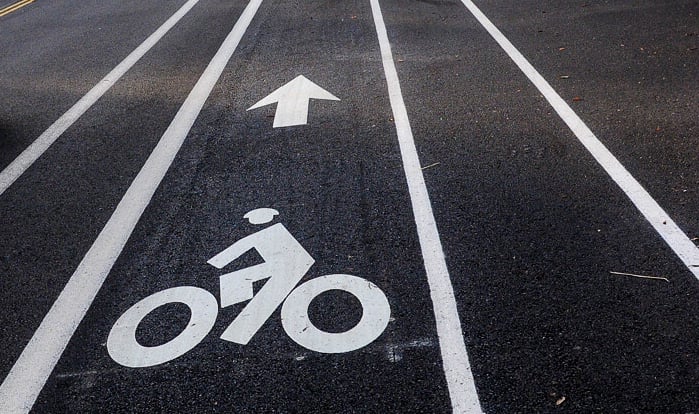
Posts from the Friends of Bikes Instagram feed (top) and a motif from their website.
One reason Portland’s vaunted bike culture keeps growing and evolving is because new people arrive in town, look at the local cycling landscape, and feel like something’s missing. Then they set out to create it.
This week’s Monday Roundup is sponsored by Nutcase, the Portland-based company that offers cool bike helmets for everyday riding.
Rolling with KISS: The legendary band has licensed their logo on a line of aero bicycle wheels.
Imagine that: This Daily Mail (UK) reporter has no clue that fines and tickets to bicycle riders are down — not because police are looking the other way — but because more people are riding, thus improving the overall behavioral pool as expected.
Sobering impact of Uber and Lyft: NYC streets are flooded with Uber and Lyft vehicles, eroding transit ridership and clogging streets even more. What a mess. Yet another reason to be skeptical of any “new technology” that puts cars at its center.
Jonathan wrote an article a few months ago on changes to the TSDC calculation methodology here. The city is now holding virtual open houses to get feedback on the proposed projects. Personally I think we should prioritize sidewalks and infrastructure in parts of the city that don’t have any, but you may have a different opinion. Let it be known by filling out this online comment form.
The Portland Development Commission (PDC) is seeking members for a Steering Committee to guide redevelopment of the Broadway Corridor.
Broadway Corridor Development Opportunity:
Redevelopment of the Broadway Corridor is a once-in-a-generation opportunity to add to Portland’s economy and vitality and to deliver community benefits. The Corridor includes the 14-acre United States Postal Service distribution facility which will relocate next year, Union Station, and several other publicly owned properties. PDC is pursuing planning and redevelopment of the Broadway Corridor with an intentional focus on ensuring all communities have an opportunity to engage in and benefit from its redevelopment. As such, PDC is seeking a diverse mix of community leaders to serve on the Steering Committee and represent a broad range of topic areas.
Steering Committee members will advise PDC, the Portland Housing Bureau and Mayor Ted Wheeler on goals for the project including:
criteria for and selection of a project developer;
the mix of housing and employment opportunities;
configuration of streets, parks, and stormwater management;
priorities for equitable engagement and community benefits, including:
business and workforce construction equity, and
equitable practices to ensure benefits for people who have not historically benefited from PDC’s investments in redevelopment;
approaches for sustainable development
PDC anticipates the Steering Committee will meet once a month beginning in spring 2017 through 2018 at a location near the site in downtown Portland served by public transportation. Meetings will typically be 90 minutes and scheduled in the late afternoon or evening on weekdays. Steering Committee members may also serve in subject area working groups.
Translation and childcare services will be made available upon request. Financial assistance may also be available for Committee members who represent organizations serving disadvantaged communities.
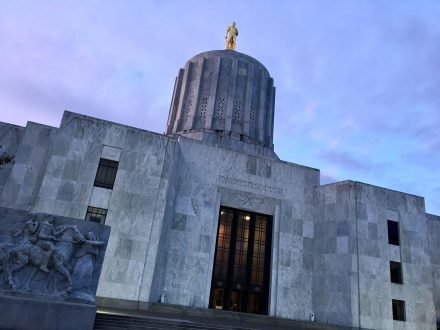
The state capitol building in Salem. (Photo: J. Maus/BikePortland)
By the end of this month Oregonians will have their first look at what state lawmakers and interest groups have cooked up for a transportation package.
I’ve followed the progress and have noticed several key themes worthy of your attention. Here’s my best take on what’s going on.
But first, let’s start with an overview of how the package is being developed:
How the sausage is being made
The package is being drafted by the Joint Committee on Transportation Preservation and Modernization — a 14-member body with eight Democrats and six Republicans that represent districts throughout Oregon. They’ve met five times since February 1st. Their meetings are usually less than 30 minutes long because the real work is being done in four work groups. These groups have been assigned to focus on specific topics. Here are the names of the groups and the committee members assigned to each of them:
Congestion Work Group:
– Sen. Brian Boquist (R-Dallas)
– Rep. Barbara Smith Warner (D-Portland)
– Rep. Susan McLain (D-Hillsboro)
– Sen. Betsy Johnson (D-Scappoose)
Public Transit/Bike/Ped/Safety Work Group:
– Sen. Lee Beyer (D-Springfield)
– Sen. Rod Monroe (D-Portland)
– Sen. Kathleen Taylor (D-Milwaukie)
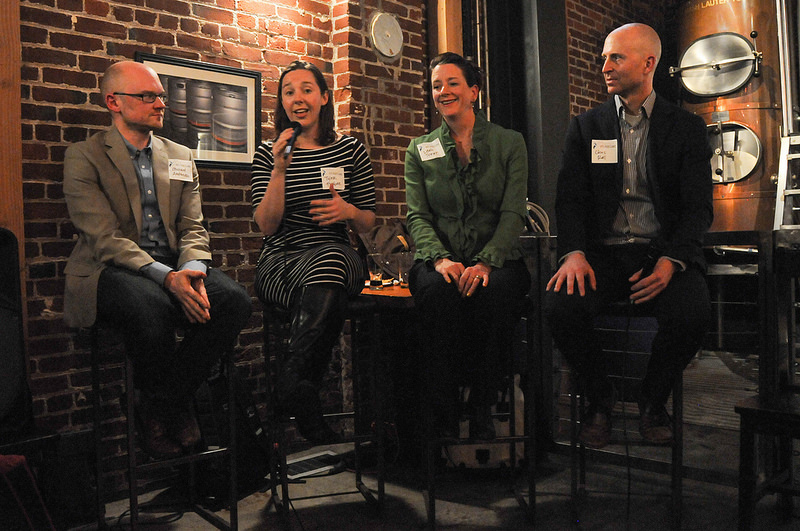
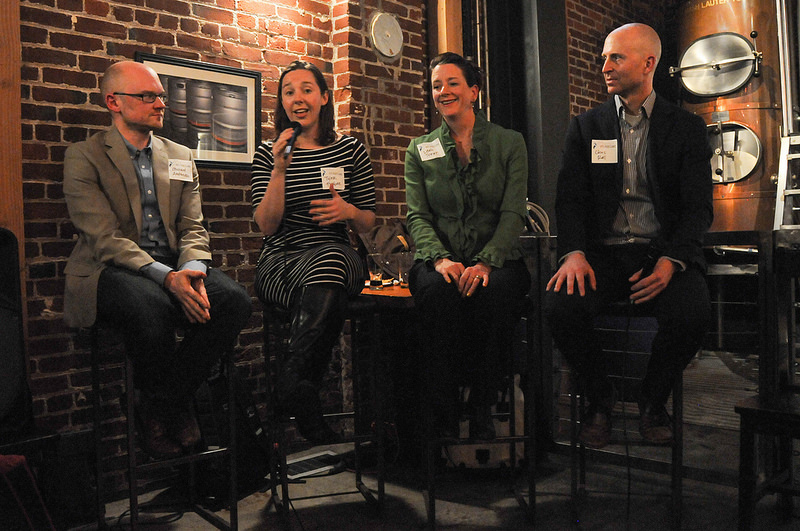
The panel from L to R: Michael Andersen (moderator), Tyler Frisbee, Leah Treat, Chris Rall. (Photos: J. Maus/BikePortland)
As the debate in Salem about a major transportation funding package just starts to boil (more on that later), insiders in the Portland region have been meeting for months to decide the framework of a separate, regional funding measure.
The future of that effort and the politics behind it were one of several topics discussed at a panel hosted by the local chapter of Young Professionals in Transportation at a pub in northwest Portland last night. The panel featured: Metro Policy and Innovation Manager (and former senior assistant to Congressman Earl Blumenauer) Tyler Frisbee; Transportation for America NW Region Organizer Chris Rall; and Portland Bureau of Transportation Director Leah Treat. The discussion was moderated by the ever-sharp People for Bikes writer and former BikePortland News Editor Michael Andersen.
Instead of facing a jury in a case they feared could go against them, the City of Portland agreed today to pay $525,000 to the family of a man seriously injured in a 2013 crash.
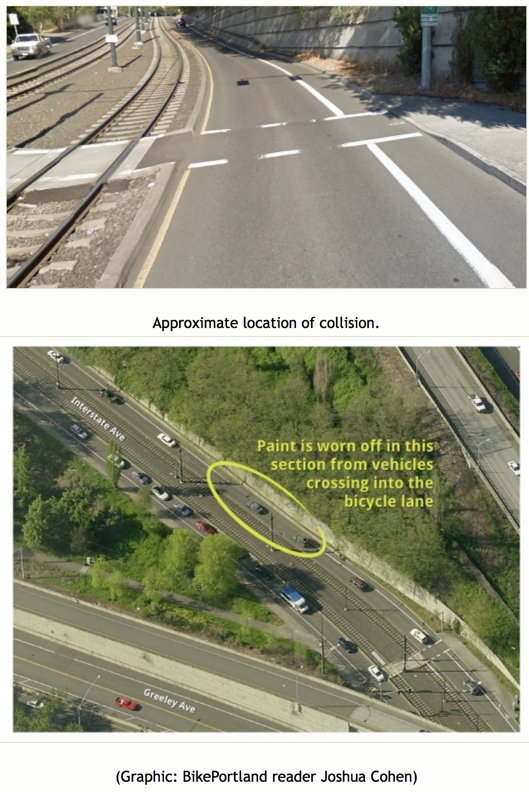
Mike Cooley, who was 59 at the time, was on his way home from work at the downtown post office when he was hit from behind by someone driving a large white truck. Cooley was riding northbound on North Interstate Avenue just north of Greeley. It’s a stretch of road with a terrible crash history and one that’s known for being narrow and very stressful. The City of Portland’s Vision Zero collision map shows 19 bike-related injuries on that stretch from 2004 to 2013.
In addition to narrow lanes, people frequently fail to maintain control of their motor vehicles and swerve into the bike lane, causing the striping to fade. There’s also a high speed differential between bicycle and automobile users due to the hill in the northbound direction.
This sign (and many others like it) will be removed tomorrow. (Photo: PBOT)
Portland City Council just voted unanimously to enact an emergency state law to drop the speed limit on outer Division Street — a road recently referred to as a “death corridor” by City Commissioner Dan Saltzman.
Since this passed as an emergency, it can go into effect immediately. PBOT crews will be out on Division Street tomorrow taking down 35 mph signs and replacing them with 30 mph signs. Once the signs are up, the new speed limit will be in place for 120 days. If all goes according to PBOT’s plan, they’ll never have to remove the signs. Upcoming changes to the street intended to slow people down are likely to reduce average speeds to an amount compatible with what the Oregon Department of Transportation prefers to see before granting an official, permanent speed limit change.
Here’s more from PBOT as shared in a press statement following today’s Council vote:
Chris Smith thinks widening I-5 in Portland is a big mistake. (Photo: J. Maus/BikePortland)
Noted transportation activist and Portland Planning and Sustainability Commissioner Chris Smith made a bold move Tuesday night that could have thrown a wrench in the works the State of Oregon’s top transportation priority.
Smith put forward a motion at a work session meeting of the Planning Commission that would have taken the I-5 Broadway Weidler Facility Plan out of the City of Portland’s Transportation System Plan. The TSP is Portland’s road investment guidebook and any major project that wants funding must be listed in it. As we reported yesterday, this $450 million (estimated) project is one of three freeway mega-projects lined up to receive significant funding in the transportation package currently being negotiated in Salem.
Smith was the sole PSC Commissioner to vote against the project when it was passed as part of the N/NE Quadrant Plan (a component of the Central City 2035 Plan) back in 2012. Judging from his pointed remarks about the project Tuesday night, he still hasn’t warmed up to the idea.
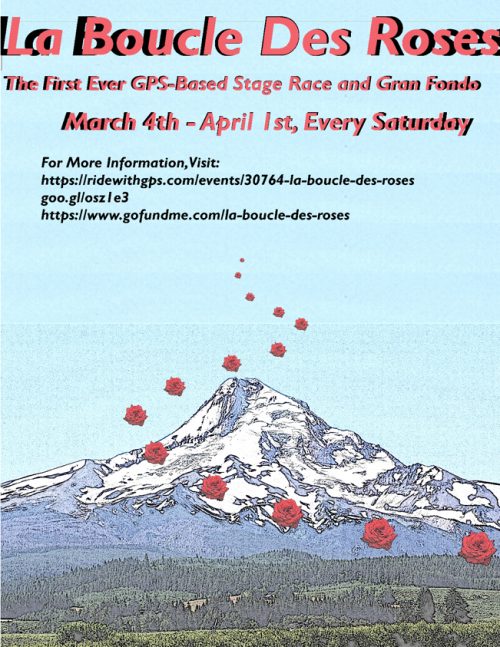
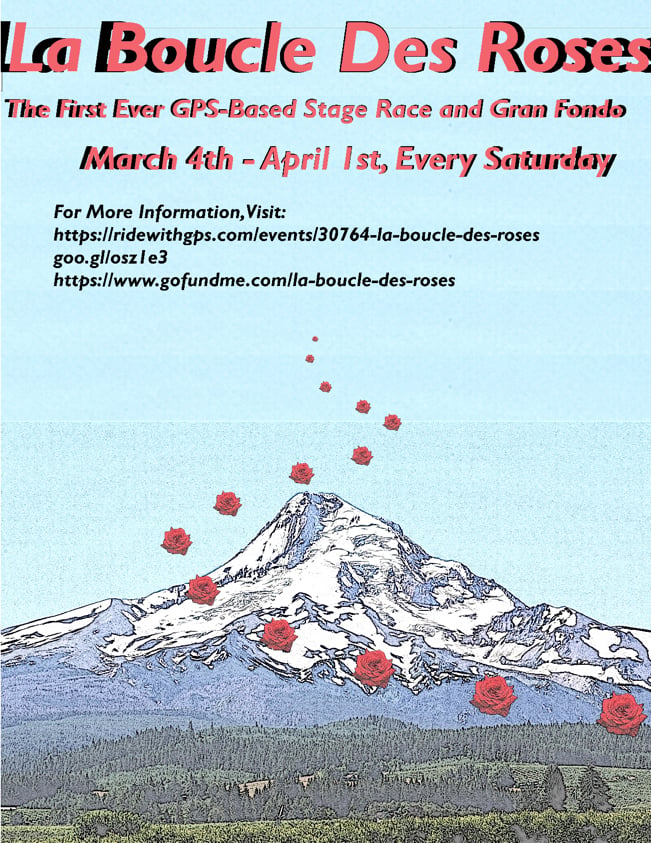
This weekend a new type of cycling event will start on the streets in and around Portland. It’s called La Boucle Des Roses and it’s unlike anything we’ve heard of before.
French for “The Loop of Roses,” La Boucle is an unsanctioned race/ride with five stages that will take place between this Saturday March 4th and Saturday April 1st.
Unsanctioned rides are nothing new to Portland. We’ve seen huge turnouts for the annual De Ronde and its sister ride, La Doyenne. Last weekend there were about 70 people who showed up for the Timber Logjam. “Organizers” of those events simply pick a date and mark a route (both online and on on-the-road), and sit back and let the promotion happen through word-of-mouth. What makes La Boucle different is its presentation as a multi-stage event and its use of an online platform to tabulate times and rankings for everyone who enters — regardless of when they complete the routes.
La Boucle’s organizer Will Hahn says the event is a “stride forward for Oregon cycling.” It’s his response to a recent decline in sanctioned road racing events statewide. A recent thread on the Oregon Bicycle Racing Association email list titled, “State of Cycling, Its Decline, and Events” brought out dozens of voices to hash out the causes and impacts of why people are racing less and why events continue to fall off the racing calendar. Membership at OBRA is down as well and it seems like everyone has an opinion as to why. Ideas I’ve heard include: the difficulty of getting permits for road closures and a lack of affordable and quality venues; a lack of profit for promoters; people doing their own rides and “competing” via Strava; and so on.
Hahn’s La Boucle avoids some of those hurdles (administrative costs) and embraces others (use of technology). The low overhead allows Hahn to manage the race for a relatively low entry fee of $22. The five-stage Baker City Classic by comparison, costs $140. To help raise money for the prize purse, Hahn has set a GoFundMe campaign. So far he’s raised just $20 of his $2,000 goal. To protect himself from legal claims in the event of a crash or other accident, Hahn will require each official participant to fill out a waiver form.
The idea of this race grew out of the desire to grow Oregon bicycle racing from a grassroots level, to promote the tenets of good bike riding and to satisfy the missing holes in the Oregon race calendar. My intent is to draw riders from all walks of life, to pit them against excellent courses that would otherwise be off-limits and create a renewable system of racing that eases the costly burdens of race promotion.
I will describe this as a race, but it is more akin to a mass start Gran Fondo, open to all and free…
These courses are (for the most part) difficult and long. They are all marked with paint, but it is up to you to know the courses before hand. There are no referees or course marshals, no follow cars and no feed zones; other than those provided by yourself. Riders who break traffic laws aren’t following the tenets of good bike racing, sullying the image of cyclists and creating an unsafe atmosphere for other riders, please don’t be this person.
There will be a roll-out at 10:00 am from the bottom of NW Saltzman Road (off Highway 30) for Saturday’s opening time trial stage. You don’t have to be there to have your time counted and the course will be “open” for a one week period. To vye for prizes however, and to be considered an official participant, you must show up to at least two Saturday starts in the five-week series.
Please do a longer story on Hawthorne with PBOT asked to comment.
Dear public. Please call commissioner Dan Saltzman’s office and ask for a much safer redesign of Hawthorne and 43rd.
(503)823-4151 Dan manages PBOT
Address where Fallon smart (my student) was killed. The new design may slow some traffic, but it only solves a fraction of the problem. It ignores deadly parking near intersections
We must not forget where 2 college girls were killed on Foster in a legal crosswalk with a median and speed just like the one proposed ..
The new design has many flaws that show left turns on 30mph roads are more important than the 3 crosswalks at that intersection.
We can calm side streets and Hawthorne by lowering it to 25 and remove left turns that conflict with dual crosswalks.
Those left turn drivers must be expected to see 270 degrees at same instant.
We must remove parking in all the legal crosswalks. These are obvious existing problems ignored currently and by the new design.
My design picture shows 3 safer crosswalks and the center lane and parking replaced by planters. Design your own to help PBOT see people over trip times.