

Hope your week is off to a great start. Below are the most notable stories that came across my inbox this past week…
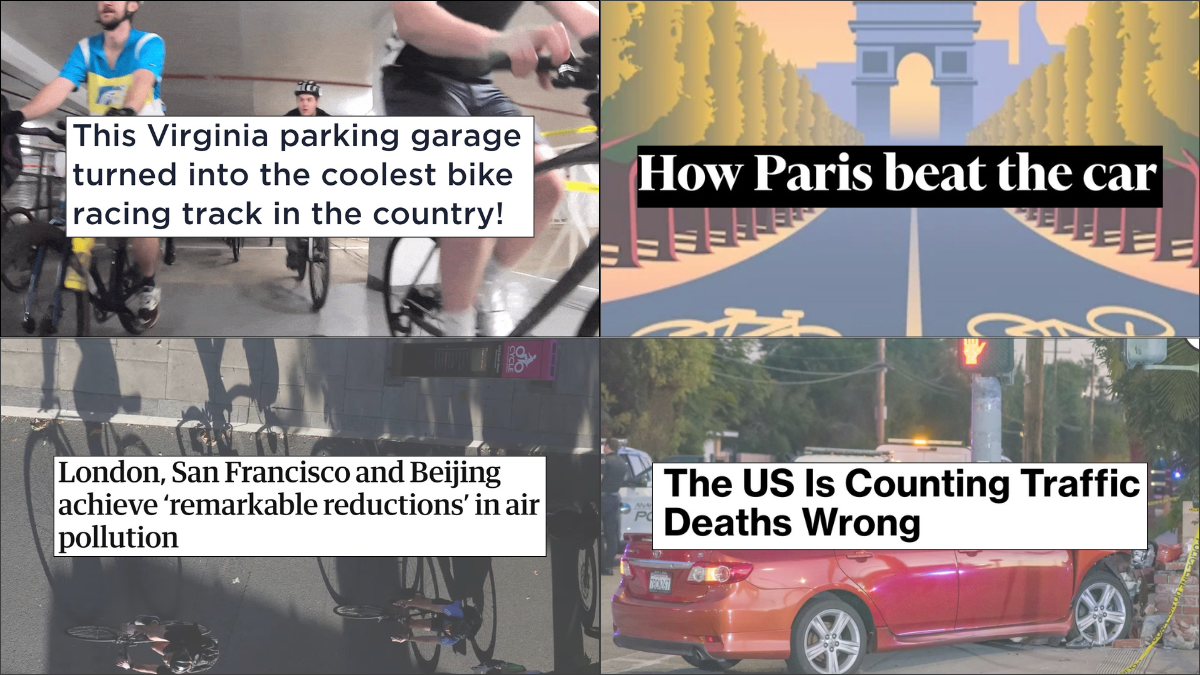
Let’s be like Paris: “Parisian car traffic fell by more than half between 2002 and 2023, while cycle lanes expanded sixfold. Bikes now make more than twice as many journeys as cars.” This piece delves into the legacy of bike-loving Mayor Anne Hidalgo and the politics of what comes next. (Financial Times 🔒)
Air pollution reduced with this one simple trick: Bicycle infrastructure is listed as one of the chief reasons several major cities across the globe — including San Francisco in the U.S. — made their air cleaner since 2010. (The Guardian)
Some Democrats really suck: As the Trump Middle East War rages on and gas prices spike, some hapless Democrats in the U.S. Senate are floating the idea of a “gas tax holiday” because they don’t have a clue how politics or transportation policy actually works. Barf emoji. (Gizmodo)
How we count traffic deaths: David Zipper argues that the trend among U.S. transportation officials to frame road safety by using the deaths per mile driven metric — instead of deaths per capita — is misleading and counter-productive. (Bloomberg)
Rails to Trails Film: I didn’t even know this documentary about the rails-to-trails movement came out back in October. Now, who in Portland wants to host a screening? I feel like the Salmonberry Trail folks should jump on this! (From Rails to Trails on PBS)
Bike share success: The bike share system in Hamilton, Ontario (Canada) that we gifted 650 Biketown bikes too is flourishing as it celebrates a record-setting year. Unlike in Portland, the system is run by a nonprofit that wants to see the system succeed, instead of a corporation that wants to see the system make as much money as humanly possible. (Hamilton Spectator)
The Fat Cake cycling club: A club in San Francisco that is all about inclusivity, having fun, and finishing each ride with baked goods has skyrocketed in popularity. (SF Chronicle 🔒)
Adaptive re-use: A parking garage in Crystal City, Virginia is home to one of the coolest cycling events in the country: the Parking Garage Bike Racing National Championship. (WAMU)
Thanks to everyone who sent in links this week. The Monday Roundup is a community effort, so please feel free to send us any great stories you come across.

Thanks for reading.
BikePortland has served this community with independent community journalism since 2005. We rely on subscriptions from readers like you to survive. Your financial support is vital in keeping this valuable resource alive and well.
Please subscribe today to strengthen and expand our work.
Finally, a worthy use for parking garages!
Would be cool if someone hosted a race in the lower level of the Lloyd center parking garage before it’s all removed. Very cool underused pavement there (maybe a little smelly, nothing some patchouli can’t fix).
The Lloyd center parking garage was featured part of the Portland Criterium Sunday route last summer.
I’ve definitely been through it on plenty of social rides too.
“one simple trick”
The article hardly mentions cycling, and in fact describes a whole suite of tricks:
“It highlighted examples of action that had helped to clean the air, such as China’s rapid switch from combustion engine cars to electric ones, the expansion of cycle lanes in dense European cities, London’s restrictions on dirty vehicles and Warsaw’s shift away from coal and wood home heating.”
China did not clean it’s air with bicycling.
But apparently the “…expansion of cycle lanes in dense European cities…” did deserve a mention? You pulled out a quote that sort of gutted your point.
Anne Hidalgo for…what? Sadly, she’s not going to move to Portland and be mayor. OBRA Peace Prize? Anyone can play.
Cycling was huge in China as cars were difficult for private citizens to obtain. Then as capitalism ate away at the communist dogma cars were easier to obtain on the coast in the economic zones, but still difficult and impractical everywhere else where cycling and animal/farm equipment powered carts still ruled.
There was a lot of cycling and pollution was horrible in China as the CCP did not care about the environment .There is still a lot of cycling and pollution is ebbing. The question is if cycling hasn’t changed, what has to affect the pollution levels?
Burning less coal in and around major cities.
Huh, I don’t remember seeing that in the article.
All kidding aside, I agree with you. There are very solid reasons why pollution is down and they have nothing to do with cycling. If anything, cycling is going down in China as public transportation and personal income improve.
When I was 17, I traveled with my mom in 1985 to visit my dad who was teaching in China at the time. We traveled to Beijing, Shanghai, and 3 other cities. Within each city we got around almost exclusively by bicycle or using their incredibly packed city buses. Most of the bikes where the old English 3-speed type, many of which were actually one-speed, and many others had rod-activated brakes (not cable). The streets were crowded with bicycles all over the place, with almost no one signalling. The air pollution in each city was awful – most folks were using barrels full of coal to do their cooking, both outside at vendors, but also inside tall apartment 20-story high-rises (often without elevators, functioning or not – lots of steps to go up). The buses were poorly maintained and were spewing exhaust everywhere. China in 1985 was still third-world, many folks still wearing olive green Mao jackets, everyone smoking (mind you, everyone in the USA was also smoking, including on airlines.) We took a long 4-day journey by rail from Yunnan to Beijing through Wuhan. Our train was being pulled by huge steam locomotives built in the 1980s.
My understanding is that everyone dresses the same as we do, the coal-filled cooking barrels are now banned and have been for quite some time, that China now uses very clean and well-maintained city buses, that far fewer people now smoke, and the long distance steam locomotives have since been replaced with electric bullet trains.
That sounds just like what I experienced in Changsha when I arrived to teach in ’90. So many bicyclists and my students were very eager to get me on a bike, but the streets were so chaotic and everyone was rushing that I stuck to foot power or the buses. As insane as those buses were, I felt much safer on them than I did on the MAX since everyone was incredibly polite. Fear of a remorseless police state will do that, but I didn’t quite internalize that at the time. The bikes represented a substantial purchase and outside the wild gasoline or steam powered farm like contraptions that spewed waste gases and the buses they were the only transportation. Private cars may have existed, but no one had access to one, let alone a place to purchase gasoline. there were I think of Changsha whenever people mention how eager they are to have a car free life and can never seem to think of anywhere besides Europe to experience that.
I appreciate the happy memories David, thanks for sharing.
The buses were really packed, but their motto was “there’s always room for one more” and they’d squeeze you in. Everyone was packed but very polite and wait for people to get off. The ticket cost was minimal but the conductor nevertheless collected fares from everyone – I think they acted as a sort of enforcer or bouncer.
Bicycling was all in slow-motion, no one went over 10 mph.
We had minders – people assigned to watch our every movement 24/7 but also reserve hotels for us, museum tickets, etc – part of the police state at that time. Once in Hongzhou I accidentally escaped our minders (everyone was napping) to walk around the lake there – 14 miles through suburbs literally full of brick walls around every compound, no idea why – and apparently our minders went berserk according to my amused parents – yet on my walk no one stopped me or even asked what I was up to, they just minded their own business. It was a nice walk, I still have fond memories of it, but I’ve heard that the China I saw in 1985 doesn’t really exist any longer, it’s all been built over.
No, I don’t think it exists like back then anymore either. Water wasn’t safe so boiled it for cooking and drinking and drank warm coke or local sodas when out while everyone else drank beer. On one of the holidays my handlers took me up into the hills ( I think I was an excuse to travel more than they normally could) to see some old temples. We went by bus past the hovels with no electricity crammed against multi story basic housing and then started walking. The hills were like a National Geographic article with the tiered farmlands and people working the fields, what I had been expecting instead of the relentless pollution and human density of the city. As we turned a corner we crossed paths with some workers and one looked at me, turned and ran away. To this day I have no idea why. First Anglo she had seen, didn’t want to deal with the obvious handlers with me? Only saw one feral dog while I was there and no other pets.
I’m glad you and I were able to see what life had been like there before it became modern.
“gutted your point”
Please explain. I said the article credited a great many things for cleaning air in cities. This is true. I also said bike lanes barely got a mention. This is also true. And I said China did not clean its air by turning the bicycling. True as well.
Some Democrats really suck: As the Trump Middle East War rages on and gas prices spike, some hapless Democrats in the U.S. Senate are floating the idea of a “gas tax holiday” because they don’t have a clue how politics or transportation policy actually works. Barf emoji. (Gizmodo)
Jonathan, have you seen Maxine Dexter’s Facebook scare posts (and paid ads too!) about the cost of gas….she seems to want gas as cheap as water. Drill baby drill says Maxine. LOL!
Comment of the week, straight to the point. Thanks, Angus! I’m going to call Dexter today from the train, I’ll have lots of time.
Dexter really said “save the planet ” on Monday and “fill up your tank for the price of a LaCroix ” by Tuesday
Like… is this a climate plan or a Costco coupon campaign? Pick a lane, Doc. One minute it’s electrify everything, next minute it’s Drill Baby Drill: Sponsored Post Edition™.
Honestly the paid ad is the best part — nothing says “deeply held policy position” like a boosted Facebook post targeting people who just searched “why is gas expensive??”
Politicians use current events to promote their career and dunk on their opposition. More at a 11.
So no big deal since you voted for her right? Sounds like the Trump supporters who never criticize him for his idiocy.
I think Maxine Dexter is calling attention to gas prices to pin blame on Trump.
The way we count traffic deaths is pretty ridiculous, in part because it isolates the vehicle from the system or context that the vehicle requires. Glad to see this called out to a broader audience. The public health costs of car-dependent systems are well characterized in public health data, but mostly ignored by policy makers.