

Welcome to the week. There is so much going on beyond the cycling and transportation world that demands our attention. I hope some of you were able to take part in community-building and/or service work yesterday for Martin Luther King Day. And I know most of you logged some sunny miles on the bike over the past three days! I’ve unfortunately been sick since Friday but am finally feeling a bit better. I should be 100% by Wednesday and look forward to seeing everyone at Bike Happy Hour.
For now, let’s take a look back at the most notable stories of the past week…
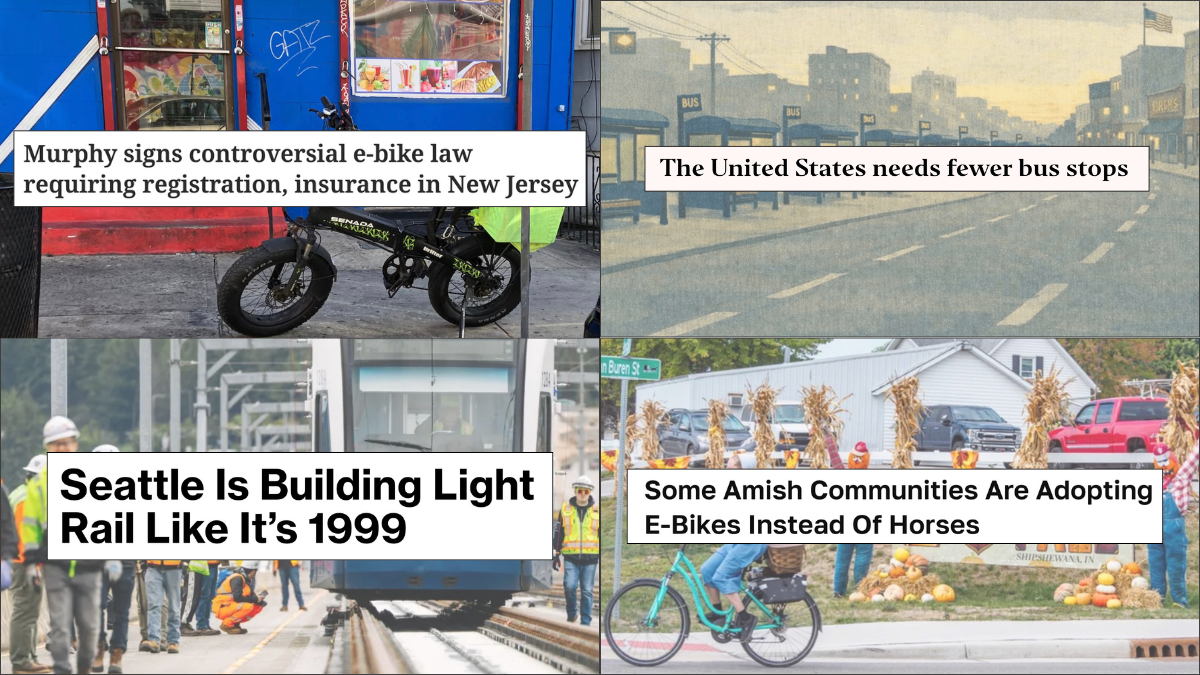
The Amish and e-bikes: Amish folks know how terrible cars are for communities, so they’ve stuck to horse-and-buggy. But an increasing amount of them are hopping on e-bikes as a way to get around. (Jalopnik)
Portland snubbed! A major national cycling nonprofit published a list of the top 10 bike lanes built in the U.S. last year and Portland’s SW 4th Avenue was not among them. Ouch. (People for Bikes)
More bus, less stop: There’s one bus service change that is cheap, fast, and effective: removing stops. I have yet to hear a good argument against having fewer stops. And for folks who bring up access issues for older and/or disabled riders, I’d say the pros (much better service overall) outweigh the cons (a few extra blocks to a stop). (Works in Progress)
New Jersey’s blunder: The governor of New Jersey signed an absurd and unprecedented bill into law that requires riders of all e-bikes — from basic Class 1s to e-motos — to be licensed and registered. It’s a worst nightmare situation. (NJ.com)
Sound Transit deep dive: An excellent look at the ups and downs of Seattle’s Sound Transit as it builds out its light rail network and experiences ridership growth, while being criticized for not building fast enough. (Bloomberg Citylab)
All eyes on Salem: It will be fascinating to see what happens in the transportation funding debate during the upcoming short session. This article is a good overview on where things stand at the moment. (The Oregonian)
Two-way streets are better for humans: I hope some influential folks in Oregon read this story about how cities across the country are converting one-way streets back to two-way streets. It’s always bugged me how many downtown main streets across Oregon are suffering because of one-way thoroughfares. (AP)
Thanks to everyone who sent in links this week. The Monday Roundup is a community effort, so please feel free to send us any great stories you come across.
Thanks for reading.
BikePortland has served this community with independent community journalism since 2005. We rely on subscriptions from readers like you to survive. Your financial support is vital in keeping this valuable resource alive and well.
Please subscribe today to strengthen and expand our work.
The article about bus stop spacing was such a good read and something I’ve been thinking about a lot. Bus stops in Portland are so close together! For example, from SE 12th to SE 82nd, the FX2 (the project the article is probably referencing) has 12 stops. In the same distance, the 9 has 23! During rush hour the bus is stopping as pretty much every stop. That’s crazy and also why it’s faster for me to take the FX2 most of the time even though I live south of Powell.
Given TriMet’s budget situation I’d love to see them do a system-wide stop cull to streamline their operations and make bus service more reliable.
TriMet planners know all this, and it is beyond me why they don’t pick the low hanging fruit already.
My best guess is TriMet is “saving” it for a bigger project (like converting the #2 to the FX) so it can show a bigger payoff and justify the project cost. If they’ve already culled the stops on the #9, harvesting 75% of the benefit of a bigger project for free, it would be harder to justify doing the remaining 25% that would actually cost money.
In other words, gaming the funding streams trumps providing better service. TriMet’s interests do not always align with those of riders.
The cynical part of me agrees with you.
I’m sure it’s more nuanced though. I think some of it is probably just the sticking power of tradition. “We’ve always had those stops there so we have to keep them there!” Maybe partially a disconnect between management and operators & riders – in that upper management doesn’t use transit and feels pressure to keep stops because when they close them, people complain.
“Coverage” could also play a role here. My friend works for a transit agency in a smaller city and some of their funding is based on the amount of “coverage” they provide. One way they do that is by adding more stops to lines so that on paper, they are serving more households.
Trimet has (or maybe had by now) a group of employees dedicated to development, yes, development along the train lines. A task they are completely ill suited for and a waste of time, tax money, and effort by them. There are already several City bureaus that can do the same, better with little extra cost. But we have to remember, it’s not about servicing transportation customers, it’s about bringing in money to feed the construction and legal professions in Portland. Goldschmidt really knew what he was doing when he brought the trains to Portland.
The need to develop all the goddamn parking lots along MAX. It’s crazy that all along the Blue/Red lines there’s oceans of parking that get more frequent train service than many of the most urban neighborhoods around the metro area.
When TriMet installed the Orange Line, they acquired a number of properties along 17th between Powell and McLoughlin, a prime transit-adjacent inner city corridor within walking distance of a reawakening commercial district, perfect for high density housing. Instead, they built parking lots for TriMet employees, and there is no new housing along that stretch (and only one new building anywhere closer in). It’s mostly wasteland, and the Orange Line has so few riders that they’re able to replace train service with buses in the evenings (and, probably during most of the day if they wanted to).
And since they were redoing everything, they could have built sidewalk-level bike lanes essentially for free, but ignored the pleas of the cycling community and opted for a conventional bike lane instead.
Its almost as if Trimet didn’t/doesn’t actually care about service and providing a way for the carless to humanely exist and that building the tracks and bridge to funnel money to supporters was the goal.
Who wants to live in dense housing in that area? There are no amenities, and it’s right next to several heavy industries and a massive noisy, polluting rail yard.
Someone who wants to have super easy access to high-quality transit, be on a well-developed bike corridor, and be able to walk to places like the Aladdin, Meta Pizza, and others. There is some moderately dense housing in the immediate area, and a whole neighborhood nestled in there, so clearly someone wants to live there.
If there was never a plan to develop housing in the area, and very little possibility of doing so further along the line, then why did we build light rail there in the first place?
As someone who has worked on stop consolidation in other cities, they do know this and they also know how much people will complain if they do it. As part of a larger project it gets wrapped up into more frequency, bus lanes, better shelters. As a lone project it makes total sense, but everyone wants you to cut the stops that aren’t “theirs.”
Should they do it: yes.
Will they blow tons of political capital and be accused of not being responsive to the community: yes.
I take the 9 in to work some days and good lord, I want to scream when we stop at 69th, then 67th, then 65th. I think there’s a 40th and 39th stop, too. Also 34th and 33rd? I will get off a stop early (sometimes two if it’s nice out) if someone else is taking that stop and walk a little farther just so I don’t feel like I’m slowing everyone else down by making the bus stop yet again a couple blocks later. I hate feeling like I’m putting people out and I almost need to apologize for taking my stop.
The 17 is the same way (along Holgate at least). Often, if I get off a stop early just as you describe, I’ll just about catch up to bus as someone requests a stop two blocks later.
Oh really? I take the 17, too, I did today as a matter of fact!, and it’s never as bad as the 9 if you ask me. I live between Powell and Holgate so I flip flop between the two, it just depends on which bus is coming next. The 17 always seems a lot faster because Holgate is not as busy as Powell.
Today was a nice ride, btw.
I’m rarely on the bus any more.
I used it more (in bad weather) when my office was right off of Pioneer Square and work gave me an annual Trimet pass. Now that work is in the central east side, there’s no good way to avoid biking in even in bad weather as a transit-commute as the proverbial and literal “last mile” from Tillicum crossing to the end of Water Ave is tricky/slow or a long walk). That “last mile” isn’t an issue when the weather is nice. But when the weather is nice, I’m riding (the long way) in anyway.
I don’t have much experience with the 9. But imagine how much faster the 17 could be if stop spacing was every 3 or 4 blocks instead of 2!
I’m super lucky in that I live between the 9 and 17 and work is between the 9 and 17. I ride my bike most days, but there are the odd days here and there where the bus works well for whatever reason. I’m with you entirely, if there were fewer stops that would be pretty great.
This was an interesting read.
I was struck by this:
“By contrast, a bus stop in a French city like Marseille will have shelters and seating by default. Higher quality stops in the city also include real time arrival information, better lighting for safety, level boarding platforms, curb extensions that prevent illegal parking at bus stops, and improved pedestrian infrastructure leading to the stops. Marseille is not a particularly wealthy French city, but because it has wider stop spacing and fewer stops, it can invest more money into each one.”
The amenities mentioned in this paragraph do not exist at MOST bus stops in Portland, and where they do, they are inevitably vandalized repeatedly. Half the stops along my regular routes don’t even have stop ID numbers (so you can check arrival times), because they have been defaced, destroyed or removed entirely. At least a dozen of the stops on my most-used route (#8 15th Ave to OHSU) which have solar-powered real-time arrival monitors have been smashed or completely painted over.
I have my doubts that more money would be invested at fewer stops by Trimet, because Portland in general is hemorrhaging the remaining funding that hasn’t left town.
Add to this the number of seniors and disabled whose inability to travel greater distances between stops is rising with the graying of Baby Boomers and the oldest Gen X’ers.
Can someone please tell me how we’re supposed to plan in the short term for that reality by removing transit stops and reducing or eliminating transit lines? I’ve yet to hear a meaningful and honest response to that issue from anyone.
I emailed TriMet in April of last year about the number of stops I was seeing in SE that were not getting the glass replaced at shelters. I was told then that they were getting some new, very-much-harder-to-smash stuff, but that there were supply chain issues. Hmmm, ok. But it’s now January 2026 and those same stops still have no good protection from weather. I mean, there’s still a top to the shelter, but if it happens to be raining and there’s any kind of a breeze you will stand there getting wet. I doubt more money would be spent on stops even if we removed a bunch of them. In a way I sorta see why TriMet hasn’t fixed the shelters that I’m thinking of. It seemed like a weekly clean up and replace of shattered glass…until they stopped replacing the glass altogether.
Stop distances. I dunno what to say here. I don’t think stops are going to be spaced at insurmountable distances if any get removed. I think even the grayest Boomers and Gen X’ers can handle this. I have family in Germany via my wife. On a visit last summer to see Oma, over 90 now, uses a walker, she was prepared to walk to the Altstadt for coffee and people watching, rather than take the bus (the bus was taken ultimately). It’s a near 2 mile walk. I think we’re lazy here and there are truly very few of us with extreme mobility issues. Travel out of the states and you see older folks doing stuff that older folks here seem to avoid. Anecdotal, but I always notice this.
“Portland Snubbed” A quick scroll through the featured projects show complete street designs that integrate space for bikes. They include landscaping, street trees and stormwater, pedestrian-scaled lighting, benches, and [place-making elements. They all seem like far better projects than Portland’s 4th Avenue project. I don’t think Portland was snubbed, it just failed to compete. 4th Ave is ugly- there is not landscape and no place for people beyond the most utilitarian use on a bike. There is no art or benches or interpretive signs. The buffers are expanses of concrete that are not ADA- accessible. Despite rebuilding extensive portions of the road, stormwater still pools and flow in the bike lanes. After looking at this collection of projects, I think the tagline should be “Portland Shamed” instead of “Portland Snubbed”
Agree.
On 4th, I could take a full-width traffic lane all to myself, and could easily ride side-by-side with a friend; now I can get about half the space, single file.
Ugly is in the eye of the beholder, but the loss of space, turn options, flexibility, and the increased risk of hooks is measurable. The wildly varying intersection treatments and signage won’t instill confidence in the 8-80 crowd, and I confidently predict a very tiny increase in the number of 8 year-olds riding from PSU into the heart of Portland’s downtown.
Ok, I’m not going to be obstinate and argue with you about 4th because it’s clear we will never agree.
Can you tell me a bike lane project that PBOT has built recently that you do like?
I’ll bite since I’m also pretty harsh on most of the projects.
I like the stripes that were recently added to Lombard. Significantly improves the riding experience and I’m seeing more cyclists.
Before the treatment, riding Lombard was just like riding Lombard is now between Boston and Freddy’s — not for the faint of heart. Now it’s quite decent.
Sure — the new facilities between the Hawthorne Bridge and SW 4th are a big improvement in a number of ways, and giving the entire right lane to cyclists past the Elk resolves a longstanding pinch point.
The downtown approach to the Hawthorne Bridge, including the new signal where the slip ramp joins the bridge is great too. It also solves a real hazard without diminishing the experience of riding at all. The signal timing is excellent.
I think aspects of the project on 4th between PSU and the Hawthorne Bridge are pretty good too, though I haven’t ridden that section enough to be sure. It’s kind of janky and won’t convert any new riders, but it solves the problem of crossing the Max tracks nicely, and I think does actually improve safety in a fairly chaotic section of street.
Other than the section of SW 4th north of the Hawthorne Bridge, I’m not sure I could name a recent project I don’t like.
I’ll add that everyone I’ve discussed SW 4th with offline (maybe 4 people) has agreed with my assessment, but those folks are mostly transportation riders who are utterly uninterested in bike politics.
That’s a fair question! First, I don’t hate 4th, but I think the signals are ineffective and the risk has not been mitigated and it just means bikes do more waiting. Also, PBOT missed a great opportunity to regrade to fix drainage issues. I realize it is more difficult due to every cross street being crowned, but it is not that hard.
Projects I like:
I also like many pieces of PBOT projects, but they inexplicably include design flaws or or just fail to make relatively simple, practical fixes that could take a project from mostly functional to great. I think calling out these is the way to get PBOT to do better.
Whether a tiny low speed section in a city containing thousands of miles of streets is awesome or awful is irrelevant to the cycling experience — so who cares rankings written and mostly read by people who don’t live here about such a section?
If you actually ride to get around, showcase projects are rarely useful (assuming there are any along your path). And even if your ride happens to include one of these sections, it’ll only be for a short bit.
The showcase stuff makes good optics, but it concentrates attention and resources in the wrong places and seems to be designed for nonriders looking to go very short distances at slow speeds. But worse, it seems to convince the shrinking number of cyclists that they need this stuff. So hardly anyone starts riding, but people are quitting.
There’s nothing unusual about riding miles in Portland without seeing a single cyclist. And if you do see any, it will be very few, even on what should be major corridors like Naito and Interstate. Don’t even get me started on what the separated infrastructure is like late at night — I actively avoid it.
I strongly suspect there will be another drop in cycling mode share when the 2025 ACS is published this fall.
Before y’all start criticizing the lack of progress in Portland, take a look at each of these projects on Google Maps and where they are in each city, and you’ll likely discover that once again People for Bikes is being intellectually dishonest on their very biased selection of star projects. Ferst Drive in Atlanta (which I’ve actually ridden on last spring) is not a major downtown arterial, but a campus drive near downtown (compare to the Park Blocks on the PSU campus), entirely on university property. 5th Street NW/NE that it connects to has basic simple painted buffered bike lanes, quite primitive compared to SW 4th in Portland, though both streets go through highly urban areas. Downtown Atlanta has a lot of barrier-protected bike lanes, but 5th ain’t one of them, and like Portland, you can’t bike from one end of the city to another just using protected bike lanes – as usual there’s lots of huge and dangerous gaps.
Most of the rest of the projects listed are clearly in suburban settings.
Yeah, I want to like SW 4th, but the design is a HUGE risk for left hooks. The first (and last) time I rode down the new lanes, my thought process went like: “oooh this is kinda nice. Wait, damn. That intersection is kinda blind and has a risk for left hooks. Annd… so does this one. Damn so does THIS one. I wonder – SHIT! (as a huge truck nearly left hooks me).”
This is exactly the problem. I’m not some grumpy old man who hates bike infrastructure — on the contrary, I love it. I just get very angry when the city spends its precious few bicycle dollars taking a street that wasn’t broken and makes it more dangerous place to ride. Plenty of people agree with me, and we can be very specific about how and why the street is now more dangerous. You summed it up nicely.
I find it rather astonishing that any experienced rider likes what PBOT did to SW 4th north of the bridge, because I think it’s largely undefendable — unless you care more about optics than safety.*
But whatever, it’s done, literally set in concrete, and I can usually use Naito instead to head north so it won’t be me that ends up in the hospital. It will probably be some newbie bicyclist who doesn’t yet understand the hidden dangers the facility presents and lets their guard down because they think they’re safe. That will probably boost 8-80 ridership.
*Note the em-dash.
PBOT could have banned left turns for drivers.
““Making our roads safer for all users has been a key priority for my Administration,” the [Governor] said.”
A quick Google check of the numbers…
“In 2025, New Jersey saw a decrease in overall traffic fatalities, but pedestrian and cyclist deaths remained a significant concern, with one source noting 131 pedestrian deaths by late 2025 compared to 96 the prior year, highlighting issues with infrastructure and vehicle size.”
“One of the most alarming aspects of New Jersey’s traffic fatality data is the increasing number of deaths among pedestrians and cyclists. So far this year, pedestrian deaths in New Jersey have climbed to 131, compared to 96 in the same period last year. The death toll among cyclists has also increased, from 14 to 17. This spike comes after a modest reduction in pedestrian deaths from 2022 to 2023, puzzling experts who hoped for a continued downward trend.
Pam Fischer, former director of the state Division of Highway Traffic Safety, highlights several factors contributing to this increase: a lack of safe infrastructure, like protected bike lanes and pedestrian crossings, combined with the prevalence of high-speed, multi-lane highways through densely populated areas.
Right turns on red lights, larger vehicles like SUVs and pickup trucks, and increased driver impairment are also contributing factors, Fischer notes.”
Yeah, the e-bikes are definitely the problem here.
Anybody riding eastside MAX for the first time immediately recognizes the slog of stopping four times between Rose Quarter and Holladay Park just to cover half a mile. It has been nearly 14 years since Willamette Week pointed out that Portland Streetcar was slower than walking. Transit users know intuitively that spacing matters.
It really feels like the powers that be are the last people to know, whether it’s Streetcar conceding the point ten years ago or TriMet cutting the Skidmore Fountain stop last year.
A number of years ago the 7th ave stop was closed due to the construction of the apartment building next to it. While it was closed, stupidly the train still stopped there. Then after a moment moved on.
During that time the 7th Ave stop was not missed at all and could have been closed. Well, nope, there’s a TriMet office (or was) near there and their poor employees were incapable of walking to Convention Center or Lloyd Center stops instead like they had to during the closure. I heard that, not in those exact words, from a TriMet employee at the time.
They should close 7th and the convention center stops. Con goers can get off at Rose Quarter and walk.
Probably better to close Convention Center and Lloyd Center. Keep 7th for connections to the Streetcar and 6 bus.
They should close the Convention Center stop. It is one block from Rose Quarter.
Plus Metro built a massive parking garage next to the Convention Center Hotel to make sure nobody visiting the Convention Center ever takes the MAX!
I imagine (but don’t know for certain) that pausing at a closed stop had to do with the signal timing in the general vicinity.
To be fair to Portland Streetcar, they did close some stops that you can see the remaining platforms of. In my opinion the biggest change that would speed up the streetcar is actual transit signal priority. I swear it ends up stopping at every red light.
Signal priority and removing parking adjacent to the streetcar would be huge improvements. Removing the parking costs effectively no money as well, so I really wish the city would move on that quickly.
There really isn’t any justification for the Convention Center stop, when the Rose Quarter stop is just over two blocks away and serves the Convention Center just as well.
I’m not clear on whether there’s a good justification for the Lloyd Center station anymore either, since Lloyd Center itself is basically a ghost mall these days.
While I agree as a rider of the Max that the stop is useless, the reason for this stop is: politics.
If you’ll allow me to get a bit tin-foil hat:The Convention Center is owned by Metro (source: https://www.oregonmetro.gov/about-metro/metropolitan-exposition-recreation-commission/visitor-venues/oregon-convention-center). Metro has statutory authority over Tri-Met and is heavily involved in it’s planning (through their Regional Transportation Plan). That MAX stop was added in 1990 when the Convention Center was built. (source: https://en.wikipedia.org/wiki/MAX_Blue_Line#cite_ref-2-stations-close_94-0 )
I’ve always sort of assumed that there’s an ongoing payment for the stop from the Convention Center to Trimet, but don’t have anything to support that and can’t find a detailed budget for the Convention Center.
I don’t doubt the “politics” explanation for a second.
But the “Kings Hills” station in Goose Hollow was also a useless station added in the 1990s because of politics (it was right next to the Multnomah Athletic Club) and eventually went away. The Pioneer Place stations were added when the Pioneer Place Mall opened, and those are now gone too.
I see no real reason the Convention Center station couldn’t go away as well.
oh it’s definitely politics that explains all the stops in the TriMet system. People do not react well to hearing “their” stop will be removed and so to be nice and not get into any hot water, all the stops stay. It reminds me of how a lot of “STOP” signs get put up. It’s not as bad as it used to be, but they were often installed in places where the loudest folks complained to PBOT, instead of being in spots that actually made traffic engineering sense. But it was easier to shut folks up and just install the STOP sign so they would go up.
Just the other day I said “More bus, less stop” on Bluesky and folks had to point out that I must be some young and able-bodied person who doesn’t care about folks who need their stops.
Like all transit systems (thanks to the ADA), we have paratransit for those who can’t walk a few minutes to a bus stop. Perhaps there are people out there who would qualify for paratransit but prefer the independence of walking to a bus stop that’s 100 feet from their house. But stop spacing decisions shouldn’t be made on that basis.
I am currently a half mile from the nearest bus stop and have a car, but use the bus once or twice a week nonetheless. It’s more difficult and dangerous in areas without sidewalks (e.g., much of SW and east Portland). I know Portland has been putting sidewalks along a lot of the bus corridors but I know there is much left to do.
There was discussion some years ago about creating a consolidated MAX stop between 1st and 2nd avenues (one block east of the current Rose Quarter stop and one block west of Convention Center station), reconfiguring some of the bus stops, and building better pedestrian infrastructure under I-5 where the Rose Quarter station sits now. That would be the best solution in my opinion but it would cost money. But a MAX station that is visually connected to the Convention Center benefits not only pols at Metro, but all businesses in the central city, as it encourages out-of-town visitors to hop on the train and explore downtown (or forego an Uber to the airport).
Regarding converting mid-last-century one-way stroud highways back to two way arterials…Hillsboro is the best local ‘poster-street’ for the struggle to accomplish this thru multiple failed starts. Vancouver would be another with its Washington Street ‘broken couplet’ (Broadway to McLoughlin to Washington) remanent still hanging on in all of its stroad-ness.
https://engage.hillsboro-oregon.gov/or8-oak-baseline-10th
I biked to River City last weekend and was trying to imaging Grand and MLKL as 2-way streets. I think it would be pretty great.
I’m cautiously supportive of this concept. Certainly there are a lot of one-way streets in downtown areas that don’t need to be one way. In some downtown areas (I’m thinking of some streets in the Pearl, Nob Hill, and a couple in downtown Hillsboro), narrower streets are made one way in order to accomodate parking–and traffic can’t go too fast due to width restrictions. I’m not a huge supporter of more car storage, but those streets aren’t bad for pedestrians.
The problem with converting existing couplets into two-way streets is what to do with all the traffic. For instance, if all Oregon 8 traffic were forced onto one of the two streets of the couplet through west Hillsboro, Cornelius, and Forest Grove, there would be gridlock and that wouldn’t be great for pedestrians. AND there would be political pressure to widen that street into a stroad, which would be horrible for pedestrians. Much better to install traffic-calming infrastructure on the existing couplet (something that ODOT is reluctant to do with any of its highways, unfortunately).
Fow what it’s worth, I think that the Oregon 8 couplet could be made into an attractive, pedestrian-friendly residential zone with the existing street setup. If all the vacant and underutilized land along that couplet (of which there is a lot!) were converted to 6-story apartments/condos and the bus service were upgraded to BRT (along with appropriate traffic-calming infrastructure), it would be a very attractive place to live–and to drive. Unfortunately, the newer development in that corridor is mostly fast-food drive-thrus and one-story bank branches with parking. Bleh.
Bottom line, I’d much rather walk across Oregon 8 in one of the couplets than in one of the 5-lane sections. Just 2 lanes to cross and all traffic coming from one direction.
No real substance to this comment.
But I think it’s amusing that I’ve heard non-electric assist bikes referred to as “Amish bikes” in casual discussions about (e)bikes.
Turns out, ebikes are Amish bikes!