

Less than three months after launching a bid to raise more revenue for transportation, Councilor Olivia Clark has heard enough: At a meeting of the Portland City Council Transportation and Infrastructure Committee this morning, Clark said she was so “moved” by the level of support for two new fees that she was ready to put forth a proposal.
“I did not start out at this point, but given all the community feedback,” Clark said, “I’m going to take a risk here, and I’m going to open up with a funding proposal for you to discuss.”
Clark’s confidence came from a presentation by Portland Bureau of Transportation staff that summarized public feedback from four recent open houses and an online survey. Over the past several weeks, PBOT hosted open houses in each district. 254 people attended the in-person events and another 477 completed the online survey. While obviously not a scientific sampling of opinion, Councilor Clark feels like it’s time to move forward.


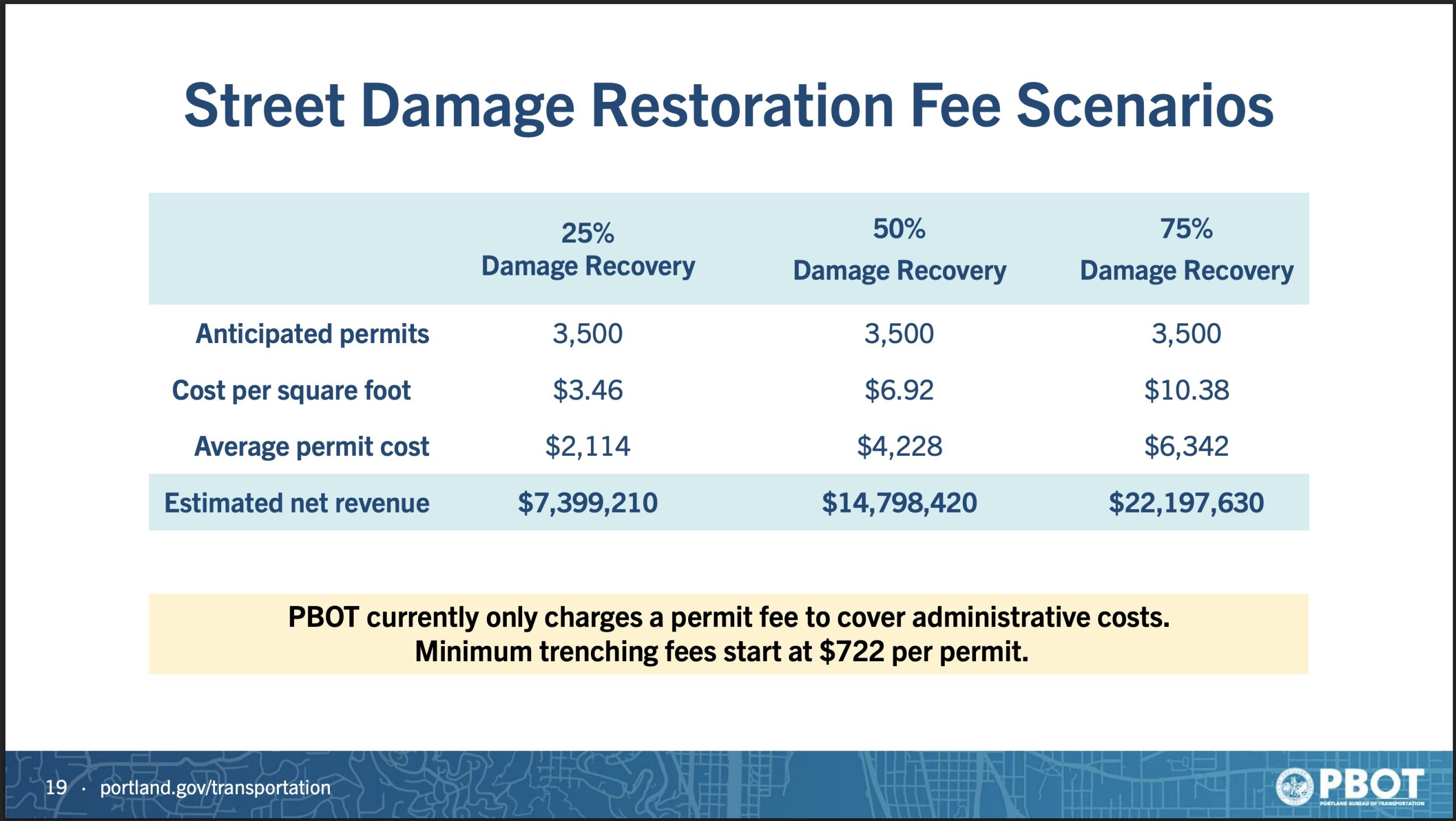
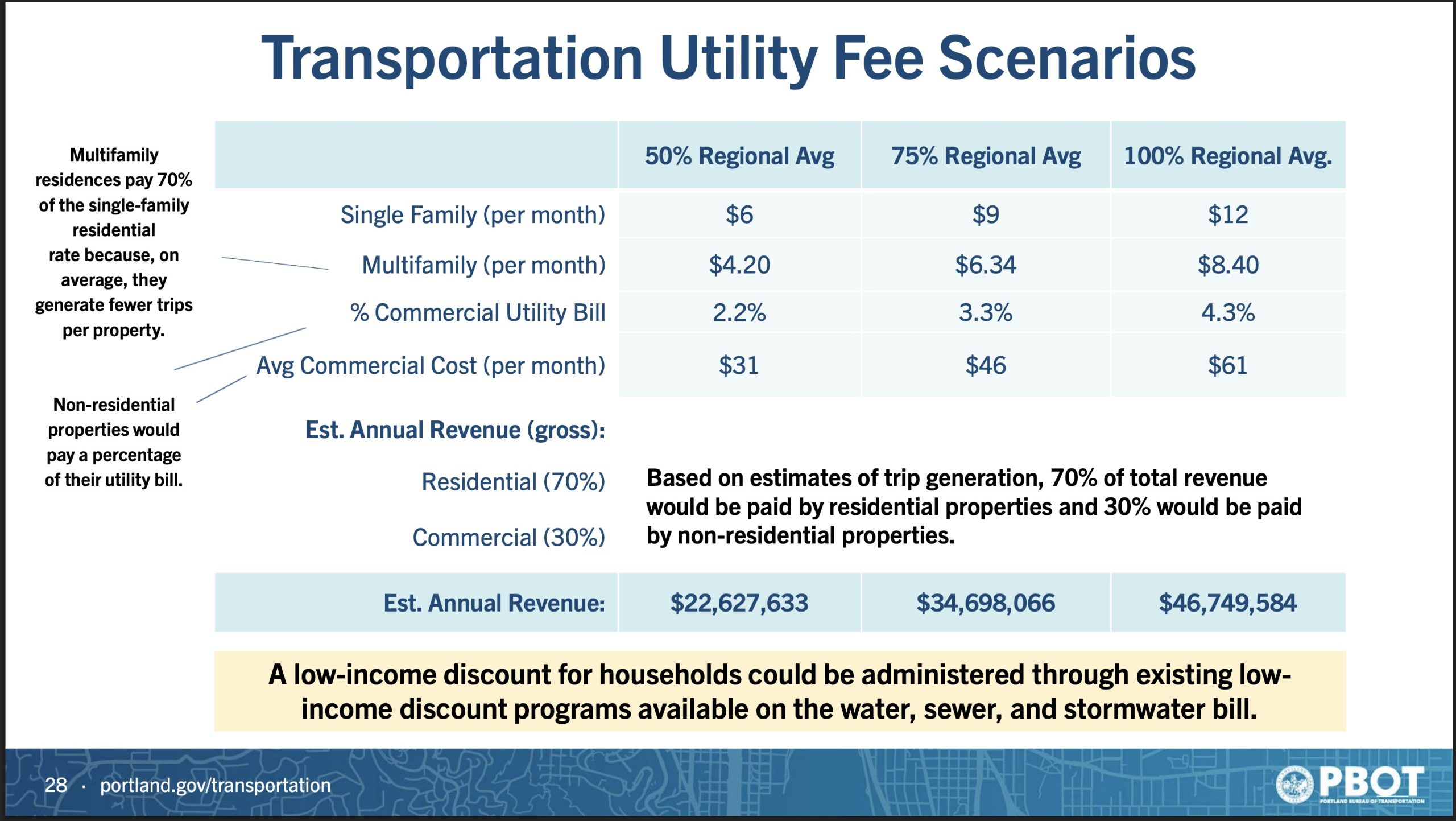
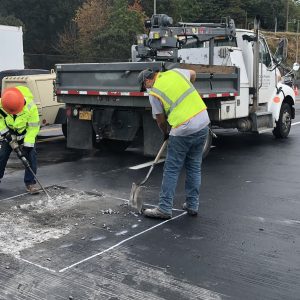
Clark plans to draft legislation that would authorize the City of Portland to pursue a Transportation Utility Fee (TUF) at around $12 per household (or $9.50 per multifamily unit) and a Street Damage Restoration Fee (SDRF) at $10.30 per square foot. The TUF is something 31 other Oregon cities have already implemented. It would be charged on utility bills and would elevate well-maintained streets to the same level as other basic city services like sewer, power, and water. The SDRF would be charged to utility companies and other contractors who dig up streets. The fee would compensate PBOT for damage done to the right-of-way.
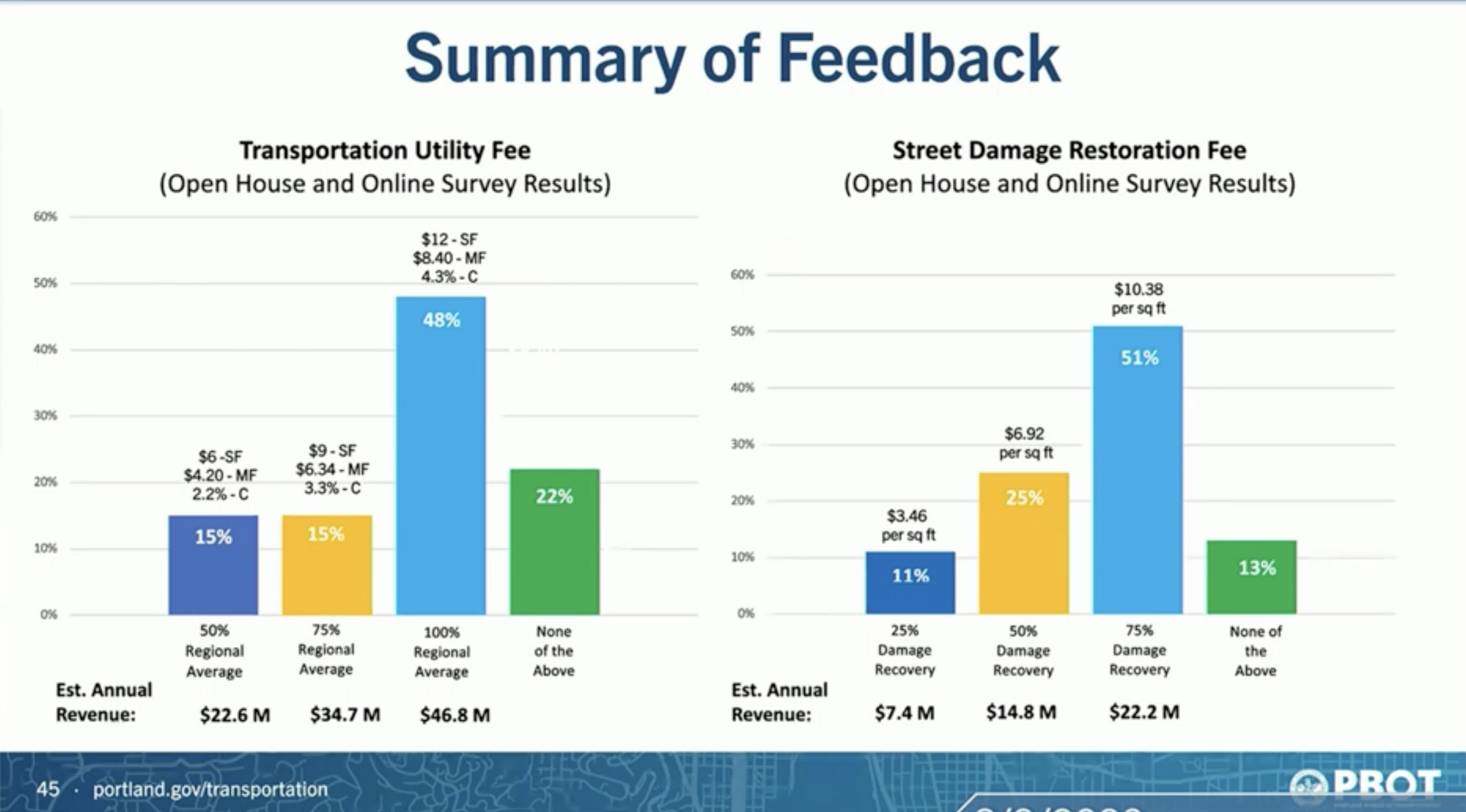
Despite the conventional wisdom that voters are reflexively against any new taxes or fees, PBOT’s recent outreach showed that 78% of those who offered feedback support the TUF and 87% support the SDRF. Of those who support the TUF, 48% said it should be the same as the regional average, or about $12. This is significant, because folks were given options to support $6 or $9 per household — yet they still chose $12. (Note: The TUF is technically a fee, not a tax, so it doesn’t need a public vote.)
PBOT says they must fill a $25 million budget in the short-term, but the overall cost to address their maintenance backlog is $6 billion.
Taken together, the TUF and SDRF would raise about $68 million per year and would give PBOT a flexible pot of funds they’d have discretion over. This is a key point given that the vast majority of PBOT’s funding is from sources that are dedicated to specific projects and programs. Add in the $18 million (or so) per year PBOT brings in from the Fixing Our Streets (10 cent local gas tax) program and the bureau would have enough to fill their budget gap and make headway on that maintenance backlog.
There are still a lot of details to hammer out. Clark said she’d likely include language in the ordinance that would mandate a certain amount of funds raised from the TUF be spent on maintenance. But Clark wouldn’t stipulate an end to PBOT’s existing local gas tax, which is an idea floated by Mayor Keith Wilson at the open houses. Councilors Clark, Smith and Angelita Morillo said that gas tax conversation should not be mixed with conversations about new alternatives.
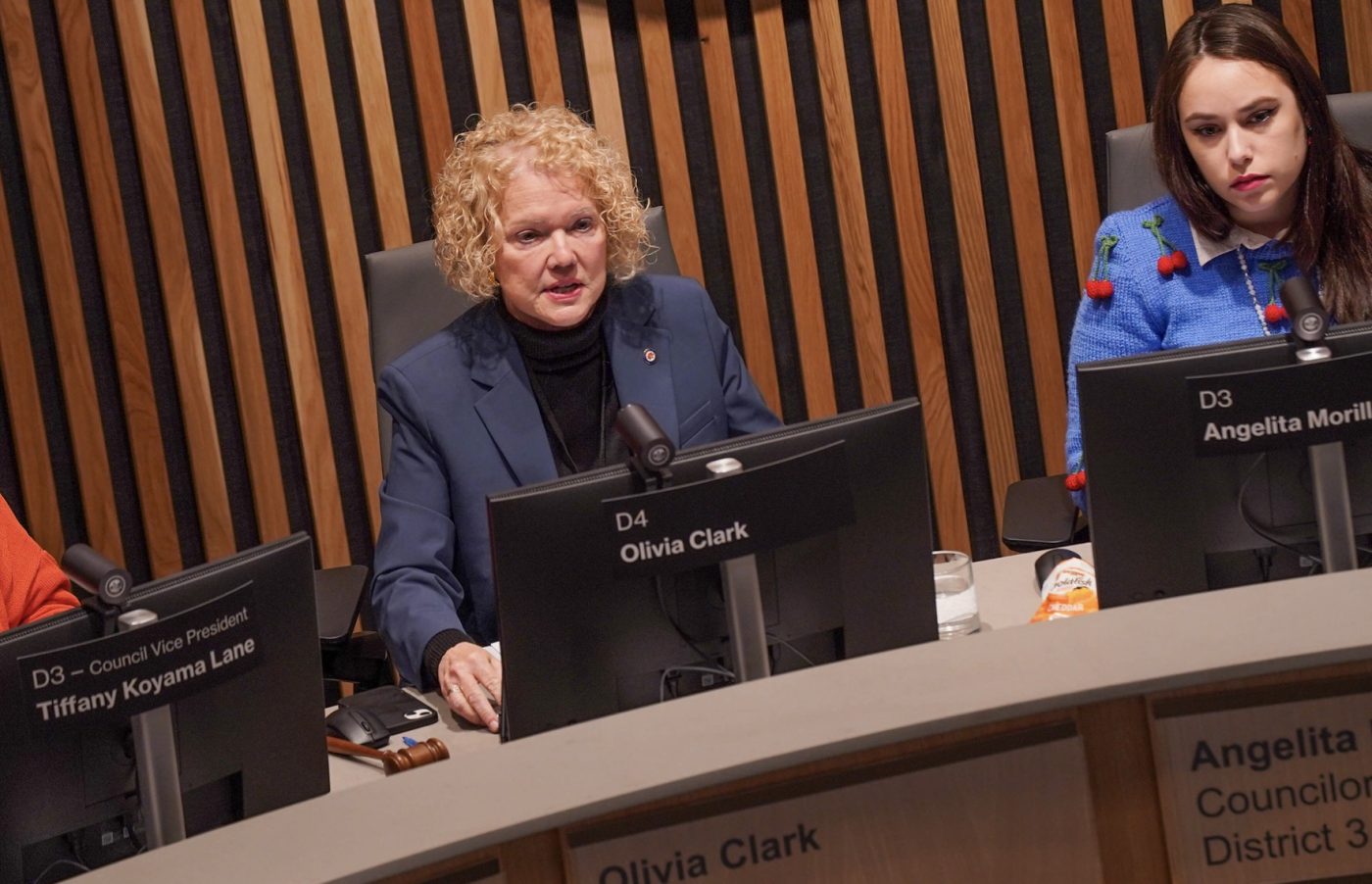
“This is an important moment in Portland history.”
– Olivia Clark, city councilor
At council Monday morning, Clark’s proposal was met with strong approval from the other four members of the committee. Councilor Loretta Smith voiced her support, seeing it as a way to fund her Sidewalk Improvement and Paving Program.
Councilor Mitch Green also said he’s ready to support the proposal. He also said the future of Portland local gas tax could be a moot point if city planners use new revenue to, “Shape the transportation system that gives people options to not drive their car.” Green said the U.S. war in the Middle East could soon lead to lines as gas stations and provide a strong impetus for people to drive less and/or seen other options. “We have an opportunity here,” Green said, “To use that geopolitical crisis as an opportunity for us to lead a city forward that’s not exposed to that kind of energy shock.”
Two other alternative funding sources — a retail delivery fee and a third-party food delivery fee — were considered not quite ready for prime-time and won’t move forward in this proposal.
As leader of this effort, Councilor Clark wants to move forward at relatively breakneck speed. She hopes to have legislation drafted and delivered to the full City Council by next week and continue the conversation at the (newly assembled) Committee of the Whole on April 2nd (which will be the first opportunity for public testimony). If all goes according to plan, the proposal will be in front of full City Council on April 8th, before the city budget process officially begins.
“Let’s move on,” Clark said at the end of this morning’s conversation. “This is an important moment in Portland history.”
Thanks for reading.
BikePortland has served this community with independent community journalism since 2005. We rely on subscriptions from readers like you to survive. Your financial support is vital in keeping this valuable resource alive and well.
Please subscribe today to strengthen and expand our work.
LOL . . . right
If, a big IF, this passes the voters, I’m taking bets on how many years it’ll take for the City Council to rob these fees and use them for something else.
I give it 3 years.
It doesn’t have to pass voters. The TUF is a fee, not a tax. And the SDRF isn’t even paid by voters. And the Fixing Our Streets program has been in place since 2016 and has a very stellar record of accountability and transparency and has never been raided for other uses.
How is calling the TUF a fee instead of a tax anything but semantics? And ignoring that issue, is this an Arts Tax 2.0 where a government agency with no experience in mass taxation is charged with doing that work?
AY,
Yes some of it is just semantics and politics. But there are also different laws and procedures that depend on something is a tax or a fee. I’m not the expert in this area, but a fee is generally more appropriate when the thing is a service you are paying for. In this case, the city provides maintained streets as a service and this would be a fee we’d all pay for that service.
Is the gas tax really a tax isn’t it just a fee for using the system, albeit a fee that hasn’t kept up with inflation. It’s like if the cost to ride a roller coaster was still $0.01 when roller coaster were invented in 18-whenever?
People like to say “gas tax” but it’s really a fee, since it doesn’t go into the general fund and is instead dedicated to roadway maintenance and operations.
Usually a “tax” is a pure revenue generation method, where the taxes go into the general fund and then the money is divvied up among government agencies by the legislative body. A “fee” is a more specific way to charge users for the cost of specific services. In this case, the idea is that much like how every household and business uses the sewer and water systems (and pays a utility bill, also considered a “fee”), everyone also uses the transportation system, so it’s kind of like a utility. And this funding would be dedicated to transportation maintenance and safety specifically, rather than going into the general fund. If it was possible to measure everyone’s exact usage of the transportation network, the way a water meter or electric meter can measure usage of those utility networks, then the fee could be more precise. But in the absence of that being feasible, cities have turned to these per-household and per-business fees instead, that are not so precise but have the advantage of simplicity and low administrative costs.
Fixing Our Streets gas taxes are regulated by state law in Oregon, so even when City Council tries to use them “in an emergency” for other purposes, they can’t. Fees on the other hand…
Jonathan, perhaps you should consider a boilerplate at the top of the Comments section: “Please Read Article Prior to Commenting”
It’s the will of the voters that the City Councilors have their jobs. If enough come out against it and let their City Councilors know, it won’t pass.
Or another scenario is someone does a ballot measure that repeals it.
The voters still very much can wield power even outside of the ballot box.
WT*?
Is it possible the you are not aware of two scathing audits from the City Auditor’s office that pilloried PBOT for refusing to account for the portion of fixing our street budget legally obligated to be spent on “safety” (e.g. bike/ped infrastructure). And, of course, PBOT’s response was to essentially thumb their noses at the idea that they should accountably allocate funds to voter-designated categories.
https://www.oregonlive.com/commuting/2021/09/portland-auditor-says-transportation-bureau-failed-to-closely-track-gas-tax-spending.html
https://www.opb.org/news/article/portland-road-repair-safety-program-fixing-our-streets-gas-tax-audit/
Yeah those are really scathing at all. And one of those was done just 3 years after it passed. And don’t get me started about how the Auditor is an elected official and that office has always had political motivations to say the least. But even if you discount all of that, you’re talking about a critique that PBOT didn’t quite categorize spending properly. That is really not a huge deal IMO. Also, for some reason voters went ahead and voted to support that tax overwhelmingly despite that audit.. so yeah not really scathing.
The intent of the first couple of rounds of fixing our streets was to have 50% of the revenue go to safety and that almost certainly did not happen. And it burns my britches that PBOT got away with violating the drafter’s and voter’s intent without even a slap on the wrist. We need better government but we desperately need a more honest and accountable bureaucracy.
The auditor’s role is inherently political because one of their duties is to make sure that voter and legislative intent is respected by the city administration. Unfortunately, I also view the city administration as even more political with a very strong conservative and classist slant. This bias is one of the reasons we have an accountability problem in the first place.
Yeah those are not really scathing at all. And one of those was done just 3 years after it passed. And don’t get me started about how the Auditor is an elected official and that office has always had political motivations to say the least. But even if you discount all of that, you’re talking about a critique that PBOT didn’t quite categorize spending properly. That is really not a huge deal IMO. Also, for some reason voters went ahead and voted to support that tax overwhelmingly despite that audit.. so yeah not really scathing if you ask me.
I’m not inspired at all by the owner of Bike Portland providing cover for a focus on potholes and paving at the expense of bike/ped infrastructure.
Have you ridden a bike in Portland? Potholes and poor pavement quality are a huge issue for bike-riding these days. It’s both a huge impact to comfort and a major safety issue, especially when riding at night. This is no longer a car vs bike issue.
It’s always cars vs bikes, unless you are a bike rider who also drives. And, unlike, the blog owner I hate
carsPAVs (pedestrian-assault-vehicles).Technically true but we all know a FEE= TAX
It will follow the same fate as the ULF, which both closely resemble, and even before the ink is dry PBOT will get 25% in the first year, 12% in the second year, and less than 3% every year after that. The rest will go into the city’s general fund to pay for fire, police, housing, pet projects, etc.
This package came up at the council’s Transportation and Infrastructure Committee today. They all liked the idea of writing the ordinance to dedicate all of these funds to transportation going forward.
I can see a lot of ways to be skeptical about this. But I’m going to wait to see what’s in the proposal before making a judgment.
The ULF clearly didn’t have enough safeguards in place, and I certainly hope they are smart enough to put harder language in the ordinance that really dedicates the revenue to the intended purpose. It should be similar to how ratepayer funds from water/sewer charges can’t be redirected for other purposes, and lawsuits are allowed to be used to enforce that if violations happen.
If council can put safeguards in place, it can remove them just as easily.
Heaven forbid we actually have focused taxes on private car usage
We do have plenty of taxes and fees on private car usage. We have gas taxes (federal, state, and local), weight-mile tax (state) and heavy vehicle use tax (local) to account for trucking, we have vehicle registration fees, driver’s license fees, smog checks, parking meters, and of course the cost of parking at private lots. Arguably these should be even higher to both discourage over-use of cars and to capture the externalities they impose on society. But that doesn’t mean we shouldn’t also have a stable source of funding, with a broad base and low rate paid by nearly everyone, to fund transportation overall, so we’re not dependent on the very thing we’re trying to discourage.
It’s similar to the situation with cigarette taxes. Usually cigarette taxes (and lots of other “sin taxes”) directly fund health programs. But you wouldn’t want to solely fund your entire health program with cigarette taxes, because if so you’d be wholly dependent on people continuing to smoke cigarettes, and either you’d get stable or growing funding because more people are smoking or you’d get steadily declining revenue that starves your health program because fewer people are smoking. So it’s good to do a combination.
So… you mean “cigarette fees”?
I’m using the term most people say, just like how we say “gas tax”. Obviously.
I don’t love that it’s not income adjusted or scaled based on actual impacts to roads. I’d rather see something like a street parking fee assessed to every vehicle stored in public rights of way, with higher fees assessed to heavier vehicles or an income adjusted tax.
Yeah at this point I think folks on council understand that we can either debate a perfect implementation and mechanism and try to do something that does more to change behaviors and punishes people for making choices that are overall a negative to our system — or we can just find something that is good and works and get it passed and start fixing streets and move on. I am personally here for the latter!
Agreed Gron although the original PBOT presentation on TUFs did have this footnote on page 28:
yeah there will most likely/definitely be some sort of low-income considerations. This is Portland City Council after all.
POEM
https://www.portland.gov/transportation/planning/pricing-options-equitable-mobility-poem
Prominent local cycling advocates caved and agreed with the decision to cancel consideration of POEM congestion pricing.
Why?
Market urbanist fears of downtown’s further real estate collapse. (It’s going to happen anyways…)
The complexity of trying to figure out exact trip generation amounts for every household and business was what tanked the previous attempt at a TUF back when Steve Novick was the transportation commissioner in 2015 or so. It was not only complex and hard to explain, it also opened itself up to the prospect of endless challenges, since it meant anyone could hire someone to come up with their own trip generation counts to challenge their fee and get it lowered. It would have been a nightmare. This is a much better system, and there’s a reason it’s what every other city in Oregon mentioned in the presentation uses.
Thanks Marvin. Lots of helpful comments for me to wrap my head around these. AFAIK there are some cities in NA that have successfully used trip estimates in their TUFs. I think Portland also uses them to estimate TSDCs. Do you know of any solid examples, or do most get mired in litigation?
Trip generation tables are used as part of the methodology for determining TSDC rates, but then they are simplified and modified, so the rate that is adopted is officially based on square footage and use type. So they can’t be legally challenged on a case-by-case basis in that same way based on someone measuring their actual trip generation. This proposal is basically the same. The lower rate for multifamily is generally based on the fact that trip generation tends to be lower, but by avoiding the rate literally being based on trip generation, it avoids those kinds of challenge issues. With Novick’s proposal in 2015, the business rate in particular was literally going to be based on the type of business and its trip generation according to the ITE trip generation tables–so that methodology was going to be constantly mired in legal challenges, plus it was super complicated to explain. So I like that this version is just a simple percentage.
The average is based on number of cities and not tied to density or population? even VMT? I guess I’m a little confused why it would just be based on number of cities and not to something more directly related to the infrastructure that the fee is meant to support
dm, I hadn’t considered that, good question – I guess I’d say offhand that the costs of maintaining a transportation system and the population it serves are theoretically in relative equilibrium..?
I would generally agree for smaller towns, but Portland has a lot of outside traffic using the streets. Perhaps it’s not fair to ask residents to pay a higher fee because folks from Vancouver are using Portland streets, so basing the fee on VMT may not be the right answer, but certainly this proposed method of averaging the fee based on number of cities will under-produce the necessary funding
This is where congestion pricing would serve to address a lot of those problems (including dedicated funding for transit). NYC has been a resounding success in that area. But baby steps. A TUF is a good start.
The total revenue generation is tied to population. The same fee per household in different cities will produce different amounts of revenue because there will be more or less payers. So Portland, even with the average fee rate, will generate more funding, which makes sense since we have more roads and more people traveling on those roads.
This just proves once again that those who cannot remember the past are doomed to repeat it.
From the 2014 article:
“In 26 years, the city has allocated 28 percent of utility license fees to transportation just once — in 1988. The actual amount diverted for transportation dropped from more than $5 million to nothing in 1994 — where it stayed until the 2010 fiscal year.”
https://www.oregonlive.com/portland/2014/08/portland_street_fee_city_counc_2.html
Fingers crossed the council can make the funds raised locked into PBOT better than the original TUF and better than how he PCEF fund turned out. Go Blazers?
I don’t think anyone is really against the $12 fee, I think people are against the frustration of paying into what according to historical trends will become a slush fund and we have to redo the drama dreaming up more fees in a few years.
I’m flat out opposed to another regressive fee. Low income people should pay nothing and people like me should pay more. These fees/taxes are convenient because they have little impact on the high-income people who are hyper-engaged in local politics (e.g. millionaire NA board-members/lawyers/Drs/Managers/Tech-workers/etc/) and a more significant impact on poor people.
If Portland does move forward with the utility fee, it will almost certainly come with lower fees for folks who don’t make as much money. There’s even a way to create a lower fee for folks that don’t have any registered vehicles, and so on.
then those definitions, qualifications, and exceptions need to be completely baked in. anything short is poor design and should be rejected because it leaves room for mismanagement and inconsistent interpretation. I agree with you when you’ve called for progress over perfection, but we need to be able to define and call out both successes and failures through data and evidence.
I have zero reason to think they won’t be baked in. This still needs to get written up, debated at council committee, go through public testimony, and get debated at full council before it is set in stone.
This city, region, and states has demonstrated their love of regressive taxes/fees many times so I think your optimism is providing political cover for Portland conservatives (again).
Show where this is even remotely true, unless you’re basing this all on Washington, which may have regressive taxes, but have dynamism in their economy OR would currently kill for.
I misread the cost when I wrote my post, I read it as $12/annually, not monthly.
You are absolutely right, the fee is too high and as typical with Council taxation, extremely regressive. Don’t worry though, they’ll fix it down the road (heavy eye rolling sarcasm!!)
The whole idea here is to treat transportation more like a utility, which is really what it is. And we have a “free rider” problem right now, where lots of people don’t pay into the transportation funding system even though we all benefit from it. So this is more like when we pay our utility bills. Yes, we have a low-income discount, and they said there will be one for this as well. But we don’t charge higher electric or water bill rates to rich people vs middle-class people, because it’s a fee for service, and we all use basically the same roads full of potholes. Arguably lower-income or middle-income people get more benefit out of a well-maintained roadway system, since they have a harder time dealing with the high cost of damage to their car or bodily injury from a crash, compared to rich people.
Again,
Utility fees are based, at least partly, on utility usage. If I use more water, I pay a higher fee. Built into utility fees is a financial incentive to be conservative in using the utility. If ANY utility should operate under this kind of incentive, it’s roads and driving. And implementing a flat household road fee takes the pressure off on coming up with a more equitable fee based on mileage driven and vehicle weight.
I (still) can’t support this proposal.
And, once the fee is implemented, you can bet that if the gas tax morphs into a more progressive mileage/weight tax, this fee won’t go away, and will only stay at $12 until council decides it needs to be higher.
I hear you Michael. But the option is to never pass any type of transportation-based utility fee because we get bogged down by the impossible task of making it fair for everyone based on their usage. That type of fee schedule sounds like a nightmare politically and if I recall, that was one of the problems with former Mayor Adams’ “street fee” was that he tried to do that but lost the public in how complicated the calculations were. I’d rather pass a flat fee (because again, we need to do something now!) and then come back later and talk about maybe credits or discounts based on certain behaviors (like maybe number of cars registered to household or something like that).
It’s not an “impossible task.” It’s a hard task. Hard things are worth doing.
And if you had to place a bet, what do you think the odds are that we’ll “come back later and talk about” it? The utility fees will literally take the pressure off, and we’ll move on to the next crisis. As much as it sucks, our deteriorating roads ARE the incentive to get it right.
Looking on my water bill, there appears to be some separate line items. One for water volume, one for sewer volume, one for stormwater billable area, and one for stormwater service unit.
I don’t know the nitty gritty of what the non-volume fees are. But, I can imagine that they relate to fees for cost of infrastructure while the volume is the cost for the product used.
except the stormwater fee is based solely on water usage – they don’t (yet) have a meter on your black/grey water.
The storm water billable area is based on the amount of impervious surface you have.
Here’s what the city’s webpage says
A stormwater service unit (often denoted as ESU – Equivalent Service Unit, or DRU – Drainage Residential Unit) is a billing metric representing a property’s impervious surface area (e.g., 2,500–2,640 sq ft) used to calculate monthly fees for managing runoff. It covers maintenance of city infrastructure like pipes and drains.
OK, good to know, I’ll take a closer look at my water bill – but I’m pretty sure the major sewer volume cost is based on the water that’s come in past the meter and then (presumably) been sent down the drain one way or another.
I think the sewage charge is based on your winter quarter usage, on the assumption that most people are not watering plants, washing cars, etc.
You should probably take a look at your utility bills again and see what they would be if you used exactly zero of the product they are offering. Any posturing that conservation is a meaningful part of the equation is pretty laughable after this analysis.
Not posturing. I’m well aware of the flat fees that are part of my bills.
But my use IS a component of my water, electricity, and gas utility bills. That’s all I was claiming, not the percentage.
The point I was making is that a road utility fee should be connected to mileage driven and vehicle weight. Do you agree or not?
That would make it significantly more difficult to assess and collect, and be more contentious, making it much less likely to be enacted. This idea clearly falls into perfect-is-the-enemy-of-the-good territory.
Plus, the fee is about more than just driving — it’s about all the benefits we accrue from a well functioning transportation system.
I agree that a mileage/weight based fee would be more difficult to implement. And likely something Portland wouldn’t be allowed to do anyway; it would have to include the county at a minimum, and would be better if ODOT & DEQ were involved and it was statewide. I find the constant blowback and resistance on mileage-based funding incredibly frustrating. People just don’t want their driving tracked, even when using publicly funded roads and driving with smartphones and gps devices actively running. The fee could easily be assessed by DEQ when you renew your registration just by checking your odometer. Hell, Jiffy Lube does it when they change your oil.
My main frustration is knowing we could do so much better. It’s seeing the surgeon reach for the butcher knife when the scalpel is right there.
Most of the miles I drive are outside of Oregon. Why should I pay Portland for that?
Sounds like you’re a fan of the fees being assessed by gps tracking then.
That would be my preference as well.
Why would you think that? Your solution is simplistic and won’t work as advertised. And no, I don’t see giving ICE a list of every place my vehicle has been for the last year as much of an improvement.
Tracking milage is actually a bit complicated, and may involve tradeoffs that most people won’t accept.
because you live in Oregon?
If I drive in WA, I should pay them for the privilege, which I do via my gas taxes. I should not also pay Portland.
maybe. But a lot of WA drivers come to Oregon and wouldn’t pay. Tools would help, but I think a mileage based system would be equitable-enough. Even if most of your miles are in WA, most of your trips presumably start and stop here. And you are not the typical driver.
That might be an issue for Portland to take up with WA, but what does that have to do with me as an individual?
Also, it would almost certainly be illegal.
Apologies, I didn’t mean that you were posturing, I meant more broadly that we are supposed to focus on usage and conservation, yet even if you conserve to zero, you’re still paying a significant sum, even for people who can’t afford their bills and likely pay no attention to conservation.
I think weight is a great metric for road utility fee, I think miles driven is great in practice, though I have much greater concerns over the implementation of that, particularly for a city with transient road users. I can’t say I particularly feel bad for people who buy heavy EVs then don’t drive them, so feel like they are being screwed.
I also completely believe that Green is onto something by having it be a flat household cost, because as a private user, or not, everyone is 100% dependent on the roads to have products and consume services, without which there is no economy to support.
We still have gas taxes, and eventually will have a VMT tax. So that’s the part you’re talking about that measures consumption/impact. Think of this TUF as the “base fee” for the system.
I agree completely. Although most utility fees have two components, one is a charge on the basis of usage. A utility fee for streets is the opposite of what is needed – a charge based upon usage. Those who choose not to own a car are paying of those who do. Those who dive a big vehicle a lot are doing so at the expense of those who drive a small car seldom.
The fee is nominally trying to address that by land use – hence the difference in rates for commercial versus residential which is based on difference in trip rates by use type. So looks pretty blunt, but that looks generally to be the ‘fee’ nexus.
Every utility bill has some sort of base charge. Every house in Portland is connected to a street and every person in Portland is dependent on these streets to some degree or another. Having every household pay a base charge to maintain the streets everyone uses makes total sense. I agree that those who are harder on the streets should pay more. If I drive a tank around town, it’s gonna destroy the pavement and I should be responsible for that. That usage portion of the utility fee can be added later, but not supporting a proposal because it isn’t perfect doesn’t make sense.
Good to know that when I am on my bicycle getting passed by a Rivian that we are paying the same fee to use the same roads.
Nice to know the socialist is behind this very fair new tax.
Part of the argument around this fee is that, whether we’re using them for personal transport or not, we are all using the streets as a method to get the things we want to the places where we can use them, whether that’s food delivered to our favorite grocery store, meals delivered straight to our homes, or ambulances saving our lives to the hospital. A functional, well-maintained road system is a public good that benefits all of us, whether we drive a car, walk or use public transit.
I didn’t say that good roads are not a benefit to all.
How we pay for them matters.
People who drive large heavy vehicles that damage the roads should pay to fix them.
Mitch Green thinks that people who drive small cars or no cars or just take transit or walk should pay the SAME fee as a person who drives a Hummer.
To **** with the whinging of economically comfortable bike riders and rivian drivers.
The real insult is that socialists are supporting a tax where a single mother working two jobs and living paycheck to paycheck pays the same amount as a gazillionaire like Timothy Boyle.
It is in the traditions of real world socialists though. I guess real socialism hasn’t been tried at the council yet?
I’m annoyed they still have the gall to still call themselves DSA instead of Democratic Corporatists of America.
The driver of the Rivian is definitely paying higher fees in the form of vehicle registration fee (which is higher for EVs than gas-powered vehicles to make up for not paying gas tax), driver’s license fee, title fee, parking meters/permits, the various sales taxes on vehicle purchases (not called sales tax in Oregon, but that’s what they are), etc. You both will pay this TUF, but the driver of the car is paying more in total.
So would the Street Damage Restoration Fee be paid by utility companies or other contractors that rip up the roads?
Yes.
And PBOT is considering various levels of cost recovery – meaning the balance between the cost of the damage vs what PBOT charges to repair it. PBOT queried the public about a 75% cost recovery model… but Councilor Green pushed PBOT to consider a 100% cost recovery model.
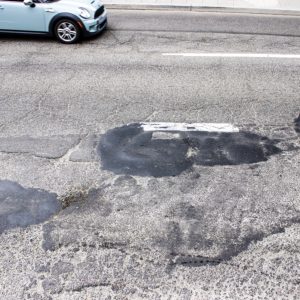
Any private utility companies (like telecom, gas, electric, etc), any public utilities (water and sewer), and any private development that includes the little road trenches that connect to the main pipes. They’d all have to pay. Anyone who has ridden a bike down N Vancouver Ave knows what it’s like to ride across a thousand bumpy utility cuts connecting to all the new apartment buildings, all badly patched and deteriorating at a different rate than the surrounding pavement. Or think about Tillamook St between Rodney and MLK, where a sewer project did a terrible job with patching and it means the optimal bike-riding area is horribly wavy and bumpy. This would mean not only do the utilities have to pay for that damage and it would go toward PBOT’s repaving budget, it also means the utilities have an incentive to avoid the fee entirely if they coordinate their work with repaving projects so there’s no patching needed in the first place.
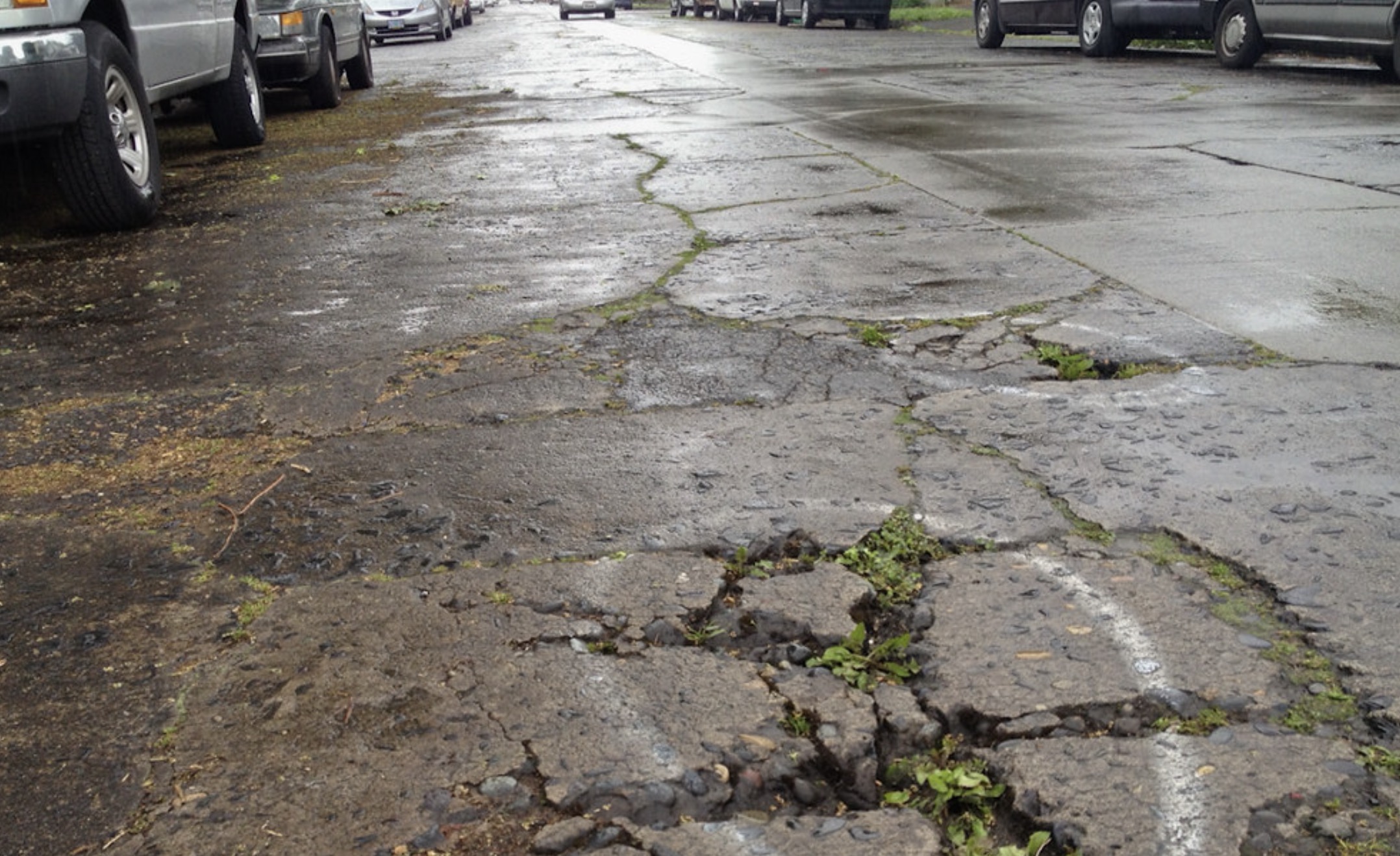
Jonathan: an interesting point crossed my mind upon seeing the photo selected with this article…the broken up concrete street may be as old as 1900 to 1920s (and not the utility cuts). The selection of materials (and preservation) can have a great impact on its lifespan. If that street had been built with asphalt then it may have needed reconstruction after 20 to 30 years and not 100.
When I briefly worked at PBOT I was told that it is called “MacAdamized concrete”, named after a popular 19th century Scottish engineer. This type of pavement is common all over the USA from about the 1880s to 1930s since it was so simple and cheap to construct – you simply cover your existing gravel streets with a layer of slow-drying liquid cement – you have to wait a month or two for it to fully dry, but it lasts quite a long time. (The Pantheon in Rome was built with slow-drying cement, it took over 30 years to build – but it’s still intact after 1,900 years while our quick-drying modern concrete stadiums crumble within 50 years.) Portland has a lot of MacAdamized streets all over the city, particularly on the inner east side – many major streets have a layer of it under the exposed asphalt.
You can do the same thing with asphalt (“oil on gravel” is what PBOT calls it), but it doesn’t last as long as concrete, and you can’t put speed humps or speed tables on them as they wont stick. SE 108th north of Division is an example.
That’s our esteemed Phd in Economics city councilor embodying the eternal political spirit of “never let a crisis go to waste”. What a complete putz. We are a net exporter of crude and refined products, this will need to go on a very long time and there will have to be a security vacuum in the Straight to cause material supply disruptions to cause gas rationing. Just Trump mentioning today that we may provide security in the Straight caused prices to drop from $115 to $88.
What an odd thing for someone to think and actually say out loud upon hearing of all the violence, death and ecological devastation that’s happening over there right now. Let’s fantasize about the imaginary future I want rather than dealing with the horrors that are the now? Bizarre!
Time for another iteration of the “earthquake” apocalypse cargo bike races.
Oil is a global commodity. Unless Trump bans the export of domestically produced oil (your guess is a good as mine), our prices will rise with the rest of the world.
This war is far from over, and we haven’t seen the biggest impacts yet.
Yes, and high prices don’t portend shortages.
How do you know?
I know because Trump said the war will end soon.
Nothing like basing one’s world view based solely on what Trump says. I’m pretty sure there is a derogatory term that identifies people like that.
Are you saying that he can’t be trusted?
I figured it was a rational comment.
There are many rational reasons to believe that the war will continue past the “two weeks” or “4 to 6 weeks” or the “nearly over” statements that we’ve heard thus far. I just figured you weren’t seeking a serious answer.
While the USA is now a “net-exporter” of crude oil, our refineries aren’t really set up to process the light crude coming from North Dakota, so all that oil gets exported to Europe where they can refine it. Meanwhile we continue to import the heavy black stuff from Venezuela, the Middle East, and other friendly dictatorships.
Do we have an excise tax on cars in Portland? I don’t drive and I tried looking this up but found nothing, so maybe a car owner here can let me know.
Back when I lived in Massachusetts, we had to pay an excise tax every year based on the value of our vehicles. The tax went to the town/city you lived in.I dont remember the rate, but it wasnt much unless you just bought a brand new car. Maybe this kind of tax exists here just under a different name. Someone let me know if it exists here or not.
If we do not have a tax like that, it makes more sense to me to raise more money this way than to just do a blanket tax on everyone. If you own a $250k lambo, it makes sense to me that you would pay more than someone with a 2010 honda civic and that someone who doesnt own a car at all doesnt pay the tax at all.
Mitch Greene, democratic socialist disagrees with you.
He supports you paying the same amount as the $250k Lambo person.
Should I take that as a no, we do not have a yearly exicse on the value of peoples cars?
The only vehicle tax that Oregon has is registration fees. There’s also a gas tax that is assessed at a per gallon rate.
Oregon has a vehicle privilege tax of 0.5%.
Thanks. I didn’t know that. Today I learned that Oregon has a vehicle sales tax. Looks like it’s a one time fee assessed on new car sales only. So it’s rolled into your purchase price.
I think this is a good idea to think about for the future, but I can tell you right now it would have no chance of passing in Portland. That would be incredibly controversial. We’re in the land of property tax limitations, after all, and what you’re describing is essentially a property tax on motor vehicles.
Question: For those who qualify for an income-based reduction in their utility bills, where does this leave them? Offering a low-income person say, an $18 per month reduction based on their income and then turning around and adding back $12 of that as a fee seems meanspirited at best and unfair at worst.
I understood the intent is to apply a similar income-based reduction for rhis new fee as well.
That’s not how it would work. It’s a percentage reduction, and that percentage reduction would also apply to the $12 fee.
Thank you, Jonathan, for the nice summary of today’s T&I committee meeting. One thing you left out, but which seems appropriate after observing the negativity of many of the BP comments so far, is that PBOT tabulated separately the views of folks who attended the open houses from those who answered the online survey.
Unsurprisingly, the views from folks who got themselves to the open houses were significantly more positive than the online survey feedback. PBOT’s Mark Lear made some generous speculations about why that might be (Mark’s a nice guy) … but I think it’s a safe generalization that folks sitting around posting anonymously from a computer are more prone to express cynicism than someone appearing in person, in a social setting. Go figure.
And what do we think that says about the people who vote without appearing in person, in a social setting?
That’s a good point, Lisa. BP comments tend to be dark, for sure.
My own feeling about these fees is akin to my feeling about the charter that created Portland’s new form of gov’t: We have to do SOMETHING. Almost anything we do will be better than what we’re currently doing, so let’s get done what we can get done and not wait for the ideal situation to come along someday.
Barack Obama: “Don’t let the ideal be the enemy of the good.”
Portland tends to be very bad at getting ANYTHING done.
It may also be true that those attending an open house on a fairly wonky topic are a self-selected bunch that are more likely to support imposing new fees than those who are only dimly aware that this is an active discussion.
I think we’ll get a more complete picture about how people feel as it becomes more widely known that these fees are likely coming to a utility bill near you.
Will a broader cross-section of Portlanders be just as enthusiastic? The lower cost Arts Tax isn’t exactly beloved, and that was passed by voters after a broad public discussion. The street fee will cost more, and will be imposed from above with much less public buy-in. I suspect many folks will first learn about it when they get a surprise in their utility bill, and may not be as supportive as those at the open house.
We’ll see.
I gripe about the Arts Tax because the remitting of it is cumbersome and the reminders from the administration are rude. Sounds like they’ve heard my main complaint and will make it easier to pay this on the same bill as other fees I pay.
Whether I can navigate another $144 a year against these economic headwinds is another question. Then again, hitting a pothole on my bike could set me back much more than that in damage and medical fees, so the fee might be a net benefit.
Who knew that people with the
timeprivilege to closely follow the policy debates of the political establishment, attend open houses/NA meetings during the work week, and find out about poorly-advertised undemocratic surveys might be less cynical than those who do not have the time for a high-degree of elite participation?Gosh I miss you!
But did you notice all those edgy, young, downtown working-class workers who managed to show up, and testify powerfully and confidently, in opposition to Angelita Morillo’s DSA, mid-year attempt to gut Mayor Wilson’s budget (a non-democratic and under-handed move during the fall budget TAO)? Those true, non-college-educated working-class folk handed cosplaying Morillo her ass on a platter. My favorite was the young security guard who complained that she was gonna “make his job harder.” So no, I’m not buying your song and dance.
Crikey mate, only in Portland could 254 blokes at an open house and a few hundred online clicks turn into “overwhelming community support” for yet another twelve bucks a month.
Next thing you know they’ll say the roads crumbling back into the earth are actually a sustainability feature. Just chuck another fee on the utility bill and call it progress.
Important moment in Portland history alright. The moment they proved if you call a tax a fee, everyone’s apparently keen as to pay it. Bloody brilliant logic that
“…only in Portland could 254 blokes at an open house and a few hundred online clicks turn into “overwhelming community support” for yet another twelve bucks a month.”
COTW
Aye, Angus. But those 254 chappies and hombres got their botties and bristols to the open houses, which is a sticky wicket harder than bashing on your manky keyboard all day long. You can suss out positions easier than a mardy lad in a strop.
I’m not taking the mickey here. I just think that if a boffin offers you an open house and you show up, that’s meaningful. Ta!
Those 254 chappies out of 631,000 citizens are not “overwhelming community support”.
I feel like I just read three dialects and a cricket match but still missed your point (if you had one).
I really enjoyed OZ getting eviscerated by ZW. World champions my arse.
Whom are you quoting? I don’t see “overwhelming community support” anywhere in the article.
The city should give people who bike, walk or take transit 10% off of their city taxes.
Portland should begin planning for a publicly run autonomous electric vehicle fleet, remove all on street parking and tax gasoline 100%.
Currently the wars in Iran and the Ukraine are largely being fought with relatively cheap remotely-controlled or pre-programmed drones (the attacking drones cost $20K to $50K each to manufacture, explosives included – and the missiles to shoot them down cost $2 mil to $11 mil each). Many US university campuses already have food delivery robots. I’d say that within 3 years, for good or ill, you’ll see remotely-controlled unmanned Amazon and FedEx delivery drones on city streets delivering packages to your door with delivery robots – all the technology is already there – and soon afterwards every other company and jurisdiction will follow suit under public pressure to reduce service delivery costs and eliminate costly personnel. Naturally Portland and some other cities will resist, but other cities like Phoenix and Dallas will eagerly embrace the new tech and every other place will eventually fall into line.
While this may sound like a dystopian scenario, keep in mind that unlike human-controlled motor vehicles, you can program the drones to always follow the law, drive the posted speed limit, and use the new technology for good by controlling the flow of traffic to make our streets safer for pedestrians and bicyclists. But no doubt some terrorist will hack the systems and make the drones drive randomly and attack people…
No thank you. I want people on bikes and transit, not a massove fleet of autonomous cars that will require a massibe amount of parking infrastructure.
Not arguing your point at all, but one thing to keep in mind regarding AV vs cars with drivers is that we already devote a massive amount of real estate to parking, and human beings want to park their cars close to where they shop/work/live etc. AVs can park on industrial land or wherever, and tighter because there’s no door zone. Look at the massive parking lots at the Willamette and Columbia shipping terminals where imported cars are unloaded from ships. AV lots could be like that, and potentially free up real estate currently used for parking in the inner city, especially if they are rolled out in combination with congestion pricing and/or exclusion zones.
That sounds like a horribly inefficient use of space, both in terms of parking land and roadway space. If I need a ride in the central city, and my vehicle has to deadhead five or ten miles on a congested freeway from the city outskirts to pick me up, that is the least efficient transportation possible (short of a private helicopter). Frequent, fixed service transit paired with decent land use patterns would be infinitely better from a resource consumption perspective.
I was thinking more about where EVs sleep in the middle of the night when far fewer people will be hailing them. Of course, the designated EV lots/garages would also be charging centers. They might look more like the TriMet bus lots.
I wonder, could they somehow be hung up on car hooks like bikes are, for storage, under freeway overpasses such as along I-405 and I-5 through downtown? It might reduce VMT a bit.
Yeah, but traffic demand pulses at different times throughout the day. There’s a peak in the morning and another in the afternoon. There are other peaks tied to events, holidays, weekends, etc. You either need to dynamically predict where and when demand will peak with some accuracy, or your system will be laggy or inefficient. Currently, the app based private car transportation system isn’t great at maximizing efficiency. A number of studies have shown that addition of Uber/Lyft to a larger causes a significant increase in total vmt in the service area. There’s every reason to expect that autonomous vehicles would have a similar effect. If the fleet is electrified, that mitigates some of the externalities, but certainly not all of them.
Waymo introduces some externalities while reducing many others, and it improves transportation options for people with and without a vehicle.
I think most people would agree the benefits outweigh the costs. That automated vehicles have any costs at all is hardly a fatal flaw.
I reject your off hand assertion that “most people” totally agree with your point of view without providing any supporting evidence at all. I’m tired of your nonstop knee jerk boosterism for automated vehicles.
I said “I think most people would agree”, which is a provably true statement. I do think that.
My support for AVs is hardly knee-jerk; it is a well thought through evaluation of the likely and possible impacts, both positive and negative, and my conclusion that the positives far outweigh the negatives.
Any weighing of the impacts of AVs will favor the positive because “increased safety” and “reduced emissions” seem so much more consequential (and demonstrated) than “possibly increased congestion” or “run out of lithium” or “the insurance is impossible to figure out”.
You are free to disagree with me, of course — I’ve learned that when it comes to the war on cars, not everyone thinks rationally, and some people are willing to ignore the ever-increasing evidence about safety (and to downplay concerns about emissions).
But maybe I’m wrong about what people think. Does it matter? AVs are being deployed at an accelerating rate because they work and people who use them like them.
They’ll be in Portland soon enough and we can see for ourselves.
Research has shown that av can achieve safety performer that is “on par, or even somewhat better” than human drivers in relatively limited experimental deployment. But that does not mean that they are such a major advancement that we should automatically ignore all the other issues related to storage, employment, vmt, etc. Also does not take into account the fact that av often violate driving norms and expectations, and that novel situations semi regularly cause av to freeze up in the middle of the road and cease driving. They are not yet so good that we can assume they will solve any problems at any point in the future. In their current form, the business model is not sustainable, and they don’t offer a better level of service, level of mobility, or lower cost than existing, competing human operated transportation services. The case for additional deployment is entirely predicated on the assumption (hope) that they will improve in the future. The current product is not a reasonable alternative or substitute for other transportation options.
https://www.researchgate.net/publication/385936888_Identifying_Research_Gaps_through_Self-Driving_Car_Data_Analysis
I agree that AVs are hardly perfect, but they are constantly improving, and they have demonstrated they are significantly safer than human drivers (I’m not sure what data the paper you linked to was based on, but it is old, discussing Cruise as if it were still a going concern).
This from the NYT in December:
https://www.nytimes.com/2025/12/02/opinion/self-driving-cars.html
That sounds pretty significant to me. Of course, this isn’t the final word, and there will be dozens if not hundreds more analyses of an ever-increasing body of data.
Waymo is doing something like 250,000 paid trips weekly, so obviously someone disagrees with you.
You seem to doubt AVs will continue to improve. If they don’t, then I (and a lot of other people) are wrong, the project will fail, Waymo will disappear, and we’ll be back to the current status quo in a few years. But technology almost always improves over time, often quite quickly, so near term stagnation seems very unlikely. Do you have any particular reason for thinking the tech has reached its high point?
And, please disregard any predictions Elon Musk makes on this topic. He’s unreliable and irresponsible, and he’s going to get (more) people killed.
Also, av implementation has not been proven to offset or displace other non av trips. They are not anywhere close to convincing anyone to give up car ownership. They are not having anything like a positive impact on greenhouse gas emissions. Quite the contrary.
Pointing out that av are not yet achieving the pie in the sky predictions that people like Elon musk have been selling for years is hardly a war on cars.
My steadfast faith in technology-boosted capitalism allows me to sound pragmatic, intelligent and a little alpha-spicy. I can let go of doubts and stress by repeating knowingly that “it is inevitable” or that “progress” will take care of any inherent flaws or negative outcomes.
If someone in SE wants a ride I doubt waiting 30+ minutes for a car to drive from Port 4 is gonna work. What will happen is they either are parked throughout the city, or are endlessly circling waiting for a fare, just like taxis in big cities. They will likely take over the existing inner-city parking lots, making an interesting problem for those who previously used those. Rides would have to be much cheaper than the price formerly paid to park in that lot to make the switch to AV for that driver worthwhile.
Like it or not AVs will be here, but I’m not sure they ‘solve’ anything as much as add nuance to existing issues.
I’ve read too much Cory Doctorow to ever get in one,
We have more than enough off street parking already for AVs, because the majority of designated parking areas are empty most of the time. If AVs were run for the public good, they could enhance bikes and transit. If AVs are run by a corporation, they will do the opposite.
Who would be running the AVs for the common good? Honestly curious.
Trimet or similar
Gotcha, I shudder at the thought of current Trimet overseeing a potential horde of AVs, but I understand your concept now. Thank you!
Well, it’s amazing what adequate funding can do. Right now, we publicly fund a vast amount of transportation infrastructure while allowing the vast majority of the revenue generated from to go into private pockets. If people paid to use the roads like they would pay to use the bus, Trimet, metro, bike town, whoever, could have a real budget and public support.
The free market, of course, assisted by public policies such as banning on-street parking citywide and requiring speed governors in all vehicles, making private car ownership a rare and expensive hobby for the very rich only rather than an increasing expensive economic necessity that it is now, and legally requiring all AVs to be driverless drones thus eliminating personnel costs. Shoot, even maintenance and dispatch could be automated.
A good if frightening point on dispatch being automated. Actually, I would love to be able to walk outside and meet my ride if needed that safely and without drama takes me where I’m going as all the vehicles on the road are simalry AVs.
We’ve off-shored the supervisor function of ‘driverless’ cars. The labor costs less but we’re using a lot of processing power and bandwidth to employ people who’ve never seen our streets.
I doubt if autonomous vehicles will need to be dispatched from as far away as Swan Island. We certainly do have unused parking structures at almost any time. Since AVs aren’t each competing with every other vehicle they can be dispersed, parked close in a lot, literally blocked in, and shifted toward predictable demand around scheduled events or travel patterns.
The real synergy would occur when the convenience and economy of a driverless vehicle truly swamps anything offered by a private car. I believe there is great potential for safer operation but if we really cared about safety we could have done so much to stop killing 40,000 people a year long ago.
Agreed. We don’t really care as a culture. Somehow auto deaths have obtained the same “it happens” vibe as cancer. The “if it saves but one life” crowd never seems to bring up the yearly slaughter of our transportation system as we all drive to the cemetery in the machines that kill our friends to mourn their passing.
Ah, I see the techno-utopian has entered the chat.
Hardly, just trying to think of a way to make room for bikes, walking and hanging out, instead of having all of our roads owned and operated by mega-corporations.
The Portland doom loop seems to be accelerating…..
The Portland Doom Loop is a self-reinforcing cycle where rising social issues, declining investment, departure of taxpayers and businesses and subsequent reduced city resources feed into each other, leading to higher taxes on the residents who remain.
The cost of a latte and a plain bagel is accelerating the doom loop?
If we have to pay $12 for a latte and a plain bagel, then yes.
For the working poor $12/month can be big deal. Many of those posting here, on the other hand, could afford a latte and bagel each day without making tough financial decisions.
Assuming it’s not a hardship is how the Doom Loop death-by-a-thousand-cuts gets perpetuated.
What if, instead, we go into these proposals with the assumption that it will be a financial hardship for everyone who’s asked to pay it. It’s a matter of perspective, a way to keep the decision makers sober while spending their constituents money.
I’m not a hard no on the fee, but I’m adamant in believing it could be implemented much more fairly than what’s currently being proposed.
Be advised residents are to heed the Doom Loop Protocol Procedures Level Orange at this point in time. Social issues have been rising at alarming rates, and premium revenue contributors are transitioning out of the Area of High Taxation (AHT), likely replaced by Tanuki. If you or your loved one has been accosted by particular individuals asking for Jan Ken Po!, please remain calm while exiting the AHT. Expert-vigilant citizens maintaining a high awareness of the level of Doom Loop may download the Doom Loop App on the App Store Website, or wherever you listen to your favorite Joe Rogan podcasts. Further instructions will be issued as conditions deteriorate.
The newest tax of the day. How about figuring out how to properly budget using the general fund. Targeted taxes are inefficient and usually end up funding something else… like the state tax on bicycles.
Remember, it’s not a tax, it’s a fee 😉 You don’t pay a water tax or electric tax or natural gas tax.
And yeah, my wallet doesn’t recognize the difference either.
The main difference here seems to be taxes get a vote, while fees are implemented based on a select opinion sampling of 731 Portlanders who care a lot about roads.
Aaahhh on my NW Natural bill:
PGE:
Water:
Not sure where you live or maybe you rent, but sure looks like I’m paying taxes on my natural gas bill and electric bill.
Your water bill with the City of Portland has a Portland Harbor Superfund Fee (yes, that’s us paying for industrial polluters and yes, it will go up once remediation starts). In the upper left corner of the bill’s first page you’ll see a notice that a new Flood Safety Benefit fee kicks off in July.
There are also all of the base charges. I’ll leave it up to you if those count as “fees” or not.
Nice to read the comments here and see that an unwillingness to actually pay for the transportation infrastructure you use is not just limited to drivers being unwilling to pay for car infrastructure.
I am fine with these fees. I think a TUF that is disconnected from any particular transportation mode is a great idea and I think it is just the responsibility of sustainable transportation advocates to make sure that it actually gets spent on good bike infrastructure!
I will echo some of the comments below that I would like to see TUF that was more of a sliding scale based on floor area ratio or some other measure of housing density, I do think that households in car-centric eastmoreland should pay more for their large houses than somebody living in all those infill condos, especially since eastmoreland registered as historic district to avoid that dense infill from happening. But this seems like a fine starting point!
Are you also in favor of a flat income tax?
We have a flat tax on bicycles in this state already.
Cyclists are paying to use roads…..
Your straw man argument that people commenting here are unwilling to pay for infrastructure is just BS.
This will be a Flat fee or tax or whatever you want to call it.
Doing a sliding scale will make this “fee” so complicated and burdensome that it won’t work to raise the kind of money they are talking about.
It’s great that $12 a month doesn’t affect you.
It will affect a lot of people, most of whom are NOT driving Large heavy expensive vehicles that damage the roads.
There are several ways to make the people who damage the roads pay the cost.
This flat fee idea is not the right way to it.
This is a curious response to a comment that explicitly says that it would be better if they had a sliding fee for less dense housing, but also everyone does in fact use transportation infrastructure of some sort so probably everyone should pay *something* for the transportation infrastructure that they use (with some carve outs for very low-income folks, which I think are already in this proposal).
At this point PBOT’s budget shortfall and very expensive maintenance backlog are quite well documented, how do we expect those problems to be resolved, if not some sort of tax or fee?
The baseline funding mechanism for PBOT currently is primarily gas taxes and parking revenue, and so heavily dependent on people driving cars. I mostly do not think that people should drive cars because they are very expensive, very dangerous, and make cities quite unpleasant, so I would like for a funding mechanism that is not car-dependent.
I would also like much better bike infrastructure than currently exists, which is not free to build!
Have you ever met a local tax in Portland that you didn’t like?
Yes, I hate ****ing hate taxes the disproportionately target low-income people (e.g. most taxes in this conservative state) and I absolutely love taxes that disproportionately target you and me.
Are you Kyle’s burner account?
Nah…just answering the well-off homeowner repeating the “have ever met a tax that you didn’t like” dog whistle.
sales tax
I’d prefer they put it to a public vote anyway, together with an enforceable lockbox mechanism to make sure all the money goes to road maintenance and safety improvements, AND NOTHING ELSE.
I’m inclined to support both of these plans, but I don’t want to hand the city council another slush fund that’s gonna be used for more cops or urban beautification or school arts programs or a waterfront monorail or whatever the cause du jour is ten years down the line.
After the Zoo didn’t build the promised retirement location for Packy that was promised for their bond measure from years ago I’ve voted no for every single tax increase on the ballot. I didn’t care what it was for.
Once lost, trust is hard to rebuild.
That’s why good governance is so important to people who (like me) want government to do good things. It’s also why living in Oregon is so frustrating — the state (and county and city) keeps shoving my belief in good government back in my face.
Al Gore was right! We need a LOCKBOX!
I was one of the survey respondents. I support the implementation of the two fees, but only for roadway maintenance. Sidewalks are generally the responsibility of the adjacent property owner. The quote in the article from Mitch Green is very concerning… Is he talking about using this revenue for anything other than addressing the maintenance backlog? Then there’s a sentence attributed to Loretta Smith that is equally compromising… What the heck. We have a $6 billion maintenance backlog! There are other sources of funds to put towards transportation capital projects.
What Portland (and the county) really need is a whole city/county/systemwide fee/tax evaluation to look at better ways to implement taxes to fund city priorities. This incremental approach over the past 30+ years, especially by ballot box, (at the county level) has been detrimental to implementing local priorities. How did free child care for households earning over $200,000 become a county priority? How can this region think big and move forward? Where did all the big thinkers go? We are literally tip toeing around past mistakes and half-heartedly trying to plug holes in a sinking ship.
Until we can stop the voters from voting on every tax increase or supporting every fee increase that the misguided City Council comes up with, we are forever going to be tops in the taxes that are paid by citizens.
You’d think renters would wake up that every time they vote yes, or show support, their rent goes up. Cause – effect.
Do you really think a bunch of rich people are using free childcare instead of the presumably superior paid childcare that is still ubiquitously available?
Meanwhile, PBOT is moving full steam ahead to spend $60-150 million- depending upon federal match- in local funds on the Montgomery Park streetcar extension to a now abandoned development project. Their rationale is that it is zoned for that development- so despite the ridership projections having plummeted in reality despite PBOT’s sticking to its fiction and fantasy of a large increase.
It seems to me that for now the Council needs to put the brakes on this project- and further spending- and divert available funds to supplement Council Clark’s plan to repair/rebuild streets throughout Portland.
Isn’t nearly all that local match being paid for by an LID, in other words paid by the property owners up at the former ESCO site? And isn’t the “abandoned development project” you’re referring to the Montgomery Park site, which was never really part of the LID? I hadn’t heard anything about ESCO not moving forward.
Supplement? No Bob, we need to oppose these new fees (taxes) being championed by Ms Clark. They will just fuel the Portland Doom Loop.
If we had a transportation system with a large percentage of private roads that drivers had to pay a fee to use, drivers would pay a fee to cover maintenance and as much profits as the market would bare without question.
LOL, just realized, they haven’t even voted it in and they are already planning to use it for non-maintenance purposes. That looks more like adding new, not taking care of existing. Heck, I though 3 years, let’s say 3 days!
Sidewalk Improvement and Paving Program means that at least a significant portion would be used to pave gravel streets, which is still a form of maintenance in my opinion given the extremely poor condition of those existing streets. Also, I believe the idea with that program was to bond against some of the revenue for a one-time big investment, so it would just be a small amount of this new revenue that would be paying the debt service. I don’t think it’s a big deal as long as it’s a small percentage, and most of it goes to regular maintenance.