

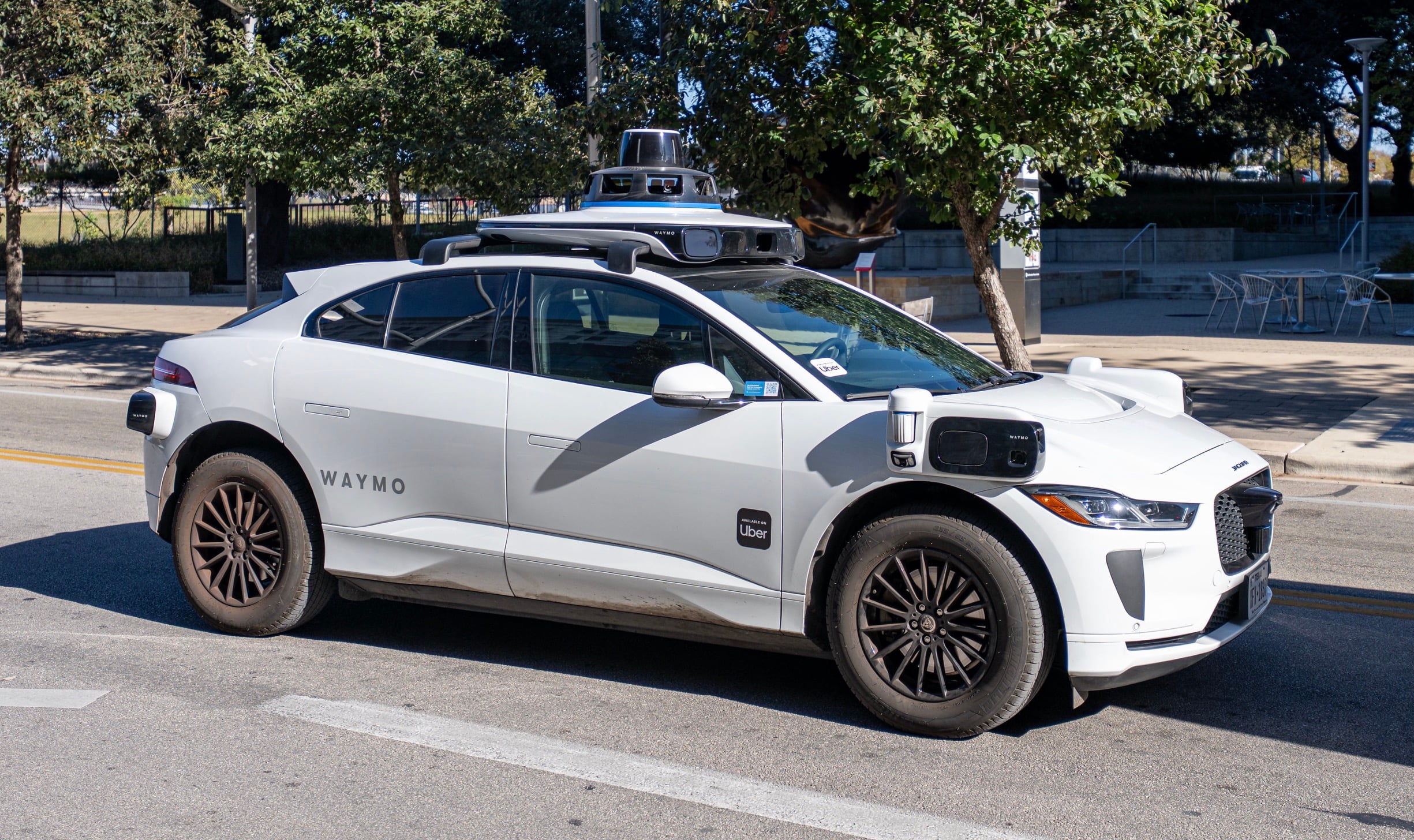
Seemingly overnight, local policymakers and elected officials are scrambling to respond to a question that could have massive ramifications to the quality of life on our streets: Should we allow autonomous vehicle (a.k.a. robotaxi) companies to launch fleets in Oregon cities without a fully-baked regulatory framework?
Waymo (owned by Google’s parent company, Alphabet) currently operates in Phoenix, San Francisco, Los Angeles, Austin, Atlanta and Miami. Since the company declared its interest in Portland last spring, local and state officials have been in talks with the company about what that might look like.
For a handful of state lawmakers — led by Republican House Representative Shelly Boshart Davis and Democrat Susan McLain — those talks led to the current short session of the Oregon Legislature where they’ve introduced a bill that would pave the way for Waymo and make it impossible for cities to keep robotaxi fleets in check. For the City of Portland Bureau of Transportation, those talks resulted in an effort to update city administrative rules and launch a process to develop a comprehensive regulatory framework — work they say deserves more time.
Those two very different responses to Waymo’s desires were on full display at separate hearings this morning when House Bill 4085 received its first public hearing at the House Committee on Transportation and Portland city councilors got a debrief on the topic at the Transportation & Infrastructure Committee.
The bill would open the floodgates for Waymo to operate robotaxis in Portland by establishing a state-managed permit program (run through the DMV), exempting them from standard equipment requirements, and by stripping city governments of the ability to effectively regulate the corporations that operate them. Backers of the bill take Waymo on their word that AVs are safer, believe they’re a much-needed mobility option, and say it’s time for Oregon to lay out the welcome in order to show our business-friendly bona fides.
At the legislative hearing this morning, Boshart Davis shared excitement for AV technology and framed it as an issue of keeping up with the times. “There’s a reason that we still don’t use the Pony Express to deliver the mail,” she said. Boshart Davis touted AVs’, “economic and tourism upsides” and said doing business with companies like Waymo would lead to much-needed investments in our state that will go elsewhere if we don’t act fast.
But when asked by House Rep. Paul Evans a very simple question about who’d be on the hook in the event of a collision, Boshart Davis went silent. When she finally answered, she said she’d have to ask law enforcement officials that question (watch a video of that exchange below).
When Evans asked if Boshart Davis is worried that Waymo uses teams in the Philipines to provide operational support for Waymo fleets, she didn’t answer directly and instead replied: “I think that we have to look at it as a risk-benefit conversation, like we do almost every piece of legislation that comes our way.”
Folks spoke up in support and opposition to the bill at this morning’s hearing (the official record of testimony is 60 people in opposition versus just 14 in support). Many backers said robotaxis would be a boon for disabled folks who don’t have reliable transit options. But others pointed out that there’s nothing in HB 4085 that would require Waymo to be wheelchair accessible. And several ridershare drivers who showed up to oppose the bill pointed out that helping people with special needs is a major part of their job that AVs simply cannot do.
A Waymo spokesperson at the meeting said they will provide a referral to riders in need of assistance, but Cassie Wilson, a wheelchair user who’s also the legislative manager for nonprofit 1000 Friends of Oregon, said other services are either unusable or unreliable. “Why shouldn’t AV networks be responsible for contributing to accessible vehicle capacity like other rideshare providers?,” Wilson asked lawmakers during testimony. “Especially if you’re all priding this innovation on accessibility, this is just another transportation service that people like me cannot actually use.”
Another concern expressed to lawmakers at today’s hearing was about the impact of robotaxi fleets on road maintenance costs. League of Oregon Cities Legislative Director Nicole Stingh said her group wants a bill that requires AV taxis to pay a road fee. “Autonomous vehicles will be electric vehicles only. That means cities are not receiving gas tax for those cars,” she testified. (HB 4085 doesn’t mandate any new fees for AVs, but would allow cities to create new fees as long as fees are already levied to rideshare companies.)
The person with the most experience at the hearing today was Jeffrey Tumlin, who served as executive director for the San Francisco Municipal Transportation Authority from 2019 to 2024 — just as Waymo and other companies hit the streets. A frequent Waymo user himself, Tumlin said he believes in the technology; but opposes the bill because he’s seen how state preemption of cities has failed in San Francisco.
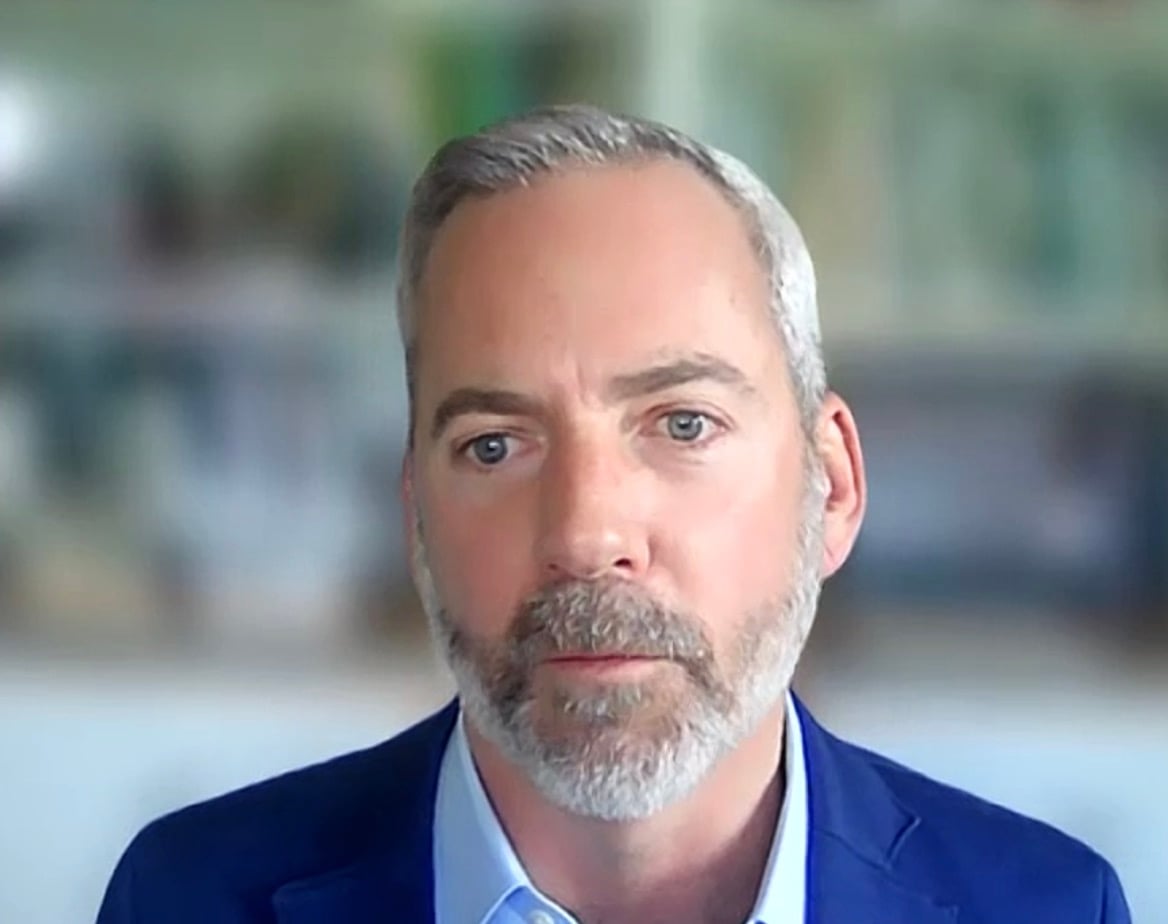
“Our experience in San Francisco has not been positive,” Tumlin told lawmakers. “As the primary global beta test site, we continue to experience significant safety and operational problems from AVs on our roads.” Tumlin listed many problems with AVs in San Francisco, including how they tend to drop-off and pick-up in bike lanes and their inability to handle folks with wheelchairs or other medical equipment. “From a disability accessibility standpoint, we are finding that AVs are creating a net negative in that they are continuing to erode our regulated Yellow Cab system that has been our primary means of serving people with disabilities.”
In California and Texas, Waymo successfully worked with state lawmakers to pass local preemption laws — much like the one they are pushing in Oregon.
After the hearing, I asked Tumlin in a video press conference what it was like trying to work with Waymo. He said the City of San Francisco receives no data from Waymo and that the company, “has been mostly unwilling to partner with the city on critical issues.” “They are not a collaborator,” Tumlin added.
The absence of data from Waymo, Tumlin said, has been a big problem. “It makes it very difficult for city officials to do their job — which is to figure out, ‘How do we rework the rest of the transportation system in order to respond to this rather significant change, particularly when it comes to critical impacts like pick-up and drop-off, interactions with first responders, interaction with human traffic control officers, and the very different outcomes that AVs produce for people with disabilities.”
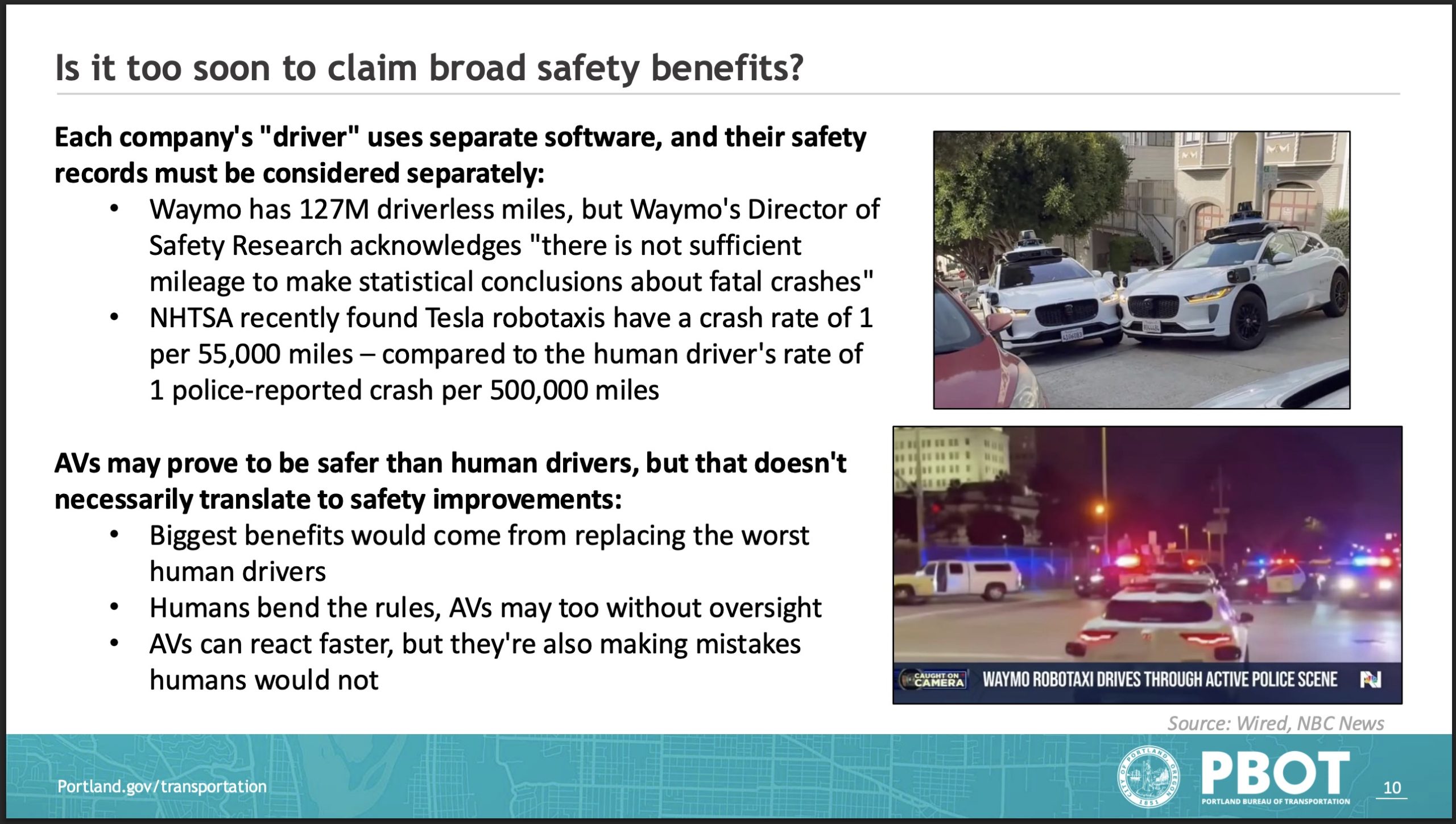
Tumlin warned that Waymo and the AV industry in general takes a much too simplistic view of safety. While boosters cite collision statistics compared to human drivers, Tumlin said that’s the wrong question to ask. “The relevant question is, will autonomous vehicles make it less likely for people to die as a result of traffic violence in cities? And from what we can see so far, the answer is no,” he said. Tumlin acknowledged that robotaxis are good and not running into things, but problems arise when the cars get confused and “brick” themselves, “which then creates unintended safety consequences for other users.” Tumlin cited several examples of robotaxis run amok, including running right through police crime scenes and work zones.
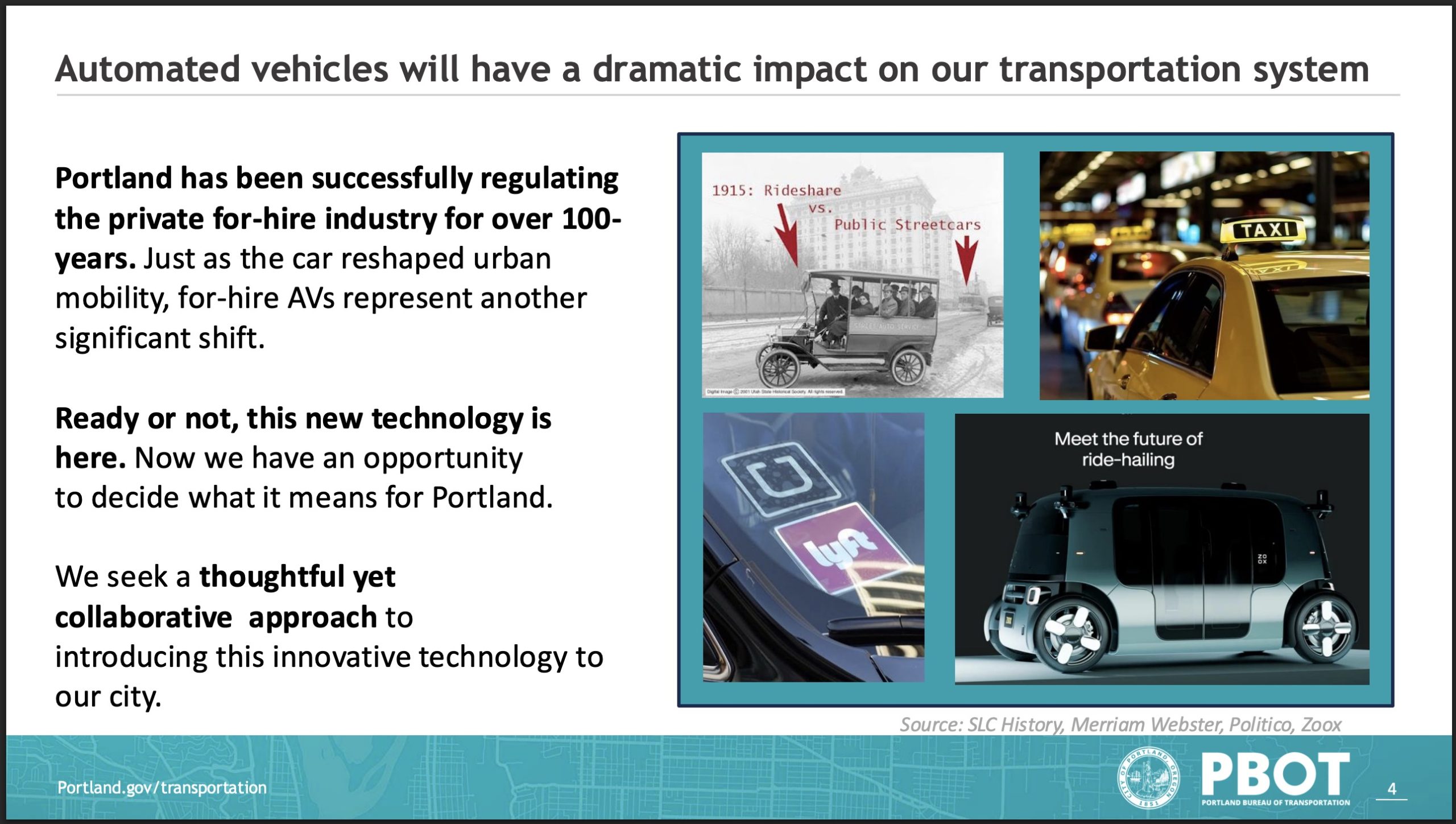
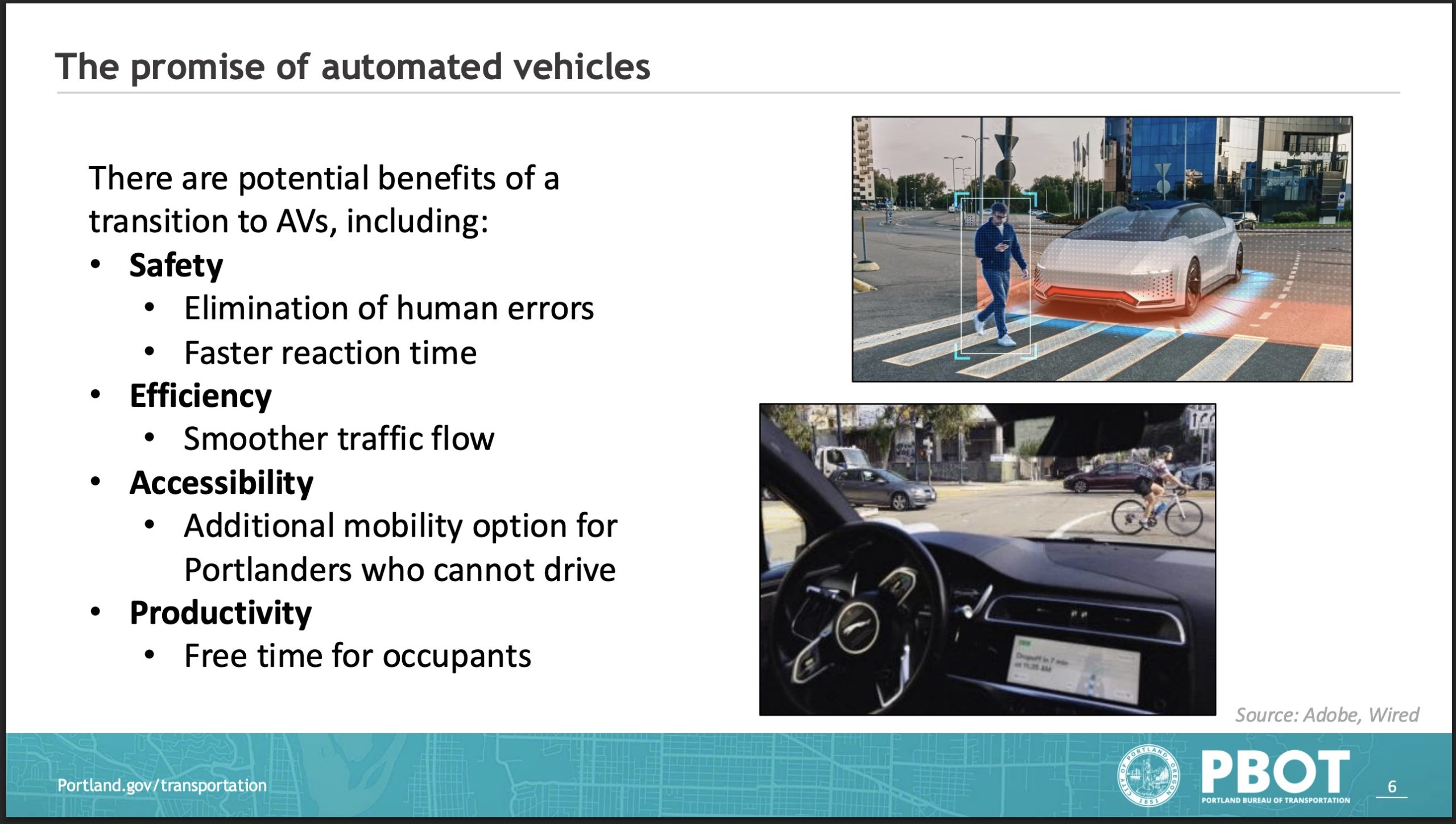
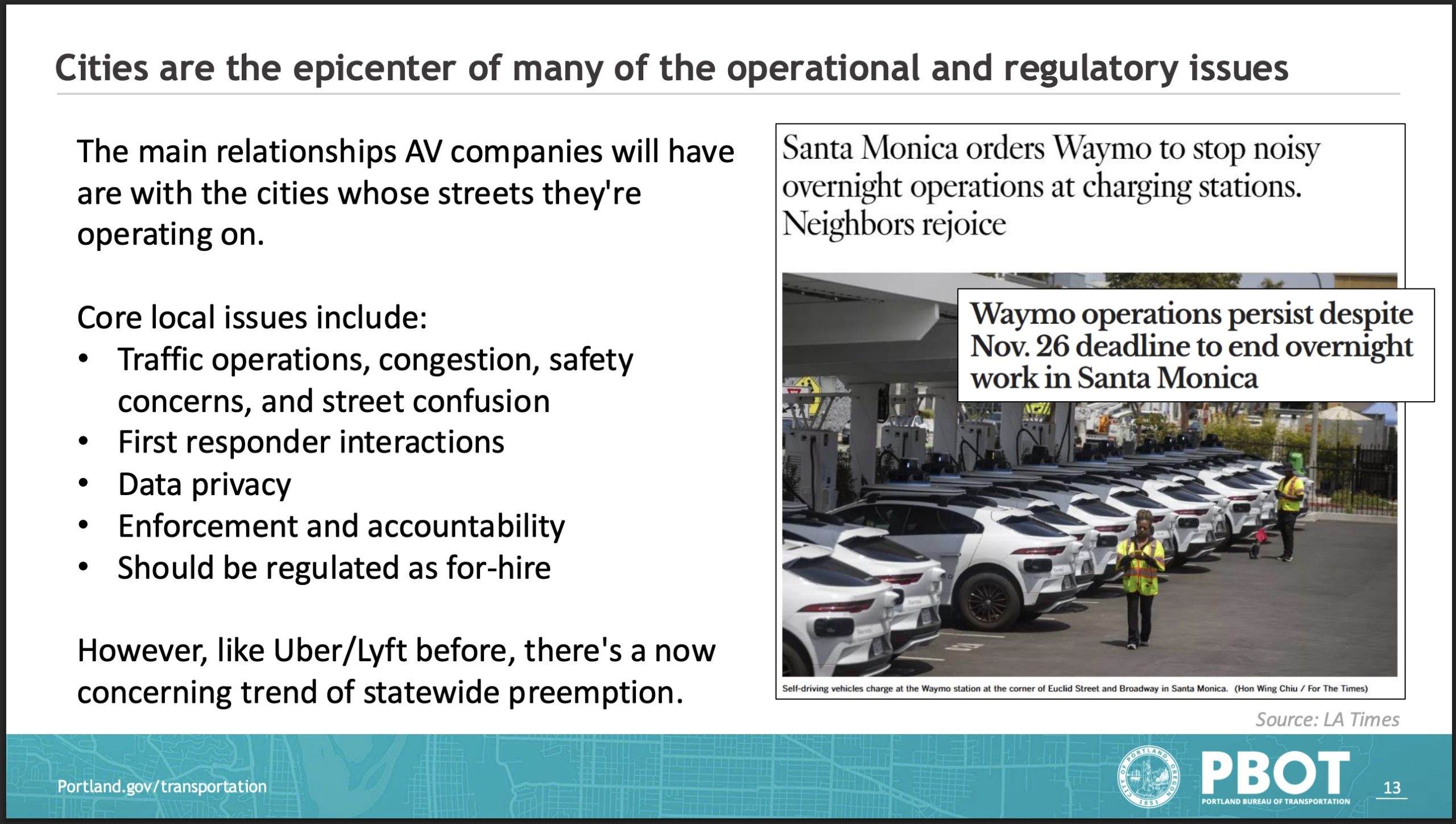
Like Tumlin, PBOT and City of Portland leaders see a lot of potential in the future of AVs to improve road safety and increase mobility options. PBOT Mobility Innovation Manager Jacob Sherman said he believes AVs are the “next big thing” that will ultimately replace rideshare companies like Uber and Lyft. But Sherman said Portland opposes HB 4085 and believes the conversation should move to the 2027 legislative session. In a letter to House committee members today, PBOT Director Millicent Williams laid out a detailed opposition to the bill.
Four of the five councilors who spoke at the council committee hearing today also expressed opposition to the bill. Councilor Tiffany Koyama Lane said she’s worried about mass surveillance and how Waymo might use the data and video their cars record. Councilor Angelita Morillo didn’t mince words with opinion: “My position right now is that we completely halt them altogether,” she said. “To me, the net negatives outweigh all the positives.”
Transportation and Infrastructure Committee Chair Olivia Clark likened robotaxis to, “the AI of transportation.” “For me, it’s kind of disturbing all the change that’s coming. I’m resistant to change and not really into this,” she added.
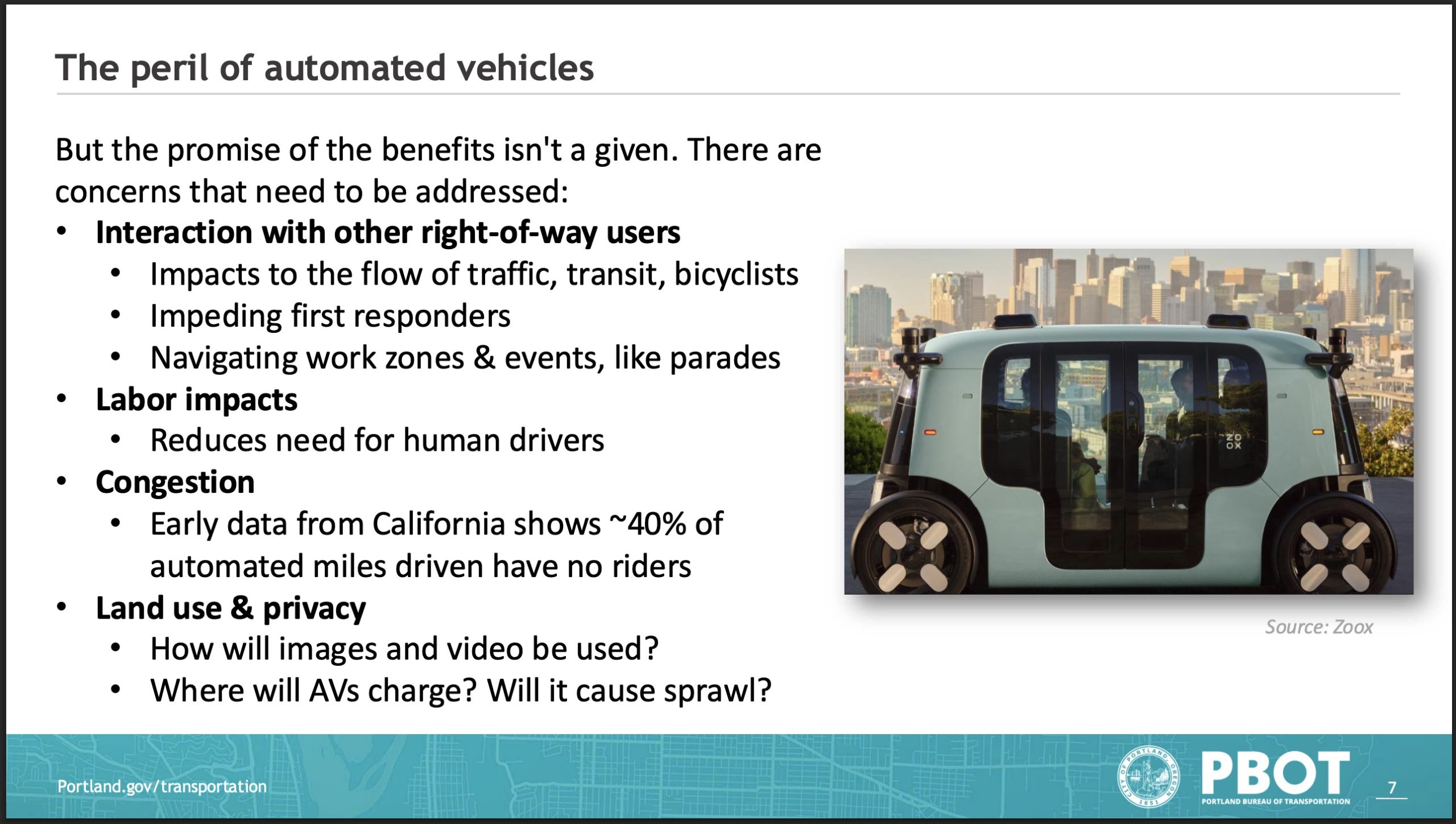
Another issue that got a lot of attention at these meetings today was traffic law enforcement. HB 4085 doesn’t address this issue directly and it’s clear city officials see that as a major shortcoming. (PBOT’s letter states: “Proposed legislation remains unclear on how local officials would issue traffic citations to AV companies for cars without an onboard operator, or without a licensed driver to link an infraction to in the system.)
At the legislative hearing, bill co-sponsor Rep. Boshart Davis was asked by Rep. Paul Evans (see video below): “In the event of a collision, who goes to jail?” Boshart Davis remained silent for several seconds and appeared to have no answer. Her eventual reply was that she’d have to ask law enforcement that question.
In California, Waymo is not accountable to local traffic laws. “There’s no way to issue a traffic citation to an AV,” Tumlin told me today, “because the vehicle code requires that a traffic citation be issued to the operator of the vehicle, and that is considered to be a human. So to my knowledge, there is no law enforcement anywhere in California that believes that they have the ability to issue citations to AVs.”
While Waymo vehicles are great at following speed limits and stopping at stop signs, Tumlin said they violate many other traffic laws.
“We’re concerned that AVs could get 100s of traffic tickets,” PBOT’s Sherman told councilors today. “As we know for human drivers, when you do that, you get your license suspended or revoked.” “We feel like we need some level of accountability where if we say, ‘This is the 47th time this AV is picking someone up in a bicycle lane’,” Sherman continued. “Maybe this doesn’t make sense right now because they’re not following the rules of the road.”
Whether it makes sense right now could be decided by Oregon lawmakers very soon. House Committee on Transportation Co-Chair Rep. McLain says she intends to bring the bill — which has eight sponsors, none of whom represent voters in Portland — up for a vote next week. If it passes this committee, it’ll head to the Senate Committee on Transportation. At least there we’ll have someone who represents Portland be able to weigh in.

Thanks for reading.
BikePortland has served this community with independent community journalism since 2005. We rely on subscriptions from readers like you to survive. Your financial support is vital in keeping this valuable resource alive and well.
Please subscribe today to strengthen and expand our work.
The local preemption is the part of this bill that I don’t understand. Republicans are supposed to be all for local control, so why not on this issue also? If your city wants AVs, it can have them; it doesn’t, then it shouldn’t have them. Seems simple.
All I can think of is that McLain promised some lobbyist she’d bring the bill forward since she knows it’s DOA – Dems are in the majority and won’t vote for it.
that crossed my mind as well. Could be a play to start the conversation this session to increase its chances next session. I just hope PBOT and other electeds are aware that Waymo is forcing this conversation. I seriously doubt any constituents or nonprofits groups organized for this. Feels very top down.
Republicans are pro-business and anti-regulation before they are for local control. They are especially opposed to local control by cities, which they perceive as leftist, pro-regulation, and anti-business. If Portland were to impose strict safety and accessibility regulations on Waymo along with taxing Waymo, it would likely dampen Waymo’s enthusiasm for rolling out their service elsewhere in the state.
Transport is often seen as a bipartisan exception to local control. Imagine if every little town had different traffic rules.
In this case Portland, despite the main character energy of many of its residents and their us v. them relationship with the rest of the state, is 600k out of a Combined Statistical Area of over 3 million.
If certain cars were allowed in 80 percent of this economic region but not the supposed center—that would be strange.
With the anti business attitudes of Portlanders we can only expect their opinions to be less and less weighty as the action shifts outwards anyway.
Great work Cassie! I didn’t realize that Waymo doesn’t offer accessible vans in their fleet.
Ugggh! I am very much opposed to Robotaxis. I know they will be initially popular because people want to experience the novelty of riding in a robot car, but in the long run these things are terrible for our transportation network.
Their safety record is unproven and whatever they cost a rider per mile today will be peanuts compared to what they’ll cost in a few years once people become dependent on them. Just look at the way Uber and Lyft have gone up in price over the years. This will be no different. Considering how much of a loss they are operating under right now, expect rider costs to grow exponentially in just a short time.
I especially hate their constant talking point that these things are good for disabled riders. How exactly??? Are the cars outfitted with wheelchair ramps or any sort of special equipment to help those with physical challenges? No!! This is just a talking point to make them look like good guys when they aren’t.
Getting more funding for TriMet (and the Lyft program) would be infinitely more beneficial for those with disabilities than Waymo’s non-existent accessibility.
Isn’t it the Lift program? – the program run by Trimet. Lyft is a rideshare company.
Here’s an idea: allow robotaxi companies to operate, but only once we have a taxing scheme in place. Tax their operations per mile driven (not just miles with riders, but ALL miles). Use this income to fund LIFT para-transit programs in the state, relieving our public transit agencies to focus on regular operations.
This would actively discourage excessive driving by these operators, which should be a big concern even for robotaxi advocates. We don’t want them adding traffic to our streets because it’s more cost-effective to circle around rather than finding a place to park.
So far Olivia Clark is the most honest speaker I’ve yet read, in the news and on this site on the subject of why she opposes WAYMO.
“For me, it’s kind of disturbing all the change that’s coming. I’m resistant to change and not really into this,”
The city doesn’t have its financial or transportation houses in order and despite protestations to the contrary, have not exhibited an ability to walk and chew gum at the same time. Now they think they’re going to oversee or be in a partnership with a corporation like Waymo that generates a massive amount of data??
It’s hard to regulate the behavior of a single motor vehicle operator, for sure. It’s probably worth the effort to do a careful job of setting up the relationship with a company that will potentially be operating thousands of vehicles all over the city, and yes it will mostly be large cities for quite a while.
Also, it’s not just Waymo we’re talking about. If this privatized model of transportation is going to work and be economical there should be competition. This initial bill, if passed, will be the template for all future AV franchises. Would the Waymo franchise be set up to block competition? Again: Waymo wrote the bill. We need to turn it over and look at the underside before signing off.
It doesn’t have to be a template. We are talking about creating new regulations for a specific vehicle and company out of whole cloth. If everyone here is so eager to make Waymo different than other taxi services then there’s no reason not to craft new regulations for anyone who comes next or even to change the Waymo regulations later.
I completely understand that Waymo is giving the state a corporate friendly bill that benefits them. I think the state should consider that and conduct due diligence. I think some things fall under supremacy and transportation is one aspect of that. No one here said that those farmers should be entitled to prevent the cycle trail from happening. Excuse it’s local. Sometimes there needs to be a master plan and the broad outlines should come from the state. . If Waymo is accepted by the state then that should be it. If the council wants to charge Lyft (which Uber couldn’t prevent from operating in the city), Uber and the remaining taxis extra fees, so be it. 7 (council majority) shouldn’t and hopefully won’t be able to deny a transport option for the whole town just cause they don’t like it without coherent explanations. Put it up for a referendum if they want and let the people decide.
Do you remember how ridiculous and belligerent Novick was when Uber defied the council back then and started operating? Uber was run by actual a**holes then and here they still are. The same thing is going to happen again because now, like then, the council has set itself up in an adversarial relationship with Waymo rather than in any fact finding.
Do you think a Waymo operating agreement with the state wouldn’t set a precedent for other AV operators? I don’t know what’s in HB 4805 but it may also favor the first company to obtain a franchise in some way that we don’t understand, not being attorneys and not having seen the bill.
So you’re suggesting that city council just let corporations do whatever they like in Portland with public resources? I get that you have a grudge, and are disappointed, but I don’t see where this line of thinking goes. It seems similar to the idea that I am unhappy with my current officials, so let’s give up on having a government.
“So you’re suggesting that city council just let corporations do whatever they like in Portland with public resources?“
Not at all. All POVs should be treated the same. I don’t believe that Waymo is inherently worse than the services we already have. Or any other car out there. If anything they are safer. The guy complaining in the article barely had any examples. Any commuter sees worse than his frankly luke warm fear-mongering on their way home in a day.
I understand everyone is frustrated with more POVs on the streets. I’m more frustrated with all the drunks and phone junkies daily trying to and succeeding to kill people. Waymo is demonstrably safer than that kind of driver and if any of them use it’s service instead of causing mayhem, isn’t that the win we all want?
“Not at all. All POVs should be treated the same.”
So city council should be able to regulate Waymo the same way it is able to regulate Uber and Lyft?
But that’s exactly what this bill does. It takes away our ability to add local controls, so Waymo/Tesla will be treated differently than Uber/Lyft.
“”A local government or local service district may not: (a) Prohibit the operation of an autonomous vehicle or on-demand autonomous vehicle network; (b) Impose a tax, fee, performance standard or other requirement specific only to the operation of an autonomous vehicle or on-demand autonomous vehicle network.”
Jonathan continues to say “That “specific only” part means that taxes and fees can be charged to AV network operators, but only if similar types of fees are levied to other competing types of taxi companies. This exception would allow Portland to levy a fee on any potential robotaxi trips because we already charge a service fee for Uber and Lyft rides.””
https://bikeportland.org/2026/02/05/a-showdown-looms-over-robotaxis-on-portland-streets-399222
To me it sounds like we will have local control over fees/taxes, we just can’t single Waymo out with them.
yes it does appear the bill would allow Portland to levy fees or taxes. But keep in mind that’s just one of the things PBOT might want authority to do. Tumlin said a lot about how a key local regulation is the ability to monitor the scale of the fleets. Imagine having Waymo in charge of how many cars they deploy! That’s why if you read the testimony from League of Oregon Cities, they oppose the bill in part because they don’t want AVs clogging up otherwise vibrant main streets without any passengers (deadheading).
Would “performance standard” count as monitoring the number of AV’s in the fleet? If so we would be able to restrict Waymo by restricting the number of Uber and Lyft drivers active at one time which would also be a good thing as they clog up the roads in a similar fashion.
If “performance standard” would not do that than I agree that too many AV’s would be a problem.
My main question is if deadheading is a different problem than too many cars in general or just part of a depressingly downward trend where the streets are too full of multi ton wandering and distracted steel boxes instead of human powered and publicly shared vehicles.
I dislike the preponderance of POV’s in the city. I don’t know if keeping Waymo out will help in any way since people keep arriving with their cars and we keep selling cars to the citizens.
Why does this line item even exist? What are they afraid of? It sounds like this language exists purely to stifle local regulation by tying local municipalities up in court for years.
It exists because of local municipalities screwing with them other places – like in Santa Monica – they required autonomous cars explicitly like Waymo’s to make beeping sounds when backing up. OK Waymo thought, no problem… except now the parking lots where Waymos go to recharge at night and need to re-arraign in create a bunch of beeping which pisses off neighbors who are then trying to get Waymo cars further regulated…
So from a buisness perspective they are understandably concerned about being singled out after investing in deployment to a city.
Not saying they shouldn’t be regulated just explaining. Although I do hope they come here truth be told – they are WAY nicer to bicycle next to than most drivers.
I almost forgot….I think you understand this, but just so we’re clear, my grudge is against the ridiculously horrible mismanagement of public resources (in this case public transportation) that have driven me to the point that the option to have a clean, safe, quiet machine move me about when I can’t walk or bike (which is all the time now) is looking really good. The city had a chance to bring about another golden age of public transit and yet here we are. A soulless corporation moving in to do what the elected refused to…provide clean, accessible transit while the Metro system is in decline. It’s very frustrating!
I’m really confused by this statement. Which year was this? Can you provide some resource to support this?
Waymo is not accessible for everyone. It is mentioned several times in the article above.
Of course not, it doesn’t have to be. Waymo would be another tool that people can use in coordination or isolation with any of the other transportation tools that exist including one’s own feet or wheels.
Have I said that I would like Waymo to replace public transportation or steal any funding from public transportation? I certainly don’t want that and I don’t think my writing suggests I do.
This is precisely what Portland did with the anti-labor and anti-transit TNCs and many cycling proponents cheered this on because Uber and Lyft made their “car-light” lives more convenient (see echo of this theme below).
I’m opposed to Waymo because I would like to see all amoral tech companies dismantled and/or nationalized. Nevertheless, I think the outrage directed at Waymo in these three posts (and counting) is less about amoral corporations (and their disgusting negative externalities) and more about a visceral fear that technology is going to make cage-mediated transportation even more convenient and fun than it already is.
I suspect cage automation is going to be the final nail in the coffin when it comes to the faint hope that yanquis will ever choose active transportation over the bloody cage.
Olivia Clark contradicted herself on this within 24 hours – in a post on her Instagram this was her caption. I agree her testimony in committee was probably her actual opinion, but I am struck by how she moderates that opinion based on what audience she’s speaking to. Regardless of whether or not you agree with the progressive Councilors, they are at least consistent in stating their position – regardless of venue or audience.
I hadn’t seen that, how embarrasing, and yet she probably does it so often she doesn’t even notice. It’s like people forget it’s not the good ole days when you could say whatever conradictory position one needed to for the intended audience and no one would be the wiser. One good thing about the internet is that it captures moments like these.
The question: ‘in the event of a collision, who goes to jail (or is held responsible)’ lands in a triggering way. It’s as if people think there’s been meaningful accountability for drivers who harm or kill others or that we have a standard (we do not) that AVs can’t meet. Drivers who kill have not been held accountable in a meaningful or consistent way. I’m left wondering, if there is outrage over lack of accountability for a hypothetical AV crash, where has that outrage and concern been for the hundreds of thousands of victims who have sacrificed their lives or have been left with debilitating injuries by a human operated vehicle when the driver is given little more than a slap on the wrist, if that. There are so many reasons to push back against AVs. But pushing back for a shortcoming that we’ve been living with forever can’t be the most persuasive.
This is also why AV companies and their fanatics are happy to target “a little better than it is right now” as their holy grail. They are well aware that the cost of doing business as measured in human lives is actually very cheap.
I think the MAX has killed more people than Waymo. Is having public transportation going through town worth it?
****portion of comment deleted. Please make your point without insulting other peoples’ comments. Thanks. – Jonathan. ***
A significant portion of pedestrian deaths on railroads are suicides, so this skews the MAX statistics a lot.
And Waymo has had extremely limited operations in a few cities for just a few years.
You know this comparison isn’t valid.
Where is the request for SD’s data? He brings up the phrase “measured in human lives” as if Waymo was profiting off of death. As far as I can tell another car hit a Waymo car which pushed the Waymo car into a pedestrian which resulted in the pedestrian dying. That’s it since they started offering autonomous service in 2018. Maybe you can find other fatalities? Please share what you can, this is a strange time and more knowledge is critical.
I count 19 people killed by MAX trains in a small geographical area since 1986. That’s much longer than Waymo and in a controlled and much smaller area.
I am not a Waymo fan. I don’t like over reliance on computers. I am a fan of transportation though and if our ability to offer effective public transportation continues to decline than Waymo and other ride share looks better and better. Is it better? No! But it is available in a way wishes and dreams are not.
There are two issues here that can be separated. Sarah Risser comments under her own name and I take anything she says very seriously. We all know that the status quo is very unsafe and I agree with Sarah that many people driving right now do not feel accountable for their recklessness.
I agree with SD and others that neither the state nor the city should not give too much latitude to a corporation that operates vehicles on public streets and roads. They should operate within bounds and if they can’t demonstrate safe operation it’s their loss.
…neither the state nor the city should give…
I used a double negative, sorry.
“We do need no education!”
I disagree with this as an absolute statement. Many drivers who cause collisions through negligent driving have been held accountable. There are many who haven’t, but the point is that a service like Waymo that has more or else bribed politicians into writing its own bill will be blocked from accountability at every turn.
John Carter, I don’t completely disagree with you. The example is triggering for the reasons I mentioned above. A broader point is that Waymo is just an extension of an already reckless auto industry that has been pretty much blocked from accountability at every turn – we can argue the extent to which that is true, but the damage caused to cities, the environment, livability, human lives is jaw dropping. And if you believe that many drivers who cause collisions through negligent driving have been held accountable I’d like to better understand your definition of accountable.
Wish I could edit my comment below. I increasingly believe that one of the reasons it’s hard to realize Vision Zero is precisely because there is not one entity responsible for vehicle crashes. Could be blamed on the driver, the vehicle design, engineers, infrastructure, enforcement, policy decisions etc. etc.
¡Jajajajajajajajajaja!
While I agree with the sentiment (stories about the lack of accountability for bad driving are numerous and galling), there *is* at least a legal framework to bring justice to bad human drivers. Often the lack of justice in such cases is due to the failure of the police officer on the street.
The apparent lack of any such legal framework for AV’s is reason enough to take a step back and wait for the law to catch up.
Charley, the issue of lack of accountability is complex and can’t be boiled down to failure of police officers on the street alone. This presumes that all fault lies with the driver when there are multiple factors at play in any given crash.
I honestly don’t know what the legal framework is to bring justice to bad human drivers. This is a 100% sincere question , would you please explain how that works Charley?
In Waymo’s bill, Waymo limited Waymo’s required insurance coverage per incident to one million dollars, as opposed to five million in California. Waymo also proposed that legislators make it really hard to modify Waymo’s franchise once granted.
Have you looked at the insurance requirements for normal drivers? Makes $1 million per incident look extremely generous.
Very informative article. San Francisco is much more of a cautionary tale than a success story. Capturing law makers and introducing legislation that ties the hands of local governments is straight out of the auto industry playbook.
This is ruthless capitalism wrapped in the trapppings of an amusement park ride, and unfortunately, a number of people who think they are smart, are hypnotized by the blinky lights.
It’s a good thing the Democratic super majority will be able to hold fast against the Republicans and continue to focus on human rights and not at how little it apparently takes to bribe one of them.
BikePortland’s coverage of HB 4085 reads less like analysis and more like a pre-loaded opposition brief.
Yes, San Francisco had early operational problems with AVs. That’s not in dispute. But citing a former SFMTA director describing SF as a “global beta test site” without acknowledging that beta tests end — and that performance data has materially improved — gives readers a distorted picture.
More importantly, the article consistently avoids the central empirical fact in this debate: autonomous vehicles have lower crash and injury rates than human drivers. That doesn’t mean AVs are perfect, but it does mean the safety baseline matters. Human driving in Portland is already killing and injuring people at unacceptable rates.
The repeated framing that AVs must prove they will eliminate traffic violence sets an impossible standard that no existing transportation mode meets — including human-driven taxis, rideshare, or private vehicles.
The “local control” argument also deserves scrutiny. Portland has struggled for years to manage curb access, enforce traffic laws, or deliver basic street safety projects on time. Suggesting that PBOT needs more discretion and more time before allowing a new technology — while offering no timeline or performance benchmarks — feels less like prudence and more like institutional risk avoidance.
Concerns about accessibility, data sharing, curb management, and fees are real — and solvable. They argue for clear statewide rules, not blanket opposition or indefinite delay. Other states have shown that preemption doesn’t mean deregulation; it means consistency.
Finally, dismissing state involvement because legislators don’t represent Portland ignores a reality Portlanders live with every day: the city’s governance structure is fragmented, politicized, and heavily influenced by nonprofits and unions that are not accountable to system performance. That context matters.
We should regulate AVs thoughtfully. But fear-driven narratives, anecdotal horror stories, and resistance to change are not a transportation safety strategy
And this post sounds like it comes from Waymo’s PR dep’t, with help from ChatGPT (“less like prudence and more like institutional risk avoidance”).
If you work for Waymo, you really should identify yourself as such.
For clarity: I don’t work for Waymo or any other transportation company.
If you think the claims I raised about safety data or HB 4085 are wrong, address them directly. Suggesting someone is a shill is just a way to avoid engaging the substance.
Happy to debate the policy on the merits. Not interested in motive-guessing.
The trojan horse argument in this debate is that autonomous vehicles have the potential for lower crash and injury rates than human drivers. But, this doesn’t mean that poorly regulated autonomous taxis will decrease the injury and fatality rates in Portland.
For instance, look back at the road fatalities over the past few years. If an autonomous vehicle was driving instead of a human driver many, if not all, of those fatalities would have been prevented. However, that is not what this discussion is about. An autonomous taxi would not have been chosen in those situations, just like a human taxi driver was not chosen. The human driver will still be there regardless of whether there are google cars downtown.
The central argument is primarily about the people in urban centers having representative control over their economy and streets vs. non-representative state control, where the Bosharts of Oregon have oversized influence. The city has had its hands tied in a hundred ways by state and federal policy and road ownership that has caused our roads to remain dangerous. Dangerous vehicle design, dangerous speed rules, dangerous road design have all been protected and promoted by the state and federal policy, which PBOT and local reps have had to fight against.
No amount of PBOT bashing will change the fact that, ultimately, safety and a much more vital Portland will not be ushered in by unregulated corporate influence over our streets. If you want better representation, you’ll have much more luck interacting with the city government that shows up to work everyday trying to make the place they live better, than the state legislators that meet a few times a year and stake their political careers on being anti-Portland.
In 1980 an MTA strike led to people paying private drivers to take them to work. Those vans were an ersatz of the fixed bus routes (and continue to augment those routes today). It showed the demand that average working folk had for commuting and how few people used cars. The solution to meeting this demand would be to fund/manage public transit adequately in those neighborhoods that had no subway/few buses (and that started happening in the late ’80s).
Fast forward to today. There is a clear demand not being met by our public transit agency. This is largely a result of underfunding (and the related complications of national/institutional inefficiency). This is also a result of a consistent prioritization and heavy subsidization of SOVs over fixed bus/MAX routes that 1) do not serve enough people, and 2) do not compete for convenience with the car (as opposed to places like NYC where the subway/bus is often competitive).
But unlike dollar vans, AV companies do not have any incentive to give average working folk a leg up to get to work/store faster. That’s not their model. Nor do they particularly have any affinity for targeting disabled people. Only a small percentage of people with expendable income can hire AVs. That’s who they will serve.
The solution to the transit strike was filled by neighborhood entrepreneurs who saw an immediate need in the average person around them and filled it. AV company CEOs see an historical disinvestment in transit and smell blood in the water. While there might be a superficial “capitalist” incentive for dollar van drivers and AV CEOS, the similarities stop there. There is no thought for the average person. There is only the wielding of a massive upscale in capital to gain more profit in whatever way possible. The results have been pretty clear with rideshare services and AVs are just taking the baton.
Ask people who have never seen efficient/effective public transit how to fix transportation and you will get the flying car as an answer. Ask people who have lived with effective public transit and you will simply get fund it adequately. This is something that has never happened in the US let alone Portland.
You got to chuckle a bit when you read Millicent’s letter. “Local control”, huh? That’s rich—Portland just “discovered” $106 million, and now they wanna take the wheel on AVs? Mate, if they can’t sort out basic traffic violence prevention and enforce license plate laws, I’m not sure I want them in charge of robot cars. I’m all for safety, but don’t act like local governments have their act together when they’re still figuring out how to park a tram. It’s like giving a kangaroo the keys to a Porsche, sure, it might work, but it’ll probably end up in a tree.
https://www.opb.org/article/2026/02/06/portland-unspent-housing-funds/
As opposed to the state or federal governments who are doing a great job of traffic enforcement and making roads safer /s
Robo-taxis? No thank you! I want to be hit the old-fashioned way—by a speeding, distracted HUMAN BEING.
I feel this pretty representative of the fundamental problem of granting corporations personhood – who gets accountable is hard when we are talking about “limited liability companies.”
I saw this news last week and my first thought not about the cars themselves, they’ll be fine. It’s what humans will do around them, plus our narrower streets than the ones they’re used to. I’m real curious how they’ll handle our crosswalk laws as well.
I feel like it’s invariably going to cause a collision where a frustrated human driver swerves around a slowing/stopped waymo and hit a man/woman/child/other vehicle. Or perhaps multiple. We really need to catch up with automated risk reduction devices on human automobiles like speed limiters in urban environments, the inability to drive recklessly, automatic braking, etc etc etc.
There’s so much to do that we don’t have the ability to at the state level.
Regarding the “risk-benefit” analysis – how much is a human life worth? If even one person dies because of these robots, that should not be worth bringing even billions of dollars to our region.
If even one life is saved by an AV, is it worth bringing in thousands of Waymo cars?
We haven’t banned cars from the city and never will despite all the people they kill. Why single Waymo out?
It’s easy for me to believe that AV use could save lives because I’m pretty familiar with how bad human driving can be at the mean, much less one standard deviation below. I’d love to have a good share of vehicles on the road that reliably observe speed limits and reliably stop short of crosswalks. The AV haters will be in cars, not outside of them.
The devil is in the details. How will we regulate a system if it starts to drive at the 85th percentile of speed, if it notices that 11 mph over the limit is normal, if it rolls through stops or rat runs green ways? We already know that AVs will park in bike lanes because on some streets those are the only available space for motor vehicles used by a business.
“How will we regulate a system if it starts to drive at the 85th percentile of speed, if it notices that 11 mph over the limit is normal, if it rolls through stops or rat runs green ways?”
This is a solid concern and I agree that it is worrisome. The safety results in Phoenix and San Fran and the other places it is operating are predicated on caution and predictability. Although it is doubtful if ruthlessly obeying the rules of the road will be predictable to modern drivers as they don’t seem to know the rules (but thats a rant for another time).
I would hope that the state finds the courage to put verbiage in any bill allowing Waymo to operate that acts as a kill switch and instantly revokes their ability to operate. If a Waymo car does something stupid the whole fleet is done. Perhaps caught speeding, someplace its not suppossed to be? I don’t know, but I surely hope there will be such a clause.
I don’t know about you, but I’ve seen a lot of 80’s/90’s robot amok films and have no desire to see that happen here.
It would be great if motor vehicle operators became more predictable. Maybe AVs at a four way stop will be excessively polite, I don’t know. It might be nice if they had a indicator light to assert right of way when the algorithm thinks it’s time to move, and a blue “bike or walker detected” pilot on each side so you can tell you’re in the picture. Does a person have to put a foot down to make a Waymo roll out?
I’m not afraid of robots running amok, I was probably reading Asimov rather than seeing those movies. However the outcomes we’ve seen from some AI platforms aren’t great. If we get the equivalent of g**k operating cars it will be time to pull the plug.
The three laws of robotics. Good times and good writing. I read the Foundation series many times and understand there’s a tv show based on it that I don’t think I’ll watch.
I think your question of what 4 Waymo cars arriving at a four way would do is insightfully hilarious. Would they obey the rule book and go in order or would they have been programmed to be Portland polite? I can just picture them stuck being electronically polite until their batteries gave out:-)
The technology that governs a robotaxi is a completely distinct technology from the LLM-based generative AI that is dominating the news cycle lately.
I asked my Atlanta cycling buds what their experiences were like with Waymo. For context, the common thread between us (besides cycling) is that we (mostly) went to engineering school together. Here’s what they said:
1:
2:
3:
4:
5:
6:
7:
After taking my first AI computer science course in 1980 and spending nearly 40 years working with data, I found this February 11 deep-dive podcast both interesting and timely given Jonathan’s article.
NVIDIA AI Podcast: Safer AVs with Smart Simulation, Neural Reconstruction, and Data-Centric Tools
https://voxel51.com/blog/nvidia-ai-podcast-smarter-simulation-for-avs
As someone who now dislikes driving intensely because of my eyesight and somewhat delayed reactions (TBH), I expect that I will be among those who occasionally use AV robotaxis when they eventually arrive in Portland.
For the record, I already use public transit frequently whenever I can.
Would the proposed legislation prevent the city from taxing “Pauking?” It seems like it would miss this transportation fee blind spot that could easily be exploited by AV taxi companies. This brings attention to the fact that there are numerous ways to systematically program AVs to behave in a way that human drivers would not. In those cases, could local governments not address these behaviors, because they do not do so for human drivers?
https://whyisthisinteresting.substack.com/p/the-pauking-edition
Interesting problem that they’ve just invented. With all the nitpicking of little minor things that people are finding that Waymo (still just the one AV taxi company, not plural) could or might or potentially do that is so much worse than drunk or distracted or rage driving or some combination of all three (heavy sarcasm intended) we might as well just cut to the chase. Why not a head tax on each Waymo per day as well as a head tax on each ride share and taxi active that day? Council gets the funding they continually want that may or may not get put into auto restitution and Waymo and the other ride share/taxis get punished for using cars to provide services the city/County/Metro won’t.
From my Walking Communities of 2040 essay Part 1 finished in 2017 and rejected by the Bay Area fossil fuel divestment organization who informally commissioned the essay, little doubt because they’re centered in high tech Silicon Valley:
“I am certain that self-driving car technology is a fraudulent ruse meant to distract public attention from actual solutions that include modern mass transit as a fundamental travel mode with the most potential to direct development beyond car dependency and traffic havoc.”
“The basic flaws of self-driving cars are simple enough. Their technological hurdles are plainly unsurmountable. They will never be completely safe. They won’t decrease traffic congestion, fuel/energy consumption nor emissions sufficient to prevent worst harm from catastrophic climate change. They are most unlikely to reduce travel-related cost of living.”
“They won’t take full advantage of the benefits EVs offer, and the technology is supported for all the wrong reasons; to bust transit operator and teamster unions; to give freeway planners an excuse to predict worsening traffic can be managed with reckless tailgating; to maintain most profitable but least resilient regional utility grids despite decentralized EV+PV household power systems a proven ideal.”
“The most telling aspect of self-driving car folly is eliminating ownership whereupon all cars are kept in central garage locations and dispatched on demand. Never mind that in a grid failure, every household with an EV in the garage gains a backup power supply. Never mind any emergency where a car is needed immediately, not one that may arrive too late. Self-driving car tech completely denies those safety features and pretends ‘mass tailgating’ won’t produce horrific multi-car pileups. Self-driving tech in many ways puts safety dead last.”
In Part 2 of the Walking Communities of 2040 essay I offer a “compromise position” of AV tech:
“Indifferent reviews of the Walking Communities essay I’ll accept but question whether disinterest is due solely to its flat rejection of autonomous vehicle tech. If a compromise position on AV tech were fairly heard, might the essay get a more favorable review? Here then is a compromise position: Most safety features AV tech offers (sans tailgating) are possible at Level 3 “driver assist” which could more sensibly prevent tailgating. AV tech at Level 5 “driverless” loses safety features of the driver’s constant attention to roadway conditions and ability to maneuver to avoid accidents. A critically important Level 3 safety feature could prevent speeding; motorists may drive slower, but not faster than posted speed limits, nor too fast through busy intersections speeding to beat the light. A good rule of thumb for safer speeds through intersections is “Reduce speed through intersections FIVE mph less than posted speed limit.”
Part 2 of the essay also addresses EV tech with a trick question: “Which of the three basic EV drivetrains (BEV vs PHEV vs HFCEV) offers the most benefits, applications and potential to reduce fuel/energy consumption, emissions AND insane traffic? All professed EV experts are invited to dispute my adamant contention that the correct answer is PHEV plug-in hybrid, the first early advancement of HEV followed more recently with advanced applications for hydrogen in both ICEngine “combustible’ as well as fuel cell hydrogen, PHEV+H.”
Part 3 of the essay (a new direction in public transit) addresses transit vehicle conversions to EV drivetrains: “Standard 40’ municipal buses do NOT convert to EV very well nor do their counterpart Yellow School Bus, paratransit lift van and ambulance fleets. Of the 3 bus types, paratransit lift-vans are ‘most’ in need of replacement. New models in 25′ 30′ and 35′ wheelbase lengths with easy boarding Low-floor drivetrains that seniors, disabled, children and all transit patrons need. Battery pack weight located in the floor for low center of gravity and improved handling and stability for a more comfortable, safer ride impossible with mere conversions of obsolete chassis/suspension.”
Part 4 is near completion. The issue it addresses are the land-use and development aspects of building our way out of car-dependency with an entire metropolitan area perspective to direct growth whereby many dozens of neighborhood commercial districts form the basis of transit-oriented neighborhood development. Naturally, that’s a hard sell. Significantly reducing car-dependency in this way may be our only hope. Certainly “driverless” cars will only worsen traffic mayhem and lead to more polluting energy production to maintain what appears to be a dying travel/transport system of urban/suburban development. Thanks Jonathan for allowing me over the years to present this perspective. I’ll let you know when the Part 4 summary and the entire essay is ready for a review. I’m hoping for a White Paper formal study by some transportation planning institute who can take over from where I leave off.
We need more electric vehicles transporting people. Autonomous vehicles are safer than us distracted meatbags so have a look. Portland ain’t special- LA, SF, Austin— why must we whine and complain and reinvent the wheel in this city? Can’t wait to see Tesla cybercabs take over this joint.
By the way, autonomous vehicles are leading to fewer people owning cars leading to more mass transit. That’s a good trend. We who own autonomous cars, and feel free to pick part level 2,3,4 whatever – we know what our car does. It drives us around town flawlessly everyday so the future is here already. We know more than anyone that autonomous vehicles threaten the ego of Americans passion for car ownership. As much as we love our robot car and don’t wanna give it up one day, we want clean safe roadways for all more. This is a transitional time. The left should be on board with safety and environmentalism and facts and science remember?