

Hi folks. I’m slowly getting the gears turning again after a nice and needed holiday break.
As per usual, here are a few stories I’ve come across (either flagged by myself or by readers) that I think are worth reading. Can’t wait to see you all again at Bike Happy Hour and to share more great stories and videos with you in the coming days and weeks. 2026 let’s go!
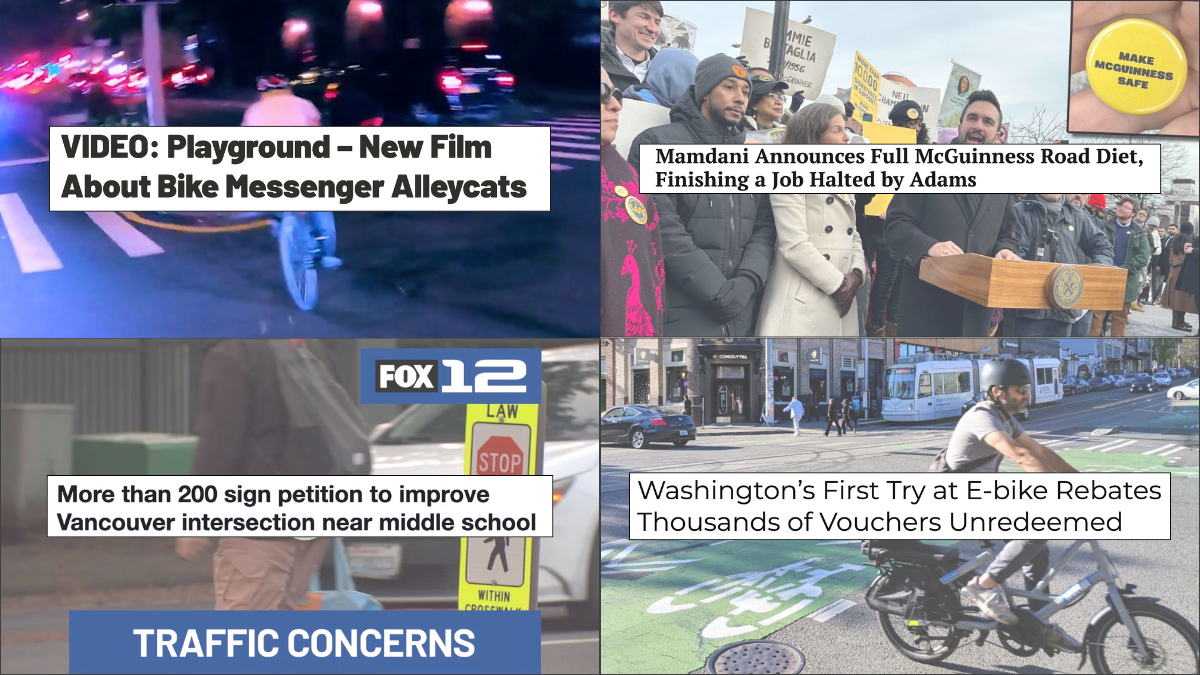
Livable streets in the limelight: How much of a priority are livable streets to NYC Mayor Zohran Mamdani? He shared his mic with his pick for transportation commissioner at his swearing-in and he has already reversed bad policies by his predecessor. (Streetsblog and Streetsblog)
Pricing works in NYC: “Since congestion pricing began one year ago, about 11 percent of the vehicles that once entered Manhattan’s central business district daily have disappeared.” (NY Times)
Lessons learned: A new report from the State of Washington shows that people are much less likely to redeem an e-bike rebate when the amount is just $300. (The Urbanist)
The depths of messengers: A new film from a PhD researcher who studies cultural identity and motion in public space (rad topic!) goes into depth on bike messengers and alleycat races. (The Radavist)

Funding stuck: A cautionary tale for when the Portland region passes a big transportation revenue bond: In Atlanta, projects are taking so long to implement that much of their new funding is having trouble getting out the door. (WSB TV)
Adventure inspiration: A man in England rode across the UK on a very interesting wooden bike and discovered community along the way. (The Guardian)
Cycling without age: I’m going to keep sharing links to this awesome program that gets senior citizens out on the streets via pedal power until someone in Portland steps up to open up a local chapter. (Reasons to Be Cheerful)
Not enough people have been hit by cars: A reader shared this story from Vancouver about parents who organized in hopes of getting safety changes to an intersection near their kids’ school, only to have city engineers say engineering rules prevent them from doing anything. (Fox 12)
Thanks to everyone who sent in links this week. The Monday Roundup is a community effort, so please feel free to send us any great stories you come across.
Thanks for reading.
BikePortland has served this community with independent community journalism since 2005. We rely on subscriptions from readers like you to survive. Your financial support is vital in keeping this valuable resource alive and well.
Please subscribe today to strengthen and expand our work.
Well at least it’s not only PBOT and ODOT that follow the absurd requirement of “not enough death here” before making safety changes. It reminds me of the numerous stories I’ve read this year about the number of Clark County (NV) school children being hit by drivers. The latest update I found was from 12/11 with 206 students hit so far. That comes out to roughly 2.4 each school day. Compared to Portland’s much smaller enrollment that would be roughly 1.8 a week here. I can’t imagine that occurring and our only response being to increase penalties for violations in school zones as Nevada did.
Not that there’s much else they could do quickly with how car-centric their community is. It’s a nightmare trying to get around there without a car. Unless you live in very specific neighborhoods and even then you’re trapped in your small walkable island.
The article isn’t clear if those 206 incidents happened the calendar year or current school year. If it’s the calendar year, I guess that 2.4 number would become 1.1 incidents per school day. Still alarming that it’s (roughly) a daily occurrence.
The title of the article “206 Clark County students have been hit by cars traveling to and from school since August“.
Oof. One of the rare instances where I read more than the headline but somehow didn’t read the headline!
I’m not usually one to get on your case about bias or a particular political leaning, Jonathan, but I have to say that your heading and summary of the McGillivray collisions is misleading, at best. The corridor is in the process of getting a road diet and various calming measures, and the city’s response to the petition, at least as it’s characterized by Fox 12, is not, “We won’t do anything because the intersection isn’t dangerous enough to warrant action,” but rather, “We’re not going to implement this specific measure called for in the petition because our available data doesn’t back up that measure as being appropriate for this circumstance.” I went into reading the article thinking the engineers deserved to lose their licenses for violating the first tenet of the ethics code (not that that’s ever actually done in these kinds of cases) but came away thinking, “Oh yeah, that seems totally reasonable; I wouldn’t want an uninformed public dictating my engineering practices, either.”
yeah I might have got that one wrong Michael. Thanks.
I think it’s a bit of both
My underline. First, engineering rulebooks do have thresholds for deciding if something is “working” or not (we’ll not argue about ‘working’ for who right now!), and avenues to address that. A HAWK at every crosswalk is obviously not fiscally doable, so perhaps the engineer is correct that a flashing beacon is not justified, just because someone wants one. The statement about nothing being worth installing is where the critique lies – they are seemingly ruling out speed bumps, wands, paint stripes, signage. To the engineer, the road is working as designed if everyone follws speed limits and is a good driver. Which, obviously, isn’t the case if Vancouver is having to redo the entire street for safety!
Perhaps the engineer is badly stating that the road makeover should fix this problem; perhaps they are carbrained and trained not to see a problem if the books say it isn’t one. In any case, Vancouver’s own documents contradict the opinion that nothing can be done near the school – pg 38 of the project’s “Future Conditions” memorandum
In the near-term, a lane could be repurposed without substantially increasing delay or
queueing at intersections or the time it takes to travel between SE Chkalov Drive and SE 164 th Avenue.
and
As design options are refined, opportunities to minimize increases in delay experienced by drivers while providing necessary safety and mobility improvements for other users
should be considered
In other words, this area could be restriped or improvd, now, to deal with this issue while the rest of the project is being implemented. Hopefully this public pressure will change some minds about doing nothing.
All the project documents are here:
https://www.cityofvancouver.us/business/planning-development-and-zoning/transportation-planning/complete-streets/mcgillivray-boulevard/
The best news is from New York City. Just wow. Fast And Free! Name check former Mayor at the top of the speech, for courtesy, and then bounce all his executive actions right out of the gate! What a savage, I love it.
Who will be our Mike Flynn?
The other end of the stick: The apparent foot dragging by City of Vancouver engineers around school safety. Sure, they have to be evidence based, but the message just plain sucks. Why was there no design in place before kids got hurt? Is there no best practice that can be found before kids get hurt? This is kin to PBOT glueing down the plastic after a person is dead, it is salt in the wound.
Grudging credit to Fox 12 for that piece.
One thing I enjoy about the film on messengers and alleycats is how they approached the subject, a refreshing and academic take. Definitely worth the 22 min watch IMO. Thanks for sharing it Jonathan
Videos for cycling without age are pretty great.
https://www.youtube.com/watch?v=O6Ti4qUa-OU
https://www.youtube.com/watch?v=3BRQX6A9BiA
https://www.youtube.com/results?search_query=cycling+without+age