home

research

PSU wins $3.5 million DOT grant for transportation research center

Thursday, January 12th, 2012

Portland State University announced today that they've been awarded a $3.5 million grant from the U.S. Department of Transportation to continue work at the federally recognized University Transportation Center — the Oregon Transportation Research and Education Consortium (OTREC) — housed on their campus.

They're also breathing a huge sigh of relief.

(more...)

Study shows cycling in heavy traffic may pose heart risk

Wednesday, July 6th, 2011
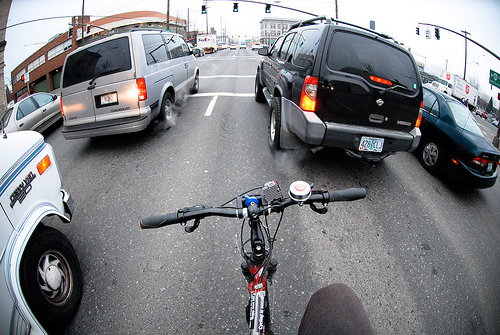
Riding on Broadway downtown-1
Riding on SW Broadway
in downtown Portland.
(Photo © J. Maus)

[Via Environmental Health News]

In what researchers call the first study ever to examine the relationship between traffic-related air pollution exposures and cardiac health among people who ride bikes, a study published last month found that cycling near heavy traffic "may have a significant impact" on heart health.

The research, Traffic-Related Air Pollution and Acute Changes in Heart Rate Variability and Respiratory Function in Urban Cyclists, was done in Ottawa by Canadian researchers and published in the journal Environmental Health Perspectives. (more...)

Researchers look into connection between bicycling, consumer behavior

Tuesday, June 14th, 2011
Research will put numbers behind biking customers.
(Photo © J. Maus)

A research project at the Oregon Transportation Research and Education Consortium (OTREC, housed at Portland State University) is taking a closer look at how bike-riding customers and bike infrastructure (or lack thereof) impacts the business bottom line.

The principal investigator is Kelly Clifton, an associate professor at PSU. I sat down with Clifton last week to learn more. (more...)

New research explores cost of bikes/transit integration (Updated)

Wednesday, April 27th, 2011
bikes on max-2
Crowded.
(Photos © J. Maus)

A new report funded by the US Department of Transportation and conducted by the Mineta Transportation Institute, Bicycling Access and Egress to Transit: Informing the Possibilities (PDF), takes an in-depth look at a topic that is very relevant for the Portland region: How to integrate bikes and transit. The study sought to answer the question, "What are the most cost effective strategies likely to generate the largest number of cyclists accessing transit?"

TriMet has grappled with accommodating the increase in users who combine bikes with their trips on MAX light rail for years now. Lately, as MAX ridership has increased and space for bikes on trains has become scarce, TriMet's focus seems to have shifted toward the park and ride model. They have altered signage near the bike hooks and they have invested in bike and ride facilities at transit centers (some of which are being singled-out for a lack of use). (more...)

Research shows biking, walking can thrive in suburbia

Tuesday, April 26th, 2011
As long as connections exist, riding
in suburbia can happen.
(Photo © J. Maus)

It's a somewhat generally accepted concept in urban planning circles that there's no hope for suburbia. Cinder block walls, cul-de-sacs, and wide arterials all make for a car-centric lifestyle. But new reseach shows that among suburban multifamily housing — the fastest growing housing type in the U.S. — biking and walking can thrive.

In Overlooked Density: Re-Thinking Transportation Options in Suburbia, Nico Larco, an assistant professor of architecture at the University of Oregon, focuses on suburban multifamily housing, which he calls a "widespread and overlooked example of density."
(more...)

Portland tops in new research report on nine major cycling cities

Wednesday, March 23rd, 2011
Broadway approach to Williams bike signal-2
Riding on NE Broadway in Portland.
(Photos © J. Maus)

A new research report, Bicycling Trends and Policies in Large North American Cities prepared for the U.S. Department of Transportation, has found that Portland leads the pack in bike-friendliness among nine bike-centric cities in the U.S. and Canada.

The report, which takes a comprehensive look at all facets of cycling in Chicago, Minneapolis, Montréal, New York, Portland, San Francisco, Toronto, and Vancouver, was done by noted researchers John Pucher and Ralph Buehler.

Sharing the report with us via email last night, Pucher commented that, "As you will see, Portland comes out very, very well: THE BEST of all North American cities, by far." (more...)

PSU report: Cycle track, buffered bike lanes working well, but could be improved

Thursday, February 24th, 2011
Cycletrack on SW Broadway-7
"Working well" says PSU evaluation.
(Photos © J. Maus)

Researchers at Portland State University have completed an evaluation of Portland's cycle track on SW Broadway and buffered bike lanes on SW Stark and Oak. The analysis, prepared for the Portland Bureau of Transportation (PBOT), shows that both of the bikeway types are "working well," but PSU also laid out some recommendations on how to make them work even better. (more...)

Ride an e-bike? PSU researchers want to hear from you

Tuesday, February 22nd, 2011
The Ohm electric-assist bicycle-1.jpg
If you ride an e-bike, PSU wants to hear from you.
(Photo © J. Maus)

Researchers at Portland State University are looking for interview subjects for a project on e-bikes. Jennifer Dill, an associate professor at the Nohad A. Toulan School of Urban Studies and Planning, got in touch with us with the news.

Dill says it's a small, exploratory research project intended to further their understanding of the e-bike market and e-bike users. "This may lead to a larger study of the role e-bikes play in bicycle transportation."

Here's some text from a flyer to recruit interview subjects:
(more...)

Report: Regional trails, parks account for $115 million per year in health care savings

Thursday, February 17th, 2011
The (Epic) Sushi Ride
Saving money.
(Photo © J. Maus)

A new report* estimates that our regional trail network saves us about $115 million per year in averted health care costs. The report (PDF) was done for Metro and focused on their interconnected system of trails, parks and greenways known as the Intertwine. The Intertwine (background story) consists of 1,250 miles of designated biking and walking trails, 12,000 acres of developed parks and 24,000 acres of maintained natural area and is visited by an estimated 8.3 million people each year.

In Physical Activity and the Intertwine: A Public Health Method of Reducing Obesity and Healthcare Costs, naturopathic doctor and public health expert Kurt Beil looked at the Intertwine as a public health asset. He analyzed the estimated amount of physical activity that occurs on the Intertwine and did some calculations to come up with health cost savings. Here's an excerpt from his report: (more...)

Research: By 2040, Portland's bikeway investments could save us $800 million in health care, fuel costs

Friday, February 4th, 2011
"Conceptual framework of the cost-benefit analysis (not including benefits of fuel savings)." — From Costs and Benefits of Bicycling Investments in Portland, Oregon by Thomas Gotschi.

(more...)

Bikes Belong looks to fund research on biking's economic impact

Wednesday, January 26th, 2011

National non-profit Bikes Belong just launched a new grant program to fund research on how bicycle facilities and events impact the economy. Seems like a very smart way to spur thinking and the public dialogue about this issue. Read the official announcement below...

Bikes Belong Foundation launches Bicycle Research Grant Program

Boulder, CO—The Bikes Belong Foundation announced today the launch of a new grant program to fund research on the economic impact of bicycling facilities and events. The Bicycle Research Grant Program will award a total of $40,000 in grants to academic or non-profit research institutions in 2011. Grants will range from $5,000 to $10,000.

This new program aims to fill a crucial knowledge gap. Collecting quantitative evidence on the benefits bicycling brings to local, regional, and national economies will help encourage and guide investments in bicycling.

In 2010, Bikes Belong awarded small grants for studies currently underway on the economic impact of bicycling in Portland, OR and at the Allegrippis Trails in Raystown Lake, PA. The new dedicated research grants program will provide more opportunities to support similar studies.

The application deadline for the first round of grants is March 31, 2011.

In addition to funding economy-driven projects, Bikes Belong will consider innovative or unique research on other bike-related topics on a case-by-case basis.

To learn more about the program or to apply for a research grant, visit www.bikesbelong.org/foundation. Questions can also be directed to the grants manager (zoe@bikesbelong.org) or research analyst (kate@bikesbelong.org).

About Bikes Belong
The Bikes Belong Foundation, host to the Peopleforbikes.org campaign, focuses on improving bicycle safety and enhancing children's bike programs. The Foundation is the charitable arm of the Bikes Belong Coalition – the U.S. bicycle industry organization dedicated to getting more people riding bikes more often. Bikes Belong Coalition works to increase federal bike funding, awards grants to support innovative bike projects, promotes bicycling and its benefits, and backs crucial national efforts such as Safe Routes to School, Bicycle Friendly Communities, and the National Bike Summit.

The quest for Oregon's "Next Top (Transportation) Model"

Friday, November 12th, 2010
Traffic-3
New models could help level the
playing field between modes.
(Photo © J. Maus)

High quality models are essential to making the right decisions about how we build our transportation systems. What do beautiful people have to do with transportation? Nothing! I'm talking about transportation models.

For instance, if your model includes motorized vehicle "traffic flow" as a fundamental component and barely includes bicycles or other modes, what do you think the outcomes from that model will be? Yep, you guessed it, more highways to accomodate more cars, and a tiny scrap or two left for bicycles. Unfortunately, that situation is one of the major problems in transportation planning today.
(more...)

Study: Separated bikeways mean better air quality for bikers, walkers

Thursday, October 28th, 2010
Cycletrack on SW Broadway-4
Breathe easy in the cycle track.
(Photo © J. Maus)

An ongoing research project by the Department of Environmental Science at Portland State University is taking a closer look at how separated bicycle infrastructure (like cycle tracks) impacts the air quality and health of road users.
(more...)

PSU evaluation finds that bike boxes work

Tuesday, September 14th, 2010
more bike boxes springing up-4.jpg

A year-long evaluation by researchers at Portland State University's Institute for Bicycle and Pedestrian Innovation has found that Portland's bike boxes improve the safety of roads users on a number of levels. The research — funded through the Oregon Transportation Research and Education Consortium — complements another study from the University of Texas published last month that also found bike boxes to have a positive impact on traffic safety. City of Portland Bureau of Transportation officials say these studies confirm their own observations about the bike boxes and they are in the process of identifying new locations to add more of them. (more...)

Events explore link between transportation, health, and equity

Friday, January 22nd, 2010
Mel Rader of Upstream Public
Health speaks at PSU today.
(Photo © J. Maus)

A quick note about a few events on the horizon that explore how transportation policy impacts the environment, public health and social equity.

Today at noon (sorry for late notice), Mel Rader of Portland-based health advocacy organization Upstream Public Health will speak at Portland State University as part of their ongoing Transportation Seminar Series. Rader's talk will examine the health benefits that come with reducing greenhouse gas emissions in our transportation system. Rader spearheaded a Health Impact Assessment on a climate change policy that studied how a reduction in driving led to significant changes in air pollution, physical activity and collision rates.
(more...)

The research is in: You're safer in the bike lane (or bike boulevard, or cycle track)

Tuesday, November 3rd, 2009

"Results to date suggest that sidewalks and multi-use trails pose the highest risk... and the presence of bicycle facilities (e.g. on-road bike routes, on-road marked bike lanes, and off-road bike paths) was associated with the lowest risk."

There's a constant chorus -- sometimes soft, sometimes overpoweringly loud -- in every conversation about bike infrastructure in America. Its refrain: You're safer without any bike lanes, separated lanes, cycle tracks, bike boulevards, off-road paths. Just take the lane, follow the rules, wear your helmet, and you'll be fine.

A group of scholars at the University of British Columbia have found otherwise. They conducted a literature review, looking at all available studies linking bicycle safety with infrastructure. Their conclusions will be counterintuitive for some. (more...)

‘Cycle Zones’ will help plan future bikeways

Thursday, October 23rd, 2008
Which Cycle Zone do you ride in?
--Watch slide presentation below--

Alta Planning and Design and the City of Portland's Office of Transportation have collaborated to develop "Cycle Zone Analysis", a powerful new modeling tool that could have a significant impact on how Portland plans its future bikeways.

PDOT's bike coordinator Roger Geller presented the Cycle Zone research and methodology at the International Symposium on Walking and Biking in Seattle back in September. He also shared the work with a packed room of Portlanders during PDOT's monthly Bicycle Brown Bag discussion series last week. (more...)

PSU study to track cyclists with GPS

Saturday, January 13th, 2007
[PSU Professor Jennifer Dill]
Photo: PSU

Oregonian reporter Jeff Mapes has the scoop on an interesting Portland State University study:

"Jennifer Dill, an urban studies professor, wants to recruit a wide range of cyclists -- and lots of them -- to tote global positioning system units on their bikes for a 10-day period. She said researchers hope to learn whether cyclists go out of their way to use bike lanes and bicycle-friendly streets and to see how travel habits are affected by such factors as the weather.
(more...)

- Independent, daily bike news since 2005 -
BikePortland.org is a production of
PedalTown Media Inc.
321 SW 4th Ave, Ste. 401
Portland, OR 97204

Powered by WordPress. Theme by Clemens Orth.
Subscribe to RSS feed


Original images and content owned by Pedaltown Media, Inc. - Not to be used without permission.