
This article was written by Susan Rosenthal. It has been guest-edited by Adrienne So.
Given policy discussed last month at Portland City Council that could ban right turn on red for drivers at another 200 intersections, it behooves bicycle riders to know more about this traffic policy.
Right Turn on Red Laws (RTOR) allow motorists to make right turns on red lights after coming to a full stop. The motorist is required to yield to pedestrians and cyclists who are in the right of way. In 1947, California was the first state to allow RTOR. Oregon, Washington, Nevada, and Arizona followed suit in the 1950s, with other states gradually adopting the practice through the 1970s.
RTOR laws were adopted throughout the country after the US Congress passed the Energy Policy and Conservation Act in 1975, in response to the US energy crisis. The law, which is still in place, required that every state allow right RTOR or lose their federal transportation funding. It was designed to save energy by reducing the amount of time drivers spent idling at stoplights.
As a result, RTOR is permitted at almost every intersection in the country. Municipalities can ban them at intersections that have significant pedestrian traffic, or under other special circumstances. For example, RTOR is banned in most of New York City. They are also prohibited on SW 6th Avenue and SW Broadway in Portland, where these roads cross the MAX tracks at Pioneer Square. (I learned about the ban at Pioneer Square when I turned right on red on my bicycle in the late 1990s and got an expensive ticket.)
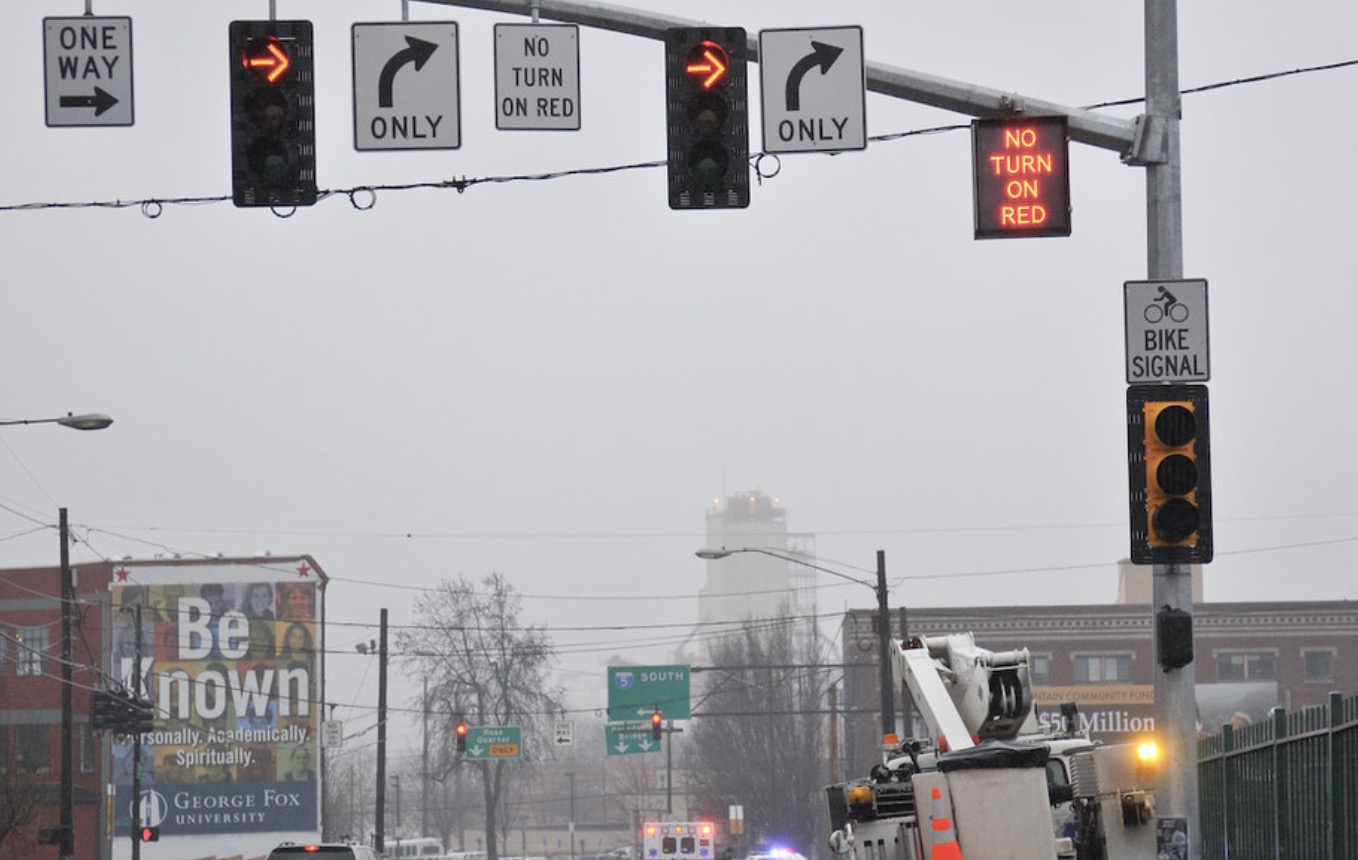
At every intersection that bans right turns, municipalities must post signs or traffic lights stating that such turns are prohibited. The US, Canada, Mexico, Brazil, Colombia, China and a few other countries allow RTOR with few restrictions. RTOR turns are prohibited or restricted in most other countries.

Fuel Savings and Safety Issues
The impact of RTOR has been hotly debated. The practice may reduce travel time for drivers and reduce congestion at intersections. It is difficult to determine whether RTOR laws have reduced fuel consumption. To perform a legal RTOR, a driver must come to a complete stop, then accelerate again. In many cases, drivers are stopping and starting multiple times, which lowers the fuel savings that can be achieved.
The economic theory known as Joven’s Paradox also plays a role. Economist William Joven noticed that changes that increased the efficient use of coal led to an increase in coal consumption. Reducing the usage cost incentivizes people to use more of the resource, and consumption increases. RTOR red laws make driving easier and faster, which may contribute to our auto-dominant culture.
The automobile landscape has changed greatly since RTOR laws were enacted. Automatic transmissions have replaced manual transmissions in the United States The adoption of hybrid and electric vehicles means that some cars produce no emissions. The car market and our roads are dominated by SUVs and light trucks. It is likely that these changes have affected the fuel savings achieved by RTOR laws.
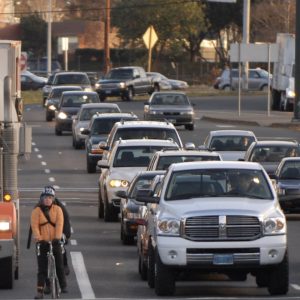
In recent years, there has been much debate about safety issues raised by RTOR. The risk of RTOR comes from the fact that drivers look to their left for oncoming traffic before making a right turn. They may not see pedestrians who are in front of them or positioned on the right side of the intersection. This can be a particular problem for drivers of SUVs and light trucks, because their large size and high clearance make it difficult to see vulnerable road users. These crashes represent a small percentage of total vehicle crashes, but RTOR does increase risks for pedestrians and cyclists.
In 2024, the Mineta Transportation Institute published a study that determined that right-turn collisions were responsible for 39,000 crashes and 217 fatalities in California between 2011 and 2022. Over half of the crashes involved pedestrians and cyclists. Race played a role in pedestrian collisions, with Black pedestrians at higher risk than White pedestrians. Black cyclists were not at higher risks for collisions than White cyclists. Neighborhood socioeconomic status also impacted the rate of collisions, with lower income neighborhoods showing higher collision rates than higher income areas. There were also higher collision rates at intersections that were close to public transit.
The Future of RTOR
Some municipalities have banned or restricted RTOR in recent years. In 2024, Cambridge, Massachusetts banned the practice for drivers and cyclists at all city-managed intersections. Washington, DC banned RTOR in a process that was completed in 2025. The process took several years and began with 100 intersections. Studies showed that collisions were reduced by 92 percent, so the practice was expanded to all city-managed intersections.
Seattle has banned RTOR on many downtown intersections for years, but has recently extended the ban to all new traffic lights and intersections. San Francisco started a pilot project which banned RTOR at 50 intersections. The project was extremely successful at reducing collisions and has been expanded to 200 intersections. The city council is now debating a proposal to ban RTOR at all intersections.
Traffic engineering problems often have multiple causes, and this is the case with RTOR safety. Engineering standards, like those outlined in Beaverton’s engineering design manual, often require a minimum of a 25-foot turning radius when a local street intersects with an arterial or connector street. On the other hand, the National Association of City Traffic Officials (NACTO) recommends a maximum 15-foot turning radius, with a preferred turning radius of 5 feet for collectors and arterials. A smaller turn radius forces drivers to slow down and to look to their left when turning. In recent years, many transportation activists have worked with transportation officials to adopt NACTO standards.
PBOT has recently developed standards for regulating RTOR at intersections that previously allowed the practice. These restrictions are concentrated in dense or dangerous zones, such as the Northwest pedestrian district, West Burnside Street, and near school grounds. In 2024, Wendy Cawley, the Portland Bureau of Transportation’s Chief Engineer, spelled out top priorities for regulation in an executive memo:
- When there are exclusive pedestrian or bicycle phases at intersections. In other words, if there is a signal phase in which bicyclists or pedestrians are allowed to move, but cars must remain stopped
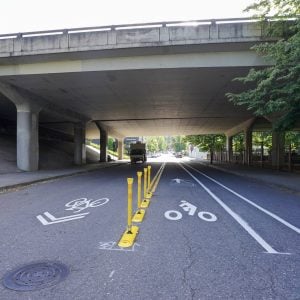
- Where bike boxes are present, at Neighborhood Greenways, and where turns cross separated paths.
- High conflict intersections where there have been more than 3 RTOR collisions reported in a 12 month period for a particular approach of an intersection. If two or more of these crashes are bicycle or pedestrian crashes in a five-year period, then that intersection should also be considered for No Turn on Red (NTOR) signage.
- Geometric or operational characteristics of an intersection that might result in unexpected conflicts, such as inadequate sight distance to vehicles approaching from the left or the right, skewed angle intersections, or intersections where U turns are allowed
The executive memo contained a chart which identified intersections that met these standards. The intersection of NW Couch St and 11th Ave was chosen because it had an exclusive pedestrian phase and a pedestrian head start. Additional factors included the fact that the intersection is close to schools and a pedestrian district. RTOR has been banned at this intersection.
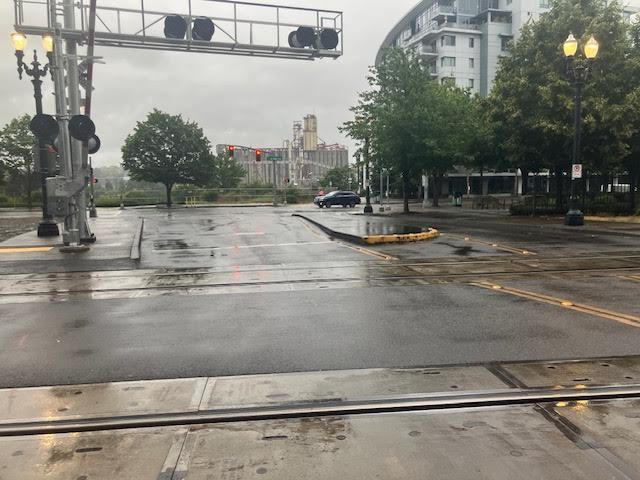
The intersection of NW Front and 9th Ave is also on the list. This intersection has a rail crossing, so the right turns conflict with a unique signal phase, as well as with the infrastructure for the rail crossing. NTOR has not been implemented at this intersection. RTOR laws were implemented in response to the crisis created by the oil embargos of the 1970s. The vast changes that have occurred in the automobile industry since that era, as well as the threat that right turns pose for pedestrians, mean that many people are re-evaluating the value of this practice, particularly in urban settings like Portland.

Thanks for reading.
BikePortland has served this community with independent community journalism since 2005. We rely on subscriptions from readers like you to survive. Your financial support is vital in keeping this valuable resource alive and well.
Please subscribe today to strengthen and expand our work.
PBOT can regulate RTOR all they want, but in my experience automobile drivers will continue to turn right on red regardless. As one example, when headed eastbound on Rosa Parks at MLK there are two “No Right On Red” signs, a line on the street marked “Stop Here”, and a big green bike box – yet drivers for many years continue to constantly turn right on red at that intersection against all the instructions not to. I’ve even seen a PPB cruiser watch a car do it as I was on a bike in the bike lane at that intersection and the police just shrugged at me. Even with regulations most drivers will continue to feel entitled to turn right on red, and local police will not enforce it.
I agree to some extent cosmos503. It’s maddening how terrible many drivers are when it comes to following these basic laws. And I know that Rosa Parks/MLK situation very well. I’ve been wanting to do a video that just shows how many people disobey that law. I think part of it is we need to begin shaming people who drive like this and make it socially unacceptable.
In my view, a more sustainable solution would be red light cameras that cite drivers running NTOR. I don’t think shaming drivers really does anything but create animosity toward cyclists.
I’m talking more like peer pressure and setting cultural norms, not running some sort of official shame PSA.
I also think it’s silly to worry about upsetting a driver. The people I’d target already don’t give a shit about anyone but themselves, and maybe making them mad will force the self reflection needed to change their behavior. Also, how’s playing nice been going so far?
Last time I “shamed” a driver at 82nd & Division for running the no turn on red sign (aka giving a palm up “what” gesture), he flipped his truck around and followed me screaming all the way from 82nd to 205. That guy is never going to self-reflect, so the least we can do is issue a legal penalty to reinforce his behavior.
It has kept me alive.
I’ve thought about the PSA approach often. It would need to for marketing best practices and be implemented enthusiastically, else it would be useless like some of our other efforts to drive behavior change.
It seems like right on red should be something that could easily be automatically enforced with photo system, the problem is that there is no camera mounted at that intersection.
I’m forever baffled that it’s legal in OR and WA to turn against a solid red arrow (as opposed to a circular red light) in the first place.
I agree with a lot of what you’re saying but just because a policy doesn’t solve 100% of the problem doesn’t mean it’s not worth implementing.
I just moved, but I used to live where the Burnside bridge intersects MLK and people would extremely regularly cross into the bus lane to turn right on red even though there’s so many signs saying no right on red.
I recently had the distinct displeasure of witnessing a driver doing a RTOR by driving through a buffered bike lane to pass up the red light queue on SE Foster & 72nd. Not just once, but twice; once when I was crossing Foster to get to Red Castle Games, then again when I crossed to leave the store. There are some pretty big holes in that swiss cheese model of safety as applied to Foster (no surprise there).
I live near here and have wondered what actions can be taken or what needs changed to reduce these dangers in particular. Woodstock and 72, Wood Stock and 52, both Eastbound to Southbound are notorious for reckless right hand turners as well. Unfortunately I think we would need to amend ORS 811.440 (2) in addition to revising RTOR laws to potentially see anything meaningful. I point this out not to be discouraging but to inform. https://oregon.public.law/statutes/ors_811.440
This policy drives me insane. We don’t need people to get in crashes, seriously injure themselves or die to know that this practice is dangerous. It baffles me that to this day this is PBOTs approach to traffic calming. It comes off as hypocritical alongside all their safety campaigns like Vision zero and 20 is plenty.
I live on an uncontrolled intersection where I regularly see people exceeding the speed limit by 20+mph why does PBOT think someone needs to die there first before they’ll put in a stop sign in either direction to reduce conflicts? They even upgraded the greenway a few blocks away in recent years adding stop signs to the greenway and the adjacent blocks but stopped at the next streets over for some reason. How much more would it have cost when they were already out here?
It’s a horrible irony that the price of fixing failed infrastructure in Portland often includes at least one person being hurt.
It seems nuts to create a situation that simultaneously gives me a green light to step off the corner into the crosswalk, and gives the driver–whose stopped vehicle I’m stepping directly in front of–a reason to turn his head completely away from me and drive his car directly into the space I’m stepping into.
But that’s what right on red creates.
PBOT does lots of things that require drivers to do two seemingly incompatible things at one time. Another example is when they have car traffic turn across a bike lane — it requires turning and merging at the same time. It is far better to do a merge first, then a turn, to lessen the cognitive load and reduce the possibility of errors and misjudgments.
Right-on-red is kind of the same thing, though the hazard can be reduced with tools like leading pedestrian intervals or other design treatments.
The frustrating thing about right turns on red is that they’re a result of underbuilt infrastructure in the first place. All intersections with a right turn only lane should have a separate right turn arrow which allows vehicles to turn when it is safe to do so (e.g. when the intersecting road has a left turn phase).
THEN you can put up the ‘no turn on red’ sign and drivers will probably be a lot more compliant.