
This article was written by East Portland resident Sean Pliska. It has been guest-edited by Adrienne So.
Ed. note: This memo was not written by Portland Bureau of Transportation Director Millicent Williams. Rather, it is a memo that Sean Pliska wishes she would have written.
PORTLAND BUREAU OF TRANSPORTATION
Departmental Memorandum
To: All PBOT Divisions, Program Managers, Project Delivery Staff, and Planning Teams
From: Director of the Portland Bureau of Transportation
Date: August 13, 2026
Subject: Directive on Bicycle Investment Prioritization and Mode Share Growth
Purpose
Effective immediately, PBOT shall prioritize bicycle investments based on their demonstrated ability to increase bicycle mode share.
While the bureau has produced numerous plans, including the 2035 Bike Plan and Central City in Motion, our project selection process has not consistently focused resources on the projects most likely to produce measurable growth in bicycling. As a result, bicycle mode share has not achieved significant growth, despite substantial planning activity and investment. The mayor and I have decided to make a decisive change based on feedback from our constituents and evidence. We will henceforth focus our efforts on projects that will lead to bicycle mode share growth.
The purpose of this directive is to establish a clear framework for prioritizing projects that will increase ridership, close critical network gaps, and accelerate progress toward Portland’s transportation, climate, and safety goals.
Policy Direction
PBOT shall prioritize bicycle investments according to the following hierarchy:
- Operationalize the low-stress bicycle network
- Identify and remove high-demand bottlenecks which limit ridership, generally Level of Traffic Stress (LTS) 2-4
- Deliver separated facilities rapidly using cost-effective materials
- Progress monitor outcomes through quarterly bicycle counts and mode-share data
- Scale successful interventions across the network, generally starting with central bottlenecks and moving outward
Projects that score highly within this framework shall receive priority consideration for discretionary funding, staff resources, and implementation.
Directive 1: Operationalize the Bicycle Network
Within three months, PBOT Planning shall establish objective and measurable criteria defining the bicycle network intended to serve the broadest segment of Portland residents, including those interested in bicycling but unwilling to ride in stressful traffic conditions.
The bureau shall:
- Establish clear criteria for low-stress bicycle facilities (e.g., physical separation at 20 mph, limit ADT on shared streets to 500)
- Identify corridors that meet those standards (generally LTS 1) and those that do not based on measurable data
- Produce a realistic audit and citywide map of the revised operational, low-stress network
- Identify bottlenecks preventing continuous low-stress travel
Network designation shall be based on measurable operating conditions rather than facility labels alone, as has historically been the case. The purpose of this effort is to ensure that network planning reflects actual rider experience along major commuter corridors and provides a consistent benchmark for evaluating progress.
Directive 2: Prioritize High-Demand Bottlenecks
Beginning with the next capital programming cycle, demonstrated and projected ridership demand shall become a primary factor in project prioritization.
PBOT shall prioritize locations that exhibit:
- Longitudinal bike counts suggesting high bicycle demand on corridors where bottlenecks fail to meet the above LTS 1 requirements
- Limited alternative routes and significant geographic or network constraints
- Strategic connections to downtown and regional centers
Bicycle count data, travel demand data, and network analysis shall be used to identify these bottlenecks which include but are not limited to major commuter corridors such as: NE Couch/Burnside, N Broadway/Weidler, SE Madison/Hawthorne, N Williams/Vancouver. The bureau’s objective is straightforward: remove barriers where the greatest number of current and potential riders are affected.
Equity, safety, diversity, geographic distribution, and maintenance considerations remain important factors in decision-making. However, projects that address major network bottlenecks and have a high probability of increasing ridership shall receive elevated priority as of this memo.
Directive 3: Deploy High-Yield Infrastructure
PBOT shall shift from a project delivery model that waits for large capital construction opportunities toward a model emphasizing rapid implementation and use of moderate-cost, moderate-duration materials.
Where feasible, staff shall prioritize:
- Durable modular separation systems
- Rubber curb protection
- Prefab concrete curbs and islands where appropriate
- Planters and hardened barriers
- Quick-build intersection treatments
- Protected bicycle signal installations
The bureau shall seek to complete critical central corridor improvements within two years, rather than decades, within budget constraints. Permanent capital projects remain important. However, lack of full capital funding shall not be considered sufficient justification for delaying improvements at major bottlenecks when lower-cost treatments can provide substantial network benefits in the interim.
Performance Measurement
All major bicycle corridor projects shall include pre- and post-implementation evaluation.
Performance metrics shall include:
- Pre- and post-bicycle counts
- Projected ridership growth
- Growth in diversity of ridership (for example, by age, sex, or socioeconomic status)
- Safety outcomes
- Mode changes where measurable
The success of a project shall be evaluated not only by its completion, but by its ability to increase bicycle use across a diverse aggregate of people.
Initial Implementation Priority: Broadway Main Street Corridor
As an initial application of this policy, PBOT shall evaluate accelerated delivery of a protected bicycle facility connecting the downtown protected network to the Broadway/Weidler and Williams/Vancouver corridors.
Analysis conducted to date indicates:
- The corridor represents a significant gap in the low-stress bicycle network.
- Existing bicycle volumes on connecting facilities are among the highest in Portland.
- The corridor functions as a critical connection between North and Northeast Portland and downtown.
- Existing conditions create a bottleneck that constrains ridership growth.
Staff shall examine opportunities to deliver corridor separation and associated bicycle signal improvements through phased implementation using rapid-deployment materials where appropriate. The objective is not simply construction of a LTS 1 facility, but removal of a major barrier within one of Portland’s highest-demand bicycle corridors.
Bureau Expectations
Effective immediately, all bicycle project proposals seeking discretionary funding shall include:
- An assessment of the project’s impact on network connectivity
- Existing bicycle demand data relevant to the project corridor
- Estimated ridership increase based demand projections
- Identification of bottlenecks addressed
- Explanation of why the project is a higher priority than competing investments
Projects unable to demonstrate meaningful contributions toward ridership growth shall receive lower priority than projects addressing critical network gaps and high-demand corridors.
Conclusion
The mayor and I have listened to our constituents and have heard that Portland does not need another planning framework. It needs a project selection framework that directs scarce resources toward measurable increases in bicycle use. The bureau’s objective is clear: increase bicycle mode share by focusing quality investments where they will have the greatest impact.
From this point forward, PBOT’s bicycle investments shall be guided by a simple principle: Where demand is highest, where network bottlenecks are greatest, and where improvements can be delivered quickly, those projects shall move to the front of the line.
Signed,
Millicent D. Williams, director



Thanks for reading.
BikePortland has served this community with independent community journalism since 2005. We rely on subscriptions from readers like you to survive. Your financial support is vital in keeping this valuable resource alive and well.
Please subscribe today to strengthen and expand our work.
I learned recently that PBOT doesn’t have funding to carry out day-to-day maintenance of ANY of Portland’s transportation network – not the car part but certainly not the bike or ped part. So why would we want them to build more bike infra that will simply be neglected?
The memo is a nice thought exercise and I agree with its thrust (stop building car & truck infra til cycling infra has caught up). I just think there has to be some reversion to maintaining what little we have before they build more that they can’t maintain.
BTW, at least one person out in Bikeland is wondering what’s going on with the hiatus. There were some hints of a new position or direction (can’t remember exactly when) but then there was no follow-up.
Please share details if you have them and I hope things are looking up.
They could make tons of money of they actually ticketed and fined every car on the street with missing/expired plates. I’m sure a good amount of these drivers probably don’t have insurance, either. What do you know, an idea that would actually make our streets safer!
I don’t think mode share alone is a good filter for bike projects. Getting more people biking is great, but I don’t think it should be the primary goal in the short term. There are many things besides infrastructure that impact whether someone chooses to bike. That doesn’t mean infrastructure isn’t important, but I think I think it’s a lot more complex and unpredictable than “if we build it they will come”.
However, bike infrastructure *can* make an immediate difference in other ways. It can immediately make people (whether biking, walking or rolling) feel safer and more welcome. It can inspire more joy. It can help foster community building. Things like Rainbow Road are a good example of this.
Mode share is an “engineers mindset”. It reinforces the idea that our public spaces are exclusively for moving people to and fro, and that bikes are good only insofar as they can out compete cars at doing so. Focusing so much on mode share isn’t working, and it obscures the amazing progress we have made in other dimensions over the past decade.
As an East Portland resident, why is it so damn sketchy to get from Ron Russell Middle School to the Springwater MUP?
Because you’re on 112th!? Best bet in the hopefully not too distant future will be traveling SE Bush to 122nd and then to Springwater. Out of direction if you’re heading west. 122nd should see significant upgrades: https://www.portland.gov/transportation/planning/122nd-plan
I really hope that the 122nd project delivers. As much hand-wringing as there is about the bike lanes on outer Division, I use them frequently and find them to be a mostly good experience. Similar bike lanes on 122nd would be a huge boon for bike connectivity in the area.
Which way do you go?
Going East you can take Bush or Holgate down to 136th too.
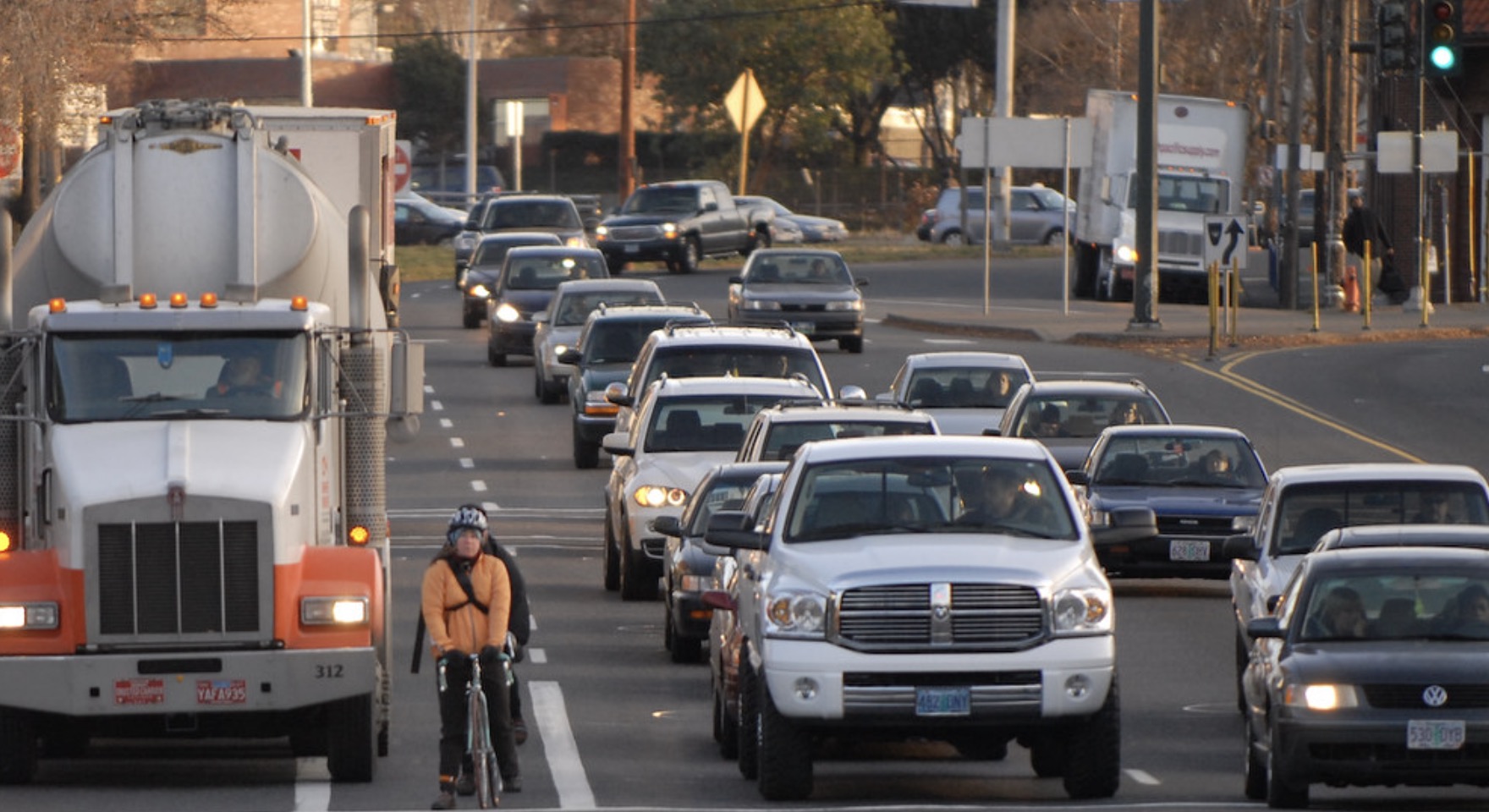
This memo pairs well with the post’s headline photo of Broadway from 2009 and may have provided helpful direction to PBOT then. It is no way relevant or an aid to the PBOT of 2026.
Let’s go directive by directive since this writer didn’t do their homework and many of the readers will likely fail to do the same.
Directive 1 asks for two things:
1a) Standards for low-stress facilities
1b) Identification of high priority spots to fix in the bike network
PBOT addressed 1a) in 2021 when it adopted the NACTO standards for bikeway design and built upon it with its Protected Bicycle Lane Design Guide.
PBOT’s most recent addressing of 1b) happened earlier this year with its Transportation System Plan Update – inventory of the bike network showing needs and gaps in the bike network (report, appendix). It was also addressed in the Bike Plan for 2030, in subsequent progress reports, and in most of the In Motion plans, including East Portland in Motion, Northwest in Motion, Southwest in Motion, North Portland in Motion, and Lower Southeast Rising.
Directive 2 asks for one thing:
2a) prioritizing improving segments of the bike network with greater than LTS 1 that see or could see high bike usage
PBOT identifies those spots in 1b) and addressed/es 2a) by prioritizing such locations with i) its Missing Links Program, ii) its Bike Network Completion Program, and iii) within the Transportation System Plan project prioritization process, which determines which projects the city can receive large and external grant funds for.
Directive 3 asks for one thing
3a) use quickbuild-type construction to increase the pace of implementation
PBOT has a track record of using scrappy approaches that stretches back decades, from the first and second generations of bicycle boulevards to the original SW Broadway protected bike lane. In the last 10 years, PBOT has built over 400 small capital/quick build projects that compromise permanence and quality of materials for claiming space in the right of way for active transportation. Several planning efforts were conducted with this implementation strategy in mind, including Southwest in Motion, Northwest in Motion, Hawthorne Pave and Paint, North Portland in Motion, Lower Southeast Rising, and Broadway Pave and Paint. Many “bottlenecks” remain. Many have been addressed. The apparatus for addressing them is well-developed, has delivered, and continues to do so.
Performance Measurement (4) asks for project-level evaluation along five lines:
4a) pre and post counts – at the project level, bike counts are not often taken pre- and post-project. More regularly, PBOT evaluates project safety outcomes , while in some cases like Northwest in Motion evaluation focuses on auto volumes to understand if constructed bike facilities are meeting city guidelines for all ages and abilities bike use. An admitted gap, one that likely exists because PBOT operates on an unexamined “build it and they will come” heuristic.
4b) projected ridership growth – no reliable tool exists to estimate this at a project level. PBOT and PCEF searched far and wide for a reliable tool to assess contribution of individual bike infrastructure projects for achieving GHG emission reduction, but none stood up to scrutiny.
4c) Growth in diversity of ridership – PBOT’s annual bike counts get at some of these demographic factors
4d) Safety outcomes – safety is assessed citywide annually and often for major corridor projects. If significant safety concerns pop up on a street with a recent project, that street goes back on the list of needs to address.
4e) Mode changes where measurable – at the street level, the raw mix of road users is simple to assess through PBOT’s traffic counts program (which can distinguish vehicle by type) and where/when project evaluations are performed. However, understanding how a specific set of users of a specific street changed their modal travel behavior due to a project is not possible with currently available tools.
Bureau Expectations (5) asks for bike projects to meet certain criteria to be funded with discretionary dollars: 5-1. Network connectivity; 5-2. Bike demand; 5-3. Ridership projections; 5-4. Bottlenecks addressed; 5-5. Prioritization justification.
For starters, discretionary money in the sense you mean is largely non-existent at PBOT; the $90M of discretionary money in PBOT’s budget is allocated almost entirely toward operation and maintenance of the existing transportation system. The new Transportation Utility Fee will go toward backfilling cuts in maintenance and operations from the last seven fiscal years.
Earlier responses to 1-4 discuss the process for developing the list of projects (5-4. And 5-5.) from which PBOT can select for various funding opportunities. Tools for assessing demand (5-2.) and ridership growth (5-3.) at the project level don’t exist or are so underdeveloped as to be not useful. As such, there is a focus on prioritizing projects that improve network connectivity (5-1.)
Your memo describes what PBOT already has – nice work Director Williams!
In seriousness, what’s worrisome is that, to the extent there is a single criticism of PBOT among bike advocates, it is well-reflected in this memo – focused as it is on nitpicking the above-described apparatus because it’s not producing the outcomes you seek (higher ridership), finding fault in small details of implementation (even as y’all seem unaware of what is actually happening, based on my above breakdown…), as if tinkering is going to address the elephant in the room (<3% bike mode share), because it’s easier than contending with the fact that your theory of change (Build for all ages and abilities! Fix the missing links! Better bike lanes on main streets!) has been PBOT’s playbook for at least 15 years and it’s not delivering.
ITOTS your input is very much appreciated and the response has given us lot to sort through. It points to many fantastic documents that show a lot of work has been done to, for example, provide guidelines for separated facilities, or identify gaps in the network. I think we may both agree that we have no lack of planning documents. The people both inside and outside PBOT have done so much amazing work!
Re Directive 2: PBOT prioritizes projects on the basis of many complex variables (TSP etc). However, prioritizing projects specifically based on bike counts (demand) is one fairly predictable way to increase mode share based on the body of evidence found in other cities. If you look at the list of locations for missing links, you will see they cover the entirety of Portland. However, if you look at the data from bike counts, you will see that the handful of locations where demand is highest (blue dots) none of those projects overlap.
The locations where a consistent increase in mode share is most likely given investment have been systematically ignored.
Again, I very much appreciate your perspective. From outside PBOT it is clear those few bottlenecks close to where bike counts are highest have generally remained static for a decade or more. Where many in PBOT might see a failure of “Build it and they will come” philosophy a lot of people (myself included) can simply look at the title picture of this article as a pretty clear answer to that. A lot of people can’t help but see that less as nitpicky and more as a gaping and unmistakable hole in policy no amount of documents or spin can obscure.
In any case your ideas are invaluable, and thanks again for sharing your point of view.
My impression – until I reached the last paragraph – was “Nicely stated, Director Williams!”
The 2045-TSP-Existing-And-Future-Conditions-Report linked above outlines a fundamental deficit within the bicycle network itself.
Table 4: System Completeness Metrics
Metric Share
Share of the pedestrian network completed 67% priority, 52% local
Share of the bicycle network completed 47%
Share of the transit network completed 88%
Share of the motor vehicle network completed 99%
Share of ITS network completed 58%
How can people of all ages and all abilities be expected to bike anywhere when there are put into situations with unsafe road designs combined with dangerous automobile use within the network? What happens when their destination is a grocery store located along a collector or arterial? I applaud the staff for riding a bicycle down the entirety of 82nd Ave to experience what the current conditions are in reaching WinCo and similar destinations on the corridor.
The bike share will continue to struggle until the bike network is complete and not relegated to backstreets with periodic speed bumps in lower socio-economic status neighborhoods.
Why would the daily activities and needs of a person cycling differ substantially from a person driving? Portland has so much going for it. There’s moderate winters, historically mild summers, and outside of the west hills, Mt. Tabor, and a few spots like Alameda Ridge, it is relatively low elevation changes. However, it will take considerable investments to create a citywide network that is safe from car drivers and appealing to new and interested cyclists. The local land use is equally important and requires coordination across bureaus and market readiness to realize complete neighborhoods particularly in East Portland where it can be miles to a grocery store, employer, or library. I would encourage not dwelling on the bike share mode when there are significant land use and transportation network gaps that are evident to anyone that has lived or worked in East Portland.
If this is going to be an evidence/data based assessment, I’m not sure we’re going to be building much new bike infrastructure. I’ve seen very little evidence that any recently built projects have increased mode share growth, or even increased ridership in any meaningful manner.
Ironically, TriMet service cuts might grow bike mode share more than any infrastructure project could. Hooray?
It might, especially for shorter trips. What I think will really help is replacing human drivers with much safer robots. It’s too early to tell, of course, but it seems intuitive that riding amongst much safer and cleaner vehicles would be more attractive.
On my daily bike ride, I saw a Tesla on SW Oleson inching along as the driver tried to see around a folded-up hood! The Tesla is such a great ad for “safe” robot-driven cars.
Tesla “self-driving” isn’t. It’s a misbranded Level 2 augmented driving system. Tesla drivers who don’t exercise control over their vehicles are negligent.
I was referring to the Waymo type of robot driving, where the vehicles are truly autonomous and are much safer than human piloted vehicles.
But then I suspect you knew that, but chose not to engage with the actual argument because you know I’m probably right.
Have you ever talked to anyone who has ridden around a Waymo? I have, and they reported feeling much safer with Waymos around than human drivers. Whether that feeling translates into more ridership is speculative, and depends on why you think people are riding less than they used to.
I disagree, though only because I suspect that Waymos and Waymo-alikes will replace just a small percentage of human drivers. That is, Uber drivers. It doesn’t really do much to influence the behavior of the 99% of other vehicles I interact with. On that front, I still think that education and enforcement would make the most difference. Maybe tax the robot cars to fund programs that improve human drivers?
Agreed — the number of vehicles currently deployed won’t make much difference. But Waymo’s deployments are accelerating, and I would be shocked if they didn’t start selling the tech to others at some point. Also, competitors are starting their own deployments. Zoox got their own license recently, for example.
I’m all for improving human driving, but I’m pessimistic about the endeavor.
I mean, I enjoy good fan fiction as much as the next person. This is well written and has good ideas, but to implement any of this it starts at the ballot box. November is approaching quick, good luck to us all.
PBOT please build it, and build it now! The city has made almost no progress on reducing VMT and gone backwards on biking, walking, transit. Time to have an operational shift in guiding ethos around infrastructure. We are beyond the time of piecemeal improvements, the city must go beyond even what this memo calls, potentially. No more placating the cars drivers, look at what is happening in the world.
Every repaved road should include one less lane for cars, increased sidewalk space, greenery and a bike lane. Cars do magnitudes more damage to roads than these other forms so they should take precedent if PBOT is always tight on budget and hate asking people to reducing emissions. We could(and should) turn certain streets into pedestrian only streets, to reduce UHI effect and promote walking/biking/transit right now.
The time has come for the Mayor, City Council, and PBOT to meet their targets, by any means necessary. Those in power need to get their head out of the sand and realize that we are well-beyond falling behind in terms of reducing emissions. We have missed the moment to move slowly, now we must operate quickly. There are ways to do this quickly, but only if our elected officials have the backbone to do so.
10 years ago Victoria, B.C. had 4% mode share so they decided to build a series of short, disconnected projects in places with low demand not connected to the center of the city. Today their mode share has remained static and they have decided the “build it and they will come” motto was wrong. Now they will attempt to regain ridership through behavioral programs by persuading people to bike in places they don’t feel comfortable.
Except none of that is true.
10 years ago Victoria had no protected bike lanes and no connection to downtown. Using technical skills from Portland they made the policy decision to prioritize projects almost exclusively on 1) high demand locations 2) connected to the city center 3) prioritizing temporary materials for quick implementation. As a result mode share has tripled to 13%. This is not an isolated example but a common phenomenon we see in most cities. Portland can choose to prioritize similar projects, and garner the similar results. We even have the expertise other cities use, we just don’t have the policy decisions to make any meaningful difference.
If you take the position that infrastructure is what drives ridership, that leaves the question of why ridership in Portland fell substantially in a period when infrastructure was improving, even before the work at home revolution. Likewise, Portland’s growth in cycling in the late 2000s cannot be attributed solely to improving infrastructure.
There are other cultural forces at play. Ignoring those and instead focusing on infrastructure because that’s more fun is unlikely to yield satisfactory results.
Like all of us, I want better infrastructure, but I don’t delude myself into thinking it is going to turn around biking in Portland (which, I’ll note, is better than ever on an experiential level).