

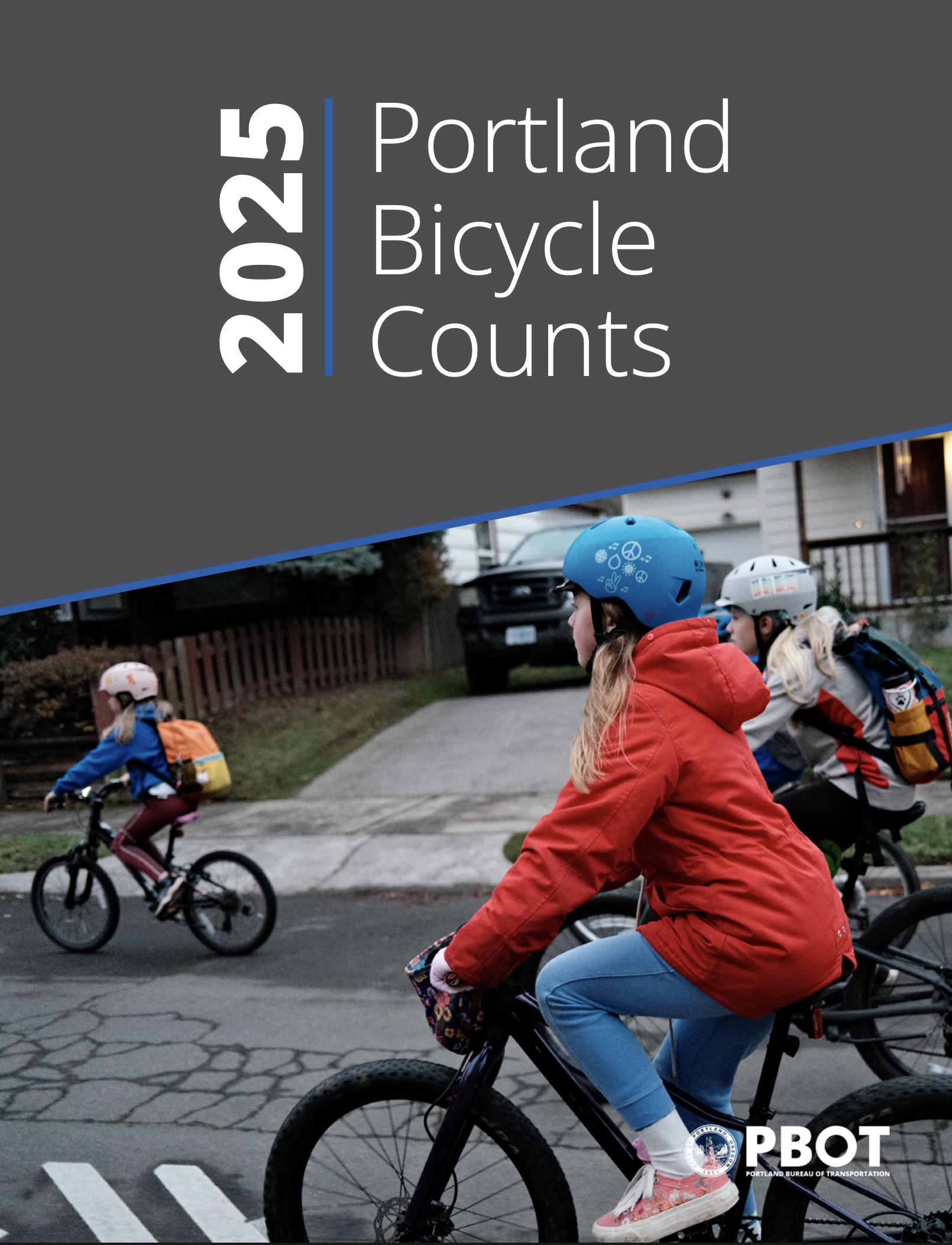
The Portland Bureau of Transportation just released their latest Bicycle Count Report and the numbers could be read as a case of “no news is good news.” Overall, PBOT counted 1% more bicycle riders on streets citywide compared to one year ago. While it’s good we’re holding steady and have pedaled out of the decline that happened between 2016 and 2022, keep in mind we’re still down about 40% from our mid-2010s peak.
PBOT’s bike counts are widely respected for their consistency over time as they’ve fanned out along bikeways with clipboards in hand for over three decades. The counts were tallied by 150 trained volunteers who posted up at 342 locations (the most ever) between June and September of last year. PBOT splits the city up into eight geographic sectors (see map below).
In 2025, none of those sectors posted double-digit growth. The largest increases came from East (all areas east of I-205) and Southwest (excluding areas in the City Center) where counts showed 6.6% and 6.0% growth compared to 2024. Three sectors showed negative growth. North (west of Martin Luther King Jr. Blvd) was down 4.2% and Northwest (excluding areas in the City Center) and South showed significant declines with a 12.9% and 16.8% decrease respectively.

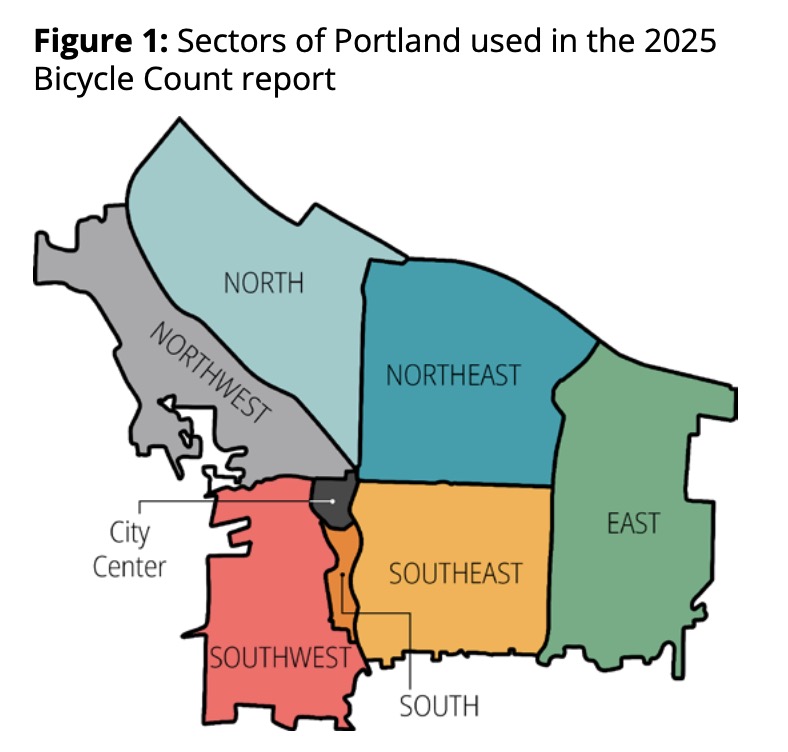
Interestingly, PBOT mentioned in the report that the nearly 17% decrease in South might be due in part to it being home to the U.S. Immigration and Customs Enforcement field office, which was the site of numerous protests.
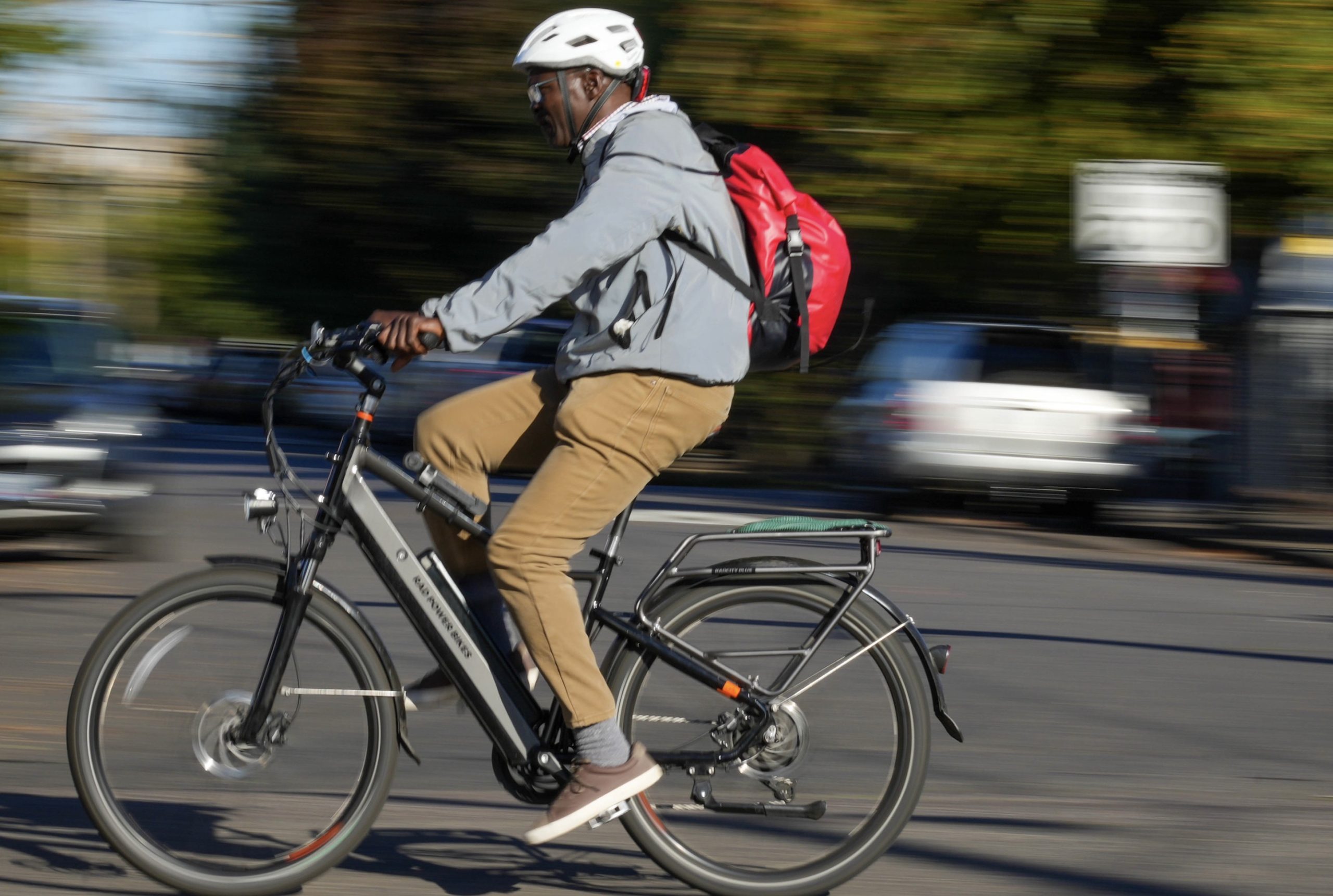
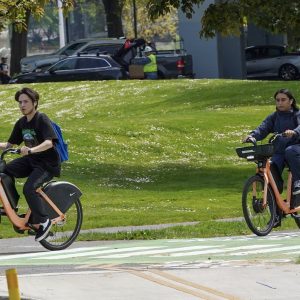
The one group that really has something to celebrate with the 2025 counts are electric bike retailers. PBOT reports that nearly one in four people on bikes in Portland are riding an e-bike. That’s the highest number counted since they began counting e-bikes in 2023 (note that this number should be taken with a grain of salt given inherent difficulties of identifying e-bikes versus acoustic bikes). Another fun e-bike fact in the report is that one-third of women counted were using them, compared to 22% of men.
When it comes to shared micromobility, the report revealed large growth in e-scooter use and the second straight year of decline in Biketown riders.
Amid the relatively “meh” news about bike ridership, the PBOT report included a section about how our city — once the undisputed “Bicycle Capital of America!” — remains full of “enthusiasm” for all things bicycle. Specifically, PBOT mentioned the bike bus movement. Here’s a snip from the report:
“The energy and enthusiasm around bike buses—as well as their leaders’ demands for network improvements—provide an insight to the desire parents and children have for an environment that fosters safe and comfortable conditions for biking for people of all ages and abilities. Portland has the policies, plans and understanding of how to create conditions that make bicycling more attractive than driving for most short trips. Lacking are the resources to make it happen.”
For more insights, check out the full report, which you can download from PBOT’s bike counts website.
Thanks for reading.
BikePortland has served this community with independent community journalism since 2005. We rely on subscriptions from readers like you to survive. Your financial support is vital in keeping this valuable resource alive and well.
Please subscribe today to strengthen and expand our work.
I really wonder about PBOT methodology with these bike counts, and the combination of post-pandemic work from home and widespread ebike adoption haven’t changed transportation patterns in ways that lead to a systematic undercounting.
My basic theory is:
Because of all those changes, even though bicycle commuting seems like it has convincingly decreased post-pandemic and never recovered, I suspect that actually there are a lot of bicycle trips that replaced commutes which are just not being counted because they are from home to school or restaurant or whatever, and either don’t occur on a greenway or even if a majority of the trip is on a greenway, they don’t pass a counting site.
Of course, if they were to starting counting trips that were occuring off greenways, they would maybe have to build some daggone bicycle infrastructure outside the greenway system and then maybe deal with crabby business owners complaining about parking being taken away and a bunch of other headaches that PBOT doesn’t seem to have much appetite to actually take on.
Good points. I recall that in the previous two years’ count reports the city addressed these concerns about the methodology’s continued validity in the face of changed travel patterns.
They found it remains valid.
You can read their reasoning in the 2023 and maybe the 2024 report on this page: https://www.portland.gov/transportation/walking-biking-transit-safety/bicycle-counts
Just looked it up. Best description is in 2022 report: https://www.portland.gov/transportation/bicycle-committee/documents/2022-portland-bicycle-count-report/download#page=32
Yeah I read that when it came out and I think their assessment that the peak travel times still hold is correct, my argument is that the location of counts leads to the undercounting
Counts appear to be city wide and at the same (and expanding number of) locations year after year. Did you see the maps of locations?
I am encouraged that more city council rep’s are living in the outer neighborhoods, Parkway, Centrum even Gresham. Candace Avalon and District 1 can really turn things around if the voting can be worked out, maybe a redistict or two. Looking forward to e-quadricycle rental at the Home Depot tool counter which is currently a deal I am brokering with the Adelsons and 47. Big news soon exciting for East Portand
Dave
Jonathan,in a non-binary world… who is riding the other 45% of ebikes? “Another fun e-bike fact in the report is that one-third of women counted were using them, compared to 22% of men.” 😉
Those stats are not counting the percentage of e-bike users that are male or female.
“one-third of women counted were using them” means that of all women counted, 1/3rd of that group [all women on bikes] were on ebikes.
“22% of men” means that of all men counted, 22% of the group [all males on bikes] were on e-bikes.
Those percentages are of different things and can’t meaningfully be added together.
Does it matter if a bike has a motor? I prefer drop bars but that isn’t an important data point to me.
Seems like it always “e-bikes are just bikes” unless it serves someone’s purposes.
Considering the confusion around what specifications actually constitute an e-bike, yes it is an important distinction whether the vehicle in question has a motor. These data clearly show a significant decline in biking (without a motor) as people replace bikes with e-bikes, e-motorcycles, and e-scooters.
Except they’re not. Bikelike for sure, but also different in that they are motorized, which is an important distinction, both legally and not, just as Razor scooters are different than Lime scooters.
Whether it “matters” or not is a different question.
I think it’s an important distinction to make. As others have mentioned, e-bikes give people the opportunity to ride when they otherwise wouldn’t, and to ride in traffic when they otherwise wouldn’t. This makes them a key part of micromobility in Portland, and an important trend to follow, in my opinion.
“keep in mind we’re still down about 40% from our mid-2010s peak.“
I can’t think of anything that might have caused this drop.
Definitely not the super sizing of vehicles over the last decade.
Definitely not the in car display systems that distract drivers.
Definitely not the increase of smart phones over the last decade.
Definitely not the breakdown of social contracts since Covid.
Definitely not the deliberate, announced stoppage of traffic enforcement by PPB.
No. I can’t think of any reason why there might be a drop in cycling.
It’s a mystery to me.
You forgot to mention the shift in people working from home over the last decade, which is possibly a more significant reason than all the other items in your list combined.
Other cities bounced back. Portland stalled—on bikes, on the economy, and on livability—while officials keep calling it “steady” like people can’t see what’s right in front of them.
And of course it couldn’t be that other communities nationwide could have met or even surpassed Portland’s platinum-level bicycle facilities and that many Portland bicyclists may have left town altogether for better paying jobs, more affordable housing, fewer homeless camps, lower taxes, and nicer climates…
I’m so happy for you that you found a higher paying job in a more desirable place to live. You can stop beating the horse now.
Of course, why would anyone in Portland want things to improve. We should leave it as-is.
Why should one have to feel like they have to find jobs elsewhere to live in an environment where one can grow, improve, and raise a family?
Truthfully if Portland had been like this when I was looking for a place to live and raise a family, I would have looked elsewhere back in the 90s.
People I know are moving to Portland because they find better jobs here. You speak as if your personal experience is the general condition, and I don’t see it. I sympathize with your feeling that things are worse off for you in Portland than you would like. Do you really think you would be better off not having moved here? I posted my admittedly snarky response to David Hampsten’s tired litany of issues that I presume led DH to leave Portland, where I still live and work and see improvements to all of those very issues except perhaps lower taxes, which I find a poor reason to move anywhere. Portland has given me the best opportunities to use my bicycle as a primary means of transport than any other US city I have lived or visited. Other cities have better recreational facilities, and I envy some improvements I see happening in Seattle and elsewhere, and yes it would be nice to have fewer potholes. I don’t see that as a reason to pull up roots. Other cities also have potholes and budget problems. Why do some people spend so much effort on this site to repeat unfounded claims that Portland is doing so badly with respect to other places? It doesn’t add up.
You can like living in Portland and still be honest about what’s happening.
Downtown office vacancy is among the highest in the U.S., population growth has stalled or reversed, and businesses have been closing or leaving. Less foot traffic → less revenue → fewer services—it’s a real feedback loop, not a myth.
Add in ongoing homelessness and public safety concerns, and it’s not hard to see why people call it a “doom loop.” That doesn’t mean the city is beyond saving—but pretending these issues aren’t real doesn’t help.
Agreed. Portland has problems. Is someone pretending that Portland doesn’t? Maybe you feel it helps to repeat the list of problems as an answer to every report about Portland?
People of Portland might want to consider the actual problems and potential solutions. The comments I responded to are the ones from those who don’t live in Portland and write as if Portland is a place to flee. The downtown office space vacancy wasn’t even on the list, by the way, so good callout if you want to keep a complete list of negatives to post in response to every article that offers any modest glimmer of hope. The purported list of reasons that cycling has declined was that other places offer:
“better paying jobs, more affordable housing, fewer homeless camps, lower taxes, and nicer climates”
It is a list repeated frequently in comments on this site. All of the issues reflected are not unique to Portland, so moving away is just as likely to give more headaches than relief, in my considered opinion. The offered explanation for the decline doesn’t hold up to scrutiny.
Crikey, SundayRider, must be nice cruisin’ through life thinking everything’s fine while the rest of us are flat out dodgin’ potholes and reality.
The driving situation was never that good. Screens may not been an issue, but there were other types of distraction and hostility (of which there actually seemed more of). I haven’t had stuff thrown at me or been threatened in years.
Not that drivers haven’t changed, but so have cyclists — probably more so.
The ethos behind slogans like “We are traffic” and “Share the road” that declare we belong everywhere is all but gone. Instead, people seem to believe they need separate infrastructure (i.e. “We aren’t traffic” and “We don’t belong on the road”) that barely exists, present the situation as scary/dangerous and pedaling as a hardship (hence the perpetual boosting of ebikes — which apparently offer totally different potential than small motorbikes).
Not much of a recipe to encourage cycling.
I’m curious if the increase in ebikes is correlated with the decrease in Biketown use. I think Biketown is the gateway to an ebike purchase for many folks. (Also, man, Biketown is EXPENSIVE. I hop on the bus if I want it to be cheaper.)
It was for me! I had a Biketown membership before I purchased my own e-bike. I was hesitant to make the switch at first, but quickly converted. I’ll use Biketown once or twice a year now to get to race events like the Portland Marathon. Otherwise I use my e-bike exclusively (and have fully neglected my regular bike).
I got to be a volunteer for this and I highly recommend participating if you have time. It was really fun to see all the cyclists and other micro mobility users and help provide this important data that the city uses to make decisions about road design
PEdaling really is a not too far from extinct method, my nieces and nephews are all getting their own electric quadricycles as soon as I can sort out the tarrifs. There is also the issue of menu screens displaying in Chinese text but that isn’t too bad since the steering and throttle is quite intuitive and braking is completely AI. Looking forward to more cars off the road and maybe a tax for charging stations from neighbor’s unused outlets. PBOT and Candace Avalon can get it done!!
Dave
“City reports, ‘steady, not stagnant’ bicycle use in 2025 count report””
LOL. That’s quite the spin.
STEADY = STAGNANT
And always, always, take any numbers that the City provides with a wheelbarrow full of salt. I’ve had conversations with a couple of City employees who actually work behind the scenes to provide those numbers to politicians and higher management, and one literally said that they routinely “cherry pick and massage the numbers” so that they look better.
If the number of riders is basically flat and a huge and growing chunk of the ones that remain depend on motorized power, it doesn’t bode well for the future.
The numbers pass the sniff test –they’re in line with what I see in the wild. I’d expect a temporary bump if fuel prices continue to rise. But people will tire of being in the elements and dealing with practical issues such as maintenance.
The drop in N Portland and sharp decline of NW Portland cycling numbers is kind of shocking. I’ve always found both of those areas mostly very easy to bike in. Certainly nicer than East of 205! Any residents of those zones care to weigh in?
That also surprised me. I’ve lived in NoPo for the past decade and pass through North all the time.
Overall conditions have been good the entire time I’ve been here, and it’s improved noticeably (Willamette, Rosa, Denver, and Lombard leap immediately to mind). Contrary to what I read here, drivers are not worse.
Unfortunately, cycling seems to be morphing into an oldster and activist thing rather than an everyone thing.
Bike rider counts are lower if we look at the past 20 years. -I’ve been on a 22 year bike commute to/from work. 100 miles weekly, mostly. Without ebikes the numbers would be worse. It is not safe to bike in Portland anymore. Here are some causes in my observations: Cops refuse to cite drivers who run red lights and stop signs. Driver behavior much worse, Not enough diverters on greenways where driver behavior is much worse. Not enough bike racks for parking, Not enough action from Shift2bikes, Bike Loud, Bike Portland, and the Street Trust… all of whom marginalize radical perspectives on safety/design. I tried, I gave up. Portland is growing in fun and naked bike rides. But if you have to use a bike get somewhere for work life is a lot less fun and safe compared to years past. The Bike Walk Vote PAC was insiders who did not want to make radical endorsements. That PAC was the same ole people from the aforementioned NGO’s who always play too nice with the systems that harm us. Bike culture has a strong flavor of stockholm syndrome in PDX.
Footnotes: Deaths are down due to PBOT minor adjustments.
I hear what you are saying and am sympathetic to your claims. You’re correct in your assessment that there is not sufficient juice in the activist community to bring about the revolution called for by “radical perspectives”. However, I don’t think biking now is significantly more dangerous than it was back in the day (if anything I think it’s better in several respects than the ’90s). In my experience (dating sporadically back to the 90s and including commutes between several different parts of town): cops were never enforcing traffic laws or giving a shit about bike safety; there were few diverters, separated bike lanes (or even standard shoulder bike lanes!), or MUPs; BTA, BP, etc. were not even twinkles in their founders’ eyes; drivers were always assholes and frequently drunk; bike racks were rare; bike theft was a real risk. Somehow we made it work. I just think younger generations have higher expectations and less willingness to deal with the slow pace, exposure to elements, risk to life and property, and so forth. I would like to see more folks biking, but I’m thankful for the opportunities I have to ride. I enjoy riding around Portland quite a bit, and I think biking could become more popular (again) in the future. I don’t have a lot of great ideas on how to make that happen. But I don’t think we can go wrong by trying to improve conditions for biking, even if we don’t see it in ‘the data’.
WTF is an “acoustic” bike?
I’m sorry to get all hung-up on the lingo, but e-bikes have been around for a while now and we can’t seem to settle on a consistent way to talk about bikes that aren’t e-bikes.
But “acoustic”? I mean, e-bikes are the ones that actually make sound.
Now that word e-bikes is normalized, why not just say “e-bikes vs bikes”?
or manual bikes, or non-assisted bikes or POB, (Plain Old Bike)
Anyway, I guess grandpa(me) needs to find a hobby other than trying to be a blog editor for free.
Cheers!
How about this?
Motorized bikes are “e-bikes”
Unmotorized bikes are “bikes”
agreed- “acoustic bike” is like nails on a chalkboard.
No, you’re right – “acoustic” has a lot more to do with sound than electrification. I think the word most people are reaching for is “analog,” at least in modern usage.
The mere presence of a modifier is the issue. The “e” or “electric” part describes what’s different about a thing that stands on its own.
Electric razors and knives are both things, but anyone sticking the word “acoustic” in front of the word knife or razor would be dismissed as a loon — “analog” might get one an upgrade to some kind of weird nerd.
I agree a lack of modifier should be enough to define a bike as a standard, normal, regular one, but I also understand the desire of a writer to find words with a little more pizazz or flair to send home a point. But as a previous commenter noted, “acoustic” is like semantic nails on a chalkboard, whereas at least “analog” has some sensible connection with its modern use in internet rhetoric for people trying to reduce their device and internet usage (in which it is the opposite of digital).
I don’t consider e-bikes to be ‘bikes’, because in my experience there is rarely any significant physical effort being expended. Not a criticism of e-bikes, just my definition. In Bend, my totally subjective take is something between 1/3 and 1/2 of ‘bikes’ on the road are battery powered for the most part. And this is in a formerly pretty outdoorsy/ athletic city. It no longer is particularly exceptional in that regard, as most emigrees are just normal folks who use a car for transport (probably 95-98% of vehicles on the road). A lot fewer bikes on the road than say 25 years ago. So, a logical conclusion based on nothing more than my observation walking the city streets 40-50 miles per week, is that two wheeled, non-combustion engine transport is probably 1/2 what it was 25 years ago, and almost half of what remains has a battery and gets little human-powered input.