

Another sunny Monday… In February! Can you believe some cherry blossoms are already in bloom? Wild times we are living in.
Below are the most notable stories that came across my inbox this past week…
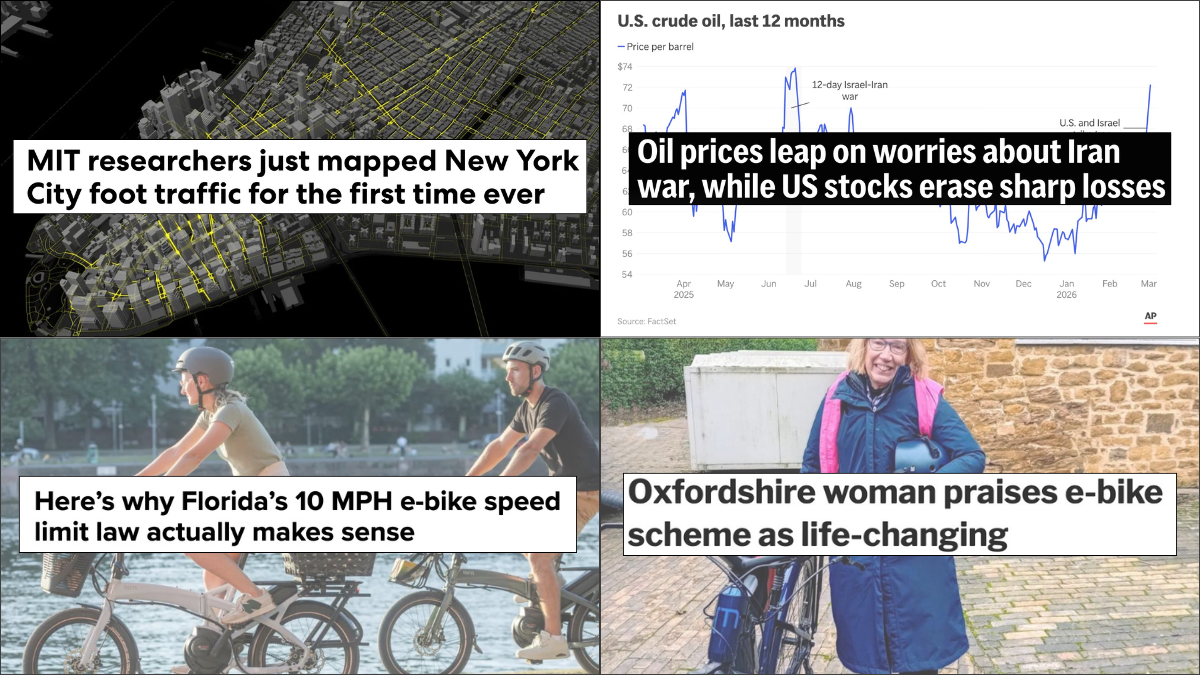
Foot traffic: Very exciting development in counting pedestrians from MIT shows the value of getting counting right and how science can help make cities better. (Fast Company)
Micromobility report: The State of Massachusetts assembled a special commission to study micromobility and their final report is a very thoughtful and thorough document that I hope some Oregon advocates can copy from. (Massachusetts DOT)
Gas prices: Because of the Trump War Against Iran we could be at the precipice of another gas price shock that sends people into bike shops and bus stops. (Associated Press)
Calling names: Noted bicycling superstar Hans “No Way” Rey has an idea for combatting the proliferation of anti e-bike laws sweeping the country: He think we should label anything that’s not a Class 1 (20 mph max, no throttle) as an “e-moped.” (Bicycle Retailer)
Florida, man: Looks like really good e-bike policy from Florida. Seriously. Instead of the boneheaded idea of regulating bike types, a new bill making its way through their statehouse would legislate behavior. Specifically it would create a 10 mph e-bike speed limit on paths and only when passing others. (Electrek)
Transforming lives: A wonderful profile of a 67-year old woman with osteoporosis from the UK who received an e-bike through a government program and credits the vehicle for changing her life for the better. (Oxford Mail)
Thanks to everyone who sent in links this week. The Monday Roundup is a community effort, so please feel free to send us any great stories you come across.

Thanks for reading.
BikePortland has served this community with independent community journalism since 2005. We rely on subscriptions from readers like you to survive. Your financial support is vital in keeping this valuable resource alive and well.
Please subscribe today to strengthen and expand our work.
The notion that raised fuel prices will have any long term impact on American behavior should have been dispelled 50 years ago.
VMT is notoriously inelastic WRT gas price changes.
Short term we’re looking at -0.05 – -0.15 – so going from $3.50 to $4.50 (a 29% increase) would result in 2-4% decrease in VMT.
That’s 240-480 miles per year.
Long term (5 or more years) results in closer to -0.3 – so that change is now 8.7% or 1,000 miles.
But that needs to hold true for a long period.
At the end of the day even democratic presidents won’t let that happen – Barack Obama cleared the way for large scale fracking to avoid it.
With vehicles staying on the road for 12-20 years,you need serious sustained pressure just to bring vehcile size down (as we saw in the late 70’s early 80’s).
Given this inelasticity, and the fact that the US produces >2/34ds of it’s needs yearly (thugh we export some and import crude more suited to some of the refineries here) and there are midterms coming up (so expect policy to work to keep prices from ballooning too high).:
We may see a few extra people at bus stops and in bike shops – but I doubt it will move mode share.
I doubt fully doubt your numbers (though a citation would be handy), but I think it’s worth considering the long term implications of something like gentrification in inner Portland on these dynamics. I’d say that inner Portland residents of today are more likely to be relatively wealthy, and by extension more likely to drive – something that probably has contributed to declining mode share of both cycling and transit.
While richer people are less price sensitive than poor people, if they live in a place where bike/transit is actually good (i.e. inner Portland), it’s entirely reasonable to expect there to be a more noticeable effect in Portland than other places.
It remains to be seen what the actual ramifications of war in Iran are on the price of gas, but I think a national look at elasticity is only so telling. Someone who does not have a reasonable other short term choice will be much less likely to change behavior than someone who does.
Yeah. What will happen is everything will get a little bit more expensive because everything is oil.
What if we made the price $8 a gallon?
It won’t matter as people like to imagine. Gas prices are noticeable, but it’s only a small part of the cost of owning/driving a car.
At $8 a gallon it would become a large part of the cost of driving a car.
“What if we made the price $8 a gallon?”
People would drive less. What if we created a $10,000 annual vehicle registration fee?
Fun to think about, perhaps, but not something that’s going to happen.
I agree.
Other countries charge thousands of dollars for a Certificate of Entitlement to buy a car or have tiered licensing requirements or real and difficult mandatory vehicle operating requirements.
Starting any of that in the US or even in just Oregon would cut down on driving.
We both know the answers and proven results are out there.
As usual, the lack of political will is the problem. People as in the voters and therefore the politicians who create the laws and regulations demonstrably don’t care about solving transportation or climate problems.
A sustained jump to $8/gal could plausibly cut VMT on the order of ~10–30% depending on time horizon, but it would also act like a regressive tax with inflationary freight spillovers, and safety outcomes depend on whether lower congestion increases risky driving the way it did during COVID.
For this particular case I used the numbers derived from the 2008 fuel crisis.
Thank you, Hans! E-bikes should be pedal-assist only. Bicycles don’t have throttles. And, while we’re at it, they should be limited to 25 kph like in Europe. There’s no reason e-bikes should be able to go faster than the average recreational rider, especially on multi-use parkways. And yeah, I know there’s no limiter on a Dodge Charger. That’s an entirely different problem, and not really relevant here.
Does that also apply to bicyclists? You say average, let’s pretend average is 10 mph on a bike, does that mean the carbon fiber crowd will also have to go that slow on MUPs?
By now we all understand that all speed laws aren’t based on the average, it’s based on the 85th percentile speed, plus enforcement…
Nope. It doesn’t even mean e-bikers have to go that slow if they can pedal beyond the motor’s capacity.
Then whats the point of the speed limit? If you are allowed to go over it with just pedal power, how is it more dangerous than going over it with electric power?
I have to wonder whether you ride a drop bar bike, wear lycra, and are darn tooting mad at those VO2 min e-fakers who never had to HTFU.
Actually all of that is wrong, there are plenty of reasons for a throttle on a bike and no reason they shouldn’t go faster. People ride bikes to go places, and some people are lazy. And if they’re supposed to use the road (because it’s dangerous on a pedestrian path), they need to go at least the minimum speed limit. We shouldn’t be telling them they’re not allowed to use the second (or first) most efficient mode of transportation that exists in the history of the planet just because it makes you mad that they aren’t earning it. Seriously, it doesn’t matter that pedaling yourself is “even better and more efficient”. First, that’s debatable, maybe not even true. Second, it’s about 100 times better than what they would use instead of an e-bike if you banned e-bikes that get the job done.
What there is need for is regulation on behavior. It’s the only thing that makes sense. And sure you could have different rules for bikes that go faster. Maybe it even requires a license if it can go over 20mph. I don’t know. But all of that stuff you said was nonsense.
Well, maybe, in a perfect world without companies using the e-bike definition to create products that are not actually bikes and, sadly, that have harmed or killed people. This is a real issue. I would suggest watching Berm Peak’s excellent video on the subject to really understand the issue.
Two things. First, I’m not sure what you mean by “pedestrian path”. Bikes and pedestrians can mix quite safely on multi-use paths. There are a lot of studies on that subject. And if the USA would adopt the striping and intersection rules of other countries on said paths, it could be even safer. Second, its possible to have traffic that goes different speeds. Yes, separation of this traffic is the best scenario, but its doable with good shoulders. (Written by a person in a rural area dodging F-350s.)
Actually that isn’t the issue that is prompting the discussion here (both Hans Reys or Seth’s in the video linked to above). What is prompting the issue is a whole much of e-motos and other e-things that are being sold via Amazon and other locations that take the classification of e-bikes with throttles and using that as a loophole to unleash unregulated electric motorcycles and tricycles upon the world. These are the “e-bikes” that mentioned as a problem when discussing impacts to pedestrians, injuries, and deaths. They aren’t e-bikes per se, but because they are being marketed as such, there is much confusion.
Well, regulating behavior is subjective at best. And it tends to be applied to already disadvantaged groups. As to different rules for bikes that go faster, we already have that with the classification system. And its failed miserably because it creates loopholes. Again, loopholes that companies have exploited to create these e-motos that are the issue.
Thanks for the vid Cyclekrieg. Very helpful. The semantic misunderstanding was a great way to illustrate this problem. Because they are relatively new and as a consequence we use the same word to refer to a wide variety of very different things, we have difficulty distinguishing between salient features.
We use the same word, i.e. “AI”, regardless of whether it is able to navigate and clean a floor, or hack another country’s energy grid and flood the internet with disinformation. We define “e-bikes” colloquially as anything with a battery and two wheels, regardless of its torque/speed/components.
The definition of passenger vehicles has allowed vehicle manufacturers to flood the streets with deadly SUV-like options, defined as “non-passenger vehicles” despite their obvious de facto (and intended) use to carry people.
Just like SUVs these types of electric vehicles exist everywhere because of a legal loophole. Just like the solution to an off-leash dog who has been trained to attack people, is not to categorically ban all pets, the potential solution to unsafe e-bikes is not to ban/regulate all “e-bikes.”
I am curious to what loophole you think SUVs exist. The term Sport Utility Vehicle (SUV) was first used in advertising by Jeep for their 1974 Cherokee. It has always been a marketing term. All SUVs, CUVs, sedans, wages, etc. are classified by the Fed govt. (state too) as class 2 (Passenger Vehicles). Pickups are classified as Class 3 unless they have 6 tires (Dually) then there a Class 5.
While ‘SUV’ is a marketing term, the federal government (EPA/NHTSA) absolutely differentiates between ‘Passenger Cars’ and ‘Light Trucks’ for regulations.
The ‘loophole’ is that many SUVs are classified as Light Trucks because of their ground clearance or AWD. This exempts them from the Gas Guzzler Tax and allows them to meet much lower fuel economy (CAFE) standards than a sedan or wagon. In fact, AMC lobbied specifically for the 1974 Cherokee to be classified as a truck to avoid the stricter safety and emissions rules applied to cars at the time. It’s less about the DMV plate and more about the federal regulatory ‘pass’ they get.
True I forgot about that. For importers of vehicles it was a double edge sword. Light trucks imported into the US are subject to a 25% tax. Known as the chicken tax. The emission loophole was shut down in 2009 by the EPA. What many now call SUVs were built on 1/2 ton truck frames (Suburban 1935, Blazer 1969, Bronco 1966 and Ramcharger 1974). The term SUV really didn’t gain traction until 1983 when the S10 Blazer and the Bronco II were introduced and both Ford and Chevy used them in their ads. SUV manufactures may have benefited from the loophole but the number of has exploded even after 2009.
Jim, the idea that the EPA shut down the loophole in 2009 is a common misconception.
While the 2009 overhaul moved to a ‘footprint’ (size) based system, it didn’t create a single standard. It created two separate curves—one for ‘Passenger Cars’ and one for ‘Light Trucks.’ The loophole isn’t just alive; it’s quantifiable.
Look at the EPA’s own targets for Model Year 2026:
That is a 40% difference in allowable emissions for vehicles that often have the same footprint. This creates a massive financial incentive for a manufacturer to take a hatchback, give it 7.5 inches of ground clearance and AWD, and call it a ‘truck’ to hit that easier 187 g/mi target instead of the 132 g/mi one.
The proof that this is still a problem is in the 2027–2032 Multi-Pollutant Rule finalized just last year. The EPA and NHTSA are specifically trying to bridge this gap now because ‘Light Trucks’ (which include most SUVs) currently account for over 60% of the market, effectively dragging down the national fuel economy average despite the ‘stricter’ 2009 rules.
So, in 2009 when the footprint concept was conceived it was supposed to be a sliding scale based on footprint, which is defined by Wheelbase and Track Width. If it had been implemented that way most SUVs (except 1/2-ton truck based) would have stricter emissions. But because of lobbying from the manufacturers, it was watered down to two classes as you stated. At the time there was a lot of talk that manufacturers would stop producing regular cab pickups because the emissions would be stricter than a crew cab with the same powertrain. Among the Subaru Performance crowd, it was felt that the STI would stop being produced. It’s basically an Impreza with a 305-horsepower motor that only gets 22 MPG. The stricter emissions that you wrote about were proposed by the Biden administration in 2023. Of course, last year the Trump administration tossed those out.
Very well said! Thanks. I would add that I don’t think any is proposing a ban on e-mopeds- they could still use the road/greenways- just not bike lanes and MUP’s
“What is prompting the issue is a whole much of e-motos and other e-things that are being sold via Amazon and other locations that take the classification of e-bikes with throttles and using that as a loophole to unleash unregulated electric motorcycles and tricycles upon the world. These are the “e-bikes” that mentioned as a problem when discussing impacts to pedestrians, injuries, and deaths. They aren’t e-bikes per se, but because they are being marketed as such, there is much confusion.”
I want to point out that there is not an actual loophole. These e-motos like Sur-rons, Alta’s, Zeros etc. have clear regulations they have to meet to either be e-bikes (which they fail) or street legal (some fail) or they can be off-road motorcycles just like dirt-bikes. The fact that they are called e-bikes sometimes doesn’t mater, just like not all motorcycles meet regulations allowing them to be ridden on the road not all e-bikes or e-motos meet those regulations. That doesn’t mean it’s a loophole.
The regulations are confusing though because they regulate invisible things like watts and software speed limit settings. That’s one reason why enforcement is very hard and why I think ultimately trying to have enforcement based on these invisible or hard to see things (even throttles are small) is a loosing battle and we should enforce behavior.
I’m confused as to why all the existing motorcycle and moped laws don’t apply to electric motor powered 2-wheeled vehicles now. Thy are bikes with engines just like their combustion driven brothers and sisters. We don’t have different lane use or driving laws for cars and trucks just because they have electric motors, why should it be different for bikes? The whole problem seems to be that when an electric motor was strapped to a bike it got called and e-bike instead of e-moped or e-motorcycle. Maybe you can’t answer these personally but it seems the “duh” moment elephant in the room here.
Maybe I can help you with how we got here, I’ve had e-bikes for a long time now. They look very similar to bicycles, sometimes indistinguishable, this then allowed them to be ridden where bicycles were ridden, as the popularity rose their was a push to regulate them so the class 1, 2 and 3 structure came about.
They often look much much more like bicycles, than mopeds so they were called e-bikes before there was any regulation around the term.
Example of one that looks nearly like a normal bicycle – https://lunacycle.com/luna-fixed-stealth-ebike/
“regulations are confusing though because they regulate invisible things like watts and software speed limit settings”
This is a legitimate problem.
Unfortunately we all know that even on transportation systems that pose a far more significant risk of injury, where (almost) every vehicle has a visible number tied to an individual, enforcement of basic rules is an insurmountable challenge.
If we don’t enforce capabilities and we can’t enforce behavior, we will end up enforcing nothing. That strikes me as by far the most likely outcome.
“there are plenty of reasons for a throttle on a bike and no reason they shouldn’t go faster”
I agree. There is definitely a use case for electric motorcycles.
Call it whatever you want, despite the constant naming debate, it doesn’t matter.
I maybe thought the OP was suggesting we just shouldn’t allow any of these modes of transport. Maybe he was just saying they shouldn’t be allowed in “bicycle places”. I would still disagree, because the behavior is the problem, not capability. We don’t allow cars and motorcycles on bike lanes because you can’t throttle down their mass and size. But an e-bike is the same (enough) mass and size as a pedal bike, so you CAN make it exactly equivalent to a pedal bike by just slowing down.
I also think 10mph is a laughable limit. At least 15, but I think 20 is fine.
We have a naming debate specifically because it does matter. Class 1 e-bikes seem pretty benign to me, but anything with a throttle or capable of propelling you close to 30mph uphill with only a token effort is simply not a bicycle.
Bicycles are not motorized by my definition.
But don’t worry — I know I’ve lost the argument, and I’m resigned to sharing MUPs with motorized vehicles, in whatever form they take.
25 kph (~15 mph) is far too slow to be safe on roads with cars going 40 mph like the road my house is on which does not have a bike lane.
The greater the speed difference with car traffic the more the bicyclist is in danger when having to mix.
In the city, most people live on streets with a 20 mph speed limit, or, if they live on a street or they higher one, they are not riding in traffic.
There are very few places I can’t access with my human powered bike, which rarely exceeds 15 mph.
Your situation may be different, but it is a very narrow niche.
Maybe I have bad luck but for the last 20+ years moving several times I’ve lived places and commuted places that required riding on 35 or 45 mph roads with no bicycle lanes. I’m in unincorporated area but it’s part of the metro area.
I’m stuck either riding a motorcycle and being forced to mix with deadly cars and SUVs all the time. Or I have to risk the huge speed difference when having to bicycle on these roads. It’s a silly ridiculous situation to have laws that force more dangerous situations.
If the goal is truly safety, the focus should remain on the vehicles that cause the most harm. According to data synthesized from the GHSA, NHTSA (2025 estimates), and the NYC DOT, passenger sedans account for 55–65 pedestrian fatalities per billion miles, while e-bikes account for only 0.8–1.6.
“the focus should remain on the vehicles that cause the most harm”
We can do many things at one time. Absolutely nobody is proposing less traffic enforcement on streets in order to increase enforcement on bike paths.
Isn’t where enforcement happens a trade off since we have limited resources?
Yes.
And since absolutely nobody is proposing less traffic enforcement on streets in order to increase enforcement on bike paths, your proposal to enforce bad behavior on bike trails means no enforcement at all.
Whats the difference between a person with pedal assist going 25kph and a person with a throttle going 25kph. I’m dying for someone to explain to me how even though the speeds are equal, one is somehow more dangerous.
Then explain to me how someone on a pedal going 30 kph is safer.
I’m getting the feeling that most of you haven’t read Hans Rey’s proposal or the reasoning behind it. He’s not against e-bikes; in fact, he’s a major promoter. His very real concern is over currently proposed legislation which would severely limit e-bike access and use, and I agree.
The three-tiered e-bike regulatory structure opened the door to unscrupulous players by broadly defining vehicles as bicycles even when they have some distinctly non-bicycle characteristics. Throttles are the most obvious example. There are e-bikes with nominal cranks, never intended for pedaling, and controllers that can easily be modified to exceed Class 2 parameters. Taking away the throttle would eliminate this subterfuge.
Rey didn’t propose banning these machines. He’d simply reclassify them as e-mopeds. I couldn’t agree more that these types of vehicles have a place in the transportation system. I’d love to see more of them taking space from cars. They’re just not bicycles. Reclaiming the definition of bicycle would reframe the discussion to acknowledge the existence of small, nimble machines which aren’t bicycles, but aren’t really motorcycles, either.
I read Hans Rey’s open letter, and while I understand the desire to protect trail access, I find the push to restrict the common noun “e-bike” to be both impractical and—as seen in Oregon’s HB 4007—dangerously Orwellian.
Attempts to match a common noun to shifting, technical regulations will always fail the “eye test.” Take a bike like the Luna Fixed Stealth; to the average citizen, law enforcement officer, or trail user, this is a bicycle. Trying to legislate what we call it based on internal motor wattage or software-locked speed tiers is a fool’s errand.
My concern with the “imposter vehicle” framework (championed by Rey and Oregon legislators alike) is that it criminalizes common vernacular. This creates three major problems:
The public will continue to call high-power electric cycles “e-bikes.” Forcing a disconnect between common language and legal advertising will only confuse consumers and complicate the used market.
Instead of policing the dictionary, we should focus on mandatory classification disclosures and behavioral enforcement (speed and etiquette). Behavior is objective and reduces the risk of biased policing; etymology is subjective and unenforceable.
Which governmental entity issued a title (certificate of ownership) for your 2016 Juiced CrossCurrent?
Santa Monica did.
Barrett, thanks for all the ebike info. Very helpful. I thought most states already have mandatory classification disclosures. What am I missing? Should C1 be more easily identifiable? Legally ebikes can have <1k watts in OR. My uninformed self says that might be high, particularly for low mass bikes. Speed is a little easier to enforce with a governor at 20mph, but acceleration with electric motors can be problematic with higher torque. Cyclekrieg proposed 750w. What’s your stance?
I just want to know why going 20mph using a throttle is more dangerous than going 20mph while using pedal assist?
How many ebike riders are actually changing the propgramming of the controller to allow even faster speeds?
Why should this tiny subset of riders take away throttles from everyone? Some days I ride over 30 miles. When I get that far, Im glad I can just use the throttle to finish my day up and not use my legs at all. Sometimes its great to use my throttle to get across a busy street. Throttles are great. They are not the problem.
It makes no difference to anybody physically (your ego aside) whether they have a throttle or not. Or if they even have pedals! Makes no difference to anyone’s safety.
A speed limit that applies to all riders of any vehicle makes sense on bike paths. That’s fine, although 10mph is a joke. We shouldn’t punish people who get around with an e-bike just because they use a motor to make themselves go. If you’re not held to the 10mph limit for a pedal bike, it doesn’t make sense for e-bikes.
I like the proposal to call class 1 e-bikes and allow them on bike paths, bike lanes, etc. Everything gets called an e-moped and is allowed on streets, greenways but not bike/ped spaces. I think registration is dumb, but maybe we could require a sticker for e-bikes (that just says Certified E-Bike or something) to be able to use bike-specific facilities
Any attempt to enforce your proposed regulation is doomed to fail. Class 3 ebikes look just like class 1 ebikes and many class 1 ebikes can be easily converted to class 3. If anything, the patina of “technical” but unenforced illegality is likely to make the “moto” type of e-bike even more desirable. Portland is just going to have to get used to people zipping about on e-bikes whether it likes it or not.
Exactly. There is probably no effective means of enforcement for behavior on bike trails or MUPs. If waving a machete around isn’t enough to trigger a response, riding too fast won’t be either.
We got used to SUVs killing people, maybe we can get used to the much much safer high power e-bikes zipping around and all be better for it.
According to data synthesized from the GHSA, NHTSA (2025 estimates), and the NYC DOT, passenger sedans account for 55–65 pedestrian fatalities per billion miles, while e-bikes (including sur-rons) account for only 0.8–1.6.
When a 14-year-old gets hurt on an e-bike, it’s a “regulatory failure” that needs a new ban. When an SUV with a 4-foot-high blind spot “fronts over” a child, it’s often called a “tragic accident” or a “blind spot issue”—language that protects the manufacturer from the same level of outrage
Barrett, you are making very insightful and informative posts- thank you! I welcome all of these e-vehicles and I think would make our streets safer, but I do not think they all belong on multi-use paths or in bike lanes. Do you agree that we need some restrictions? Do you have any ideas for behavioral enforcement that you think would be effective?
Mixing with 35–45 mph traffic is inherently lethal. Forcing e-bikes onto those roads is asking people to gamble with their lives.
Safety from cars is the #1 cited reason in transportation studies (like those from NITC) for why people won’t switch from cars to bikes. If we want fewer SUVs on the road, we have to provide paths where people feel—and actually are—safe.
While more e-bikes on multi-use paths (MUPs) does increase interaction, we have to look at the ‘net’ danger. A collision between two 200 lb bike/rider units at 15 mph is a scrape; a collision with a 4,000 lb SUV at 40 mph is a fatality.
Regarding enforcement: I lived in Santa Monica in the 2010s where they regularly ticketed for exceeding a 15 mph speed limit on paths—regardless of the vehicle. If we focus on enforcing safe behavior rather than banning the technology, we get the best of both worlds: safer paths and fewer cars on our streets.
In the long term reclaiming the roads from the automobile & auto lobby that took our roads and convinced us they were just for cars would be ideal in my opinion but we need a critical mass of light weight vehicles first.
Santa Monica has 2x the number of officers per resident than Portland does. They can do things we can’t.
What I like about Hans’ proposal is that is defines an e-bike so it can fit into existing infrastructure. All the other things get classified as mopeds. The missing piece, IMO, is developing rules about mopeds. We should get rid of speed limits over 30 mph in the City and explicitly allow mopeds on all lanes except bike lanes. This creates a safer transportation system for everyone.
Florida, man.
While Oregon’s Democratic supermajority keeps fumbling education outcomes, economic growth, direct democracy and now e-bike policy — Florida is advancing something refreshingly sane.
Instead of banning bike types or obsessing over classifications, a Florida bill (via Electrek) would simply set a 10 mph speed limit on shared paths when passing. Regulate behavior. Not hardware.
It may be hard to admit, but right now Florida looks more functional and pragmatic than Oregon.
That should concern anyone who cares about good governance or living in a well functioning thriving state.
I don’t think you’ve ever biked in Florida.
The “regulate behavior, not hardware” appears to be a e-moto talking point. An astroturf talking point in other words.
Question: how would you regulate 10mph passing speed? What distance would that apply to, both before, at, and after the pass? How would a pedestrian know they were passed at a speed less than or greater than 10mph? Would law enforcement have to hide in the bushes with a radar gun to monitor this? The point in asking these questions is to show how subjective and impossible to actually regulate that would be.
You know what would be simpler: say e-bikes can not have a throttle, can only be 750 watts peak power, and can only turn on/off the motor via pedaling.
Yes law enforcement is needed to enforce any of these laws, but isn’t it a lot more reasonable to expect law enforcement to enforce based on observable behavior, speed, recklessness etc. rather than invisible device software settings like watts?
How are they going to spot peak watts?
They wouldn’t have spot peak watts. A device not fitting the narrow definition would be banned or would have to meet more stringent sales requirements. And guess what? In the 2026 Youth e-Bike Report, MN DOT makes this (more stringent sales requirements) suggestion as part of Strategy #2.
This just isn’t about teenagers buzzing past Grandma on a multi-use path. It’s about people riding e-motos where they don’t belong or buying them for kids who can’t legally operate them. That’s happening because the current class system lets non-e-bikes slip through a wording loophole. And yes, it’s a loophole; without the throttle allowance, many of these machines wouldn’t qualify as e-bikes at all.
BTW, the “behavior, not regulation” talking point is actually more invasive than clear hardware standards or sales rules. Law enforcement already struggles with bias and overreach, and giving them a “reason” to harass people is recipe for more bias and overreach. Guess what, Officer Bubba McKlan is going to love another tool that allows him to nightstick some poor kid because he popped a wheelie while have a skin tone other than eggshell.
New Jersey’s new law is misguided. But it’s also a predictable response to e-moto (and some e-bike) advocates unwillingness to allow some logical boundaries.
Just an FYI here. I’m doing a master plan for an urban MTB trail system and the #1 issue is e-motos. So much so, it might get all e-MTBs banned from that park. So this “behavior, not regulation” astroturffed talking point and unwillingness to admit there is a problem is having real consequences for a bunch law abiding citizens who might actually need e-bikes due to age, injuries, or diminishments.
That doesn’t sound like a functional law that will lead to any changes in behavior. I guess it might provide a more legitimate basis for a lawsuit if someone was to be injured by a reckless person on an ebike or emoto. But I doubt it’s going to get people to slow down. Also, does the law apply to bike lanes, or is it specific to multi use paths?
How would this work n practice? Here’s an example rom Friday night: I am biking home over the Broadway bridge- these are narrow 7′- ish sidewalks for bikes/peds. I am riding uphill at maybe 13-16 mph. I am overtaken by a very large e-bike- a fat tire bike with panniers, and front bags- they whiz by me, no pedaling, maybe 20-25 mph? On the downhill side I pick up speed and I’m going maybe 16-18 mph when I encounter a little scooter coming at me. It is gas powered, but very quiet and honestly smaller than the e-bike and moving slowly, probably 10 mph or slower. So who is wrong? I was going faster than 10 mph- should I have slowed when passed the scooter? Should the scooter have been on the sidewalk at all? It is gas powered but it was the only going slow. How would the e-bike pass me at mph if I am going faster than that? They could easily go 20mph and it could be frustrating to be stuck behind me on an uphill going 13 mph.
MaxD, the interesting thing about the Florida bill is that it actually answers your ‘who is wrong’ question by being very narrow. It doesn’t set a blanket speed limit for the bridge; it creates a situational 10 mph bubble around pedestrians.
Under that law:
The catch for the e-bike: If that same e-bike whizzed by a pedestrian at 25 mph, they’d be looking at a non-moving traffic violation.
It’s a ‘regulate behavior, not hardware’ approach—basically saying you can have a fast bike, you just can’t use that speed when you’re within 50 feet of someone on foot.
thanks for the reply!
We really need updated language around power levels of ebikes. 750w is plenty… for an average human on an average bike on average terrain. It is woefully inadequate for hauling heavy cargo or steep hills or any combination of both. Also, having a throttle on cargo bikes is essential for safe starts as the motor power kicks in. We seem to have an anti-throttle lobby that seems to think being able to start your ride with a throttle should be illegal for reasons passing understanding.
Can we write up a class C(argo) ebike definition? In experience, I’ve found 1000w to be my floor, and 1500+ makes it much more useful.
I am aware that the 750w rating can be similar to rated vs max power on speakers, but the language isn’t written that way, and one day they will come for our cargo motors that can actually climb hills.
750 watts can move a freight train with the right gearing, I have no idea how much weight and how steep a hill you’d have to be in for that to not be plenty to start up a hill in the lowest gear.
Maybe it helps when the cargo bike is designed to be comfortable to pedal because they’ll be built with sane gear ratios.
That said, I don’t really care how powerful the motor is so long as the behavior is what gets regulated.
On the other hand, there has to be some limit for what you’re allowed to haul on a bike path with a powerful motor. A big cargo bike with a big rider, a long trailer stacked with cargo, can easily weigh more than a large motorcycle, and if it’s flat you can probably move it 20mph with a 1000w motor. And your brakes probably can’t stop it very fast. That is legitimately dangerous on a bike path. But it’s also probably really rare. I don’t feel comfortable going fast with a heavy load.
Just caught wind of this article on a website called ‘electrek’
Keeping the speed to just 10mph is going to be a tough lift after these little beauties hit the MUPs
http://electrek.co/2026/03/02/the-new-low-cost-40-mph-e-moped-that-teens-will-love-and-hoas-will-hate/
“The new low-cost 40 MPH e-moped that teens will love and HOAs will hate”
With a $1399 starting price, these are going to be popular, and they look like some of the other e-bikes that are already out there.
And the most notable cycling related news in Portland is vulnerable low income residents are pushing back against bike lanes in Goose Hollow.
https://www.koin.com/video/sw-portland-apartment-tenants-claim-new-bike-lane-project-would-limit-parking/11574262/
Jonathan this would make a good story….why are poor Portlanders against bike lanes?
Huh? Nice try Angus. That story isn’t about “poor Portlanders.” It’s about people who believe they have a right to park their private property on public streets and that their needs are more important than others.
Hey Jonathan, I reckon you might’ve missed that the people raising concerns here are actually low-income Portlanders, who live in affordable housing. It’s not just about parking; it’s about how these changes affect those who might not feel included in the bike lane conversation. Having only wealthy, college-educated, white folks pushing for bike lanes doesn’t exactly feel inclusive. This is an issue Bike Portland should really be exploring. It’s a shame that you’re shutting it down so quickly—especially when it feels like it’s more about not liking the messenger than the issue itself. These communities deserve to have a voice in the conversation, just as much as anyone else. You should work on bringing them into the fold instead of rejecting them.
Oh yeah the article says it’s a low income building. But yeah Angus, I’m not about play into your bait here. You’re misrepresenting the issue and my response to it. So I’ll just leave it at that for now.
“you might’ve missed that the people raising concerns here are actually low-income”
This is not really important. Though many bike advocates want to bolster their political positions by representing themselves as fighting for the “little guy”, in truth, most people of any income level don’t ride, don’t want to ride, and will never ride.
Yes, most low income folks want a place to park their car if their apartments don’t provide one, and being low income, they have fewer alternatives than people with more resources.
And when the city takes away their parking after telling their landlord they don’t need to provide any, of course they get testy.
Poor folks mostly want less hassle in their lives, just like the rest of us.
And that’s just fine.
Middle east conflict raises oil prices, Permian increases production, prices stabilize, most people aren’t taking the bus still.
And in Portland transportation news….500K of taxpayer money down the tubes. Wow!
It’s tough to have nice things here…..although good to see a conviction.
“Portland man who shot $500K worth of traffic cameras sentenced”
https://www.koin.com/local/multnomah-county/portland-man-who-shot-500k-worth-of-traffic-cameras-sentenced/