

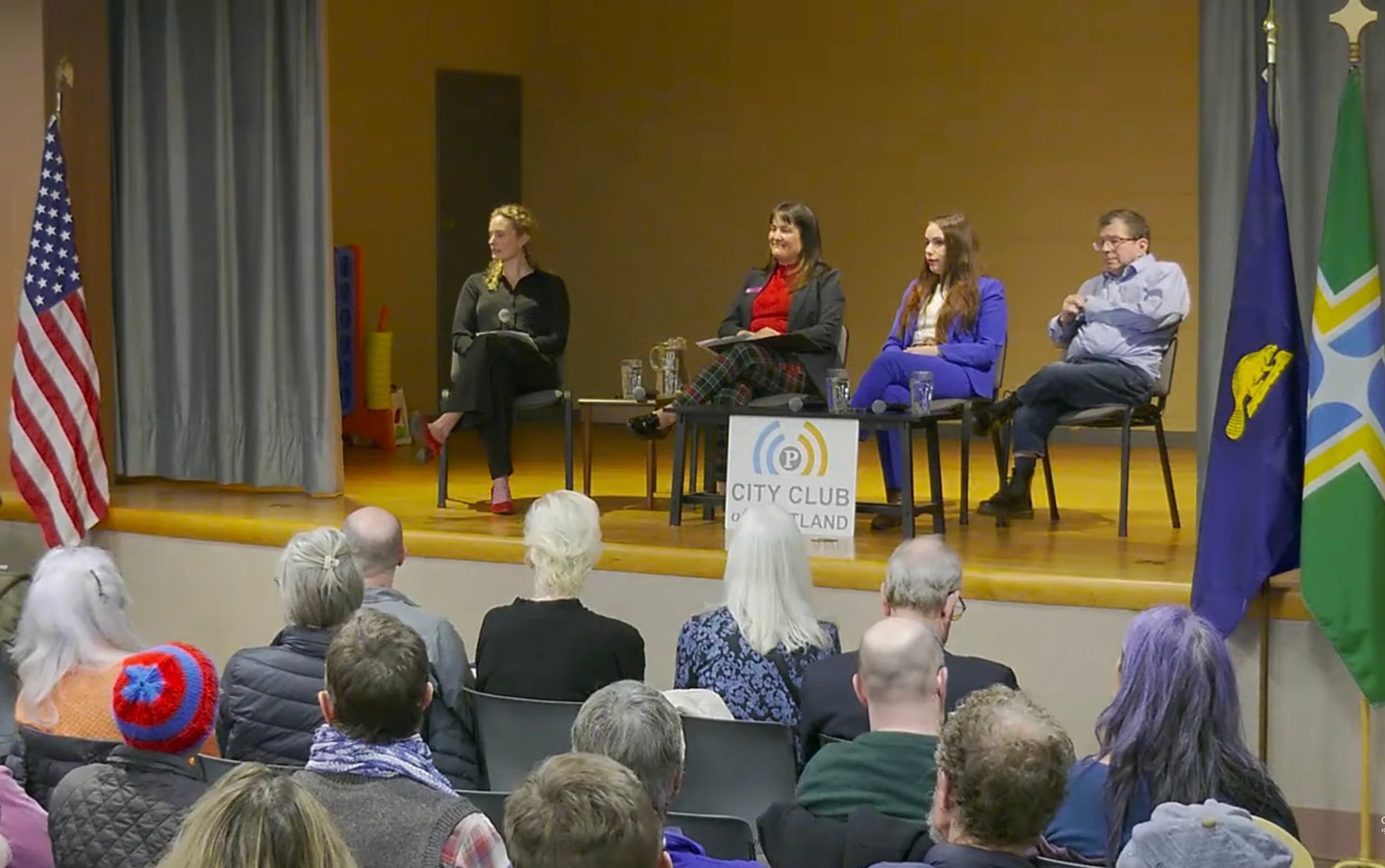
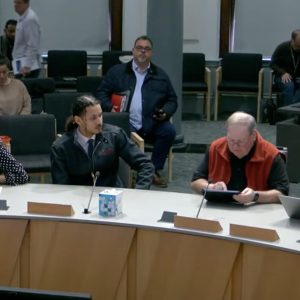
The topic of transportation got a lot of attention at a forum of city council members in District 3 Wednesday night. At an event hosted by Portland City Club at St. Philip Neri Catholic Church, moderator Sophie Peel (a reporter at Willamette Week) asked councilors Tiffany Koyama Lane, Angelita Morillo and Steve Novick what they felt was a unique challenge facing the district.
Morillo and Koyama Lane both brought responded with transportation.
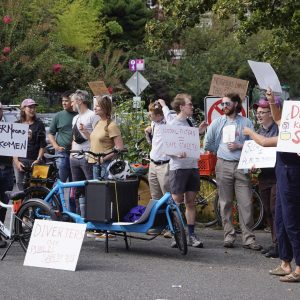
“We have some of our most beautiful parks and pedestrian areas,” Morillo said. “And at the same time, we have pretty high traffic fatalities on multiple corridors.” Morillo mentioned 82nd, Cesar E Chavez Blvd, and Sandy as examples of dangerous corridors in District 3.
Morillo also offered what she thinks would help make streets safer. “We are going to have to find creative ways to address how we harden our safety barriers in the street to protect pedestrians and bicyclists,” she said. “Because if we don’t do that, the alternative is that we lose our community members and we continue to fund car infrastructure without making sure that people feel safe to find other alternatives.”
Koyama Lane said she hears District 3 come up a lot when talking to cycling advocates, “Because so many people go through District 3 to get to the other districts. So I think it is something that that is huge in D3.”
Both Koyama Land and Morillo mentioned personal stories about how traffic violence impacted them or someone they know.
“There are more and more stories,” Koyama Lane said. “This is going to be something that is kind of systemic, so it’s changing systems, and it’s going to take a long time, but it’s absolutely worth it.”
The councilors also shared their views on the Portland Bureau of Transportation’s nascent new funding effort. Novick said he’s hoping any new revenue mechanism raises at least $45-50 million a year (the annual cost to keep up with paving major arterials), and Morillo expressed reluctant support for some sort of new fees. She also offered what she framed as a “creative” idea — to simply stop maintaining some streets and transition them into carfree community spaces. That’s an idea her colleague, Councilor Mitch Green, proposed a year ago.
It was good to hear politicians talk about transportation, road safety, and bicycling. It used to be much more common for these topics to come up at events like this. Perhaps this is another sign that Portland is poised to start leading on transportation reform once again. We certainly seem to have the right political environment for it.
I’ll be watching to see if the next three district councilor forums planned in the coming weeks give transportation this much attention. The next event in this City Club series is February 17 in District 4. Check out their website for more information.
Thanks for reading.
BikePortland has served this community with independent community journalism since 2005. We rely on subscriptions from readers like you to survive. Your financial support is vital in keeping this valuable resource alive and well.
Please subscribe today to strengthen and expand our work.
> to simply stop maintaining some streets and transition them into carfree community spaces.
more creativity like this please, councilors!
But would they be good for cycling? We’ll see ruts, gravel, potholes, etc. Bikes benefit from the same smooth surfaces as cars and trucks do.
And how is all that damage happening after you remove all those heavy vehicles?
Let’s stop funding all these homeless services also since we’ll have all these new community spaces available.
Any reasonable model for doing this that creates durable public spaces still probably requires more upfront investment than just repaving streets. In the long run, yes, it would be cheaper, but the upfront investment is the hard sell politically when so many of our streets are in such dire condition.
It’s good to hear transportation safety getting attention again, but let’s be real about what usually follows: calls for higher taxes and new fees. Portland already has one of the highest local tax burdens in the country. People are tapped out.
Before asking residents for more money, City Hall needs to prove it can stop wasting the money it already has. The city routinely burns time and political capital on symbolic distractions (like debating foie gras bans) while basic services and street safety lag.
And just this week, the city “found” $106 million that somehow wasn’t being used. That alone should pause any talk of new transportation taxes.
Credibility also matters. Councilor Koyama Lane personally approved an unusual arrangement allowing her chief of staff to collect two near–full-time public salaries (plus a pension). Even if legal, it feeds the perception that there’s one standard inside City Hall and another for everyone else.
If councilors want buy-in for real transportation reform, the answer isn’t more taxes, it’s better priorities, transparency, and serious discipline with existing funds.
https://www.oregonlive.com/politics/2026/02/portland-political-aide-worked-2-government-jobs-for-2-near-full-time-salaries.html
https://www.oregonlive.com/politics/2026/02/portlands-pile-of-unspent-housing-dollars-surges-to-106m-city-administrator-says.html
José, are you an AI bot? You always have the same schtick about “no new taxes.” You raise some good points but they sound like ChatGPT and they don’t address any of the points in JM’s article.
More of our fellow citizens should be “no new taxes”. Doesn’t take an AI to see that we are overburdened.
The City Council is already looking to add more taxes to make living in Portland harder for those on the edge of houselessness, so it seems right on topic.
Do you have a good I analysis that shows Portland is more burdened than other places that comes from an independent analysis team? Meaning not a anti-tax nonthink tank. Been trying to understand this issue and never seen a good analysis that is convincing.
I think a good first step to answering your question is to posit a precise definition of burden. The data needed to evaluate any reasonable formula likely exist and are accessible. (My anecdotal subjective feeling is that taxes are medium-high here compared to other cities in the region.)
Just seems like something that soany people take as fact, Portland/Multnomah has the highest taxes, would have a ton of econometric data to easily point to but I can’t find much analysis other than from partisan sources.
I agree that people erroneously take it as fact that we are overtaxed in Portland. I’m arguing is that “Does Portland/Multnomah have the highest taxes?” is a questions that can reasonably be answered in the affirmative or negative. This is so because it is not a precise question. Conservative commentators have been really effective at using this ambiguity to paint the picture that Portland in unlivable and very highly taxed. My instinctual response it to support more taxes. I moved here several years ago from a ‘low tax’ area. My subjective experience is that the taxes are a little higher here, but not ridiculously so. The biggest differences are in state policy, I think (e.g. WA has no state income tax). But that experience depends on how one interacts with the tax system (type of employment, property ownership, etc., etc.).
“Overtaxed” can only be evaluated in the context of what we get in return.
Do you feel you are getting good value for your taxes?
“Do you feel you are getting good value for your taxes?”
Yes, but the relevant question is “Are we getting good value for our taxes.”
Agreed.
I see education as important metric and how we’re doing as a society. Oregon has achieved the distinction of worst outcomes in the country, despite spending more than many other states.
There are numerous other examples I could cite, but I’m curious what we are achieving that makes you feel you’re getting good value for your money (or that we are getting good value for ours).
When I visit other places I find many visible markers of success, including streets in better condition and fewer people sleeping on the street.
Hi 2WheelsGood,
I think this is an area where we more or less agree about the facts but hold divergent subjective (metaphysical) views. I like Oregon and, particularly, Portland, and I enjoy living here. Doing so entails paying more taxes than some other places. I enjoy living here a lot more than those other places, and the taxes are only a bit higher, so I think I “get good value” from them.
I find your question, though, to be a poor framework for thinking about taxes and society. It’s not like I’m purchasing government services with my taxes. Taxation is a collective action through which we fund the common good and keep our society functioning. I don’t think the value of a functional society can easily be quantified. Rich folks are going to pay more taxes than poor folks.They likely do not receive proportionally more services, but I don’t think that’s a problem. I think it’s a functioning society.
Agreed, and it was a bargain I accepted and continue to accept.
I see taxes, in and of themselves, as a bad thing. Ideally, we wouldn’t have any, but, of course, they are what enables us to do other things that range from necessary (education, police) to nice (parks). There is an inherent tradeoff between paying more taxes and getting more services/amenities in return.
This is equivalent to your statement about taxation being collective action to fund the common good. I think that when we pay more taxes we should get more good (even if we’re paying for things we don’t directly benefit from, or paying more because we have more).
The taxes themselves don’t generate the public good — they need to be transformed by effective and functional government. The problem is that in Portland, we pay more but aren’t enjoying the commensurate level of public good that an effective and functional government should be providing.
You say that’s not important, but I disagree. If people fundamentally agree with my viewpoint (which I think they do), it will become harder to raise more funding for the things we want to do, because people don’t want to pay more just to see their money squandered. Alternatively, with a more effective government, we could provide more public good without raising taxes on anyone.
I think I understand you position (I would describe it as a standard libertarian one), but maybe I’m missing something. I disagree with this framing as I said above. I’m not sure our disagreement is very consequential, however, because I think our opposed positions lead to pretty similar desired policies. I agree that there is a huge problem at local, state, and federal levels, of government policy being very ineffective. I would like to see the government become more effective. Locally, it seems like key city departments are incredibly sclerotic, slow, and uncommunicative. I have yet to comment on this story in which Jonathan reports on an acrimonious exchange between a PBOT staffer and a Councilmember (Zimmerman). The comments below the article and the original exchange brim with frustration about the perceived inflexibility and large budget surrounding some upgrades to MLK. I have had similar emotions when watching PBOT staff testify/present to the Bicycle Advisory Committee. I don’t have any personal animus towards the staff, but they do not give off an air of professionalism. Same goes even more for Parks and Rec. I just get the feeling that the city struggles to deliver basic services, and I would really like them to do better. Even though I don’t have an ideological anti-tax axe to grind.
I don’t think you need to be a libertarian to see no inherent value in taxation. It is a negative means to a (hopefully) positive end. I don’t know anyone (with a possible exception of some on this forum) who thinks taxation is good in itself, except perhaps as a deterrent for certain antisocial behaviors such as smoking.
If I’m a libertarian, I’m a tax and spend libertarian who wants good government, enforcement of drug laws, limits on guns, and a large social safety net.
I think our point of disagreement, if we have one, is in whether the quality of services we collectively receive can be used to help determine whether or not our collective tax bill is too high.
Well said. Over the years I’ve opposed many PBOT transportation proposals. The SW Corridor MAX extension to Tigard was in every way extremely bad engineering. Worst of all, it would put the public in harm’s way. The Rose Quarter I-5 so-called “Improvement” is similarly bad engineering. The Columbia River I-5 Bridge replacement is once again floating in the toilet soon to be flushed away.
Closer to concerns about bicycling, the plan for the Federal Post office – The Green Loop – includes a massive elevated ped/bikeway about 3 blocks with a lengthy circular ramp that leads to the 3-way stoplight where the Lovejoy and Broadway ramps meet on the bridge. This stoplight is extremely dangerous, but our dimwit planners oooh & aaah over this plan with callous disregard for public safety. The simplest safest ramp eastbound is in the Amtrak parking lot from Johnson to Irving close to the Broadway ramp. Maybe 10 parking spaces are lost. Big deal. Westbound, an elevator could be located on the north side of this 3-way stoplight.
The Green Loop through the North and South Park Blocks is plainly objectionable engineering. Sidewalk and adjacent bike path on the park blocks will fell I’ll guess 100 trees. My suggestion is to remove all parking on the eastside adjacent to the parks and create a 2-direction bikeway.
Simple, safe, relatively inexpensive, but NoOOooo; Handpicked sycophant smart alec city planners are blind to their own rank incompetence.
Too often I use more words than necessary. Simply saying “The Green Loop is poorly designed through the Park Blocks” should’ve been enough, but doesn’t say enough. To direct peds & cyclists to an extremely hazardous 3-way stoplight is beyond despicable; it’s criminal. The impact of a massive circular overhead bikeway leading to that ‘deadly’ intersection alongside removing hundreds of trees in the Park Blocks is a disservice to park lovers. Portland city planners are acting with political vengeance in mind. In short, I’ve long concluded ALL major metropolitan cities in the USA are run by republican business interests. These leaders are selling Portland out to the highest bidders. Cost of living will continue to rise. Next to nothing is their plan to address the homelessness crisis.
José isn’t wrong, though. We waste a lot of money through mismanagement and can’t even seem to track where the money is.
Fred, I’m not a bot, just someone who’s been paying attention to City Hall for a long time. Disagreeing is fine, but dismissing concerns as “AI-like” sidesteps the substance.
My point is that in Portland, transportation conversations almost always end the same way: calls for new taxes or fees, as if raising revenue is the only tool available. That mindset ignores mismanagement, unspent funds, and poor prioritization, and it feeds the broader Portland doom loop where higher costs drive people and businesses away, shrinking the base and prompting calls for even more taxes.
If city leaders want real buy-in for safer streets, they need to show discipline with existing resources and rebuild trust first. Otherwise, even good transportation ideas are going to keep running into the same wall.
I’ve noticed that even when people do agree that City Hall needs to step up their game, it’s always something for after they get the next tax increase, not something that needs to happen as a prerequisite for more money.
I think higher taxes and new fees on Portland’s richest people and corporations are a great idea, and it’s the new councilors that are bringing the better priorities, transparency, and serious discipline with existing funds of which you speak to city hall. Anyway, Morillo and Green’s great ideas for ending the maintenance of certain roads and making them car-free will cost less money while improving public safety.
Banning cars from a bunch of streets is really the least expensive, most effective way to improve safety and cycling in Portland.
And of course, those corporations and “rich” business owners are just going to absorb those taxes and not raise their prices instead. Nah never would happen in our social paradise in Portland.
Psst, little secret, excessive taxes and fees are part of what’s hurting this town.
You are correct. Businesses are fleeing MultCo (esp downtown Portland) so their execs don’t have to pay the preschool tax, which is many thousands of dollars at the salaries they earn. Surrounding counties are the beneficiaries.
In the meantime people like Mitch Green insist we can tax the rich with no penalty, but it’s just not true.
Below, there’s a link to where Mitch Green addresses your claim with statistics; perhaps you have statistics supporting your counterclaim?
“Councilor Mitch Green’s Office Debunks Myths on Tax Migration, Defends Preschool for All Program”
https://www.portland.gov/council/districts/4/mitch-green/news/2025/6/21/councilor-mitch-greens-office-debunks-myths-tax
Key Findings of the Report:
Dusty, thanks for finding this info and providing the link. Undoubtedly, it will be dismissed by the folks have invested too much of their hard-earned feelings into this fanciful flight narrative.
Is having a rich, tax-avoiding prick move to your county a benefit? Honest question — I can argue it either way.
Corporations compete in markets so don’t just automatically raise their prices when taxes increase. Are you saying, like, Big Macs are 1% more expensive now due to Preschool for All?
Anyway, we should be buying only from local businesses; out-of-town corporations just vacuum Portlander’s money away to corporate owners. Goodbye, and good riddance to these capitalist leeches.
What’s hurting Portland is the same thing hurting the rest of U.S. cities and the globe: capital’s ceaseless, narrow drive for profits.
“Anyway, we should be buying only from local businesses; out-of-town corporations just vacuum Portlander’s money away to corporate owners.“
I’m very curious what you consider a local business. As much as I love Portland, we don’t really produce any products or groceries or clothes or hobby material or affordable bicycles or generate any electricity to run all the devices and e-bikes and e-cars that are also not produced here. What would we eat, wear or get around on?
Portland, like the rest of the planet, is severely affected by the ubiquitous scourge of multinational corporations, as we both acknowledge, which is why we should hasten their speedy destruction and departure while supporting whatever local alternatives there are. There are local restaurants, shops, and businesses selling locally made items all over town. Even my Safeway has a big sign advertising all of the thousands of local items they sell. Go to the Co-ops. I own an Icecyle Tricycle made here in Portland. Buy used from locals and reduce the landfill waste stream.
There’s no silver bullet, but defending, however we can, our democracy from corporate capitalist hegemony is the order of the day.
The ubiquitous scourge of multinational corporations was unleashed on us back when we took the first steps into globalism with NAFTA which was dreamed up by Reagan, signed by Bush 1 and signed into law by Clinton. None of whom were exemplars of decency, morality or compassion for the working class.
I agree with you that more should be created and grown at home and consumed at home. Using large amounts of fuel to ship off season fruits and veggies around the world has always seemed utterly insane. International corporations engage in prison and near and essentially slave labor to enhance their profits. It is a disgrace that taints us all by the products we use which gives support to and reinforces the business practices that hurt so many.
Here, here, my friend.
“… back when we took the first steps into globalism with NAFTA ….”
I’m fascinated by the clarity and certainty with which you view history. It always seems complicated and uncertain to me.
I remember the Reagan years and how quality of life and employment began to noticeably collapse where I grew up. Then NAFTA being enacted and the rest of the country started to suffer the same effects as our factory jobs went overseas to destroy someone else’s ecology and drag generations of people into near slavery to produce our gizmos and gadgets and year round avocados rather than pay American workers a fair union wage. Corporations fled to Mexico and then even cheaper locations. Globalism was supposed to lift all the boats into a new prosperity and yet all it did was create a billionaire and multi millionaire class while the rest of us all over the world scrabble for health care, shelter and clean, edible, non-gmo food.
You might remember NAFTA differently. Feel free to tell us how globalism has gone for you.
Correlation is not causation as they say.
I am no fan of globalism and share the dismay that you eloquently describe. Where I diverge from you is the analysis that, if only (President Bill) Clinton had more moral fiber (Lord knows he could use some…), everything would be peachy. Globalism and the decline of American manufacturing predate Clinton (you even invoke Regan, and I assume you would expect the cause to precede the effect in time). Measured in monetary terms, globalism did lift many, many boats. The arguments for and against facilitating trade were debated at the time, and support of or opposition to NAFTA and similar policies was then and remains a subjective and contested thing. There is a compelling case that there is much more wealth now than there would be absent global (“free”) trade. I don’t care. My position is that we should use other measurements of progress. Lower classes in ‘the West’ currently enjoy the highest living standards ever, but it does not make us happy.
I’m not singling Clinton out, Micah. Both of his predecessors are equally at fault of laying the groundwork for corporate profits over the well being of the working class here and abroad. With unfettered access to geographical production there will always be cheaper labor to exploit and I am wholeheartedly against that business model.
Agreed. I feel like the context of the enactment of NAFTA (and other aspects of the ‘pivot’) should be acknowledged in such abbreviated political histories. Yes, Clinton signed NAFTA into law. But it was part of a larger effort to compromise with the right wing of American politics that included “ending welfare as we know it” and many other unfortunate policies. Now, whenever NAFTA is mentioned, always with bile, Clinton’s name follows as though it was his pet issue. Further, it has raged as coalition-splitting sore spot for the American left that has festered to the point where we live in an upside-down reality where DJT is seen as friendlier to workers than Democratic politicians! We did a similar thing to Obama by calling him ‘deporter in chief.’ Now we have ICE completely unchecked terrorizing us. Oh, but there’s really no difference between the two major parties, right?
“Oh, but there’s really no difference between the two major parties, right?“
Very intriguing question. Parties are always in flux which is why I dislike scorekeeping over results. I’m a pretty solid democrat, but there are many things the local and National Party stand for that I am against.
It wasn’t that long ago a Republican President sent federal troops down to Arkansas against the wishes of a Democratic Governor and Democratic Mayor so nine Black students could segregate with a White school.
Labels change, but what’s good and just doesn’t.
Dude, that’s a pretty long time ago. Reminds me of a great song.
The democratic party has many, many shortcomings. But it is the best vehicle we have to form a sane governing coalition.
“The democratic party has many, many shortcomings. But it is the best vehicle we have to form a sane governing coalition“
Very succinct and I agree 100%!
I’m so tired of this lie. Us having a high marginal income tax rate for high income households does not mean our overall tax burden is high compared to other cities. Not to mention those marginal income taxes don’t go to funding any PBOT project and are not part of this conversation. PBOT is funded by fees, gas taxes and some property taxes not by income taxes except the portion of the highway fund that PBOT gets from the feds that are supposed to be paid for with gas taxes but isn’t because the GOP won’t raise those taxes.
We do have higher taxes on higher income brackets than other states/cities but that’s a good thing because regressive taxes are lame and should be illegal.
“You’re lying!”
This is such a tedious argument. “Highest taxes” is a hugely under-specified statement, and depending on how you measure it, you’re both right. Nobody is lying, you’re just measuring different things differently for different purposes.
If you are concerned about rich people moving away and reducing the tax base, then the most visible taxes they face are probably the relevant metric. If you want to compare how the city or state is performing in returning value to taxpayers (spoiler: not well), then a broader measure is appropriate.
So how about everybody stop accusing each other of lying and bad will, and properly qualify your statements.
I’m not and there’s no evidence it’s happening. It’s not like our income taxes were significantly better for rich people here before we passed those local marginal income taxes. If rich people didn’t like paying their fair share they already moved to Clark County decades ago.
It is a lie to say we have the one of the highest local tax burdens by referencing two marginal income taxes. Just like it would be a lie for me to claim we have one of the lowest tax burdens by only comparing our sales tax to other cities. Dress it up however you want it is in bad faith and a lie and I’ll keep calling it out when people keep spreading it.
If you are talking about high earners, as Jose is, then it is true, as you yourself stated, that we have a pretty high tax rate compared to other places. That’s not a lie.
If you want to argue that out migration is not happening among high earners, then why are you wasting your time talking about taxes on the populace as a whole? It’s simply not relevant.
Maybe we could all stipulate that we have a high tax on high earners, but the overall tax burden for the population is middling compared to other places.
Then we could get back to arguing about the important stuff, like whether Waymo is going to program their vehicles to drive on the sidewalk in order to shave time off their trips.
All these sources including the Governor telling the County to cool it and not raise taxes are liars and there is nothing to see? No concerns at all? If you don’t like it, don’t let the door hit your butt as you move one county over?
“An advisory group that originated with the Portland Central City Task Force convened by Gov. Tina Kotek in 2023 came out Tuesday with a menu of suggestions intended to staunch the flow of higher-income residents leaving the metro area.”
I guess Green’s staff doesn’t think very much of the Governor’s Task Force.
https://www.msn.com/en-us/news/us/governors-task-force-recommends-portland-multnomah-county-rein-in-taxes-to-slow-flight-of-wealthy-residents/ar-AA1KPBZh?ocid=BingNewsVerp
https://www.oregonlive.com/politics/2023/02/thousands-of-high-income-households-failed-to-pay-portland-area-taxes-to-fund-homeless-services-preschool.html
https://www.wweek.com/news/2025/01/22/tax-foes-say-those-who-can-leave-portland-do/
https://www.msn.com/en-us/news/us/governors-task-force-recommends-portland-multnomah-county-rein-in-taxes-to-slow-flight-of-wealthy-res
https://www.koin.com/local/clark-county/sw-washington-population-boom-linked-to-portland-exodus-new-report/
https://www.oregonlive.com/business/2024/08/affluent-people-lead-the-way-among-those-leaving-multnomah-county.html
https://www.wweek.com/news/city/2025/01/16/high-taxes-are-hurting-portland-job-growth-and-prodding-wealthy-people-to-leave-report-says/
https://www.opb.org/article/2025/08/19/portland-area-taxes-need-major-overhau
https://www.washingtonexaminer.com/news/983371/portland-lost-1-billion-as-residents-fled-homelessness-and-crime/
I feel such a quandary about the DSA councilors (Morillo, TKL, Green). They say the right things about cycling but they are terrible on almost every other issue. And have they demonstrated they can move beyond saying nice things to funding cycling improvements? No, they have not yet done so. I hope they will but until they do I will not be holding my breath. Governing is hard – much harder than saying things.
They had a perfect opportunity this last budget cycle and didn’t do much of anything new and innovative.
No quandry for me…Virtue signaling on Gaza, foie gras and federal immigration policy seem to be their focus.
I like that they’re focusing on those issues.
“Governing is hard – much harder than saying things.” yes, this is why we need pragmatic administrators rather than activists cosplaying as such.
The DSA Councilors seem to be quite realistic and pragmatic, understanding how power really operates at the City and making policies that help common Portlanders, not just the “open for business,” back-slapping Portland elites and their financial interests.
Right . . .
The Peacocks thinking they can have any influence on international politics.
And then them insulting us like we are little children because they are the only ones that know what’s best for us to eat or not to eat.
Sorry, but I’ve been in Portland a long time and usually we’d get someone bad elected to the Council. But at least previously they would be outweighed by the more intelligent members. Unfortunately, now we have 6 and the Council has some of the worst members I’ve ever seen.
Great, the idea of having them represent districts of the City, but as we’ve seen, and as they’ve proven, they are only interested in pushing forward their social agendas. Who cares about what citizens really want them to work on . . . excessive taxes . . . law and order . . . houseless . . . etc
Socialists accurately view capitalists and their selfish pursuit of personal gain as the cause of houselessness, our oversized, militarized police force, and regressive taxation.
The DSA councilors, voted in by and representing their respective District constituents, are probably doing what “citizens really want them to work on,” actually, but their solutions will look different than the tired old status quo.
Is taking a $50,000 per person trip to Europe what citizens really want them to work on?
I don’t think there is a more capitalistic thing to do than to take really expensive vacations with someone else’s money.
I didn’t hear about the taxpayer-funded expensive vacations of your claim, but in any event, that wouldn’t be capitalism; it would be malfeasance in office.
I thought you knew all about the accomplishments of the DSA councilors?
I agree it’s malfeasance in office and they pay back the money or resign.
What are the specific policies that are helping common people like me.
Name a few.
Sure thing. I like these things Portland socialists did for our city last year:
Ban on Algorithmic Rent-Setting (Ordinance Passed November 2025),
Temporary System Development Charge (SDC) Exemption for Housing (Passed unanimously by City Council in July 2025),
Code Suspension to Speed Development (Adopted: September 2025.)
$2 million shifted from Police Bureau to parks maintenance.
$1.8 million from Golf Fund to parks.(Both adopted as part of the fiscal year 2025–2026 budget.)
Don’t forget SIPP (Sidewalk improvement paving Program)
SIPP was the brainchild of Loretta Smith and Eric Zimmerman. Smith made a point of straightening the record on that during one of the council meetings a couple weeks ago.
Jonathan, it would be great in articles like this to have even a small, simple map that outlines where district 3 is. I’m sure I’m not the only one who doesn’t really know but would benefit from the additional context it would provide to understanding this story (and others they use geography).
ok i can do that!
This page on the city website has a link to the district map:
https://www.portland.gov/council/districts