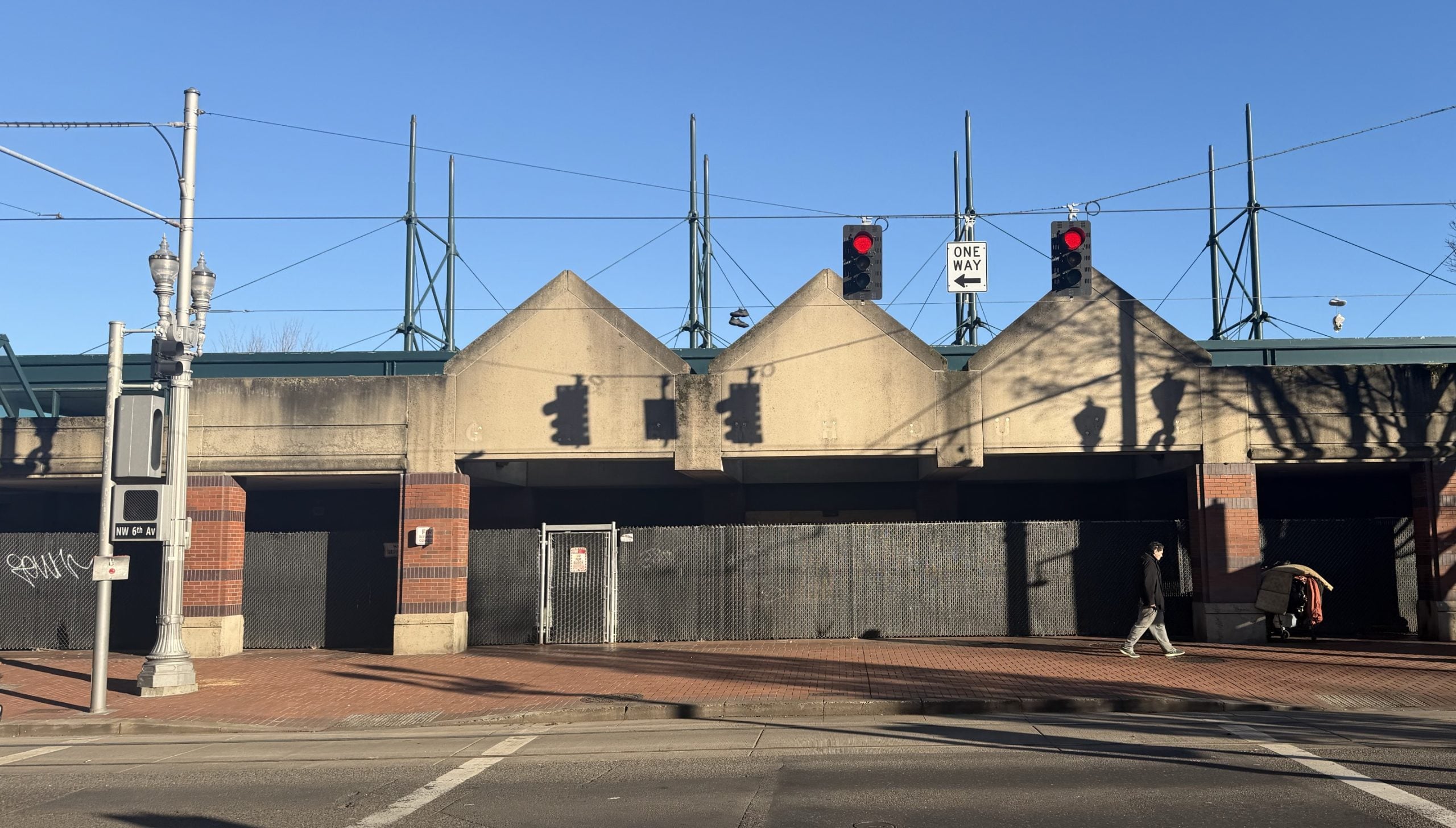
Former Greyhound bus terminal as it stands today on NW 6th Ave. (Photo: Jonathan Maus/BikePortland)
*Updated with statement from TriMet at 11:23 am.*
The former Greyhound station in Old Town across the street from Union Station will soon house TriMet buses if a plan to purchase the building goes through. At a meeting this morning of Metro’s Joint Policy Advisory Committee on Transportation (JPACT), TriMet General Manager Sam Desue announced a plan to reallocate funds currently set aside for zero emission buses and instead use it to purchase the Greyhound building for use as a bus layover facility.
“Due to our current financial situation, where we are reprioritizing the use of these funds,” Desue told fellow members of JPACT. “We currently have more buses that we need for our current operations. However, we’re not taking our foot off the gas regarding zero emission buses and purchases for the future.”
Advertisement
Desue went on to explain that TriMet intends to purchase the two-acre property at 550 NW 6th Avenue and convert it from a Greyhound terminal into a layover facility that can house up to nine, 60-foot spaces for TriMet buses. Currently, TriMet bus operators on the frequent service FX-2 Division Line layover in the transit mall on NW 5th and 6th avenues. TriMet says housing these buses indoors will be safer for operators, spur much-needed urban development in Old Town and satisfy a commitment TriMet made with the City of Portland in 2016 to not use a public street for extended layovers.
At their meeting today, JPACT authorized an amendment to the Metropolitan Transportation Improvement Program (MTIP) that reallocates $4.1 million in federal funds previously intended for zero emission bus purchases and adds $7.9 million (a mix of federal and TriMet funds) for a total of $12 million.
According to the Portland Business Journal, the former Greyhound terminal is currently owned by Transportation Realty Income Partners LP, and it listed on the market for $10 million. Greyhound moved out of the building in 2019 and TriMet has had its eye on it ever since. TriMet says they hope to close on the property by this summer.
Below is more information about the proposed sale in email from TriMet just before noon on Thursday:
This is a unique opportunity for TriMet, as the funding strategy to acquire the former Greyhound property as a bus layover site leverages federal funds with the minimum possible investment of TriMet general funds. Given our constrained revenues and more than enough buses needed given our current and future service levels, we are not making this particular electric bus purchase this year.
TriMet is looking to reallocate existing federal funds and grant money to purchase the former Greyhound bus site at 550 Northwest 6th Avenue for a new bus layover facility. The need for additional bus layover space was identified back in 2016, during the planning phase of the Division Transit Project. When the City of Portland adopted the Locally Preferred Alternative (LPA) for the project, they included a provision, which said that TriMet would work with the City “to identify, plan and design a permanent off-street bus layover facility… near the north terminus of the transit mall.” The resolution gave a timeline of five-years from the Sept. 18, 2022 service launch of the Division Transit Project.
The site at 550 NW 6th Avenue is uniquely suited to TriMet’s needs, as it located next to Union Station; close to TriMet MAX lines and the Steel Bridge; and serves TriMet access and future needs in this part of the city. It includes 2-acres of property on the transit mall, with an existing bus yard. Of the locations TriMet considered for the layover facility, the Greyhound site had the lowest up front capital investment requirements and the greatest long-term flexibility. It will serve buses from across the region; meet an urgent need for additional layover space; and has the opportunity to catalyze development directly adjacent to high capacity transit and Union Station.
The proposed transaction for the site leverages existing federal funds and federal grant monies that are not available for TriMet operations, maintenance or TriMet service, or other agency expenditures. A breakdown of the funding is below.
In addition to the $3.3 Million in federal formula dollars in this MTIP amendment, TriMet will be using $7.9 Million in FTA restricted funds for the purchase of this site. When TriMet sells a piece of property that was purchased with federal funds – a portion of the sale, attributed to federal funds – goes into a dedicated fund that we can only use for purchases like these and attached to other federal dollars like these formula funds.
TriMet’s Board of Directors was briefed on the topic in December, and you can watch that part of the meeting here. As for next steps, we expect our Board of Directors to vote on a Resolution related to the acquisition at their Jan. 28 meeting. We hope to close on the property as soon as this summer.
BikePortland founder. Father of three. North Portlander. Basketball lover. If you have questions or feedback about this site or my work, contact me via email at maus.jonathan@gmail.com, or phone/text at 503-706-8804. Also, if you read and appreciate this site, please become a paying subscriber.
BikePortland has served this community with independent community journalism since 2005. We rely on subscriptions from readers like you to survive. Your financial support is vital in keeping this valuable resource alive and well.
This makes too much sense for anyone to be happy about it.
They do need the layover space and bathroom space.It will help having Trimet manage the property and keep out the riff raffIt is a fantastic location for future development where the bus bays stay and on top you place office/residential/retail. It’s a cheap price, good for them to buy while downtown suffers.
FlowerPower
7 months ago
Well, a timely reminder of how TRIMET as an organization is difficult to take seriously. Sam Desue acknowledges the “current financial situation” and says the best way to deal with that is to buy property they don’t really need, have done just fine without for years and will cost an unknown amount to “convert into a layover facility”.
Thank goodness they can backfill the money they will spend on the property instead of buses with PCEF funds. Funding is fungible and this is yet another example of why all the city money should just go into a single pot to be drawn from as there seems to be no ability to actually set money for specific reasons or objects.
Also, that seems like a lot of money for a property no one else wants.
There’s basically 2 main types of bus networks: Hub-And-Spoke and Lattice.
Hub-and-spoke is very common in smaller communities whereby there’s a central depot and to get across town you have to transfer at least once – all the buses come into the depot around the same time and you walk within the depot to catch the next bus to your destination. The main advantages to Hub-And-Spoke are that it makes transfers relatively easy and it increases “ridership”; it’s main disadvantage is that it is incredibly inefficient on moving people and it takes forever to get to your destination.
Lattice networks are much more common in major cities that have multiple centers (Houston TX for example), whereby nearly all buses are “crosstown” and to transfer where buses intersect or at multiple depots. Generally you get to your destination faster and the system is more efficient as long as you only need one or fewer transfers. It’s not so great if you need multiple transfers to get to your destination.
Most systems are hybrids of the two, including Trimet’s.
A really good transit system tries to move as many people as possible to their destinations as quickly as possible. However, in the USA, a lot of systems get their funding based on “ridership” which is how many “trips” their passengers take rather than the number of people moved. The more transfers, the more trips taken, and the higher the ridership.
So I can see Trimet looking at this bus depot as an investment into a future of low transit people movement and using it for a Hub-And-Spoke system that basically requires everyone to transfer at least once to get to their final destination in order to inflate reported ridership.
They’re going to use it as a rest/storage spot for 9 buses. That it can be used as something else in the future with more money spent isn’t mentioned. They are cutting routes, not expanding them. If Trimet were capable of making profitable, forward thinking decisions they wouldn’t be in the financial hole they are now so you’ll have to (or not) forgive my disbelief that there is any kind of future plan that pencils out profitably or at least isn’t a black hole of tax money.
My own transit system design is based on Denver’s 16th Street Shuttle that runs fareless every 2 minutes with the least number of buses on that city’s 1-mile transit mall like Portland’s. I call this transit system a sort of missing link in that it affects convenient transfers right where they’re most needed. Fares are collected on the shuttle’s feeder routes.
The shuttle crosses 2 light rail lines and 2 bus transfer centers between the Capitol complex and Union Station district. If I’m correct in assuming the shuttle has universal applications, similarly low cost Shuttles (or as I call them Loop Oriented Transit Intermodal “LOTi” Loops), whole metropolitan areas could install dozens to affect convenient transfers and direct truly transit-oriented mixed-use development.
One last point to make about the district: I do not believe Tri-Met is seriously considering a MAX subway with a station either below the totally rebuilt Greyhound Depot or the empty block on NW 6th Ave. My concern is seismic stability of the entire subway route with stations at Pioneer Courthouse Square and the South Park blocks at Jefferson.
The subway route I prefer is along Naito Pkwy – a narrow stacked cut-cover for seismic stability – that turns west on Columbia to the South Park blocks. From there to Goose Hollow with twin-tunnel and a twin tunnel under the Willamette to a station at Moda Center, then cut-cover to NE 7th Ave surface station. The initial westside portal is beneath the Morrison bridgehead. Initially the Red & Blue lines feed the downtown core. The Green Line reverses direction at SW 11th Ave. The next phase extends along Naito Pkwy to a portal south of Harrison where the Green Line extends to Milwaukie. The last phase builds a ‘wye’ on Naito Pkwy for the Blue Line west and the Orange Line to head west to Beaverton and then Tigard & Tualatin.
I’ve submitted the system design to City Hall & Metro but Council members are hesitant to admit their loyalty is more to the Portland Business Alliance and the Portland Development Commission rather than the public good. Go figure.
I’ve submitted the system design to City Hall & Metro but Council members are hesitant to admit their loyalty is more to the Portland Business Alliance and the Portland Development Commission rather than the public good. Go figure.
I don’t think there’s some grand conspiracy against you; your “plan” just isn’t very good. Running a subway along Naito parkway misses most of downtown, and at that point, it would be much more cost-effective to build elevated.
Given how many lines go North-South on 5th and 6th, if you wanted to accomplish the same thing as Denver’s shuttle, bringing back fareless square would do it.
I prefer the subway route (Naito Pkwy) because it poses less danger of damage to buildings above in severe earthquakes predicted. A cut-cover tunnel is more stable than twin tube which allows ‘shock waves’ to roll over and force the tubes to sink and rise. Soils along the Waterfront are most prone to liquify, thus would benefit most with a stabilizing cut-cover.
The Yellow Line would remain on the transit mall, complemented with a “Shuttlebus” service operating ‘fareless’ at less than 5 minute intervals. The Red Line would run on Yamhill/Morrison past Pioneer Courthouse Square and Providence Park to Beaverton; the last phase Blue Line runs west on Columbia/Jefferson to a Goose Hollow portal and to Hillsboro; the Orange Line would also run west on Columbia/Jefferson to Beaverton, from there to Tigard/Tualatin and from Milwaukie to Oregon City; the Green Line would run first to Milwaukie, then Clackamas Town Center.
For near the same length of subway line, this proposal for MAX achieves 4 subway lines instead of 1 with the route Tri-Met proposes plus the danger posed to buildings above. It’s an extensive layout in phases.
Why did Metro & Tri-Met propose a terrible MAX extension to Tigard along State Hwy 99W (ODOT jurisdiction). It met NONE of the basic metrics that determine merit – Public Safety, Public Health, Environmental impact, Urban impact, development potential and lastly various costs which were exorbitant. Answer: Members of PBA and PDC do not want transit systems to function, so they pull strings and hire sycophants to plan impossible projects.
Oops, I left out one of the 7 basic metrics that determine merit – Gains in transit patronage, 5th in importance after Urban impact and before Transit-oriented development. Cost concerns are last on the list, but they were ODOT director Kris Strickler’s ONLY concern as his statements at public hearings reveal; they began with the money, ended with the money, and in between was the money for this project, that project and other projects, period, end of story. He was forced to resign but is still paid to keep his mouth shut.
TriMet has a fairly good lattice network already. People in outlying areas generally don’t have to go downtown to connect to where they’re going, and the frequent service network is fairly built out. While hub-and-spoke wouldn’t work in a market the size of Portland, giving everyone a one-seat ride to every possible destination dramatically reduces frequency and efficiency. As you imply, the best solution is a frequent-service grid. (See Jarrett Walker’s Human Transit.) Of course it would be great if they had the resources to expand the frequent service network rather than reducing frequency at night on existing routes. (One drawback we have in terms of travel time is that MAX and streetcar have too many stops, making those trips longer than they should be. But if the rail system had been designed with fewer stops, more buses would have been required to service the locations in between.)
Who’s saying it’s city money? If you mean the PCEF funds you better do some research.
Angus Peters
7 months ago
I hope they got a good deal for taxpayers. Commercial properties are selling at fire sale prices in Portland. Unfortunately I don’t see a lot of fiduciary responsibility from our local government entities.
Large cities with hub-and-spoke transit systems will often have a huge bus shed near the center of the city. Examples include Durham NC, Charlotte NC, and Winston-Salem NC.
Glad to hear that Trimet is taking it over. Would love to see it function again as a regional regional bus hub to connect rural Oregon wit the city. Flix’s ‘leverage buyout’ real estate grab and moving passenger waiting to the curb nationally is a modal / equity travesty. BUT Not sure that a bus parking / layover lot will “spur much-needed urban development in Old Town”..more spin than reality unless this is Trimet land banking this facility for bigger and better things.
I agree that a bus layover facility isn’t an economic driver, but having any activity at that site, and especially with more TriMet employees around, will do a lot to improve the situation in that area.
Between that, and the new development at the old Post Office site, it will be a good first step in improving the area around Union Station.
Longer term, I do hope to see the space get more improvements. As others have said, a inter-city bus depot is actually something that we should be investing in for improved car free travel options around the region. I think a bus depot on the ground floor with a building on top would actually be an effective use of the space.
I think the comment about catalyzing development is associated with transit-oriented redevelopment of the site itself in the future, not the bus parking use now. This makes sense given how cheaply they would acquire the site. I doubt very much they are paying the asking price given the state of the market.
We already have a regional bus hub one block away at Union Station. It doesn’t have bays like the Greyhound station, but it is served by Oregon’s state funded POINT bus system.
maxD
7 months ago
This seems like a good fit, but a downgrade from its former use as a bus terminal. I do not buy the claim that a bus parking lot will “spur much-needed urban development in Old Town”. It is better than being empty, but only barely.
Harper Haverkamp
7 months ago
Please put 20 stories of housing on top + a coffee shop too. Prime location for transit oriented development.
Harper, Have you walked around Old Town anytime in the last 5 years? The nearby Ritz Carleton condos are selling at 50% off. No investor is gonna put their $ into development in Old Town anytime soon.
I walk through there on my way to my job, and it’s still an awful area. I’ve seen no improvements despite all the claims to the contrary from folks who obviously don’t go into that part of town.
The worst part of any trip on Amtrak with my family in tow is the return trip and transfer to the green line in this area. We’ll spend 3 nights in Seattle, walking all over town, and the worst interactions of the trip will happen between Union Station and our MAX train.
Chris, on my frequent Cascade rides, I now see a lot of other Portlander’s / Oregonians on Amtrak northbound trains have the same concerns and have shifted to starting their trip from the Vancouver train station. (Noted its not as architecturally not as nice as Portland Union Station.)
I predict, in a couple years, TriMet will sell the property to a well-connected developer for a few dollars. Just like TriMet did with all those properties they bought along the Max lines. Developers really profited then and they will continue too.
Remember, there are folks, high up, in TriMet who see themselves as an “economic development” company, not transportation.
Union Station hosts a dozen or so regional bus services to the Coast, Central Oregon, north and south. Some passengers wait in Union Station for buses parked out front. Many if not most bus lines require passengers to wait uncomfortably on sidewalks with no seating or shelters north of the Broadway Bridge. My thinking is to funnel most bus services into the defunct Greyhound depot. Build a new entry facing Union Station with matching architecture and inviting pedestrian infrastructure.
That said, with this in mind, it seems Tri-Met should not use the facility for a bus layover. I have a few other ideas along this line of thinking. It may require ‘widening’ of Irving Street between NW 5th & 6th Aves to better accommodate Tri-Met buses.
….You are aware that the only transportation companies in the world that make money solely on transportation prioritize money above their transportation provision? All those fantastic private suburban railways in Japan? Essentially all of their money comes from development. Countries which have functional transit and intercity rail systems with per capita/per-distance ridership that dwarfs ours? It’s from the sort of harmony between transportation and development which in its absence has helped created the ridership/funding quandry that TriMet’s now facing.
Transportation does not fund itself, any mode, anywhere. Public transit just happens to be the only sort of transportation that enables development patterns that can pay for it. Seeing transportation and development as separate is simply a mistake.
Allen
7 months ago
in the mean time Trimet is seeking public comments on what Trimet needs to cut because they are out of money and need to cut service. Instead of allocating that money to a ridiculous land purchase or to purchase zero emission busses, how about the keep existing services running. I think Trimet is forgetting their purpose is to give people rides.
This right here. We have to cut lines and face budget issues but let’s keep dumping money in the name of speculation to make more money?
Dusty Reske
7 months ago
$12 million to park 9 buses, while Trimet is cutting service, is really, really disappointing.
AEG
7 months ago
‘$4.1 million in federal funds previously intended for zero emission bus purchases’
So it’s that easy to reallocate federal funds? I’m curious about how the funds were granted and what restrictions are in place for their disbursement.
poncho
7 months ago
So are they parking buses in the back old bus zone and not touching the building? Are they reviving the building and it will have a rider interface or is it only for bus drivers? Are they demolishing the building? I would imagine maintenance has been severely neglected since it closed 6-7 years ago and even years before that.
Its actually quite a nice building as far as modern-day bus stations go, would be nice to see it restored back into an intercity bus terminal for all bus operators.
The location makes little sense to me. Portland has MAX lines going north, west and east, but nothing really going south. This means that if I want to get anywhere south of downtown from inner-east Portland, I need to change a bus on the street level, awkwardly walking around trying to find the right line. from outer-east, north-east and really, anywhere else, you could take a MAX and end up in the same location looking for the right bus.
What this means is this layover is on the WRONG side of downtown, perhaps useful for people who hate the MAX, but for everyone else, not really a great benefit. Sure, it would be better if that money helped plug the hole in the budget right now, but if you HAVE to spend it on a layover station, put it on the south side of downtown to fix the mess over there.
“Layover” as in break for drivers at the end of the route. The FX2, 9 and some other lines terminate there, so that’s where they take breaks and change drivers.
I am at a loss as to why so many people think this property purchase involves ridership in any way. Not only is it only for trimet drivers and 9 buses, but one of the stated reasons was because it’s no longer safe for drivers to take their layover breaks parked at bus stops. Trimet says it’s not safe for their drivers, they need to rest in a gated parking lot. What does that say about what the rest of us face? Is it safe for us?
Trimet drivers get 12 million dollar (likely plus a lot more to get the property up to code and safety), Councilor has a homeless person accidentally set her car on fire and she gets personal security at our expense. Wheres my security team to keep me safe? Where’s my fencing to separate me from the crazies? Why can’t government treat us the way they treat themselves?
Also, this is not the beginning of a transportation hub that will revitalize anything. It’s a fenced parking lot. It is so frustrating.
I don’t think there’s a way it improves ridership much, but if this layover allows for a stop closer to the train station for the 9 and 17-Holgate, it at least can improve rider experience. When I lived near the junction of the 9/17/MAX Orange and got in late at night on Amtrak, it was always very annoying to have to leg it down to Davis to catch the 9 or 17 when the MAX was a half hour away.
Will that attract much in the way of ridership? I doubt it. But it’s a former pet peeve of mine.
It’s a useful place for a bus layover location, but it’s less useful than it was in the past when more buses terminated at Union Station. Currently, the 9, FX2, and half of the 17 terminate here. Hopefully it will allow them to have a stop in the vicinity that saves Union Station passengers the walk from Davis (a thorn in my side when I used the 9/17 to get home from Amtrak trips). I think the reason that they don’t serve the existing 5th/Hoyt stop is that it’s not possible to get there easily from the layover lot. The 14 terminated there before the MAX green line, and I think other routes did as well (was looking for an old map but couldn’t find one).
Better bus circulation to Union Station is important, though maybe not $10M important during service cuts. And this move generally benefits travelers going to SE Portland from Old Town. That’s a niche, but it’s a niche I’m formerly part of so I think it’s a positive.
Fred
7 months ago
“we’re not taking our foot off the gas regarding zero emission buses and purchases for the future.”
Trimet comms staff need to help their leader craft better metaphors. That has to be the worst metaphor for GHG reduction ever!
Charley
7 months ago
“[W]e’re not taking our foot off the gas” is so literal, when it regards delaying the purchase of electric buses.
(I’m not second guessing the re-prioritization, I just think the turn of phrase is hilarious in context).
SolarEclipse
7 months ago
Sounds like par for the course for TriMet, a very expensive solution in search of a problem.
Funny, I ride down to that area on my way to work. I’ve never seen an issue with buses stopped/parked where they do now.
Like the Parkrose and Gateway portion of the “better red” project. Lots of money tossed at imagined problems that just weren’t there to begin with.
Just remember these types of expenditures by TriMet when they go with their hands out asking for more money. Make sure you tell your political reps that TriMet needs a management change that is fiscally more responsible to the tax payers.
Jesse Bufton
7 months ago
What if instead they used that money to not cut the number 10 bus line from SE 72nd to 136th avenues? East Portland is once again getting totally screwed. My TriMet commute time is going to increase by 30%.
It’s ridiculous that trimet is considering purchasing an unnecessary multimillion dollar building downtown while they are simultaneously cutting services because they have no money.
Make it make sense right? Its not possible. Maybe those that make the rules or decisions need to take a daily commute on any number of Eastside buses for a few years before they have that power. Without a lived experience they dont know the reality shortcomings
Trimet could buy this property and clean it up and redevelop it, but without a whole lot of security around there it’s just going to be a waste.
As long as all the monied interests continue to invest in keeping the Homeless Industrial Complex afloat, by throwing more money at all these shiny nonprofits without effecting meaningful change, ANY development or redevelopment in downtown is doomed to fail.
Mark
7 months ago
I’m surprised this property wasn’t a part of the Broadway Corridor vision by Prosper Portland. Is this property east of that development?
While everyone agrees that someone using the property is better than it being vacant, I don’t think this is the highest and best use of property at such a prime location in the long term. (Unless, as another commenter suggested, multiple stories of housing are built above the bus yard. That could be really cool.)
But as others have noted, it would probably take a decade or more for housing or other uses to be realized at this site, so this is a good way to clean up the property for now. And it’s hard to argue that it’s not an absolutely ideal location for such a facility from a transit perspective. TriMet had not used 60-foot bendy buses before FX-2 was launched, and one drawback of bigger buses is that it requires more land to store them. I think better bus service is worth the tradeoff.
Of course, the property’s location on multiple transit lines (plus intercity buses and trains) makes it ideal for housing too. Hopefully the Union Station area becomes a busy hub for travelers AND residents in the not-too-distant future. I personally enjoy walking in the area and haven’t ever felt unsafe.
mark smith
7 months ago
This is a real estate move. Buy low, sell high. Nothing more or less.
John D.
7 months ago
One thought that I had after thinking on this a little more, I also wonder if this property acquisition helps lower the barrier to eventually building a MAX tunnel underground through downtown?
Any tunneling project will still be hugely expensive, but those projects do require a location to stage equipment, initially dig down, as well as bring materials in and out. A two-block area right in downtown, near the river, seems like a perfect place to start.





Thanks for reading.
BikePortland has served this community with independent community journalism since 2005. We rely on subscriptions from readers like you to survive. Your financial support is vital in keeping this valuable resource alive and well.
Please subscribe today to strengthen and expand our work.
This makes too much sense for anyone to be happy about it.
They do need the layover space and bathroom space.It will help having Trimet manage the property and keep out the riff raffIt is a fantastic location for future development where the bus bays stay and on top you place office/residential/retail. It’s a cheap price, good for them to buy while downtown suffers.
Well, a timely reminder of how TRIMET as an organization is difficult to take seriously. Sam Desue acknowledges the “current financial situation” and says the best way to deal with that is to buy property they don’t really need, have done just fine without for years and will cost an unknown amount to “convert into a layover facility”.
Thank goodness they can backfill the money they will spend on the property instead of buses with PCEF funds. Funding is fungible and this is yet another example of why all the city money should just go into a single pot to be drawn from as there seems to be no ability to actually set money for specific reasons or objects.
Also, that seems like a lot of money for a property no one else wants.
There’s basically 2 main types of bus networks: Hub-And-Spoke and Lattice.
Hub-and-spoke is very common in smaller communities whereby there’s a central depot and to get across town you have to transfer at least once – all the buses come into the depot around the same time and you walk within the depot to catch the next bus to your destination. The main advantages to Hub-And-Spoke are that it makes transfers relatively easy and it increases “ridership”; it’s main disadvantage is that it is incredibly inefficient on moving people and it takes forever to get to your destination.
Lattice networks are much more common in major cities that have multiple centers (Houston TX for example), whereby nearly all buses are “crosstown” and to transfer where buses intersect or at multiple depots. Generally you get to your destination faster and the system is more efficient as long as you only need one or fewer transfers. It’s not so great if you need multiple transfers to get to your destination.
Most systems are hybrids of the two, including Trimet’s.
A really good transit system tries to move as many people as possible to their destinations as quickly as possible. However, in the USA, a lot of systems get their funding based on “ridership” which is how many “trips” their passengers take rather than the number of people moved. The more transfers, the more trips taken, and the higher the ridership.
So I can see Trimet looking at this bus depot as an investment into a future of low transit people movement and using it for a Hub-And-Spoke system that basically requires everyone to transfer at least once to get to their final destination in order to inflate reported ridership.
They’re going to use it as a rest/storage spot for 9 buses. That it can be used as something else in the future with more money spent isn’t mentioned. They are cutting routes, not expanding them. If Trimet were capable of making profitable, forward thinking decisions they wouldn’t be in the financial hole they are now so you’ll have to (or not) forgive my disbelief that there is any kind of future plan that pencils out profitably or at least isn’t a black hole of tax money.
Buying a new building and contemplating a subway > keeping 38 jobs and maintaining current routes. Makes total sense
My own transit system design is based on Denver’s 16th Street Shuttle that runs fareless every 2 minutes with the least number of buses on that city’s 1-mile transit mall like Portland’s. I call this transit system a sort of missing link in that it affects convenient transfers right where they’re most needed. Fares are collected on the shuttle’s feeder routes.
The shuttle crosses 2 light rail lines and 2 bus transfer centers between the Capitol complex and Union Station district. If I’m correct in assuming the shuttle has universal applications, similarly low cost Shuttles (or as I call them Loop Oriented Transit Intermodal “LOTi” Loops), whole metropolitan areas could install dozens to affect convenient transfers and direct truly transit-oriented mixed-use development.
One last point to make about the district: I do not believe Tri-Met is seriously considering a MAX subway with a station either below the totally rebuilt Greyhound Depot or the empty block on NW 6th Ave. My concern is seismic stability of the entire subway route with stations at Pioneer Courthouse Square and the South Park blocks at Jefferson.
The subway route I prefer is along Naito Pkwy – a narrow stacked cut-cover for seismic stability – that turns west on Columbia to the South Park blocks. From there to Goose Hollow with twin-tunnel and a twin tunnel under the Willamette to a station at Moda Center, then cut-cover to NE 7th Ave surface station. The initial westside portal is beneath the Morrison bridgehead. Initially the Red & Blue lines feed the downtown core. The Green Line reverses direction at SW 11th Ave. The next phase extends along Naito Pkwy to a portal south of Harrison where the Green Line extends to Milwaukie. The last phase builds a ‘wye’ on Naito Pkwy for the Blue Line west and the Orange Line to head west to Beaverton and then Tigard & Tualatin.
I’ve submitted the system design to City Hall & Metro but Council members are hesitant to admit their loyalty is more to the Portland Business Alliance and the Portland Development Commission rather than the public good. Go figure.
I don’t think there’s some grand conspiracy against you; your “plan” just isn’t very good. Running a subway along Naito parkway misses most of downtown, and at that point, it would be much more cost-effective to build elevated.
Given how many lines go North-South on 5th and 6th, if you wanted to accomplish the same thing as Denver’s shuttle, bringing back fareless square would do it.
I prefer the subway route (Naito Pkwy) because it poses less danger of damage to buildings above in severe earthquakes predicted. A cut-cover tunnel is more stable than twin tube which allows ‘shock waves’ to roll over and force the tubes to sink and rise. Soils along the Waterfront are most prone to liquify, thus would benefit most with a stabilizing cut-cover.
The Yellow Line would remain on the transit mall, complemented with a “Shuttlebus” service operating ‘fareless’ at less than 5 minute intervals. The Red Line would run on Yamhill/Morrison past Pioneer Courthouse Square and Providence Park to Beaverton; the last phase Blue Line runs west on Columbia/Jefferson to a Goose Hollow portal and to Hillsboro; the Orange Line would also run west on Columbia/Jefferson to Beaverton, from there to Tigard/Tualatin and from Milwaukie to Oregon City; the Green Line would run first to Milwaukie, then Clackamas Town Center.
For near the same length of subway line, this proposal for MAX achieves 4 subway lines instead of 1 with the route Tri-Met proposes plus the danger posed to buildings above. It’s an extensive layout in phases.
Why did Metro & Tri-Met propose a terrible MAX extension to Tigard along State Hwy 99W (ODOT jurisdiction). It met NONE of the basic metrics that determine merit – Public Safety, Public Health, Environmental impact, Urban impact, development potential and lastly various costs which were exorbitant. Answer: Members of PBA and PDC do not want transit systems to function, so they pull strings and hire sycophants to plan impossible projects.
Oops, I left out one of the 7 basic metrics that determine merit – Gains in transit patronage, 5th in importance after Urban impact and before Transit-oriented development. Cost concerns are last on the list, but they were ODOT director Kris Strickler’s ONLY concern as his statements at public hearings reveal; they began with the money, ended with the money, and in between was the money for this project, that project and other projects, period, end of story. He was forced to resign but is still paid to keep his mouth shut.
TriMet has a fairly good lattice network already. People in outlying areas generally don’t have to go downtown to connect to where they’re going, and the frequent service network is fairly built out. While hub-and-spoke wouldn’t work in a market the size of Portland, giving everyone a one-seat ride to every possible destination dramatically reduces frequency and efficiency. As you imply, the best solution is a frequent-service grid. (See Jarrett Walker’s Human Transit.) Of course it would be great if they had the resources to expand the frequent service network rather than reducing frequency at night on existing routes. (One drawback we have in terms of travel time is that MAX and streetcar have too many stops, making those trips longer than they should be. But if the rail system had been designed with fewer stops, more buses would have been required to service the locations in between.)
TriMet money isn’t city money.
Who’s saying it’s city money? If you mean the PCEF funds you better do some research.
I hope they got a good deal for taxpayers. Commercial properties are selling at fire sale prices in Portland. Unfortunately I don’t see a lot of fiduciary responsibility from our local government entities.
https://www.realtor.com/news/trends/ritz-carlton-residences-for-sale-portland-oregon/
https://www.oregonlive.com/business/2025/12/portland-office-sales-will-drive-millions-in-property-tax-losses-year-in-review.html?outputType=amp
The HOA in those condos is another whole mortgage
Large cities with hub-and-spoke transit systems will often have a huge bus shed near the center of the city. Examples include Durham NC, Charlotte NC, and Winston-Salem NC.
Glad to hear that Trimet is taking it over. Would love to see it function again as a regional regional bus hub to connect rural Oregon wit the city. Flix’s ‘leverage buyout’ real estate grab and moving passenger waiting to the curb nationally is a modal / equity travesty. BUT Not sure that a bus parking / layover lot will “spur much-needed urban development in Old Town”..more spin than reality unless this is Trimet land banking this facility for bigger and better things.
Yes that is a stretch to think that bus storage is going to spur development. Still, compared to it’s current state, this is a large improvement.
I agree that a bus layover facility isn’t an economic driver, but having any activity at that site, and especially with more TriMet employees around, will do a lot to improve the situation in that area.
Between that, and the new development at the old Post Office site, it will be a good first step in improving the area around Union Station.
Longer term, I do hope to see the space get more improvements. As others have said, a inter-city bus depot is actually something that we should be investing in for improved car free travel options around the region. I think a bus depot on the ground floor with a building on top would actually be an effective use of the space.
I think the comment about catalyzing development is associated with transit-oriented redevelopment of the site itself in the future, not the bus parking use now. This makes sense given how cheaply they would acquire the site. I doubt very much they are paying the asking price given the state of the market.
don’t assume anything about our government being wise. its a mess, beholden to utopists.
We already have a regional bus hub one block away at Union Station. It doesn’t have bays like the Greyhound station, but it is served by Oregon’s state funded POINT bus system.
This seems like a good fit, but a downgrade from its former use as a bus terminal. I do not buy the claim that a bus parking lot will “spur much-needed urban development in Old Town”. It is better than being empty, but only barely.
Please put 20 stories of housing on top + a coffee shop too. Prime location for transit oriented development.
Harper, Have you walked around Old Town anytime in the last 5 years? The nearby Ritz Carleton condos are selling at 50% off. No investor is gonna put their $ into development in Old Town anytime soon.
I walk through there on my way to my job, and it’s still an awful area. I’ve seen no improvements despite all the claims to the contrary from folks who obviously don’t go into that part of town.
The worst part of any trip on Amtrak with my family in tow is the return trip and transfer to the green line in this area. We’ll spend 3 nights in Seattle, walking all over town, and the worst interactions of the trip will happen between Union Station and our MAX train.
Chris, on my frequent Cascade rides, I now see a lot of other Portlander’s / Oregonians on Amtrak northbound trains have the same concerns and have shifted to starting their trip from the Vancouver train station. (Noted its not as architecturally not as nice as Portland Union Station.)
I predict, in a couple years, TriMet will sell the property to a well-connected developer for a few dollars. Just like TriMet did with all those properties they bought along the Max lines. Developers really profited then and they will continue too.
Remember, there are folks, high up, in TriMet who see themselves as an “economic development” company, not transportation.
Union Station hosts a dozen or so regional bus services to the Coast, Central Oregon, north and south. Some passengers wait in Union Station for buses parked out front. Many if not most bus lines require passengers to wait uncomfortably on sidewalks with no seating or shelters north of the Broadway Bridge. My thinking is to funnel most bus services into the defunct Greyhound depot. Build a new entry facing Union Station with matching architecture and inviting pedestrian infrastructure.
That said, with this in mind, it seems Tri-Met should not use the facility for a bus layover. I have a few other ideas along this line of thinking. It may require ‘widening’ of Irving Street between NW 5th & 6th Aves to better accommodate Tri-Met buses.
….You are aware that the only transportation companies in the world that make money solely on transportation prioritize money above their transportation provision? All those fantastic private suburban railways in Japan? Essentially all of their money comes from development. Countries which have functional transit and intercity rail systems with per capita/per-distance ridership that dwarfs ours? It’s from the sort of harmony between transportation and development which in its absence has helped created the ridership/funding quandry that TriMet’s now facing.
Transportation does not fund itself, any mode, anywhere. Public transit just happens to be the only sort of transportation that enables development patterns that can pay for it. Seeing transportation and development as separate is simply a mistake.
in the mean time Trimet is seeking public comments on what Trimet needs to cut because they are out of money and need to cut service. Instead of allocating that money to a ridiculous land purchase or to purchase zero emission busses, how about the keep existing services running. I think Trimet is forgetting their purpose is to give people rides.
I am curious if their statement regarding “too many buses” is being calculated before or after the service cuts.
This right here. We have to cut lines and face budget issues but let’s keep dumping money in the name of speculation to make more money?
$12 million to park 9 buses, while Trimet is cutting service, is really, really disappointing.
‘$4.1 million in federal funds previously intended for zero emission bus purchases’
So it’s that easy to reallocate federal funds? I’m curious about how the funds were granted and what restrictions are in place for their disbursement.
So are they parking buses in the back old bus zone and not touching the building? Are they reviving the building and it will have a rider interface or is it only for bus drivers? Are they demolishing the building? I would imagine maintenance has been severely neglected since it closed 6-7 years ago and even years before that.
Its actually quite a nice building as far as modern-day bus stations go, would be nice to see it restored back into an intercity bus terminal for all bus operators.
It sounds like they will just utilize the existing space to park buses during layover periods. I wouldn’t expect any major changes to the building.
They are buying a fenced parking lot and some bathrooms.
The location makes little sense to me. Portland has MAX lines going north, west and east, but nothing really going south. This means that if I want to get anywhere south of downtown from inner-east Portland, I need to change a bus on the street level, awkwardly walking around trying to find the right line. from outer-east, north-east and really, anywhere else, you could take a MAX and end up in the same location looking for the right bus.
What this means is this layover is on the WRONG side of downtown, perhaps useful for people who hate the MAX, but for everyone else, not really a great benefit. Sure, it would be better if that money helped plug the hole in the budget right now, but if you HAVE to spend it on a layover station, put it on the south side of downtown to fix the mess over there.
“Layover” as in break for drivers at the end of the route. The FX2, 9 and some other lines terminate there, so that’s where they take breaks and change drivers.
I am at a loss as to why so many people think this property purchase involves ridership in any way. Not only is it only for trimet drivers and 9 buses, but one of the stated reasons was because it’s no longer safe for drivers to take their layover breaks parked at bus stops. Trimet says it’s not safe for their drivers, they need to rest in a gated parking lot. What does that say about what the rest of us face? Is it safe for us?
Trimet drivers get 12 million dollar (likely plus a lot more to get the property up to code and safety), Councilor has a homeless person accidentally set her car on fire and she gets personal security at our expense. Wheres my security team to keep me safe? Where’s my fencing to separate me from the crazies? Why can’t government treat us the way they treat themselves?
Also, this is not the beginning of a transportation hub that will revitalize anything. It’s a fenced parking lot. It is so frustrating.
I don’t think there’s a way it improves ridership much, but if this layover allows for a stop closer to the train station for the 9 and 17-Holgate, it at least can improve rider experience. When I lived near the junction of the 9/17/MAX Orange and got in late at night on Amtrak, it was always very annoying to have to leg it down to Davis to catch the 9 or 17 when the MAX was a half hour away.
Will that attract much in the way of ridership? I doubt it. But it’s a former pet peeve of mine.
So many many many valid points here. Sadly I think this is Rose Colored Portlandia Fantasy voting issue we’ve been having for many many years.
It’s a useful place for a bus layover location, but it’s less useful than it was in the past when more buses terminated at Union Station. Currently, the 9, FX2, and half of the 17 terminate here. Hopefully it will allow them to have a stop in the vicinity that saves Union Station passengers the walk from Davis (a thorn in my side when I used the 9/17 to get home from Amtrak trips). I think the reason that they don’t serve the existing 5th/Hoyt stop is that it’s not possible to get there easily from the layover lot. The 14 terminated there before the MAX green line, and I think other routes did as well (was looking for an old map but couldn’t find one).
Better bus circulation to Union Station is important, though maybe not $10M important during service cuts. And this move generally benefits travelers going to SE Portland from Old Town. That’s a niche, but it’s a niche I’m formerly part of so I think it’s a positive.
Trimet comms staff need to help their leader craft better metaphors. That has to be the worst metaphor for GHG reduction ever!
“[W]e’re not taking our foot off the gas” is so literal, when it regards delaying the purchase of electric buses.
(I’m not second guessing the re-prioritization, I just think the turn of phrase is hilarious in context).
Sounds like par for the course for TriMet, a very expensive solution in search of a problem.
Funny, I ride down to that area on my way to work. I’ve never seen an issue with buses stopped/parked where they do now.
Like the Parkrose and Gateway portion of the “better red” project. Lots of money tossed at imagined problems that just weren’t there to begin with.
Just remember these types of expenditures by TriMet when they go with their hands out asking for more money. Make sure you tell your political reps that TriMet needs a management change that is fiscally more responsible to the tax payers.
What if instead they used that money to not cut the number 10 bus line from SE 72nd to 136th avenues? East Portland is once again getting totally screwed. My TriMet commute time is going to increase by 30%.
The 19 and 10 changes are idiotic at best.
It’s ridiculous that trimet is considering purchasing an unnecessary multimillion dollar building downtown while they are simultaneously cutting services because they have no money.
Two different kinds of money. Tough to understand. Funds that were used to but this facility cannot be used for operational expenditures.
Make it make sense right? Its not possible. Maybe those that make the rules or decisions need to take a daily commute on any number of Eastside buses for a few years before they have that power. Without a lived experience they dont know the reality shortcomings
Trimet could buy this property and clean it up and redevelop it, but without a whole lot of security around there it’s just going to be a waste.
As long as all the monied interests continue to invest in keeping the Homeless Industrial Complex afloat, by throwing more money at all these shiny nonprofits without effecting meaningful change, ANY development or redevelopment in downtown is doomed to fail.
I’m surprised this property wasn’t a part of the Broadway Corridor vision by Prosper Portland. Is this property east of that development?
While everyone agrees that someone using the property is better than it being vacant, I don’t think this is the highest and best use of property at such a prime location in the long term. (Unless, as another commenter suggested, multiple stories of housing are built above the bus yard. That could be really cool.)
But as others have noted, it would probably take a decade or more for housing or other uses to be realized at this site, so this is a good way to clean up the property for now. And it’s hard to argue that it’s not an absolutely ideal location for such a facility from a transit perspective. TriMet had not used 60-foot bendy buses before FX-2 was launched, and one drawback of bigger buses is that it requires more land to store them. I think better bus service is worth the tradeoff.
Of course, the property’s location on multiple transit lines (plus intercity buses and trains) makes it ideal for housing too. Hopefully the Union Station area becomes a busy hub for travelers AND residents in the not-too-distant future. I personally enjoy walking in the area and haven’t ever felt unsafe.
This is a real estate move. Buy low, sell high. Nothing more or less.
One thought that I had after thinking on this a little more, I also wonder if this property acquisition helps lower the barrier to eventually building a MAX tunnel underground through downtown?
Any tunneling project will still be hugely expensive, but those projects do require a location to stage equipment, initially dig down, as well as bring materials in and out. A two-block area right in downtown, near the river, seems like a perfect place to start.