

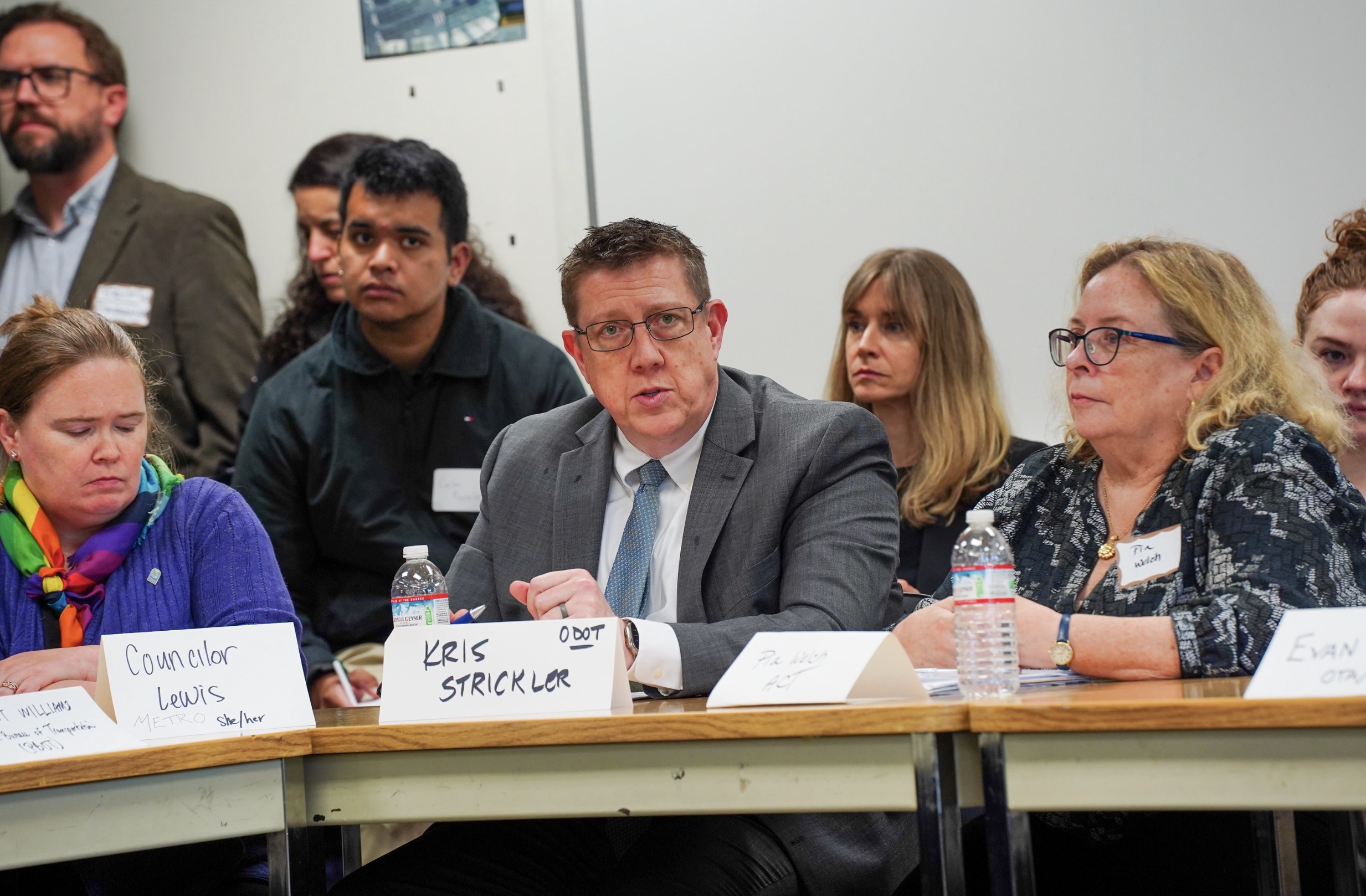
Oregon Department of Transportation Director Kris Strickler has flipped on his turn signal and will take the next offramp. The leader of the agency since 2019, Strickler announced Wednesday he’ll exit for good on January 2nd, 2026.
Texts about Strickler’s decision flew between phones of transportation advocates and insiders last night, many of whom see him as just the latest high-profile leader to jump from a sinking ship. As I reported last month, agency leaders have been fleeing faster than drivers can fill up a new freeway lane. Strickler leaves ODOT as it tries to heal from scars of a brutal legislative session, years of funding uncertainties, project delays, cost overruns, and an embarrassing accountability audit released back in May.
When Strickler assumed the director role in 2019, things looked rosy by comparison. ODOT had money in the bank and a clear roadmap on how to spend it thanks to the the $5.3 billion transportation package passed in 2017. The same week Strickler was named ODOT’s new leader, the agency launched an ambitious effort to reduce congestion by expanding freeways in the Portland region. Initially called the Office of Urban Mobility & Mega Projects and later changed to the Urban Mobility Office (UMO), the new Portland-based office was created to ensure ODOT could deliver what they knew would be three very controversial projects: a new tolling system and two freeway expansions on I-5; one at the Rose Quarter and one between Portland and Vancouver.
In the six years since, the UMO has been defunded and shuttered, tolling was torpedoed by Governor Tina Kotek, the Rose Quarter is in such dire straits that Strickler’s bosses at the Oregon Transportation Commission (OTC) removed a “stop funding the project” vote from the agenda of their meeting today, and the Interstate Bridge Replacement Program (IBR) is on life support after its leader jumped ship last month and an OTC member recently logged the first ever “no” vote against it.

Even so, you’ve got to have some sympathy for Strickler. Just months after he was hired, Covid threw our state into turmoil and then ODOT faced disastrous impacts from major wildfires. After leading the agency through those disasters, more of them hit: Kotek’s capitulation on tolling destroyed the revenue stream Strickler was counting on to build megaprojects and the Trump Administration caused “confusion and delay” at the agency including a rescission of $382 million Strickler was counting on to build the I-5 Rose Quarter project.
Strickler’s life preserver was Oregon lawmakers, who promised to pass major funding for ODOT in the 2025 legislation session. In the run-up to that session, Strickler worked overtime to convince lawmakers (and the public) that ODOT deserved — and could be trusted with — a massive funding package. But even that failed. The bill Kotek ultimately signed just last week barely keeps the lights on at the agency. Despite massive increases in projects costs and inflation (and a false narrative from Republicans that it’s massive) the total funding is over one billion dollars less than what was passed in 2017.
And it must sting that the paltry revenue lawmakers were able to raise for Strickler’s agency is still somewhat in limbo as hundreds of signature gatherers fan out across the state as I type this, eager to refer the increased taxes and fees to the ballot and use the issue to boost Republican chances ahead of next year’s gubernatorial election.
Before he came to ODOT, Strickler spent nine years working on the Columbia River Crossing project, the precursor to the IBR that shares not only many of its design elements, but also its unfortunate distinction as a project that spent hundreds of millions on consultants and planning without one shovel pressed into the dirt. That’s 15 years focused on one project that still might never be built.
Maybe Strickler just got tired of not winning.
Maybe Strickler’s exit and the horrible condition of ODOT he leaves behind will finally shake things up. Maybe the OTC and Oregon lawmakers will wake up and take our state’s approach to transportation in a very different direction — one that stops chasing freeway expansion megaprojects as a solution to climate change (which is what Strickler believed them to be) and one that ends the bottomless pit of taxpayer dollars going to consulting firms who benefit from making projects as expensive, expansive, and extensive as possible.
Oregon needs to build more, not bill more.
Now Governor Kotek has an opportunity to heal her wounded transportation legacy by picking an ODOT director that is humble enough to change the status quo and courageous enough to create a new one.

Thanks for reading.
BikePortland has served this community with independent community journalism since 2005. We rely on subscriptions from readers like you to survive. Your financial support is vital in keeping this valuable resource alive and well.
Please subscribe today to strengthen and expand our work.
Kinda surprising Strickler gets such a bad rap around here. Perhaps he’s our Manchurian Candidate: during his tenure there was relatively high investment in bike ped (gorge trail, corner ramps, for example), transfer with $ of 82nd Avenue, death of i205 expansion, no progress on Boone Bridge freeway expansion, potential death of RQ and IBR.
I know it’s a bit tongue in cheek, but he was brought in to ODOT build the HB2017 freeway expansion projects we all hate and, at least right now, we’re further from building them than any time in the last decade.
Jonathan, you may have a quote for the ‘ages’: “Oregon needs to build more, not bill more.”
It’s more likely that Governor “More-Lanes” Kotek fired Strickler due to his failure to rapidly build-out the freeway projects she prioritized. Can’t wait to see what kind of SUV-brained apparatchik she hires to run ODOn’T.
Readers of the Bike Portland comments section knew this was inevitable : )
No doubt some BP readers knew it, but I suspect that most of those readers hoped the IBR would fail but feared it would not.
Kris on a Bike, they’re skedaddling ODOT as fast as they can now.
If this mix of dysfunction and abandonment from the highway-building state monolith means the freeway expansion may very well be in irreversible freefall, then it’s a welcome sign.
I really hope Kotek appoints somehow with a more holistic view of transportation and evolves the department from its highway roots…but I’m not optimistic. Hope to be surprised!
Here’s hoping one of these jumpshippers has a come to the lord moment and does an interview esposing induced demand, etc.
Actually, Oregon needs to build less, a lot less, and do a better job on maintenance and prioritize moving people rather than vehicles.
Oregon’s population will continue to grow (even as Portland’s fluctuates) while the real value of gas-tax revenue will continue to decline due to inflation and e-cars, so the state legislature needs to take a more realistic approach to its current failed policy of trying to build its way out of congestion.
First, it needs to reduce posted speed limits on all its highways and interstates – and drastically reduce lane widths to help get drivers to drive slower – ten-foot wide lanes should be the norm, not the exception. The state needs to work within their existing budget, not figure out how to raise more revenue in an uncertain political environment.
Second, it needs to repair existing road surfaces and bridges as needed. The old bridges crossing the Columbia River need to have their supports upgraded for earthquake resistance and need repainting (hot pink or neon green would be my preference) rather than replaced with something that no one can afford – already the state has spent far more on studies than the actual cost of basic upgrades.
Third, it needs to embrace congestion and encourage drivers who are passing through to actually visit the state – reduce lane widths, eliminate interchanges and ramps whenever possible, deliberately add bottlenecks at commercial corridors, expand safe bicycle and pedestrian facilities and crossings – and encourage drivers to seek alternative transportation modes such as rail, bicycling, scooters, and so on.
Yes I hear you on that David. But when we have megaprojects that are fueled by greed and hubris, instead of actually just building something – like the IBR, where we actually could use a new bridge but they want 5 miles of wide freeways – I think we do need to build more.
And “build” here could be seen as a metaphor for just doing more and talking/billing consultants less… Whether that be putting the money into more maintenance or building bike paths, etc…
JM, I currently live in a state (and city) that does a lot less “community outreach” and has much fewer community meetings, open houses, etc than I remember in Portland (we are lucky if 5 people show up), and yes, they do in fact build more, a lot more, too much really – our state DOT just finished a 20-year $1 Billion complete bypass around our 300,000-person city – yet we have sidewalks and public transit for less than 50% of the city, and our bicycle infrastructure is abysmal (but better than most of the state outside of our 2 largest cities).
One major difference here and in nearby VA and WV is that back in the 1930s the state highway departments merged with the county road systems so that nearly all rural and most suburban highways are state-owned highways, even many collector and arterial streets in most cities, along with the tax base. They not only have more roads to maintain but also more money to move around and greater economies of scale – so that rural areas still have crappy roads but the urban areas are way overbuilt. Along with the usual highway funds (gas tax, vehicle registration, weight-mileage tax, etc), our state has a 2% sales tax on food including staples like milk and eggs, that goes entirely for state highway construction. On top of that, our state construction costs are well below the national average, unions are banned for government employees, environmental regulations are lax, and since we are a famous “swing state”, our notoriously gerrymandered congressional delegation never has any trouble getting extra federal funding. NC with just 10.5 million residents has the second largest state highway system in the country – only Texas is larger – and they keep building more.
COTW. Public involvement is important and shame on any public agency that doesn’t have a public involvement process for projects. However as someone that works on transportation issues at a statewide and national level I can tell you that the left coast in an outlier on public involvement for all the wrong reasons. When you spend 15 years trying to replace the last remaining bottleneck on the interstate system (CRC 1.0 then CRC 2.0 now IBR) blowing through hundreds of millions of $$$ with nothing to show for it then your public involvement system is broken. Drawn out public involvement processes that last years and years instead of months is draining $$$ at an alarming rate for all public transportation agencies in OR, WA & CA.
blaming these megaproject failures on public involvement is interesting. I might agree with you to a point, but it’s not as if “the public” is forcing this to happen. Who’s demanding such drawn-out public process? Maybe it’s happening because these projects are too big and there is too much of a bias toward process because there are many millions of dollars to be made by consultants and agency staffers who work on public process. We need a set of policies that penalizes agencies for missing deadlines. Perhaps a policy like that will make agencies think twice before they try and get greedy by making these projects way too big.
Put another way, if ODOT/WashDOT would have found a way to just replace the g-damn bridge and not get so excited about expanding 5 miles of freeways, the public process would have been relatively short and sweet and the bridge would have been built by now. Buck stops with the agencies.
I hear you JM. I just think of the I-205 Glenn Jackson Bridge constructed in 1982 at a cost of $170 million ($570 million adjusted for inflation in 2025). ODOT & WSDOT were able to get it done without a long drawn out public involvement process where every stakeholder wanted their way. Yes it was a different time back then. I grew up in Portland in the 1970’s & 80’s as I-205 was being constructed. But even then I-205 was constructed with a MUP across the Glenn Jackson Bridge which was ahead of its time so something must have worked in the public involvement process. Now we spend years and years trying to get everyone to agree in a day and age where society can’t agree as a whole on almost anything that’s supposed to be for the public good. IBR has been a colossal failure on so many levels and there’s plenty of blame to go around. Yes it’s the public agencies of ODOT & WSDOT but it’s also elected officials, its stakeholders unwilling to compromise, and it’s a public involvement process that drains $$$ and lasts for years waiting for everyone to sing in harmony around the campfire.
Public process is part of a set of trade-offs. The longer processes on the left coast often delay and ultimately prevent huge wasteful and unnecessary projects such as the Mt Hood Freeway, CRC, and so on, but they come at a cost of also delaying needed small projects as well – and one person’s wasteful project is another person’s needed project of course.
Our lack of local public process here in NC has resulted in a lot of nearly empty freeways and stroads, devoid of any sidewalks and bike infrastructure of course, and huge future repaving and replacement costs “down the road” (life-cycle costs), as our high summer heat and humidity tends to more quickly erode asphalt. We also build “complete streets” with 5-foot sidewalks plus painted 5-foot bike lanes on 45 mph stroads, and realize even as it’s being built how incredibly dumb, dangerous, and arcane the project is, yet no one can change it.
The MUP on the Glenn Jackson bridge was a federal requirement, not the product of public involvement. The design of the MUP as a median is an indicator of how poor that process–and any consideration of other modes–had been.
No, the buck stops with the politicians who set policy. The continuing belief that ODOT, WashDOT and even PBOT are these rogue agencies is detrimental to instigating any actual change. The agencies are extensions of the executive and legislative branches and are following official and under the table policy.
Having driven from Portland to Salem during peak hours, I am quite certain that the bridge across the Columbia is not the last “bottleneck” on I-5. I wish proponents would explain the necessity of the project in more precise language, including why it matters to the system as a whole.
If ODOT created a project to fix the bridge without all the associated highway widening, it would have been completed years ago.
Exactly. The last remaining bottleneck? What a crock.
If I-5 is there mainly to move traffic up and down the coast, then the Glen Jackson bridge is the fix for that “bottleneck” that has been in place for decades. Unfortunately there are about a dozen interchanges on I-205 between Tualatin and the bridge over the Columbia. We can’t build our way out of this.
If we’re going to use private cars on freeways as the technology for fast long distance travel we have to optimize them for long stretches of consistent flow instead of for local connectivity.
No one wants to just fix or even replace the bridge except for us powerless citizens. The distributors of public money want to funnel money to their supporters, it’s a multilayered machine that’s not going away anytime soon as long as Oregon, Washington and Cali remain single party states. The end results are secondary as to whom the money goes to. Say no to gerrymandering and speak out for complete redrawing of the states from scratch!!
I work for a consulting engineering firm and by and large we do great work . I keep reading article where the blame goes to the consultants- this is so
misplaced. I’ve worked with ODOT for nine years as a consultant (along with other public agencies). The overruns lay on the agency’s shoulders- they have a horrible time making critical decisions and staff are paralyzed up and down the agency. Yes, consulting firms charge overhead and profit and I’m happy to agree that they are capitalists. Agencies could do these projects in-house but with benefits and pensions the price tag wouldn’t be smaller. Consulting firms do not dictate the scope of projects- agencies do. Consulting firms are not the decision makers.
These are mega projects and the U.S has political issues with delivering these projects across the country. It’s not the consulting firms, it’s our political landscape.
Hi JC,
Points taken. I appreciate you sharing that. You know the inside workings better than I do. My feelings come from seeing the revolving door from gov’t to consulting firms and it doesn’t look good. Like Greg Johnson at the IBR and the huge role he had w WSP – a firm getting massive contracts for that same project!
But yes I agree the buck should stop with the agencies. I’ve thought for years now that mega projects are simply undeliverable in the modern era and we shouldn’t even try them anymore. We shd build more smaller projects it seems, and break larger ones up into more manageable parts.
Thanks again. I’ll take your points about consultants to heart when I write abt this in the future.
Thanks for the reply, Jonathan. Yes, there is a revolving door- I see it more as we live in a small state and the number of people in the field at that high level are relatively small- but I understand your point. Re: Megaprojects- they can happen and happen in other countries. Breaking them apart will make the projects longer and more expensive- look at the Abernethy Bridge. ODOT is widening that Bridge with no funding or plan to complete the other phases of the parts. We are widening the bridge to nowhere. My view is that if you want Megaprojects, you have to push them through and stay committed. That said- I’m no fan of the current ODOT Megaprojects- except the I-5 Bridge. Sad we can’t get things done.
Great perspective JC. Thanks for sharing. Do you have any perspective on the old CSA, and the move to make a local-access bridge and HSR bridge?
One of the criticisms of the CRC and IBRP was its inflexibility in dealing with local traffic and anything other than cars. Requiring everyone traveling across the river, regardless of trip distance or mode, to merge with interstate car traffic, is poorly thought out. It’s this basic and inflexible assumption (among others) that leads the massive and unnecessary freeway expansion and the majority of the cost of the project.
Joe Cortright highlights the Brookings findings that consultants are more expensive than in-house staff. That’s not to blame the consultants, just to note it.
“a recent study published by the Brookings Institution did exactly that. It found that one of two key factors explaining high costs was excessive reliance on consultants.”
. . there is broad agreement that state DOTs have become more understaffed and that reliance on consultants drives up costs. Survey respondents attribute a lack of details in project plans to both a lack of time or experience of DOT engineers and the use of consultants. When there is not enough specificity in the plans the risk to the contractor increases, increasing bids. Moreover, whenever the scope of a project changes this initiates a costly and time-consuming renegotiation process. Survey respondents agree that such changes are a major contributor to costs.
States that flag concerns about consultant costs have higher costs—a one standard deviation increase in reported consultant costs is associated with an almost 20% increase ($70,000) in cost per lane-mile. States where contractors and procurement officials expect more change orders have significantly higher costs: one additional change order correlates with $25,000 in additional cost per lane-mile at the mean.
Frequent change orders could directly lead to higher costs through delays and costly renegotiation; they could also be a downstream symptom of poor administrative capacity at a state DOT—many contractors reference poor-quality project plans made by third-party consultants. . . . A lack of capacity at the DOT can hurt the quality of project plans, either from under-staffing in-house or from outsourcing to consultants with limited institutional knowledge and misaligned incentives.
Zachary Liscow, Will Nober and Cailin Slattery, Procurement and Infrastructure, July 11, 2024, Brookings Institution.
Thanks, JaredO for the response. I agree with your point and the reports points overall. Agencies should not have skeleton crews and primarily rely on consultants. They should have more staff in house. However, in this political climate it seems unlikely and it can take years and years to grow a workforce.
If ODOT would eliminate the cover on the Rose Quarter project and remove light rail from the IBR project, both of these projects could be built at significantly less cost. If Trimet wants a bridge to Vancouver they need to convince voters to fund a separate one. But this will never happen because the people of Vancouver don’t want light rail.
Also if the IBR project eliminated cars and trucks, it would be cheaper.
Let me try that again for you: If ODOT would not try to massively widen the freeway in RQ (permanently sentencing the east bank to carshittery) nor try to turn the IBR bridge replacement project into a freeway expansion project, both of these projects could be built at significantly less cost.