

Hi friends (and everyone else).
10 days post-surgery and I’m still just slogging along. The silver lining of my leg not feeling super good is that I don’t really go anywhere or do much, so I had a lot of time last week to follow the transportation bill shenanigans. I’m really hoping I make good progress this week and feel good enough to be at Bike Happy Hour on Wednesday. In fact, I’m committing to that right now: I’ll see you in the plaza on Wednesday! We’ll unveil our new banners and pass out our new, 20th anniversary commemorative stickers!
Here are the most notable stories that came across my desk in the past seven days…
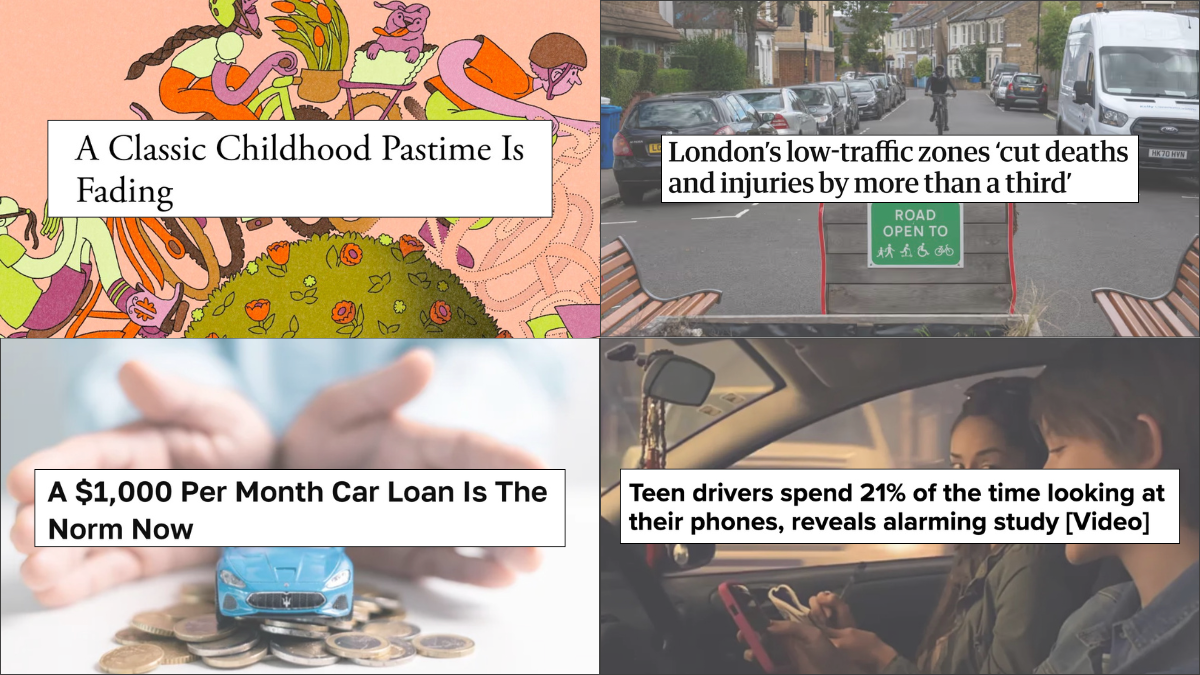
You missed something: It’s unfortunate that this mainstream article on the decline in children riding bikes doesn’t mention that huge trend of bike buses that’s sweeping the country and the urgent need for more of them to counter the historical downward spiral. (The Atlantic)
Are roads getting safer? Maybe it’s just a statistical anomaly, but it’s curious that New York City is seeing the same type of dramatic decline in road deaths so far this year that we’re seeing here in Portland — where fatalities are about 50% less than they were last year at this date. (New York Times)
Fewer cars, fewer dead people: A new study in London found that hundreds of lives have been saved thanks to the implementation of Low Traffic Neighborhood (LTN) streets, which are similar to Portland’s neighborhood greenways. It’s almost as if when you reduce the presence of cars, fewer people die. What a radical concept!! (Guardian)
Big, beautiful silver lining: A tiny provision in Trump’s budget bill that claws back the Reconnecting Communities grant program has very likely imperiled the future of the I-5 Rose Quarter project. (City Observatory)

Bicycle mayors: A network of bicycle mayors is a brilliant program that helps connect advocates and cycling ambassadors in cities around the world. (Reasons to Be Cheerful)
Distracted driving: I don’t even know what to say anymore when I read, “A alarming new study has found that som teen drivers in the US spend as much as 21% of their time at the wheel looking at their phones, creating a substantial risk of distracted driving crashes.” (9 to 5 Mac)
Tragic turns: We’ve all heard about the idea of banning right turns on red signals, but there’s also a strong case to be made that prohibiting left turns wherever possible could save lives as well. (The Conversation)
Out of reach: New figures show that nearly one in five Americans now have a monthly car loan that is $1,000 or more — which makes it all the more heartbreaking that we are still not investing in transit and other non-car transportation to the extent we should. (Jalopnik)
Thanks to everyone who sent in links this week. The Monday Roundup is a community effort, so please feel free to send us any great stories you come across.
Thanks for reading.
BikePortland has served this community with independent community journalism since 2005. We rely on subscriptions from readers like you to survive. Your financial support is vital in keeping this valuable resource alive and well.
Please subscribe today to strengthen and expand our work.
Fewer cars…: London’s LTNs are “…using filters to STOP through-traffic by motor vehicles”. Portland’s greenways aren’t that similar, since their main physical characteristic is the speed bump and model filters are only sporadic. Rare in fact. A motor vehicle operator can travel on, or cross, a Portland greenway and be unaware that human power is preferred in that area. You could make a case that private vehicle storage is the preferred activity on greenways and other bike routes since car parking is allowed and fostered at the clear expense of safe human travel.
Low traffic, fewer stop sign bikeways are the best streets to drive on!
It would be great if PBOT adopted the LTN concept and implemented it with more of the concrete planters that started popping up a few years ago. There are many neighborhoods where the addition of a simple diverter would greatly reduce cut-through traffic, and improve safety and livability for local neighbors. When will we get more diverters?
The numbers in that Jalopnik article make me explode with dread. The average new car loan in the country is 70 months at 7.2% APR on $42,400. $750 a month. On average!
I just cannot comprehend spending that kind of money on a car… it makes no sense financially. It’s a depreciating asset, and a six year loan for something that will be worth well under half of what you paid $50k+ (after interest) on. Just why? Why would you do that? It feels like the average person in this country is a layoff away from immediate bankruptcy. Feels like a miserable way to live, and while yes, some of it is beyond people’s control, some is well within our control. No one needs a tripped out new car. Cars, as they are sold now, are luxury goods with a bit of transportation utility tacked on as a side effect. And reading about other people’s car loans makes me so incredibly happy that my total yearly transportation bill (with a serviceable car mind you) is like one of their monthly payments.
Our society is deeply, maybe unalterably sick. The fact that people literally light money on fire to not ride public transit blows my little #14 booster mind. Every time I ride the bus to serve my needs, I think “wow, what a good deal this is, I’m so glad enough people live close to me that our local transit agency feels the need to run lots of buses”. I would seriously never live in a place where I couldn’t do that. Never! You want me to sit in traffic behind the wheel of a car? I would rather jump in a bit of snakes. Plus, I can ride my bike to get groceries from the eight different stores within a 15 minute ride. And before you say “rich yuppie”, I’ll just throw out that my rent (~$1,550) is well under the 80% AMI limit for a one bedroom in Portland ($1,775).
I just feel like I do not understand the reality most people live in. I cannot understand why you would jump into deep financial precarity for a nicer car. It just does not compute.
Not everyone believes you have to apply business principles to things we buy. I buy something because I need it, not because it’s going to be worth $X at some future date. Things I’m done with, I donate. I never resell.
Full disclosure, we just bought a new car with a payment of over $1,000. I could care less what it will be worth next year, or the year after, or the year after that. All I care about is using it for travel, which we have already to several states.
We never make decisions in our house that would put us in financial precarity, so for us, it’s affordable.
I know just crazy!
I can’t speak to your financial situation, and won’t attempt to. But taking out a $1,000/month loan on a new car and not caring what it’s worth at the end of the term literally does not make sense to me. So you get $1k/month of value, but like how can you not look at the interest over the life of the loan and think “wow I could save a lot of money by buying a decent used car in cash”? I don’t think there’s any amount of money I could ever earn where I would feel comfortable doing what you’re doing, which probably says more about me (a weird frugal 20 something) than you (someone with a roughly average car loan)
Not everyone can spend $1000 on a new car (plus insurance, parking, gas, and other expenditures) and also have the luxury of giving it away for nothing when they’re done with it.
Ever get the vague impression some folks might not be as well off as you?
The fact that you can justify a car loan payment of $1,000 per month and not end up in financial precarity suggests you have no idea how most people’s finances actually work.
So utterly unbelievably accurate. Though I am agreeing from the other side of the equation, with two new cars this year, even basic versions from Toyota come with so many features, sensors, cameras, and “improvements” that will one day break and my guess is the car won’t run at all. Unlike my first car, a 1989 SAAB (not exactly known for reliability), that I drove for 3 years without 4th gear.
Not that you asked, but to provide some context, we have a family car and I have a truck. We have 5 kids, 3 of whom are in weekly activities in disparate locations. I travel frequently for work and the quality of Ubers has gone downhill dramatically in the last year, so I got tired of a sketchy ride at midnight 35 mins from the airport. I don’t think of either vehicle as an asset, they are completely a liability, but the flexibility they provide is beyond what transit could ever provide. Unfortunately that comes with a cost that for many is probably much more than reasonable.
Yeah the cherry on top of all this is that all the new features driving the higher costs come with software locks intended to milk owners dry to access features shipped in the car. It’s a bad deal on both ends.
I was being a bit annoying about the “luxury good with transportation utility tacked on” line, even if I think it’s partially true. If I was in your situation, I imagine I’d have a similar car situation too.
This reminds me of one bit of very-online-discourse I’ve noticed: all the memes of Madison Avenue style happy 1950’s families (white, father/mother/two kids, nice car, bungalow), with a quote like “it used to be possible to live like this on one income.”
It’s become common for economically literate commenters to point out flaws. The images are derived from advertisements, don’t really apply to Black people or people from Southern Appalachians, the car had no seatbelts (unsafe), no catalytic converter (toxic pollution), terrible fuel efficiency, the house was 800 square feet, they had no tv, the family got to eat out a few times a year, and none of them had ever been on an airplane.
It’s not that the image is untrue, it’s just that the happy smiles only tell us a partial truth.
Furthermore, if you wanted to live in an 800 square foot house in, say, Ohio or Illinois, drive an old beater, and eat out a few times a year, you probably could do that on a single income!
But most people want modern lifestyles, so the comparison is apples to oranges!
Expensive cars are part of this problem. People will complain all day about the expense, but they feel like it’s necessary to get a loan to have a nice, new car. It’s just not!
Such an excellent point. In 1950, the average new size of a new home was under 1,000 sq ft and you’d expect a single vehicle per family at best. Today we’re around 2,500 sq ft for a new home and a lot of households provide a car for every driving-age person in the family. The concept of “standard” in America has ballooned so much that we feel like we’re suffering under the same conditions that once constituted privilege.
A corollary is that continuously growing levels of consumption do not lead to widespread human satisfaction, which is something the ‘abundance,’ ‘YIMBY,’ and other pro-growth prescriptions often fail to account for. Maybe we have grown enough and need to learn how to get along with each other at current (or lower) levels of per capita consumption. Poor people are just as miserable today, but they have many more cars, TVs, cell phones, etc. compared to days of yore.
cotw
I’m lucky enough to not own a car. When walking over a freeway, looking down at the traffic traveling 70mph, or sitting still, trapped. It all looks insane. Plus, as you pretty much indicated between the lines of your comments, going carless is good for emotional health, I will take all of that I can right now.
On the other hand, it really is nice to be able to get out of town easily.
People in more civilized countries use things called “trains” for that purpose.
We all saw this coming. They will cram through the freeway widening and we won’t get the covers.
Out of reach: New figures show that nearly one in five Americans now have a monthly car loan that is $1,000 or more
Not exactly accurate… the article states that one in five new car buyers takes a monthly loan of $1k or more. Thankfully this is much lower than 20% of the population!
Teens shouldn’t operate dangerous machinery, period. Let’s raise the driving age to 21 and lower the drinking age to 18 while we’re at it.
I just did some napkin math and the entire cost of my bike stuff from 2011-2025 is equal to about $23 a month. The car is probably more around $150 because I drive a POS paid off used light truck. Which I fully resent needing to do, of course.