
PSU and Metro study shows active transportation investment helps the economy

“Projects are more likely to reach their full potential when they reduce the effects of an auto-oriented environment.”

The PSU and Metro study looked at 12 projects spanning the Portland metro area. (Graphic: Metro)

Have projects funded with Oregon Metro’s Regional Flexible Funds provided an economic return on investment? In partnership with Metro, Portland State University researchers embarked on a study to find out, and analyzed 12 of these projects funded between 2001 and 2016 to evaluate if they had “significant effects on the local economy.” The results, released last month, confirmed what transportation and safe streets advocates have long been saying: when an area is safe for people to walk and bike in, they’ll feel more comfortable spending time – and money – there.

Researchers evaluated projects in Portland as well as smaller cities in Clackamas, Multnomah and Washington counties including Milwaukie, Oregon City, Gresham, Beaverton, Cornelius, Forest Grove and Tigard. Most of these projects focused primarily on improving conditions for people walking by widening sidewalks, making crossings safer and adding landscaping, lighting and public art, but some included bike infrastructure upgrades as well.

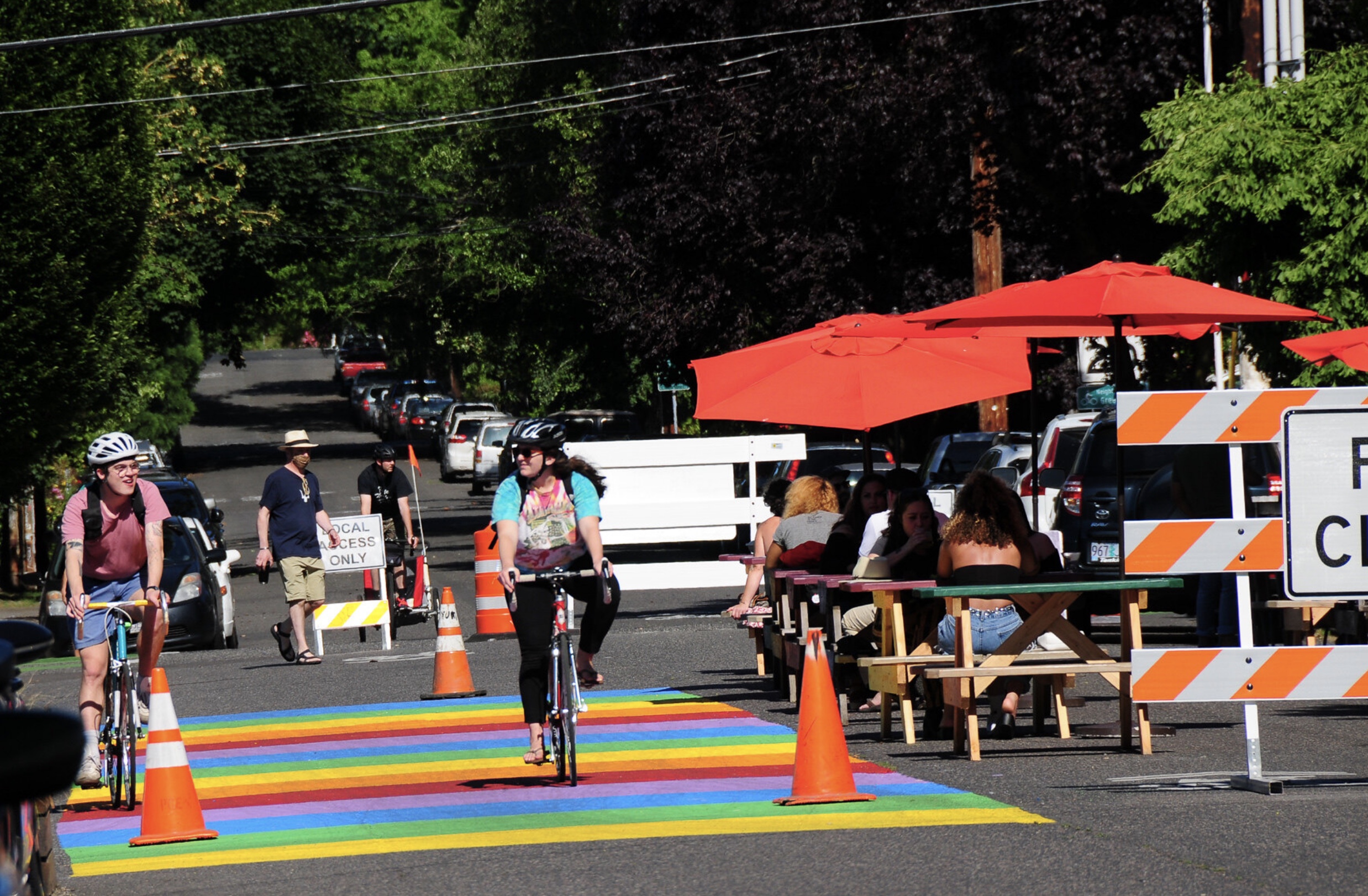
The active transportation improvements on Division St have made it safer and more appealing for people to walk and shop at local businesses.

These projects are part of Metro’s 2040 Growth Concept, the long-range plan for the region’s infrastructure. Analyzing the benefits of these projects to “clarify the relationship between these investments and economic activity” is important for determining which investments Metro should make going forward.

“One of the most important outcomes of the study is informing the region’s decision makers, business owners, and the general public in the recent public comment period for Metro’s Regional Flexible Funding Allocations (RFFA) for transportation projects. With 29 project proposals on the table, it’s important to have the context and data on what has been effective in the Portland region,” the report states.

PSU researchers used quantitative and qualitative methods to measure these 12 projects, which were chosen based on similarities making it possible to compare them. According to the PSU and Metro report, 75% of the project locations “saw measurable economic gains in the food or retail industries after implementation,” with the greatest benefits occurring in places with multiple complementary transportation investments, like layering a new light rail stop with nearby crosswalk enhancements. But in order to see the most improvement, projects need to explicitly tamp down on local car traffic speeds and volumes.

“Projects are more likely to reach their full potential when they reduce the effects of an auto-oriented environment and create places for walking that are also less stressful and more comfortable,” the report states.

The majority of the projects studied had positive impacts on local retail and food businesses.

One Portland project researchers analyzed is the SE Division Streetscape Project, which was completed in 2014 and included landscaping, transportation and general street improvements on inner Division St to “create a more pedestrian- friendly, economically vibrant, and environmentally sustainable corridor.” Though people surveyed would still like further improvements on inner Division, especially to make it safer to bike, researchers found this project was overall successful and “created favorable conditions for developers creating a high-density residential area and developmental sector and turning Division into a destination street and restaurant district.”

Division is almost unrecognizable from its pre-streetscape upgrade days. The report quotes Chris Eykamp, the Chair of the Hosford-Abernethy neighborhood which encompasses inner Division Street, who said it’s “unimaginable” that you can now go on Division and get world-class food. Wider sidewalks and adequate crosswalk placement has made Division Street a street to casually stroll down with a Salt & Straw ice cream cone and with plenty of places to window-shop, which was not the case 10 years ago.

But the report makes it clear returns on active transportation investments are not limited to the Portland urban core. In fact, smaller communities may even benefit more from these projects. One of the places where investments were “layered” was at the Milwaukie Town Center with a project to connect the Milwaukie MAX station with Main Street and South Downtown Plaza in order to “help restore the Milwaukie historic downtown as a vital town center, strengthen the retail character of Main Street, and create a flow of pedestrian activity.”

People the researchers surveyed responded positively to these upgrades, with one respondent saying “downtown Milwaukie used to be a dump and not an interesting place to walk at all” but now it “seems livelier, more like a neighborhood.” This has created opportunities for businesses to move into the area.

Active transportation investments to improve safety for people walking, biking and taking transit are important even if they don’t provide measurable economic benefits. However, money can perk people’s ears faster. Local policymakers hesitant to support active transportation projects may be lured by the prospect they could bring economic benefits to an area, which will be especially appealing in the wake of the pandemic that devastated small businesses across the region.

“While this report only explores the effects of active transportation infrastructure on business trends, we are currently developing methods to help us measure other ways that active transportation infrastructure impacts the region by quantifying things such as travel cost savings and health benefits,” the report says.

You can check out the full report, which details the methodology and describes more case studies, here.
Job: Kerr Bikes’ Lead Worker – Albertina Kerr / Kerr Bikes

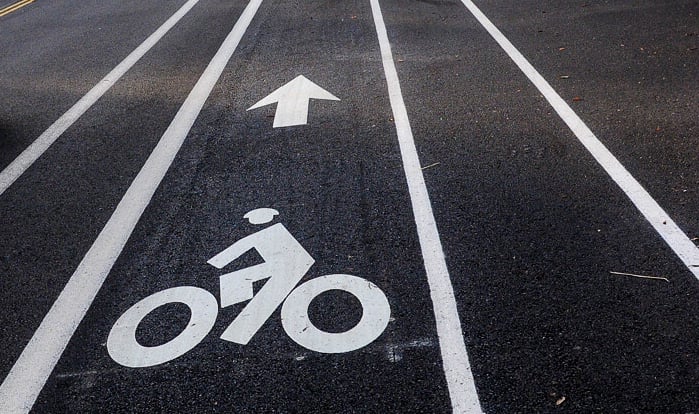
Buffered Bike Lane with a bike symbol and arrow pointing forward

Job Title

Kerr Bikes’ Lead Worker

Company / Organization

Albertina Kerr / Kerr Bikes

Job Description

Albertina Kerr strengthens Oregon families and communities by helping children and adults with developmental disabilities and mental health challenges – empowering them to live richer lives. We’re seeking a Lead Worker for our Kerr Bikes rental store. Kerr Bikes provides the public with seasonal bike rental services. The Lead Worker may supervise other Kerr Bikes employees, volunteers and participants in services we provide, and will perform maintenance on bicycles as needed. Join our team, get a $2,000 sign-on bonus!

How to Apply

Apply online at www.AlbertinaKerr.org/Careers.

Direct apply link: https://www.paycomonline.net/v4/ats/web.php/jobs/ViewJobDetails?job=61772&clientkey=542894A572AB94252AC5B03B14208AB1

Learning to ride (smarter) at a bike commuter clinic

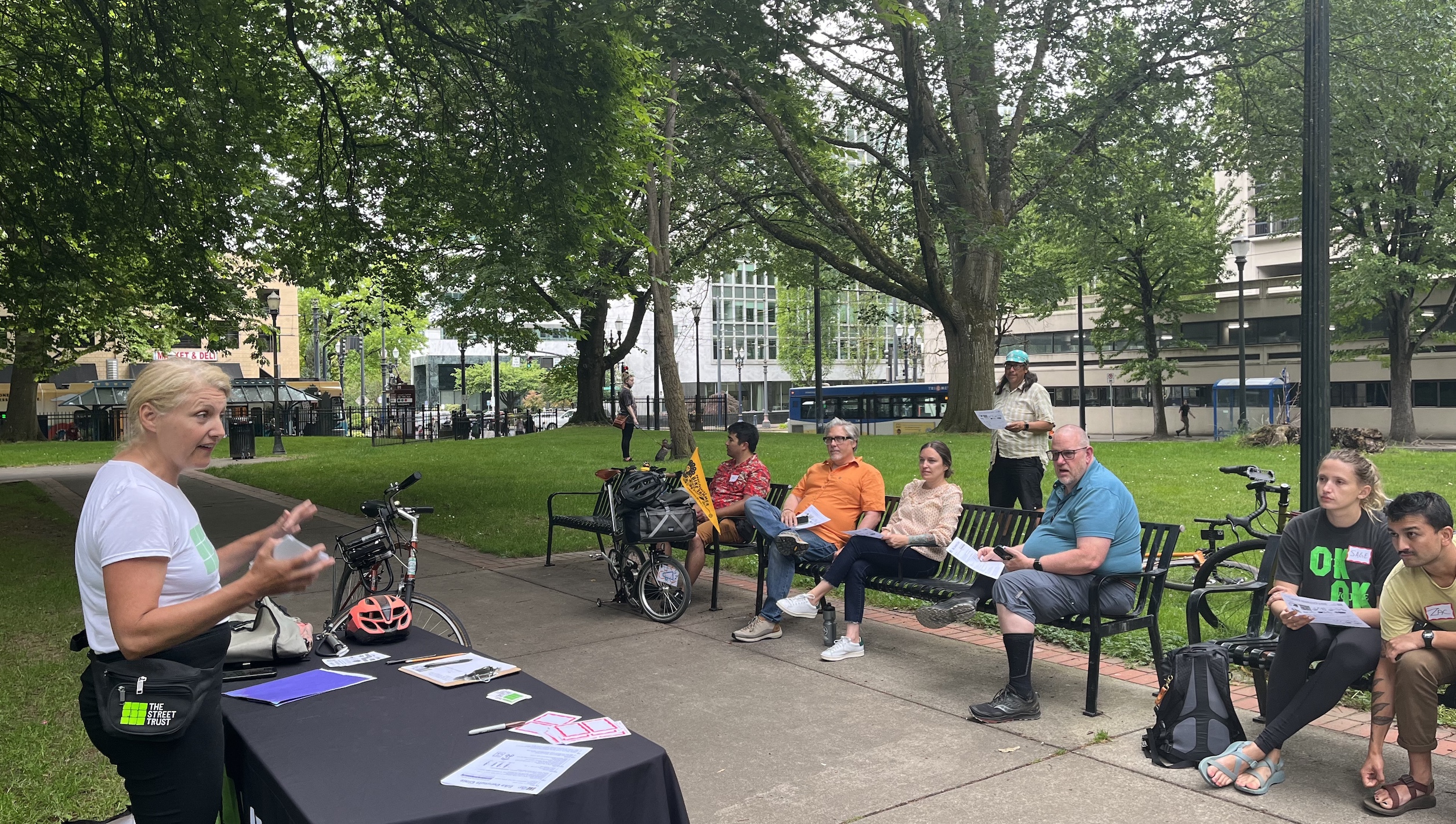
people sitting in a park listening to someone speak
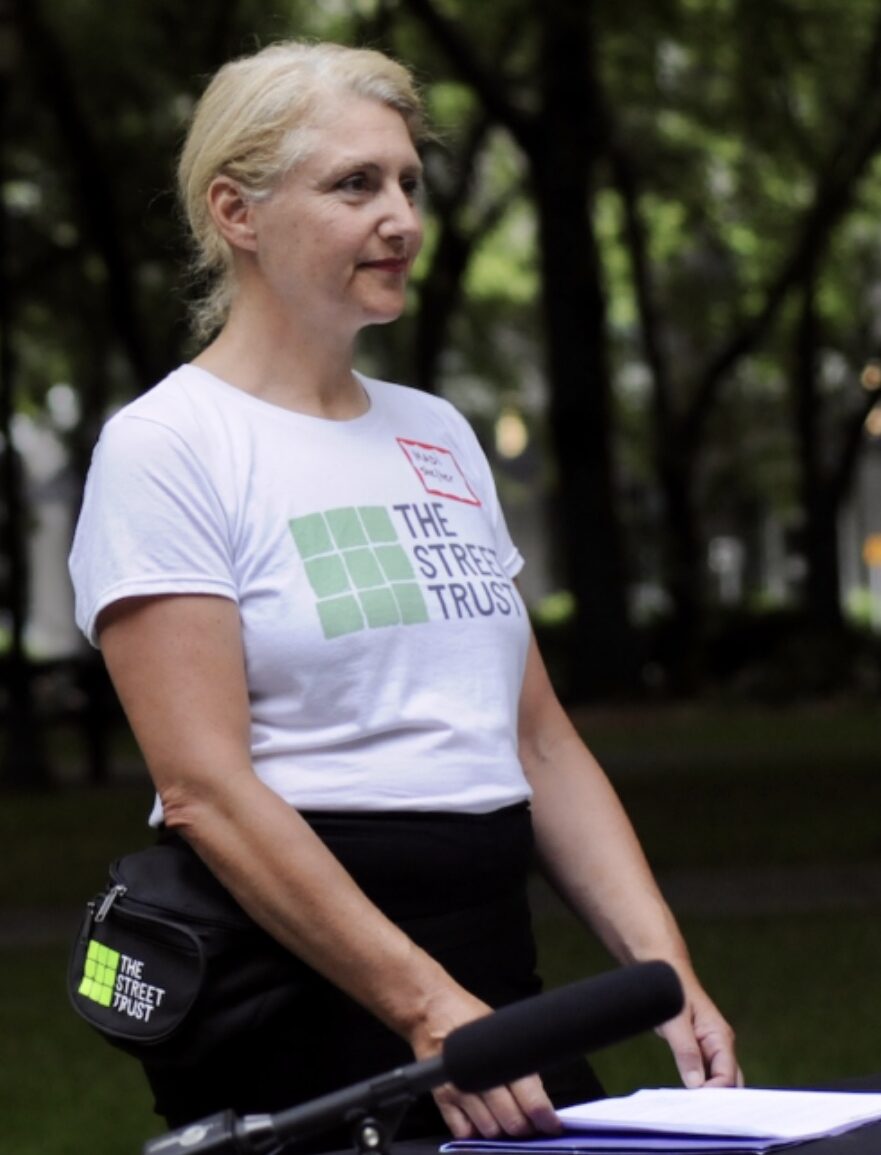
Madi Carlson with The Street Trust led a commuter clinic in Holladay Park Tuesday evening. (Photos: Taylor Griggs/BikePortland)

“There is always a new tip you can pick up.”

– Armando Luna

Portland-based nonprofit The Street Trust wants to make bike commuters out of as many people as possible, and through their clinics, wannabe commuters can get a rundown of what they need to know to start biking in Portland.

Yesterday evening, I rode to Holladay Park to attend a commuting workshop led by The Street Trust’s Community Engagement Manager (and local carfree icon) Madi Carlson. I was surprised by the range of Portland bike experience from attendees – while there were several people who are very new to the local bike scene, many people who joined the group are very regular Portland cyclists.

Attendee Matt Browning is on the far side of that spectrum – he just moved to Portland from Salt Lake City two weeks ago. Browning was excited to move to Portland, where it’s feasible and popular to commute by bike, so he could exchange his long, arduous driving commute for a short bike trip from the the Hollywood neighborhood to the Lloyd District. But he thought he could use a refresher course, so after seeing this clinic on the calendar, he decided to check it out as his first bike event as a Portlander.

“I didn’t bike regularly in Salt Lake City,” Browning told me. “Hearing the information about bike etiquette [at The Street Trust clinic] was really helpful.”

For the more experienced bike commuters in the group, this workshop was a chance to show support to people newer to hitting the pavement by bike. And, hey – who says you can’t learn new tricks?

“Even being a ‘seasoned’ commuter, there is always a new tip you can pick up,” Armando Luna, one of Portland’s most prolific cyclists, told me. “Most helpful is hearing what other riders do for their commutes. You might find out about bike lockers in your area, or a repair station you didn’t know was there. Bike info is always changing and it’s best to get it from the folks who are biking.”

My personal bike skills have mostly been acquired by trial-and-error, a tactic that certainly has its place but is best supplemented by at least a little bit of “formal” learning. But even though I have developed a method for getting around the city that works well for me, I agree that there’s always something new to pick up. If I’d heard Carlson’s advice for crossing rails perpendicularly, for instance, I might not have wiped out a few weeks ago after getting my tire stuck in the MAX tracks.

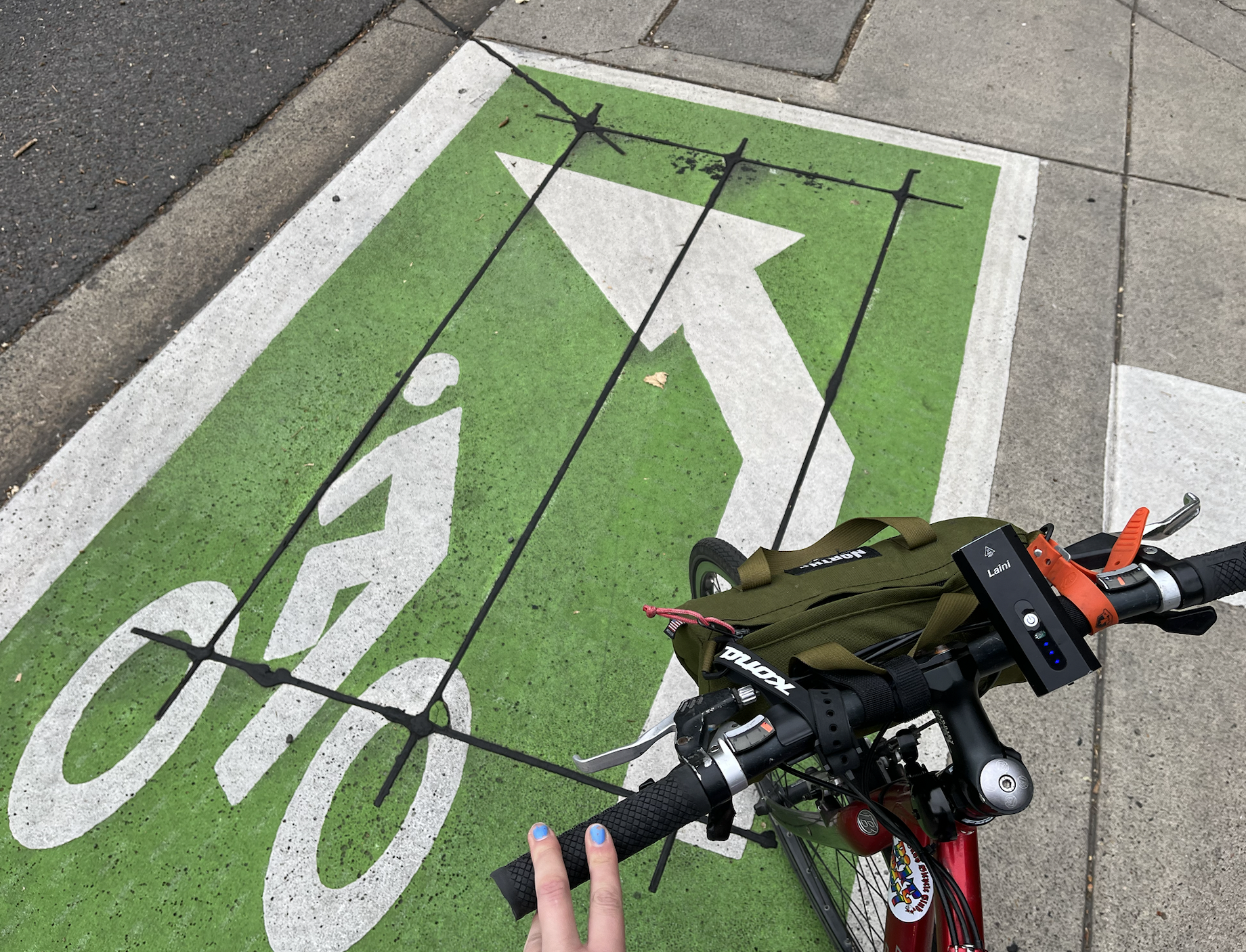
Other topics covered at the clinic included bike laws (lights aren’t just a safety precaution – they’re legally required), etiquette (use hand signals and yield to pedestrians), gear suggestions and more. It was especially helpful to hear about some of the infrastructure you might see riding around Portland, some of which took me quite a while to figure out how to use. For instance, Carlson discussed Copenhagen-style two-stage left turn boxes, which are pretty unique to Portland in North America. These help people riding bikes so they can turn left at a signal without having “take the lane” and share space with car traffic. If you see one on your route, it’s nice to know what it is and how to use it!

A bike turn box on NE Lloyd Blvd I saw on my way home from the clinic.

Carlson told me she thinks these introductory clinics are a way to inform people about the benefits and how-tos of cycling in an approachable way, and she hopes they can help some people make the switch from driving cars to work.

“In the face of rising gas prices and truncated transit service, bicycle commuting offers an affordable, accessible travel solution for all types of people. We want to support them in learning more about how to enjoy safe and comfortable bike commuting in all seasons,” Carlson said.

You don’t always get a chance to learn this directly, and when there’s an opportunity to get a lesson from the legendary Madi Carlson, I recommend you take it. Keep an eye on The Street Trust’s calendar for announcements on the next clinic.

And check out our guide to cycling in Portland from a few months ago. No gatekeepers allowed here – anyone can start biking in Portland, and the more the merrier. There are many people and groups who would love to be your guides.

Speaking of guides, browse the handy leaflets created by The Street Below for your own primer/refresher course.

Making new family biking traditions

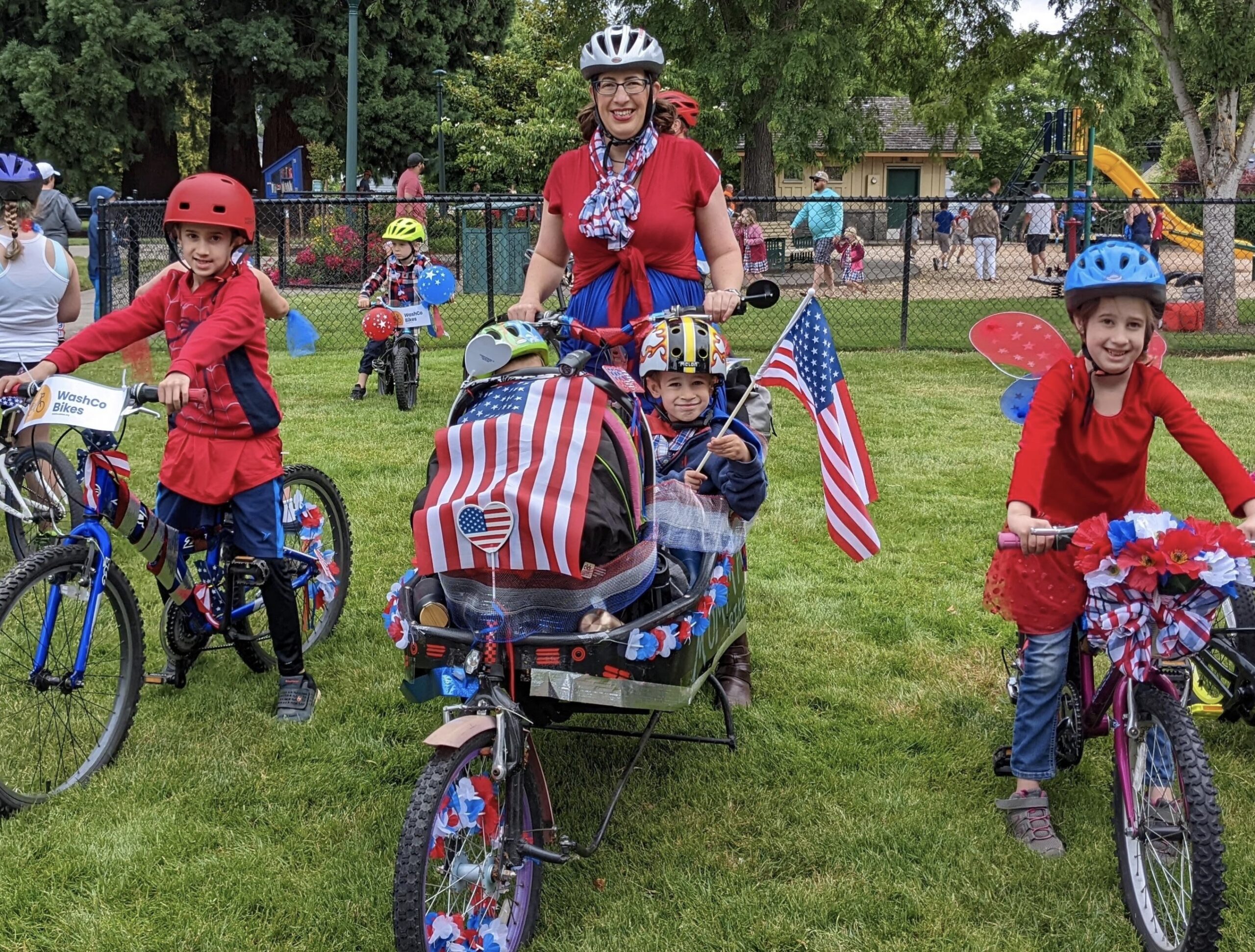
Ready for the parade. (Photo courtesy Shannon Johnson)

I love family traditions: shared annual activities and ritual ways of marking the holidays. There is something soothing about the repetition of the seasons and their celebrations. Children especially look forward to these cyclical festivities. 

As we grow together, we continue to build our repertoire of family feast days and bolster our favorite celebrations with new activities as children grow older.

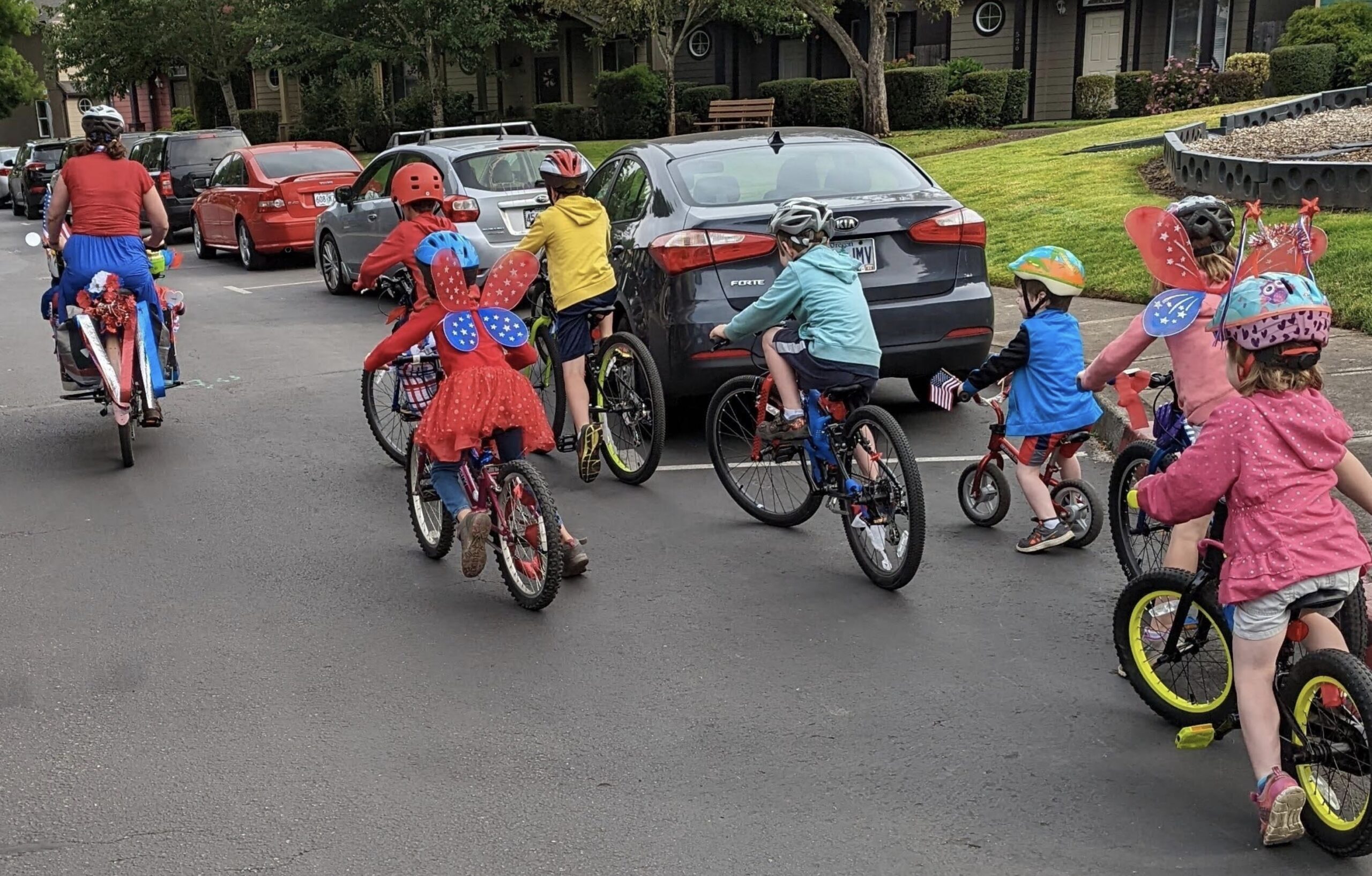
Now that we are a “biking family,” I can see new biking traditions riding their way into our lives, happily taking their place alongside old favorites. This Fourth of July we rode together in Hillsboro’s pre-parade bike ride, hosted by our local nonprofit WashCo Bikes. The carfree parade route makes for a fabulous family bike ride. For even more fun, riders are encouraged to decorate their bikes and dress for the festivities, which we pulled off last minute…I think we began decorating bikes at 10pm the night before, and raiding closets for red, white, and blue garments and accessories.

In the end, I was thrilled with the result. We and our bikes were all gussied-up for a jovial celebration. It was our first group ride too, and we had a blast while knocking multiple items off our Biking Bucket List (first group ride, and decorate bikes for maximum fun). 

We turned a lot of heads on the cargo bike, which is still a rarity in the U.S., outside of downtown Portland and a few other locales. I love showing people what cargo bikes make possible: big families can ride bikes too! It’s possible to keep riding with young children and even babies — even for an out-of-shape Mama with lots of little ones. And contrary to the expected norm, there is a life that can be lived outside of a minivan stuffed with car seats.

Our Fourth was full of parade candy, picnicking with friends, singing patriotic songs, twirling sparklers and watching fireworks. We’ve done all those things before; but this year we added a new tradition with the pre-parade bike ride, which was easily my favorite part. According to my kids, it was “the best Fourth of July ever!” And my little four-year-old hopefully exclaimed, “I hope we can have a Fourth of July again someday!” Indeed. Just 364 days from now.


Read more from Shannon’s Family Biking Column here.
A quippy slogan has galvanized the ‘ban cars movement’

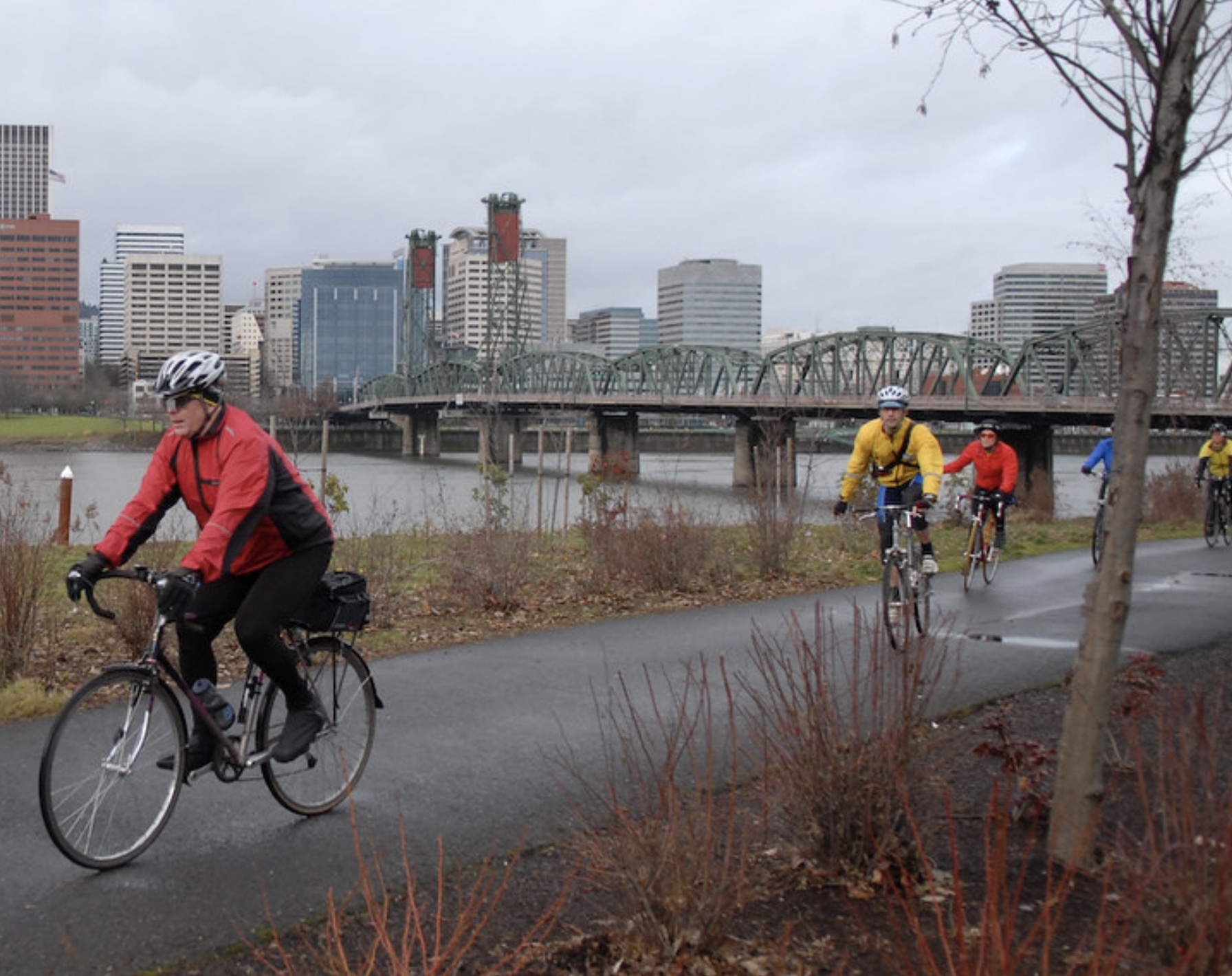
Screengrab from Jalponik. Inset image: Doug Gordon in 2012 by Jonathan Maus/BikePortland

It’s impossible to explain the crusade to reform the American transportation system with a quippy slogan. But a successful movement needs a catchy tagline, and some bike and transit activists have settled on “ban cars” as the t-shirt and sticker-worthy phrase to summarize their ideology.

To the average car-dependent American, however, the rallying cry comes with baggage and may seem like bait for Fox News fearmongers. The fight against car culture is much more complicated than simply “banning cars.” So should we go with “ban cars (once we have enough alternate transportation infrastructure to accommodate everyone so they don’t need to drive, and even then there will be exceptions”)? Well…I don’t think that really has the same ring to it.

Those who want nuance are going to have to stick around past the slogan.

In a recent Jalopnik piece (an outlet whose tagline is “drive free or die”), transportation activist and co-host of the War on Cars Podcast Doug Gordon provided some of that nuance in a summary of what the phrase “ban cars” means to him. In the article, Gordon says the ‘ban cars movement’ “wants us to reckon with the truth about the automobile’s impacts on society, to weigh the bad against the good.” He’s explicit about the bad, citing statistics about how many Americans die in car crashes every year (last year, it was 42,915 people) and how much carbon cars spew into the atmosphere. Transportation activists know these stats well, but the general car-driving public doesn’t often come face to face with the destruction cars create.
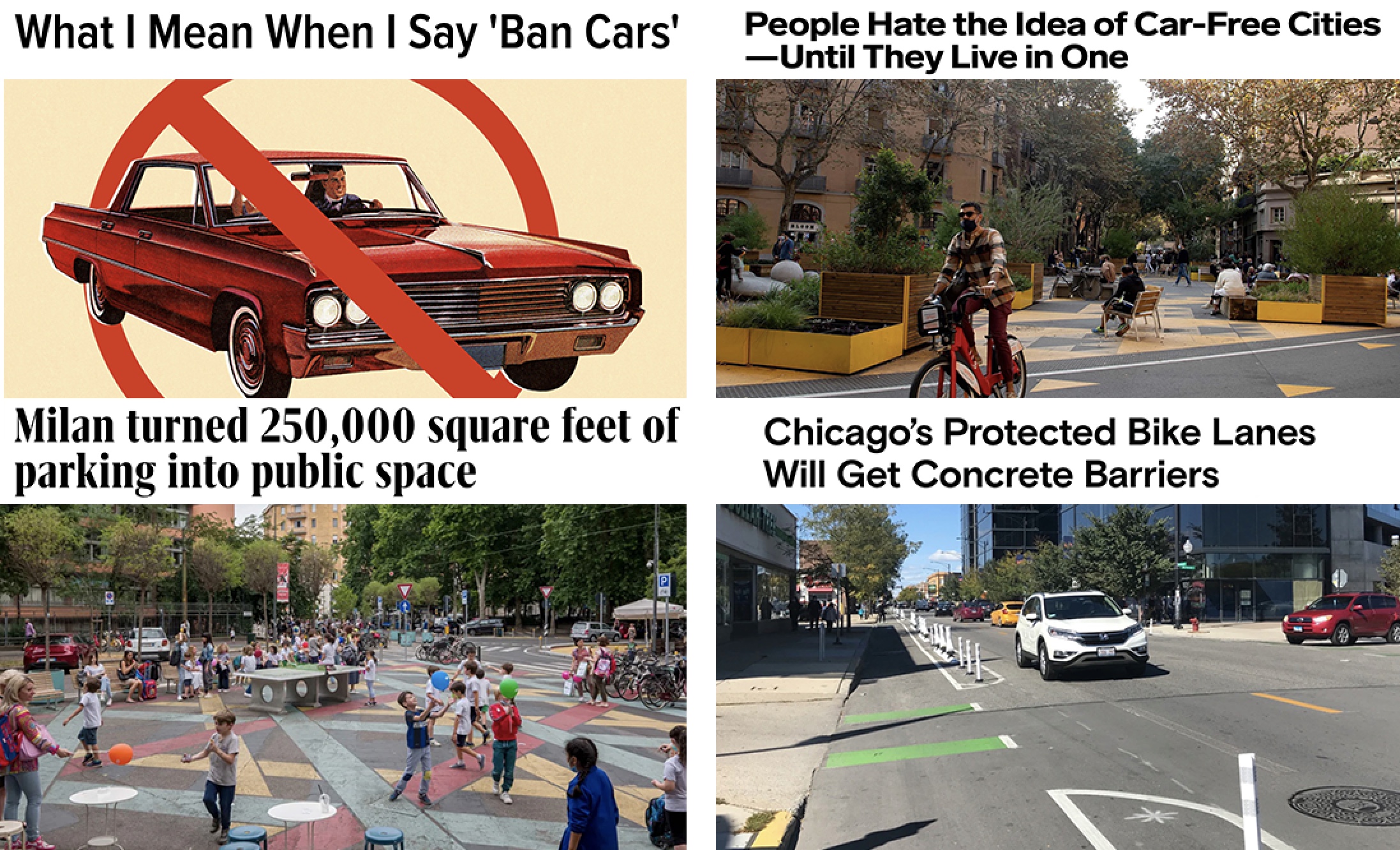
Gordon writes the ‘ban cars movement’ is not literally a movement to ban cars, and is instead simply a prompt to consider how dominant the automobile is as a part of American society – and is that really so radical?

It’s a fight to expand the rights and freedoms of those who are unable to drive — for medical, financial, or legal reasons — and those who are simply uninterested in operating a multi-ton machine where a momentary lapse of judgment can kill. Given the aggregate ways in which cars negatively impact individual lives, communities, and the planet, I believe a good-faith understanding of “the ban cars movement” is actually less radical than maintaining the status quo, which often seems to take the shape of a ban on everything but cars.

I really struggle to articulate my thoughts on this subject, and I appreciated Gordon’s helpful explanation that contains all the disclaimers necessary when talking about something so controversial. Gordon’s article acknowledged the ways “ban cars” is not an adequate argument against car culture while still defending its usefulness as “a short, pithy message.”

Here’s more from Gordon’s piece:

The goal of “the ban cars movement,” as I see it, is not to render cars obsolete. It’s to give people the choice to live a life where car ownership, and car dependence, are unnecessary — regardless of socioeconomic status or physical ability to operate an automobile. It starts in dense urban areas, places where a few policy tweaks could turn public transit, cycling and walking into the lowest-stress, most convenient options.

No societal effort ever reaches 100 percent success. If the humorously-named “ban cars movement” enacted just a fraction of its goals, people who need to drive, or who simply enjoy driving, would still have that option. Car ownership simply wouldn’t be the price of admission for full participation in society. Or for picking up a gallon of milk.

None of what I’ve described could be accurately called a “ban on cars.” At worst, you could say these are limits on driving in specific locations and circumstances. Taking a lane away from car traffic to install a protected bike route? Sure, that bans cars — from a sliver of pavement. Dedicated bus lanes do the same. At its heart, “ban cars” is not a call to abolish all motor vehicles, but a focused effort to de-emphasize the least efficient form of transportation — the single-occupancy private vehicle — in urban centers where public transit is available and space is at a premium.

I’ve been met with enough backlash after making seemingly reasonable claims about the state of the American transportation system to know this is a topic to tread lightly about. But I also think being overly explanatory can water down the message. Sometimes I get so nervous about coming across as dogmatic or holier-than-thou, I use so many justifiers I end up saying nothing at all.

There’s a fine line to walk here. The transportation reform movement needs as many people on board as possible, and nobody likes to listen to someone on a high horse that makes such a direct affront to the status quo. But given the dire state of the earth and so many things on it, it feels like the right time to push open the Overton window a bit more.
You can read Gordon’s full article here, and be sure to check out the War on Cars podcast if you haven’t already.

Bike box, right turn on red ban coming to N Ainsworth 

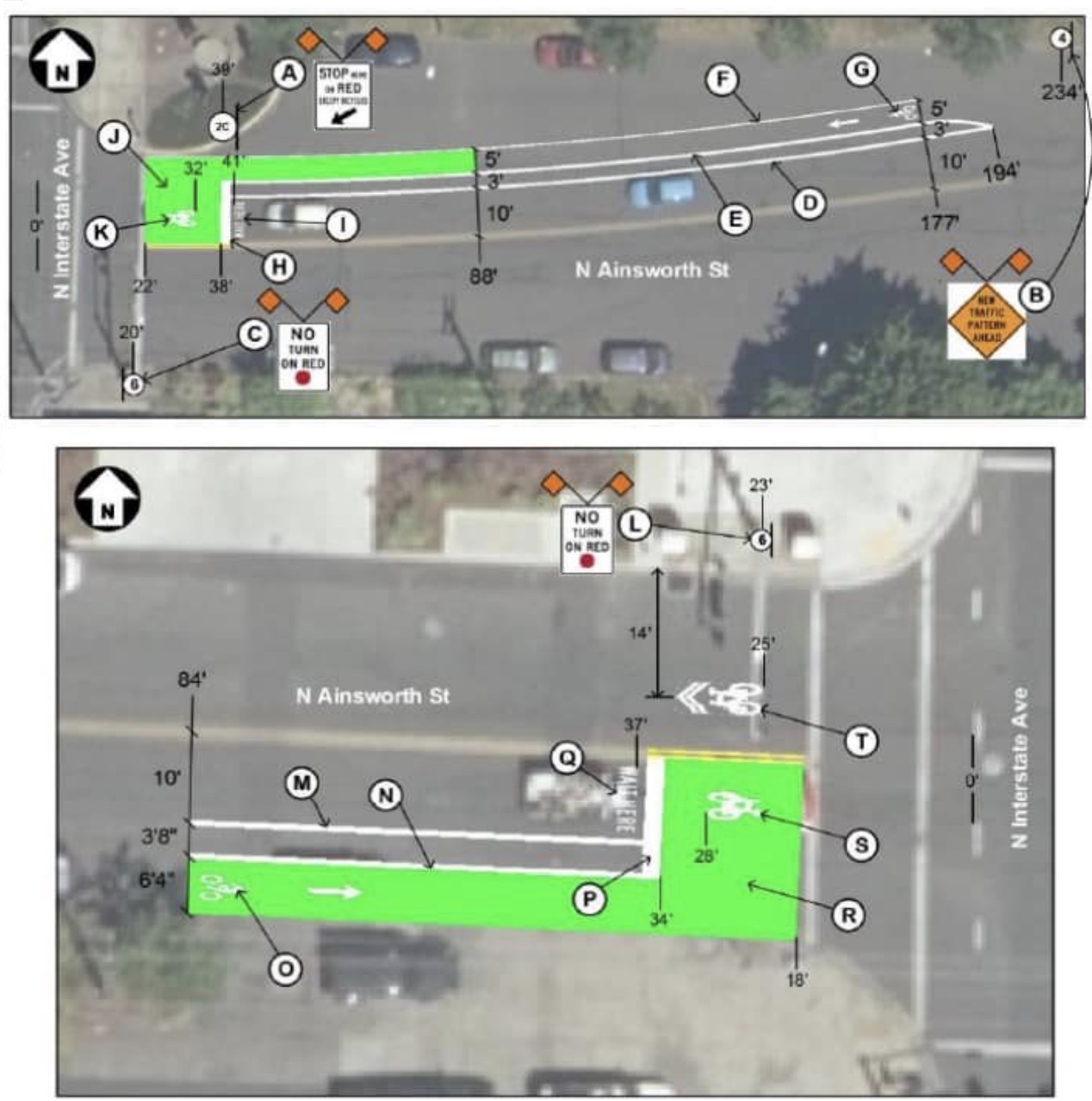
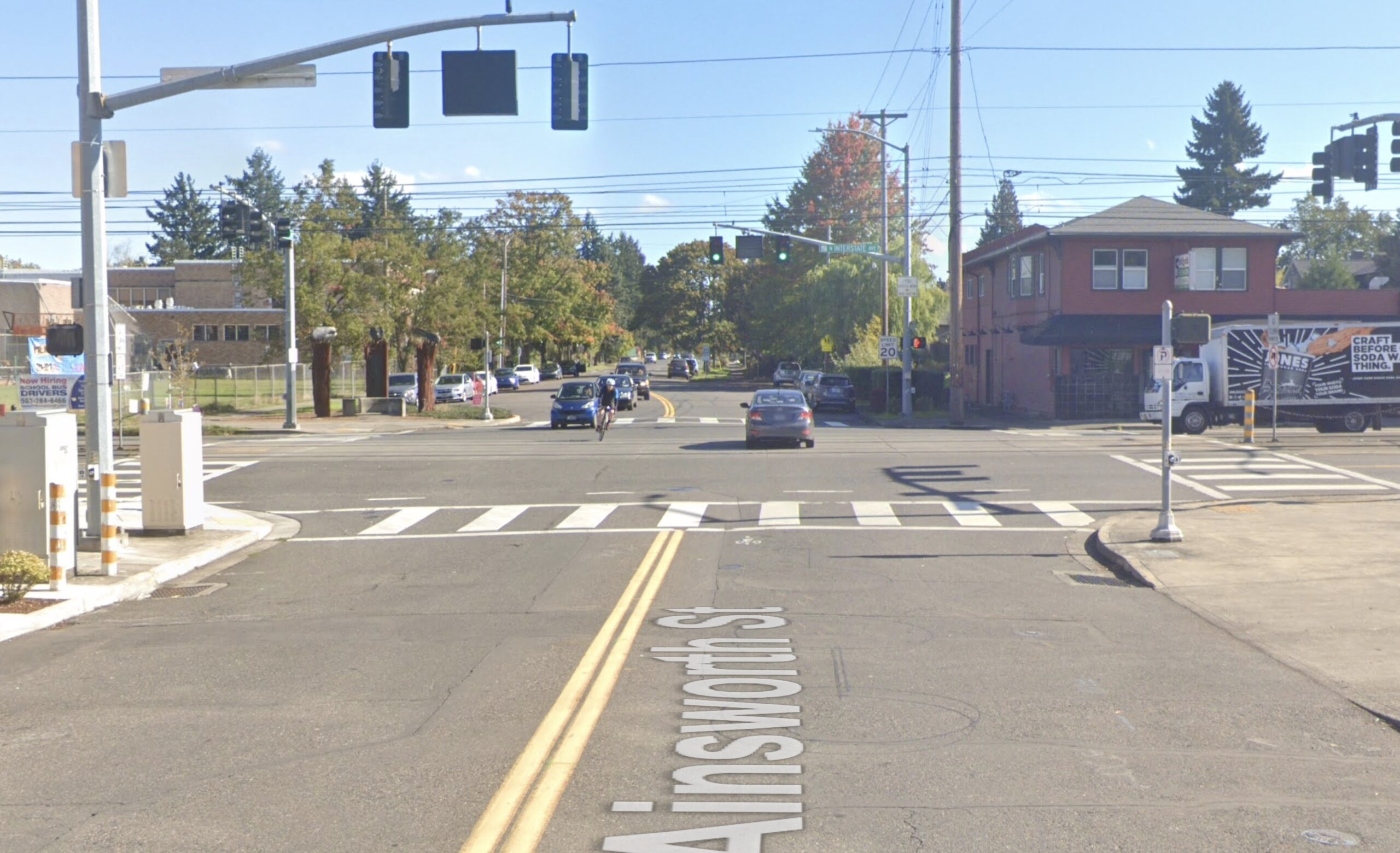
PBOT plan drawing for bike lane and bike box on N Ainsworth at N Interstate.
PBOT plans for Ainsworth and Interstate.

A popular bike route in north Portland is about to see a significant change. The Portland Bureau of Transportation plans to install a bike box and will prohibit right-turn-on-red on North Ainsworth Street at Interstate Avenue.

The plans were posted on the Facebook page of the Ockley Green Middle School Community Forum Facebook page.

PBOT Neighborhood Greenways Program Coordinator Scott Cohen wrote in the message that, “The project will improve safety and close a gap in the transportation system.”

Ainsworth is an interesting street in this area. It’s not particularly bike-friendly, but people like it because it connects directly to the (north-south) Michigan and Concord neighborhood greenways and the Williams Ave bikeway. It’s also the best, southernmost connection to the serene vibes and views on Willamette Blvd (which connects to St. Johns and points beyond). One of the stressful things about Ainsworth is that riders share a roadway with car drivers. Despite the 20 mph speed limit, the lack of dedicated cycling space and design characteristics (on-street parking and relatively narrow curb-to-curb width) can make it feel unsettling — especially for families and “interested but concerned” riders.

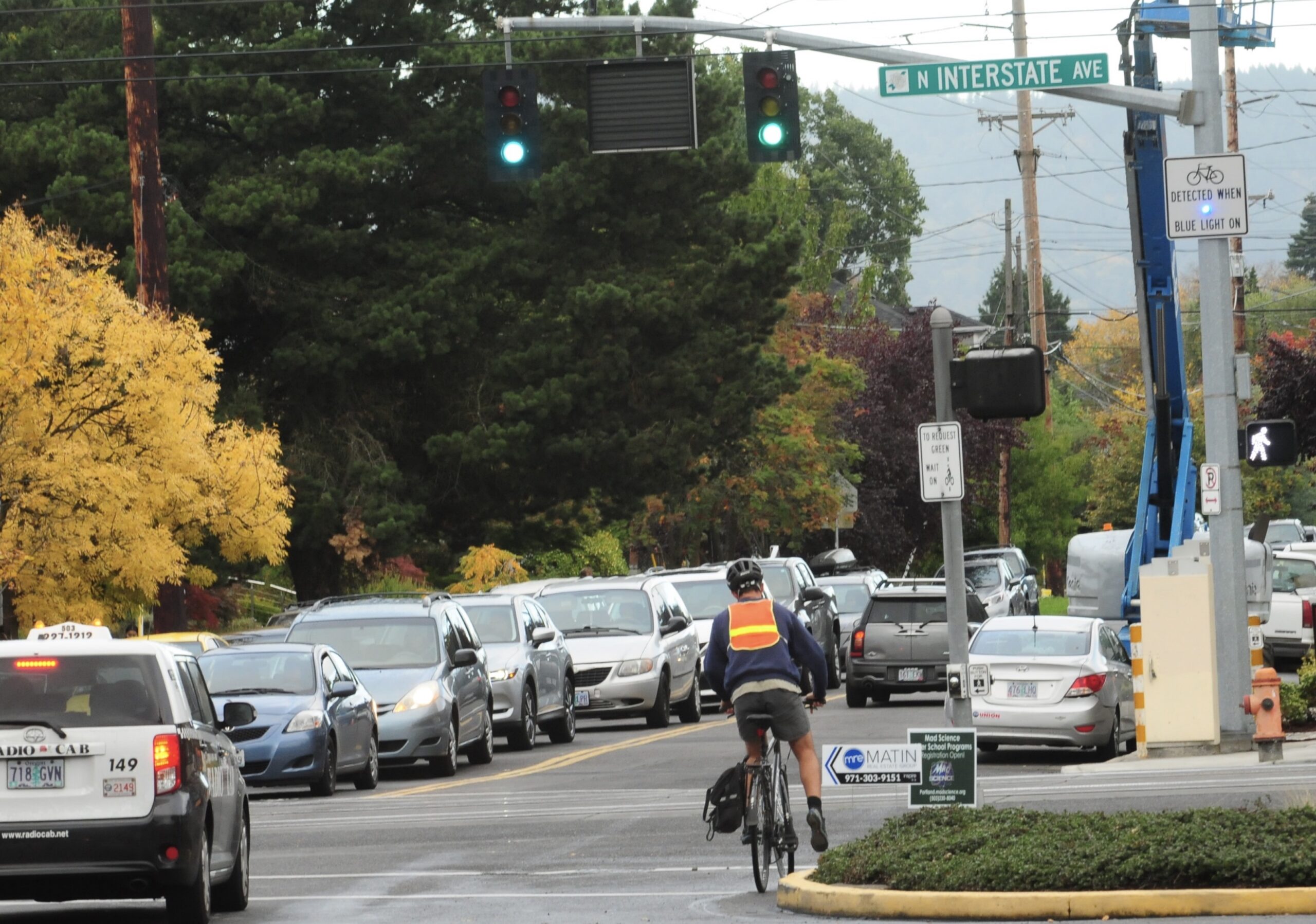
PBOT has taken note of the valuable role Ainsworth plays in the bike network. In 2019 they installed a special detector to help bike riders trigger the traffic signal. Unfortunately, many people using bikes don’t know how it works and still hug the curb and push the pedestrian button instead of waiting in the middle of the lane (like the person in the photo above left, and who can blame them?!). This is inconvenient and it puts bike riders at higher risk for right-hooks. 

The new bike box should help promote safer behaviors at this intersection. It will be colored green, with a wide, buffered bike lane directing bike riders to the front of the traffic queue.  The “No Turn on Red” signs should also help — but only if people obey them.

In addition to the bike box and turn restrictions, PBOT will also prohibit parking for 65-feet west of Interstate on the south side of Ainsworth (in front of several businesses). “This will allow people who are bicycling to move ahead of vehicles at a busy intersection,” Cohen said.

The changes will help not only the bikeway, but should lead to a calmer intersection overall for kids and families walking to the school and other destinations in the area.

Construction is expected to begin as early as this month or later this fall and be completed before the end of the year.

Comment of the Week: We’d get more street trees with better city code

Comment of the Week

Comment of the Week

“Trees require care and tidying up, so they’re not convenient anywhere, but they are necessary everywhere.”

Welcome to the Comment of the Week, where we highlight good comments in order to inspire more of them. You can help us choose our next one by replying with “comment of the week” to any comment you think deserves recognition.


It’s always worth keeping an eye on Scott Kocher, he has a track record of successfully getting the city’s attention on a number of issues. Urban trees, and their importance to cooling the city, have become a focus for him.

We published last week’s post, You have trees to thank for Portland’s cool streets, a year after the deadly “heat dome” killed 72 people in Multnomah County, many in east Portland which has the most anemic tree canopy in the city.

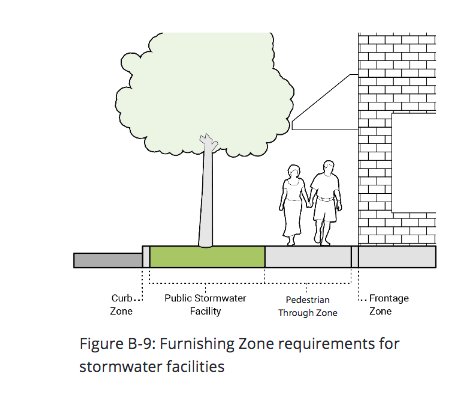
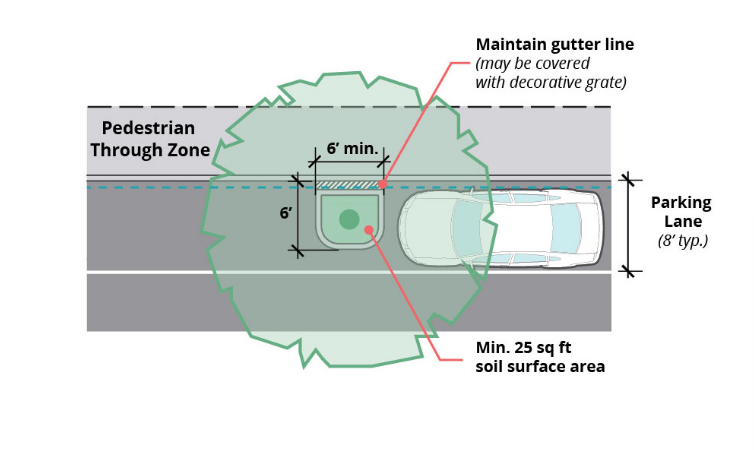
Scott was ready with some code changes in response. We’ve added a couple of images to illustrate his points. Here is what he wrote:

My observations are that new development routinely allows other competing uses (utility poles, underground utility vaults, on-street parking, etc) to supersede the “required” number of street trees planted, resulting in few or even no trees along many frontages that are now being redeveloped. And, current tree code limits the places trees must be considered for planting, and the size of allowable trees. 25′ canopies are now the max for most species allowed in 3′ planting strips.

Replacing a huge old tree with a miniature species results in net loss. I would like to see the tree code amended to require at least consideration of curb zones and medians for street tree plantings, for existing and new development. While future bike lanes, or underground utilities make this impossible some places, there are many other places where large-form trees could be planted in large wells, including East Portland streets that have no curbs.

Trees require care and tidying up, so they’re not convenient anywhere, but they are necessary everywhere.

Thank you Scott! You can read Scott’s comment, and the full comment thread, under the original article.

(Disclosure: Kocher is a Portland-based attorney and safety advocate, and his law firm, Forum Law Group, is a financial supporter of BikePortland.)

Pedalpalooza’s Bike Prom is way more fun than your average high school dance

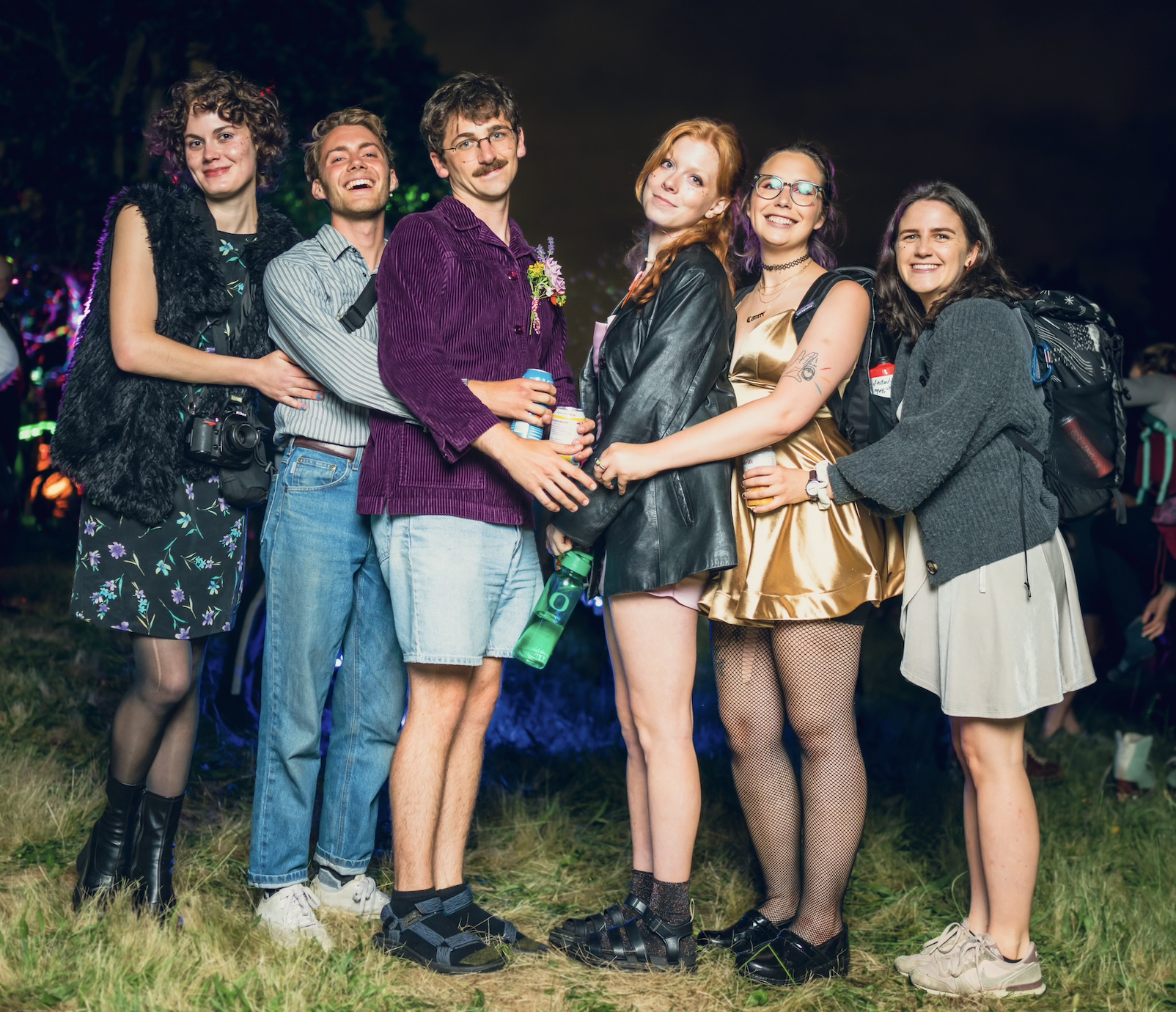
Six people posing together in prom style shot.

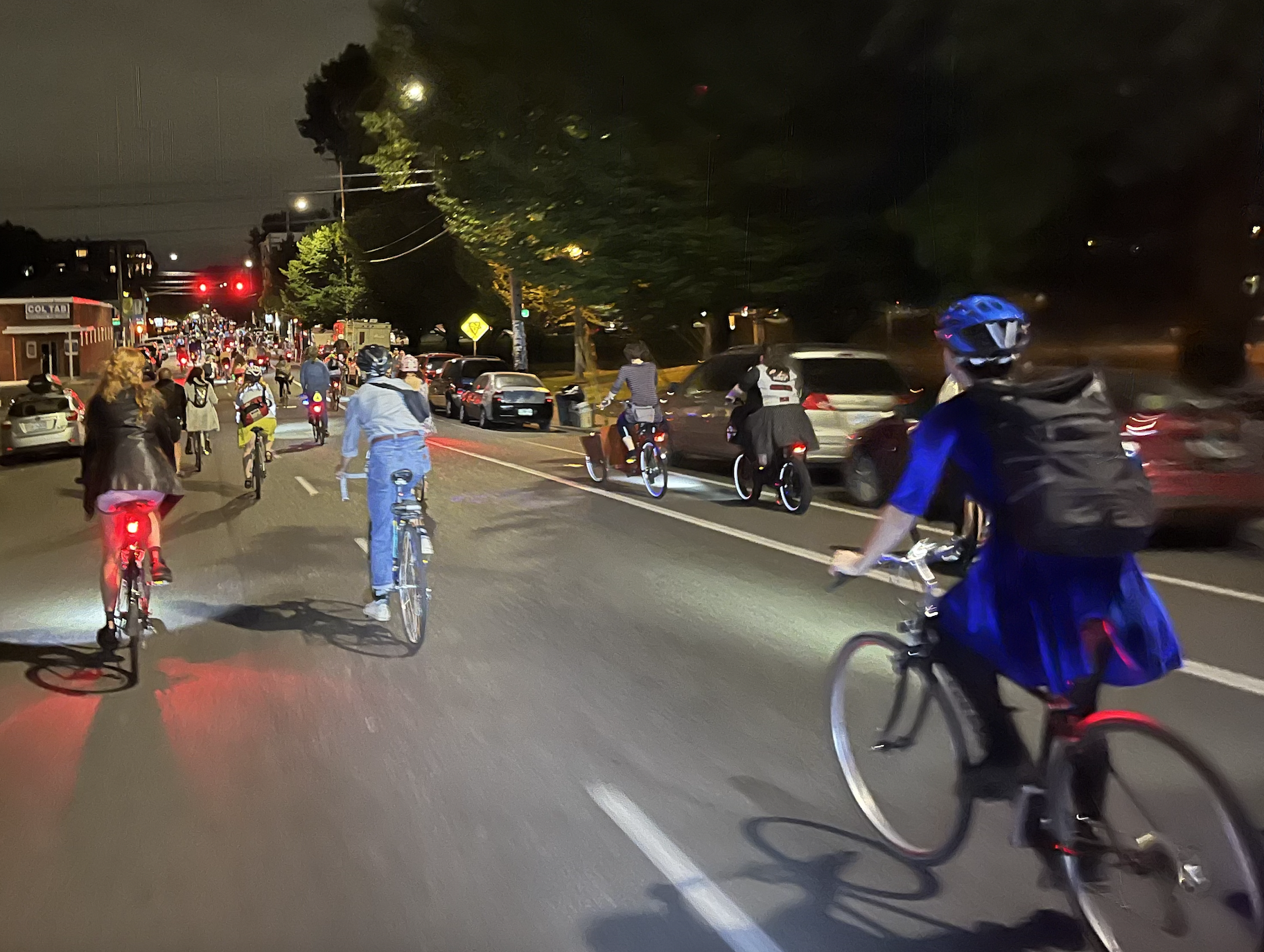
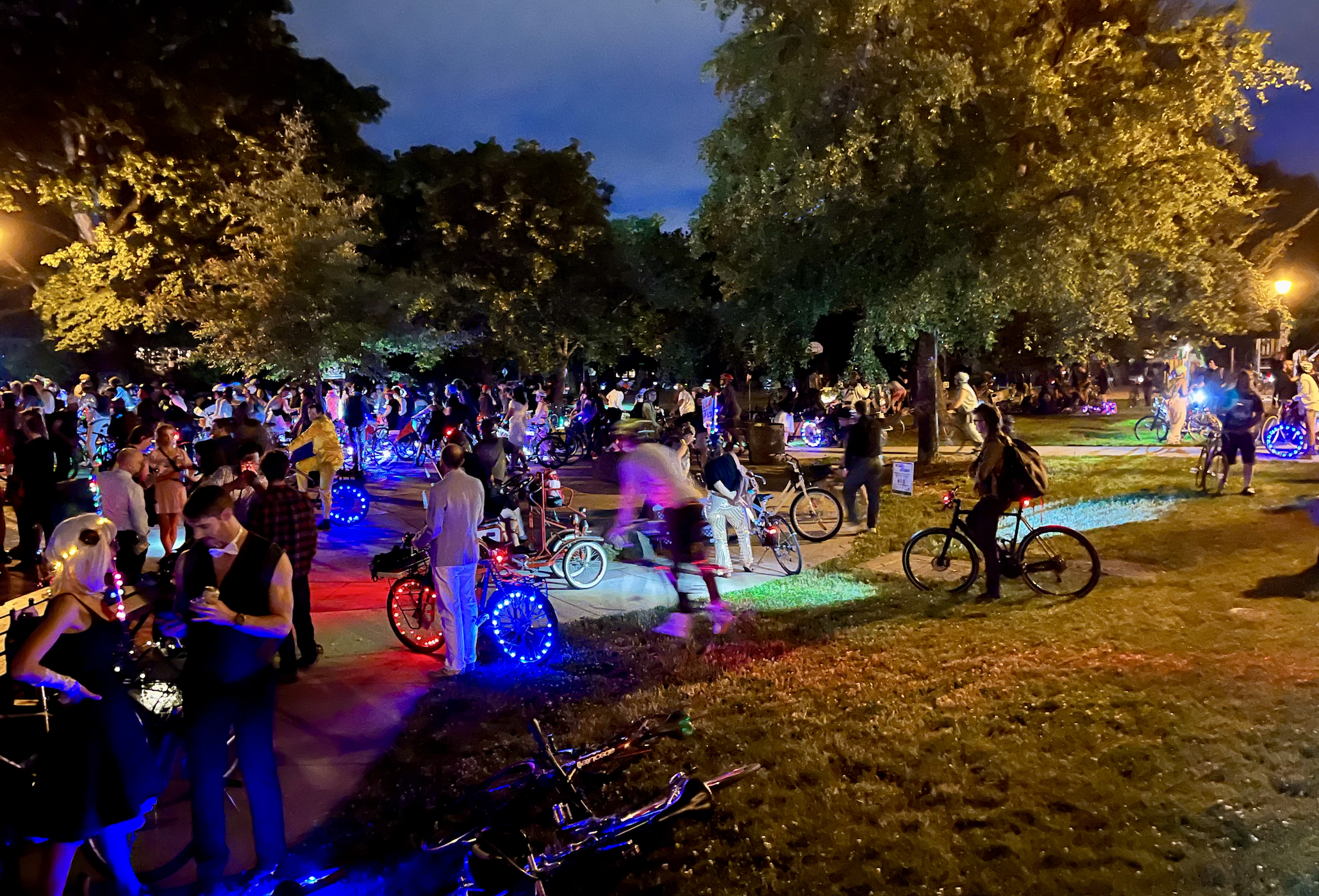
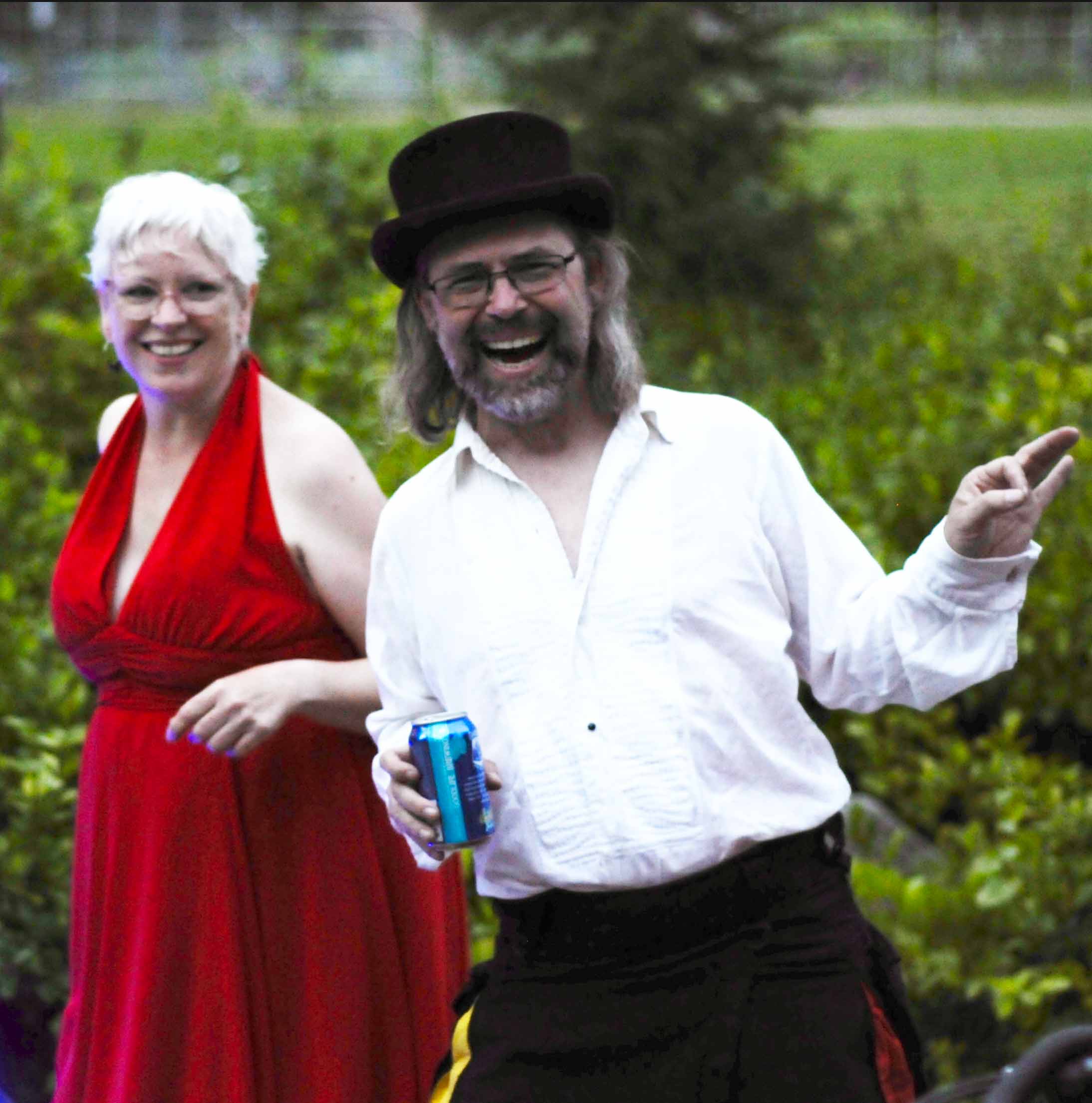
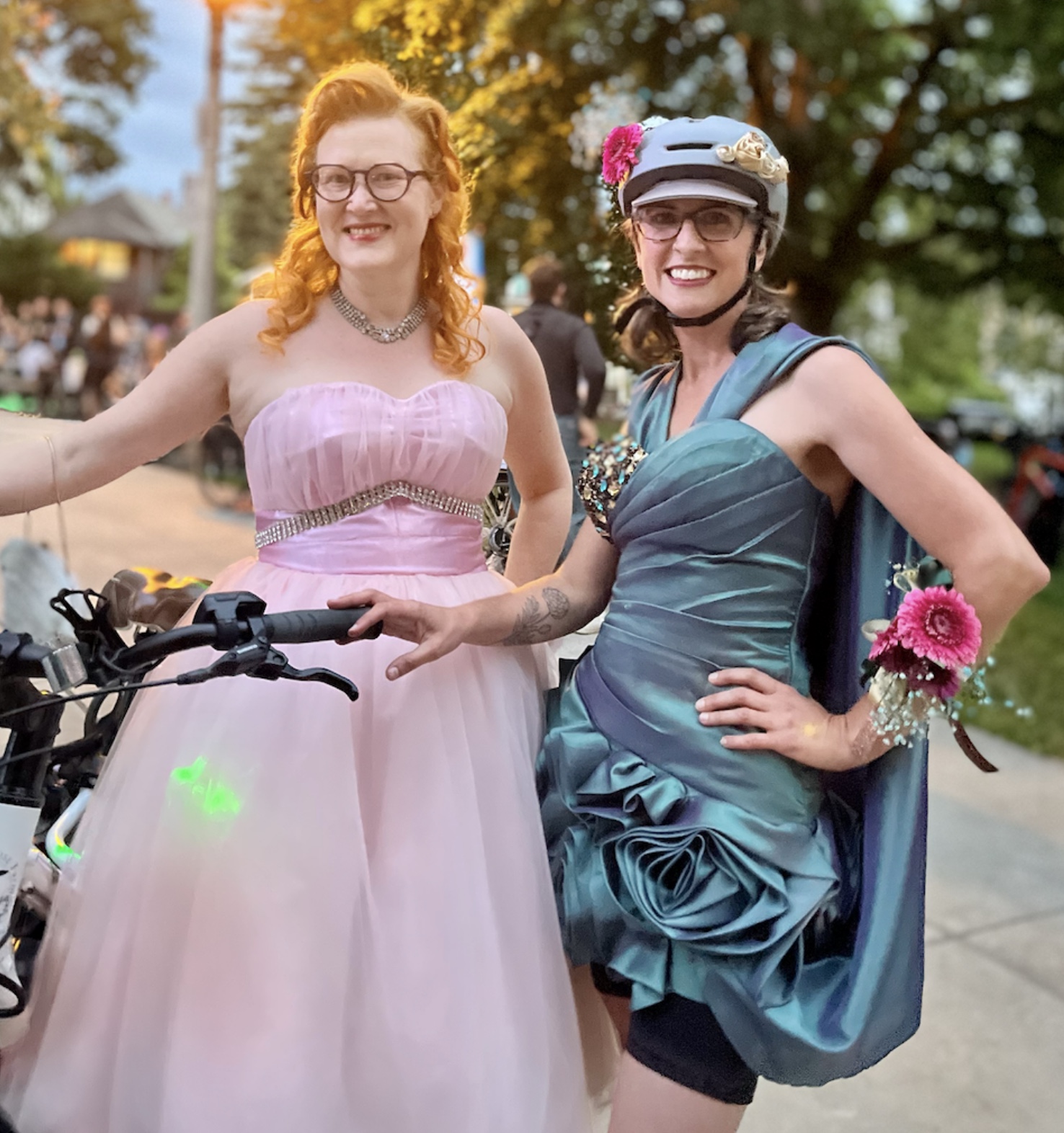
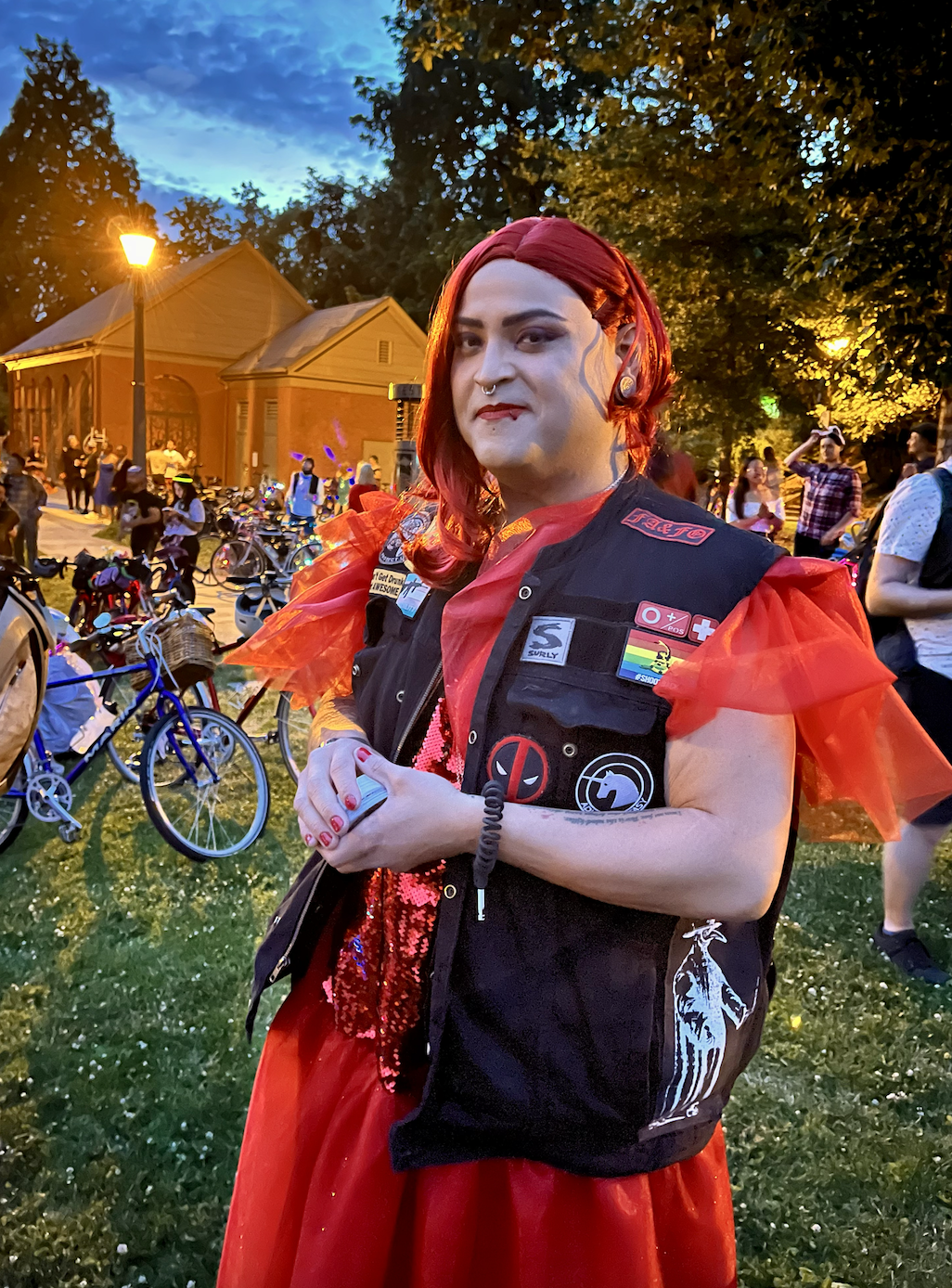
Hundreds of people donned their finest – or most eccentric – garb and headed to Colonel Summers Park Saturday night for Pedalpalooza’s annual Bike Prom. This event, which was hosted by the Portland chapter of the Dead Baby Bike Club for the second year in a row, capped off the first month of Bike Summer 2022. It was the perfect event to epitomize the energy of the summer so far: enthusiastic, weird and slightly revelrous. 

I asked several attendees how they thought Bike Prom compares to their high school dance, and everyone was resoundingly clear that this event is far superior. At Bike Prom, you get all the fun of dressing up, but you don’t have to dance with a bunch of sweaty 17-year-olds in a high school gym.

The author (left) and her Bike Prom friends (Photo: Eric Thornburg/No Lens Cap)

Our big group of well-dressed cyclists travelled down to the Springwater Corridor to join a dance party along the Willamette River. Eric Thornburg, who has been killing the game photographing Pedalpalooza rides, took everyone’s prom photos, and then the true debauchery began: a lube wrestling competition that rivaled the excitement of any sporting event I’ve ever seen.

“I thought I’d be above watching the lube wrestling, but something about it was primal and impossible to look away from,” one observer told me. I agreed: when I set out for the evening, this is not what I was expecting!

I also expected maybe 40 people or so and was surprised when several hundred showed up (it’s my first Pedalpalooza, and apparently this is a regular turnout for Bike Prom).

Though this event transcended beyond a mere bike ride, I think the oddness of it all shows how versatile and unique Portland’s bike scene is. Come for the biking, stay to watch people slipping and sliding in a baby pool, dancing together in public, and giving Hulk Hogan a run for his money with their wrestling skills. You never know what you’re going to get at a Pedalpalooza ride.

Remember: there are two more months of Pedalpalooza, and many more opportunities to find yourself somewhere as strange and exciting as the Bike Prom dance floor.


See a full gallery of excellent prom photos by Eric Thornburg here. View the official Pedalpalooza Bike Summer calendar here.

Pulling our kayak (by bike) from Tigard to the Tualatin River

Cargo bicycle pulling a kayak.
It’s long, but it works! (Photos: Shawne Martinez)

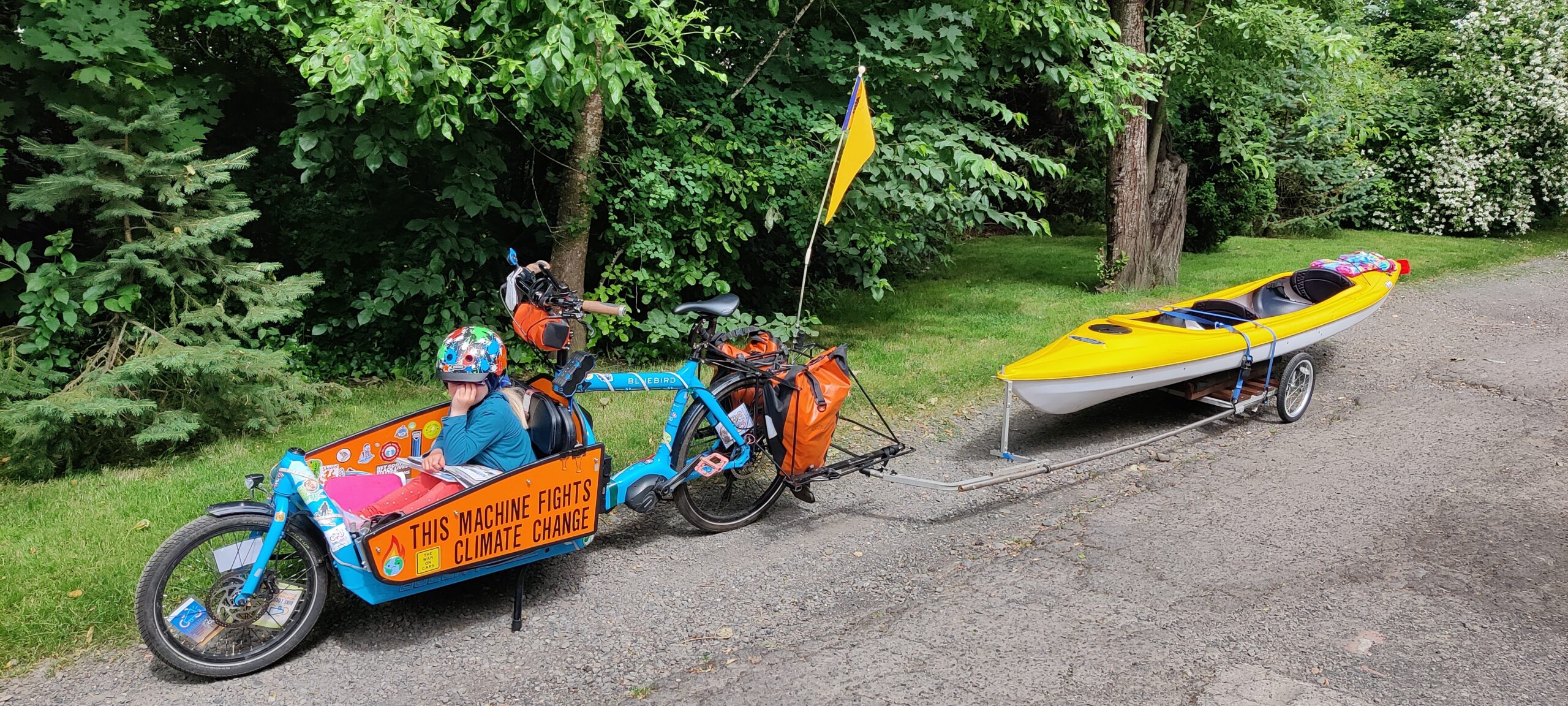
We converted an old kid’s bike trailer into a kayak hauling machine.

As our soggy spring rain let up and the sun peeked from behind the clouds I began thinking about another kayak adventure on the Tualatin River. Transporting a kayak to the dock by bicycle from the county line between NE Tigard and SW Portland may seem like a difficult task with a twelve mile round trip and 600 feet of climbing.

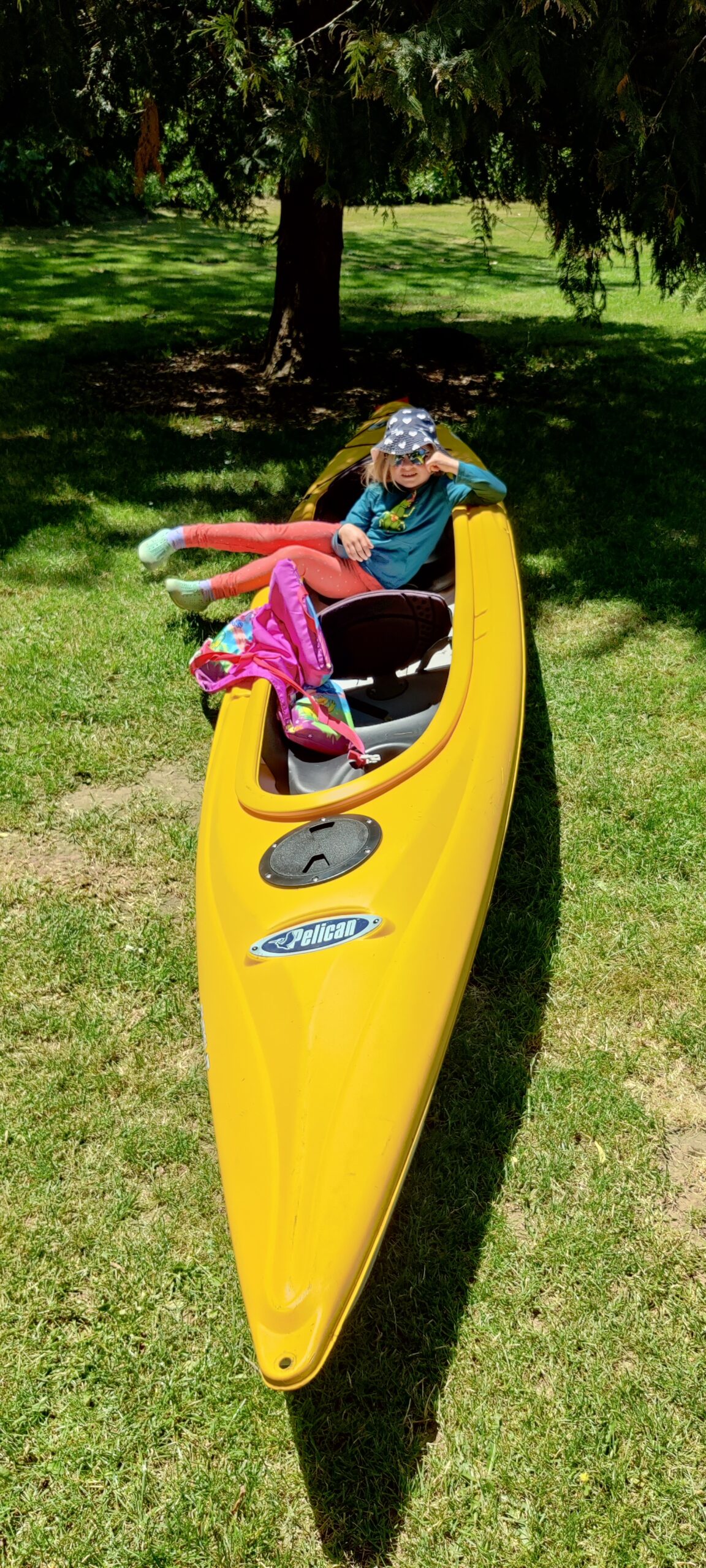
Make it a tandem kayak behind a bucket bike with a 6 year old riding in front and it gets even more interesting! 

We converted an old kid’s bike trailer into a kayak hauling machine by lengthening the tongue and adding a bracket to hold the front of the boat to the tongue. Our bike has e-assist and plenty of stopping power with 4 piston disc brakes front and rear. The kayak tows remarkably well. Width is not much of an issue but turning radius is a consideration as the bike, trailer and kayak are 25-feet long. This is not something I would take on the Fanno Creek Trail which has some tight turns near Downtown Tigard. The most direct route is to ride on SW Hall Blvd (State Route 141). 

Yellow kayak with little girl sitting in it.

There has been much news about jurisdictional transfer of ODOT facilities lately. The stretch of SW Hall Blvd through Tigard is one that I have been following closely since we cross it on our trip to school by bike. It is in terrible condition with deteriorating asphalt, sporadic sidewalks/bike lanes, high speed limit (40 near our school!), many drain grates in the bike lane and constant debris. The current widening of 217 will require replacement of the SW Hall overpass near SW Pfaffle Street. The new bridge promises better walk/roll/bike safety but it’s still a painted bike lane in the drawings. 

I’m hoping with jurisdictional transfer this route will get better. Fortunately I ride it often so I know the quirks: Take it slow at the railroad crossing near SW Commercial as there’s a big bump in the asphalt; watch drivers in the s-curve near the skate park, they tend to drive in the painted bike lane; there’s a ton of debris near the Tigard Library; a homeowner blocks the right of way with their trash bins near SW Bonita. We should need this level of expertise to navigate to the river! 

Even hauling this long load, it’s not that bad of a ride. Turning down SW Durham in front of Tigard High School and taking SW 92nd to Cook Park is one option. The other is to stay on Hall (which changes to SW 85th) all the way past the Clean Water Services treatment plant. This leads to a wide multi-use path that takes you to Cook Park as well. 

Kayak towed behind a bike in a park.

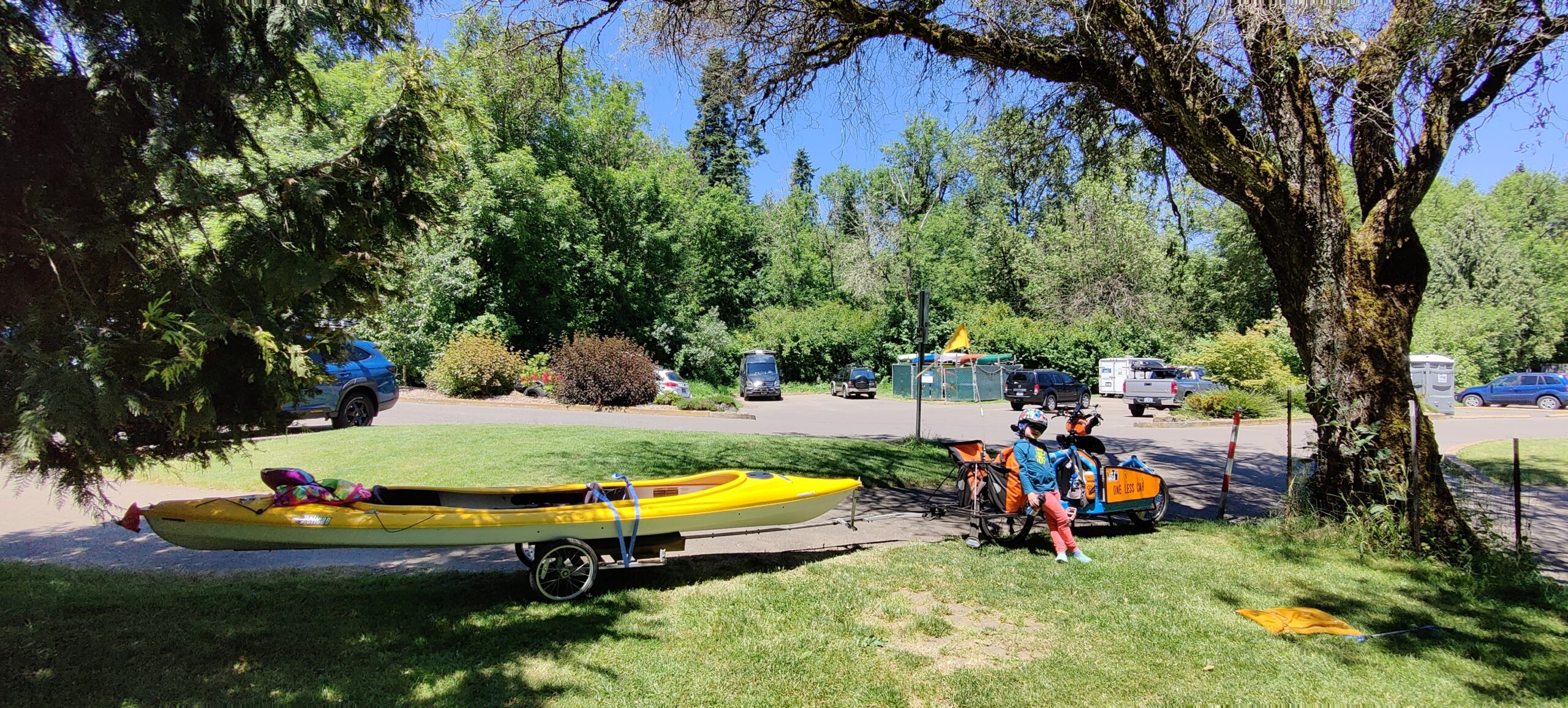
Wayfinding is not great at Cook Park and many drivers get lost trying to find the boat launch. Study the map as there are even more ways to get turned around on the paths and trails. It is so nice not to have to worry about car parking when kayaking by bike. “Front row parking every time” is so true as we unload our kayak on the grass right next to the boat launch. There are no bike racks, but there are many poles/trees to lock to. I also lock the trailer to the bike. 

Once on the water we started searching for sunbathing turtles with no luck. Bringing litter pickers along we usually find a few pieces of garbage, this gives the kid something to look for and do. Hugging the shoreline provides some shade but the mid-day solar radiation can get intense! Two miles of paddling and the kid is usually done. It was time to get out of the water and hit the playground on the way home. Advantages that Cook Park has over many parks are lots of trees for shade, many bathrooms, large picnic shelters and public power for e-bike charging. 

Related: ODOT says US DOT Sec Pete Buttigieg will be Oregon’s ‘new best friend’

We took Hall Blvd home as I contemplated stopping for groceries. Could I find kayak parking at Fred Meyer? Would the bike be safe if I took two car parking spots and locked it to itself? The wave racks would be even less useful with this long load. Thinking that I better not chance it, we took the kayak home and went grocery shopping later. Although now that I think about it, we probably could fit a lot of ice cream in the kayak!

Thanks for reading along on our adventure! 

Police say racial bias motivated assault of bicycle riders on Eastbank Esplanade

Eastbank Esplanade south of Hawthorne Bridge. (Photo: Jonathan Maus/BikePortland)

A man and his young daughter were assaulted by a stranger while bicycling on the Eastbank Esplanade this past Saturday.

According to the Portland Police Bureau, a 36-year-old man, his wife and his 5-year-old daughter were pedaling on the Esplanade just south of the Hawthorne Bridge when they were approached by a man who began punching them. The family was visiting from California.

The PPB says the incident is being treated as a bias crime. 

Here’s more from the PPB statement

“Officers contacted the victims… and learned that they were hurt but they did not require immediate medical attention. Officers learned that the man was riding bikes with his wife and daughter when the suspect approached, made comments about his perception that they were of Japanese descent, and began punching the man in his head. The suspect then punched the 5-year-old girl in her bike helmet numerous times. Nearby witnesses quickly intervened and the suspect began walking away. Several witnesses remained at the scene and provided statements to investigating officers.”

Dylan J. Kesterson, 34, was arrested and booked into the Multnomah County Detention Center on charges of Bias Crime in the First Degree and Bias Crime in the Second Degree (2 counts). As per Oregon statute, a Bias Crime is committed when someone, “Intentionally, knowingly or recklessly causes physical injury to another person because of the person’s perception of the other person’s race, color, religion, gender identity, sexual orientation, disability or national origin.”

KOIN news reported that Kesterson was released from jail one day after his arrest and is due back in court today (7/5).

A spokesperson for the Portland Bureau of Transportation said in a statement emailed to BikePortland, “We were heartbroken to hear the news of this bias crime on an important and popular corridor for people biking and pedestrians. PBOT believes that people should be free to travel throughout our city without fear of bias or intimidation.”

The Monday Roundup: Power of framing, bike lane protection, and carfree public space

Welcome to the week. I hope you had a nice long weekend. Now it’s time to buckle in and move forward.

Let’s start with getting up to speed on the news. Here are the most notable items our writers and readers came across in the past seven eight days…

Behind the popular and potent ‘Ban Cars’ mantra: War on Cars podcast co-host Doug Gordon explains the reasoning behind his language choices and what the war is really all about — and does it directly to car lovers via Jalopnik.

Robert Moses at the theater: A new play opening in London will feature Ralph Fiennes playing the influential 1950s NYC DOT director Robert Moses.

EV inequity: Scarcity of materials needed for batteries could push the price of EV cars even higher and make more efficient EV bikes even more attractive.

Real protection: After several high-profile collisions, Chicago officials say they will add concrete protection to all bike lanes by the end of next year. We need a similar plan in Portland.

Exposing ‘bike bros’: A San Francisco-based journalist says she is sick and tired of ‘radical bike activists’ who ‘take cities hostage’ with their anti-car positions and she plans to go on the offensive expose them to win the war on cars.

SUV fines: A German court has ruled that due to the inherently more dangerous design of some SUVs their owners can be slapped with higher fines for breaking traffic laws.

Coal roll penalty: A mechanic in North Carolina who sold thousands of kits to truck owners so they could “roll coal” (spew exhaust at will) has been busted and will serve a year in prison and pay $2.5 million in fines.

Carfree playbook: Wired has a great article on lessons learned from European cities on how to drastically reduce car use and create a healthier, happier city for all.

Public spaces, not parking spaces: The pandemic helped the Italian city of Milan turbocharge their efforts to change parking spaces to public spaces and they’ve created new parks and gathering places for pennies on the dollar.

Murder suspect caught: U.S. Marshals worked with Costa Rican authorities to arrest Kaitlin Armstrong, the woman who is the prime suspect in the killing of professional cyclist Moriah Wilson.


Thanks to everyone who sent in links this week.

As TriMet struggles with driver shortage, union leader says agency is part of the problem

We’re all waiting for bus drivers. (Photos: Jonathan Maus/BikePortland)

TriMet, Portland’s regional transit agency, has taken on an intense marketing campaign, touting their benefits in employee testimonial ads on YouTube and social media posts to reel in potential employees to fill the bus and light rail operator deficit they’ve been dealing with in the wake of the pandemic.

But despite the ad blitz, increased pay and hiring bonuses TriMet has offered, their worker shortage appears to be getting worse, not better – they just can’t hire enough people to make up for the staff lost in the last several years. Last week, they announced they will reduce or cut service on 10 bus lines starting this fall because they don’t have the staffing required to maintain the routes. TriMet says these cuts will be temporary, but there’s no telling when they’ll have the staff to bring back full service.

“We can’t compare this to anything else,” Tyler Graf, a Trimet Public Information Officer, told BikePortland on a phone call last week. “This is a unique situation we’ve never faced before.”

While many factors are at play and TriMet is just one of many transit providers nationwide struggling with this problem, union leaders say the agency needs to accept more responsibility for their role in the crisis.

A history of low morale

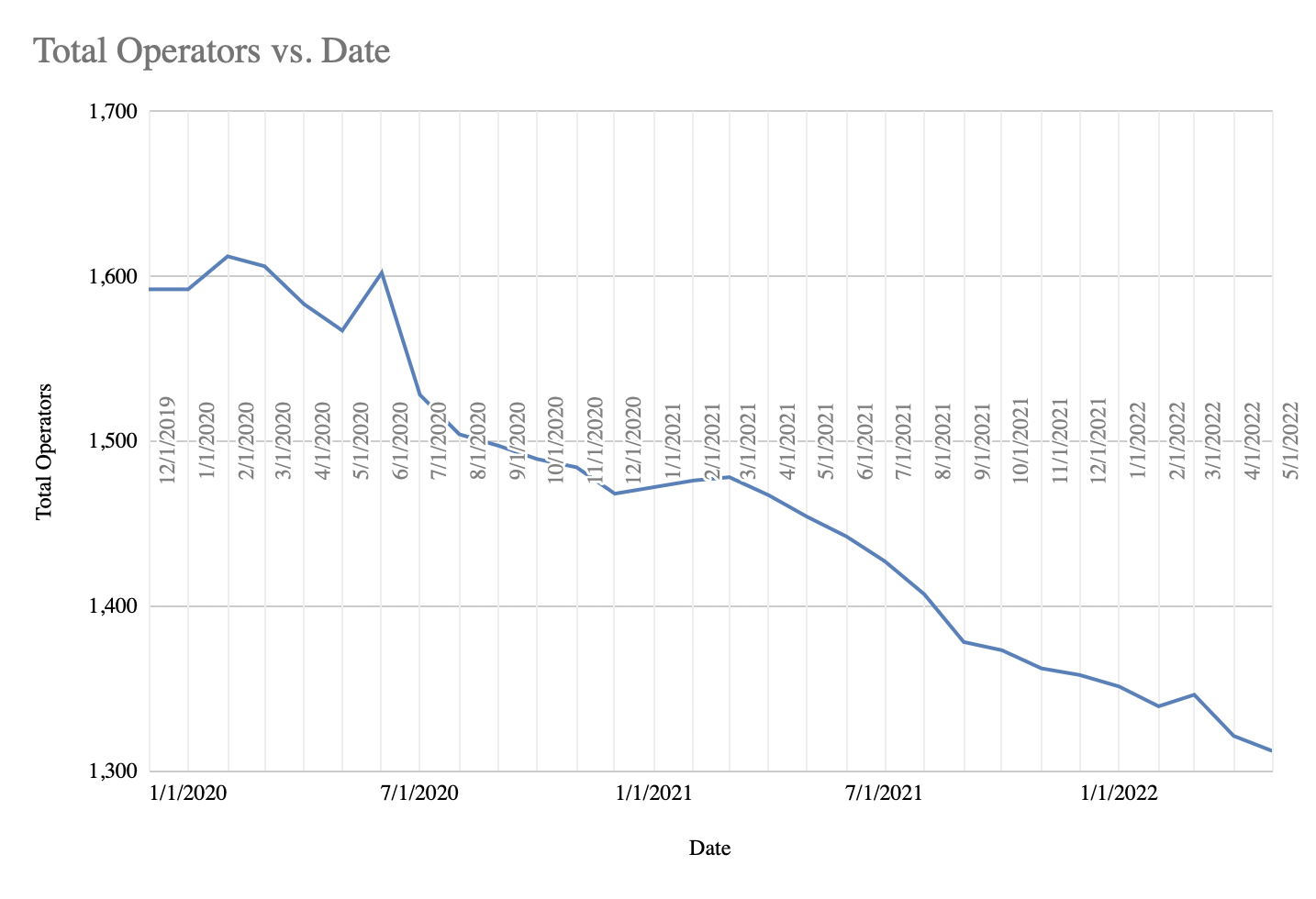
(Data: TriMet. Graphic: BikePortland)

[TriMet’s] attitude about discipline was, ‘There’s no shortage of workers.'”

– Fred Casey, Amalgamated Transit Union Local 757

TriMet data indicates operator staff levels have declined steadily over the last two-and-a-half-years. In the period between December 2019 and May 2022, staffing levels peaked in February 2020, when TriMet employed 1,612 total bus and light rail operators. As of this past spring, TriMet’s staffing levels are the sparsest they’ve been throughout that period: a May 1 count tallied 1,312 total bus and light rail operators, with the biggest loss coming from the bus driver category.

What’s to blame for the shortage? Fred Casey, the Vice President of Amalgamated Transit Union (AMU) Local 757 which represents TriMet employees, said there’s not just one cause to point to.

Casey said there have been tensions between the union and TriMet for years over a myriad of issues. (The Northwest Labor Press’ TriMet archives are a great resource for details on more than a decade of this turmoil.)

TriMet GM Sam Desue.

“Up until very recently, the relationship has been acrimonious, and not because of a lack of trying on our side,” Casey said on a recent phone call with BikePortland. “The relationship got really sour during [former TriMet General Manager Doug Kelsey’s] tenure, and the morale took a real bad hit to the point where there’s zero morale at TriMet now.”

TriMet bus operators have experienced abuse and even assault from passengers, which has become more severe during the pandemic. Some drivers don’t think TriMet is doing enough to help them.

Patrick Coomer, a TriMet bus operator who runs a blog called “From the Driver Side,” described TriMet’s attitude toward drivers during the pandemic in a May 2020 post, saying the transit agency took the customer’s side in disputes at the detriment of operator safety. He wrote that TriMet was “intent on protecting everyone but the operator” with their Covid policies and drivers didn’t feel safe because they’d be punished if they “denied boarding to any pseudo-badass who refuses to wear a mask.”

Recent management changes at TriMet have given union leadership some hope of a better relationship going forward. Casey said Sam Desue, who was appointed General Manager last summer, has expressed more interest in having an amicable relationship with the union. They’ve just successfully negotiated an extension of the current union through November 2024, which will maintain the current contract but include wage increases.

But Casey said even though the relationship between ATU and TriMet may be on the up-and-up, he isn’t completely impressed by their recruiting tactics. One concern he has is that the agency is trying so hard to hire new operators they are neglecting and overworking the people already on staff.

“The current workers there are being overworked. [They’re] working several extra hours a day or week to cover shifts because they don’t have the staffing levels to get the service out,” Casey said.

Casey also told us employees felt a crackdown on disciplinary measures under recent management who had created a culture of fear, which worsened during the pandemic.

“Suddenly, these operators were getting hit with reprimands and suspensions and eventual terminations for things that they had never done before,” Casey said. “[TriMet’s] attitude about discipline was, ‘There’s no shortage of workers.'”

Are beggars being choosers?

Riders board a Line 15 bus emblazoned with an ad for drivers on SW Alder on Wednesday, June 29th, 2022. (Photo: Jonathan Maus/BikePortland)

According to TriMet Public Information Officer Tia York, the agency has received 1,468 bus operator applications in 2022 so far – well above the 300 person deficit they need to restore pre-pandemic staffing levels. But only 88 of these applicants have actually been hired to date.

This discrepancy shocked me: If their worker shortage is so dire, why isn’t TriMet hiring more people who apply?

Casey doesn’t think they’re being completely upfront about the incentives TriMet has offered potential applicants, which has led to an uneven ratio of applicants to people hired. In their ad campaign, they’ve promoted a $7,500 hiring bonus and a starting wage of $25.24 per hour to potential applicants, which come with some caveats. New hires don’t get the $7,500 all at once – it’s doled out over three years – which makes sense as a way to incentivize retention. But it appears some applicants decide not to move forward with the hiring process after reading the fine print.

In an email to BikePortland, York said many people have applied for the job to keep their unemployment benefits, which requires them to apply for a certain number of jobs each week, which has resulted in “some applications from people who have no real interest in working at TriMet.” (I want to note here that labor experts say unemployment benefits don’t keep people from returning to work, especially since the benefit program beefed up during the pandemic came to an end back in the fall of 2021.)

Another reason many applicants drop out? The onboarding process may be more than prospective hires thought they signed up for. York said there are a “number of requirements that must be met before a candidate can begin training.” Applicants are required to have a clean driving record for the past three years and a commercial driver’s license (CDL) (TriMet will help with the CDL permit test). They also must pass a pre-employment background check, drug screen, medical exam and complete an employment and reference check. TriMet says many of the applicants weren’t able to make it through this process.

Hampering long term goals

This shortage comes at a time when TriMet is engaged in major projects like the Division Transit Project and A Better Red and has plans for more transit service improvements to meed ridership demands. As gas prices continues to rise, public transit use is trending upwards, which could be a huge boon to climate and transportation advocates who want to get people out of single-occupancy vehicles.

“We have tempered optimism about our ability to address this in the coming months.”

– Tyler Graf, TriMet

But without enough operators to keep the buses moving, it’s going to be difficult to see these visions through.

Don Iler, a TriMet operator and public transit advocate, urged the agency to up the effort to improve conditions. He shared his concerns on Twitter last week about what the staff shortages will mean for recouping ridership lost to the pandemic and bringing more passengers aboard, calling the problem “a shitstorm that will take years to fix.”

Iler’s advice to TriMet: “Make this job so lucrative it’s competitive to get. Bring back the pension, pay all health care premiums, restore retiree health benefits. Also TriMet needs to increase the pay of long serving operators today in order to stem the exodus. More money might convince people to stick around longer. Offer retention bonuses to everyone, offer those nearing retirement cash to stay longer until more can get trained.”

TriMet said they were careful when selecting which bus lines to impact with cuts. They chose routes “with an eye on preserving service in areas with high concentrations of people with low-incomes and communities of color,” and based decisions on ridership trends and data. It’s not clear how many people will be affected by these service reductions. Even if these particular changes will have minimal practical impact, the broader implications may be severe. People will have to choose other methods of transportation if buses aren’t reliable or if their service is cut off entirely.

But TriMet isn’t despairing yet. They’re holding onto hope that changes will encourage more people to apply and stay on board.

“We have tempered optimism about our ability to address this in the coming months. It will take a little bit of time and we want to acknowledge that and make sure our riders understand,” Graf said. “It’s important that our front line and mission critical staff feel valued and appreciated. Operators are the lifeblood of the agency. Now’s the time to get in on the ground floor and join the movement.”