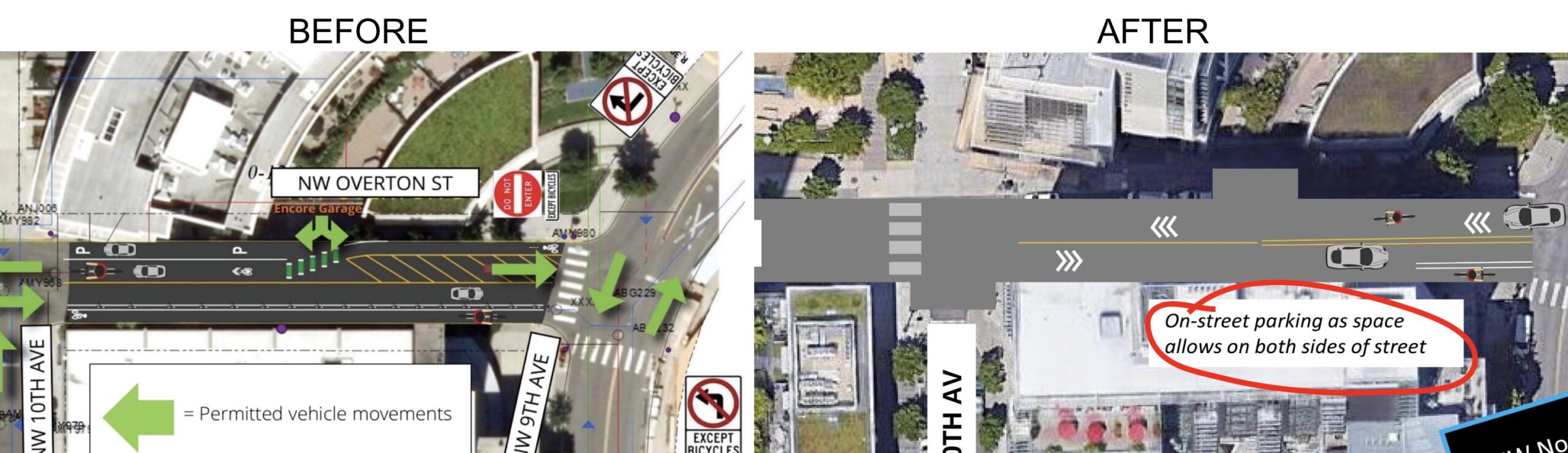
Source: PBOT. Note that PBOT’s new drawing on the right doesn’t show the car parking that will return to the street.
The City of Portland just confirmed changes to the neighborhood greenway route on NW Overton.
As we reported last week, the transportation bureau had second thoughts about their design on Overton between 9th and 10th just over one month after it was first installed. Local businesses (especially Ovation Coffee & Tea) fumed about the removal of on-street parking spaces that came with addition of new bike lanes and first responders said the traffic diverter at the NW 9th/Overton intersection made it hard to turn. Many drivers also chose to ignore the westbound prohibition — especially when traffic backed up due to the busy railroad crossing nearby.
PBOT’s new plan will remove the bike lane, add back most of the auto parking, and add shared-lane markings to the block. They’ll move the eastbound-only, one-way driving configuration two blocks over.
In the graphic sent out by PBOT today, the new plan drawing didn’t show cars parked on the street. They haven’t said how many spaces will be returned, but we can expect to see them on both sides of the street except for the ramp into the Encore Condominium building, near the corners, and at the southeastern corner where the bike lane will remain.
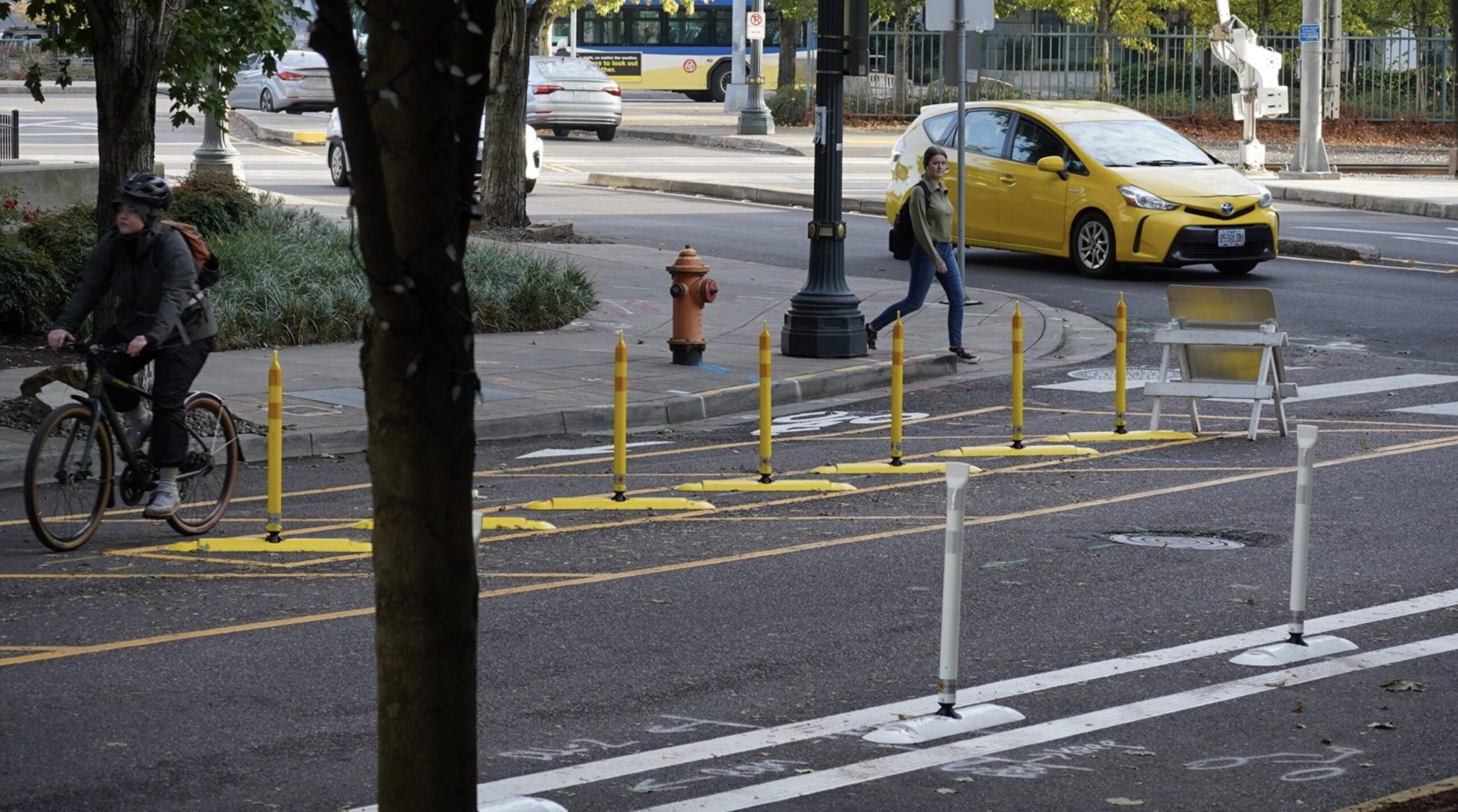
Ride ’em while you can! (Photo: Jonathan Maus/BikePortland)
“As a result of both communication with area stakeholders and on-site evaluations, the project team will be moving the NW Overton traffic pattern change from NW 9th Ave to NW 11th Ave to improve traffic operational issues. The revised design will improve access to NW Overton Street, particularly for freight vehicles and during train events, while reducing cut-through traffic on the NW Pettygrove/NW Overton neighborhood greenway,” read a PBOT statement released earlier today few minutes ago. Here’s more about the changes (taken directly from PBOT):
NW Overton Street between NW 11th and 12th avenues will become one-way eastbound only for auto travel to discourage cut-through traffic on the NW Overton-Pettygrove Neighborhood Greenway.
A section of bollard-protected bike lane will remain on the south side of NW Overton Street approaching NW 9th Avenue to allow people biking to bypass vehicle queues.
No changes will be made to the current amount of on-street parking on NW Overton Street between NW 12th and NW 11th avenues. No changes will made to NW Overton St between NW 11th and NW 10th avenues.
On-street parking on NW Overton Street between NW 9th and NW 10th avenues will be restored on both sides of the street, except where the short bike lane will remain.
The changes will be made as soon as weather allows and PBOT says once the new configuration is in place they’ll monitor traffic for six months to determine if any changes should be made. But of course they said that the first time and only waited about five weeks before making major changes, so we’ll have to wait and see how this all plays out.
This work is part of the NW Pettygrove Neighborhood Greenway project, a key part of the city’s Northwest in Motion Plan. Learn more about the project on the official website.
NOTE, 6:59 pm: This post was originally published with a doctored image. I thought it was silly that PBOT didn’t add the car icons to their conceptual drawing of the new plans, so I added in a bunch of my own. I shouldn’t have done that, because it’s misleading. I replaced that image with the original and regret any confusion.
Two programs from the City of Portland mark a new approach to keeping high school students safe while traveling to and from the classroom.
“We must take a more holistic approach to traffic safety.”
– Jo Ann Hardesty, PBOT Commissioner
A $35,000 grant from the Oregon Department of Transportation accepted today at Portland City Council, will allow the Portland Bureau of Transportation to expand its Safe Routes to School (SRTS) efforts in the Parkrose School District. This new approach will take the form of a “Transportation Academy” at Parkrose High School, intended to teach students about traffic safety skills and other transportation topics.
The Transportation Academy will be staffed by high school teachers and mentors from the non-profit youth service Elevate Oregon, who will go through a PBOT training so they’re equipped to teach students about traffic safety. A PBOT press release issued earlier today states the partnership will “encourage growth beyond the classroom and into students’ day-to-day lives” and the educational efforts are “designed to increase pedestrian, bike, and driver safety, with the goal of reducing fatal and serious crashes” for Parkrose students and the broader community.
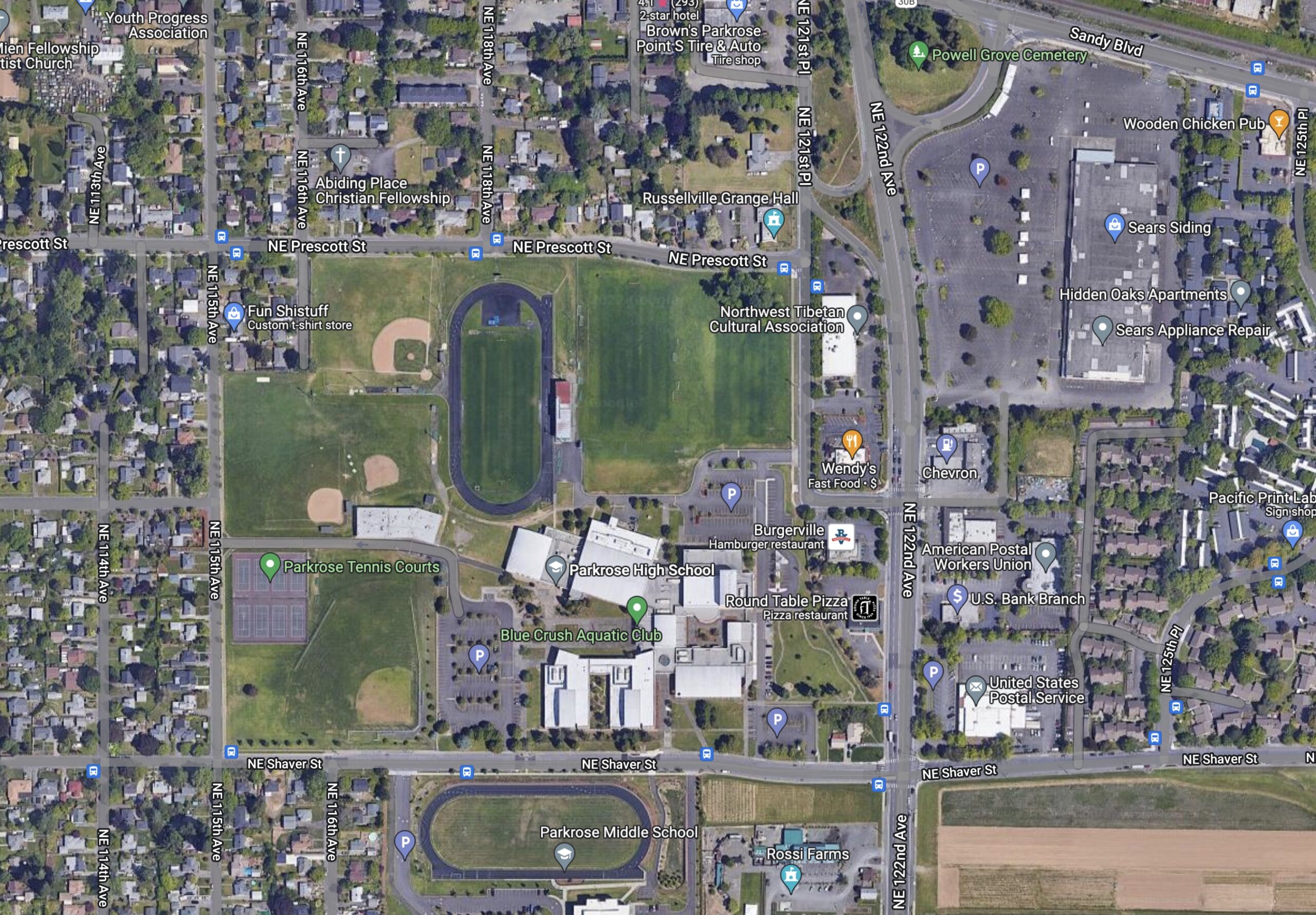
The Parkrose School District is located in one of the most racially diverse areas of Portland, a fact reflected in its student population. A majority of the students in the district also live on low-incomes. The streets around the school are largely devoid of biking and walking infrastructure, and many of them are major traffic thoroughfares like 102nd Ave, 122nd Ave, Sandy, Fremont and Columbia Blvd. PBOT cited this street context in its ODOT grant application.
“East Portland generally bears the burden of historic underinvestment in infrastructure and has poor air quality and limited community resources,” PBOT wrote in the grant application.
Community Crossroads Initiative
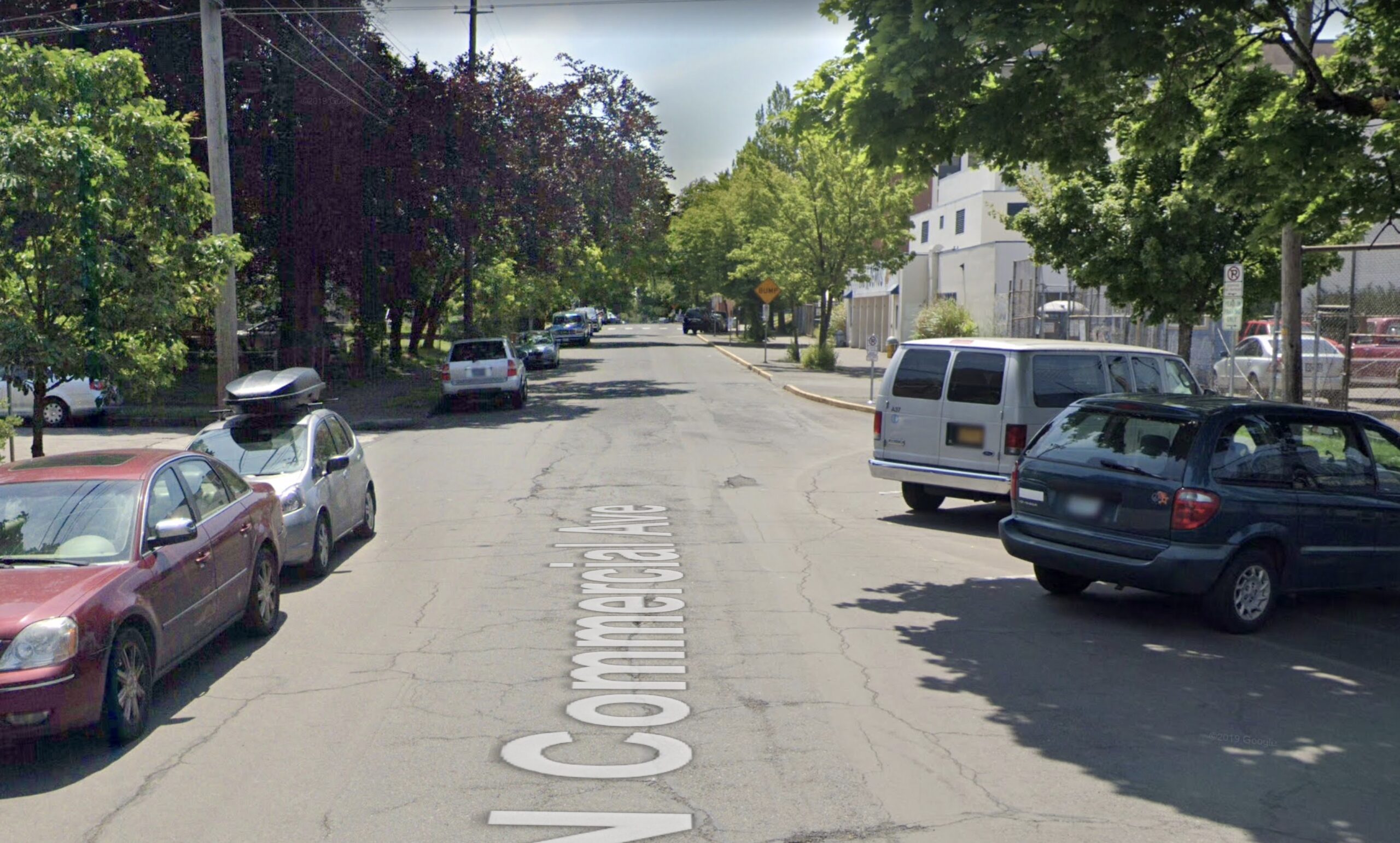
N Commercial Ave outside Jefferson High School.
In addition to the Transportation Academy at Parkrose, PBOT announced a new Community Crossroads Initiative (CCI) they say will, “engage with community using interventions like traffic slowing or traffic diversion to address immediate issues of traffic and gun violence.” CCI will be part of Mayor Ted Wheeler’s Safer Summer PDX strategy that is housed in the Office of Community Safety.
Asked for more details about the new program today, PBOT Interim Communications Director Hannah Schafer said they’ve been asked to build 2-3 projects each summer (starting in 2023) for the next three years. “Our work enhances other gun prevention strategies so we aren’t looking to independently solve gun violence in community,” Schafer said.
On the ground, this will lead to more temporary barricades and traffic diverters at neighborhood hot-spots and other street changes such as more lights, trees or crosswalks. The new CCI approach is the formalization of the Arleta Triangle project that debuted in September.
To determine where interventions should go, PBOT will work with local partners in the neighborhood and analyze data that includes: existing neighborhood transportation plans and community requests, high crash corridors, information gleaned from site visits, and “Gun violence clusters overlayed with built environment data that shows which neighborhoods have built environments that make them more likely to contribute to gun violence,” Schafer said.
PBOT says the first the Community Crossroads Initiative will evaluate street light levels and explore potential street calming projects near Jefferson High School in north Portland – the site of a recent drive-by shooting that injured two students. Another student was injured earlier in October after she was struck by a driver while walking near the school. This effort will give PBOT Commissioner Jo Ann Hardesty another opportunity to connect the dots between street design and public safety.
“As students walk and roll to schools in Parkrose and across Portland, they encounter several barriers and hazards ranging from unsafe driver behavior, lack of knowledge about multimodal travel options like biking and walking, limited access to transit, and gun violence,” Hardesty said in a press release from earlier today about the new SRTS programming. “We must take a more holistic approach to traffic safety that includes the intersection of traffic and gun violence as we support our students traveling to, from, and around their schools.”
NOTE, 12/16/22: We are aware of multiple allegations from customers who have not received units after paying for them and many folks say the company is not replying to emails or giving refunds when customers ask for them. We recommend that no one purchases a Swytch kit until they publicly address these concerns and/or begin shipping product more promptly. Sorry for any issues our post might have caused. — Jonathan Maus, editor and publisher, maus.jonathan@gmail.com. UPDATE, 1/19: Swytch has responded to many readers’ concerns in a Twitter thread posted on 12/16/22.
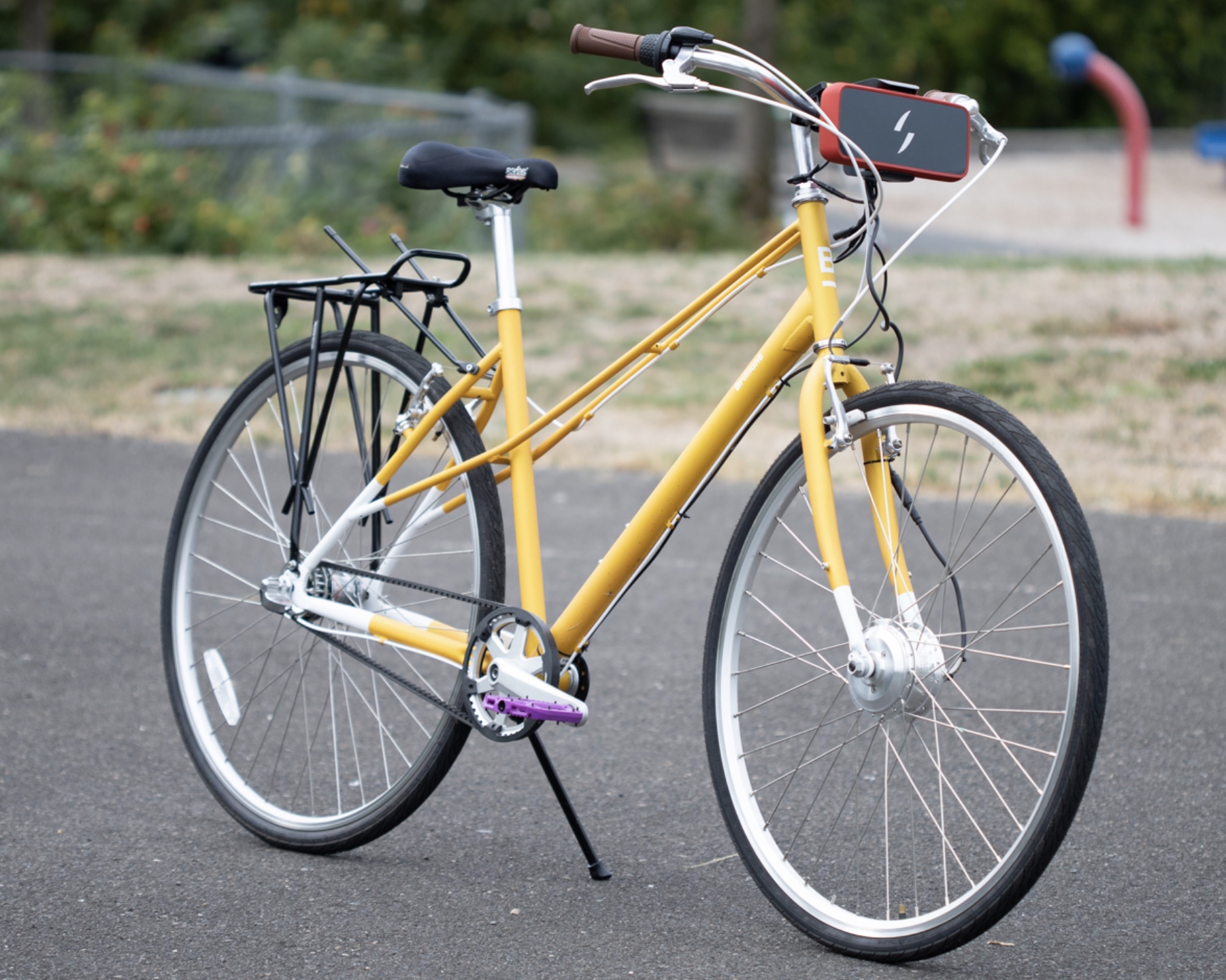
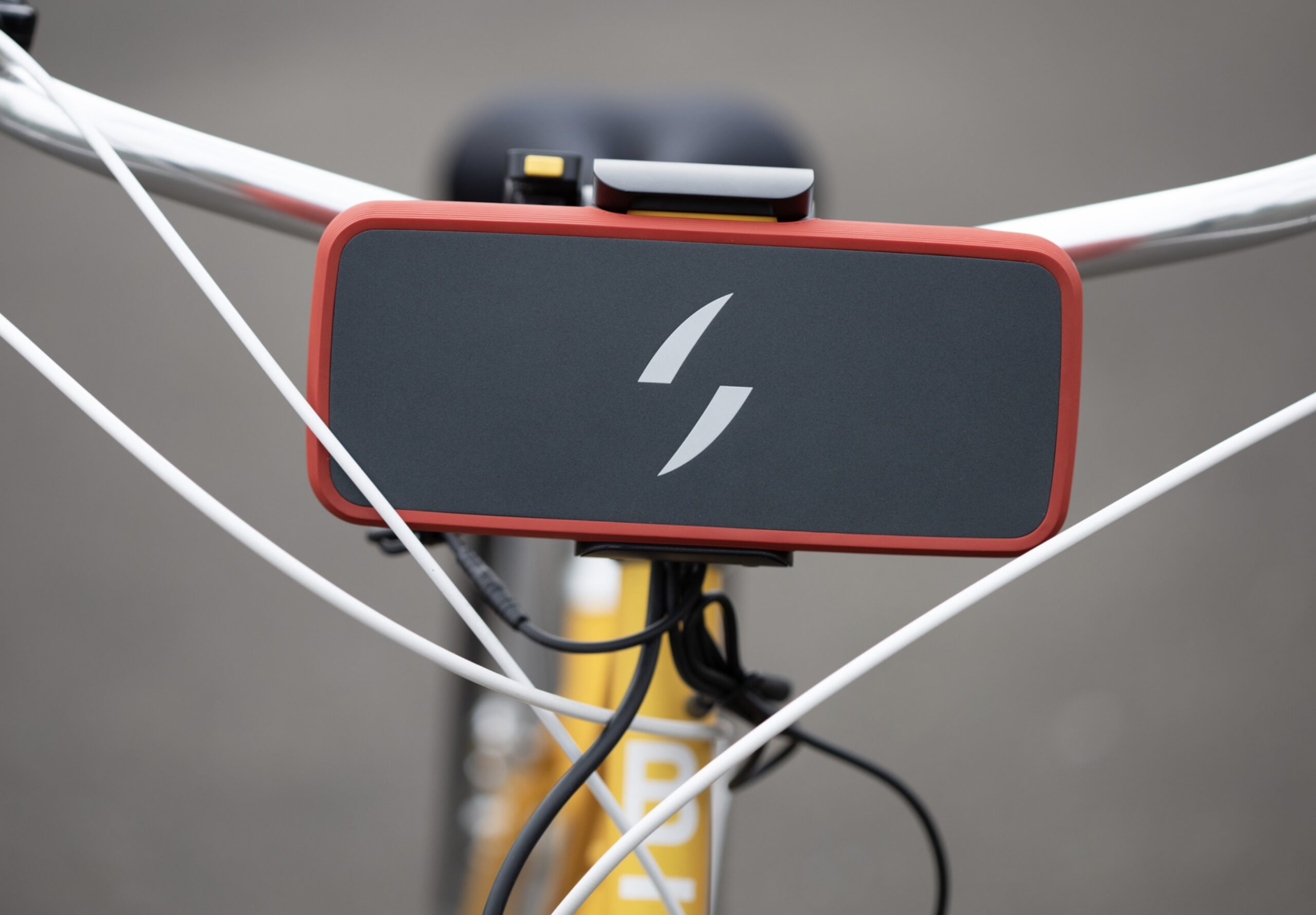
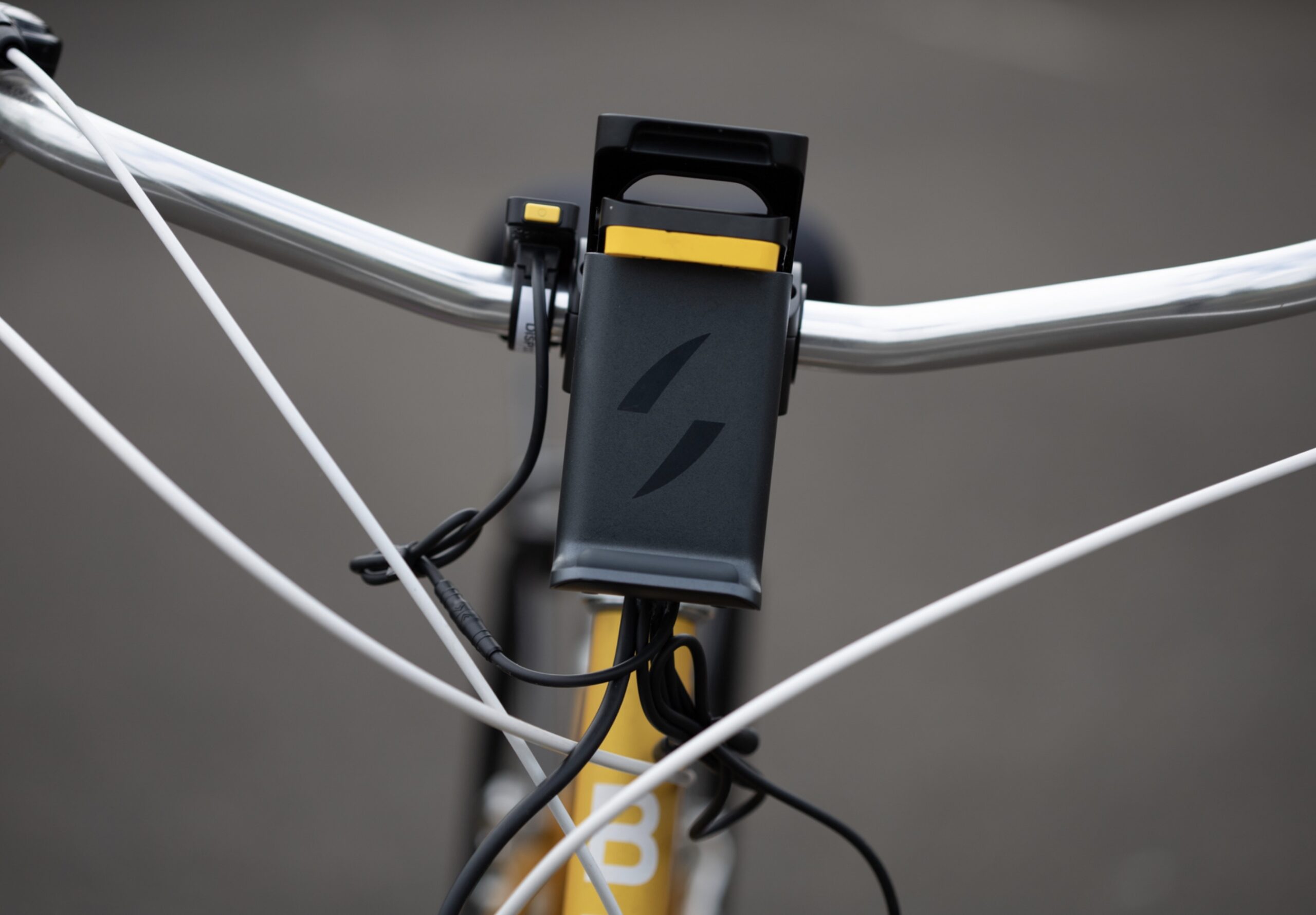
The new kit looks better and is smaller and lighter. (Photos: Josh Ross)
Of all the reviews I’ve shared here on BikePortland, none have sparked as big of a response as the Swytch electric bike conversion kit. At the time I said emphatically that the Swytch kit, paired with a Brilliant Bikes three-speed belt drive cruiser, was my favorite e-bike riding experience. I continue to stand by that, but at the time I also wondered if most people wouldn’t be better served just purchasing an off-the-shelf system.
I learned a lot from this community in the comments from that first post. So with that in mind, I wanted to share the latest update from Swytch.
What it offers
As before, the motor sits in the front hub and when ordering from Swytch you have the opportunity to choose what size wheel you need. All the wheels are 36 spoke count, double-walled construction with a solid axle and they are available in either a black or silver finish. The 250-watt motor with a top speed of 20 mph is also unchanged.
The solid axle will work for either quick-release bikes or bikes designed for a bolt-on solid axle. It will not work for a thru-axle bike but that’s a limitation of hub motors in general and not specific to the Swytch kit. One of the biggest points of discussion in the first article was the potential for movement in the dropouts and the optional torque arm. The torque arm is an optional accessory designed to spread the load for lightweight carbon forks. There is a torque washer included in every kit that slots into the fork drop-out. None of these specs for the wheel or battery have changed at all since the last version of the Swytch kit.
The cadence sensor is also unchanged. Like many of the less expensive e-bikes on the market, the Swytch kit only cares that you are pedaling, and not how hard. I’ll talk about this a little more below but this isn’t a bad thing, it’s just different. The cadence sensor is what makes this work. The Swytch cadence sensor uses a magnet ring with a series of plastic bristles.
On the frame side there’s a sensor that registers the magnets passing by. The sensor is able to rock and just needs to be zip-tied to the frame so that it’s close to the magnet ring and always in the same place as the ring rotates. This is the hardest part of the system to install and it is still incredibly easy. Just check the clearance first and you won’t waste time installing and removing the ring.
The last piece is the battery and controller. This piece is what makes the Swytch system special, and it has been completely redesigned for the 2022 version of the kit. Previously, the battery and control scheme consisted of a handlebar mounted unit that looked like a front bag. Some units had a light on the front and they weighed about 2 kg. All the controls sat at the top of the pack and there were a series of lights to let you know battery life and power level.
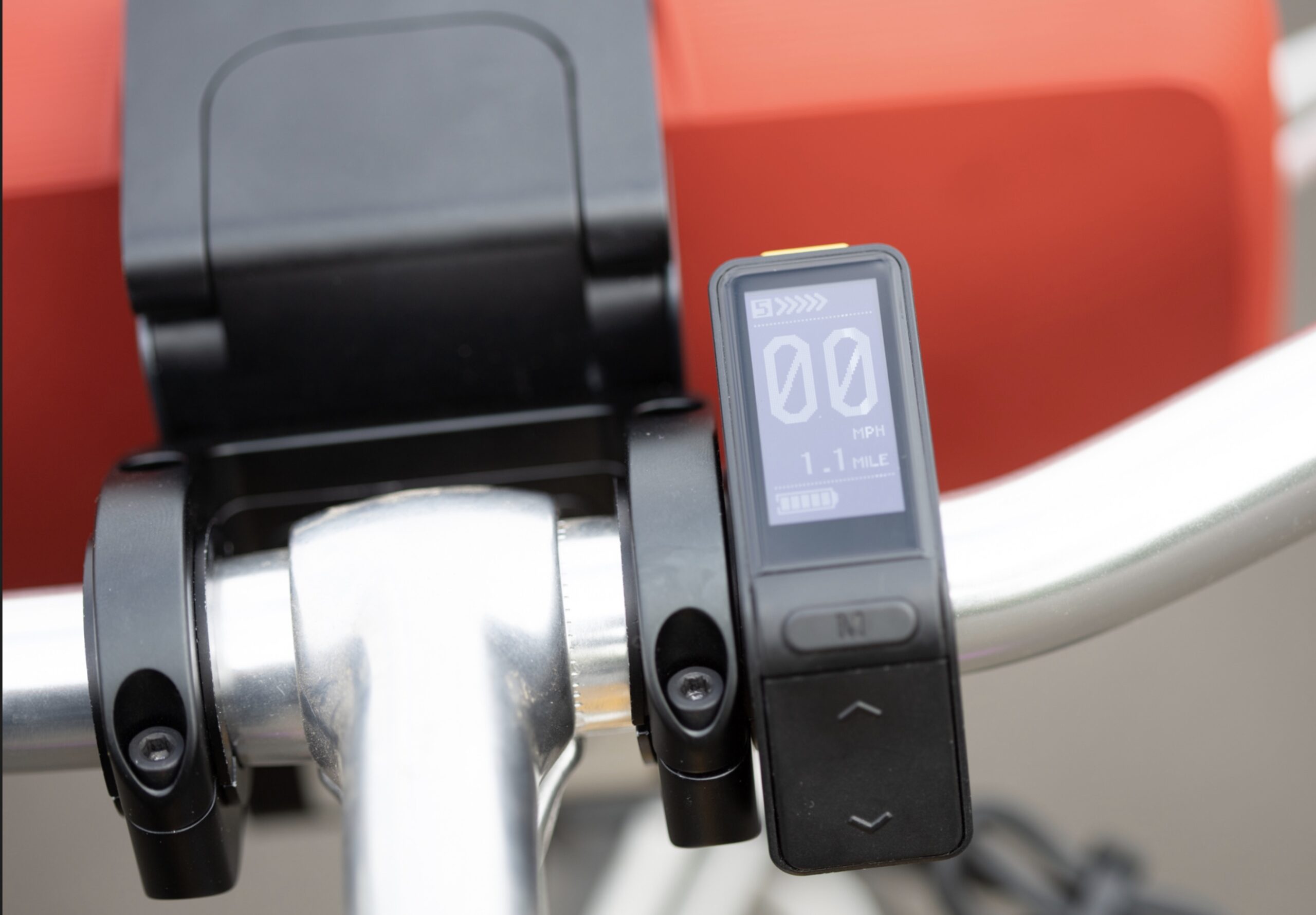
With the 2022 Swytch kit update, that whole system is gone. Instead of the fabric outer with integrated controls, there is now a battery that weighs about half as much. It’s available in two versions that will either take you about 9-20 miles on one charge. You can get either version in a wide range of colors. The size is roughly 22.5 x 9.5 x 3.8 cm and there are no more controls built in. Instead of buttons on the battery pack, you can now access the modes, battery level, and current speed via a small display.
The battery is still removable, but that system has changed as well. The last generation mounted in the center of the bars with rubber spacers and an anti-rotation strap. The new unit uses metal spacers, lacks the strap, and mounting the battery involves sitting it on a small shelf then pressing the top down. The upper part of the mount connects the power as it clamps down. To remove it, just pull up.
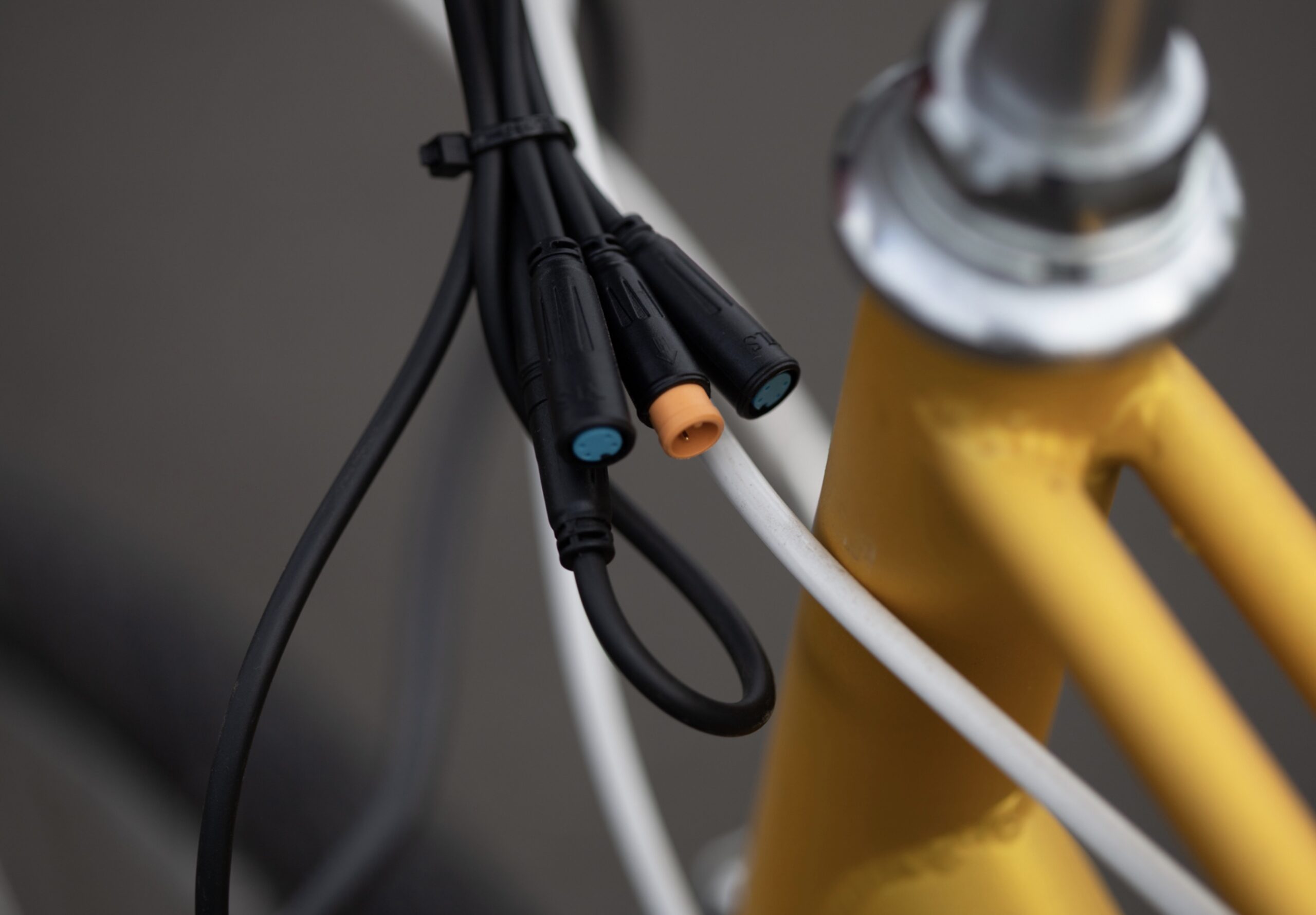
If you wanted to upgrade your previous kit, all the connections are exactly the same. The cadence sensor and the wheel motor run up the frame and connect with a color-coded connection with only one possible orientation. The last kit had unused plugs and this one does too. The display fills one of them and there’s an optional throttle, either twist or thumb-activated, that will take up another. You could add a light to take up another of the plugs or a brake sensor if you are using the throttle.
How to purchase
After my previous review, I received a lot of confused messages about how to buy the kit. The company will tell you there’s more demand than supply and they are intentionally rewarding customers who are willing to wait by giving discounts. You had to sign up for the list and you could preorder at a discounted price.
Either way, the current situation for the 2022 Swytch eBike conversion kit is that it’s sold out. Existing waitlist customers will receive their pre-orders first and there is still room to pre-order for December delivery at a 50% discount. A third batch is also offered for a Jan/Feb 2023 delivery at a 60% discount. Unlike before, the whole system is now up on the website and pretty simple but Swytch is hoping that sometime in the first quarter of 2023 there will be enough supply to change over to a standard ordering process.
Right now the smaller battery complete kit is $1199 or you can pre-order at $499. The larger battery kit is $1599 and the preoder price is $649. If you already have an existing kit, you can also upgrade only the battery and control system for $799/$324.
What’s it like to use?
Nothing has changed in terms of how it rides, and that’s a very good thing! And now it’s even smaller and lighter. The low weight and ability to use a small bike is a big deal for accessibility.
It’s really easy cruise along at a nice clip without doing much work. Given that the Swytch kit is cadence based, you’ll just need to keep in mind that it will feel less like you are a bionic rider and more like the bike is doing the work for you. A mid-drive, torque-based system, can almost feel transparent. It’s like you are riding a bike and happen to be incredibly strong but depending on your needs that’s not always best. A cadence based system is great for transportation replacement.
Verdict
Much of this section isn’t all that different either. Since the last review I put together one of the many Bafang based kits you can find on Amazon. As expected, it’s not nearly as slick as the Swytch. The end result looks like a science experiment. The Swytch kit is a more polished experience and also a better ride (depending on what bike you pair it with if course).
The challenge is that even though it works well, and the kit is now even more polished with the update, it’s still a kit. Given how prices of e-bikes are coming down, it’s not even that much of a discount — maybe even none if you pay full price! — and you end up with a bike that isn’t nearly as integrated. But what you get with the Swytch is the ability to install it on almost any bike. I personally haven’t put it on anything other than a pretty standard bike but there’s a lot of people who use them for things like trikes, kids bikes, cargo bikes, or just as a way to get a lightweight e-bike. If that’s what you need, Swytch makes a fantastic option.
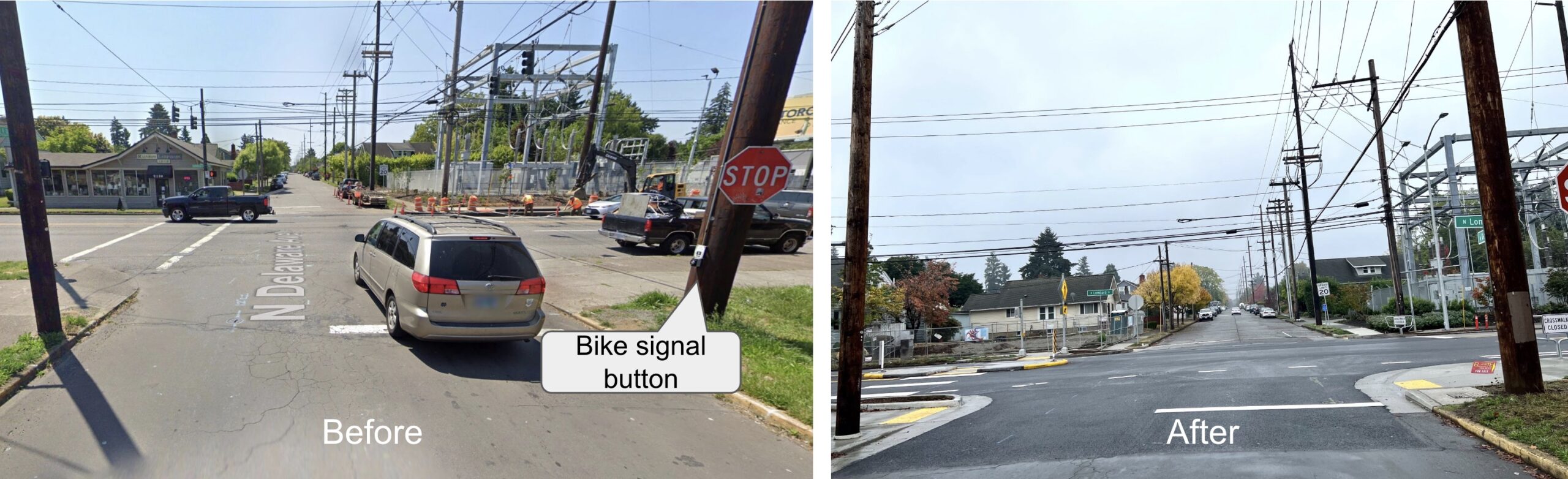
View southbound on Delaware at N Lombard. Note the new crossing and “crosswalk closed” signs in the “after” image.
A recent Oregon Department of Transportation project in north Portland has helped tame an urban highway, but it came at the cost of a key bike crossing. It’s a trade-off we shouldn’t have to make.
I’m talking about the project that brought new pavement and a new cross-section to NE Lombard (U.S. 30) between St. Johns and the Kenton neighborhood. The new buffered bike lanes and other changes have made the once-unthinkable-for-cycling street into a viable route. I’ve ridden it several times in recent weeks and drivers go much slower and it actually feels OK in the bike lane.
But what ODOT did at the North Delaware Avenue intersection is not OK.
The project removed a traffic signal that could be instantly activated via push-button on either side of Delaware. For southbound Delaware bicycle riders, the button was right near the curb and could be pushed without having to roll onto the sidewalk. Now there’s a rapid flashing beacon on just one side of the intersection, which means if southbound bicycle riders want the protection of the crossing, they have to cross over a lane of traffic twice.
“It is also really annoying and potentially unsafe,” one mom who bikes her kids to school and parks on Delaware told us after the changes went in. “It’s a huge pain for cyclists… Definite downgrade from what was there before,” said another. Both people wanted to know why ODOT did it.
The first thing I did was confirm the design with one of the ODOT engineers who worked on the project. “Yes, this is the final design,” they said. “Southbound or northbound bike riders would need to either treat the Delaware approach like a vehicle or a pedestrian.”
It wasn’t until a few weeks later that I learned more about why they made this decision. It seemed like an interesting example of how arcane federal engineering guidelines can have an impact on our everyday experience on our bikes.
Here’s what I learned:
The old signals were “half signals.” This is where the signals only stop half of the intersection — in this case the signals stop the major street in favor of the smaller side street without a signal. The Federal Highway Administration’s all-powerful Manual on Uniform Traffic Control Devices (MUTCD), a guidebook (more like a bible) used by state traffic engineers, strongly encourages their removal, “because of the issues such designs cause when the interruption of the major-street traffic flow by a pedestrian actuation is used by side-street drivers as their opportunity to turn onto the major street, in conflict with the crossing pedestrians,” reads the FHWA website.
ODOT didn’t opt for a new traffic signal at this location for several reasons. First, it would have added cost to the project that wasn’t in the budget. But even more importantly, the MUTCD requires a specific amount of cross-traffic before a signal can be installed (this is known as “meeting signal warrants”). An ODOT spokesperson told me the traffic volumes on Delaware would have to be 3-4 times higher during peak hours to event come close to meeting signal warrants.
A HAWK (“high intensity activated walk”) signal couldn’t be used here because those are typically only used at mid-block crossing locations. * UPDATE, 11/3 at 8:47 am: To further clarify, ODOT prefers to not use HAWK signals at intersections, but that’s not the case with PBOT. The two agencies differ on this issue.
So that’s why the crossing of Delaware and Lombard is worse for bicycle users today than it was before ODOT’s project. It’s a clear example of how arcane federal engineering guidelines can impact your bike route to school.
The good news is that the City of Portland manages Delaware and they have a much less rigid interpretation of the MUTCD. And since it’s such an important and popular route to schools and parks and other destinations, I won’t be surprised if PBOT manages to add some bike-friendly crossing features back to this intersection as part of an upcoming neighborhood greenway project. Stay tuned!
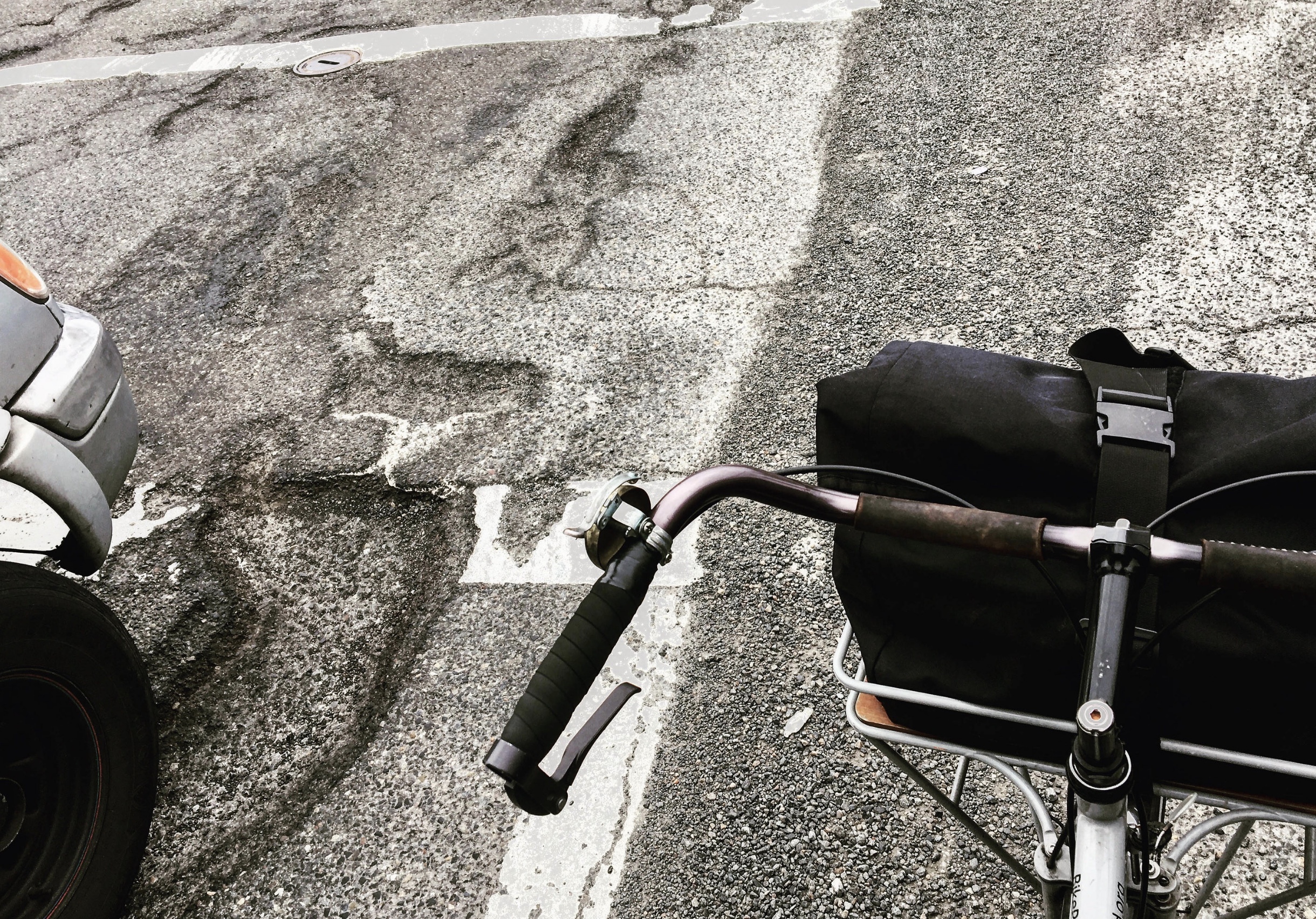
If you use Portland’s streets, you know there’s room for improvement. From crumbling and cracked pavement on greenways, to debris-strewn bike lanes and cavernous potholes — basic street upkeep has fallen by the wayside.
There’s a number behind all of Portland’s unmet maintenance needs: $4.4 billion.
If you’ve spent any time doing transportation advocacy in this town, that number is likely very familiar to you. This statistic is often used by Portland Bureau of Transportation leadership and staff as an excuse to do nothing. One of the most effective ways to shut down requests from people who want a new project or program to be funded is for someone to say, “We’d love to, but we have a four billion dollar maintenance backlog to worry about.”
PBOT Commissioner Jo Ann Hardesty does this all the time. She recently cited the backlog as a reason the bureau has struggled to placate disgruntled maintenance workers. She also mentioned the backlog several times in our podcast interview last year, expressing that it’s one of the main things dragging down PBOT’s potential.
A look at how the backlog has grown over time. (Source: City of Portland)
But the maintenance backlog didn’t start with Hardesty. PBOT commissioners and staff have long lamented about the seemingly interminable problem that keeps growing every year (see above).
“Continuing to maintain the assets…particularly the most costly facilities (like arterial pavement and bridges) is challenging for jurisdictions across the country as funding for ongoing repair, rehabilitation, and ultimately replacement were assumed to be covered by the federal gas tax, which was last increased in 1993 and which we know is woefully insufficient to keep up with aging infrastructure,” PBOT Public Information Officer Dylan Rivera shared with us in an email this week.
Politics don’t work in its favor either. Maintenance work is decidedly unsexy and there are no ribbon-cutting events for sweeping a bike lane. As Cathy Tuttle pointed out in a recent BikePortland guest article, maintenance “just doesn’t have the same political oomph that ‘new’ has.”
Another reason our roads are in such poor condition is because our transportation system strongly favors the type of vehicles that damage roads most. There are tens of thousands of extremely heavy cars, buses and trucks rolling over our roads on a daily basis, and as more people buy larger and heavier ones (EV batteries being the main culprit), the problem will only get worse.
The picture looks even more bleak when you realize that federal grant programs — a huge source of funding for capital projects — don’t pay for maintenance. That means PBOT has to use “discretionary” funding for maintenance, a source the agency has been forced to reduce by 9% in the last two budget cycles.
So what, exactly, is on this infamous backlog? And can the city’s current approach even begin to tackle it?
What does the backlog consist of?
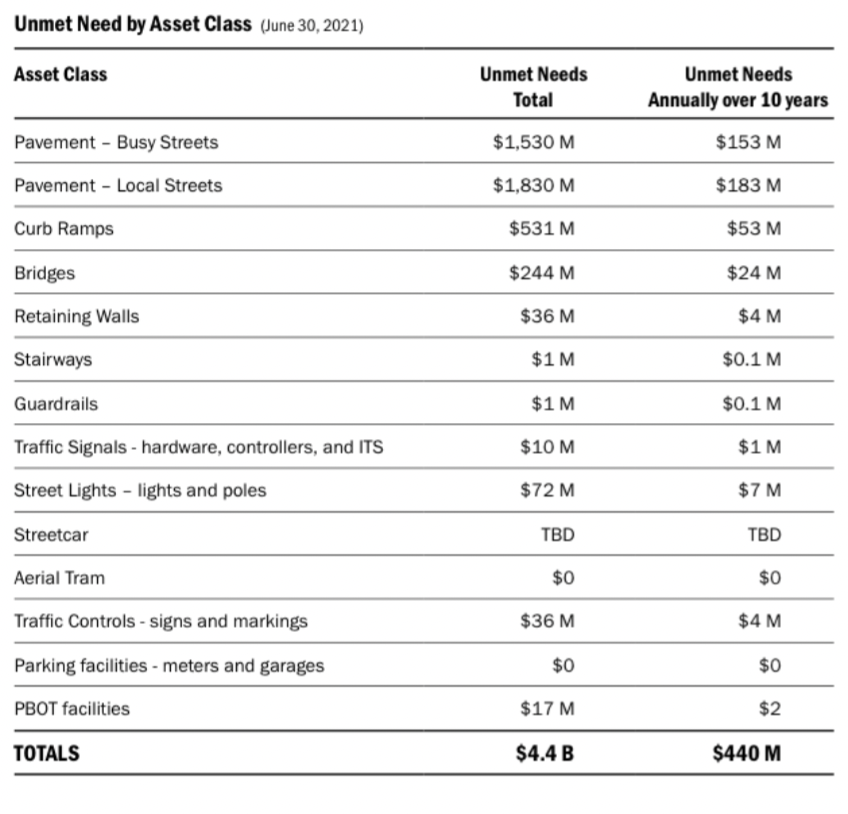
The categories of unmet needs that total $4.4 billion of backlog
PBOT’s Rivera tells BikePortland the $4.4 billion refers to the bureau’s “unmet need” – the calculation of how much it would cost to bring the bureau’s $18 billion in assets to fair or better condition in 10 years. According to this calculation, it would require the city to dedicate $440 million a year to maintenance for 10 years to get assets into that level of condition.
Taking up the bulk of this cost is unmet road maintenance needs. This includes $1.5 billion for busy streets and $1.8 billion for residential streets in various states of disrepair. A Citywide Assets Report released in 2019 deemed the majority of Portland’s arterials and local streets in ‘poor’ or ‘very poor’ condition. Other big contributors to the backlog include streetlights, curb ramps and bridges.
Not figured into these totals are the millions PBOT is forced to spend every year due to infrastructure damaged by incompetent and/or reckless drivers who plow over signs into poles with alarming regularity.
A 2013 city report detailing the condition of Portland’s pavement said it would cost about $750 million over ten years to get roads in proper condition. In 2015, the backlog totaled $1.2 billion, increasing to more than $2 billion by 2017. A little more than five years later, we’ve doubled that price. This proves a dire warning we often hear from PBOT staff: the longer we wait to fix roads, the more expensive it gets.
Potential solutions
Former Mayor Sam Adams at a press conference for his fee proposal in 2008. That’s current Portland Mayor Ted Wheeler behind him, when he was Multnomah County chair.
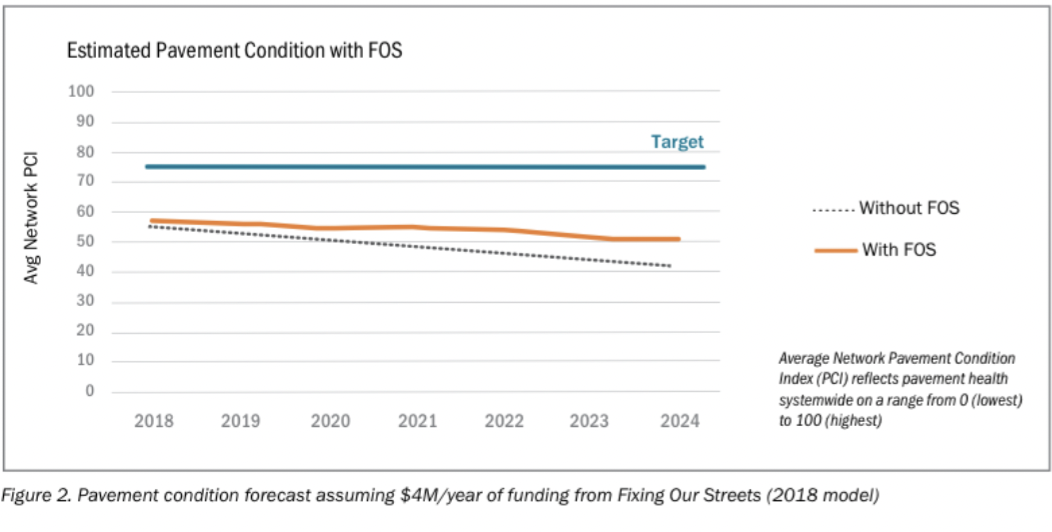
A graphic from the 2021 Citywide Assets Report detailing how Fixing Our Streets helped keep Portland’s pavement condition in better shape. (Source: City of Portland)
The people running Portland’s transportation system have championed a variety of efforts to pay for maintenance over the years. Way back in 2007, former mayor Sam Adams pushed a “Safe, Sound and Green Streets” fee initiative for Portland households that would have raised money for maintenance work (back when the deficit was still manageable). After that initiative died, former PBOT Commissioner Steve Novick advocated for a similar program in 2013 – a universal “street fee” – which also never came to fruition.
Finally, in 2016, Portland voters approved the Fixing Our Streets program as a way to fund street maintenance projects using a $0.10 per gallon fuel tax and a Heavy Vehicle Use Tax. Policymakers knew this program wouldn’t be able to solve every problem in the city, but it was a start. And like many PBOT funding sources, it has a double-pronged approach. Not only is the tax a source of revenue, but the hope is that increased fuel prices will incentivize people to drive less so less pricey maintenance work would be required in the long-term.
The backlog has only grown since the passage of Fixing Our Streets. Even so, PBOT says the money has been put to good use to stave off some of the worst outcomes (see chart at right).
“The Fixing Our Streets program has made a big difference in preserving and extending the life of the city’s pavement, in addition to providing some critical safety improvements,” Rivera said. “No one ever said FOS alone would be enough to solve the maintenance backlog that took a half century to produce.”
So, in a scenario in which everyone either rides a bike or drives an electric vehicle (a utopia for many advocates), the FOS money would run dry fast. That’s where the city’s Pricing Options for Equitable Mobility (POEM) effort comes in. Or, was supposed to come in. Launched in 2019 and adopted by City Council in 2021, the POEM Task Force outlined several ways PBOT could raise revenue. Unfortunately, the recommendations of the task force have yet to move forward.
One new fee PBOT has begun to collect (which wasn’t technically part of POEM) is a new parking fee that was created out of desperation following a massive decline in drivers filling meters during the pandemic. But that fee is estimated to collect just $2 million, a drop in the bucket.
What now?
SE Division near 130th.
The backlog is as bad as it’s ever been. We have less money than ever. And the morale at PBOT’s Maintenance Operations division is at its nadir.
It feels like PBOT and City Hall’s courage to implement the new revenue ideas from the POEM plan is diluted by their fear of losing out on the car-based, cash cow, status quo. But the sooner we rip off the band-aid, the sooner we can heal our streets and our budget.
In the short-term, we must get PBOT’s Maintenance Operations group on better footing. This has nothing to do with a lack of funding and it goes beyond looming threats of a strike. We’ve recently heard about a lack of trust between staff and leadership, a dysfunctional institutional culture, and eye-popping staff turnover rates. This constant reshuffling of staff is very disruptive to work crews and their programs, and leads to less work getting done. Our fingers are crossed that new Maintenance Operations Director Jody Yates, who was hired in February, can right the ship.
We also must charge people more to use our streets. With inflation and income inequality at all-time highs, and with transportation not even being on the political radar in Portland these days, that will be a tough pill to swallow.
To make it easier to swallow, we should consider a different the narrative around the issue. Our goal shouldn’t be to raise more money to do more maintenance; the goal should be to do less maintenance. The situation is unsustainable not because we lack funding, but because we are living above our means. We spend too much money fixing damage from vehicles that we can’t afford to support any longer, and we don’t do enough to make things we can support — like biking, walking, and taking transit — viable options.
Portland has a long legacy of supporting carfree spaces. Former Mayor Vera Katz declared September 14, 2004 as “Portland Car-free Day.” In 2008 we hosted the international Towards Carfree Cities Conference. And even the recent POEM initiative had, “Our system today over-prioritizes cars” as one of its foundational principles. But despite years of rhetoric and advocacy we still haven’t fully embraced the idea of permanent carfree streets, despite the fact that every time we dip our toe in the water — with programs like Sunday Parkways or recent plaza and public safety projects — it feels good.
We need more attention on the problems we face today and the political will to do things differently tomorrow. The maintenance backlog excuse should not be the end of the conversation — it should be the start of a new one.