(August. 24, 2022) Help shape the Portland Bureau of Transportation Budget choices! The Portland Bureau of Transportation (PBOT) is currently accepting applications for its Bureau and Budget Advisory Committee (BBAC). The committee advises PBOT Director Chris Warner on the direction of the budget and bureau priorities.
The BBAC application deadline has been extended to September 5, 2022.
The BBAC is a 24-member committee. Members meet monthly and serve a two year term, which may be renewable.
To be eligible for the advisory committee, members must live, play, worship, go to school, work and/or do business in the City of Portland.
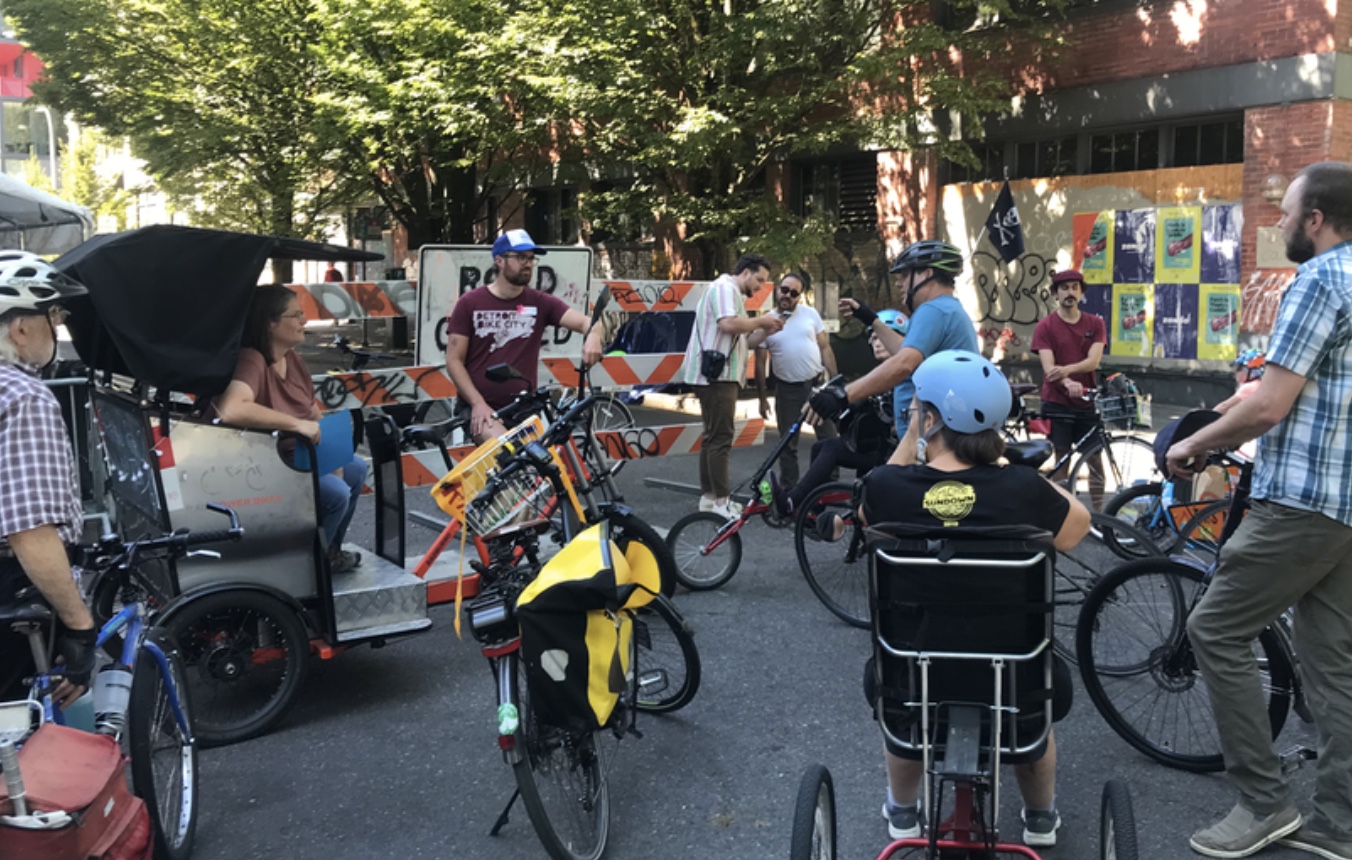
PBOT’s Jody Yates (seated in pedicab) at the ride. (Photos: Cathy Tuttle/BikeLoud PDX)
Story and photos by Cathy Tuttle
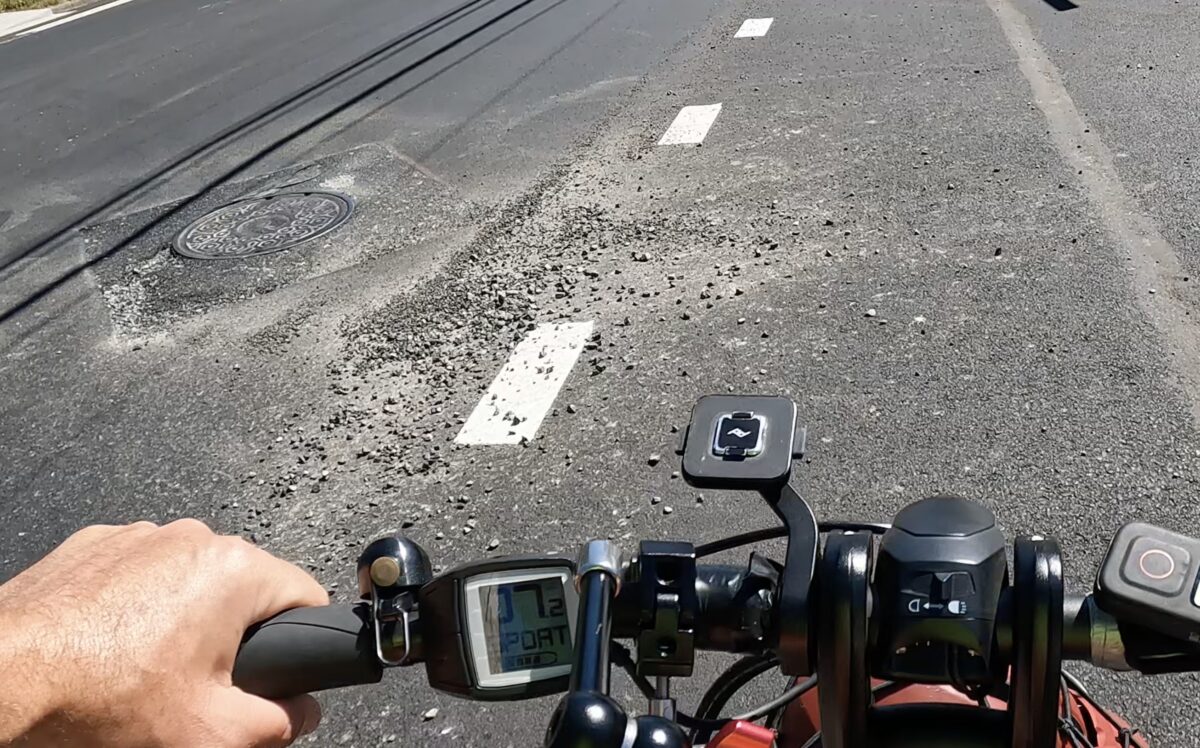
People who bike every day are the folks who ground-truth poor maintenance. We intimately experience gutters filled with leaves and plastic bike lane wands broken in the same locations day after day. We see street trees dying, and giant potholes reappearing over and over on what look like war-torn streets. Then there are the piles of slippery leaves, illegible street signs, shattered glass, chunks of concrete, thorny brambles and so on. These hazards could injure or even kill someone. And they always make us uncomfortable.
Yet as important as it is, a well-maintained stretch of asphalt isn’t much of a photo op or ribbon-cutting opportunity. Maintenance just doesn’t have the same political oomph that “new” has. That means repairing, upgrading, and fixing streets is often overlooked, underfunded and understaffed.
The City of Portland wants to change that.
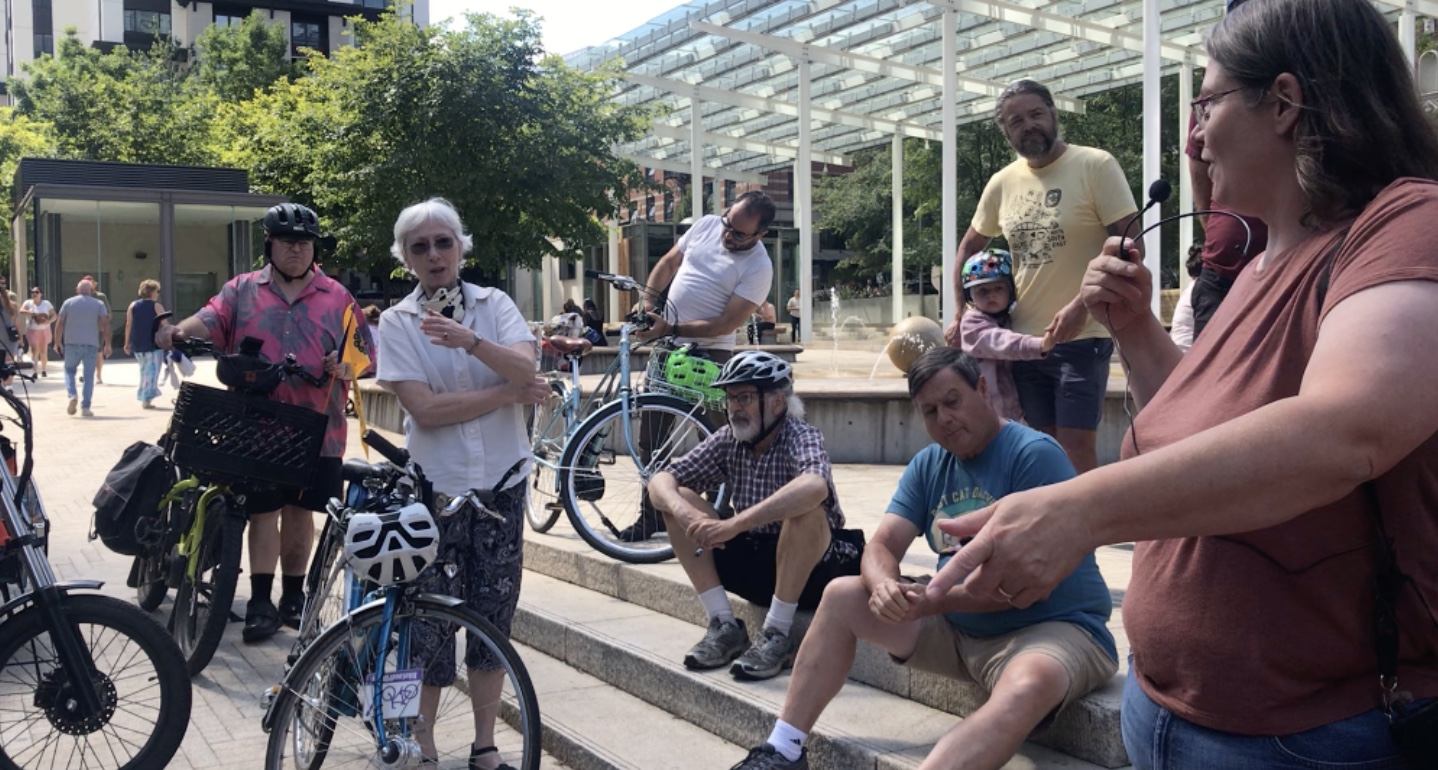
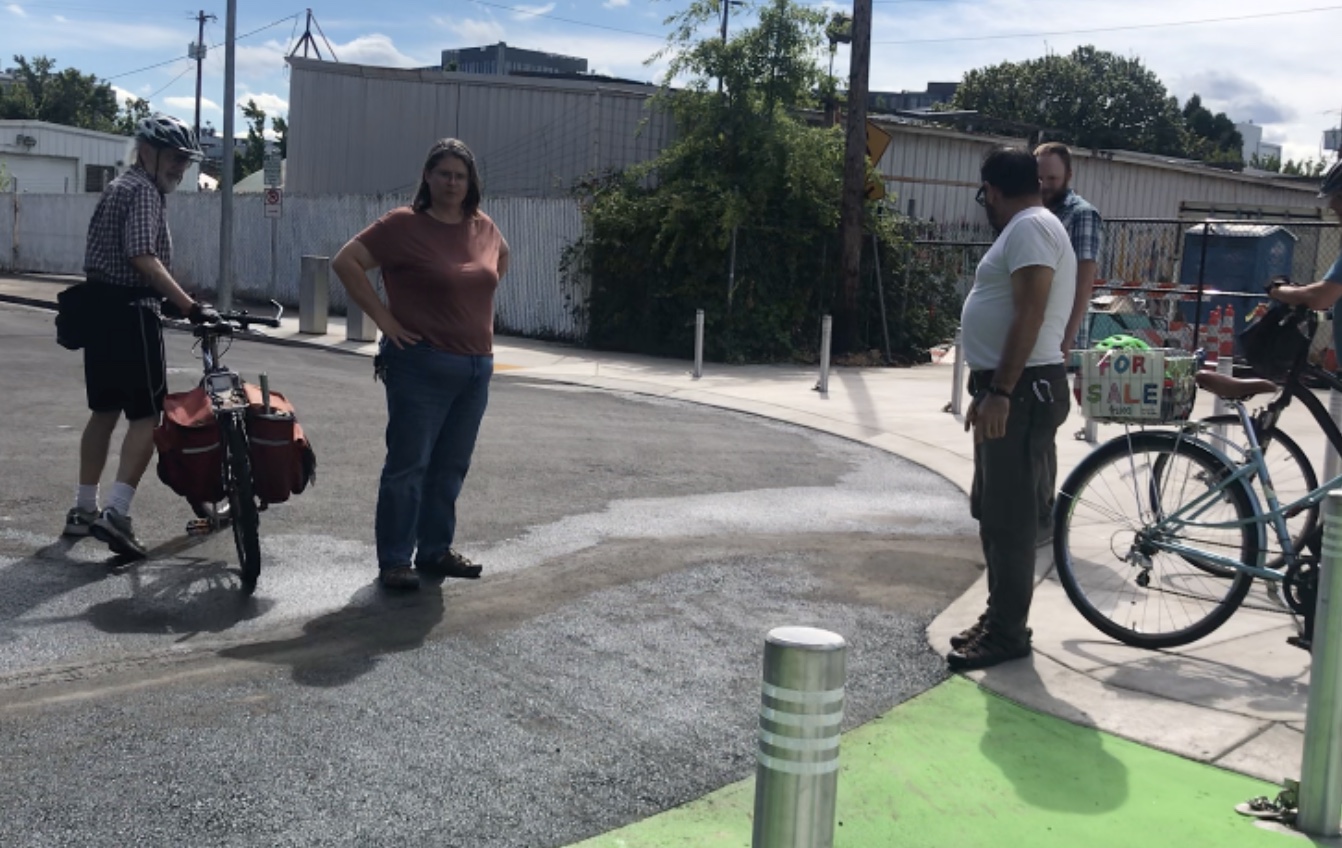
Yates at Director Park.Checking out Blumenauer Bridge bump.Yates at a stop along the route.
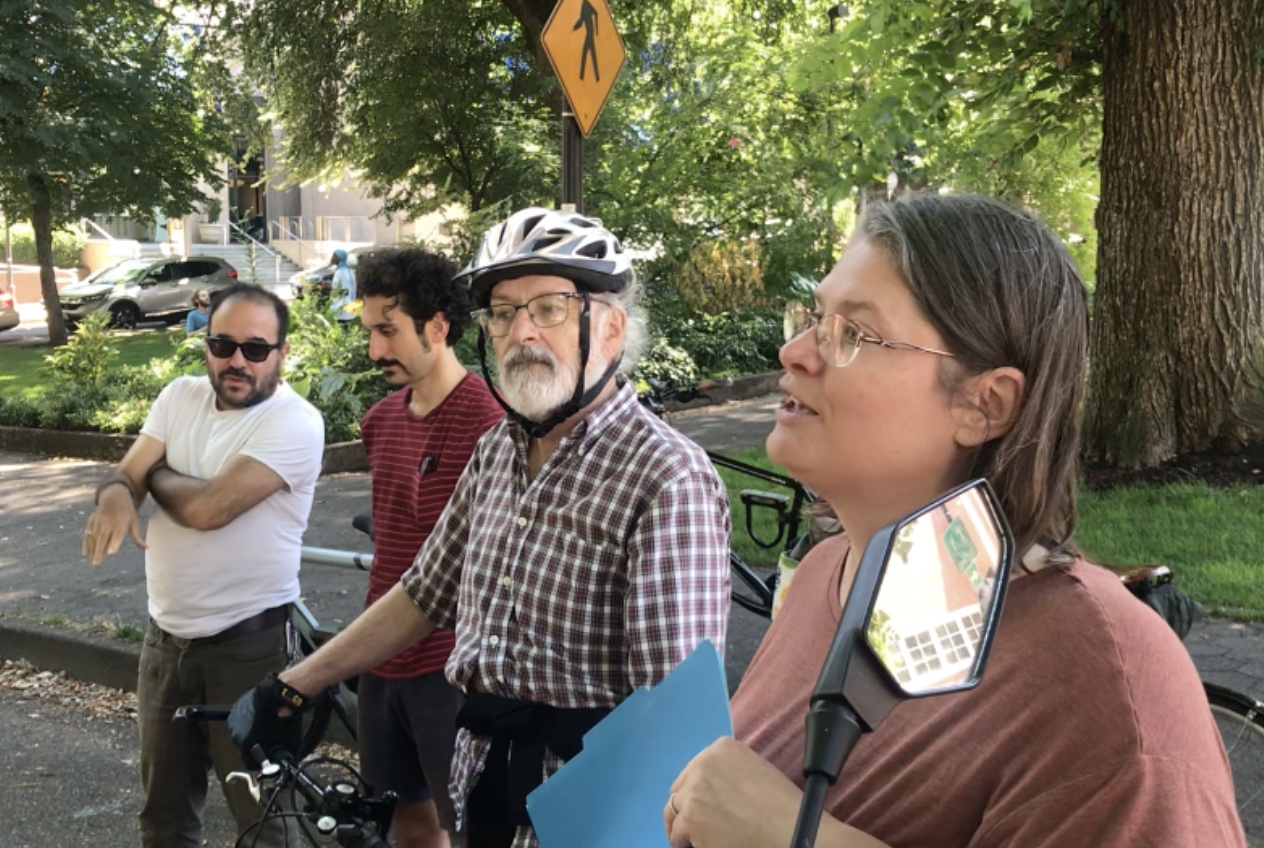
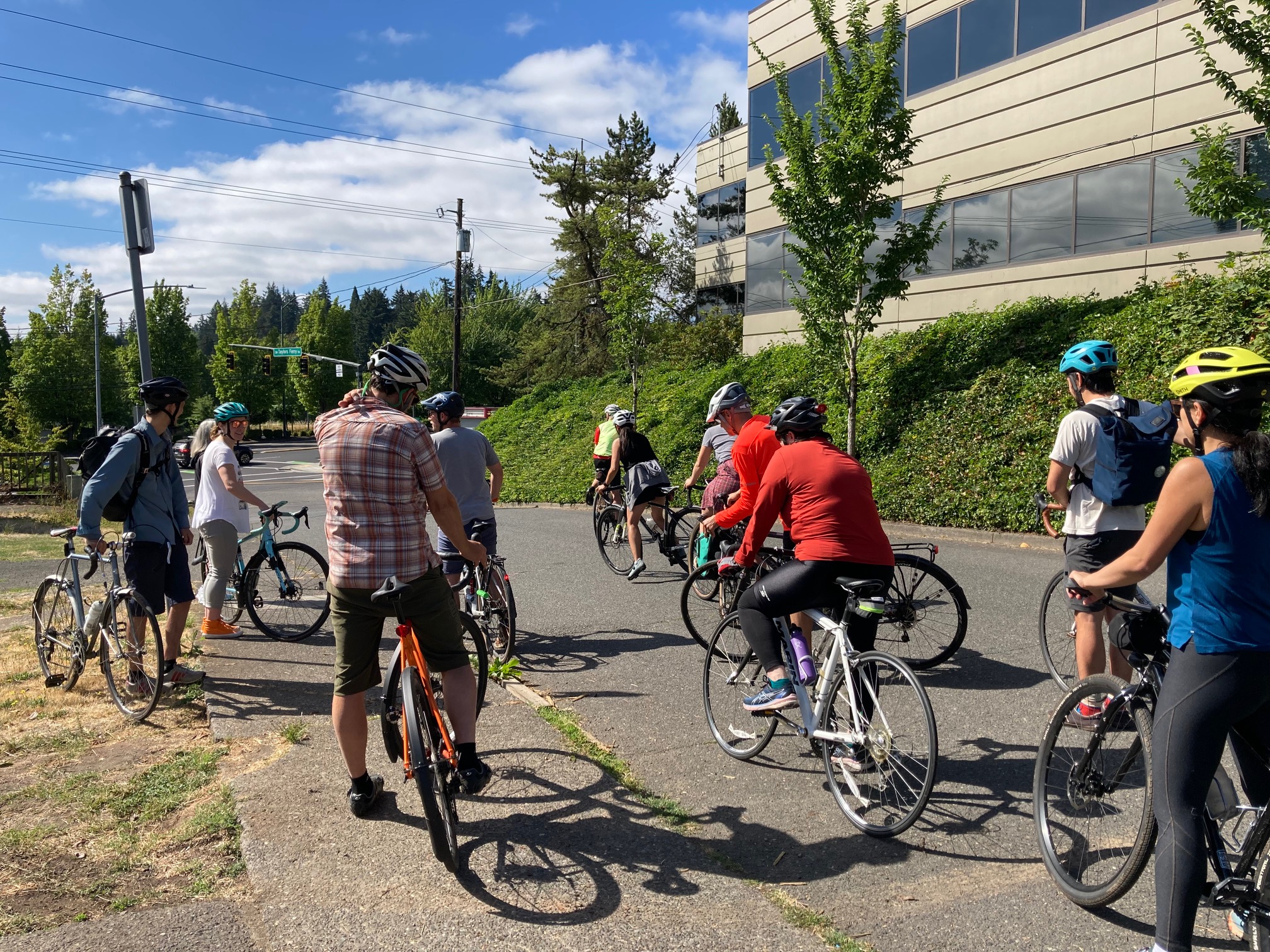
Portland Bureau of Transportation (PBOT) Maintenance and Operations Manager Jody Yates shared her time, knowledge, and experience with us on Friday August 26. Yates headlined the eleventh monthly BikeLoud PDX Policy Ride I’ve hosted, and her topic is what I’m personally most interested in as we retrofit our cities for the future. As a city planner and project manager, I have always been dedicated to building infrastructure we can maintain easily, rather than spending money on streets that need to be constantly rebuilt. Yates is too.
Jody Yates spent Friday afternoon riding in a three-wheeled electric pedicab piloted by Go By Bike founder and BikeLoud PDX Board President Kiel Johnson. Yates and the group who came to this Pedalpalooza ride talked for three hours about the materials under our feet (and wheels) and we barely scratched the surface.
PBOT is responsible for the maintenance of hundreds of millions of square feet of pavement – streets, sidewalks, bridges, staircases, plazas, and more. Though she started just in February 2022, Yates is up to speed on leading a maintenance and operations division of several hundred people. She brings a wealth of practical experience. A civil engineer for the past 25 years, Yates worked mainly for governments in Clackamas, Portland, and most recently in Beaverton. A thoughtful engineer, Yates was instrumental in getting programs started in creative street activation and rigorous asset management. Yates is putting significant energy into assessing where and how streets are failing, and smart ways to improve them.
There are three main culprits of pavement destruction. In order of severity, streets are damaged by: poorly repaired utility trenches, extra heavy vehicles, and tree roots.
Though PBOT’s Maintenance and Operations Division does repairs and implements designs generated by other PBOT divisions, Yates talked about street maintenance as a design issue in and of itself, of how maintenance should be a first consideration and built into designs of new and upgraded streets. Streets need to be easy and affordable to take care of.
Yates said there are three main culprits of pavement destruction. In order of severity, streets are damaged by: poorly repaired utility trenches, extra heavy vehicles, and, far back in third place, by tree roots.
Utility trenches are made by gas, sewer, water, telecom, and other utilities. Yates called out telecom companies for doing a slapdash job repairing the roads they rip up when installing cables. Yates made the analogy of the process of utility cut and covers to a shirt that has been torn again and again; sometimes repaired carefully, but often too quickly. And all the tears and repairs eventually destroy the “fabric” of the street.
On our tour we looked at old streets cobbled with ballast blocks, pocked and pitted asphalt, concrete panels, and even some 100-year-old mixtures of paving material that still are intact because they hadn’t been cut into very much.
Road repaving can cost upwards of $6 million a mile, and with Portland on the hook for taking care of over 2,000 miles of roads, keeping what we have in good condition is very sensible.
Heavy vehicles can and do quickly destroy roads too. Transit stops are reinforced with heavy duty concrete panels instead of a few inches of asphalt that tends to quickly deform under heavy wheels. People walking and rolling do virtually no damage to streets, but cars also quickly wear off paint and thermoplastic, damage curbs and street furnishings, and wear down pavement too. A few divisions of PBOT staff under Yates are responsible for repairing damage to paint, furnishings, and other public street elements.
Street trees are vital to a healthy resilient city, but their roots can also lift pavement as they search for water and nutrients. Streets that have minimal or no car traffic — like the Park Blocks on the PSU campus — have plenty of room for mature street trees. Low-car streets also need much less maintenance to repair paving, paint, and street furnishings. Another reason it’s smart for us to invest in streets that prioritize people walking and wheeling? They never do as much damage to the right of way as cars do.
People who bike care about safety and comfort. That’s why road maintenance is so important to us. Smooth roads, clear sightlines, few conflict zones along routes including door zones and safe intersections. We need clear directional signs to guide us while biking. We need enough room to avoid obstacles and wide enough lanes to ride side by side together or to pass other people biking.
For all these reasons and more we look forward to learning more and working with Jody Yates and PBOT on these issues in the future!
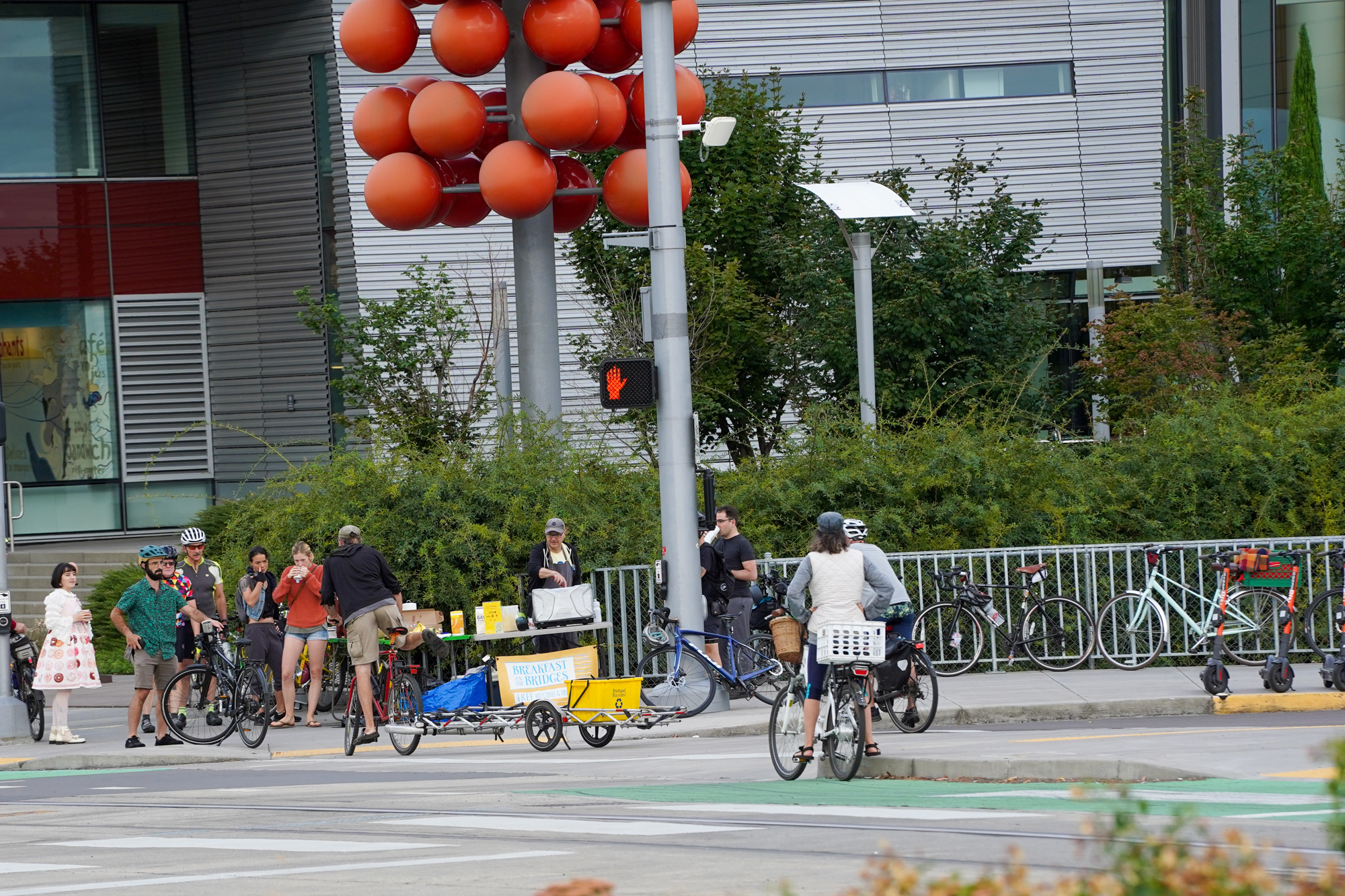
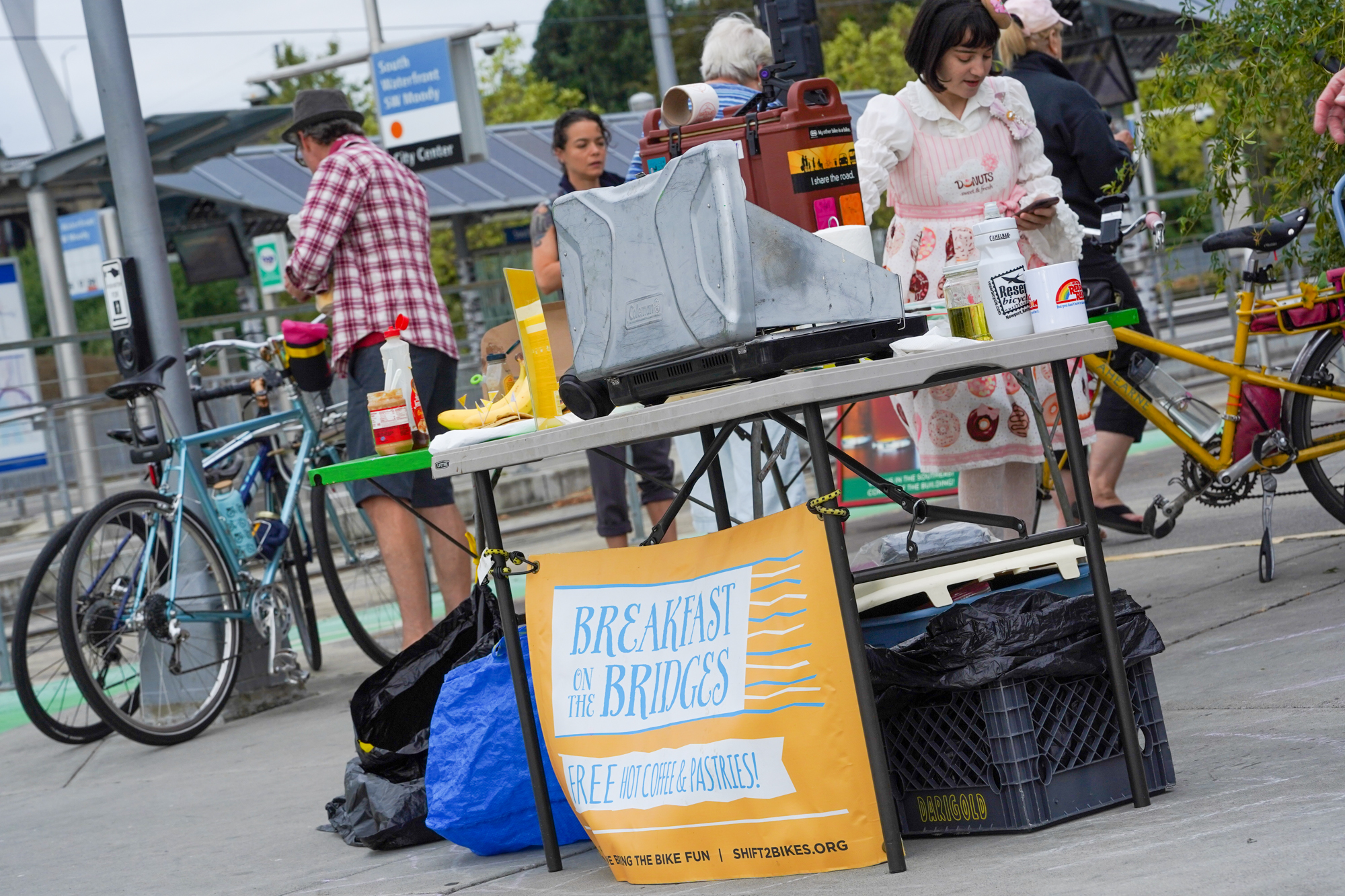
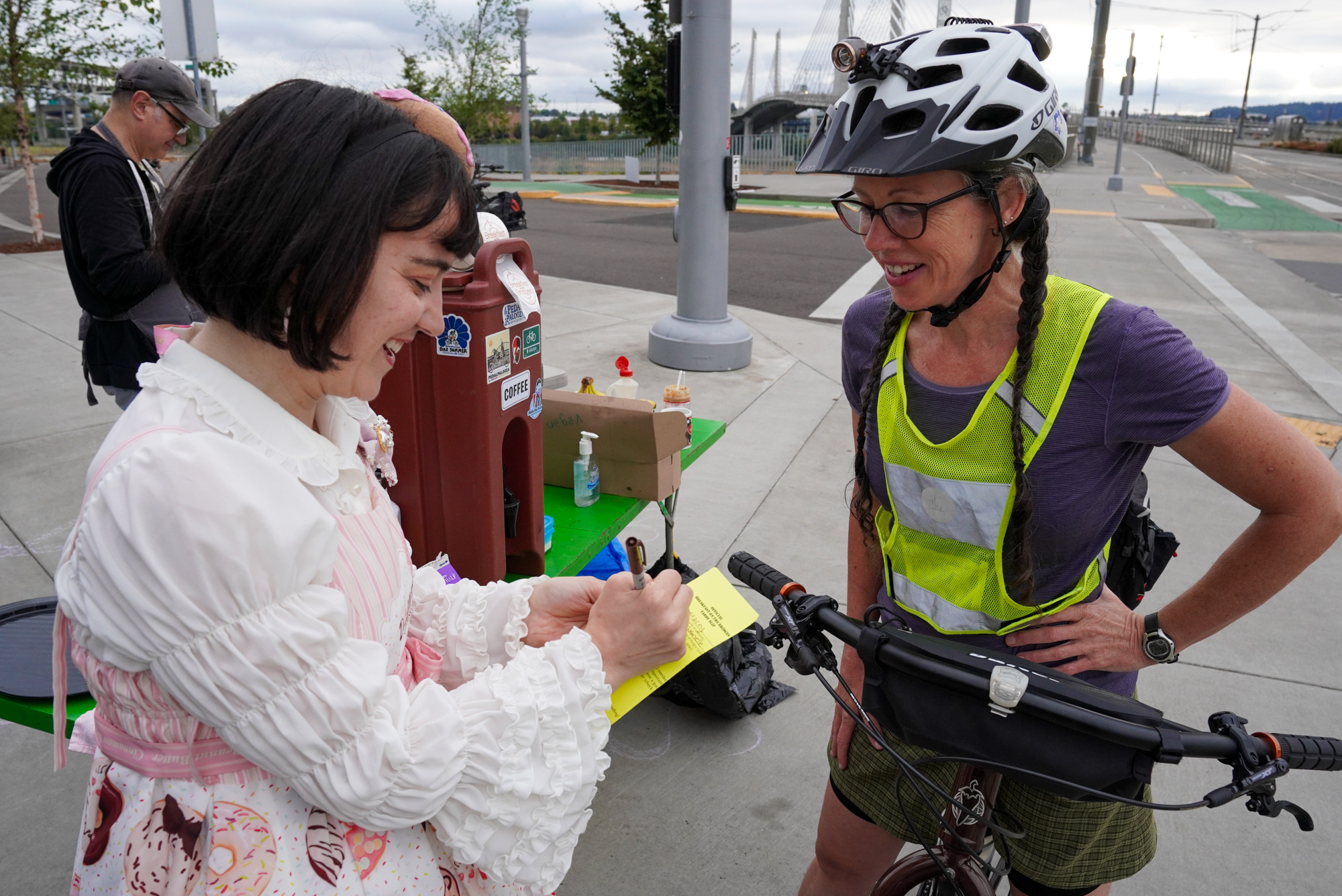
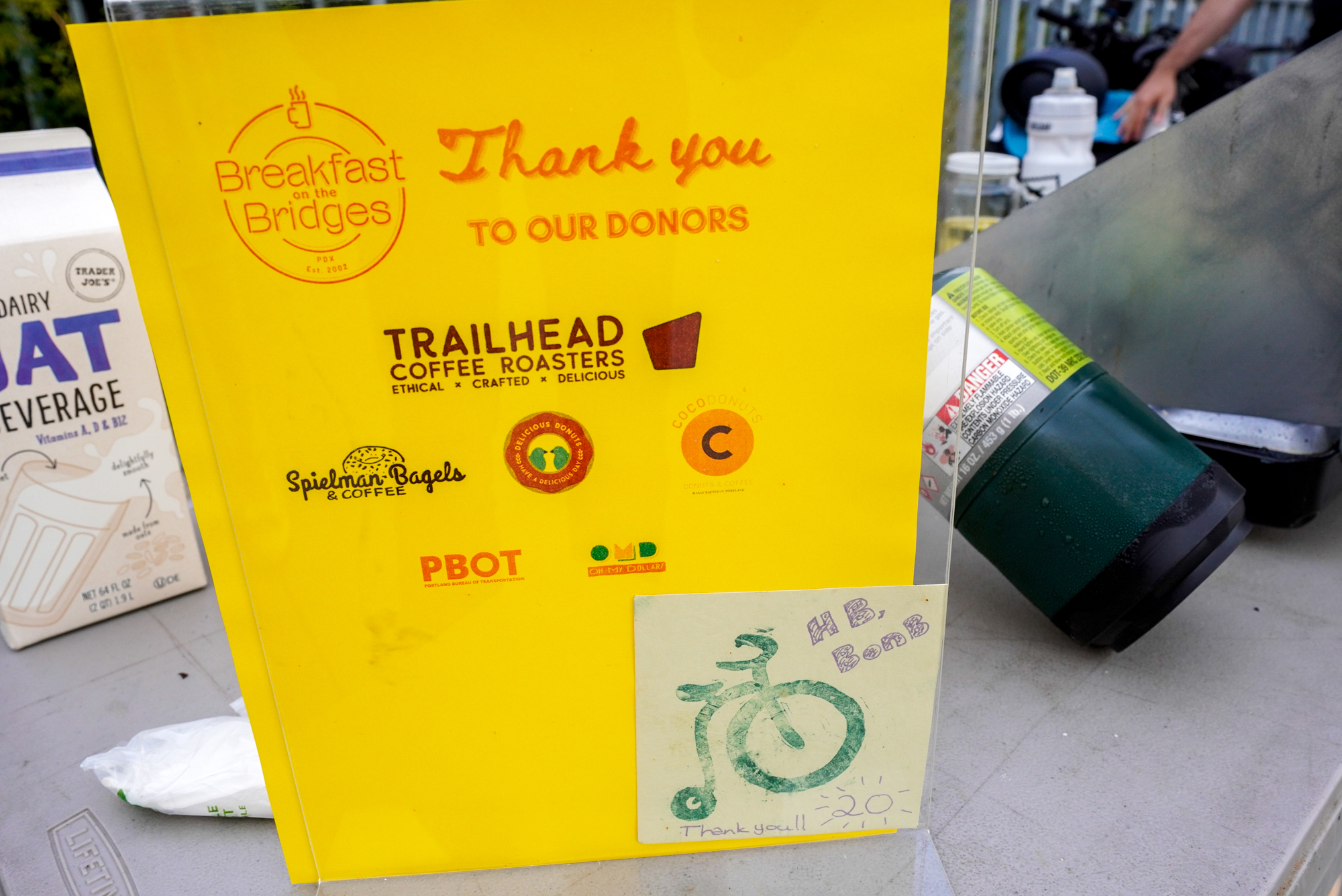
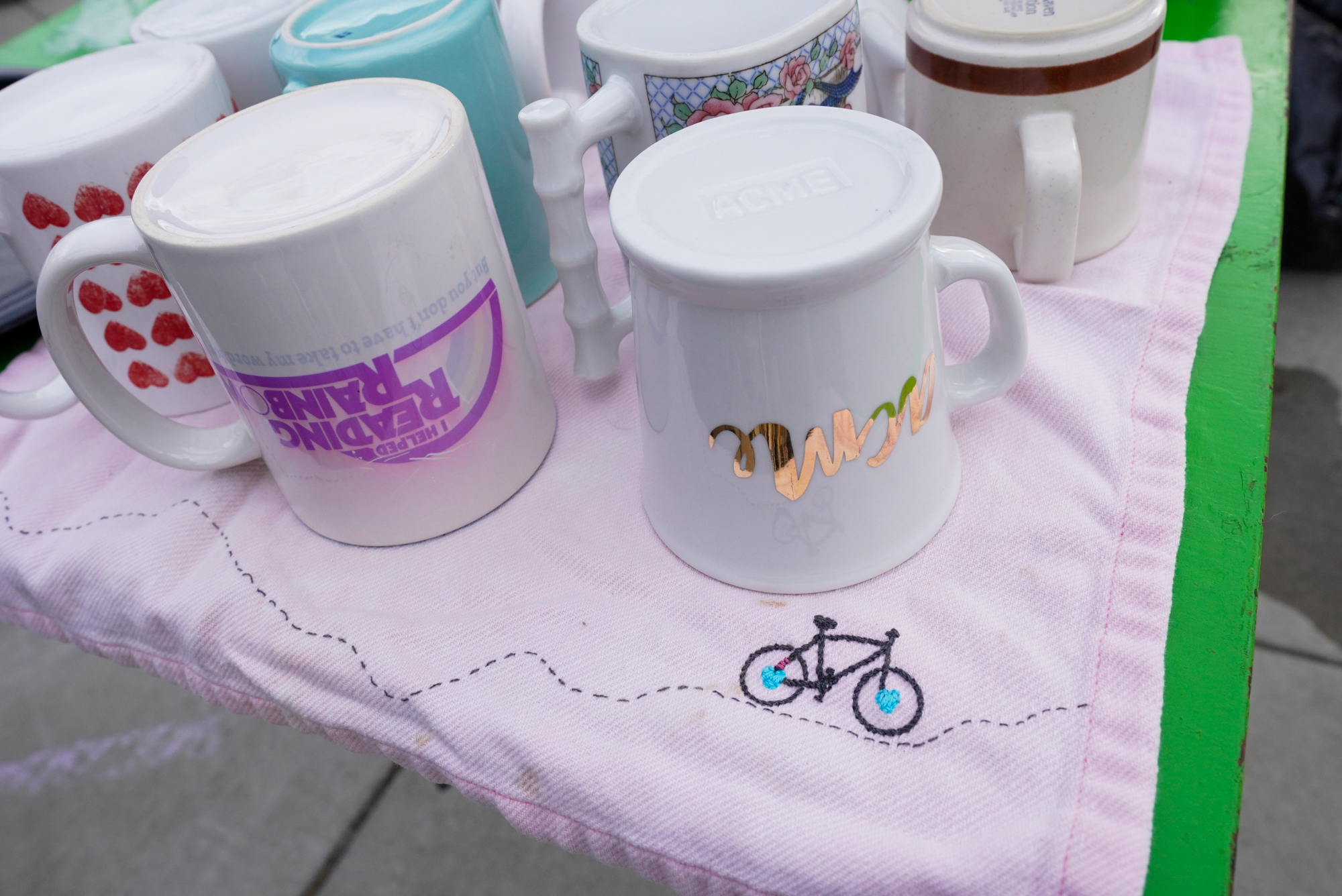
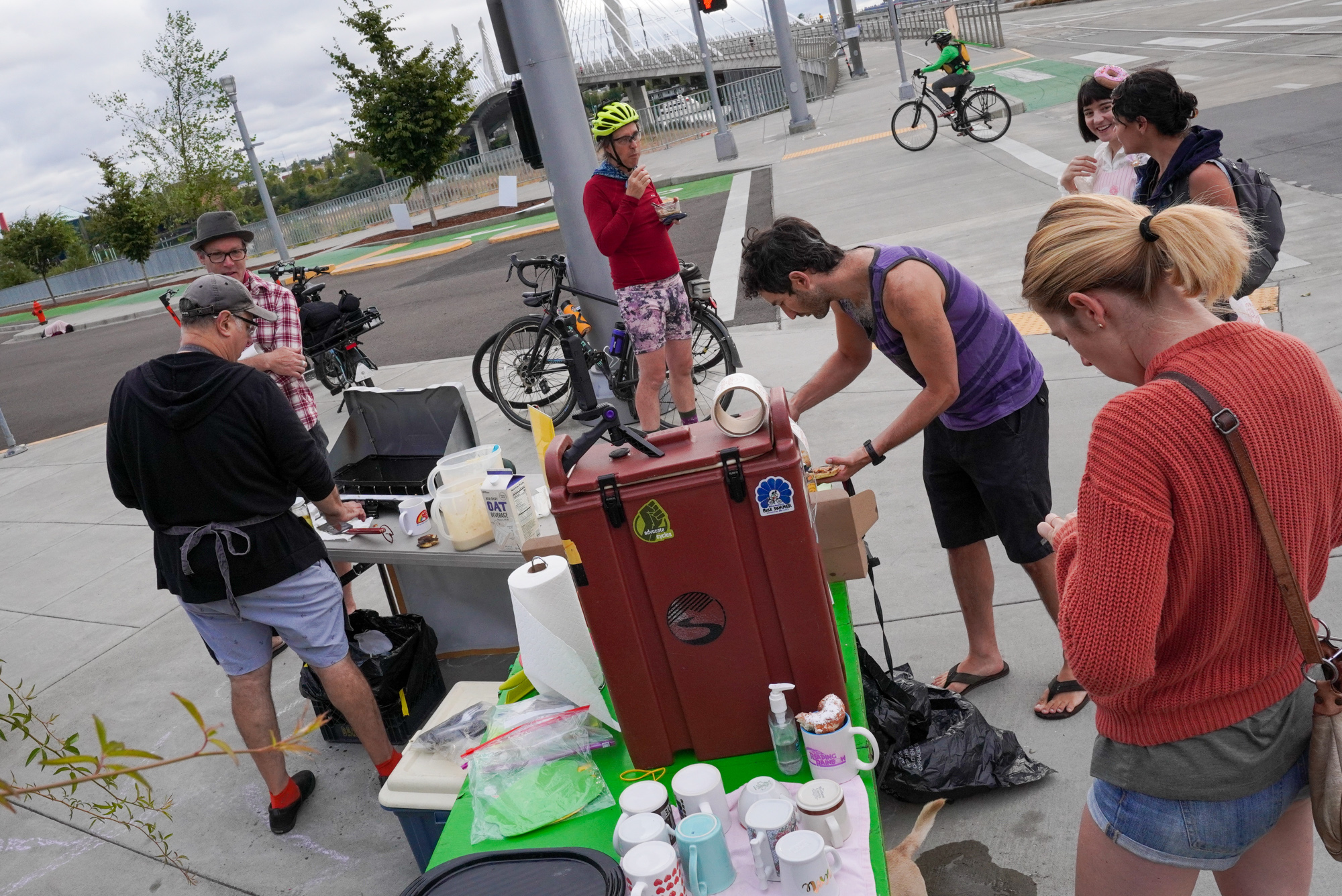
For the past 15 years, Hollywood neighborhood resident Lily Karabaic has woken up around 4:00 am on the last Friday of every month. Like you, the first thing she does is make coffee. Unlike you, she makes 42 cups. And then she straps a percolator, a few dozen donuts (a vegan sampler from Doe Donuts), a bunch of mugs, and sometimes even pancake mix (gluten free if you choose) or freshly baked muffins onto her bike trailer and heads out to stand on a bridge and gives it away to anyone who passes by.
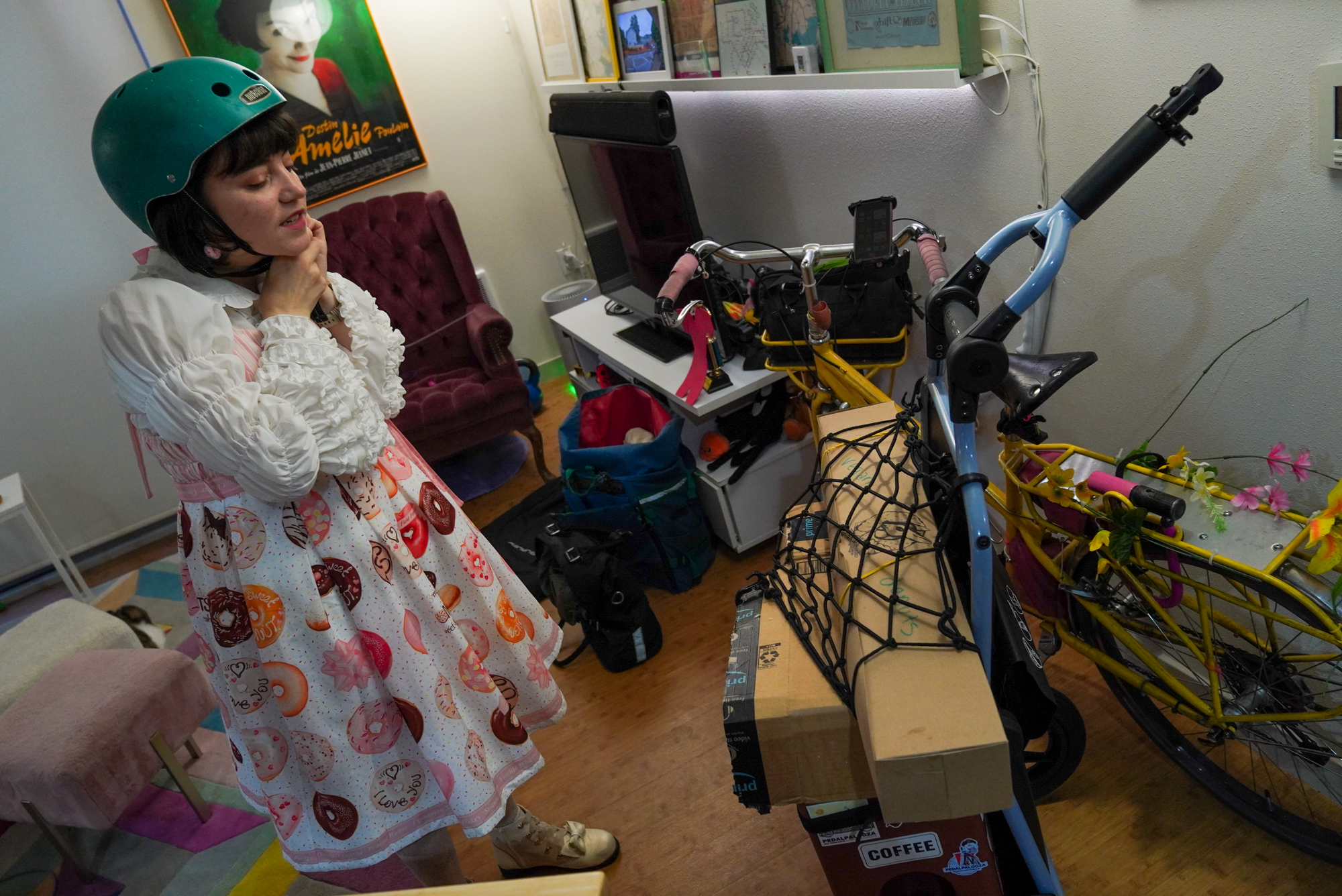
Lily Karabaic in “full donut regalia” (she even has matching donut earrings!).
The event means so much to Lily that every time she gets a new job she makes sure to negotiate for Fridays off.
Lily in her living room.The event also takes place on the Steel, Flanders, and Blumenauer bridges simultaneously.Lily fills out a tardy slip for someone who was running late.
I met Lily at her apartment last Friday morning around 6:30 am so we could ride together to the Tilikum Crossing for the birthday B on B. When I showed up, there was spilled coffee on the counter and she and her spouse Aaron Parecki were fussing with straps in her small living room, trying to get several boxes secured onto a Burley Travoy trailer.
Once we were all ready to roll, we took the lane on Northeast Sandy Blvd while drivers sped past and my camera rolled.
“It’s more about community-building, where we happen to have coffee,” Lily explained. “We use it as a tool for community building and connecting. People that ride bikes, scooters, people that walk, the morning runners on the waterfront and Esplanade — I think we spend a lot of time going past each other in those spaces. B on B is a meeting place.”
And for as many people who see this unexpected display of public hospitality and altruism for the first time and are taken aback, there are just as many regulars.
“I think it’s one of the foundational pieces of bike culture in Portland,” Lily said. Is that what keeps her getting out of bed so early every Friday morning? To keep the tradition alive? “Now [that it’s been 20 years] we feel like we can’t [stop]. You don’t want to be the one who ended B on B.”
Watch the full interview above or on YouTube (thanks to Aaron Parecki for shots of us riding together and the drone footage).
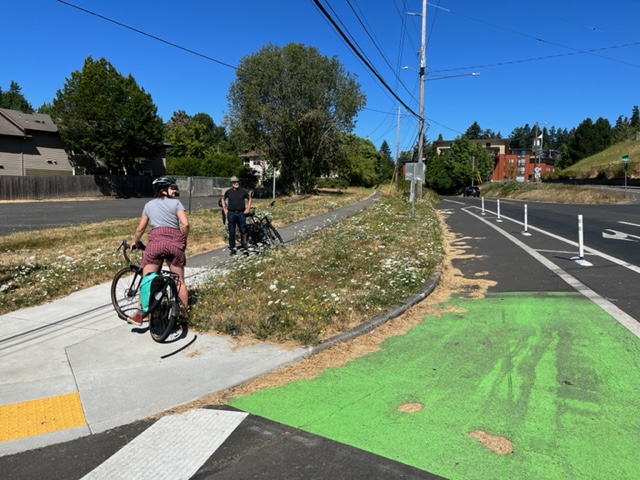
New bike lane along SW Bertha Blvd at Vermont.Crossing SW Bertha Blvd at Capitol Hwy. Rolling onto Red Electric Bridge. (Photos courtesy Keith Liden)
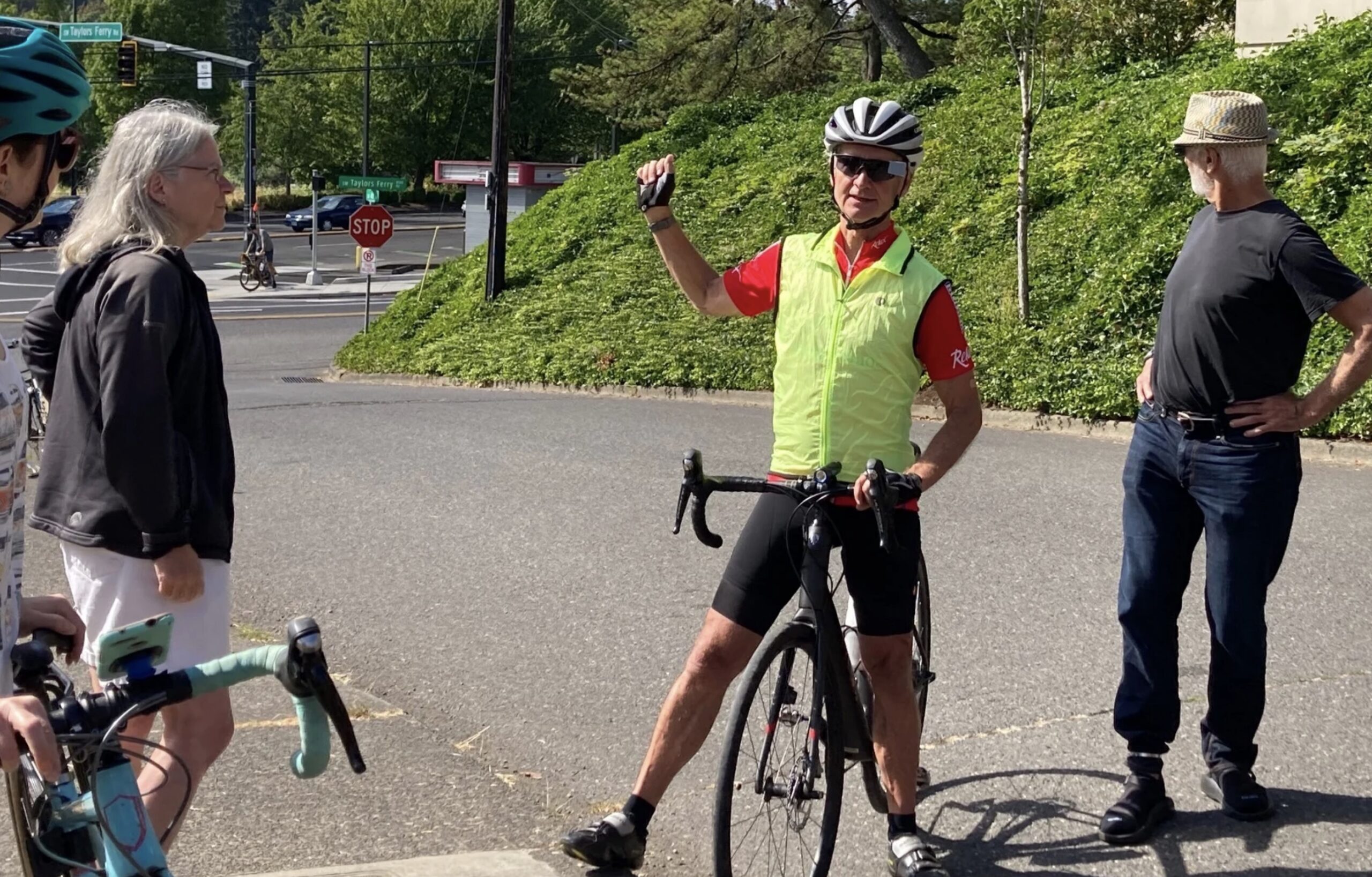
From right to left: Roger Geller, Keith Liden, Marianne Fitzgerald.
The Portland Bicycle Advisory Committee (BAC) and community members gathered on Sunday for a tour of some of Southwest Portland’s most recently built bike infrastructure. Leading the group was Portland Bureau of Transportation’s (PBOT) Bicycle Coordinator, Roger Geller.
The event had a bit of a “passing the baton” feel to it—or at least a sharing of the baton. The BAC has a new chair, Ally Holmqvist (who was along for the ride), and an infusion of fresh faces on its roster.
On hand were two longtime SW neighborhood activists, Marianne Fitzgerald and Keith Liden, to bring folks up to speed on area issues.
The group gathered near “the crossroads” intersection of SW Barbur Blvd and Capitol Highway. As BikePortland has extensively covered, the crossroads is one of the worst intersections in Portland, and is the location of a large gap in what is soon to be an important north-south bikeway running from Lake Oswego to Hillsdale.
Bicycle Advisory Committee tour of SW Portland sets off.
Geller said that PBOT was aware of the problem gap, and explained that even though Capitol Highway is under city control, the nearby I-5 freeway ramps give ODOT authority over any PBOT design. He hinted at a possible approach for cyclist safely between Barbur and Huber, and said that the two agencies were working together.
Fitzgerald then spoke about lack of stormwater management as the key to understanding southwest active transportation issues. The land on which the group was standing, she pointed out, was the site of the future West Portland Town Center, a zoning and urban development plan which she criticized for only paying “lip service” to transportation.
Stormwater facilities are expensive to build, private developers fight building them, and the city ends up letting them off the hook for required active transportation improvements. That’s one of the main reasons SW Portland has the least sidewalk coverage of any area in town.
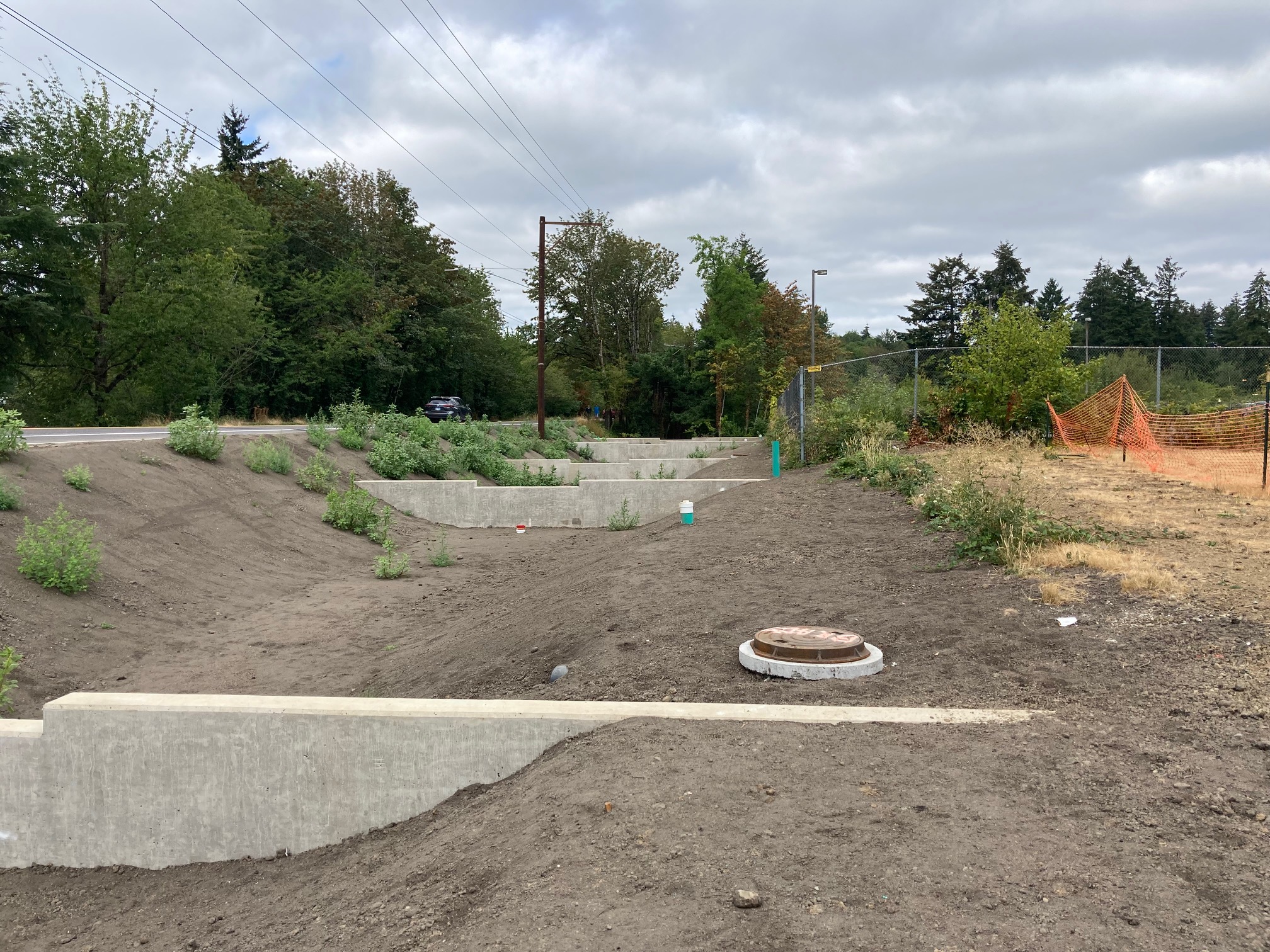
Fitzgerald concluded by saying that the city needed to build more stormwater collection and treatment basins, like the four that BES has built to accommodate runoff from the Capitol Highway project.
And with that, the group set off on its tour. (I wasn’t able to join them as I’m not riding my bicycle these days.)
Stormwater basins
Stormwater basin at 42nd Ave and Woods Creek. (Photo: Lisa Caballero/BikePortland)Stormwater basin south of the US Post office, Multnomah Blvd on the left. Looking west. (Photo: Lisa Caballero/BikePortland)
It’s been almost a year since we last looked at the stormwater collection and treatment basins that make the multi-use path along the Capitol Highway project possible. Last November, BES contractors had finished the basin at 42nd/Woods Creek, and it was waiting to be filled with soil and for native, water-filtering vegetation to be planted.
As you can see in the photos above, now they’re just waiting for rain!
SW Capitol Highway Project
The multi-use path on the west side of Capitol Highway, looking north. (Photo: Lisa Caballero/ BikePortland)
The Capitol Highway project is in full swing, the entire street is in a state of almost … well, kind of like when the contractor has done the framing, and the drywall is up, and you can see where it’s going — but there is still a lot of work to do.
That gnarly ADA ramp
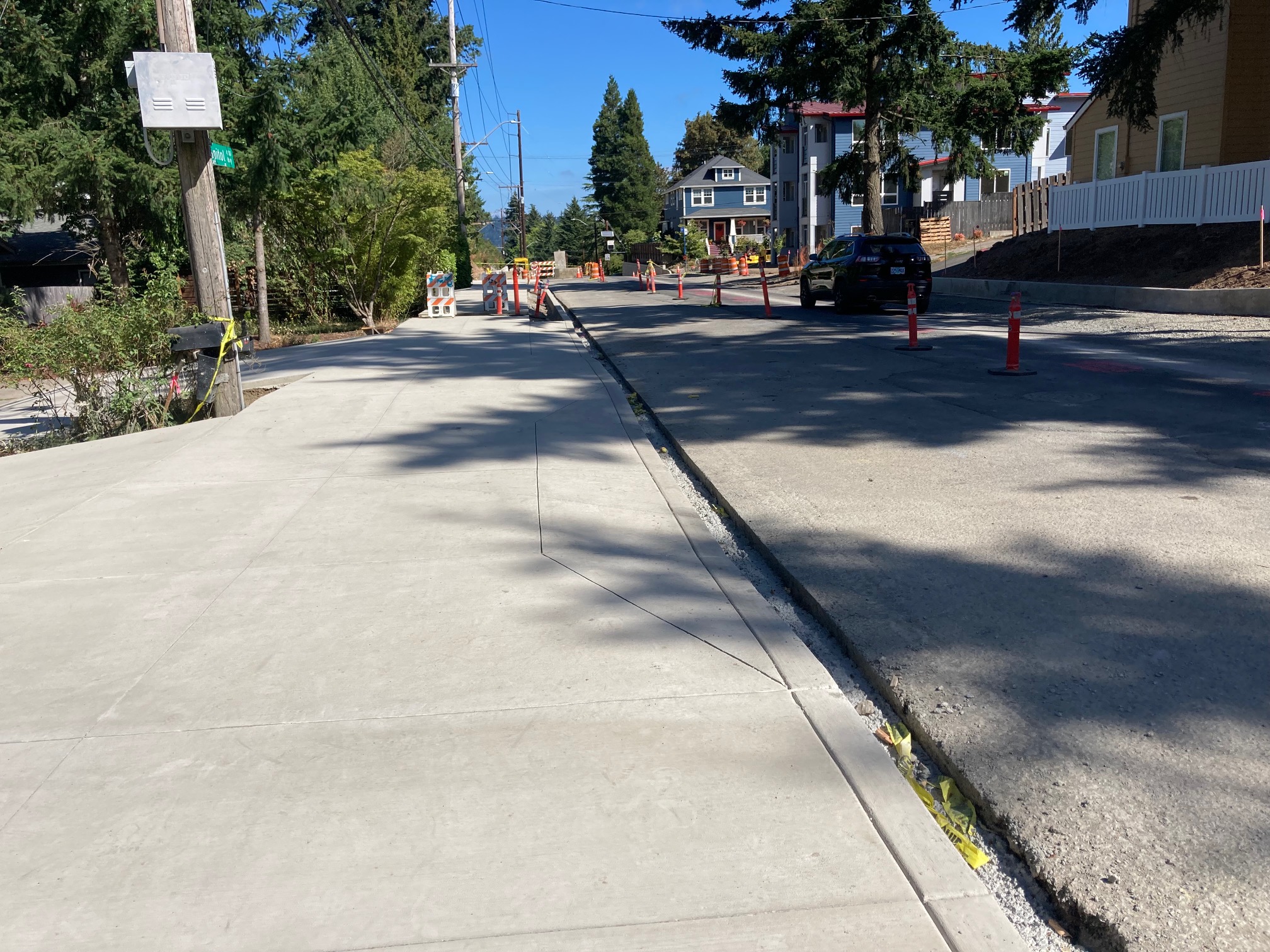
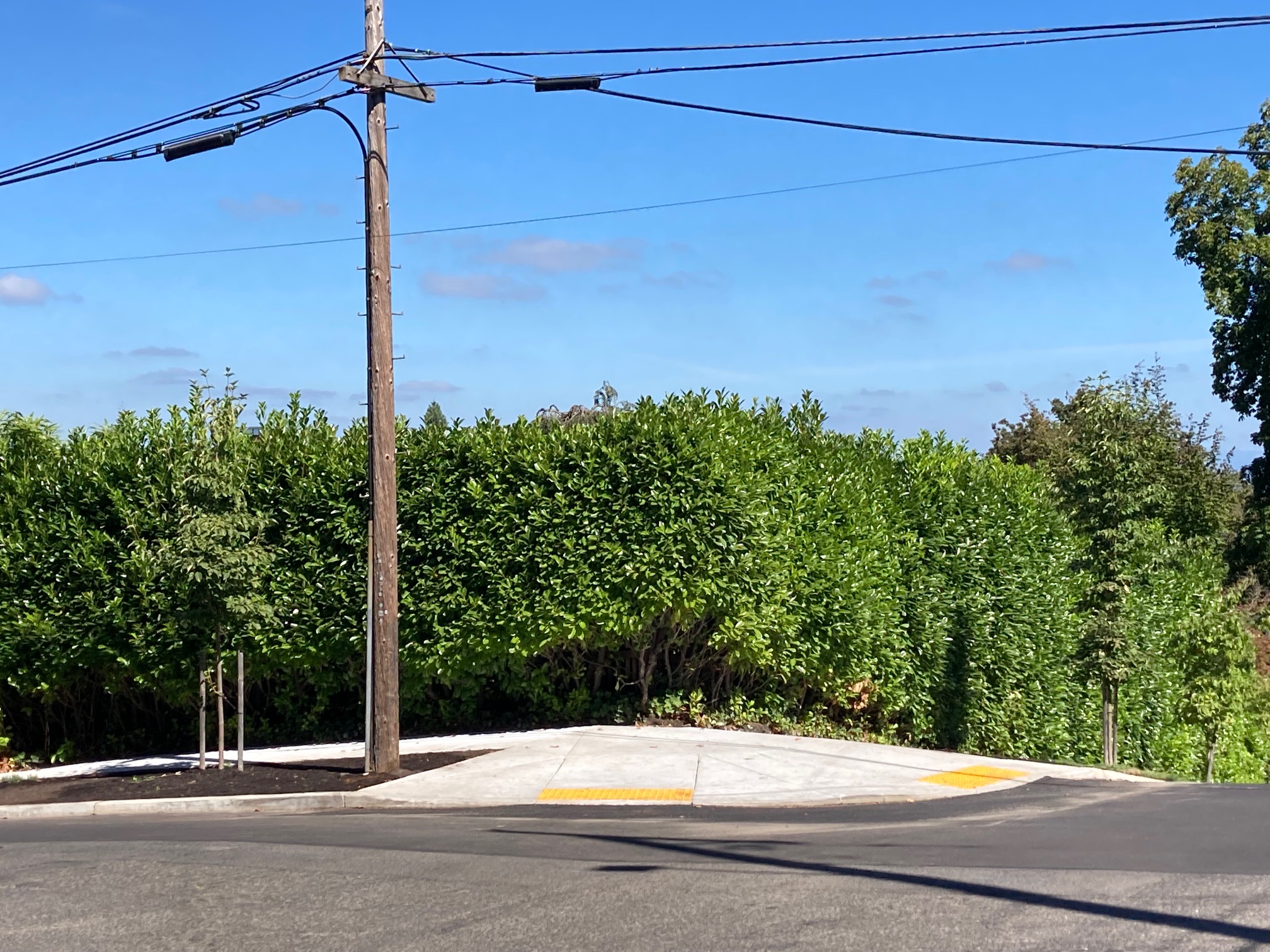
Finally, BikePortland ran a couple of stories last month about the struggle BES contractors were having in Portland Heights building ADA ramps to meet the city’s standards. More concrete pours followed and it looks like these ramps are acceptable.
Newly built ADA ramp at SW 16th Ave and Elizabeth Street. (Photo credit: Lisa Caballero/BikePortland)
Hey good lookin’! (Photos: Jonathan Maus/BikePortland)
TriMet Project Director Michael Kiser.
TriMet has spent six years and about $175 million to establish a new kind of bus service on Southeast Division between downtown and Gresham. Now it’s finally time to see what this thing can do.
The Division corridor has been the poster child for our region’s struggles with climate killing car dependency, traffic deaths and poor transit service. When it opens on September 18th, TriMet hopes its new Frequent Express (FX) line starts a different narrative; one where Division is more humane and welcoming, and where buses finally move out of the shadows of light rail and take a starring role in non-car travel.
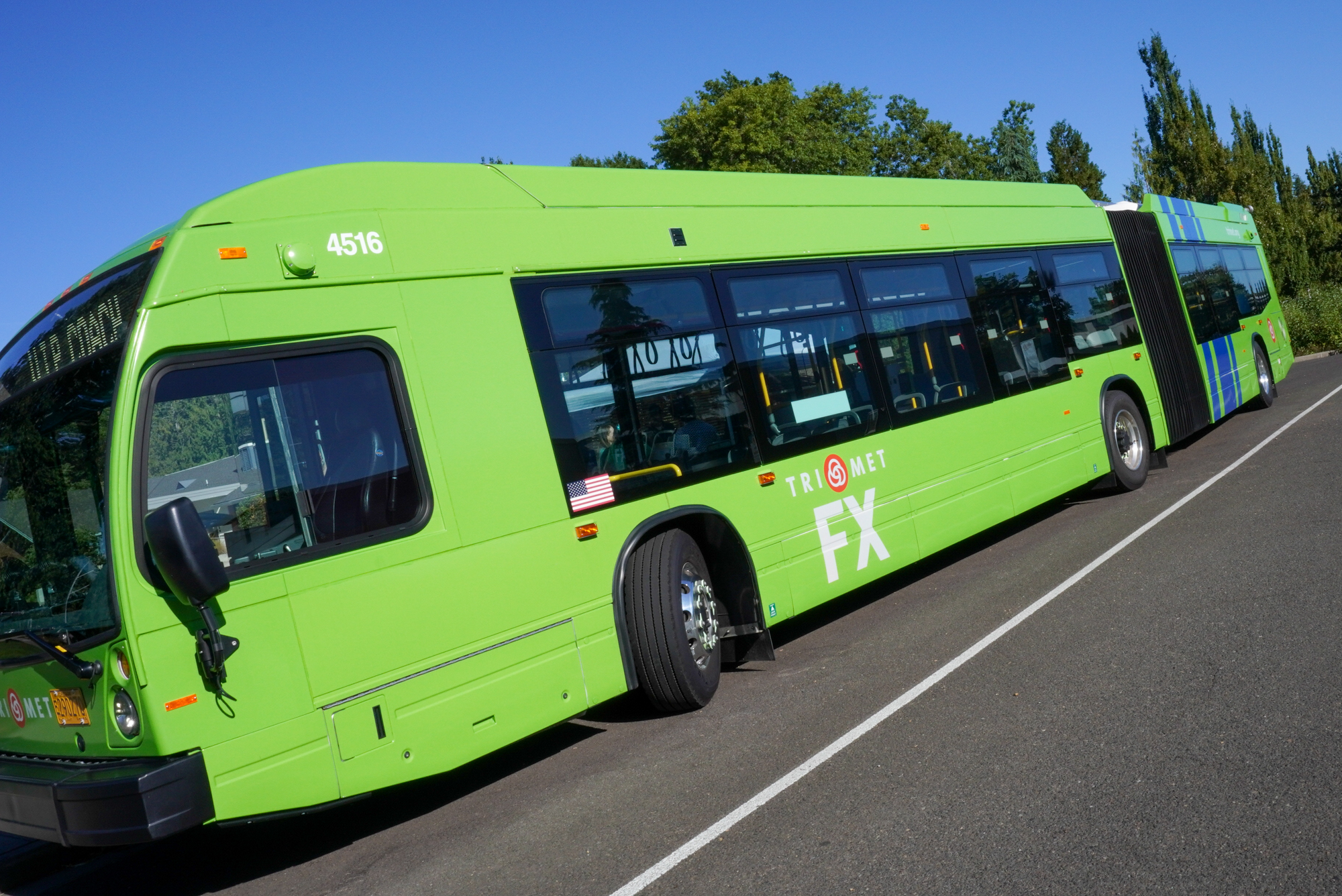
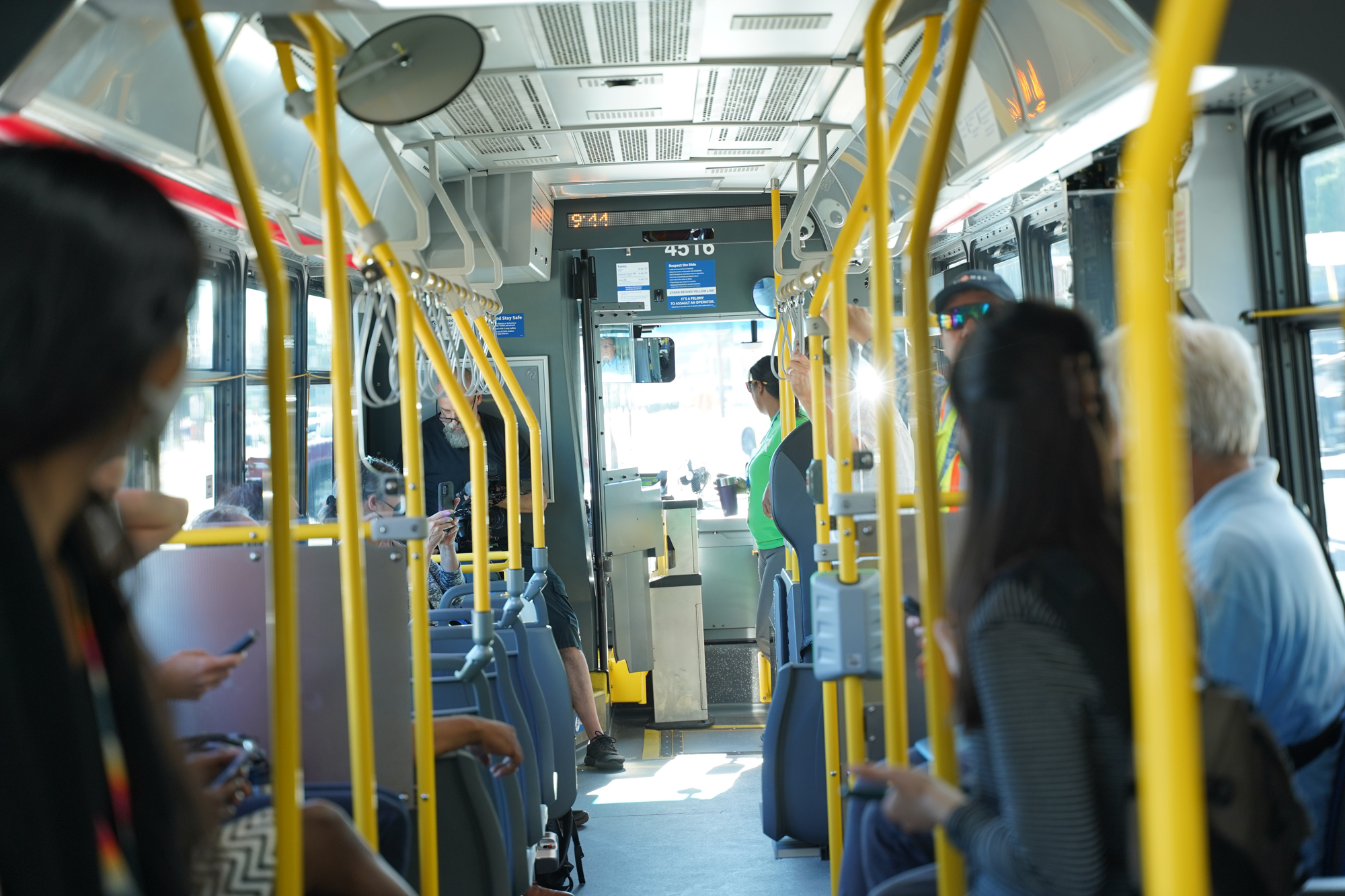
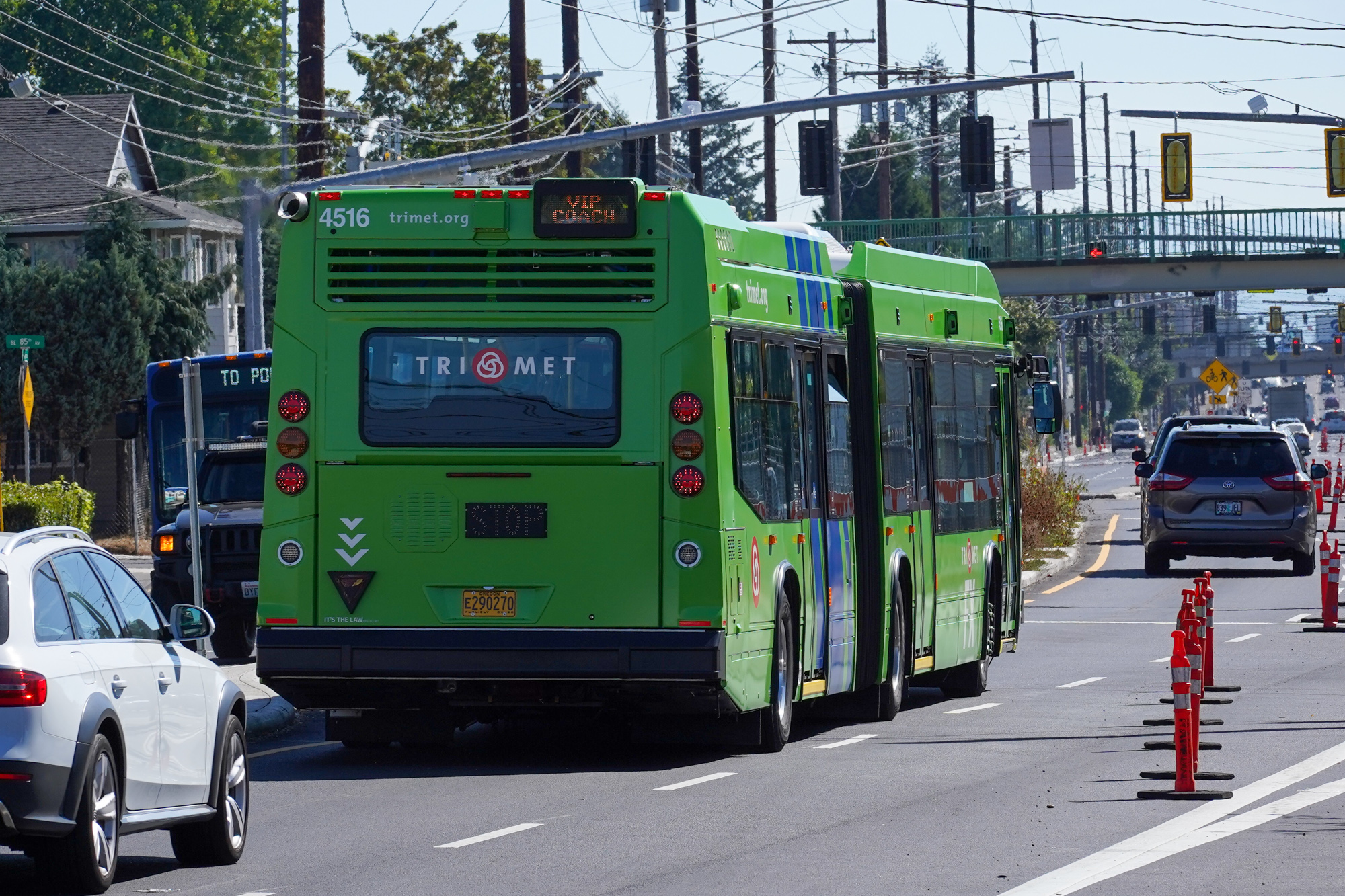
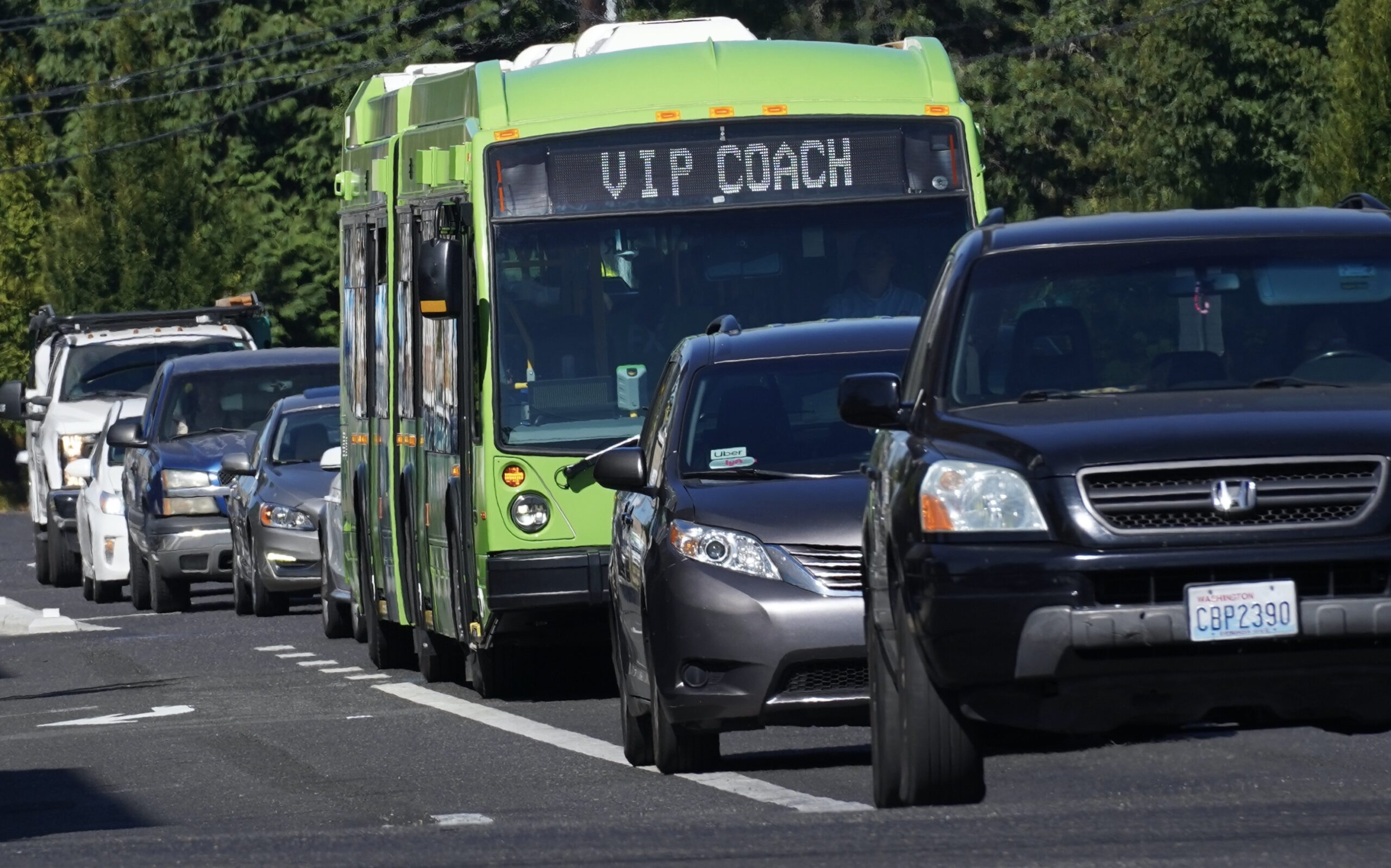
This morning TriMet hosted a sneak peek of the FX Line 2. I hopped on board one of the 31, 60-foot articulated buses that will soon serve 84 new bus platforms on the 12-mile corridor.
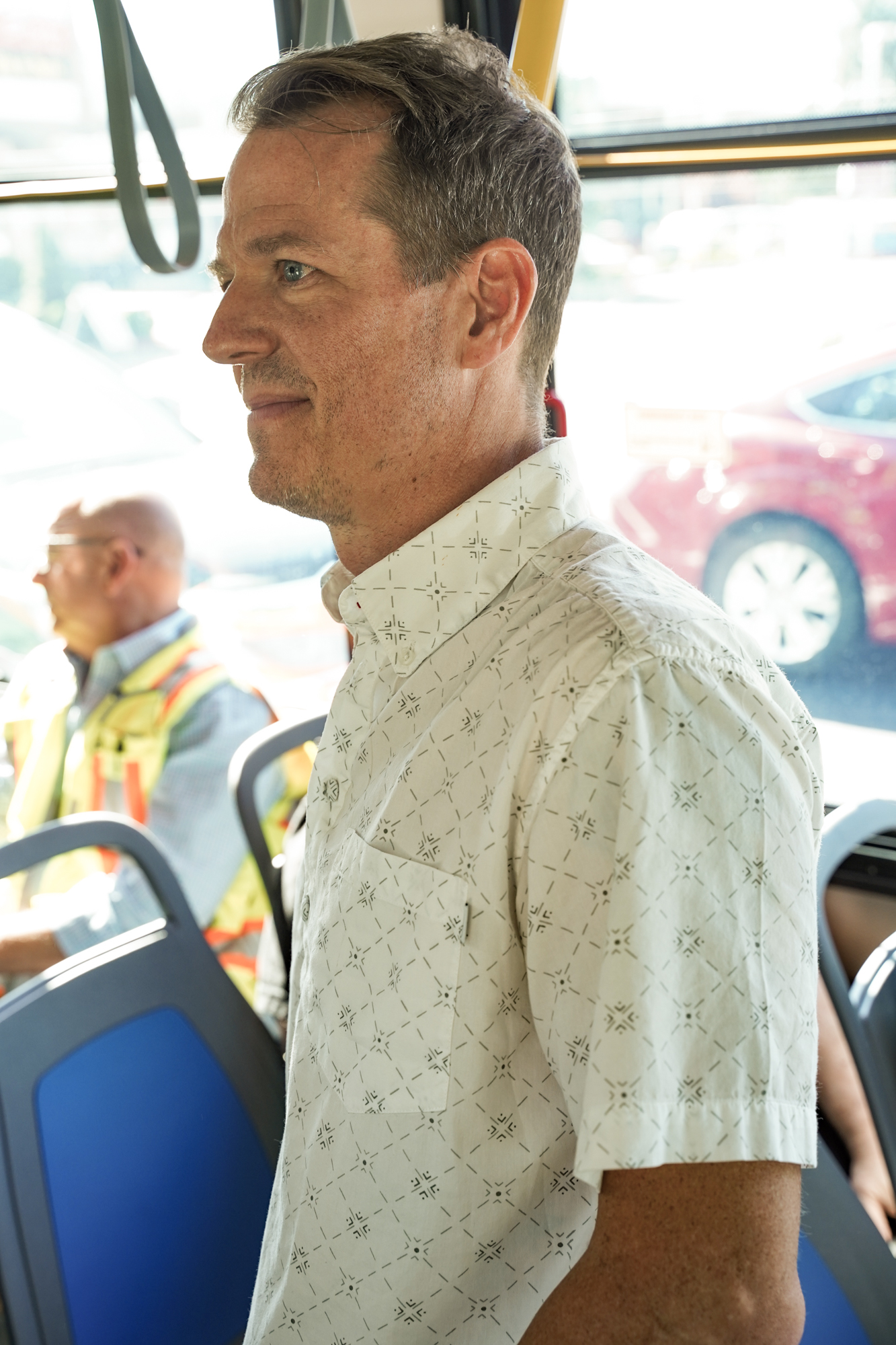
As we motored eastbound on Division from Portland Community College at SE 82nd, TriMet Division Transit Project Director Michael Kiser held court with several reporters. He detailed how the agency was able to speed up bus service, serve more people and improve safety in one fell swoop (and with a big assist from the City of Portland).
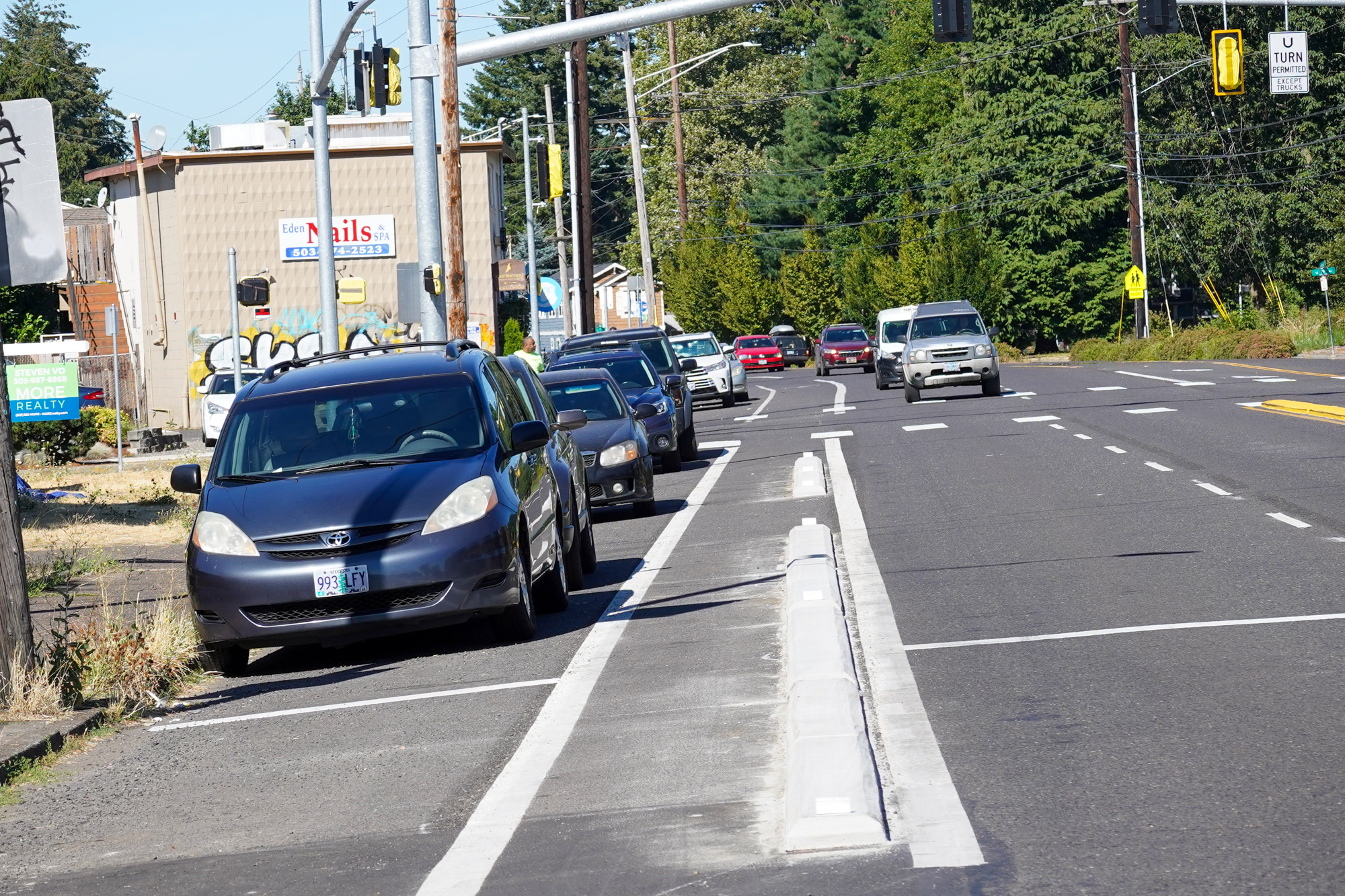
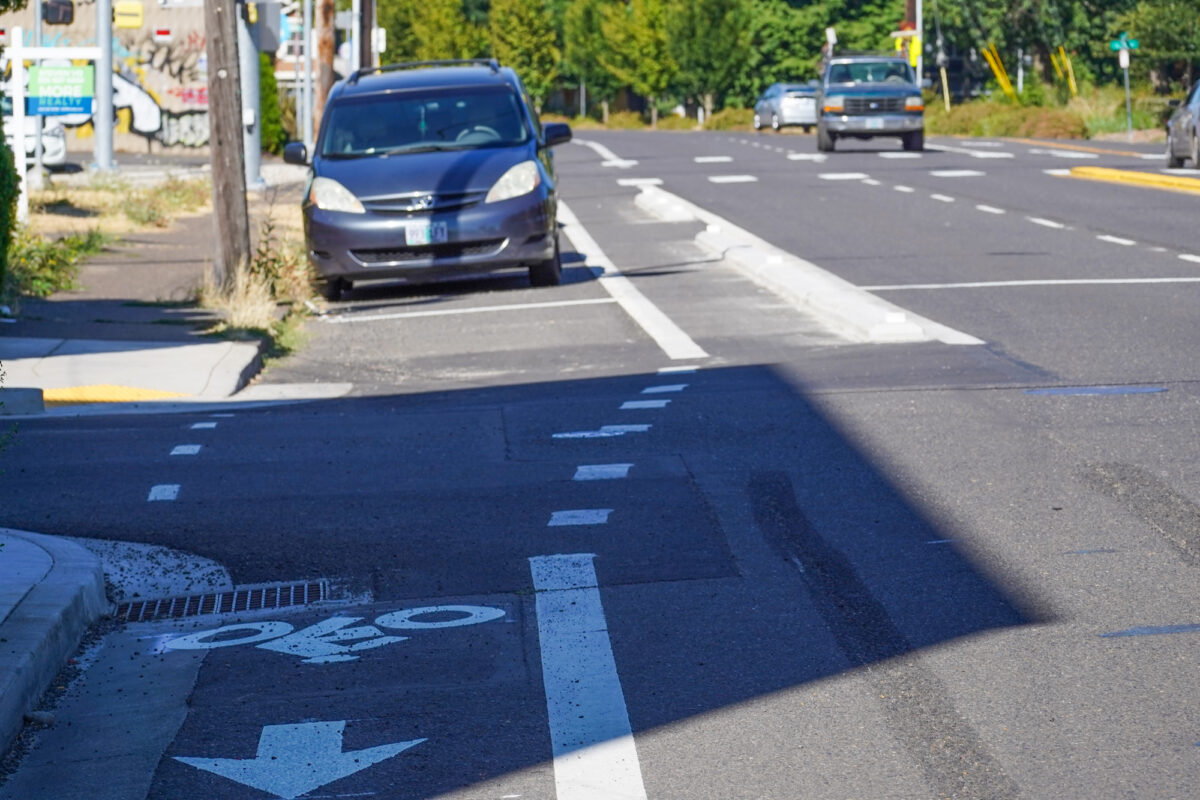
It’s really just a regular bus, but longer. The center median (left) and bus station platform with bike lane running through it.All these cars are parked in the “protected” bike lane.Thar she goes!
“Prior to this project we were passing up people just because we simply didn’t have the room on the bus.”
– Michael Kiser, TriMet project director
The FX lines boasts 12-minute headways and will shave significant seconds off trip times. TriMet Public Information Officer Tia York said the agency estimates the average rider will experience 20% faster trip times through the corridor (and it would have been even faster if the route didn’t divert south to the Tilikum Crossing instead of using the Hawthorne Bridge, but I digress.)
TriMet used a variety of methods to boost bus speeds.
One “very big lift” according to Kiser was collaborating with traffic engineers at the cities of Gresham and Portland to use machine-learning software to estimate arrival times and adjust signal timing at intersections accordingly. This transit signal priority will give bus operators a leg-up on the busy corridor.
The FX line will also have all-door boarding and fare validator machines at all three doors. The buses also don’t have to pull out of a traffic lane to pick up passengers. This means they can stop and get rolling much faster without having to wait for a break in traffic. There are also fewer stops along the route. Some sections of red bus-only lanes we see on the Portland Bureau of Transportation’s Rose Lane projects are coming too. They aren’t on the ground yet, by Kiser said they should be by opening day (red lanes as a design standard wasn’t in use when TriMet design this project, hence the late implementation).
These time savings are combined with buses that can fit 60% more people. “Prior to this project,” Kiser shared, “we were passing up people just because we simply didn’t have the room on the bus.”
“This is a huge improvement for biking in east Portland,”
– Dylan Rivera, PBOT
Every time someone takes the bus instead of their car we reap major safety benefits. But there are other changes to Division meant to make it safer. Many of them, about $13 million worth, were concurrently installed by the Portland Bureau of Transportation as part of their Outer Division Safety Project.
PBOT spokesperson Dylan Rivera was on the bus with us. He rattled off an impressive list of project elements: three protected intersections, 4.5 miles of protected bike lanes with physical separation, bike only signals with bike detection, 81,000 square feet of new sidewalks in the whole project, almost 60,000 of which are in Portland, and 11 new marked crosswalks with stoplights, median islands and flashing beacons.
“This is a huge improvement for biking in east Portland,” Rivera said.
But a bike lane is only a bike lane if PBOT can keep people from parking cars in it. And on Division, PBOT and TriMet have a lot of work to do on that front. Kiser with TriMet said, “Parking in the bike lane will be an ongoing challenge,” and added they are partnering with PBOT to come up with a solution. But it didn’t sound promising. “Obviously, we have a lot of enforcement issues across the city right now,” he added.
Access managed, thanks to a center median.
Drivers have lost curbside parking spaces and they’ve lost the ability to turn into any driveway anytime they want. That’s because of new “access management” medians added for safety. This is another name for curbs in the middle of the street installed to prevent people from turning left out of — or into — driveways along the route.
“Transitioning to this changed environment is going to take some time. And access management is a big part of that,” Kiser said. “At times it has made it less convenient for motorists, but it’s safer for pedestrians. The pedestrian fatalities we’ve seen along this corridor is a big piece of how we approached the design.”
The Division streetscape feels very hectic. There’s just a lot going on. The medians help chill things out a bit. They also reduce available space on the road — something TriMet and PBOT had more flexibility on in the design of this corridor because it’s a bus route instead of light rail. If MAX was the chosen solution, there would have been very little room left for anything else after the tracks went in (see East Burnside or North Interstate).
I asked Kiser why this corridor gets a bus while TriMet has favored light rail almost exclusively in the past.
“We’re really asking a lot of this particular corridor, Division is a real workhorse,” Kiser said, rattling off all the different users like freight truckers, errand-runners, walkers, and bike riders. “And we don’t have a parallel route for bicycles out here because the adjacent street network is discontinuous,” he pointed out. “If we would have put in light rail, something would have had to go, there’s not room for every mode. So maybe bicycles would not have been a component.”
Unlike every existing corridor with a light rail, there’s no parallel route for drivers on SE Division either (which makes me think if we would have built the Mt. Hood Freeway, this would probably have been a MAX project.)
I asked Kiser if he thinks Division Transit Project elements will trickle-down to other lines. He said it will and specifically mentioned upcoming “BRT” (bus rapid transit) projects on 82nd Avenue and Tualatin-Valley Highway. “Barbur too perhaps?” I asked, and he nodded in agreement.
The advancements in transit signal priority are especially exciting, Kiser said, because the software they’re using is backwards-compatible to every other bus in their fleet. “All the other buses have what they need to plug into that system from a technological standpoint,” he said. The new bus stations with raised bike lanes through them are another thing TriMet is excited to debut in this project that we could see elsewhere as time goes on.
What about the bike racks?
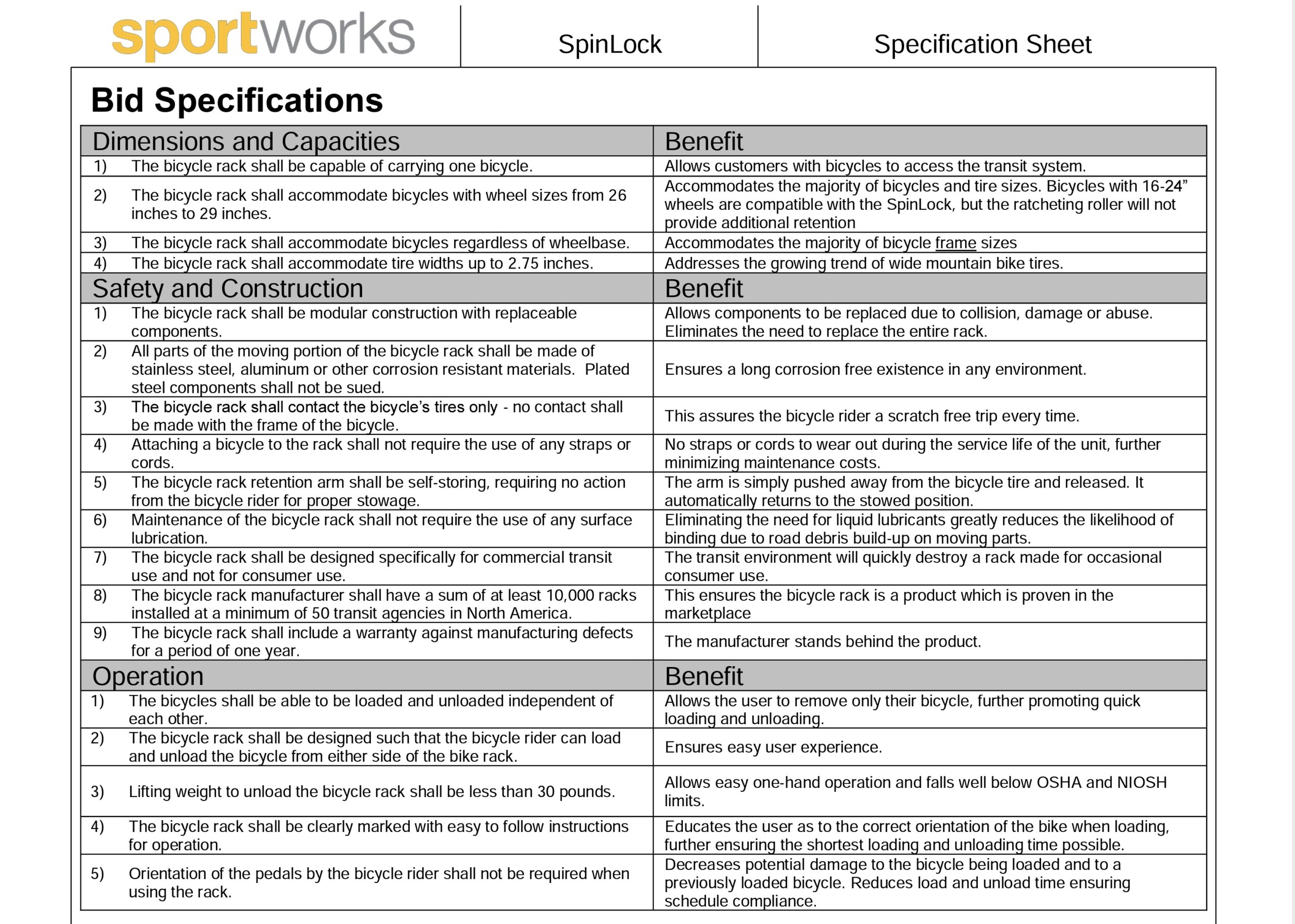
Spec sheet for bike racks.
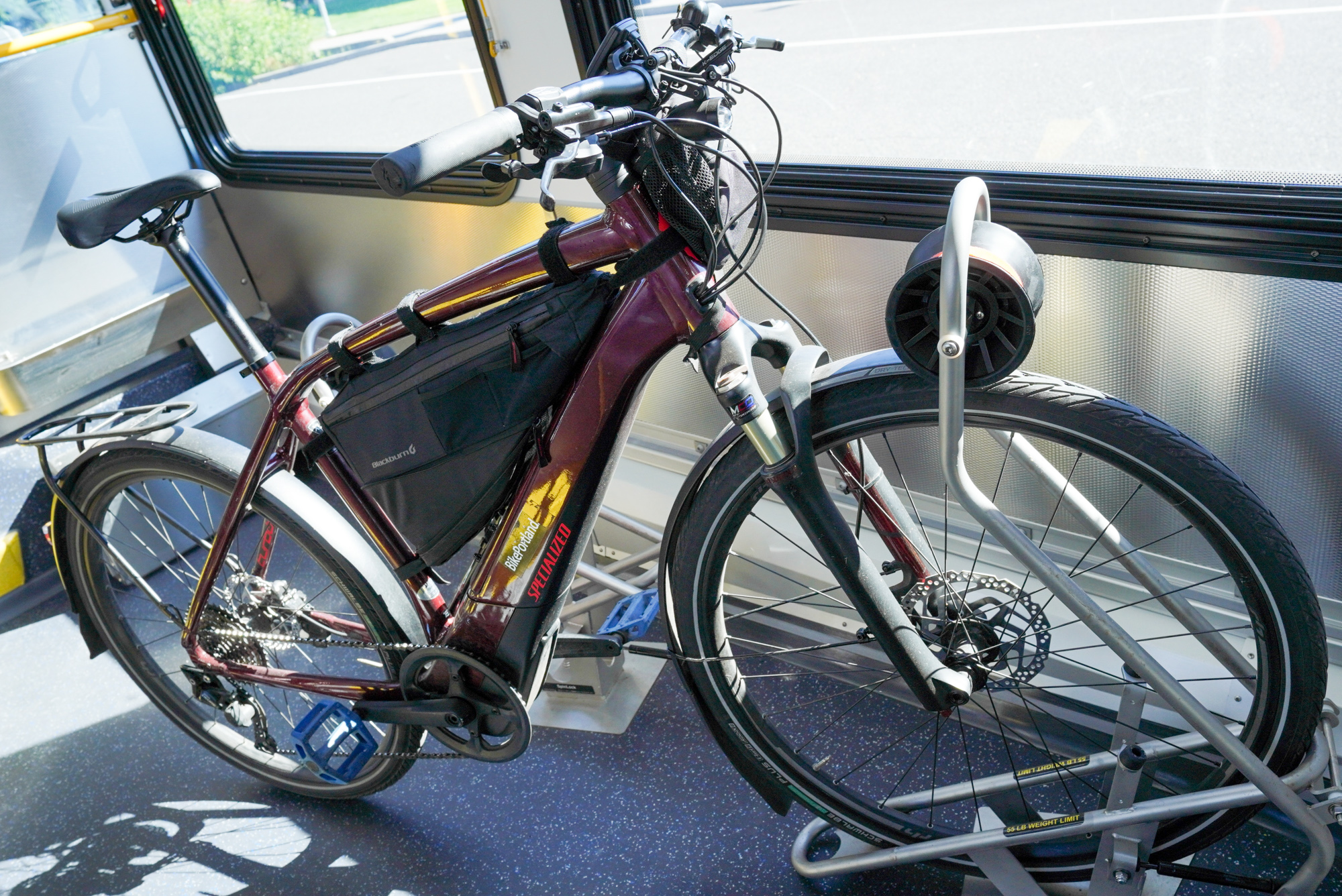
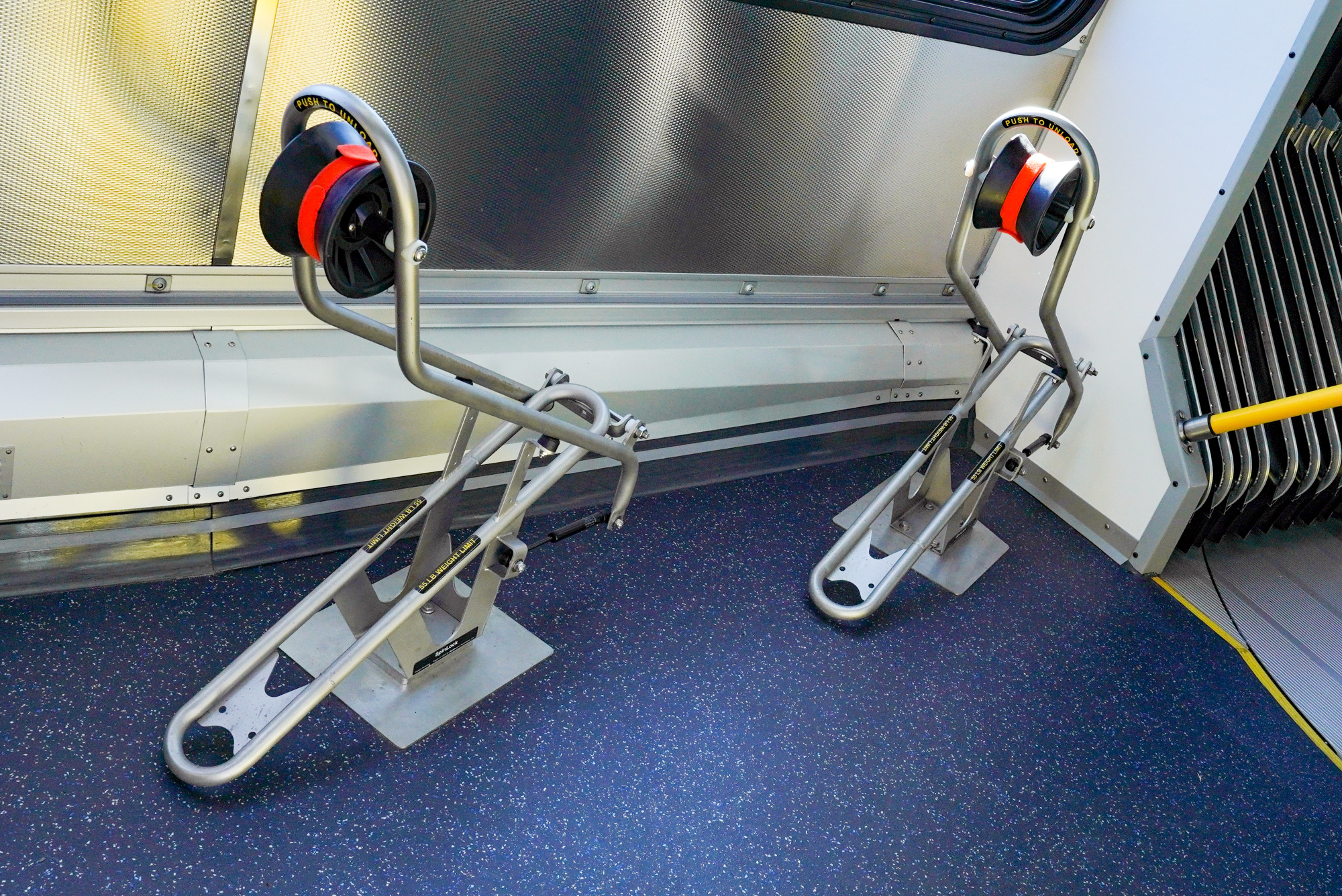
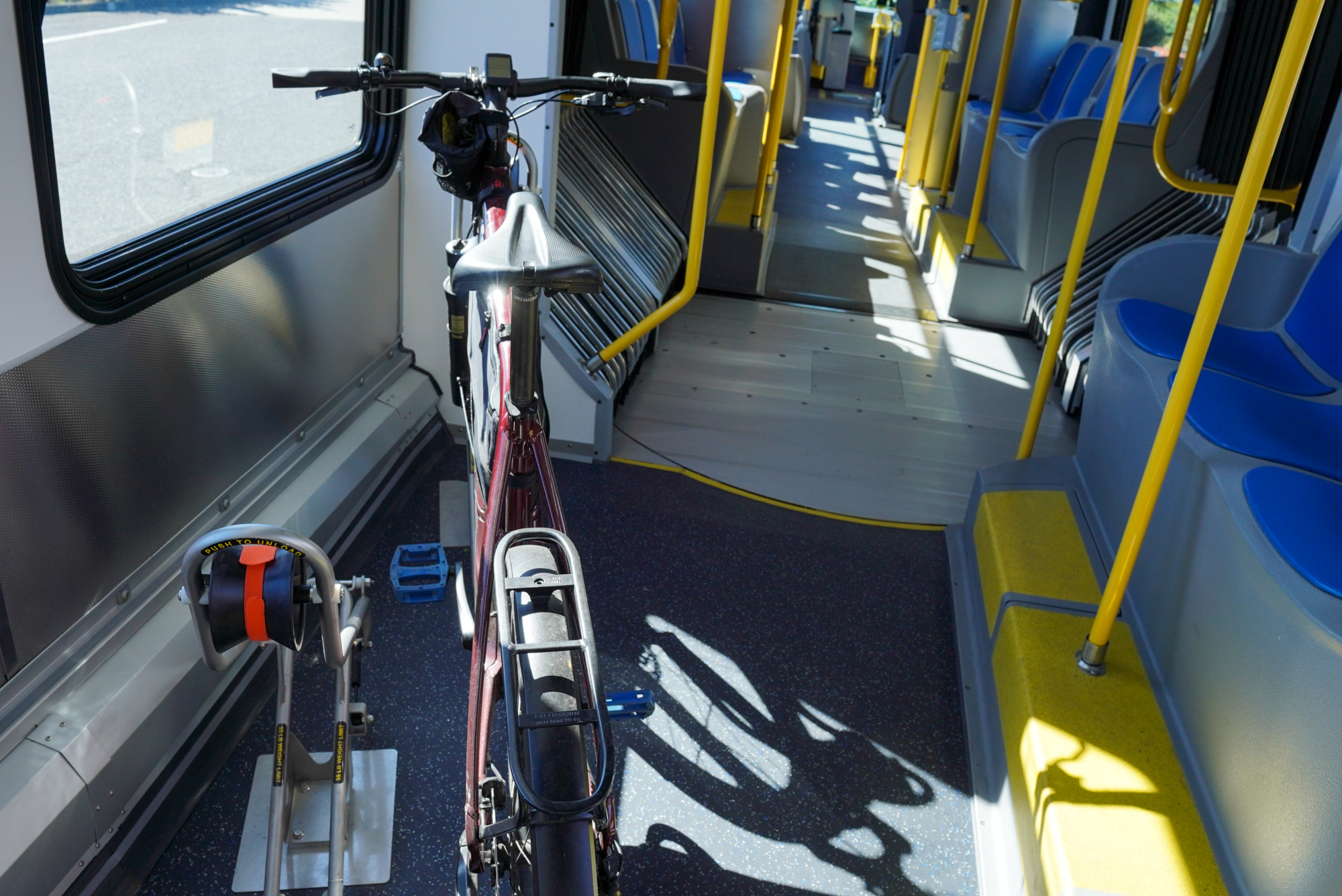
Gone are the front-loading racks. Those waste precious time and weren’t the right fit for an FX line, Kiser said. The new racks are a model known as Spinlock made by Sportworks. They can fit wheel sizes from 26 to 29-inches (yes that includes standard road bikes) and tire widths up to 2.75-inches. Click the spec sheet on the right for a full rundown of the features.
There is space for just two bikes, the same amount TriMet buses have had for about three decades. C-TRAN’s similar buses on the Vine BRT route up in Vancouver, Washington have three racks. So why just two on FX? TriMet considered three racks, but didn’t go that direction. Kiser and another TriMet planner said it came down to competition for space between humans and bikes.
“It’s a balancing act,” Kiser said. “You want to be able to move as many people as you can and make sure they can get to their destination and then balance that with the need of bicycles.” If TriMet sees more demand for bike capacity, Kiser said they could revisit the issue in the future.
(See how easy it is to roll a bike into the racks in our TikTok.)
Car users and their large, inefficient vehicles, are the thing that slows FX down the most.
That’s not the only aspect of the FX TriMet might reconsider down the line.
12-minute headways are nice, but even more frequent service would be better. Is it possible TriMet could speed things up in the future? “I think so,” said Kiser. “With ridership levels being a bit lower now, with our shortage of operators, these things put strains on the service that we can put out. As things kind of get back to a more sustainable state, I think we we could see an improvement in the service.”
The new FX line is a big deal for TriMet. It’s their first major corridor project that isn’t a light rail line, and it feels like there’s a lot of internal buzz about what the means for the future of the agency. Bus projects are easier to implement, quicker to build, more flexible, and cost less than light rail. Does Kiser think FX marks a renaissance in bus service for the region? Not wanting to paint a picture of competition between the two transit modes, Kiser said, “It gives us another tool in the region to reduce our reliance on vehicles. So certainly we are going to see more of it. Because of what doors this project opens up.”