

What impact will the City of Portland’s e-bike rebate program have? How exactly does the process work? What type of people will take advantage of it? These are just some of the questions I’ve pondered as the date nears for the program to launch this coming spring. And yesterday I biked through an atmospheric river to find the answers.
In the video above you’ll meet Liraz Brand, a 22-year-old Reed College grad and nursing student who got a free e-bike thanks to the Portland Rides PCEF E-Bike Rebate Program. The program soft launched to Portland Community College students back in September and Brand jumped at the opportunity. The $1,600 rebate and additional $300 for accessories, got Brand into a new Trek that she adores and it’s given her much more than just a new way to get around.
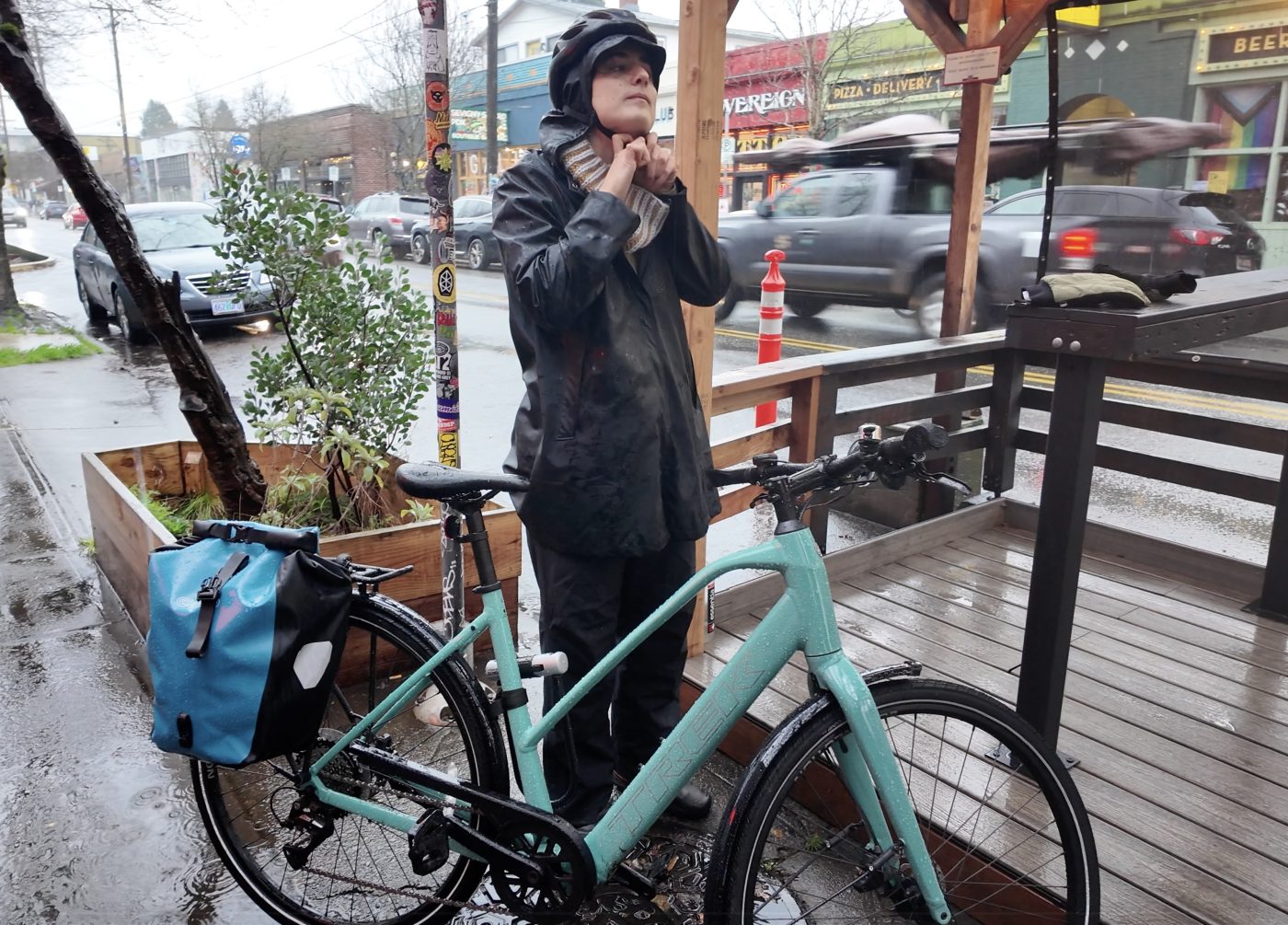
“It’s been really nice. I’ve been really enjoying not being in my car.”
“It’s been really nice. I’ve been really enjoying not being in my car,” Brand shared with me during an interview under a leaky outdoor dining patio on Southeast Division where she stopped in for a chat on her way to work. Brand’s car is in disrepair, her other bike got stolen, and she finds the bus too unreliable. But she’s got major mobility needs. She splits her class time between two PCC campuses — one near SE 82nd, the other on N Killingsworth — that are nearly nine miles apart. Then she works in Sellwood, which is in a completely different part of town. Despite those distances, and despite taking up daily cycling in fall and winter, she’s smitten with cycling: “I’ve been having really beautiful interactions with people on the trails. I get to ride the riverfront back from work every day. I’ve been seeing deer and the wildlife of Portland come out, which has been really cool. Yeah, I’ve been loving it.” Brand says getting out of her car has helped her mood and made her days easier to manage. She also finds Portland’s bike infrastructure “incredible,” “next-level,” and, “a cut above” compared to her hometown of Boston, Massachusetts.
As for the e-bike rebate program, she found the process easy to use. After winning a lottery drawing, she received a code for her discount. She then brought that code to the Trek Bicycle Store in Sellwood and they set her up on the bike she wanted, a baby blue Trek FX-2. Brand was also able to purchase a set of pannier bags, a u-lock, a helmet and rain pants with the accessory rebate.
Portland’s rebate program is possible due to a grant from the Portland Clean Energy Community Benefits Fund (PCEF) and it’s operated by the Bureau of Planning and Sustainability. Everything is funneled through a non-city website (thank god) at PortlandEbikeRebate.com, which Brand said was a bit “clunky” but it did the job.
As I’ve reported, the program will tap into $20 million from the PCEF fund (which comes from a tax on large corporations) to support an estimated 6,000 new e-bike purchases over the next five years.
If those e-bikes have as much impact as the one that went to Brand, Portland will be much better for it.


Thanks for reading.
BikePortland has served this community with independent community journalism since 2005. We rely on subscriptions from readers like you to survive. Your financial support is vital in keeping this valuable resource alive and well.
Please subscribe today to strengthen and expand our work.
PCEF for the win!
Right. . . let’s do some math
$20,000,000 / 6,000 = $3,333 per bike.
$3,333 – $1,600 rebate – $300 accessories = $1,433 left over
Hmmmmm where’s that $1,433 going? Yeah, PCEF is such a win win for the Portland citizens. Good to see the money is being used wisely. LOL
Sounds to me like the usual failure PCEF has always been.
Not to mention that many of those of us who actually supported PCEF feel burned and are unlikely to trust the city again.
If the accessories and e-bike cost $3333 then the $1433 comes from the person buying the e-bike to cover the difference.
$ 1600 e-bike rebate
$ 300 accessory rebate
$ 1433 from buyer
———
$ 3333 total charge at bike shop to ride out the door
If the e-bike + accessories cost $1900, then there is zero cost to the person buying the bike since the rebates are $1600 for the bike + $300 in accessories.
If the e-bike + accessories cost $1800, then I imagine the rebate is only $1500
You misunderstood. PCEF is paying $3,333 to provide $1,900 worth of benefit to grant recipients.
$1,433 is evaporating on every transaction.
From a limited experience with City of Portland bookkeeping: they may be charging a share of the cost of running city government, the overhead, onto the program which makes it look really inefficient. Or, maybe there’ll be part of the $20 million left over and they’ll authorize more grants. Either way, it’s not transparent and the simple arithmetic that we can all do makes for easy criticism.
“they may be charging a share of the cost of running city government”
That seems quite possible. And that’s one reason the ballot measure explicitly did not allow the city to use the funds. For any purpose. Whatsoever.
Or, that extra money is heavily enriching a few people who wrote the grant. Or, a portion of that money is going to be used as donations during the next election cycle. However it’s missing, ALMOST HALF OF the grant is not being used for its stated purpose.
Maybe you can shrug that off, but I sure can’t.
It’s gonna be hard to find grants to support if the people running the grant have to do so on a volunteer basis.
Personally, I dream about writing a grant to do a study where say, my neighborhood all gets solar panels installed, and we track the net metering, panel production through the year, etc.
But someone has to do all of that. The grant has to pay for more than just the panels themselves and their installation.
Almost half the grant is almost 10 million dollars unaccounted for. Feel free to call out the math, but that excess money is not disappearing. It’s going somewhere and I suspect it’s going into someone’s pockets. If you want almost half of a grant to go to overhead costs, that’s fine. I sure don’t.
I dunno, man. I don’t run a non-profit. No one’s said who’s administering this grant, so it’s hard to know what’s actually going on here.
I’m a consultant in the AEC industry a common rate multiplier is ~3.4 depending on the client sector. That means AEC firms typically charge their clients an hourly rate ~3.4x higher than they pay the technical/billable staff.
All of that overhead goes to office space, computers, non-billable staff, etc.
A lot of stuff has gone under the bridge in the last nine days, but here’s a quote from the Sept. 25 BP article about the E-bike program:
“…the program will train 50 mechanics and invest in infrastructure for charging and bike parking at multi-family apartment buildings.”
I think eawrist mentioned the mechanics in a comment below. Most of us, if we even read the article, just divided $20 million by 6000 bikes, came up with a meaningless number, and galloped off towards the windmills.
How much does it cost to train a mechanic, and what is the incremental value of that trained person to community? How much parking infrastructure can you get for $4 million or so, and what is the value of that for the people who might use bikes, or their new e-bikes, for transportation?
It’s harder to answer those questions than it is to bash the city, and the PCEF, with those $3000 e-bikes.
Let’s see, let’s look at the cost this way.
We’ll just round up to $2,000 the amount that goes to the applicant for an e-bike.
Let’s pretend it costs $100 to process an application.
How many bikes should the community get?
$20,000,000 / $2,100 = 9,523
So, again, where is all that extra money going for these bikes? I’m not saying it’s a bad program. I’m saying, in typical Portland fashion, someone(s) is skimming a huge chunk of money off. It’s why running a “non-profit” is such good business in Portland as you can really rake it in.
So just remember, just because something is a “good cause” doesn’t mean someone isn’t taking advantage financially.
The most popular ideology will always be the one that allows for near infinite corporate profit by blindly pointing the finger in the opposite direction.
If you read the ordinance, some of these questions become a little more clear.
Here is what it covers:
Central Program Administrator
Rebate Payment Processor (value include rebates)
Multifamily E-Bike Storage and Charging Pilot
Third-Party Evaluator
Bike Mechanic/Technician Training [50]
While 6k is the number you can use, it’s a projection/estimation “for a minimum of 6,000 electric and adaptive e-bikes… not to exceed 20 mil over five years.” Would you project an unrealistic number of bikes or underestimate the total amount of money at the outset? The city will show how it used the funding. It’s nearly impossible to know how “efficient” the program is since it is an ongoing pilot.
Cities and non-profits undergo a level of transparency and scrutiny that rarely exists in the corporate world, and future funding (with no-profits) depends on how well they report on successful programs. That is why we can hold their feet to the fire and limit administrative waste when we have data from programs such as these (we will do this when we know how well it worked).
Blind scrutiny of “government waste” using handwavey numbers just reinforces that most popular clickbait ideology that some media corporations, millionaires and billionaires really count on for you to maintain your focus.
The knee-jerk government waste ideology requires a narrative to support it however small or implausible, and camouflages the vast economic inefficiency of corporate welfare (>100 bil per year) and profit, which is where our attention regarding a need for transparency should primarily be focused.
This is a great point, thank you. I’m getting worried because the misdirei you speak of is getting traction. I don’t want to see pcef repealed because they do a bad job of explaining how the money is used up front, a thing they should be able to predict with better accuracy. But that said, it’s absolutely true that the real waste is in corporate welfare.
When 90% of media in the US is owned by 6 corporations, misinformation gets real. It’s truly shocking to go overseas and listen to the news in comparison to the US.
I do not envy Jonathan and his endless work to filter. He has a difficult job where he rides the line in assuming misinformation with only very grievous and obvious examples to be disinformation.
I personally tend to give the benefit of the doubt, until it’s clear people are trolling. Some of this above is genuine misinformation. Solar clearly doesn’t understand what they’re talking about. And to their defense, funding mechanisms and non-profits aren’t easy to understand intuitively.
But yeah John V, I worry purposefully misleading people (disinformation) is becoming a more accepted strategy. The means justify the end sort of thinking. IMO the “evidence for thee, not for me,” is becoming a common enough strategy now to warrant a response by Jonathan.
eawriste,
Thank you for this comment and for understanding the dilemma I find myself in when it comes to this comment section. I never want folks to be able to say I don’t welcome opposing views, so I tend to allow a lot of stuff that I am not 100% sure is even posted in good faith. I do delete stuff from time to time when I just get tired of the same ol’ same ol’ comments from the same people. That being said, I think it’s important to let some of these comments through and then immediately respond to them with why I disagree – especially when I feel like the comments represent what some people feel — because it’s important to have a public record of different views. I think a vacuum of information when folks post misinformation is not good. I learned about racial activists in Portland in the 90s who were fighting skinheads and something they said always stuck with me: Instead of erasing racist graffiti, they would cross it out and then put up their own next to it. This showed people that these views exist, but more importantly, that there are also people who disagree with them and are willing to stand up and fight back in the public sphere.
So glad to see you write all that out, Jonathan.
I was just listening to the latest Weird Little Guys podcast episode. Because of the holiday, it’s a rerun of a multi-part series the host did on the idea of white genocide in South Africa impacting the White House. She draws a link between the Golden Gate Skinheads protesting in Sacramento in 2012 to draw attention to the supposed white genocide, the news media covering the event putting no effort into uncovering the skinheads’ motives and ideology, groups like theirs pushing the idea all over, sources like Fox News also promoting the South Africa Project narratives (sometimes hosting white nationalist group leaders to that effect), and Trump tweeting in 2018 about the supposed genocide lending credence to the idea in the minds of many. The ideas of white genocide and the great replacement are still going strong, maybe in large part because the most prominent media rarely touch them for whatever reason(s).
Aren’t people following up with the grant recipients, tracking their ebike use, helping with maintenance, etc. Won’t the results of all that be compiled into a report that eventually goes to the PCEF and makes recommendations about future programs?
Thank you Paul. Someone finally sees through the naïve govt waste narrative to a modicum of reality. They will also report on the actual line items spent as well as the objectives reached, not merely minimum objectives and maximum expenditures, which are largely meaningless.
PCEF has been going on a few years and I was trying to find something like you’re describing. I couldn’t find result reporting, but I’m not able to do an exhaustive dive. If you or anyone finds anything like that I’d be very curious to see what the results are showing.
Here is the process for funding decisions. Here is the grant committee who reviews requests for funding and quarterly reports by grant recipients. The program status updates are under documents.
Looks like the updates are simple words such as “Completed” or “not started” or “in development” without any other metric for the public to see how it’s working.
I could be wrong, but I’m not seeing a file that has the actual numbers or overall breakdown of how much went into overhead/payroll and how much went into results and what specifically those results were.
I just realized, “administrative overheard” is 43% for this project.
Yes, folks, nothing to see here. It’s for e-bikes so it has to be good and not a ripoff.
Ok, I go now.
handwavey mathyness again? citation please
“I just realized, “administrative overheard” is 43% for this project.”
How did you “realize” that? Did you read it somewhere, or did you just decide on that number all by yourself?
We should prioritize getting subsidized ebikes in the hands of graduates from schools that cost $250,000 in tuition for a degree, thats how the earth will heal.
Yeah fuck people who want to be nurses! They’re so selfish!!
What does wanting to be a nurse have anything to do with the subject or PS comment?
It is a reasonable question to ask why a student at the most elite and expensive college in Oregon needs a tax payer subsidy to get a bicycle.
Selfishness has zero to do with anything.
If this program is worthwhile, the people getting the subsidy should be means tested and should be permanent Oregon residences in low income situations.
I don’t think Reed College students fall into the low income worker category by any means.
This is Oregon tax money and I think a person from Boston probably should not be at top of the list for giving our money away.
The person graduated from Reed College and is in a post graduate nursing program at PCC. Some people have family support for an undergrad degree but not professional school, or perhaps they got through Reed with financial aid and now have some debt. Either speculation is just as probable as ‘they are out of state rich people’.
Our society needs nurses, nursing school is not free in this countty, and from internal evidence in the story they are on a tight budget. Surprise, transit doesn’t meet their transportation needs very well.
It’s very possible they will get a degree, stay in town, and care for BP readers.
Reed college gives tuiton free education to any student who’s family makes less than 100k a year. So yes, they easily can have low income students.
https://www.nytimes.com/interactive/projects/college-mobility/reed-college
65% of Reed college students come from the top 20% incomes in America.
1.1% come from low income families.
We really need to subsidize more wealthy people, thats the real purpose of the PCEF tax.
That only starts in 2026, so that wouldn’t have applied to students before then.
How long do you need to live in Oregon in order to be considered an Oregon Citizen? What kind of citizenship test does Oregon have?
That’s a question with many answers, but one is how you become eligible for benefits such as in-state tuition.
https://admissions.uoregon.edu/residency/faq
Looking at the questions and information going into in-state tuition eligibility (which I think we can all agree is very different than city-run grant programs), I don’t think we know enough about the interviewee one way or another.
Yes, we agree on that, and I don’t assert that the criteria I posted is appropriate for this situation. I was just trying to demonstrate that such criteria exist, and that the question you posed has been answered many times.
Yeah. I appreciated the link.
Right so this is a prime example of proving a point through the logical fallacy of cherrypicking. It’s great way to shed light on a generally false narrative of govt waste for people who need examples to reinforce that already held belief.
The requirement of residency is here. Generally, 12 mo permanent address is required. Except, who is going to move here for a year, AND to go to PCC for half the cost of an ebike? The requirements for the initial (pilot) program are here.
Here is an example of an economic impact study of the value of PCC.
On the surface you’re intimating a rich (???) person from Boston is exemplary of who receives this benefit. Let’s be clear: that’s a false narrative. In reality, PCC students who are eligible earn 60% of the AMI ($52k/year).
HEAR THAT GUYS!!!? The idea the government doesn’t allocate capital efficiently and regularly participates in waste by knowing full well that they can just guilt trip the public into another tax increase to fund whatever pet project they come up with next is cherry picking data to reinforce your already wrong beliefs about how government acts.
Amazing, unfortunately there is the real world and the prevalence of government agencies failing audits, particularly in Oregon confirms that there is rampant waste and a complete disregard for where the money the government spends comes from, or they are idiots and don’t know how to account for spending, probably a lot of both.
What wasn’t allocated appropriately here? An Oregon student got an e-bike rebate. Students with huge loans aren’t known for being super wealthy, and last I checked, going to college isn’t something you just hop into for a few weeks for the tax breaks.
There is no scandal here. You’re just making stuff up.
Unrelated, but yeah, kinda…
https://www.opb.org/article/2025/02/24/providence-nurses-oregon-health-care-strike-approved/
https://www.wweek.com/news/health/2025/09/17/in-oregon-providence-lost-a-quarter-billion-dollars-in-three-months-thats-not-even-the-bad-news/
Good on them for striking for better working conditions and pay!
Yes, two aspects of nursing that have been terrible for a long time. Best of all there are no negative second order effects because everyone loves paying more for Healthcare and health insurance.
What are the second-order effects of running nurses into ground and burning them out from not paying them what they’re worth and crappy working conditions, all the while health care and insurance companies continue to grow their profits?
Not sure, will they be forced to work 40 hours like everyone else? Are the working conditions the same place its perfectly fine for me to be sick/hurt?
Growing profit margins or absolute dollars?
Everyone else only works 40 hours? I need to join a union.
Nurses are needed at all hours, and on every day of the year. Sometimes they are compensated with something like a 36 hour work week instead of higher pay for 40 hours of night shift work.
Do you have a bad feeling about that?
Prioritizing community college students actually strikes me as a pretty good balance between giving subsidies to everyone and the administrative burdens and arbitrary cutoffs created by means-testing. OK, so one recipient went to a fancy school before they started at PCC. (a) for all we know they could be in deep debt and (b) do you actually think this is a representative case?
A) thats not how Reed College works. B) LOL, yeah, it probably is.
Given that the city has set aside $20 million for an estimated 6,000 ebike purchase rebates, has the city also set aside $20 million for anti-bike-theft programs and theft counter-measures?
No. They have not.
It’s a good point PCEF should fund some anti-bike-theft initiatives. I have often said to myself “I don’t want to bike there because there’s nowhere secure to lock up, I’ll drive instead”
After taking a mental inventory, I’m pretty deep into the bike thing and have $300+ in locks and chains. Also a bike that’s worth <$100 resale. No problem locking that out.
For people without such a collection, Biketown is a choice. If you're not showing much income it's also free. It would be interesting to meet a student's schedule using Biketown, I'd rate it a handicap similar to riding TriMet.
I think bike valets would be great near PCC campuses, for instance, but PCEF may not be able to pay employees.
Last bike got stolen, so we should replace it with a spendier one financed by taxpayer dollars. It just makes sense! /s
Having a bike stolen at college/university is such a common thing that I don’t know why you would mention it. At PCC having only one bike stolen is not a bad record. Maybe it was a bike they cared about and that would make sarcasm feel pretty unkind.
We all hope for a better outcome with the e-bikes.
Another “e-bike miracle” and good news read for the day. 😉
Nice to hear a success story from the pilot a.k.a. soft launch! Students get a lot of practice navigating bureaucracy. One can hope the process will scale when it opens up to the general public in March!
Making Portland great again!
Is the bike in the photo an e-bike ?
Yes. Yes it is.
forget my post below. i see the battery is built into the bike (not removed for charging).
I love it, this is fantastic. This is a great way to use those funds. And that is a crazy amount of travel, it’s exactly the kind of distances that an e-bike makes much more manageable.
I only hope they can manage to do it a little more efficiently eventually. There is no excuse for how few bikes they’re getting for that amount of money. That said, people are blowing it out of proportion. It’s a great cause and there is room for improvement.
“Why This Should Worry the Progressive Left of Portlandia”
(Yes, You Lot)
Here’s the real kick in the teeth: this is why Portland’s progressive policies have lost legitimacy.
Not because helping people bike is bad — it’s great.
Not because climate action is bad — it’s essential.
But because when voters see $20 million produce 6,000 “free”bikes with exorbitant overhead, they don’t think:
“Wow, climate justice is complex.”
They think:
“Portland can’t be trusted with money.”
And that’s deadly. It hands ammunition to every cynic, every anti-tax crusader, every “government can’t do anything right” bloke yelling into a radio mic in Silverton.
Plenty of people who voted yes on PCEF are now saying:
“Never again.”
That’s not a right-wing talking point , that’s a left-wing own goal.
Only in the minds of people who have an ideology and desperately need a narrative to fit it. Read the ordinance. Those are long term estimates/targets and max expenditures, not budgetary items.
A similar program might look to house a minimum of 20 families using a maximum of $1 million. Saying this scenario is “exorbitant overhead” and “Portland can’t be trusted with money,” during the pilot of that program, before you even know their fiscal report is entirely nonsensical.
Meet Angus, in Silverton, warning us about the crazies who believe in a religion of “government waste.”
If anyone can can make a credible case that these e-bikes will prevent $20M worth of emissions, that would go a long way to blunting the criticisms of folks like Angus.
PCEF isn’t just about reducing emissions, so any analysis that leans almost entirely on that metric is flawed. PCEF is a public health initiative. It aims to take money from massive corporations in order to help the folks most impacted by climate change. It does this not just by investing in things that reduce carbon emissions, but also by economic development, supporting nonprofits that support those communities, and so on.
No program of this size will be perfectly efficient. Corporations aren’t always efficient. I think PCEF is worth supporting and it should be a model of how we restructure American society (that is, taxing the rich to help folks in need)
I think folks should re-read my op-ed in 2023 when former Councilor Rene Gonzalez criticized PCEF in a way that was basically a racist dog whistle. https://bikeportland.org/2023/09/28/opinion-commissioner-gonzalezs-comments-on-race-are-misguided-and-untrue-379820
You honestly believe that corporations and the rich aren’t passing on those taxes to the customers? Wow, I’m shocked.
I never said that. Obviously that might happen in some cases. I just don’t see it as such a clear line as other folks on here do. And that’s a choice corporations have, just like dealing with any other expense they incur. Ultimately, consumers can decide where to take their business.
We tried to decide where to take our business a few years ago with one of those product tracker apps to find out who the parent company was because we didn’t want our dollars going to bad things. We gave up in a week or so as it was depressing how the day to day stuff all go back to the same few megacorps. Unless one is rich enough to buy one off stuff, there isn’t really as much choice as the capitalist propagandists would have us believe.
PCEF is not a public health initiative. It was intended to help with a transition to clean energy both by directly funding projects and by helping train people to work in that industry. It was never intended to help the city buy street maintenance equipment or to subsidize e-bike purchases.
I don’t expect perfect efficiency or zero missteps. But I do expect a voter-approved program to stick to its core mission unless voters approve changing that mission.
I really hope no one else thinks PCEF is a model of how to structure American society. Random regressive taxes with huge overheads spent on the whims of the day are no way to run a government.
Doesn’t have to do that for me. Just knowing where the extra $8,000,000 is going would go a long way to making it palatable.
$20,000,000 – (6,000 * ($1,600 rebate + $300 accessories + $100 admin processing)) = $8,000,000
It’s not like they are buying the bikes and having to store them in a warehouse. It’s all paper pushing to process applications and send out money.
That $8m hasn’t gone anywhere yet. That math doesn’t work like you think it does. Sorry, I fell for that trap too, but you’ll have to wait and see how it gets spent to know if you should be outraged.
PCEF is funded by a 1% gross-receipts tax, and that cost doesn’t disappear — it shows up in higher prices on groceries and essentials, including at places like WinCo, where low-income Portlanders shop. For people living paycheck to paycheck, 1% less at the checkout line matters more than abstract climate benefits that may or may not materialize.
On the spending side, voters see climate dollars used for nonprofit office buildings, high-overhead programs, consultants, and planning grants, with unclear carbon impact and weak transparency. Even many people who voted yes now feel burned.
That’s the problem: a regressive tax funding a progressive aesthetic.
If PCEF were rapidly weatherizing homes, slashing utility bills, and delivering obvious emissions cuts at low cost, the tradeoff might be worth it. But that’s not what’s happening. Instead, we’ve built a permanent slush fund that’s alienating the very voters climate policy depends on.
Repealing PCEF wouldn’t mean abandoning climate action. It would mean admitting this was the wrong tool — and that low-income families deserve cheaper groceries more than they deserve to subsidize a broken system.
Hi Jose,
I strongly disagree with your comment. Feels to me like you are cherry picking things to put PCEF in a very bad light and missing some important context.
There’s no clear line from the 1% tax to peoples’ paychecks. That is also not a great argument because it doesn’t capture the true cost of climate change and how climate change hurts poorer people hardest. PCEF is funding proven measures that reduce climate impact and it’s also saving lower-income folks a lot of money by subsidizing various things and granting funds to nonprofits that are staffed by folks from communities that don’t usually benefit from these type of programs.
The tax is levied against billion dollar companies. I find it interesting that you twist taxing massive corporations into something that hurts poor people. I don’t deny that some companies might pass on higher taxes to retail prices, but I still don’t agree with your framing at all. And sorry, but taxing corporations to fund proven climate mitigation strategies is not a “progressive aesthetic,” it’s a very sound approach and climate change is not political (although that’s what deniers and corporations fueling it want you to believe).
I think a lot of folks are afraid of PCEF because of how much money it’s garnered and because of who it benefits most. We should do more stuff like this because I’d much rather have slush funds for the community than slush funds for corporate CEOs and their shareholders!!
If it needs to be more accountable, let’s have that conversation. There are oversight mechanisms built in and it’s controlled by a city bureau and we have a city government that is elected by the people. The real truth is that if PCEF went up for a local vote again (keeping in mind it already passed by a nice margin), I bet it would pass because now people can see all the stuff that it’s funding.
That claim needs to be substantiated. I’d love to see a report that compared what PCEF is spending against 1) the CO2 emissions prevented; and 2) the money it was saving lower-income folks (even though saving people money was not the purpose of the program). If the program were being effective and efficient in terms of preventing emissions, I’d be a lot more forgiving in how the money is being spent. But I think we all know that’s very unlikely to be the case.
I don’t know anyone who’s “afraid” of PCEF, but I do know plenty of people who are unhappy with how the money has been spent. I am well aware that the people I know are not a representative sample of Portlanders, but I highly doubt fear is the primary reaction to the program in any group.
PCEF has installed like nearly 20,000 heat pumps, each one of which saves families a significant amount of money from utility bills.
Of course some people are “unhappy” with how the money is being spent because it’s being spent on people that they don’t feel are worth spending “our” money on. The entire program upsets the typical balance of power (where wealthy companies dictate the terms and poor folks have to adjust) and I believe that is very scary to a lot of people.
Good; that’s what it’s supposed to be doing. But for the money we’ve spent, we should have a lot more accomplishments like that. (I know there are more, but not nearly enough compared to the money spent.)
I’m unhappy with how the money is being spent, but it has nothing to do with who the recipients are or where the money comes from. I’m unhappy because it’s being spent on projects well outside what we voted on and we’re not getting good value for our money. I have, however, learned we cannot trust city leaders to respect rules set out by voters.
You keep saying “scared”, but I really don’t understand why. I’m having a hard time imagining who might be scared by rebates on e-bike purchases, regardless of who is receiving them, and I also don’t think anyone seriously thinks this program is overturning the “typical balance of power”. I don’t even think you believe that.
Jonathan, the following excerpts are from the City of Portland webpage, “New to PCEF? Start here!”
Do you (or anyone else) know whether the public dashboard described below is currently available? If it’s not available yet, do you know when it will be?PCEF staff and the PCEF Committee take seriously the responsibility to follow the legislative codeand the intentions of the citizens who worked diligently to create and pass this legislation, and to carefully steward these dollars. As noted below, accountability is addressed in a number of ways.
Program metrics – PCEF’s Reporting & Evaluation Subcommittee is developing, with community input, high level metrics for tracking and reporting to the public, Mayor, and City Council the effectiveness of the program. Program metrics include outcome measures (what was accomplished) and process measures (how well did we deliver) and will be displayed on an easily accessible public dashboard (7.07.050.E.5).
Edit after initial post. I found the dashboard: https://www.portland.gov/bps/cleanenergy/dashboard
“I’d much rather have slush funds for the community than slush funds for corporate CEOs and their shareholders!!”
I think the dissonence you are seeing in the comments is based right here. If a person has great faith and has had great luck with a moral community doing the right thing, I would trust them more than a corporation as well.
However, if your community happens to be full of human beings doing human things, than it makes no difference who has control of the slush fund. If I’m not directly feeding from the grant trough I’m most likely getting as much benefit from this PCEF which is now a blatant jobs program as I would from the corporations.
With the logic you are using that big corporations are being taxed and not consumers paying that tax, you must absolutely be in love with Trumps tariffs.
Years ago I bought an item from a craftsman who’s catalog had the following statement:
“I am not going to insult your intelligence by telling you I pay the shipping; it’s included in the price.”
The tax is not paid by the big corporations, it’s included in the price. Same as the craftsman I bought from decades ago. I’m
Some prominent examples of the people harmed in the check out line by the 1%:
A list of the 2025 recipients of a progressive aesthetic.
Some examples:
Habitat for Humanity building 50 affordable townhomes
Augustana Lutheran Church expanding/weatherizing an education center
Community vision installing backup solar batteries for people with disabilities
Vocational training program at iUrban teen
I doubt Nike and Intel are hurt at the checkout line but possibly the 30,000 people they employ in the area are….Do you think the average employee at both corporations are the 1%?
You’re correct. They are not. Nike made $46.3 billion in 2025 alone. A 1% tax on Nike is pennies for them. But Nike does want people to talk about the PCEF as government waste in however dubious form possible, regardless of the evidence.
1% refers to the PCEF, which is a 1% retail tax on large corporations with >$1 billion in global annual sales and over $500,000 in Portland sales.
Do you have a citation for the corporations eating the PCEF tax and not passing it along to the consumer?
That is an interesting and valid question. if you find any solid evidence please post.
Does anyone have an actual list of those companies that are making over $500,000 annually in Portland and paying the tax, and how much they paid?
“Do not tax the billion dollar corporations that are squeezing pennies from people living paycheck to paycheck, because if you do, they will squeeze more pennies”
In other words, “taxing billionaires is regressive.”
Behold the new “trickle down economics.”
What a joke.
No, but putting a sales tax on low-end grocery stores is.
It is not a sales tax on consumers.
Billionaires aren’t being taxed. Their corporations are and then are just passing the losses on to the consumer in the form of higher prices which means their profits remain the same and we all pay a little more. Whether you want to call it a sales tax, fee or corporate malfeasance doesn’t really matter.
Please note this is not a statement on whether or not the PCEF is a good idea or not, but what it is doing.
Yes, All costs can be passed onto consumers, and companies are already extracting what they think the market will bear. The logic that the most wealthy companies that are highly profitable cannot be taxed in order to protect consumers is absurd.
What is absurd is people not understanding simple economics and acting like the rich corporations will somehow eat the costs of a local tax. They are not our friends. They are going to pass along the costs to the consumer.
If the company is passing along the tax to us, are they paying the tax or are we paying the tax?
We are paying the tax which means the PCEF is funded by us, not the corporations.
It is wealth redistribution from our pockets to those of our fellow citizens. This is why people here are upset about the attitude that overhead costs aren’t a concern or the way the grants have “evolved” from their earlier, stated goals.
I want the grant recipients to use my money effectively and not waste it or pocket an unseemly amount.
This is highly oversimplified, and as a result, flawed and inaccurate. And again, you are making the case that “rich corporations” can’t be taxed to pay for the harm or costs they incur. This is flat out not the case. You can look at countries with much higher corporate taxes to find that many things they consume are similarly priced. Basic necessities are cheaper in many instances.
The consternation in the comments that has you salivating is a result of people ranting about things they haven’t taken the time to understand.
“Passing along the tax” does not mean the consumer pays the tax, but instead just means the consumer pays a whole new cost the company creates. The PCEF tax is not regressive even if the company’s choices render its effects so. Yes, corporations are beholden to shareholders and nobody else. I don’t think that what SD said indicates they’re naive to that fact. Frankly I wonder how anyone can see that a company charges more specifically to account for PCEF when they already had and have ample incentive and excuse to incrementally and endlessly raise prices in this era of rampant inflation and tariffs.
If you shop at Safeway-Albertsons, Walmart/Sam’s Club, Costco, Target, Amazon-owned Wholefoods, or any of the Kroger-owned chains like Quality or Fred Meyers, you are definitely paying the tax. Likely at WINCO as well. If you shop at any of these stores outside of Portland and use a credit or debit card or phone payment app connected to a Portland address, you are also paying the PCEF.
But look on the bright side, at least you don’t live in NC and pay a 2% statewide sales tax on basic foods, the proceeds of which are specifically designated towards building more freeways.
It is literally a tax on sales to consumers. Most people would call that a sales tax.
I assumed you actually understood what most people think as sales tax. Tiresome, obtuse reframing does not strengthen the argument.
Sales are taxed — that fact exists independent of any framing.
Congratulations! Now, compare a “sales tax,” which is commonly understood to mean a percentage that is applied uniformly at the point of sale to the consumer, with little variation, to the PCEF tax. Then consider how broadly conflating the two is disingenuous.
A real analysis with a point by point comparison on immediate and longe term costs to low income residents could be made, and it would be very interesting to read this, but the cliche anti-tax, anti-government spew in this comment thread is barely rising to the level of “Nextdoor” or “facebook.”
It just seems you’re trying to make a morality play out of a math problem and getting snarky as you realize there is no real counter argument. The PCEF is clearly passed on to consumers which is what happens to all taxes passed on corporations. Wanting corporations to suffer financially is not the same as them actually suffering financially.
I understand that it’s hard to accept that we are all paying the PCEF tax and poor people are paying more of their income on it than wealthier people. Whose fault is that? The corporation who passes it along to the consumer or the people who voted in the poorly written tax? I had high hopes that PCEF would be able to solve some pressing issues like tree/shrub canopy improvement, water access, grown food security and less costs through improved insulation and efficiencies. Instead my tax money is going into e-bikes. E-bikes are neat and are helping individuals, but thought those funds would unite us together and be spent on things that help us all.
This is a shower thought level of discussion here. You can look sideways at any tax imaginable and concoct some way in your head to say that it eventually gets passed to someone who made a sale. Ergo all taxes are sales taxes and regressive!
But people use these terms to mean specific things. The PCEF tax is neither a sales tax or regressive.
You don’t need to resort to any tortured reasoning at all to see PCEF, which taxes sales, as a sales tax. Sales taxes are almost by definition regressive, especially so for ones that tax sales of foods at stores frequented by low income earners.
It does not get added on at the register, but that doesn’t mean people aren’t paying it. You pay the gas tax and the alcohol tax, both of which are sales taxes included in the price tag.
Instead of just repeating “it’s not a sales tax” why not explain why? And why is it not regressive? Or is it like Trump’s tariffs that are magically paid by China?
I don’t object to the mechanism and am not trying to discredit it by describing it accurately; I strongly supported PCEF and donated money to help it pass. That’s probably why I feel so betrayed over what it has become.
A Comment of the Week disagrees with your view. Charlie nailed some of the problems and was prophetic on how the PCEF is being diverted to all kinds of things, like shiny new e-bikes.
“Some flaws:
Since these taxes haven’t changed the real priorities of these governments…
The taxes add to the existing tax burden, rather than re-direct funding. We all just pay more taxes, rather than, for example, diverting funding from auto-oriented road projects to bike-oriented projects.
The funds are subject to diversion. For example, while the Arts Tax was marketed to local arts organizations as a way to get steady funding, they’ve seen little steady money from the tax, even though the local arts community lobbied the public in support of the measure, and the public understood the tax to be of great benefit to these organizations.
Sometimes, governments just literally don’t spend the money (Multnomah County Homeless Services Tax).
There’s little democratic accountability. One can’t just vote the Arts Tax out of office.”
https://bikeportland.org/2024/03/25/comment-of-the-week-the-problems-with-bespoke-funding-385052
I think literally everything you said is wrong or misleading. Yes the tax can be voted out.
Not spending the money doesn’t mean someone just pockets it.
Obviously it can be diverted, but PCEF in particular is pretty robust against being diverted. City council can’t just take it.
All taxes add to the tax burden. Nobody expected otherwise.
One thing I agree with though, we should not be doing bespoke special purposes taxes. There should be exactly one pot of money and some combination of legislators (or whatever) and potentially ballot measures can set priorities. If funding road maintenance is really not a priority, then fine. If it is, we need to increase taxes. Having everything chopped up like this obscures the budget, raises nonsense conspiracies about wasteful spending, and ironically is less democratic IMO.
The problem is we have (now and historically) too many cowardly and dishonest politicians that placate some of our baby brained population by pretending we don’t actually need to get more money to do things like highway maintenance. Car culture is expensive (not sustainable), and instead of honesty we pretend we can just keep everything going for free.
Since these comments don’t show an understanding of how taxes work, it’s no surprise that this prior comment of the week is misunderstood in this context.
Given that choosing the best mechanism of taxation is complicated and rarely agreed on, what tax structure do you propose? You have argued against “taxing” profitable large corporations/ businesses that are heavy users of public services and you have argued against “taxing” common everyday people.
Do you think that stomping your feet and saying “government accountability” 100 times a day is going to pay for road maintenance?
I’m not arguing against the idea of taxing profitable corporations in this discussion. I’m arguing against the false belief that the PCEF tax isn’t paid by everyone in Metro area. I’m also arguing that the tax should be spent on improvements that affect us all as much as possible as it is the people funding the tax.
Despite your attempt at reframing my argument, I am not anti tax. I am against patently wasteful spending of the funds collected by taxes. Look at the link eawriste shared on the reporting of the grants.
https://www.portland.gov/bps/cleanenergy/grant-committee/documents/pcef-program-status-report-sept-10-2025/download
Those results are not very helpful in seeing how the money was actually doled out. It just says “completed” or “in progress” without showing where the money actually went. If I’m wrong and I just didn’t see the part that shows how much went to salary/overhead versus results please let me know.
The PCEF won’t fund road improvement and that is what I have been discussing. Your attempt to move the goalposts and dragging all kinds of other taxation and spending issues into a very narrow and defined discussion is telling.
The tax is not paid evenly. I pay much less PCEF than some because I largely do not shop at the sorts of large corporate stores that charge the tax. Fred Meyers and Winco and Home Depot patrons pay the tax; people who buy at farmers markets, co-ops, and small hardware stores do not.