
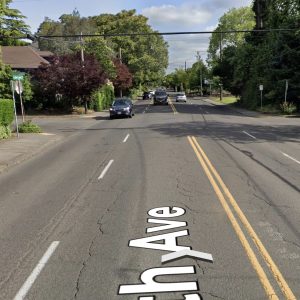
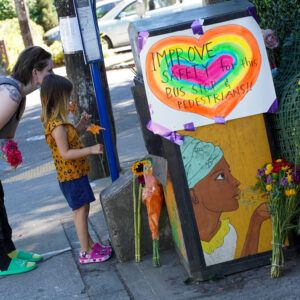
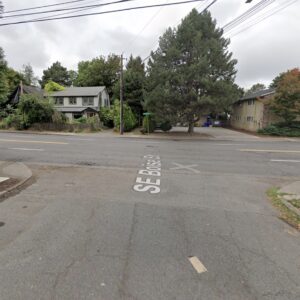
The Portland Police Bureau has released more information about the fatal crash that happened over the holiday. They say a person was driving a compact car southbound on Southeast Cesar E Chavez Boulevard prior to striking the woman who was walking. As I reported the day before Thanksgiving, the woman was hit and killed somewhere near the intersection of of Cesar Chavez and SE Harrison.
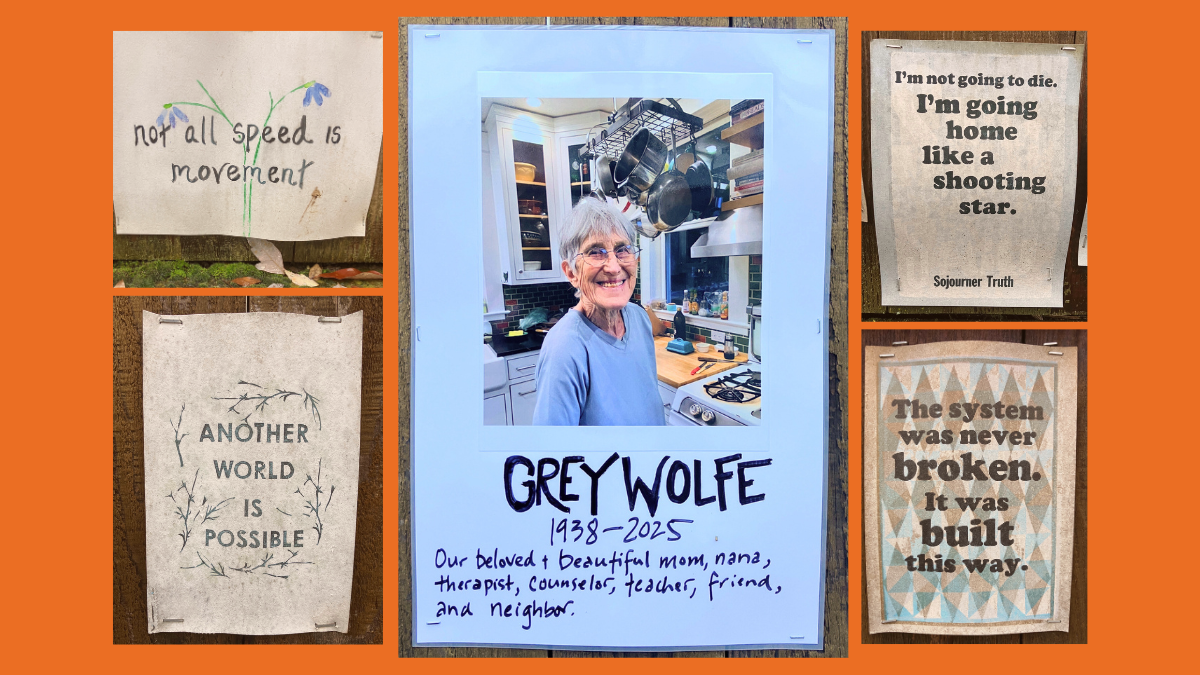
We now know the victim was 87-year-old Grey Wolfe, a revered Portlander who was known by many in our community as a mental health counselor. On her business website, Wolfe said she spent the last 25 years of her life in that practice. Before that she was a school teacher in Baltimore and she was also a restauranteur who co-owned, cooked, and baked at two Portland restaurants — Genoa and Bread and Ink. She also raised three children.
One of her children posted about the tragedy on Bluesky on Friday. “My one-and-only mother was hit & killed by a car on Wednesday,” someone with the username “Ursula” shared. “I am all the adjectives you can imagine: shattered, devastated, bereft. And no hour has passed in the last 48 where I have not felt unbelievably lucky, overwhelmed with gratitude for all the time I got to be her daughter.”
Below is an excerpt from Wolfe’s obituary:
Grey Wolfe died in the early hours of the morning on November 26, 2025. She was returning home from her daily walk to Mt. Tabor in southeast Portland, Oregon, when she was hit by a car. She was 87 years old.
For the last four decades, Grey was a therapist, working with individuals and couples. Grey’s practice was at the center of her life. To her, the meaning of life was meaningful relationships – with her family, friends, and clients.
Grey’s previous careers included co-owning and cooking at Portland restaurants (the Genoa and Bread and Ink Café) and teaching middle and high school social studies in Baltimore.
In 2012 Grey lost her beloved partner, Howard Waskow. Grey’s family includes her children Ben, Morgan, Ursula, Dan, Saul, Ilan and their partners Tim, Joel, Lizzie, and Meg; and eight grandchildren, Will and his partner Kimmy, Milo, Blaire, Jack, Aaron, Emily, Maya, and Harper.
Donations in Grey’s memory may be made to Northwest Abortion Access Fund https://nwaafund.org/donate.
Wolfe’s death should send a message to city leaders: it’s long overdue for traffic to be calmed on Calle Cesar Chavez. Portland has lost too many people because of its car-centric design and tragedies like this will continue until people are forced to drive more slowly.

Thanks for reading.
BikePortland has served this community with independent community journalism since 2005. We rely on subscriptions from readers like you to survive. Your financial support is vital in keeping this valuable resource alive and well.
Please subscribe today to strengthen and expand our work.
Grey died seven blocks from where a driver killed Jeanie Diaz.
Kill a beloved children’s librarian, and you traumatize thousands of children and families.
Kill a therapist, and you leave her patients as well as her family and friends bereft and at a loss of their source of support.
Cesar E Chavez remains deadly, and PBOT has yet to do anything to change that, so I suppose more of my beloved neighbors can expect to be killed here.
I can share the email exchange I’ve had with PBOT Director Millicent Williams since Grey’s killing, if others want to see it without having to submit an Oregon Public Records Request.
Ursula Wolfe is Grey’s daughter, with whom Grey lived in a splendid multigenerational household. I knew Grey well, and first learned about her violent death from Grey’s extended family in Chicago, with whom I am close. They were already mourning the death of Grey’s late brother-in-law, also an amazing activist and a faith leader who died in late October. In that instance, there was a transition to hospice, with time for the family to gather and say farewell. But when vehicular violence strikes someone dead on our streets, the shock and grief are so very different — and avoidable, if only PBOT leadership would, well, lead. But here we are, same old Zero Vision that will never really get us to Vision Zero.
Please post your exchange with Director Williams.
Here you go. She and I have interacted in the past, via email and in person when I made her sit at the bus stop where Jeanie Diaz was violently killed.
Here’s the email I sent on Wednesday, the day a driver killed Grey Wolfe:
Millicent Williams responds:
[Note to BikePortland comment readers: I only just now notice the Lao Tzu quote in Millicent Williams’s email signature. Quite the charming touch, given that you’d barely know her leadership exists based on how many people are dying on her watch. But anyway, here’s what I write back]
Sent: Saturday, November 29, 2025 6:57 PM
To: Williams, Millicent <Millicent.Williams@portlandoregon.gov>
Cc: Cawley, Wendy <Wendy.Cawley@portlandoregon.gov>;
Subject: Re: Thanksgiving thought
Oh, Ms. Williams,
When you go/to pass by those places (presumably in your luxury SUV, which of course is a more potentially deadly option than a smaller motor vehicle, and much more so than a bicycle or public transit, but still you choose the luxury SUV), you do not need to think about me. You need to think about Jeanie Diaz’s children, who have just spent another holiday without their mother, and Jeanie’s spouse, who has spent another holiday without his loving partner. And now you can also think of Grey Wolfe’s children and grandchildren, nieces and nephews, bereaved this holiday weekend, carrying the knowledge that their matriarch suffered a violent death because even after Jeanie Diaz’s equally preventable and violent death, PBOT has done nothing to make Cesar E Chavez safer.
You can cut the “we grieve with the community” nonsense. If you took seriously the IMPERATIVE to protect individuals and communities, Grey would be alive, as would many others, and still more would not have been badly injured by vehicular violence (because it’s not just the deaths you’re failing to prevent, it’s also all the horrid injuries occurring on our streets, which nobody even tallies).
Please don’t waste any time and energy wishing me peace. Please put your energy into ensuring the safety of my community. Or, since your claimed “prioritizing” of safety doesn’t actually lead to “ensuring safety,” you can, as I noted previously, cede the incredible power of your position to someone who would have the ability to keep one more family from losing their beloved one to the streets that PBOT is supposed to keep safe.
With renewed commitment to the cause,
Dr. Lois Leveen
[To this Millicent Williams again responds]
Good Morning Ms. Leveen,
Acknowledging receipt of your message. The team will continue to work to support communities and to prioritize safety as we have always done.
Sincerely,
Millicent
Millicent D. Williams (she/her)
Director
And so there you have it, BikePortland readers. “The team will continue to work … to prioritize safety as we have always done.” Which is, POORLY, because people keep dying on this same damn street (and on many other streets).
Continuing to do as they have always done means get ready for our next community member to die. And then another one after that. And another. Because under Millicent Williams’s direction, PBOT will continue to work the same damn deadly way.
This exchange offers a master class in tact, diplomacy, and persuasion.
Thank you for sharing.
totally disagree, to me it reads as mean-spirited and alienating. gets worse as it goes on. over-activated citizen actively undermining their own cause IMO.
it’s important to step outside your bubble and give grace when you do. this is not that.
Not even a little bit. My comment was intended as sarcasm. We completely agree about the letter’s prospect to move PBOT forward.
Thanks so much for sharing your correspondence with Director Williams, who trots out the same old platitudes. Remember that in Portland it is always more important to PERFORM leadership than it is to LEAD.
I loved your comment about Williams’s luxury SUV. I’ve always thought that’s how you can really tell what someone believes: by how the person acts and the choices the person makes in her/his private life. Williams’s choice says a lot about her, but mainly that she is afraid on the roads and that she prioritizes her own safety (and comfort) over others’.
Learning that the PBOT Director drives an SUV was an aha moment for me. She, like so many other Americans, is suffering from car brain—which explains the PBOT inaction in the face of so much traffic violence. If she rode a bike regularly I expect she’d understand much better why drastic action to reduce auto speeds and improve safety was an imperative.
This was a great exchange until the part about her SUV. That turned a compelling commentary into a personal attack. I think we should be extra careful when we address Black women leaders in particular, who, for so long, have been kept out of city government and leadership roles and told that everything about their personal presentations has been wrong. I am not defending Director Williams’s choice of what to drive, but this is a hugely problematic critique to send in her direction. It also, I suspect, makes it less likely for her to listen to us about these issues in the future. (And I am going to guess my car is much older and smaller and lower mileage than the cars of BP folks who actually do have a car, so I am not defending monster SUVs by any means.)
Spot on. Though I don’t think Millicent Williams will write off bicycles or safety. I do think she’ll write off Lois. Any leader who reads this would write off Lois. There were several personal attacks in there. Blood on her hands? Basically saying that she doesn’t actually care when people die? Saying she shouldn’t be able to eat because of “all the people dying on her watch” as if she can single-handedly fix every safety problem in the city in the three years she’s been in the job. You think your signals idea would have stopped the super drunk guy who killed Jeanie Diaz? PBOT needs to do better with safety. But these emails are over the top personal attacks that don’t advance anything.
Thinking we need to play nice with the leaders is exactly why the leaders will never do anything. If a leader cant handle someone pointing out that their leadership killed someone, and that the SUV they drive is a danger to everyone outside of it, that means they are not fit for leadership at all and need to give their position up to someone who can handle the backlash when they make poor decisions.
A person being Black does not mean that when they are in leadership we can’t harshly criticize their poor decisions. Thinking that is racist in itself since it’s really saying “I think Black people are weak and need to be coddled when they have positions of power.”
They aren’t and Black people, like everyone else, needs to be treated the same when they have positions of power, even more so when their positions of power can lead to peoples deaths due to their poor decsicions.
I’m not talking about what a leader can handle; I’m talking about being strategic and keeping the door open. And nowhere did I say Williams shouldn’t be subject to criticism, but I suspect you know that.
I bet, if asked, Director Williams would not want or even need your lame attempt at apologizing for her.
She’s the head of the transportation department of a large city. She needs to be held accountable for her actions when she fails to live up to the needs of the citizens, and safe streets are a huge need.
It is very sad to see your overt racism at play in your comment. I can’t speak for others in these forums, but I’m utterly dismayed and appalled at it.
“overt racism”
Oh pleeeeease. Just stop. Considering the racial history of our society, discourse around the intersection of class and race, and the critiques more commonly levied at certain groups but not others is not “overt racism”.
Reasonable people can argue about the degree to which it is necessary (if it all). But it is not “overt racism”. Drop the drama.
We don’t know exactly how this lady was killed, yet you automatically assume it was 100% the driver’s fault. You need a major reality check on human behavior. Bad drivers obviously exist but they’re a subset of the problem.
You really think cyclists & pedestrians never do dumb things around cars? The opposite is true. Lots of jaywalking, bikes running red lights with overconfidence, etc. Many walkers traipse around in dark clothes with no lights. I recently almost hit a mindless no-lights couple on Hall Blvd in SW Portland, walking far too close to traffic at the Metzger curve, barely visible on a foggy night.
Crazed homeless people are well known for deliberately walking into traffic, often seen on Burnside downtown. Drunk night-on-the-town pedestrians also die fairly often, since booze makes them lax or oblivious to their surroundings.
Unless the driver veered onto the sidewalk (like that library bus stop tragedy) or she was crossing in a legal location and was caught off guard by excessive speed, do we have any evidence that this was avoidable?
There’s always a rush on this site to assume riders & pedestrians have no major role in what befalls them. I constantly see people dressed in dark clothes with no lights, blindly assuming they can be seen, and we all know the elderly aren’t as aware as they used to be.
All anyone survival-minded can do is stay off busy streets whenever possible, and never assume you’re visible unless eye contact is made. If you live your life presuming street safety is “owed” to you, and behave as such, you’re being reckless.
While there is certainly no need to be oblivious, careless, stupid, you are overlooking a very important distinction.
People walking and cycling have a RIGHT to be out there on their feet or wheels. Some of them might even be blind or deaf or frail or otherwise impaired. People driving do not. Driving is a PRIVILEGE that can/should sometimes be revoked. Walking and cycling do not present (statistically relevant) modal threats to others. Driving does.
The ones who need to be perspicacious first and foremost are those who are piloting their horseless carriages. Once that part is addressed, then we can get ourselves exercised about the things pedestrians are doing wrong. Vision Zero (at least in other countries) understands this too.
From the updated police report:
Do we know yet if the driver was driving over the speed limit? And if so, how much over?
We know very little, yet many of the comments here were made on autopilot, blaming drivers, never the numerous reckless cyclists and walkers I see all the time, especially at night when they make no attempt to be visible with lights or common sense.
Any number of things could have happened to this lady, including literally falling into the street due to balance issues, tripping on something, etc. Evidence needs to be seen before assuming anything!
You must be from around here, Jack C. In many European countries fault is assigned* much more readily to the operator of the motor vehicle as they are understood to be the ones causing the injury or death with their conveyance. The logic in situations like this is that the operator of a motor vehicle can and should expect the unexpected as people walking and biking are recognized to be about even at night or in circumstances where visibility is low, can’t safely be assumed never to cross their path.
Part of the outrage you see here in the comments is a reaction to the cavalier manner in which people piloting cars are given a pass (by officials who are supposed to protect the vulnerable) when they injure or kill people. Even in crosswalks!
*not just in online comment forums but by law enforcement.
I’m as against bad drivers as anyone, and stay as far from main roads as possible, but there are blatantly unsafe walker/cyclist behaviors I witness all the time, described in more detail earlier. It doesn’t matter what prosecutors think should be generically prioritized.
You must know that walkers or cyclists who are truly “unexpected” can never be predicted, by definition! We still don’t expect that from self-driving cars, which are technically more aware than typical drivers in many scenarios. It would take a detailed scientific study of various roads and sidewalks to assign a percentage of blame due drivers alone.
Just the other day I was driving under 5 MPH through a Fred Meyer lot at night, and most people crossing to the store casually walked in front of cars while only seeing them in peripheral vision, never making eye contact. One fool literally walked within 10″ of my front bumper, never looking at me, just because I’d paused. There’s also a smugness about it with some of them, as if hoping to get hit and mildly injured so they can sue (documented tactic).
Link to an earlier discussion of this very issue:
https://bikeportland.org/2014/12/18/defazio-leads-trio-requesting-gao-investigation-bikewalk-safety-121067#comment-6031137
There may be more wisdom in Europe on the part of walkers & cyclists, and/or the expectation that cars aren’t favored as THE means to get around, so culture matters. I just don’t see those numbers applying well to Portland, with its particular attitudes.
Again, I see high degrees of recklessness, especially among the homeless and younger people in Portland who think they’re owed the right to do whatever they want around “fascist cars” (you get my drift). I also tend to resent cars when I’m not in one and trying to cross a busy road (traffic lights or not) but I live in reality.
P.S. Those same head-in-clouds types tend to get squashed by MAX trains. It’s wise to treat all trains, trucks and cars as if they have lousy brakes. Plus cyclists for that matter, since they also hit pedestrians and other cyclists!
From the first report:
From this report:
JM, I don’t disagree with what you have written, but here’s a problem. If Oregon drivers, by state law, are allowed to drive 10-11 mph over the speed limit, doesn’t that effectively make the legal speed limit on Calle Cesar Chavez a more-deadly 40 mph? Even the 20 mph imposed on Portland residential streets is a bit false, isn’t it, as the legal limit is actually 30 mph? All those walkable 20 mph parts of Portland aren’t so walkable when the legal (but unposted) speed limit is actually 30 mph, isn’t it, which tends to give all pedestrians a very false sense of security, does it not? And this mess with legal speed limits, is it caused in large part by a state legislature that seems rather obsessed with being very car-centric?
Calle Cesar Chavez is listed by PBOT as a “high crash street” but near the bottom of the list, among the least bad, with zero high-crash intersections. It’s noted as being bad for pedestrians (near the middle) but not so bad for bicyclists and car drivers. Yes, it is car-centric in its design – so unfortunately is most of the rest of the city, and the state, and the entire country for that matter.
I agree with you, car drivers need to slow down. The city needs to lower all posted speed limits by 10 mph, which will probably cause the state legislature to allow 20 mph over the speed limit, and so on – in fact I can’t really tell the difference between the Republican-dominated legislature in Raleigh NC and the Democratic-controlled one in Salem OR – they seem to act exactly the same on speed. So your better option, IMO, is to put signals on as many intersections as you can afford and have the city time the signals to a safer speed than what is posted or legal.
What State law allows people to drive 10-11 mph over the speed limit?
Also, even if there is a State law, wouldn’t it be overridden by Portland’s traffic laws? I ask that because of past discussions about how Portland’s laws (or lack of laws) for things like parking close to a crosswalk override State law.
I certainly agree with your main point that more needs to be done to get people to slow down.
Under ORS 810.434 traffic cameras in Oregon can only be used to issue tickets to drivers exceeding the speed limit by 11 miles per hour or more. Portland can’t override that law.
The 11 mph rule only applies to automated, camera-based tickets, not tickets issued in-person by police; it’s not true that state law allows driving over the speed limit (although obviously enforcement is rare).
So let me try to get this straight: if the city put in speed cameras to enforce the 30 mph speed limit on CCC as many folks are here advocating, it would legally, by state law, effectively raise the speed limit to 40 or 41 mph? But if the PBOT does nothing, the speed limit stays 30 mph, but with current enforcement levels (i.e. none)? It sounds a lot like a Catch-22 – basically Portland residents are f****d.
Similarly, if the lane configuration was changed from 4-lane no median to 3-lane with turn lane (and maybe a painted bike lane), without solid curbed medians and bike lane barriers you’ll get drivers behaving like they do on outer Powell, using the median lane and bike lanes as passing lanes, again without any or little enforcement by police. And the high costs of median curbs, bike lane curbs, more signals, and so make any project on CCC more or less unaffordable unless Portland residents are willing to raise taxes a lot. And it’s not just on CCC, but any city stroad – 122nd, BH, the list is endless.
With that in mind, MW’s cynical response to LL makes a lot more sense – PBOT is already trying to do its best given all these restrictions (and many others.)
Not exactly. If the posted speed limit is 30 mph, police can (in principle) stop and ticket people driving 31 mph. If traffic cameras are installed, police can still stop and ticket people driving 31 mph. (In practice they mostly make the discretionary choice not to do this, Jay-Z notwithstanding.)
But the traffic cameras can’t issue automated tickets to people driving less than 41 mph in the 30 mph zone. Adding cameras doesn’t change the legal limit or bar in-person enforcement, but there’s a restriction on how the automated traffic cameras themselves can enforce the limit.
(My idea on this is that Oregon should change state law to allow camera enforcement at 6 mph over the limit, but make camera-enforced ticket fines half the amount of officer-enforced fines, because consistent enforcement means you don’t need the same cost to maintain deterrence.)
For Chavez, I think a 4-to-3 lane reallocation would help a lot because—
You’re right that there would have to be raised medians to prevent the turn lane for being used for passing. Cost is not trivial but I think not huge—much cheaper than signals—since you don’t have to worry about drainage in the middle of the street.
I don’t know what signal timing is on Chavez—PBOT is generally okay on timing, but the longer gaps on Chavez would make it less effective there than downtown. I do wonder if PBOT could implement “rest-in-red” on Chavez to reduce nighttime speeding.
COTW+1 Jay-Z!
That’s a fantastic response and summary.
Also, my experience driving past speed cameras is that people mostly slow down to the speed limit. I’m not sure many people know about the 10 mph leeway. I definitely don’t see everyone–or even many–going 10 mph over past the cameras.
And one more benefit of the 3-lane design is that each car going slower forces the ones behind them to also go slower. So you don’t need to convince everyone to slow down, just enough to slow traffic.
That’s great info, David B, but if the ORS prohibits tickets under the 11-mph threshold, then you’ve made David H’s point about the de facto speed limit.
(Unless enforced by a cop.)
Right, I’m trying to emphasize that adding cameras does not make the situation worse in any way, just less better than we would like.
I would argue that the law which implements the cameras actually DOES make the situation worse, by creating the de facto +11 speed limit that David H. referred to.
What would the de facto speed limit be without the cameras?
Since I’m out cycling west of the river almost every day, I’m more and more intrigued by all of Teslas and other e-cars that seem to be operated by self-driving software. Most of them seem to be going 5-10 mph over the speed limit at all times, which fits with what you’re saying, David, that cars are ALLOWED to speed – that there’s a de facto speed limit which the software recognizes and responds to. I’d love it if some e-car owner could verify that it is in fact what the software does.
Another intriguing bit of anecdotal data: Occasionally an e-car will stay well behind me as I’m riding and then pass at very high speed when both lanes are clear. Again I wonder if the operator has set the self-driving software to respond in this way to a slow-moving vehicle ahead of it (me).
I have a friend who just got a Tesla (I know) and the self-driving modes are “chill,” “normal,” and “aggressive.” So, yeah. Intriguing is a good way to describe that.
That’s interesting, Paige. I’d love to know more about what the “aggressive” mode means for actual driving speeds. I rode in a Tesla, on a Lyft ride, and I hated how quickly the car accelerated. I’d imagine the driver was using the “aggressive” mode to maximize rides and income. Thanks for the insight.
Taking all that as given, it’s an old-fashioned* scandal that a major car brand has an “aggressive” mode. It’s chilling, and works to defeat the argument that automated driving makes people safer. How are vulnerable road users to know that the approaching motor vehicle operator has instructed their widget to be aggressive? It’s another reason to boycott Tesla.
*Not a news cycle scandal.
It’s not news to me that moneyed folks pay no mind to fee based penalties. Another reason why physical implements (roundabouts) are far superior as they rely on physics not psychology to produce results.
I’m sad, exhausted, frustrated, and angry.
We know that some streets are more dangerous than others. The data is clear.
We know that neither education nor enforcement will change dangerous streets into safe streets. The data is clear.
Engineering streets to be safer – to have reduced vehicle speeds and less cognitive load for drivers – is the only way to make safer streets. The data is crystal fucking clear on this.
So why do these horrors persist? Why do children and elderly folks and POC and everybody else have to gasp out their final breaths on the unforgiving asphalt of American streets in a pool of their own lifeblood?
There’s a long procession of loud, entitled, brainwashed suburban drivers who bray and bleat endlessly about their own convenience. These drivers scream at any politician they can find, parroting disproven claims about “traffic congestion”. These suburban carbrain zombies are backed up by slick political lobbyists who reassure the elected folks that the economy would grind to a halt without more asphalt for trucks.
Thanks to these assholes, American streets have multiple wide car lanes that encourage drivers to race each other: speeding and making rapid lane changes and sudden turns – in a complex environment full of hazards. Pedestrians are just another hazard to be avoided.
We could do better. We could take best practices from other, better transportation systems. We could slow down the cars. We could remove the extra lanes.
If we did that, politicians wouldn’t get re-elected.
“Sorry for your loss, maybe next year we’ll do something.”
Yeah. Things are probably not going to get any better.
Partially at fault are also all those who refuse to admit the — as you said — crystal clear data showing that safe streets need to be engineered. Traffic safety will never be punished or enforced into existence. There is an emotional appeal to imaginary thinking, involving cops and appropriate punishments for bad people, but reality won’t adjust itself to ever make that thinking productive.
Jonathan’s comment that traffic deaths will continue until people are forced to drive more slowly probably understates the situation. Unless cars slow down, I expect pedestrian and bicyclist deaths will increase substantially as our population ages. Streets are unsafe for all pedestrians and bicyclists, but particularly unsafe for the elderly. I know because I am one of them. Now more than ever is the time to take Vision Zero serious – slow cars down and while at it make them smaller.
Do you think the driving landscape in, say, 20 years, will look at all like it does today, after all those millennials take away the keys of their boomer parents, and autonomous cars are much more prevalent than they are today?
I think that in 20 years urban areas autonomous vehicles will significantly improve pedestrian and bicyclist safety. Instead of waiting 20 years, invest in Vision Zero so that when autonomous vehicles do arrive our streets will be even safer.
I’m not saying “wait”… but in 20 years, the road system will be more-or-less like it is today, just as it is now very similar to the way it was in 2005.
Rebuilding infrastructure takes time and resources, and our efforts may well be overtaken by events that improve things in ways that are hard to imagine today.
I’m actually pretty pessimistic about the driving landscape in 20 years. By all rights we should have a fleet of daily driven vehicles that has 90%+ Automatic Emergency Braking features. The old cars in 20 years will be the cars of today.
Here’s the wrinkle. People don’t maintain their camera systems. I’m a valet, I drive a lot of customer cars. No one with a 20 year old car is going to care when the screen lights up and says “automatic braking, and cruise control unavailable”. How could I claim to know this. Because people don’t care when their brand new Subaru or Honda throws this error today.
I agree that human nature is unlikely to change in 20 years. But I think the death toll today is a worst-case scenario for the future.
Autonomous electric cars are going to cost 2X-10X as much to operate per mile as today’s manually driven ICE cars do. It’s difficult to squeeze energy into stable storage, and it requires more and more exotic materials to increase that capacity. Electric vehicle battery components are already rare, toxic, and dangerous, and we’re going to have much less cheap labor in third world countries to outsource that work to.
Most people prefer to believe in a star Trek future full of flying cars and technology magic, but tiny gains in efficiency aren’t going to get us there.
In 20 years we’re going to have half as many cars on the road. Either that or we’re going to keep burning fossil fuels and have worsening climate change, which is the future that capitalists want. One side of the capitalists face speaks fantasy about cheap cars that last forever and create no pollution, while the other side whispers that climate change is inevitable and we should keep burning oil.
Yours is a grim future. Luckily, there are a lot of societal and technological trends that suggest it is highly unlikely to play out that way.
And just one technical point: EVs are hugely more efficient than ICE vehicles, even if they are ultimately powered by coal, which is being phased out everywhere except perhaps China and India, largely because greedy capitalists would rather generate electricity from cheap sources like the wind.
Coal is being phased out in China. They install more green enerygy than the rest of the world combined. The vast majority of the coal plants they have now are used only when the extra energy is needed.
China happened to have a massive surge in living standards, and with that, a greater need for more energy. They still emit less emissions than the US does per capita.
Not true.
https://en.wikipedia.org/wiki/Coal_in_China#/media/File:China-energy-consumption-by-source.svg
https://en.wikipedia.org/wiki/Coal_in_China
3 lane cross section benefits:
And while you’re at, put in stop lights every third block that change WITHOUT a pedestrian or bicycle begging to cross. They just go red at regular (short) intervals so that traffic on Cesar Chavez can’t be at a breakneck speed for block upon block upon block. Photo enforcement for running the lights and for speeding.
I know, it would INCONVENIENCE drivers to have to wait at all those red lights. And that would be so much worse than more people dead and still more people grieving the dead, which is what PBOT is instead choosing.
This about that.
Ca. 2007 PGE and PBOT did a thing where they retimed the lights on thoroughfares including what was then still SE 39th… to ameliorate global warming, because, you know, all that idling at stop lights is bad for sea level rise. Ha! It was some early carbon scheme. But I’m pretty sure the pedestrian lights at Taylor and Chavez took longer to respond after that.
here is the Oregonian article:
Global warming fight brings local victories Oregonians benefit as the state leads in offsetting greenhouse gases
Sunday, March 11, 2007
MICHAEL MILSTEIN
The Oregonian
Next time you drive down Southeast Division, Southeast McLoughlin, North Greeley or any of more than 15 other busy roads in and around Portland, your car will burn less gasoline and pump out less greenhouse gas.
That’s because a company that built a power plant in Eastern Oregon paid $533,000 to synchronize the traffic signals. Now cars spend less time sitting, engines idling, at red lights.
It’s one way efforts to control global warming are already changing your life, without you noticing. As governments clamp down on greenhouse gases, more change is on the way.
The signal re-timing is called an offset: Reducing carbon dioxide from cars in Portland helps offset the same gas emitted by Avista Utilities’ natural gas-fired power plant near Boardman.
Oregon in 1997 became the first state to make new power plants control or offset emissions, and the order has pumped millions of dollars into reforestation and energy efficiency projects statewide. It has made Portland a national — and international — clearinghouse for power companies in need of offsets and others with offsets to offer.
Altogether the traffic signal adjustment saves drivers about 1.6 million gallons of gas a year that, if burned, would inject more than 15,000 extra metric tons of carbon dioxide into the atmosphere, adding to global warming.
Car owners also enjoy a green payoff of about $3.5 million a year they no longer have to spend on gasoline.
But that’s just the start. Offsets will become much more common as utility companies face wider demands to compensate for greenhouse gases that their plants vent to the sky.
Gov. Ted Kulongoski last month joined four other Western governors in moving toward regional emissions limits that may require offsets, and a coalition of Northeast states is on the verge of capping emissions from power plants.
Many utility companies — including Portland General Electric — want nationwide greenhouse gas limits so they don’t have to juggle a web of different state rules. Any national strategy would probably set caps on emissions and then require companies to keep their emissions within the caps. They could do that by controlling what they release, paying for offsets to balance their emissions or by buying credits from other companies that emit less.
People can buy offsets on their own to compensate for the greenhouse gases that they and their families emit by driving, cooking and heating. But those only nibble around the edges of what a mandatory national system would do.
Although power plants are far from the only source of greenhouse gases, they’re one of the biggest and easiest targets of controls. It’s generally cheaper for them to pay for projects such as the traffic signal work than to control or capture carbon dioxide at their plants.
That means more money will probably flow to offset projects in Oregon and across the country as utilities and other industries build up credit so they’re prepared for coming regulations.
Offsets in Oregon have so far included:
The traffic signal re-timing — so successful it will soon be expanded to include other streets in the Portland area.
Planting trees, creating new forest that absorbs carbon dioxide. Trees are now growing on plots across the state.
Upgrades at the Blue Heron Paper Co. mill in Oregon City, increasing the amount of recycled paper going into its projects and reducing energy use (funded by Calpine Corp. to offset emissions from a power plant in Hermiston).
Buying wind power to replace electricity that would have been produced by burning fossil fuels.
Portland has quietly become a central brokerage for offsets. The Climate Trust, a Portland nonprofit organization, first formed to help power plants meet the Oregon requirement, but now is handling offsets from Europe to Ecuador.
Just this month, The Climate Trust announced the largest-ever U.S. request for new offset projects. They could include anything from planting trees to improving building insulation. Five major utilities from across the country are paying for the offsets because they expect to need them as greenhouse gas requirements develop.
“The situation has changed dramatically in the last six months,” said Mark Trexler, a Portland consultant who helps companies prepare for greenhouse regulations.
The European Union has started a cap-and-trade system to try to control carbon dioxide emissions, driving some European companies to fund offsets. The concept is that it doesn’t matter where carbon dioxide is reduced — as long as it’s reduced — so some of that money has even flowed to the United States.
For example, European companies have put up money through The Climate Trust — the amount is confidential — to install plug-ins at truck stops in Oregon beginning this month. Soon truckers will be able to connect to the outlets, powering their cabs with electricity instead of keeping their engines running, burning fuel and emitting carbon dioxide.
But the market in the United States is so rudimentary that there aren’t yet clear standards for offsets.
“It’s a Wild West out there,” said Sean Clark, director of offset projects at The Climate Trust. “The supply of proposals (for offsets) is not limited. The supply of high-quality proposals is limited.”
What makes an offset high quality is assurance that it actually reduces carbon dioxide beyond what otherwise would have been. In other words, offset buyers want to make sure they’re getting what they pay for. They don’t want to pay to plant trees on clear-cut land where they would have been planted anyway, for example.
The first major required offset project in Oregon involved tree-planting funded as part of the construction of a power plant in Klamath Falls. About 530 acres have been enrolled in the program since 1999, but that’s short of the original goals, said Jim Cathcart, manager of the Forest Resource Trust at the Oregon Department of Forestry.
Many landowners were deterred by the requirement that the state place a lien on their property to protect its interest in the trees. But the state is now revising that requirement to make the program more attractive.
That highlights another challenge of making offsets work: Buyers want to be sure the offsets remain in place. In this case, they don’t want trees they paid to plant to be cut down.
Nancy Pelton, who lives west of Eugene, signed up to turn her 23 acres west of Eugene into forest on Sept. 11, 2001, when the nation’s mind was focused far away. But it seemed like a good time to do something positive, she said, even though global warming wasn’t the issue it is today.
Many of the trees today are 20 feet tall.
“You see the land changing, and with global warming, it really feels good,” she said. “We’re doing something.”
Michael Milstein: 503-294-7689; michaelmilstein@ news.oregonian.com
“…a company that built a power plant in Eastern Oregon paid $533,000 to synchronize the traffic signals…”
Talk about unintended consequences. Traffic light sequencing also trains motor vehicle operators to expect a long succession of green lights and, on multi-laned streets, creates the potential for aggressive drivers to move from the back of the pack to the front at speeds well above the average. Barring right turns on red would tamp down a little of this behavior. Maybe dialing back the sequence speed a few percent would help?
Yes – four-lane urban stroads are inherently dangerous b/c every car that is ABLE to pass a slower car expects to do so. The speeds become very high and unsafe for anyone outside of a vehicle.
What’s so hard about putting in a bunch of speedbumps? I honestly am curious.
The Fire Bureau has absolute veto power on speed bumps/pillows/humps/tables on any city street – they generally limit their vetos just to arterial and some collector streets – and in response PBOT generally doesn’t even try to put in speed bumps/pillows/humps/tables on any arterial stroad even when the Fire Bureau doesn’t actually object to it. The city’s costly fire insurance premiums are based in large part to how quickly the Fire Bureau can respond to any emergency in any part of the city, which in turn affects the city’s bond rating (borrowing costs) for municipal bonds that pay for, among other things, transportation infrastructure improvements.
Right, Portland’s current Transportation System Plan includes policies against new raised traffic slowing measures (speed bumps/humps/cushions/tables) on major emergency response routes on higher-traffic (district collector+) streets or on major transit priority routes, which means no traffic calming on the streets where there’s the most need to slow people down.
I think PBOT has sometimes bent the rules (laudatory) on this; PF&R is probably a challenge on Chavez because there’s a fire station right there.
I do know that there are PBOT staff who would like more flexible language in the new TSP.
Thanks for the response…so we are left with little/no enforcement, infrastructure designed to “encourage” speed, and more distracted people, driving bigger, more powereful vehicles year over year.. got it.
Actually, they are trying! I saw PBOT placed speed cushions designed with PF&R input on SW Broadway Dr, a Major Emergency Route, and they slowed traffic!
https://www.swhrl.org/wp/speed-cushions-work/
Apparently Fire is reviewing a few streets that tried this design, and if they did not materially lengthen response times and get approval, MERs will be eligible for traffic calming… finally.
Broadway in Portland is a strange animal. The section you are referring to in Southwest is listed by the city as a “neighborhood collector”, more important than a residential street but far less important than an arterial. Other parts from the Broadway Bridge to NE Cesar Chavez Boulevard (as the city calls it) is a major arterial, then east of there it turns into a minor and utterly insignificant local street. And of course in downtown itself Broadway really is more broad than most other downtown streets. However, I am glad the city is finally joining the 20th Century and adding some traffic calming to some of its more important stroads.
The local neighborhood association (including former BP writer Lisa Caballero) convinced PBOT their own data showed it was a cut-through for 26 traffic avoiding the tunnel, and extra load/speed was really dangerous for kids who had to use unpaved, narrow shoulders as a bus stop. I suspect there are a number of roads in town that used to be fairly sleepy before Waze, etc…
Back in the 1990s the Fire Bureau attempted to work with PBOT on designing speed bumps that would work with the emergency vehicles. I believe a prototype was even prepared. PBOT utterly refused.
The planned and unfunded Rose Lane project which was to begin south of Powell would have been a start to changing Chavez. But a 4 to 3 lane conversion with short bus refuges is the best/cheapest option. Bus lanes can be great (particularly when separated). They can also be a nightmare like H street in DC. Ped islands absolutely need to be the priority in any redesign of Chavez. These could be done in a few days with paint and planters, given priority by D3 reps, the mayor and/or PBOT.
Agree with other comments here about 39th. Get more red lights that force drivers to stop. Add some speed cameras as well. Let’s stop the “cameras are racist” nonsense if you really want to save some lives.
That’s a better formulation. Sounds more like the car struck the person, which is correct, but also that a person was controlling (nominally?) the car that did the striking.
I just read that Waymo cars hit things, people, other cars etc 91% less often than cars driven by people. Bring on the driverless cars!
Just as AI isn’t inherently “evil”, self driving cars can have their use in the future. Leaders in the AI movement tend to train their AIs with their perspective and ideologies (e.g., Grok). That holds very true with the self-driving car phenomenon. We tend to want to gloss over current problems, and their difficult solutions, for that quick future fix (my dad still mentions flying cars as a the solution to traffic congestion).
Self-driving cars are not going to solve our transportation problem in their current form. Stats like “91% less often” has a really glaring flaw: who is going to be at fault and will that number of deaths be simply accepted by insurance companies and corporations as the necessary cost of doing business?
Self-driving cars aren’t LLMs; they are more akin to industrial robots, and there is very little concern those machines will develop an “attitude”.
Fault in a crash is easier to determine when all the events leading up to it are recorded. If Waymo is found liable, they will pay out just like a driver working for UPS would. This issue was raised in the early days of autonomous vehicles, but there’s a reason why no one talks about it now — it’s not an actual problem.
I’d welcome the opportunity wrestle with the implications of 91% fewer injuries/deaths.
Do you really think any future government in the US is going to mandate automated driving on all citizens, and that these systems will work on every road in the country? We aren’t going to see a 91% reduction in our lifetimes, unless cars go away altogether.
From today’s vantage point, it seems unlikely. However, as the article I linked to below points out:
Even a 40% reduction in crashes would be revolutionary.
Why not celebrate and push to accelerate that increasingly likely possibility?
Also, will the future police reports say, “The car remained at the scene and cooperated with police”, then “The pedestrian was not wearing an electronic beacon”?
Ha! Thanks qqq. The human police reported that Johnny cab was questioned at the scene of the accident, and reported he is unfortunately unable to locate and disclose video recording of the alleged event due to property rights infringement. In a statement to the media Johnny cab wrote, “Corporations are people. I am people.”
LOL. Not the future I’m hoping for.
91% will probably cut into profits too much. They will probably shoot for 5%, which is far less than we could achieve now with adequate regulation.
https://www.wsj.com/lifestyle/cars/waymo-self-driving-cars-san-francisco-7868eb2b?st=Ybw1vz&reflink=desktopwebshare_permalink
It’s important to remember these cars are being trained in the US where road design and laws reflect an abject failure of road safety when compared to every other developed country. So, as these robo-cars move into other countries, they bring with them all that shitty baggage. While we become accustomed to more “assertive” autonomous SOV driving, that becomes the norm, and we forget that robo cars were pretty cautious at the start.
In 1970 John Volpe, then US Secretary of Transportation, claimed that the US would never get used to the current amount of road deaths (the previous year had >56k). We have become accustomed to that with pizazz and flair like no country in history. When the paradigm isn’t safe and free movement, but profit margins, it’s probably not all that far fetched for us to quietly accept a consistent increase in road deaths with robo-taxis until they are unrecognizable from the current form.
The fun part will be when the trillion dollar company that owns a self-driving car monopoly sends their lawyers to small and mid-sized cities to redesign roads to favor the speed and profit extraction capacity of their vehicles. Or better yet, dumps millions into local elections to put their people on city council, city manager office or other elected position.
Besides the money they don’t have to do that, PBOT will no doubt trot out a 50-year-old study showing it just makes drivers speed between each light even more.
No need to go to burbs – one group of parents loudly complained at a neighborhood meeting that it was too dangerous for their kids to cross street to the school, and Won’t Somebody Please Think Of The Children.
The next month, those SAME people were at another meeting, about a cross walk less than half-a-mile down the road, screaming that children crossing to THAT school were really slowing them down and a huge inconvenience to them.
Streets, cars, lighting, shitty engineering – that’s not the issue. PEOPLE are. and people in cars just lose their goddamn minds. Until we figure out how to fix that, we’re left just trying to nudge along improvements in the other factors.
A number of transit activists feel autonomous cars will actually lead to pedestrians being removed from streets completely… walls around streets, etc. Fewer impediments to throughput. Fewer lawsuits. In any case, self-driving cars will not be the answer if they behave like current cars, in our current road network. Call me when the industry prioritizes ped safety over speed to destination and maximum profit.
Your phone is ringing. The data comparing crash statistics between automated cars and human driven ones is pretty stark. From an article in today’s NYTimes looking at autonomous vehicles from a public health point of view:
Compared to real-world data, the baseless predictions of transit activists mean nothing to me. It may not be over, but it’s pretty clear that the “war on cars” has been lost. It’s time to start the “war on drivers in cars”.
https://www.nytimes.com/2025/12/02/opinion/self-driving-cars.html
The most dangerous drivers in the US are also going to be the ones who will resist self-driving tech the most. They are on average poorer, less educated, and opposed to regulation.
Unless we see a full socialist takeover of the Federal government, I don’t see how we get laws that mandate self-driving tech on all US citizens. Until we have that, self-driving tech adoption will increase at a trickle.
We need to dual-path this approach. You have to target human drivers while also encouraging this new technology.
Personally, I’m less worried about the end-game than I am about the opening moves. I don’t know that a mandate will prove necessary, but either way, it’s a problem to solve later when we see what the new landscape looks like. The challenge of getting the most dangerous drivers out of the drivers seat may look very different when there are more alternatives available.
And absolutely yes on the dual path. I think I’ve made it pretty clear that I support an all-solutions approach to traffic safety.
This is why I am skeptical on the self-driving Utopians:
The Feds have refused to deal with new headlights in any material way; I do not expect them to deal with higher-level issues, like tellng companies they may not make cars that can drive in ‘aggressive’ mode. ANY car computer can and will be hacked and tuned to allow ‘sportier’ settings, regardless.
I agree a car that has multiple sensors and a “HEY STUPID- DONT HIT THAT” mode would be great.
I see a parallel with e-bikes that are being hacked to go 30+ mph.
You mean some futuristic tech like Automatic Emergency Braking, that, in addition to alerting you, actually applies the brakes?
https://en.wikipedia.org/wiki/Automated_emergency_braking_system
https://www.consumerreports.org/cars/car-safety/automatic-emergency-braking-guide-a1780056935/
(And sure, be skeptical. But also be optimistic because self-driving cars offer a chance to make a dramatic improvement in crash rates in a way that no other technology or social movement is likely to do.)
In the case of my kid’s car, several times, randomly and abruptly, with no traffic in lane ahead. 🙂
Yes, it will get better, but I have no hope regulations will require it be so uniformly across an industry. Some company will be the self-driving equivalent of the old Volvo I guess.
Old conversation; new article
https://www.wired.com/story/can-bike-riders-and-self-driving-cars-be-friends/
I haven’t read the article, but the subtitle captures the zeitgeist well:
What I find particularly ironic is that at the same time, many cycling advocates are embracing motorization of bikes, which completely blurs the lines between auto dependency, motor-normativity, driving, motorcycling, and what is conventionally understood to be bicycling.
l could imagine it is the same people who embrace both. If so, then that wouldn’t be ironic would it?
Having lived in the neighborhood for four years, and using that exact crossing, plus Clinton, Franklin, Lincoln, and Main and like everyone other one a zillion times. I’m just pissed off at PBOT.
Drivers all treat Cesar like an interstate. No care for anyone who happens to live in the neighborhoods it bisects. They run the pedestrian red lights. They go around the diverters. They honk at other drivers who dare to stop for another human. They speed off at full throttle the moment the light flips green. It’s the same mental headspace that drivers are in when the are on Powell or Barbur or 99E. “Fuck you, I got to go places”
It won’t stop until we delete the extra lanes.
The cheapest path forward is some paint.
The next best path is paint, plus asphalt curb bulbs and islands painted a light color. It’s cheap. It’s quick. It’s ugly but it will slow people down.
While we go out and do a million studies and design the “perfect” road, just do that. Just make Cesar a pain in the ass for drivers.
Drivers will complain about the added travel time. Let them! We all have dealt with the construction of the library. Yes it added travel time. But it also slowed down the street. Seems fine to me.
Enforcement is the only answer, unless PBOT builds really hardened infra, which they won’t.
Despite PBOT’s MO and bad rap, there are people there who want to build safe streets (like a 4 to 3 on Chavez). It really only takes a concerted political effort. I never thought I’d see Foster redesigned, but it happened (despite the Euroclassic furniture weirdness).
IF we want to add enforcement we can have cops sit on Chavez all day stopping a few people. That will slow that small stretch, and get a few speeders tickets. Then, when the cops leave, it will return to the status quo (i.e., “decay effect” often seen with camera vans prior to permanent ones). Maybe we want that IDK, but I’m more in favor of less ephemeral solutions. There is already a camera at Cesar Chavez and Sandy. I think a reasonable request to D3 reps (in addition to a road diet) would be to ask for another camera, maybe even at Harrison where Grey died (Ankeny and Brooklyn would also be good choices).
I swear some of it has to do with the fact that getting North-South on the East side is just all around shitty, by every mode. Making public transit connect and function better would ease up so much of the static.
At one point I saw an internal TriMet presentation that laid out an idealized version of the future. It included all-day frequent service on the 70 and a new “20s crosstown” route that would do that, sort of snaked its way through the 20s and 30s aves. That was before Trump 2.0 and our dysfunctional transportation bill though. So for the time being we’re probably just gonna be biking.
It is pretty horrible that we name stroads after people that are among our best examples of inspiration to serve and uplift vulnerable people only to have those same stroads enable the killing of vulnerable people just living their lives.
Maybe PBOT could rename the stroads appropriately to reflect their current serial killer-style conditions. “Vlad the Impaler blvd,” “Ted Bundy Ave”or “Stroady McStroad-Face Strd, killer of people who dare to walk.”
They could even give them terrible, offensive tag lines, like “VI blvd, his speed limit signs say “no,” but his wide open lanes say “yes.”
We never should name numbered streets, anyway. This stroad will always be 39h.
There was a campaign to rename 122nd after the early 19th century botanist David Douglas, but city policy on street renaming requires the person named has to be born in the USA – and alas he was Scottish. The Douglas Fir, which is really a type of pine tree, was named in his honor partly as a joke by a fellow botanist from that same time period. He was eventually killed by natives in Hawaii – he literally lived and died for science.
Apparently a lot of poorer residents in East Portland refer to everything east of 42nd as “The Numbers”, the poor ghetto part of the city, as all the MAX stations have numbers instead of names.
I’ve always been surprised that there isn’t a Bart Simpson Street.
East of 42nd is not “ghetto.” The Numbers, I think, generally refers to east of 82nd these days.
Tell that to Mr Broadway.
“Manson Parkway!”
Very much off the topic of this very sad story, but Jonathan can you help me understand the genesis of the nomenclature you’re using for Cesar Chavez Blvd? As a N/S street wouldn’t it be an avenida or, consistent with its Anglo name, a bulevar?
Thanks for the comment Sam. I was wrong with the name. “Calle” was incorrect. I’ve corrected it to, Cesar E Chavez Boulevard.
For fun (it is not fun), go on Google Maps and go look at some streets as they change from 2007 to today in 2025. Now do the same for Cesar E. Chavez Blvd. It’s the same four-line mini highway it has always been. Cars are a reality, but that does not mean our streets have to be built for the speed and convenience of cars first, or even second or third. No more people should die – no more nanas, no more kids, no more anybody – for us to change our streets, now. Including this one.
It was a dark, rainy very early morning prior to 6am where the blue LED street lights and LED headlights were reflecting on the wet pavement making it hard for a driver to see well… it was a tragic accident. I regularly saw this lady while walking the same route and I can tell you that you have to be careful crossing any street at that hour especially when it’s raining because people have a hard time seeing you. I’m very sorry for the family.
It’s really hard to lose a person that you know even by sight. I feel you. I’ve also had the experience of being in a car on a rainy night and knowing that my view was very limited. In those situations the responsibility is very much on the motor vehicle operator. The first imperative is to slow down.
Agreed!
Until PBOT actually takes pedestrians and bikes into thought and stops with the paint and plastic poles that *do nothing to protect either*! It does heighten driver confusion (Glisan / 122 is a mess) by actually expanding the sidewalks to become a bi-modal transportation infrastructure we need – this will continue to happen. ALL possible sidewalks should be widened to include bikes. It CAN be done. Milwaukee at Lindwood proved that. It just takes someone at PBOT to get a clue. ALL new sidewalks should be built with this in mind. If street trees need to come out, so be it. replant them or give homeowners incentives for planting larger trees that could help with the tree canopy. Literally solving many issues with better infrastructure.