

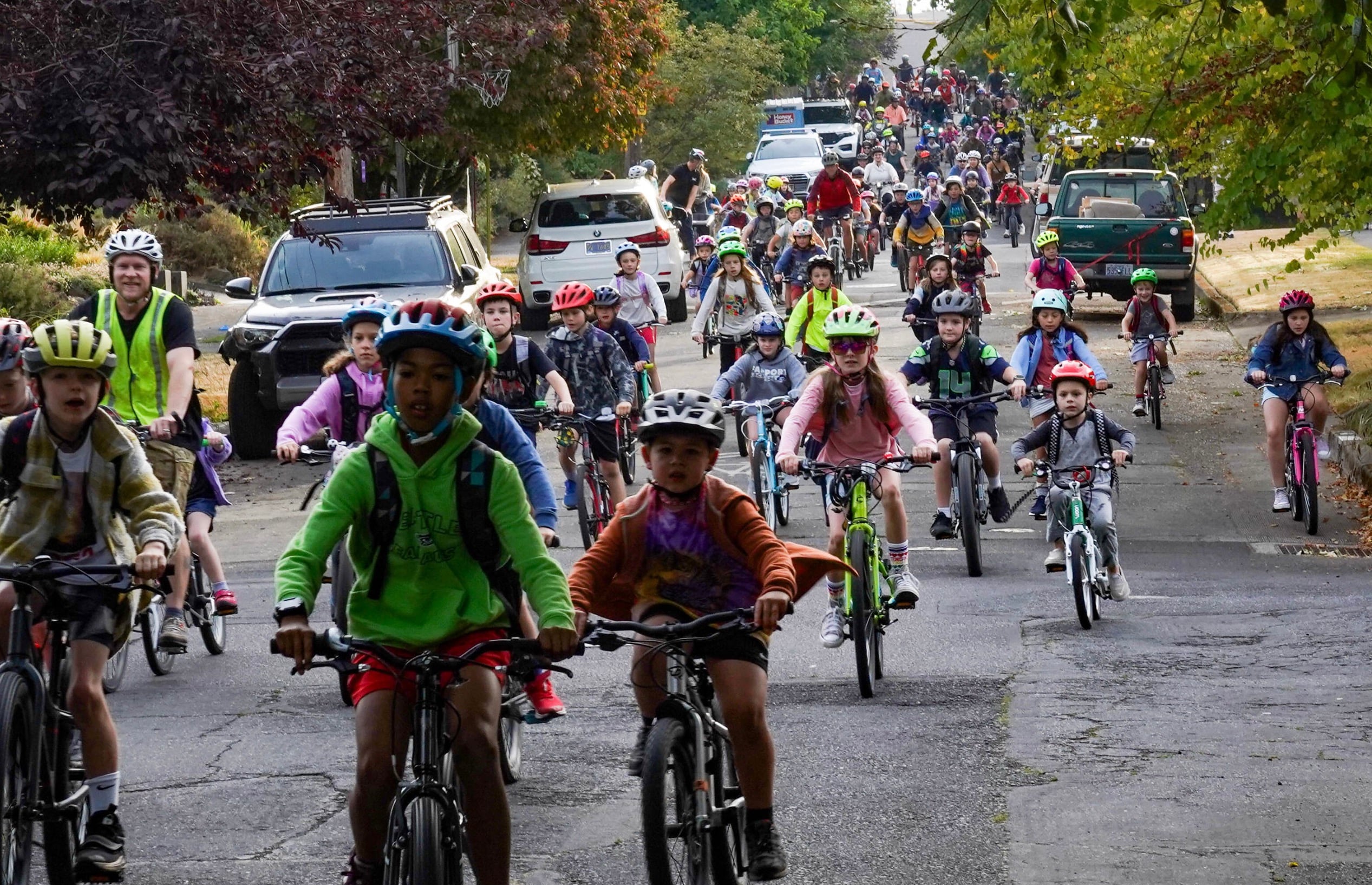
Local nonprofits wanting to provide electric bikes to their communities won big in the latest round of Portland Clean Energy Community Benefits Fund (PCEF) grants announced last week. A total of $64.4 million was awarded through the PCEF Community Grants program. Among the 60 grants, 12 of them totaling just over $8 million were in the Transportation Decarbonization category. Funds from five of the grants will be used to purchase e-bikes. A project to strengthen local bike buses won the other award.
Organizations who won bike-related grants include: Bike Bus PDX, The Street Trust, Community Cycling Center, Ethiopian and Eritrean Cultural and Resource Center, P:ear, and Oregon Health and Science University.
PCEF is powered by a 1% “clean energy surcharge” on the retail sales of large retailers in Portland. Businesses with $1 billion in national sales and $500,000 or more in local retail sales pay into the fund. It was passed by Portland voters in November 2018.
This is the fourth round of PCEF Community Grants, which are managed by the Portland Bureau of Planning and Sustainability (BPS). On their website, BPS says, “The approved projects offer PCEF priority communities healthier homes, lower utility bills, job training and living-wage opportunities, better access to fresh food, and stronger community connections. The estimated lifetime reduction in greenhouse gas emissions for projects (not including regenerative agriculture) is estimated to be roughly 76,204 metric tons CO2e.”
Below is a list of grant winners with project summaries taken from the BPS report:

Community Cycling Center: Cycling Basics for Priority Populations
Amount awarded: $459,826 – Length of grant: 3 years
This project seeks to support the empowerment of new cyclists from PCEF priority populations by leveraging strong community engagement skills to provide positive initial on-bike experiences that will inspire people to take the next step. The proposal strives to impact up to 1,424 participants, including 386 adults and 1,038 youth from PCEF priority populations. Key milestones include hiring two seasonal Bike Camp instructors, facilitating summer youth Bike Camps, Learn to Ride Clinics, group bike rides in partnership at no cost to participants, and distributing 120 bikes with accompanying accessories to Bike Camp participants. Major goals include getting new bicyclists on the streets while ensuring meaningful engagement for priority populations with little to no prior connection to cycling.
Ethiopian and Eritrean Cultural and Resource Center: Eco-Transport Access & Education Project
Amount awarded: $658,145 – Length of grant: 4 years
This project aims to implement a green transportation access and education initiative to reduce greenhouse gas emissions and advance environmental equity for PCEF priority populations by distributing 100 e-bikes, providing education on clean transportation for more than 200 residents, and more. Key milestones include distributing 100 electric bikes, providing bike safety and maintenance workshops, delivering education on green transportation in multiple languages, and promoting awareness of electric vehicle (EV) infrastructure. Major project goals include achieving an estimated $65,000 to $100,000 in total annual savings for the 100 e-bike users, lowering transportation-related emissions, and building long-term climate resilience through targeted community engagement.
P:ear: Empowering Sustainable Mobility: Expanding E-Bike Access and Infrastructure in East Portland
Amount awarded: $1,837,403 – Length of grant: 5 years
The project aims to deliver a comprehensive, community-centered approach to transportation decarbonization, including a retrofit of the grantee’s shop for e-bike maintenance. Key milestones include acquiring specialized tools, hiring a dedicated mechanic, expanding the Pedal It Forward slidingscale repair program, deploying a fleet of e-bikes for hands-on education, purchasing an electric cargo van, providing mobile repair services in PCEF priority population neighborhoods, hosting 9 multilingual e-bike education courses, offering 4 bike camp and pop-up maintenance events, and holding 7 learn-toride and community bike rides. The major goals include reducing greenhouse gas (GHG) emissions, improving air quality, and expanding affordable, low-carbon mobility options for East Portland residents from priority populations by combining infrastructure upgrades, mobile maintenance, and robust community outreach.
The Street Trust: Ride 2 Own Ebikes for East Portland Disadvantaged Youth
Amount awarded: $253,743 – Length of grant: 1 year
The project seeks to expand the grantee’s Ride2Own e-bike ownership program to provide 25 youth from the Parkrose community, ages 14 and up, with free Class 1 e-bikes, safety gear, and training. The project also proposes a collaboration with Portland State University’s Transportation Research and Education Center, which will collect data on greenhouse gas reductions, mode shifts, and economic benefits for youth who might otherwise become auto-dependent adults. Key milestones include providing participants with training on bike handling, safety, and maintenance; offering opportunities to take part in community rides and peer-to-peer engagement; delivering 25 youth free e-bikes along with safety gear, maintenance, and education to support independent, low-carbon mobility. The major goals include building transportation confidence, reducing car dependency, and improving access to school, work, and community for youth from PCEF priority populations.
Bike Bus PDX: Expanding and Evaluating Bike Buses
Amount awarded: $895,000 – Length of grant: 5 years
The project aims to support bike bus programs at several schools, engaging nearly thousands of students. As part of the proposed project, Portland State University’s Transportation Research and Education Center (PSU TREC) will conduct assessments to measure the impact of bike buses on transportation habits and carry out a longitudinal study following first graders to track their travel behavior beyond elementary school. Key milestones include developing a ‘Bike Bus Toolkit’ to help establish new bike buses, hosting bike fairs to distribute hundreds of bikes, promoting the benefits of bike buses and active transportation, and hiring “Bike Bus Cluster Coordinators” and “Bike Bus Champions” to support education, outreach, and promotion efforts. The major goal of the project is to replace more than half a million miles in car trips to school.
Oregon Health and Science University: E-bike Loaner Program Expansion
Amount awarded: $662,563 – Length of grant: 5 years
This project aims to expand OHSU’s e-bike loaner program to encourage more employees to commute by bike rather than by car, reducing greenhouse gas emissions and improving personal and community health. The program will add 50 new e-bikes to the fleet, hire a part-time coordinator, and enhance outreach and education to increase participation across diverse employee groups. Key milestones include purchasing and outfitting new e-bikes, scheduling educational workshops in partnership with local bike organizations, and launching participant recruitment and data tracking to assess program outcomes. The project will also refine auditing tools to measure participation among PCEF priority populations and document environmental impact. Major goals include promoting long-term behavior change, improving access to sustainable transportation, and supporting a healthier, more accessible campus community.
In a statement from BPS, PCEF Program Manager Sam Baraso said, “Together, these community-led projects demonstrate the power of collective action to advance the City’s climate goals while creating lasting benefits for Portland’s communities.”
Thanks for reading.
BikePortland has served this community with independent community journalism since 2005. We rely on subscriptions from readers like you to survive. Your financial support is vital in keeping this valuable resource alive and well.
Please subscribe today to strengthen and expand our work.
Or about 1.2 days of commercial and private aviation in the US. Just the definition of performative slop.
This is fantastic! It’s really nice to see grants going to these worthy organizations. One question though – in the description of the The Street Trust: Ride 2 Own Ebikes for East Portland Disadvantaged Youth it says “ ages 14 and up”. In Oregon I believe the “legal” age to operate an e-bike is 16. Any thoughts? ( I’m sure this is just an oversight, but that caught my eye).
I am not super worried about that. Children and Young Adults have good motor control and this is probably the result of video games some what (my grandnephews cant stop playing fort night). As a volunteer brand Evangelist for the agent imported my electric quadracycle I have let the neihborhood kids drive it numerous times and they do great on the streets, it’s controlled not unlike the Power Wheels they had a few years ago. Last summer to get them acclimated with the handling and braking I got a block party permit so they could have a nice long runway and did it on garbage day so the bins were like orange cones. Clever idea- thats my granddaughter’s. Glad to see some common sense regulation come of the city if Salem can’t do it.
Dave
Great news on expanding access AND knowledge of successful use of e-bikes. One area that might have been overlooked: secure home parking and charging. Do not forget it. 😉
Crikey, Portland really treats PCEF like a magic pudding of taxes. A billion-dollar surcharge here, an $895k Bike Bus “Cluster Coordinator” there, and suddenly we’re handing out $64 million like it grows on trees.
I love bikes. I am Bike Portland’s target audience. But when you look at the grants — fleets of free e-bikes, cargo vans, coordinators for the coordinators, five-year studies tracking first-graders’ travel habits — it starts to feel less like climate action and more like a very woke Portland slush fund with pedals.
Meanwhile the city can’t fill potholes big enough to swallow a Subaru and leafs and gravel in bike lanes are never ending. Maybe before we hand out another million for bike fairs and toolkits, we could make sure the roads don’t shake the e-bikes to pieces on day one.
A little less fairy dust and a little more accountability wouldn’t hurt.
Angus, these grants were carefully vetted and are exactly why PCEF exists. I’m indirectly on the receiving end of one of them, and I guarantee you that it’s going to be transformative for its target population. We’re at capacity with our current ability, and this grant is something we’ve been working towards for a couple years.
As for the potholes, yep, they’re a thing. But like the Police Bureau, not a PCEF thing.
$253,000 to put 25 kids on e-bikes…. So it costs $10,000 per child to get them to ride a bicycle?
Are you seriously suggesting this is a good use of tax money?
This is laughable, a Portlandia skit….
That is quite steep but a good ebike costs $2500, and they’ve gotta pay people to teach the bike safety and maintenance courses.
$7500 per child?
Its a Bicycle! Excusing this blatant corruption is pathetic.
The whole PCEF tax needs to be repealed if this is the nonsense that they are doing.
This is just payoffs to Friends with taxpayer money.
Ianarone pockets some more grift money.
Is it good policy to give children $2500 bicycles?
I doubt it is corruption but rather the endemic inefficiency of the NGO/nonprofit industrial complex. Because these structures don’t exist already and expanding your government department is massively harder than allocating grants, everything gets outsourced, and you have a lot of building from scratch.
Starting a program, building it into a durable structure, documenting it and making it repeatable, all takes a lot of effort and people who have to get paid fairly for their time. You need the program to be able to continue to exist when people inevitably move on to better paying jobs, often in the private sector. The government needs to know where their money went and so a lot of time gets spent writing reports that nobody will read. There are a lot of oversight structures built in that increase the suck on a small project. I think my own viewpoint is that it in part amounts to research spending.
None of this is really corruption, it’s bullshit red tape people have to put up with that saps energy from getting results, eg more than 25 people (and nobody is hyped to write the mandatory report that takes up 50% of the billable hours). There is of course true corruption in the system but that exists in any kind of structure that money flows through.
I think this is probably it, and it doesn’t seem like an insurmountable problem. It CAN be done efficiently, but for some reason we just don’t.
Just give people bikes! It should be that simple, but somebody has to overcomplicate it. Maybe that’s the part that should be considered corruption. There is no conceivable reason why we can’t do this without all the waste.
Here’s the reason: there’s no accountability.
Buying kids a $2500 motorized bicycle is just insane. It’s the kind of thing you would only do if you had free money to spend.
The bike doesn’t stop existing when they stop being kids. Not do whatever habits may have been started because of that investment.
Get a $2500 bike and at least it will be repairable.
If any bike-related habits are instilled, one of them will be that riding without a motor sucks. Is that a lesson we want to pay $10K of supposed “clean energy money” to teach?
Kids do not need motorized bikes. They are strong, energetic, and need exercize. I definitely wouldn’t buy my kids a $2500 motorized bicycle. It would be a curse. You have to feed it. You have to worry about it getting stolen. It might set your apartment on fire. It’s heavy if you have to carry it up stairs. If it breaks you can’t fix it (even if you can take it to a shop and pay someone a couple of hundred to do it for you, money that you earn, what, in your after school job?) No, if it breaks it’s probably not getting fixed. Hell you didn’t pay for it, so no big loss. It will become e-waste.
The only reason you’re defending the program (without giving any actual reasons why it’s good) is because I said it was a bad idea. And I said that because it is a bad idea.
But go ahead, tell me why it’s better to give one kid a $2500 anchor rather than 5 kids a $500 bike (or 3 kids an $800 bike) that is much less of a theft target, doesn’t need to be plugged in, won’t burn their family out of their housing, is probably safer, and that they can plausibly fix themselves.
And, I’ll add, a bike that also won’t stop existing when they stop being kids. And one that might even last that long.
I assume you’re dismissing the Street Trust’s grant targeting young people in the Parkrose neighborhood. Did you read the whole grant? And are you familiar with this community and the mobility issues young people face their (I’ve work in Parkrose MS and volunteered with bike advocates in the community, but it’s not the grant I’m involved in)
The grant is an investment in the lives of these kids and their families.
It sounds like you’re saying it’s a bad investment.
If so, I recommend you contact the members of the PCEF committee and let them know you disapprove.
Their info is here: https://www.portland.gov/bps/cleanenergy/about/pcef-team
oh, yes. I’m sure they will listen to complaints about misuse of the slush fund.
Thanks for posting the link. I’m not a fan of PCEF in that I think that the money could be spent on actual climate mitigation and not in the way the funds are distributed. Knowing that my own bias does not predispose me to appreciating PCEF, I was still dismayed at what the supplied link shows.
(Oh, and I know, I should write my own grant and start doing the projects I mentioned below. I should just quit criticizing and just join in instead of the city, specifically the city council actually making climate mitigation and vulnerable road users a priority)
Basically PCEF reads like a jobs program that has green/climate ties. I’m all for a jobs program as it’s desperately needed these days, but the model for that is the old Civilian Conservation Corp, not climate mitigation funds. The following come from the site:
The PCEF initiative was passed by 65% of Portlanders in November 2018. – Fair enough.
These targeted investments ensure that our community’s climate-action efforts are implemented to support social, economic, and environmental benefits for all Portlanders, but prioritizes communities disproportionately impacted by climate change, including communities of color and people with low incomes. – Okay, environmental concerns are last, and references to race rather than circumstances or income is a little troubling, but it is Ptown after all.
Funded projects will continue to prioritize benefits to our priority populations, and will require inclusive workforce goals and strong wage standards.– Jobs, jobs, jobs. Which is fine, but perhaps not what people thought they were voting for? Also, the minimum wage is spelled out, but not a maximum wage for the grantee. Grant recipients need that Porsche to get around I suppose.
Creating jobs that provide living wages is a priority of PCEF. – Who knew? I thought preparing for the progressing stark environmental change was the main priority, but I guess they need to hire people to do it. Instead of the government agencies that have the legal means to properly do so?
PCEF’s Workforce Policy Coordinator, leading initiatives and strategies to promote diversity and growth in climate action-focused workers and contractors. She brings extensive experience leading initiatives in the public and non-profit sectors to improve access to economic opportunity through apprenticeship for communities that are impacted by systemic barriers and disparities. – Their senior person? More focus on jobs and grievances, less on mitigation and no mention of lives saved. I doubt anyone on the committee believe in the climate crisis that is unfolding right now.
So much money that could be coordinated to do large scale mitigation such as improving safety for cyclists and pedestrians, as DW pointed out that is a lot of diverters the city could be installing. Also tree/shrubbery planting and maintenance, wells, hydrants, erosion control, funds dedicated to traffic safety through enforcement (instill fear of financial pain in drivers). I mean, the list of concrete (no pun intended) things that could be done that would have a lasting impact is long. Unfortunately the list of small things that can be bought and disposed of such as e-bikes for selected groups is also long and apparently far easier to accomplish. Plus it distributes the money for what is essentially a jobs for friends program.
What is more important? Lives saved or jobs distributed?
Also, there is almost nothing available for clean energy R&D. I thought it would be really useful to have some sort of resource to aid low income people to file for patents and make prototypes of innovative green energy related inventions. Patents are insanely cost prohibitive for innovators. Heck, the city could even sign on for a percentage of the patent ownership. That could keep Portland relevant as a hub of innovation and keep the spoils local.
I suggest this to PCEF repeatedly during the drafting process and *crickets*. No response. I’m personally sitting on several ideas that I won’t work on outside of drafting and crude testing because I don’t want to lose my intellectual property and can’t afford to drop $15,000 on a patent. Yes, there is probably a lot of garbage out there, but the diamonds might outweigh it.
Michael Mann admits he is on the PCEF dole…he’s not gonna push for accountability, transparency or the needed repeal of this tax. Unfortunately this massive slush fund has created an entire constituency that feed off it…meanwhile Portland can’t provide basic essential municipal services.
FYI, I’m not making a dime off the grant. It supports an initiative and our clients.
As for “basic essential municipal services” that’s another issue that the repeal of the PCEF would have zero impact on, but maybe it makes you feel better to link them?
If the goal is to get everyone in cars, it might be.
If kids think they need motors to get anywhere, hardly anyone cycles anymore, but everyone agrees bikes don’t belong on roads, it sets them up perfectly for driving.
Burning cash to power transport is good Portlandia skit material — but spending $895K to study first graders travel habits is comedy gold.
You can’t make this stuff up.
“A little less fairy dust and a little more accountability wouldn’t hurt.”
Also, accountability is a requirement for a successful grant, and is built into the description of each of the profiled recipients.
Will you or others show us the receipts to prove that the Street Trust spent $6-7000 per child to “teach and train” them how to ride a bicycle? Accountability is a nice word to throw around but its laughable on the surface that any group could charge those kind of fees to do what most kids learn in a half hour in a parking lot.
Financial record keeping is part of the responsibility of receiving the grant.
And if you’re volunteering to teach kids to ride, the CCC, or Safe Routes will take your call.
And if no one reviews the accounting books, what’s the point?
Look how long the head scammer at the pre-school for all bilked tax payer money. How about all the other “non-profits” that have not had what they do audited?
Face it, Sam Adams had lots of friends in the non-profit industry and he did everything he could to funnel money to them and it still continues with little to show for it and even smaller accountability.
I curious how many diverters could be installed for $895K.
I’m sure you could check and see if someone applied for a PCEF grant to install diverters. Somehow I doubt it.
You’re going to complain about a clean energy fund going to bikes (if transportation isn’t energy, nothing is), call it a slush fund (it isn’t), and in the same comment complaint that what? They’re not spending it on filling potholes? A decidedly not intended use of the fund. Interesting choice.
You could probably come up with some stretched justification for spending the money that way but it sounds almost like you don’t have any consistent views when you also call it a “magic pudding of taxes”.
Here is what we decided was the type of clean energy project we’d support:
=====
Renewable energy, energy efficiency and green infrastructure projects, such as:
Energy not produced from fossil fuels, nuclear power, or certain hydropowerHeating, lighting, water, cooling efficienciesGreen building designTree canopy=====
So not transportation. And not potholes, either. In fact, we specifically excluded giving any of that money to the city, though that safeguard got knocked down pretty quickly.
“Magic pudding” sounds like a pretty evocative description of what this fund has become. I gave a not insubstantial sum to help pass it. I would not vote for it again.
https://ballotpedia.org/Portland,_Oregon,_Measure_26-201,_Renewable_Energy_Initiative_(November_2018)
I worked so hard on the stupid formatting, and it came out as a undifferentiated mass of cursed pudding.
When I mistakingly voted for PCEF some years ago, I thought we were supporting projects like thermal efficiency retrofits for existing homes and buildings, solar panels for low-income residents, replacement super-efficient HVAC, planting lots of street trees, replacement construction equipment that is more efficient and spews less CO2 and other pollutants, etc. I really don’t like the idea of giving away e-bikes. A rebate for low-income residents, maybe, but not a free bike.
I hope we get a chance to re-evaluate this tax in the near future. I’d be glad to pare it down and increase the requirements, along with fixing the city’s budget for necessary capital maintenance and the like.
JR, I’m right there with you. I also voted for PCEF thinking we were getting boring-but-important stuff like attic insulation, heat pumps, and maybe a few thousand street trees — not a $64 million Oprah episode where everyone gets an e-bike and a coordinator and a longitudinal study of first-graders’ travel habits.
I’m all for revising the tax too, but at this pace, by the time the City gets around to “re-evaluating” it, we’ll have spent another $40 million on pilot programs, pop-up bike camps, and at least one more “Bike Bus Champion” (which sounds like a Mario Kart expansion character).
Totally agree: rebates for low-income folks? Yes. A free $2,500 bike plus five years of program overhead? That’s how you end up with a climate fund that burns cash faster than it cuts carbon.
Let’s fix the PCEF ship now — before the next grant round includes $2 million to “study community attitudes toward hypothetical future bike buses.” Because at this point, even the potholes are looking at us like, “Mate… really?”
A lot of PCEF money is going to exactly that. The multi family energy efficiency and renewable energy programs are critical for this kind of work to continue in portland. Especially with the repeal of federal energy efficiency dollars and high cost of apartment construction, PCEF is the only reason solar, high quality building envelopes, and efficient heating and cooling systems are viable in affordable housing projects right now.
NW Natural has just released a program to pay for natural gas systems in new construction. So without PCEF paying for the premium that comes with energy efficiency measures, we may see new buildings hooked on gas as insane as that sounds.
I guarantee you’re not alone and if this was placed on the ballot again it would struggle mightily. The very last thing that people are super excited about right now is paying taxes (yes, you’re paying it, either via higher costs from retailers or via lack of options due to retailers that have moved out of the city) that hand out luxury goods. I look forward to Portland voters coming to their senses and putting it up for a referendum.
Holy smokes, what a waste.
Ignoring the cost per person/bike which is already nuts (as is the concept that kids need electric power to get around), ebikes don’t even have the potential to reduce greenhouse gases unless they eliminate car trips.
Ebikes are significantly more expensive/complex to maintain than regular ones, and frankly don’t even make sense except for atypical riders who go significantly further, carry significantly more, or need actual assist rather than want to use them as motorcycles — “assist” is a misnomer if it’s providing the lion’s share of the power.
I’m not following how ebikes somehow got connected with clean initiatives. Sure, the number of ebikes has gone up dramatically, and they represent a much greater total of the percentage of bikes out there. But my anecdotal observations are they don’t seem to be contributing to more bikes in general out there. Rather, regular bikes are getting replaced with ebikes which is not a net gain. It’s absolutely pathetic how few cyclists of any kind I encounter along what should be major corridors at rush hour.
The fact that ridership is down despite the proliferation of e-bikes says so much, IMO (and I don’t like what it’s saying).
But I think it all come down to:
1) people don’t want to ride in the weather
2) people don’t want to ride in traffic
3) people don’t want to deal with their bike (locking it up, worrying about it, handling it inside the house/office, changing clothes at the office, buying more clothes to ride in, basic maintenance…)
Your observations line up with mine — though you’d think the improved gear and infrastructure over the years in combination with a more cycling tolerant culture would mitigate all 3 factors.
But cycling is less seen as a fun/practical way to get around and more as something other people do because they think it’s the right thing to do.
Pushing ebikes on able bodied people is ultimately about presenting cycling as something other than cycling. Ebikes have the potential to expand the number of riders, but they may have the exact opposite effect.
2WheelsGood summed it up nicely
And they’ll find that riding with a motor also sucks because it does nothing about the other issues — if such weren’t the case, we would’ve had a lot more lightweight motorbikes around all along.
Only one of those things has really changed over time though. And people ride more in places with worse weather than we have.
Yeah I agree. But that doesn’t change the situation Portland is in.
A must-read for anyone who thinks giving away e-bikes is top-shelf public policy:
Honestly, after reading it you’ll be thinking,
“Righto — maybe giving out turbo-charged kid-launchers isn’t the government slam-dunk we thought it was.”
“The Shocking Crash That Led One County to Reckon With the Dangers of E-Bikes”
https://www.nytimes.com/2025/11/30/magazine/e-bikes-accidents-safety-legislation-california.html