
Welcome to Monday.
Things will be slow around here this week due to the Thanksgiving holiday. I’ve got family in town and I probably won’t be working full days again until next Monday.
I hope you can join us Wednesday for a special Friendsgiving Bike Happy Hour at Migration Brewing on North Williams Avenue. We’ll eat together around 5:30 and the folks at Migration are offering a $20 meal (burger, drink and a side) deal for us. Sweet plantains for desert!
Below are the most notable stories I came across in the past seven days. Thanks to everyone who suggested links this week.
Best of the worst: Portland earned the top ranking of all U.S. cities with its 35th place in a global report on bike-friendly cities. We placed 11th worldwide when this list first came out in 2011. (Copenhagenize)
Clarity about a crisis: It’s infuriating that we have such a clear grasp of how many people are being killed by drivers on dangerous roads, and the response from the system feels like a huge shrug. We all need to be more aggressive in how we talk and organize around this public safety crisis. (Washington Post)
Free transit works (in Iowa City): “Since the fare-free program began, people in Iowa City have driven 1.8 million fewer miles and emissions have fallen by 24,000 metric tons of carbon dioxide a year, the same as taking 5,200 vehicles off the roads.” (NY Times)
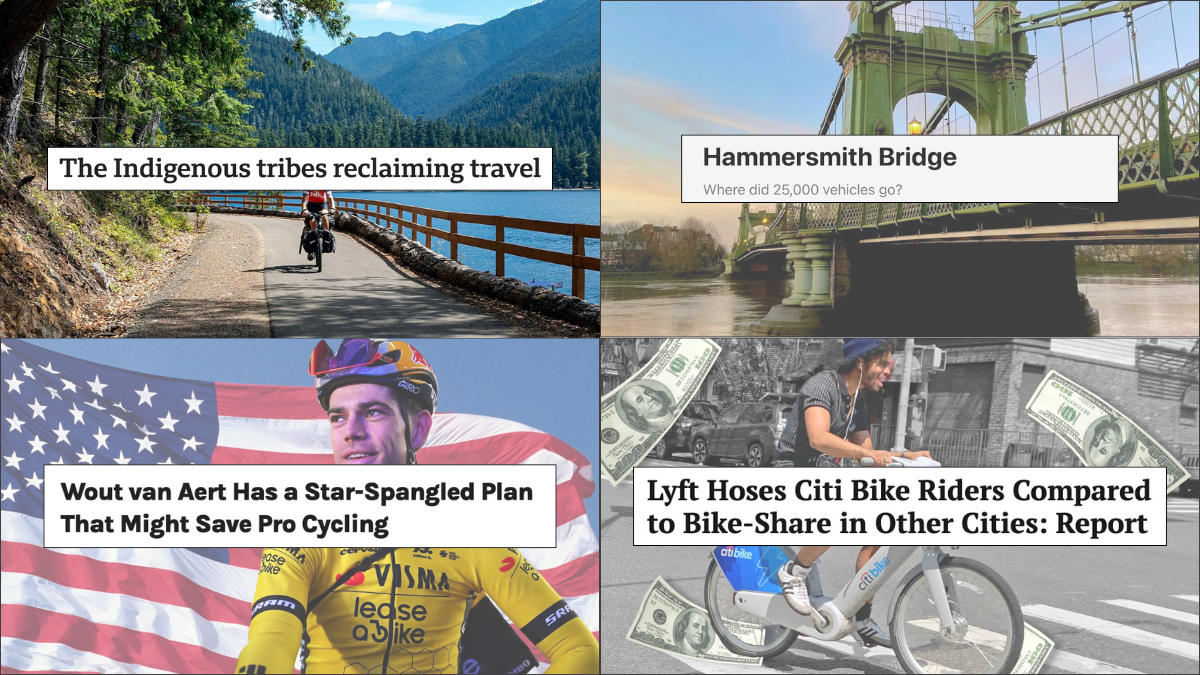
Wout’s vision: I like that Belgian cycling superstar Wout Van Aert spent time in the U.S. and is now encouraging us to build a stronger business around professional cycling. Unfortunately, American’s won’t care about road cycling until we can cycle safely on our roads. If bike brands invested as much into advocacy as they did into R&D, there would be more people buying their expensive parts. (Velo/Outside)
Case in point: If you think the above item is out of line, see this story about an avid roadie who’s decided to stop riding because he’s so spooked. (I know it’s from the U.K., but they have a similarly dysfunctional driving culture). (Bike Radar)
Native trails: Indigenous people are turning their land into economic assets by developing trails — including many ambitious bike path projects across the country — into tourism hotspots. (BBC)
Induced evaporation: I love this deep dive into a bridge in London closed to cars due to structural problems. After it became used only by bicycle riders, predicted traffic chaos never happened and about 9,000 auto trips simply vanished forever. (Nick Maini on Substack)
High cost of bike share: The steep cost of using New York City’s Citibike has some advocates pushing for public subsidies of the wildly successful transportation mode. (Streetsblog NYC)
Thanks to everyone who sent in links this week. The Monday Roundup is a community effort, so please feel free to send us any great stories you come across.

Thanks for reading.
BikePortland has served this community with independent community journalism since 2005. We rely on subscriptions from readers like you to survive. Your financial support is vital in keeping this valuable resource alive and well.
Please subscribe today to strengthen and expand our work.
Re: Trails as economic assets.
Meanwhile, in Yamhill County, 2 of the 3 county commissioners are looking to remove the proposed Yamhelas trail from their TSP. https://www.yamtrail.com/post/county-moves-to-eliminate-trail-from-transportation-projects-list
Hilarious that they are talking about light rail as part of the project. No one was ever going to build light rail to Yamhill county.
The crazy thing about this is that MUPs are some of the biggest return on investments a city/county can make. Rejecting trails is one of the best ways for a government to shoot itself in the foot and remain economically stagnant. Yamhill, Gaston, Carlton are all ensuring that stagnation. Here are the survey results showing the community generally supports building the trail.
Interesting that by being 35th in the world, Portland is still #1 in the world outside Europe and Canada.
I wouldn’t be too surprised — that is likely a sign of a very western-biased (there are various names for it) report
Here’s another local newsworthy piece. It’s an interesting article regarding our repeat reckless driver Oscar Burrell, Jr and his first and second court appearances. It’s written by a retired Clatstop County (Astoria, OR) district attorney. It includes some fascinating facts about the justice system in Oregon and the controversial actions by the judge in the case.
“Reckless Justice”
https://open.substack.com/pub/portlanddissent/p/reckless-justice?utm_campaign=post&utm_medium=web
Wow! If you care about bike and pedestrian safety in Portland, you should read this piece. It lays out how Judge Katharine von Ter Stegge gave astonishing leniency to a driver who filmed himself “driving without using his hands while hanging out the driver side window on Interstate 5” and tearing through parks, playgrounds, and pedestrian paths—twice.
Despite the judge openly admitting “everything I saw in those videos is 100 percent illegal,” she acquitted him of most charges and gave no jail time on the remaining ones. Afterward, the driver immediately posted more videos of reckless driving—this time on a suspended license.
When DA Nathan Vasquez publicly criticized the verdict as “bewildering,” the judge scolded him, saying “I won’t tolerate statements to the press.” Meanwhile, terrified pedestrians and cyclists are left wondering how someone doing doughnuts through parks and veering into oncoming traffic can walk away with probation.
If you bike, walk, or care about safe streets in Multnomah County, this is worth your full attention.
The problem about road cycling in the US isn’t so much about the lack of road riding safety in rural areas, though it is certainly an issue, but rather how expensive current road bike technology is and how the expense is a huge barrier for entry for people with only modest means (let alone poor people.) Anyone can still build up a 9-speed or 10 speed bike these days using old used parts, but hardly anyone actually does so, there’s simply no demand for such bikes. People wanting to “road ride” instead want the latest and greatest carbon fiber frames with thru-axles and a lot of them are e-shift only, they aren’t set up to allow traditional cabling at all – and so those who engage in road riding are often people from upper incomes only, those 1% who can afford the current technology. Our local community bike shop has lots of Dura Ace, Ultergra, & 105 parts from the 9-11 speed eras, in perfectly excellent shape, donated by those same 1%, but there’s zero demand for it – when you attend swap meets, sellers can’t even give away the parts let alone sell them for even close to what they paid for them. Essentially there’s been a huge enormous leap in road bike technology since the pandemic and all those cool old parts you spent hundreds of dollars on over the past 30 years are now worthless.
I thought the “induced evaporation” article was going to be about large-scale manipulation of the hydrologic cycle.
Does anyone know why these rankings matter at all?
Most cities, that is their city staff, local unelected VIPs, and elected officials, want job growth, higher incomes for their residents, more job stability, housing stability, a better educated and trained workforce, and lower crime rates, all of which are related – in order to raise more tax income, for civic boosterism, keep their government jobs, and for local politicians to get re-elected. They typically do it by attracting or recruiting new employers by various incentives like tax breaks, employee subsidies, or building-to-suit certain industries.
Low wage companies like manufacturers, warehousers, and fulfillment centers, are looking for cheap land, cheap housing, and improved highway connections, which most cities can easily provide. However, high-paying high-end tech and biotech companies, let alone corporate headquarters – the darling fantasy of every city economic development department – they want a lot more such as good bike infrastructure, good public transit, a mix of housing and neighborhood types, and so on. To get these companies “in the door”, to even consider moving to your community, your community needs to develop a good national or regional reputation as a great place to recreate, to have family fun, be a “safe community” so to speak.
The easiest and most low-hanging fruit is to get a “bike friendly” rating from the League of American Bicyclists – any community that officially approves a bike plan gets a “bronze” rating even if none of the plan actually gets implemented. You then get “silver” if you put in bike racks, some 20 mph speed limits, and a few bike lanes. Gold comes from having a few “protected” bike lanes (including cheap candlesticks and buffered bike lanes) and having a mode share that is greater than 0.20% – obviously not a very high standard.
If you look at the top 100 on the Copenhagenize list, you’ll see a lot of “corporate headquarter” cities that have a proven record for recruiting high-paying employers (or even developing homegrown companies). You’ll also see the flip-side of successful job recruitment: a very high cost of living and lots of homelessness.
David, mate, that’s a lovely description of how most cities operate — but Portland seems to have wandered off for a long lunch and never come back.
Our leaders keep talking about “opportunity” every time a major employer bails. Candace Avalos literally called the Fred Meyer/Gateway collapse a chance to “build from the ground up… rooted in community, creativity, and care.”
That’s adorable in a “let’s paint the house while it’s on fire” sort of way, but not exactly how you lure high-wage employers or build a safe, functional district.
Most cities chase stability; Portland keeps treating major closures like they’re a vision board workshop. We don’t need more inspirational quotes — we need the basics to actually work. Otherwise the only thing we’ll be recruiting here is more empty storefronts and sad bike rack photo-ops.
Right, but 2WheelsGood was asking a general question, of cities in general and why they might care about these rankings, not just for Portland. And the city officials in Portland do care about various rankings, maybe not all staff and elected officials, but quite a lot of them do. The whole thing is very biased and each ranking is pretty questionable, but so are sports statistics and most people’s online profiles.
I shopped regularly at that particular Fred Meyer when I lived in Hazelwood from 2008-2015 (I even served on the NA board), as well as the WINCO across the street. When my panniers and accessories started getting stolen at that store, I took a longer trip to the Fred Meyer on Division at 148th, a much more secure location, but a very scary bike ride. I’m bummed that Hazelwood is now felony flats in Portland, it didn’t used to be, but even before I left town it was already going downhill with frequent nighttime shots fired and petty theft.
Portland in general has way too much commercial-zoned land (as most cities do) and way too little industrial or general employment land, so I hope and kinda expect Gateway will get rezoned to allow for a more productive use. Unfortunately, or fortunately depending on your view, it will likely become another Amazon fulfillment center.
“Portland in general has way too much commercial-zoned land and way too little industrial or general employment land…”
Doesn’t seem like there is much demand for this in modern day Portland. Industrial users are moving out, not in.
Yes. These rankings seem to be based on the usual checking of checkboxes rather than any real sense of how good it is to ride a bike somewhere. And I agree the value comes from civic boosterism. I do not think these rankings mean much for the people actually riding their bikes.
The rankings tell me nothing about whether my bike ride to work will be better in Portland or Des Moines, or whether it would be fun to ride bikes in Los Angeles while I’m on vacation there. Those are the kind of things I really care about. I’ve had some great bike experiences in places that would likely rank pretty low on these rankings (like suburban/exurban Boston, or western NY), and some pretty awful ones in places people would rank highly.
I’ve taken the train with my bike a couple times through LA with a couple hours between trains. Their train station is really stunning, totally art-deco, and my bike ride around downtown was less dangerous than I thought it would be. Philadelphia from the 30th Street station on the other hand was crazy-dangerous with their insane drivers. Chicago’s Union Station has a barrier-protected bike lane right next to the station, at the west entrance, and the Loop isn’t that bad, while the lake shore is well worth the trip. It’s easy to navigate from the Washington DC Union Station with several excellent bike facilities nearby, as well as a Red Line subway station within the terminal. New Orleans, Sacramento, and Atlanta are a bit sketchy. I’ve never biked in NYC, Detroit, or Boston.
Van Aert is very much Belgian
That’s long way for us to fall. Definitely makes me want to check out Montreal sometime, #15 in the world, that’s seriously impressive.
Yep Montreal actually has a bike share program that works unlike Portland (“the city that no longer works”). Ours is full of empty Biketown racks and the cost is too much when you can actually find a bike. Not so in Montreal.
Montreal is a fantastic town. Take a look at the petit train du nord, an old train line to the ski resorts turned into a 234 km cycling trail. Montreal has made a concerted effort in the past decade to expand their separated network to ~200km (current plan is to double that in 5 years). Add the walking streets to that, the effort to kick in year-round plowing, and you have a decent recipe for massive increase in cycling (4% in 2013 to almost 8% in 2023).