

Welcome to the week. Let’s make it a good one.
Below are the most notable stories I came across in the past seven days. Thanks to everyone who suggested links this week!
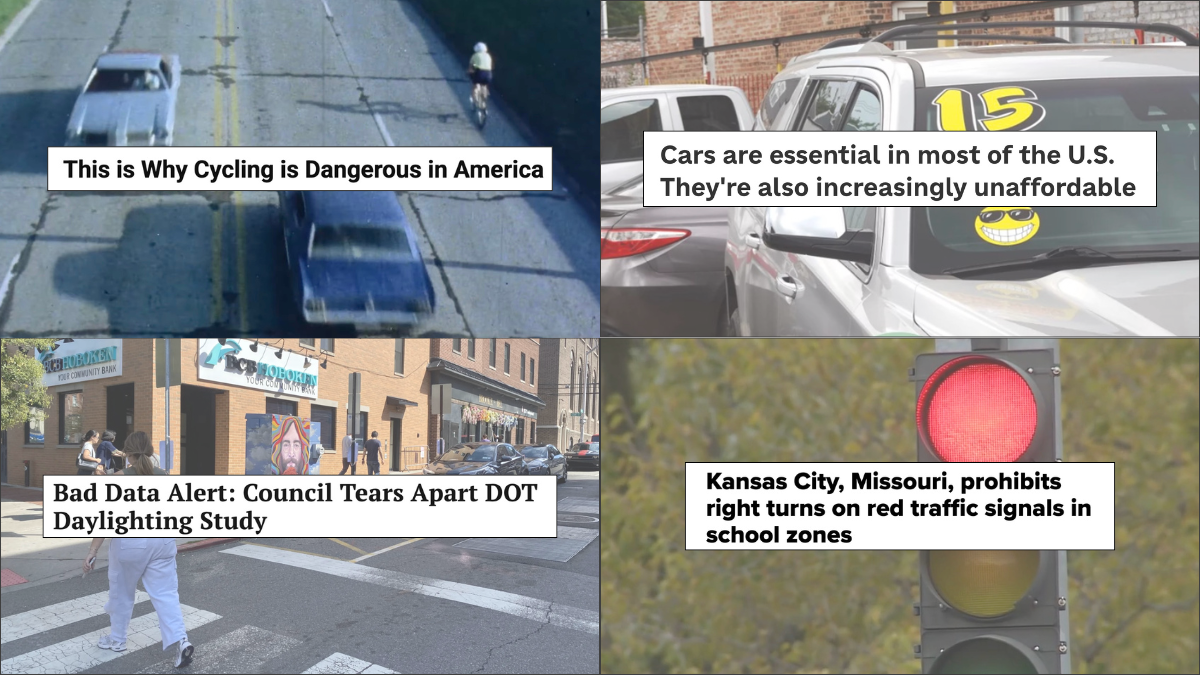
Daylighting data: I love two things about this story: First, it underscores the positive impact of removing parking from corners (aka “daylighting”) and it is an inspiring example of a city council holding a DOT to account. Can you imagine Portland City Council staff launching an investigation of a PBOT decision? (Streetsblog NYC)
Road rage turns ugly: A driver and bicycle rider were detained by police in Marin, California after some sort of altercation caused the driver to get out of their car and stab the bicycle rider with a knife several times. (CBS News)
Cycling award controversy: A UK nonprofit who intentionally excluded trans riders from the winners of its, “100 Women in Cycling Award” now faces backlash. (Bike Radar)
Anti vehicular cycling video: Popular YouTuber Not Just Bikes has released a 90-minute takedown of the late “vehicular cycling” advocate John Forester, whom he credits with single-handedly making cycling dangerous in America. (Not Just Bikes)

Wrong turns on red: A city in Missouri has banned right turns on red in school zones following a collision that killed a nine-year old who was riding to school. The policy allows schools to opt out of the law if they so choose. (KSHB)
Cost of cars: Because of rising prices on cars and service/repairs, the cost of owning a car is up 40.59% since January 2020 and nearly one in five buyers has a monthly payment over $1,000. (NPR)
Homework: Get ready for ‘War on Cars’ Week in Portland by reading this short interview with Life After Cars authors and then make sure to see them live at Bike Happy Hour on Wednesday and/or Powell’s on Thursday. (OPB)
It’s official, car bloat kills: What further evidence do elected officials need to make policy that further regulates the purchase of supersized vehicles than an op-ed from the BMJ saying unequivocally that larger cars are a public safety hazard? (British Medical Journal)
Thanks to everyone who sent in links this week. The Monday Roundup is a community effort, so please feel free to send us any great stories you come across.

Thanks for reading.
BikePortland has served this community with independent community journalism since 2005. We rely on subscriptions from readers like you to survive. Your financial support is vital in keeping this valuable resource alive and well.
Please subscribe today to strengthen and expand our work.
We watched the Not Just Bikes video last night. It’s 3x the length of videos we tend to have the patience for, but it was GOOD. I love attention to footnotes and he brought all the receipts.
It’s amazing. A must watch. I wasn’t aware of the depth of idiocy and harm Forester accomplished. Jason Slaughter is a saint for reviewing all those hundreds of pages Mr. Forester wrote in his engineering and proper riding manuals, as well as all the vids of Forester’s speeches. It goes to show how effective someone’s argument can be based purely on a common-sense, rationalist view, while essentially ignoring any actual evidence.
There were several times during the vid I was dumbfounded someone could actually believe this silliness, let along persuade others. One of my favorite parts was an instance where Forester is trying to show how clueless the Dean of traffic engineering from a University in Holland is when attempting to answer questions related to traffic engineering.
Hearing his book read out-loud makes it sound like satire, honestly. I can’t believe this was considered the definitive cycling book in America for so long.
Yes, sadly John Forrester set back cycling about 50 years. I have seen local and federal arterial design plans from the mid/ late 1970s that were very current and ‘NACTO-like’ with protected bike lanes and now what we now call ‘Dutch Intersections’ but these were all scrapped due to his direct (and indirect work: thru League of American Wheelmen’s training) all too effective advocacy for ‘vehicular cycling’.
I (and many others) spent more time in the 1990s/ 00s arguing against ‘fellow cyclists’ so we could have NACTO type bikeways for the 8 to 80 cyclist set. The League’s training created many of these well intentioned advocates over its initial ~35 years.
thanks for commenting this. I’ll make sure to watch the whole thing now!
This video vastly overstates John Forester’s influence on stroadway design. I have yet to meet a highway or city transportation engineer who has ever heard of John Forester or even “vehicler cycling” – some planners may have heard of him, yes, but not engineers – and it’s engineers who make the final design decisions. The MUTCD and AASHTO has a far bigger influence on our more awful bike infrastructure. LCI, Cycle Savvy, and the numerous pro cycling clubs are clearly an outgrowth of John Forester, however. I found this video in poor taste, poorly researched (no mention of the 1970s oil crises related to bicycling suddenly becoming popular), and the presenters were highly biased.
And JF is correct on several points. Most bicycles out there, by volume, are “utility bikes” with brands like Next, Magna, Pacific, Murray, Huffy – are utter crap, always have been and always will be. Similar bikes made by Trek, Specialized, Jamis, etc are much smaller in number, some of which are higher quality (though a Trek 220 is consistently utter crap and Specialized Hardrock isn’t much better), but a much smaller segment of the overall market. I like my Surly bikes, but I know that the total volume of all Surly bikes is a tiny percentage of all bikes out there. John Forester was writing in the 1970s and 80s when most bicycles were still heavy steel, the time of the Schwinn Varsity and 27×1 1/4″ tires – mountain bikes was a niche market – and in spite of all the progress since then in bicycle technology, the most popular bikes by sales volume is still the crap that Walmart and Target sells.
I see people all up and down the comment section on this blog and in Reddit comment sections making arguments about bike infrastructure from a vehicular cycling point of view. John Forester is an avatar of the car brained anti bike infrastructure crowd, writ large. Even if people aren’t directly quoting or name checking him, his way of thinking has infused American attitudes toward bike lanes and bike infrastructure.
Also, the fact that his opinion on non drop handlebar bicycles didn’t change one iota between the first edition and most recent printing of his book (forty years later) is a microcosm of his unwavering and unfounded views about bike lane safety.
I’m glad you noted that JF was correct about many things. The most important thing he got right IMO was that bikes are vehicles to be taken as seriously as cars, not toys that should have separate infrastructure. Of course the “safety at all costs “ movement now holds sway, with complete separation as the main goal.
This video is for you Fred. Give it a whirl!
More like “the feeling of safety at all costs”; even if separation makes riding more dangerous.
It doesn’t. Quite the opposite, actually.
I’m not sure I understand what you are saying (probably because you’re not really making an argument, just contradicting). Is it that there are situations where separation can improve safety? Or that all separation is safer regardless of implementation?
If it’s the first, I would agree without reservation. If it’s the second, that’s a hard no.
I guess it’s easy to make unequivocal arguments like that when you’re putting words in people’s mouths.
That’s demonstrably false. Places with higher bike mode shares than Portland typically have much more separated infrastructure and much better bike safety as measured in crashes, injuries, or fatalities per mile ridden. It is just silly to argue otherwise.
It’s demonstrably false that some separated bike infrastructure increases the danger to cyclists?
Ok, demonstrate it.
You have shown no evidence that separation makes riding more dangerous.
Is that your “demonstration”?
Some protected bike lanes, such as the lanes on SW 2nd, increase the danger of being hooked by moving bikes that are going straight over to the left of those turning left. That creates a natural conflict. To some extent, that was addressed on SW 4th, but it wasn’t on SW 2nd.
In that example, we took a very safe street for riding, and made it more dangerous.
Do trains having separate infrastructure make them toys?
Is it “infantilizing” for me to walk on the sidewalk instead of the road?
Shouldn’t airplanes just use wide stretches of freeway to land instead of “segregating” them to just a few areas of pavement in the name of “safety”?
“No”, “no”, and “no”. Glad we were able to clear that up.
You forgot farm machinery–which often moves slower than bicycles
Except for a very narrow sliver of the cycling community, no one knows who Forester is or what vehicular cycling is — or cares (including cyclists who think they belong on roads like everyone else)
The idea of getting someone to watch a feature length movie on the topic is practical joke material
Well, I watched it and didn’t think it was a “joke”. Sure, it could have been edited down to an hour, but this is how I feel about most long videos or podcasts.
And so what if “no one” knows who Forester is? Plenty of people couldn’t name Robert Moses, but his ideas on city planning and highway construction have held an outsized grip on our country for the last 80+ years. We need to educate ourselves about our past if we want to have a better future.
Oh no, the video does not.
Meet Mighk Wilson. He is a board of the Bicycle Technical Committee of the National Committee on Uniform Traffic Control Devices. He is a John Forester discipline and (oh boy) has written a large number of articles that puppets John Forester’s beliefs to a tee.
I do civil engineering and let me tell you, the John Forester disciples are wormed into a lot of engineering circles. The number of times I see John Foreste/ Mighk Wilson used today by civil engineers (who don’t know they are cranks) is shocking.
As to the bikes, the reason Walmart and Target bikes are the most popular is that many bike brands have abandoned the low cost tier bikes. Even brands like Primos are considered high cost for a lot of people. I say this as nearly 50 year old adult who have had friends think I’m crazy for spending $1500 on a bike.
The oil crisis is mentioned multiple times, both in first 10 minutes (when discussing the early 1970s California bike boom) and then when discussing the Dutch biking renaissance of the 1970s. It also cites all the data John Forester “cited” and corrects his (Forester’s) misstatements while giving callouts and links to multiple studies, including a meta study.
I don’t think the problem was as much that utility bikes were heavy junky “crap” when Forrester formulated his feelings on what’s a “serious” bike, as there were better examples like Raleigh Sports and Superbes available in the US in the 60’s and 70’s. Yeah, they aren’t as light as a road bike, but are definitely not as clunky as the Huffys of then (or now). But Forrester was more concerned about speed than utility (or at least the perception of speed) so a functional bike like a Superbe (with racks and even dynamo-hub lighting!) would be pooh-poohed as “unserious”. And Forrester remained inflexible on his views: I’d guess if you’d present him with a dolled up modern upright handbuilt bike displayed at MAKE, with cro-moly (or even titanium!) tubing and disc brakes selling for multiple thousands of dollars, he’d still sneer at it.
John Forrester was not alone in separating “serious” bikes (lightweight, drop bars, stripped down, lacking fenders) and their riders from the unserious folks riding upright bar’d utility bikes, as many “bike influencers” from that era held the same views. (Eugene Sloane, Jobst Brandt, and Tom Cuthbertson come to mind.) These guys (and it’s always “guys”) rode their bikes hard and fast for sport instead of utility, and most of them lived in California, where nice dry weather was the norm. These views on what’s a real vs unreal bike got passed down through the years, as the respective books these guys wrote were often the only information about bicycles easily available to the general public. What makes Forrester stand out is how his views about not just bikes and riders but what cycling is supposed to look like influenced governments for too many years.
I also watched it last night. The audio and captions are good enough that I had no problem watching it at 2x speed.
And yes, it is extremely well made.
Interesting choice with the Bike Radar article as this is one of the few topics you heavily censor. Kind of hard to discuss when only the allowed perspective gets through.
“I will not accept recognition from a committee that has chosen to align with the Supreme Court’s definition of “woman” as sex at birth. “
What other definition is there? I am no more a Black cyclist if I show up with blackface than a biological male is a women showing up for a women’s ride or race.
I don’t understand how biological women are so eager to be displaced in the sporting world.
Let men wear what they want, whatever makeup they want or hair they want, be accepted for “top 100 road or mountain bike riders” but let’s please keep an understanding of biology and keep female spaces and recognition available to females.
Oh look, another biology expert who hasn’t cracked a biology textbook in decades. Suffice it to say that the science of sex and gender have evolved since you were last in a classroom.
Ah, come on mate — “the science has changed”? Biology didn’t get up one morning and decide to swap chromosomes around. What’s changed is the language, not the science.
We’ve added a bunch of social terms about gender identity, sure — but male and female are still about who produces what gametes, same as it ever was. You don’t need a new edition of the biology textbook to know that.
No drama if folks want to express themselves how they like, but let’s not pretend that physics and physiology suddenly took a gap year.
You just flunked basic biology, again, because the presence of XY or XX chromosomes alone does not determine biological sex (and some people have both).
https://www.scientificamerican.com/article/sex-redefined-the-idea-of-2-sexes-is-overly-simplistic1/
https://www.scientificamerican.com/article/beyond-xx-and-xy-the-extraordinary-complexity-of-sex-determination/
Appreciate the links, Soren. Always good to hear from the “I skimmed two articles and now I’m Darwin” crowd.
Sure, there are exceptions — there always are. But that’s like saying the platypus proves mammals are just a social construct
I guess you skipped the part about developmental determination or the pervasiveness of mosaicism. Heck, there is a ~10-20% chance that you yourself might have XX chromosomes in addition to XY (or vice versa).
More seriously, I think the likelihood that you would even bother to read something that challenges your fundamentalist belief system is practically zero.
The fact that you think the ontology of biological taxa is an immutable and atomic categorization is another “F” grade.
As a 21st century molecular biologist who has studied hormone-regulation of biological function/fate for 20+ years, I’m more knowledgeable than a 19th century zoologist. Standing on the shoulders of giants and all that…
What does this have to do with men taking over women’s places and opportunities ? You can brag about your knowledge base all you want, but it doesn’t matter nor is it helpful if it’s not channeled into the practicalities of the article under discussion.
Soren, you’re right that biology isn’t always binary at the chromosomal level since nature allows for exceptions. But acknowledging complexity is not the same as dismissing the broader biological realities that define male and female physiology.
When the discussion is about competitive sport, that distinction matters. The goal is not to deny anyone’s identity but to ensure a fair and level playing field for women, whose categories in sport exist precisely because of consistent physiological differences.
Scientific nuance is valuable, but it is just as important to remember what question we are actually trying to answer.
Fixed it for you:
Soren, you’re right that biology isn’t always binary.
So your only argument on the actual discussion at hand is to reword a poster’s statement into a straw man argument? Oh come on.
“Social construct” does not mean “fake”. Money is a social construct. The USA is a social construct. Likewise, everything in science is a social construct, because scientists are human beings who live in a society like the rest of us.
I can always rely on you to provide an awful take on any given topic that is posted on this forum. It’s like clockwork. If a debate arises, Angus Peters is sure to get on the wrong side of it.
Aw, cheers Gron — glad I can bring some reliability to your feed. But this isn’t a “take,” it’s just biology. Even the IOC and World Athletics handle intersex athletes based on measurable traits like testosterone levels, not identity. Intersex people exist — but that doesn’t mean male and female stopped existing. Fairness in sport still depends on physiology, not pronouns.
Imagine thinking sports are fair when money exists lol
Are there any distribution curves, with populations? Like exactly how widespread are these examples?
Look up ‘intersex’. There are people whose recorded gender has been arbitrarily assigned at birth from their ambiguous anatomy. Not all intersex people have that same expression but taking all the specific biological conditions together it’s about as common as having red hair.
I went to a small high school but probably ten or twenty of the students at any given time were intersex and in the 70s they might not have known about it. You didn’t have to take a chromosome test to play basketball. I wonder what an Originalist justice would have to say about about that?
that seems like a statistical anomaly.
According to ChatGPT, the percentages of intersex people is:
Definition ScopeEstimated PercentageApprox.
Frequency
Broad (any intersex variation) 1–1.7%~1 in 60–100
Narrow (visible at birth) 0.02–0.05%~1 in 2,000–5,500
According to ChatGPT, there are two “R”s in “strawberry”.
What you can’t see at birth, and I can’t quickly describe (because it wasn’t in the biology text that Angus and I read in school) are the chromosomal differences that could get a person booted off their team if we insist that it’s just boys and girls forevermore.
Yes, 1.7% is the same number I saw. That seems small but it means that most of us know somebody who is intersex.
I’ve had to deal with misogyny with foreign “friends” and coworkers back here in the states. It’s always amazing how no matter where, misogynists will use the tiniest opportunity to make sure women are subservient to men. Overseas they were pleasantly blatant and obvious, back here they wrap themselves in percentages so tiny of scientific ideas that they clearly don’t understand. The goal is always the same and that is men deserve women’s places and women don’t.
Intersex is the latest opportunity for these people. Yes, it exists. Does it alter whether one is male or female? No, it does not. Are there very many of them? No, there are not.
The focus needs to stay on women’s access to advancement, their access to safety and their access to a level physical playing field. The focus should not and can not be on the noise that upset males generate at the idea that them being male outweighs a women’s rights.
Gimme a break. The current wave of ugly transphobic regression is part and parcel of an alarmingly successful project to undue about a century of progress in civil rights and restore traditional hierarchies of race, religion, and, of course, gender. Feminism and the LGBTQ+ movement are two parts of the same struggle. None of you reactionaries gave a shit about women’s sports before right wing propagandists raised the salience of trans people for political purposes. You think trans people (WOMEN) weren’t around (and playing sports) before you got your panties in a twist about it?
“You think trans people (WOMEN) weren’t around (and playing sports) before you got your panties in a twist about it?“
No, I don’t. It’s a modern phenomena.
Go talk to rape survivors who want nothing to do with men in their safe places and are threatened by demands to share their spaces. I have, it’s not pleasant.
Talk to women who lose out on money and scholarships because a man decided it was his right to compete against them.
Talk to women in jail who share cells with men because people like you demand that men share their cells and living areas.
I’m tired of the abuse heaped upon women by men and their supporters who share none of the risks they expect women to endure.
It’s always men deciding they can replace women.
As I said in my opening post, I care not if a man wants to dress, act or present himself however he wants. Just keep them out of women’s spaces and away from women’s opportunities.
It’s very simple.
According to you sincerely writing “According to ChatGPT”, I shouldn’t give your words any more weight than the chittering of a squirrel outside my window…
Your binary world view is just wrong:
See above.
Doesn’t even attempt to deal with the issue. Only can muster empty sarcasm. At least, I hope it’s sarcasm and they aren’t being serious . I would enjoy hearing how human sexes have spread from two to however many they think there are. Finally, since they can’t justify their comment, they can’t even explain the point they are making.
I’m so tired of the misogynists coming out of the woodwork on this issue.
Everyone can howl, but the IOC is getting ready to vote on banning transwomen from competing in womens’ categories at the Olympics. They will vote on the issue only a week or so before the 2026 Winter games in Milan.
https://www.nytimes.com/athletic/6795023/2025/11/10/olympics-ioc-transgender-women-ban/?source=athletic_user_shared_article_copylink&smid=url-share-ta
Why howl? Because people care deeply about fairness and safety in women’s sport — protecting hard-won opportunities isn’t hatred, it’s about maintaining a level playing field while still treating everyone with respect. The IOC seems to understand this concept.
Weird how some people who are apparently so concerned with “fairness” regarding transgender athletes never seem to complain about the gender pay gap between men’s and women’s sports, or the gap in funding for women’s college athletics.
Professional sports are a business and a ridiculous one at that. Title IX helps in high school and college sports,. There isn’t the market audience for professional women’s sports to pay them large salaries. Go look at how much the NBA has subsidized the WNBA for decades.
Playing on a level field against other females is absolutely different than getting paid for it.
So you think female athletes aren’t as valuable as male athletes. Sounds kind of misogynistic to me.
Nice try repeating back to me what I’ve been telling you. Read the post again. I support women’s sport’s financially and think they’re great. Unfortunately, others do not agree and do not pay to support women’s sports. Do you?
Ah yes, because scientific facts are totally decided by majority vote and not empirical data.
I think I missed something. What scientific fact is being decided by majority vote?
I’m still not sure what facts you’re talking about, nor how it pertains to men taking opportunities from women in the sports environments. Can’t you explain further? Maybe without your post being all sarcasm?
Next I suppose you’ll complain that tall basketball players are “taking opportunities” from short basketball players lol
No, I would say that males shouldn’t take opportunities for females away from them in a sporting environment.
I would then complain that misogynists will say anything to make themselves the focus of attention so It would be helpful if you brought something to the conversation instead of noise.
You first.
What does that even mean??
I really think you’re just trolling in an attempt to be antagonistic, but your posts don’t make any sense so it’s not even trolling. I don’t know what you’re doing, but it’s not communicating.
Why is this the issue that empirical data matters? We didn’t use it for COVID, we don’t use it for crime, we don’t use it for education, we are regularly at the mercy of feelings and vibes from the social “sciences” brigade.
Interestingly, even with your annoyance at it, the science doesn’t really matter because people don’t actually care about the edge cases. If there is a few instances of people affecting the outcome of sporting events in a way that the majority don’t like, and they decide to change the rules, that is that.
Good thing we have civil rights to protect us from the whims of the majority. Otherwise things could get very ugly very fast. Also, who’s “we”?
I suspect “PS”, Angus, and FlowerPowers do not think this is a good thing at all.
I think title IX is great as are civil rights. I’m unclear what civil rights are being broken by keeping sports between males and females. Can either you or Steven let me know?
Intersex athletes are denied full participation in sports when the binary division of “male” and “female” is enforced. Caster Semenya is a famous example of this.
Again, still clinging to the extraordinarily rare examples that everyone agrees are unique and has nothing to do with the wider problem of men willfully taking over women’s spaces and opportunities. Caster is either a male or female and have organs that while not being the same size as others of their gender, still exist.
A modern example is Imane Khelif who has been disqualified from boxing against women, but is free to compete against men.
Do you have a larger point to any of this? I’d appreciate it if you would just make it. I’d hate to think I was wasting time responding to a bot.
I think you definitely support title IX for your your own pseudo-scientific definition of
protectedprivileged classes. Civil rights for my class but not for the “others” that I’m afraid of and, therefore, not-so-secretly despise.By “class” do you mean females that make up half the human population? That’s the “class” I am referring to. I see that your thought process has been subsumed by theory and intersectionality which can only focus on the generalities of social group inspired grievances and not specific or real world issues.
I suspect your desire for being an “ally” to the next marginal “victim” class is on the verge of misogyny.
Intersex women are women. Trans women are women.
I see we’ve reached the point in the discussion where you can do nothing except plug your ears and start repeating statements you want to be true to reassure yourself.
Why on earth would you say something inflammatory like that?
It’s all they have. Faux anger, outrage and hostility to hide that they support the abuse of women. Even Micah can’t develop a coherent response and can only throw out angry, cliched tropes.
Lol, i think you’ve got it backwards, the civil rights are protecting the majority, women, from the very small minority, trans women. The pendulum swinging back to normalcy is good for everyone, considering your apt prognostication.
The proverbial we, Steven, also probably the proverbial, you.
The right’s persecution complex in a nutshell. Go ask female Olympic boxer Imane Khelif how anti-trans bigotry is “protecting” her.
The left’s suicidal empathy in a nutshell. Let’s ruin sport for half the population because if we don’t this person will feel bad. I don’t care how Imane feels about it if that is the trade.
It’s protecting the women they are now banned from fighting from real and serious harm. They are more than welcome to fight men which would be a fair fight.
Boxing is an excellent example of why men shouldn’t compete against women. I’m glad you brought it up.
We don’t actually need to wait for another nine-year-old child, or even an adult, to die. We can just end turn-on-red. Not just near schools. End it everywhere. It’s dangerous, and it also enforces the idea that a driver should get to decide whether or not to observe traffic laws based on their expedience. There’s forty years of data, plus enough dead and injured pedestrians and bicyclists, to indicate that mildly inconveniencing motorists by making them wait for the light to change is a net good.
‘Murrica:
The tiniest driver inconvenience >>>>>> brutal homicide of your neighbor by cage-driver turning right on red
All that, PLUS as a driver, I LIKE no turn on red. It removes (mostly) the situartion where I’m not turning at a red because I see it’s not safe (because there are vehicles approaching that drivers behind me can’t see, because there’s someone ready to cross and I don’t want to turn just as the light changes and risk hitting them…) so drivers behind me who can’t see any of that are getting frustrated at me for not turning.
I’m happy to reduce that in trade for having to wait a few seconds before turning. And that’s just as a driver–not even factoring in all the benefits as a pedestrian.
To be a lot more precise, your link does not describe “forty years” of data, it refers to forty-five year-old data, which is quite a different story.
Given that we have almost no traffic law enforcement, I’d be very curious about the mechanism by which “ending” turn-on-red might improve safety. It’s already quite illegal, at least on paper, to run people over, and yet drivers do that regularly, and typically without repercussions unless they were drunk, so it’s very unclear how adding another unenforced law will change matters.
It’s already the case that motor vehicle operators have to yield to pedestrians in almost every situation, except when proceeding straight under the protection of a green light, and yet, those various laws have little to no effect on driver behavior. So again, very unclear how more unenforced laws will improve matters.
I’d also include this tragic and notable event:
“Pedestrian in wheelchair, killed crossing NE Portland road, identified”
https://katu.com/news/local/pedestrian-in-wheelchair-killed-crossing-ne-portland-road-identified
“Not just bikes” – I’m not sure why this person felt he had to spend so much time and energy “taking down” John Forester. He made me really mad but I did watch the video all the way thru. I also didn’t like that he called us a “cult”. Forester’s views are definitely outdated today, but back in the 70’s, when he was riding and when he wrote his first book, riding as he advocated (vehicular cycling) was considered the safest way to ride. Myself, and everybody I rode with, rode this way. Today I consider it very dangerous. I wish it weren’t so, but fear of distracted driving has driven me from being a vehicular cyclist to having to drive my bike to a place where I can ride on bike lanes and wide residential streets, instead of riding out my driveway onto the street for a ride (I live in the country – narrow roads with no shoulder and 55 mph speed limit). But if I have to ride in traffic, I still believe in taking the lane. Yes the book is outdated, but I don’t see how he set bicycling back 30 years. But then, I haven’t read any of Forester’s books.
Here is how John Forester (“JF”) set back cycling infrastructure 30+ years in America: the idea of vehicular cycling, as defined by JF, was used to ignore the the previous embryonic work done in the early 1970s in California and later the more complete work done in Europe. Much of the 1970s Davis work, I’m going to note here, was slightly ahead of the Dutch designs of the time. JF killed that directly and through his books, especially the later one that was referenced by engineers, killed that in the future.
I’m not sure how you can watch all 90 minutes of the Not Just Bikes video and not understand that. That is kind of his whole thesis.
The podcast “War on Cars” had a 2 part podcast on JF and talked way more about JF and his disciplines spamming opposition to bike infrastructure in the 1980s and 1990s when someone tried to create it. They also talk about JF did seminars for roadway engineers claiming bike infrastructure was less safe than “taking the lane”.
As to the “cult” aspect, that isn’t too far from the truth in my estimation. The vehicular cycling groups still spam comment periods of bike infrastructure projects now with the same BS as JF. There is a real type to these people. And just like a cult, JF is held up as the near divine leader of the vehicular cycling movement.
And, though only slightly explored in Not Just Bikes video or a bit more on War on Cars’ podcast, JF had some… thoughts… how cyclists were viewed. (Famously, he once called himself a “bike [n-word with a very hard r]” and described those who wanted separate infrastructure as “retarded”.) War on Cars mentions that fact, but don’t does delve into it much, because, boy, its something.
I haven’t read his Book either but I definitely recognize some of his ideas because there are times and places where I do the same. There are also times when I very consciously break traffic laws and places where I just ride on the sidewalk because I’m not willing to stake my life on proving somebody else’s thesis.
Riding on the sidewalk is its own kind of folly because even if there is a sidewalk (and it’s not in use by pedestrians) it can be hard to re-enter street traffic and you wind up half crawling to your destination. The genius of VC is, there IS a car route to every place.
I’d bet that a good number of engineers were bitten by John Forester because that would explain why they struggle to design usable bike infrastructure.
Maybe this person felt they needed to spend 90 minutes “taking down” Forester because of his outsized influence on bike planning/infrastructure in the US (or lack thereof) over the past 50 years. The video’s narrator admits that there were good practical aspects to Vehicular Cycling, especially when riding where infrastructure does not exist. The problem is that Forester and those he influenced felt that the status quo was “fine” and resisted any attempts to create bike infrastructure, meaning that the only riders who could “effectively” cycle were in the “Strong and Fearless” category. That’s where the “setting back bicycling 30 years” claim comes from, and the video’s narrator made it abundantly clear that they read the whole book, including sharing quotes from the text. Would you rather keep the roadway status quo, or be able to safely ride from your front door?
I can safely ride to most destinations in Portland with the roads that exist today, so I don’t feel I need to make that choice.
That said, I totally like new infrastructure that caters to me, and there are still plenty of dangerous spots out there, so keep on building!
My question was less rhetorical than a response to the OP who complained about not being able to ride from her front door because they live in a rural area with high-speed roads and no bike facilities. But I’m glad that you can ride safely from your front door, as not everyone has that benefit..
Even expanding to rural environments, which are quite challenging (even in Europe many many heavily traveled rural roads have no bicycle infrastructure whatsoever), the best facility on a rural highway is a parallel dedicated bike path, which requires little to no modification of the primary route for motorized traffic.
So in a rural environment, the best bike infrastructure is often compatible with the status quo auto infrastructure (which is often far too dangerous in it’s own right, but that’s not what we were discussing).
While it may be “compatible”, building parallel dedicated bike paths and/or widening shoulders (or just creating an actual shoulder) would still mean changing something, which would mean a little up-ending of the status quo. Radical, no, but still a change.
The problem is not that he advocated taking the lane. That is still best practice when riding a bike in mixed traffic where there is no bike lane, or when the bike lane is blocked (as they often these days). The problem is that he fought tooth and nail against the installation of separated infrastructure and made up fake statistics to argue that riding on separated infrastructure was less safe than riding a bike in mixed traffic.
From your comment, it sounds like you’re only willing to ride on separated infrastructure, which is a common attitude among the majority of Americans. Forester did you a disservice by actively discouraging the development of separated bike infrastructure.
To the author;
The reason why that BMJ Editorial is insufficient proof of the alleged danger of large vehicles is that it attempts to ask the wrong question, and then does a poor job of answering it.
The appropriate question is not “Is a person more likely to die when hit by a light truck?”. The appropriate question is, “Do light trucks kill and injure a disproportionate number of people?”
And the answer is “No” — which one can confirm by investigating the NHTSA Fatality Analysis Reporting System, here in the US. FARS clearly shows that light trucks are responsible for slightly fewer deaths and injuries than would be expected, based either on number of vehicles or mileage of same.
A person is more likely to die when they experience a plane crash, compared to an automotive crash, but that does not make air travel the more dangerous option. We have to also consider the incident rate. And regular cars hit people disproportionately often, by a small margin, for a variety of reasons.
The upshot of which is, even if you hate large vehicles for your own personal reasons, it is the operator of the vehicle that represents the danger, not the vehicle. A correction to this article would be worth your time, rather than continuing to spread disinformation.
Let’s take your concluding logic to an extreme. A tractor-trailer rig is not dangerous, just it’s driver is dangerous. Would you agree with that?
There is inherently greater risk when the machine is heavier and operated in places not optimized for its size. That someone can operate it well does not mean it’s only as dangerous as or less dangerous than smaller machines.
A semi rig will not move without its operator (human, or otherwise these days) unless left unbraked on an incline by same, so yes, such a rig is perfectly safe.
Feel free, to attempt to apply your “logic” and explain why and how light trucks demonstrate a superior safety record with respect to pedestrians and cyclists in the US.
And you are wrong about the alleged inherent danger of mass, by the way. As already noted, light trucks are involved in fewer collisions with pedestrians and cyclists than regular cars are, per unit, and by far, the safest event is for no collision at all to occur. Larger vehicles have a number of characteristics which improve their relative safety — better operator visibility where it matters, and reduced cornering ability, and frequently reduced power-weight ratios among them.
Also, being hit by a regular car, and vaulted over the roof and deposited on the road behind the vehicle is not actually all that much preferable to being hit by a taller vehicle and knocked down.
Why?
I’m honestly surprised you would ask that.
If we wanted to know if meteorites posed a hazard to human health, we might ask “is a person likely to die when hit by a meteorite?” Yes, they are. We’d get a different answer if we asked if meteorites killed and injured a considerable number of people. No, not many at all.
The first question would lead us to conclude that meteorites are a real hazard that we might want to protect against, whereas the second one reveals that we’d probably be better off focusing our safety efforts elsewhere.
From watching movies and tv in the 70s-80s I was sure quicksand would be a bigger danger than it turned out to be. As you say, there’s a difference between perceived/potential threat and actual threat.
Are you serious?
The answer is, “Because we are trying to improve (or at least maintain the current level of ) safety.”
Question for the anti-vehicular cycling zealots here, what exactly is your proposal for non-urban cycling?
There is no plausible scenario where small towns, rural areas, and even most suburbs can afford to build and maintain a complete redundant infrastructure dedicated to cycling. Even the existing shared infrastructure in most such locations is beyond their ability to maintain.
It might be possible for some urban areas to build and maintain a complete redundant infrastructure dedicated to a single type of vehicle — although even that’s highly questionable — but there is simply no possibility at all that most non-urban areas can do so. So what, exactly, is your plan? Should all residents of non-urban areas just abandon cycling, and buy cars? How does that help matters? What about residents of urban areas — seeming the only people that you care about — who wish to ride from one urban area to another? How are they supposed to accomplish that — given that there is no plausible scenario by which every urban area can be connected to every other one by a redundant dedicated infrastructure?
When one removes their urban blinders, and considers the country, or the world, at large, the only conclusion is that vehicular cycling is the only actual option. The problem we have is not anything to do with our infrastructure, it is that people are misusing that infrastructure, in contravention of existing laws, and that such misuse is somewhere between allowed and encouraged by those who are responsible for enforcing those laws.
That’s the problem that has to be fixed, or nothing else matters, because even “dedicated” infrastructure is only dedicated due to laws. So if those laws are unenforced, construction of such infrastructure is just throwing good money after bad.
If you look at the Netherlands, Belgium, and much of Western Europe, it is quite possible to integrate bike infrastructure in rural communities and along rural highways. It is unreasonable to expect bike infrastructure along every single road, and even Netherlands doesn’t do that. But on roads that have higher levels of car traffic, such as suburban stroads and exurban rural highways, it is totally reasonable to expect separated infrastructure. That’s how it’s done in countries that have high levels of cycling.
I ride on rural roads in Oregon that have no shoulder or bike lane all the time, and I feel comfortable doing it. But I would much prefer a separated bike path, if one was provided.
The problem is that people like Forester set up a false dichotomy. They argue that because you can’t have a separated facility in every single conceivable situation, you shouldn’t build them at all. Or worse, they argue that separated facilities are worse than no facility at all. There are lots of different potential solutions, and just because dedicated bike infrastructure makes cycling safer and more enjoyable for many people doesn’t mean that cycling on country roads shouldn’t be permitted or is an unreasonably risky activity.
One can visit, or more cheaply, use Google Maps, to confirm that dedicated infrastructure is nowhere near as common in those areas, as you are claiming. And even if it were, you listed places with significantly higher population densities than the non-urban areas in the United States.
It is not remotely plausible to expect that millions of miles of non-urban highways and roads in the US can be made redundant with another infrastructure, nor even that a significant percentage could be — and even if that could be built, there’s no plausible method by which motor vehicle operators could be prevented from abusing it, just like they do with the extant shared infrastructure.
What you allege to be a false dichotomy is not one, at all.
We know that dedicated cycling infrastructure does nothing to improve cyclist safety — and we can consult the fatality rate in the Netherlands, which is triple the US’ rate as exhibit A. Other exhibits include every other location that has attempted to build safety. And even if dedicated cycling infrastructure helped cyclists, it does nothing for the vast larger population of pedestrians.
Building such infrastructure is simply wasting time, money, and lives, while ignoring the actual problem, which is road user behavior — and the indolence of our “law enforcement” branch who are supposed to be responsible for same. In every single location where a construction-based strategy has been attempted, it has failed to improve cyclist safety, and the municipality in question has subsequently pivoted to the strategies that do work, which are reducing motor vehicle volumes and lawlessness.
Meanwhile Japan has built almost no dedicated infrastructure, and has the world’s safest roads for pedestrians and cyclists alike — precisely because they enforce their traffic laws.
Why not start with the strategies that are proven to work, and skip the expensive ones that have failed every single time to-date?
Why, exactly, do you consider it “totally reasonable” to spend trillions of dollars on ineffective construction but apparently not to leverage the considerable money we already spend on law enforcement to fix the actual problem, which is behavior?
The fatality rate in the Netherlands is triple the US fatality rate? What metric are you using? Are you saying the annual number of bike fatalities? The number of bike fatalities per mile ridden? You can’t be talking about the overall number of road fatalities for all modes…
The Netherlands suffers about 280 cyclist deaths annually ( cf: https://www.fietsersbond.nl/nieuws/olifant-in-de-openbare-ruimte/ among others ) from a cycling population of around 12M persons. That’s about 1 death per 43,000 cyclists. The US has around 115M cyclists ( cf: https://momentummag.com/more-americans-are-riding-bicycles-than-ever-before-report-states/ ), and suffers about 950 cyclist deaths annually — which is approximately triple the Dutch number, at 1 per 121,000 cyclists.
And before you ask, no, the Dutch do not ride sufficiently more to account for the difference — only about 1.25 km per day. And they also ride very slowly, at around 12 kph.
No one has ever tracked miles-cycled in the US with any useful degree of precision, but there’s no plausible way to arrive at the conclusion that 115M US cyclists ride sufficiently little to even equalize the fatality rates of the two nations in question here, never mind to provide an advantage to the Netherlands in that respect.
The unfortunately-hidden fact of the matter, with respect to infrastructure dedicated to cycling is that it does not work at all to save cyclists’ lives.
United States has seen around 1100 bicycle deaths per year in recent years https://bikeleague.org/another-year-of-devastating-and-preventable-bicyclist-deaths/
United States bicycle vmt is between 5 and 8 billion
In the Netherlands, it’s about 250 https://swov.nl/en/fact-sheet/road-deaths-netherlands
With an annual Dutch vehicle kilometers traveled of 19 billion https://nltimes.nl/2024/11/11/dutch-people-cycle-often-distances#:~:text=Dutch%20people%20are%20traveling%20more%20often%20by,cycled%20ten%20years%20ago%20was%20902%20kilometers.
I don’t think it’s necessary to do the unit conversions for you to prove that the annual rate of bike fatalities per distance ridden is much higher in the United States than in the Netherlands.
You’re just spouting ridiculous falsehoods. Jonathan should add an editor’s note to highlight your lies.
Read the preceding reply.
No one has ever tracked miles-ridden in the US with any useful degree of precision, but the fanciful notion that 115M US cyclists average only 70 miles a year is completely ridiculous.
If there exist even just 10M dedicated cyclists in the US — out of that 115M total — who ride just 800 miles a year on average each, that’s your alleged 8 billion miles.
Leaving zero miles for the other 105M US cyclists to ride. Can you explain how such could be possible?
Also, the Dutch are very fond of overstating their cycling statistics, for both political and cultural reasons.
https://www.dutchnews.nl/2021/09/cycling-injuries-three-times-more-than-official-figures/
That 19 bkm estimate is not plausible, https://www.peopleforbikes.org/news/best-kept-secret-dutch-biking-dutch-hardly-bike
The actual number is closer to 6 or perhaps 7 billion ( 12M cyclists averaging 1.25 km per day ).
Jonathan wouldn’t have time to do original reporting if he tried to point out all the mistruths people spout here, LOL!!
Here’s a link for United States bike vmt. I neglected to include it https://data.bikeleague.org/data/national-rates-of-biking-and-walking/
Again, 8 billion miles cycled annually in the US is not remotely close to a plausible value, as previously explained.
A per-cyclist average of only 69 miles a year is simply not close to reality, and we can prove this with fairly simple arithmetic, as seen above.
The claim of 2.2 billion bicycle trips is similarly not plausible. Just 6M daily cyclists would ride that entire total, again leaving zero trips for the remaining 109M riders.
There is no plausible scenario where small towns, rural areas, and even most suburbs can afford to build and maintain complete infrastructure dedicated to pedestrian traffic. And yet, somehow, they do.
Steven, you are completely wrong. Sidewalks are nothing close to ubiquitous, and are exceedingly poorly maintained almost everywhere that they do exist.
And, to the point of this discussion, sidewalks do very little to improve the safety of pedestrians because intersections still necessarily exist, and traffic laws that apply there are widely disregarded. And there’s no means to prevent road-users from abusing that infrastructure by driving and parking on it.
Thanks for the comments everyone. I am now going to close the comment section on this post.