


(Photo: Jonathan Maus)
[We’ve heard from the local media, we’ve heard from the Police Bureau, we’ve heard from the BTA, and we’ve heard from the community (through hundreds of comments on various websites and blogs). Now, in this guest article, PDOT bike coordinator Roger Geller shares an in-depth analysis of how the City of Portland Office of Transportation plans to improve bike safety through re-engineering and enhancing dangerous intersections.
Please note, all hyperlinks, callout quotes and some paragraph formatting are the work of the editor (me), not Mr. Geller.]
“PDOT has strongly endorsed the design that enhances separation… similar designs are employed in the world-class cycling cities… whose ridership levels, policies and practices we hope to emulate.”
In the light of two recent “right-hook” crashes resulting in fatalities, Commissioner Sam Adams and PDOT have recommended a pilot treatment at 14 targeted intersections to create safer conditions for bicycling. People following this issue — motorists and cyclists alike — legitimately have questions about the effectiveness of the proposed design and how we selected the 14 intersections.
Following these crashes, there arose two leading and opposing options for treating intersections. One of these options eliminates the separation of cyclists and motorists as they approach intersections; the other maintains and enhances the separation. PDOT has strongly endorsed the design that enhances separation. Our approach is based on two guiding principles:
- To increase bicycle ridership in Portland we need to create comfortable conditions for people to ride. The more people who ride, the better will be conditions for cycling,
- Bicycling is safer when awareness and visibility of road users is enhanced and movements are well defined and universally understood.
We are further encouraged in our decision by the fact that similar designs are employed in the world-class cycling cities throughout Europe whose ridership levels, policies and practices we hope to emulate.

The design we propose consists of three main elements: a bicycle lane that is colored as it approaches the intersection, a bicycle box at the intersection, and a colored bicycle lane leading away through the intersection (see Figures 1 and 2).
Other elements will include signing that alerts motorists to the presence of the bicycle lane and expected motor vehicle and bicycle movements through the intersection, a prohibition against turning right on a red signal, and, where feasible or considered necessary, flashing warning signing triggered by the presence of a cyclist approaching the intersection.
The primary intent of this design is to increase the visibility of cyclists at the intersections.
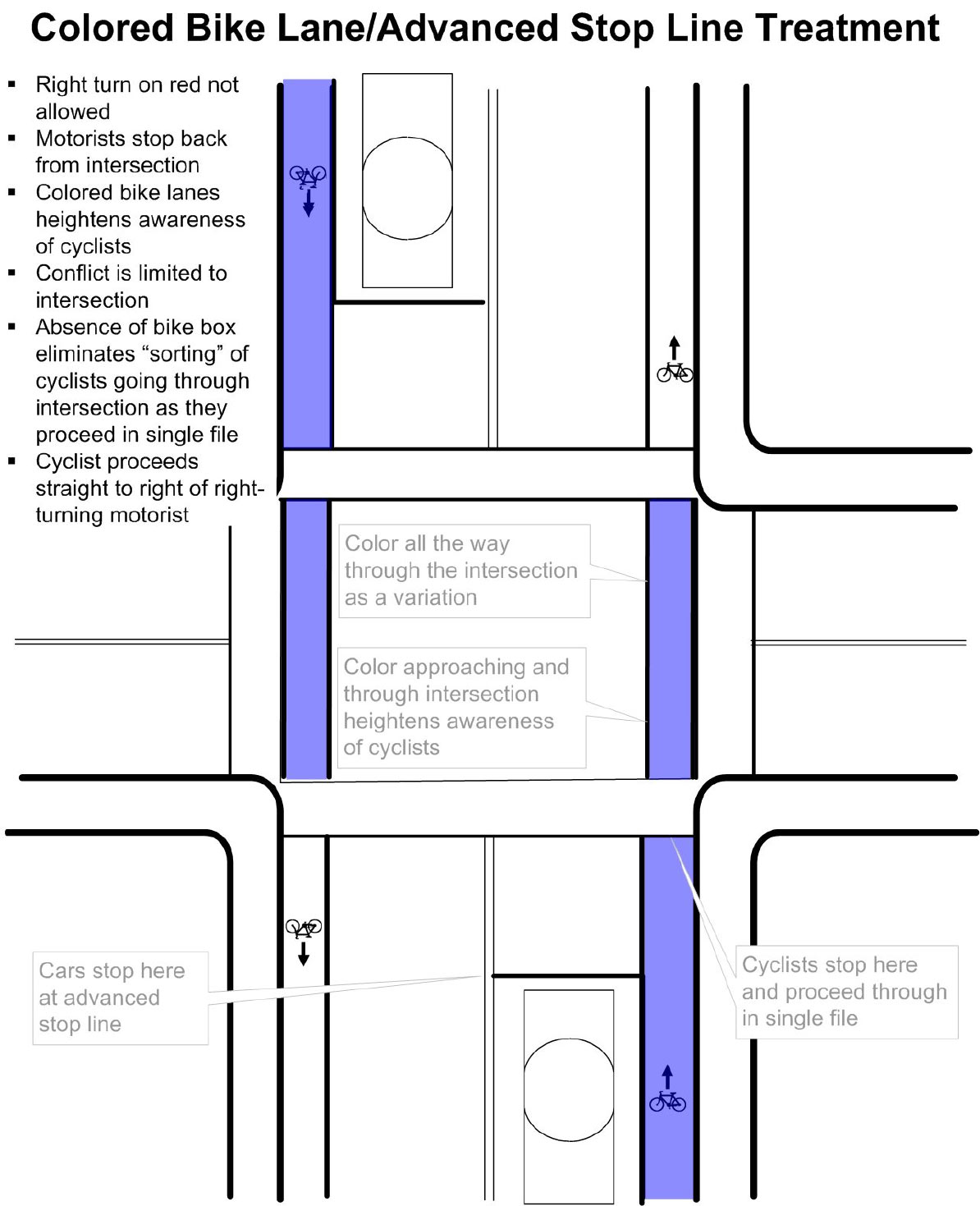
We wish to heighten motorist’s awareness to the presence, or potential presence of cyclists. We want to remind motorists to look for cyclists who may be crossing their paths as they proceed through the intersection. The blue lanes approaching and leading away from the intersections are intended to be the primary trigger for this awareness. By coloring blue the approach, and especially the trailing lanes through the intersection, we will send motorists a clear message to expect cyclists moving through the intersection.
This practice of using color to define a cyclist’s path through an intersection is a common design feature in the bicycle-friendly cities of Denmark, The Netherlands, and Germany. It is also common in those countries to keep cyclists to the right of the roadway — in their own designated space-and to the right of right-turning motorists. Why? Because, those countries have determined, through the repeated feedback from their citizens and following decades of experimenting and refining their designs, policies, and approaches to managing traffic, that people riding bicycles want to stay separated from motor vehicles.
- [Editor note: Learn more about PDOT’s blue bike lanes, and view a study of their effectiveness here.]
It is this separation that creates comfortable conditions for bicycling. It is this feeling of comfort that serves to encourage more people to bicycle. Creating more cyclists, and having fewer people driving cars, makes bicycling safer.
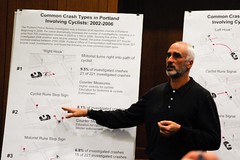
stakeholders meeting last week.
(Photo © Jonathan Maus)
Of course, separation without safety doesn’t serve anybody well. In this case, safer conditions will be achieved, in part, by clearly and unavoidably making known the presence of cyclists at the approach to and through the intersection. We believe the colored bicycle lanes in Portland, as in Copenhagen, Amsterdam, Muenster, and in bicycle-friendly cities throughout Europe, will encourage motorists to stay out of the bicycle lane when approaching an intersection, and look for cyclists before executing their turn through an intersection.
The bicycle box is a separate but related part of the design and is intended to do two things:
- It will allow cyclists to go to the head of the line when the light is red so that they are more visible to queuing motorists and allowed to proceed through the intersection ahead of them,
- It will allow the entire queue of cyclists to come up to the head of the line, so that when the signal turns green there are none or few cyclists moving through the bicycle lane to the right of motorists.
Additional signing and flashing lights would reinforce to motorists the idea to expect cyclists. We feel comfortable testing these designs in Portland because of their successful use in Europe.
However, there is another approach that encourages mixing motor vehicle and bicycle traffic when approaching and going through the intersection. This second approach encourages cyclists and motorists to share either the travel lane by dropping the bicycle lane before the intersection, or to share the bicycle lane, by allowing motor vehicles into the bicycle lane in advance of their making a right turn (Figures 3 and 4).

(Click to enlarge)
This is an approach based on a “vehicular cycling” model, which suggests that bicycles, as vehicles operating on the roadway, should behave the same as the primary vehicles for which the roadways were designed: automobiles. The benefit of this approach is that it takes cyclists who are going straight through an intersection away from the path of a right-turning motorist. It conforms to standard automobile operating rules, in which a vehicle going straight is always to the left of a vehicle turning right.
We believe there are a few problems with this approach.
The main problem is that vehicular cycling is generally best used by those cyclists who are already the most fit and confident. While knowledge of vehicular cycling and the skills it encourages are beneficial to all cyclists, requiring such behavior at each intersection would not feel comfortable to the vast majority of Portlanders — the very people we are working to attract to bicycling.

Keep in mind that Dutch cyclists (and motorists) are perhaps the best trained in the world. They are taught throughout elementary school how to ride a bicycle. They generally begin riding a bicycle very young and continue to ride well into old age. Despite this intensity of training, the Dutch have firmly decided that maintaining separation between cyclists and motorists is what creates the most comfortable conditions for bicycling.
The other main problem with this approach is that cyclists and motorists will still cross paths at some point. Either motorists will merge into the bicycle lane (under the California law approach) or cyclists will have to weave across the path of cars (under the dropped bicycle lane approach). In either case, there will still be multiple conflict points. Instead of having one conflict point at the intersection, it is now moved some indeterminate and varied distance back from the intersection. Cyclists can still be in a motorist’s blind spot when the motorist merges to the right.
We believe that inviting motorists into bicycle lanes creates three conditions that will be uncomfortable to most cyclists.
First is the merge itself. It is not clear where this merge will occur and it still allows cyclists to be in a motorist’s blind spot when the motorist moves to the right.
Second is the blocking of the bicycle lane. One of the advantages of having a bicycle lane-the uninterrupted flow for the bicycle-would be eliminated at almost every intersection where there is a line of motorists waiting to turn right.
“We believe that inviting motorists into bicycle lanes creates… conditions that will be uncomfortable to most cyclists.”
Third is the weaving behavior this will encourage of cyclists, who will understandably not be content to stop in a bicycle lane, near the intersection, when the signal is green, and who will instead move left into the travel lane around the right-turning automobiles.
There are places in Portland where we have dropped bicycle lanes before an intersection. We hear many complaints from cyclists where that occurs. We don’t do it to create safe conditions for cyclists. Instead, we drop bicycle lanes in order to better serve motorists at the intersection. Typically dropping the bicycle lane in order to add an additional turn lane.
If Portland is to be successful in attracting the general public to bicycling as a main means of transportation, then we need to create conditions where cyclists both feel comfortable and are safe when operating their bicycles. Dropping bicycle lanes shy of an intersection and encouraging or requiring cyclists to merge left into the travel lane, is not the ticket.
We developed the list of 14 targeted intersections from three primary sources:
- Comments received from the cycling public at the June 2006 Portland Bike Summit
- Feedback from Portland’s Bicycle Advisory Committee regarding deficiencies in the city’s bikeway system
- Feedback from the general public and analysis performed by technical staff as part of the city’s work to define existing conditions for bicycling in Portland as part of the city’s process to update the bicycle master plan.
We have chosen a design approach that we believe will create comfortable conditions for cyclists, improve safety by clarifying what we expect of motorists and cyclists, and continue to encourage increased bicycle use among more of the general public.
We recognize that intersection design alone does not create safe conditions. Appropriate user behavior is crucial to an individual’s safety. Being aware, looking out for others, yielding to others, and operating at slower speeds all help promote safety for all. This is true no less for cyclists than it is for motorists.
Roger Geller
Bicycle Coordinator, City of Portland Office of Transportation
(503) 823-7671
Mr. Geller looks forward to reading and responding to your comments…



Thanks for reading.
BikePortland has served this community with independent community journalism since 2005. We rely on subscriptions from readers like you to survive. Your financial support is vital in keeping this valuable resource alive and well.
Please subscribe today to strengthen and expand our work.
1. where\’s the motorist education component?
2. stop building curb extensions that reduce bicyclist mobility and choice of roadway positioning at high hazard intersections.
Roger,
Thanks for taking the time to provide such a thorough explanation.I\’m supportive of the bike boxes as a pilot project but only if we take the opportunity to collect information about thier affect on safety. I haven\’t seen any information about how you\’ll determine the success or failure of this pilot project. Pilot projects usually have a goal of collecting data and a time period for that data collection. What is planned for this project?
\”where\’s the motorist education component?\”
BURR,
This article is not meant to represent PDOT\’s comprehensive policy on bike safety. This is merely a look into one aspect (engineering at dangerous intersections) of what they\’re doing.
bArbaroo,
From what I know, PDOT did an analysis and follow-up study on their blue bike lane pilot project (it\’s linked in the article above) and I\’m also aware that they have been doing extensive evaluation of their pilot project on sharrows.
With the sharrows project, they\’ve had video cameras on the streets watching what happens… and now they\’ve got someone going through and analyzing all that video.
I would expect they would have a similar process in place for evaluating the effectiveness of bike boxes, etc… but I\’m sure Roger can tell you more…
so when are we going to get a comprehensive plan that includes an education component? all we\’ve seen so far is engineering and more engineering – a substantial portion of which up until now has been, in my opinion, substandard – and a misguided police enforcement policy.
We\’re looking at various ways to evaluate how these intersections work. I\’ll be meeting next week with representatives from PSU\’s IBPI (Initiative for Bicycle and Pedestrian Innovation; http://www.ibpi.usp.pdx.edu/) to see how we might cooperate in evaluating these locations.
\”so when are we going to get a comprehensive plan that includes an education component?
It\’s called the Platinum Bicycle Master Plan. From what I\’ve heard, there\’s an entire chapter on education and one on enforcement as well.
I think one postive thing about the bike box design that hasn\’t yet been discussed on any forums is this…
It\’s big. It\’s brightly colored. It has an enourmous whopping great picture of a bicycle in the middle of it.
Thus, it should give motorists who have the green light wanting to make right-turns quite a substantial warning that they are at an intersection where they should be expecting high levels of bicycle movement.
I don\’t know about you, but if I was at an intersection in a car, and there was an enormous blue section of paint with a bicycle symbol in front of me on the road, I\’d be looking.
and when will that plan be finalized, how will it address education and enforcement for motorists (it\’s a bicycle plan after all), and what\’s to prevent it from sitting on a shelf gathering dust like most of the last bicycle master plan?
\”and when will that plan be finalized,\”
I think by summer 2008.
\”how will it address education and enforcement for motorists (it\’s a bicycle plan after all)
good question. I expect some of the educational information in the plan will be created by the Transportation Options division within PDOT. Their messages and programs reach all of Portland, not just cyclists.
\”and what\’s to prevent it from sitting on a shelf gathering dust like most of the last bicycle master plan?
funding, staffing, community activism, political and bureaucratic will, public pressure to enact more bike-friendly policies, public education that it exists and that it is an official city document…
I know one thing, there will be a lot more awareness of the Bike Master Plan (what it is and what it means) this time around than when it was last completed in \’95. .. that fact alone makes me optimistic that it will not become irrelevant.
Roger, thanks for this really interesting explanation. It clarifies a lot of issues for me — my gut feeling has always been against the California-style right turn merge, but I haven\’t been able to back it up with a very good argument — and you\’ve presented an ironclad one. Thanks.
One question: is there any statutory requirement for people to observe bike boxes and advanced stop lines while driving? Or in other words, is the bike box enforceable? I see people pull their cars all the way into the one on Clinton all the time, and always wonder about that.
Yes, the bicycle box will be enforceable as it will include accompanying regulatory signing stating: \”Stop Here on Red\” and \”No Turn on Red\”.
Burr, you make a very good point. Without education, the best design in the world won\’t work the way it\’s meant to. Our infrastructure right now should be safe, if people understood their rights and responsilities on the road. But many don\’t. The recent tragedies were caused partly by engineering problems, but mostly by motorists unwilling to cede a legally mandated right of way to cyclists.
So, I applaud Roger for getting the work going on redesign – even if i fundamentally disagree with him about vehicular cycling – but I caution him that the bigger job lies ahead.
\”gathering dust…\”
Seems like we\’ve implemented a lot of the bicycle master plan adopted in 1996.
We\’ve got a bikeway network of about 300 miles, we changed the city code in order to create requirements for short- and long-term bicycle parking, we\’ve developed on-street bicycle corrals and bike oases, bicycles are now allowed on all transit (almost) all the time without a special pass, we\’ve created an extensive encouragement program (Smart Trips) that each year provides an individualized marketing outreach to a 20,000 household swath of Portland, we have perhaps the most comprehensive Safe Routes 2 School program in the country, we have a bikeway maintenance program that is the envy of most large municipalities, we have a substantial number of bicycle events year-round, many of which are supported by the City, and we\’ve continued to innovate with bikeway facility design.
Perhaps most importlantly, we have strong policies, including the lines on our bikeway map, that ensure that bicycle transportation is considered and provided for on classified city bikeways.
Has the plan been implemented perfectly in every case? Of course not. Show me one that has been. Are we done? Never. But, we continue to make progress in every area identified for action in the original master paln. The Bicycle Master Plan has been a necessary and important element that has led to bicycle trips across the four bicycle-friendly Willamette River Bridge (which was only 3 bridges back in 1998, and will soon be 5 bridges in 2009 once the Morrison Bridge bike ped project is completed) growing from 4,530 in 1996 when the plan was adopted to 14,560 this past summer.
I don\’t know how the plan can be described as \”gathering dust,\” other than through the tired old jab that that\’s what plans do.
Quite an eye opener – for some reason, I thought that Mark Krueger was Portland\’s biggest expert on bicycle traffic planning and intersection design. I guess not. You learn something new every day.
Roger, thank you for you well considered explanation. Another problem, as I see it, with allowing auto traffic into the bike lane at a point decided by the driver is such a move essentially gives them the right of way when they decide they want it. Such action increases a bicyclist\’s danger, not decreases it. Applying the approach utilized in California follows the logic of that state, the car is dominant, all others survive as best they can.
Roger, thanks for laying out the options in a clear and understandable manner. The images help me understand the blue box idea a little better. It\’s difficult to say if it would be the best solution, but I definitely am against the California law requiring vehicles to enter the bike lane before a right turn. In the last week and a half, I\’ve been using the shared lane approach more often, merging into the vehicle lane at busy intersections with frequent right turns, but this can be extremely difficult and I think even dangerous if traffic is travelling at a higher rate of speed (as they do down the Interstate Ave. hill)–and when cars are following each other very closely as many often do. I also don\’t think this is a very good option for new and inexperienced cyclists. It\’s a very difficult issue to find a solution to. Of course, education for all users is paramount, but certainly more signage and bright colors to alert hurried drivers to use caution is a good thing.
Roger Geller mentions the \”No turn on red\” with bike boxes. Previously, I had missed all mention of this in regards to bike boxes. I think this is an important component.
I would feel rather uncomfortable if the right turn was allowed. Especially if I rolled-up to the front of traffic and blocked drivers from making a right turn. I imagine this would anger many drivers.
Since when does the blue lane keep cars out of the bike lane? The one on hall street in Beaverton doesn\’t have that effect. Motorists ignore it like they ignore just the regular white stripe. It seems to actually decrease safety since when its wet out, the stripe is extra slippery. I always enter the traffic lane to avoid the blue death strip.
Roger,
I am glad to see PDOT propose the bike boxes as a strategy for increasing bike safety.
However, I have a couple of concerns:
1)We have a tremendous lack of awareness of the need to yield to cyclists in bike lanes community-wide. Close calls and accidents that don\’t result in fatalities happen frequently. These boxes may solve some of these problems, but I really think driver and cyclist awareness training or an ad campaign(right-of-way laws for drivers and safe riding training for cyclists) seems essential. Funding for street improvements does not address this community need.
2) These facilities cost money to implement. The money may be well-spent, but how long will it take to implement enough of them to address the safety issues in a meaningful way? How far does this initial proposal go towards addressing the problem?
3) There are locations where right turn hooks are not the issue, but that would lend themselves to similar or revised strategies to promote safety. Two downtown are the bike lane on the Hawthorne Bridge westbound off-ramp where cyclists go straight and cars and buses need to cross the bike lane to reach the turn lane. This is a frightening place right now, whether or not accidents occur.
The other is the approach to the Hawthorne Bridge on Madison east-bound. Between 2nd and 1st Aves. the bike and car lanes must shift to the north to allow the bus/right-turn lane in the next block. Drivers do not notice that they must shift left, and buses cross the bike lane without yielding consistently. A bike box is not the answer here, but an answer is needed.
Thanks for your efforts, and I look forward to hearing more.
Patty
Activism involves an interesting frame of mind. For someone to consider themselves an activist, it often means they have a black and white view of one or more topics.
I live with an activist and have for nearly 20 years. It used to bother me, because I am much more willing to trust topics of importance to time and the inevitable need for consensus building. But eventually, after imagining what would happen in various (certainly not all) situations if my friends views were implemented, and seeing that The Right Thing really should be done immediately, it stopped bothering me.
This a long way of saying that despite mine and many other\’s willingness to be patient through the long march towards consensus and implementation, if it weren\’t for the activists demanding immediate action, for what is in many cases obviously The Right Thing, nothing much would really ever get done.
So Roger, your methods are sound, and you and others have built good plans with implementation schedules that fit the timing that is comfortable for the bureaucracy (not meant pejoratively), and I know you are passionate, and truly care about making things better. Left to my own devices, this is all I could or would personally ask of you.
But, thankfully, the \”activists\” continue to remind us that two young people are dead. They were guilty only of riding their bikes on a part of our infrastructure that is already supposed to be known as a mechanism to keep them safe, as vulnerable users of that infrastructure.
Yet… No citations… and officials of the Police Department at best claiming that things like this happen, and at worst out-right blaming the victims and spreading misleading and dangerous information…
Where are the public service commercials reminding motorists AND cyclists to care for each other? Where is the demand for the resignation of Kruger, and his replacement with someone who has ridden a bike and knows well how vulnerable you are, regardless of how defensively you ride?
If some immediate, tangible actions were taken today, more people would trust that the longer term plans were not only well-intended, but actually likely to be implemented.
I am angry. I think people should be held responsible for their actions, even if they were mistakes. That\’s all I want. I don\’t think the two drivers were necessarily bad people, but they made mistakes that cost 2 people their lives. And no, living with what they\’ve done is NOT retribution enough. [Completely Reasonable] Laws meant to protect people were broken. They must be held responsible. And we must have a Police force that protects one and all, not just the majority.
Thank you, sincerely, for your hard work Roger. My hope that justice will be done for Tracey and Brett is all but gone, but my hope for the future of cycling in Portland is alive because of people like you — AND the \”activists\”.
Ron
Jonathan,
Great to hear that the Bicycle Master Plan has an entire chapter on education and one on enforcement. However, it sounds like it might not do much to address these two key areas in the short term.
Many of us are alarmed about the recurring pattern in the most recent string of bike fatalities (both in Portland and WA County): motorists – seemingly on a frequent basis – are failing to watch for and yield to cyclists (I think the title of The Mercury\’s article is right on). Even some members of the PPB don\’t seem to fully recognize the right of way of cyclists in designated bike lanes.
My understanding from last week\’s press conference is that the bike boxes – which I personally am all for – will be put in place well before the Bicycle Master Plan gets rolled out. If the prevailing sentiment is that many motorists aren\’t aware of (or don\’t respect) cyclists\’ right-of-way in bike lanes (which have been around for a long time), I share the concerns of many here that the bike boxes could provide cyclists a false sense of protection (at least in the short run). That is unless the installation of the bike boxes goes hand-in-hand with a highly visible motorist education and enforcement campaign.
I don\’t expect neither Roger or you to address this concern, but I feel it would make all of us a little more at ease (and less impatient) if we would hear more specifics on what will happen in the short term in the area of education and enforcement.
Of course, we don\’t have to wait for the PPB or the City to take action. At a grassroots level, we should all do our part to educate our friends, neighbors, co-workers about cyclists\’ safety, sharing the road, etc. and of course be role models ourselves while riding or driving in traffic.
Bike boxes work well as long as the light is red. After it has been green for several seconds, and traffic is flowing, what alerts the motorist to the cyclist on his back right, quickly approaching the intersection? We talk of educating the driver, but I believe we must also educate the bicyclist to NEVER trust a vehicle in front of him, regardless of blue boxes or anything other designs we implement.
John F. verbalizes my apprehension about the bike boxes as the predominant engineering solution. I *like* the one on SE Cllinton and SE 39th. It\’s a lower traffic street and I feel comfortable using it. I don\’t actually get to use it all that often because very few motorists actually respect it. I don\’t feel particularly optimistic that motorists will respect other bike boxes, even if they are blue and even if there are more strongly worded signs. There are a few intersections on that list from the press conference that I\’m downright pessimistic about. SE Hawthorne at SE 7th and SE 11th are intersections where I think it\’s got a greater chance of working. SW 14th and W Burnside is one that I don\’t think it will work at all, and my belief is based on the temperament of the motorists when they are travelling through there.
I was told very specifically by the PPB officer who visited Tracey Sparling\’s memorial ride that there was nothing the police could do about vehicles that are parked in bike lanes. He was *extremely* clear about this when we were conversing and I know a few other people heard it, too. I even repeated back what he said to make sure I understood him correctly. I guess I\’m wondering how these treatments would work since cars can park in them and the Portland Police Bureau is helpless to stop that. I know the ORS states I am allowed to leave them if I felt existing conditions were unsafe, but the Portland Police Bureau *do* issue tickets to people who leave the bike lane for legitimate reasons. Given all of that, it seems like having these treatments would be something of a setup. If I had to leave a bike box/blue lane treatment because a car was blocking it (and the police can do nothing about that), how can I avoid getting a ticket from the police?
Thank you Roger!
As part of the prototype bike box at 39th and Clinton, can we please get some police enforcement of the regulatory \”stop here\” and \”no right on red\” signs? I got honked at again today by a driver in the box, wanting to turn right on red. They seem to think the behavior is optional.
I\’ve always felt comfortable with the existing blue lanes,and look forward to seeing more. Thanks, Roger for the details…so good to have the City supporting cycling safety!
Oh, and thank you to Roger for his explanation and all he does for us. You really are the cat\’s pyjamas, man. 🙂
I was told very specifically by the PPB officer who visited Tracey Sparling\’s memorial ride that there was nothing the police could do about vehicles that are parked in bike lanes. He was *extremely* clear about this when we were conversing and I know a few other people heard it, too.
It sounds like we need an ordinance that prohibits cars from stopping within the bike box, with an appropriate level of fine to discourage the practice.
Then we need somebody to explain to the Traffic Division that the prohibition does not include the words \”if the driver perceives that the law is being violated.\”
I\’m glad to hear the \’dropping of bike lanes\” at intersections will end. I think that where we there exists a conflict between parking and continuance of a bike lane we should go with a bike lane ( ie. NW Everett @ 13th)
Thanks Roger for helping make Portland a better place to ride.
Education and enforcement are key elements to safety. I recognize that we (at PDOT) tend to emphasize the engineering component. Perhaps that\’s a western thing–born from the idea that \”science has the answers to everything.\” That said, engineerign is crucial and ideally we adopt engineering solutions that clearly communicate what we expect of roadway users. That\’s the intent behind the colored markings, the depth of the box, and the use of the big bike symbol in the middle of the box. There is research out of Britain on bike boxes that indicates that color, a big bike in the middle of the box, and a deep box are key elements to the box being respected by motorists.
We don\’t yet know what educational components will be associated with these intersection treatments. There are long-term education strategies (Safer Routes 2 School, changes in the DMV manual) and short-term strategies (billboards, PSAs, articles). We\’re currently very actively considering how to roll out these treatments in a manner so that everybody going through the intersections understands them.
Enforcement is a key component, as well. What\’s helpful about this treatment is that it shouldn\’t be ambiguous in terms of enforcement: there\’s to be no encroachment into the box on a red–and motorists must yield to cyclists going through the colored bicycle lanes on the green.
We\’re also aware that these 14 intersections are not the only difficult ones in the city. The city\’s Bicycle Advisory Committee, attendees at the Bike Summit in June 2006 and in the initial bicycle master plan open houses in June 2007, as well as PDOT staff and comments made to PDOT staff have resulted in a long list of intersections that could be improved. The master plan process will identify them all and develop conceptual designs for at least 50 of them, if not more.
Geller sez: \”Stop Here on Red\” and \”No Turn on Red\”.
These are the things that are gonna get motorists to comply. Not more education, not blue paint, not the location of the box.
By turning against a red light, regardless of whether there is a bicycle near him/her, a motorist commits an OBVIOUS traffic infraction.
The less confusion among motorists and bicyclists, the better.
Good planning!
Roger –
How would the development of Bike Boxes have helped in Brett\’s accident?
How do they help when the light is green and cars are in motion? This is what scares me when driving a car and visibility is flawed.
Thanks,
This seems like a set of positive, practical steps; I\’m encouraged!
One note on blue lanes: until I began bike-commuting last spring, after many years of driving through the same areas, I was not even consciously aware of any blue lanes. Once on the bike, I noticed them, but did not understand what they meant. At first I figured they meant \”bikes yield to buses merging left here\” because that\’s the way the tri-met buses seem to operate at the one on eastbound Hawthorne crossing Grand.
I don\’t think I\’m *that* much dumber or unaware than the average driver. Driver\’s/biker\’s ed is badly needed.
This is a bit off-topic, but if you\’re like me you\’ve been wondering about the design of the bicycle and pedestrian improvements to the Morrison Bridge that Roger mentions are coming in 2009.
You can see all the schematics at the bottom of this page: http://tinyurl.com/28slqk.
Thanks Roger for pointing out that engineering solutions – when done well – can have a major educational function. The blue treatments definitely do the job for me, whether I am on the bike or driving my car.
As for tackling the issue of cars parking in bike lanes, there is always the option to resort to the way they do things in NYC ;o) http://tinyurl.com/38qz2g
Sorry, apparently the site formatted the period into the web address. Here\’s a clickable link to the Morrison Bridge information: http://tinyurl.com/28slqk
Rixtir #27:
There is a statute in place that will cover this. ORS 811.265 \”Failure to obey a traffic control device\” would include any lawfully placed stripe, sign or other device to control traffic. So the law already exists. 811.050 \”Failure to Yield to rider on bicycle lane\” may also come into play as the bicycle box may be viewed as an extension of the bike lane. At least I would venture to issue a citation under that proviso and let the judge tell me I\’m wrong.
Flyingdog5000
Roger\’s efforts are admirable, but the solutions that he and traffic engineers offer are necessarily limited by the human element. People are not flotsam that can be channeled like a river with \”blue levees,\” so to speak. As this video from Manhattan demonstrates, even the most inventive barriers are no match for stubborn autonomy – especially in a society that values individualism far more than collectivism.
Several respondents have mentioned the need for \”education,\” and I agree that it\’s critical. I also think that the bigger issue is the lack of real community in Portland – notwithstanding the popularity of that word (as if repetition would make it true).
Two prerequisites for community are shared values and communication. The people of Portland are deficient in both. The primary problem is that the city is simply too big. Like all other large American cities, Portland has automotive hegemony, not community.
Unlike other cities, however, Portland has thousands of residents who dissent from the American cultural norm. Many of them are even trying to build alternative culture within the city.
The critical question is whether there can ever be reconciliation between opposing values and culture. I don\’t think so. I expect the conflicts in public space to continue and even escalate – especially as we enter an age of energy and resource scarcity. I assert that there will never be real community in Portland within my lifetime. That\’s why I left.
Thanks for clarifying that Flyingdog5000.
Roger,
I\’m curious… in the countries you are sighting as examples of how bike lanes function to make cyclists feel safer… do they put the lane between parked cars and traveling lanes? In all of the pictures I\’ve seen, I don\’t think I\’ve ever seen bike lanes adjacent to parked cars.
Also, what is the average width of the european bike lanes? I\’ve seen some that are as narrow as ours, but most look considerably wider, making for more of an obvious bike presence, especially when two riders can ride side by side.
I\’m asking, because perhaps if we really try to emulate those euro bike lanes, the bike boxes will work. But if we are only getting it half right, then what? Are there details in the design of those euro bike lanes, and in the culture, that we are missing? If so, are we compromising the safety? Will there be more unintended consequences that will require another round of debates, and further engineering to go back and fix?
As to culture, there are some glaring differences:
Most drivers are also riders and understand what to expect from a cyclist.
Cyclists always have the right of way.
Drivers are aware of this right of way, and show courtesy to cyclists.
And I\’m not sure of the accuracy of these last two… but urban cycling seems to happen at a more leisurely pace, and I have the impression that they follow traffic rules such as stopping for stop signs and signals.
Thanks, Jacque
The biggest thing I noticed about the separated bike lane that recently opened in NYC is that when a car wants to turn across it they first have to move over a lane at a point where the parking area becomes a turning lane. This alerts a cyclist that the car is definately about to turn. Many of the intersections also had separate bike and car signals but I think that any time we can implement this type of move over before you enter the bike lane/begin the actual turn we should.
bjorn
Thanks Roger can\’t wait to see the bike boxes! Might have missed it – when do you expect them to be in place? Obivously lots of opinions outh there obviously – will be great to start seeing how they work in the real world.
I\’m putting in my support for bike boxes (including enforcement); no drop bike lanes; and huge amounts of public education, including billboards, bus tails, and pamphlets to all businesses for their employees. Sign me up, I\’ll deliver them!
Would a cycle track like the one Jeff mentioned in #34 work for Hawthorne Blvd for bicyclists coming eastbound off the Hawthorne Bridge, until you hit 12th?
There is SO MUCH bike traffic coming off the bridge these days, the majority of it staying on Hawthorne in the bikelane until SE 12th Avenue.
The fast moving Hawthorne traffic coming off the bridge, the cars turning right at 7th Ave & 11th Ave, coupled with the narrow bike lane, and the endless parked cars, makes me nervous as a bicyclist.
It seems there would be enough room to put one in here, and the modeshare numbers of cyclists using the roadway would justify it.
Any thoughts?
Err… in my post above I meant westbound, not eastbound Hawthorne crossing Grand.
@ Patty #19
I concur with your assessment of the problems in both directions at the west end of the Hawthorne Bridge, plus for years there has been some really bad pavement in the eastbound bike lane on SW Main between SW 4th and SW 1st. The new curb extension on the SW corner of SW 5th and Main is also going to make it much harder for cyclists to get through this area during the PM peak, it\’s already one of the most congested streets downtown in the afternoon.
I just read… bicycles represent 18% of bridge traffic for the Hawthorne Bridge!
I would hope this data could help justify a cycle track at this location 🙂
Jacque,
On-street parking is much less prevalent in those cities than it is here in Portland. However, they do have standard designs that include bicycle facilities (either cycle tracks or bicycle lanes) adjacent to parking.
From what I\’ve read and from conversations I\’ve had with planners over there, they\’re also much more willing to remove on-street parking when there\’s a conflict. Of course, it helps that they have about one-third of their trips being made by bicycle.
They did not achieve this ridership overnight and I imagine that they experienced incremental change over time in their policies, practices and designs much as any city goes through. They just started decades before we did.
Standard widths for striped bicycle lanes or cycletracks in many European cities range from 2m to 2.2m (roughly 6.5 feet to 7.2 feet) and Denmark is planning to widen their standard to 2.5m (8.2 feet). Safety is not the primary reason for these widths. In The Netherlands they talk about how cycling is a social activity and the 2m allows cyclists to comfortably ride side by side. In Copenhagen they need the width to allow faster cyclists (those traveling, by their estimate 10-11 mph!) to pass slower cyclists (typically children and the elderly, who travel at 4-5 mph).
Earlier this year we striped a bicycle lane at 6.5 feet on N Vancouver between Fremont and Broadway. We received very positive feedback about that at the bicycle master plan open houses.
There are clearly cultural differences between Portland and Amsterdam or Copenhagen. But, the culture here is changing–largely in response to the dramatic increase in bicycle use we\’ve seen over the past 15 years. The key is to maintain and accelerate that growth. It\’s a bit of a chicken and egg problem.
PDOT says they\’ll give bicyclists a whole lane on the bridge deck in each direction when bicycle traffic hits 25% of trips on the Hawthorne bridge.
[PLEASE NOTE: BURR meant this as a joke. It is not true.]
BURR writes: \”PDOT says they\’ll give bicyclists a whole lane on the bridge deck in each direction when bicycle traffic hits 25% of trips on the Hawthorne bridge.\”
We did?
sorry, bikeportland doesn\’t have little emoticon smileys or I would have put a little winking one on the end of that last post.